Syria’s War of Self-Defence Turning the tables on claims of war crimes
By David Macilwain | OffGuardian | February 28, 2020
Continuing in efforts to get the OPCW fraud exposed to the Western mainstream media’s sheltered and blinkered audience, I recently had an opportunity to have an opinion article published in the Sydney Morning Herald. This followed a formal complaint to ACMA, Australia’s media overseer, over the failure of state broadcasters to report on the OPCW story. The proviso for this article was that the OPCW “story” needed to be linked in some way to current events in Syria, given its controversial nature.
This, of course, I readily accepted, because the very “humanitarian crisis” in Idlib predicted two and more years earlier was now eventuating, or at least in the minds of anyone following the Western MSM news output.
Linking this with what happened in Douma in April 2018 was no problem, and in fact was more than that, because had the lies about the “humanitarian crisis in Eastern Ghouta” been properly exposed at the time, along with the fake chemical attack, the course of the war would have been entirely different.
Now two years later, as the true extent of the deception is exposed, along with those who organised it in Westminster and Washington, Tel Aviv and Ankara, I had hoped that credible newspapers like the non-Murdoch SMH would consider dipping a toe in the water. Then at least they would be already swimming with it if the water came up rather suddenly, and be ready with some explanation or excuse on how they had been wrong or didn’t know.
It didn’t even need to be “wrong about Assad” – in the first instance, and before the penny dropped on the ramifications of corruption at the OPCW. As James Harkin “admitted” – Jaish al Islam ruled Douma with an Iron Fist, so the White Helmets had to do what they said, and were desperate for foreign assistance. It was all just a big misunderstanding, and Trump’s fault for launching a missile attack on an impulse.
So I wrote an article proposal, looking at the way that the “humanitarian crisis” predicted in Aleppo in 2016 and in Ghouta in 2018 had not materialised, and had in fact been prevented by the Syrian government’s setting up of humanitarian corridors to allow people to escape – to the safety of areas protected by the Syrian Army and Russian police. It was I said, the failure of Western media to report on what had actually happened that allowed yet another humanitarian crisis to be played as a cause for intervention once again.
Naturally and unavoidably I criticised those media for relying on unbalanced and unsavoury sources, and for providing platforms for “propagandumentaries” like For Sama. The awarding and release of this film to coincide with the campaign to liberate Idlib deserves a whole article of its own, as more doctors with photogenic young children now appear in the last hospitals in Idlib.
Criticism of Waad al Khatib and her Oscar-winning partners in East Aleppo could have been a mistake, but the critical role of the White Helmets in staging the “Chlorine attack” in Douma made this part of the essential context for a discussion on the OPCW story – which was, of course, the real focus of the article.
In declining to publish my article following consultations with the opinion page editor, and despite my assurances on the credentials of Ian Henderson, I was offered the following explanation:
Thanks for the contribution but after talking to the opinion editor I think it doesn’t work for us as it is. There are enough questions over whether Henderson is telling the truth or not to make it hard to use him to absolve the Assad regime of war crimes during the war.
To say so lightly would offend not just the security establishment in the West but also the many Syrians who (even allowing for the exaggerations of western propaganda) have suffered at Assad’s hands.
Perhaps you mean that Syria is no worse than the rest, and as the government it has a right to use violence. But at the moment it seems to whitewash Assad.
In fact I’d already concluded my views “wouldn’t work” for the SMH, after just reading their correspondent’s “Explainer” on the Syrian war and events that led up to the current crisis in Idlib. It didn’t explain anything to me, except why it was that I would never get an article published in this mainstream paper!
Almost every sentence in my article contradicted the accepted Western narrative expressed by the Herald’s correspondent, as here:
Assad, largely thanks to Russian air power, has subdued the rebels in most parts of the country, partly by bombing several of his own largest cities into oblivion and deploying chemical weapons against his own citizens.”
And this is what most people believe, with emotive propaganda and photos turning belief into a conviction which evidence and reasoning is unable to dislodge. The SMH article above devoted as much space to a photo of a blond-haired child sitting in a bus as it did to the ‘explainer’, along with the title – “Sequel to a real-life horror show”.
Such propaganda has worked not just on the audience but on the editors of our media, as it has also done on most of the refugees living in Turkey. They fled because they were told the Syrian Army was coming after them, and they now believe they are in danger of retribution if they were to return. The idea that the Syrian Army and its partners are fighting and dying to kill the terrorists so that it will be safe for Syrians to come home is probably not one they can believe.
In deference to the editor of the Herald, I welcomed his willingness to consider my views and some of the evidence supplied in links. That he did is clear from his recognition that “using Henderson’s claims” should not be taken lightly as “it could absolve Assad of war crimes”. Which of course was my very point.
While OffGuardian remains something of a “Salon des Refuses” to republish opinion unacceptable to the mainstream, it is more useful to repaint this dispute over the OPCW’s toxic deception as a question of “whose war-crimes”. As far as we – on Syria’s side – are concerned, all the war-crimes committed in Syria are attributable to the aggressors who started and fuelled the war on Syria, including all those cases where civilians have been victims of Syrian or Russian airstrikes.
Both militaries have gone to great lengths to avoid hitting civilians where they can be identified, despite the incessant stream of claims to the contrary. An integral part of this effort has been to provide and protect humanitarian corridors for civilians to escape, and many or most of the trapped residents have bravely resisted the insurgents’ threats and propaganda to do so.
There is little verifiable evidence of civilian deaths from Syrian bombing however, as confirmed by the White Helmets’ evident need to fake such deaths for their rescue videos. At the centre of the Douma hoax chemical attack were the contorted bodies of 35 women and children, whose murder for a propaganda video is certainly a war-crime. At the same time the number of civilians killed by the terrorist groups in missile and bomb attacks aimed at residential neighbourhoods now numbers in the hundred-thousands.
The difficulty in persuading people – even reasonable and sympathetic people – of this evident truth on who is responsible for the worst war-crime of this century – the war of aggression on Syria – is illustrated by another group discussion in which I have been involved this week.
On one side are those who believe that President Bashar al Assad is basically a good person who has not, and would not intentionally kill “his own people”, and of course would never and never did use chemical weapons against them, (or even against terrorists for that matter). One of our group, still recovering from the pleasure of meeting Assad last year, dared to refer to him as “wonderful”.
Despite all the contributors to this discussion claiming opposition to all US foreign interventions and regime-change wars and NATO support for extremists and tyrants, some simply cannot stomach such admiration for a man “who has killed civilians”, and no amount of argument or evidence will counter their belief that he has.
It is as though the very first events in the so-called uprising – the false-flag shootings in Dera’a – made an indelible mark on those who believed them, and believed the false story of “Assad’s brutal crackdown on protestors”. And as long as they believe this, the responsibility for Syria’s dead can be shifted and shared, and one day their alleged culprits will be brought to “justice” – in Western courts.
Perhaps there is no answer to this dispute, where even those who are potentially most sympathetic to the Syrian cause cannot be persuaded of its most essential character – that the Syrian army and its allies have fought a war of self-defence since the start; a “just war” which even the most anti-war of activists should accept as legitimate. So rather than pursue this hopeless quest, we should turn on the offensive.
Instead of denying claims that Assad used chemical weapons in Douma, in Khan Shaikoun, and in Ghouta we must demand evidence and proof that he did so, because there is none. We could follow the style of Vassily Nebenzia, expressed so well at the start of this UN session (embedded above) on the OPCW fraud, as he mocks the “highly likely” standard of proof Syria’s enemies pretend is sufficient as a casus belli.
Turkey, Russia tiptoe toward ‘unnecessary war’
By M. K. BHADRAKUMAR | Indian Punchline | February 28, 2020
A military confrontation between Turkey and Syria has erupted in Syria’s northwestern province of Idlib. Latest reports say that at least 34 Turkish soldiers were killed on Thursday in a Syrian air attack. A Turkish retaliation commenced last night itself.
The Syrian airstrike in Idlib took place in an area between the towns Baluon and Al-Bara, and was in response to Syrian rebels backed by the Turkish military recapturing the strategic town of Saraqeb earlier on Thursday.
Earlier in the week, through the past 3-day period, Syrian forces had seized about 60 towns and villages in the southern Idlib area and the adjoining province of Hama.
The backdrop is the warning by Turkey that by the end of February, Syria should vacate the territories in Idlib captured from the terrorist groups in recent months and retreat to the ceasefire line agreed between Turkey and Russia as per the Sochi agreements of 2018, failing which it will be pushed back by force.
The denial by Kremlin spokesman Dmitry Peskov on Thursday that any meeting between President Vladimir Putin and his Turkish President was being scheduled over Idlib was a definitive signal that Moscow anticipated that a showdown with the Turkish military was imminent. Erdogan had claimed that a meeting with Putin was on cards on March 4.
Evidently, Moscow has taken note of Erdogan’s increasingly belligerent statements, especially his assertion that Turkish intervention in Idlib is in accordance with the Adana Agreement of 1998 between Ankara and Damascus on the mutual commitments regarding border security, which is of course an ingenious interpretation of the 21-year old accord that neither Russia nor Syria will accept.
The Russian line has perceptibly hardened, based on the assessment that ongoing Syrian military operations in Idlib must be taken to their logical conclusion, namely, the defeat of the al-Qaeda affiliates ensconced in the province, which is also what Damascus demands.
Turkey senses that the ongoing consultations with Russia are only providing time for Moscow and Damascus to advance their operations in Idlib.
The eruption on Thursday adds a new dimension to the military balance. Russia will back Syria. The air space over Idlib is under Russian control.
On the other hand, Turkey recently deployed anti-aircraft guns in Idlib that threaten Russian and Syrian jets supporting the ground operations.
Turkey feels emboldened by the assessment that the killing of General Qasem Soleimani in a US drone strike in Baghdad in January has thrown the Iran-backed militia groups into disarray while Syrian government forces are overstretched.
Turkey also assumes that Russian forces will not get involved in the fighting on the ground. These Turkish assumptions are going to be put to severe test in the coming days and weeks.
However, the big question is about the extent to which the US is prepared to support Turkey militarily. Washington did not accede to a recent Turkish request for deploying the Patriot missile system in Turkey as a deterrent against Russia. Will there be a rethink on this? Ankara and Washington are in constant touch with each other.
The US state department is yet to react on the clashes in Idlib on Thursday. But unnamed US officials told the Turkish news agency Anadolu, “We stand by our NATO Ally Turkey and continue to call for an immediate end to this despicable offensive by the Assad regime, Russia and Iranian-backed forces. As the President and the Secretary have said, we are looking at options on how we can best support Turkey in this crisis.”
Following the latest developments on Thursday, Turkish Foreign Minister Mevlut Cavusoglu spoke to NATO secretary-general Jens Stoltenberg over the phone. Possibly, Turkey proposes seeking NATO support / intervention. Will Turkey invoke Article 5 of the NATO Charter, which states that an attack on one member of the alliance is an attack on all of its members?
The Turkish ruling party’s spokesman has said, “We call on NATO to [start] consultations. This is not [an attack] on Turkey only, it is an attack on the international community. A common reaction is needed. The attack was also against NATO.”
However, as things stand, the probability is low, since a NATO and / or US intervention, would mean military confrontation with Russia, which neither the Trump administration nor the western alliance would want. The Russian assessment also seems to be that the West will huff and puff for a while but will eventually calm down and desist from getting entangled with Erdogan’s Syrian project.
The point is, the western world also has its grievances against Erdogan and is wary of his mercurial nature. The Trump administration has far from forgiven Erdogan’s strategic defiance to buy the S-400 AMB system from Russia.
Having said that, Turkey can always leverage the Syrian refugee flow to compel an EU intervention, especially by Germany.
The crunch time comes if a direct Turkish-Russian military conflict ensues. Of course, in such an eventuality, NATO will be hard-pressed to ignore an important member country of the alliance being at war.
Erdogan believes that he’s holding a strong hand. Russia on the other hand cannot afford a retreat in Idlib, as that could well lead to a quagmire in Syria with assorted foreign powers using the al-Qaeda groups as proxies to challenge the Russian bases.
The complex alignments bring to mind the Crimean War (1853-1856) which was also a geopolitical struggle like the Syrian conflict.
The Crimean War had its genesis in Russia pressuring the Ottomans with a view to winning control of the Black Sea so that it could gain access to the Mediterranean Sea, which in turn threatened British commercial and strategic interests in the Middle East and India and prompted France to cement an alliance with Britain and to reassert its military power.
The Crimean War was a classic example of an unnecessary conflict bearing out A.J.P. Taylor’s thesis of wars caused by blundering politicians and diplomats — where the causes are trivial but the consequences aren’t. The Jamestown Foundation, which is wired into the US intelligence and defence establishment, has a commentary titled Russia and Turkey Drift Toward War, here.
Russian missile frigates passing through Turkish straits amid Idlib escalation
RT | February 28, 2020
A pair of advanced Russian missiles frigates is passing through the Turkey-controlled straits while en-route to the Mediterranean. It comes as dilomatic tensions between Moscow and Ankara over Syria’s Idlib are not letting down.
The ‘Admiral Grigorovich’ and its sister ship ‘Admiral Makarov’ are among the more modern assets of the Russian Navy, capable of firing the advanced Kalibr-NK cruise missiles. Part of the Russian Black Sea fleet, they are currently moving to join Russia’s naval forces in the Mediterranean as part of a scheduled rotation.
“The third frigate of the class, the ‘Admiral Essen’ has been on a mission in the Mediterranean Sea since December 2019,” a spokesman for the fleet said as cited by Interfax news agency.
Their passage through the Dardanelles and the Bosphorus, the straits controlled by Turkey, comes at a period of heightened tension between the Ankara and Moscow. Turkey blames Russia’s ally Syria for the deaths of its soldiers in the Syrian Idlib Governorate. The worst incident happened on Thursday, when 33 Turkish soldiers were killed by a Syrian airstrike, according to Ankara.
Moscow says Turkey failed to report the location of its troops in Idlib and allowed them to get mingled with terrorist forces, which led to the tragic outcome. Turkish officials insist that Russia was informed about the deployment, and deny the presence of militants in the area where the strike had happened.
Moscow, for its part, has maintained that Turkey still fails to separate so-called moderate opposition from terrorists in the Idlib de-escalation zone.
Turkey has the right to deny passage through its straits to any nation’s warships if it decides its security demands it. But no reports immediately indicated that the Russian frigates would be turned back.
Erdoğan Unleashes New Migrant Crisis in Europe
By Paul Antonopoulos | February 28, 2020
At least 33 Turkish soldiers who were illegally operating in Syria’s Idlib province were killed and another 35 injured by a Syrian military attack on Thursday night. The attack came just days before Turkish President Recep Tayyip Erdoğan’s end of month deadline for the Syrian Army to forfeit the large swathes of area it has liberated from Turkish-backed jihadists and to return to positions it held at the beginning of the year. The powerful assault suggests that the Syrian Army has no intentions to withdraw from any positions it holds on its own land and is willing to engage the Turkish military, even under threat of a full-scale war.
Although Russia has denied any involvement in the attack, hundreds of Turks congregated at the Russian consulate in the middle of the night chanting “Russian Killers, Putin Killer.” Despite this, Ankara has ignored the emotions of the people and thus far has only blamed the Syrian government for the “nefarious attack against heroic soldiers in Idlib who were there to ensure our national security,” as described by Turkish director of communications Fahrettin Altun in a statement.
Of course, this is a long stretch to claim that Turkey is in Idlib to ensure natural security as they are the main backers of terrorist organizations like ISIS and the Al-Qaeda affiliated Al-Nusra and Turkistan Islamic Party. Although they claim the Kurdish People’s Protection Units are a threat to Turkey’s national security, they have no presence in Idlib, meaning the notion that Turkey’s national security is under threat in Idlib has to be rejected and rather this is part of a project for a neo-Ottoman Empire.
Although Turkish Foreign Minister Mevlüt Çavuşoğlu spoke to NATO Secretary General Jens Stoltenberg following the Syrian attack in the hope of invoking Article 5 and forcing NATO members into Erdoğan’s adventurism in Idlib, Article 6 explicitly excludes Article 5 being invoked in areas outside of NATO members territory. As Article 5 cannot be invoked, Stoltenberg made a weak condemnation against both Syria and Russia and said “defusing the tension, all sides should prevent this terrible situation and humanitarian conditions in the region from getting worse.”
Despite cold relations over the past few years, the U.S. has continued taking advantage of tense relations between Moscow and Ankara with a State Department representative saying “We stand by our NATO Ally Turkey and continue to call for an immediate end to this despicable offensive by the Assad regime, Russia, and Iranian-backed forces.” This was followed up by U.S. ambassador to NATO, Kay Bailey Hutchison, saying that Turkey should see “who is their reliable partner and who isn’t” and expressed her “hope that President Erdoğan will see that we are the ally of their past and their future and they need to drop the S-400.” Washington is taking every opportunity to firmly put Turkey back into the NATO sphere even if it is acting independent of NATO and after Ankara’s short-lived flirtation with multipolarity.
Even though Antonio Guterres, Secretary General of the United Nations, repeated his call for a ceasefire in Idlib following the attack, the Syrian Army are unlikely to halt their operation to clear the northwest province of Turkish-backed terrorist forces. Rather, as Erdoğan’s deadline approaches, the Turkish president is likely to weaponize the high casualty rate of Turkish soldiers in Idlib to justify a direct war with Syria and get the general population into an emotional frenzy, bypassing any calls for a ceasefire that will likely be rejected by Syria anyway.
Although NATO made a weak response to Turkey, the EU also responded weakly by offering condolences as Erdoğan opens his country’s borders for 72 hours, allowing tens of thousands of illegal immigrants to flood to the borders of Greece and Bulgaria, violating the 2016 EU-Turkey refugee deal. Effectively Erdoğan has once again weaponized refugees to blackmail the EU despite the latter having no involvement in Idlib. Spearheading this migrant flow into Europe in response to the Syrian attack on Turkish soldiers is the Turkish Intelligence Agency MIT who were directly transporting illegal immigrants with buses to the border regions. Erdoğan hopes that by flooding Europe with illegal immigrants it will force the EU to become more involved in Idlib against the Syrian government and Russia.
However, as many EU members are also NATO members, it is unlikely to work as frontline EU states like Greece and Bulgaria will only have more hostile relations with Turkey and are not wanting to get involved in Syria for the sake of Erdoğan’s dreams. Close ally of Erdoğan, Nationalist Movement Party (MHP) Chairman Devlet Bahçeli, and Justice and Development (AK) Party Spokesman Omer Çelik, demanded overnight that NATO become involved. But as Turkey is going to flood two NATO members with illegal migrants and violates Greek airspace on a daily basis, it is unlikely to find widespread support.
Although Washington is taking every advantage of Turkey’s spat with Russia to mend relations, it is also unlikely that the U.S. will want to risk a potential conflict with Russia over Idlib and Erdoğan, and will probably limit its support to intelligence, weapons and diplomacy if Turkey is to go to war with Syria. But what is for certain, Turkey will not find massive support for any adventurism in Syria from NATO as it hopes to achieve and rather it will make many NATO members criticize Turkey’s one-sided and aggressive policy towards Syria.
Paul Antonopoulos is a Research Fellow at the Center for Syncretic Studies.
Don’t Hold Your Breath for ‘World War III’: World War IV Has Already Begun
By A. B. Abrams | The Saker Blog | February 27, 2020
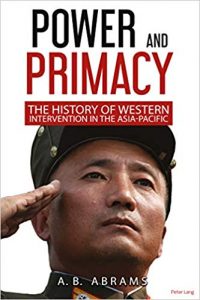
“A. B. Abrams is the author of the book ‘Power and Primacy: A History of Western Intervention in the Asia-Pacific.’ His second book covering the history of the United States’ conflict with North Korea is scheduled for publication in 2020.
He is proficient in Chinese, Korean and other East Asian languages, has published widely on defence and politics related subjects under various pseudonyms, and holds two related Masters degrees from the University of London.”
 The world today finds itself in a period of renewed great power conflict, pitting the Western Bloc led by the United States against four ‘Great Power adversaries’ – as they are referred to by Western defence planners – namely China, Russia, North Korea and Iran. This conflict has over the past 15 years escalated to encompass the military, economic and information spheres with global consequences – and appears to be coming to a head as signs of peaking tensions appear in multiple fields from military deployments and arms races to harsh economic wars and a harsher still information war.
While the term ‘World War III’ has been common since the 1940s, referring to the possibility of a global great power war on a greater scale than the first and second world wars, the Cold War between the Western and Soviet Blocs was at its height as total, as global and as heated as the prior conflicts. As weapons technology has evolved, the viability of a direct shooting war has diminished considerably – forcing major powers to seek alternative means to engineer their adversaries’ capitulation and assert their own dominance. This has been reflected in how the Cold War, and the current phase of global conflict some refer to as ‘Cold War 2’ have been distinct from the first two world wars despite the final objectives of the parties involved sharing many similarities. I would thus suggest redefining what a ‘world war’ is and acknowledging that this current phase of global conflict is every part as intense as the great power ‘hot wars’ waged in the first half of the 20th century.
Had the intercontinental range ballistic missile and the miniaturised nuclear warhead been invented twenty years earlier, the Allied Powers may have needed to rely more heavily on economic and information warfare to contain and eventually neutralise Nazi Germany. The Second World War would have been very different in nature to reflect the technologies of the time. When viewed from this paradigm, the Cold War can be seen as a ‘Third World War’ – a total conflict more vast, comprehensive and international than its predecessors stretched out over more than 40 years. The current conflict, or ‘World War IV,’ is ongoing. An assessment of prior ‘great power wars,’ and the unique nature of the current conflict, can provide some valuable insight into how warfare is evolving and the likely determinants of its victors.
As of 2020 it is clear that great power conflict has become almost as heated as it can short of an all-out hot war – with the Western Bloc applying maximum pressure on the information, military and economic fronts to undermine not only smaller adversaries such as Venezuela and Syria and medium sized ones such as North Korea and Iran, but also China and Russia. When exactly this phase of conflict began – sometime after the Cold War’s end – remains uncertain.
The interval between the third and fourth ‘world wars’ was considerably longer than that between the second and the third. This was due to a number of factors – primarily that there was no immediate and obvious adversary for the victorious Western Bloc to target once the Soviet Union had been vanquished. Post-Soviet Russia was a shade of a shadow of its former self. Under the administration of Boris Yeltsin the country’s economy contracted an astonishing 45% in just five years from 1992 (1) leading to millions of deaths and a plummet in living standards. Over 500,000 women and young girls of the former USSR were trafficked to the West and the Middle East – often as sex slaves (2), drug addiction increased by 900 percent, the suicide rate doubled, HIV became a nationwide epidemic (3) corruption was rampant, and the country’s defence sector saw its major weapons programs critical to maintaining parity with the West delayed or terminated due to deep budget cuts (4). The possibility of a further partition of the state, as attested to multiple times by high level officials, was very real along the lines of the Yugoslav model (5).
Beyond Russia, China’s Communist Party in the Cold War’s aftermath went to considerable lengths to avoid tensions with the Western world – including a very cautious exercise of their veto power at the United Nations which facilitated Western led military action against Iraq (6). The country was integrating itself into the Western centred global economy and continuing to emphasis the peaceful nature of its economic rise and understate its growing strength. Western scholarship at the time continued to report with near certainty that internal change, a shift towards a Western style political system and the collapse of party rule was inevitable. The subsequent infiltration and westernisation was expected to neuter China as a challenger to Western primacy – as it has other Western client states across the world. China’s ability to wage a conventional war against even Taiwan was in serious doubt at the time, and though its military made considerable strides with the support of a growing defence budget and massive transfers of Soviet technologies from cash strapped successor states, it was very far from a near peer power.
North Korea did come under considerable military pressure for failing to follow what was widely referred to as the ‘tide of history’ in the West at the time – collapse and westernisation of the former Communist world. Widely portrayed in the early 1990s as ‘another Iraq’ (7), Western media initially appeared to be going to considerable lengths to prepare the public for a military campaign to end the Korean War and impose a new government north of the 38th parallel (8). Significant military assets were shifted to Northeast Asia specifically to target the country during the 1990s, and the Bill Clinton administration came close to launching military action on multiple occasions – most notably in June 1994. Ultimately a combination of resolve, a formidable missile deterrent, a limited but ambiguous nuclear capability, and perhaps most importantly Western certainty that the state would inevitably collapse on its own under sustained economic and military pressure, deferred military options at least temporarily.
The fourth of the states that the United States today considers a ‘greater power adversary,’ Iran too was going to considerable lengths to avoid antagonism with the Western Bloc in the 1990s – and appeared more preoccupied with security threats on its northern border from Taliban controlled Afghanistan. With a fraction of the military power neighbouring Iraq had previously held, the presence of an ‘Iranian threat’ provided a key pretext for a Western military presence in the Persian Gulf after the Soviets, the United Arab Republic and now Iraq had all been quashed. With the new government in Russia put under pressure to terminate plans to transfer advanced armaments to Iran (9), the country’s airspace was until the mid 2000s frequently penetrated by American aircraft, often for hours at a time, likely without the knowledge of the Iranians themselves. This combined with a meagre economic outlook made Iran seem a negligible threat.
While the Cold War ended some time between 1985 and 1991 – bringing the ‘third world war’ to a close – the range of dates at which one could state that the ‘fourth world war’ began and the West again devoted itself to great power conflict is much wider. Some would put the date in the Summer of 2006 – when Israel suffered the first military defeat in its history at the hands of the Lebanese militia Hezbollah. Using North Korean tunnel and bunker networks, command structures, weapons and training (10), and bolstered by Iranian funding and equipment, the shock of the militia’s victory, though underplayed in Western media, reverberated among informed circles across the world.
Others would place the date two years later in 2008 during the Beijing Summer Olympics, when Georgia with the full support of the West waged a brief war against Russia – and Moscow despite harsh warnings from Washington and European capitals refused to back down on its position. Post-Yeltsin Russia’s relations with the Western Bloc had appeared relatively friendly on the surface, with President George W. Bush observing in 2001 regarding President Vladimir Putin that he “was able to get a sense of his soul,” and predicting “the beginning of a very constructive relationship.” Nevertheless, signs of tension had begun to grow from Moscow’s opposition to the Iraq War at the UN Security Council to President Putin’s famous ‘Munich Speech’ in February 2007 – in which he sharply criticised American violations of international law and its “almost uncontained hyper use of force in international relations.”
It could also be questioned whether, in light of what we know about Western support for separatist insurgents in Russia itself during the 1990s, the war against the country ever ended – or whether hostilities would only cease with a more total capitulation and partition and with the presence of Western soldiers on Russian soil as per the Yugoslav precedent. As President Putin stated in 2014 regarding continuing Western hostilities against Russia in the 1990s: “The support of separatism in Russia from abroad, including the informational, political and financial, through intelligence services, was absolutely obvious. There is no doubt that they would have loved to see the Yugoslavia scenario of collapse and dismemberment for us with all the tragic consequences it would have for the peoples of Russia” (11). Regarding Western efforts to destabilise Russia during the 1990s, CIA National Council on Intelligence Deputy Director Graham E. Fuller, a key architect in the creation of the Mujahedeen to fight Afghanistan and later the USSR, stated regarding the CIA’s strategy in the Caucasus in the immediate post-Cold War years: “The policy of guiding the evolution of Islam and of helping them against our adversaries worked marvellously well in Afghanistan against the Red Army. The same doctrines can still be used to destabilize what remains of Russian power” (12). The U.S. Congressional Task Force on Terrorism and Unconventional Warfare’s director, Yossef Bodansky, himself also detailed the extent of the CIA’s strategy to destabilize Central Asia by using “Islamist Jihad in the Caucasus as a way to deprive Russia of a viable pipeline route through spiralling violence and terrorism” – primarily by encouraging Western aligned Muslim states to continue to provide support for militant groups (13).
Much like the Cold War before it, and to a lesser extent the Second World War, great powers slid into a new phase of conflict rather that it being declared in a single spontaneous moment. Did the Cold War begin with the Berlin Blockade, the Western firebombing of Korea or when the atomic bombs were dropped on Hiroshima and Nagasaki – which accelerated the move into a nuclear arms race. Equally, multiple dates were given for the opening of the Second World War – the German invasion of Poland in 1939, the beginning of the Sino-Japanese war two years prior, the Japanese Empire’s attack on Pearl Harbour and conquest of Southeast Asia which marked the first major expansion beyond Europe and North Africa in 1941, or some other date entirely. The slide into a new world war was if anything even slower than its predecessors.
The shift towards an increasingly intense great power conflict has been marked by a number of major incidents. In the European theatre one of the earliest was the Bush administration’s withdrawal from the Anti-Ballistic Missile treaty in 2002 and subsequent deployment of missile defences and expansion of NATO’s military presence in the former Soviet sphere of influence, which was widely perceived in Russia as an attempt to neutralise its nuclear deterrent and place the Western Bloc in a position to coerce Moscow militarily (14). This threatened to seriously upset the status quo of mutual vulnerability, and played a key role in sparking a major arms race under which Russia would develop multiple classes of hypersonic weapon. Their unveiling in 2018 would in turn lead the United States to prioritise funding to develop more capable interceptor missiles, a new generation of missile defences based on lasers, and hypersonic ballistic and cruise missiles of its own (15).
Another leading catalyst of the move towards great power confrontation was the Barak Obama administration’s ‘Pivot to Asia’ initiative, under which the bulk of America’s military might and considerable assets from the rest of the Western world would be devoted to maintaining Western military primacy in the Western Pacific. This was paired with both economic and information warfare efforts, the latter which increasingly demonised China and North Korea across the region and beyond and actively sought to spread pro-Western and anti-government narratives among their populations through a wide range of sophisticated means (16). These programs were successors to those sponsored by Western intelligence agencies to ideologically disenchant the populations of the Warsaw Pact and Soviet Union with their own political systems and paint Western powers as benevolent and democratising saviours (17). Economic warfare also played a major role, with efforts centred around the ‘Trans-Pacific Partnership’ trade deal – or ‘Economic NATO’ as several analysts referred to it – to isolate China from regional economies and ensure the region remained firmly in the Western sphere of influence (18). The military aspect of the Pivot to Asia would reawaken long dormant territorial disputes, and ultimately lead to high military tensions between the United States and China which in turn fuelled the beginning of an arms race. This arms race has more recently led to the American withdrawal from the Intermediate-Range Nuclear Forces treaty, which paves the way for deployment of American long-range missiles across the Western Pacific – all with China and North Korea firmly in their crosshairs (19).
It is arguably in the Middle East, however, where the new phase of global conflict has seen its most direct clashes so far. The nine-year conflict in Syria, although far less destructive or brutal, provides ‘World War IV’ with something of an analogue to the Korean War in the Cold War. The conflict has united the Western Bloc and a wide range of allies, from Turkey and Israel to the Gulf States and even Japan (which funds the jihadist-linked White Helmets) (20), in an effort to overthrow an independent government with close and longstanding defence ties to Russia, North Korea, Iran and China. The conflict has seen North Korean, Russian, Hezbollah and Iranian special forces (21) among other assets deployed on the ground in support of Syrian counterinsurgency efforts, with all of these parties providing considerable material support (the Koreans have built and fully staffed at least three hospitals as part of large medical aid packages and continue to be a major supplier of arms and training) (22). China too, particularly concerned by the presence of jihadist militants of Chinese origin in Syria, has played some role in the conflict – the exact details of which remain uncertain with much reported but unconfirmed (23).
Syria’s insurgency involving a range of jihadist groups, at times united only by their intent to end the secular Syrian government, have received widespread support from the Western Bloc and their aforementioned allies. This has involved both material support, which according to State Secretary Hillary Clinton included turning a blind eye to Gulf countries’ considerable assistance to the Islamic State terror group (24), and active deployments of special forces from a wide range of countries, from Belgium and Saudi Arabia to Israel and the U.S. The U.S., European powers, Turkey and Israel have at times directly attacked Syrian units in the field – while Russian reports indicate that close Western coordination with jihadist groups has been used to facilitate a number of successful attacks on Russian positions (25). The conflict in Syria arguably represents a microcosm of the macrocosm which is a new world war – one which pits the Western Bloc and those which support the Western-led order, both directly and through local proxies, against three of its four ‘great power adversaries’ in the field.
‘World War IV’ is unlikely to come to an end for the foreseeable future, and its final outcome remains difficult to predict. Much like in the Cold War, the Western Bloc retains considerable advantages – today most notably in the field of information war which allows it to extensively shape perceptions of the vast majority of the world’s population. This has included the demonization of Western adversaries, the whitewashing of Western crimes both domestically and internationally, and portraying westernisation and increased Western influence as a solution to people’s frustrations from corruption to economic stagnation. This has been a key facilitator of the pro-Western protests engulfing states from Sudan and Algeria to Ukraine and Thailand. Economically too, only China among the Western Bloc’s major adversaries has posed a serious threat to Western primacy. Indeed, it remains highly questionable whether the other three could survive economically under Western pressure without Chinese trade and economic support.
Russia has made a considerable economic recovery since the 1990s, but remains a shadow of its former self in the Soviet era. The country’s leadership has succeeded in reforming the military, foreign ministry and intelligence services, but the economy, legal system and other parts of the state remain in serious need of improvement which, over 20 years after Yeltsin’s departure, cannot come soon enough. Even in the field of defence, the struggling economy has imposed serious limitations – and in fields such as aviation and armoured warfare the country is only beginning to slowly go beyond modernising Soviet era weapons designs and begin developing new 21st century systems (26). On the positive side, the country does remain a leader in many high end technologies mostly pertaining to the military and to space exploration, while Western economic sanctions have undermined the positions of Europhiles both among the elite and within the government and boosted many sectors of domestic production to substitute Western products (27).
In the majority of fields, the ‘Eastern Bloc’ have been pressed onto the defensive and forced to prevent losses rather than make actual gains. While preserving Venezuelan sovereignty, denying Crimea to NATO and preventing Syria’s fall have been major victories – they are successes in denying the West further expansion of its own sphere of influence rather than reversing prior Western gains or threatening key sources of Western power. Pursuing regime change in Venezuela and Ukraine and starting wars in the Donbasss and in Syria have cost the Western Bloc relatively little – the Ukrainians and client states in the Gulf and Turkey have paid the brunt of costs for the war efforts. Material equipment used by Western backed forces in both wars, ironically, has largely consisted of Warsaw Pact weaponry built to resist Western expansionism – which after the Cold War fell into NATO hands and is now being channelled to Western proxies. Libyan weaponry, too, was transferred to Western backed militants in Syria in considerable quantities after the country’s fall in 2011 – again minimising the costs to the Western Bloc of sponsoring the jihadist insurgency (28). The damage done and costs incurred by the Syrians, Hezbollah, Russia and others are thus far greater than those incurred by the Western powers to cause destruction and begin conflicts.
Syria has been devastated, suffering from issues from a return of polio to depleted uranium contamination from Western airstrikes and a new generation who have grown up in territories under jihadist control with little formal education. The war is a victory only in that the West failed to remove the government in Damascus from power – but Western gains from starting and fuelling the conflict have still far outweighed their losses. In the meantime, through a successful campaign centred around information warfare, the Western sphere of influence has only grown – with further expansion of NATO and the overthrow of governments in resource rich states friendly to Russia and China such as Libya, Sudan and Bolivia. Commandeering the government of poor but strategically located Ukraine was also a major gain, with states such as Algeria and Kazakhstan looking to be next in the Western Bloc’s crosshairs. Thus while Syria was saved, though only in part, much more was simultaneously lost. The damage done to Hong Kong by pro-Western militants, ‘thugs for democracy’ as the locals have taken to calling them, who have recently turned to bombing hospitals and burning down medical facilities (29), is similarly far greater than the costs to the Western powers of nurturing such an insurgency. Similar offensives to topple those which remain outside the Western sphere of influence from within continue to place pressure on Russian and Chinese aligned governments and on neutral states seen not to be sufficiently pro-Western.
While the Western Bloc appears to be in a position of considerable strength, largely by virtue of its dominance of information space, which has allowed it to remain on the offensive, a sudden turning point in which its power suddenly diminishes could be in sight. From teen drug abuse (30) to staggering debt levels (31) and the deterioration of party politics and popular media, to name but a few of many examples, the West appears at far greater risk today of collapse from within than it did during the Cold War. A notable sign of this is the resurgence of both far right and far left anti-establishment movements across much of the Western world. Despite massive benefits from privileged access to third world resource bases, from France’s extractions from Francophone West Africa (32) to the petrodollar system propping up American currency (33), Western economies with few exceptions are very far from healthy. A glimpse of this was given in 2007-2008, and little has been done to amend the key economic issues which facilitated the previous crisis in the twelve years since (34). The West’s ability to compete in the field of high end consumer technologies, particularly with rising and more efficient East Asian economies, increasingly appears limited. From semiconductors to electric cars to smartphones to 5G, the leaders are almost all East Asian economies which have continued to undermine Western economic primacy and expose the gross inefficiencies of Western economies. The result has been less favourable balances of payments in the Western world, a growing reliance on political clout to facilitate exports (35), and increasing political unrest as living standards are placed under growing pressure. The Yellow Vests and the rise of Donald Trump and Bernie Sanders are all symptoms of this. With very real prospects of another economic crash in the coming decade, in the style of 2008 but likely much worse, Western economies are expected to bear the brunt of the damage. Their ability to survive remains in serious question. Effects of a crash on North Korea, Iran, Russia and even China will be far less severe. While the previous crash hit Russia particularly hard (36), an economic turnaround from 2014 and the insulation provided by Western sanctions leave it far less vulnerable to the fallout from a Western economic crisis.
Ultimately China appears to be setting itself up for an ‘Eastern Bloc’ victory – a coup de grace which could see Western gains over the past several decades reversed and the power of the West itself diminished to an extent unprecedented in centuries. While the United States reluctantly outsourced much of its high end consumer technologies to East Asian allies during the Cold War – namely Japan, South Korea and Taiwan – China is going for the jugular of the Western world’s economy with its ‘Made in China 2025’ initiative, which will see some critical remaining fields of Western technological primacy shift to East Asian hands. The Coronavirus, bombings in Hong Kong, the trade war, and the wide range of tools in the Western arsenal for destabilisation can at best slightly delay this – but cannot prevent it. In a globalised capitalist economy the most efficient producers win – and East Asia and China in particular, with its Confucian values, stable and efficient political systems and world leading education (37), are thus almost certain to take over the high end of the world economy.
Much as the key to Western victory in the Cold War was successful information warfare efforts and isolation of the Soviet economy from the majority of the world economy, the key to determining the victor of ‘World War IV’ is likely lie in whether or not Beijing succeeds in its attempt to gain dominance of high end technologies critical to sustaining Western economies today. This is far from the only determinant of victory. Efforts to undermine the effective subsidies to Western economies from Central and West Africa, the Arab Gulf states and elsewhere in the third world, and to ensure continued military parity – to deter NATO from knocking over the table if they lose the game of economic warfare – are among the other fields of critical importance. Based on China’s prior successes, and those of other East Asian economies, the likelihood that it will meet its development goals is high – to the detriment of Western interests. The result will be an end to world order centred on Western might – the status quo for the past several hundred years – and emergence in its place of a multipolar order under which Russia, Asia (Central, East, South and Southeast) and Africa will see far greater prominence and prosperity.
- Menshikov, S., ‘Russian Capitalism Today,’ Monthly Review, vol. 51, no. 3, 1999 (pp. 82–86).
- Yulia V. Tverdova, ‘Human Trafficking in Russia and Other Post-Soviet States,’
Human Rights Review, December 11, 2016.
- Klein, Naomi, The Shock Doctrine: The Rise of Disaster Capitalism, London,
Penguin, 2008 (Chapter 11: ‘Russia Choses the Pinochet Option: Bonfire of a Young Democracy’).
- ‘The Death of the MiG 1.44 Program; How the Collapse of the Soviet Union Derailed Moscow’s Fifth Generation Fighter Development,’ Military Watch Magazine, September 16, 2018.
‘Russia’s Sukhoi Unveils Images from Cancelled Next Generation Fighter Program,’ Military Watch Magazine, December 17, 2019.
- Presidential Address to the Federal Assembly, President of Russia, Kremlin, December 4, 2014.
Bechev, Dimitar, Rival Power: Russia’s Influence in Southeast Europe, New Haven, CT, Yale University Press, 2017 (Chapter 1).
- Kristof, Nicholas D., ‘WAR IN THE GULF: China; Beijing Backs Away From Full Support of the War,’ New York Times, February 1, 1991.
- ‘Thaw in the Koreas?,’ Bulletin of Atomic Scientists, vol. 48, no. 3, April 1992 (p. 16).
- ‘Time to End the Korean War,’ The Atlantic, February 1997.
- Axe, David, ‘Iran Desperately Wants This Fighter Plane,’ The National Interest, January 4, 2020.
- ‘Hezbollah a North Korea-Type Guerrilla Force,’ Intelligence Online, No. 529, August 25–September 7, 2006.
“North Koreans Assisted Hezbollah with Tunnel Construction,” Terrorism Focus, The Jamestown Foundation, vol. III, issue 30, August 1, 2006.
Dilegge, Dave and Bunker, Robert J., and Keshavarz, Alma, Iranian and Hezbollah Hybrid Warfare Activities: A Small Wars Journal Anthology, Amazon Media, 2016 (p. 261).
‘Bulsae-3 in South Lebanon: How Hezbollah Upgraded its Anti-Armour Capabilities with North Korean Assistance,’ Military Watch Magazine, September 3, 2019.
- Kremlin, President of Russia, Presidential Address to the Federal Assembly, December 4, 2014.
- Congressional Record, V. 151, PT. 17, U.S. Congress, October 7 to 26, 2005.
- ‘American political scientist: Western Intelligence used Azerbaijan to export terrorism into Russia,’ Panorama, May 30, 2015.
- Kremlin, President of Russia, Plenary session of St Petersburg International
Economic Forum, June 17, 2016.
- Gregg, Aaron, ‘Military Industrial Complex Finds a Growth Market in Hypersonic Weapons,’ Washington Post, December 21, 2018.
- Mullen, Mike and Nunn, Sam and Mount, Adam, A Sharper Choice on North Korea: Engaging China for a Stable Northeast Asia, Council on Foreign Relations, Independent Task Force Report No. 74, September 2016.
Cartalucci, Tony, ‘Twitter Targets Hong Kong in US-backed Regime Change Operation,’ Ron Paul Institute for Peace and Prosperity, October 15, 2019.
Park, Kyung-Ae, ‘Regime Change in North Korea?: Economic Reform and Political Opportunity Structures,’ North Korean Review, vol. 5, no. 1, Spring 2009 (p. 23-45).
- ‘Worldwide Propaganda Network Built by the C.I.A.,’ New York Times, December 26, 1977.
- Wu, S., ‘Why the TPP is an “economic NATO,”’ Huffington Post, October 19,
2015.
- Ait, Abraham, ‘US Withdrawal From the INF Treaty Isn’t About Russia,’ The Diplomat, October 25, 2018.
- al-Jablawi, Hosam, ‘The White Helmets Struggle Without US Funding,’ Atlantic Council, June 11, 2018.
- ‘North Korean Special Forces in Syria; A Look at Pyongyang’s Assistance to Damascus’ Counterinsurgency Operations,’ Military Watch Magazine, June 10, 2018.
- ‘DPRK Ambassador affirms his country’s readiness to support health sector in Syria,’ Syrian Arab News Agency, July 25, 2016.
- Pauley, Logan and Marks, Jesse, ‘Is China Increasing Its Military Presence in Syria?,’ The Diplomat, August 20, 2018.
Hemenway, Dan, ‘Chinese strategic engagement with Assad’s Syria,’ Atlantic Council, December 21, 2018.
- ‘We finally know what Hillary Clinton knew all along – U.S. allies Saudi Arabia
and Qatar are funding Isis,’ The Independent, October 14, 2016.
- ‘Inquiry Into Death of Russian Lt. Gen. Asapov Shows Data Leaks to Daesh –
Source,’ Sputnik, September 26, 2017.
‘Drones used by Syrian terrorists “require advanced training” – Russian MoD in response to US,’ Sputnik, January 9, 2018.
- ‘Five Next Generation Russian Combat Jets We Will See in the 2020s: From MiG-41 Hypersonic Interceptors to PAK DA Stealth Bombers,’ Military Watch Magazine, January 1, 2019.
- Twigg, Judy, ‘Russia Is Winning the Sanctions Game,’ National Interest, March 14, 2019.
- Hersh, Seymour, ‘The Red Line and the Rat Line,’ London Review of Books, vol. 36, no. 8, April 2014
Angelovski, Ivan and Patrucic, Miranda and Marzouk, Lawrence, ‘Revealed: the £1bn of weapons flowing from Europe to Middle East,’ The Guardian, July 27, 2016.
Chivers, C. J. and Schmitt, Eric and Mazzetti, Mark, ‘In Turnaround, Syria Rebels Get Libya Weapons,’ New York Times, June 21, 2013.
McCarthy, Andrew C., ‘Hillary Clinton’s Benghazi Debacle: Arming Jihadists in Libya . . . and Syria,’ National Review, August 2, 2016.
- ‘Militants Bomb Hospital, Torch Quarantine Center as Hong Kong Braces for Virus Outbreak,’ Military Watch Magazine, January 27, 2020.
- ‘Class A drug use “at record levels due to young people”,’ BBC News, September 20, 2019.
- Buchholz, Katharina, ‘Industrialized Nations Have Biggest Foreign Debt,’ Statista, February 7, 2019.
- ‘France’s Colonial Tax Still Enforced for Africa. “Bleeding Africa and Feeding
France,”’ Centre for Research of Globalization, January 14, 2015.
Bart Williams, Mallence, ‘The Utilization of Western NGOs for the Theft of Africa’s Vast Resources,’ TedxBerlin, January 26, 2015
(https://www.youtube.com/watch?v=AfnruW7yERA).
- Wong, Andrea, ‘The Untold Story Behind Saudi Arabia’s 41-Year U.S. Debt Secret,’ Bloomberg, May 31, 2016.
Spiro, David E., The Hidden Hand of American Hegemony: Petrodollar Recycling and International Markets, New York, Cornell University Press, 1999.
- ‘Banks have not learnt lessons of 2008 crisis, says Gordon Brown,’ Financial Times, October 31, 2017.
‘A decade after the financial meltdown, its underlying problems haven’t been fixed,’ The Guardian, August 6, 2017.
- ‘Fearing U.S. Sanctions Over Su-35 Purchase: What is Behind Indonesia’s Interest in New F-16V Fighters,’ Military Watch Magazine, November 6, 2019.
Rogan, Tom, ‘The very political reason Qatar buys different fighter aircraft from Britain, France, and the US,’ Washington Examiner, February 25, 2020.
Krishnan, Rakesh, ‘Countering CAATSA: How India can avoid American arm twisting,’ Business Today, March 6, 2019.
- Gaddy, Clifford G. and Ickes, Barry W., ‘Russia after the Global Financial Crisis,’ Eurasian Geography and Economics, vol. 51, no. 3, 2010 (pp. 281-311).
- Hobbs, Tawnell D., ‘U.S. Students Fail to Make Gains Against International Peers,’ The Wall Street Journal, December 3, 2019.
Turner, Camiilla, ‘Chinese students are two years ahead of their white British peers by age 16, report finds,’ The Telegraph, July 30, 2019.
Clinton: Destroy Syria for Israel
The New Observer | May 22, 2016
A newly-released Hilary Clinton email confirmed that the Obama administration has deliberately provoked the civil war in Syria as the “best way to help Israel.”
In an indication of her murderous and psychopathic nature, Clinton also wrote that it was the “right thing” to personally threaten Bashar Assad’s family with death.
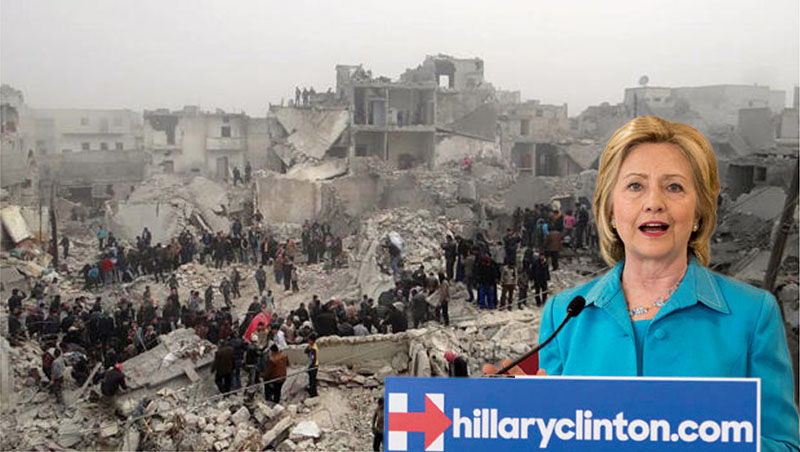
In the email, released by Wikileaks, then Secretary of State Clinton says that the “best way to help Israel” is to “use force” in Syria to overthrow the government.
The document was one of many unclassified by the US Department of State under case number F-2014-20439, Doc No. C05794498, following the uproar over Clinton’s private email server kept at her house while she served as Secretary of State from 2009 to 2013.
Although the Wikileaks transcript dates the email as December 31, 2000, this is an error on their part, as the contents of the email (in particular the reference to May 2012 talks between Iran and the west over its nuclear program in Istanbul) show that the email was in fact sent on December 31, 2012.
The email makes it clear that it has been US policy from the very beginning to violently overthrow the Syrian government—and specifically to do this because it is in Israel’s interests.
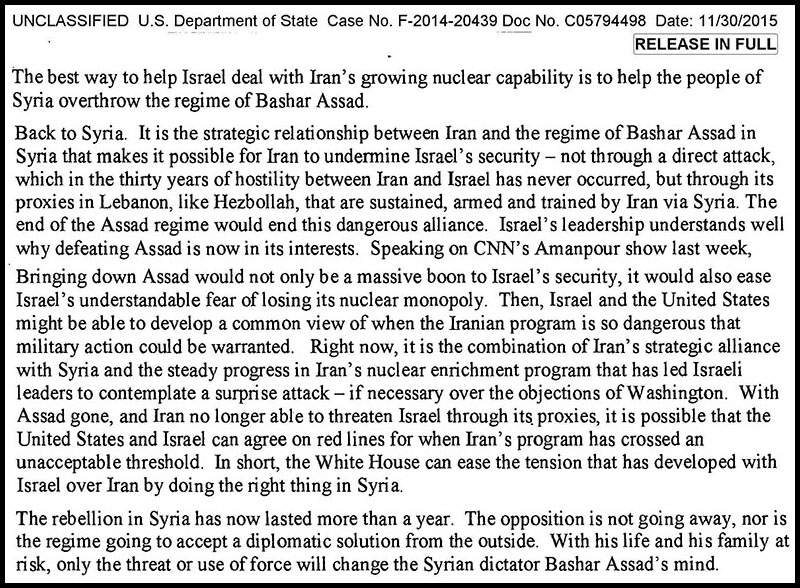
“The best way to help Israel deal with Iran’s growing nuclear capability is to help the people of Syria overthrow the regime of Bashar Assad,” Clinton forthrightly starts off by saying.
Even though all US intelligence reports had long dismissed Iran’s “atom bomb” program as a hoax (a conclusion supported by the International Atomic Energy Agency), Clinton continues to use these lies to “justify” destroying Syria in the name of Israel.
She specifically links Iran’s mythical atom bomb program to Syria because, she says, Iran’s “atom bomb” program threatens Israel’s “monopoly” on nuclear weapons in the Middle East.
If Iran were to acquire a nuclear weapon, Clinton asserts, this would allow Syria (and other “adversaries of Israel” such as Saudi Arabia and Egypt) to “go nuclear as well,” all of which would threaten Israel’s interests.
Therefore, Clinton, says, Syria has to be destroyed.
Iran’s nuclear program and Syria’s civil war may seem unconnected, but they are. What Israeli military leaders really worry about — but cannot talk about — is losing their nuclear monopoly.
An Iranian nuclear weapons capability would not only end that nuclear monopoly but could also prompt other adversaries, like Saudi Arabia and Egypt, to go nuclear as well. The result would be a precarious nuclear balance in which Israel could not respond to provocations with conventional military strikes on Syria and Lebanon, as it can today.
If Iran were to reach the threshold of a nuclear weapons state, Tehran would find it much easier to call on its allies in Syria and Hezbollah to strike Israel, knowing that its nuclear weapons would serve as a deterrent to Israel responding against Iran itself.
It is, Clinton continues, the “strategic relationship between Iran and the regime of Bashar Assad in Syria” that makes it possible for Iran to undermine Israel’s security.
This would not come about through a “direct attack,” Clinton admits, because “in the thirty years of hostility between Iran and Israel” this has never occurred, but through its alleged “proxies.”
The end of the Assad regime would end this dangerous alliance. Israel’s leadership understands well why defeating Assad is now in its interests.
Bringing down Assad would not only be a massive boon to Israel’s security, it would also ease Israel’s understandable fear of losing its nuclear monopoly.
Then, Israel and the United States might be able to develop a common view of when the Iranian program is so dangerous that military action could be warranted.
Clinton goes on to assert that directly threatening Bashar Assad “and his family” with violence is the “right thing” to do:
In short, the White House can ease the tension that has developed with Israel over Iran by doing the right thing in Syria.
With his life and his family at risk, only the threat or use of force will change the Syrian dictator Bashar Assad’s mind.
The email proves—as if any more proof was needed—that the US government has been the main sponsor of the growth of terrorism in the Middle East, and all in order to “protect” Israel.
It is also a sobering thought to consider that the “refugee” crisis which currently threatens to destroy Europe, was directly sparked off by this US government action as well, insofar as there are any genuine refugees fleeing the civil war in Syria.
In addition, over 250,000 people have been killed in the Syrian conflict, which has spread to Iraq—all thanks to Clinton and the Obama administration backing the “rebels” and stoking the fires of war in Syria.
The real and disturbing possibility that a psychopath like Clinton—whose policy has inflicted death and misery upon millions of people—could become the next president of America is the most deeply shocking thought of all.
Clinton’s public assertion that, if elected president, she would “take the relationship with Israel to the next level,” would definitively mark her, and Israel, as the enemy of not just some Arab states in the Middle East, but of all peace-loving people on earth.
Hamas: Israel’s aggressive mindset poses a threat to the entire region
Palestine Information Center – February 24, 2020
GAZA – The Hamas Movement has called for pooling the Arab nation’s efforts to confront the Israeli expansionist project in the region.
In a press release on Sunday night, Hamas spokesman Hazem Qasem said that Israel’s “bombing of resistance sites in Damascus vindicated further the Israeli government’s aggressive mentality that keeps targeting the Arab nation and posing a threat to their region.”
“This entails uniting and integrating the entire nation’s efforts in order to confront the Zionist expansionist project and put an end to its ongoing aggression and its existence on the Palestinian land,” spokesman Qasem added.
The spokesman also described Israel’s renewed aggression against the Gaza Strip and the Palestinian resistance’s response to its crimes as “an ongoing battle between an arrogant colonial power and a people striving to extract their freedom and live with dignity on their own land.”
“This battle is to be won by our people, the rightful owners of the land and history, while the passing colonist will not have a place on our Palestinian land,” he said.
‘Deliberate hoax’: Russian military denies NGO report of airstrikes in Idlib
RT | February 24, 2020
Syrian Observatory for Human Rights reports of Russian airstrikes on two villages in Idlib province have nothing to do with reality, the Russian military said, adding that none of its planes operated in that area on Monday.
“The information provided by the British NGO is a deliberate hoax,” Rear Admiral Oleg Zhuravlev, head of the Russian Center for the Reconciliation in Syria, said at a briefing.
Earlier in the day, the UK-based Syrian Observatory for Human Rights (SOHR) claimed that an airstrike by Russian and Syrian forces on the villages of Kansafra and Al-Bara in Idlib led to the “killing and injuring of nearly ten Turkish soldiers.”
Ankara has not reported any casualties among its troops in Syria, however.
The SOHR claim came at a moment when Russia and Turkey stand on the brink of war over Syria. Ankara sent troops to Idlib – the last remaining terrorist stronghold in Syria – two weeks ago, provoking deadly clashes with the advancing Syrian army. Turkey has demanded Russia to pressure its allies in Damascus into ceasing its operations in the area, while Moscow blamed Ankara of not fulfilling its earlier promise to separate the “moderate” rebels from terrorists.
Last Thursday, Russian bombers struck militants who had launched an attack on Syrian positions with the support of Turkish artillery. However, both Russia and Turkey said they weren’t looking for a military conflict. A new round of consultation between the sides is being prepared in order to defuse the situation in Idlib, Russian Foreign Minister Sergey Lavrov announced on Monday.
SOHR has been one of the key sources of Western media since the conflict in Syria broke out in 2011. However, a 2015 investigation revealed that the entire organization was run by a single man in Coventry, a former convict who fled Syria for the UK and has not been back since.
Turkey, US protect Al Qaeda in Idlib and worsen Syria’s suffering
Pushback with Aaron Maté | February 21, 2020
Idlib is facing a humanitarian disaster as hundreds of thousands flee a Syrian and Russian military campaign to retake the province from militant rule. Overlooked in Western coverage of the crisis is that Idlib is mostly controlled by Hayat Tahrir al-Sham, a rebranded affiliate of Al-Qaeda — and that Turkey, with U.S. backing, has intervened to keep the extremist group in place.
Guest: Scott Ritter, former UN Weapons Inspector and Marine Corps Intelligence Officer.
Pentagon expects US public to buy lame excuse about missing weapons sent to Syria, Iraq
‘We weren’t keeping inventory’
By Nebojsa Malic | RT | February 20, 2020
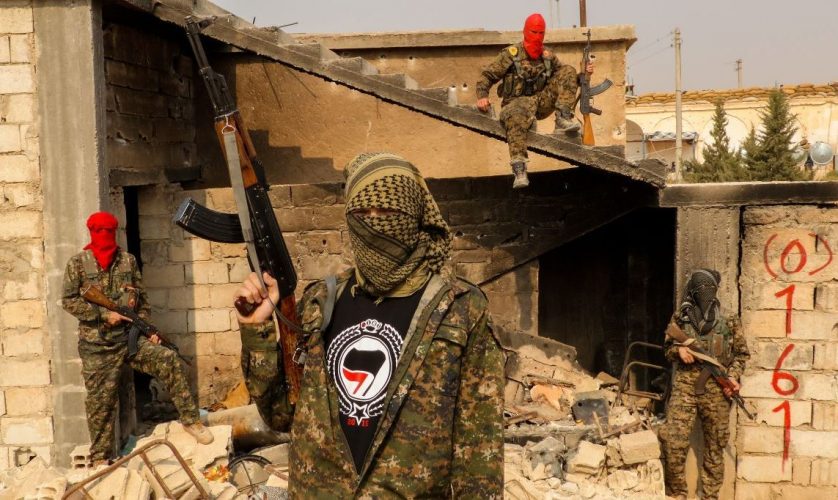
US weapons worth some $715 million dollars were warehoused poorly and soldiers handling them did not keep receipts or records, so it’s impossible to tell how many, if any, ended up in wrong hands, the Pentagon says.
Supply units in Kuwait and elsewhere “did not maintain comprehensive lists of all equipment purchased and received” or “stored weapons outside in metal shipping containers, exposing the equipment to harsh environmental elements, such as heat and humidity.”
This is according to the partially redacted report by the Department of Defense’s inspector general (IG), of an audit into the “Counter Islamic State of Iraq and Syria Train and Equip Fund” (CTEF), dated February 13 and published this week.
That is not to say that $715 million worth of US weapons, intended for the Iraqi military and “Vetted Syrian Opposition” – as the euphemism for US-allied militia goes – has gone missing, as some reports may have suggested. In Pentagon-speak, there was “a lack of a central repository for accountability documentation.” Once you cut through the obtuse verbiage, the IG report basically says there’s no way of figuring any of that out, because the troops charged with running the program did not maintain records or receipts.
The audit was commissioned because the DOD has requested $173.2 million for weapons, ammunition, vehicles, and other CTEF-S equipment for the current fiscal year, which began in October. Without accurate records, the Pentagon risks buying stuff it doesn’t need and “further overcrowding” the warehouses in Kuwait, which is what caused the pricey hardware to be stored outside in the first place.
Even though the Trump administration declared Islamic State (IS, formerly ISIS) defeated back in March 2019, ensuring the “enduring defeat” of the terrorists apparently requires that the weapons and equipment must flow. While the US taxpayers don’t have a choice in footing the bill, expecting them to swallow the explanation – that their noble men and women in uniform are just too stupid, lazy or incompetent to keep a ledger – sounds a bit rich.
Washington has a notoriously spotty record of pouring weapons into Syria and Iraq. At one point in 2015, the Pentagon admitted the failure of its program to train and equip “Vetted Syrian Opposition” (also known as “moderate rebels”). Having spent $2 million per fighter, the US saw them defect to the Al-Qaeda affiliate group Al-Nusra, bringing the US-supplied weapons and kit along.
So the Pentagon doubled down in 2016, spending untold millions to train “dozens” of rebels in Turkey. It is unclear how many of those “moderates” took part in last year’s assault on areas held by US-allied Kurdish militias.
As late as September 2016, Al-Nusra commanders openly talked about getting US weapons, both “directly” and via third countries, such as Saudi Arabia. The Syrian government has since dealt the militants one defeat after another, and currently advances on their last remaining strongholds in the Idlib province.
While the US government and media have objected to these operations – and NATO member Turkey actually sent troops and tanks to Idlib in an attempt to halt them – a spokesman for the anti-IS coalition has just openly admitted Idlib is a nest of terrorists.
Syria and “Transitional Justice”

By Helena Cobban | Just World News | February 12, 2020
Almost from the beginning of the US-supported regime-change project in Syria, US policymakers have incorporated several kinds of planning for what is called “transitional justice” into their pursuit of the project. Transitional justice (TJ) is a field that came into great vogue in the mid-1990s, after two key developments in the post-Soviet world: (1) the UN Security Council’s creation of a special International Criminal Tribunal for the Former Yugoslavia (ICTY) and (2) the agreement of the African National Congress in South Africa to negotiate an end to the Apartheid system– but with the proviso that the most heinous of the rights violators of the Apartheid era all ‘fess up to all their actions in a specially created Truth and Reconciliation Commission (TRC); and if those confessions were deemed full and heartfelt, then the perpetrators could escape prosecution for their actions.
From the early 1990s, these two approaches to TJ were in tension with each other; and that tension has lain at the heart of the rapidly burgeoning field of TJ projects ever since.
For its part, the prosecutorial/criminal-justice approach claimed descent from, crucially, the two US-dominated international courts established immediately after WW-II, in Nuremberg, and Tokyo. (The above photo is of Herman Goering on the stand, in Nuremberg.) The creation of ICTY was followed, two years later, by the Security Council’s creation of a parallel special court for Rwanda; and meantime, a broad movement emerged to press for the establishment by treaty among nations of a permanent “International Criminal Court” (ICC) which could hold accountable perpetrators of the worst forms of atrocities– described as war crimes, crimes against humanity, and genocide– in a criminal proceeding. In 1998, 120 governments adopted the “Rome Treaty” that established and set the rules for this court. In 2002, the requisite 60 countries had ratified the Rome Treaty and the ICC came into existence, headquartered in The Hague.
I have reflected at length in many earlier writings (including this 2006 book and these earlier articles: 1, 2) on some of the shortcomings of the ICC and the criminal-justice approach it adopts to dealing with the aftermath of atrocities. Suffice it here to note the following:
- The United States is not a member of the ICC; but all the presidents since 2002 have on occasion sought to use the investigative, international arrest, and prosecutorial powers of the ICC, or to threaten their use, against political figures around the world they are opposed to.
- The whole prosecutions movement since the creation of ICTY has claimed descent (and therefore a strong degree of legitimacy) from the whole Nuremberg/Tokyo Trials legacy. But all the “modern” international courts have omitted from their actual charge-sheets one of the key acts– perhaps the key act– prosecuted at Nuremberg and Tokyo: the crime of aggression, that is, the act of launching an aggressive war. The Rome Treaty listed the crime of aggression as potentially on the ICC’s docket, but its signatories have failed to reach agreement on how to define it and thus it has not in practice been chargeable.
- In March 2003, eight months after the ICC formally came into existence, the United States launched a massive, quite unjustified (and militarily successful) war of regime change in Iraq– a war that UN Secretary-General Kofi Annan later admitted lacked any legitimacy.
- One of the early acts of the “Coalition Provisional Authority” through which the US military ruled Iraq after the invasion was to establish a special tribunal to try former president Saddam Hussein and his top associates. After the CPA set up an Iraqi government (though still under its own control), this government adopted the trial plan, renaming the body the Supreme Iraqi Criminal Tribunal. Saddam was captured by US soldiers in late 2003 and sent for trial by the SICT; in November 2006, it sentenced him to death. He was held in a prison inside the US military’s “Camp Justice.” On December 30, 2006 he was taken to a scaffold earlier than the Americans had planned by a group that included SICT officials and members of Shiite militias. There, he was hanged to the jubilation of many of the witnesses, who also circulated cellphone videos of the event. Saddam’s very unseemly execution capped off a trial that had been marred throughout by grave irregularities.
This political background should be borne in mind when considering the legitimacy (or even, the utility) of any plans to use prosecutorial TJ mechanisms in connection with US-led regime-change projects in the present era– in Syria, Venezuela, or anywhere else.
In June 2019, Max Blumenthal and Ben Norton published a broad and detailed description in The Grayzone of the work of several organizations that have as their mission the collection of evidence of war crimes and other atrocities committed in Syria and to some extent also Iraq, and the compilation of this evidence into forms that can help (or even spur) the prosecution of alleged perpetrators by international courts.
Most of these organizations are funded by Western governments. Most were also, like the Syrian Network for Human Rights, founded at, or shortly after, the time that Secretary of State Hillary of Clinton and Pres. Barack Obama committed Washington to full support of the regime-change project in Syria. Other such organizations include:
- the “Commission for International Justice and Accountability”, an organization founded by an enterprising Canadian investigator called Bill Wiley, that has received funding from Canada, the EU, numerous European countries, and the United States. CIJA got a massive boost in visibility in the United States after the New Yorker published a serious of materials about it written by Ben Taub. In this one, Taub breathlessly described how, “At an undisclosed location in Western Europe, a group called the Commission for International Justice and Accountability (CIJA) is gathering evidence of war crimes perpetrated by the Syrian government… “
- The Syria Justice and Accountability Center (SJAC), which states explicitly on its website that it was founded in 2012 by the “Group of Friends of the Syrian People”– that is, the coalition of governments united in their project to overthrow the Syruian government. On its website, SJAC states that it was founded in The Hague and moved in 2016 to Washington DC, where it “is currently registered as a nonprofit corporation.” However, no organization of its name comes up in standard searches of nonprofits, while SJAC is currently listed as a project of the old cold-war organization, IREX.

Chart from p.50 of the Day After Project’s report
During their early years in existence, these organizations had as their goal the collection, preservation, and organization of materials that could, after the opposition’s overthrow of the government, serve in a war-crimes court as evidence of the organization by Syrian government officials of broad patterns of gross abuse.
The work of these documentation organizations was also inspired by “The Day After Project”, a project the federally funded U.S. Institute of Peace launched in late 2011 to plan for what decisionmakers in Washington all confidently expected would be the imminent fall of the Assad government. The Day After Project’s final report (PDF) was launched in August 2012, ostensibly by the all-Syrian group of 45 individuals who co-authored it. It contained a lengthy section on “Transitional Justice”, complete with a complex organogram showing how all the proposed parts of this project should be managed.
That was still the heyday of the thinking in official Washington that “Assad will fall any day now!” Washington– like Paris, Ankara, Doha, and other anti-Assad capitals– was full of very busy, Ahmad Chalabi-style Syrian exiles (often being handsomely paid by their Qatari, Saudi, or Emirati backers) who had managed to persuade themselves and numerous “locals” in those Western countries that any day now they would be riding into Damascus to take over the whole Syrian government. Well, in March 2003, Ahmad Chalabi did at least manage to get back to Baghdad in the wake of the US invasion of the country– though once he arrived, it was patently clear he had never enjoyed anything like the degree of popular backing within Iraqi society that he had long claimed to have. Regarding Syria, the earnest bands of exiles who were making detailed plans for their own imminent return “home” never even made it. They were unable to persuade a US government and public that had already been badly duped once, back in 2003, that the claimed “sins” of the Syrian government were bad enough to warrant a full-scale U.S. invasion– especially one that this time around (unlike in 2003) threatened to trigger a serious global showdown with a now more confident and capable Russia.
Yes, under Obama and Clinton, Washington did give the anti-Assad fighters some serious shipments of arms, along with strong political backing; and they and the Israelis did from time to time launch one-off strikes against Syrian military bases. But Obama and Clinton never signed off on a full-throated military campaign against Assad; and the anti-Assad rebels proved quite incapable of actually persuading enough Syrians to come over to their side, to win. The sides settled into a very lengthy and draining stalemate, during which the government side slowly proved able– with the help from international allies on whom it was quite legitimately able to call– to retake parts of Syria that had earlier been taken over by the foreign-armed (and increasingly jihadi-controlled) rebels.
Today, nine years into the conflict in Syria, there is no hope at all of the opposition seizing Damascus. And within the anti-Assad camp itself, extremist jihadis affiliated with either ISIS or Al-Qaeda long ago took over control, snuffing out the hopes of the Washington establishment that “moderate rebels” of the kind now firmly ensconced in Western think-tanks can ever become a significant force inside Syria. All the plans that those “moderate rebels” had made for the imminent establishment of an anti-Assad “special war-crimes court” like the one that earlier tried Saddam Hussein, or for other mechanisms of post-victory “transitional justice”, have to them a quality that is either robotic or slightly other-worldly.
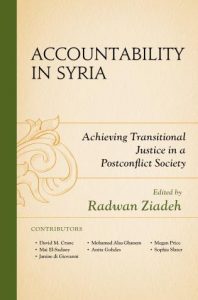 Last week I went to the launch at a Qatari-funded think-tank called the Arab Center of Washington of a book called Accountability in Syria: Achieving Transitional Justice in a Postconflict Society. I guess the Qatari funding has been running a bit low, because there were no free copies of the book being handed out, and only one sample copy that attendees could take a glance at. It costs $90. Rush right over to the link above to buy your copy!
The three panelists were: the book’s editor, Radwan Ziadeh, a longtime regime-change advocate whose only listed professional achievement is his longtime gig as a “Senior Fellow” at the Arab Center; Mai el-Saadany, a US-trained Syrian-American lawyer who now works at the Tahrir Institute for Middle East Policy; and Mohammed Alaa Ghanem, who until recently was Government Relations Director and Senior Political Adviser for the Syrian American Council, one of Washington DC’s principal regime-change organizations. Ghanem, who still has a (presumably nicely funded) affiliation with the UAE-funded Atlantic Council, is now doing a Master’s degree in international affairs at Columbia.
At one level, it was kind of a sad event. When Ziadeh started talking, he recounted that work on the book had started back in 2015– at a time when it may have been possible for regime-change advocates still to imagine that one day soon, just possibly, they could seize power in Damascus. (Hence, the reference in the book’s sub-title to a “Postconflict society.”) Poignantly, he spoke about how back then, “Aleppo”–actually, just that small portion of East Aleppo that the opposition still controlled– was becoming a center of evacuation, and how Ma’aret al-Numaan, in the opposition fighters’ Idlib redoubt, was a center of evacuation today.
In both instances, as the government regained control of terrain previously held by the jihadi extremists, the government allowed the opposition fighters and any civilians who chose to leave, to do so, and indeed, facilitated their departure. This is in notable contrast to the bloodthirsty actions the jihadi oppositionists have always taken toward the residents and defenders of areas that they’ve overtaken. But the video footage of desperate civilians fleeing in advance of the Syrian army’s arrival always looks pretty heart-wrenching.
(The videos widely circulated in the west notably do not depict the civilians who stay in the areas being brought back under Syrian government control– or, the earlier presence and activities of any of the jihadi fighters, some of whom who are Syrian and many of whom are not, who had controlled these areas so brutally over the preceding few years.)
When Mai el-Saadany spoke she stated confidently that, “The time for justice is now… We can’t afford to wait until the conflict ends.” She said that both the International Criminal Court and the UN’s doctrine of “Responsibility To Protect” (R2P) had proven useless in protecting Syria’s people; but that even without those tools there were three “accountability tools” the Syrian oppositionists could use: Documentation; a couple of different UN inquiry/documentation mechanisms; and prosecutions outside Syria, such as the one brought against two former Syrian officials by a court in Germany, last October.
When she talked about documentation, el-Saadany singled out for special praise the efforts of a group called Bellingcat–and of The New York Times.
For his part, Ghanem focused on the contribution he had made to the Accountability in Syria book, in which he looked at what he described as the “sectarian cleansing” that he saw the Syrian government as undertaking in formerly opposition-held areas over which it regained control. He accused “the Assad regime” of being dominated by Alawites and of engaging in “sectarian cleansing or demographic engineering” against “communities” in these areas, though he did not name these “communities.” He said he had been very proud to have gotten reference to this phenomenon included in the “Caesar Act”— a US sanctions measure against Syria that was signed into law in late December.
The most interesting part of this sad gathering came toward the end ( at 1h24m on the video.) A questioner had asked how the panelists thought that the kinds of “accountability”mechanisms they favored could be applied to other perpetrators of atrocities in Syria, “such as in the Turkish-controlled areas, or the SDF”, in addition to the government. At that point, Ziadeh almost completely lost it. The other two panelists, much better qualified and better prepared professionals than he, had both expressed their support for the idea that all accused perpetrators of significant atrocities, whatever their political alignment, should be subjected to the same accountability measures. (This is, after all, a key tenet to the whole field of transitional justice… Heck, in South Africa’s Truth and Reconciliation Commission, even some of the excesses of the ANC came under the same kind of scrutiny as the gross tortures of the Apartheid regime.)
Ziadeh argued that only the “Assad regime” should be addressed by any accountability mechanisms. “The Syrian government– it became not a rogue state, but deep sectarian militias, that has no regard for the life of any Syrian” he said. “It’s impossible to think of having a political settlement with this kind of militia in control of Syria… What’s the end answer? No Syrians nor anyone else have any answer for that… There is nothing to talk about! There is nothing to leverage or negotiate about. I am very pessimistic. There is no soon, any hope of a political settlement of the conflict.”
The other two panelists hewed more closely to the standard TJ script. Both argued that, while there is no “false equivalence” between the violations committed by the “Assad regime” and those committed by other parties, still, all violators should be held accountable.
Ghanem had earlier argued that accountability-seeking mechanisms could be used as “leverage” for the Syrian opposition in a future negotiated settlement. The relationship between pressure for “accountability” and momentum toward negotiations is a complex–and, as I demonstrated in this recent article, “Syria: Peacemaking or prosecutions?”, often an inverse–one. (When I wrote that piece, in early November, the prospects for reaching a negotiated political transition in Syria seemed greater than they do today.)
One misapprehension into which all three of the panelists at the Arab Center event seemed to have fallen was to conflate the idea of “accountability” almost completely with the path of criminal prosecutions. But as anyone who has studied the TJ field knows, there are numerous other mechanisms that have been used to enact accountability other than Western-style courts of law. South Africa’s TRC was one such mechanism. It was widely (and correctly) lauded for helping enable South Africans to make the transition from a deepseated system of colonial expropriation and Apartheid to a much more inclusive system that enabled the “White” colonists to remain in the country on a basis of political equality with its indigenes– and to achieve this without triggering a massive new race war between those two sides (though the transition was accompanied by very lethal fighting between the two major Black African political forces.)
The main premise of the TRC was that as part of the transition to political equality, it was necessary to draw a line under the violence of the past and to offer a full amnesty from prosecutions for all the perpetrators of that violence provided they (a) had stopped committing it; and (b) provided a full description of the violent acts they had committed, such as could help bring a degree of legal and emotional “closure” to survivors of the violence and others bereaved by it or otherwise affected by it.
The exact terms of the TRC’s “deal” with former perpetrators were painstakingly negotiated among the parties to the transition– principally, the Apartheid era’s ruling National Party and the anti-Apartheid African National Congress (ANC). The Apartheid government possessed overwhelming military and socioeconomic force throughout the whole of South Africa; and it would never have agreed to end Apartheid and transition to a one-person-one-vote system in South Africa if its leaders had not been offered an amnesty. If there had been no TRC, the whole of Southern Africa might still be riven with terrible conflicts, to this day. The “offer” of amnesty was backed up by the existence in the country of a fairly well-functioning judicial system. But the main factor motivating perpetrators to come forward and participate in the often riveting public hearings that the TRC held all around the country was the desire most of them felt to allow their families, their communities, and their country to move forward.
 In my 2006 book, Amnesty After Atrocity? Healing Nations after Genocide and War Crimes, I looked at the effectiveness of South Africa’s TRC and compared it with the very different post-conflict mechanisms that, in that same period of 1992-94, had been adopted by Mozambique and post-genocide Rwanda. Those two other cases effectively “bracketed” what the South Africans agreed to do. In Rwanda, the post-genocide government was heavily inclined towards prosecutorialism, supporting both the creation and work of a UN-established International Criminal Tribunal for Rwanda (ICTR) and the use of a very broad campaign of national-level prosecutions of suspected genocidaires. In Mozambique, by contrast, an extremely lengthy and ugly civil war was brought to an end in 1992 when the two main parties to it, the ruling Frelimo movement and the opposition Renamo, were brought together in a negotiation conducted by a Vatican-sponsored peace group and agreed to end their combat on the basis of a blanket amnesty for previous perpetrators of violence from both sides. The United Nations then stepped in with a broad program for demilitarization, demobilization, and reintegration into their home societies of the former fighters from both sides (DDR).
Intense inter-group conflict of any kind of course inflicts massive damage on a country’s economy, including its most basic infrastructure, so societies emerging from such conflicts have numerous, extremely pressing human and economic needs. In this context, the relative costs– and therefore, also opportunity costs– of the TJ mechanisms used are definitely a factor. I used public documentation to calculate the costs of these mechanisms as follows (p.209):
- Each case completed at the ICTR : $42,300,000
- Each amnesty application at the TRC: $4,290
- Each case in Rwanda’s planned “local-style” gacaca courts (projected): $581
- Mozambique: each former fighter demobilized/reintegrated: $1,075
- South Africa: each former fighter demobilized/reintegrated: $1,066.
In that concluding chapter of the book, I presented (pp.212-13) a critique of the degree of “accountability” that advocates of prosecutorialism judge that their favored approach provides, noting that the kind of personal “accountability” required of perpetrators by a court of law is very thin indeed compared with, for example, that required in TRC or other similar mechanisms.
I also presented (p.241) a list of nine “meta-tasks” that, based on my previous analysis in the book– and on my own experience of having lived and worked in an area wracked by civil conflict, during the first six years of Lebanon’s civil war– I concluded that societies recovering from grave inter-group conflict need to undertake. It runs as follows:
Top rank (all of equal urgency):
-
- Establish rigorous mechanisms to guard against any relapse back into conflict and violence.
- Actively promote reconciliation across all inter-group divisions.
- Build an equality-based domestic democratic order that allows for nonviolent resolution of internal differences and respects and enforces human rights.
- Restore the moral systems appropriate to an era of peace.
- Reintegrate former combatants from all the previously fighting parties into the new society.
- Start restoring and upgrading the community’s physical and institutional infrastructure.
- Start righting the distributional injustices of the past.
Second rank (of somewhat less urgency):
-
- Promote psychological healing for all those affected by the violence and the atrocities, restoring dignity to them. (If the top-rank tasks are all addressed, those moves will anyway do much to achieve this; but it will probably need continuing attention.)
- Establish such records of the facts as are needed to meet victims’ needs (death certificates; identification of the burial sites; etc) and to start to build a record for history.
In the real world, decisions on what to do with individuals accused of having committed grave infractions nearly always get made in the context of a negotiation over the nature and terms of a major societal transition to a new political order. “String ’em all up on the lamp-posts!” or “Line ’em all up and shoot them!” are versions of one notable, non-negotiated type of such decision– and a type that notably doesn’t augur well for the political tone of the new order. In Syria, the way that ISIS or the bunch of Al-Qaeda-affiliated jihadis who currently control Idlib treat accused government supporters who fall under their sway definitely falls into this category.
Negotiating an end to a conflict– or acting with restraint in the event no negotiation proves possible– nearly always augurs a better outcome. At the end of WW-II, in the Asian theater, the Japanese Emperor was able to negotiate surrender terms on fairly favorable terms that ensured his dynasty’s continuation in office (and his own exculpation from responsibility for any of Japan’s preceding war crimes)–but in return for allowing the Americans and their allies to set up an international criminal tribunal to try certain Japanese decisionmakers, and numerous other concessions. In Germany, there was no negotiated end to the fighting; and the Russian, French, and British leaders (whose peoples had suffered most gravely from the Nazis’ actions) were all baying for extreme retribution. But the US public was relatively distant from the battlefield. That allowed Secretary of War Henry Stimson and President Harry Truman– both of whom were also aware of the disastrous sequelae of the punitive approach the victorious Allies had imposed on post-WW-I Germany– to argue for, and implement, the much more restrained approach to post-war justice that the Nuremberg trials represented.
Recent developments in Syria make the prospect of a negotiated end to the country’s lengthy civil war seem more remote today than they did a few months ago. The country’s 22 million people have been held in the vice of this conflict, and victim to the wiles of numerous outside actors and interveners much more than to those of any domestic actors, for nine long years. (This was also, interestingly, the case in Mozambique. Much of the terrible violence that Renamo used in its campaign to control as many Mozambicans as possible as a way of pressuring and overthrowing the Frelimo government had been organized and underwritten by South Africa’s Apartheid. The intra-Mozambican negotiations that brought an end to the war only made progress after a weakened South Africa started to withdraw that support.)
Throughout the first six years of Syria’s civil war, the determination of the United States and several allied governments (Turkey, Qatar, the Saudis, the UAE) to accept nothing less than the complete overthrow of the Assad government stymied all attempts by the United Nations and others to attain a negotiated end to the war. After Pres. Trump assumed office, he was less devoted to total “regime change” than Pres. Obama had been… and since late 2018 or so, the UAE has pulled back from its focus on regime change. Turkey also, from the Astana Agreement of September 2018 on, was clearly exploring some kind of “regional super-powers mega-deal” with Russia and Iran, that could help ramp down, or even bring to a negotiated end, Syria’s civil war.
More recently, though, Trump has pulled back from his fondness for a pullback from Syria. And perhaps he has started to see US military involvement in Syria as helping to serve his broader campaign of “maximum pressure” against Iran? Turkey has also pulled back from its commitment to Astana and is currently squaring up for a possibly broader military clash with Syrian government forces?
So the prospect for a negotiated settlement to the Syrian civil war has receded some. But it has certainly not disappeared completely. If nine years of slogging fighting– accompanied by terrible, unspeakable atrocities being suffered by people from all “sides”–has not succeeded in bringing about a “decisive” victory for any side, then surely an end to this war that is negotiated in some way is the only reasonable path, and the only path that can draw a line under the suffering of the past nine years? A viable negotiating forum has already been established by the United Nations. Let us hope it can complete its work as soon as possible, and that as part of this process the negotiators can find a list of mutually acceptable ways to deal with the whole range of transitional justice issues. And these, as noted above, go considerably further than the kinds of war-crimes trials so beloved by the Western media.
Russian Air Force strikes repel militant attack on Syrian government army in Idlib – Defense Ministry
RT | February 20, 2020
The Russian Air Force launched strikes to repel a militant offensive against the Syrian Army in Idlib, which had sought to breach the government forces’ defensive lines, the Russian Defense Ministry said.
The militants, supported by Turkey, had shelled the Syrian Army’s positions in the region. However, the Turkish forces stopped the artillery barrage after Moscow contacted Ankara, the ministry added.
The militants had launched a “massive offensive” southeast of the city of Idlib, using many armored vehicles, the Russian Reconciliation Center in Syria said on Thursday, adding that it was Turkish artillery that helped them breach the Syrian Army’s defenses in some areas.
Aerial footage published by the Russian Defense Ministry shows a Turkish self-propelled howitzer battery shelling the Syrian Army positions.
At the request of Damascus, Russian Su-24 strike aircraft hit the advancing armed groups, helping Syrian forces to repel the offensive, destroying a tank and six infantry-fighting vehicles, among other hardware.
The reconciliation center also said that the Turkish shelling left four Syrian soldiers injured. Moscow also once again called on Ankara to cease its support for terrorists in Idlib, and stop handing over weapons to them.
Meanwhile, Turkey’s Defense Ministry said that two Turkish soldiers were killed and five others injured in the air strikes.
The incident comes amid a spike in tensions between Damascus and Ankara. Turkey has opposed the Syrian Army’s advances in the battle against extremists and militants entrenched in Idlib province for quite some time. On Wednesday, President Recep Tayyip Erdogan said that Turkey would not “leave Idlib to the Assad regime” and threatened to launch an incursion into the province.
Turkey had already reinforced its outposts in the area, which is the last remaining major militant stronghold on the Syrian territory. Russia repeatedly warned Turkey against attacking the Syrian Army and has continued diplomatic efforts to ease tensions around Idlib.
Featured Video

Chinese jet fuel and the myth of energy independence
or go to
Aletho News Archives – Video-Images
Book Review
Former Insiders Criticize Iran Policy as U.S. Hegemony
By GARETH PORTER | CounterPunch | February 27, 2013
“Going to Tehran” arguably represents the most important work on the subject of U.S.-Iran relations to be published thus far.
Flynt Leverett and Hillary Mann Leverett tackle not only U.S. policy toward Iran but the broader context of Middle East policy with a systematic analytical perspective informed by personal experience, as well as very extensive documentation.
More importantly, however, their exposé required a degree of courage that may be unparalleled in the writing of former U.S. national security officials about issues on which they worked. They have chosen not just to criticise U.S. policy toward Iran but to analyse that policy as a problem of U.S. hegemony. … continue
Blog Roll
 Aletho News
- What is fueling unrest across the EU?
- Why no power can undermine Iran’s eternal dominance over the Strait of Hormuz
- Is The War Against Iran Over?
- Iran war will leave long-term ‘scar’ on Wall Street, investors warn
- How Iran decimated US power projection in West Asia: Military lessons of 40-day war
- Iran’s report details US-Israeli war crimes in targeting schools, hospitals, livelihoods
- NATO’s Slow Fracture: How Trump’s Iran War Exposed the Instrument of Hegemony
- Chinese jet fuel and the myth of energy independence
- Ukraine Sea Drone Fired From Libya Hit Russian Tanker in Mediterranean
- IRGC: Iranian forces launched no attacks during ceasefire hours
- If Americans Knew
- Military aid to Israel emerges as the latest political litmus test for Democrats
- The only Palestinian children’s rights organization closes following years-long Israeli campaign against it
- ‘I Can’t Forget the Smell’: Lebanese Reel After Israel Kills Over 300 in Single Day
- DNC Shoots Down Resolutions Calling Out AIPAC and Limiting Arms to Israel
- TCN: Is Israel Blackmailing President Trump?
- Israel killed at least 303 Lebanese yesterday – who were they? Daily Update
- Amnesty: Urgent – Protect Lebanese civilians from brutal escalation in Israeli attacks
- Is The War Against Iran Over?
- Inside the Israeli army’s propaganda wing
- Hundreds of Gaza Amputees Stranded in Legal Limbo
- No Tricks Zone
- New Study: No Linear Warming Or Glacier Retreat Along Northern Antarctic Peninsula Since 1980s
- An Inconvenient Tree: Uncovered In Alps… Europe Much Warmer Than Today 6000 Years Ago
- New Study Reports A 60% Slowdown In Greenland’s Ice Loss Rate In The Last Decade
- Low Intensity Tornado Wrecks Major Solar Farm, Creating A Potential Toxic Dump
- New Study Finds Warming Saves Lives…Cold Temperatures 12 Times More Deadly Than Excess Heat
- German Science Blog Accuses PIK Climate Institute Of Hallucinating Climate Tipping Points
- Devastating Assessment Of Comirnaty Vaccine By Former Senior Pfizer Europe Toxicologist
- New Study: CO2 Is ‘Effectively Negligible’ As An Explanatory Climate Change Factor Since 2000
- Former Pfizer Toxicologist Dr. Helmut Sterz Tells Bundestag Hearing Pfizer Vaccine Should Have Never Been Approved
- Energy Expert: Germany’s Nuclear Phaseout Was A “500 Billion Euro Mistake”
 Aletho News