Yet Another Israeli Provocation in the Middle Eastern Skies
By Vladimir Platov – New Eastern Outlook – 11.02.2020
While using a civilian airliner as cover, four Israeli F-16 fighters approached the outskirts of Damascus and launched an attack on local residential areas late night on February 6. There’s no disputing that by adopting such tactics the Israeli Air Force endangered the civilian aircraft – an Airbus A320 owned by the private Syrian Cham Wings Airlines, arriving at Damascus from Najaf International Airport (NJF) in Iraq with 172 passengers on board. This Syrian airliner was running late and it’s clear from data provided by FlightrRadar24, that Israeli military aircraft were clearly expecting the arrival of yet another A320, owned by SyrianAir due to arrive from Tehran, hoping to provoke local air defence units into destroying the liner by mistake.
If it weren’t for the prompt actions of the flight dispatchers of Damascus International Airport and its efficient automated air traffic control system, this civilian airliner would have been in peril, but thankfully it managed to escape the kill zone, landing safely at the nearest available airfield, the Russia’s Hmeimim air base.
The situation is painfully similar to September of 2018, when 4 Israeli F-16s launched missile strikes against unknown targets in Syria’s Latakia province, using Russia’s Il-20 reconnaissance aircraft with 15 crew members aboard as cover. Predictably enough, the Israeli jets provoked a response from Syrian anti-aircraft units resulting in the destruction of the Russian aircraft. All people on board were killed.
On December 26, 2018, another Syrian airline Cham Wings Airlines plane was bound to land at Damascus International Airport, but in a bid to escape a similar provocation staged by the Israeli Ari Force, it detoured and landed at Russia’s Hmeimim airbase. On that day a total of two civilian airliners had to change their flight routes as a result of the Israeli Air Force, which threatened innocent civilians in what that can only be described as a provocation. In both cases near Damascus, the jets were operating from the airspace of a third country – Lebanon, justifying their actions by alleging to attack Iranian warehouses and convoys that were said to be used for military operations against Israel.
In both cases, passengers aboard civilian airliners were at risk as local air defense units were bound to open fire to repel the Israeli missile attacks, risking civilian aircraft approaching Damascus International. In other words, on more than on one occasion a situation similar to the tragic incident with the Iranian downing of the UIA Boeing 737, traveling from Tehran to Kiev was deliberately staged by the Israeli Air Force. As for the downed Boeing the Iranian authorities officially recognized that it was mistakenly shot down by air defence units of the Islamic Revolutionary Guards Corps (IRGC), which resulted in the untimely demise of 167 passengers and nine crew members – citizens of Iran, Ukraine, Canada, the UK, Sweden and Afghanistan. This tragedy inflicted significant political, economic and PR damage on Iran. In this regard, the clearly distinguishable similarities of the provocative attacks in Iran and Syria are obvious, which raises reasonable questions regarding the strategic command that must be planning such attacks.
It is also noteworthy that the Israeli Air Force chose the SyrianAir flight arriving from Tehran as its target, with Israel explaining all of its recent aggressive actions in Syria and the Middle East through the prism of countering the rising influence of Iran.
Thus, the Israeli General Staff conducting military operations in Syrian airspace using civilian aircraft carrying passengers as a cover is now something of a trademark of the Israeli Air Force, which isn’t afraid of putting the lives of hundreds of innocent people in harm’s way to achieve its ends.
Acting in this way, striking from cover, like highway robbers, the Israeli Air Force seeks to avoid getting caught violating Syrian airspace or even being hit by Syrian anti-aircraft missile systems. They strike Syrian territory, appearing in the sky, for example, over Lebanon, leaving Damascus’ hands tied. If Syrian air defenses shoot down an Israeli plane over Lebanon failing to officially invade Syrian airspace, then Damascus will be framed by Israel, the United States and its allies as an aggressor attempting to provoke war in the Middle East. In addition, geographical features surrounding Damascus play a huge role here. Israeli military jets would typically launch strikes against targets within Syrian territory from the Bekaa Valley, covered from all sides by mountains. They seem to appear from nowhere from behind the mountains and disappear just as rapidly, while still managing to hit various targets.
For these reasons, there can be no objective assessment regarding the efficiency of the Russian S-300 anti-aircraft missile systems delivered to Syria to allow Damascus to defend its air space.
At the same time, looking at the provocative and frankly aggressive actions of Israel who has repeatedly launched missile attacks against civilian targets inside Syria, it can be confidently said that it has already crossed the “red line” and Damascus may at any time retaliate against these aggressors, which will add one more conflict to the long list of the existing armed conflicts within the region.
The Syrian Foreign Ministry has raised the issue of Israeli air strikes on Damascus via official UN statements, while pointing out that such attacks are only possible due to US support and the UN Security Council remaining silent about them. As indicated in one of the most recent messages of the Syrian Foreign Ministry, such treacherous actions fit within the framework of Israel’s attempts to prolong the crisis and derail Damascus’ anti-terror efforts and to raise the morale of the remnants of terrorist groups. Thus Israel is acting as their supporter. In addition, this is yet another attempt made by the Israeli government to avoid discussing the most pressing regional problems including the peaceful settlement of the Palestinian-Israeli conflict, which only leads to an increase in anti-Israeli sentiments across the region and the world.
At the same time, the stubborn silence of the international community and the United Nations regarding such Israeli actions is truly surprising, when civilians, including foreign citizens, passengers of civilian aircraft arriving in Syria every day, may perish in similarly provocative attacks carried out by the Israeli Air Force in the future.
Is Hollywood about to award an Oscar to ‘For Sama’ – a propagandumentary that pushes Al Qaeda’s narrative in Aleppo?

Screenshot from the trailer for For Sama (2019) PBS distribution
By Vanessa Beeley | RT | February 8, 2020
Oscar-nominated ‘For Sama’ is a gritty, well produced “documentary” claiming to present the reality of the five-year siege of the Syrian city of Aleppo. Just how deceptive is this portrayal?
The 90-minute video directed by UK Channel 4’s Waad Al-Kateab and English filmmaker Edward Watts has been unanimously praised in the mainstream media and tonight it might win this year’s Academy Award for Best Documentary Feature. But does the film present a truly unbiased picture of the Syrian conflict or, rather, just the side of the story that fits the Western narrative about the war?

Waad al-Kateab and Edward Watts, February 4, 2020 © REUTERS/Mario Anzuoni
The armed-group occupation of East Aleppo portrayed as “freedom”
East Aleppo was the armed group hinterland of the city of Aleppo for five years. During this time the shape-shifting militant cadres mingled and confronted each other in mafia-style gang warfare over territory, status, financing and control over the civilians living through their occupation. Ultimately the dominant force was Al-Qaeda or Nusra Front in Syria.
Very few journalists could safely enter this barren and desolate zone reigned over by brutal, extremist groups. Channel 4 teamed up with Syrian “revolution” sympathiser and camera-woman, Waad Al-Kateab, and her alleged “doctor” husband who goes by the pseudonym of Hamza Al Kateab (real name Zahed Katurji) to produce “citizen journalist” reportage that would effectively choreograph the events in Aleppo for an unsuspecting public in the West.
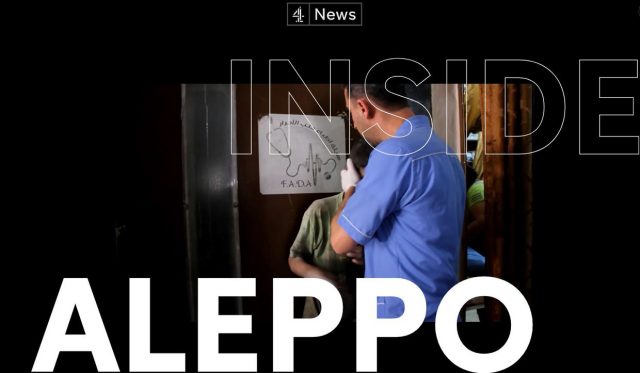
Screenshot taken from Channel 4’s series of reports on Aleppo, provided by Wa’ad Al Kateab
Inside Aleppo consisted of a series of video reports produced by Waad, for Channel4, that claimed to record the daily life inside the extremist group-controlled districts of East Aleppo. Channel 4 accepted and republished these reports without any apparent independent verification or investigation.
Aleppo was Channel 4’s perceived “Guernica,” their reporting was consistently one-sided and partisan towards the “moderate rebels” who, according to the British TV network, were being “disproportionately” targeted by the “dictator Assad” and the Syrian Arab Army. The reality for journalists, like myself, who spent time in Syrian-government secured West Aleppo, sheltering 1.5 million civilians including an estimated 500,000 who had fled East Aleppo when it was invaded by armed militants in 2012, was diametrically different from the narrative being marketed by Channel 4 and the majority of state-aligned media in the West. Aleppo, according to residents, was opposed to the “revolution” from day one.
Channel 4 normalising terrorism and extremism
Channel 4’s reporting in Aleppo and Syria has almost invariably presented the child-beheading, ethnic-cleansing sectarian groups as “rebels with a cause.” In a 2016 report, ‘Aleppo: up close with the rebels’, Krishnan Guru Murthy follows none other than members of formerly US-funded Nour Al Din Zinki, responsible for the horrific public torture and decapitation of 12-year-old Palestinian child, Abdullah, in July 2016.
In the same report, Murthy appears to legitimize the armed group strategy of mass suicide bombing as an act of “defense” without mentioning that many of these suicide bombers were targeting civilian and residential areas. Channel 4 removed this report after their lack of recognition of the war crimes committed by its protagonists was exposed.
‘For Sama’ is little more than a compilation of the ‘Inside Aleppo’ reports, skilfully converted into a feature-length documentary that has already been awarded the Bafta for best documentary and is nominated for the Oscars this weekend.
Dedicated to Waad’s daughter, the documentary can only be described as a grotesque misrepresentation of life in East Aleppo under the tyranny of sectarian armed groups. Anyone watching this movie will assume that East Aleppo was the “free country” as described by Waad, besieged and preyed upon by the Syrian government. The film literally airbrushes Nusra Front from the scenario. Groups like Nour al-Din al-Zenki are not referred to, their crimes go unmentioned.
The role of Hamza Al-Kateab affiliated with the armed groups in East Aleppo
Many journalists have pointed out the dangers of working in areas occupied by the militant factions. Waad and her husband have no apparent issues living side by side with groups renowned for their brutal violence against anyone who would challenge their rule. In fact, a number of videos and social media interactions demonstrate the close relationship that Hamza had with members of these groups – in particular with the aforementioned Nour al-Din al-Zenki.
While corporate media and ‘For Sama’ portray Hamza as a compassionate “doctor,” we must ask how deceptive that image is. Many interactions have been deleted from Hamza’s social media accounts but are still available as screenshots. In these interactions Hamza is involved in military strategy discussions with extremist groups. Hamza is clearly aware of the violence and abuse meted out against civilians by the occupying forces but he never condemned it to the media outlets who relied heavily upon his testimony to file their Aleppo reports.
When the terrorists were evacuated from the last district of East Aleppo, Al Sukare, where Al Quds hospital was located, they left behind a deadly trail of mines and booby traps designed to kill civilians returning to their homes. I was, myself, witness to one of these explosions, after a booby trap left in a washing machine was detonated – murdering and injuring civilians on Christmas Eve 2016.
According to social media conversations, Hamza was aware of this heinous practice. He and Waad evacuated at the same time as the armed groups. Therefore, it can be assumed that they knew about the dangers that awaited civilians, yet they apparently did nothing to warn them.
Much of ‘For Sama’ footage is located in the Al Quds hospital which was, itself, the center of controversy in East Aleppo when Doctors without Borders (MSF) declared it “destroyed” by a Russian airstrike in May 2016. Various independent researchers and journalists exposed this narrative as misleading and unsubstantiated.

Screenshot from movie ‘For Sama’ (2019) Dir: Waad Al-Kateab, Edward Watts, Channel 4/PBS Distribution
‘For Sama’ omits the reality that hospitals in East Aleppo were taken over by the armed groups, often converted into military headquarters. The vast complex of the Childrens and Eye hospital was transformed into a torture and detainment center for civilians who did not comply with the armed group ideology or those perceived to be Syrian government-loyalists. After liberation of East Aleppo, civilians testified that they did not receive medical treatment in the remaining hospitals which were effectively militant triage centers. I spoke with children and teenagers whose injured limbs had been amputated by the so-called medical staff who preferred such cruel expediency over long-term treatment. Why does ‘For Sama’ not cover any of these inconvenient truths?
The children I interviewed in East Aleppo who were forced to witness public executions and crucifixions, by the extremist groups, are ignored by Channel 4 and ‘For Sama’. Journalists like Theo Padnos and Matthew Schrier, who were imprisoned and tortured by the armed groups in the Eye Hospital compound are not referred to.
The mortars fired daily into West Aleppo by the militants that Waad does not refer to were responsible for thousands of civilian deaths and the maiming of countless more who lost limbs in the rain of lethal “Hell-cannon” gas canister missiles or were sniped in the streets that bordered the Nusra Front-dominated enclaves.
The 2013 Queiq River narrative explained
The 2013 River Queiq massacre is portrayed, in the film, as a Syrian government crime, the gory scenes exploited to further criminalise the SAA. If Channel 4 had conducted any kind of investigation into this event, they might have fulfilled their duty to provide context and evidence that would have better informed their audiences in the West. Channel 4 must be considered grossly negligent in their distorted representation of the Syrian conflict.
Aleppo-based journalist, Khaled Iskef, did exactly this investigation over a period of years before Al Mayadeen channel published his findings based upon forensic DNA reports and witness testimony. ‘For Sama’ glosses over fact in favor of propaganda and denies justice for the victims of extremist violence & brutality. According to Iskef’s evidence, River Queiq was a convenient dumping ground for these armed groups to dispose of evidence, Waad and Channel 4 have apparently provided cover for the crimes they committed.

Screenshot from Khaled Iskef documentary on the 2013 River Queiq massacre, blamed on the Syrian government
Channel 4, media architects of war
It is no surprise that Channel 4 has been instrumental in the production of ‘For Sama’. I have extensively documented the channel’s role in the behind-the-scenes management of other such revisionist projects on Syria. The White Helmets, another terrorist-linked entity operating in East Aleppo, produced an award winning, Oscar nominated movie, ‘Last Men in Aleppo’, which also eradicated the presence of extremist fighters and terrorist groups from the conflict landscape – reducing the narrative down to “bad Assad” and “good rebels.”
Channel 4 were among the hidden architects of this production and were also at the forefront of support for the White Helmets Nobel Peace Prize nomination while this UK/US funded group stands accused of all manner of war crimes by the Syrian people who lived under militant-group-occupation across Syria.
‘For Sama’ is an exploitative and well packaged instrument of injustice. It is an attempt by governments and media in the West to rewrite history, to erase their shameful role in maintaining a nine-year conflict, in Syria, based on lies and obfuscation of fact.
If you were to speak to the Syrian people in Aleppo who lived through the period covered by ‘For Sama’, they would tell you that this film does not represent their suffering or abuse at the hands of the armed gangs. They would tell you that ‘For Sama’ effectively defends those who tortured, imprisoned and subjected them to all manner of horror and bloodshed. They would tell you that ‘For Sama’ is just another insult from the billionaire funded PR industry for war that has denied the real Syrian victims a voice for nine years while those who help perpetrate the crimes against them will, once again, be on Hollywood’s red carpet.
Vanessa Beeley is an independent journalist and photographer who has worked extensively in the Middle East – on the ground in Syria, Egypt, Iraq and Palestine, while also covering the conflict in Yemen since 2015. In 2017, Vanessa was a finalist for the prestigious Martha Gellhorn Prize for Journalism, which was won by the much-acclaimed Robert Parry that year. In 2018, Vanessa was named one of the 238 most respected journalists in the UK by the British National Council for the Training of Journalists. In 2019, Vanessa was among the recipients of the Serena Shim Award for uncompromised integrity in journalism. Follow Vanessa Beeley on Patreon.com and on Twitter @VanessaBeeley.
Erdogan’s biggest gamble yet
The Turkish president’s misguided dispatch of troops to Syria risks an unwinnable showdown with Russia
By Abdel Bari Atwan | Rai al-Youm | February 4, 2020
The Turkish-Syrian clash in Idlib province – resulting in the death of six Turkish soldiers when their convoy was shelled by the Syrian army near the town of Saraqeb – ultimately reflects Russia’s growing frustration with President Recep Tayyip Erodgan. Moscow has lost patience with the Turkish leader’s failure to evacuate terrorist-designated groups and factions from Idlib city under the terms of the 2017 de-escalation agreement.
The Syrian army’s advance in the Idlib countryside, retaking a succession of towns and villages from the Turkish-backed Hay’ at Tahrir ash-Sham (the former Nusra Front) and its allies, left Erdogan in a predicament. With the recapture of the strategic town of Maarat al-Numan and the imminent fall of Saraqeb, he faced the prospect of his allies being ejected from Idlib city too – which would, in turn, cause the flight of tens of thousands of its inhabitants across the Turkish border.
This prompted him to make his biggest gamble since he began his intervention in the Syrian conflict nine years ago. He sent a 350-vehicle military convoy to Saraqeb and fresh arms supplies to the opposition forces defending the town, effectively trashing his understandings with his Russian allies.
The official Russian account, given by Kremlin spokesman Dmitri Peskov, is that the Turks did not inform Moscow of their incursion, and their troops came under fire from Syrian forces targeting terrorists to the west of Saraqeb. Moscow also denied Erdogan’s claim that Turkey launched retaliatory airstrikes in which up to 35 Syrian troops were killed, as did Syria’s official news agency – basically accusing him of lying.
In short, when forced to choose between its Syrian and Turkish allies, Russia opted for the former, having grown weary of Erdogan’s foot-dragging and failure to live up to his commitment in the 2018 Sochi agreement to clear Idlib of terrorist groups.
Erdogan could not, or rather would not, curb Hay’ at Tahrir Ash-Sham and stop it from attacking the Syrian army in the Idlib an Aleppo countrysides. It even launched repeated drone strikes against the Russian airbase at Hmeimim near Latakia. This enraged the Russians and prompted then to launch a joint offensive with the Syrian army to capture Idlib, resorting to the military option after the political option failed.
It is hard to predict how events will unfold. But it is clear that if Turkey persists with its intervention it well end up clashing with the Russians as well as the Syrians – unless Erdogan backs down, as he has done in the past, and seeks a deal or truce with President Vladimir Putin. This would have to be based on a renewed commitment to implementing the Sochi agreement and abandoning the Nusra Front and its allies.
All the makings of a showdown are in place. The Russians and Syrians are not prepared to halt their campaign to retake Idlib, and Erdogan is not prepared to see his allies there defeated and bloodily decimated. Moscow, meanwhile, no longer feels bound by the Sochi agreement after it was broken by Ankara and its clients.
Erdogan is in escalation mode for now. His visit to Kyiv, where he denounced Russia’s annexation of Crimea, was a deliberate jibe, which Putin may not take lightly.
The death and injury of Turkish soldiers in Syria for the first time since the start of Ankara’s intervention in the crisis will also have domestic repercussions for Erdogan. The Turkish public is becoming increasingly hostile to Syrian migrants, and critical of the ruling AK Party in general. It will not easily put up with Turkish boys losing their lives in Syria. The risk of sustaining military casualties prompted a majority of Turks to oppose military intervention in Libya. How about a war of attrition in Syria, against both the Russians and the Syrians?
And what would it be for? Nine years of fighting sponsored by an array of world and regional powers – entailing the expenditure of tens of billions of dollars and the recruitment of 250,000 fighters – failed to bring down the Syrian regime. The despatch of a few thousand Turkish troops to Saraqeb cannot change that reality.
France’s exposure of Turkish arms shipments to Libya and its arrest of Jaish al-Islam spokesman Islam Alloush, and Russia’s bombing of the Nusra Front in al-Bab, serve as a message to Turkey. They signal that times have changed and that its adversaries are growing in number.
But will the message be received and acted upon? Or will Turkey continue walking into the traps set for it by the US – first in Syria, now in Libya, with Russia as a principal adversary in both cases – with eyes wide open?
Russia rejects Turkish narrative on Syria
By M. K. BHADRAKUMAR | Indian Punchline | February 7, 2020
The Russian reaction to Turkey’s latest military moves in the northwestern Syrian province of Idlib has appeared in the form of a lengthy interview with the government daily Rossiyskaya Gazeta by Foreign Minister Sergey Lavrov on February 4, which has since been followed by a formal statement by the foreign ministry on Thursday.
Moscow has underscored that the current Syrian operation in Idlib is about vanquishing the al-Qaeda affiliates supported by Turkey and the western countries.
Lavrov dwelt on the backdrop to the so-called Astana format, which resulted from the collapse of the regime change project of “our Western and other foreign partners” in Syria following the Russian intervention in 2015.
He outlined how the Astana process led to the “de-escalation zone” in Idlib where “terrorist groups herded together”. Russia and Turkey reached specific written agreements spelling out their commitments to oversee Idlib. However, to quote Lavrov,
“Regrettably, so far, Turkey has failed to fulfil a couple of its key commitments that were designed to resolve the core of the Idlib problem. It was necessary to separate the armed opposition that cooperates with Turkey and is ready for a dialogue with the government in the political process, from the terrorists of Jabhat al-Nusra, which became Hayat Tahrir al-Sham. Both are blacklisted as terrorist groups by the UN Security Council, so neither Jabhat al-Nusra nor the latest version, Hayat Tahrir al-Sham, has anything to do in Idlib.”
Even after repeated reminders from Russia, Turkey didn’t act. Equally, Lavrov repeated that the recent Turkish military deployments to Idlib were undertaken without any advance intimation to the Russian side. He said, “We urge them (Turkey) to strictly comply with the 2018 and 2019 Sochi accords on Idlib.”
The Russian Foreign Ministry statement of February 6, as reported by Tass news agency, disclosed that there have been Russian casualties due to the “increasing terrorist activities.” It justified the operations of the Syrian government forces as reaction to “the unacceptable rise in terrorist activities.”
Through the month of December, “over 1,400 militant attacks involving tanks, machine guns, infantry fighting vehicles, mortars and artillery took place.” During the past fortnight alone, “more than 1,000 attacks have been recorded” and hundreds of Syrian troops and civilians have been killed and wounded and the Russian base at Hmeymim came under attack repeatedly.
The foreign ministry statement says, “all this points to an unacceptable increase in terrorist strength in Idlib, where militants have complete impunity and free hands” which left the Syrian government with no alternative but to “react to these developments.”
In a rebuff to Turkish President Recep Erdogan’s demand that the Syrian government should terminate the military operations in Idlib and withdraw, the Russian statement said, “A thing to note is that the Syrian army is fighting on its own soil against those designated as terrorists by the UN Security Council. There can be no interpretations. It is the Syrian government’s right and responsibility to combat terrorists in the country.”
Curiously, both Lavrov’s interview as well as the Foreign Ministry statement drew attention to the transfer of terror groups from Idlib to northeastern Syria and from there to Libya in the recent weeks. The implication is clear — Ankara continues to deploy terrorist groups as tools of regional strategies in Syria (and Libya).
Russia has contacts with all parties in Libya, including Khalifa Haftar. The implicit warning here is that Erdogan will have a high price to pay in Libya where he cannot count on Russian empathy. Turkey is already under withering criticism from EU, France, Italy, Greece, Cyprus, Israel, UAE and Saudi Arabia for its military intervention in Libya, especially by deploying its proxy groups from Syria. Turkey’s regional isolation over Libya is now complete.
The Russian Foreign Ministry statement concluded saying, “We reaffirm our commitment to the agreements reached at the Astana talks, which envisage fighting terrorist groups in Syria on the condition of respect for the sovereignty and territorial integrity of the country. We will maintain close coordination with our Turkish and Iranian partners for the sake of achieving lasting stability and security on the ground.”
It is highly significant that the Foreign Ministry statement singled out the “Iranian partners” for reference. On February 5, while receiving the new Iranian ambassador to Moscow, President Putin also said Russia and Iran were “key powerful players” in the fight against global terrorism and will continue their cooperation. Putin added, “(Russia’s) cooperation with Iran within the Astana framework has played an effective role in the settlement of the Syria conflict.”
What emerges is that Moscow senses that behind Turkish president Erdogan’s mercurial behaviour, there is the old pattern of Turkey using terror groups as proxies, with covert support from western powers. Moscow cannot but be aware that the US is making overtures to Erdogan with a view to shift the military balance against Russia and Iran on the Syrian-Iraqi chessboard in the downstream of the killing of General Qassem Soleimani.
Curiously, on Monday, a US appeals court agreed to “pause” a case alleging that Turkey’s state-owned HalkBank evaded US sanctions on Iran. The US Senate Finance Committee member Ron Wyden, a Democrat, has since addressed a letter to the US Attorney General William Barr asking if President Trump had tried to intervene on behalf of Halkbank!
A Reuters report said Senator Wyden asked Barr to detail his interactions with Trump, President Tayyip Erdogan and Turkish Finance Minister Berat Albayrak (who is also Erdogan’s son-in-law).
The HalkBank scandal implicates Erdogan and family members and an adverse court verdict can be highly damaging politically to the president and his son-in-law who is groomed as a potential successor. (A commentary on the scandal featured in the Foundation for Defense of Democracies authored by a former Turkish member of parliament is here.) The HalkBank case hangs like the sword of Damocles over Erdogan. Washington is adept at using such pressure tactics against recalcitrant interlocutors abroad.
On the other hand, if Trump has done a favour to Erdogan (or anyone for that matter), he’d expect a quid pro quo. And it is to be expected that the Trump administration would visualise that Erdogan’s cooperation can be a game changer in the geopolitics of Syria and Iraq. However, Moscow has kept the line open to Ankara.
To be sure, it is with deliberation that Moscow has highlighted the salience of the Russian-Iranian alliance in Syria where Washington is escalating tensions lately as part of its “maximum pressure” approach threatening Tehran with a region-wide war.
Israel uses civilian flight as shield to raid Damascus after Syrian troops liberate Saraqib
Press TV – February 7, 2020
An Israeli airstrike, carried out as Syria troops were liberating the terrorist-held town of Saraqib in northwestern Idlib province, has endangered a civilian flight carrying 172 passengers, according to the Russian Defense Ministry.
Defense Ministry spokesman Major General Igor Konashenkov said Friday the civil Airbus-320 was heading to Damascus from the Iranian capital early Thursday when it was forced to divert its route as the Syrian capital’s air defenses were intercepting Israeli missiles.
The plane made an emergency landing in the Hmeymim air base in Syria’s western coastal province of Latakia.
“Only due to timely actions of the Damascus airport dispatchers and the efficient operation of the automated air traffic control system, the Airbus-320 managed to… successfully land at the closest alternative airfield,” Konashenkov said.
‘Israel using passenger jets as shields’
The spokesman stressed that Israel was well aware of civilian flights around Damascus and that such missions demonstrated the regime’s reckless disregard for human lives.
“The Israeli general staff’s use of passenger jets as a cover for its military operations or as a shield from Syrian missile system fire is becoming a typical trait of Israeli air force,” he said.
Russia had previously warned that Israeli airstrikes against Damascus were endangering civilian jets.
Lebanese officials have also stated that Israeli jets illegally conducting operations against Syria from the country’s airspace pose a danger to civilian aircraft in Lebanon.
In 2018, Syrian air defenses mistakenly shot down a Russian Ilyushin Il-20 reconnaissance plane after it was similarly used as a cover by Israeli warplanes, killing 15 people on board.
Syria: Saraqib fully liberated
The Israeli airstrikes took place as Syrian troops were entering the terrorist-controlled town of Saraqib, which lies at the crossroads of two key highways in the Idlib province, the last major terrorist bastion in Syria.
The town has currently been fully liberated by Syrian forces.
Damascus has highlighted that the Israeli airstrike on Thursday happened at the same time the Turkish military was deploying a military caravan in Idlib to “protect the terrorists” and halt the Syrian military advance in the province.
Damascus has slammed the operation as evidence of Tel Aviv and Ankara’s coordinated support for the terrorists.
Israel is known for conducting airstrikes against Damascus during major Syrian military advancements.
The reported joint Israeli-Turkish operations in Syria come as Ankara – which has also been a major backer for terrorists in Syria – has warned that it may resort to military action if Syria does not withdraw its troops battling terrorist forces in Idlib until the end of February.
The ongoing Syrian army offensive in Idlib was launched last August after terrorists failed to honor the Sochi de-escalation zone agreement brokered between Russian and Turkey in September 2018.
Large swathes of the province have since been liberated by Syrian troops.
Tehran offers mediation, stresses political resolution
Iran’s Ambassador to the United Nations Majid Takht-Ravanchi said Iran, as a main party to the Astana peace process, was ready to help solve disputes between Damascus and Ankara regarding the Idlib province.
“We have to guarantee that this crisis is solved politically while at the same time prohibiting terrorists from using this as an opportunity to fortify their positions, turn Idlib into a safe refuge and target more civilians,” he said.
“We have to be aware that the goal of protecting civilians doesn’t get replaced with protecting terrorists,” he added.
The UN envoy added that an Astana meeting, which is planned to be held in the near future in Tehran, provides an “indispensable opportunity” to resolve issues related to the Syria conflict.
The Astana peace process was launched by Iran, Turkey and Russia in 2017 and had a major role in reducing violence in the country by agreeing to de-escalation zones in the war-wracked country.
Syrian Army captured Saraqib. Netanyahu and Erdogan come to the rescue
South Front | February 06, 2020
In Greater Idlib the defences of Hayat Tahrir al-Sham and other favorites of the foreign powers supporting ‘Syrian democracy’ are collapsing.
On February 5, the Syrian Army, supported by Russian airpower, took control of a number of villages in southeastern Idlib and southwestern Aleppo including Resafa, al-Dhahabiyah, Ajlas, Talafih and Judiydat Talafih. They besieged a Turkish observation post established near Tal Toqan and reached another one, near al-Sheikh Mansur.
Late on the same day, the army’s Tiger Forces captured the eastern entrance to Saraqib and established fire control over the open roads leading from the town. According to local sources, Hayat Tahrir al-Sham and other al-Qaeda so-called freedom fighters started fleeing the town. The Turkish Army had stuck several observation posts right in the area, but these apparently did not help.
Early on February 6, pro-government forces seized the area of Duwayr, cutting off the M5 highway north of Saraqib. Thus, the road through Saramin remained the only way to flee for militants remaining in the town. However, it is under the fire control of the Syrian Army.
Several hours after this government forces took full control of Saraqib.
Saraqib Nahiyah is the largest subdistrict of the Idlib district of the province. The subdistrict is located on the crossroad of the M4 and M5 highways. Its pre-war population was approximately 88,000. The fall of Saraqib into the hands of Damascus and its allies will allow government troops to continue the operation clearing the entire M5 highway and open the road to Idlib city itself.
Right on cue, while the Syrian Army was storming Saraqib, the Israeli Air Force delivered a wide-scale strike on targets in the countryside of the Syrian capital, Damascus, and in the province of Daraa. The Al-Kiswa area, Marj al-Sultan, Baghdad Bridge and the area south of Izraa were among the confirmed targets of the attack.
Syria’s State media claimed that the Syrian Air Defense shot down most of the Israeli missiles before they were able to reach their targets. Pro-Israeli sources claim that the strikes successfully hit Iran-related targets destroying weapon depots and HQs of Iranian-backed forces. The Israeli leadership once again officially confirmed its participation in the club of terrorism supporters in Syria.
Another member of the al-Qaeda Rescue Rangers is Mr Recep Tayyip Erdogan.
On February 5, he vowed that Turkey would deploy locally made air-defense systems along the border with Syria. The President did not provide many details on the matter, but the aforementioned systems were likely the HISAR-A low-altitude air-defense system which will be deployed along the border with Idlib.
Additionally, Erdogan delivered an ultimatum to Syria claiming that “if the Syrian regime will not retreat from Turkish observation posts in Idlib in February, Turkey itself will be obliged to make this happen.” In other words, the Turkish president threatened to declare war on Syria if the Syrian Army does not withdraw from the territory it liberated from terrorists.
Kurdish-led forces in Syria say they will keep conscription system
MEMO | February 4, 2020
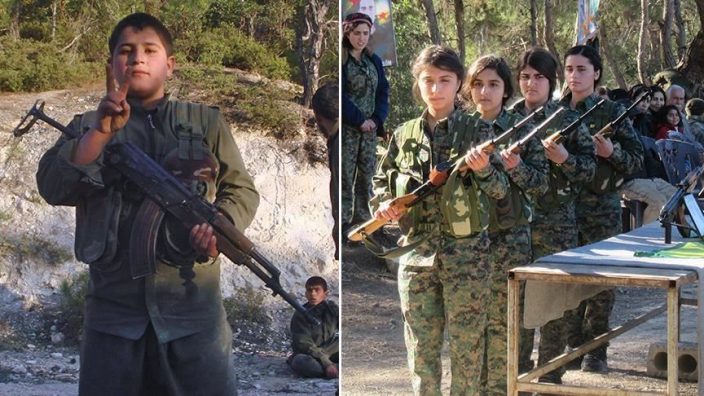
A senior Kurdish official in the “Defence Board” of the so-called Autonomous Self-Administration in Syria’s northeast town of Ain Al-Issa has stated that there are no plans to stop the controversial forced military conscription of young men in the Syrian territory currently controlled by Kurdish-led forces, known as the Syrian Defence Forces (SDF).
According to Kurdistan24 Shirin Qamar, co-chair of the Board, reiterated the decision to keep the system in place, describing the military service as “for the sake” of the defence of their homeland.
“The process is known to everyone: it includes 45 days of patriotic education and self-knowledge, as well as military training. And later on, they serve their homeland in the position of border guards,” she explained.
The Kurdish administration passed their own law making conscription compulsory in the “autonomous areas” on 14 July 2014, which was implemented in November of the same year on military-aged men and applies to all men regardless of their ethnic or religious background and regardless of whether they have previously served in the Syrian-state army.
However, every local authority in Kurdish-controlled Syria has the right to decide its own military conscription age, leading to complaints against discrimination and inconsistency.
There are documented allegations of child soldiers serving in the SDF, despite an order issued banning their recruitment in 2018.
The SDF has received funding and arms from the US to aid its efforts to combat Daesh. The force consists largely but not exclusively of YPG fighters, which is considered to be the Syrian faction of the terrorist PKK organisation. It has recently been reported that Saudi and US officials have held talks on potentially financing Arab factions who are currently affiliated to the SDF, under the pretext of “resisting the Iranian expansion attempts” in the country.
Al-Qaeda’s Air Force? Erdogan Protecting HTS in Idlib, Threatens to Attack Advancing Syrian Army

21WIRE | February 3, 2020
Over the last few months, the Syrian Arab Army (SAA) and its Russian allies have been advancing into the heart of Idlib province – the last remaining terrorist stronghold in Syria. Not everyone is happy about the effort by Damascus to retake is own territorial areas in the north, not least of all Turkish President Recep Tayyip Erdogan, who is now threatening the SAA and its allies with military force if they continue with operations to dislodge Turkish and US-backed terrorist forces currently holed up in Idlib, and neighboring Afrin.
The stakes increased over the last 24 hours, after Turkey claimed that the SAA had killed 6 of its ‘soldiers’ and injured many others, after coming under heavy fire from the SAA. This incident comes after reports of a large Turkish military convoy which had entered Idlib via the “Kafr Loosen” crossing, supposedly to help ‘monitor a ceasefire’ from one of its numerous (and increasingly notorious) “observation posts” which are dotted conspicuously in parallel to positions held by terrorist group Hay’at Tahrir al-Sham (HTS) formerly known as Jabhat al-Nusra (al-Qaeda in Syria).
‘Al-Qaeda’s Air Force’ over Syria
The Turkish Ministry of Defense have issued a statement today claiming that its forces came under heavy artillery fire in the northern Syria, and that its forces have since retaliated by attacking ‘unspecified’ SAA targets in the area. Thus far, these reports are unconfirmed. If true, then NATO-member Turkey is now performing the function of al-Qaeda’s Air Force over Syria.
Under the Astana Peace Process, stakeholders Russia, Turkey and Iran all agreed to a designated “de-escalation zone” in Idlib in order to calm down fighting in the region and help to deal with the movement of refugees and IDP’s (internally displace persons). Unfortunately, Turkish and US-backed terrorist forces have conveniently gamed the de-escalation zones in order to attack Syrian government forces and maintain an air of destablization, which has kept the status quo of terrorist occupation in lace. Turkey is clearly on board with this alternative agenda and is supporting HTS and other terrorists factions where it can.
Strangely, Turkey is still claiming dominion over sovereign Syrian territory, now erroneously claiming that advances by the SAA in its own country are going to cause an influx of refugees into Turkey and therefore any advances by Syria to retake its own land must cease in order to “save the refugees.” Clearly, this is a well-worn ploy by now, used ad nauseum by both Turkey and the US and its coalition partners – in order to keep Syria from liberating the entirety of its country.
One of the main problems with Turkey’s story is that it’s becoming increasingly difficult to tell who, and who isn’t, part of Turkey’s ever-changing military forces. Recently, Ankara has officially absorbed the former Free Syria Army (FSA) under its military wing, but to make matters more confusing, this new Turkey-based division (comprised mainly of western and gulf-backed terrorist fighters) has been misleadingly named The Syrian National Army (SNA), presumably to represent a military wing of the Syrian opposition in exile currently based in Istanbul. As 21WIRE revealed in 2019, this new SNA has numerous ISIS and al Qaeda in its ranks.
Accusation of its terrorist deployments have also emerged in Libya, where Turkey is backing the Tripoli-based Government of National Accord and has sent mercenary ‘troops’ (former FSA terrorists, now under the SNA banner) to Libya support to help repel an offensive led by Gen. Khalifa Haftar in January.
Undoubtedly, Turkey’s increasing use of terrorist brigades is damaging its legitimacy as a NATO member.
Questions About Turkey’s Supposed ‘Retaliation’ Against SAA in Idlib
Soon after last night’s altercation, western mainstream media have reported that 13 Syrian troops were killed by Turkey, while Erdogan himself released announcements claiming his forces had killed some 30 or more Syrian Army soldiers in a retaliatory air and artillery strikes against SAA positions. However, both Syria and Russian officials have so far reported that no such Turkish response took place. Syria News reports:
“The Turkish ministry, like its president, lied to their people by adding: the Turkish forces responded to the attack and destroyed ‘enemy targets’ in Idlib, claiming that the Syrian forces carried out the attack despite being informed beforehand of the position of the Turkish forces.
(…) The Turkish madman criminally announced that his regime forces will remain on the Syrian territories and lied that they have retaliated against the Syrian Army killing 30 soldiers. Erdogan added that his fighter jets bombed Syrian posts, claims fake verified by Erdogan and his propaganda machine, no other source about any Turkish response.
The only response was the Turkish war ministry complaining to the Russian Reconciliation Center in Syria, which in turn replied they had no advanced information about Turkish troops entering Syria, not coordinated with them, and they have not recorded any Turkish retaliation and definitely no Turkish fighter jets breaching Syria’s air space.”
The ambiguity in Turkey’s reporting shows that Ankara is now struggling in the public relations war, as its international reputation continues to come under fire.
For the last few years, Syrian President Bashar al-Assad has consistently vowed that, “Every inch of Syria will be liberated.”
The question now remains: have Ankara and Washington been listening?
How goes the war?
By Paul Robinson | Irrussianality | February 1, 2020
This week brought a bunch of news about the wars in the Middle East and Central Asia. In Afghanistan, the United States and its allies have been directly involved in fighting the Taleban for over 18 years. In Syria, they’ve attempted to overthrow the government of Bashar al-Assad with the help of proxies in various forms, who are now holed up in an ever-shrinking enclave in Idlib province. And in Yemen, they’ve been backing the Saudis in their attempt to reinstall Adrabbun Mansar Hadi as president in the Yemeni capital Sanaa, now under the control of the Houthis. So, how go America’s wars?
First, Afghanistan:
A few days ago, the Special Inspector General for Afghanistan Reconstruction (SIGAR) released his latest quarterly report to the US Congress. According to an email I got from SIGAR’s office, the key points of this report include the following:
- Enemy-initiated attacks (EIA) and effective enemy-initiated attacks (EIA resulting in casualties) during the fourth quarter of 2019 exceeded same-period levels in every year since recording began in 2010.
- The month of the Afghan presidential election (September 2019) saw the highest number of EIA in any month since June 2012, and the highest number of effective enemy-initiated attacks (EEIA) since recording began in January 2010. The high level of violence continued after the presidential election; October 2019 had the second highest number of EIA in any month since July 2013.
- According to the UNODC, the overall value of opiates available for export in Afghanistan in 2018 (between $1.1 billion and $2.1 billion) was much larger than the combined value of all of the country’s licit exports ($875 million).
- As of December 18, conflicts had induced 427,043 Afghans to flee their homes in 2019 (compared to 356,297 Afghans during the same period in 2018).
- Between November 2019 and March 2020, an estimated 11.3 million Afghans – more than one-third of the country’s population – are anticipated to face acute food insecurity.
I think that gives a good enough impression. Eighteen years on, things aren’t going so well in Afghanistan.
So what about Syria?
About a week ago, government forces (the Syrian Arab Army (SAA)) launched a two-prong offensive against what were once US-proxy forces in Idlib, but might now be more accurately described as Turkish proxies. News reports suggest that casualties have been heavy on both sides, but the results from the SAA point of view have been very satisfactory. In the north, the SAA advanced a short distance south west of Aleppo, but the real progress was further to the south, where the SAA smashed through the rebel defenses and advanced rapidly to seize the town of Ma’arrat al-Numan, as shown in this map:

Since this map was produced, the SAA have advanced even further, continuing northeast up the M5 highway from Ma’arrat as far as the town of Saraqib. How much further they will go before pausing remains to be seen. But one thing is clear – bit by bit, the rebels in Idlib are being squeezed out. Once they’re gone, the war in Syria will be all but over. The attempt to topple Assad has failed.
Which brings us to Yemen.
As you may recall, in September last year the Houthis crushed a Saudi incursion into northern Yemen, capturing large numbers of prisoners and armoured vehicles. After that things quieted down for a bit, until about a week ago when Saudi-backed forces launched an offensive to the east of Saana in the province of Marib. Before long, the Houthis counter-attacked, with devastating consequences. According to one news report:
Hadi’s forces are now on the back foot. Where once they spoke about taking the Houthi-held capital Sanaa, now they discuss ways to defend Marib, a strategic oil and gas hub. … Ibrahim, a pro-government fighter in Marib province, said that some loyalist soldiers ‘betrayed’ them and withdrew from battles, causing sizeable losses amongst their troops. ‘We were planning to advance towards Sanaa, but our attempt was hindered by the withdrawal of a battalion of soldiers, which gave the Houthis a chance to attack us … This was a betrayal by the soldiers and their leaders.’
Houthi sources claim that Saudi-backed forces suffered 2,500 casualties, and that the Houthis captured 400 pieces of equipment, including tanks, armoured personal carriers, and multiple rocket launch systems. The Saudi defeat has gone just about unnoticed in the English-language media but, for anybody interested, Russian blogger Colonel Cassad has published a bunch of Houthi photographs and videos, such as the picture below, showing the results of the battle (here and here). They make for interesting viewing.

Putting this all together, what we see is the Americans and their allies losing not just one, not just two, but three wars simultaneously. It’s quite something. A few days ago, news emerged that US president Donald Trump had denounced his generals as ‘losers’ and ‘a bunch of dopes and babies’. The story was treated by pretty much everybody as yet more evidence of Trump’s unsuitability to be president. But given the news from the front this week, I have to think that Trump got it right. ‘I wouldn’t go to war with you people’, Trump allegedly told the generals. If only the president took his own advice.
Why Turkey won’t hitch Syrian wagon with US
By M. K. BHADRAKUMAR | Indian Punchline | February 1, 2020
The remark by President Recep Erdogan on Friday that Turkey might militarily intervene in Syria’s northwestern Idlib province fuelled speculation that tensions between Ankara and Moscow have reached a point of no return.
However, this is nothing but wishful thinking. The calm rebuttal by the Kremlin spokesman Dmitry Peskov signalled a measure of confidence that Moscow’s ties with Turkey are in no such danger. Peskov said in measured tone, “We don’t agree with this view [of Erdogan]. Russia is in full compliance with the Sochi agreements on the Idlib zone. At the same time, we regret to say that the situation is far from perfect.”
He added that “a large number of terrorists remain in the area and continue aggressive attacks on the Syrian army and Russia’s Hmeymim air base. It causes us huge concern.”
Moscow is on strong ground. Turkey failed to honour its commitment under Sochi agreements to separate the ‘moderate’ groups supported by it from the al-Qaeda affiliates ensconced in Idlib (also with covert support from outside.) Besides, the Sochi agreements on Idlib do allow operations against extremist / terrorist groups.
Peskov’s ‘reasonableness’ suggests that Moscow is seeking Erdogan’s understanding and wouldn’t want the US to exploit the Turkish disquiet over any refugee influx from Idlib. The US is already fishing in troubled waters, as evident from the sudden visit to Ankara on Friday by Gen. Tod Wolters, commander of the US European Command and NATO Supreme Allied Commander-Europe.
The US doesn’t want the Russian-Syrian operation in Idlib (with the participation of the Iran-trained militia groups) to make headway and wrest control of the sole remaining preserve of the al-Qaeda affiliates armed and equipped by western powers.
Wolters’ mission to Ankara also aimed at persuading Turkey to help eject the Russian military presence in northeast Syria, which the US regards as its exclusive zone. The Pentagon wants to revive its deal with Turkey establishing a ‘safe zone’ 145 kilometers in length and 30 km in depth in northern Syria, with the US undertaking that its Kurdish allies would be withdrawn from that area. (The US didn’t keep its word and Turkey eventually struck a deal with Russia on similar lines.)
Interestingly, on the eve of Wolters’ arrival in Ankara, Russian and Turkish forces conducted yet another joint patrol in the countryside of Al-Darbasiyah and Ras Al-Ain in the northeast extreme of the Turkish-Syrian border. Despite the US provocations to make life difficult for the Russian military presence in that remote Kurdish region near Iraq, Russian forces have dug in, which of course is also in Turkish interests.
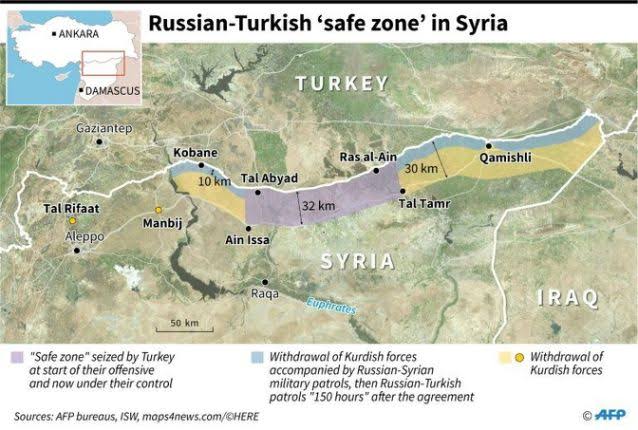
The Russian objective is to steadily expand the Syrian government control of the border regions with Turkey, which would incrementally lead to direct dealings between Ankara and Damascus on issues of border security. In sum, Moscow doesn’t seem to be unduly perturbed that the US is about to get back into bed with Turkey.
Turkey harbours serious misgivings about the US intentions regarding Kurds. Ankara has failed to break the nexus between the US and the Kurdish militant groups and if anything, the Pentagon commanders are lately rather blasé about the axis. Therefore, Turkey cannot afford to put its eggs in the American basket when it comes to northeast Syria.
Importantly, the suspicion is deep-rooted in the Turkish mind that the 2016 coup attempt against Erdogan by the movement led by Islamist preacher Fethullah Gülen (who lives in exile in the US since 1998) was supported by the US military and intelligence circles.
Meanwhile, US-Turkey relations may become toxic what with the US prosecutors in New York asking a federal judge on January 21 to impose escalating fines on Turkey’s state-owned Halkbank for failing to respond in court to criminal charges that it helped Iran evade US sanctions. The proposed fine on the bank is a $1 million-per-day fine – a penalty that would double for each week of further non-compliance. It could total $1.8 billion after eight weeks.
The case against Halkbank has been a longstanding point of tension in the increasingly fraught relationship between Ankara and Washington. Some analysts estimate that it is the single most explosive issue that could blow up the Turkish-American relationship.
If Halkbank decides to acquiesce and appear in court, the case will tarnish the reputation of the Erdogan government. The case implicates senior Turkish ministers, top Halkbank executives and even Erdogan and his family members as beneficiaries of the sanctions-busting efforts.
On the other hand, if the Halkbank insists on its civil contempt of court, that might ultimately severe its ties with the US financial system, hurting not only the bank but also Turkey’s financial sector, and send Turkish-American relations into a free fall.
Can the Trump administration intervene in the Halkbank case and rescue Erdogan? That likelihood can also be ruled out in the downstream of the reported allegation by former NSA in the White House John Bolton in his upcoming memoirs that Trump who has a property in Turkey was inclined to grant favours to Erdogan.
In such a sombre backdrop, it is highly improbable that Erdogan can afford to hitch Turkish wagons with the US. Having said that, Erdogan is under pressure from Turkish public opinion on the refugee problem. He may have to be seen doing ‘something’ to stall the Syrian offensive in Idlib.
No doubt, Ankara has sharpened its messaging but there is no clear Turkish strategy in view. The only viable option will be to accept the new facts on the ground. Possibly, as happened so often before, President Vladimir Putin will step in at some point to hold Erdogan’s hand.
Americans Keep Putting Up Roadblocks Against Russian Troops on Key Syrian Highway
By Marko Marjanović | Anti-Empire | January 29, 2020
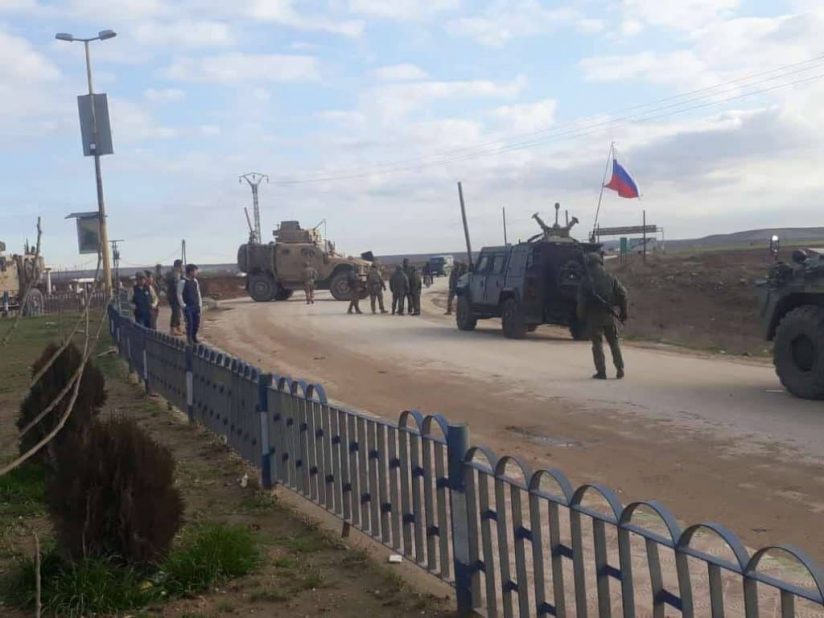
This is now the fourth time this has happened that we know of. US troops in northeastern Syria keep blockading the M4 highway to prevent Russian troops from moving on it.
In fall of 2019, to prevent a Turkish invasion of the Kurdish-held northeastern Syria, the Pentagon hammered out a deal with the Turks for joint US-Turkish patrols on the Syrian side of the Syrian-Turkish border.
As soon as that happened however Trump, after a talk with Erdogan, declared and ordered a US military withdrawal from Syria. At this moment Russia jumped in and took over the US role in the formerly US-Turkish agreement. To minimally appease Erdogan and limit his invasion it would now be Russians who patrolled together with the Turks, which was welcomed by the Kurdish leadership.
In separate negotiations with the Kurds the Russians also gained a number of bases in the northeast to make the patrols possible, and thousands of Syrian army troops also poured in to reinforce the Kurds against the Turkish invasion in the limited sector it was taking place in.
At this point Trump reversed himself, saying US forces would stay in Syria, but only in the oil-rich parts. But the withdrawal from the Syrian-Turkish border, where US presence had hampered US-Turkish relations, would be permanent.
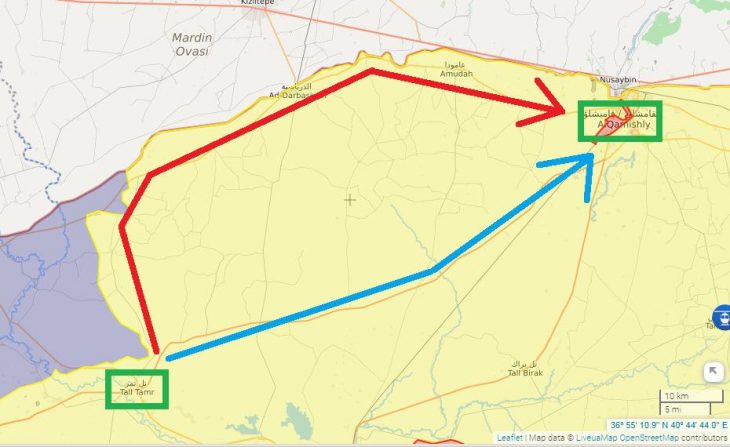
Blue is the obvious path, but the Americans insist the Russians must hug the border along the red path
What is happening now is that when the Russians coming from the west want to take the direct and obvious route to their facilities in the city of Qamishli they periodically encounter US troops near the town of Tell Tamr standing in their way.
The Americans block the road with their vehicles and demand the Russians take the longer, indirect way to Qamishli along inferior roads hugging the Syrian-Turkish border.
Featured Video

Chinese jet fuel and the myth of energy independence
or go to
Aletho News Archives – Video-Images
Book Review
Former Insiders Criticize Iran Policy as U.S. Hegemony
By GARETH PORTER | CounterPunch | February 27, 2013
“Going to Tehran” arguably represents the most important work on the subject of U.S.-Iran relations to be published thus far.
Flynt Leverett and Hillary Mann Leverett tackle not only U.S. policy toward Iran but the broader context of Middle East policy with a systematic analytical perspective informed by personal experience, as well as very extensive documentation.
More importantly, however, their exposé required a degree of courage that may be unparalleled in the writing of former U.S. national security officials about issues on which they worked. They have chosen not just to criticise U.S. policy toward Iran but to analyse that policy as a problem of U.S. hegemony. … continue
Blog Roll
 Aletho News
- What is fueling unrest across the EU?
- Why no power can undermine Iran’s eternal dominance over the Strait of Hormuz
- Is The War Against Iran Over?
- Iran war will leave long-term ‘scar’ on Wall Street, investors warn
- How Iran decimated US power projection in West Asia: Military lessons of 40-day war
- Iran’s report details US-Israeli war crimes in targeting schools, hospitals, livelihoods
- NATO’s Slow Fracture: How Trump’s Iran War Exposed the Instrument of Hegemony
- Chinese jet fuel and the myth of energy independence
- Ukraine Sea Drone Fired From Libya Hit Russian Tanker in Mediterranean
- IRGC: Iranian forces launched no attacks during ceasefire hours
- If Americans Knew
- Military aid to Israel emerges as the latest political litmus test for Democrats
- The only Palestinian children’s rights organization closes following years-long Israeli campaign against it
- ‘I Can’t Forget the Smell’: Lebanese Reel After Israel Kills Over 300 in Single Day
- DNC Shoots Down Resolutions Calling Out AIPAC and Limiting Arms to Israel
- TCN: Is Israel Blackmailing President Trump?
- Israel killed at least 303 Lebanese yesterday – who were they? Daily Update
- Amnesty: Urgent – Protect Lebanese civilians from brutal escalation in Israeli attacks
- Is The War Against Iran Over?
- Inside the Israeli army’s propaganda wing
- Hundreds of Gaza Amputees Stranded in Legal Limbo
- No Tricks Zone
- New Study: No Linear Warming Or Glacier Retreat Along Northern Antarctic Peninsula Since 1980s
- An Inconvenient Tree: Uncovered In Alps… Europe Much Warmer Than Today 6000 Years Ago
- New Study Reports A 60% Slowdown In Greenland’s Ice Loss Rate In The Last Decade
- Low Intensity Tornado Wrecks Major Solar Farm, Creating A Potential Toxic Dump
- New Study Finds Warming Saves Lives…Cold Temperatures 12 Times More Deadly Than Excess Heat
- German Science Blog Accuses PIK Climate Institute Of Hallucinating Climate Tipping Points
- Devastating Assessment Of Comirnaty Vaccine By Former Senior Pfizer Europe Toxicologist
- New Study: CO2 Is ‘Effectively Negligible’ As An Explanatory Climate Change Factor Since 2000
- Former Pfizer Toxicologist Dr. Helmut Sterz Tells Bundestag Hearing Pfizer Vaccine Should Have Never Been Approved
- Energy Expert: Germany’s Nuclear Phaseout Was A “500 Billion Euro Mistake”
 Aletho News