And now, a message from our wannabe masters about Syria
The Saker | October 16, 2019
this just came to my inbox:
Dear The Saker,
The American Jewish Congress opposes the U.S. decision to withdraw troops from Syria and strongly condemns Turkey’s actions in Syria against the Kurds. In addition to endangering a U.S. ally, the Kurds, it also poses a great threat to Israel and to the region’s stability overall. Israel shares a border with Syria and is affected by what happens within Syria.
Syria has become a hotbed of Hezbollah and Iranian activity, which poses a direct threat to Israel; as a result of this decision, Turkey, Iran and Hezbollah win while Israel loses. Ultimately, the impact of this decision may come to outweigh President Trump’s historic actions in support of Israel. Regional stability and the security of our allies must be paramount for U.S. policy in the Middle East.
Jack Rosen
President
American Jewish Congress

American Jewish Congress
745 5th Ave., 30th Floor
New York NY 10151 United States
Why Interventionists Won’t Help the Kurds
By Jacob G. Hornberger | FFF | October 16, 2019
An interesting aspect of the controversy over Syria is the reaction of interventionists to what they call President Trump’s betrayal of the Kurds. They’re saying that Trump should have kept those 50 U.S. troops serving as a tripwire between Turkish military forces and the Kurds. Removing the tripwire, they say, enabled Turkey to attack the Kurds.
Why is that interesting?
Because, as far as I know, not one single interventionist has traveled to Syria to join up with the Kurds to help them fight the Turkish forces attacking them!
What’s up with that?
After all, let’s keep in mind that it’s really not that difficult for an interventionist to travel to Syria. Just buy a plane ticket, pack your bags, grab your passport, and head on out. No one is going to stop you. Once you get into the Middle East, there will be plenty of people to direct you on how you get to the Kurds.
Then, once you reach the Kurds, just volunteer your services to them. Tell them that you would like to help them. You can be a shooter, or a cook, or a medic. Older interventionists can volunteer to be suicide bombers. What’s important is that you interventionists will be living your principles. You will be helping out people who you ardently believe need help.
As far as I know, not one single interventionist has done that. Instead, they’ve just been filling the newspapers and television talk shows about how important it is that “we” help the Kurds.
Here’s my prediction: Not one single American interventionist is going to travel to Syria to join up with the Kurds and help them out.
Why not?
The reason is simple: Interventionists place a higher value on their everyday lives here in the United States than they do on helping the Kurds. They have jobs. They like going home to their families. They like going on vacation. They like going to sporting events and concerts. They enjoy television. They have hobbies.
All of those things are more important to interventionists than going to Syria to help the people that they say “we” need to help.
Vicarious bravery
There’s that pronoun again — “we.” Interventionists love to use it, they don’t really mean “we” because that pronoun would include them, and they would rather stay here at home than go to Syria to take up arms against the Turks.
By “we,” the interventionists are always referring to U.S. soldiers. Interventionists feel like they are showing how brave and courageous they are by boisterously exclaiming how “we” need to help the Kurds.
What type of “help” are interventionists referring to? Why, military help, of course. They want U.S. soldiers to be killing and dying to help the Kurds, while the interventionists remain here at home going to work, spending time with their families, going on vacation, and attending sporting events and concerts.
Equally interesting, interventionists are willing to sacrifice whatever number of U.S. troops are necessary to keep the Kurds from being killed by the Turks. After all, don’t forget: the purpose of using those 50 U.S. troops as a tripwire is to guarantee that more U.S. soldiers will be committed to battle if the tripwire is triggered. In the mind of the interventionist, if that means thousands or even tens of thousands of U.S. troops losing their lives or limbs in the defense of the Kurds, well, that’s just the way it is.
Maybe U.S. soldiers ought to keep all this in mind the next time an interventionist thanks them for their service. With friends like that, who needs enemies?
The Russian Masterpiece in Syria: Everyone Wins
By Federico Pieraccini | Strategic Culture Foundation | October 16, 2019
“Moscow and Damascus have always maintained they are against any form of partition or illegal foreign presence in Syria.”
Moscow has managed to maintain contacts with all parties in the conflict, even in spite of its stance against partition and illegal foreign presence. Trilateral talks between Iran, Turkey and Russia occurred in Astana at Moscow’s urging. Putin managed to bring together in Sochi the Syrian government and opposition groups to discuss the future of Syria. In Geneva, Moscow mediated between Damascus and the international community, shielding Syria from the diplomatic skulduggery of the US and other enemies of Syria.
Turkey, solely as a result of its defeat in Syria, now finds itself in active dialogue with Moscow and Tehran. As Ankara experiences worsening relations with Washington and other European capitals, Moscow saw a great opportunity to bring Turkey closer to Damascus.
Russia’s operation was complicated and required a lot of patience; but thanks to negotiations supervised by Russia, together with the bravery and courage of Syrian soldiers, almost all of the terrorist pockets scattered around Syria have been progressively overcome.
Other than the Idlib province, the main problem for Damascus lay with the US occupation in the northeast of the country, under the pretext of protecting the Kurds (SDF) from the “Assad regime”, as well as to “fight Daesh”.
Erdogan currently finds himself boxed in, squeezed in by a collapsing economy, threatened by his allies (the purchase of the Russian S-400 system irritated many in Washington and in NATO): he desperately needs to present some kind of victory to his base.
This may be the primary reason behind Erdogan’s decision to move into Syria under the pretense that the YPG is a terrorist organization linked with the PKK — proceeding to create a buffer zone on the border between Syria and Turkey and declaring “mission accomplished” to boost popularity ratings.
With Trump, he is desperate to shift attention away from the impeachment proceedings (a hoax), and similarly needs to present some kind of victory to his base. Why, what better way to do this than with a mini withdrawal of US troops from Syria, leaving the Kurds to their destiny (Trump’s care factor regarding SDF is minimal, as they are more connected to his political opponents in the Democratic Party), while claiming victory over Daesh for the umpteenth time in recent months?
Trump, with a handful of tweets directed against the Pentagon’s “crazy spending” and America’s past wars, finds himself and his base giving each other high fives on their commitment to the doctrine of “America First”.
Erdogan and Trump have also solved the embarrassing internal conflict within NATO between Turkey and the US, probably reestablishing personal relationships (the tough talk from the White House notwithstanding).
The agreement between the Kurds (SDF) and Damascus is the only natural conclusion to events that are heavily orchestrated by Moscow. The deployment of Syrian and Russian troops on the border with Turkey is the prelude to the reconquest of the entirety of Syrian territory — the outcome the Kremlin was wishing for at the beginning of this diplomatic masterpiece.
Washington and Ankara have never had any opportunities to prevent Damascus from reunifying the country. It was assumed by Moscow that Washington and Ankara would sooner or later seek the correct exit strategy, even as they proclaimed victory to their respective bases in the face of defeat in Syria. This is exactly what Putin and Lavrov came up with over the last few weeks, offering Trump and Erdogan the solution to their Syrian problems.
Trump will state that he has little interest in countries 7,000 miles from the homeland; and Erdogan (with some reluctance) will affirm that the border between Turkey and Syria, when held by the Syrian Arab Army, guarantees security against the Kurds.
Putin has no doubt advised Assad and the Kurds to begin a dialogue in the common interests of Syria. He would have no doubt also convinced Erdogan and Trump of the need to accept these plans.
An agreement that rewards Damascus and Moscow saves the Kurds while leaving Erdogan and Trump with a semblance of dignity in a situation that is difficult to explain to a domestic or international audience.
Moscow has started joint patrols with the Syrian Arab Army on the borders with Turkey for the purposes of preventing any military clashes between Ankara and Damascus. If Ankara halts its military operation in the coming days, Damascus will regain control of the oil fields.
The world will then have witnessed one of the greatest diplomatic masterpieces ever conceived, responsible for bringing closer the end of the seven-year-long Syrian conflict.
Russia, Damascus Ensure Safe Pullout of Foreign Troops From Syria’s North-East
Sputnik -October 15, 2019
The Russian military and the Syrian authorities have taken the necessary measures to ensure the safe withdrawal of foreign troops from northeastern Syria as the evacuation of US servicemen continues, the Russian centre for Syrian reconciliation said Tuesday.
“The evacuation of US forces from the northeastern parts of the Syrian Arab Republic is continuing. US troops have left bases in Dadat and Umm-Mial locations in the Manbij district of Aleppo province and have departed towards the Syrian-Iraqi border,” Maj. Gen. Alexey Bakin, the head of the centre, said at a daily briefing.
“The Syrian authorities and the Russian command are taking all necessary measures to ensure the safe withdrawal of foreign military personnel,” the general stressed.
Earlier, a senior US state department official, who spoke on condition of anonymity, said that US troops had completely pulled out from the northern Syrian city of Manbij. However, he added that the US still retains control over the airspace in north-eastern Syria.
On October 9, Turkey launched an offensive in northern Syria in a bid to create a safe zone along the border that would be free of Kurdish militias. Soon after US President Donald Trump announced the withdrawal of US troops from their bases in Syria.
Turkey considers the Kurdish forces to be an extension of the Kurdistan Worker’s Party (PKK), which it has classified as a terrorist organization.
It’s curtains for US in Syria. Russia, Iran owe big thanks to Erdogan
By M. K. BHADRAKUMAR | Indian Punchline | October 15, 2019
The scenario agreed on behind the curtains through months of confidential exchanges, often one-on-one, between the Russian and Turkish leaders regarding north-eastern Syria is entering a critical phase with the agreement between the Kurds and the Assad regime.
We have a complex scenario where on the one hand the Turkish army and the Syrian opposition units loyal to Ankara are relentlessly continuing their southward offensive expanding control over Syria’s border regions populated by the Kurds. According to Turkish President Recep Erdogan 1000 sq.kms. of territory previously under Kurdish control have been “liberated”.
On the other hand, following up on the agreement with the Kurds, the first columns of Syrian government forces have moved into the north of the country toward the Turkish border.
Prima facie, Damascus is challenging the Turkish offensive — as it should — and, in principle, a confrontation can ensue. But things are never really quite what they appear on the surface in Syria.
A clash between the Turkish and Syrian forces is simply out of the question. That is not how the game is being played. A Turkish Defence Ministry statement on Monday disclosed that the military chief Gen. Yasar Guler and his Russian counterpart Gen. Valery Gerasimov were in contact on the phone and discussed the “security situation in Syria and recent developments.”
No further details have been divulged but the picture that emerges is that Russia proposed and Turkey agreed that Russian units will be patrolling between Turkish and Syrian forces in northern Syria after the withdrawal of the US troops from the area.
Accordingly, Moscow’s Defense Ministry has revealed that its military police in the Kurdish town of Manbij have begun patrolling along the Syria-Turkey border and interacting with Turkish authorities. Russian troops entered Manbij town with the Syrian government forces on Monday.
More importantly, through Russian mediation, Ankara and Damascus will prefer to agree on dividing the zones of control in northern Syria. That is to say, things are broadly moving in the direction of what the Adana Agreement of 1998 (over the Kurdish question) between Turkey and Syria had envisaged, namely, that the security of the Syrian-Turkish border will be a bilateral affair between Ankara and Damascus.
In the given situation, Turkey’s imperative need is to prevent a contiguous “Kurdistan” emerging on its borders. The so-called “safe zone” aimed at frustrating the US plans to create a Kurdistan in Syria akin to what it succeeded in Iraq in the Saddam Hussein era.
Arguably, there could be a congruence of interests between Ankara and Damascus on this score. (Tehran too has common interests with its two neighbours in this regard.)
Indeed, for Damascus all this is a bonanza insofar as the “deliberate withdrawal” (as Pentagon put it) or the eviction of the US troops in the northern regions of Syria, triggered by the Turkish incursion, enables it to reoccupy parts of the northeast regions, especially those parts that are well-endowed with water resources and hydrocarbon reserves, which the American military had designated as its exclusive zone.
For President Bashar al-Assad, this is a great leap forward in the fulfilment of his pledge to reclaim control of entire Syria. (See the Euronews commentary Damascus is looking stronger than ever’: What next for Syria as Kurds join forces with Assad?)
As for the Kurds, they have nowhere to go but to settle with Damascus. They are simply no match for the highly professional Turkish army.
Clearly, the Turkish incursion and impending offensive against Kurds has made continued American military presence in northern Syria untenable and Russia has leveraged the situation to bring about the agreement between Kurds and Damascus.
Having succeeded in this endeavour, Russians have taken Turks into confidence. Unsurprisingly, President Recep Erdogan is nonchalant about the agreement between the Kurds and Damascus and has shrugged off the Syrian troop movements close to Turkey’s borders. He evasively referred to Vladimir Putin’s assurances.
In the final analysis, the Americans are paying a heavy price for being clever by half — stringing Turkey along in the recent years while methodically consolidating the ground for the creation of an autonomous Kurdistan on its borders, apart from arming and training the Kurdish militia to shape up a regular army.
Erdogan gave a long rope to the Americans to hang themselves literally. When he struck, the contradictions in the US policy got exposed overnight — the game plan to balkanise Syria and overthrow Assad; the Faustian deal with a terrorist group that has been bleeding a NATO ally; and the geopolitical agenda to sever Iran’s axis with Syria and the Levant.
Suffice to say, the eviction of the US forces from northern Syria, the Turks have achieved something that Russia and Iran (and Damascus) all along wished for but couldn’t realise. From this point, Russia and Iran will prevail upon Ankara to reconcile with Damascus.
The West has belatedly understood that Turkey has summarily terminated its 8-year old intervention in Syria to overthrow the Assad regime. The vitriolic reaction by Trump and US defence Secretary Mark Esper (here and here) is self-evident.
But the threat of US sanctions will not deter Erdogan, as the spectre of Kurdistan on its borders threatened Turkey’s sovereignty and territorial integrity and there is no scope for compromise when national security is under threat. By the way, the domestic opinion is overwhelmingly supportive of Erdogan.
Turkey was uncharacteristically patient with the US, hoping that the latter would give up the nexus with YPG (Kurdish militia) now that the fight against ISIS is over. It is not Trump so much as the Pentagon who is responsible for the breakdown in trust between Turkey and the US. Like on most foreign policy issues, Washington had two policies on Syria — Trump’s and the US security and defence establishment’s.
The US has no locus standii under international law to keep a permanent military presence in Syria and when Trump first announced the troop withdrawal, it should have been implemented. But, instead, the Pentagon undercut Trump’s decision, whittled it down and finally ignored it altogether.
Erdogan knows that the US will huff and puff but will get used to the “new normal” in Syria. The West won’t have an alibi, either, as Russians will never allow the ISIS to surge in Syria. Trump is reportedly deputing V-P Mike Pence to travel to Turkey seeking a “negotiated settlement” — whatever that may mean in tackling the fait accompli that Erdogan has created.
Trump imposes sanctions on Turkey in response to Ankara’s “Operation Peace Spring” in Syria
By Sarah Abed | October 15, 2019
On Monday, after a weekend of bloody chaos in northeastern Syrian brought on by Turkey’s cross border military incursion “Operation Peace Spring” which included airstrikes, ISIS prison breaks, and a continuation of the exodus we’ve seen over the past few days of over a hundred thousand civilians fleeing their homes, President Trump signed an Executive Order authorizing sanctions against current and former Turkish government officials and anyone who is contributing to Turkey’s actions in destabilizing northeast Syria.
In a formal statement, published by the White House, President Trump went on to say that steel tariffs will be increased back to 50%, which is the level they were at prior to a reduction in May of this year. President Trump also said negotiations led by the Department of Commerce which include a $100 billion trade deal with Turkey, would cease immediately.
The Order goes beyond sanctions and would also authorize consequences including blocking of property and barring entry into the United States on anyone Washington deems to be involved in serious human rights abuses including obstructing ceasefires, preventing displaced people from returning to their homes, and forcing the repatriation of refugees etc.
President Trump mentioned a few times during the past few days that the United States and their partners are the ones that brought Daesh to their knees and are responsible for eliminating 100% of their territorial caliphate.
Each time I hear this claim, I justify its inaccuracy by saying even though this is categorically false, and the United States has protected and helped Daesh on more than one occasion and the previous administration supported extremist groups which bore Daesh, that if taking credit and feeding his enormous ego means that US troops will withdraw from Syria, then by all means give President Trump all the credit, perhaps even an award, or a trophy, heck add on a Nobel Peace Prize, just as long as he withdraws US troops, which will help end this monstrous western-manufactured war.
President Trump also cautioned Turkey against indiscriminate targeting of civilians, destruction of civilian infrastructure and targeting ethnic or religious minorities. He also mentioned that refugees must be returned in a safe, voluntary and dignified manner. President Trump announced again that he would be withdrawing remaining US service members from northeast Syria and that they will be redeployed while remaining in the region to monitor the situation to prevent a resurgence. Trump stated that a small number of troops will remain in southern Syria at Al Tanf Garrrison to disrupt remnants of ISIS.
Repeating his threat to destroy Turkey’s economy if they continue down this “dangerous and destructive path” could just be more posturing by President Trump and distancing Washington from Ankara’s war crimes.
Vice President Mike Pence on Monday announced he would be leading a delegation to Ankara where they will be discussing with Turkey’s President Recep Tayyip Erdogan the US’s demands which include an immediate ceasefire and negotiating with the Kurds in Syria.
Just the notion of asking President Erdogan to negotiate with Kurdish militias is preposterous considering their history. Turkey will most likely say that they do not negotiate with terrorists, considering they see the Kurdish militias in Syria as an offshoot of the Kurdistan Workers Party (PKK) in Turkey who they have been at war with for over three decades.
Secondly, the Kurdish militias are now in talks with the Syrian government. It’s a little too late for the US to try to win them back. I would hope that after seeing how many times the United States has left them out in the cold that the YPG/SDF/PYD would know by now not to put their trust in them again.
It’s worth mentioning that corporate media and war hungry politicians have intentionally focused on the “plight of the Kurds” and highlighted their cause above and beyond any other ethnicity in Syria. This begs the question, why is 7-10% of the population given an unequal amount of attention when “the Kurds” are not even a homogenous group of people.
There’s no mention of how Kurds migrated to Syria in waves and sought refuge and stayed for decades. Rather than telling you how they bought property, studied in Syrian schools, received benefits that are awarded to all Syrian citizens regardless of ethnicity and religion, propagandists will try to convince you that they were systematically oppressed.
There’s also little to no mention of the war crimes committed by the Kurdish YPG and the SDF in Syria against the indigenous populations including closing the vast majority of schools, enforcing a non-authorized Kurdish curriculum, forced conscription, theft of property and businesses, kidnapping of children to turn them into soldiers, etc, much like the PKK in Turkey.
Reporting has been very one-sided and has portrayed them as the leading fighters against terrorist groups in Syria and although they did play a part the Syrian Arab Army and their allies are the ones that did the heavy lifting and made the most progress, but they get trashed in the media.
And, many are surprised to learn that there are Syrian Kurds that are in the Syrian Army that categorically reject the notion of establishing a US/Israeli sponsored Kurdistan on sovereign Syrian land. They oppose the wrongdoing of the Kurdish militias and stand with the Syrian government and army.
Celebrations erupted once news was received that the SAA was on their way to northern towns. Even tribal leaders came out in support of the SAA, saying the SAA were the only true protectors of the land.
On Monday the SAA entered Manbij, Tal Tamr and towns in Raqqa’s countryside. Videos showed US armored vehicles exiting the area while Syrian troops were entering, in a peaceful almost poetic re-alignment of power. The American-Israeli backed “Kurdistan” dream was destined for failure from the beginning.
US Working With Russia to Handover Patrols Between Turkish and Syrian Armies in Manbij
By Patrick Henningsen | 21st Century Wire | October 15, 2019
This morning, Russian military officials announced they are now patrolling the region surrounding Syria’s northern town of Manbij, specifically in the areas which separate Turkish troops and the Syrian Arab Army soldiers.
According to a Russian Defense Ministry statement issued Tuesday, Russian military police are being positioned as a ‘buffer’ around the area northwest of Manbij, “along the line of contact between the Syrian Arab Republic and Turkey.” Officials also indicated that they are in communication with the Turkish military leadership to ensure that patrols are observing necessary deconfliction protocols.
More interestingly, US reports suggest that the Pentagon has been working together with Moscow in order engineer a seamless handover to Russian military police of positions previously held by US forces.
According to one senior Pentagon official who spoke to Newsweek, some US personnel have stayed to behind to assist Russian forces, noting that US special forces “having been in the area for longer, has been assisting the Russian forces to navigate through previously unsafe areas quickly.”
“It is essentially a handover,” said the official. “However, it’s a quick out, not something that will include walk-throughs, etc., everything is about making out with as much as possible of our things while destroying any sensitive equipment that cannot be moved.”
This latest move by Moscow to install a security buffer should allay any international concerns that Trump’s sudden withdrawal of US forces would create a power vacuum that might lead to some sort of Turkish ‘massacre’ of ethnic Kurds in northern Syria. The sheer volume of alarmist western propaganda promoting that scenario has been incessant over the last week. The UK’s Guardian newspaper even went so far as to promote the idea that a US withdrawal would result in “genocide” of Syrian Kurds.
Also helping to promulgate the idea of an impending Turkish-led massacre was America’s ABC News, who used old footage from a Kentucky gun range – claiming it was Turkey firing on the Kurdish population in Syria.
This latest news comes immediately on the heels of a new deal struck yesterday between Kurdish officials in northeastern Syria and the government in Damascus allowing the Syrian Arab Army (SAA) to takeover key strategic positions along Syria’s northern border with Turkey. The new security agreement also includes disbanding and abolishing the previously US-backed SDF (Syrian Democratic Forces), and with remaining militias to be incorporated into the Syrian Republic’s Armed Forces including “all the current Kurdish forces and military groups joining the 5th Corps (Assault Legion) under Russian control.”
As a newly unified SAA and Russian military police establish positions around Manbij, the threat still remains of advancing platoons of Turkish-backed former FSA (Free Syrian Army) ‘opposition’ fighters who are now rebranded as ‘Syrian National Army.’ These opposition militants could still cause problems in maintaining peace and stability along proscribed battle lines.
***
Author Patrick Henningsen is an American writer and global affairs analyst and founder of independent news and analysis site 21st Century Wire, and is host of the SUNDAY WIRE weekly radio show broadcast globally over the Alternate Current Radio Network (ACR). He has written for a number of international publications and has done extensive on-the-ground reporting in the Middle East including work in Syria and Iraq.
One out, another one in: Retreating US military meets advancing Syrian Army
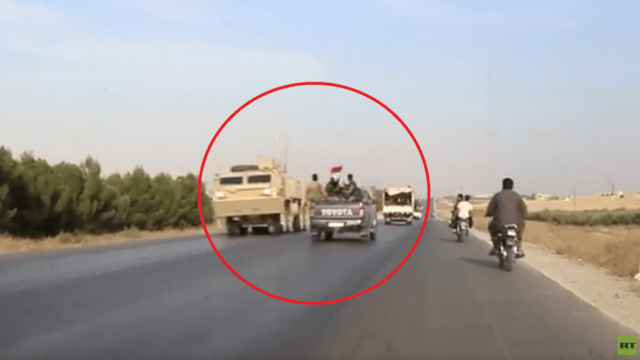
RT | October 14, 2019
An unlikely road meeting of US and Syrian troops was captured in northern Syria as the American vehicles were retreating from the Kurdish-held town of Kobani, while the Syrians rushed to protect it from the Turkish-led offensive.
Getting American and Syrian government forces into a single image is quite a difficult task despite the protracted – and illegal – US military presence in the war-torn country. Nonetheless, RT’s video agency Ruptly managed to snap a rare shot at a highway between northern Syrian towns of Tabaqqa and Kobani.
The short clip from the scene shows a US military convoy of several armored vehicles leaving the border town of Kobani. A Syrian military unit, transported on apparently less fancy vehicles, is seen heading towards the town.
It was not immediately clear if the servicemen somehow reacted to seeing one another, as both parties seemed to be in a rush.
The US military has been withdrawing from northeast Syria following the orders by President Donald Trump, issued last Monday. The withdrawal has been sped up by the Turkish-led military operation against the Kurdish militia, one-time ally of the US, that incidentally heads the so-called Syrian Democratic Forces (SDF) controlling around one-third of Syria’s territory. Washington used the SDF as a ground force in the fight against Islamic State (IS, formerly ISIS).
Ankara regards Kurdish militia groups as terrorists over links to the outlawed Kurdistan Workers’ Party (PKK), which has been waging insurgency in Turkey’s southeast for decades, ultimately seeking secession from the country. However, the Turkish incursion into Syria, which aims to establish a 30-km wide “safe zone” and plant previously displaced refugees and Ankara-backed Islamist rebel groups there, was not met with open arms by Damascus.
After apparently striking a deal with the Kurds, the Syrian Army said it was moving in to secure the strategic border area and entered the towns of Qamishli and Manbij. Kobani, once famously besieged by ISIS, is likely to become a hotspot of conflict again due to its position right on the Syrian-Turkish border.
Moscow on Monday said it never approved of the occupation of Kobani in security discussions with Ankara, with the Defense Ministry dismissing reports that such a question was ever brought up.
Washington’s Sum of All Fears: Kurdish Militants Cut a Deal with Damascus
By Patrick Henningsen | 21st Century Wire | October 14, 2019
Last night, Kurdish officials in northeastern Syria issued a statement that an agreement has been reached with the government in Damascus allowing the Syrian Arab Army (SAA) to takeover key strategic positions along the Syria’s northern border with Turkey.
Not surprisingly, cheers can he heard from Damascus to Moscow, and Tehran too, while leaving Washington’s foreign policy blob visibly moaning in agony.
The reality of the situation is that Turkey sprung a trap set by Damascus and its allies. In doing so, Turkey helped to clean up what was previously a near impossible situation for Damascus.
While much of the western mainstream media has laboured over ‘Trump’s decision‘ to pull-out US troops from Syria, there are other factors which have been driving the current situation. If you’ve been monitoring the Turkish press over the last few years, you would know that Turkey’s President Recep Tayyip Erdoğan has been eager to fire-up his AKP base at home and project Neo-Ottoman power regionally, so this latest Turkish foray into Syria can be seen as a resumption of the ‘New Turkey‘ – the AKP’s gradual transformation of Turkey from a secular Kemalist state, to an Islamic one. This gradual revolution is not confined within Turkey’s own borders though, as it hopes to extend its micro-colonial project of Sunnification to include areas in question located inside and along Syria’s northern border with Turkey. Hence, Ankara has moved its forces into Syrian territory for the third time in as many years, this time dubbed “Operation Peace Spring,” and with Erdogan justifying the move under the auspices of ‘fighting terrorism,’ vowing once again to secure the country’s national security by stamping-out the Kurdish YPG-PKK ‘terrorist threat’ embedded in northern Syria. He may have achieved some marginal success in this department, but not in the way most mainstream pundits think.
Unknowingly perhaps (or not), Turkey helped towards resolving at least three separate problems which had been grating at Damascus and Moscow for at least the last three years. Firstly, the Turkish incursion has finally displaced uninvited US military forces that had begun illegally occupying northeastern Syria since late 2016, effectively propping-up their SDF (Syrian Democratic Forces) Kurdish-led proxy militants, many of whom share membership with Kurdish YPG/PKK militant groups. This weekend has shown the world that without its US protection, Kurdish-led forces are not as viable as they have been depicted in the western media, now exposed to the painful reality that their ‘autonomous’ status in northeastern Syria is on borrowed time, evidenced by the fact that they failed to protect Kurdish residents from the Turkish military and their jihadi vanguard ground forces, formerly known as Free Syrian Army (FSA), who’ve rather cynically rebranded themselves now to the ‘Syrian National Army’. With Syrian Kurdish forces now on their back heels, they were left with no other option than to approach Damascus to negotiate an alliance. That agreement was inked this weekend, with the SAA now heading towards key towns and cities in the northeast of Syria including one of the centers of fighting – the hotly contested Syrian border town of Kobani. This new reality also means that Turkish military will not willingly fire upon SAA forces inside of Syrian sovereign territory, although Turkey’s jihadist FSA/SNA militias might engage with its old nemesis. Those side skirmishes could prolong instability, but they are not nearly as insurmountable as entrenched US forces in the area.
Reports show the SAA’s arrival in these areas as being met with cheers from crowds – which is a public relations disaster for Washington and its Kurdish ‘Rojava’ nation-building project in northern Syria.
Lastly, aside from securing its key northern border crossings, Damascus in now one step closer to reclaiming its oil and gas fields situated north of the Euphrates river near the city of Deir Ezor, and which have been continuously occupied by ISIS and SDF forces respectively since 2014. Liberating its own domestic energy supply will go a long way towards helping Damascus mitigate some of the economic suffering felt as a result of the imposition of joint EU-US sanctions, a punitive embargo designed by western powers to strangle the country and foment more domestic unrest.
A New Middle East
The Kurdish request for Damascus protection also flies in the face of years of western propaganda which tried to justify Washington’s policy of military occupation and nation-building by convince the world that the Syrian government was unwelcome in the northeastern region of its own country, and that “Kurdish independence” was a fait accompli. Moreover, Damascus is a step closer to securing previously vulnerable stretches of is eastern border with Iraq which the US was previously ‘managing’ and which allowed ISIS the move through and use as a staging ground for attacks further afield in areas like Sweida and Al Tanf. If a mutual security arrangement can be reached between Syria and Iraq to secure its shared border, then this would potentially revolutionise political and economic affairs in the region, and even globally.
If these events do come to pass, it would be a complete defeat for decades of Washington-led efforts in the region. Together with its allies, the US has worked long and hard to keep this part of the Middle East unstable and divided. It was in this US-led and Saudi and Israeli-engineered environment of destablisation that both al Qaeda and ISIS terrorists were able to emerge and thrive for so long. Its adversaries should remain vigilant though, as history demonstrates, both Washington and Israel are not above provoking instability in order to achieve their shared short-term and long-range goals for the region.
Regardless, the board has been flipped in Syria. Unable to either hold territory or keep thousands of ISIS prisoners in custody, US-backed SDF militias have been exposed as the latest in a long lineage of hapless pawns of Washington in the Great Game. Once new ground locations are secured by SAA forces, then Damascus could invite Russian air support to secure this airspace – an outcome which can only mean that terrorists’ days will be numbered going forward. Any remaining ISIS or Al Qaeda terrorists brigades active in north of the Euphrates will have few remaining escape routes, other than north to seek refuge in the various AKP-sanctioned terrorist enclaves located across the border in southern Turkey.
As this author said back in early 2018, the US-Kurdish dance in northeastern Syria was always a game of musical chairs, and sooner or later, someone had to leave. And that someone is the USA, and immediately followed by ISIS.
As President Bashar al-Assad said already, Syria is determined to reclaim “every inch” of its territory. So it might behoove western powers not to underestimate the will and determination of a country and army which has withstood eight years of a fully internationalised regime change war waged against it.
***
Author Patrick Henningsen is an American writer and global affairs analyst and founder of independent news and analysis site 21st Century Wire, and is host of the SUNDAY WIRE weekly radio show broadcast globally over the Alternate Current Radio Network (ACR). He has written for a number of international publications and has done extensive on-the-ground reporting in the Middle East including work in Syria and Iraq.
Washington is Wrong Once Again – Kurds Join Assad to Defend Syria
By Ron Paul | October 14, 2019
When President Trump Tweeted last week that “it is time for us to get out of these ridiculous endless wars,” adding that the US would be withdrawing from Syria, Washington went into a panic. Suddenly Republicans, Democrats, the media, the think tanks, and the war industry all discovered and quickly became experts on “the Kurds,” who we were told were an “ally” being sent to their slaughter by an ignorant President Trump.
But it was all just another bipartisan ploy to keep the “forever war” gravy train rolling through the Beltway.
Interventionists will do anything to prevent US troops from ever coming home, and their favorite tactic is promoting “mission creep.” As President Trump Tweeted, we were told in 2014 by President Obama that the US military would go into Syria for just 30 days to save the Yazidi minority that they claimed were threatened. Then that mission crept into “we must fight ISIS” and so the US military continued to illegally occupy and bomb Syria for five more years.
Even though it was the Syrian army with its Russian and Iranian allies that did the bulk of the fighting against al-Qaeda and ISIS in Syria, President Trump took credit and called for the troops to come home. But when the military comes home, the military-industrial-Congressional-media complex loses its cash cow, so a new rationale had to be invented.
The latest “mission creep” was that we had to stay in Syria to save our “allies” the Kurds. All of a sudden our military presence in Syria was not about fighting terrorism but rather about putting US troops between our NATO ally Turkey and our proxy fighting force, the Kurds. Do they really want us to believe that it is “pro-American” for our troops to fight and die refereeing a long-standing dispute between the Turks and Kurds?
It was a colossally dumb idea to train and arm the Kurds in Syria in the first place, but after spending billions backing what turned out to be al-Qaeda affiliates in Syria to overthrow the Assad government, Washington found that the Kurds were the only willing boots remaining on the ground. While their interest in fighting ISIS was limited, they were happy to use Washington’s muscle in pursuit of their long-term goal of carving out a part of Syria (and eventually Turkey) for themselves.
We can never leave because there will be a slaughter, Washington claimed (and the media faithfully repeated). But once again, the politicians, the mainstream media, and the Beltway “experts” have been proven wrong. They never understand that sending US troops into another country without the proper authority is not a stabilizing factor, but a de-stabilizing factor. I have argued that were the US to leave Syria (and the rest of the Middle East) the countries of the region would find a way to solve their own problems.
Now that the US is pulling back from northern Syria, that is just what is happening.
On Sunday the Kurds and the Syrian government signed an agreement, brokered by the Russians, to put aside their differences and join together to defend against Turkey’s incursion into Syrian territory.
Now “our Kurdish allies” are fighting alongside the army of Syrian President Assad – who we are still told by US officials “must go.” Washington doesn’t understand that our intervention only makes matters worse. The best way to help the Kurds and everyone else in the region is to just come home.
US poised to withdraw remaining troops from northeastern Syria: Pentagon
Press TV – October 13, 2019
The Pentagon has announced that the United States is set to withdraw the rest of its troops from northeastern Syria amid an ongoing Turkish offensive in the region.
Defense Secretary Mark Esper said in an interview with the CBS News on Sunday that the US would be pulling out around 1,000 troops from Syria’s northeast as part of a “deliberate withdrawal” directed by US President Donald Trump.
Describing the situation for American troops in the region as “untenable,” Esper said the measure was taken to ensure that US forces were not “put in harm’s way.”
During the interview, the Pentagon chief claimed that Kurdish militants of the so-called Syrian Democratic Forces (SDF) were planning to negotiate a deal with the government in Damascus and Russia to withstand the Turkish attacks.
“In the last 24 hours, we learned that [the Turks] likely intend to extend their attack further south than originally planned, and to the west,” Esper told the CBS News.
“We also have learned in the last 24 hours that the SDF are looking to cut a deal with the Syrians and the Russians to counterattack against the Turks. And so we find ourselves, we have American forces likely caught between two opposing advancing armies, and it’s a very untenable situation,” he added.
Turkish military forces and Turkish-backed militants of the so-called Free Syrian Army (FSA) on Wednesday launched a long-threatened cross-border invasion of northeast Syria in a declared attempt to eliminate Kurdish militants from the so-called People’s Protection Units (YPG) to push them away from border areas.
The YPG, which itself is the military wing of the Syrian Kurdish Democratic Union Party (PYD), constitutes the backbone of the SDF, an anti-Damascus alliance of predominantly Kurdish militants.
Ankara views the US-backed YPG as a terrorist organization tied to the homegrown Kurdistan Workers’ Party (PKK) militant group, which has been involved in armed separatism in Turkey since 1984.
Turkish President Recep Tayyip Erdogan said on Friday that Ankara will not stop its military operation against Kurdish militants in northeastern Syria “no matter what anyone says.”
The Turkish Defense Ministry announced on Sunday that a total of 480 YPG militants had been “neutralized” since the operation began.
The Turkish military generally uses the term neutralize to signify that the militants surrendered or were killed or captured.
The self-proclaimed Kurdish-led authority in northeastern Syria says more than 191,000 people have been displaced as a result of the Turkish invasion.
The US has long been providing the YPG and SDF militants with arms, calling them a key partner in the purported fight against the Takfiri Daesh terrorist group in Syria. Many observers, however, see the support as part of Washington’s plans to carve out a foothold in the Arab country.
The Turkish military, with support from allied militants of the so-called Free Syrian Army, launched two cross-border operations in northern Syria, namely “Euphrates Shield” in August 2016 and “Olive Branch” in January 2018 with the declared aim of eradicating the presence of Kurdish militants and Daesh terrorists near Turkey’s borders.
Three Arab-language media interview Russia’s President Putin
RT | October 13, 2019
Excerpts:
Moscow is supporting Damascus to ensure that extremists never reach Russia’s borders
Damascus has to take responsibility for the country’s political and social problems, but these internal issues would not be resolved by allowing Syria to be overrun by extremists, Putin told RT Arabic, explaining Russia’s rationale for entering the conflict there in September 2015.
“We came to Syria to support the legitimate government… It does not mean that they do not have internal problems… It does not mean that the current leadership is not responsible for what is going on there. They are, but it does not mean that we were to allow terrorist organisations to capture Syria and to establish a terrorist pseudo-state there.”
“We still remember what happened in Russia’s North Caucasus region not that long ago,” Putin said, referring to the bloody conflicts in Chechnya and making the case for protecting Russian borders from terrorism spill-over.
“We could not allow militants to move to former Soviet republics. We do not have hard borders or a visa regime with them. We could not allow militants to infiltrate Russia from there.”
Supporting “rebels” in the Middle East and North Africa, like Washington and its Gulf and European allies has routinely done, has had disastrous effects for global security, Putin pointed out. The invasion of Iraq led to an insurgency that later created Islamic State (IS, formerly ISIL/ISIS), he said, and NATO’s “humanitarian intervention” in Libya created a “chaos and confusion” that is still seen today.
‘Syria must be free of foreign military presence’
Russia will be least affected if US exit from INF treaty brings back arms race, Putin says
A renewed arms race between the US and Russia would be bad for the world but Moscow won’t be dragged into excessive military spending, as it has already developed next gen weapons of “unmatched” capabilities, Vladimir Putin said.
The Russian president discussed Washington’s unilateral withdrawal from the Intermediate-Range Nuclear Forces (INF) Treaty at a joint interview with RT Arabic, UAE-based Sky News Arabia and Saudi Arabia’s Al-Arabiya broadcasters.
“I do understand the US concerns. While other countries are free to enhance their defenses, Russia and the US have tied their own hands with this treaty.”
However, Putin pointed out that “it was not worth ruining the deal,” which helped the US and Russia by precluding the fielding in Europe of ground-based missiles with a range of between 500km and 5,500km, and which remained the cornerstone of security on that continent since 1987. “I believe there were other ways out of the situation,” he added.
Also on rt.com Russia offers NATO a moratorium on missile deployment, but won’t sacrifice its own security to prove its goodwill
The New START Treaty, which came into effect in 1994 and limits the number of strategic nuclear missile launchers possessed by the two countries, is the final element that could “prevent us from falling back into a full-scale arms race,” Putin warned.
That deal expires in 2021 and, “to make sure it is extended, we need to be working on it right now,” he said.
But if an arms race couldn’t ultimately be avoided, the President assured interviewers that “Russia will be the least affected party because… we already have the next generation of weapons, and these are unprecedented, with unmatched capabilities. We have done our homework. We do not need to rush now and can calmly think of what can be done next.”
An arms race is a bad thing, and it will not be good for the world. However, we will not be dragged into exorbitant budget-spending games.
The reason for Russia obtaining those state-of-the-art weapons, despite being only sixth globally in terms of military spending – behind the US, China, Saudi Arabia, UK, France and Japan, is “focused research on priority areas,” he explained.
Featured Video

Deception – Submarines against Olof Palme
or go to
Aletho News Archives – Video-Images
From the Archives
Woolsey Fire started at Santa Susana Field Lab — where “radioactive materials released were never accurately measured”
By John Laforge | CounterPunch | November 30, 2018
In my Nov. 16 column, I reported on potential radiation risks posed by California’s Woolsey wildfire having burned over parts or all of the Santa Susana Field Laboratory—south of Simi Valley, Calif., 30 miles outside Los Angeles—site of at least four partial or total nuclear reactor meltdowns.
The field laboratory operated 10 experimental reactors and conducted rocket engine tests. In his 2014 book Atomic Accidents, researcher James Mahaffey writes, “The cores in four experimental reactors on site … melted.” Reactor core melts always result in the release of large amounts of radioactive gases and particles. Clean up of the deeply contaminated site has not been conducted in spite of a 2010 agreement.
Los Angeles’s KABC-7 TV reported Nov. 13 that the Santa Susana lab site “appears to be the origin of the Woolsey Fire” which has torched over 96,000 acres. Southern Calif. Public Radio said, “According to Cal Fire, the Woolsey Fire started on the afternoon of Thursday, Nov. 8 … on the Santa Susana site.” … continue
Blog Roll
 Aletho News
- Dr. Abu-Sitta: Beirut ‘felt like a day in Shifa Hospital’
- Iran Has Won the War, It Will Be Up to the US to Secure the Peace: Mohammad Marandi
- Iran condemns assassination threats against Iranian negotiators amid US talks
- Brussels cannot say where its own pipeline inspectors are as Hungary’s oil lifeline remains shut
- Israel’s Iran War: Myth and Reality
- Between war and industrial breakdown: The US-Israeli attrition crisis
- Pressure builds on Iran to ‘drop’ Lebanon ceasefire demand as Islamabad talks hang in balance
- In another clash report, US denies agreement to release Iran’s assets
- What is fueling unrest across the EU?
- Why no power can undermine Iran’s eternal dominance over the Strait of Hormuz
- If Americans Knew
- Pro-Israel ‘Thinktanks’ and Individuals who Influence U.S. Foreign Policy
- Mearsheimer reveals how Israel dictates US policies on Iran, Gaza – video
- After killing 350+, Israel still has a “score to settle” with Lebanon before ceasefire – Daily Update
- Military aid to Israel emerges as the latest political litmus test for Democrats
- The only Palestinian children’s rights organization closes following years-long Israeli campaign against it
- ‘I Can’t Forget the Smell’: Lebanese Reel After Israel Kills Over 300 in Single Day
- DNC Shoots Down Resolutions Calling Out AIPAC and Limiting Arms to Israel
- TCN: Is Israel Blackmailing President Trump?
- Israel killed at least 303 Lebanese yesterday – who were they? Daily Update
- Amnesty: Urgent – Protect Lebanese civilians from brutal escalation in Israeli attacks
- No Tricks Zone
- German Expert: Heat Dome Led To Record Temps In Western USA…Warmer In 1934, 1936
- New Study: No Linear Warming Or Glacier Retreat Along Northern Antarctic Peninsula Since 1980s
- An Inconvenient Tree: Uncovered In Alps… Europe Much Warmer Than Today 6000 Years Ago
- New Study Reports A 60% Slowdown In Greenland’s Ice Loss Rate In The Last Decade
- Low Intensity Tornado Wrecks Major Solar Farm, Creating A Potential Toxic Dump
- New Study Finds Warming Saves Lives…Cold Temperatures 12 Times More Deadly Than Excess Heat
- German Science Blog Accuses PIK Climate Institute Of Hallucinating Climate Tipping Points
- Devastating Assessment Of Comirnaty Vaccine By Former Senior Pfizer Europe Toxicologist
- New Study: CO2 Is ‘Effectively Negligible’ As An Explanatory Climate Change Factor Since 2000
- Former Pfizer Toxicologist Dr. Helmut Sterz Tells Bundestag Hearing Pfizer Vaccine Should Have Never Been Approved
 Aletho News