Lebanon won’t survive with Palestinian, Syrian refugees: Auon
MEMO | May 10, 2019
Lebanon will never survive if half a million Palestinian refugees and 1.6 million Syrian refugees remain in the country, the Lebanese president, Michel Aoun, said yesterday.
Aoun’s remarks came during a meeting held at the presidential palace in the Lebanese capital of Beirut with a delegation from the Middle East Council of Churches (MECC), headed by its secretary general Souraya Bechealany.
Aoun called on the MECC to help the Lebanese government resolve the Syrian refugees’ issue “by persuading Western countries to accept the refugees return to their countries as soon as possible.”
“Israel has declared that the Palestinian refugees would remain where they are,” he pointed out, warning that if the refugees remained in Lebanon, “its demographics would change completely.”
There are 174,422 Palestinian refugees currently living in 12 camps and 156 Palestinian communities across Lebanon’s five governorates, according to a report by the Palestinian Central Bureau of Statistics (PCBS) in 2017.
Lebanon – with an estimated population of 4.5 million – complains of the refugees’ burden it has been facing since the start of the Syrian civil war in 2011.
According to the UN High Commissioner for Refugees (UNHCR), the number of Syrian refugees in Lebanon reached 997,000 by the end of November 2017, excluding the Syrians who are not registered with UNHCR.
Washington Post Begs Trump to Save al-Qaeda in Syria Before It’s Too Late
“Time is running out”

By Marko Marjanović | Checkpoint Asia | May 10, 2019
Washington Post’s Josh Rogin:
There is little that can stop the brutal assault underway in northwest Syria, where Russian, Iranian and Assad regime forces have launched a major military offensive as millions of civilians flee for their lives. But the record shows that if President Trump acts to try to halt the slaughter, it will have real impact on the ground. Even a presidential tweet could save lives. Time is of the essence.
LOL, “millions” of civilians? There are about 2.5 million under rebels in Idlib, if millions are fleeing who is left?
Of course every Syrian/Russian offensive is a “brutal assault”. The Empire meanhile plants flowers and throws candy from its aeroplanes. It must have been diabates that killed 1,600 civilians in Raqqa and 9,000 in Mosul.
There’s a lot going on right now in U.S. foreign policy. The Trump administration is dealing with an escalating Iran crisis, North Korea missile firings, a shaky China trade negotiation and an attempt to oust the Venezuelan regime. It’s no mere coincidence that Bashar al-Assad and Moscow chose this moment to retake the last rebel-held area of Syria using scorched-earth tactics, committing atrocities along the way.
The region of Idlib holds about 3 million civilians, including 1 million children, who were moved there from across the country because they would not submit to the Assad regime. And now there is deafening silence from the international community about their brutal slaughter.
James F. Jeffrey, the State Department’s special envoy for Syria, told me the U.S. government sees a “major escalation” by the regime and its allies in Idlib and is working diplomatic channels to de-escalate the fighting.
“We are raising this at every level with the Russians,” he said. “Any major operation into Idlib would be a reckless escalation of the conflict.”
It’s a reckless escalation to smash al-Qaeda when it’s the Syrians/Russians doing it. And when al-Qaeda is Empire’s battering ram against Damscus.
Assad is dependent on Russian air power, and Moscow has committed a lot of it to the assault, Jeffrey said. That means Moscow is flagrantly violating the cease-fire and de-escalation agreement it signed with Turkey last year in Sochi, Russia.
Why is an agreement Russia signed with Turkey any business of the US and the Washington Post ?
So far, Moscow is ignoring Jeffrey’s warnings. The Turkish government, which saw its outpost in Idlib shelled, seems unable or unwilling to stop the onslaught.
In other words, Russians and Turks have an understanding and there is no breech of agreement.
But history shows that when Trump decides to intervene in Syria to protect civilians, Moscow listens.
In April 2017, when Trump first launched missiles at the Syrian regime, he was responding to a chemical weapons attack in Idlib that looked to be the beginning of the very offensive we are seeing now. Trump’s actions persuaded Assad and Russia to back down.
After a Syrian activist told Trump at a fundraiser that the assault on Idlib was beginning again, the president tweeted last September that Assad “must not recklessly attack Idlib” and that Russia and Iran must not support a “potential human tragedy.” The tweet worked.
“It stopped. You saw that. And nobody’s going to give me credit, but that’s okay,” Trump said at the time. “Millions of people would have been killed. And that would have been a shame,” he said.
Erdogan did most of the work to halt that offensive, but it’s possible Trump’s threats played a part as well.
Now Moscow is testing Trump again. So far, the president is silent. That has a cascading effect inside the U.S. national security system. Several people who work with U.S. government agencies on the ground in Syria told me that U.S. officials throughout the bureaucracy are waiting on Trump to signal his intent before they move to engage in Idlib.
Actually Moscow is doing no such thing. Defending al-Qaeda in Idlib does not have to be America’s job if Washington doesn’t make it so.
Sen. Lindsey O. Graham (R-S.C.) understands the importance of Trump’s verbal cues. He tweeted at the president this week asking him to speak up and protect Idlib. Putin surely also understands that in the United States’ Syria policy, only Trump’s words really matter. Trump and Putin spoke for about an hour last week, but it is unknown what, if anything, they discussed about Syria.
Meanwhile, Russian planes are targeting residential areas and hospitals and then killing aid workers responding to those attacks, said Raed Al Saleh, founder of the Syria Civil Defense, a civilian rescue organization better known as the White Helmets. In Idlib, he said, the regime has resumed the use of barrel bombs and white phosphorus, weapons of mass atrocity and mass displacement.
Don’t forget the kitten shelters.
Public estimates of 150,000 newly displaced people are just the beginning, said Saleh. Millions of people are preparing to “form caravans like in El Salvador” to head for Europe. “These people see the international community is not willing to do anything to keep them safe in their homes,” he said.
Syria has 5 million refugees outside the country and 6 million displaced internally courtesy of the Empire weaponizing salafi jihad against it. Would crushing al-Qaeda and stabilizing the country encourage them to return? Would the US tolerate al-Qaeda carving out an enclave of 2 million people on its territory?
Several schools in Idlib supported by U.S. aid organizations are now at grave risk. Thirty of those organizations wrote to Trump asking him to give the signal so the U.S. government can snap into action.
“Only you are able to direct our government to use every tool and resource at our disposal for the protection of civilians in Idlib Province,” they wrote.
Syrians will remember that the world abandoned them in their time of most dire need. The fresh atrocities will fuel more extremism. The new refugee crisis will further destabilize Turkey, the Middle East and Europe.
It’s bizarre that the fate of millions could hinge on whether Trump decides to speak up to protect them. But that is where we are. So please, Mr. President, tweet something, say something, do something — anything — before it’s too late. The people of Idlib will give you credit, if they survive.
You kind of lose the moral high ground of being an “aid organization” when you start begging your government to cruise missile another country.
US-backed SDF militants kill six civilians during raid in Syria’s Dayr al-Zawr
Press TV – May 9, 2019
Kurdish-led militants from the so-called Syrian Democratic Forces (SDF), backed by helicopters from the US-led coalition, have reportedly stormed a town in Syria’s eastern province of Dayr al-Zawr, killing and injuring a number of locals.
Local sources, requesting not to be named, told Syria’s official news agency SANA that the US-sponsored militants laid siege to the al-Katef neighborhood of al-Shuhayl town for more than two hours on Thursday, before raiding the area and firing at people indiscriminately.
The sources added that six civilians lost their lives and four others sustained injuries as a result. SDF militants rounded up a number of local residents as well.
Back in late April, hundreds of people took to the streets in the northeastern Syrian towns of al-Busayrah, Masheikh, al-Tayyana as well as the villages of Tal al-Dhaman, al-Namliyah and Tayyeb Al Faall to protest the presence of SDF militants, rising cases of abduction and assassination in their areas and plunder of Syria’s oil wealth by the US-sponsored forces.
The protesters closed the main roads to their areas, burning tires and demanding the expulsion of SDF militants from their hometowns.
Local sources said the Kurdish-led militants fired indiscriminately at demonstrators in al-Tayyana to disperse the protest. There were no reports about possible casualties.
The development came only a day after dozens of people staged demonstrations in the towns of al-Shuhayl, al-Sur and al-Hissan as well as Mweileh village against the presence of SDF militants in their areas.
Local residents, speaking on condition of anonymity, said the Kurdish-led forces opened fire on protesters in Hissan, injuring a number of them.
SDF militants illegally transport Dayr al-Zawr’s crude oil to neighboring Hasakah province in Syria’s northeast, a move that has angered local people.
The United States has long been providing the SDF, a Kurdish alliance, with arms and militants, calling them a key partner in the purported fight against the Daesh terrorist group.
Many observers, however, see the support in the context of Washington’s plans to carve out a foothold in the Arab country.
Such support has also angered Washington’s NATO ally, Turkey, which views militants of the People’s Protection Units (YPG), the backbone of the SDF, as a terrorist organization tied to the homegrown Kurdistan Workers’ Party (PKK) militant group.
The PKK has been seeking an autonomous Kurdish region in Turkey since 1984.
US violating NPT, ignoring Israeli regime’s breaches of accord: Syrian UN envoy

Press TV – May 7, 2019
Syria’s UN Ambassador Bashar al-Ja’afari has slammed the United States for flagrantly violating the nuclear Non-Proliferation Treaty (NPT) and turning a blind eye to the Israeli regime’s breaches of the international accord.
“Syria took the initiative in 1968 to join the treaty, and signed the agreement of guarantees with the International Atomic Energy Agency (IAEA) in 1992 … It also presented a draft resolution in 2003 aimed at the establishment of a (Middle East) region free from weapons of mass destruction (WMD); but the US blocked the measure,” Ja’afari said at the the Preparatory Committee for the 2020 Review Conference of the Parties to the Treaty on the Non-Proliferation of Nuclear Weapons (NPT) in New York on Tuesday.
The Syrian diplomat also lambasted certain Western states for helping Israel establish the Dimona nuclear center and offering it related substances, experience and technology – a step that enabled the Tel Aviv regime to possess hundreds of nuclear heads.
Israel is estimated to have 200 to 400 nuclear warheads in its arsenal. The regime, however, refuses to either accept or deny having the weapons.
It has also evaded signing the Non-Proliferation Treaty (NPT) amid staunch endeavor by the United States and other Western states on international levels in favor of its non-commitment to the accord.
The clandestine nuclear activities were uncovered when whistle-blower Mordechai Vanunu, originally a technician at the Dimona nuclear facility, handed overwhelming evidence of Israel’s nuclear program to Britain’s Sunday Times in 1986.
It is believed that the nuclear site is home to Israel’s nuclear weapons.
In September 2017, then-Iranian Ambassador to the IAEA Reza Najafi denounced the West’s double standard approaches on the possession and development of atomic technology, urging a complete end to any nuclear cooperation with the Israeli regime.
Addressing a quarterly meeting of the IAEA’s 35-member Board of Governors in Vienna, Najafi warned that the Israeli regime’s nuclear program is negatively impacting security of the Middle East.
Israel’s Terrorists: The White Helmets Receive an Award
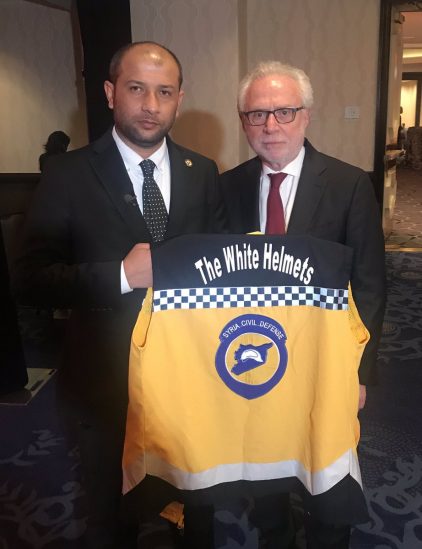
By Philip Giraldi | American Herald Tribune | May 5, 2019
Increasingly, groups and even foreign governments have pandered to Israel and its supporters in the United States because they have come to understand that success in dealing with Washington can be dependent on Jewish support. Last week, Raed Saleh, the leader of the so-called White Helmets, also referred to as the Syrian Civil Defense, a terrorist-affiliated group operating in Syria, was in the United States to “… receive the Elie Wiesel Award from the Holocaust Memorial Museum for his organization’s work in Syria.” He was also dropping by to pick up a check for $5 million courtesy of the U.S. government that “… helps us with acquiring ambulances and helps us with search and rescue operations.”
During his visit, Saleh was treated to a nauseatingly obsequious interview courtesy of National Public Radio, which, inter alia, described how the Helmets “were the subjects of an Oscar-winning documentary two years ago, which captured images of them carrying broken and bloody Syrians from dust and rubble.”
Saleh claimed that the alleged victory of the Syrian regime in the yet to be completed war is an illusion as President Bashar al-Assad presides over a broken country, yet reports from inside Syria indicate that the return of the government to areas formerly controlled by terrorists has been welcomed and refugees from the fighting are now eager to return home. Saleh also claimed, falsely, that his organization has been “providing services to all Syrians and to providing support to all Syrians. Now after six years of war, we have saved more than 116,000 people from under the rubble. We have not asked any of these 116,000 people who did they belong to? Is he a Kurd? Is he a Christian? Is he a Muslim? Is he with Assad? Is he against Assad? Is he with the Kurds? Is he against the Kurds? We have never asked anyone these questions.”
Saleh, whose group has only operated in terrorist-controlled areas, could not, however, maintain his approved narrative. He fairly quickly abandoned his non-partisan quasi-humanitarian rhetoric when asked about how he sees the Syrian conflict developing, saying “We do not call this a civil war, but we rather call it a revolution against a dictatorship… the revolution still goes on. We have not lost.”
Those who are unfamiliar with the White Helmets should understand that the group has been praised by those who hate the government of President Bashar al-Assad in Syria and want to see it removed, which includes the United States, Israel, Saudi Arabia and the Emirates. The White Helmets have played a leading role in the propaganda campaign that seeks to instigate violence or use fabricated information to depict the Damascus government as guilty of slaughtering its own citizens. The propaganda is intended to terrorize the civilian population, which is part of the definition of terrorism.
Favorable media coverage of the group has largely derived from the documentary The White Helmets, which was produced by the group itself and tells a very convincing tale promoted as “the story of real-life heroes and impossible hope.” It is a very impressive piece of propaganda, so much so that it has won numerous awards including the Oscar for Best Documentary Short two years ago and the White Helmets themselves were even nominated for the Nobel Peace Prize. More to the point, however, is the undeniable fact that the documentary has helped shape the public understanding of what is going on in Syria, describing the government in Damascus in purely negative terms.
Nine months ago, with the Syrian Army closing in on the last White Helmet affiliates still operating in the country, the Israeli government, assisted by the United States, staged an emergency “humanitarian” evacuation of the group’s members and their families to Israel and then on to Jordan. It was described in a BBC article that included “The IDF said they had ‘completed a humanitarian effort to rescue members of a Syrian civil organization and their families’, saying there was an ‘immediate threat to their lives.’ The transfer of the displaced Syrians through Israel was an exceptional humanitarian gesture. Although Israel is not directly involved in the Syria conflict, the two countries have been in a state of war for decades. Despite the intervention, the IDF said that ‘Israel continues to maintain a non-intervention policy regarding the Syrian conflict.’”
All of the Israeli assertions are nonsense, including its claimed “humanitarianism” and “non-intervention” in the Syrian war, where it has been bombing almost daily. The carefully edited scenes of heroism under fire that have been filmed and released worldwide conceal the White Helmets’ relationship with the al-Qaeda affiliated group Jabhat al-Nusra and its participation in the torture and execution of “rebel” opponents. Indeed, the White Helmets only operate in terrorist-held territory, which enables them to shape the narrative both regarding who they are and what is occurring on the ground.
The White Helmets were accustomed to traveling to bombing sites with their film crews trailing behind them. Once at the sites, with no independent observers, they are able to arrange or even stage what is filmed to conform to their selected narrative. Exploiting their access to the western media, the White Helmets thereby de facto became a major source of “eyewitness” news regarding what was going on in those many parts of Syria where European and American journalists were quite rightly afraid to go, all part of a broader largely successful “rebel” effort to manufacture fake news that depicts the Damascus government as engaging in war crimes directed against civilians, an effort that has led to several attacks on government forces and facilities by the U.S. military. This is precisely the propaganda that has been supported both by Tel Aviv and Washington.
Perhaps the most serious charge against the White Helmets consists of the evidence that they actively participated in the atrocities, to include torture and murder, carried out by their al-Nusra hosts. There have been numerous photos of the White Helmets operating directly with armed terrorists and also celebrating over the bodies of execution victims and murdered Iraqi soldiers. The group’s jihadi associates regard the White Helmets as fellow “mujahideen” and “soldiers of the revolution.”
For those interested in further details, White Helmet activities have been thoroughly exposed by Maxim Grigoriev of the Russian NGO Foundation for the Study of Democracy. Grigoriev presented his findings at a special meeting of the United Nations just before Christmas 2018. A video prepared based on the U.N. meeting includes interviews with actual witnesses of White Helmet atrocities and participants in the staged chemical attacks that were blamed on the government.
So Raed Saleh was in Washington to pick up his award and his multi-million dollar check on top of the tens of millions that his organization has already received from Congress and the White House. He also met with a number of Congressmen who support his initiatives and was praised by New Jersey’s own seriously corrupt Israel-firster Senator Robert Menendez of the Senate Foreign Relations Committee who observed “that Saleh’s group of about 3,000 volunteers has ‘saved almost 100,000 lives’ doing ‘courageous work on the ground in Syria, while being targeted by Russia.’” Yes, Russiagate is alive and well.
There is considerable irony in the fact that the National Holocaust Museum, which is taxpayer funded, has given an apparently prestigious award to a terrorist group, something which could have been discerned with even a little fact checking. And the museum also might have been sensitive to how the White Helmets have been used in support of Israeli propaganda vis-à-vis Syria. Perhaps, while they are at it, the museum’s board just might also want to check out Elie Wiesel, for whom the award is named. Wiesel, who was a chronicler of Jewish victimhood while persistently refusing to acknowledge what Israel was doing to the Palestinians, notoriously mixed fact and fiction in his best-selling Holocaust memoir Night. Ironically, the award and recipient are well matched in this case as mixing fact and fiction is what both Elie Wiesel and the White Helmets are all about.
US, Israel to supply anti-aircraft missiles to Kurdish militants in Syria: Report
Press TV – May 1, 2019
The United States and Israel are reportedly set to supply anti-aircraft missiles to Kurdish militants in northern Syria amid tensions between Ankara and Washington over the latter’s support for the militants, which the Turkish government views as terrorists.
Citing local sources, Turkey’s Yeni Safak daily reported that the US is set to deliver shipments of Stinger Man Portable Air Defense System (MANPADS) to militants of the Kurdistan Workers’ Party (PKK).
The PKK, it added, has designated the towns of Rmelan and Shaddadah in Syria’s Hasakah Province as well as the Jalabiyah and al-Omar regions as launching points for its American-supplied missiles.
Ankara is unhappy with Washington’s support for Kurdish militants of the People’s Protection Units (YPG), which it views as an extension of the PKK, and has repeatedly called on the US administration to stop providing them with arms.
The PKK has been fighting for autonomy inside Turkey for decades and runs bases in neighboring Syria and Iraq as well.
The report further said the regime in Israel has also vowed to supply the Kurds with Spike anti-aircraft missiles in the Syrian provinces of Dayr al-Zawr and Raqqah following high-level meetings between the militants and Tel Aviv.
Israel has long been backing the militants operating against the Syrian government. The regime has, on several occasions, criticized Turkey for its operations against the Kurdish militants.
The US-Kurdish alliance is closely coordinating the missiles’ deployment to Syria as part of a “special joint strategy,” according to the report.
It further said that a group of 30 PKK militants have already received training to handle the advanced anti-aircraft missiles.
Turkey has since 2016 launched two military operations inside Syria against the US-backed Kurdish militants and has threatened a third if they fail to leave the east of the Euphrates.
Like Turkey, the US has listed the PKK as a terrorist group, but views the YPG as an ally in its so-called fight against the Takfiri Daesh terror group.
Turkey has repeatedly questioned Washington’s deployment of heavy weapons in Syria despite the defeat of Daesh.
Last December, US officials said the Pentagon was considering recommending that Kurdish militants be allowed to keep American-supplied weapons after the withdrawal of troops from Syria.
In February, President Recep Tayyip Erdogan slammed Turkey’s NATO allies for supplying huge loads of weapons to Kurdish militants in northern Syria, while ignoring Ankara’s arms purchase requests.
‘Declare war on Lebanon, take out Syria’s S-300s’: Outgoing Israeli general on handling neighbors
RT | April 20, 2019
Israel has the full arsenal needed to take on Hezbollah in Lebanon and eliminate the Iranian threat in Syria, the outgoing IDF Northern Command chief boasted, warning Damascus against using S-300s to protect its sovereignty.
“If our freedom of movement is threatened, we will remove the threat. We know how to do that,” General Yoel Strick told Ynet News, adding that Israel will soon introduce “advanced weapons systems” to ensure it can continue to violate neighboring states’ airspace and to strike targets in Syria with impunity.
If the Syrians employ Russian S-300s against our planes, and we take them out, it will be seen as a legitimate move on our part.
While acknowledging that such a drastic move might damage Tel Aviv’s relations with Moscow, Strick expressed hope that it wouldn’t come to that. Moscow had supplied the Arab Republic with S-300 air defense systems following the downing of a Russian Il-20 reconnaissance plane with 15 airmen on board in mid-September, during an Israeli raid.
Also on rt.com Israel took out ‘Iranian missile site’ in Syria… or something like that
Moscow also warned Israel that it will suppress all satellite navigation, radars and communications systems of combat planes over the Mediterranean Sea if their maneuvers threaten Russian forces. Since then, Israel has been staging its intrusions via Lebanon, where the Jewish State is trying to keep Hezbollah in check.
Also on rt.com Netanyahu confirms Israeli military shelled Syrian province to prevent ‘Iran entrenchment’
Hezbollah is inseparable from Lebanon as a country, due to the militant group’s strong political presence, the general argued. Thus, he claimed, “if it were up to me, I would recommend declaring war on Lebanon and Hezbollah” – not out of bloodlust but only to thwart the group’s alleged plot to “invade” Israel.
I have no doubt what the outcome will be… It will be a decisive victory.
Damascus should take control over northeast Syria: Russia FM
Press TV – April 18, 2019
Russia says the legitimate Syrian government should immediately take control over the country’s northeastern region, including the East Euphrates River, which is held by US-backed Kurdish militants.
“There is a need to resolve the issue concerning the country’s northeast and the left bank of the Euphrates River in order to achieve one of the priority tasks and ensure the restoration of the legitimate government’s control over the region,” Russian Foreign Minister Sergei Lavrov said at a press conference on Wednesday.
The top Russian diplomat underlined the need to build dialog with Kurdish groups and secure the interests of Turkey “as far as security in Syria’s border areas is concerned.”
Northeastern Syria is currently controlled by the so-called Syrian Democratic Forces (SDF), a US-backed anti-Damascus alliance of mainly Kurdish militants, which include the Kurdish People’s Protection Units (YPG).
Turkey considers the YPG a terrorist organization and an extension of the outlawed Kurdistan Workers’ Party (PKK), which has been fighting for an autonomous region inside Turkey since 1984.
The United States is a key advocate of autonomy for Syrian Kurds which Damascus has roundly rejected.
Many observers believe Washington plans to carve out a foothold in the region through supporting Syrian Kurds.
In February, a senior adviser to Syrian President Bashar al-Assad flatly rejected the idea of giving Syrian Kurds a measure of autonomy, saying such a move would open the door to the partition of the country.
The Kurdish-led authority that runs much of north and east Syria has presented a roadmap for a deal with Assad in recent meetings with Russia.
Also in February, President Assad called on SDF militants to return to the Syrian army, warning them against reliance on the United States.
“We say to those groups who are betting on the Americans, the Americans will not protect you. The Americans will put you in their pockets so you can be tools in the barter, and they have started with it,” he said.
Russia has been helping Syrian forces in their fight against foreign-backed Takfiri militants. The military assistance began in September 2015 at the official request of the Syrian government.
Foreign-backed militancy, supported by the United States and many of its Western and regional allies, erupted in Syria in 2011.
The militants and Takfiri terrorists overran large swathes of Syria’s territory.
The Daesh terrorist group, which once held large swaths of land in Syria, has now been completely defeated in the Arab country and has lost almost all of its occupied territories.
Syria has now reestablished its reign over nearly its entire expanse.
Sitting on Syria’s Oil, US Cuts Lifeline From Iran, Plunges Syria Into Fuel Crisis
By Marko Marjanović | Checkpoint Asia | April 17, 2019
Syria produced 325,000-385,000 barrels of oil per day before the war. Now it produces 25,000. Partly because of war damage, and partly because the majority of its oil fields are to the east of the Euphrates and occupied by the US and its Syrian Kurdish proxies. (The Kurds are happy to sell but the US won’t let them.)
It used to consume over 200,000 barrels of oil domestically, but that has gone down to 100,000 or less, with majority of that being shipments from Iran on a credit line that both nations understood was unlikely to ever be paid back in full.
Now the US has succeeded in cutting off that lifeline as well. It is blacklisting tankers which deliver the Iranian fuel and having Egypt block them from ever crossing the Suez.
This has caused a huge fuel crisis in government-controlled Syria with extreme rationing and cars lining up for miles in order to pump their allowed maximum of 20 liters every five days.
In Syria’s case the US really did “steal its oil”. It has forced an oil-producing nation into a fuel crisis. It has seperated Damascus from its oil fields (which BTW are in the ethnically Arab part of the country) and then cut its oil from abroad as well.
Iran, Iraq and Syria considering transnational railway project: Report
Press TV – April 13, 2019
Iraq says negotiations are underway with Iran and Syria to develop a transnational railway line linking the three countries.
Iraqi Republic Railways Company chief Salib al-Hussaini said a summit will be held between the countries to further discuss the matter, the Arabic-language al-Sumeria news website reported on Friday.
The comments made on the sidelines of the joint Syrian-Iraqi committee held in Damascus came a week after Iranian First Vice-President Eshaq Jahangiri spoke of an initiative to link the Persian Gulf to the Mediterranean.
“We will connect the Persian Gulf from Iraq to Syria and the Mediterranean via railway and road,” said Jahangiri, making reference to the construction of a railway linking the Iranian Shalamcheh border region to the Iraqi city of Basra.
The Shalamcheh-Basra railway project is estimated to cost 2.22 billion rials and can link Iran to Syria via Iraq.
Speaking last December, Director General of the Railway and Technical Structures Department at the Islamic Republic of Iran Railways (RAI) Mohammad Mousavi said Iran was planning to build a movable railway bridge over the Arvand river as part of the Shalamcheh-Basra project.
Mousavi said the project would effectively link the Iranian cities of Khorramshahr and Abadan along with the Imam Khomeini Port to the Iraqi city.
The railway project was agreed to last month when Iran and Iraq signed five memorandums of understanding for the expansion of bilateral cooperation in various economic and healthcare sectors.
Observers have described the new agreements as a sign of Baghdad’s serious intention of not being “party to the system of sanctions against Iran” as Prime Minister Abdul-Mahdi said earlier in February.
Iraq heavily depends on Iran for everything from food to machinery, electricity, natural gas, fruits and vegetables.
Last year, Iran exported $8.7 billion worth of commodities to Iraq, overtaking Turkey with $7.3 billion of exports.
President Hassan Rouhani said last week that Iran and Iraq had plans to expand bilateral trade volume to $20 billion in the future.
Iran and Syria also signed a series of “historic” agreements earlier this year, including a “long-term strategic economic cooperation” deal described as a sign of changing realities in the Middle East.
Syrian Prime Minister Imad Khamis said the “historic” agreements covered cooperation in fields of industry, trade and agriculture. He called the agreement “a message to the world on the reality of Syrian-Iranian cooperation.”
Iraq and Syria have been expanding political and economic ties with Iran as they seek assistance in the post-war reconstruction of their countries which had large swathes of their territories overrun by foreign-backed terrorist outfits in the past years.
Iran has been offering military advisory support to Iraq and Syria at the request of their governments, enabling their forces to speed up gains on various fronts against the terrorist groups.
3 people injured in Israeli rocket attack on Syria’s Hama province – reports
RT | April 13, 2019
Syria has shot down several missiles launched by Israel and targeting the city of Masyaf in northwestern Syria, Syrian state media reported. Three people have been wounded and several buildings destroyed in the attack.
The rockets were launched by Israeli warplanes from Lebanese airspace at about 2.30am on Saturday, SANA reported. In response, Syria activated its air defenses and intercepted several missiles, the agency said. The alleged Israeli raid hit a military post in the city and destroyed several buildings. Three people have been reported wounded.
Lebanese Al-Masdar News reported, citing a military source on the ground, that Israeli rockets damaged a number of sites near the Masyaf National Hospital.
While Israel has not commented on the reported attack, it is presumed that Tel Aviv has made another incursion into Syrian territory to take on alleged Iranian elements there.
Israeli media reported in February that three of the four S-300 surface-to-air defense systems delivered by Moscow to Syria in October last year and stationed in Masyaf were photographed in an “erect” position, prompting speculation that they might be soon deployed into combat.
According to the Al-Masdar source, the Russian-made systems had no role in fending off Saturday’s attack.
Israel routinely rains down missiles on Syrian territory under the pretext of engaging Iranian targets there. In late March, the Syrian missile defense forces responded to an attack by Israel that reportedly targeted a civilian airport and caused a blackout in Aleppo.
Featured Video

Max Otte: How Germany Destroyed Itself – No Turning Back
or go to
Aletho News Archives – Video-Images
From the Archives
Guaido’s true colors: “President” to fix Venezuelan relations with Israel
By Jim Carey | Geopolitics Alert | February 13, 2019
Caracas – In an interview over the weekend, “interim President” of Venezuela Juan Guaido promised he would work on restoring relations with Israel.
Despite not actually having a government or being in any type of official position of power within Venezuela Juan Guaido is still somehow making big promises. Last week it was the promise to sell oil he doesn’t control to the US and this week he is setting foreign policy for a state, a military, and a diplomatic core that he doesn’t have.
Regardless of Juan Guaido’s material position, Israel has been more than willing to indulge in the US fantasy in Venezuela and was one of the early states to recognize the fraud as “interim President.” Now it seems Guaido is more than willing to repay the favor should he ever actually hold office.
Guaido made this promise in a recent interview with the Israel Hayom newspaper where he told the interviewer that he was “very happy to announce that the process of stabilizing relations with Israel is in full swing.” While what exactly that means when you’re a President with no power is rather ambiguous, for some reason Guaido has said restoring relations “is very important for us.”
Regardless of all these factors, there are still several reasons the new President has made this a high priority. Even without any actual diplomatic staff recognized by the state, Guaidó has still been in contact with Israel and has even discussed opening a new Venezuelan embassy in Israel, saying it “is one of the subjects we are talking about.”
Another reason Guaidó claims he wants to restore relations with the Zionists is due to the fact that there “are many Venezuelans in Israel and many Jews in Venezuela.”
According to Guaidó, this Venezuelan Jewish community “is very active and prosperous”… continue
Blog Roll
Recent Comments
Craig Nelms on New study shows that toxic gas… loongtip on A Funny Thing Happened on the… loongtip on EU free trade pact on hold as… John Edward Kendrick on Regime Change In Iran Is The F… Bill Francis on Australia Passes New Hate Spee… seversonebcfb985d9 on Australia Passes New Hate Spee… Bill Francis on Britain’s AI Policing Plan Tur… loongtip on Miami Beach Resident Questione… loongtip on Israeli agricultural export co… loongtip on The War On Free Speech In Aust… seversonebcfb985d9 on Scott Ritter Hiding the Domina… Richard Ong on Europe Economic Panic


 Aletho News
- Lebanese Resistance will inevitably triumph: Former President Lahoud
- Iran: The Eurasian Lock
- Russian gas exports to China soar – data
- France seizes tanker ‘coming from Russia’
- European leaders’ shift in their Davos addresses exposes Europe’s strategic anxiety
- Utility disaster in Ukraine as the fate of the country plays out
- Max Otte: How Germany Destroyed Itself – No Turning Back
- Why Trump’s ‘Board Of Peace’ Is Destined To Crash And Burn
- ‘Board of Peace’ resembles a club that turns the world into the ‘law of the jungle’
- After the headlines fade: Gaza, abandoned while the genocide persists
- If Americans Knew
- War criminal Netanyahu kills 11 in Gaza, joins Board of Peace – Not a ceasefire Day 104
- Another baby dies of cold in Gaza, as Rafah crossing remains locked down – Not a ceasefire Day 103
- Brutal Beatings, Arson, and Impunity: A Palestinian Plant Nursery Becomes a Target for Settler Pogroms
- On Iran’s protests, Israeli hypocrisy knows no limits
- A Cease-fire for Israelis and a War for Palestinians
- ‘When will Baba come back?’ Gaza’s widows and orphans struggle to survive
- Genocide research institute levels accusations against Germany for denying Israel’s genocide against Palestinians
- Over 1,200 Israeli truce violations in Gaza – Not a ceasefire Day 102
- Trump has created a monster: Gaza Board of Peace – Not a ceasefire Day 101
- As world leaders squabble over controlling Gaza, another baby freezes to death – Not a ceasefire Day 100
- No Tricks Zone
- As German Gas Storage Dips Dangerously Low…Shortage Hardly Avoidable
- New Study: Brazil’s Relative Sea Level Was 2+ Meters Higher And SSTs 3-4°C Warmer 6000 Years Ago
- Philosopher Schopenhauer: Climate Science Certainty Stems From Stupidity, Ignorance
- New Study: Species Extinction Rates Declining Since 1980 – ‘Climate Change Is Not An Important Threat’
- Denmark Places Climate Protection Above Animal Welfare, Poisoning And Culling Cows
- New Study: Greenland Was 3-7°C Warmer And Far Less Glaciated Than Today 6000-8000 Years Ago
- German Media Report That Current Frigid Weather Can Be Explained By Arctic Warming!
- Berlin Blackout Shows Germany’s $5 Trillion Green Scheme Is “Left-Green Ideological Pipe Dream”
- Modeling Error In Estimating How Clouds Affect Climate Is 8700% Larger Than Alleged CO2 Forcing
- Berlin’s Terror-Blackout Enters 4th Day As Tens Of Thousands Suffer In Cold Without Heat!
 Aletho News