Syria’s UN Ambassador Bashar al-Ja’afari has called on the United States and Turkey to end their “illegal military presence” in the Arab country and crimes against civilians.
Speaking at a United Nations Security Council (UNSC) session on Middle East peace and security challenges in New York on Tuesday, Ja’afari urged Washington and Ankara to respect the UN Charter’s principle of non-interference in the internal affairs of other countries and refrain from using force against them.
“The United States and its allies, including the Turkish occupation forces, must be obliged to end their illegal military presence on Syrian territory and to stop their aggressive practices in support of terrorism and their crimes against Syrians, civilian installations and infrastructure,” he said.
He also criticized Turkey for sending a military convoy carrying ammunition into Syria’s Idlib Province in support of the militants holed up in the embattled region.
The Syrian envoy further highlighted the need for the world body to stay focused on the real root causes of the Middle East conflict, including occupation, acts of aggression and destructive interventions in countries’ domestic affairs — such as those aimed at overthrowing governments by force, investing in terrorism and fabricating crises.
“Success in dealing with the challenges facing the region requires upholding the principles of international law and the provisions of the UN Charter and stopping attempts to distort and manipulate its provisions,” he said.
Ja’afari also described Israel’s occupation of Arab territories as the main reason for the crisis in the region.
“The main cause of the conflicts in the Middle East and the inability to achieve peace and stability has been and continues to be the Israeli occupation of Arab territories, including the occupied Syrian Golan,” he said.
Ja’afari further expressed concerns about Israel’s accumulation of weapons of mass destruction, saying the regime should join the Non-Proliferation Treaty (NPT) without delay and subject its facilities to the International Atomic Energy Agency (IAEA)’s safeguards regime.
August 21, 2019
Posted by aletho |
Illegal Occupation, War Crimes | Israel, Middle East, Syria, Turkiye, United Nations, United States, Zionism |
Leave a comment
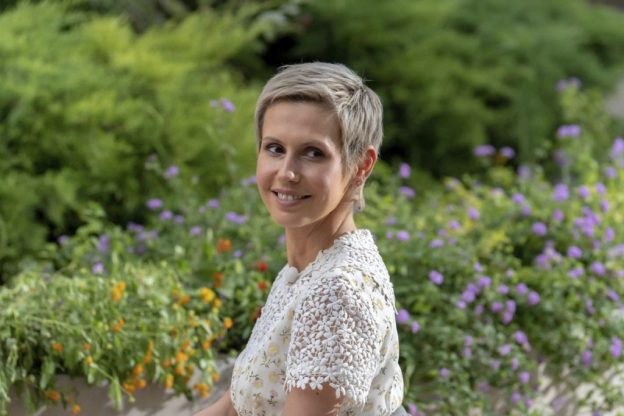
Asma al-Assad, First Lady of Syria (from released Syrian Presidency Facebook page)
It may be a new low in propaganda. National Public Radio (NPR) used the news that Syrian First Lady Asma al-Assad had overcome breast cancer to mock her and continue the information war against Syria. They interviewed a Human Rights Watch staffer named Lama Fakih who is an American from Michigan now based in Beirut.
Do you believe Ms. Fakih in Beirut or do you believe people who live in Syria who say we are being lied to? Lilly Martin is such a person. Although she is American from Fresno California, Lilly has lived in Syria for nearly 25 years. She is married to a Syrian and has two Syrian sons. Dr. Nabil Antaki is another such person. He is a medical doctor in Aleppo, fluent in English and French as well as his native Arabic.
While NPR snorts about Asma al-Assad “sporting a chic blonde pixie cut”, Lilly Martin points out that she was recently bald while fighting for her life.
While Ms. Fakir in Beirut says that there is “quite a lot of anger” because Asma al-Assad has conquered cancer, Dr. Antaki says that Syrians are happy at the news. Asma al-Assad is First Lady, mother to three children, and known for her compassion. Lilly Martin says that even while she battled cancer Mrs. al-Assad continued her charitable work.
While Ms. Fakih says that the “Assad government has been systematically targeting medical facilities and medical personnel”, Dr. Antaki, who has remained in Aleppo throughought the conflict, says this is not true. While there are many western accusations that the Syrian government attacks hospitals, the evidence is remarkably thin. One of the most highly publicized cases was regarding “Al Quds Hospital” in east Aleppo. In April 2016 there was a media blitz about this hospital having been destroyed by the Syrian Army. Following the departure of the “rebels”, it was discovered that “Al Quds Hospital” was an unmarked portion of an apartment building, that it had NOT been bombed and was the LEAST damaged building in the area. It was determined that the nearby Nusra (Al Qaeda) headquarters and ammunition depot was the Syrian army target. Accusations that “Al Quds Hospital” was bombed were false. It was a media stunt.
Ms. Fakih says that “Syrians have not been able to benefit from medical care in Syria since the beginning of the uprising in 2012”. Lilly Martin simply says “This is factually untrue. The Syrian system of national hospitals, free services to the public, are in every area of Syria and have run continuously throughout the war.” Dr. Antaki is an example; he is one of THOUSANDS of doctors working at HUNDREDS of hospitals throughout Syria. But you would never know it from NPR or Ms. Fakih.
It is true that there have been disruption and damage to many hospitals, as demonstrated in this jihadi assault on Al Kindi Hospital. These are the “rebels” supported by Ms. Fakih and Human Rights Watch. They effectively supported them in east Aleppo until they were expelled from the city. Now Ms. Fakih and HRW are supporting the “rebels” in their last redoubt in Idlib. There are countless videos demonstrating the cruelty and fanaticism of the “rebels”. For example, the aftermath of the above assault on Kindi Hospital and the execution of the Syrian soldiers who defended the hospital. Those who are cheerleading for the “rebels” and trying to prevent the Syrians reclaiming Idlib should look at the execution video to see what they are supporting.
The West has provided weapons and other support to the “rebels”. In parallel, there has been a campaign to whitewash the “rebels” and demonize the Syrian government. On top of this, the USA has imposed crushing sanctions on Syria which make it difficult or impossible to get critical medicines and replacement parts for western medical equipment. Dr. Antaki says it took him 1.5 years to obtain a replacement part for a Japanese medical instrument. I had my own experience with the draconian and inhumane sanctions. It took one year and endless hassle to send hearing aid batteries to help a deaf child in Syria.
This is one among hundreds of Syria “regime change” propaganda pieces broadcast on NPR. Behind a facade of authority and objectivity, there is bias and misinformation along with crocodile tears. As Lilly Martin says, “While the Syrian government medical system has tried to meet all the needs of Syrian civilians during 8 years of armed conflict, still there are numerous cases where the needs were not met and Syrians have suffered, and that blame must be shouldered by every person who held a gun against Syria and their foreign supporters who have succeeded in bringing the Syrian people into the depths of destruction and despair.”
As to Asma al-Assad and her integrity, it is best to listen and judge for yourself. At about 5:30 of the interview she speaks of the families of 100 thousand Syrian martyrs who died defending their country. “On a personal level, I am humbled by their determination, by their resilience, and by their love of Syria. They are my biggest source of strength and hope for the future.”
The sneers, misinformation, unverified accusations and de facto defense of Nusra/Al Qaeda by NPR and Lama Fakih stand in stark contrast.
Rick Sterling is an investigative journalist who grew up in Canada but currently lives in the San Francisco Bay Area of California. He can be reached at rsterling1@gmail.com.
August 20, 2019
Posted by aletho |
Mainstream Media, Warmongering | Human Rights Watch, NPR, Syria, United States |
Leave a comment
The Turkish Defense Ministry has condemned Syria for attacking its convoy in the Syrian province of Idlib. Damascus said the vehicles were transporting weapons and ammo to “terrorist forces.”
Ankara said three people were killed and 12 others injured on Monday after the Syrian airstrike, which targeted a Turkish military convoy travelling between two observation points in northern Syria. The statement said all victims were civilians, without explaining how they were involved in a military operation.
Ankara said the attack violated the agreement between Russia, Turkey and Iran, which paved the way to a relative de-escalation in the protracted war in Syria, the Turkish news agency Anadolu reported.
Idlib province is the last major part of Syria largely controlled by various armed groups, some of them hardcore jihadists. On request from Russia, the Syrian government agreed not to use force to retake the region to avoid casualties among civilians, who have blood ties with Turkey.
Ankara is supposed to prevent hostilities from reigniting, with a series of observation posts spread along the provincial border to monitor the situation. The plan however never fully worked, with regular flare-ups happening between various armed groups and the Syrian Arab Army.
The nature of the attacked convoy is perceived differently by the Syrian side, however. The Syrian news agency SANA said it was carrying weapons and ammunition to “terrorist forces” in the town of Khan Sheikhoun. It’s located in the southern part of Idlib province on a highway connecting the cities of Aleppo and Hama.
Lately there has been heavy fighting near Khan Sheikhoun between Damascus forces and the group controlling the city, predominantly the Islamist group Hayat Tahrir al-Sham (HTC), formerly known as Nusra Front.
August 19, 2019
Posted by aletho |
Aletho News | Syria, Turkiye |
Leave a comment
The exchange below took place a few days ago, below the line of an OffGuardian piece on the corruption of the UN’s Organisation for the Prohibition of Chemical Weapons (OPCW) as shown in its handling of last year’s Douma incident.
Louis Proyect is one of many on the marxist left I think dead wrong on Syria – see my post from last year on Workers’ Power. He professes bafflement that marxists could defend evil Assad.
Me, I’m baffled that any marxist could buy, on such negligible evidential basis, the demonising of a third world leader who stands in the way of imperialist powers with multiple motives (oil pipeline, privatisation, Golan theft, hurting Iran and Russia) for crushing Ba’athism – and with a record as long as your arm of lying at every turn as to the why of it.
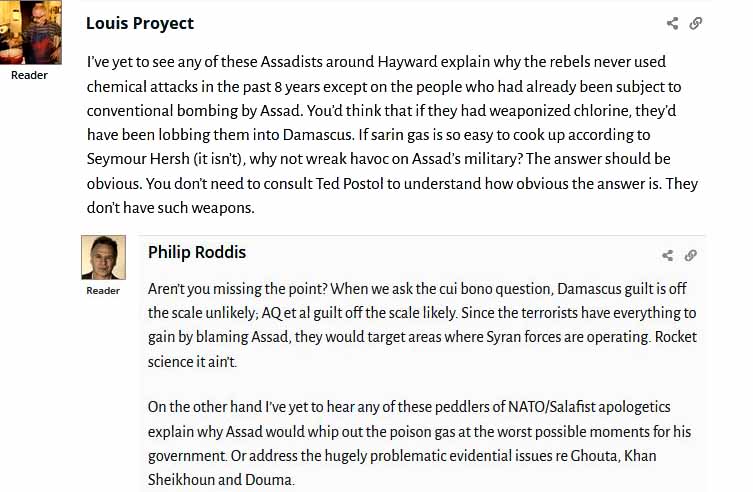
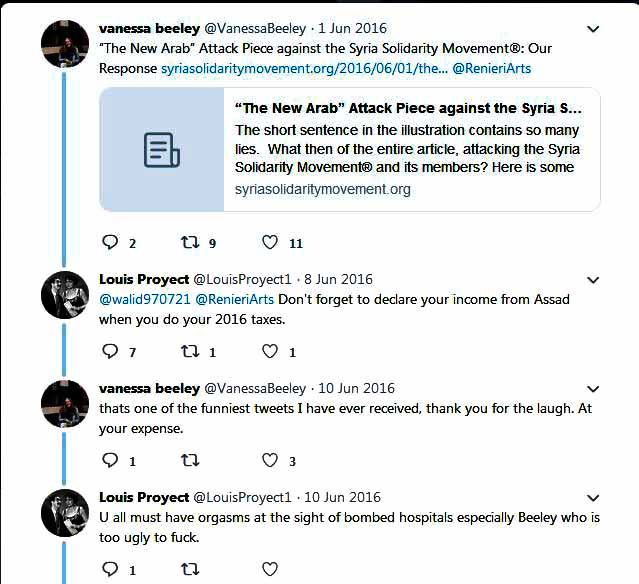
I’m even more baffled that anyone could take seriously a man who describes Vanessa Beeley – one of the most high profile reporters to challenge official NewSpeak on Assad – as “too ugly to fuck”.
Classy.
Moving on, Proyect claims – I’ve heard the Guardian’s George Monbiot do the same – that sarin is hard to manufacture; certainly beyond the capacity of Islamist groups working to bring down Assad. Since neither Proyect not Monbiot are experts, I’ll turn to those who are.
Let none accuse me of cherry picking. This piece, from Wired two years ago, is vehemently of the view that Assad does have sarin, and does use it.
[Sarin] is not especially hard to produce, in terms of both resources and expertise. “A competent chemist could make it, and possibly very quickly, in a matter of days,” says John Gilbert, a senior science fellow at the Center for Arms Control and Non-Proliferation, who spent much of his Air Force career assessing countries’ WMD capabilities. Producing sarin doesn’t require any kind of massive facility; a roughly 200 square foot room would do.
Author Brian Barrett, eager to make the case that Damascus could have rebuilt sarin stockpiles after the OPCW oversaw their destruction in 2014, inadvertently blows Proyect’s and Monbiot’s argument clean out of the water!
We should also note the Tokyo subway attack of March 20, 1995. Perps? Aum Shinrikyo, a bunch of doomsday wingnuts originating as a yoga and meditation group devoted to a mishmash of deities with Hinduism’s Shiva – the destroyer – in overall charge and channelling through head wacko Shoko Asahara. Says wiki:
Tsuchiya [a member] had established a small laboratory in Kamikuishiki in 1992. After initial research (at Tsukuba University, where he had studied chemistry) he suggested to Hideo Murai – a senior Aum advisor who had tasked him with researching chemical weapons, out of fear the cult would soon be attacked with them – that the most cost-effective substance to synthesise would be sarin.
He was ordered to produce a small amount – within a month, the necessary equipment had been ordered and installed, and 10-20g of sarin produced via synthetic procedures derived from the five-step DHMP process as originally described by IG Farben in 1938, and as used by the Allies after World War II.
Murai then ordered Tsuchiya to produce 70 tons. When Tsuchiya protested that this was not feasible in a research laboratory, a chemical plant was ordered to be built alongside the biological production facility in the Fujigamine district of Kamikuishiki, to be labelled Satyan-7 (‘Truth’). The equipment and substantial chemicals were purchased using shell companies under Hasegawa Chemical, already owned by Aum. At the same time, in 1993, cult members travelled to Australia, bringing generators, tools, protective equipment (including gas masks and respirators), and chemicals to make sarin.
Are we seriously to suppose that ‘moderate Islamists’ operating in Syria with barely hidden aid from Israel, Saudi Arabia, Turkey and – not least through the likes of White Helmets – the West are less resourceful than this bunch of millennial crazies?
It amazes me, perhaps because I still deem them deluded but sincere, that so many fail to see that on Syria, and much besides, we are being lied to on a monumental scale and will continue to be lied to until we wake up and demand the truth.
Scribbler for some sixty years, and for fifteen a photographer too, Philip Roddis began blogging in the early noughties by inflicting film reviews on an unsuspecting public. Soon he was doing the same with illustrated writings on wanderings in Asia and Africa. He writes “to help me think, and because I like to be read”, and finds photography’s problem solving aspects “a break from those of writing, as well as an aid to writing and to reflective travel”.
August 18, 2019
Posted by aletho |
False Flag Terrorism, Mainstream Media, Warmongering, Progressive Hypocrite | Middle East, Syria, Zionism |
Leave a comment
The creation in 2014 of a new mechanism – the “Fact-Finding Mission in Syria” (FFM) – to investigate alleged chemical attacks allowed the OPCW to bypass the procedures laid down in the Chemical Weapons Convention for investigations of alleged use, and to set its own rules for these investigations.
The roles of the Director-General and the newly appointed director of the Investigation and Identification Team (IIT) are mostly ceremonial. The effective boss of the OPCW is the Chief of Cabinet Sébastien Braha, a French diplomat, and the Principal Investigator of the IIT is Elise Coté, a Canadian diplomat. Although these individuals have obvious conflicts of interest in relation to Syria, the OPCW lacks any procedure for managing such situations.
The Technical Secretariat’s excuse for suppression of the Engineering Assessment – that evidence that the cylinders were manually placed rather than dropped from the air is “outside of the mandate and methodology of the FFM” – is fallacious and contradicts OPCW’s published reports on the Douma incident.
It was already clear from open-source evidence, as we pointed out in an earlier briefing note, that the Interim and Final Reports of the FFM on the Douma incident had been nobbled.* Our sources have now filled in some of the details of this process. Specifically:
- By mid-June 2018 there would have been ample time to draft an interim report that summarized the analysis of witness testimony, open-source images, on-site inspections and lab results. We have learned that the original draft of the interim report, which had noted inconsistencies in the evidence of a chemical attack, was revised by a process that was not transparent to FFM team members to become the published Interim Report released on 6 July 2018 that included only the laboratory results.
- After the release of the Interim Report, the investigation proceeded in secrecy with all FFM team members who had deployed to Douma excluded. It was nominally led by Sami Barrek who as FFM Team Leader had left Damascus before the on-site inspections began. These FFM team members do not know who wrote the document that was released as the “Final Report of the FFM”.
- We have learned from multiple sources that the second stage of the investigation involved consultation with Len Phillips, the previous leader of FFM Team Alpha who worked in the OPCW during this period as a self-employed consultant.
From examination of three earlier FFM reports on incidents in 2015 or 2017 where Phillips was the Team Leader, it is clear that these reports also excluded or ignored evidence that these alleged chemical attacks had been staged. Specifically:
- The FFM report on the alleged chlorine attacks in Idlib between 16 March and 20 May 2015 omitted the crucial fact, later noted by the Joint Investigative Mechanism, that the refrigerant canisters allegedly used as components of chemical munitions could not have been repurposed.
- The FFM report on the alleged sarin attack in Khan Sheikhoun on 4 April 2017 omitted the information, later noted by the Joint Investigative Mechanism which had access to the same records, that the recorded hospital admission times of at least 100 patients were too early for them to have reached hospital if they had become casualties at the time the attack was alleged to have occurred.
- The FFM investigation of the alleged chlorine attack in Ltamenah on 25 March 2017, reported on 13 June 2018, led it to discover a previously unrecorded sarin attack nearby the day before, and to prompt the White Helmets to provide, eleven months later, munition parts that tested positive for intact sarin. The report failed to explain or even comment on how intact sarin could have persisted for so long in the open.
This indicates that the suppression of the Engineering Assessment of the Douma incident was not an isolated aberration. In this context it is relevant that the opposition-linked NGOs on which the FFM has relied for evidence since 2014 have dubious provenance, and at least some of them have been set up under UK tutelage.
The credibility of the OPCW cannot be restored simply by finding some way to reverse what were purported to be the findings of the FFM on the Douma incident, but only by an independent re-examination of all its previous investigations of alleged chemical attacks in Syria, and a radical reform of its governance and procedures.
To resolve the discrepancy between the conclusions of the internal Engineering Assessment and those of the Final Report, a first step would be to make public the assessments of the external engineering experts on whom the Final Report relied. The engineering assessments were based on observations of the cylinders and measurements at the locations where they were found.
As the cylinders, tagged and sealed by the OPCW inspectors, are in the custody of the Syrian government, it is feasible to undertake an independent study to determine whether the conclusions of earlier engineering assessments can be replicated. For such a study to be credible, it would have to be undertaken by a panel independent of OPCW, in accordance with methods for reproducible research.
This is the Summary of a long work first published by Working Group on Syria, Propaganda and Media earlier this year, to read the full report click here.
*The term ‘nobbled’ is used here to describe illegal or unfair interference. The term was originally used to describe actions designed to prevent a horse from winning a race.
August 15, 2019
Posted by aletho |
Corruption, Deception, False Flag Terrorism | Syria, UK |
Leave a comment
By Sara Abed | August 11, 2019
After three days of intense negotiations in Ankara, US and Turkish officials reached an agreement on Wednesday to create a joint operations center and set up a safe zone east of the Euphrates in north eastern Syria. Deal details have not yet been disclosed.
This last minute deal between Washington and Ankara is in response to Turkish President Recep Tayyip Erdogan’s announcement on Sunday that Turkey was prepared to carry out a unilateral cross-border operation to push back Kurdish militias on the Syrian Turkish border east of the Euphrates river, if Washington didn’t cut ties with the Kurdish militias and create a safe zone in northern Syria.
The two NATO allies agreed that the Turkish based joint operations center would be created as soon as possible to address Turkey’s security concerns. The safe zone would become a “peace corridor”, and efforts would be made so that Syrian refugees could return home.
However, wanting peace is just a front for Erdogan’s true motives. The Syrian government categorically rejects the deal as a blatant attack on Syria’s territorial sovereignty and warns of Erdogan’s real reasons for establishing a so-called safe-zone on Syrian soil.
The Syrian Foreign Ministry said “The agreement constitutes a partnership between the US and Turkey over aggression against Syria that would serve the interest of the Israeli occupation entity. It also reflects how evasive and misleading the policies of the Turkish regime are.”
On Thursday an official Syrian source at the Ministry of Foreign Affairs told SANA “Syria expresses categorical rejection of the agreement announced by the US and Turkish occupations on establishing the so-called [safe zone] which constitutes a blatant aggression against the sovereignty and territorial integrity of the Syrian Arab Republic and a flagrant violation of the principles of international law and the UN Charter.”
Turkey is using the excuse of protecting its borders against the US-backed Kurdish People’s Protection Units (YPG) and the Syrian Democratic Forces (SDF) who Turkey views as the Syrian branch of the Kurdistan Workers’ Party (PKK), to fulfill its long-term mission of expanding its territory by invading and balkanizing its sovereign neighbor.
Many nations including the United States, who designated the PKK as a terrorist group in 1997, and Turkey who has been in conflict with the PKK since their inception in 1984, consider them to be a terrorist organization.
Another Turkish goal is to replace the indigenous diverse ethnic population in northern Syrian with extremists that are sympathetic to Erdogan, like we have seen in Afrin and other towns on Turkey’s border in northern Syria.
Erdogan’s plans for invasion and annexation will put Christian minorities in danger, some of whom can trace their lineage back to the original inhabitants of this land. However, Kurdish militias have also targeted them by using forced conscription and other Daesh-like intimidation tactics. The Kurdish Connection: Israel, ISIS And U.S. Efforts To Destabilize Iran explains more about how Kurdish militias have been used by the US to achieve their own objectives in the Middle East.
A statement issued by the Syrian Ministry of Foreign Affairs states “This agreement has very clearly exposed the US-Turkish partnership in the aggression against Syria which serves the interest of the Israeli occupation entity and the Turkish expansionist ambitions and it unequivocally exposed the misleading and evasiveness which govern the policies of the Turkish regime.”
“Syria calls on the Arab people to be aware of the dangers of the expansionist ambitions of the Turkish regime which is spreading the killing and chaos in different parts of the Arab world from Syria to Libya and the Sudan and it will not stop till it will satisfy its illusions on reviving the Ottoman Sultanate,” the source said.
The Syrian Ministry of Foreign Affairs representative concluded by saying that “Syria calls on the international community and the UN to condemn the US-Turkish flagrant aggression which constitutes a dangerous escalation and poses a threat to peace and security in the region and the world and hinders all positive efforts for finding a solution to the crisis in Syria.”
All the major players involved in the proxy war in Syria, including Turkey, Russia, and Iran want the US to leave, except of course the US-backed Kurdish SDF which are just a rebranding of the YPG.
US President Donald Trump has expressed interest multiple times in a swift troop withdrawal, and to let the local regional players figure things out. However, the war hawks surrounding him in Washington, along with the Pentagon have derailed his plans since last December. They have stressed that US interests need to be protected by having a long-term presence in the oil-rich, agriculturally rich, breadbasket of Syria, to keep an eye on Iran while protecting their ally, Israel.
As I have stated previously establishing an independent Kurdish state in Syria is just part of the decades-long Israeli-American plan to weaken and divide all the nations neighboring Israel.
Although it might seem like Russia has been uncharacteristically quiet this week regarding the latest developments with Turkey and the US in north eastern Syria, Russia has consistently stood by the Syrian government’s right to protect its territorial integrity and sovereignty.
Whether its occupation and annexation by the Kurds or Turks, Kurdification or Turkification, the Syrian government and military categorically reject any infringement on their land, and have adamantly stated they will take back every inch of Syrian territory from terrorists or occupiers.
August 11, 2019
Posted by aletho |
Ethnic Cleansing, Racism, Zionism | Israel, Middle East, Syria, Turkiye, United States, Zionism |
Leave a comment
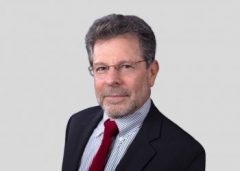 To say that Clifford May, founder of the Foundation for the Defense of Democracies, loves war would be an understatement. He loves almost everything about war and he thinks the US should be in a lot more of them. He thinks that the US should never go home, should never withdraw troops, should forever be searching for “bad guys” to fight, lest they come find us and fight us here. Because the rest of the world is exclusively focused on how to invade and destroy the United States.
He likes to invoke Sun Tzu and Clausewitz and Plato to make his case for endless wars. Neocons love to do that because it makes them sound erudite and grounded in history – when in fact they are neither.
About the only thing Clifford May does not love about war is fighting it himself.
While others of May’s generation were being blown to bits in that lost cause called “Vietnam,” May was drinking brewskis at Sarah Lawrence College and then Columbia University. His experience of war consists of covering it as a pampered correspondent of the shining lights of the mainstream US media like Newsweek and the New York Times.
Not only does May disdain the idea of soiling his dainty hands with the real blood and guts of war, he actually disdains those unlucky young Americans who find themselves churned up in the endless killing machine called “US empire.”
In a recent Washington Times editorial, tellingly titled, “Why endless wars can’t be ended,” May argues that members of the US military should be constantly in battle. Not a moment’s rest from the killing and being killed. After all…
… the men and women volunteering to serve in America’s armed forces are not doing so in order to hang around the house drinking brewskies.
May’s is a rare look into the utter contempt the neoconservatives feel for members of the United States military. Veteran suicides are an epidemic in the United States and are in fact the second leading cause of death in the US military. Veterans make up 18 percent of all US suicides while representing only 8.5 percent of the population.
Why are veterans killing themselves at a rate of 20 per day? A recent study found that the risk of military suicide rises with rapidly repeating deployments – just the kind of constant warfare that Cliff May calls for in his Washington Times article this week.
After all, what the hell else would these kids be doing if they weren’t driving themselves to suicide from endless wars… hanging around the house drinking brewskis?” Right, Cliff?
In the Washington Times piece this week, May argues passionately against President Trump’s stated goal of removing US troops from their positions occupying parts of Syria. US troops in Syria are, in his telling, “both preventing a revival of the Islamic State, and helping contain the Islamic Republic of Iran.”
This above sentence is key to understanding May’s constant push for more US involvement in the Middle East. Hint: It’s not really about America.
May’s Foundation for the Defense of Democracies is lavishly funded by single-issue billionaires who believe they are helping Israel by sending US troops to the Middle East to constantly provoke and kill those they believe are Israel’s enemies. Thus far it has not brought peace any closer to either Israel or its rivals in the region. In fact the opposite. But the money keeps flowing so May keeps blowing. And American troops (along with millions of innocents in the target countries) keep on dying.
Just as the neocons like it.
August 8, 2019
Posted by aletho |
Mainstream Media, Warmongering, Militarism, Wars for Israel | Israel, Middle East, Syria, United States |
Leave a comment
Syria on Thursday lashed out at US and Turkey over a deal to establish so-called ‘safe zone’ in northern Syria, stressing that such agreement constitutes ‘blatant aggression’ against the country’s sovereignty.
In a statement issued on Thursday, Syrian foreign ministry said Damascus “expresses absolute rejection of the agreement announced by the US and Turkish occupiers on establishing the so-called ‘safe zone’ which constitutes a blatant aggression against the sovereignty and territorial integrity of the Syrian Arab Republic and a flagrant violation of the principles of the international law and the UN Charter.”
“This agreement has very clearly exposed the US-Turkish partnership in the aggression against Syria which serves the interest of the Israeli occupation and the Turkish expansionist ambitions,” SANA news agency quoted a source at the Syrian ministry as saying.
Turkish and US officials agreed on Wednesday to establish a joint operations center to coordinate efforts to carve out a buffer zone in northern Syria, in order to manage tensions between Ankara and US-backed Kurdish forces in Syria, according to statements from both governments.
Syria, meanwhile, slammed some Kurdish, saying they “have been misled and accepted to become a tool in this aggressive US-Turkish project” and “bear a historical responsibility” in this regard.
“It is time to reconsider their calculations and to stand by the side of all the Syrians and the Syrian Arab Army in defending the sovereignty of the Syrian Arab Republic and its territorial integrity,” the source added.
In recent weeks, Turkish media have repeatedly shown images of military convoys heading for the border area, carrying equipment and fighting units.
Turkey has already carried out two cross-border offensives into Syria, including one in 2018 that saw it and allied militias overrun the majority Kurdish Afrin enclave in the northwest.
August 8, 2019
Posted by aletho |
Illegal Occupation | Middle East, Syria, Turkiye, United States |
Leave a comment
Sarah Abed | August 7, 2019
In what would be Turkey’s third cross-border military operation in Syria since the war began, in as many years, Erdogan announced on Sunday that he would be launching a military operation east of the Euphrates river, to push back Kurdish militias on Turkey’s southern border.
Although Erdogan did not set a timeframe, preparations have been underway for well over a month. Increased deployment of Turkish military forces along with weaponry, and tanks, etc. have been reported by various sources, on the Turkish side of the southern border with Syria.
Preparations are also underway by Kurdish militias, to counter any possible Turkish aggression. Both sides have said that if the other attacks they will be ready to respond.
The same announcement, regarding a military operation east of the Euphrates, was made by Erdogan over nine months ago, but was then called off due to talks with US President Donald Trump who agreed to set up a safe zone on Turkey’s border to appease Erdogan. However, this never came into fruition, and a buffer zone was not created because of a difference of opinion on the depth. Erdogan now feels the US is stalling, and his latest threats seem to indicate that his patience is running thin.
Some believe that the chances of Erdogan carrying out his mission this time, are higher because he has notified Russia and the US, in advance of his plan.
However, if Turkey carries out this third operation, the outcome will most likely not be a swift defeat and take over by Turkish armed forces and their terrorist ally the Free Syrian Army (FSA) like we have seen in the past. The stakes are also much higher due to the presence of US troops, intelligence officers and US personnel stationed in northeastern Syria.
On Tuesday, U.S. Defense Secretary Mark Esper said that “the U.S. intends to prevent any unilateral invasion by Turkey into northern Syria, saying any such move by the Turks would be unacceptable.” Esper seemed hopeful that negotiations and talks would lead to some sort of agreement but did not disclose what that could be.
Some speculate that specific airstrikes targeting Kurdish militia installations are more likely to occur, than a unilateral land invasion. The demographics are such that all of the various ethnicities whether they be Syrian Muslims, Assyrians, Armenians, Kurds, Arameans, etc. would most likely bond together against any Turkish aggression.
The first cross-border Turkish operation Euphrates Shield in 2017, focused on targeting a “terror corridor” made up of Daesh and Kurdish fighters further east from Afrin along its southern frontier with Syria. After completing that operation, Turkey set up local systems of governance in the swath of land captured, stretching from the area around Azaz — located to the northeast of Afrin — to the Euphrates River and protected by Turkish forces present there.
The second, Operation Olive Branch, which began January 2018 and was completed in two months with Afrin being captured by the Turkish Armed Forces and their ally the Free Syrian Army. They quickly established control over Afrin and all of the villages that had remained under the control of Kurdish YPG (the People’s Protection Unit) north and northwest of the city. Many YPG fighters and their families fled to government-held parts of Aleppo.
In primarily the second operation, YPG fighters felt abandoned and betrayed by the US who stated that they would not get involved and seemingly allowed Turkey to carry out its operations without much objection. There was a noticeable silence from Russian and Syrian forces as well.
In order to understand Turkey’s contentions with the Kurdish militia’s it’s important to clarify the major players. The YPG is a Kurdish-majority militia that is the military wing of the Democratic Union Party (PYD), a Kurdish democratic confederalist political party in northeastern Syria. The YPG is the Syrian offshoot of the Kurdistan Workers Party (PKK), which is an organization based in Turkey and Iraq that has been engaged in armed conflicts with the Turkish state since 1984.
Turkey considers all these Kurdish organizations to be terrorists and has urged the United States for years to sever ties with them and has demanded a buffer zone. Both the United States and Turkey view the PKK as a terrorist organization.
The United States justified its military and economic support for the YPG by claiming they were the most reliable fighters in Syria against Daesh. Kurdish factions have been used throughout history to create chaos in the Middle East.
To disassociate the YPG from the PKK, General Raymond Thomas, the commander of the United States Special Operations Command (SOCOM), revealed — at a Security Forum on July 21, 2017 at the Aspen Institute — that he personally discussed the importance of changing its name with the YPG. As he states in this video, he was impressed that they included the word “democratic” in their rebranding: their new name, the Syrian Democratic Forces (SDF), would help them enter into political negotiations, where they had been excluded previously owing to their association with the PKK.
Recently tensions have been high between the United States and Turkey over the latter’s purchase of the S-400 missile defense system from Russia which the former disapproved of and then subsequently removed the latter from the F-35 fighter jet program. The United States has also threatened to impose sanctions if Turkey activates the S-400 system which Erdogan has stated they have every intention of doing by April 2020.
On Monday, an American military delegation met with Turkish officials in Ankara to continue negotiations and discuss an alternative Turkish military operation which wouldn’t threaten U.S. troops stationed in the area. The U.S. is urging Turkey not to carry out its proclaimed mission.
Sarah Abed is an independent journalist and analyst.
August 7, 2019
Posted by aletho |
Illegal Occupation, Militarism | Syria, Turkiye, United States |
Leave a comment
Running as an anti-war candidate in the US comes with a target painted on your back that draws fire from those rooting for foreign interventions. In case of Tulsi Gabbard, it includes a lengthy piece on chemical attacks in Syria.
Gabbard, a Democratic presidential hopeful, became the most-googled candidate during the second primary debate – but the surge of public interest came with renewed attacks against her anti-interventionist agenda. In case you’ve missed it all, Gabbard has been branded a ‘Russian’ spoiler for whichever candidate is eventually picked, and, once again, an apologist for Syrian President Bashar Assad.
Joining the chorus of bashers on Sunday was Elliot Higgins, the founder of the UK-based ‘citizen investigation’ outlet Bellingcat, who wrote a whopping 4,000-word piece attacking Gabbard’s negative attitude toward regime change wars. In particular, Higgins didn’t like her skepticism over chemical weapons attacks in Syria reflected on her campaign website. The attacks were used by Washington to justify missile attacks against the country’s government – and by extension continued illegal US military presence in the country.
The mammoth piece starts with screenshots featuring logos of RT and InfoWars (Russian propaganda, dear readers, conspiracy theories!) and goes on to criticize anyone doubting the US-favored narrative about what happened in Syria.
MIT Professor Theodore Postol gets an honorable mention, with whom Higgins no longer debates in person since their encounter in 2018. Back then, Higgins failed to address Postol’s technical criticisms of his investigations and instead resorted to mocking applauses and calling his opponent a tool of Russian propaganda.
While the West squarely laid the blame for most, if not all, chemical incidents in Syria on the government forces – and Bellingcat did their best to “prove” it – Damascus and Moscow have insisted the attacks mentioned by Gabbard and Higgins were false-flag operations by Al-Qaeda-affiliated militants.
Particularly infamous was the one in Douma on April 7, 2018, in which the Oscar-winning ‘White Helmets’ doused unsuspecting children with cold water on camera, so as to fake the treatment of the alleged “victims.” They might not have expected for witnesses to later come forward and speak on the record at the Hague, denouncing the whole affair as staged.
Syrian war aside, some may find a bit of irony in how Bellingcat has found a good use for US taxpayer money, which it receives through one of its sponsors, the National Endowment for Democracy – and then gets to do a little meddling in the 2020 presidential campaign.
Also on rt.com:
MIT professor accuses Bellingcat’s Higgins of enabling war criminals to walk free in Syria (VIDEO)
Real ‘obscene masquerade’: How BBC depicted staged hospital scenes as proof of Douma chemical attack
August 4, 2019
Posted by aletho |
Mainstream Media, Warmongering | Syria, United States |
Leave a comment
The Washington Post, which is wholly owned by a CIA contractor who is reportedly working to control the underlying infrastructure of the global economy, has published a shockingly deceitful smear piece about Democratic presidential candidate Tulsi Gabbard in the wake of her criticisms of her opponent Kamala Harris’ prosecutorial record during the last Democratic debate.
The article’s author, Josh Rogin, has been a cheerleader for US regime change interventionism in Syria since the very beginning of the conflict in that nation. It is unsurprising, then, that he reacted with orgasmic exuberance when Harris retaliated against Gabbard’s devastating attack by smearing the Hawaii congresswoman as an “Assad apologist”, since Gabbard has been arguably the most consistent and high-profile critic of Rogin’s pet war agenda. His article, titled “Tulsi Gabbard’s Syria record shows why she can’t be president”, is one of the most dishonest articles that I have ever read in a mainstream publication, and the fact that it made it through the Washington Post’s editors is enough to fully discredit that outlet.
You can read Rogin’s smear piece without giving Jeff Bezos more money by clicking here for an archive. There’s so much dishonesty packed into this one that all I can do is go through it lie-by-lie until I either finish or get tired, so let’s begin:
“Gabbard asserts that the United States (not Assad) is responsible for the death and destruction in Syria, that the Russian airstrikes on civilians are to be praised”
This is just a complete, brazen, whole-cloth lie from Rogin. If you click the hyperlink he alleges supports his claim that Gabbard asserts “Russian airstrikes on civilians are to be praised,” you come to a 2015 tweet by the congresswoman which reads, “Bad enough US has not been bombing al-Qaeda/al-Nusra in Syria. But it’s mind-boggling that we protest Russia’s bombing of these terrorists.”
Now, you can agree or disagree with Gabbard’s position that the US should be participating in airstrikes against al-Qaeda affiliates in Syria, but there’s no way you can possibly interpret her acceptance of Russia doing so to be anywhere remotely like “praise” for “airstrikes on civilians”. There is simply no way to represent the content of her tweet that way without knowingly lying about what you think it says. The only way Rogin’s claim could be anything resembling truthful would be if “al-Qaeda” and “civilians” meant the same thing. Obviously this is not the case, so Rogin can only be knowingly lying.
“That bias, combined with her long record of defending the Assad regime and parroting its propaganda, form the basis for the assertion Gabbard has ‘embraced and been an apologist for’ Assad, as Sen. Kamala D. Harris (D-Calif.) said Wednesday post-debate on CNN.”
Gabbard has no record whatsoever of “defending the Assad regime”. This is a lie. There exist copious amounts of quotes by Gabbard opposing US regime change interventionism in Syria and voicing skepticism of the narratives used to promote said interventionism, but there are no quotes anywhere in which she claims Assad is a nice person or that he hasn’t done bad things. If such quotes existed, Rogin would have included them in his smear piece. He did not. All he can do is lie about their existence.
“To repeat: There is no quote in which Tulsi praises, supports, or otherwise ‘apologies for’ Assad,” journalist Michael Tracey recently tweeted with a link to his January article on the subject. “I checked the record a long time ago, and it doesn’t exist. This is just a smear intended to delegitimize diplomatic engagement”
“Claiming that politicians are ‘defending’ objectionable rulers they meet with, in pursuit of achieving some alternative to war, is a tired trope that has been frequently used throughout history to discredit diplomatic engagement,” Tracey wrote. “As Gabbard told me in an interview shortly after returning from Syria: ‘The reason why I decided to take this meeting on this trip was because if we profess to care about the Syrian people — if we really truly care about ending their suffering and ending this war — then we should be ready to meet with anyone if there is a chance that that meeting and that conversation could help to bring about an end to this war.’”
Gabbard has been remarkably consistent in explaining her position that she opposes US regime change interventionism in Syria because US regime change interventionism is reliably disastrous. This isn’t “defending” anyone, nor is it “parroting propaganda”. It’s an indisputable, thoroughly established fact.
“Other Democratic candidates have promised to end U.S. military adventurism without making excuses for a mass murderer. It’s neither progressive nor liberal to defend Assad, a fascist, totalitarian psychopath who can never peacefully preside over Syria after what he has done.”
Again, claiming that Gabbard has done anything at all to “defend Assad” is a lie. If anything Gabbard has been too uncritical of establishment war propaganda narratives, calling Assad “a brutal dictator” who has “used chemical weapons and other weapons against his people.” Gabbard’s sole arguments on the matter have been in opposition to US military interventionism and skepticism of narratives used to support such interventionism, which only an idiot would object to in a post-Iraq invasion world.
Rogin argues that it’s possible to end US military adventurism without defending and making excuses for Assad, yet this is exactly the thing that Tulsi Gabbard has been doing since day one. Which means Rogin doesn’t actually believe it’s ever okay for any presidential candidate to want to end US military adventurism under any circumstances. Which is of course the real driving motivation behind his deceitful smear piece against Gabbard.
“Gabbard never talks about her other trip — to the Turkish-Syrian border with a group of lawmakers in June 2015, when she met with authentic opposition leaders, victims of Assad’s barrel bombs and members of the volunteer rescue brigade known as the White Helmets. Their stories, which don’t support Assad’s narrative, never make it into Gabbard’s speeches on the campaign trail.”
This one is bizarre. Rogin says this as though Gabbard’s meeting with Assad is something that she brings up “on the campaign trail” rather than something war propagandists like himself bring up and force her to respond to. The fact that those propagandists never bring up Gabbard’s meetings with the Syrian opposition is an indictment of their bias, not hers. The mental gymnastics required to make Gabbard’s meetings with all sides of the Syrian conflict feel more pro-Assad rather than less deserve an Olympic gold medal.
Obviously Gabbard having met with all sides is indicative of an absence of favoritism, not the presence of it. The fact that she didn’t come away from her meetings with empire-allied opposition forces with the opinion that the US should help storm Damascus doesn’t mean she supports any particular side.
“Gabbard’s candidacy should be taken very seriously — not because she has a significant chance of being president, but because her narrative on Syria is deeply incorrect, immoral and un-American. If it were adopted by her party and the country, it would lead the United States down a perilous moral and strategic path.”
Saying a “narrative” can be “un-American” is a fairly straightforward admission that you are authoring propaganda. Unless you believe your nation has one authorized set of narratives, a narrative can’t be “un-American”. This is as close as you’ll ever get to an admission from Rogin that US power structures work to control the dominant narratives about world events, and that he helps them do it. To such a person, opposition to your narrative control agendas would be seen as the antithesis of the group you identify with.
The US empire has an extensive and well-documented history of using lies, propaganda and false flags to initiate military conflicts which advantage it. To continue to deny this after Iraq is either willful ignorance or propaganda.
The fact that Rogin adds “strategic path” to his argument nullifies his claim that his position has anything to do with morality. If your foreign policy concern is with strategic leverage, you will naturally try to interpret anything which advances that strategic path as the moral choice.
“Listening to Gabbard, one might think the United States initiated the Syrian conflict by arming terrorists for a regime-change war that has resulted in untold suffering.”
This is exactly what happened. The US armed extremist militants with the goal of effecting regime change, and before Russia intervened they almost succeeded. According to the former Prime Minister of Qatar, the US and its allies were involved in this behavior from the very beginning of the conflict in 2011. Here is a link to an article full of primary source documents showing that the US and its allies had been scheming since well before 2011 to provoke a civil war in Syria with the goal of regime change. They did exactly what they planned to do, which is exactly the thing Rogin claims they did not do.
But Gabbard never even takes her analysis this far. She simply says the US should not get involved in another US regime change war, because it shouldn’t.
“Responding to Harris, Gabbard called Assad’s atrocities ‘detractions,’[sic] before eventually saying she doesn’t dispute that he’s guilty of torture and murder. That’s a slight improvement from her previous protestations that there was not enough evidence.”
Rogin falsely implies here that Gabbard only just began accusing Assad of war crimes, and that she only did so in response to new pressure resulting from Harris’ criticism. As noted earlier, this is false; Gabbard has been harshly critical of Assad.
“Gabbard then quickly accused President Trump of aiding al-Qaeda in Idlib. ‘That does sound like a talking point of the Assad regime,’ CNN’s Anderson Cooper said. He could have just said she is wrong.”
Even the US State Department has acknowledged that Idlib is an al-Qaeda stronghold, and the Trump administration has taken aggressive moves to prevent the Assad coalition from launching a full-scale campaign to reclaim the territory. Claiming that this did not happen is a lie per even the accepted narratives of the US political/media class.
“Gabbard’s 2017 trip was financed and run by members of a Lebanesesocialist-nationalist party that works closely with the Assad regime.”
Former US Congressman Dennis Kucinich, who accompanied Gabbard on this trip, dismissed this accusation as “so much horseshit I can’t believe it.” All parties involved have denied this narrative, which Rogin has played a pivotal role in promoting from the very beginning and to which he has been forced to make multiple embarrassing corrections.
“Gabbard’s plan to overtly side with Assad and Russia while they commit crimes against humanity would be a strategic disaster, a gift to the extremists and a betrayal of decades of U.S. commitments to stand up to mass atrocities. Democratic voters who believe in liberalism and truth must reject not only her candidacy but also her attempt to disguise moral bankruptcy as a progressive value.”
Another lie; Gabbard has no such plan. Opposing US regime change interventionism isn’t “siding” with anybody, it’s just not supporting a thing that is literally always disastrous and literally never helpful.
Rogin’s closing admonishment to reject not just Gabbard but her skepticism of US war narratives is yet another admission that he’s concerned with narrative control here, not with truth and not even really with a US presidential candidate.
Whoever controls the narrative controls the world, and shameless war propagandists like Josh Rogin are the attack dogs of establishment narrative control.
August 4, 2019
Posted by aletho |
Fake News, Mainstream Media, Warmongering | Syria, United States, Washington Post |
Leave a comment
MOSCOW – Russia is urging the United States and European countries to withdraw forces from Syria, but can see the increase in their military presence there instead, Russian Special Presidential Envoy for Syria Alexander Lavrentyev said Friday.
“We are always calling on the United States and other — European — countries, whose troops are also illegally in Syria, to leave this sovereign state. Nevertheless, they are still justifying it by the need to fight Daesh* and other terrorist groups”, Lavrentyev said at a press conference.
The Russian presidential envoy stressed that these countries were in reality pursuing their own agenda.
“So far we have not been able to convince them to withdraw forces. Despite the words of [US President Donald] Trump that US forces would be pulled out, we can see, on the contrary, the increase in these forces, partly because of the presence of private military companies”, the envoy said.
The number of US troops in Syria has been declining since US President Donald Trump claimed victory over the jihadists in December, promising to withdraw at least 2,000 troops from the country in the near future.
US forces have been operating in Syria as part of an international coalition to fight the Daesh terrorist organisation for about four years without the permission of either Damascus or the UN Security Council.
August 2, 2019
Posted by aletho |
Illegal Occupation | European Union, Russia, Syria, United States |
Leave a comment


 Aletho News