Marie Colvin, Homs and Media Falsehoods about Syria
By Rick Sterling | Dissident Voice | January 20, 2019
Introduction
In April 2014 I was part of an international delegation which visited Syria for five days. The delegates came from many different countries. Among the notables were the Irish Nobel Laureate Mairead Maguire, a Syrian-British heart surgeon and Julian Assange’s father. We spent time in Damascus, then traveled by bus to Latakia and then Homs. In each city we had meetings with political, religious and social leaders but also had time to wander about and talk with people on the streets.
In Latakia, I met Lilly Martin, an American woman who married a Syrian and has lived there, raising a family for the past twenty-five years. She told me how wrong the western media coverage was. Contrary to media claims, she said protests in Latakia were violent from the start. After the first outbreak of violence, Syrian police and military were ordered to not carry weapons. Protesters continued to burn and destroy government offices with incidents of knifing and shooting unarmed police.

Peaceful Homs Street (Photo: Rick Sterling)
When we visited Homs I was struck by how normal it looked. The streets were full of people and the city looked fine. It was dramatically different than the images portrayed in western media. It was only when we were driving out of Homs that we passed an area where there was widespread destruction and battle damage. There was a sharp contrast between most of the city and the few neighborhoods where battle had raged.

Homs (Photo: Rick Sterling)
The American journalist Marie Colvin died in February 2012 in one of those neighborhoods. It was called Baba Amr. Ten days after her death, the militants and remaining civilians had all departed Baba Amr. It’s unfortunate that Marie Colvin did not talk with Lilly Martin or visit the majority of Homs where the war was not raging. It could have provided much needed balance to her perspective.
Marie Colvin and Homs
According to many of her colleagues, Marie Colvin was charming and courageous, ambitious and fun to be with. She had a knack for including personal details, descriptions and emotions that engaged the reader. Unfortunately, Colvin’s reports and interviews from Syria were inaccurate and a huge distortion of the situation.
It is useful to examine Colvin’s reporting now, seven years later, because there is a wave of new articles, books and movies about her and how she died in Syria.
Colvin and photographer Paul Conroy were smuggled into Syria from Lebanon in February 2012. They spent some days in the town of Al Buwaydah and then were taken into the city of Homs using a drainage culvert to avoid Syrian Army checkpoints. Their guides and minders for the trip were from the Farouq Battalion associated with the Free Syrian Army (FSA).
Beginning in the Fall 2011, militants from the Farouq Battalion set up checkpoints, killed security and soldiers and gradually took control of the Homs neighborhood called Baba Amr. They called it a “liberated zone”. By the time Marie Colvin and other journalists arrived, most of the civilians had fled the fighting to stay with friends and family in other parts of the city.
Colvin and Conroy spent a few days in Baba Amr but then left through the tunnel when it was rumored that Syrian forces were going to attack. After learning that the attack did not take place, the journalists made the difficult journey back into Baba Amr. The second morning after returning, Marie Colvin and French photographer Remi Olchik died as the Syrian forces launched mortar and missile attacks.
Biased and Inaccurate Reporting from Syria
Marie Colvin’s reports and interviews from Syria were broadcast widely in the UK and USA. She wrote an article titled “A vet is only hope for Syrian wounded“. The article begins “Wounded civilians arriving at a makeshift clinic in the Syrian city of Homs are relying on a vet to save their lives because there is no doctor to treat them.” As documented in Conroy’s book, they were not in Homs; they were in the town Buwaydah when they observed a vet working as a medic. Actually, there were hundreds of doctors performing medical duties and treating civilians and soldiers injured in the conflict in Homs.
Colvin’s major story for the Sunday Times was titled “Final dispatch from Homs, the battered city“. It begins by describing a “widows basement” with 300 “frightened women and children trapped in the horror of Homs”. The report of 300 women and children is an exaggeration. Another journalist estimated half that number which is likely an exaggeration itself, since the photos and video show fewer than 50 women and children.
Colvin continued her report saying, “The widows’ basement reflects the ordeal of 28,000 men, women and children clinging to existence in Baba Amr.” This is a huge falsehood; there was a tiny fraction of that number of civilians remaining in the neighborhood. Paul Conroy wrote as follows: “It became increasingly unbelievable that there were an estimated 28,000 people still living in Baba Amr. I hadn’t seen a single one.” (page 188, “Under the Wire”)
The night before her death, Marie Colvin did live interviews on BBC, Channel 4 and CNN. The CNN interview began by showing video of a baby dying from a shrapnel wound. CNN believed Marie Colvin was an eye-witness to the baby’s death. Anderson Cooper asked Colvin what it was like to be in the room. Marie Colvin replied that the room was chaotic and the baby’s death heartbreaking. She dramatized the situation by speaking about the baby’s grandmother being a volunteer in the room when the baby arrived. However, Colvin was not in the room at all. Marie Colvin and the media activists were shown the video on a laptop computer by their FSA guide. (page 155, “Under the Wire”).
In her CNN interview Colvin described Baba Amr as “28,000 civilians, men, women and children, hiding, being shelled, defenseless…. There are no military targets here…. So it’s a complete and utter lie that they (Syrian military) are only going after terrorists…. The Syrian Army is simply shelling a city of cold, starving civilians.” In reality, Baba Amr was the primary base for militants of the Farouq Battalion. If there was an “utter lie”, it was pretending that this was primarily a civilian neighborhood.
The Syrian Reality Which Colvin Did Not Report
Like most western coverage of Syria, Colvin’s reporting did not provide important context such as the following:
* How the conflict began in Homs. An eyewitness reported “From the start, the protest movements were not purely peaceful. From the start I saw armed demonstrators marching along in the protests, who began to shoot at the police first. Very often the violence of the security forces has been a reaction to the brutal violence of the armed rebels.”
* How Baba Amr was taken over. In October 2011 militants from the Farouq Battalion set up checkpoints within Baba Amr, attacked and killed Syrian Army soldiers and other security forces, and killed or expelled government supporters. The process was similar to what was documented by a civilian in Aleppo: “Nine days from my window in Aleppo“.
* Attacks on infrastructure. In December 2011, militants blew up the pipeline to Homs’ oil refinery, a major source of oil for the country.
In mid January, an Arab League report documented the results of their investigation. They said:
The Observer Mission witnessed acts of violence being committed against Government forces and civilians that resulted in several deaths and injuries. Examples of these acts include the bombing of a civilian bus, killing eight persons and injuring others, including women and children, and the bombing of a train carrying diesel oil. In another incident in Homs, a police bus was blown up, killing two police officers. A fuel pipeline and some small bridges were also bombed.
Militants in Baba Amr destroyed government tanks and used their own tank to attack government forces.

Abu Sa’eed, Free Syrian Army Unit Commander
On 2 February 2012, FSA militants attacked a government checkpoint, killing ten soldiers and taking another 19 as prisoners. That was evidently the last straw for the government. The next day, February 3, the intense bombardment of Baba Amr began.
Promoting External Intervention
Marie Colvin’s reports from Baba Amr had a political goal of spurring Western intervention. This is made clear in emails to her Sunday Times editor. “It is sickening that the Syrian regime is allowed to keep doing this …. I think again to focus on Baba Amr, 28,000 defenceless under shelling….” (pp 196-197, “Under the Wire”).
Her reports were missing crucial facts, sensationalized the suffering on one side, ignored the suffering on the other side and demonized the government which was the target for overthrow.

Amateur Video Homs
In her interview with CNN, Colvin used the video of the dying little baby to urge western intervention. “That baby probably will move more people to think, ‘What is going on, and why is no one stopping this murder in Homs that is happening every day?”
In her final article for the Sunday Times Colvin says, “In Baba Amr, the Free Syrian Army (FSA)…. have virtually unanimous support from civilians who see them as their defenders.” This claim is highly dubious. The vast majority of civilians had left Baba Amr. All that were left were family members of FSA militants and others who had nowhere to go.
The bias in Marie Colvin’s reports and interviews was not unique. On the contrary, nearly all NATO and Gulf state reporting on Syria has been biased. Stephen Kinzer would later write “The media are misleading the public on Syria.” Patrick Cockburn would later write that “Nearly everything you have read about Syria and Iraq could be wrong“.
How Marie Colvin Died
It is claimed that Marie Colvin was intentionally targeted by the Syrian government. This is unlikely. Her death brought opprobrium on Damascus and helped the militant opposition. A few months after Marie Colvin’s death, a prominent British journalist reported that the same Syrian rebels tried to get him and his team killed. “I’m quite clear the rebels deliberately set us up to be shot by the Syrian Army. Dead journos are bad for Damascus.”
It is also claimed that Syrian intelligence determined the location of Marie Colvin by identifying a satellite phone signal used in her interviews. This is false. Colvin told her editor at the Sunday Times that the Thuraya satellite phones did not work. For her Skype interviews she used the same antenna uplink used night and day by media activists in Baba Amr.
Marie and Remi were working in a battle zone, guided and effectively embedded with armed insurgents. Their deaths were another tragic consequence of the war.
Ten days after Colvin’s death, the militants and remaining civilians withdrew from Baba Amr. There was no massacre, just a street parade and celebration in other parts of Homs.
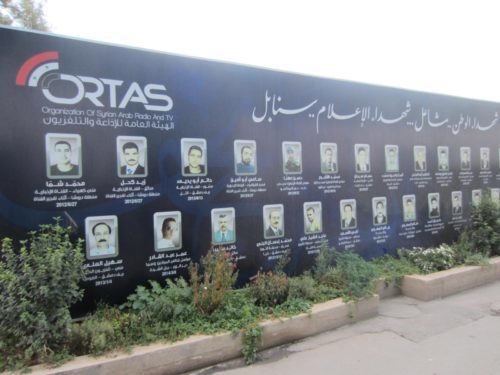
Syrian Journalists Killed (Photo: Rick Sterling)
The deaths of Marie Colvin and Remi Olchik sparked many tributes and widespread publicity. Largely unknown in the West, hundreds of Syrian journalists have also died in the conflict. In a sense, they are all victims of the proxy war on Syria. In another sense, the equivalence is not fair. The war has been encouraged by some and imposed on others.
Rick Sterling is an investigative journalist who grew up in Canada but currently lives in the San Francisco Bay Area of California. He can be reached at rsterling1@gmail.com.
Amnesty International’s Troubling Collaboration with UK & US Intelligence
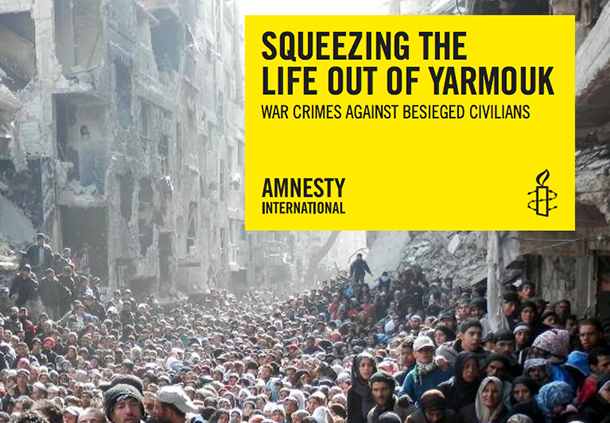
Propaganda image from the cover of AI’s report entitled, ‘Squeezing the Life Out of Yarmouk: War Crimes Against Besieged Civilians’,
one of many designed to fit hand-in-glove with the joint US and UK covert regime change operation deployed against Syria since 2011.
By Alexander Rubinstein | Mint Press News | January 17, 2019
Amnesty International, the eminent human-rights non-governmental organization, is widely known for its advocacy in that realm. It produces reports critical of the Israeli occupation in Palestine and the Saudi-led war on Yemen. But it also publishes a steady flow of indictments against countries that don’t play ball with Washington — countries like Iran, China, Venezuela, Nicaragua, North Korea and more. Those reports amplify the drumbeat for a “humanitarian” intervention in those nations.
Amnesty’s stellar image as a global defender of human rights runs counter to its early days when the British Foreign Office was believed to be censoring reports critical of the British empire. Peter Benenson, the co-founder of Amnesty, had deep ties to the British Foreign Office and Colonial Office while another co-founder, Luis Kutner, informed the FBI of a gun cache at Black Panther leader Fred Hampton’s home weeks before he was killed by the Bureau in a gun raid.
These troubling connections contradict Amnesty’s image as a benevolent defender of human rights and reveal key figures at the organization during its early years to be less concerned with human dignity and more concerned with the dignity of the United States and United Kingdom’s image in the world.
A conflicted beginning
Amnesty’s Benenson, an avowed anti-communist, hailed from a military intelligence background. He pledged that Amnesty would be independent of government influence and would represent prisoners in the East, West, and global South alike.
But during the 1960s the U.K. was withdrawing from its colonies and the Foreign Office and Colonial Office were hungry for information from human-rights activists about the situations on the ground. In 1963, the Foreign Office instructed its operatives abroad to provide “discreet support” for Amnesty’s campaigns.
Also that year, Benenson wrote to Colonial Office Minister Lord Lansdowne a proposal to prop up a “refugee counsellor” on the border of present-day Botswana and apartheid South Africa. That counsel was to assist refugees only, and explicitly avoid aiding anti-apartheid activists. “Communist influence should not be allowed to spread in this part of Africa, and in the present delicate situation, Amnesty International would wish to support Her Majesty’s Government in any such policy,” Benenson wrote. The next year, Amnesty ceased its support for anti-apartheid icon and the first president of a free South Africa, Nelson Mandela.
The following year, in 1964, Benenson enlisted the Foreign Office’s assistance in obtaining a visa to Haiti. The Foreign Office secured the visa and wrote to its Haiti representative Alan Elgar saying it “support[ed] the aims of Amnesty International.” There, Benenson went undercover as a painter, as Minister of State Walter Padley told him prior to his departure that “We shall have to be a little careful not to give the Haitians the impression that your visit is actually sponsored by Her Majesty’s Government.”
The New York Times exposed the ruse, leading some officials to claim ignorance; Elgar, for example, said he was “shocked by Benenson’s antics.” Benenson apologized to Minister Padley, saying “I really do not know why the New York Times, which is generally a responsible newspaper, should be doing this sort of thing over Haiti.”
Letting politics creep into mission
In 1966, an Amnesty report on the British colony of Aden, a port city in present-day Yemen, detailed the British government’s torture of detainees at the Ras Morbut interrogation center. Prisoners there were stripped naked during interrogations, were forced to sit on poles that entered their anus, had their genitals twisted, cigarettes burned on their face, and were kept in cells where feces and urine covered the floor.
The report was never released, however. Benenson said that Amnesty general secretary Robert Swann had censored it to please the Foreign Office, but Amnesty co-founder Eric Baker said Benenson and Swann had met with the Foreign Office and agreed to keep the report under wraps in exchange for reforms. At the time, Lord Chancellor Gerald Gardiner wrote to Prime Minister Harold Wilson that “Amnesty held the [report] as long as they could simply because Peter Benenson did not want to do anything to hurt a Labour government.”
Then something changed. Benenson went to Aden and was horrified by what he found, writing “I never came upon an uglier picture than that which met my eyes in Aden,” despite his “many years spent in the personal investigation of repression.”
A tangled web
As all of this was unfolding, a similar funding scandal was developing that would rock Amnesty to its core. Polly Toynbee, a 20-year-old Amnesty volunteer, was in Nigeria and Southern Rhodesia, the British colony in Zimbabwe, which was at the time ruled by the white settler minority. There, Toynbee delivered funds to prisoner families with a seemingly endless supply of cash. Toynbee said that Benenson met with her there and admitted that the money was coming from the British government.
Toynbee and others were forced to leave Rhodesia in March 1966. On her way out, she grabbed documents from an abandoned safe including letters from Benenson to senior Amnesty officials working in the country that detailed Benenson’s request to Prime Minister Wilson for money, which had been received months prior.
In 1967 it was revealed that the CIA had established and was covertly funding another human rights organization founded in the early 1960s, the International Commission of Jurists (ICJ) through an American affiliate, the American Fund for Free Jurists Inc.
Benenson had founded, alongside Amnesty, the U.K. branch of the ICJ, called Justice. Amnesty international secretariat, Sean MacBride, was also the secretary-general of ICJ.
Then, the “Harry letters” hit the press. Officially, Amnesty denied knowledge of the payments from Wilson’s government. But Benenson admitted that their work in Rhodesia had been funded by the government, and returned the funds out of his own pocket. He wrote to Lord Chancellor Gardiner that he did it so as not to “jeopardize the political reputation” of those involved. Benenson then returned unspent funds from his two other human-rights organizations, Justice (the U.K. branch of the CIA-founded ICJ) and the Human Rights Advisory Service.
Benenson’s behavior in the wake of the revelations about the “Harry letters” infuriated his Amnesty colleagues. Some of them would go on to claim that he suffered from mental illness. One staffer wrote:
Peter Benenson has been levelling accusations, which can only have the result of discrediting the organisation which he has founded and to which he dedicated himself. … All this began after soon after he came back from Aden, and it seems likely that the nervous shock which he felt at the brutality shown by some elements of the British army there had some unbalancing effect on his judgment.
Later that year, Benenson stepped down as president of Amnesty in protest of its London office being surveilled and infiltrated by British intelligence — at least according to him. Later that month, Sean MacBride, the Amnesty official and ICJ operative, submitted a report to an Amnesty conference that denounced Benenson’s “erratic actions.” Benenson boycotted the conference, opting to submit a resolution demanding MacBride’s resignation over the CIA funding of ICJ.
Amnesty and the British government then suspended ties. The rights group then promised to “not only be independent and impartial but must not be put into a position where anything else could even be alleged” about its collusion with governments in 1967.
Amnesty’s role in the death of Black Panther Fred Hampton
But two years later, senior Amnesty officials engaged in far more troubling coordination with Western intelligence agencies.
FBI documents, released by the Bureau in the spring of 2018 as a part of a series of disclosures of documents pertaining to the assassination of President John Kennedy, detail Amnesty International’s role in the killing of Black Panther Party (BPP) Deputy Chairman Fred Hampton, the 21-year-old up-and-coming black liberation icon — a killing that was widely believed to be an assassination but was ruled officially as a justifiable homicide.
Amnesty International co-founder Luis Kutner attended a November 23, 1969 speech of Hampton’s delivered at the University of Illinois.
During the speech, Hampton described the BPP “as a revolutionary party” and “indicated that the party has guns to be used for peace and self-defense, and these guns are at the Hampton residence as well as BPP headquarters,” according to the FBI document.
“Kutner has reached the point where he would like to take legal action to silence the BPP,” the FBI wrote. “Kutner concluded by stating that he believed speakers like Hampton were psychotic, and it is only when they are faced with a court action that they stop their “rantings and ravings.”
The FBI internal report on Kutner’s testimony cited above was issued on December 1, 1969. Two days later, the FBI, alongside the Chicago Police Department, conducted a firearms raid on Hampton’s residence. When Hampton came home for the day, FBI informant William O’Neal slipped a barbiturate sleeping pill into his drink before leaving.
At 4:00 a.m. on December 4, police and FBI stormed into the apartment, instantly shooting a BPP guard. Due to reflexive convulsions related to death, the guard convulsed and pulled the trigger on a shotgun he was carrying – the only time a Black Panther member fired a gun during the raid. Authorities then opened fire on Hampton, who was in bed sleeping with his nine-month pregnant fiancee. Hampton is believed to have survived until two shots were fired at point-blank range towards his head.
Kutner formed the “Friends of the FBI” group, an organization “formed to combat criticism of the Federal Bureau of Investigations,” according to the New York Times, after its covert campaign to disrupt leftists movements — COINTELPRO — was revealed. He also went on to operate in a number of theaters that saw heavy involvement from the CIA — including work Kutner did to undermine Congolese Prime Minister and staunch anti-imperialist Patrice Lumumba — and represented the Dalai Lama, who was provided $1.7 million a year by the CIA in the 1960s.
While Amnesty International’s shady operations in the 1960s might seem like ancient history at this point, they serve as an important reminder of the role that non-governmental organizations often play in furthering the objectives of governments of the nations where they are based.
Alexander Rubinstein is a staff writer for MintPress News based in Washington, DC. He reports on police, prisons and protests in the United States and the United States’ policing of the world. He previously reported for RT and Sputnik News.
Syria: In the History of Bad Excuses, This One’s Top-Tier
By Thomas L. Knapp | Garrison Center | January 17, 2019
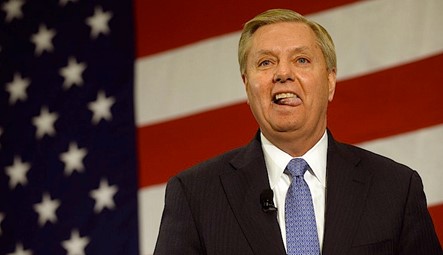
US Senator Lindsey Graham (R-SC) thinks — I’m using the term “thinks” very loosely here — that Americans dying in Syria is a compelling reason to continue exposing Americans to the danger of dying in Syria. So do Senators Marco Rubio (R-FL), James Inhofe (R-OK), and Jack Reed (D-RI).
Ever since US president Donald Trump announced his intent to withdraw US troops from Syria in December, “hawks” in Congress have been looking for an argument against the withdrawal.
And this is the best they can come up with? If the troops don’t stay in Syria, they can’t keep getting killed in Syria? Wow, that really shows Trump, doesn’t it?
At issue: The single deadliest Islamic attack on US forces in their nearly four-year US invasion and occupation of Syria, on January 16 in Manbij, in which four Americans (two members of the armed forces, a contractor, and a civilian Pentagon employee) died.
When former president Barack Obama authorized the invasion and occupation of Syria in 2015, he did so in complete defiance of both US and international law. Congress had not then declared war on Syria and has not since then offered any formal legal basis for the Obama’s actions. And since Syria is a United Nations member state which has never attacked the US nor indicated any intent to do so, the invasion/occupation constitutes a war of aggression — “the supreme international crime,” as Nuremberg Tribunal judge Norman Birkett called it.
Despite the complete absence of any compelling military or political reason for invading and occupying Syria, and despite the complete illegality of that invasion and occupation, these Senators believe that Trump should reverse his decision and keep US troops at risk in a land whether they’re neither needed nor welcome.
After all, if US troops aren’t there, US troops can’t be killed there, and US troops need to be killed there every once in a while to justify keeping them there in perpetuity. The Senators’ campaign donors in the “defense” industry need them kept there. Government contracts and stock dividends depend on it!
That’s the caliber of mind and morality the voters of South Carolina, Florida, Oklahoma, and Rhode Island send to Washington, DC. Can’t say I blame the voters for wanting those guys to go somewhere, anywhere other than South Carolina, Florida, Oklahoma, or Rhode Island. If nothing else it probably raises those states’ average IQs and reduces their petty crime rates.
Thomas L. Knapp (Twitter: @thomaslknapp) is director and senior news analyst at the William Lloyd Garrison Center for Libertarian Advocacy Journalism (thegarrisoncenter.org). He lives and works in north central Florida.
A Convenient Killing of US Troops in Syria
By Finian CUNNINGHAM | Strategic Culture Foundation | 18.01.2019
With unseemly haste, US news media leapt on the killing of four American military personnel in Syria as a way to undermine President Donald Trump’s plan to withdraw troops from that country.
The deadly attack in the northern city of Manbij, on the west bank of the Euphrates River, was reported to have been carried out by a suicide bomber. The Islamic State (ISIS) terror group reportedly claimed responsibility, but the group routinely makes such claims which often turn out to be false.
The American military personnel were said to be on a routine patrol of Manbij where US forces have been backing Kurdish militants in a purported campaign against ISIS and other terror groups.
An explosion at a restaurant resulted in two US troops and two Pentagon civilian officials being killed, along with more than a dozen other victims. Three other US military persons were among those injured.
US media highlighted the bombing as the biggest single death toll of American forces in Syria since they began operations in the country nearly four years ago.
The US and Kurdish militia have been in control of Manbij for over two years. It is one of the main sites from where American troops are to withdraw under Trump’s exit plan, which he announced on December 19.
Following the bombing, the New York Times headlined: “ISIS Attack in Syria Kills 4 Americans, Raising Worries about Troop Withdrawal”. The report goes on, “the news prompted calls from Republicans and Democrats for President Trump to reconsider his plans to withdraw troops from the country.”
A more pointed headline in The Washington Post was: “Killing of 4 Americans in Syria Throws Spotlight on Trump’s Policy”.
The Post editorialized, “the bombing showed that [ISIS] is likely to be a force to be reckoned with in Syria for the foreseeable future.” It quoted politicians in Washington claiming the “bombing deaths… were a direct result of a foolish and abrupt departure announcement [by Trump], and made the case for staying.”
Democrat Senator Jack Reed, who sits on the Senate Armed Forces Committee, said: “From the beginning, I thought the president was wrong [in ordering the withdrawal]. It was a strategic mistake for the whole region.”
With macabre smugness, anti-Trump politicians and news media appeared to exploit the death of US troops in Manbij to score points against Trump.
The president’s claims made just before Christmas of having defeated ISIS were widely replayed following the Manbij attack this week by way of ridiculing Trump’s order to pullout US troops from Syria.
Nevertheless, despite the deaths, Trump and his Vice President Mike Pence stated they were still committed to bring the 2,000 or so US troops home. Some military figures also went on US media to defend Trump’s pullout plan in spite of the terror attack in Manbij.
There clearly is a serious division in Washington over Trump’s policy on Syria. For Democrats and supportive media outlets, anything Trump does is to be opposed. But there are also elements within the military and intelligence nexus which are implacably against, what they see as, his “capitulation to Russia and Iran” in Syria. That was partly why his Defense Secretary James Mattis resigned days after Trump made his announced withdrawal at the end of last month.
Having invested years and money in regime-change machinations in Syria, there are bound to be US military and intelligence cabals which are resistant to Trump’s move to pack up. Not that Trump’s move portends a peace dividend for the region. It is more a “tactical change” for how US imperialism operates in the Middle East, as his Secretary of State Mike Pompeo said in Cairo last week.
That is why Trump’s order to take troops out of Syria may not be a clear-cut withdrawal. His National Security adviser John Bolton on a tour of the Middle East last week has already tried to undermine Trump by attaching all sorts of vague conditions to the troop pullout. Bolton and Pompeo have talked about the need to ensure the total defeat of ISIS and of the countering of Iranian presence in Syria.
This brings up the question of who may have carried out the bombing in Manbij? Was it really a suicide bomber? Was it really ISIS? Several observers have pointed out that ISIS have not had any presence in Manbij for the past two years since the Americans and Kurds took control of the city.
As always, the key question arises: who stands to benefit from the killing of the American troops? The scale of the attack suggests it was carried out with a sharp political message intended for Trump.
One potential beneficiary are the Kurdish militants who are being abandoned by the putative US withdrawal. Without their American sponsor on the ground, the Kurds are in danger of Turkish forces launching cross-border operations to wipe them out, as Ankara has vowed to do. A Machiavellian Kurdish calculation could be to “disprove” Trump about “ISIS being defeated”, and that US forces are needed to prevent any resurgence of the terror group in Manbij and northeast Syria.
Another sinister player is the CIA or some other element of US military intelligence. It is certainly not beyond the realm of plausibility that the CIA could facilitate such an atrocity against American personnel in order to discredit Trump’s withdrawal plan.
Certainly, the way the anti-Trump media in the US reacted with such alacrity and concerted talking points suggests there was something a bit too convenient about the massacre.
It would in fact be naive to not suspect that the CIA could have pulled off such a false flag in Manbij. As in 1950s Vietnam, as told by Graham Greene in ‘The Quiet American’, the CIA have been doing such dirty tricks with bombing atrocities and assassinations for decades in order to precipitate wars in foreign countries that the agency calculates are in America’s geopolitical interests.
Final Steps in Syria’s Successful Struggle for Peace and Sovereignty
By Federico PIERACCINI | Strategic Culture Foundation | 17.01.2019
The situation in Syria evolves daily and sees two situations very closely linked to each other, with the US withdrawal from Syria and the consequent expansionist ambitions of Erdogan in Syria and the Hay’at Tahrir al-Sham (HTS) takeover in Idlib that frees the Syrian Arab Army (SAA) and Russian aviation to liberate the de-escalation zone.
Trump has promised to destroy Turkey economically if he attacks the Kurds, reinforcing his claim that Erdogan will not target the Syrian Democratic Forces (SDF) once the US withdraws from the area. One of the strongest accusations made against Trump’s withdrawal by his opponents is that no Middle Eastern force will ever trust the US again if they abandon the SDF to its fate, that is, to its annihilation at the hands of the Turkish army and its FSA proxies. This, however, is not possible; not so much because of Trump’s economic threats, but because of Damascus and Moscow being strongly opposed to any Turkish military action in the northeast of Syria.
This is a red line drawn by Putin and Assad, and the Turkish president likely understands the consequences of any wrong moves. It is no coincidence that he stated several times that he had no problems with the “Syrians or Syrian-Kurdish brothers”, and repeated that if the area under the SDF were to come under the control of Damascus, Turkey would have no need to intervene in Syria. Trump’s request that Ankara have a buffer zone of 20 kilometers separating the Kurdish and Turkish forces seems to complement the desire of Damascus and Moscow to avoid a clash between the Turkish Armed Forces (TAF) and the SDF.
The only party that seems to be secretly encouraging a clash between the SDF and Turkish forces is Israel, criticizing Ankara and singing the praises of the SDF, in order to try and accentuate the tensions between the two sides, though naturally without success. Israel’s continued raids in Syria, though almost constantly failing due to Syrian air defense, and the divide-and-rule policy used against Turkey and the SDF, show that Tel Aviv is now weakened and mostly irrelevant in the Syrian conflict.
In Idlib, the situation seems to be becoming less complicated and difficult to decipher. Russia, Iran and Syria had asked Erdogan to take control of the province through its “moderate jihadists”, sit down at the negotiating table, and resolve the matter through a diplomatic solution. Exactly the opposite happened. The HTS (formerly al-Nusra/al-Qaeda in Syria) has in recent weeks conquered practically the whole province of Idlib, with numerous forces linked to Turkey (Ahrar al-Sham and Nour al-Din al-Zenki) dissolving and merging into HTS. This development puts even more pressure on Erdogan, who is likely to see his influence in Idlib fade away permanently. Moreover, this evolution represents a unique opportunity for Damascus and Moscow to start operations in Idlib with the genuine justification of combating terrorism. It is a repeat of what happened in other de-escalation areas. Moscow and Damascus have repeatedly requested the moderates be separated from the terrorists, so as to approach the situation with a diplomatic negotiation.
In the absence of an effective division of combatants, all are considered terrorists, with the military option replacing the diplomatic. This remains the only feasible option to free the area from terrorists who are not willing to give back territory to the legitimate government in Damascus and are keeping civilians hostages. The Idlib province seems to have experienced the same playbook applied in other de-escalation zones, this time with a clear contrast between Turkey and Saudi Arabia that shows how the struggle between the two countries is much deeper than it appears. The reasons behind the Khashoggi case and the diplomatic confrontation between Qatar and Saudi Arabia were laid bare in the actions of the HTS in Idlib, which has taken control of all the areas previously held by Ankara’s proxies.
It remains to be seen whether Moscow and Damascus would like to encourage Erdogan to recover Idlib through its proxies, trying to encourage jihadists to fight each other as much as possible in order to lighten the task of the SAA, or whether they would prefer to press the advantage themselves and attack while the terrorist front is experiencing internal confusion.
In terms of occupied territory and accounts to be settled, two areas of great importance for the future of Syria remain unresolved, namely al-Tanf, occupied by US forces on the Syrian-Jordanian border, and the area in the north of Syria occupied by Turkish forces and their FSA proxies. It is too early to approach a solution militarily, it being easier for Damascus and Moscow to complete the work to free Syria from the remaining terrorists. Once this has been done, the presence of US or Turkish forces in Syria, whether directly or indirectly, would become all the more difficult to justify. Driving away the US and, above all, Turkey from Syrian territory will be the natural next step in the Syrian conflict.
This is an unequivocal sign that the war of aggression against Syria is winding up, and this can be observed by the opening of a series of new embassies in Damascus. Several countries — including Italy in the near future — will reopen their embassies in Syria to demonstrate that the war, even if not completely over, is effectively won by Damascus and her allies.
For this reason, several countries that were previously opposed to Damascus, like the United Arab Emirates, are understood to have some kind of contact with the government of Damascus. If they intend to become involved in the reconstruction process and any future investment, they will quite naturally need to re-establish diplomatic relations with Damascus. The Arab League is also looking to welcome Syria back into the fold.
Such are signs that Syria is returning to normality, without forgetting which and how many countries have conspired and acted directly against the Syrians for over seven years. An invitation to the Arab League or some embassy being reopened will not be enough to compensate for the damage done over years, but Assad does not preclude any option, and is in the meantime demonstrating to the Israelis, Saudis and the US Deep State that their war has failed and that even their most loyal allies are resuming diplomatic relations with Damascus, a double whammy against the neocons, Wahhabis and Zionists.
New Poll: US Military Occupations Supported By Far More Democrats Than Republicans
By Caitlin Johnstone | Medium | January 10, 2019
A new Politico/Morning Consult poll has found that there is much more support for ongoing military occupations among Democrats surveyed than Republicans.
To the question “As you may know, President Trump ordered an immediate withdrawal of more than 2,000 U.S. troops from Syria. Based on what you know, do you support or oppose President Trump’s decision?”, 29 percent of Democrats responded either “Somewhat support” or “Strongly support”, while 50 percent responded either “Somewhat oppose” or “Strongly oppose”. Republicans asked the same question responded with 73 percent either somewhat or strongly supporting and only 17 percent either somewhat or strongly opposing.
Those surveyed were also asked the question “As you may know, President Trump ordered the start of a reduction of U.S. military presence in Afghanistan, with about half of the approximately 14,000 U.S. troops there set to begin returning home in the near future. Based on what you know, do you support or oppose President Trump’s decision?” Forty percent of Democrats responded as either “Somewhat support” or “strongly support”, with 41 percent either somewhat or strongly opposing. Seventy-six percent of Republicans, in contrast, responded as either somewhat or strongly supporting Trump’s decision, while only 15 percent oppose it to any extent.
These results will be truly shocking and astonishing to anyone who has been in a coma since the Bush administration. For anyone who has been paying attention since then, however, especially for the last two years, this shouldn’t come as much of a surprise.
This didn’t happen by itself, and it didn’t happen by accident. American liberals didn’t just spontaneously start thinking endless military occupations of sovereign nations is a great idea yesterday, nor have they always been so unquestioningly supportive of the agendas of the US war machine. No, Democrats support the unconscionable bloodbaths that their government is inflicting around the world because they have been deliberately, methodically paced into that belief structure by an intensive mass media propaganda campaign.
The anti-war Democrats, after Barack Obama was elected on a pro-peace platform in 2008, went into an eight-year hibernation during which they gaslit themselves into ignoring or forgiving their president’s expansion of George W Bush’s wars, aided by a corporate media which marginalized, justified, and often outright ignored Obama’s horrifying military expansionism. Then in 2016 they were forced to gaslight themselves even further to justify their support for a fiendishly hawkish candidate who spearheaded the destruction of Libya, who facilitated the Iraq invasion, who was shockingly hawkish toward Russia, and who cited Henry Kissinger as a personal role model for foreign policy. I recall many online debates with Clinton fans in the lead up to the 2016 election who found themselves arguing that the Iraq invasion wasn’t that bad in order to justify their position.
After Clinton managed to botch the most winnable election of all time, mainstream liberal America was plunged into a panic that has been fueled at every turn by the plutocratic mass media, which have seized upon unthinking cultish anti-Trumpism to advance the cause of US military interventionism even further with campaigns like the sanctification of John McCain and the rehabilitation of George W Bush. Trump is constantly attacked as being too soft on Moscow despite having already dangerously escalated a new cold war against Russia which some experts are saying is more dangerous than the one the world miraculously survived. Trump’s occasional positive impulses, like the agenda to withdraw US troops from Syria and Afghanistan, are painted as weakness and foolishness by the intelligence veterans who now comprise so much of corporate liberal media punditry. And their audience laps it up because by now mainstream liberals have been trained to have far more interest in opposing Trump than in opposing war.
And how sick is that? Obviously Trump has advanced a lot of toxic agendas which need to be ferociously opposed, but how warped does your mind have to be to make a religion out of that opposition which is so all-consuming that it eclipses even the natural impulse to avoid inflicting death and destruction upon your fellow man? How viciously has the psyche of American liberals been brutalized with mass media psyops to drive them into this psychotic, twisted reality tunnel?
There was one group in the aforementioned survey which was not nearly as affected by the propaganda as armchair liberals. To the statement “The U.S. has been engaged in too many military conflicts in places such as Syria, Iraq and Afghanistan for too long, and should prioritize getting Americans out of harm’s way,” military households responded 54 percent that this statement aligns with their view. Turns out when it’s your own family’s blood and limbs on the line, people are a lot less willing to commit to endless violence. Sixty percent of Republicans agreed with this statement, while only 41 percent of Democrats did.
Could these statistics have something to do with the fact that younger veterans are statistically much more likely to be Republicans than Democrats? Is it possible that a major reason Trump beat Hillary Clinton, and a major reason Republicans are now far less bloodthirsty than Democrats, is because mothers, fathers, sisters and brothers are tired of flag-draped coffins being shipped home containing bodies which were ripped apart for no legitimate reason in senseless military entanglements on the other side of the world? Seems likely. And it also seems likely that the mass media propaganda machine is having a harder time steering people toward war once they’ve personally tasted its true cost.
Lebanon president warns of the consequences of Israel threats
MEMO | January 10, 2019
Lebanese President Michel Aoun yesterday warned of the “Israeli threats” which could lead to new wars, displacement and ethnic cleansing.
Speaking before members of the diplomatic corps accredited to Lebanon in the capital Beirut, Aoun said that “peace does not take place while deals are made at the expense of the refugee who was expelled from his land and his identity was stolen”.
“Peace does not come at the expense of manipulating demography and changing the geographical and social parameters of countries. Peace does not result from deepening racism and rejecting the other.”
The Lebanese president was referring to US President Donald Trump’s proposed Middle East peace plan dubbed the “deal of the century”.
In regards Syrian refugees in Lebanon, Aoun said the international community’s position is not clear about whether they should return to their country, warning that the proposed positions which link the refugees’ return to finding a political solution to the Syrian crisis is “worrying” because a solution could take a long time.
More than 1.2 million Syrian refugees live in Lebanon, a majority of them in areas that experience economic, political and security crises.
US Withdrawal from Syria: Postponing the Inevitable
Tim Hayward Blog | January 7, 2019
Peter Ford, former British Ambassador to Bahrain (1999–2003) and Syria (2003–2006), offers the following assessment:
At the start of the year the horizon seems to be dominated by the issue of the possible withdrawal of US troops. In reality however the more important action is elsewhere.
US withdrawal: on or not?
Every day that passes seems to bring fresh evidence that Trump’s decision is being walked back. But appearances can be misleading.
Trump’s ultra-hawkish National Security Adviser, John Bolton, is touring the Middle East apparently setting new conditions for the withdrawal with every stop he makes. We are currently told that the troops will not leave until the remnants of ISIS are mopped up, until there is certainty they cannot remerge, until Erdogan promises not to slaughter the Kurds, and until Israel’s security is absolutely assured.
It is certainly true that crushing those ISIS remnants could take some time, and as for ensuring that ISIS can never re-form that is a recipe for a never-ending US presence. The US allies, the Kurdish-dominated SDF, are currently retreating from parts of Eastern Deir Ez Zor because they are meeting hostility from Arab villagers, who resent the abduction of their young men and even children into the ranks of the SDF. While the departure of the sprinkling of 2000 US troops will hardly leave a vacuum as far as the fight against ISIS is concerned the departure of the SDF from certain areas certainly will. Only the government’s Syrian Arab Army (SAA) could enter these Arab areas, and that is precisely what some clan leaders are calling for (calls ignored of course by our media).
Extracting assurances from Erdogan is also likely to prove difficult, especially if (like Bolton, no doubt) you will perhaps not strain every sinew to extract them. Erdogan however has already said that he will have no need to invade if the Syrian Army interposes itself in a 40 mile deep buffer zone. To guard against this possibility of receiving yes for an answer Ambassador James Jeffrey, presidential envoy for Syria, is being dispatched to talk to the Kurds and deter them from pacting with Assad and the Russians.
The irony here is that it is the very presence of the US (and UK) forces which prevents the US conditions for withdrawal being met. While the US refuses to cooperate with the Syrian Army and Russia in fighting ISIS the holy warriors will always have somewhere to hide. And while the US keeps promising protection to the Kurds, and the Kurds believe them, then the YPG will go on infuriating the Turks and the Turkish threat will not go away.
But will the Kurds believe Jeffrey? Will they put their entire existence at the mercy of Trump’s whims and a frayed US tripwire? It seems not, at least to judge by reports that Kurdish negotiations with Damascus and the Russians are well advanced.
In this game for the prize of Kurdish affections Damascus holds most of the cards. To begin with the Kurds have never fought or wanted to fight the SAA and never wanted independence. They do want a measure of autonomy which they would like to see guaranteed in a new federal constitution. Damascus will have difficulty swallowing that, not least because other restive areas like the South might also want autonomy. Assad will probably reckon that he can clinch a deal with a few concessions rather than a federal constitution: use of Kurdish language in schools, incorporation of the peshmerga into the SAA. He can afford to sit on his hands indefinitely: the small US presence in the remote Syrian Far East is no existential strategic threat to him, while the endless lingering will be a constant embarrassment to Trump. Most crucially of all, the Kurds know now, if they hadn’t realised it before, that one day the US tripwire will indeed be removed and they will get no deal at all from Damascus if they do not strike one now.
We can expect to see bluster, smoke screens, reversals and and posturing on all sides in the coming days but ultimately it must be considered likely that at some point the Kurds, when they judge that no more concessions can be extracted from Assad, could ask the US to leave. Ah! That would upend everything. Actually they won’t even need to ask. All they have to do is conclude a deal. Then it will be game, set and match to Assad and the Russians. The real issue may soon become how to save American face and here we can expect to see some adroit Russian diplomacy. There is already talk of drafting UAE and Egyptian forces into Manbij, the key town under Turkish threat.
Before we reach that point however we must address two loose ends. Firstly Trump’s statement, when he was under fire and needed an excuse, that the Turks were going to deal with ISIS. This idea is a total nonsense but Bolton on the Turkey leg of his tour must go through the motions of exploring it with Erdogan. He will be told that for Turkish troops to cross over a hundred miles of hostile Kurdish territory to deal with ISIS in Deir Ez Zor Turkey would need the support of more US resources than are in the area already. Turkish generals are horrified at the idea. It will be quietly dropped. Anyway the preferred plan is for the US forces with the SDF to use all this new time at their disposal to do the necessary (except that, as mentioned, the SDF is something of a broken reed).
Secondly, and this is even more absurd, Bolton says the US is not going to withdraw its ‘a couple hundred’ troops from the ‘key’ Al Tanf enclave which straddles the Syrian/Jordanian/Iraqi borders, because of its strategic position blocking completion of the fabled ‘land bridge’ which we are told links Iran with Syria and Lebanon. It is quite simply grotesque that anyone with pretentions to being a strategist can appear seriously to believe this and that the media dutifully regurgitate the US talking points on it without question. While it is true that Al Tanf has been an important crossing point, all we are talking about here is bit of inconvenience. There are other crossing points a few miles to the North East. Anyway Iran airlifts most of its supplies to Damascus and Beirut and wouldn’t dream of ferrying sensitive equipment through Iraqi territory, pullulating with US troops and agents. Don’t they have maps in the Pentagon? It can perhaps be most charitably assumed that the Al Tanf gambit is part of the face-saving which has to be done, this time to be able to claim that the US has ensured that Iran will not become more ‘entrenched’ (what does this much bandied about word mean? They never tell us) and Israel’s concerns are not being overlooked.
Assad will not care less if the US wants to stay on in Al Tanf. The only settlement is the Ar Rukban encampment housing about 60,000 displaced persons, many of them ISIS and their families who fled from Raqqa. The US troops do not dare enter this encampment. Assad will be perfectly happy for the US to keep holding this tar baby and can lambast the US for blatant breach of international law, because after ISIS is gone the last vestige of any legal excuse for the US presence will also be gone. (Bolton tells us that the US constitution is basis enough, so now we know.)
Syria comes in from the cold
Meanwhile Syria’s rapprochement with much of the Arab world has proceeded apace. The President of Sudan visited. The UAE reopened its embassy. Bahrain says it will follow. Flights to Tunisia have resumed. It seems likely that Assad will be invited to the Arab Summit in March in Beirut and Syria will be readmitted to the Arab League. Italy is said to be close to reopening its embassy. The British Foreign Secretary, Jeremy Hunt, has sourly accepted that Assad is going to remain President ‘for a while’. Although reports that the British Embassy are being refurbished may turn out to be a false dawn, the day can surely not be far off when the UK informs Damascus that it proposes to reopen. However the issue will not be what concessions Syria must make to receive this favour but rather what concessions the UK must make if it is not to be even more totally excluded from the diplomacy around the Syrian question than it is already. The Syrians would be remiss not to require a lifting of sanctions as a minimum.
The economic war
The most important aspect of these rapprochements is the economic one. Syria’s immense battle ahead is economic recovery. The gains on the battlefield may be eroded if the government fails to get the country on its feet again. The problems seem never ending. One small example: 84,000 children are fatherless, the offspring resulting from rapes and forced temporary marriages by jihadis.
The Western media gleefully reckons that Syria needs $400 billion for reconstruction. The Western powers currently set their faces against contributing anything to this and indeed seek to push Syria deeper into the mire with punitive sanctions. A surer way of creating the conditions for a resurgence of ISIS could hardly be imagined.
Hence the importance of rapprochement with the Gulf countries. While Trump’s claim that Saudi would pay for recovery was probably another of Trump’s mis-statements, it is not fanciful to imagine the big Gulf development funds – the Saudi, Kuwaiti and Arab Development Funds, and some of the UAE funds – providing enough to make a good start. Syria in any case could not absorb huge amounts to begin with. Not least it would generate massive inflation.
Idlib
The Idlib issue, presently on hold, gets worse rather than better. Hayat Tahrir Ash Sham (HTS), the group everyone (except Qatar) considers terrorists, have fought and displaced other armed groups from a string of towns, some in the buffer zone which the Turks were supposed to have cleansed of the most radical groups. The groups in Idlib mount regular forays or artillery attacks into government-controlled areas, attracting air raids in retaliation.
Lest we forget
Within two days of each other John Bolton and Jeremy Hunt publicly reminded Syria that it must not run away with the idea that it could get away with more chemical attacks now that it seems to be in the ascendant. This seems to be the last lingering hope of all those who can never have too much Western military intervention in Syria, that an incident can be manufactured to justify heavy bombing. Unfortunately for them, the Syrians and Russians appear to be a step ahead: only the Russians seem to be doing any bombing. While a compliant media would dutifully echo possible Pentagon claims that any planes or helicopters were Syrian rather than Russian, or that black is white, this tactic does make that a tad more difficult.
There is broad international support for US withdrawal from Syria – but will Washington listen?
21st Century Wire | January 7, 2019
Forward by Daniel McAdams, Executive Director of the Ron Paul Institute:
The mainstream press coverage of President Trump’s announcement that he would be removing US troops from Syria has been unanimously apocalyptic. Journos who until a few days ago couldn’t care less about the Kurds (certainly not when US president after US president has used them as a cat’s paw and then abandoned them to their fate), were all of a sudden up in arms warning about an impending slaughter with the blood dripping squarely onto Trump’s hands.
In fact, US weapons, training, and backing had carved out a de facto super-sized Kurd-controlled section of northern Syria which it does not take a geopolitical expert to understand would incense NATO ally Turkey. Why prop up the Kurds and in the process infuriate Erdogan? The US-led regime-change program simply did not have many other boots on the ground to turn to. After years of arming jihadists whose masks slipped quickly thereafter to reveal al-Qaeda or ISIS markings, the game was up for the “Assad must go” crowd and the only move left was to pretend that a proxy Kurd militia was something called the “Syrian Democratic Forces.” When in fact it was nothing of the sort. It was simply the Kurds, rented by Washington.
And the bloodbath the media and neocons warned would come about should Trump dare reconsider another US forever war? More lies and bluster. The Kurds are re-considering their foolish refusal to partner more closely with the Syrian government against foreign-sponsored insurgencies. Just last week, they began negotiations with Damascus to reconcile and forestall a massive Turk incursion.
But the Kurds acting in their own best interest is a big problem for the neocons. Sen. Lindsey Graham, who has given himself credit for slowing Trump’s announced withdrawal from Syria, has gone on record claiming it would be a “major disaster” if the Kurds in Syria aligned themselves with the Syrian (aka their own) government. To Graham and his neocon cohort, the US can never leave any war. Undeclared wars are just fine with them, but declared peace is a “major disaster.”
Which brings us back to public opinion. With the neocons clogging up the airwaves with predictions of gloom and doom if the US ends its illegal occupation of Syria and with the mainstream media in its continuing Pravda-esque lock-step when it comes to the US global military empire, something quite remarkable has happened: the American people are happy that Trump plans to bring the troops home. According to a recent poll, more than half of Americans surveyed support the removal of US troops from Syria and Afghanistan.
Overseas, support for President Trump’s moves is also significant. The Baroness Caroline Cox of the UK House of Lords, has sent President Trump a letter, with former UK Ambassador to Syria Peter Ford, and on behalf of a network of “concerned parliamentarians, senior clerics, former ambassadors and academics,” congratulating the president on his announced pull-out.
The Baroness writes:
Your courage in doing the right thing, in the face of conflicting advice and an onslaught from ill-informed politicians, a blinkered media and brittle allies, commands respect. We salute you.
The letter continues with a call for the end of US sanctions on Syria, which, she writes “only hobble its economy, hamper refugee return, cause mass unemployment, hinder recovery and create conditions for a re-emergence of ISIS.”
She warns Trump that there’s nothing his critics (like Lindsey Graham) would like more than a resurgence of ISIS in the areas left by US troops so as to make Trump look wrong in withdrawing. An end of sanctions would help strengthen the Syrian government and better enable it to fight against ISIS.
Let’s hope President Trump heeds the wise counsel of very engaged experts like Baroness Cox. Perhaps next time Sen. Graham demands a meeting to harangue Trump on a troop pull-out he can beg off. Let Graham and Bolton stew in their own juices in some West Wing broom closet. Better yet…maybe Trump should consider some additional personnel changes.
This OpEd was originally published at the Ron Paul Institute for Peace and Prosperity. Below is the full text of the letter to President Trump…
OPEN LETTER OF THANKS TO PRESIDENT TRUMP FROM CO-FOUNDERS OF THE GLOBAL NETWORK FOR SYRIA (GNS)
The Honorable Donald John Trump,
President of the United States of America
White House, 1600 Pennsylvania Avenue NW
Washington DC 20500
United States of America.
December 31st 2018
Dear Mr President,
Please allow us to thank you for your bold decision to bring American forces home from Syria, mission accomplished.
Our Network of concerned parliamentarians, senior clerics, former ambassadors and academics has campaigned for just such an essential step on the way to bringing peace and stability back to Syria.
Your courage in doing the right thing, in the face of conflicting advice and an onslaught from ill-informed politicians, a blinkered media and brittle allies, commands respect. We salute you.
We urge you now to carry on as you have started by lifting sanctions on Syria. Keeping sanctions on Syria to keep it weak can only hobble its economy, hamper refugee return, cause mass unemployment, hinder recovery and create conditions for a re-emergence of ISIS. This will be a gift to your enemies, who long to see you proven wrong on the defeat of ISIS.
Continuing sanctions will also prevent American firms from benefitting from the multi-billion dollar recovery projects which will be funded by rich Arabs and otherwise benefit the Chinese and the Russians.
Congratulations, Mr President, on taking a momentous step which shows true statesmanship. We pray that you continue on this wise path and take the follow up steps essential so that your actions are not undermined.
Yours sincerely,
The Baroness Cox, Independent Member of the House of Lords, London
Peter Ford, British Ambassador to Syria, 2003-6
***
A copy of the original letter can be found here: Open Letter to President Tr… on Scribd
Featured Video
Max Blumenthal: ‘Israel First’ in Iran War Sparks MAGA Civil War
or go to
Aletho News Archives – Video-Images
From the Archives
Wartime internment camps in Australia
National Archives of Australia
World War I
During World War I, for security reasons the Australian Government pursued a comprehensive internment policy against enemy aliens living in Australia.
Initially only those born in countries at war with Australia were classed as enemy aliens, but later this was expanded to include people of enemy nations who were naturalised British subjects, Australian-born descendants of migrants born in enemy nations and others who were thought to pose a threat to Australia’s security.
Australia interned almost 7,000 people during World War I, of whom about 4,500 were enemy aliens and British nationals of German ancestry already resident in Australia.
Records of World War I internment camps
World War II
During World War II, Australian authorities established internment camps for three reasons – to prevent residents from assisting Australia’s enemies, to appease public opinion and to house overseas internees sent to Australia for the duration of the war.
Unlike World War I, the initial aim of internment during the later conflict was to identify and intern those who posed a particular threat to the safety or defence of the country. As the war progressed, however, this policy changed and Japanese residents were interned en masse. In the later years of the war, Germans and Italians were also interned on the basis of nationality, particularly those living in the north of Australia. In all, just over 20 per cent of all Italians resident in Australia were interned. … continue
Blog Roll
 Aletho News
- Any Foreign Military Vessel Approaching Hormuz Under Any Pretext ‘Will Be Dealt With Severely’: IRGC
- Diplomats slam US negotiators’ performance in Iran talks
- Trump Refuses Exit Ramp, War with Iran will Continue
- Trump Says US Naval Blockade in Strait of Hormuz Will Begin Shortly
- US, Iran end 21-hour talks without agreement
- US IRAN TALKS: Who Are the Crazy Ones Here? /Lt Col Daniel Davis
- Talks with the US end without a deal over excessive US demands: Iran
- Feeling Better, Getting Worse: How Psychiatric Drugs Create the Illusion They Cure
- ‘Nobody Told Me’: Former Mental Health Patient Calls Out Dangerous Side Effects of Psychiatric Drugs
- Dr. Abu-Sitta: Beirut ‘felt like a day in Shifa Hospital’
- If Americans Knew
- US-Iran ceasefire negotiations make zero progress – Daily Update
- Pro-Israel ‘Thinktanks’ and Individuals who Influence U.S. Foreign Policy
- Mearsheimer reveals how Israel dictates US policies on Iran, Gaza – video
- After killing 350+, Israel still has a “score to settle” with Lebanon before ceasefire – Daily Update
- Military aid to Israel emerges as the latest political litmus test for Democrats
- The only Palestinian children’s rights organization closes following years-long Israeli campaign against it
- ‘I Can’t Forget the Smell’: Lebanese Reel After Israel Kills Over 300 in Single Day
- DNC Shoots Down Resolutions Calling Out AIPAC and Limiting Arms to Israel
- TCN: Is Israel Blackmailing President Trump?
- Israel killed at least 303 Lebanese yesterday – who were they? Daily Update
- No Tricks Zone
- German Expert: Heat Dome Led To Record Temps In Western USA…Warmer In 1934, 1936
- New Study: No Linear Warming Or Glacier Retreat Along Northern Antarctic Peninsula Since 1980s
- An Inconvenient Tree: Uncovered In Alps… Europe Much Warmer Than Today 6000 Years Ago
- New Study Reports A 60% Slowdown In Greenland’s Ice Loss Rate In The Last Decade
- Low Intensity Tornado Wrecks Major Solar Farm, Creating A Potential Toxic Dump
- New Study Finds Warming Saves Lives…Cold Temperatures 12 Times More Deadly Than Excess Heat
- German Science Blog Accuses PIK Climate Institute Of Hallucinating Climate Tipping Points
- Devastating Assessment Of Comirnaty Vaccine By Former Senior Pfizer Europe Toxicologist
- New Study: CO2 Is ‘Effectively Negligible’ As An Explanatory Climate Change Factor Since 2000
- Former Pfizer Toxicologist Dr. Helmut Sterz Tells Bundestag Hearing Pfizer Vaccine Should Have Never Been Approved
 Aletho News