Syria: US-Led Coalition Creating Appropriate Conditions for ISIL to Survive, Expand
Al-Manar | January 6, 2019
Syrian Foreign Ministry lashed out at the US-led coalition over crimes committed against civilians in the war-torn country, stressing that the coalition have been creating appropriate conditions for ISIL terror group to survive.
In a letter sent on Saturday to both UN Secretary-General and the UN Security Council, the Syrian ministry said “the continuous massacres against the Syrian civilians and destroying their houses and livelihoods by the illegitimate US-led coalition confirms the necessity to address the disregard showed by countries of this coalition with regard to UN Charter and the provisions of international law.”
The ministry was referring to strikes carried out by warplanes of the US-led coalition in Syria, the last of which were in al-kishkiah and al-Shaf’a villages in Deir Ezzor southeastern countryside.
“Since its establishment, the international coalition’s practices only served to create the appropriate conditions to enable Daesh (ISIS) terrorist organization to survive and expand again,” the letter read, according to SANA news agency.
The ministry meanwhile, renewed its demand that the Security Council “should shoulder its responsibilities and take immediate action to stop these crimes, attacks, massacres, and systematic destruction of infrastructure in Syria and punish their perpetrators.”
Senate’s First Act: “An Implicit Rebuke” Of Trump’s Syria Draw Down
By Tyler Durden – Zero Hedge – 01/05/2019
The Republican-held Senate’s first order of business as it reconvened on Friday for 2019 was to push back against President Trump’s planned Syria withdrawal, as the first bill Republican leadership introduced, led by hawk Marco Rubio, is being described as “an implicit rebuke” of the president’s Syria policy.
Senate Bill 1, expected to be one of the first pieces of legislation under consideration of the new Senate, was introduced Thursday by Sen. Marco Rubio (R-FL) is being co-sponsored by Majority Leader Mitch McConnell of Kentucky and incoming Senate Foreign Relations Committee Chairman Jim Risch of Idaho. Sen. McConnel subsequently announced this means Congress is finally set to debate Syria policy; however ironically at the very moment Trump is attempting a “full” and “immediate” pull out of some 2,000+ US forces. This after US officials reiterated on Friday that “no fixed deadline” for troop withdrawal has been given and they would seek to ensure “no power vacuum” in previously occupied northeast Syria would remain.
NBC describes the proposed legislation, which focuses on a new round of sanctions against Damascus, as follows:
Although Congress can’t force the commander-in-chief to keep troops in Syria, Senate aides say the move is designed to illustrate the need for a strong, continuing U.S. presence in the Middle East and re-assert the role of Congress on national security. It comes as many of Trump’s GOP allies have joined Democrats in deploring his announcement of a Syria withdrawal without consulting allies and lamenting the subsequent resignation of former Defense Secretary Jim Mattis.
The Senate is moving quickly to assert its point-of-view on U.S. policy regarding Syria and in the broader Middle East, and it could serve as a rebuttal to the decision by President Donald Trump to pull back U.S. forces from Syria.
Of note is that Congress is only attempting to “re-assert” its role on national security the moment a US president is seeking to pull out of the Middle East.
Statements by the bill sponsors referenced consulting “steadfast” allies first. While naming Israel and Jordan specifically, Foreign Relations Chairman Jim Risch said, “This package of legislation is an important step toward finishing the work of the last Congress. Israel and Jordan have been steadfast allies of the United States that deserve this support.”
Also noticeable was the complete lack of appeal to American self-defense and the unpopularity among the American public of remaining in Syria, according to recent polls.
Sen. Risc continued to cite foreign allies first and foremost as necessitating the bill: “Also, it is vital to confront Syrian government atrocities and end discrimination against Israel,” he said while calling for it to move forward rapidly.
And well-known Iran hawk Sen. Rubio echoed the same:
It is in America’s national security interests to ensure that our allies in the Middle East like Israel and Jordan remain secure amid the region’s growing destabilizing threats posed by Iran and Syria’s Assad regime… This important bill will also impose new sanctions against the Assad regime and its supporters who continue to commit horrific human rights violations against the Syrian people.
On Wednesday President Trump altered his language after immense pushback in Washington, saying the US will get out of Syria “over a period of time” and in such a way that will protect America’s Kurdish partners on the ground, at a moment pro-Turkish forces backed by Turkey’s army are set to invade and annex Kurdish enclaves in the north of the country.
Notably, Trump also told reporters on Wednesday: “Syria was lost long ago. we’re not talking about vast wealth. we’re talking about sand and death,” while also noting: “It’s not my fault. I didn’t put us there.”
But it appears senators like Rubio, McConnell and Risch want to come keep the US there indefinitely, continuing what’s unfortunately becoming an American tradition of “forever wars” and quagmires.
Imperialism Abhors a Void: Guest: Sarah Abed
The Rabbit Hole | January 3, 2019
Cindy Sheehan’s Soapbox
Guest: Sarah Abed
Topic: US “Withdrawal” from Syria
On this episode of Cindy Sheehan’s Soapbox we discussed Trump’s announcement to withdraw US troops from Syria, the media’s reaction, and the impact this will have on Kurdish militias and Syria’s ultimate fight against imperialism.
Below are some of the points that I made during our chat (this is not a full transcript) or some thoughts I would like to expand on.
Cindy asked what I make of Trump’s announcement to withdraw 2,000 troops from Syria.
My response:
Trump had stated during his campaign and his presidency and even prior to that during Obama’s presidency in 2013 that he did not think we should be in Syria, nor should we be bombing Syria, that it was a waste of money and lives and that the Arab League and neighboring countries should be the ones to step up to the plate.
I think this was one of the reasons that many people voted for him, because of his non-interventionist foreign policy, which was in stark contrast to that of Hillary Clinton.
In April, of this year he had announced that he wanted to pull the US out of Syria and then just days later there was an alleged chemical weapons attack that was pinned on the Syrian government in Douma, to which Trump responded with attacking multiple targets along with his allies the UK and France.
This of course derailed his plan to pull out US troops, which is the exact outcome that the terrorists that staged the whole theatrical performance had wanted. And we have seen this sort of thing happen time and time again during the war. Whenever the Syrian army and government have made significant progress new allegations and attacks are made against them in corporate media in order to garner international support for military, political intervention as well as increased sanctions.
There are other factors at play with this latest withdraw announcement which was made on December 19th, in addition to standing by his America first promise, campaign statements, saving money and lives, there’s the fact that Turkey’s president Erdogan had threatened to attack the Kurdish militias on his border, if the US didn’t have them removed. He sees the YPG (People’s Protection Units) which was rebranded at the request of the US into the SDF (Syrian Democratic Forces) as an extension of the PKK (Kurdistan workers party) which is a terrorist group that has been in conflict with the Turkish state for decades.
As I had written about back in March the Olive branch operation in Afrin proved that NATO alliances are stronger than any other alliances and that the US will choose Turkey over the Kurds and that’s what we are seeing happen right now. Some have also speculated that Israel may have given the US a heads up that it would be engaging in an intense bombing campaign and that US troops should be sent home so that they are not caught in the crosshairs.
Cindy asked what I make of the reaction by democrats, liberals, celebrities etc.
My response:
It would be comical if it wasn’t actually dangerous. In their blind opposition to anything and everything that Trump says these overnight analysts and pundits started claiming that if US troops were to withdraw from Syria then Kurds would be annihilated by Turkey or succumb to some other equally horrible fate.
What we have seen over the past few days however is that leaders of Kurdish militias have actually reached out to the Syrian government and asked that they step in and take back Manbij and all the territory under their control west of the Euphrates in order to protect them against Turkey. This is a clear shift in their political alliance away from the US and towards Syria and Russia. Turkey will not directly confront the Syrian army so Trump’s announcement could actually signify a big step towards peace in this almost eight-year western imposed insurrection.
The US entered Syria illegally and has since set up over a dozen military bases and supported the Kurdish militias during the last few years only. Prior to using the Kurdish militias as a tool to create chaos and division in Syria, the US was predominately supporting the hardcore Al Qaeda-linked terrorists in the Free Syrian Army and an assortment of other alphabet soup groups who they affectionately referred to as “moderate rebels” to topple the secular Syrian government.
Had the US not supported the Kurdish militias they would have not had the motivation to turn against the Syrian state. During the beginning of the war, the Kurds were fighting with the Syrian army against terrorists, by the way some still are and many Kurds in Syria are not in agreement with the separatist ambitions of the Kurdish militias.
I want to stress the fact that before 2011 Kurds, Arabs, and Christian minorities lived peacefully in Syria and till now they are NOT the majority. They do not have any justifiable claims to the north eastern region (which also happens to be the most agriculturally and oil rich part of the country) or any other part of Syria. They are a nomadic people and I do not mean that in a condescending way at all but to illustrate that they came into Syria in waves to escape mistreatment in neighboring countries and were treated fairly and given equal rights. Not all Kurds envision a unified Kurdistan that would span four different sovereign countries (Turkey, Iraq, Syria, and Iran). Most Kurdish movements and political parties are focused on the concerns and autonomy of Kurds within their respective countries. Within each country, there are Kurds who have assimilated and whose aspirations may be limited to greater cultural freedoms and political recognition.
It’s also worth noting that only Israel is their main and really only supporter and their plans for an independent Kurdistan align almost perfectly with Israel’s greater Israel plan. They have historically been used by Israel and NATO.
Cindy asked about the demands being made that Russia or Iran should withdraw from Syria if US troops are to be withdrawn.
My response was basically that Russia, Iran, and Hezbollah are there with the Syrian government’s permission. Whereas the US, UK, France, and Turkey are there illegally and need to leave. Cindy noted and I agreed that it’s a false equivalency and a logical fallacy.
We also spoke about fasting to raise awareness #illuminateYemen for the entirely man-made and avoidable Saudi war and genocide that’s been going on for over three years and nine months. We discussed the latest developments and how Saudi Arabia is outsourcing their front line fighters with children and men from Dafur, Sudan and paying their families $10,000.
My response:
Fasting for seven days was a very humbling experience. The war on Yemen is truly heartbreaking especially because it is entirely man-made and avoidable. It’s so important for us to continue to raise awareness and get people to talk about it to literally everyone they know. For the past 3 years and nine months the murderous Al Saud regime, has been bombing civilians using weapons bought from the US, UK, and Germany, what they are doing is nothing short of committing genocide and deliberately starving Yemeni’s them through blockades. Tens of thousands have been killed since it began.
There was actually a report in the New York Times today that Saudi Arabia was recruiting children from Darfur to fight on the front lines and paying their families $10,000. Sudan has been part of the Saudi-led alliance, and deployed thousands of ground troops to Yemen. In the NYT report they said that five Sudanese fighters who had returned from Yemen told them that that children made up 20-40 percent of their units in Yemen.
The fact that House of Saud is on the UN human and woman’s rights council while also being the leading violator in crimes against humanity and the main sponsor of terror in the world shows the western worlds blatant hypocrisy. A United Nations-sponsored peace agreement was signed in Sweden earlier this month, and was agreed upon by both sides to implement a ceasefire in Hodeida. The panel will be meeting again on January 1 to discuss “detailed plans for full redeployment”. Every effort needs to be made for this conflict to end.
More Reckless Behavior by Israel: Netanyahu Plays by His Own Rules
By Philip M. GIRALDI | Strategic Culture Foundation | 03.01.2019
As has become the normal practice, Christmas Day’s air raid by Israel directed against targets near Damascus was largely ignored by the US media. Given the fact that Israel has bombed Syria more than two hundred times, the attack itself, which wounded three soldiers at a warehouse, was not particularly notable. But what was significant was the fact that it was the second time that Israel has used other planes to mask the approach of its own warplanes to the target. On this occasion, the masks consisted of two civilian airliners making their approaches to the airports in Beirut and Damascus. Fortunately, the Syrian Arab Air Defense Forces made the decision to delay the deployment of surface-to-air missiles and electronic jamming “to prevent a tragedy” and air traffic control was able to divert one of the passenger jets landing at Damascus to the reserve military airport in Khmeimim in southern Latakia.
Syrian anti-aircraft crews did manage to intercept and shoot down fourteen of the sixteen incoming missiles that were launched by six Israeli F-16 warplanes using US-made GPS-guided GBU-39 Small Diameter Bombs (SDBs). If the Syrian air defenses had been more reckless and gone after the F-16s themselves, they might have hit an airliner by mistake and hundreds of lives could have been lost.
The Russian Ministry of Defense, which was able to reconstruct the attack from radar imaging, condemned the incident, stating that “Provocative acts by the Israeli Air Force endangered two passenger jets when six of their F-16s carried out airstrikes on Syria from Lebanese airspace.” The terse Russian announcement reveals that beyond endangering hundreds of civilians, Israel had committed several war crimes in its action, which the Israeli government claimed was intended to destroy a shipment of Iranian-made Fajir-5 rockets, which was allegedly on its way to Hezbollah.
As Israel is not at war with Iran or Syria or Lebanon and it persists in attacking targets in Syria based on its own perception of threats, it meets the United Nations definition of an aggressor. And its violation of Lebanese air space to stage the attack on Syria was also an act of aggression. Both would normally be condemned in the UN Security Council but for the American veto protecting Israel.
Analysts have confirmed that the Israelis carried out the strikes in Syria by deliberately using scheduled airline departures and arrivals as cover to foil the improved and upgraded Syrian air defenses. Security sources in the region now believe that any civilian flights entering or leaving Damascus or Beirut are potentially in danger due to the Israeli tactics, which clearly accept endangering civilians to mask the movements of the warplanes.
The Israelis also used a Russian intelligence plane as a mask off the coast of Syria back in September, with fatal results for the crew after Syrian air defenses responded to the attack. Israel, of course, claimed innocence, insisting that it was the Syrians who shot down the Russian aircraft while the Israeli jets were legitimately targeting a Syrian army facility “from which weapons-manufacturing systems were supposed to be transferred to Iran and Hezbollah.”
The Russian aircraft was returning to base after a mission over the Mediterranean off the Syrian coast monitoring the activities of a French warship and at least one British RAF plane. As a large and relatively slow propeller driven aircraft on a routine intelligence gathering mission, the Ilyushin-20 had no reason to conceal its presence. It was apparently preparing to land at its airbase at Khmeimim when the incident took place.
Syrian air defenses were on high alert because Israel had attacked targets near Damascus on the previous day, including a Boeing 747 on the ground that Israel claimed to be transporting weapons.
The Israelis used four F-16 fighter bombers to stage the surprise night attack targeting sites near Latakia, close to the airbase being used by the Russians. They came in from the Mediterranean Sea using the Russian plane to mask their approach as the Ilyushin 20 would have presented a much larger radar profile for the air defenses.
The Israelis might have been expecting that the Syrians would not fire at all at the incoming planes knowing that one of them at least was being flown by their Russian allies. If that was the expectation, it proved wrong and it was indeed a Syrian S-200 ground to air missile directed by its guidance system to the larger target that brought down the plane and killed its fourteen crew members.
There was also a back story. The Israelis and Russian military had established a hotline precisely intended to avoid accidents. Israel reportedly used the line but only one minute before the incident took place, leaving no time for the Russian plane to take evasive action.
The Russian Ministry of Defense was irate. It saw the exploitation of the intelligence plane by the Israelis as a deliberate high-risk initiative. It warned “We consider these provocative actions by Israel as hostile. Fifteen Russian military service members have died because of the irresponsible actions of the Israeli military. This is absolutely contrary to the spirit of the Russian-Israeli partnership. We reserve the right for an adequate response.”
It’s the same old story. Israel does risky things like attacking its neighbors because it knows it will pay no price due to Washington’s support. The downing of the Russian plane and the current endangering civil aviation has created a situation that could easily escalate. What Israel is really thinking when it seeks to create anarchy all around its borders is anyone’s guess, but it is, to be sure, in no one’s interest to allow the process to continue.
SYRIA: The Western Rogue States Must Confess their Crimes Against Humanity and be held Accountable

Christmas 2018 in Damascus, Old City, without mortars from Eastern Ghouta since its liberation in April 2018. (Photo: Vanessa Beeley)
By Vanessa Beeley | 21st Century Wire | January 2, 2019
The West and its allies in the Gulf States, Turkey and Israel have waged an eight year war against the Syrian people. The West has besieged, starved and deprived the Syrian people of humanitarian aid while pouring “aid” into the areas controlled by their extremist sectarian proxy armies.
The West has violated international law and it has enabled the destruction of Syria’s history, heritage and cultural footprint. The West has behaved as a collective rogue state without conscience and without pity for a people its media has systematically dehumanised to enable such a crime to take place.
Despite this war of attrition and despite battling disproportionate force, the Syrian people have refused to capitulate or to abandon their secularism in favour of an extremist tyranny that would destroy their society and persecute the minority communities into extinction. Christmas 2018 has demonstrated the victory of Syrian unity over the regime change project incubated in the West which is now a failed campaign lying in tatters at the feet of the self determination of the Syrian people, the valiant defence by the Syrian Arab Army and the steadfastness of the Syrian Government and its President, Bashar Al Assad.
In Aleppo I spoke with Pastor Ibrahim Nseir of Aleppo’s Presbyterian Church, whom I had also interviewed in 2017. The following is a mixture of quotes and paraphrase from our conversation on New Year’s Eve 2018/19.
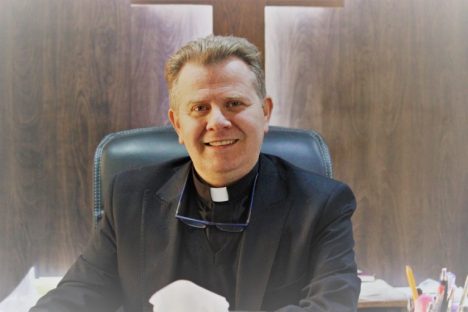
Reverend Ibrahim Nseir, Presbyterian Church, Aleppo. December 31st 2018. (Photo: Vanessa Beeley)
The Presbyterian Church in the Old City of Aleppo was destroyed by the Western-backed terrorist groups in November 2012. An article in the Mennonite World Review in July 2018 described the destruction of the church – “In the old city of Aleppo, Syria, Ibrahim Nseir stands on the pile of rubble that used to be his church. The building where his congregation worshiped is now broken stones and dust. It’s a sunny day, the bright sky a stark contrast to the destruction on the ground.”
After eight years of resistance against the threat of persecution and mass exodus of Christians from Aleppo, Nseir remains defiant and upbeat about the future of Aleppo and Syria. Of the 300,000 Syrian Christians in Aleppo, only 30,000 remain. This is the legacy of sectarian oppression that has been imprinted upon Syria by Western hegemony and it will take generations for it be turned around.
Nseir described the rebuilding process for the Presbyterian Church as difficult but he insisted that it would be rebuilt from its original stones to preserve its historical identity. For Nseir the priorities for Aleppo and Syria are to address the economic situation which has clearly taken a hit on many levels and is suffering in a typical post-war slump. Education is another top priority for this intelligent and enthusiastic Reverend. The intention is to create a center for retreats and conferences at the current Presbyterian Church offices in the center of Aleppo, including a student dormitory.
“We will increase educational capacity by 1000 in the very near future and continue to build upon this progress” Nseir told me.
Education, according to Nseir, is the greatest weapon against extremism and is the only way to re-habilitate children who spent seven of their formative years under occupation of extremist and sectarian factions who worked hard to brainwash almost an entire generation of Syria’s children.
“Ethically the West and the East are responsible for Syria’s destruction. This is not a “Christian” issue, it is a World issue.” Nseir insisted.
The role of the Western media in manufacturing consent for the collective punishment of the Syrian people was clearly a primary cause of the devastation that Nseir and other faith leaders across Syria are now dealing with:
“Western media played more than a negative role, they literally urged the terrorists to take action against the Syrian people by providing false information and blinding people in the West to what was really happening in Syria for eight years. This should never be forgotten.”
Nseir stressed that the healing process for children traumatised by the war would not be easy.
“How do you erase the hatred and horror planted in the brains of 7-10-year-old children by these fanatics? What do you expect from children who have played football with the head of a Syrian Arab Army soldier or who have witnessed the violent abuse of their mother by these terrorists or have seen their father executed by the armed groups? This is the greatest challenge for Humanity and for Syria to put right these terrible wrongs.”
Nseir spoke of the shocking estimated figures of 82,000 children whose father is unknown, referring to the huge number of young women raped or forced into multiple marriages by the terrorist groups and their fighters. How do these children regain their identity and re-integrate into Syrian society? The rebuilding of schools and hospitals must be a priority. The terrorists destroyed “the most developed hospital in the Middle East, Al Kindi” in 2013 and since then, and the destruction of more hospitals across Syria by the terrorist groups, Nseir told me Syria has seen an increase in Cancer and new diseases. Nseir also suggested that this may be attributed to the weapons used by the US Coalition proxies and the U.S itself, which include depleted uranium.
Another important challenge, according to Nseir, is the environmental one. Syria needs to rebuild its natural environment which has also been hugely affected by the conflict. 100,000 trees have been destroyed in Aleppo alone which could lead eventually to desertification of the province if not dealt with. The Governor of Aleppo has recently planted 2,000 new trees but this is an issue that must be addressed with urgency for Nseir.
Nseir strongly believes that Western people should come to Syria independently to see the truth for themselves and report the truth as they see it without any agenda. The Church and the media in the West have maintained a sectarian, divisve narrative which is confusing for people in the West and far from reality.
Nseir addressed the position and status of Syria in the Middle East and described how it has not changed, all that has changed is the perception of Syria portrayed by the media and world leaders who have aligned themselves with the West’s criminal project to partition Syria into sectarian statelets and to remove the elected Syrian government from power by force:
“What has changed since 2011 in reality? Nothing. Syria has always been the protector of the Middle East before 2011, during the conflict and now. The only thing that has changed is the positions of those who turned against Syria, betrayed Syria and who now wish to come back to Syria for protection. We see the Gulf States now change their stance and the UAE has re-opened its embassy in Damascus. The Arab League will welcome Syria back into its fold. Nothing has changed, Syria has remained the same while others have been opportunists and traitors.”
The fact that Syria will forgive its betrayers is testament to what has given Syria victory over its enemies throughout history. With regards to the West, Nseir is not so forgiving:
“The West must go beyond simply stopping its financing of terrorism and the supply of weapons. The West must confess to its crimes against the Syrian people in order to be forgiven. The West must lift the economic sanctions which are a siege upon the Syrian people and it must allow the Syrian people to rebuild in peace without meddling in their affairs. The Syrian people will rebuild according to what the Syrian people want not what the East or the West want. The West has sold the idea that this war was against President Assad but in reality it was against the will of a nation and the people of that nation must be respected”.
Nseir confirmed that the western NGOs are nothing more than political instruments and devices who further the cause of war but he insisted that the West must effectively pay reparations to Syria and expect nothing in return. This is the only way the West can be forgiven by Syria.
Nseir told me that his church will be establishing a medical and health center in the coming months which will be open to everyone in Aleppo to offer medical check-ups and treatment for free. Staff will be trained to deal with the children afflicted by the effects of the war and the terrorist occupation and the plan is to eventually set up special schools to continue the work of rehabilitation for these children. This will enable the coming generations to stand against radicalism and terrorism in the future.
“The West has a duty to respect our dignity and territorial integrity. The Syrian Arab Army has saved the image of our God of Peace, Love and Unity – this has been a spiritual war in Syria not only a military war. The God of love has been embodied by the SAA and our allies and has been victorious over the God of terrorism and hatred. The whole world will change after this war and after Syria’s victory. Syria will be a transformational catalyst for all of Humanity. Syria was never going to be defeated, you only have to study our history to know this. Our society has always embraced diversity and this is the essence of our country. Fanaticism was never going to survive breathing the pure oxygen of our humanity. Actually this demonstrates the stupidity of leaders in the West – to even imagine that extremism has a place in our culture”. Nseir told me.
Nseir ended our talk by stating that the crisis in Syria must be an alarm bell for the country and for its leaders.
“We must re-prioritise our schedule, our agenda and make sure it is not only political but that we address all issues – religious, educational, health care. We must rethink our priorities to ensure a future of peace and stability. At the end I believe strongly that all the negative consequences of this terrible war will be transformed into positive consequences if we address them in the right way. Out of adversity are born the greatest opportunities for the future of Syria and Humanity.”
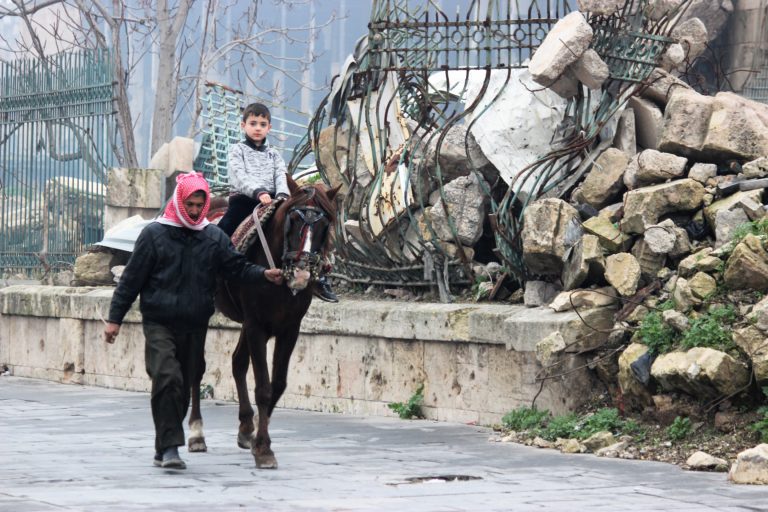
Horse rides on offer at the foot of the Citadel in the Old City of Aleppo. (Photo: Vanessa Beeley)
***
Vanessa Beeley is an independent journalist, peace activist, photographer and associate editor at 21st Century Wire.
Christmas 2018: Iran and Syria show respect, Israel and Saudi Arabia don’t
By Neil Clark | RT | December 29, 2018
Christmas is a time of goodwill to all men. Or at least it should be. But while the West’s Middle East ‘bad guys’ Iran and Syria, showed the Yuletide spirit, its closest allies, Saudi Arabia and Israel, failed to do so.
Iran is demonized by Western neocons and we’re meant to see the country as an evil, ‘monster‘ regime of foaming-at-the-mouth religious fanatics who hate everyone.
So it goes against the dominant narrative somewhat that Iran’s Foreign Minister Javad Zarif tweeted a Christmas message and wished ‘peace and joy to all in 2019’, on Christmas Eve.
It also goes against the narrative, that Zarif, back in September, wished Jews, in Iran and across the world, “a very Happy New Year filled with peace and harmony.”
We’re told repeatedly that the Iranian ‘regime’ is ‘anti-Semitic’, but do ‘anti-Semites’ wish Jews a happy ‘Rosh Hashanah’? If so, it’s a rather strange definition.
The Iranian Foreign Minister also tweeted on December 26 a message of goodwill to Iran’s Zoroastrian community.
Contrast this consideration to people of different faiths from Tehran, with the lack of congratulations on other religious holidays from the Kingdom of Saudi Arabia. A week before Iran’s Foreign Minister was tweeting positively about Jesus, the KSA’s Customs Authority was also on the social media platform, confirming that Christmas trees were banned from entering the Kingdom for the festive season.
In fact, despite the large number of Christians from other countries who work in the country, including many Britons, the holding of any Christmas-related services or commemorations in Saudi Arabia is strictly banned. “The Christmas season – often a season where Christians around the world are most visible – is a tense time for Christians in Saudi Arabia, who have to celebrate the holiday in secret, risking arrest and deportation,” said Jeff King, President of the International Christian Concern, in 2016.
Imagine being a Christian and not being able to openly celebrate the birth of Christ. It happens in Saudi Arabia, yet Western leaders, so keen to lecture others about ‘human rights’ and ‘religious freedom’ stay silent, preferring to pick on Iran – where Christmas can be openly celebrated.
Syria is another country ‘monstered’ by the endless war lobby but where, against all the odds, the Christmas spirit is still maintained. Big seasonal celebrations were held this year in Aleppo and Damascus. Remember Aleppo?
It was recaptured by the Syrian Arab Army from Islamist ‘rebels’ two years ago this month, and the neocon/’liberal interventionist’ commentariat, and most of the political class portrayed it as a most terrible thing. Ian Austin MP said that people in Aleppo faced ‘slaughter’.
John Woodcock MP called the Morning Star newspaper ‘traitorous scum’ for referring to the recapture of Aleppo by Syrian forces of their own territory, as a ‘liberation’. But if you look at the pictures of Christians celebrating Christmas there once again, which they were forbidden to do under the western-backed head-chopping ’rebels’ you can see that the ‘L’ word was indeed appropriate.
This year in Damascus though, the festive celebrations were defiled by another act of aggression against Syria from a Western-supported-country, one which incidentally Ian Austin and John Woodcock have been Parliamentary ‘Friends’ of.
On the evening of December 25, loud explosions could be heard seven miles from the center of Damascus. Russia’s Defense Ministry said that Israel’s Christmas Day F-16 strikes endangered two civilian flights – as well as injuring three personnel at the logistics compound.
Whatever your stance is on Middle Eastern affairs – and leaving aside the illegality of the operation whenever it took place – the question is: did Israel really have to bomb Syria on Christmas Day?
Would Israel’s ’security’ have been lessened if the raid had taken place on December 28 and not the 25th? Israel’s Prime Minister Benjamin Netanyahu did tweet Christmas greetings out to ‘Christian friends’ in Israel and around the world on December 24, but why did his forces attack a country where Christians were celebrating one day later?
Just imagine the enormous outcry if Russia had carried out air strikes on Ukrainian targets on the evening of 25th December. In fact, the US magazine Newsweek, doing its best to ratchet up East-West tensions still further, predicted such an event only last week. They published an article on Christmas Eve which began with the words “As people in Western Europe and the United States get comfortable for the holidays, the chances increase that Russia will take advantage of the distraction to launch attacks against its neighbor Ukraine, experts said.”
And who are these ’experts’, I hear you ask. Well, guess what, they were all from the Atlantic Council.
The ‘experts’, surprise surprise, were wrong. The ‘monster’ Russia did not launch attacks on Ukraine over Christmas. But Israel did attack Syria – and there was silence from those who would have screeched very loudly (and be calling for RT to be taken off the air immediately) if the Kremlin had ordered such a sacrilegious act.
Islamic State (IS, formerly ISIS/ISIL) were also busy bombing on Christmas Day. The genocidal group carried out suicide bomb attacks on Libya’s Foreign Ministry in Tripoli on Tuesday morning, killing three and leaving over half-a-dozen injured.
One doesn’t expect IS to respect Christmas, but you would expect Western leaders – of predominantly Christian nations to regard the group as public enemy number one. Yet in Syria, the US and its allies welcomed the group’s growth precisely because it threatened the secular, Christian-protecting government of Bashar al-Assad. A declassified US intelligence report from August 2012 predicted the establishment of a “Salafist principality in Eastern Syria” and said that this is “exactly what the supporting powers to the opposition want, in order to isolate the Syrian regime.”
Furthermore, in a leaked tape recording the former Secretary of State John Kerry admitted that the US allowed IS to expand its territory to threaten Damascus.
At the same time, those fighting IS, and other al-Qaeda-linked death squads in Syria, namely the Syrian Arab Army, Russia, Iran and Hezbollah, have been ‘monstered’ by the West and its regional allies’ propaganda machines.
Reflect on this: It wasn’t Syrian, Russia, Iranian or Hezbollah forces or followers who slaughtered British and other Western holiday-makers on the beach in Tunisia in 2015 – but an IS terrorist who is thought to have trained at a jihadist camp in neighboring Libya and whose government had been forcibly toppled by NATO powers four years earlier. Similarly, it wasn’t Syrian, Russian, Iranian or Hezbollah forces or followers who carried out murderous attacks against civilians in Paris, Nice, Brussels, and London, or at Christmas markets in Berlin and Strasbourg.
Respecting Christmas and what it stands for is an important litmus test, as it tells us a lot about the actors involved, especially if they are not themselves Christians.
The ‘monstering’ of those who do show the proper ‘Yuletide spirit’, and the turning of a blind eye to those that don’t, highlights the spectacular hypocrisy of those in power in the West who profess to support ‘Christian values’ but in fact do everything possible to subvert them.
If anyone needs an Ebenezer Scrooge-style epiphany this Christmas, it’s the ‘monster-slayers’ themselves.
Read more:
Notes On The Withdrawals
By Michael Tracey | Medium | December 23, 2018
Trump announced the withdrawal of US troops from two warzones, which prompted the resignation (and now, firing) of James Mattis. It’s one of the most consequential weeks of the presidency thus far, so rather than try to come up with a grand cohesive Take on it all, here are some scattered thoughts.
- The media doesn’t know how to grapple with an event that genuinely does represent Trump contending with an intractable establishment, which is partially understandable given recent overheated bleating about the Deep State — a phenomena that does plainly exist but has been misrepresented by the dumber portion of MAGA boosters. “Establishment,” likewise, is a fuzzy buzzword, and almost nobody ever claims to be part of it. Trump himself can reasonably be said to be The Establishment considering he is the President. However, this is a specific instance in which Trump really is in direct confrontation with very particular “establishment,” namely the institutional national security apparatus, which exists largely unfettered across administrations. Survey the scene and there’s not a single person in this entire apparatus who apparently supports the Syria withdrawal.
- So what does the media do? They act, essentially, as vehicles for the grievances of said national security apparatus. Take a look at some of the coverage from the major outlets: NYT, WaPo, AP, etc.
- OK, who exactly is “outraged,” and why does their sentiment justify featured placement in an Associated Press headline? It’s the national security establishment figures who are outraged, for them Mattis is a patron saint. These are the people AP, NYT, and WaPo reporters rely on to inform their natsec coverage. This NYT example is less subtle, and far more egregious:
- Really? Robert Kagan, to the uninformed reader, might just be some innocuous “expert” offering his wisdom, but Kagan is one of the most significant neoconservative foreign policy luminaries ever, competing ignominiously for that distinction with Bill Kristol. And it’s his ideology which is being transmitted to unwitting readers by way of the NYT. People who hate Trump will be susceptible to the message, because what he’s saying portrays Trump in a very negative light, but they’re also consuming loads of stubborn interventionist pablum along with the typical anti-Trump dopamine hit.
- Collectively, the theme of all mainline media coverage in reaction to the withdrawals is some combination of “chaos,” “disarray,” “tumult,” etc. Never is it ever considered that the very fact of multiple endless military deployments in hot warzones is also “chaotic.” And destructive. And insanely expensive. And unpopular with the wider public. None of these facts amount to “chaos” in the minds of fretting journalists, because what they’re being informed by is the sentiments of the “natsec” apparatus Trump has just acted against. (Oh yeah BTW the Syria deployment is also illegal and unauthorized, and has been since Obama launched it on false pretenses, but again, that’s definitely not chaotic.)
- On a slightly different note, it’s also worth harkening back to the time, earlier this year, when John Bolton was appointed National Security Advisor. I joined in the dismay, considering Bolton is one of the most fervent unreconstructed hawks in the entire country, and has *even today* not stopped defending the Iraq invasion. I attended a speech of his in DC about a month before the appointment when he did so, once again… in 2018. His Iran antagonism is a virulent obsession, and he called for a first strike on North Korea in February.
- But what happened subsequently? Bolton’s wishes have been totally overruled at every turn, most notably at two spectacular junctures. The first was Trump’s Korea diplomacy initiative, when Bolton was made to sit meekly at the negotiating table with Kim’s generals, whom he’d not long before declared should be wiped out with a preemptive strike. Then this week, the Syria withdrawal is among the most epic humiliations conceivable, as Bolton has specifically and publicly declared that US troops would not be leaving Syria until Iranian influence was repelled (i.e., essentially never).
- So those are crucial facts to consider about Bolton’s influence in the administration. I still think it’s dangerous to have him anywhere near the locus of military power, because who knows what leverage he might wield in the event of some unforeseen crisis. But he’s clearly not anywhere close to calling the shots, or the last 9 months of the Trump presidency would have gone much differently. (If he had any personal pride he’d resign in the wake of the Syria withdrawal, but Bolton’s principal priority is proximity to power, not personal consistency or pride. Unlike, evidently, Mattis.)
- In sum: the initial freakout when Bolton was appointed at least had basis, because he’s a dangerous person, but the freakout over the policies which he’s (ironically) presided over have engendered an even greater freakout, by several orders of magnitude. And those policies have tended to be dramatically less belligerent and militaristic than what you’d expect from an Administration in which Bolton resides. (The two leading examples again being Korea and Syria/Afg withdrawals.) So you have to wonder what the freakout is really about then. Maybe it’s just simple knee-jerk Trump hatred. (Yeah, it’s that.)
- There’s a running fight in certain Online Circles about whether Trump is a “non-interventionist.” My point was always that Trump clearly evinced greater non-interventionist tendencies than Hillary Clinton, but that 2016-specific observation has been exaggerated by certain bad faith agitators into a bogus charge that I claimed Trump is some pure, peace-loving anti-war voice. Obviously that’s NEVER been the claim. Any assessment of Trump’s scatter-shot “non-interventionism” has to coexist alongside the acknowledgment that Trump has dropped large quantities of bombs in pre-existing warzones, and killed lots of civilians in the process. That’s bad. At the same time, Trump has now declared his intention to end two wars that were started by previous administrations, and has not started any new ones. He’s done so over the strident objections of his own staff, advisors, and 95% of his own party. Clearly the “instincts” I noted, and then was ruthlessly ridiculed for noting, had some basis in reality, or we would not be where we are.
- Trump, during the campaign, frequently complained about the trillions squandered in the Middle East. Hillary Clinton never did (because she was partly responsible for it). Therefore, the comparative assessment was warranted. Nobody ever assumed Trump’s complaint would automatically translate into a swift, seamless change in US policy, or that the US would now become a beacon of wholesome anti-interventionism. It took two years, but Trump has now taken tangible steps to actualize those complaints, at significant political risk.
Pentagon mulls allowing Kurdish militias to keep weapons after US withdrawal from Syria, breaking promise made to Turkey
RT | December 29, 2018
The Pentagon is considering allowing Kurdish fighters to keep their US-supplied weapons after American forces withdraw from northern Syria, breaking a promise it had made to Turkey, a media report reveals.
US commanders preparing for the troop pullout from Syria have recommended that Kurdish militias be allowed to keep weapons and equipment provided by the US military, according to American officials who spoke with Reuters. The Pentagon is mulling the possibility as it draws up its plan for exiting Syria. A final decision on the matter will have to be approved by President Donald Trump, who ordered the withdrawal of all US forces from Syria earlier this month.
After the emergence of Islamic State (IS, formerly ISIS/ISIL), the US had repeatedly supplied the Kurds with small arms, equipment, and munitions, as well as vehicles and medical aid, at times airdropping dozens of tons of supplies ahead of major battles. However, the supplies were said to exclude heavy weapons, anti-tank and anti-aircraft missiles due to concerns of Turkey.
It wasn’t until before the 2017 Battle of Raqqa that Washington officially said it was sending heavy arms – including TOWs – to Kurdish forces. But Ankara said that the resigning US Defense Secretary Jim Mattis has promised that Kurds are to give all those arms back.
However, one official who spoke with Reuters said that locating all the weapons and securing their return would be close to impossible. Another unnamed official argued that it would be irresponsible to demand the weapons back, since the Kurdish YPG are still clearing out the remnants of Islamic State from northeastern Syria.
The situation is further complicated by Turkish threats to launch an offensive against the YPG, which Ankara claims is a terrorist group. Turkish military forces were spotted crossing into Syria on Friday.
On the same day, the Syrian Army reportedly entered the Kurdish stronghold of Manbij, after the YPG called on Damascus to help defend the city from a Turkish attack.
Syrian Kurds throw Americans under the bus
By M. K. BHADRAKUMAR | Indian Punchline | December 28, 2018
The Syrian government forces have entered the northern town of Manbij on the Turkish border earlier today. The Syrian military command announced in Damascus that the operation stemmed from the commitment to “impose sovereignty to each inch of Syrian territories and in response to calls of locals of Manbij city.”
The announcement reiterated Damascus’ twin objective of “smashing terrorism and expelling the invaders and occupiers out of Syrian soil.” The government troops have hoisted the Syrian Arab flag in Manbij.
In a highly significant move, Kremlin Spokesman Dmitry Peskov promptly welcomed the development. “No doubt, this is a positive step towards stabilizing the situation,” the spokesman said. He added that the expansion of the zone of the Syrian government troops’ control “is a positive trend.”
It stands to reason that Moscow mediated between the Syrian Kurdish leadership and Damascus. There have been reports that Syrian Kurdish delegations visited Moscow this week as well as the Russian military base at Hmeimim in Syria. A senior Kurdish leader in Manbij told Reuters, “We want Russia to play an important role to achieve stability.”
Indeed, Moscow needs no prompting from anyone in this regard. The Russian Foreign Ministry spokesperson Maria Zakharova said on Wednesday, “The question of fundamental importance is who will assume control of the regions the Americans will vacate. It should be the Syrian government… We believe that the Syrian government is equipped to maintain stability through dialogue and interaction with all the national patriotic forces. This dialogue in the interests of all Syrians can help complete the routing of the terrorists and preclude their reappearance in Syria. It is important not to interfere with the Syrian society’s efforts on the political track.”
The fact of the matter is that while Russia welcomes Trump’s decision to withdraw US troops from Syria and regards it as “important in that it can promote a comprehensive settlement of the situation” Moscow remains extremely wary of what it entails. So far, even a week after Trump’s announcement, Washington has not contacted Moscow to explain its decision.
Foreign Minister Sergey Lavrov drew attention to this while talking to the media in Moscow today: “To the best of my knowledge… Washington wants its coalition partners to assume responsibility. French, British and German service personnel are also illegally deployed on the ground. Of course, there are also the coalition’s air forces on whom they want to shift an extra financial burden. We hope to receive specific explanations… on the assumption that the end goal of all counter-terrorist operations in Syria is to restore Syria’s sovereignty and territorial integrity.”
The known unknown will be the terms of any Faustian deal between Washington and Ankara with regard to the future of the Syrian territories under American control. A US military delegation is expected in Ankara. Moscow and Damascus (and Syrian Kurds) would not rule out the possibility that Pentagon commanders would work on the “neo-Ottoman” and secretly encourage Turkish revanchism. Meanwhile there are also reports that Turkish forces are moving toward the frontlines facing Manbij in “full readiness… to start military operations to liberate the town, according to Reuters.
Suffice to say, Damascus and Moscow have pre-empted Ankara in the race for Manbij. Put differently, they have created a new fact on the ground, which either Ankara has to learn to live with or use military force to change. The latter course is fraught with immense risk, apart from severely jolting the Turkish-Russian political understanding over Syria. It is unlikely that Turkey will push the envelope.
However, to my mind, Turkish President Recep Erdogan is unlikely to cross lines with the Kremlin. A high-powered Turkish delegation comprising Foreign Minister Mevlut Cavusoglu, Defence Minister Hulusi Akar, Turkish intelligence chief Hakan Fidan and the presidential spokesman Ibrahim Kalin is expected to travel to Moscow on Saturday. No doubt, Moscow hopes to engage Ankara constructively.
Interestingly, amidst the dramatic developments concerning Manbij today, Russian President’s Special Representative for the Middle East and African Countries, Deputy Foreign Minister Mikhail Bogdanov disclosed in Moscow today that the Guarantor States of Astana Process (Russia, Turkey and Iran) may hold a summit in Russia next week, depending on the schedule of the three presidents.
Curiously, there has been no reaction from Washington to today’s developments in Manbij. American troops have been patrolling in Manbij town and the tense front line between Manbij and adjacent towns where fighters backed by Turkey were based. Having received the orders from Washington to withdraw from Syria, the local US commanders in northeast Syria will be in a quandary.
Nonetheless, it will be a bitter pill for the Pentagon commanders to swallow that the Syrian Kurds are overnight reconciling with Damascus. This will become additional fodder for Trump’s detractors in the US, too. In fact, sniping has already begun in Washington.
On the other hand, the Syrian Kurds, who have been the US’ main allies in Syria up until recently, have openly declared that they have invited the government forces to enter Manbij. They said in a statement today, “Due to the invading Turkish state’s threats to invade northern Syria and displace its people similarly to al-Bab, Jarablus and Afrin, we as the People’s Protection Units, following the withdrawal of our forces from Manbij, announce that our forces will be focusing on the fight against ISIS on all the fronts east of the Euphrates.”
The statement added that the Syrian government forces are ”obliged to protect the same country, nation and borders” and also protect Manbij from Turkish threats. It leaves the door wide open for the Syrian government forces to eventually regain control of the entire territory vacated by the US.
Assad has offered the integration of the Kurdish fighters into the Syrian Army under separate regiments. The prospects are that Assad’s offer will find acceptance among the Kurds at some point soon. There has all along been a tacit co-habitation between the Syrian Kurdish fighters and the government forces operating in northern regions bordering Turkey. It will be recalled that Assad quietly went to the aid of the Kurdish fighters in February when the Turkish army attacked Afrin region in the northwest in February.
Clearly, it is nonsense to say that the Kurds have been “thrown under the bus”, as Trump’s critics in the US are alleging. The plain truth is that the US created the illusion in the Kurdish mind that the creation of another Kurdistan on Syrian territory, similar to the one in Iraq, could become a possibility. But, fundamentally, Kurds will reconcile with Damascus. The comfort level between the Kurds and the Russians is also appreciable, historically. Moscow has consistently held the view that the Kurds must be represented at the negotiating table in any intra-Syrian peace process. The speed with which Kurds began mending fences with Damascus only underscores that they never quite trusted the Americans and all along had kept their options open.
Trump’s Holiday Gift to America: Hope for a Little More Peace on Earth?
By Thomas L. Knapp | Garrison Center | December 27, 2018
In March, US president Donald Trump promised the American public that US troops would be leaving Syria “very soon.”
Nine months later, he threw Washington’s political establishment into turmoil by finally ordering the withdrawal he’d promised. Politicians like US Senator Lindsey Graham (R-SC), who’d never once in four years bestirred themselves to authorize the previous president’s decision to go to war there in the first place, railed against Trump’s decision to bring the bloody matter to a close.
Instead of backing down in the face of opposition, Trump doubled down. Or, rather, decided to draw down the 17-year-long US military presence in Afghanistan.
Then he jetted off for a surprise Christmas visit to Iraq … eliciting, with his usual theatrics, calls from Iraqi lawmakers for US withdrawal from THAT country. I suspect he may concede to that demand as well.
Nothing’s written in stone, and both US foreign policy and Donald Trump are prone to sudden and unexpected turns. But the holiday season is a time of hope. Maybe, just maybe, nearly three decades of US war in the Middle East are coming to the beginning of their end.
Adding to that hope, let’s turn an eye further east.
After significant saber-rattling and then a sudden turn toward personal diplomacy, Trump stood back and let events on the Korean peninsula take their course even as he continued the bellicose rhetoric and sanctions noises demanded of him by Graham and company.
As a result, North and South seem on the brink of ending a 68-year war. They’ve begun removing land mines and guard posts along the Demilitarized Zone. They’ve broken ground on a railway connecting the two countries.
Is it possible that Trump, as some of his supporters like to say, has been playing 4D chess while the rest of us distracted ourselves with checkers?
I’d really like to think so, and I do hope so.
As an advocate for ending US military adventurism, I’ve doubted Trump every step of the way. During his presidential campaign, he alternated between talking peace and pronouncing himself the most militaristic of the GOP’s presidential aspirants.
I’ve generally found it safer to believe the worst, rather than the best, things politicians say about themselves. But at moments like these, his bizarre zigs and zags on the global 4D chess board suddenly seem in retrospect to have taken American foreign policy in the right direction.
If he brings home substantial numbers of the American fighting men and women now in harm’s way around the globe, he will have secured his legacy and deserve the thanks of a grateful nation. I wish him every success in that endeavor.
Peace on Earth, goodwill toward men, and Happy New Year.
Featured Video
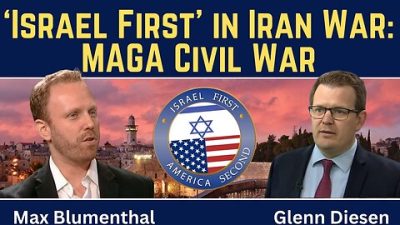
Max Blumenthal: ‘Israel First’ in Iran War Sparks MAGA Civil War
or go to
Aletho News Archives – Video-Images
From the Archives
Wartime internment camps in Australia
National Archives of Australia
World War I
During World War I, for security reasons the Australian Government pursued a comprehensive internment policy against enemy aliens living in Australia.
Initially only those born in countries at war with Australia were classed as enemy aliens, but later this was expanded to include people of enemy nations who were naturalised British subjects, Australian-born descendants of migrants born in enemy nations and others who were thought to pose a threat to Australia’s security.
Australia interned almost 7,000 people during World War I, of whom about 4,500 were enemy aliens and British nationals of German ancestry already resident in Australia.
Records of World War I internment camps
World War II
During World War II, Australian authorities established internment camps for three reasons – to prevent residents from assisting Australia’s enemies, to appease public opinion and to house overseas internees sent to Australia for the duration of the war.
Unlike World War I, the initial aim of internment during the later conflict was to identify and intern those who posed a particular threat to the safety or defence of the country. As the war progressed, however, this policy changed and Japanese residents were interned en masse. In the later years of the war, Germans and Italians were also interned on the basis of nationality, particularly those living in the north of Australia. In all, just over 20 per cent of all Italians resident in Australia were interned. … continue
Blog Roll
 Aletho News
- Tomorrow’s naval blockade showdown
- ‘Israel’ attacks civilians to hide its embarrassing military failures & out of pure sadism
- Any Foreign Military Vessel Approaching Hormuz Under Any Pretext ‘Will Be Dealt With Severely’: IRGC
- Diplomats slam US negotiators’ performance in Iran talks
- Trump Refuses Exit Ramp, War with Iran will Continue
- Trump Says US Naval Blockade in Strait of Hormuz Will Begin Shortly
- US, Iran end 21-hour talks without agreement
- US IRAN TALKS: Who Are the Crazy Ones Here? /Lt Col Daniel Davis
- Talks with the US end without a deal over excessive US demands: Iran
- Feeling Better, Getting Worse: How Psychiatric Drugs Create the Illusion They Cure
- If Americans Knew
- US-Iran ceasefire negotiations make zero progress – Daily Update
- Pro-Israel ‘Thinktanks’ and Individuals who Influence U.S. Foreign Policy
- Mearsheimer reveals how Israel dictates US policies on Iran, Gaza – video
- After killing 350+, Israel still has a “score to settle” with Lebanon before ceasefire – Daily Update
- Military aid to Israel emerges as the latest political litmus test for Democrats
- The only Palestinian children’s rights organization closes following years-long Israeli campaign against it
- ‘I Can’t Forget the Smell’: Lebanese Reel After Israel Kills Over 300 in Single Day
- DNC Shoots Down Resolutions Calling Out AIPAC and Limiting Arms to Israel
- TCN: Is Israel Blackmailing President Trump?
- Israel killed at least 303 Lebanese yesterday – who were they? Daily Update
- No Tricks Zone
- German Expert: Heat Dome Led To Record Temps In Western USA…Warmer In 1934, 1936
- New Study: No Linear Warming Or Glacier Retreat Along Northern Antarctic Peninsula Since 1980s
- An Inconvenient Tree: Uncovered In Alps… Europe Much Warmer Than Today 6000 Years Ago
- New Study Reports A 60% Slowdown In Greenland’s Ice Loss Rate In The Last Decade
- Low Intensity Tornado Wrecks Major Solar Farm, Creating A Potential Toxic Dump
- New Study Finds Warming Saves Lives…Cold Temperatures 12 Times More Deadly Than Excess Heat
- German Science Blog Accuses PIK Climate Institute Of Hallucinating Climate Tipping Points
- Devastating Assessment Of Comirnaty Vaccine By Former Senior Pfizer Europe Toxicologist
- New Study: CO2 Is ‘Effectively Negligible’ As An Explanatory Climate Change Factor Since 2000
- Former Pfizer Toxicologist Dr. Helmut Sterz Tells Bundestag Hearing Pfizer Vaccine Should Have Never Been Approved
 Aletho News