McConnell Mulls Introducing Amendment to Stop US Pullout from Syria, Afghanistan
Sputnik – 30.01.2019
WASHINGTON – Senate Majority Leader Mitch McConnell said on Tuesday he plans to introduce legislation to prevent what he called a “precipitous” withdrawal of US forces from Syria and Afghanistan before terrorist groups such as Al-Qaeda and the Daesh are defeated there.
“My amendment would acknowledge the plain fact that al Qaeda, ISIS[Daesh], and their affiliates in Syria and Afghanistan continue to pose a serious threat to our nation”, McConnell said in remarks on the Senate floor.
McConnell said his amendment, which he plans to introduce to a wide-ranging Senate bill on the Middle East, would “recognize the danger of a precipitous withdrawal from either conflict, and highlight the need for diplomatic engagement and political solutions to the underlying conflicts in Syria and Afghanistan”.
He stressed that his amendment would ensure the continued commitment of US forces until “vile terrorists” suffer an enduring defeat in both countries.
Moreover, McConnell emphasized that if the US exit the two countries before defeating the terrorists, the two conflicts would “reverberate in the United States”.
The comments mark a rare break between the Republican Senate majority leader and President Donald Trump, who has signaled that he intends to pull US troops out of both countries.
McConnell said he would introduce the amendment to the “Strengthening America’s Security in the Middle East Act”, a sweeping package of measures that would impose new sanctions against Syria, boost defense spending in the region and punish activists who call for economic boycotts of Israel to protest its policies in Palestine, among other measures.
The bill cleared a first Senate hurdle on Monday in a 74-19 vote, and the chamber is expected to decide on the final version of the legislation in the coming days.
In December, the US-based media reported that Washington planned to withdraw around 7,000 troops deployed in Afghanistan. The reports came in the wake of Trump’s announcement regarding his intention to pull the US troops out of Syria since, according to him, the Daesh had been defeated.
The White House, however, has dismissed the claims about Afghanistan, saying that Donald Trump had no such plans.
Fake News: ‘Hundreds Killed In Clashes Between Pro-Iranian, Pro-Russian Forces’
Syrian War Report – January 29, 2019
A fake-news story about large-scale clashes between pro-Russian and pro-Iranian factions in Syria is making jitters in English- and Russian-language mainstream media outlets. According to these reports citing anonymous sources and each other, “the pro-Russian Tiger Forces and 5th Assault Corps” clashed with “the pro-Iranian 4th Division” near the villages of “Shahta, Bredidg, Innab and Haydariye” in northern Hama.
Most of the reports claimed that there were casualties among the sides providing “precise” numbers varying from a dozen to 200 fighters from the both sides. No source was able to provide details into how clashes had started but the versions are varying from “some differences” to “a campaign to limit Iranian influence”.
Most of the media outlets presented these reports as some kind of breaking news. However, in fact, this is a week-old story. First such reports appeared in several pro-militant social media accounts and a local media outlet, al Modon Online. Later this rumor was reposted by anti-Assad, anti-Iranian and anti-Russian bloggers also citing anonymous sources to show the story look more reliable. By January 29, this rumor has reached large mainstream media outlets, but no evidence has appeared to confirm this kind of developments. However, the lack of factual data was ignored because this story is contributing to the US-Israeli-backed media efforts designed to undermine cooperation between Iran and Russia or at least to show that there are significant tensions between the sides.
The similar situation was observed in 2018 when various mainstream media outlets and even top US leadership like President Trump and Secretary of State Pompeo were claiming that “hundreds” of “Russian fighters” were killed by the US-led coalition in the province of Deir Ezzor. Both of these stories demonstrate how media forgery could reach the wide international audience and start being repeated as facts despite zero evidence supporting them.
On January 27, Russian forces launched at least three surface-to-air missiles at unidentified aerial objects near the Hmeimim airbase. According to local sources, at least 3 UAVs apparently launched from the Idlib de-escalation zone were intercepted.
The Syrian Arab Army deployed reinforcements at frontlines near the Idlib de-escalation zone and carried out a series of artillery strikes on militant positions in northwestern Hama and southern Idlib on January 28 and 29.
The US-backed Syrian Democratic Forces continue to claim dozens of casualties among ISIS members in the Euphrates Valley. However, a few remaining ISIS positions remaining there are still not captured.
Partition: Bad in Ireland and Palestine, Good in Syria?
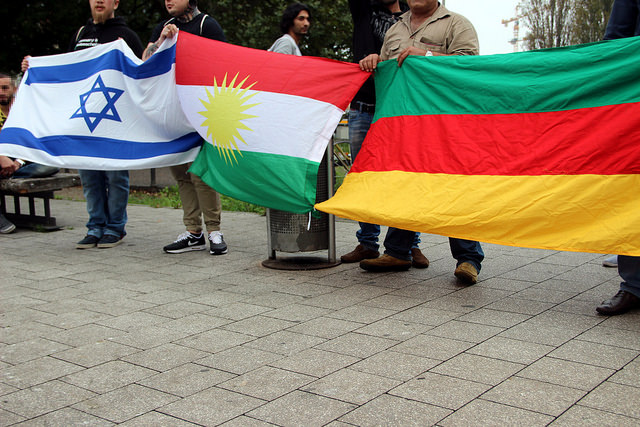
By Gavin O’Reilly | American Herald Tribune | January 29, 2019
Ask the question in left-wing circles of what affect partitioning a country along ethno-religious lines at the behest of an imperial power can have and the response will usually be straightforward.
In Ireland, following the 1921 surrender agreement between former revolutionaries and the British government, a six-county statelet was formed in the north-east of the country remaining under British rule and with an inbuilt Unionist majority; the pro-British element descended from English and Scottish colonizers, planted in the region by King James in the 17th century in a bid to displace the native Irish population which had provided so much resistance to British occupation.
The Nationalist population of this British-ruled part of Ireland, those descended from the indigenous Irish and who sought to live in an Ireland free of British rule, suffered systemic discrimination at the hands of this newly-formed British statelet, being denied the same access to housing, education, and employment that was afforded to their Unionist counterparts.
A neo-colonial pro-British state was also formed in the south of Ireland, where secret police and military units intern Irish Republicans through the use of non-jury courts to this day.
In Palestine, following the establishment of the Zionist State in 1948 in line with the UK-authored 1917 Balfour Declaration, more than half a million Palestinians found themselves refugees in their own country overnight; being forced from their homes in order to accommodate Jewish settlers from Europe.
The State of Israel, in a similar vein to the occupied North of Ireland, would also subject its indigenous Arab population to systemic discrimination and would go on to launch several imperialist wars against its Arab neighbors throughout its existence, with the most recent being covert Israeli involvement in the Syrian conflict.
This would all ultimately suggest that partition is a concept that should be universally opposed by anyone claiming to be anti-Imperialist. Right?
Wrong; when it comes to the issue of Syria, many ‘anti-Imperialists’ do a complete U-turn on the position and instead demand that the Arab Republic, along with Iran, Iraq, and Turkey, is divided up to form a US-Israeli backed Kurdish ethnostate.
In July 2012, when the Syrian conflict was its height, units of the Syrian Arab Army withdrew from the predominantly Kurdish Rojava region in the north of the country in order to provide assistance to military units fighting elsewhere in the Arab Republic; besieged at the time by Western-backed terrorists and yet to receive the key support which would later be provided by Iran and Russia.
The withdrawal of the SAA allowed local Kurdish militias to turn Rojava into a de facto autonomous region, with the most prominent of said groups being the People’s Protection Units (YPG), part of the wider Syrian Democratic Forces (SDF), a US-backed anti-government group.
However, whilst US-backed groups elsewhere in the country were supported by the White House with the intention of ousting the government of Bashar al-Assad, the primary reason for Washington’s support of the Kurds was to fulfill the 1982 Tel Aviv-authored Yinon plan.
This document, written by Oded Yinon, a senior advisor to Ariel Sharon, envisaged Israel maintaining hegemonic superiority in the region via the balkanization of neighboring Arab states hostile to Tel Aviv; in Syria, a country long known for its opposition to Zionism, this would entail the creation of a Kurdish state in the north of the country in a bid to undermine the authority of Damascus.
However, despite this US support for Rojava lining up perfectly with the Yinon plan, support for the creation of a Kurdish state within Syria remains widespread amongst Western leftists, with the feminist politics of the YPG endearing itself to Western Anarchists in particular; the lessons of Ireland and Palestine being lost it would ultimately seem.
Putin’s firewall around Russia-Turkey partnership
By M. K. BHADRAKUMAR | Indian Punchline | January 27, 2019
The much-awaited meeting between Russian President Vladimir Putin and his visiting Turkish counterpart Recep Erdogan in Moscow last Wednesday focused on the the withdrawal of US troops from Syria. The timeframe of the US drawdown or its scope and directions remain far from clear. Meanwhile, attention is riveted on creating a buffer zone in northern Syria, 32 kilometre wide on the Turkish border, which is under discussion between Washington and Ankara.
The US special representative on Syria James Jeffrey is expected in Ankara in coming days to carry forward the discussions. From present indications, US may control the airspace over the proposed zone and maintain some sort of presence on the ground as well while Ankara has been maintaining that it has the capability to enforce the zone.
Russia, on the other hand, has consistently voiced its opinion favoring Syrian government control over the regions vacated by the US. Indeed, Syrian leadership also has reiterated its determination to regain control over the entire country.
Thus, the meeting in Moscow on Wednesday took place in a supercharged atmosphere amidst speculation that the Russia-Turkey partnership might get rocky. The US never liked the Astana process on Syria between Russia, Turkey and Iran and the American intentions in baiting Turkey with the buffer zone proposal are highly suspect. (Significantly, Erdogan has hit out hard against the coup attempt by Washington to overthrow the Venezuelan government.)
If good diplomacy is about showing tact in handling awkward situations while brilliant diplomacy lies in creating a pathway through a minefield, Putin was probably at his best in navigating the Russian-Turkish partnership out of the reach of US tentacles. Putin’s remarks after the talks with Erdogan once again underscored that in the Russian estimation, any foreign presence on Syrian soil will lack “international legal grounds” if it is not on the basis of an invitation from Damascus or emanating out of a decision of the UN Security Council. But having said that, Putin qualified that “constructive cooperation” nonetheless becomes necessary even with such partners whose presence in Syria may lack legitimacy. Importantly, Putin added that Russia respects Turkey’s security interests. Then he went on to spring a big surprise:
“And the third. The 1998 treaty between the Syrian Arab Republic and the Republic of Turkey is still valid, and it deals specifically with the fight against terrorism. I think this is the legal framework that covers many issues relating to ensuring Turkey’s security on its southern borders. Today we have been discussing this issue thoroughly and intensively enough.”
This needs some explaining. Putin was referring to the Adana Accord of October 1998 between Turkey and Syria regarding cooperation in combating terrorism, which became moribund through the 7-year Syrian conflict. Putin said the agreement “is still valid”, which of course was tantamount to saying that Damascus thought so, too.
In effect, Putin has suggested that the Adana Accord can still serve as the legal and political framework for securing the Turkish-Syrian border to combat terrorism. The Russian Foreign Minister Sergey Lavrov amplified Putin’s remark further in media comments on Saturday. While on a visit to Rabat, Lavrov said, “The Adana agreement of 1998 was concluded between Turkey and Syria, its essence is to eliminate Turkey’s concerns about its security. [Syria] entered into this agreement, assuming certain obligations, and we proceed from the assumption that this agreement remains in force. As I understand, so do the state parties to the agreement.”
That is to say, Putin’s proposal offers an alternative to a Turkish occupation of Syrian territory – or involving a joint operation with the US to create a safe zone inside Syria and to enforce it militarily. The Adana Accord states that Syria is committed to eliminate any activity on its territory that would jeopardize Turkey’s security, including “the supply of weapons, logistic material, financial support to and propaganda activities” of Kurdish groups affiliated to the PKK. (The Syrian and Turkish foreign ministers signed an updated treaty in 2010.)
However, there is a caveat here. In order for the Adana Accord to come alive and fully satisfy Turkey’s security needs on the border region with Syria (which used to be the case till 2011 when Turkey became the staging ground for the US-led project to overthrow the Syrian government), Ankara must resuscitate its contacts with Damascus. Simply put, Putin is nudging Erdogan to restore ties with Syrian President Bashar al-Assad. After all, under the Adana Accord, Syria is committed to protect Turkey’s security, but that obligation is also “on the basis of the principle of reciprocity.”
Interestingly, on Saturday, Syrian state news agency SANA quoted a foreign ministry official as saying, “Syria confirms that it is in compliance with the Adana Interstate Agreement on Combating Terrorism in all its forms and all agreements related to it, but the Turkish regime has been violating the agreement since 2011 up to now by sponsoring and supporting terrorism, training militants and making it easier for them to go to SAR, or through the occupation of Syrian territories with terrorist groups it controls or directly with the help of the Turkish Armed Forces.” Furthermore, SANA reported the Syrian Foreign Ministry as calling on Turkey to “activate” the Adana Accord, leaving the boundary as it used to be before the beginning of the war in 2011.
Clearly, an inflection point has come. Erdogan has a big decision to make. Putin’s goal is to encourage Erdogan to work with Assad, while also taking care to preserve the verve of the Russian-Turkish cooperation and accelerate the Syrian peace process in Geneva.
On the ground, this translates as the Astana partners – Russia, Turkey and Iran (which also, incidentally, had endorsed the Adana Accord in 2003) – coordinating on establishing another de-escalation zone in northern Syria following the US withdrawal. It appears Putin has made an offer Erdogan cannot easily refuse and which may even be his own preferred option.
Damascus Accuses Ankara of Breaching 1998 Agreement – Reports
Sputnik – 26.01.2019
Turkish President Recep Tayyip Erdogan recently recalled the 1998 agreement with Damascus, saying the deal allows Ankara to enter Syria when it is threatened.
The Syrian Foreign Ministry reacted to the recent statement by Erdogan concerning the 1998 Adana agreement, accusing Turkey of violating the accord since 2011 by supporting terrorists and occupying Syrian territory, SANA reported, citing a representative in the ministry.
“Syria confirms that it is in compliance with the Adana Interstate Agreement on Combating Terrorism in all its forms and all agreements related to it, but the Turkish regime has been violating the agreement since 2011 up to now by sponsoring and supporting terrorism, training militants and making it easier for them to go to SAR, or through the occupation of Syrian territories with terrorist groups it controls it or directly with the help of the Turkish Armed Forces,” Syrian state television quoted a source in the ministry as saying.
The ministry called on Ankara to “activate” the 1998 agreement, leaving the boundary territories in the state as they were before the beginning of the war in 2011.
The Adana agreement was signed by Syria and Turkey on October 20, 1998 and aimed to restore bilateral relations following a crisis that arose due to Syria sheltering militants linked to the Kurdistan Workers’ Party (PKK), which is officially listed as a terrorist organization in Turkey.
According to the agreement, Syria had to halt PKK activities on its territory, including a ban on logistical, material and financial support for the group on its territory, as well as prohibit establishing camps, shelters and facilities for training militants. Turkey, in turn, gained the opportunity to take appropriate measures to deter the terrorist threat.
Syria, Turkey Relations Tense Amid Plans for New Ankara Op in Manbij
Tensions between the two sides of the Adana agreement recently flared up, as Turkey mulled over a new operation against Kurdish-held areas of Syria after its military success in Afrin.
Damascus is negotiating with the Kurds, who are seeking support amid Ankara’s military plans.
Erdogan, in turn, recently emphasised that Turkey should have control “in the field” and is not open to other suggestions.
Prior to that, Recep Tayyip Erdogan announced that the Turkish Army was ready to start an offensive against Kurdish forces on the eastern bank of the Euphrates at the earliest opportunity. However, after talks with US President Donald Trump, who informed his Turkish counterpart of plans to withdraw US troops from Syria, Erdogan shelved his plans, saying that the offensive would be launched only after the US forces’ complete pullout.
Arab Protesters Clash With SDF In Raqqa Province
Syrian War Report | South Front | January 24, 2019
On January 23, hundreds of civilians took to the streets in the town of al-Mansoura in the province of Raqqa to protest against the Syrian Democratic Forces (SDF) after the group’s security forces had murdered a civilian.
According to local sources, Ahmad al-Zaban, a member of the prominent al-Bukhamis tribe, was killed because he had refused to join the SDF. In 2018, the Kurdish-dominated group started to employ forced conscription as a measure to form some Arab units within its ranks. This effort is a part of attempts to justify the political and military dominance of US-backed Kurdish armed groups in northeastern Syria.
During the protests in al-Mansoura, the locals and members of the al-Bukhamis tribe clashed with the SDF’s security forces and burned down their center. This forced the SDF to temporarily withdraw from the town. The locals also demanded that the SDF hand over those of their members who had been involved in the crime. The situation is developing, but it is not likely that the group will find a comprehensive peaceful solution with the protesters. In most of the cases, the SDF’s security forces just crack down on protests and accuse the opposition of links with terrorists.
Earlier this week, several tribes living on the eastern bank of the Euphrates held rallies asking Russia and the Damascus government to restore river bridges, which had been destroyed by the US-led coalition. The destruction of bridges is one of the tools used to prevent movement of people and goods between SDF-held and government-controlled areas.
The isolation of the SDF-held area from the rest of Syria as well as an ongoing large-scale propaganda campaign claiming that the bloody Assad regime is preventing people from returning to their homes are tools, which are being used to undermine Syria’s territorial integrity.
Meanwhile, the SDF has achieved notable progress fighting ISIS in the terrorist-held pocket near the Iraqi border. The SDF has captured the villages of al-Baghuz al-Fawqani and Shajlah and advanced on ISIS positions in the village of Murashida. When this village falls into the hands of the SDF, the ISIS-held pocket will be formally eliminated.
According to pro-Kurdish sources, more than 5,100 people have fled the ISIS-held area. At least 500 ISIS members were among them. They surrendered themselves to the SDF.
In Moscow, Turkish President Recep Tayyip Erdogan and his Russian counterpart Vladimir Putin held a meeting discussing a wide range of topics, including the situation in Syria. In a press briefing following the meeting, Putin announced that Moscow and Ankara had agreed to work on additional measures to implement the Idlib deconfliction agreement.
“We see that our Turkish partners are making great efforts to eliminate the terrorist threat there and it is necessary to work together to remove tension in that region”, Putin said. He added that Russia is also working to support negotiations between the SDF and Damascus.
Trump, Pull Them Out of Syria Now, Not Later
By Jacob G. Hornberger | FFF | January 24, 2019
In December, President Trump announced that he was finally ordering an immediate withdrawal of all U.S. troops from Syria. Almost immediately, under pressure from the interventionist crowd, including the national-security branch of the U.S. government, Trump reversed course and announced that he intended to delay the pullout by another four months. Today, it’s not clear that he even intends to abide by that deadline.
Meanwhile, while Trump dawdled with the withdrawal, four more Americans were killed in a suicide-bombing attack carried out by ISIS in Syria. They included two U.S. soldiers, a former U.S. soldier serving as a contractor, and an interpreter. Three other Americans were wounded in the attack.
What did those Americans die for? Nothing. All four died for nothing.
They died for nothing because the U.S. government has no business being in Syria. It never has had any business being in Syria. Those 2,000 U.S. troops don’t belong in Syria. Those four Americans deserve to be alive today. So do all other Americans who are killed in Syria the longer that Trump delays the pullout of all U.S. troops from the country.
Interventionists, not surprisingly, are saying that the ISIS attack instead shows that Trump needs to keep U.S. troops in Syria. They’re saying that the attack shows that ISIS hasn’t really been “defeated,” as Trump claimed when he was justifying his original withdrawal order.
But whether ISIS has been defeated or not is quite besides the point. The point is that the U.S., government has no business in Syria, ISIS or no ISIS.
Moreover, let’s not forget something important: It is interventionists who are responsible for the rise of ISIS. The organization did not exist prior to the U.S. invasion and occupation of Iraq. Never mind that Iraq had never attacked the United States or even threatened to do so. What mattered was that interventionists felt that Iraq’s dictator, who had partnered with the U.S. government in the 1980s, now had to go and be replaced with another pro-U.S. dictator.
Interventionists cheered as U.S. forces were invading and occupying the country for many years. But while they were celebrating the destruction of Iraq and the killing and torturing of tens of thousands of Iraqis (none of whom had ever attacked the United States), interventionists were refusing to take personal responsibility for what their interventionism had brought into existence — ISIS, which consisted largely of people who opposed the U.S. interventionist war against Iraq.
So, ISIS, which was a direct result of the U.S. intervention in Iraq, become the new official enemy, which now, interventionists said, required even more interventionism. The idea was that if the U.S. government didn’t now stop ISIS , ISIS would supposedly establish a worldwide Muslim caliphate that would end up conquering the United States and taking over the federal government, much like Iraqi dictator Saddam Hussein, with whom U.S. officials had partnered in the 1980s, was supposedly going to do if the U.S. government didn’t intervene against him.
The notion was ridiculous from the get-go. ISIS was never coming to get us, any more than Saddam was coming to get us. It was just one more of a series of official bugaboos that interventionists have used to justify their forever foreign interventions and ever-increasing tax-funded largess for the military-industrial complex, the CIA, and the NSA.
Trump and the U.S. national-security establishment have used SIS to justify the stationing of those 2000 troops in Syria. But it’s been a lie from the beginning. The real reason those troops are there is to attempt to achieve regime change in Syria, just like they got regime change in Iraq. That’s ultimately what those four Americans died for—regime change, which is the same thing as dying for nothing. That’s because the U.S. government has no business engaging in the business of regime change. It is not a legitimate role of the U.S. government to be deciding who should be in power in foreign countries and engaging in actions to buttress or remove foreign regimes.
Of course, that’s not the mindset of interventionists, including those who pressured Trump into immediately modifying his withdrawal order on Syria. What we hear from them is classic imperialism. “If we get out, there will be a power vacuum that will be filled by Russia, which is our rival.” “We need to counterbalance Iran.” “We need to block our NATO ally Turkey.” “ISIS could become a regional hegemon.”
All that is Empire Talk 101. After all, do you see Switzerland, a country whose government is limited to defense of the country, talking like that? Do you see Swiss officials referring to rivals, counterbalancing, blocking, or the rise of regional hegemons?
Meanwhile, while Trump dawdles with his withdrawal from Syria, he’s now stating that US. military intervention is a possibility for Venezuela, on top of the interventionist sanctions that Trump has already imposed on that country. Just more interventionism from America’s interventionist-in-chief.
Syria threatens to ‘strike Tel Aviv airport’ unless UNSC acts against Israel’s impunity
RT | January 23, 2019
Damascus has threatened to exercise its legitimate right for self-defense against Israeli aggression and target Tel Aviv airport in a mirror response, unless the Security Council puts an end to IDF intrusions into Syrian airspace.
Apparently fed up with years of Israeli impunity in the Syrian skies and regular strikes carried out in the vicinity of Damascus International Airport, Syria has threatened to retaliate in explicit terms.
“Isn’t time now for the UN Security Council to stop the Israeli repeated aggressions on the Syrian Arab Republic territories?” Syria’s permanent representative to the UN, Dr. Bashar al-Jaafari wondered Tuesday.
“Or is it required to draw the attention of the war-makers in this Council by exercising our legitimate right to defend ourself and respond to the Israeli aggression on Damascus International Civil Airport in the same way on Tel Aviv Airport?”
Air strikes against alleged ‘Iranian targets’ in close proximity to Syria’s busiest airport have become a norm for the Israel Defense Forces (IDF), whose former chief of staff openly confessed last month to running a large-scale bombing campaign in Syria for years. Besides causing casualties and material damage by their “near-daily” strikes, Israeli combat missions into Syria have also repeatedly endangered flights operating over the conflict-torn country.
While the IDF rarely acknowledges striking specific targets in Syria, the Russian military has been keeping a close watch on IDF maneuvers over the Arab Republic. On Christmas Day, Israeli jets endangered two civilian aircraft while engaging targets in Syria, the Russian Defense Ministry said, noting that the IDF F-16s flew in as civilian jets were landing at Beirut and Damascus airports. In September, Israeli actions resulted in the death of 15 Russian servicemen after Israeli jets deliberately used Russian Il-20 recon plane as a cover and placed it into the path of a Syrian air defense missile.
Urging the UN Security Council to adopt measures to stop such blatant violations of Syrian sovereignty by the Jewish state, Jaafari accused France, Britain and the US – all permanent members of the world body – of endorsing Israeli aggression in breach of their responsibility to “maintain international peace and security in accordance with international law.”
Placing little faith into Western intentions to bring long-awaited peace to the country, the diplomat noted that Syria plans to restore full sovereignty over its lost territories, including the Golan Heights, which Israel continues to occupy.
“The restoration sovereignty of the occupied Syrian Golan is a permanent right of Syria that [is] not subject to negotiations,” Jafari stressed.
Israel captured the Golan Heights from Syria in the 1967 Six-Day War. While Tel Aviv refrained from extending sovereignty over the Golan for over a decade, in 1981 the Jewish state annexed the area. The Druze of the Golan were offered full Israeli citizenship under the Golan Heights Law of 1981, but only a small minority changed their allegiance from Syria to Israel. Syria repeatedly reiterated that the occupied land is an integral part of its territory, and that it will work to return it by all means necessary. Tel Aviv sees things differently.
“Israel will remain forever on the Golan Heights, and the Golan Heights will forever remain in our hands,” Prime Minister Benjamin Netanyahu said in November, after the US become the only state to vote alongside Israel against a symbolic, non-binding UN resolution calling on Tel Aviv to withdraw from the occupied region.
The White Helmets, alleged organ traders & child kidnappers, should be condemned not condoned
By Vanessa Beeley | RT | January 22, 2019
The White Helmets, “volunteers” who reportedly “rescue Syrians from rubble.” Never in history has such a group been so feted by the elite, or received so many awards from institutions acting as extensions of US and UK hegemony.
A recent panel at the UN Security Council in New York revealed the shocking evidence of White Helmet involvement in organ trafficking in Syria. The lucrative trade of human body parts, bones, blood and organs is one of the most protected and hidden harvests of war.
The potential of White Helmet involvement in these nefarious activities raises questions that must be answered. Why were the shocking revelations met by a wall of silence from corporate media present at the panel in New York?
Not one media outlet pursued the subject, preferring to divert onto more comfortable issues that did not challenge the iconization of the White Helmets that has been the default position for virtually all state-aligned media since the establishment of the group in 2013 in Jordan and Turkey.

© Screenshot from the presentation of Maxim Grigoriev
Above is one of the slides from the presentation of Maxim Grigoriev, director of the Foundation for the Study of Democracy, given to the panel and audience at the UNSC in New York, December 2018.
In July 2017, I had interviewed residents of the East Aleppo districts that had been under occupation of the various extremist armed groups and the White Helmets. Salaheddin Azazi was a resident of the Jib Al Qubbeh area (also mentioned in Grigoriev’s presentation).
Azazi went through the details of the November 2016 Nusra Front attack on civilians trying to flee via the Syrian and Russian-established humanitarian corridors which had been spun by the White Helmets into a “regime” bombing raid that resulted in a civilian massacre. It was a complete misrepresentation of reality which was seized upon by corporate media with no fact checking. My full report on that incident and the White Helmet involvement in the massacre and subsequent theft of civilian belongings from the dead and dying is here.
“The bodies of the dead and dying were left unattended for ten hours in the street after the Nusra Front rocket attack that killed 15 civilians. The White Helmets did not help them, they stole their belongings,” Salaheddin Azazi, resident of Jib Al Qubbeh and eyewitness to events on 30.11.2016, said.

Discussing the November 2016 events in Jib Al Qubbeh with residents Salaheddin Azazi and Ammar Al Bakr, July 2017 © Vanessa Beeley
Azazi and another resident, Ammar Al Bakr (on the right, in above photo) described how the White Helmets were the “runners” for the organ traffickers.
“The White Helmet drivers would take the injured or dead bodies to the Turkish border. Many of the injured had light wounds, nothing that needed hospitalization but the bodies would come back without organs,” said Ammar Al Bakr.
“The bodies, dead and alive, would be inspected in the towns on the borders with Turkey before being taken by Turkish vehicles to the hospitals but if the injured civilian was a child or young and strong they would be taken directly to the hospital in Turkey because their organs had greater value,” Azazi told me.
According to both of these witnesses, the bodies were worth $2000 dead and $3000 if alive and this market was dominated by the White Helmet operatives who profited from cross-border organ trafficking.
Other civilians I met in July/August 2017 confirmed the threat of organ theft which hung over them during the almost five-year occupation of East Aleppo districts by the armed groups and their White Helmet auxiliaries. Families spoke to me of hiding their children if they were lightly injured to prevent the risk of them being abducted and taken to one of three hospitals – Omar Abdulaziz, Al Quds and Zarzour – that allegedly specialized in organ theft in East Aleppo, all of which had been taken over by militant gangs early on in the conflict. I was told that “foreign doctors” were operating in these three hospitals and were in charge of organ extraction. In post-liberation Eastern Ghouta, similar stories abounded.
In January 2019, I visited survivors from the Jaysh Al Islam controlled Tawbah Prison in Douma, Eastern Ghouta (known as Repentance Prison). I met with former prisoners in Adra Al Balad who spoke of the torture and violent abuse they had received after being kidnapped from Adra Al Ummaliya in 2013 by Jaysh Al Islam and Nusra Front. Familiar descriptions of the White Helmets were forthcoming:
“Regarding the White Helmets, they are terrorists and Takfiris […] they have nothing to do with Humanity […] when they used to see an injured civilian, they used to finish them off. If you come to “rescue” a man would you slaughter them? The White Helmets and the terrorists are one and the same, they are hand in hand,” said Hassan Al Mahmoud Al Othman, one of the survivors I spoke to about their experiences as captives of Jaysh Al Islam and Nusra Front during the six years that Eastern Ghouta was occupied.
The evidence against the White Helmets is mounting on a daily basis and will only increase as Idlib is liberated or a political resolution is achieved in the last Syrian province effectively controlled by Hayat Tahrir Al Sham (HTS) a rebrand of Al Qaeda.
Despite this, Western corporate media and NATO-aligned think tanks, policy influencers and NGOs are stubbornly sticking to the “volunteer hero” script. The Observer recently collaborated with Reader’s Digest to produce a slick homage to the White Helmets “rescued” from Syria by Israel in July 2018, entitled ‘The inside story of Canada’s dramatic rescue of the White Helmets out of Syria.’ It depicts the volunteer “bankers and barbers” as heroes and downtrodden saints fleeing for their lives. A far cry from the image portrayed of organ thieves, child abductors and bone peddlers by the Syrian people who lived under the White Helmet regime of sectarian violence and exploitative abuse.
The White Helmet involvement in the “red market” (a term used to describe the multi-billion-dollar trade in human body parts, tissue and organs) should come as no surprise. James Le Mesurier, the former private security and “democratization” expert who founded the White Helmets in Turkey and Jordan was also present in Pristina, Kosovo in 1999 when he worked under the direction of the notorious Bernard Kouchner, co-founder of MSF (Medecins Sans Frontieres) and former French foreign minister.
Kouchner’s tenure in Kosovo was plagued by controversy and accusations of involvement in human and organ trafficking masterminded by the Albanian mafia gangs within the Kosovo Liberation Army (KLA).
Carla Del Ponte, former chief prosecutor for war crimes in former Yugoslavia, detailed these crimes in her book The Hunt: Me and the War Criminals, which was published in 2008 just after Kosovo declared its independence.
In 2010, an interim report by the Council of Europe vindicated Del Ponte’s claims, which had garnered skepticism and criticism from the NATO-aligned media and spokespeople. Del Ponte persistently complained, at the time, that UN authorities in Kosovo were systematically blocking her investigations into crimes committed by the Kosovo Albanians in the KLA and the rebranded Kosovo Protection Corps (KPC).
James Le Mesurier was responsible for the rebranding of the KLA, linked to Al Qaeda at that stage alongside the Albanian warlords, and their transformation into the Kosovo Protection Corps while they were being accused of running cross-border organ trafficking operations.
A blueprint that Le Mesurier seems to be reproducing with the White Helmets in Syria while attempting to maintain an untarnished White Helmet image, at least in the aligned media and PR circles. In reality, there is an entire billionaire-supported industry of NGOs and influential global transformation institutions protecting the White Helmets’ image.
A network of global carpetbaggers enabling the criminal obfuscation of White Helmet crimes against Humanity and denial of justice to the Syrian people whose accusations against the pseudo humanitarian group are systematically silenced and marginalized by the White Helmet acolytes.
The White Helmets have received an unprecedented number of awards and peace prizes, including the Right Livelihood Award 2016 (RLA), the Atlantic Council Freedom Award 2016, Tipperary Peace Prize 2017, Hollywood Oscar 2017 (one win, one nomination in 2018) and they have been nominated for the Nobel Peace Prize for three years running.
According to the RLA website, they “honour and support courageous people and organisations that have found practical solutions to the root causes of global problems”. There is nothing honourable or courageous about the White Helmet crimes against the Syrian people.
The White Helmets have enabled and participated in organ trafficking, one of the deepest root causes of our global problems but the RLA has made no move to retract their award from this group of criminals, thieves and terrorists. They have ignored petitions and statements from groups of peace activists and academics. Instead, in 2018, they published a counter petition signed by 29 former RLA Laureates calling upon all parties to “stop targeting the White Helmets […] in Syria”.
While blaming Russia for the smear campaign against the White Helmets, the petition informs us that “(White Helmet) work is guided by the inherent dignity of human life.” The RLA claims that the evidence against the White Helmets is “unsubstantiated and does not stand up to scrutiny”. One cannot help but wonder; when did they scrutinize the evidence or listen to the huge number of Syrian civilian testimonies that detail the crimes committed by the White Helmets that are most definitely not guided by the inherent dignity of human life?
What all these US Coalition-aligned organizations fail to understand is that Russian media and UN missions do indeed give a voice to the Syrians who are ignored by media in the West. Russia is not the originator of the claims against the White Helmets.
While these organizations, claiming to support peace in Syria and an end to hostility, continue protecting the White Helmets who are responsible for so much of the misery endured by the Syrian people, they forfeit any credibility and become nothing more than a corrupt extension of US supremacism in the region.
Child exploitation, abuse, human trafficking and organ trafficking – which often goes hand in hand with the former – should never be tacitly condoned or covered up and must always be investigated or we have fallen into a moral vacuum from which there is no escape.
I invite all Western media outlets and “peace” promoting institutions to retract their White Helmet accolades and laurels, and to “scrutinize” the evidence before they too are implicated in one of the most heinous crimes ever committed against victims of war.
Vanessa Beeley is an independent investigative journalist and photographer. She is associate editor at 21st Century Wire.
Read more:
Organ theft, staged attacks: UN panel details White Helmets’ criminal activities, media yawns
Moscow slams EU’s ‘arbitrary’ chemical-weapons sanctions, threatens to retaliate
RT | January 22, 2019
Russia has threatened to respond to “freshly invented” punitive measures imposed by the EU over the Skripal poisoning. Moscow says it’s an arbitrary punishment that disrespects established non-proliferation norms.
The accusations that gave rise to the sanctions “don’t stand up to criticism,” the Russian Foreign Ministry said in a statement. “We reserve the right to retaliatory measures in response to this unfriendly act.”
On Monday, Brussels used its new powers against four Russian nationals over the March 2018 poisoning of double agent Sergei Skripal and his daughter Yulia in the UK.
Alexander Petrov and Ruslan Boshirov (named in the sanctions ruling as Russian intelligence agents Alexander Mishkin and Anatoliy Chepiga) were subjected to a European asset freeze and a travel ban, along with Igor Kostyukov, the head of Russia’s main intelligence directorate (the GRU), and his deputy, Vladimir Alekseyev.
The EU also sanctioned five Syrians who it claims were involved in the Damascus government’s chemical-weapons program.
“It’s notable that among the first subjects to be added to the EU’s ‘chemical’ restrictions list are citizens of Russia and Syria – two countries that (unlike, for example, the US) have ensured the complete destruction of their chemical weapons arsenals under OPCW control,” said the Foreign Ministry.
Moscow has repeatedly denied any involvement in the Skripal poisoning and offered to help with the investigation. London has not provided any conclusive proof of Russian involvement.
The EU Council adopted a new regime of restrictive measures on October 15, 2018. Under the new regulations, the EU reserves the right to sanction persons and entities it deems to be involved in the development and use of chemical weapons, without seeking the opinion of the UN Security Council.
Featured Video
Seyed M. Marandi: Toward Total War in the Middle East
or go to
Aletho News Archives – Video-Images
From the Archives
The Geopolitics behind the War in Yemen (I)
By Mahdi Darius NAZEMROAYA | Strategic Culture Foundation | 30.03.2015
The United States and the Kingdom of Saudi Arabia became very uneasy when the Yemenese or Yemenite movement of the Houthi or Ansarallah (meaning the supporters of God in Arabic) gained control of Yemen’s capital, Sanaa/Sana, in September 2014. The US-supported Yemenite President Abd-Rabbuh Manṣour Al-Hadi was humiliatingly forced to share power with the Houthis and the coalition of northern Yemenese tribes that had helped them enter Sana. Al-Hadi declared that negotiations for a Yemeni national unity government would take place and his allies the US and Saudi Arabia tried to use a new national dialogue and mediated talks to co-opt and pacify the Houthis.
The truth has been turned on its head about the war in Yemen. The war and ousting of President Abd-Rabbuh Manṣour Al-Hadi in Yemen are not the results of «Houthi coup» in Yemen. It is the opposite. Al-Hadi was ousted, because with Saudi and US support he tried to backtrack on the power sharing agreements he had made and return Yemen to authoritarian rule. The ousting of President Al-Hadi by the Houthis and their political allies was an unexpected reaction to the takeover Al-Hadi was planning with Washington and the House of Saudi. … continue
Blog Roll
 Aletho News
- Pakistan-Iran talks secure LNG shipment to Islamabad through Hormuz
- Black Sea grain crisis puts global wheat supplies under pressure
- IRGC air defenses destroy another US MQ-1 drone over Strait of Hormuz
- Imran Khan’s entire immediate family detained in Pakistan ahead of mass protest demanding his release
- EU nation detains former presidential frontrunner
- Leaked: Britain’s Sham Conviction Of Hashim Thaci
- Seyed M. Marandi: U.S. Strike Imminent – Toward Total War in the Middle East
- Russia Voted Under Fire. Washington Is Loading the Tankers.
- 12 Things Your Oncologist Was Trained Not to Tell You
- Anthrax Attacks Paved Way for COVID-Era ‘Junk Drugs and Vaccines’
- If Americans Knew
- Trump’s militarization of Washington DC as he pursues Israel’s war against Iran
- Why Israel Fears This Searing New Documentary
- Huckabee aide solicited cash gifts from Israelis
- This isn’t sci-fi, AI is already killing people
- ‘The Most Brutal Thing’: Investigation Reveals Execution of Elderly Woman in Rafah
- Inside Israel’s ‘soft’ ethnic cleansing plan for Gaza through the eyes of its victims
- New online database tracks pro-Israel political donations in the United States
- Israeli president pardons soldier convicted for killing wounded Palestinian
- Singer Ed Sheeran says his ‘heart broken’ by Gaza devastation, addresses Macklemore controversy
- Israel Has Imprisoned Female Journalist Bushra Al-Tawil Without Trial Or Charge In Solitary Confinement For Past Month
- No Tricks Zone
- 2025 Nature Paper Claiming Worsening Global Drought Gets RETRACTED …Heavily Flawed
- New Study: ‘Global Drought Shows No Detectable Recent Acceleration Under Climate Warming’
- Economic Masterminds: German Socialists Suggest Taxing Productivity Gains Stemming From Using AI
- The South China Sea Has Not Been Cooperating With The Climate Change Narrative
- Energy Crisis: Germany Enters Heating Season With Historically Low Gas Reserve Fill Levels
- New Study: The Antarctic Ice Sheet Gained Mass From 2020-2024 Due To Staggering Snow And Ice Accumulation
- Study: Ocean Heating Rates From Thousands Of Years Ago ‘Dwarf’ Modern Ocean Heating Rates
- Climate Extremists Target, Attack Large-Scale Power Grid Infrastructure In Germany!
- New Study: Antarctic Ice Melt Has Contributed Less Than 1 Centimeter To Sea Level Rise In The Last 30 Years
- Fear Of Debate: Alarmist German Climate Scientist Calls On Mainstream Media To Discredit Skeptic Voices
 Aletho News