Hamas condemns recent Israeli aggression on Syria
Palestine Information Center – December 1, 2018
GAZA – Islamic Resistance Movement, Hamas, on Saturday condemned the latest Israeli aggression on Syria.
Member of the Hamas Political Bureau Khalil al-Hayya said in statements to the PIC that the world should realize that Israel is the real threat to the region and international peace.
Al-Hayya called on the world countries to put an end to Israel’s aggression before it destroys the whole region.
“We condemn in principle any Israeli aggression on an Arab or Muslim land, because it comes from an occupying state that sees itself above the law,” he added.
Israeli warplanes on Thursday launched several airstrikes on different targets in Damascus countryside and southern Syria.
UN once again urges Israel to withdraw from entirety of Syria’s Golan Heights
Press TV – December 1, 2018
The majority of the United Nations General Assembly has adopted a resolution urging the Israeli regime to withdraw from the entirety of the Syrian Golan Heights it occupied some half a century ago.
The resolution, titled The Syrian Golan, was adopted by a record vote of 99 in favor, 10 against and 66 abstentions on a Friday session, declaring that the Israeli controversial move to extend its laws, jurisdiction and administration on the occupied mountainous plateau is null and void and calling on the Tel Aviv regime to pull out from the strategically-important territory.
In 1967, the Israeli regime waged a full-scale war against Arab territories, including those of Syria, and occupied a large swathe of Syria’s Golan Heights.
In 1973, another war, known as the Arab-Israeli War or the Yom Kippur War, broke out between the Israeli regime and a coalition of Arab states led by Egypt and Syria. A year later, a UN-brokered ceasefire came into force, according to which the Israeli regime and the Syrian government agreed to separate their troops, and create a buffer zone patrolled by the UN Disengagement and Observer Force (UNDOF).
In late 1981, Israel passed the Golan Heights Law that extended the regime’s “laws, jurisdiction and administration” to the Golan Heights, effectively annexing the territory to Israel.
A few days after the law’s passage in Israel’s Knesset, UN Security Council Resolution 497 determined the law as “null and void and without international legal effect.”
The assembly on Friday also denounced Israel’s non-compliance with the UNSC 1981 resolution.
The so-called Israeli law is not recognized by the international community.
“Israel continues to occupy a precious part of our land, and our people there continue to suffer because of this occupation,” said Syria’s permanent delegation at the world body, Munzer Munzer, adding, “We are the legitimate owners.”
He also stressed that Syria would not forfeit its right to its land and that its share of Golan Heights are non-negotiable.
The fact that most UN member states continue to support these resolutions shows that they are committed to the goals and purposes of the UN Charter, and that they reject foreign occupation and support Syria’s right to reclaim the entirety of its Israeli-occupied lands, Munzer added.
Back in July, the Israeli military said that it had deployed artillery and armored reinforcements to the occupied mountainous plateau, claiming that the move was the result of a situation assessment “in light of developments on the Syrian Golan Heights.”
Syria shoots, downs ‘hostile targets’ following Israeli attack
Press TV – November 30, 2018
Syria has shot down “hostile targets” following an Israeli attack south of the capital Damascus and foiled its goals despite the “intensity of the aggression,” state media said on Friday.
A military source did not specify the targets but dismissed earlier reports that an Israeli war plane had been downed.
Syrian air defenses responded to the attack aimed at the town of Kiswah, south of the capital Damascus Thursday night, destroying at least five missiles.
They “were able to foil its goals despite the intensity of the aggression,” state media said.
Israeli media claimed that Iranian military advisers as well as fighters from Lebanese resistance movement Hezbollah were the main target in the attack.
Israel claims that Iran’s presence in Syria as part of an advisory mission requested by Damascus poses a threat to the regime’s security. Using this pretext, Tel Aviv has struck alleged positions of Iranian and Iran-backed forces across Syria over the course of the seven-year conflict.
The attacks are usually viewed as attempts to prop up terrorist groups that have been suffering defeats at the hands of Syrian government forces.
Israel and the US have even put pressure on Russia, another close ally of Syrian President Bashar al-Assad in the war against terrorist groups, to force Iran out of Syria.
Russia says Iran’s presence in Syria is at the official request of the Syrian government and other parties are not in a position to interfere with this issue.
In October, Moscow equipped Damascus with the advanced S-300 surface-to-air missiles, days after Israeli fighter jets attacking Syrian targets used a Russian surveillance plane flying nearby as a shield and misled the Syrian air defenses to shoot it down.
Since then Israel has been very careful with its operation over Syria.
It is not yet clear whether the S-300s were among the air defense systems used in the Thursday night counterattacks.
Canadian woman continues to fight to obtain a passport

By Rick Sterling | Rabble | November 26, 2018
In the Fall of 2012, a young man from Calgary Alberta, Damian Clairmont, received a new Canadian passport. He received this despite the fact that Canadian Security Intelligence Service (CSIS) had been secretly monitoring Damian and several others in Calgary and knew the young men were planning to join an armed extremist organization in Syria. At least five youth from Calgary did travel to Syria and Iraq where they all died with one becoming a suicide bomber reportedly killing 46 Iraqis.
In a bizarre contrast, in the spring of 2016, the Canadian government forced Damian’s mother, Christianne Boudreau, to surrender her Canadian passport. This article examines the strange circumstances and seeming irrationality.
Christianne Boudreau Countering Extremism
Unlike her son, who had been indoctrinated then recruited to join a terrorist group, Christianne Boudreau has worked with other parents internationally to create and promote educational programs to counter extremism. She converted her grief at the loss of Damian to help educate others how to prevent the same thing happening again.
Dr. Daniel Koehler, Director of the German Institute on Radicalization and De-Radicalization Studies, described her role:
Christianne Boudreau was one of the first mothers to speak out publicly against violent radicalization with her own painful personal experience of losing her son Damian. Together with Christianne, I built up a network of affected parents around the world: the Mothers for Life Network, which currently includes about 150 families from 11 countries. It is the only international parental self-help group addressing the needs of those parents. I also trained Christianne to be a family counsellor to help other parents of children undergoing violent radicalization.
Mothers for Life works with the important goal of countering extremist ideology and violence which has exploded in the West as well as the Middle East. It uses human connections and sharing among families who have experienced radicalization, not just lectures and lofty seminars.
Christianne Boudreau has travelled and spoken at many places across Canada and internationally. She says the problem is not Islam or religion. A writer documented Chris’s visit to the Islamic Institute of Toronto in an article titled “Christianne Boudreau’s visit to Toronto left us inspired.” The writer reported:
Chris was asked, ‘Do you blame Islam and Muslims for the death of your son?’ Everyone held their breath. I couldn’t look her in the eyes. ‘No, I don’t blame Muslims or Islam for what happened to my son. I blame misguidance and bad choices. It is ideology similar to that of gangs and cults. It is the same. They prey on young impressionable adolescents and exploit them.
In addition to this organizational work, Chris Boudreau has been exceptional in another way: she has dared to criticize the intelligence security service of her native Canada. When CSIS agents first contacted her in January 2013 and told her they had been monitoring Damian for nearly two years, she asked why they had not warned her about his real intentions. Why did they not prevent him from getting a new Canadian passport?
CSIS “Research”
After Damian’s death in January 2014, Chris Boudreau said she thought CSIS had some responsibility for his actions and death. In May 2014 she wrote a letter to CSIS politely expressing her questions and complaints. “We as a family have a right to know what has happened, and how our system has failed us.” She described her efforts to get answers over the previous year, how a CSIS agents had asked her to stop speaking out and asking questions. Finally, almost one half year later, CSIS Director Michel Coulombe responded to Chris’ inquiries. He did not answer her specific questions yet concluded that “the Service acted professionally and within its legislated mandate.” Regarding the warning of a CSIS agent, Director Coulombe evaded the issue by saying,“We have found no indication of an attempt to interfere in your relationship with other parties.” Regarding the disturbing consequences of radical indoctrination and violence, Coulombe said that CSIS “is conducting research to better understand this phenomenon in Canada.” This “research” is small comfort to a woman whose son was misled into joining a violent terrorist group, perhaps killing innocent Syrians and being killed himself.
Canada Takes Away Christianne Boudreau’s Passport
Fifteen months later, in February 2016, Citizenship and Immigration Canada acted in a way which definitely restricted and interfered with “her relationship with other parties”. While Chris and her son Lucas were visiting family in France, the Canadian government ordered her to surrender her Canadian passport. Christianne and her son were stuck in France, dependent on the generosity of family, for the next eighteen months. Chris was without income or ability to return home. Finally in November 2017, when Lucas’ father was dying of cancer, the Canadian embassy in France provided temporary emergency documentation so that Chris and her son could return home to Calgary.
The Official Reason Canada Took Away her Passport
Chris Boudreau has tried repeatedly to get her passport back. The official reason it was taken away and cannot be returned is that she provided “false or misleading information” in the passport application for her son Lucas. The “false and misleading” information was that she did not include the name of Lucas’ father on the passport application and did not disclose court orders from 2004-2007 which had defined the father’s visiting rights with baby Lucas (born in 2004).
In fact, Ms Boudreau was never married to the father, they did not live together when Lucas was born and Lucas’ birth certificate did not include the father’s name because the father wanted no responsibility. The applications for Lucas’ previous passports in 2007 and 2010 were filled out just the same way with no question or objection by Citizenship and Immigration Canada. In addition, there was a court order and signed agreement between Ms. Boudreau and the father in January 2016 which confirmed a summer visit with the father.
Ironically, Lucas was unable to visit the father as specified because CIC took away the passports of him and his mother in the spring of 2016. Ms. Boudreau and Lucas were unable to return to Canada until November 2017 when they received emergency travel documents as the biological father was in a terminal stage of cancer.
“Very few people have been denied passports”
Ray Boisvert, former head of CSIS counter-terrorism was previously asked why CSIS did not prevent Damian Clairmont from receiving a passport if CSIS knew about his radicalization and intentions. Boisvert responded that denying a passport to a Canadian citizen was an infringement on freedom of movement and required solid evidence. “There have been very few people who have been denied passports because the threshold is so high. And rightfully so.”
If Boisvert’s assertion is true, then why has CIC acted so harshly against Christianne Boudreau? The violation in the passport application caused little or no harm. The complaint by the biological father was resolved in the January 2016 court order and agreement. This was not an issue of parental joint custody because Christianne Boudreau had been the sole parental custodian for Lucas since his birth.
Christianne Boudreau’s Effectiveness in Countering Extremism
This extreme decision is not only harming Christianne Boudreau and her children. It is also hurting the international campaign against extremism and violent radicalism.
Dr. Koehler, Director of the German Institute on Radicalization and De-Radicalization Studies says:
Christianne’s work depends on her ability to travel, meet with other parents, participate in workshops, educate about the threat of violent radicalization and help affected families around the world. She was a main driving force behind the Mothers for Life Network and her absence from these important activities have caused serious harm to global issue of helping families in need.
Dr. Amar Amarasingam, Senior Research Fellow at the Canadian Network for Research on Terrorism, Security and Society at University of Waterloo has said:
Since the loss of her son Damian, Christianne Boudreau has been tirelessly working to try and prevent other young men and women from traveling abroad to fight. She traveled around the world to meet with other parents and families, gave talks and conducted workshops. Especially now, with ISIS fighters and families being captured by Kurdish forces and parents in Western countries trying to get in touch with them, Chris’s activism is much-needed. She is trusted by families the world over and would be an invaluable resource today. I’m not too familiar with the particulars of her case, but her ability to travel is fundamental to her work and I hope it gets sorted out soon.
In 2016, as Christianne Boudreau was having her Canadian passport revoked, CBC produced a documentary describing her good work. The producer Gail McIntyre and director/writer Eileen Thalenberg have recently written:
Christianne Boudreau was the focus of our film, A Jihadi in the Family, which was broadcast on CBC – TV in 2016. Over a period of two years, we covered her important work as founder and driving force behind the movement Mothers for Life. This organization was set up to support families and to inform educators, the public and policy makers about the early signs of radicalization and how to prevent it. Her work in this area was far-reaching – uniting mothers in North America and Europe…. Without her passport, she is unable to continue with her high profile work. This not only impacts anti-radicalization efforts, it severely affects her ability to support her herself and her son.
Public Appeal to “Return Christianne Boudreau’s Passport!”
Chris Boudreau, born in Toronto, is still being denied a Canadian passport. She has the anguish of knowing her son died in a foreign land. She has the pain of not knowing what he might have done with others in the terrorist group. She has difficulty finding a job when employers easily see and identify her as the “jihadi’s mother”. She was punished and impoverished by being left in a foreign country without a passport for a year-and-a-half.
Why is Canada denying this woman her right to travel, guaranteed to all citizens under the Canadian Charter? Most importantly, why is Canada preventing this brave woman from continuing her effective work countering international extremism?
A petition to “Return Christianne Boudreau’s Canadian Passport!” has been launched and can be seen here.
Rick Sterling can be reached at rsterling1@gmail.com.
With Azov Sea Events Stealing Spotlight, US Gathers Huge Military Force in and Around Syria
By Arkady SAVITSKY | Strategic Culture Foundation | 29.11.2018
While the world attention is riveted to the situation in the Azov Sea and the relationship between Russia and Ukraine, US forces are getting prepared for a large-scale military operation in Syria.
US President Donald Trump announced this past March that the military personnel would be leaving Syria “very soon.” Looks like he has changed his mind since then. The five-ship strong Harry S. Truman Carrier Strike Group has recently entered the Mediterranean Sea. American, British, French and Israeli aircraft are conducting round the clock flights across Syria’s airspace under the pretext of holding an exercise. The US-led anti-ISIS coalition aircraft are constantly on patrol. French Dupuy de Lome intelligence gathering vessel is also there, coordinating its activities with the American ships.
The US Army has rushed another 500 Marines to the Al Tanf base straddling the borders of Syria, Jordan and Iraq. 1,700 members of the Syrian Democratic Forces (SDF), which operates under US command, have also moved to reinforce the garrison. There are over a dozen US military locations in northeastern Syria, including at least four air strips stretched from Manbij in the vicinity of the Turkish border to Al-Hasakeh, the hub of the pro-American Kurds-dominated SDF forces located in northern Syria.
US soldiers started to patrol the Syrian-Turkish border earlier this month. The move is seen as offering a kind of protection to Kurdish forces from Turkey, probably because their support would be crucial if shooting starts. Russia warned the US twice in September about possible consequences in case Syria starts an operation to free its territory from foreign troops but the warning fell on deaf ears.
According to the Washington Post, the US is preparing to strike Iran in Syria under the pretext of being a target of unprovoked attack.
There are other signs an operation is a possibility. “Russia has been permissive, in consultation with the Israelis, about Israeli strikes against Iranian targets inside Syria. We certainly hope that that permissive approach will continue,” James Jeffrey, Washington’s special representative to Syria said in early November. Back then, the ambassador noted that forcing Iran to leave Syria was an objective of Trump’s economic pressure campaign against the Islamic Republic. With the Islamic State reduced to insignificance and holding no territory to control, it would be a large order to find a legal pretext for a military action but the administration appears to be unfazed. With no threat to national security or strategic interests to justify getting embroiled in a conflict, it is adamant to stay.
The Arab nations, which are candidates for the “Arab NATO” membership, held a joint large-scale military exercise dubbed Arab Shield 1. It ended on Nov.16. The training event was seen as a preparation for a joint military operation. Tamer al-Shahawi, a member of the parliamentary National Defense and Security Committee and a former Egyptian military intelligence officer, said “There is close cooperation between the Gulf states, Egypt and Israel against Tehran. Arab countries are trying to benefit from any possible support against the Iranian influence.”
To increase the effect of sanctions, Iran should be separated from the Mediterranean Sea. The route across Iraq, Syria and Iran-friendly Lebanon should be made inaccessible. If Israel decides to strike what it calls Iranian targets, it would badly need US backing. Another reason to stay in Syria is making sure the nation would be divided in case the reconciliation and restoration process starts to gain momentum. Separating the SDF-controlled areas from the rest of the country is the only way to achieve it. Rebuilding rebel forces and controlling a vast chunk of land is the way to deny Syrian President Assad the international legitimacy he so desperately strives for. The ongoing American presence at Tanf and elsewhere demonstrates Washington has no intention to leave the Middle East as President Trump promised it would do. Neither would it pull out from Syria until a security situation in the region meets its goals.
The concentration of US military in the region is a worrisome sign. This huge force has gathered for something much more serious than just training. With the events in Europe grabbing public attention, the situation creep in Syria is staying under the radar. It shouldn’t be. Something is definitely being cooked up.
Turkey’s Hour of Reckoning in Syria
By Melkulangara BHADRAKUMAR | Strategic Culture Foundation | 29.11.2018
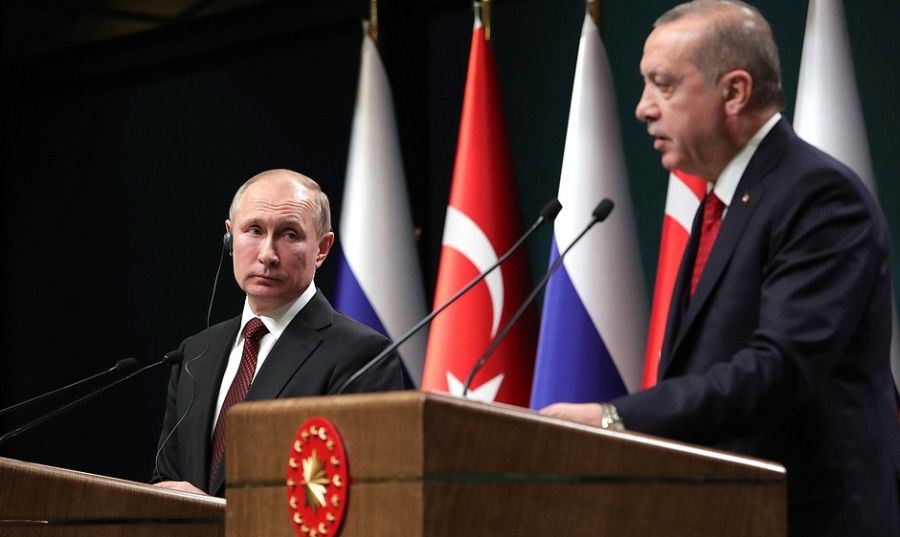
During a Pentagon briefing last weekend, Secretary of Defence James Mattis dropped a bombshell by innocuously slipping in that the US military intends to set up a string of observation posts on the Syrian-Turkish border. Mattis implied that Turkey was on board and that the idea was for the two militaries to jointly prevent any terrorist threats to the US’ NATO ally emanating out of Syrian territories.
Turkish officials immediately tore into Mattis’ project. Defence Minister Hulusi Akar disclosed that he had warned US Chairman of the Joint Chiefs of Staff Gen. Joseph Dunford only a week ago that the observation posts would have a “negative impact” and create the impression that “US soldiers are somehow protecting terrorist YPG (Syrian Kurdish) members and shielding them.”
The move would make an already complex situation “much more complex,” Akar added. He said, “Nobody should doubt that the Turkish armed forces and the Republic of Turkey will take the necessary steps against all kinds of risks and threats from across its borders.”
On Tuesday, President Recep Erdogan lashed out against the US troop presence in eastern Syria, charging that plans to establish observation posts along the Turkish border are meant to aid terrorist elements. “Those who say they are countering (ISIS) in Syria are in fact allowing a small group of terrorists to exist in the country to justify their presence in the war-torn country,” he said.
Erdogan alleged that the US is actually showing a preference to “live and breathe with the terrorists.” “The only target of this terror organization (YPG)… is our country,” he said. “It’s not possible for us to remain idle against this threat.”
Clearly, what is unfolding is a US game plan to block the Turkish military’s future operations in northern Syria against the Kurdish militia. Pentagon regards the YPG to be its most effective Syrian partner. Simply put, what we see here is the Syrian equivalent of what Washington did in 1991 in Iraq by imposing a “no-fly zone” over the Kurdistan region in the north.
The US is playing the long game. It is exactly three years since President Obama deployed 50 commandos to advise the Syrian Kurdish militia in their fight against the ISIS. Obama insisted it was “just an extension” of “special ops” that the US was running already. But the the numbers steadily kept increasing – from 50 to 250, from 250 to 500, and from 500 to 2000. The true figure today is around 5000 – and growing.
Seth Harp at the New Yorker magazine noted after a recent visit to the US bases in Syria, “the mission has morphed into something more like a conventional ground war. The United States has built a dozen or more bases from Manbij to Al-Hasakah, including four airfields, and American-backed forces now control all of Syria east of the Euphrates, an area about the size of Croatia.”
According to reports, there are presently 17 military bases in northeastern Syria. Yet, the US Congress has not authorized military action in Syria, nor has UN mandated the use of force. The Pentagon’s so-called Operation Inherent Resolve comes under the authority of the secretive Joint Special Operations Command, which means that “basic facts are kept classified, including the cost of the mission, the units involved, where they are located, and the number of wounded, which is believed to be substantial,” as Harp pointed out.
The intriguing part is about the US intentions. The stated purpose of the Operation Inherent Resolve is to defeat the ISIS, but lately it has shifted to countering Iranian presence in Syria. According to the US special representative for Syria engagement James F. Jeffrey, Trump has agreed to keep U.S. troops in Syria indefinitely. “We are not in a hurry,” he said.
Turkey’s worst fear may be coming true – a Syrian Kurdistan taking shape right along its border. Indeed, this becomes a template of the overall US strategy to encircle Turkey and Iran and to control Baghdad and Damascus – and eventually to make Russian presence in Syria untenable.
The US aims to put a knife into the heart of the Turkey-Russia-Iran axis in Syria by accentuating the contradictions in the region. The gloves have come off vis-à-vis Iran, Pentagon is now “defanging” Turkey and it remains to be seen how long the gloves will remain in place in the dealings with Russia.
In a candid interview with the Russia media on November 21, Special Representative for Syria Engagement Jeffrey sounded testy. He repeated that the deployment of S-300 missiles to Syria is a “dangerous escalation” – “we would urge the Russians to be very careful with this” – and assertively spoke of the new sanctions against Iran and Russia for oil shipments to Syria, while also rejecting offhand any talk of trade-offs with Russia over Iranian presence in Syria and debunking the Astana process. Jeffrey even reserved the US military’s right “to exercise our right of self-defense” if Russian forces on the ground came in the way. (Jeffrey disclosed that there have been military engagements with the Russians so far in “about a dozen times in one or another place in Syria.”)
Pentagon will press ahead with the establishment of observation posts on the Syrian-Turkish border despite Ankara’s objections. Turkey’s hour of reckoning is approaching. A few days ago, Turkish media reported that Saudi and UAE troops had deployed to northern Syria. In early November, the UAE reopened its embassy in Damascus.
The US and Israel are pressing Saudi Arabia and the UAE to fund the Syrian Kurdish militia and help create proximity between the Kurdish and Arab tribes inhabiting northeastern Syria with a view to create a unified Kurdish-Arab militia that becomes a Syrian bulwark against the two non-Arab regional powers Turkey and Iran.
To quote from a prominent Saudi commentator in the establishment daily Asharq Al-Awsat, “The Americans are now establishing Syrian Kurdish militias as a striking force against several parties and this revives the hopes of the Syrian opposition that it has an opportunity to resume its fighting activities after it has lost most of what it gained of villages and territories during the civil war.”
Both Saudis and Emiratis are once again at the US’s bidding in Syria. These Gulf States no longer hide their association with Israel. They are reciprocating the US-Israeli help to shove the Khashoggi affair under the rug.
Russian MoD Confirms Chlorine Used in Aleppo Attack, Dispatches Army Chem Team
Sputnik – 25.11.2018
MOSCOW – Russian military chemists arrived in the Syrian city of Aleppo, at which militants fired shells filled with poisonous agents on Saturday, Russian Defense Ministry spokesman Maj. Gen. Igor Konashenkov told reporters on Sunday.
“Groups from the observation posts of the radiation, chemical and biological protection units with special equipment stationed in Syria arrived to the area of shelling urgently. They work with the injured taken to medical institutions, monitor the situation in the area where the militants used poisonous substances,” Konashenkov said.
The symptoms of those injured shows that most likely, the shells had been filled with chlorine, he added.
“According to preliminary confirmed data, in particular, by the symptoms of poisoned victims, the shells that were fired at residential areas of Aleppo had been filled with chlorine,” the spokesman said.
He stressed that earlier the Russian side had drawn attention to the fact that the White Helmets organization had been trying to organize provocations using chemical agents in the demilitarized zone around Idlib to accuse government forces of using chemical weapons against the local population.
“It is clear that the White Helmets are directly connected with terrorist organizations operating in Syria, and in particular, in the Idlib de-escalation zone,” he said.
Russian specialists conduct a thorough monitoring of the situation around the Idlib de-escalation zone, for which the Turkish side is responsible, Konashenkov said.
According to the information of the Russian Defense Ministry’s Center for Syrian reconciliation, at 21.50 on Saturday, terrorist groups located in the Idlib de-escalation zone fired 120-millimeter shells at the northwestern districts of Aleppo from the southeastern part of the demilitarized zone (near the village of Al-Buraykat, controlled by the militants of Hayat Tahrir Ash-Sham, former Nusra Front).
Shells filled with poisonous substances exploded in the area of Nile Street in the quarter of Al-Khalidia.
“As a result of the shelling, 46 people, including 8 children, received a chemical damage. All the victims were taken to medical institutions of the city of Aleppo, where they received medical assistance,” Konashenkov said.
Earlier, Konashenkov reported that six special radiation, chemical and biological reconnaissance vehicles had been deployed to Russian observation posts in the immediate vicinity of the demilitarized zone in the province of Idlib, which would regularly carry out an assessment of the radiation, chemical and biological conditions.
Aleppo Governor Says Chlorine Attack Proves Militants Possess Chemical Weapons
Sputnik – 25.11.2018
DAMASCUS – The governor of the Syrian province of Aleppo, Hussein Diyab, reported an increase in the number of injured civilians in the attack by militants with chlorine-filled shells, saying that this is confirmation of the possession of chemical weapons by terrorists.
“The terrorists’ missiles contained poisonous gases, which proves that the terrorists possess chemical weapons,” the governor said, as quoted by Al Ekhbariya broadcaster, when he arrived at the ar-Razi hospital where the victims were hospitalized.
On Saturday, militants from terrorist groups fired shells at neighborhoods of al-Khalidiye and Al Zahraa as well as the Nile Street. At least four children were hospitalized with asphyxiation and other symptoms typical for poisoning.
The head of the health department of the Syrian city of Aleppo, Ziad Haj Taha, said Saturday that 50 residents of the city were injured in the attack by militants with chlorine-filled shells at the city’s residential areas.
“Of those injured, 25 were hospitalized to ar-Razi hospital, 25 to Aleppo University Hospital. Ambulance services continue to provide assistance to victims of poison gas use by terrorist groups, presumably chlorine,” Taha said.
Meanwhile, the number of victims with poisoning symptoms has reached 55, local media reported Sunday.
The city of Aleppo was liberated by the Syrian government troops from militant and terror groups in 2016 but militants continue to shell the city from their positions in Aleppo’s suburbs.
US creates new facts on the ground in Syria
By M. K. BHADRAKUMAR | Indian Punchline | November 24, 2018
The Trump administration is making a determined effort to engage with Turkey, which used to be the anchor sheet of American regional strategies in the Middle East for several decades. Without a robust partnership with Turkey, US policies remain ineffectual on several regional fronts – ranging from the Black Sea and Eastern Mediterranean to post-conflict Syria, Iran oil sanctions and Gulf security — and even Khashoggi affair.
Turkey has a long list of grievances – real, feigned or imaginary. But President Trump senses that Turkish president Erdogan prioritizes two core issues – demand that a) Washington should extradite his arch political rival Islamist preacher Fetullah Gulen (who he alleges plotted the failed coup against him in 2016); and, b) that the so-called Halkbank case in a Manhattan court should be wound up.
Trump has lately signaled that he is acting on both issues. Gulen is a tough call for Trump insofar as he has been an “asset” of the CIA. The Halkbank file may be relatively easy to handle.
(Fetullah Gulen’s ‘retreat center’ in Pennsylvania)
In turn, Erdogan is holding the trump card in the Khashoggi affair, which has potential to undermine the US’ grand Middle East strategies. A top Saudi establishment commentator Abdulrahman Al-Rashed wrote in the Saudi daily Asharq Al-Awsat, “Turkey has been using the (Khashoggi) crime to push Trump to make concessions to release a convicted Turkish banker or hand over an opposition figure in exchange of stopping its campaign against Saudi Arabia.” Clearly, Trump expects Erdogan to stop fueling the Khashoggi affair.
Erdogan has now let it be known that he is open to meeting with the Saudi Crown Prince Mohammed bin Salman on the sidelines of the G20 summit in Argentina on November 30.
However, the Turkish-American engagement has a much bigger backdrop — Syrian conflict. How far the tango over Khashoggi helped US to address the Syrian situation is hard to tell, but American diplomacy has a way of juggling several balls. In particular, the Pentagon’s alliance with Syrian Kurdish groups worries Turkey and Erdogan has been threatening to move against them.
Now, the US has come up with an innovative idea to work with Turkish military apropos any terrorist threats from Syria. Two days ago, US defence Secretary James Mattis unveiled the idea with disarming simplicity during an interaction with the media:
“Turkey is a NATO ally and they have legitimate concerns about terror threats… from Assad’s Syria… And Turkey has a lot of reasons for concerns, being the NATO country with a border right along Syria. And we don’t dismiss any of their concerns. We are putting in OPs up in northern Syria, this is the change now, okay? We are putting in observation posts in several locations up along the Syria border — northern Syria border because we want to be the people who call the Turks and warn them if we see something coming out of an area that we’re operating in. This is closely collaborated – we are consulting closely with Turkey, military and State Department. Both were consulting with them.”
“We are going to track any threat that we can spot going up into Turkey. That means we will be talking to Turkish military across the border. They will be very clearly marked locations day and night so that the Turks know where they’re at.”
Meanwhile, Voice of America also reported on November 22 that “a large military convoy from an Arab country was deployed last week to the eastern Syrian province of Deir el-Zour” in the region under US control.
Prima facie, the US is pre-empting any excuse by Turkey to attack the Kurdish groups by offering a CBM. But the bottom line is that the US is marking as its exclusive preserve a vast swathe of territory in Syria’s northeastern region — roughly one-third of entire Syria — which is rich in hydrocarbon reserves and water resources, and it expects Turkey to respect the ground reality.
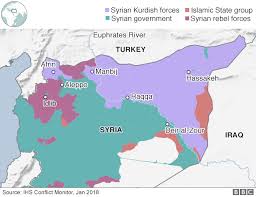
(Who controls what in Syria.)
Without doubt, an entity is being carved out of Syria that is beyond the reach of Damascus, with the Arab Forces providing the “steel frame” for internal security and acting as deterrent against any Turkish attacks against the Kurdish militia, while the US monitors the border region with Turkey.
Mattis claimed that Turkey is on board. But Turkey strongly supports Syria’s unity. Turkish Defence Minister Hulusi Akar has openly voiced disquiet over the US move to set up observation posts on Turkish-Syrian border. Akar disclosed that Turkey conveyed its “discomfort” to the Pentagon:
“We have stated that the observation points to be established by the US troops on the Syrian border will have a very negative impact… and in the course of our discussions we expressed that it could lead to a perception that US soldiers are somehow protecting terrorist YPG (Syrian Kurdish) members and shield them.”
Equally, could an Arab force’s – most likely Saudi and Emirati troops – deployment (just when the war is ending) have been without prior consultation between Washington and Ankara? The point is, Turkey has troubled relations with both Saudi Arabia and the UAE and will resent their deployment of troops to its border regions with Syria.
In sum, the US’ newfound role as the gatekeeper of the Turkish-Syrian border means the Pentagon is creating new facts on the ground, which signals a long-term US occupation of northern Syria. There are serious implications for Syria’s unity and territorial integrity. Indeed, the last thing that Turkey wants is an independent entity along its border with Syria where the Kurds enjoy autonomy. Turkey has a congruence of interests with Russia and Iran in this regard.
The Final Push for Idlib Will Come Soon
By Federico PIERACCINI | Strategic Culture Foundation | 23.11.2018
The situation in Syria is that of a frozen conflict, following the agreements made between Russia, Turkey and Syria on the demilitarized zone created around Idlib. Except for some sporadic terrorist attacks, the truce seems to be holding up over the last few weeks, even though it has become clear to everyone what the next step is for the province.
The Syrian Arab Army (SAA) has been busy eradicating Daesh in the southern part of Syria in recent weeks, concentrating its efforts on securing all areas that have been liberated from terrorist control but which still remain vulnerable to sporadic attacks, as occurred in Sweida at the end of July 2018. In that incident, there were dozens of victims and numerous abductees who remained in the hands of Daesh for months. This caused the Syrian population in neighbouring areas to clamor for protection, forcing the SAA to undertake an anti-terrorist campaign that has been ongoing since August.
This effort by the SAA has slowed down in part due to subsequent events, with an agreement reached between Erdogan and Putin to create a demilitarized zone in the province of Idlib. From October 15, an area spanning 20 kilometres and guarded by Turkish and Russian troops guarantees a separation between the SAA and terrorist groups in the province.
Russian and Syrian efforts have been moving in two very specific directions over the last few weeks. While Moscow supplies Damascus with new equipment in preparation for the future advance on Idlib, Putin and his entourage continue diplomatic efforts to draw more of Syria’s enemies closer to the Russia-Iran-Syria axis. The meeting that brought about the demilitarized zone included Macron and Merkel, the Europeans having evidently come to terms with the impossibility of overthrowing the legitimate government of Syria. Macron and Merkel were offered a way out of the Syrian conflict, decoupling themselves from the belligerent stance of the United States, Israel and Saudi Arabia. The intention is to usher Paris and Berlin towards the same direction Qatar, Turkey and Jordan have been progressively gravitating. Certainly, these are not countries to be considered friends of Damascus. Rather, they are parties with whom a constructive dialogue needs to be entered into in order to advance common diplomatic interests.
Moscow has often found it possible to reach an agreement or start unpublicized negotiations with each of these parties. Erdogan seems to have preferred an agreement with Putin rather than waiting for the liberation of Idlib by the SAA, thus being able to postpone the natural conclusion of the war that will find him sitting at the table defeated. At the same time, Erdogan wants to concentrate on the Kurds in order to secure the border between Syria and Turkey controlled by the Syrian Democratic Forces (SDF), and to prevent any partition of Syrian territory that would favor other parties. Jordan has even reopened the border crossings with Syria, appearing to be the first country in opposition to Damascus that is now taking practical steps to mend fences.
The case of the participation of the two European countries at the summit with Erdogan and Putin is more complex. The rift between Washington and the other European capitals is wide and well documented, even more so after the events in Paris commemorating the end of the First World War. Macron and Trump seem to be diverging further in terms of policy and ideology, while Trump and Merkel have always had their differences. Trump’s choices in the Middle East, in the wake of the destructive actions of Israel and Saudi Arabia, marked a profound point of difference and mistrust with the European allies. Macron and Merkel have a huge problem dealing with refugees flowing from areas in North Africa and the Middle East destroyed by US-led wars. The prospect of working with Erdogan, and indirectly with Damascus, to bring back hundreds of thousands of refugees currently in France and especially Germany, seems to have been Putin’s winning argument during the talks in Istanbul.
This slow diplomatic approach has been accelerated as a result of Israel’s downing of a Russian electronic-surveillance aircraft. The need to avoid a direct conflict between Moscow and Tel Aviv allowed the Russian missile forces to deploy to Syria an advanced model of the S-300 in addition to the existing S-300/400 systems on the ground. The presence of these advanced systems, and Moscow’s threats to use them, together with American concerns over the possibility of an F-35 being shot down by Soviet systems dating from the 1970s, forced the Zionist entity to halt its attacks on Syria.
This situation has helped to create a frozen conflict in the country. Together with the agreement of Idlib, this gives the SAA plenty of time to rest, regroup, and receive supplies needed for future campaigns.
The current truce is a strategic pause that has all the appearance of what has happened in the past in the provinces of Homs and Aleppo. The need to free Idlib from terrorists goes hand in hand with the promise of Assad and the government of Damascus to liberate every inch of Syria from terrorists. The diplomatic efforts of Moscow serve to prepare the ground for what will happen in the coming months, with the SAA set to advance on Idlib. In this sense, the deployment of advanced systems in Syria serves as a deterrent against possible responses from countries like Israel and the United States, anxious to defend their jihadists, but continuing to have minimal influence on the ground.
Russia and Syria’s moves therefore seem to be in preparation for the battle for Idlib, to be the longest and most difficult yet. The liberation of the province is inevitable but requires all the necessary political, diplomatic and military preparation in order to ensure success and limit potential escalation. As is often the case, Moscow and her allies approach complex issues with simple and pragmatic solutions, even offering exit strategies to their (geo)political opponents, which contrasts with their demonstrated tendency to rush heedlessly towards war.
Russia: US Sanctions over Alleged Oil Supply to Syria Looks Like “Statement of Support for Terrorists”
Sputnik – 21.11.2018
MOSCOW – Regular US anti-Russian sanctions are routine, the Russian Foreign Ministry said in a statement on 21 November.
“Washington continues to impose sanctions on Russia at an increasing rate. Their recent expansion has become the 11th in the last three and a half months, and is increasingly becoming a routine,” the ministry said.
The ministry noted that the main reasons for the introduction of sanctions lay in the internal political discord in the United States when each of the parties sought to “earn points” by any means.
“Attempts to accuse [some states] of supplying oil to Syria, whose armed forces have been fighting terrorist aggression for eight years, look like a statement of support for terrorists and at the same time a desire to prevent the restoration of a devastated country, many of whose inhabitants are deprived of light and heat. Is that what the US wants?” the statement read.
The ministry stressed that by trying to put pressure on Russia, Washington had repeatedly demonstrated its inability to force Moscow to change its independent line in the international relations.
The statement has been voiced a day after the United States announced the introduction of new sanctions against Syria, Iran and Russia. The reason for the restrictive measures was alleged secret supplies of Iranian oil to Damascus with the “assistance” of the Russian side.
This is the last package of sanctions against Russia that have been introduced by the United States for several years, blaming Moscow for meddling other countries’ elections and poisoning people, with all the accusations denied by Russian officials.
Featured Video

The Most Important Bet You’ve Never Heard Of
or go to
Aletho News Archives – Video-Images
From the Archives
Wars for Israel: A reminder of who’s giving the marching orders
By Damian Lataan | February 7, 2012
As the West prepares to march off to yet another war in the Middle East, we should perhaps remind ourselves of who is giving the West their marching orders.
In February 2003, just weeks before the US and their allies launched their attack on Iraq and her peoples, a delegation of US congressmen, together with the US Ambassador to the United Nations, John Bolton, a well known pro-Zionist and neoconservative war-hawk, were in Israel at the invitation of the Israeli government then led by Israeli Prime Minister Ariel Sharon.
Addressing the congressmen, Sharon told them ‘that Iran, Libya and Syria should be stripped of weapons of mass destruction after Iraq’. Later, Sharon told John Bolton ‘that Israel was concerned about the security threat posed by Iran, and stressed that it was important to deal with Iran even while American attention was focused on Iraq’. … continue
Blog Roll
 Aletho News
- Bombing Iran Back Into the Stone Age /Lt Col Daniel Davis & Jim Jatras
- UAE rejects report claiming it is ready to join war on Iran to reopen Hormuz
- A New Resistance Front: How Does Syria Factor into the Regional War?
- Gulf states weigh pipeline expansion plans, hoping to bypass Hormuz
- Iran sets up ‘tollbooth’ system in Strait of Hormuz
- Wave 90: IRGC strikes US-linked industrial sites in Gulf
- Iran Says US-Israeli Claims of Its Military Strength Are Wrong
- Trump’s April Fools’ Address to the nation
- The Most Important Bet You’ve Never Heard Of
- The killing of three Indonesian soldiers in Lebanon should remind Jakarta that Israel does not want peace
- If Americans Knew
- ‘War crime’: Global condemnation as Israeli ministers celebrate death penalty law targeting Palestinian prisoners
- 7 Ways Israel Is Turning Lebanon Into Gaza
- World’s Leading Football Bodies Under Fire Over Israel Policies
- Experts warn of possible use of nukes against Iran
- Israeli invasion of Lebanon could be worse than 1982, warn European officials
- Passover: Liberation and collective punishment
- Trump says the quiet part out loud: (Israel’s) war on Iran > Americans’ health – Daily Update
- Gaza families reunite years after babies evacuated amid Israel’s war
- International Rescue Committee warns Gaza’s children face grave protection risks
- Iran’s Alleged 47-Year War on America: Debunking the 1,050 American Deaths Canard
- No Tricks Zone
- Low Intensity Tornado Wrecks Major Solar Farm, Creating A Potential Toxic Dump
- New Study Finds Warming Saves Lives…Cold Temperatures 12 Times More Deadly Than Excess Heat
- German Science Blog Accuses PIK Climate Institute Of Hallucinating Climate Tipping Points
- Devastating Assessment Of Comirnaty Vaccine By Former Senior Pfizer Europe Toxicologist
- New Study: CO2 Is ‘Effectively Negligible’ As An Explanatory Climate Change Factor Since 2000
- Former Pfizer Toxicologist Dr. Helmut Sterz Tells Bundestag Hearing Pfizer Vaccine Should Have Never Been Approved
- Energy Expert: Germany’s Nuclear Phaseout Was A “500 Billion Euro Mistake”
- New Research: South Australia’s Mid-Holocene Sea Surface Temperatures Were 4°C Warmer Than Today
- Storing Green Energy To Last Germany 10 Days Would Require A 60-Million Tonne Battery
- New Studies: UK Sea Levels Were 4 Meters Higher Than Today During The Mid-Holocene
 Aletho News