The Final Push for Idlib Will Come Soon
By Federico PIERACCINI | Strategic Culture Foundation | 23.11.2018
The situation in Syria is that of a frozen conflict, following the agreements made between Russia, Turkey and Syria on the demilitarized zone created around Idlib. Except for some sporadic terrorist attacks, the truce seems to be holding up over the last few weeks, even though it has become clear to everyone what the next step is for the province.
The Syrian Arab Army (SAA) has been busy eradicating Daesh in the southern part of Syria in recent weeks, concentrating its efforts on securing all areas that have been liberated from terrorist control but which still remain vulnerable to sporadic attacks, as occurred in Sweida at the end of July 2018. In that incident, there were dozens of victims and numerous abductees who remained in the hands of Daesh for months. This caused the Syrian population in neighbouring areas to clamor for protection, forcing the SAA to undertake an anti-terrorist campaign that has been ongoing since August.
This effort by the SAA has slowed down in part due to subsequent events, with an agreement reached between Erdogan and Putin to create a demilitarized zone in the province of Idlib. From October 15, an area spanning 20 kilometres and guarded by Turkish and Russian troops guarantees a separation between the SAA and terrorist groups in the province.
Russian and Syrian efforts have been moving in two very specific directions over the last few weeks. While Moscow supplies Damascus with new equipment in preparation for the future advance on Idlib, Putin and his entourage continue diplomatic efforts to draw more of Syria’s enemies closer to the Russia-Iran-Syria axis. The meeting that brought about the demilitarized zone included Macron and Merkel, the Europeans having evidently come to terms with the impossibility of overthrowing the legitimate government of Syria. Macron and Merkel were offered a way out of the Syrian conflict, decoupling themselves from the belligerent stance of the United States, Israel and Saudi Arabia. The intention is to usher Paris and Berlin towards the same direction Qatar, Turkey and Jordan have been progressively gravitating. Certainly, these are not countries to be considered friends of Damascus. Rather, they are parties with whom a constructive dialogue needs to be entered into in order to advance common diplomatic interests.
Moscow has often found it possible to reach an agreement or start unpublicized negotiations with each of these parties. Erdogan seems to have preferred an agreement with Putin rather than waiting for the liberation of Idlib by the SAA, thus being able to postpone the natural conclusion of the war that will find him sitting at the table defeated. At the same time, Erdogan wants to concentrate on the Kurds in order to secure the border between Syria and Turkey controlled by the Syrian Democratic Forces (SDF), and to prevent any partition of Syrian territory that would favor other parties. Jordan has even reopened the border crossings with Syria, appearing to be the first country in opposition to Damascus that is now taking practical steps to mend fences.
The case of the participation of the two European countries at the summit with Erdogan and Putin is more complex. The rift between Washington and the other European capitals is wide and well documented, even more so after the events in Paris commemorating the end of the First World War. Macron and Trump seem to be diverging further in terms of policy and ideology, while Trump and Merkel have always had their differences. Trump’s choices in the Middle East, in the wake of the destructive actions of Israel and Saudi Arabia, marked a profound point of difference and mistrust with the European allies. Macron and Merkel have a huge problem dealing with refugees flowing from areas in North Africa and the Middle East destroyed by US-led wars. The prospect of working with Erdogan, and indirectly with Damascus, to bring back hundreds of thousands of refugees currently in France and especially Germany, seems to have been Putin’s winning argument during the talks in Istanbul.
This slow diplomatic approach has been accelerated as a result of Israel’s downing of a Russian electronic-surveillance aircraft. The need to avoid a direct conflict between Moscow and Tel Aviv allowed the Russian missile forces to deploy to Syria an advanced model of the S-300 in addition to the existing S-300/400 systems on the ground. The presence of these advanced systems, and Moscow’s threats to use them, together with American concerns over the possibility of an F-35 being shot down by Soviet systems dating from the 1970s, forced the Zionist entity to halt its attacks on Syria.
This situation has helped to create a frozen conflict in the country. Together with the agreement of Idlib, this gives the SAA plenty of time to rest, regroup, and receive supplies needed for future campaigns.
The current truce is a strategic pause that has all the appearance of what has happened in the past in the provinces of Homs and Aleppo. The need to free Idlib from terrorists goes hand in hand with the promise of Assad and the government of Damascus to liberate every inch of Syria from terrorists. The diplomatic efforts of Moscow serve to prepare the ground for what will happen in the coming months, with the SAA set to advance on Idlib. In this sense, the deployment of advanced systems in Syria serves as a deterrent against possible responses from countries like Israel and the United States, anxious to defend their jihadists, but continuing to have minimal influence on the ground.
Russia and Syria’s moves therefore seem to be in preparation for the battle for Idlib, to be the longest and most difficult yet. The liberation of the province is inevitable but requires all the necessary political, diplomatic and military preparation in order to ensure success and limit potential escalation. As is often the case, Moscow and her allies approach complex issues with simple and pragmatic solutions, even offering exit strategies to their (geo)political opponents, which contrasts with their demonstrated tendency to rush heedlessly towards war.
Russia: US Sanctions over Alleged Oil Supply to Syria Looks Like “Statement of Support for Terrorists”
Sputnik – 21.11.2018
MOSCOW – Regular US anti-Russian sanctions are routine, the Russian Foreign Ministry said in a statement on 21 November.
“Washington continues to impose sanctions on Russia at an increasing rate. Their recent expansion has become the 11th in the last three and a half months, and is increasingly becoming a routine,” the ministry said.
The ministry noted that the main reasons for the introduction of sanctions lay in the internal political discord in the United States when each of the parties sought to “earn points” by any means.
“Attempts to accuse [some states] of supplying oil to Syria, whose armed forces have been fighting terrorist aggression for eight years, look like a statement of support for terrorists and at the same time a desire to prevent the restoration of a devastated country, many of whose inhabitants are deprived of light and heat. Is that what the US wants?” the statement read.
The ministry stressed that by trying to put pressure on Russia, Washington had repeatedly demonstrated its inability to force Moscow to change its independent line in the international relations.
The statement has been voiced a day after the United States announced the introduction of new sanctions against Syria, Iran and Russia. The reason for the restrictive measures was alleged secret supplies of Iranian oil to Damascus with the “assistance” of the Russian side.
This is the last package of sanctions against Russia that have been introduced by the United States for several years, blaming Moscow for meddling other countries’ elections and poisoning people, with all the accusations denied by Russian officials.
US Threatens ‘Grave Consequences’ for Those Who Supply Oil to Syria
Sputnik – 21.11.2018
The United States claims that an illegal scheme is in place to support Syrian President Bashar Assad and provide financial assistance to Hezbollah and Hamas.
US Secretary of State Mike Pompeo has promised severe consequences for anyone who is supplying oil to Syria or trying to circumvent US sanctions against Iran.
“Today’s US Treasury’s action targeting the Russia-Iran oil scheme to prop up [Syrian President Bashar] Assad, and finance Hizballah & Hamas, sends a clear message: there are grave consequences for anyone shipping oil to Syria, or trying to evade U.S. sanctions on the Islamic Republic’s terrorist activities,” Pompeo wrote on Twitter on Tuesday.
He added that Iran’s spiritual leader, Ayatollah Ali Khamenei, “should decide if spending the Iranian people’s money on the Iranian people is more important than inventing schemes to fund Assad, Hizballah, Hamas, and other terrorists”.
On Tuesday, Washington added six individuals and three organisations to its sanctions list claimed by the Treasury to be involved in oil shipments to the Syrian government, among them the Russian companies Global Vision Group and Promsyryeimport, and the latter company’s first deputy director Andrei Dogayev.
The list also features two Iraqi nationals, a Lebanese, a Syrian and an Iraqi,as well as the Iranian-registered Tadbir Kish Medical and Pharmaceutical Company.
According to the US Treasury Department, the Global Vision Group and Syrian citizen Mohammed Amer Alshviki, who, according to Washington, is the company’s owner, allegedly play a key role in a scheme for petroleum shipments to Syria and financial transfers to the Quds Force special unit of Iran’s Revolutionary Guards Corps.
Shortly before that, US Special Representative for Syria James Jeffrey stated that the recently imposed second batch of US sanctions against Iran are aimed at forcing Tehran to reduce its ‘presence’ in Syria.
Russia and Iran are yet to comment on these accusations and sanctions.
Prospects for Syrian peace are looking up
By M. K. BHADRAKUMAR | Indian Punchline | November 20, 2018
After prolonged hibernation, the Astana Process on Syrian peace is kinetic, with the troika of ‘guarantor’ states – Russia, Turkey and Iran – set to hold a round of talks in the Kazakh capital on November 28-29. Delegations of the Syrian government and the opposition are also expected to attend. A renewed effort is commencing to create traction for the UN-sponsored negotiations in Geneva.
Much water has flown down the Euphrates since the 9th round of the Astana Process took place in May. Six months is a long time in politics – especially in Middle East politics. But, paradoxically, while Middle Eastern politics is in turmoil, the prospects for peace in Syria may have improved. The setting for tomorrow’s meet – it’s unclear at what level the event will take place – has become largely favorable. At least 10 major reasons can be attributed.
One, Syria is witnessing a period of relative calm. There has been no major fighting for months. Two, Syrian-Jordanian border had reopened and nothing of a feared flare-up happened in the Golan Heights. Three, the Russian-Turkish understanding on Idlib is holding. Four, Israel has been effectively ‘defanged’ (thanks to deployment of Russian S-300 ABM system to Syria). Five, Russia and Iran intend to retain their military footprints in Syria for a foreseeable future, while on the contrary, the US lacks the political will or the military capability to impact the strategic calculations of Moscow, Tehran, Damascus or Ankara.
Six, importantly, Turkey has become an implicit ally of Russia and Iran and is inching closer and closer to a political deal that leaves President Bashar Al-Assad in power. Seven, Russia, Turkey, and Iran are in the lead in shaping the Syria policy, with clear strategic goals and, even more so, the means to achieve them.
Eight, on the other hand, a growing determination on the part of Russia, Iran, and Turkey is discernible to freeze out the United States from any role in shaping Syria’s geo-strategic future. Although the three countries would have tactical differences between them, broadly, Turkey will accommodate Russia and Iran so long as it has a free hand to check the Kurdish forces threatening its security. Significantly, the announcement on the rebooting of the Astana Process comes after the visit by Russian President Vladimir Putin to Turkey on November 19.
Nine, the crisis in Turkish-American relations not only persists but may even deepen in the period ahead. Finally, the Trump administration’s calculations that its re-imposition of sanctions against Iran will either force Iran out of Syria or, better yet, produce a veritable collapse of the Iranian government are turning out to be a mere pipe dream. In fact, the opposite has happened.
Iran is intensifying its coordination with Russia and Turkey, and is creating firewalls to protect its strategic gains in Syria. Again, it is clear by now that the US cannot count on the new government in Baghdad to act against Iranian interests.
On the other hand, the dangerous situation that has arisen on Israel’s border with Gaza (which was precipitated entirely by Israeli hardliners) and the ensuing mayhem in Israel’s domestic politics will seriously delimit Benjamin Netanyahu’s energy and resources to act as ‘spoiler’ in Syria. Moscow has openly snubbed Netanyahu lately by refusing him to schedule his visit.
Similarly, the widening cracks in the US-Saudi alliance in the downstream of the Khashoggi murder all but means an overall Saudi disengagement from the Syrian conflict. The UAE has already begun mending fences with the Syrian government, which would only have been possible with Saudi approval. (See my blog UAE, Saudi sense convergence with Syria.)
Suffice to say, the so-called Syrian opposition is finding itself rudderless. Their erstwhile mentors – US, Turkey, Saudi Arabia, UAE – have either reached a dead end or have turned to new priorities in their self-interests accepting the defeat in the Syrian conflict.
Meanwhile, the appointment of Norwegian diplomat Geir Pederson as the UN Secretary-General’s new special envoy for Syria becomes a positive factor. Russia has warmly noted that “we know him as an experienced and unbiased diplomat.” Pederson’s predecessor Staffan de Mistura was widely perceived as a sidekick of the US. Clearly, the Astana Process is not wasting time by kickstarting the work on a Syrian settlement even as Perdersen moves in.
The Only Regime Change that Is Needed Is in Washington
By Philip Giraldi | American Herald Tribune | November 19, 2018
One of the things to look forward to in the upcoming holiday season is the special treats that one is allowed to sample. Fruitcake and nuts are Thanksgiving and Christmas favorites. They usually come in tins or special packages but it seems that this season some of the nuts have escaped and have fled to obtain sanctuary from the Trump Administration.
Currently, there is certainly a wide range of nuts available on display in the West Wing. There is the delicate but hairy Bolton, which has recently received the coveted “Defender of Israel” award, and also the robust Pompeo, courageously bucking the trend to overeat during the holidays by telling the Iranian people that they should either surrender or starve to death. And then there is the always popular Haley, voting audaciously to give part of Syria to Israel as a holiday treat.
But my vote for the most magnificent nut in an Administration that is overflowing with such talent would be the esteemed United States Special Representative for Syria Engagement James Jeffrey. The accolade is in part due to the fact that Jeffrey started out relatively sane as a career diplomat with the State Department, holding ambassadorships in Iraq, Turkey, and Albania. He had to work hard to become as demented as he now is but was helped along the way by signing on as a visiting fellow at the Washington Institute for Near East Policy (WINEP), which is a spin-off of the American Israel Public Affairs Committee (AIPAC).
Jeffrey set the tone for his term of office shortly after being appointed back in August when he argued that the Syrian terrorists were “. . . not terrorists, but people fighting a civil war against a brutal dictator.” Jeffrey, who must have somehow missed a lot of the head chopping and rape going on, subsequently traveled to the Middle East and stopped off in Israel to meet Prime Minister Benjamin Netanyahu. It has been suggested that Jeffrey received his marching orders during the visit.
James Jeffrey has been particularly active during this past month. On November 7th he declared that he would like to see Russia maintain a “permissive approach” to allowing the Israelis to attack Iranian targets inside Syria. Regarding Iran’s possible future role in Syria, he observed that “Iranians are part of the problem not part of the solution.”
What Jeffrey meant was that because Israel had been “allowed” to carry out hundreds of air attacks in Syria ostensibly directed against Iran-linked targets, the practice should be permitted to continue. Israel had suspended nearly all of its airstrikes in the wake of the shoot-down of a Russian aircraft in September, an incident which Moscow has blamed on Israel even though the missile that brought down the plane was fired by Syria. Fifteen Russian servicemen were killed. Israel reportedly was deliberately using the Russian plane to mask the presence of its own aircraft.
Russia responded to the incident by deploying advanced S-300 anti-aircraft systems to Syria, which can cover most of the more heavily developed areas of the country. Jeffrey was unhappy with that decision, saying “We are concerned very much about the S-300 system being deployed to Syria. The issue is at the detail level. Who will control it? what role will it play?” And he defended his own patently absurd urging that Russia, Syria’s ally, permit Israel to continue its air attacks by saying “We understand the existential interest and we support Israel” because the Israeli government has an “existential interest in blocking Iran from deploying long-range power projection systems such as surface-to-surface missiles.”
On November 15th James Jeffrey was at it again, declaring that U.S. troops will not leave Syria before guaranteeing the “enduring defeated” of ISIS, but he perversely put the onus on Syria and Iran, saying that “We also think that you cannot have an enduring defeat of ISIS until you have fundamental change in the Syrian regime and fundamental change in Iran’s role in Syria, which contributed greatly to the rise of ISIS in the first place in 2013, 2014.”
As virtually no one but Jeffrey and the Israeli government actually believes that Damascus and Tehran were responsible for creating ISIS, the ambassador elaborated, blaming President Bashar al-Assad for the cycle of violence in Syria that, he claimed, allowed the development of the terrorist group in both Syria and neighboring Iraq.
He said “The Syrian regime produced ISIS. The elements of ISIS in the hundreds, probably, saw an opportunity in the total breakdown of civil society and of the upsurge of violence as the population rose up against the Assad regime, and the Assad regime, rather than try to negotiate or try to find any kind of solution, unleashed massive violence against its own population.”
Jeffrey’s formula is just another recycling of the myth that the Syrian opposition consisted of good folks who wanted to establish democracy in the country. In reality, it incorporated terrorist elements right from the beginning and groups like ISIS and the al-Qaeda affiliates rapidly assumed control of the violence. That Jeffrey should be so ignorant or blinded by his own presumptions to be unaware of that is astonishing. It is also interesting to note that he makes no mention of the U.S. invasion of Iraq, knee-jerk support for Israel and the unrelenting pressure on Syria starting with the Syrian Accountability Act of 2003 and continuing with the embrace of the so-called Arab Spring. Most observers believe that those actions were major contributors to the rise of ISIS.
Jeffrey’s unflinching embrace of the Israeli and hardline Washington assessment of the Syrian crisis comes as no surprise given his pedigree, but in the same interview where he pounded Iran and Syria, he asserted oddly that “We’re not about regime change. We’re about a change in the behavior of a government and of a state.”
Actually, the only regime change that is needed is in Washington and it would include Jeffrey, Bolton, Haley, Pompeo, and Miller. And while we’re at it, get rid of son-in-law Jared Kushner and his claque of Orthodox Jews, Jason Greenblatt the “peace negotiator” and David Friedman the U.S. Ambassador in Israel. None of them are capable of acting to advance any American national interest, which they wouldn’t recognize even if it hit them in the butt. Once they are gone the U.S. can bid the Middle East goodbye and leave its constituent nations to sort out their own problems. Jeffrey’s ridiculous prescriptions for the Syrians and Russians are symptomatic of what one gets from a team of yes-men who have latched onto some dystopic ideas and pursued them relentlessly, blinded by what they believe to be American power. Someone should tell them that their antics have made that power a commodity that is dramatically depreciating in value, but it is clear that they are not listening.
US Budgetary Costs of the Post-9/11 Wars: $5.9 Trillion Spent and Obligated
Through FY2019
By Prof. Neta C. Crawford | Watson Institute, Brown University | November 14, 2018
The United States has appropriated and is obligated to spend an estimated $5.9 trillion (in current dollars) on the war on terror through Fiscal Year 2019, including direct war and war-related spending and obligations for future spending on post-9/11 war veterans (see Table 1).
This number differs substantially from the Pentagon’s estimates of the costs of the post-9/11 wars because it includes not only war appropriations made to the Department of Defense – spending in the war zones of Iraq, Syria, Afghanistan, Pakistan, and in other places the government designates as sites of “overseas contingency operations,” – but also includes spending across the federal government that is a consequence of these wars. Specifically, this is war-related spending by the Department of State, past and obligated spending for war veterans’ care, interest on the debt incurred to pay for the wars, and the prevention of and response to terrorism by the Department of Homeland Security.
If the US continues on its current path, war spending will continue to grow. The Pentagon currently projects $80 billion in Overseas Contingency Operations (OCO) spending through FY2023. Even if the wars are ended by 2023, the US would still be on track to spend an additional $808 billion (see Table 2) to total at least $6.7 trillion, not including future interest costs. Moreover, the costs of war will likely be greater than this because, unless the US immediately ends its deployments, the number of veterans associated with the post-9/11 wars will also grow. Veterans benefits and disability spending, and the cost of interest on borrowing to pay for the wars, will comprise an increasingly large share of the costs of the US post-9/11 wars.
Table 1, below, summarizes the direct war costs – the OCO budget – and war-related costs through FY2019. These include war-related increases in overall military spending, care for veterans, Homeland Security spending, and interest payments on borrowing for the wars. Including the other areas of war-related spending, the estimate for total US war-related spending allocated through FY2019 is $4.9 trillion.[3] But because the US is contractually and morally obligated to pay for the care of the post-9/11 veterans through their lifetimes, it is prudent to include the costs of care for existing post-9/11 veterans through the next several decades. This means that the US has spent or is obligated to spend $5.9 trillion in current dollars through FY2019.[4] Table 1 represents this bottom-line breakdown for spent and obligated costs.
Table 1. Summary of War Related Spending, in Billions of Current Dollars, Rounded to the Nearest Billion, FY2001- FY2019[5]

Figure 1. US Costs of War: $5.9 Trillions of Current Dollars Spent and Obligated, through FY2019[10]
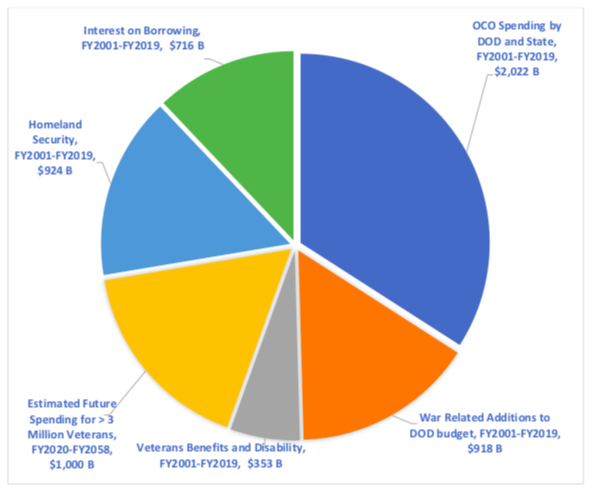
Further, the US military has no plans to end the post-9/11 wars in this fiscal year or the next. Rather, as the inclusion of future years spending estimates in the Pentagon’s budget indicates, the DOD anticipates military operations in Afghanistan, Pakistan, Iraq and Syria necessitating funding through at least FY2023. Thus, including anticipated OCO and other war-related spending, and the fact that the post-9/11 veterans will require care for the next several decades, I estimate that through FY2023, the US will spend and take on obligations to spend more than $6.7 trillion.
To read the full PDF report by Professor Neta C. Crawford, click here.
In first, US endorses Israeli occupation of Golan, votes against 9 anti-Israel resolutions

Press TV – November 16, 2018
The US has, for the first time, endorsed the Israeli occupation of the Golan Heights by voting against an annual UN resolution that condemned the occupation and was unanimously approved along with several other resolutions against Tel Aviv.
The resolution titled “The occupied Syrian Golan,” adopted on Friday with 151 votes in favor, two against (Israel and the US), and 14 abstentions, condemns Israel for “repressive measures” against Syrian citizens in the Golan Heights.
The resolution, which was adopted during the 73rd session of the UN General Assembly’s Special Political and Decolonization Committee (Fourth Committee), expresses deep concern that the Syrian Golan, occupied since 1967, has been under continued Israeli military occupation.
The non-binding annual resolution takes issue with the “illegality of the decision” taken by Israel “to impose its laws, jurisdiction and administration on the occupied Syrian Golan,” which is illegal under international law.
The US’ vote against the annual resolution signaled a dramatic shift in Washington’s policy toward the territory, as it used to abstain in previous cases. The administration of Donald Trump had announced its changed policy ahead of the vote.
“If this resolution ever made sense, it surely does not today. The resolution is plainly biased against Israel,” outgoing US Ambassador to the UN Nikki Haley said in a statement.
During the debate, Syrian envoy Bashar al-Jafari vowed that Damascus would recapture the heights by peace or by war.
Israel seized the Golan Heights from Syria during the 1967 Six-Day War and has continued to occupy two-thirds of the strategically-important territory ever since, in a move that has never been recognized by the international community.
The Tel Aviv regime has built dozens of illegal settlements in the area since its occupation and has used the region to carry out a number of military operations against the Syrian government
Tel Aviv has also been pressing the US administration under Israel-friendly President Trump to recognize its claim to sovereignty over the occupied territory in defiance of international law.
Syria has repeatedly reaffirmed its sovereignty over the Golan Heights, saying the territory must be completely restored to its control.
Eight other resolutions against Israel
The resolution on the occupied Syrian Golan was one of the nine separate resolutions which condemned the Israeli regime.
Through these resolutions, the UN reinforced the mandate of its Relief and Works Agency (UNRWA), and renewed the mandate of its “special committee to investigate Israeli practices affecting the human rights of the Palestinian people and other Arabs of the Occupied Territories.”
Other resolutions included “Palestine refugees’ properties and their revenues”, “Persons displaced as a result of the June 1967 and subsequent hostilities”, “Applicability of the Geneva Convention… to the Occupied Palestinian Territory…”, and “Operations of the United Nations Relief and Works Agency for Palestine Refugees in the Near East”.
The member states also unanimously voted for a resolution titled “Assistance to Palestine refugees”.
Apart from the US, which voted against all the nine resolutions, only a few member states – including Canada and Australia – cast nay votes. The majority of member states voted for the resolutions.
View the resolutions and voting results here: https://t.co/WlLL5EBZ4q
— UN Watch (@UNWatch) November 16, 2018
European Parliament ‘Shocked’ at Amount of EU-Made Arms in Hands of Terrorists
Sputnik – 12.11.2018
This week, members of the European Parliament will gather in Strasbourg for the plenary session with a wide array of issues on the agenda, including arms exports.
A draft report on arms exports, which will be tabled at the European Parliament’s plenary session in Strasbourg later this week, suggests launching an investigation into how EU-made weapons end up in the possession of terrorists in the Middle East.
One provision of the document, presented by German MEP Sabine Lösing, says that the European Parliament is “shocked at the amount of EU-made weapons and ammunition found in the hands of Daesh in Syria and Iraq.”
The same draft highlights that some EU member-states, including Bulgaria and Romania, have failed to apply the Common Position in relation to weapons’ retransfers, which contravenes end-user certificates.
The document further proposes making it obligatory for EU member-states to “deny an export licence if there is a clear risk that the military technology or equipment to be exported might be diverted.”
The European Parliament “calls on all Member States to refuse similar transfers in the future, notably to the US and Saudi Arabia,” the draft reads.
Syrian media have on multiple occasions reported that the country’s army had discovered large stocks of arms, ammunition, vehicles and other military equipment, made in the US, Europe and Israel, while conducting mop-up operations in regions liberated from terrorists.
Germany, EU funding militants in Idlib: Report
Press TV – November 12, 2018
The German government and other EU members are funding militants still present in Idlib and involved in a conflict against the Syrian army, Germany’s Tagesspiegel newspaper has revealed.
According to the report cited by British daily the Telegraph on Sunday, “no less than 37.5 million euros” has been transferred to militant groups in Idlib by the German Ministry of Foreign Affairs.
In total, Berlin has paid nearly 49 million euros to militants fighting to topple the Syrian government and facilitated the transfer of similar funds by other EU members, it added.
Those funds included “11.3 million other sources, or 17 million euros from the European Union, for which Germany would have played an intermediary role.”
According to the report, the German government does not communicate the precise list of recipients of the funds for fear of angering Russia and other sides involved in the Syria war.
The information was revealed in an answer given by German Secretary of State for Foreign Affairs Walter Lindner to a question asked by Member of European Parliament Evrim Sommer, to which Tagesspiegel was able to have access.
The report comes after German Chancellor Angela Merkel met with Russian and Turkish leaders in Istanbul late last month to discuss a solution to the Syria conflict.
Ankara has long backed militants seeking to overthrow President Bashar al-Assad, while Moscow is a close ally of the Syrian government in its relentless fight against foreign-backed terrorists.
Merkel apparently rejected Russian President Vladimir Putin’s call to financially contribute to Syria’s reconstruction after they met outside Berlin in August.
Germany is a member of a US-led coalition which has been bombarding Syria since September 2014 without any authorization from the Syrian government or a UN mandate.
Just recently, Berlin said it was in talks with Washington and other allies about a possible involvement in airstrikes on Syria if it used chemical weapons.
Syria and Russia have warned of a “false flag” chemical attack by militants in order to give the US and its allies an excuse to target Syrian troops which have sought to evict terrorists from their last stronghold in Idlib.
Germany has reportedly deployed special forces to northern Syria to aid US-backed Kurdish militants. In September, Defense Minister Ursula von der Leyen said Germany would not reject a possible longer-term deployment of troops to the Middle East.
She made the remarks during a visit to the Azraq air base in Jordan where some 300 German troops are operating as part of the US-led coalition.
The US and its allies characterize their military presence in the region as part of their war on Daesh, but fiercely oppose a final push by Syrian troops against terrorists in Idlib.
Extremists from across Europe joined Daesh in droves in 2014, when the Takfiri terror group launched its campaign of bloodshed and destruction in Iraq and Syria.
Back then, many European leaders ignored repeated warnings that militants could return home one day and that they would pose a security challenge for years to come across the continent.
Last month, Germany said more than a hundred militants, who had been fighting in Iraq and Syria, had returned to the country, but among them only dozens were being investigated for possible terror links.
German Interior Ministry said in a statement that they knew of 124 people, who were part of at least 249 people who had traveled from Germany to Iraq and Syria.
Meanwhile, some 40 percent of at least 900 Britons who traveled to Syria to join Daesh had returned to the United Kingdom, but UK counter-terrorism chief Neil Basu said they were no longer considered a main threat.
Nasrallah speech given on the first anniversary of the Liberation of Lebanon against terrorist groups
Translation: unz.com/sayedhasan
Transcript:
[…] I want to tell you, on this first anniversary of the (Second) Liberation (of Lebanon against terrorist groups in August 2017), that in these battles against the Al-Nusra Front on the one hand, and ISIS in the Jurd (Ersal) on the other hand, the number of our fighters was higher than what was required in numbers on both fronts. And I asked the military officials, “Why do you bring so many forces?” I was concerned above all by the preservation of the blood (life and health) of our brothers, and I also cared about the fact that each of them would open fire, and it would have a price in terms of ammunition and money, but my main concern was to preserve the blood of our brothers. They said that they could not prevent the youth (Hezbollah fighters) from coming (voluntarily and massively in Syria). Especially because it was summer and there was no school or university courses, which is why the majority of fighters were (Hezbollah) students in universities and high school, because our practice is not to allow young people under 18 to fight, and there was therefore a significant number of young people among our martyrs.
And today also, these same young people, the same generation (is fighting in Syria and elsewhere). Some may think that the generation of 1982 or 1985 was different (more heroic than today), as well as that which fought in 2000 or 2006, but not in any case! Today’s generation has all the momentum, enthusiasm, presence, consciousness and alertness (found in the earlier ones). And it proved it during all the past years.
But on the other side, when you look at Israel, for example, we see in studies of which the Israeli media are currently speaking that the real crisis of the enemy, of the Israeli army, is in the human element (the soldiers themselves). The leaders and staff of the Israeli army have great difficulty to attract young (Israeli soldiers) to the combat units and troops and to the special brigades (elite forces), because the young Israelis prefer to serve in other units than combat. They do not have any motivation, the spirit of sacrifice disappears and there is no cause in which they believe and for which they are ready to be killed. This is a real problem, which many studies are devoted to, but I do not have time to discuss them in detail.
And there is also another problem that was revealed a few days ago with precise figures, namely the increase of mental disorders among soldiers of the enemy, who are monitored by psychologists in the army. “During the year 2017 –I quote the Israeli media–, nearly 44,000 soldiers asked support from psychologists officers.” It is a figure quite significant for the Israeli army. Against 39 000 soldiers for 2003. Last year, 44,000 soldiers went to see who? Psychologists doctors. Psychologists doctors. And that’s why…
When they speak of the reasons (of their depression), they say they do not want to die, to sacrifice, to get tired, to get up at dawn, their morale is low or nonexistent, they want a more comfortable and better paid position, etc. That’s what they say themselves. And that is why the strategists of the enemy entity always say that this army is not ready to enter into a new war. Despite the fact that since 2006 to this day, they got new aircraft (F-35), new missiles and developed many of their assets and capabilities. We know this and monitor it (closely). But since 2006 and to date, they have not managed to change the spirit of defeat that swept over their officers, their soldiers, and their people. They have failed to remedy the state of doubt and suspicion (prevalent) between soldiers and officers, and they were unable to find historical leaders able to mobilize again.
As for us, today, our strength lies in our young generations of these true and sincere fighters, willing to sacrifice, loyal, ready to shed their blood, who believe in dignity, in glory and in honor, and for whom the dignity of their people, the glory of their country, the honor and life of their loved ones deserve from them all the sacrifices and all these gifts. And this is what has allowed the Second Liberation (of Lebanon in August 2017), as well as the First Liberation (in 2000). […]
Speech by Hezbollah Secretary General Sayed Hassan Nasrallah on September 20, 2018, on the tenth day of the Islamic month of Muharram, commemorating the martyrdom of Imam Hussein.
Transcript:
[…] Sixth, regarding Israel, we must always stay on alert, my brothers and sisters. The Israelis are angry, the Israelis are worried. They are angry because their project in the region collapsed. The Israelis had high hopes on what was happening in Syria and Iraq. In the past, they had high hopes on what was happening in Lebanon. But all their illusions were scattered to the four winds. The Israelis know that the Resistance Axis will come back (to face them) stronger than ever. The Israelis know that new countries (Iraq, Yemen) are now part of the Resistance Axis, and that (whole) peoples who were outside the sphere of the struggle against the Israeli enemy are now within this sphere, in a strong, active and integrated manner. Israel is angry, Israel is worried, and that is why we must all stay on alert. I am not speaking of assumptions (of aggression) here and there, but I know that no one should allow himself to be reassured concerning this enemy, or even with the analyzes (about it), even if, as I have always confirmed to you, he fears any confrontation in the region, especially against Lebanon. And he knows well that any battle, any war he would launch could have a huge impact on the region. He knows he now has weaknesses that have become exposed (to everyone), and he knows very well our strengths.
Some days ago, (the Israeli Minister of War) Lieberman said on the occasion (of the commemoration) of the 1973 war: “We must understand that in the Middle East, two truly strategic changes have occurred: the first is that our enemies –meaning us (Hezbollah) and our allies– now have high-precision missiles and the second thing –of course, he still has no solution to these missiles, and logically, this will delay and repel the prospect of an Israeli war– and the second thing is that the home front (of the Zionist entity) has become the central front in any future war. If, during the 1973 war, the (Israeli) soldiers could fight on the front, while in Tel Aviv, people were (peacefully) sitting in coffee shops, reading newspapers, –during the 1973 war, the fighting took place on the front, at the borders, but the people who lived in Tel Aviv were quietly sitting in coffe shops, reading newspapers– but now everything has changed.” What he said about the current situation is a treat (to our ears). “Now everything has changed.” Yes, today everything has changed. We must also be conscious of this reality, just like the enemy is aware of it. The enemy knows (well) that major changes have occurred in this region, which he did not expect and that he had not anticipated.
As for the high-precision missiles and his attempts in Syria to cut the way for this power and this ability, today, I want to say something he already knows, but I want to say it publicly, for his people to be informed and take heed, and for our people to be informed and gain confidence. I say to Israel: Whatever you do to prevent the (weapons transfers), it’s already too late. Everything has already been done and completed, and the Resistance (in Lebanon) already has all the high precision missiles and such, all the capabilities and armaments it needs, so much that if Israel imposes a war in Lebanon, they will face a destiny and a reality they never anticipated.
This is the reality of the situation. And likewise, many things that have changed within their army. When I spoke at Hermel (on August 26), in commemoration of the Second Liberation (of Lebanon from terrorists), I talked about the situation with regard to the morale, spirit and psychological state of the Israeli army (disastrous according to recent studies in Israel). There is almost no one inside the entity that has not answered me. The President of the entity, the Head of government, the War minister, other ministers, MPs, journalists, etc., all have answered me, some by naming me and others without naming me, but it was clear that they were referring to me. Because I put light on a painful truth for them, for their people and for their future. And they know that now, technology alone is not enough to win in a battle, and that the decisive factor in a battle is the human element (soldiers). This is what experience has shown, whether in 2000, in 2006 or in recent years (Syria, Iraq, Yemen).Look how ridiculous these Israelis are: how did they answer me? With what facts did they answer me? They responded, and here you can see their weakness, by threatening Lebanon, but what did they say? Long ago, before 1982, they threatened to invade Beirut. But today, does anyone hear them speak about an invasion of Beirut? Did you hear such a thing? From 2000 to today, my brothers, (say) from 2006 to the present, did Israel ever claim that they were going to invade Lebanon and reach Beirut? It’s over! Why? Because an invasion of Lebanon up to Beirut requires ground forces (worthy of the name). This is not aviation, missiles and warships that can achieve such a thing. This army (able) to invade Lebanon and reach Beirut no longer exists! There is nothing like that in Israel, but in Lebanon, the situation is very different. Today, in Lebanon, something very different is found (real fighters, battle-hardened and in high spirits). And that’s why all the (Israeli) response consisted of threats to destroy and raze Lebanon to the ground. That is to say, they drew their strength (only) from their firepower, and dare not boast of the human element. […]
Featured Video
Seyed M. Marandi: Negotiations Collapsed – Return to War
or go to
Aletho News Archives – Video-Images
From the Archives
Wartime internment camps in Australia
National Archives of Australia
World War I
During World War I, for security reasons the Australian Government pursued a comprehensive internment policy against enemy aliens living in Australia.
Initially only those born in countries at war with Australia were classed as enemy aliens, but later this was expanded to include people of enemy nations who were naturalised British subjects, Australian-born descendants of migrants born in enemy nations and others who were thought to pose a threat to Australia’s security.
Australia interned almost 7,000 people during World War I, of whom about 4,500 were enemy aliens and British nationals of German ancestry already resident in Australia.
Records of World War I internment camps
World War II
During World War II, Australian authorities established internment camps for three reasons – to prevent residents from assisting Australia’s enemies, to appease public opinion and to house overseas internees sent to Australia for the duration of the war.
Unlike World War I, the initial aim of internment during the later conflict was to identify and intern those who posed a particular threat to the safety or defence of the country. As the war progressed, however, this policy changed and Japanese residents were interned en masse. In the later years of the war, Germans and Italians were also interned on the basis of nationality, particularly those living in the north of Australia. In all, just over 20 per cent of all Italians resident in Australia were interned. … continue
Blog Roll
 Aletho News
- Seyed M. Marandi: Negotiations Collapsed – Return to War
- Tomorrow’s naval blockade showdown
- ‘Israel’ attacks civilians to hide its embarrassing military failures & out of pure sadism
- Any Foreign Military Vessel Approaching Hormuz Under Any Pretext ‘Will Be Dealt With Severely’: IRGC
- Diplomats slam US negotiators’ performance in Iran talks
- Trump Refuses Exit Ramp, War with Iran will Continue
- Trump Says US Naval Blockade in Strait of Hormuz Will Begin Shortly
- US, Iran end 21-hour talks without agreement
- US IRAN TALKS: Who Are the Crazy Ones Here? /Lt Col Daniel Davis
- Talks with the US end without a deal over excessive US demands: Iran
- If Americans Knew
- US-Iran ceasefire negotiations make zero progress – Daily Update
- Pro-Israel ‘Thinktanks’ and Individuals who Influence U.S. Foreign Policy
- Mearsheimer reveals how Israel dictates US policies on Iran, Gaza – video
- After killing 350+, Israel still has a “score to settle” with Lebanon before ceasefire – Daily Update
- Military aid to Israel emerges as the latest political litmus test for Democrats
- The only Palestinian children’s rights organization closes following years-long Israeli campaign against it
- ‘I Can’t Forget the Smell’: Lebanese Reel After Israel Kills Over 300 in Single Day
- DNC Shoots Down Resolutions Calling Out AIPAC and Limiting Arms to Israel
- TCN: Is Israel Blackmailing President Trump?
- Israel killed at least 303 Lebanese yesterday – who were they? Daily Update
- No Tricks Zone
- German Expert: Heat Dome Led To Record Temps In Western USA…Warmer In 1934, 1936
- New Study: No Linear Warming Or Glacier Retreat Along Northern Antarctic Peninsula Since 1980s
- An Inconvenient Tree: Uncovered In Alps… Europe Much Warmer Than Today 6000 Years Ago
- New Study Reports A 60% Slowdown In Greenland’s Ice Loss Rate In The Last Decade
- Low Intensity Tornado Wrecks Major Solar Farm, Creating A Potential Toxic Dump
- New Study Finds Warming Saves Lives…Cold Temperatures 12 Times More Deadly Than Excess Heat
- German Science Blog Accuses PIK Climate Institute Of Hallucinating Climate Tipping Points
- Devastating Assessment Of Comirnaty Vaccine By Former Senior Pfizer Europe Toxicologist
- New Study: CO2 Is ‘Effectively Negligible’ As An Explanatory Climate Change Factor Since 2000
- Former Pfizer Toxicologist Dr. Helmut Sterz Tells Bundestag Hearing Pfizer Vaccine Should Have Never Been Approved
 Aletho News