Douma: Part 1 – Deception In Plain Sight
Media Lens | April 25, 2018
UK corporate media are under a curious kind of military occupation. Almost all print and broadcast media now employ a number of reporters and commentators who are relentless and determined warmongers. Despite the long, unarguable history of US-UK lying on war, and the catastrophic results, these journalists instantly confirm the veracity of atrocity claims made against Official Enemies, while having little or nothing to say about the proven crimes of the US, UK, Israel and their allies. They shriek with a level of moral outrage from which their own government is forever spared. They laud even the most obviously biased, tinpot sources blaming the ‘Enemy’, while dismissing out of hand the best scientific researchers, investigative journalists and academic sceptics who disagree.
Anyone who challenges this strange bias is branded a ‘denier’, ‘pro-Saddam’, ‘pro-Gaddafi, ‘pro-Assad’. Above all, one robotically repeated word is generated again and again: ‘Apologist… Apologist… Apologist’.
Claims of a chemical weapons attack on Douma, Syria on April 7, offered yet another textbook example of this reflexive warmongering. Remarkably, the alleged attack came just days after US president Donald Trump had declared of Syria:
I want to get out. I want to bring our troops back home. I want to start rebuilding our nation.
The ‘mainstream’ responded as one, with instant certainty, exactly as they had in response to atrocity and other casus belli claims in Houla, Ghouta, Khan Sheikhoun and many other cases in Iraq (1990), Iraq (1998), Iraq (2002-2003), Libya and Kosovo.
Once again, the Guardian editors were sure: there was no question of a repetition of the fake justifications for war to secure non-existent Iraqi WMDs, or to prevent a fictional Libyan massacre in Benghazi. Instead, this was ‘a chemical gas attack, orchestrated by Bashar al-Assad, that left dead children foaming at the mouth’.
Simon Tisdall, the Guardian’s assistant editor, had clearly decided that enough was enough:
It’s time for Britain and its allies to take concerted, sustained military action to curb Bashar al-Assad’s ability to murder Syria’s citizens at will.
This sounded like more than another cruise missile strike. But presumably Tisdall meant something cautious and restrained to avoid the terrifying risk of nuclear confrontation with Russia:
It means destroying Assad’s combat planes, bombers, helicopters and ground facilities from the air. It means challenging Assad’s and Russia’s control of Syrian airspace. It means taking out Iranian military bases and batteries in Syria if they are used to prosecute the war.
But surely after Iraq – when UN weapons inspectors under Hans Blix were prevented from completing the work that would have shown that Saddam Hussein possessed no WMD – ‘we’ should wait for the intergovernmental Organisation for Prohibition of Chemical Weapons inspectors to investigate. After all, as journalist Peter Oborne noted of Trump’s air raids:
When the bombing started the Organisation for the Prohibition of Chemical Weapons (OPCW) was actually in Damascus and preparing to travel to the area where the alleged chemical attacks took place.
Oborne added:
Had we wanted independent verification on this occasion in Syria surely we ourselves would have demanded the OPCW send a mission to Douma. Yet we conspicuously omitted to ask for it.
Tisdall was having none of it:
Calls to wait for yet another UN investigation amount to irresponsible obfuscation. Only the Syrian regime and its Russian backers have the assets and the motivation to launch such merciless attacks on civilian targets. Or did all those writhing children imagine the gas?
The idea that only Assad and the Russians had ‘the motivation’ to launch a gas attack simply defied all common sense. And, as we will see, it was not certain that children had been filmed ‘writhing’ under gas attack. Tisdall’s pro-war position was supported by just 22% of British people.
Equally gung-ho, the oligarch-owned Evening Standard, edited by veteran newspaperman and politically impartial former Chancellor of the Exchequer, George Osborne, headlined this plea on the front page:
HIT SYRIA WITHOUT A VOTE, MAY URGED
Guardian columnist Jonathan Freedland, formerly the paper’s comment editor, also poured scorn on the need for further evidence:
Besides, how much evidence do we need?… To all but the most committed denialists and conspiracists, Assad’s guilt is clear.
Freedland could argue that the case for blaming Assad was clear, if he liked, but he absolutely could not argue that disagreeing was a sign of denialist delusion.
Time and again, we encounter these jaw-dropping efforts to browbeat the reader with fake certainty and selective moral outrage. In his piece, Freedland linked to the widely broadcast social media video footage from a hospital in Douma, which showed that Assad was guilty of ‘inflicting a death so painful the footage is unbearable to watch’. But when we actually click Freedland’s link and watch the video, we do not see anyone dying, let alone in agony, and the video is not, in fact, unbearable to watch. Like Tisdall’s claim on motivation, Freedland was simply declaring that black is white.
But many people are so intimidated by this cocktail of certainty and indignation – by the fear that they will be shamed as ‘denialists’ and ‘apologists’ – that they doubt the evidence of their own eyes. In ‘mainstream’ journalism, expressions of moral outrage are offered as evidence of a fiery conviction burning within. In reality, the shrieks are mostly hot air.
In the Observer, Andrew Rawnsley also deceived in plain sight by blaming the Syrian catastrophe on Western inaction:
Syria has paid a terrible price for the west’s disastrous policy of doing nothing.
However terrible media reporting on the 2003 Iraq war, commentators did at least recognise that the US and Britain were involved. We wrote to Rawnsley, asking how he could possibly not know about the CIA’s billion dollar per annum campaign to train and arm fighters, or about the 15,000 high-tech, US anti-tank missiles sent to Syrian ‘rebels’ via Saudi Arabia.
Rawnsley ignored us, as ever.
Just three days after the alleged attack, the Guardian’s George Monbiot was asked about Douma:
Don’t you smell a set up here though? Craig Murray doesn’t think Assad did it.
Monbiot replied:
Then he’s a fool.
Craig Murray responded rather more graciously:
I continue to attract attacks from the “respectable” corporate and state media. I shared a platform with Monbiot once, and liked him. They plainly find the spirit of intellectual inquiry to be a personal affront.
Monbiot tweeted back:
I’m sorry Craig but, while you have done excellent work on some issues, your efforts to exonerate Russia and Syria of a long list of crimes, despite the weight of evidence, are foolish in the extreme.
The idea that Murray’s effort has been ‘to exonerate Russia and Syria of a long list of crimes’ is again so completely false, so obviously not what Murray has been doing. But it fits perfectly with the corporate media theme of Cold War-style browbeating: anyone challenging the case for US-UK policy on Syria is an ‘apologist’ for ‘the enemy’.
If Britain was facing imminent invasion across the channel from some malignant superpower, or was on the brink of nuclear annihilation, the term ‘apologist’ might have some merit as an emotive term attacking free speech – understandable in the circumstances. But Syria is not at war with Britain; it offers no threat whatsoever. If challenging evidence of Assad’s responsibility is ‘apologism’, then why can we not describe people accepting that evidence as ‘Trump apologists’, or ‘May apologists’, or ‘Jaysh al-Islam apologists’? The term really means little more than, ‘I disagree with you’ – a much more reasonable formulation.
As Jonathan Cook has previously commented:
Monbiot has repeatedly denied that he wants a military attack on Syria. But if he then weakly accepts whatever narratives are crafted by those who do – and refuses to subject them to any meaningful scrutiny – he is decisively helping to promote such an attack.
Why Are These Academics Allowed?
The cynical, apologetic absurdity of questioning the official narrative has been a theme across the corporate media. In a Sky News discussion, Piers Robinson of Sheffield University urged caution in blaming the Syrian government in the absence of verifiable evidence. In a remarkable response, Alan Mendoza, Executive Director of the Henry Jackson Society, screeched at him:
Who do you think did it? Was it your mother who did it?
Again, exact truth reversal – given the lack of credible, verified evidence, it was absurd to declare Robinson’s scepticism absurd.
Mendoza later linked to an article attacking Robinson, and asked:
Why are UK universities allowing such “academics” – and I use the term advisedly because they are not adhering to any recognised standard when promoting material with no credible sourcing, and often with no citation at all – to work in their institutions?
In 2011, Mendoza wrote in The Times of Nato’s ‘intervention’ in Libya:
The action in Libya is a sign that the world has overcome the false lessons [sic] of Iraq or of “realism” in foreign policy.
The UN had ‘endorsed military action to prevent a humanitarian catastrophe unfolding’.
In fact, the unfolding ‘humanitarian catastrophe’ was fake news; Mendoza’s mother needed no alibi. A September 9, 2016 report on the war from the Foreign Affairs Committee of the House of Commons commented:
Despite his rhetoric, the proposition that Muammar Gaddafi would have ordered the massacre of civilians in Benghazi was not supported by the available evidence….
The Times launched a shameful, front-page attack on Robinson and other academics who are not willing to accept US-UK government claims on trust. The Times cited Professor Scott Lucas of Birmingham University:
Clearly we can all disagree about the war in Syria, but to deny an event like a chemical attack even occurred, by claiming they were “staged”, is to fall into an Orwellian world.
In similar vein, in a second Guardian comment piece on Douma, Jonathan Freedland lamented: ‘we are now in an era when the argument is no longer over our response to events, but the very existence of those events’. Echoing Soviet propaganda under Stalin, Freedland warned that this was indicative of an intellectual and moral sickness:
These are symptoms of a post-truth disease that’s come to be known as “tribal epistemology”, in which the truth or falsity of a statement depends on whether the person making it is deemed one of us or one of them.
And this was, once again, truth reversal – given recent history in Iraq and Libya, it was Lucas and Freedland who were falling into an Orwellian fantasy world. Mail on Sunday columnist Peter Hitchens made the obvious point:
Given the folly of the British government over Iraq and Libya, and its undoubted misleading of the public over Iraq, it is perfectly reasonable to suspect it of doing the same thing again. Some of us also do not forget the blatant lying over Suez, and indeed the Gulf of Tonkin.
Hitchens clearly shares our concern at media performance, particularly that of the Guardian, commenting:
Has Invasion of the Bodysnatchers been re-enacted at Guardian HQ? Whatever the dear old thing’s faults it was never a Pentagon patsy until recently. Rumours of relaunch as The Warmonger’s Gazette, free toy soldier with every issue.
Hitchens questioned Guardian certainty on Douma:
But if facts are sacred, how can the Guardian be so sure, given that it is relying on a report from one correspondent 70 miles away, and another one 900 miles away.. and some anonymous quotes from people whose stories it has no way of checking?
He added:
The behaviour of The Guardian is very strange & illustrates just what a deep, poorly-understood change in our politics took place during the Blair years. We now have the curious spectacle of the liberal warmonger, banging his or her jingo fist on the table, demanding airstrikes.
Indeed, in discussing the prospects for ‘intervention’ in the Guardian, Gaby Hinsliff, former political editor of the Observer, described the 2013 vote that prevented Britain from bombing Syria in August 2013 as ‘that shameful night in 2013’. Shameful? After previous ‘interventions’ had completely wrecked Iraq and Libya on false pretexts, and after the US regime had been told the evidence was no ‘slam dunk’ by military advisers?
In the New Statesman, Paul Mason offered a typically nonsensical argument, linking to the anti-Assad website, Bellingcat:
Despite the availability of public sources showing it is likely that a regime Mi-8 helicopter dropped a gas container onto a specific building, there are well-meaning people prepared to share the opinion that this was a “false flag”, staged by jihadis, to pull the West into the war. The fact that so many people are prepared to clutch at false flag theories is, for Western democracies, a sign of how effective Vladimir Putin’s global strategy has been.
Thus, echoing Freedland’s reference to ‘denialists and conspiracists’, sceptics can only be idiot victims of Putin’s propaganda. US media analyst Adam Johnson of FAIR accurately described Mason’s piece as a ‘mess’, adding:
I love this thing where nominal leftists run the propaganda ball for bombing a country 99 yards then stop at the one yard and insist they don’t support scoring goals, that they in fact oppose war.
Surprisingly, the Bellingcat website, which publishes the findings of ‘citizen journalist’ investigations, appears to be taken seriously by some very high-profile progressives.
In the Independent, Green Party leader Caroline Lucas also mentioned the Syrian army ‘Mi-8’ helicopters. Why? Because she had read the same Bellingcat blog as Mason, to which she linked:
From the evidence we’ve seen so far it appears that the latest chemical attack was likely by Mi-8 helicopters, probably from the forces of Syria’s murderous President Assad.
On Democracy Now!, journalist Glenn Greenwald said of Douma:
I think that it’s—the evidence is quite overwhelming that the perpetrators of this chemical weapons attack, as well as previous ones, is the Assad government…
This was an astonishing comment. After receiving fierce challenges (not from us), Greenwald partially retracted, tweeting:
It’s live TV. Something [sic – sometimes] you say things less than ideally. I think the most likely perpetrator of this attack is Syrian Govt.
We wrote to Greenwald asking what had persuaded him of Assad’s ‘likely’ responsibility for Douma. (Twitter, April 10, direct message)
The first piece of evidence he sent us (April 12) was the Bellingcat blog mentioning Syrian government helicopters cited by Mason and Lucas. Greenwald also sent us a report from Reuters, as well as a piece from 2017, obviously prior to the alleged Douma event.
This was thin evidence indeed for the claim made. In our discussion with him, Greenwald then completely retracted his claim (Twitter, April 12, direct message) that there was evidence of Syrian government involvement in the alleged attack. Yes, it’s true that people ‘say things less than ideally’ on TV, but to move from ‘quite overwhelming’ to ‘likely’, to declaring mistaken the claim that there is evidence of Assad involvement, was bizarre.
Political analyst Ben Norton noted on Twitter:
Reminder that Bellingcat is funded by the National Endowment for Democracy (NED), which is funded by the US government and is a notorious vehicle for US soft power.
Norton added:
It acts like an unofficial NATO propagandist, obsessively focusing on Western enemies.
And:
Bellingcat founder Eliot Higgins is a fellow at the Atlantic Council, which is funded by NATO, US, Saudi, UAE, etc.
And:
According to Meedan, which helps fund Bellingcat — along with the US government-funded NED — Bellingcat also works with the group Syrian Archive, which is funded by the German government, to jointly produce pro-opposition “research”.
And:
The board of the directors for Meedan, which funds Bellingcat, includes Muna AbuSulayman—who led the Saudi oligarch’s Alwaleed Bin Talal Foundation—and Wael Fakharany—who was the regional director of Google in Egypt & North Africa (US gov. contractor Google also funds Bellingcat)
And:
Bellingcat—which gets money from the US gov-funded NED and fixates obsessively on Western enemies—claims to be nonpartisan and impartial, committed to exposing all sides, but a website search shows it hasn’t published anything on Yemen since February 2017.
Although Bellingcat is widely referenced by corporate journalists, we are unaware of any ‘mainstream’ outlet that has seriously investigated the significance of these issues for the organisation’s credibility as a source of impartial information. As we will see in Part 2, corporate journalism is very much more interested in challenging the credibility of journalists and academics holding power to account.
Index on Disgrace
By Craig Murray | April 22, 2018
The second half of my life has been a continual process of disillusionment with the institutions I used to respect. I suppose it started with the FCO, where I went from being Britain’s youngest ambassador to being sacked for opposing the use of intelligence from torture, at the same time having an insider view of the knowing lies about Iraqi WMD being used as a pretext for invasion and resource grab.
I still had some residual respect for the BBC, which respect disappeared during the Scottish independence referendum where BBC propaganda and disregard for the truth were truly shameless. My love of the universities was severely tested during my period as Rector of Dundee University, when I saw how far the corporate model had turned them from academic communities developing people and pursuing knowledge, to relentless churners out of unconsidered graduates and financially profitable research, with nearly all sense of community gone. My respect for charities vanished when I discovered Save the Children was paying its chief executive £370,000 and had become a haven for New Labour politicos on huge salaries, which was why it was so involved in pushing a pro-war narrative in Syria. When Justin Forsyth and Brendan Cox – both massively salaried employees who came into Save the Children from the revolving door of Gordon Brown’s office – were outed over sexual predation, that seemed a natural result of “charities” being headed by rich party hacks rather than by simple people trying to do good. As for respect for parliament, well the massive troughing expenses scandal and all those protected paedophiles…
It has become difficult to hang on to respect for any institution, and that is unsettling.
Which brings me to last week’s annual awards from Index on Censorship. The winners of the awards – from Cuba, the Democratic Republic of Congo, Honduras and Egypt – all seem worthy enough, and there is even some departure from the neo-con narrative in recognising a human rights problem in Egypt.
But the Chairman of Index on Censorship is, incredibly, Rupert Murdoch lead hack David Aaronovitch, and he presided over the awards, in the very week in which the newspaper for which he writes produced this appalling attack on freedom of expression:

Inside there was a further two page attack on named academics who have the temerity to ask for evidence of government claims over Syria, including distinguished Professors Tim Hayward, Paul McKeigue and Piers Robinson. The Times also attacked named journalists and bloggers and, to top it off, finished with a column alleging collusion between Scottish nationalists and the Russian state.
That the Chairman of “Index on Censorship” is associated with this kind of attack on freedom of speech, freedom of thought and freedom of research is sadly unsurprising. The guest list of the Index ceremony had a distinct right wing tinge including A C Grayling and Sara Khan, as well as a good smattering of the BBC, which was also represented on the judging panel. The irony of the state broadcaster being part of a panel on freedom of expression is plainly lost.
I realised something was very wrong with Index on Censorship when I contacted them over a decade ago, when Jack Straw attempted to ban the publication of my book Murder in Samarkand, after it had passed successfully through the exhaustive FCO clearance process over a time-consuming year. I tried to interest them again when my second book The Catholic Orangemen of Togo was dropped by my publisher following libel threats from mercenary commander Tim Spicer of Aegis/Executive Outcomes/Sandline. On both occasions I was told that then Chief Executive of Index, John Kampfner, did not regard these attempted book bannings as incidents of censorship. Presumably because they weren’t somewhere like Cuba or Zimbabwe…
The truly appalling Times attack on academics was part of a coordinated and government-led campaign to delegitimise anybody doubting the official narrative on Salisbury and Syria. The BBC weighed in with this horrible effort:
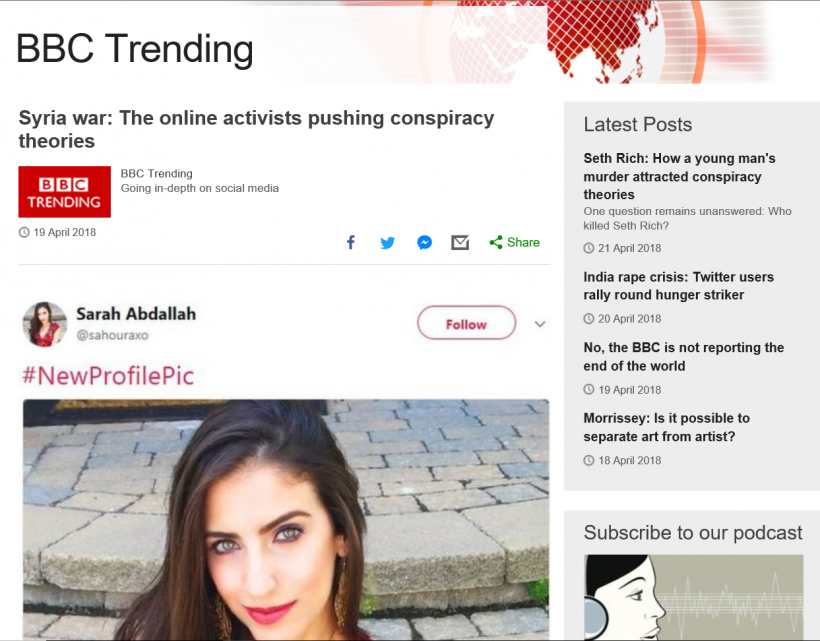
The government then issued a ridiculous press release branding decent people as “Russian bots” just for opposing British policy in Syria. In a piece of McCarthyism so macabre I cannot believe this is really happening, an apparently pleasant and normal man called Ian was grilled live on Murdoch’s Sky News, having been named by his own government as a Russian bot.
The Guardian uncritically published the government’s accusations in full, and astonishingly seemed proud that it had made no attempt to investigate their veracity but had merely published what the government wished them to publish:

The Guardian naturally was just as reliable as the BBC in driving home the message that anybody who doubted the government’s word on Syria was a flat-earth denier of the truth:

Mr Freedland is of course a perfect representation of an interesting fact. Those who are most active in telling us that we must attack Syria, and that anybody who questions the government’s pretexts is insane or evil, are precisely the same individuals who supported the war in Iraq and attacked those who doubted the existence of Iraqi WMD. Indeed these people – Jonathan Freedland, David Aaronovitch, Oliver Kamm, Alan Mendoza, Andrew Rawnsley, John Rentoul, Nick Cohen – are the leaders of the tiny, insignificant number of people who still believe that the invasion of Iraq was both justified and beneficial in its result.
Yet these people of proven terrible judgement, they and others of their media class, are the arbiters who are allowed to dictate the terms of what is and what is not an acceptable public utterance on the situation in Syria.
When Jeremy Corbyn became leader of the opposition, one of two things had to happen. Either the Overton window had to shift to allow for the reflection of views held by the leader of the official opposition and his myriad supporters, or the leader of the opposition had to be castigated and humiliated as an unreasonable lunatic. Corbyn’s rational scepticism on British involvement in the conflict in Syria is a key moment in this process. Despite the fact Corbyn’s scepticism is supported by a wide swathe of diplomatic and military opinion within the UK, it has to be portrayed as fringe, extreme and irrational.
We thus have the extraordinary spectacle of a coordinated government and media onslaught on anybody who doubts their entirely fact free narratives. Those who were demonstrably completely wrong over Iraq are held up as infallible, and given full control of all state and corporate media platforms, where they deride those who were right over Iraq as crackpots and Russian bots.
Meanwhile public trust in the state and corporate media hits new lows, which is the happy part of this story.
Support Craig Murray’s continued writing.
Media Support US Violence Against Syria, but Long for More
By Gregory Shupak | FAIR | April 20, 2018
Corporate media outlets were glad that the US, France and Britain bombed Syria in violation of international law (FAIR.org, 4/18/18), but lamented what they see as a dearth of US violence in the country.
In The Atlantic (4/14/18), Thanassis Cambanis described the war crime as “undoubtedly a good thing,” and called for “sustained attention and investment, of diplomatic, economic and military resources”—though the latter rubbed up against his assessment in the same paragraph that “a major regional war will only make things worse.” Moreover, he described “the most realistic possibility” for the US and its partners in Syria as “an incomplete and possibly destabilizing policy of confrontation [and] containment. But a reckoning can’t be deferred forever.”
This “reckoning” was his somewhat oblique way of referring to a war pitting the US and its allies against the Syrian government and its allies, the very “wider regional war” he just warned against. In Cambanis’ view, “confrontations” between nuclear-armed America and nuclear-armed Russia are “inevitable,” which implies that there is no sense in trying to avoid such potentially apocalyptic scenarios.
A Washington Post editorial (4/14/18) said that “Mr. Trump was right to order the strikes.” The paper was glad that Defense Secretary Jim Mattis and President Donald Trump “properly left open the possibility of further action.” The Post’s rationale for continuing to attack Syria was that “the challenge to vital US interests in Syria is far from over,” and that Trump was therefore wrong “to call Friday’s operation a ‘Mission Accomplished.’” These “interests” include ensuring that Iran does not “obtain the land corridor it seeks across Syria.” (Cambanis, similarly, described as “justified” US efforts to “contain Syria and its allies.”)
The paper was concerned because Trump says that he’d like to subcontract US activities in Syria to US regional partners like Saudi Arabia, the United Arab Emirates, Qatar and Egypt. None of these states, the Post fretted, “are capable of working with local forces [in Syria] to stabilize and hold the large stretch of [Syrian] territory now under de facto US control east of the Euphrates River.”
The editorial failed to note that this territory amounts to “about one-third of the country, including most of the oil wealth” (New York Times, 3/8/18) and “much of Syria’s best agricultural land” (Syria Comment, 1/15/18). The legitimacy of “de facto US control” over Syrian territory and some of its most valuable resources is apparently beyond question, as is the US’s alleged right to determine which governments are allowed to be friendly with each other: The Iranian “land corridor” refers to the Iranian government having warm relations with the governments of Syria, Iraq and Lebanon, something the Post appears to regard as a grave danger.
The editorial says that the US and its allies sought to “minimize the risk of a direct military confrontation with Russia or Iran” and that this was “prudent,” but that “if Russia takes retaliatory action, including in cyberspace, the United States must be ready to respond.” According to this view, projecting US power in Syria is so essential that no form of opposition to US violence in Syria can be brooked, the concern for prudence having vanished.
The Post contended that the US must demand “an acceptable political settlement brokered by the United Nations”—“acceptable” signifying “the departure” of the Syrian government. Functionally, this means keeping the war going: Saying that negotiations should take place but that the only “acceptable” outcome is the dissolution of the Syrian government amounts to the same thing as saying that no negotiations should take place, particularly now that the Syrian government is working from a position of strength and unlikely to agree to its own surrender as a pre-condition for talks.
Andrew Rawnsley, writing in the Guardian (4/15/18), supported US violence in Syria by attacking its critics. He said that those who oppose the Anglo-American-French airstrikes on Syria out of “indifference” to Syria’s plight have the “sole merit of being candid,” unlike those who are
less honest . . . the self-proclaimed peace-lovers. Mainly to be found on the hand-wringing left, they are too busy looking in the mirror admiring their own halos to face the moral challenges posed by a situation like Syria.
Luckily Rawnsley has the requisite courage to meet “the moral challenges” and advocate more war: He says that the West should have “impos[ed] no-fly zones” early in the war in Syria, a policy that would have entailed attacking Syria’s air forces, an act of war by any definition. No-fly zones over Iraq and Libya ultimately led to regime change in both countries, with hideous results for their people.
Rawnsley’s complaint that the West applied “no meaningful pressure” to “bring [the Syrian government to the negotiating table” is wildly misleading; the Western powers in fact applied “meaningful pressure” to prevent negotiations.
Rawnsley also legitimized US violence against Syria by expunging the damage it has inflicted. He trotted out the well-worn lie that the West “stood by” and “fail[ed] to act” in Syria, a canard that FAIR has repeatedly de-bunked (e.g., 9/20/15, 4/7/17, 3/7/18). He characterized the West’s approach to seven years of war in Syria as “years of unmasterly inactivity,” having their hands “wedged firmly under their bottoms,” an “impotent posture,” “failures to act,” making the “grav[e] decision not to act,” “inaction,” “non-interventionist” and as “inaction” a second time. Yet the CIA’s effort to oust the Syrian government has been one of the costliest covert-action programs in the agency’s history; has built ten military bases in the country, with two more on the way; and has killed thousands of Syrian civilians in a bombing campaign ostensibly aimed at ISIS (Jacobin, 4/18/18).
“Non-interventionists,” Rawnsley concludes his article, “the horrors of Syria are on you.” Yet there is no shortage of horrors that are on the interventionists. Sanctions imposed by the US and its allies have punished the Syrian population (9/28/16). These states are implicated in sectarian violence that anti-government armed groups have carried out against minorities (Electronic Intifada, 3/16/17). The US bombed a mosque in Aleppo, Syria, in the name of fighting Al Qaeda, killing almost 40 people (Independent, 4/18/17), and America used toxic depleted uranium against ISIS-held territory in Syria (Foreign Policy, 2/14/17): It would be rather difficult to claim that these horrors were caused by “non-interventionists.”
Cambanis, moreover, exclusively listed Syria, Iran and Russia among those governments who “have serially transgressed the laws of war” and “gotten away with murder” in Syria, but the atrocities attributable to the US and its allies surely constitute “serially transgress[ing] the laws of war” and having “gotten away with murder.”
The Syrian government and its partners are also responsible for a substantial share of carnage in the war, but Rawnsley’s accusation that “non-interventionists” are to blame for Syria’s bloodshed is completely untenable. His argument that Western states have inflicted insufficient harm on Syrians amounts to war propaganda.
And he’s far from the only media figure about whom this can be said.
Gregory Shupak teaches media studies at the University of Guelph-Humber in Toronto.
The Guardian Distorts Nicaragua’s Indio Maiz Fire
teleSUR | April 14, 2018
Under the headline ‘Nicaragua fires: aid from Costa Rica rejected as blaze destroys rainforest,’ the U.K.’s Guardian newspaper has published another politically skewed report smearing Nicaragua’s Sandinista government. This time, the pretext is a devastating forest fire affecting the peripheral buffer zone of the Indio Maiz Biological Reserve. Falsely alleging that Nicaragua has rejected the offer of help from Costa Rica, the Guardian report uses the standard NATO propaganda attack recipe, blending false reports from hostile opposition media and anti-government NGOs.
The article argues that Nicaragua’s government has been negligent in protecting the Indio Maiz Biological Reserve; has not sought international help, and has deliberately facilitated invasion of the reserve by impoverished rural families seeking land.
Reality completely contradicts the report’s main assertions. The Guardian refers to a statement by the Costa Rican government saying that a unit of Costa Rican firefighters was turned away, but the Guardian report offers neither a link to the alleged statement nor any quote from it.
Here’s the Costa Rican fire service spokesman on the matter: “We are fully ready to cooperate in any other incident. From what we can see, this incident has already been controlled by the army. We were at the border and had to return. We see no problem. In the moment (we offered to help) Nicaragua they didn’t have the personnel to fight the fire; thankfully, over the last few hours, it now has the personnel to deal with this emergency and they are engaged in controlling and extinguishing the fire.”
In fact, the decision not to use the help offered by Costa Rica was taken jointly by the chiefs of the Nicaraguan and Costa Rican fire services during a meeting in Managua on April 8, when they agreed that “the realistic possibilities of controlling the fire by the firefighting services of Nicaragua and Costa Rica were limited due to the characteristics of the fire and that the effective means to control and extinguish the fire is from the air.” In any case, access to the area of the fire was impractical overland, with access being possible almost exclusively by air or sea along the region’s Caribbean coast.
Nicaragua’s Vice-President Rosario Murillo said on April 9, in relation to coordination with the director of operations of the Costa Rican Fire Fighting Service: “We have been in meetings with him all weekend, looking precisely at what is being done, the difficulty of reaching the place… There, where the fire has broken out, it’s impossible to reach with trucks or pick-ups. What’s really needed, urgently, are airplanes equipped with all the technical means to fight forest fires.”
Murillo also explained on April 10 that the Sandinista government led by President Daniel Ortega had “coordinated with Honduras, El Salvador, Panama, Mexico, the Russian Federation, the air forces of each one of these countries, requesting air resources to fight the fires.” Currently, helicopters from Mexico, Honduras and El Salvador are helping control and extinguish the fire, contradicting the impression given by the Guardian’s report that the government had not sought international help.
The Nicaraguan government has also coordinated support from U.S. authorities, with a specialist team sent from USAID’s Office of Disaster Assistance and the U.S. Forestry Service. The team leader arrived in Nicaragua on April 10. The Guardian’s April 11 report includes none of this information, which contradicts the impression that report gives by citing environmentalists calling on the government to seek international support, as if it had not already done so a week before the Guardian’s report was published.
The report quotes criticism from well-known Nicaraguan environmentalist Jaime Incer Barquero. Now in his 80s, Incer Barquero has made distinguished contributions to environmental conservation in Nicaragua. However, his pronouncements on the fire in the Indio Maiz Biological Reserve demonstrate ignorance of the measures taken by the Nicaraguan government to control the fire. The Guardian report also quotes a representative of the Fundacion Rio NGO, who noted ‘relations between the countries have not been the best’ due to a long-running border dispute. But as Costa Rica’s cooperation with Nicaragua makes clear, diplomatic relations take a back seat in the context of a major regional ecological threat like the Indio Maiz forest fire.
The Fundacion Rio NGO has solicited funds supposedly to support community authorities and firefighters in the Indio Maiz area, a function well beyond the organization’s statutory objectives. It has now been warned by the Nicaraguan government not to solicit funds for purposes it was not established to carry out: functions which are the government’s responsibility and which the government is fulfilling. The self-serving propaganda of this kind of environmentalist NGO is no doubt the basis for the Guardian’s allegation that “the fires are believed to have been started by illegal homesteaders, who were attempting to clear land for planting crops.”
In fact, the fires began in a marshland area completely unsuitable for agricultural activity, either arable farming or pasture for cattle. One of Nicaragua’s leading environmental scientists, Efrain Acuña, has dismissed the accusation that the area was set on fire so as to facilitate arable or cattle farming: “The soils in this zone do not lend themselves to those activities, among other reasons because the acidity is high, the fertility percentages for grazing are very low and so the nutritional value for cattle is insufficient.”
The Guardian quotes Gabriel Jaime of Fundacion Rio as saying that the government has encouraged rural workers and their families to encroach on land belonging mainly to the Indigenous Rama people, but gives no context to that allegation. Jaime’s solution is “removing people and telling them ‘You can’t live in a protected area.”’ Jaime also criticizes the government’s provision of health and education services in the area, as if these did not benefit the local Indigenous population. This is another example of a neocolonial NGO patronizing local Indigenous people who own their land and have a strong say in how it is used.
The same false neocolonial argument has been used to misrepresent the potential displacement of Indigenous people should Nicaragua’s interoceanic canal go ahead. The canal company HKND and the Nicaraguan authorities consulted with local Indigenous people who agreed terms for the canal’s construction across their land, but that fact has been systematically omitted or misrepresented by environmentalists in the same way as the complex issue of migration by rural workers families to areas of the Caribbean coast has been.
Western NGOs and the local organizations they fund around the world undermine the role and functions of sovereign national governments. That is why Western corporations finance them. It is also why foreign news coverage by Western corporate media systematically distorts and misrepresents the reality of events around the world. The Guardian report on the Indio Maiz forest fire categorically demonstrates that fact one more time.
21stCenturyWire restores service after sustained DDoS attack
Glad to have you back. Firstly, we would like to apologise for being offline most of last week. We’ve been working hard behind the scenes to get back online.
On Tuesday April 10th, 2018 at approximately 2pm EST, 21stCenturyWire.com sustained a heavy Denial of Service (DDoS) cyber attack and were only able to restore our systems yesterday afternoon.
We were not the only ones. Other leading alternative news websites were also hit at this exact time, including South Front, Hands Off Syria (Australia-based antiwar organisation), Fort-Russ, Syria News and others – each covering the situation in Syria closely and truthfully.
Based on the number of page requests or ‘bots’ that were hitting us each hour, this seemed similar to what happened to Craig Murray’s blog two weeks prior. In addition to the online attacks on alternative media outlets, Facebook was blocking similar content on their platform – including South Front, until they appealed and were eventually reinstated.
Based on these facts, we believe that it’s not “highly likely” but 100% certain that the party(s) attacking us and other similar platforms did so on behalf of a state actor – and in the interests of prosecuting another illegal war by way of deception based on a false pretext.
The entire false case for this latest US, UK and French missile strike relied on spurious claims made by US-funded ‘opposition’ group called the Syrian American Medical Society (SAMS), and more importantly – by videos produced and uploaded by the White Helmets, a pseudo NGO funded mainly by the UK government, as well as millions from US and EU member states, and who operate exclusively in terror-held areas of Syria. Their raison d’etre is precisely what took place this week – to manufacture and fabricate a case for western military intervention in Syria.
On this basis, we believe that it was no coincidence that this website, 21stCenturyWire.com, was attacked in part because we happen to house the largest White Helmets research archive on the web, thanks to the hard work of our associate editor Vanessa Beeley currently reporting from on the ground in Syria – bravely working to tell the truth not only about this week’s events, but also about the last seven years of the West’s dirty war on Syria.
In 2015, we blew open the White Helmets story and proceeded to keep digging through their rubble of lies to get a true picture of what this western construct was all about. Many mainstream bodies were not happy about our coverage, including a supposed ‘free press’ organisation, Reporters Without Borders who tried to block Vanessa’s testimony at the Swiss Press Club this past fall.
The establishment’s campaign continued, with defamatory and sloppy hit-pieces by leading mainstream media publications like the The Guardian and Rupert Murdoch’s The Times and various other media outlets – all designed to harass, intimidate and silence us, or anyone who dares to challenge the official western corporate narrative on the White Helmets and Syria.
This week the world saw the White Helmets in all their glory – serving the necessary propaganda to create a false pretext for another regime change war in the Middle East. What we are witnessing here is truly a criminal enterprise, made possible by western governments, their Gulf and NATO allies and their loyal battalions of proxy militants and terrorists, paid for by our public money and oil profits from Saudi Arabia, Qatar and others. And they have resources to prosecute war on many fronts including the information sphere, where they wage their war on truth from the fortified ivory towers of the mainstream media and the Silicon Valley, and in the cyber sphere through various government programs attempting to mute, shut down and censor in the name of ‘national security’ or worse, claiming that they are somehow ‘combating fake news’ by suppressing the truth. And yet, despite all this, we found their Achilles heel, hiding in plain sight.
For those of you who stepped-in to help us this week – thank you very much. Without your support we might still be offline right now. Those of you who know us and have been kind enough to support us and our work our this last year – we really appreciate your help. Thanks also to our technical experts and IT contractors who worked hard on our behalf this week, with a lot time, effort and money spent. As we’re a small and independent operation, our resources are limited and we’ll need your continued help and support going forward.
I think this week shows more than anything how a small, independent and dedicated group of people, supported by an even bigger group of wonderful individuals – can make a difference.
Now back to work.
Regards,
Patrick Henningsen
Editor and Founder
21st Century Wire
How the Ex-Spy Case is Transforming UK Media Into Orwellian ‘Ministry of Truth’
Sputnik – April 5, 2018
The admission by scientists from the Porton Down defense lab that that they could not actually verify the source of the nerve agent used to poison Sergei Skripal and his daughter has not stopped British media from blaming Russia for the affair, or calling on London to take an even tougher stance against the Russians.
Unnamed ‘security sources’ have told The Times that they may have pinpointed the location of the “covert Russian laboratory” which allegedly created the chemical agent used to poison the Skripals.
According to the newspaper, government ministers and security officials “were able to identify the source using scientific analysis and intelligence” soon after the attack. “We knew pretty much by the time of the first Cobra [the emergency coordination briefing] that it was overwhelmingly likely to come from Russia,” a Whitehall source said.
The Times’ source insisted that the security services have a “high degree of confidence” regarding the location where the chemical was produced, but admitted they were not 100% certain.

Screenshot of The Times’ story.
Not to be outdone, The Sun ran a similar story, claiming that a lab run by Russia’s SVR foreign intelligence service in the Moscow district of Yasenevo was the “likely” creator of the poison. The tabloid paraphrased unnamed ‘security sources’, who told the newspaper that the Russian lab is “one of a handful of labs in the world that produces the nerve agent.”

Screengrab of The Sun article.
No Proof Needed
The pair of stories comes 48 hours after Porton Down Defense Science & Technology Laboratory chief Gary Aitkenhead’s admission that the military could not definitively conclude that the nerve agent believed used in the Skripal case was of Russian origin.
The new media efforts to implicate Russia, using unnamed sources and terms such as “likely” and “high degree of confidence” is reminiscent of the kind of language used by the British government in the days and weeks following the poisoning. However, following Tuesday’s revelation by Mr. Aitkenhead, the government and Foreign Secretary Boris Johnson in particular have been reeling from their attempts to definitively claim Russian involvement in the Skripal case.
Some outlets, including The Independent, decided to meet Aitkenhead’s revelations with a stiff upper lip, insisting that Russia’s efforts in the Skripal case, including its “ever more reasonable-sounding but insincere offers” to help in the investigation, don’t change “the overwhelming probability that the novichok nerve agent originated in Russia…” It is simply “inconceivable that anyone other than the Russians” could organize such a plot, according to the newspaper.
As for Russia’s demand that London actually prove its allegations, The Independent suggests that “a legal standard of proof is not required,” adding that the kind of proof asked for by Moscow is “impossible to achieve.” The paper even accuses Labour leader Jeremy Corbyn and others of ‘buying into’ the arguments presented by the Russians.
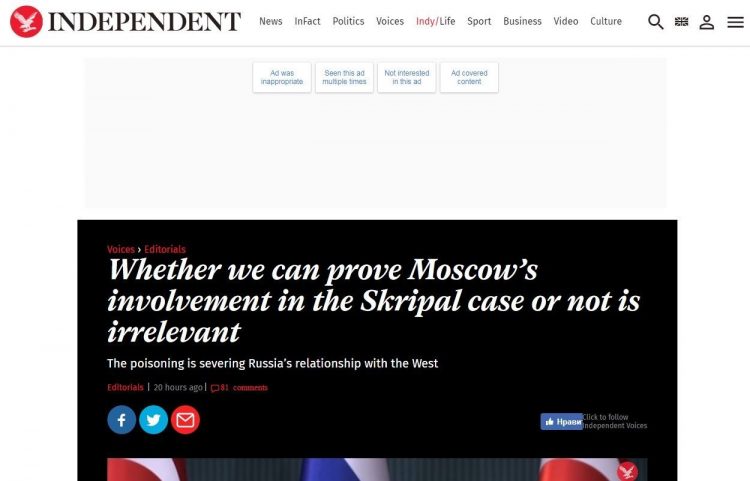
The Independent’s ‘bold’ editorial amid the revelation that Porton Down scientists couldn’t prove the poison’s origin.
Ministry of Truth
Also, even as the case against Russia over the Salisbury poisoning slowly falls apart, some UK and other Western media continue an effort to further poison Russia-Western relations, insisting that Russia is surely responsible for the attack, and criticizing their governments for not being tough enough on Moscow.
Bloomberg, for example, has run an editorial arguing that while the recent expulsion of dozens of Russian diplomats from dozens of Western countries is all well and good, “it’s too mild” to put real pressure on Vladimir Putin and the Russian government.Rather, the business news agency says, the West should band together to turn up the heat to “counter the domestic propaganda that Putin has used to increase his popularity and build anti-Western sentiment. Reaching out to Russians in big cities and neighboring countries, where dissent exists and could be encouraged, the US and its allies should make clear that the cause of their complaints is Putin and his helpers, not Russia at large.”

Screenshot of the Bloomberg piece.
Commenting on the Bloomberg piece, Rossiya Segodnya politics contributor Viktor Marakhovsky quipped that the logic of the story was just brilliant: “When Russia appeals to the citizens of Western countries with criticism toward their authorities, this is propaganda and an attempt to assert influence. But when it’s the other way around, this is a fight against internal propaganda and bringing the truth to Russia,” he wrote.
The Guardian issued its own editorial, recommending paying more attention to the ‘home front’ to arrange a nationwide informational manhunt of ‘Putin’s trolls’.
Complaining about The Guardian’s comments section being “infected” by “Russian trolls,” the editorial says that while not all offending accounts or hashtags may be Russian-made, “its sentiments chime sufficiently with the trolls’ aim for them to boost it.”
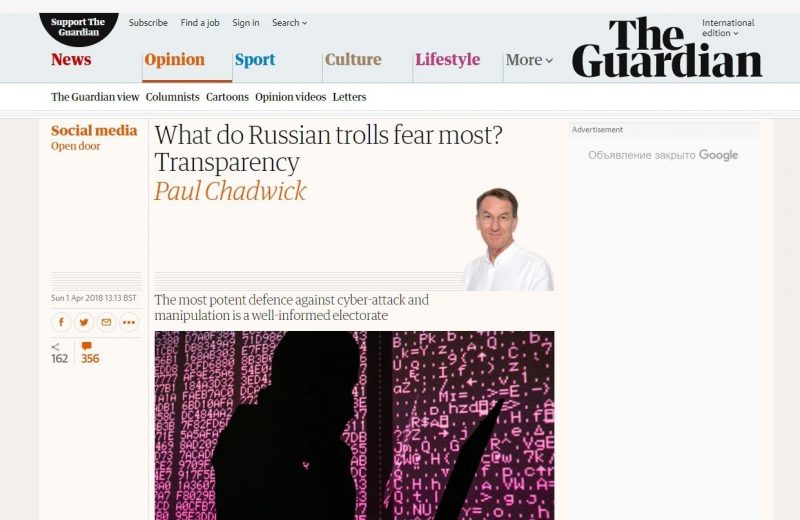
Screengrab of The Guardian editorial.
In other words, Marakhovsky commented, these non-Russian accounts are de facto “enemies because they think and write the wrong thing.” In this way, the journalist noted, the newspaper is effectively calling on Western media “to assume the functions of the Ministry of Truth – to identify both Russian trolls and those who have been infected by their propaganda… and explain to them why their views are wrong, because they happen to agree with the opinion of the Russian foe.”
Russian ex-spy Sergei Skripal and his daughter Yulia were hospitalized in Salisbury, southern England on March 4 following a chemical attack thought to involve the A-234 nerve agent. Sergei remains in critical condition; his daughter has regained consciousness and is making a recovery. London almost immediately accused Moscow for the attack, and initiated a series of measures directed against Russia, including the expulsion of 23 Russian diplomats. Many of the UK’s allies have followed suit. Moscow has rejected London’s accusations, saying claims of Russian involvement are entirely unsubstantiated.
Why did UK court say “limited evidence” Skripals have relatives while cousin interviewed in UK media?
Why did the UK Home Office make no attempt to contact the Skripals’ relatives in Russia? Why does High Court judgment imply they may not even exist when they have appeared on UK TV? More bizarreness in this already very bizarre case
By Catte | OffGuardian | March 28, 2018

Viktoria Skripal, Sergey’s niece, interviewed by the BBC March 28 2018
The Skripal case has been a strange one, even by current standards. The persistent lack of basic information that extends way beyond anything that could seem to be justified by security considerations. The conflicting accounts, the unprecedented government and media hysteria, the complete rejection of due process, and the demands for international reprisals against a sovereign country based on absurdly scant and inadequate evidence continue to be as baffling as they are dangerous.
We’ve already covered the absence of evidence and the various lies and/or misconceptions or confusions on the part of the UK government, including some of the further puzzles, raised by the High Court judgment made by Mr Justice Williams on March 22, about how much it currently knows about the alleged “nerve agent”
But there are other glaring oddnesses in Williams’ Judgment as well.
One, discussed today by James O’Neill, is the contradiction between Russia’s claims to have tried to make contact with the Skripals through formal channels and having been denied or evaded by the UK, and the UK claim to have received no such requests.
Another, related to the above, is the question of the Skripals’ relatives in Russia. This is what the Judgment says about this:
“… Neither Mr Skripal nor Ms Skripal appear to have relatives in the UK although they appear to have some relatives in Russia. The SSHD have not sought to make contact with them. Discussions have taken place with the OPCW TS about precisely what enquiries they wish to undertake. In summary the main issues are
And
“… Given the absence of any contact having been made with the NHS Trust by any family member, the absence of any evidence of any family in the UK and the limited evidence as to the possible existence of family members in Russia I accept that it is neither practicable nor appropriate in the special context of this case to consult with any relatives of Mr Skripal or Ms Skripal who might fall into the category identified in s.4(7)(b) of the Act.
Firstly, these statements seem to contradict each other and themselves. Do the Skripals “appear” to have relatives in Russia, or is evidence for this so “limited” it can be safely ignored? How can such a basic question be subject to such misty uncertainty?
But odder than that is the fact these allegedly theoretical and possibly non-existent or distant relatives consist of at least one niece/cousin and a mother/grandmother. Second and first degree relatives respectively.
And one of them has been interviewed by at least two different UK news outlets.
Viktoria Skripal, allegedly niece of Sergey and cousin to Yulia was interviewed by the Sun on March 14, one week before the court judgment, and again by the BBC today.
These interviews suggest this particular relative is pretty real, and not very hard to locate. If the Sun could find her on March 14, it’s hard to see how she could still be a mere thought experiment and “limited” theory for the Home Office eight days later.
So, since the implication in the judgment that these (very close) relatives are quasi hypothetical is obviously untrue, why has the Home Secretary (SSHD) not “sought to make contact with” the Skripals’ mother/grandmother and niece/cousin?
Is it because they don’t “fall into the category identified in s.4(7)(b) of the Act”
No. The “Act” being referred to is the 2005 Mental Capacity Act. S.4(7)(b) stipulates that before determining what is in an incapacitated person’s “best interests”, the person ruling (in this case Mr Justice Williams) must:
take into account, if it is practicable and appropriate to consult them, the views of anyone engaged in caring for the person or interested in his welfare
Had Mr Justice Williams not been informed that one of these relatives was so “practicable” to consult she’d recently been featured in the Murdoch press? Surely, if he knew how easy to locate they were, his judgment would have reflected the assumption a mother/grandmother, niece/cousin would at very least be “interested” in the “welfare” of Yulia and Sergey?
Do such close and easily contactable relatives really warrant being passed over simply because of “the absence of any contact having been made with the NHS Trust by any member of the family”?
I mean look, these people are in Russia. It’s possible – shocking – they don’t speak English. It’s possible they aren’t clear how to get in contact directly with a rural hospital in Wiltshire. It’s possible they tried but failed.
Would it hurt someone at the Home Office to get on the phone and check things out before assuming they just don’t care and taking the matter to court?
What’s more, far from being indifferent, Viktoria tells her interviewer she is worried about her uncle and cousin and is anxious to get information:

“I would just like to know how [Yulia and Sergey] are. Where they are.“

“If you were offered the chance to go the the UK would you go?”

“Yes, yes”
If this is the case, can we take it as pretty unlikely the Skripals have really made no attempt to contact the UK about their family members?
And, if you look at the wording again:
Given the absence of any contact having been made with the NHS Trust by any family member
It doesn’t actually say no contact has been made does it? It says no contact has been made with the NHS trust. This leaves the undeclared possibility there has been contact made by the Skripals with other departments of the UK state. This would broadly dovetail with claims made by the Russian foreign ministry, which, until at least March 19, has maintained its attempts to gain access to or information about the Skripals have been stonewalled.
If the Skripals have tried to gain information, either directly or through their embassy or consulate, why aren’t they being given any? Why aren’t they being consulted about the medical interventions being performed? Why has Viktoria been told so little since the poisoning, that she tells the BBC she still holds out a fanciful hope the victims may not even be Julia and Sergey?
Altogether, it seems this part of the official narrative is as confused and as hard to reconcile with reality as the clearly unwarranted claims about “novichoks.”
NOTE: The Guardian’s version of the BBC interview with Viktoria is shockingly deceptive. It omits all mention of the main point of the interview – that Viktoria is desperate for information and has received none – and contrives through this omission, and its headline (“Sergey and Yulia Skripal have slim chance of survival says niece”) to give the absolutely opposite impression – that Viktoria has been well informed, may even have seen her relatives and is predicting their small chance of survival from first hand observation. Even in the Guardian’s recent history of poor ethical choices and lies by omission, this is egregious in the extreme.

Cambridge Analytica & The Facebook-Big Data Conspiracy
By Andrew Korybko | Oriental Review | March 26, 2108
The Guardian published an exposé about how Cambridge Analytica allegedly mastered the use of social media data to give the Brexit and Trump campaigns a crucial edge in 2016.
The UK news outlet released an extensive story about Christopher Wylie, the Canadian genius behind the Cambridge Analytica data firm that was reportedly the secret weapon behind these two campaigns’ electoral successes. It’s long been speculated that the company used people’s Facebook information to enhance their electioneering efforts, but now its founder has come forward and purportedly claims to have documents proving that this was the case. What’s more, he says that his company was created by SCL Elections, a subsidiarity of the SCL Group that he told a reporter is supposedly known for its expertise in conducting “cyberwarfare for elections”. The SCL umbrella has military contracts alongside civilian ones, therefore making it an extension of the “deep state” and adding credence to the claims that Cambridge Analytica functioned as an indispensable component behind Brexit and Trump’s victories.
The Guardian goes on to explain how users’ Facebook data was mined through apps, quizzes, and “seeders”, and that people’s personality traits were paired with their “likes” and other account activity to build detailed profiles of millions of people, which the outlet and its interviewee suggest might have been illegal. In their defense, Cambridge Analytica always asserted under pressure that this isn’t the case, and has sometimes said that it was conducting academic research. This “plausibly deniable” stance shows just how blurred the line is becoming between academia, marketing, politics, and intelligence, but to be fair, this has been a steadily growing problem for years already and Cambridge Analytica isn’t the first company to be implicated with accusations of legal and ethical impropriety in this field. The only thing that they’re really “guilty” of is creatively identifying and tapping into the anti-systemic zeitgeist of the British and American societies.
The argument can be made that it was “wrong” for them to procure people’s private Facebook data, but that doesn’t change the fact that the results were used for very effective purposes in pushing forth what the masses apparently wanted, which is Brexit and Trump. The Mainstream Media was, and still is, completely taken aback by what happened because they convinced themselves of the inevitability of both of those campaigns’ defeats, arrogantly refusing to recognize and accept the obvious signs that people were clamoring for change. All that Cambridge Analytica did was process preexisting data, objectively assess its results, and pass along the findings to its clients so that they can hone their messages, though there are legitimate fears that data brokers such as this one might eventually become too powerful if they independently leverage this information for their own ends one day.
This whole affair goes to show the growing influence that technology companies are having in today’s post-modern society, but the only reason why it’s coming under the Mainstream Media’s microscope is because it was one of the reasons why the “wrong side” won. That’s why The Guardian also goes on a bizarre tangent in implying that there might have been a Russian government connection to Cambridge Analytica, all in order to pander to the Russiagate mob and their “deep state” controllers. That aside, the exposé is informative because it lays bare the truth of what’s happening behind the scenes – and literally, behind computer and phone screens – and explains how people’s private preferences are being vacuumed up and analyzed in creating a dizzying array of psychological profiles for political purposes.
Featured Video
Alon Mizrahi: ‘Israel Must Be Dismantled’
or go to
Aletho News Archives – Video-Images
From the Archives
Allies Don’t Need Lobbies
By Jay Knott | Dissident Voice | September 24, 2013
In a recent article on Counterpunch, Rob Urie defended the traditional Marxist analysis of US policy in the Middle East. He argues that support for Israel is driven primarily by economic interest, not the Jewish lobby.
He starts by paying tribute to the idea that Western societies are uniquely racist. He says that the “Western narrative” claims there is an “Arab character”, and that this is “antique racist blather”. He gives no definition of these terms. Further, he establishes his credentials as part of the dominant current in the American left by claiming that “over a million people in Iraq died so ‘we’ in the West can drive SUVs.”1
When he tries to criticize bourgeois economics, he makes it clear he doesn’t understand the developments it has made since Marx’s day, using the mathematical discipline known as “game theory”. He dismisses the basic abstraction of economic theory, the idea of the rational individual, on the grounds that it is “devoid of history, culture and political context”. But abstractions are always devoid of something.
He defends a more concrete economic theory, mostly Marxist, with some input from another theorist of capitalist crisis, Hyman Minsky. This concrete theory leads him to the view that US activity in the Middle East is primarily driven by rational capitalist motives, the need to secure a supply of oil.
“Taking the totality of circumstance — former oil company executives launching war on an oil rich nation on a pretext they publicly proclaimed they didn’t believe shortly before taking office — and that upon launching their war proved to be non-existent, requires a willingness to overlook the obvious — that the war on Iraq was for oil, that is difficult to support.”1
Perhaps I’ve misunderstood him, but based on what he says in the rest of the article, this convoluted sentence seems to argue that, because president Bush and vice-president Cheney attacked Iraq on false premises, and they also said it was all about oil, and they are former oil executives, and Iraq has a lot of oil, it’s difficult to deny US attacks on Iraq are all about oil.
In fact, it’s not hard at all. As Urie points out, at times Bush and co. said that attacking Iraq was “protecting the world’s supply of oil.”1 But, as he also points out, they are congenital liars. Why should we believe them when they say they are trying to “protect” the oil supply? Protect it against what? When politicians “admit” attacks on Middle Eastern countries are wars for oil, they are parroting the neo-con party line, feeding the public, both left and right, with a plausible-sounding pretext. For right-wingers, “it’s a war for oil” is a reason to support war, and for leftists, it’s a way to feel better by complaining impotently about corporate greed. Both approaches help the war drive. … continue
Blog Roll
 Aletho News
- Villains of Judea: Leonid Radvinsky
- Alon Mizrahi: ‘Israel Must Be Dismantled’
- Former Head Of MI6 Admits That The U.S. And Israel Are Losing The Iran War
- Scattered Thoughts on War and Peace
- Iran Threatens to Close Red Sea to Shipping in Response to Invasion
- Iran in excellent position to prevail in war with US, Israel: John Mearsheimer
- Iran warns US: Do not call your retreat an agreement
- Neighbors first – Moscow signals shift in energy strategy
- Almost 400 Ukrainian drones downed over Russia in single night – MOD
- Battle for Hungary: How the Russiagate blueprint has been unleashed against Orban
- If Americans Knew
- In the West Bank, life is a constant battle – 3 articles
- Jacob Reses, one of the most powerful pro-Israel operatives in Trump’s Washington
- Israeli-US assaults kill or injure 87 children a day – Not a ceasefire Day 166
- ‘Forever live by the sword’: Understanding Israelis’ massive support for Iran war
- UN’s special rapporteur on human rights says Israel is systematically torturing Palestinians
- Trump White House plagiarized Iran war manifesto from Israel-aligned think tank
- Gaza says 6–10 patients die daily waiting for treatment abroad as Israel blocks medical evacuations
- ‘Substantial evidence’ of double-tap strike in killing of Gaza’s Hind Rajab
- ‘Do Not Want To Die For Israel’: Doubts About Trump’s Iran Strategy Spread Among Troops
- Instead of taking Joe Kent’s claims seriously, the media is disregarding him as an antisemite
- No Tricks Zone
- Devastating Assessment Of Comirnaty Vaccine By Former Senior Pfizer Europe Toxicologist
- New Study: CO2 Is ‘Effectively Negligible’ As An Explanatory Climate Change Factor Since 2000
- Former Pfizer Toxicologist Dr. Helmut Sterz Tells Bundestag Hearing Pfizer Vaccine Should Have Never Been Approved
- Energy Expert: Germany’s Nuclear Phaseout Was A “500 Billion Euro Mistake”
- New Research: South Australia’s Mid-Holocene Sea Surface Temperatures Were 4°C Warmer Than Today
- Storing Green Energy To Last Germany 10 Days Would Require A 60-Million Tonne Battery
- New Studies: UK Sea Levels Were 4 Meters Higher Than Today During The Mid-Holocene
- Destructive Green New Deal: German Energy And Metal Group Warns Of Drastic Crisis
- New Study Documents A 20-Year Pause In Arctic Sea Ice Decline – Driven By Internal Variability
- Wake-up Call: Survey Shows Majority Of Germans Now Favor Postponing Climate Targets!
 Aletho News