Fact-checking the second volume of the U.S. National Climate Assessment
By Roger Andrews | Energy Matters | December 4, 2018
 This recently-issued study (the “Assessment”) was seized on by the media as proof of the massive damage the US will suffer if nothing is done about climate change. The Assessment’s conclusions are based largely on speculative model projections that aren’t amenable to checking, but it also claims that the US is already experiencing some of the impacts of man-made climate change, and these claims can be checked. This post accordingly evaluates them claim-by-claim and finds that they are rarely backed up by any hard data, that in some cases they are contradicted by disclaimers buried in the text, and that in no case is there any hard evidence that conclusively relates the impacts to man-made climate change. The credibility of the Assessment’s predictions can be judged accordingly.
The Assessment is 1,600 pages long and I doubt that anyone has read it from cover to cover – I certainly haven’t. I have obtained my information from the Summary Findings, Overview, Report Chapters and Downloads sections in the boxes that clicking on this link leads to. These sections themselves contain several hundred pages of text, much of it repetitive, but there is always the possibility that I’ve missed some critical graphic or piece of text. On the other hand, if I’ve missed it the media, who will have read the introductory sections only, will have too.
And how did the media report the Assessment’s results? Here are some excerpts:
Climate change is already harming Americans’ lives with “substantial damages” set to occur as global temperatures threaten to surge beyond internationally agreed limits ……… The influence of climate change is being felt across the US with increases in disastrous wildfires in the west, flooding on the east coast, soil loss in the midwest and coastal erosion in Alaska
Billions of hours in productivity will be lost. Hundreds of billions of dollars will be wiped from the economy. Tens of thousands of people will die each year. The scientific report, which was produced by 13 federal agencies, describes an American future nothing short of apocalyptic due to rising threats from climate change …. rising sea levels, disruptions in food productions and the spread of wildfires — have all come true today.
Climate change is happening here and now …. It is affecting all of us no matter where we live. And the more climate changes, the more serious and even more dangerous the impacts will become.
From record-breaking wildfires that destroyed more than 14,000 homes in California, to hurricanes that devastated parts of Florida and much of Puerto Rico, long-predicted impacts of climate change are here and wreaking havoc.
The media never lose an opportunity to cast climate change in the worst possible light, or fail to report it when someone else does it for them.
And what are the climate change impacts that the Assessment claims are “happening here and now”, which are the only ones we can verify, or not verify as the case may be, against observations? These excerpts identify them either explicitly or implicitly:
Glaciers and snow cover are shrinking
Increases in greenhouse gases and decreases in air pollution have contributed to increases in Atlantic hurricane activity since 1970.
America’s trillion-dollar coastal property market and public infrastructure are threatened by the ongoing increase in the frequency, depth, and extent of tidal flooding due to sea level rise
Existing water, transportation, and energy infrastructure already face challenges from heavy rainfall, inland and coastal flooding, landslides, drought, wildfire, heat waves, and other weather and climate events
Climate-related changes in weather patterns and associated changes in air, water, food, and the environment are affecting the health and well-being of the American people, causing injuries, illnesses, and death.
Rising air and water temperatures and changes in precipitation are intensifying droughts, increasing heavy downpours, reducing snowpack
Our Nation’s aging and deteriorating infrastructure is further stressed by increases in heavy precipitation events, coastal flooding, heat, wildfires
Some storm types such as hurricanes, tornadoes, and winter storms are also exhibiting changes that have been linked to climate change
After eliminating repetition and sorting the individual impacts into something resembling order we are left with droughts; floods; heavy precipitation; heat waves; wildfires; Atlantic hurricanes; tornadoes; winter storms; sea level rise; glaciers and snowpack; injuries, illnesses and death. We will review these in order of appearance:
1. Droughts
The Assessment begins by claiming that climate-change-induced droughts are intensifying in the US. Then later in the text it shoots itself in the foot:
While there are a number of ways to measure drought, there is currently no detectable change in long-term U.S. drought statistics using the Palmer Drought Severity Index
And adds a graphic to prove it, reproduced below as Figure 1:

Figure 1: US drought conditions. The Palmer Drought Severity Index is the commonly-used metric for measuring drought intensity
2. Floods
The Assessment provides no hard data to back up its claims that climate change is already causing increased flooding in the US (coastal flooding is discussed under sea level rise). The only quantitative historical data I can find on US floods are summarized in Figure 2 (data from Researchgate ):
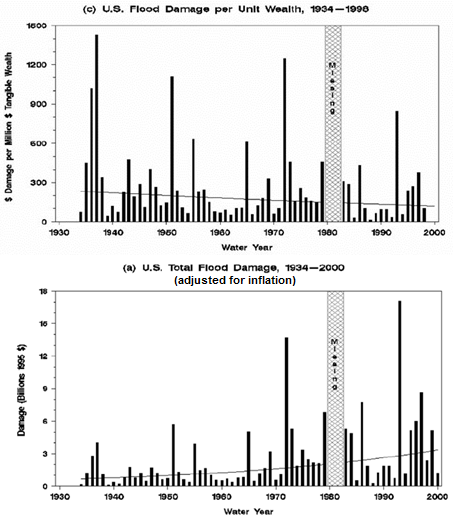
Figure 2: Two measures of US flood damage, 1934-2000
These graphics don’t tell us whether floods in the US are on the increase or not. And the Assessment doesn’t tell us either, Not only does it fail to detect any nationwide trends, it states that it never claimed any relationship between floods and man-made climate change to begin with:
Analysis of 200 U.S. stream gauges indicates areas of both increasing and decreasing flooding magnitude but does not provide robust evidence that these trends are attributable to human influences …. Hence, no formal attribution of observed flooding changes to anthropogenic forcing has been claimed.
3. Heavy Precipitation
Since the Assessment admits that there are no detectable human-induced trends in US flooding we can reasonably assume that the claimed increase in heavy precipitation events has had no impact. But we will look at the data anyway. The Assessment presents this graphic to back up its claim that heavy precipitation events are increasing over the US as a whole (Figure 3). As usual, the source of the data is not specified:
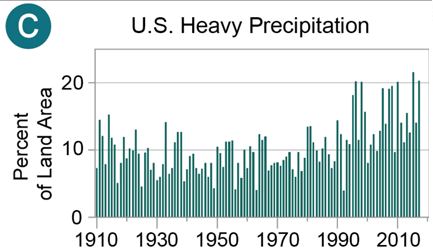
Figure 3: Percent of US land area with heavy precipitation events
The U.S. Global Change Research Program, under the auspices of which the Assessment was written, also produces graphics showing how heavy precipitation has changed with time and by region in the US (they may in fact be buried in parts of the Assessment I haven’t looked at). According to Figure 4 (from Globalchange) heavy precipitation events have increased over all of the US except the Southwest:
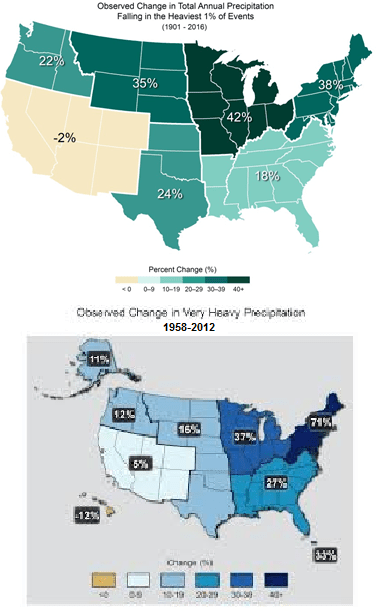
Figure 4: Increases in US total precipitation and very heavy precipitation events by region
And Huang et al (2017) produce time series showing how total precipitation and extreme precipitation in the Northeast US have both increased since about 1960 (Figure 5):
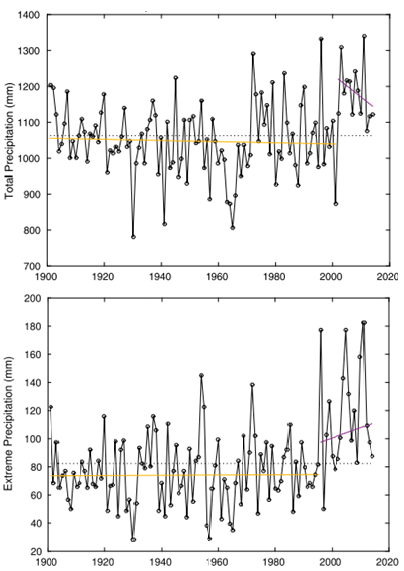
Figure 5: Increases in US total and extreme precipitation
So in this case the claim checks out against observations, or least in the northeast US. A lingering question, however, is how much of the increase in heavy precipitation was caused by man-made climate change. The Assessment implicitly assumes that all of it was, but a 2015 study by Hoerling et al. concludes that most of the changes after 1979 were caused by ocean variability:
Based on the modeling results, we conclude that anthropogenic climate change has not been a principal factor driving key characteristics of observed changes in U.S. heavy daily precipitation since 1979 …. Our results provide evidence for an alternative argument for another factor that has been operating in recent decades, namely, that statistics of U.S. heavy precipitation have been sensitive to strong decadal ocean variability since 1979
4. Heat Waves
One of the problems with heat waves is defining them (droughts and floods have the same problem). How hot does it have to get, and for how long, before a warm spell becomes a heat wave? The Assessment does not tell us. All it presents in the way of evidence for an increase in heat waves in the introductory report sections, including the 186-page “Report-in-Brief”, is this graphic (Figure 6), which shows the “heat wave season” increasing since the 1960s but not how many heat waves there were. Once again the data source is not specified, nor is the meaning of the cross-hatching:
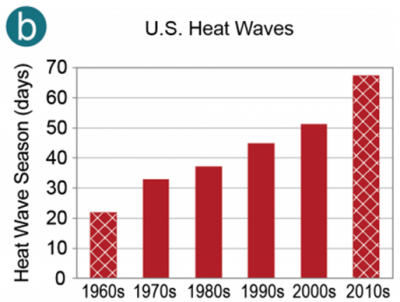
Figure 6: Length of US “heat wave season”
The next graphic (Figure 7) is another one I added from the globalchange website. It shows an increase in daily record high temperatures in recent decades but again provides no information on the number of heat waves. How many of the record highs, for example, occurred in the winter?
 Figure 7: Record daily highs in the US. The meaning of “ratio of daily temperature records” isn’t clear
The only graphic I found that provided any historic information on the incidence of heat waves was the Figure 8 plot of the EPA’s Annual Heat Wave Index. It’s not surprising that it doesn’t appear in the Assessment:
 Figure 8: US annual heat wave index since 1895
5. Wildfires
The Assessment provides two graphics to support its claim that climate change is causing more wildfires. Figure 9 shows the first. Again no data source is cited, but it turns out that it comes from the National Interagency Fire Center:
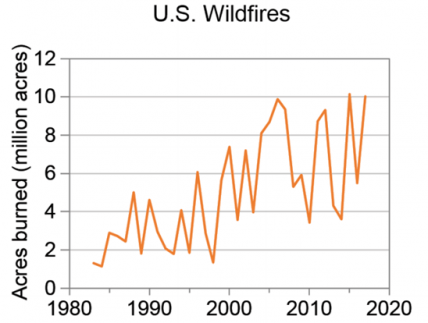
Figure 9: Acres burned by US wildfires since 1987
It also shows only a fraction of the NIFC data. Figure 10, for what it may be worth, shows the complete plot. I say “for what it may be worth” because the plot comes accompanied by this disclaimer:
The National Interagency Coordination Center at NIFC compiles annual wildland fire statistics for federal and state agencies. This information is provided through Situation Reports, which have been in use for several decades. Prior to 1983, sources of these figures are not known, or cannot be confirmed, and were not derived from the current situation reporting process. As a result the figures prior to 1983 should not be compared to later data.
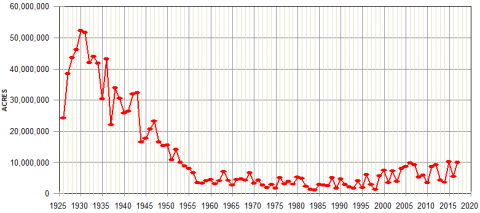 Figure 10: Acres burned by US wildfires. Figure 9 data carried back to 1926
Figure 11 reproduces the Assessment’s second graphic. It shows that about half of the increase in acreage burned was caused by climate change. (Note that it conflicts with the Figure 9 data, according to which a cumulative total of 173 million acres, not 23 million, has been burned since 1984).
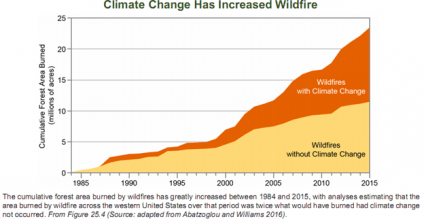 Figure 11: Acreage burned by naturally-occurring wildfires vs. acreage burned by climate-change-caused wildfires
In this case the data source is specified. It’s a 2016 paper written by John T. Abatzoglou and A. Park Williams entitled “Impact of anthropogenic climate change on wildfire across western US forests”. How did they segregate climate change-caused wildfires from naturally-occurring wildfires? They used climate models:
We quantify the influence of ACC (anthropogenic climate change) using the Coupled Model Intercomparison Project, Phase 5 (CMIP5) multimodel mean changes in temperature and vapor pressure …. This approach defines the ACC signal for any given location as the multimodel mean 50-y low-pass-filtered record of monthly temperature and vapor pressure anomalies relative to a 1901 baseline.
Before we can accept these results as meaningful we must assume that the global CMIP5 climate models can hindcast temperatures and vapor pressures to a high level of accuracy in the US, which they probably can’t (it’s generally accepted that climate models do a poor job of simulating regional changes). We also have to assume that the numerous other variables that affect wildfires have had no impact. This is a stretch, to put it mildly.
6. Atlantic Hurricanes
In this case the Assessment supplies no data, or at least none that I can find, to back up its claim that Atlantic hurricanes have increased since 1970. So once again I have had to dig up data on my own. Figure 12 (data from the US Environmental Protection Agency) plots the number of North Atlantic hurricanes since 1880. The total number is defined by the orange line, which adjusts for undercounting before 1967, and by the green line after that. There has been an erratic overall increase since about 1970, but since 1880 there has been no clear trend:
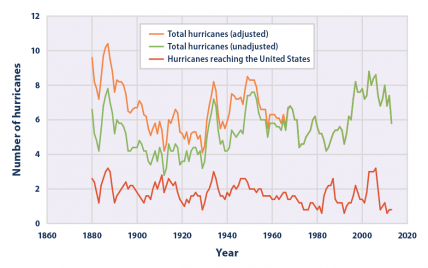 Figure 12: Unadjusted hurricane counts, hurricane counts adjusted for undercounting and hurricanes making landfall in the US
The North Atlantic, however, is not part of the US. The important consideration is how many hurricanes have made landfall in the US. These are shown by the red line at the bottom of Figure 12. There is no clear trend since 1970 and if anything a decrease since 1880.
According to Figure 13 (data from Dr. Roy Spencer) major hurricanes making landfall in the US have also been decreasing since the 1930s:

Figure 13: Major hurricanes making landfall in the US
And according to Klotzbach et al (2018) there has been little to no increase in normalized hurricane damages in the US since 1900 (Figure 13):
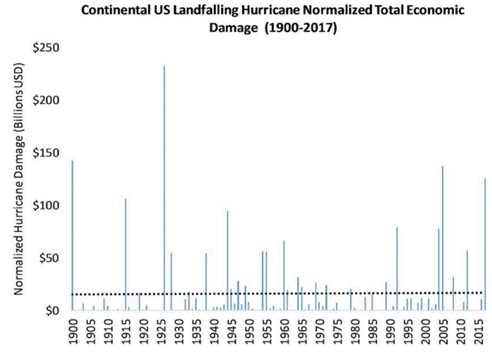
Figure 14: Normalized damages from hurricanes making landfall in the US
In this case the claim broadly matches observations but conceals (probably deliberately) the big picture, which is that man-made climate change has not increased the incidence of, or the damage caused by, North Atlantic hurricanes making landfall in the US since at least the late 1800s.
7. Tornadoes
Some storm types such as … tornadoes … are also exhibiting changes that have been linked to climate change. Once more the Assessment presents no supporting data, but NOAA’s tornado counts (Figure 15) speak for themselves:
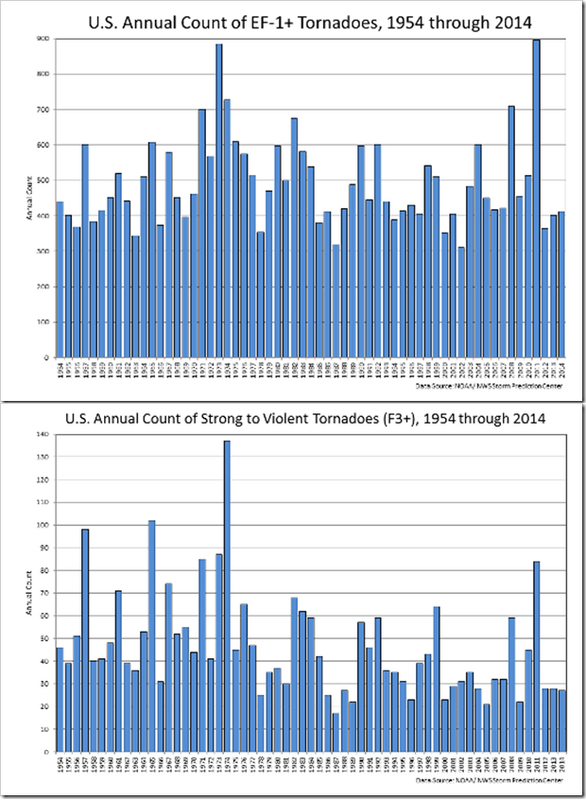
Figure 15: Total tornado and strong-to-violent tornado counts since 1954
8. Winter Storms
… winter storms … are also exhibiting changes that have been linked to climate change.
Once again there are no supporting data in the Assessment, but according to Coleman & Schwartz’s 2017 paper An Updated Blizzard Climatology of the Contiguous United States (1959–2014) the incidence of blizzards in the US has been increasing (Figure 16):
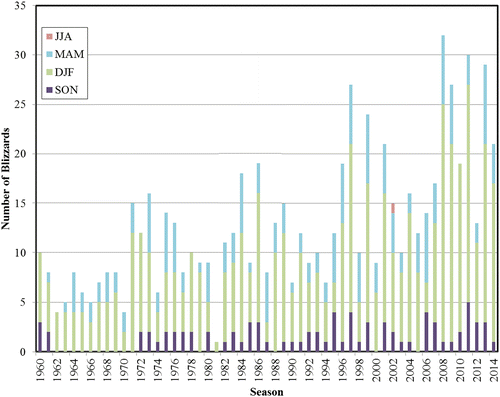
Figure 16: Incidence of blizzards in US
Is this counter-intuitive increase related to climate change? NOAA thinks it may be, although NOAA’s explanation works only in the eastern US ….
Conditions that influence the severity of eastern U.S. snowstorms include warmer-than-average ocean surface temperatures in the Atlantic. These can lead to exceptionally high amounts of moisture flowing into a storm and contribute to greater intensification of the storm. Natural variability can affect ocean surface temperatures, but as global surface temperatures increase, the temperature at any time is higher than it would have been without climate change.
…. and it doesn’t match up very well with trends in sea surface temperatures off the eastern US coast (data from KNMI Climate Explorer) ….
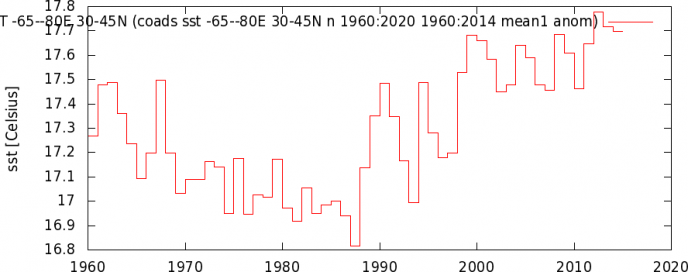
Figure 17: Sea surface temperatures along US east coast (30N-45N, 65W-80W)
… and according to the IPCC Fifth Assessment Report it’s going off in the wrong direction:
Changes in the frequency, severity, and duration of extreme events may be among the most important risks associated with climate change. In some parts of North America, this includes fewer periods of extreme cold, fewer snowstorms ….
Milder winter temperatures will decrease heavy snowstorms .…
This is one of the cases where the claim matches observational changes, but no conclusion as to causation can be reached until there is agreement over whether climate change causes a) more snowstorms, b) fewer snowstorms or c) both at the same time. My money is on c).
9. Sea Level Rise/Coastal Flooding
These are related phenomena, so I will discuss them under the same heading.
Once more there are no supporting data in the Assessment, so once more I had to go searching for some. This graphic from NOAA shows an increase in high-tide flooding that correlates with an increase in “coastal sea level” (Figure 18):

Figure 18: Average days/year with high-tide flooding vs. US sea level
And as shown in Figure 19 (data from EPA) the increased flooding is dominantly an east coast phenomenon:
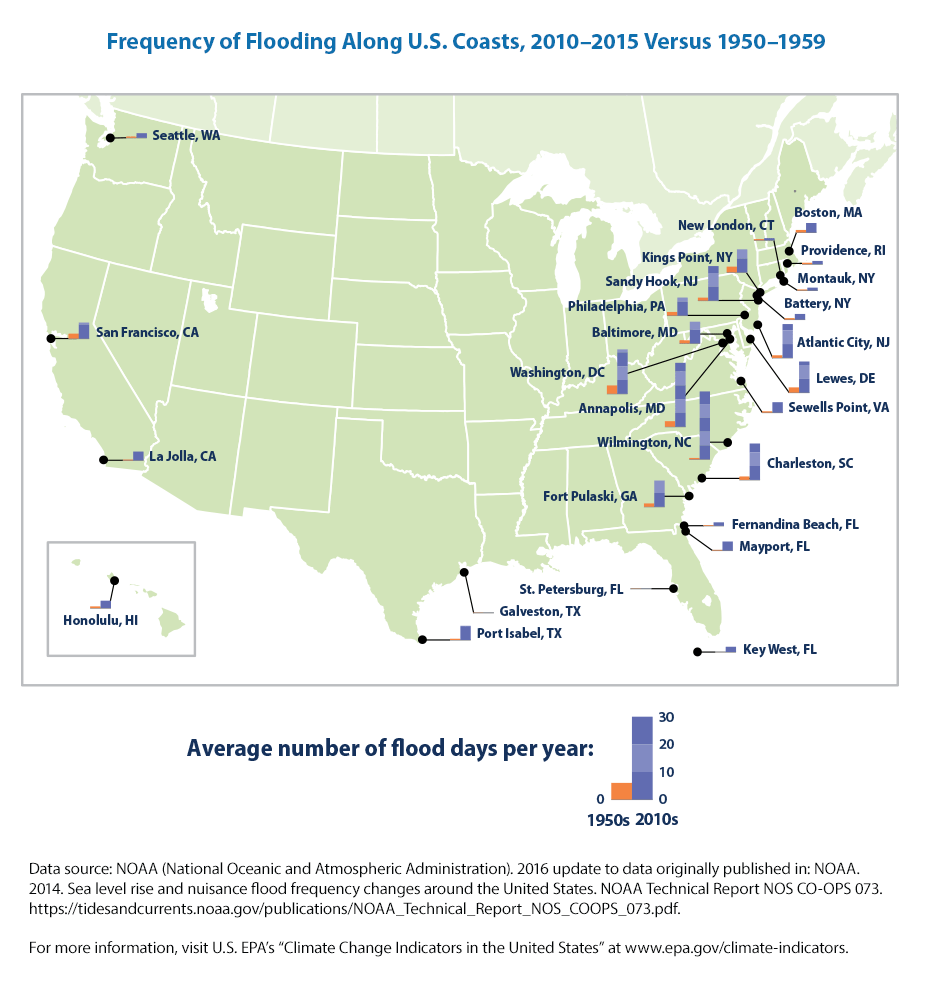
Figure 19: Average number of tidal floods/year, 2010-2015 vs. 1950-1959
But note the fine print. These are “nuisance floods” that don’t do any serious damage. There is no accepted definition of a nuisance flood, but a maximum water depth of 10cm has been proposed. And a 10cm-deep flood is hardly a catastrophic event.
And what does sea level rise have to do with the increase in nuisance floods? Not much. The reason nuisance floods are more common along the east coast of the US is that the east coast is sinking (a result of glacial rebound*, sediment compaction and groundwater extraction) while the west coast isn’t, and the rate at which the east coast is sinking exceeds the rate at which sea levels are rising in many places. The PSMSL tide gauge record from Sewell’s Point, near the mouth of Chesapeake Bay, is an example (Figure 20). The trend line shows sea level rising at an average rate of 4.5mm/year, but according to the United States Geological Survey less than half of this – maybe less than 2 mm/year – is a result of eustatic sea level rise. The rest is caused by land subsidence:
* Glacial rebound causes the land in and immediately around the ice sheet to rise while the surrounding land, which was squeezed upwards by the ice, sinks back down again.
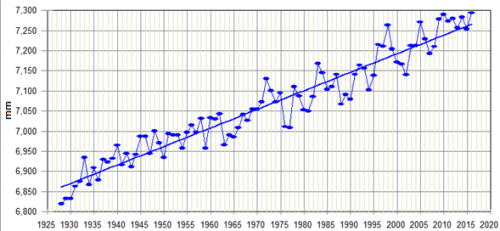 Figure Figure 20: Relative sea level rise, Sewell’s Point, Virginia
10 cm nuisance floods and ~2 mm/year sea level rises also pale into insignificance beside the hurricane storm surges that have occurred in the past and which can be expected to recur in the future along the US east coast. They reached heights of eight feet at Sewell’s point during Hurricane Isabel as recently as 2003 and 18 feet along the North Carolina coast during Hurricane Hazel in 1954.
My 2016 post on Isle de Jean Charles, Louisiana describes how sea level rise routinely takes the blame for inundations it didn’t cause. The Assessment cites it as an example of climate change in action.
10. Glaciers and snowpack
North American glaciers have indeed been retreating, as the Assessment claims. But according to Oerlemans (2005, Figure 21) they have been retreating since about 1825 and retreating rapidly after 1890, well before human-induced climate forcings became significant. This raises the question of whether the retreat has anything to do with man-made climate change:

Figure 21: Glacier retreat since 1700. The green line is North America
No data are available on snowpack, but Rutgers University publishes North American snow cover data (Figure 22). The trend line shows only a very minor decrease since 1975:
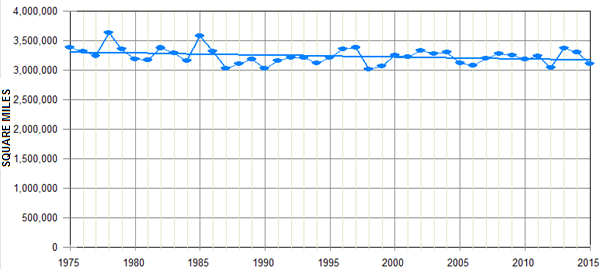 Figure 22: Snow-Covered Area in North America, 1972-2015
11. Injuries, Illnesses and Death:
Climate-related changes in weather patterns …. are affecting the health and well-being of the American people, causing injuries, illnesses, and death.
No data on illnesses or injuries are readily available, but over the last ten years approximately 25 million people have died in the US. According to Wikipedia
natural disasters of the type that commonly get blamed on climate change (hurricanes, floods, blizzards, wildfires, tornadoes) have claimed only 1,200 lives over this period.
Conclusion:
In this post I have fact-checked eleven separate climate change impacts which according to the Assessment’s summary sections are already doing damage in the US. In six of these cases (heavy precipitation, heat waves, wildfires, winter storms, sea level rise/coastal flooding and glacier retreat) there is observational evidence – most of which I have had to dig up myself – for impacts that might be related to man-made climate change, but in all of them this evidence is equivocal (e.g. wildfires) or the impacts are insignificant (e.g. nuisance tidal floods). In the other five cases (droughts, floods, Atlantic hurricanes, tornadoes, and injuries, illnesses and deaths) the observational evidence either contradicts the Assessment’s claims or the Assessment admits later in the text that the claim isn’t valid (droughts and floods).
Clearly the Assessment was conducted with little regard for the facts. A disregard for the facts, however, is necessary if one wishes to get the climate change catastrophe message across.
‘Temples to colonial theft’: Western museums should return looted artifacts to where they belong
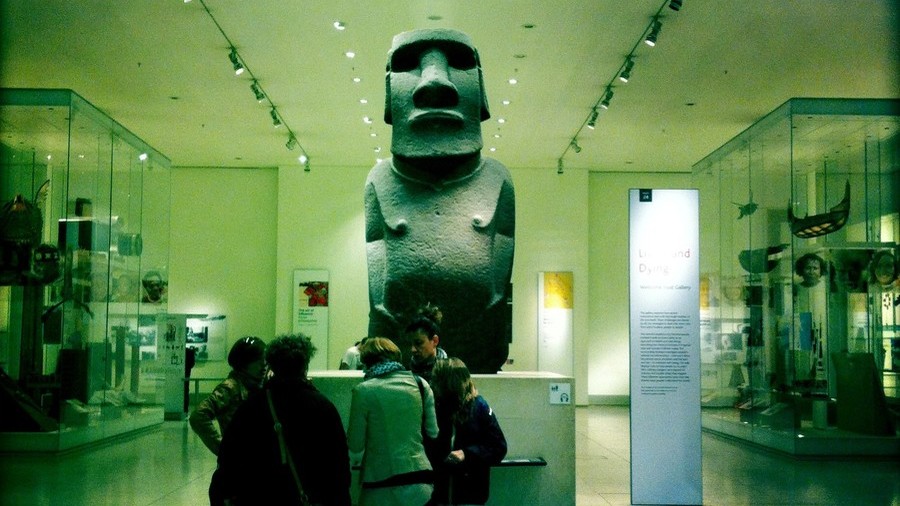
Moai sculpture from Easter Island in the British Museum © Veronika Lukasova © Global Look Press
By Danielle Ryan | RT | November 28, 2018
Is it possible to ‘loan’ something back to the person or place you stole it from? The British Museum in London, which houses one of the biggest permanent collections of world art and artifacts, certainly seems to think so.
Last week, responding to an emotional plea from the governor of Easter Island, the museum generously announced that it would consider “loaning” an 800-year-old statue back to the territory, which is now part of Chile.
The Hoa Hakananai’a was stolen — or “taken without permission” as The Guardian more delicately put it — in 1868 by the British HMS ‘Topaze’ and delivered to Queen Victoria. The museum itself uses even more sanitized language. Its online information page about the statue explains that it was “collected” during the frigate’s expedition to Rapa Nui (Easter Island) and was “gifted” by the Queen to the museum a year later.
“This statue would have originally stood on a specially built platform on the sacred site of Orongo,” the museum explains. “It would have stood with giant stone companions, their backs to the sea, keeping watch over the island.”
The reason it doesn’t still serve this purpose, is because the museum refuses to give it back. The 2.4-meter statue has no cultural or emotional significance to British people. To the Rapa Nui people, on the other hand, the Hoa Hakananai’a is extremely culturally and spiritually significant.
“We are just a body. You, the British people, have our soul,” Governor Tarita Alarcon Rapu said through tears during a visit to the museum last week. “You have kept him for 150 years. Just give us some months and we can have it there.”
The Hoa Hakananai’a is just one example of many when it comes to spoils of the British Empire which sit permanently in UK exhibitions. The museum has also refused to return the Rosetta Stone, something the head of Egypt’s new national museum recently called for, and the Parthenon Marbles. Greek Prime Minister Alexis Tsipras recently raised the issue with Theresa May, saying that their “natural place” is at the Parthenon. In 2013, India called for the return of the Koh-i-noor diamond, which was taken and given to Queen Victoria in 1850. David Cameron dismissed the notion, saying he did not believe in “returnism.”
Just this week, news reports said that the London museum would temporarily return some of the iconic ancient Benin bronze sculptures to Nigeria. There are more than a thousand of the bronzes sitting in museums across Europe, and successive Nigerian governments have sought their return for decades. France is set to give back 26 of the sculptures permanently, a decision made after a report commissioned by President Emmanuel Macron called for thousands of African artworks to be returned.
“I cannot accept that a large part of the cultural heritage of several African countries is in France,” Macron said last year in Burkina Faso. “There are historical explanations for this but there is no valid, lasting and unconditional justification.”
According to the French report, about 90 percent of Africa’s cultural heritage is situated outside of the continent. When the British Museum returns “some” of their 700 Benin bronzes, however, it will only be on loan.
In a recent article for The Guardian, Tiffany Jenkins, the author of an entire book about why Western museums should refuse to return their stolen treasures, writes that when the first wave of Benin bronzes were created, Benin was an empire and the objects were crafted on the back of the slave trade. Maybe the descendants of the Benin king should apologize for slavery before they are approved as “morally worthy owners of the artefacts,” she writes, rather ironically.
Jenkins argues reductively that history is ugly and tussling over the rights and wrongs of the past is a pointless exercise. If Western countries start returning artifacts looted during the colonial era, she says, “there could be no end to competitive claim-making.”
Well, so be it.
It is not any British or European museum’s right to withhold plundered treasures while it decides who is “morally worthy” of possessing them. The very suggestion reeks of colonial arrogance. Ultimately, Jenkins writes, artifacts in Western museums “enlighten us about the world” and that is the job of our museums. How lovely; stolen cultural heritage enlightens us deserving Westerners, so of course, it has fulfilled its one, true purpose.
The fact that repatriating colonial loot is complicated and uncomfortable is no good reason to avoid facing reality and doing the bare minimum to atone for past sins. This is cultural property we are talking about. It belongs to the peoples and cultures where it originated — and to quote Macron, there is “no valid, lasting and unconditional justification” for refusing their return.
Of course, it is not only British or French museums that house looted art and cultural objects. There has been an ongoing dispute between Russia and Germany over artwork looted when the Red Army conquered Berlin in 1945. Much of the looted items were returned to East Germany after 1945, but not all of them. Moscow claimed the looting was a legitimate response to Germany’s invasion of the Soviet Union and its destruction of Soviet national treasures. Germany begged to differ.
In October, the British Museum launched an initiative to counter the perception that everything within its walls is looted treasure — but Twitter users quickly made fun of the effort. ‘We didn’t steal all of it’ is hardly a very persuasive or positive-sounding plea.
That campaign came after art historian Alice Procter made headlines for giving ‘Uncomfortable Art Tours’ in British museums. The tours focus on slavery and colonialism and Porter encourages participants to wear ‘Display It Like You Stole It’ badges as they wander the exhibitions to advocate for more honest descriptions under artifacts. “On most text panels there’s little or no mention of how objects came to be there. Euphemistic language of ‘acquisition’ obscures the truth,” Procter wrote in a piece for The Guardian.
“You can look at the Gweagal shield in the British Museum and have no idea that it is considered crucial to the story of indigenous and settler relations in Australia, that its position in the museum is extremely controversial, and it’s sought by Gweagal people today,” she adds.
Another argument those against repatriation frequently use is that indigenous people, in some cases, offered or sold cultural objects to colonizers in exchange for something they needed more — money or tools, for example. Those items, they argue, can’t be said to be ‘stolen’ — but this completely ignores the power imbalance of the relationship between the colonizer and the colonized.
“Collected,” “acquired,” and “taken without permission” in this context are simply euphemisms for “stolen.” It is clear that the British Museum and people like Jenkins are worried about setting a precedent. Returning just one item would open the floodgates.
The British Museum is nothing short of a temple to colonial theft. If it concedes in one case, where does it end? It will never happen, of course, but in an ideal world, that would be just one extremely tiny — and wholly inadequate — price to pay for hundreds of years of colonial massacre and plunder.
Assange Never Met Manafort. Luke Harding and the Guardian Publish Still More Blatant MI6 Lies
By Craig Murray | November 27, 2018
The right wing Ecuadorean government of President Moreno continues to churn out its production line of fake documents regarding Julian Assange, and channel them straight to MI6 mouthpiece Luke Harding of the Guardian.
Amazingly, more Ecuadorean Government documents have just been discovered for the Guardian, this time spy agency reports detailing visits of Paul Manafort and unspecified “Russians” to the Embassy. By a wonderful coincidence of timing, this is the day after Mueller announced that Manafort’s plea deal was over.
The problem with this latest fabrication is that Moreno had already released the visitor logs to the Mueller inquiry. Neither Manafort nor these “Russians” are in the visitor logs.
This is impossible. The visitor logs were not kept by Wikileaks, but by the very strict Ecuadorean security. Nobody was ever admitted without being entered in the logs. The procedure was very thorough. To go in, you had to submit your passport (no other type of document was accepted). A copy of your passport was taken and the passport details entered into the log. Your passport, along with your mobile phone and any other electronic equipment, was retained until you left, along with your bag and coat. I feature in the logs every time I visited.
There were no exceptions. For an exception to be made for Manafort and the “Russians” would have had to be a decision of the Government of Ecuador, not of Wikileaks, and that would be so exceptional the reason for it would surely have been noted in the now leaked supposed Ecuadorean “intelligence report” of the visits. What possible motive would the Ecuadorean government have for facilitating secret unrecorded visits by Paul Manafort? Furthermore it is impossible that the intelligence agency – who were in charge of the security – would not know the identity of these alleged “Russians”.
Previously Harding and the Guardian have published documents faked by the Moreno government regarding a diplomatic appointment to Russia for Assange of which he had no knowledge. Now they follow this up with more documents aimed to provide fictitious evidence to bolster Mueller’s pathetically failed attempt to substantiate the story that Russia deprived Hillary of the Presidency.
My friend William Binney, probably the world’s greatest expert on electronic surveillance, former Technical Director of the NSA, has stated that it is impossible the DNC servers were hacked, the technical evidence shows it was a download to a directly connected memory stick. I knew the US security services were conducting a fake investigation the moment it became clear that the FBI did not even themselves look at the DNC servers, instead accepting a report from the Clinton linked DNC “security consultants” Crowdstrike.
I would love to believe that the fact Julian has never met Manafort is bound to be established. But I fear that state control of propaganda may be such that this massive “Big Lie” will come to enter public consciousness in the same way as the non-existent Russian hack of the DNC servers.
Assange never met Manafort. The DNC emails were downloaded by an insider. Assange never even considered fleeing to Russia. Those are the facts, and I am in a position to give you a personal assurance of them.
I can also assure you that Luke Harding, the Guardian, Washington Post and New York Times have been publishing a stream of deliberate lies, in collusion with the security services.
I am not a fan of Donald Trump. But to see the partisans of the defeated candidate (and a particularly obnoxious defeated candidate) manipulate the security services and the media to create an entirely false public perception, in order to attempt to overturn the result of the US Presidential election, is the most astonishing thing I have witnessed in my lifetime.
Plainly the government of Ecuador is releasing lies about Assange to curry favour with the security establishment of the USA and UK, and to damage Assange’s support prior to expelling him from the Embassy. He will then be extradited from London to the USA on charges of espionage.
Assange is not a whistleblower or a spy – he is the greatest publisher of his age, and has done more to bring the crimes of governments to light than the mainstream media will ever be motivated to achieve. That supposedly great newspaper titles like the Guardian, New York Times and Washington Post are involved in the spreading of lies to damage Assange, and are seeking his imprisonment for publishing state secrets, is clear evidence that the idea of the “liberal media” no longer exists in the new plutocratic age. The press are not on the side of the people, they are an instrument of elite control.
WikiLeaks Categorically Denies Assange-Manafort Meetings
By Tyler Durden – Zero Hedge – 11/27/2018
Update: WikiLeaks has fired back at the Guardian, tweeting: “Remember this day when the Guardian permitted a serial fabricator to totally destroy the paper’s reputation. @WikiLeaks is willing to bet the Guardian a million dollars and its editor’s head that Manafort never met Assange.”
This is going to be one of the most infamous news disasters since Stern published the “Hitler Diaries”.
— WikiLeaks (@wikileaks) November 27, 2018
The Guardian’s report was written by Luke Harding and Dan Collyns, and was based exclusively on unnamed sources.
***
Paul Manafort, Donald Trump’s former campaign manager, held secret talks with Julian Assange inside the Ecuadorian embassy in London, right around the time he joined Trump’s campaign, according to The Guardian, which as is now the norm in reports of this kind refers to unnamed “sources.”

Sources have said Manafort went to see Assange in 2013, 2015 and in spring 2016 – during the period when he was made a key figure in Trump’s push for the White House.
It is unclear why Manafort wanted to see Assange and what was discussed. But the last meeting is likely to come under scrutiny and could interest Robert Mueller, the special prosecutor who is investigating alleged collusion between the Trump campaign and Russia.
A well-placed source has told the Guardian that Manafort went to see Assange around March 2016. Months later WikiLeaks released a stash of Democratic emails stolen by Russian intelligence officers. –The Guardian
The 69-year-old Manafort has denied any involvement in the release of the emails, and has said that the claim is “100% false.”
While Manafort was jailed this year under a plea agreement with special counsel Robert Mueller, on Monday, Mueller said that Manafort had repeatedly lied to the FBI, breaching his deal. According to documents filed in court, Manafort committed “crimes and lies” covering a “variety of subject matters.”
According to The Guardian, Manafort’s first visit to the Ecuadorian embassy occurred one year after Assange was granted asylum inside, according to two sources. To add icing to the cake, “a separate internal document written by Ecuador’s Senian Intelligence agency and seen by The Guardian lists “Paul Manaford [sic]” as one of Assange’s several well-known guests, along with… “Russians.”
According to two sources, Manafort returned to the embassy in 2015. He paid another visit in spring 2016, turning up alone, around the time Trump named him as his convention manager. The visit is tentatively dated to March.
Manafort’s 2016 visit to Assange lasted about 40 minutes, one source said, adding that the American was casually dressed when he exited the embassy, wearing sandy-coloured chinos, a cardigan and a light-coloured shirt.
Visitors normally register with embassy security guards and show their passports. Sources in Ecuador, however, say Manafort was not logged. –The Guardian
So we have Manafort allegedly visiting Assange, in sandy-coloured chinos, and that Russians also visited the WikiLeaks founder. And none of this was known until today.
The Guardian goes on to suggest that “The revelation could shed new light on the sequence of events in the run-up to summer 2016, when WikiLeaks published tens of thousands of emails hacked by the GRU, Russia’s military intelligence agency. Hillary Clinton has said the hack contributed to her defeat.”
Note that The Guardian has considered the “hack” settled, which agrees with Western intelligence assessments (the same Western intelligence that conducted espionage on Donald Trump’s campaign). Nowhere to be found is the possibility that the emails were copied locally – a theory recently bolstered by a fresh analysis that flies in the face of a report commissioned by cybersecurity firm Crowdstrike – which was caught fabricating a report on Russia hacking Ukrainian munitions, and was forced to retract portions of their analysis after the government of Ukraine admonished them.
CrowdStrike has retracted statements it used to buttress claims of Russian hacking https://t.co/8AZOvoQl0K
— Michael Tracey (@mtracey) March 28, 2017
The Guardian goes on to link Manafort to “black operations” against the political rival of Ukraine’s former “Moscow-friendly president, Viktor Yanukovych,” and that Manafort “flew frequently from the US to Ukraine’s capital, Kiev – usually via Frankfurt but sometimes through London.”
Manafort is currently in jail in Alexandria, Virginia. In August a jury convicted him of crimes arising from his decade-long activities in Ukraine. They include large-scale money laundering and failure to pay US tax. Manafort pleaded guilty to further charges in order to avoid a second trial in Washington.
As well as accusing him of lying on Monday, the special counsel moved to set a date for Manafort to be sentenced.
One person familiar with WikiLeaks said Assange was motivated to damage the Democrats campaign because he believed a future Trump administration would be less likely to seek his extradition on possible charges of espionage. This fate had hung over Assange since 2010, when he released confidential US state department cables. It contributed to his decision to take refuge in the embassy. –The Guardian
And in perhaps the most shocking part of The Guardian‘s reporting, they refer to the highly salacious and largely discredited “Steele Dossier,” saying that according to the document, Manafort was at the center of a “well-developed conspiracy of cooperation” between the Trump campaign and the Kremlin, and that both sides had a mutual interest in defeating Clinton, wrote former MI6 spy Christopher Steele.
In a memo written soon after the DNC emails were published, Steele said: “The [hacking] operation had been conducted with the full knowledge and support of Trump and senior members of his campaign team.” –The Guardian
You know things are desperate when the Steele Dossier makes a guest appearance to once again bolster unsupported reporting.
How Elites Use Mainstream Media to ‘Maintain and Expand Their Power’

By Kit Klarenberg – Sputnik – November 16, 2018
For quite some time, debate about ‘fake news’ has reverberated clamorously in both mainstream and alternative discourse. One could easily conclude the issue was a pressingly new plague, restricted to certain corners of the web – but academic TJ Coles begs to differ. In fact, he tells Sputnik fake news has been ubiquitous for thousands of years.
It’s difficult to pinpoint the precise moment the term ‘fake news’ entered the Western political and media lexicon, but the election of Donald Trump as US President certainly turbocharged its usage. For the controversial leader and his supporters, the label can be automatically applied to any and all media reporting critical of him, while his opponents play much the same game when roles are reversed.
This tit-for-tat sparring inspired TJ, director of Plymouth University’s Institute for Peace Research, to write a book on the subject — the fruit of his labours, Real Fake News: Techniques of Propaganda and Deception-based Mind Control, was published in September.
“All that talk made me think ‘hang on a minute, we’ve always had fake news’. It’s the nature of power — all power structures want to maintain and expand their power, so it’s therefore important to present information that benefits them, and keeps populations in a psychological and/or intellectual prison. The ‘fake news’ peddled by elite financial, commercial and political financial interests, duly regurgitated by major media organizations, eclipses any bogus story perpetuated by alleged ‘bots’ on Twitter, or whatever,” TJ says.
Babylonian Beginnings
In his work, TJ traces the birth of fake news all the way back to ancient Babylon, when rulers sought to perpetuate the notion they were descended from Gods and thus had a right to dominate and control the populace — history’s first recorded instance of the ‘divine right of kings’.
Similarly, Plato famously popularized the idea of the ‘noble lie’ — privileging untruths told for the benefit of elites and the population alike. These ideas very much endure in the modern day — TJ notes Wikileaks’ dump of the Clinton campaign’s internal emails amply demonstrates her team felt it wouldn’t be good, or necessary, for Hillary’s supporters to be aware of her close connections to Wall Street, so did their utmost to conceal the mephitic kinship.
“Elites the world over are acutely aware information is power, and actually quite open about their use and abuse of the news to shape public perceptions and preserve sociopolitical conditions benefitting them. For instance, the UK Ministry of Defence regularly publishes projections of how planners think the world will look in 10 — 20 years, and they routinely note the media is one of the key ways to maintain the current paradigm, and discuss the various ways information can be ‘weaponized’ against the public,” he says.
TJ suggests elites shape and control the public mind so effectively because they exploit fundamental facets of human nature. First, the well-established instinctive inclination to reflexively believe something reinforcing one’s existing beliefs, rather than assessing whether alternative facts or viewpoints have any value, or indeed considering whether what one believes might be wrong, or informed by confirmation bias.
This tendency is greatly exacerbated by the use of internet and social media algorithms that present a ‘personalized’ picture of the world to users, unfailingly presenting individuals with content they want to see, and tacitly suppressing information contrary to their existing opinions.
“Elites also know how easy it is to exploit guilt, which is why atrocity propaganda is so widespread today. Most sympathize with the victims of major atrocities, and naturally want to do something to help, so this aspect of human nature can be easily manipulated to justify aggressive foreign policy actions — ‘look at what we’re letting happen to poor defenceless people, we have a responsibility to protect them’ etcetera. It’s funny, when it comes to the economy, the powerful are quick to say people are naturally selfish, so it’s everyone for themselves, but when it comes to foreign policy, we should care about our fellow human beings and do something to help,” TJ says.
Evidence
As the academic’s work makes clear, atrocity propaganda doesn’t even need to have any grounding in reality whatsoever. In the lead-up to the NATO-backed violent overthrow of Libyan leader Muammar Gaddafi in 2011, the mainstream media was awash with reports government forces fuelled by viagra were conducting mass rapes of civilians, and planning a borderline genocidal massacre of rebel forces — claims used to justify the imposition of a no-fly zone over the country, and NATO airstrikes.
The stories were subsequently found to be entirely without foundation — similarly, serious question marks hover over the veracity of numerous claimed chemical weapons attacks in Syria, which likewise have provided a pretext for Western attacks on the country.

© Flickr / Thierry Ehrmann
“It’s especially easy to exploit guilt when you present bite-sized news reports about an atrocious event stripped of all context, and exclude the voices of people who are actually on the ground. Occasionally, contradictory voices do filter through the system, although largely by accident. For instance, the BBC made the mistake of inviting Peter Ford, former UK ambassador to Syria, on air to discuss chemical weapons attacks — he quickly demolished their propaganda. He hasn’t been invited back since,” TJ says.
Ford is surely but one of a great many talking heads to effectively be banned from appearing on the BBC for daring to state views and evidence contrary to ascendant elite narratives. However, the British state broadcaster’s blacklisting activities also extend to its own employees — in April 2018, the BBC admitted that for decades, job applicants and serving staff were subject to political vetting by MI5, in an effort to prevent “subversives” gaining employment with the Corporation.
Often, individuals were ostracized on extremely tenuous grounds. For instance, respected film director John Goldschmidt was blacklisted in the late 1960s, with two projects he was working on for the Beeb cancelled midway through production without warning or explanation — MI5 deemed him a potential subversive as he’d spent a few weeks in Czechoslovakia in his youth, as part of a student exchange program. Similarly, award-winning journalist Isabel Hilton was refused a job by BBC Scotland in 1976 — that she spoke Chinese and had been a member of Scottish China Association at Edinburgh University made MI5 extremely anxious.
Under the policy, popular children’s book author and playwright Michael Rosen was also outright sacked from the BBC in 1972 while a graduate trainee for a number of ‘transgressions’, including student activism at Oxford, and producing a film featuring clips of US soldiers being tested with LSD. The American Embassy in London complained about the project to both MI5 and the BBC directly, whereupon Rosen was shown the door.The policy was wound down in the 1990s, and it’s unknown whether any comparable structures existed at other major news organizations — although City University research suggests dissenting voices remain rare in the British mainstream media. The 2016 study concluded UK journalists are overwhelmingly white, male, and elite-university educated — and are far more trusting of politicians, the government, police and military than the general population, which the study’s authors partly attributed to reporters’ “reliance on these institutions as sources of information”.
Such widespread faith in the establishment may account for why so many prominent reporters see no problem with maintaining close relationships with the intelligence services. The Guardian’s Luke Harding has frequently, openly and proudly advertised his warm bond with British spying agencies in articles and books — and equally frequently been condemned for uncritically running stories of questionable probity potentially provided to him by agency staff. In a September article he claimed Russian diplomats had held secret talks in London with associates of WikiLeaks founder Julian Assange, in an attempt to assist in his escape from the UK. The covert action would’ve allegedly seen Assange smuggled out of the Ecuadorian embassy in Knightsbridge under cover of Christmas Eve in a diplomatic vehicle and transported to Moscow.
The story was entirely based on the testimony of anonymous sources, the identity of which Harding didn’t even hint at in the piece. In response, Craig Murray, former UK Ambassador to Uzbekistan, slammed the article, calling it a “quite extraordinary set of deliberate lies” and “entirely black propaganda” published by an “MI6 tool”.”I was closely involved with Julian and with Fidel Narvaez of the Ecuadorean Embassy at the end of last year in discussing possible future destinations for Julian. It is not only the case Russia did not figure in those plans, it is a fact Julian directly ruled out the possibility as undesirable. The entire story is a complete and utter fabrication. It is very serious indeed when a newspaper like the Guardian prints a tissue of deliberate lies in order to spread fake news on behalf of the security services. I cannot find words eloquent enough to express the depth of my contempt for Harding and Katherine Viner, who have betrayed completely the values of journalism,” Murray wrote.
Similarly, in 2007 the Campaign Against Sanctions and Military Intervention in Iran published an analysis of 44 articles written by Daily Telegraph Defence Editor Con Couglin on Iran — including stories suggesting North Korea was helping Iran prepare a nuclear weapons test, and Iran was grooming Bin Laden’s successor. They found the pieces almost invariably; were based on “unnamed or untraceable” sources in intelligence agencies or the UK Foreign Office and “published at sensitive and delicate times” when there’d been “relatively positive diplomatic moves” towards Iran; contained ‘exclusive revelations’ about Iran combined with eye-catchingly controversial headlines, which were typically drawn from a single sentence in the wider article.
Prison Break
Despite his bleak analysis, TJ does not view the elite monopoly on information as insurmountable, or invincible — there’s much individuals and groups can do to shatter the stranglehold.
“People should keep a keen eye on sources that analyse news reporting and misreporting, such as Glasgow University Media Group and MediaLens, which offer alternative information and tell you what media coverage is actively omitting from the real story. However, change must come from within too — people should divorce themselves from preconceptions, and question their beliefs wherever and whenever possible. When presented with information that doesn’t conform to our predispositions, we should ask ourselves whether it’s true, rather than reflexively dismissing it outright,” TJ says.
While having less trust in the media more generally is a must, the academic also warns against placing too much faith in alternative news outlets and social networks, despite them being valuable resources with a significant positive potential.
“Independent media is growing in size and strength, but its overall reach is still relatively tiny — while print circulation is obviously down, people still get the vast bulk of their information from mainstream outlets. Similarly, social media could’ve democratized the spread of information, but it hasn’t — and in fact any such potential has probably been permanently neutered by the proliferation of ‘fact-checking’ resources, which are anything but unbiased and disinterested arbiters of truth,” TJ notes.
One-such ‘fact-checker’ is the Atlantic Council, a NATO-offshoot with a board of directors comprised of a ‘who’s who’ of contentious US political figures, including Henry Kissinger, Condoleezza Rice, Colin Powell, Robert Gates, Michael Hayden and David Petraeus, among others.
It partnered with Facebook in May to “independently monitor disinformation and other vulnerabilities” and combat the spread of fake news on the platform. To date, the collaboration has resulted in untold hundreds of pages and personal accounts being shut down — rather than being promulgators of propaganda though, the overwhelming bulk of the banished were alternative news sources, political organizations and individuals, highlighting issues and events the mainstream media downplays or ignores, such as US interventionism, drug legalization and police brutality.
Moreover, that elites exploit social media’s information-sharing capabilities to suit their own objectives is well-established.”The US State Department has used major social networks to recruit revolutionaries on several occasions, most notably during the ‘Arab Spring’, connecting ‘moderate rebels’ — actually violent jihadist lunatics — in select countries. Washington wanted Assad, Gaddafi and Mubarak gone, because they weren’t following orders — but there were no Twitter or Facebook ‘revolutions’ in the Gulf states, because the American empire wanted their rulers to remain in place. In Cuba, the CIA even went as far as creating a social network for the same purpose,” TJ concludes.
Mainstream media on Gaza: Israelis get killed, but Palestinians merely ‘die’
By Darius Shahtahmasebi | RT | November 15, 2018
After a Twitter backlash, the Guardian was forced to amend a brazenly propagandized headline which sought to undermine the basic rights of Palestinians and elevate Israeli soldiers to levels previously thought unimaginable.
“We remain editorially independent, our journalism free from commercial bias and our reporting open and accessible to all,” reads an advertisement on the Guardian UK’s online newspaper when you click on a recent story.
“Imagine what we could continue to achieve with the support of many more of you. Together we can be a force for change.”
The article in question that I clicked on is a recent story entitled “Eight dead in undercover Israeli operation in Gaza.” According to the opening paragraph of the report, Israeli forces killed seven Palestinians in the Gaza Strip in an “apparently botched undercover raid and ensuring firefight.”
Sounds fairly straightforward, right? Just another day in Gaza, where Palestinians and Israelis alike find themselves in the line of fire, with the number of dead Palestinians outnumbering those on the Israeli side.
However, this wasn’t the only title the Guardian had previously given this same story. The original title was a poorly crafted “Israeli officer killed during raid in which seven Palestinians died.”
You see, prior to the title’s amendment, the Israeli officer was “killed” during the raid, yet the Palestinians (who were killed by the way) merely died. The Israeli officer was killed by the Palestinians, but the seven Palestinians died from some unknown cause. This is a clever yet obvious play on the English language, whereby the deaths of the seven Palestinians are brought about passively, whereas the Israeli officer is actively killed by his aggressor.
In actuality, the perpetrator of the raid is the person bringing about the violence. The Palestinians who react in response are not, in any normal sense of the word, the perpetrators of the violence in question.
Furthermore, the Israeli officer is the one that is highlighted by the title, whereas the lesser deaths of the Palestinians are brought about as a side note. The Guardian explains in the text of its report that seven Palestinians are dead, but the identities of those Palestinians are not highlighted.
If they were militants, why not say so? If they are not militants, are they in fact civilians? If they are civilians, why is the Israeli officer highlighted first in the title, and not the tragedy of the seven civilian deaths? If they are militants, why are they given a lesser status than the Israeli officer? Well, as far as we know, two of those killed (I mean, died) were Hamas commanders. The rest of the deceased were aged between 19 and 25.
Of course, the Guardian will no longer have to worry about answering those questions as it wasted no time in changing its headline in the wake of what can only be described as a viral Twitter frenzy. The UK-based Canary described it as the “Guardian headline on Palestine that’s shaming the entire field of journalism.”
If they had been allowed to get away with this shoddy piece of journalism, one could still argue that it is just a title and we should not spend our time fussing and feuding over the intricate wording of titles. After all, what matters to a story and its journalistic integrity is its content, right?
Anyone who knows and understands anything about modern journalism and propaganda knows this to be complete nonsense. Firstly, a study by the Media Insight Project, an initiative of the AP-NORC Center for Public Affairs Research and the American Press Institute found that over half of Americans surveyed were mere headline readers and nothing more.
The effects of this painful reality go well beyond that of a resulting lazy populace. As explained by Maria Konnikova in the New Yorker :
“Psychologists have long known that first impressions really do matter—what we see, hear, feel, or experience in our first encounter with something colors how we process the rest of it. Articles are no exception. And just as people can manage the impression that they make through their choice of attire, so, too, can the crafting of the headline subtly shift the perception of the text that follows. By drawing attention to certain details or facts, a headline can affect what existing knowledge is activated in your head. By its choice of phrasing, a headline can influence your mindset as you read so that you later recall details that coincide with what you were expecting.”
In a series of studies, Ullrich Ecker, psychologist and cognitive neuroscientist at the University of Western Australia, more or less confirmed this sad state of affairs. One of Ecker’s studies found that when matching headlines to photographs, if the headline diverged from the photo, the victim was rated more negatively by the respondents when the headline had been about the criminal; and the criminal was rated more positively when the headline had been about the victim. Starting to sound a little bit familiar?
According to Konnikova, Ecker’s findings show that misinformation causes more damage when it’s subtle than when it is blatant.
Say what you like about Fox News, but its blatant approach to lying makes it less of a threat in my mind than papers like the Guardian who advertise themselves as “editorially independent” and “free from commercial bias” as it deploys more subtle techniques to not only toe the establishment line, but to provide free public relations for states such as Israel, who regularly contravene international law in a variety of ways.
Make no mistake, the Guardian editors knew what they were doing when they released this headline. It was not done by accident. This is a tried and true strategy in which Western media will paint the aggressors in a conflict as being passive players with as little fault as possible – so long as those players are the US, UK or its close allies.
For example, a March 2017 attack by US-led forces in Mosul, Iraq massacred over 200 civilians in a single bombardment. The reason this attack took place is primarily because Donald Trump relaxed the so-called Obama-era restrictions on air strikes, meaning that even Iraqi commanders could call in air strikes on the battlefield with little to no oversight. The result of this policy was of course, outright death and destruction, with over 9,000 civilians killed in Mosul alone.
However, the US bombardment in March was framed by the establishment media in the kindest way possible for the US and its allies. As noted by FAIR’s (Fairness and Accuracy In Reporting) Ben Norton, ABC News went with the headline “US Reviewing Airstrike That Corresponds to Site Where 200 Iraqi Civilians Allegedly Died.” The LA Times ran with “US Acknowledges Airstrike in Mosul, Where More Than 200 Iraqi Civilians Died.” France 24 settled for “US-Led Coalition Confirms Strike on Mosul Site Where Civilians Died.” The best, of course, was the New York Times, which managed to concoct the following headline: “US Concedes It Played a Role in Iraqi Deaths.” Remember, this is the same US who “played a role” in over one million “Iraqi deaths,” but that is a topic for another story.
Conversely, if the alleged perpetrator of violence is in the handful of countries deemed to be enemies of Western society by the mainstream media (think Iran, Syria, Russia, or North Korea), they are portrayed as menacingly evil and bloodthirsty with no logic or context to their actions. These countries “pound” their victims, for example. Even when the alleged acts cannot be proven at all, such as highly questionable chemical weapons attacks that are immediately pinned on the Syrian government with little to no evidence of Syrian government involvement, Syria’s president is condemned by all forms of Western media in the strongest terms imaginable.
You see, the victims of attacks carried out by the US, UK, and its allies and lackey states such as Israel aren’t killed, they merely die at the scene. If anything, they were in the way of the magical freedom bombs that we and our allies have been trying to spread around the Middle East for years. But those victims who are purportedly killed by countries who have been targeted for regime change, they were tragically murdered by brutal forces. The jihadists fighting against these forces with known ties to al-Qaeda are mere rebels fighting for their freedom, but militants fighting against government forces in Gaza or in Yemen are terrorists who kill noble Israeli soldiers while dying in the crossfire by accident.
While we are on the topic, an honourable mention of course has to go to the New York Times, who once felt that it was justified to describe the plight of a young Yemeni girl who had her entire family wiped out in a Saudi-led airstrike with the headline: “Young Yemeni Girl Is Sole Survivor After Airstrike Topples Her Home.” Thank God – at least it only toppled her home, as air strikes are known to do much worse if they belong to an adversarial state.
This is shameful propaganda, plain and simple. The Guardian was once heralded as a beacon of journalistic integrity, but it has long given up that status and decided it will go out of its way to perpetuate establishment narratives that benefit, for example, even the dictatorship of Saudi Arabia.
Despite this, the fact the Guardian amended its headline and deleted its original tweet can still be seen as somewhat of a partial victory. While I don’t expect many of us who spoke out to continue to keep our Twitter privileges for much longer, the end result was totally worth it and I hope more people can continue to speak out as we fight back against warmongering establishment narratives.
Guardian Watch – Freedland Remembers Yemen is a Thing
By Kit Knightly | OffGuardian | October 20, 2018
Jonathan Freedland has weighed in on the Khashoggi case. He’s outraged, of course. Because they all are. Every single voice in the mainstream world has suddenly realised just how appalled they are that Saudi Arabia does bad things.
They weren’t appalled a few weeks ago, when the Saudis blew up a bus full of school children.
But they are appalled now, because Mike Pompeo was told by the Turkish government, who were told by the Turkish secret service, that a reporter who may or may not be dead, might have been killed by a super-secret Saudi Arabian hit squad (who then died in a car accident). There are video and audio recordings to prove all of this but we’re not allowed to see them yet.
Freedland recounts these alleged gory details with po-faced prurience. Apparently, they might have used a chainsaw. But that’s not really what his article is about – his article is about attempting to claw back some credibility in the face of (perfectly justified) accusations of massive hypocrisy, and deeper questions about the motivations of the media and the agenda of the Deep State.
You see, Yemen is a thing.
It’s the poorest country in the Middle-East and it’s being systematically destroyed by its vastly richer neighbours, with the full backing and cooperation of NATO. In fact, we’re making a fortune out of it. Bombs are expensive, the Saudis need a lot of them, and you can only use them once. Ker-ching.
Domestically, Saudi Arabia is an absolute monarchy with a laughable track-record when it comes to human rights. This has been known for decades, it is talked about a lot. Barely a week goes by without some author, somewhere in the alternate media, writing up a story about the crimes of the House of Saud – either international or domestic. So why are we just now hearing about them in the mainstream?
When he was selling wars in Libya and Syria, did Freedland ever once suggest the “humanitarian bombing” of Riyadh?
Did he object to his paper selling ad space to promote the Muhammed bin Salman, “the great reformer”?
Did he boycott events or protest arms deals or in any way speak out?
Did he devote even a single one his columns to the war in Yemen?
People all over the world are asking: “Why are the Saudis suddenly the bad guys? Why can’t Jamal Khashoggi be brushed under the carpet as if he’s nothing but a burning bus full of children or a napalm-strewn wedding reception?”
It’s a question no one in the media has an answer for. They are aware of the contradiction though, and they are busily trying to get around it.
This is Freedland’s attempt:

I can understand the frustration of campaigners for Yemen that the death of one man has captured a global attention that has so rarely focused on the tens of thousands killed…But sometimes it takes the story of a single individual to break through. So it has proved with Khashoggi.
That’s it. A simple brush-off.
That’s the new narrative – nobody really realised just how bad the Saudis were until now. This is the big reveal. The “oh shit” moment. None of them had been on twitter, or read the alternate news or even looked at the comments BTL on their own articles. Yes, Yemen was there in the background but – through forces beyond everyone’s control – it just never broke through to the public consciousness. Oops.
He’s trying to imply that the news just sort of happens, like it’s an organic process beyond the control of the mere mortals writing the stories or filming the segments or thinking up the headlines.
That is patently absurd. We know how the media works, and it’s not some Jungian expression of the collective will. To suggest as much is insulting and ridiculous.
The news is a system by which a handful of mega-corporations distribute propaganda and manipulate public opinion. It is rigidly controlled. They push some issues to the front page and shovel others down the memory hole. When they need to, they make stuff up. Every headline is picked for a purpose, every omission deliberately made. Cogs turn and push the constantly-evolving agenda forward. There are no accidents, and the process is anything but organic.
It’s mechanical. And like all machines, it lacks a soul. There has been no grand awakening of the media conscience. There is no such thing.
There was a reason Yemen was banished to the far reaches of the press for four years. There was a reason the mainstream media were happy to white-wash the Saudi Arabians as they pummelled school buses and weddings with bombs British and American arms companies probably over-charged them for.
There’s a reason every big newspaper on both sides of the Atlantic was happy to serve as Muhammad bin Salman’s PR agency…. and there’s a reason they stopped. A real reason, that has nothing to do with Jamal Khashoggi.
We just don’t know what it is yet.
Kit Knightly is co-editor of OffGuardian. The Guardian banned him from commenting. Twice. He used to write for fun, but now he’s forced to out of a near-permanent sense of outrage.
Featured Video

Alon Mizrahi: ‘Israel Must Be Dismantled’
or go to
Aletho News Archives – Video-Images
From the Archives
How a War with Iran Would Diminish American Power
By Greg Scoblete | The Compass | August 13, 2010
Jennifer Rubin wants a war with Iran:
But the emphasis on the existential threat to Israel ignores a more basic issue for Americans to ponder: a nuclear-armed Iran represents a dagger at the heart of America and an existential threat to our status as a superpower and guarantor of the West’s security. As to the former, Iran is pressing ahead with its long-range ballistic missile program. First the Middle East and Eastern Europe, then all of Europe and, within a matter of years, the U.S. will be within range of Iranian missiles. If those are nuclear and not conventional, what then? We’re not talking about whether Iran is going to be “merely” a destabilizing factor in the Middle East or whether it will set off an arms race with its neighbors or imperil Israel’s existence. We’re talking about whether America will then be at risk (and lacking sufficient missile-defense capabilities if we continue to hack away at our defense budget). The argument about whether mutual assured destruction can really work against Islamic fundamentalists who have an apocalyptic vision becomes not about Israel’s ability to deter an attack but about ours. Those who oppose American military action have an obligation to explain why America should place itself in that predicament.
I would argue that any obligation to present an explanation lies with those whose disastrous policy prescriptions with respect to Iraq lead America into the worst strategic blunder in the country’s recent history. That aside, note the blind faith in the power of the military to actually achieve its ends. … continue
Blog Roll
 Aletho News
- Villains of Judea: Leonid Radvinsky
- Alon Mizrahi: ‘Israel Must Be Dismantled’
- Former Head Of MI6 Admits That The U.S. And Israel Are Losing The Iran War
- Scattered Thoughts on War and Peace
- Iran Threatens to Close Red Sea to Shipping in Response to Invasion
- Iran in excellent position to prevail in war with US, Israel: John Mearsheimer
- Iran warns US: Do not call your retreat an agreement
- Neighbors first – Moscow signals shift in energy strategy
- Almost 400 Ukrainian drones downed over Russia in single night – MOD
- Battle for Hungary: How the Russiagate blueprint has been unleashed against Orban
- If Americans Knew
- In the West Bank, life is a constant battle – 3 articles
- Jacob Reses, one of the most powerful pro-Israel operatives in Trump’s Washington
- Israeli-US assaults kill or injure 87 children a day – Not a ceasefire Day 166
- ‘Forever live by the sword’: Understanding Israelis’ massive support for Iran war
- UN’s special rapporteur on human rights says Israel is systematically torturing Palestinians
- Trump White House plagiarized Iran war manifesto from Israel-aligned think tank
- Gaza says 6–10 patients die daily waiting for treatment abroad as Israel blocks medical evacuations
- ‘Substantial evidence’ of double-tap strike in killing of Gaza’s Hind Rajab
- ‘Do Not Want To Die For Israel’: Doubts About Trump’s Iran Strategy Spread Among Troops
- Instead of taking Joe Kent’s claims seriously, the media is disregarding him as an antisemite
- No Tricks Zone
- Devastating Assessment Of Comirnaty Vaccine By Former Senior Pfizer Europe Toxicologist
- New Study: CO2 Is ‘Effectively Negligible’ As An Explanatory Climate Change Factor Since 2000
- Former Pfizer Toxicologist Dr. Helmut Sterz Tells Bundestag Hearing Pfizer Vaccine Should Have Never Been Approved
- Energy Expert: Germany’s Nuclear Phaseout Was A “500 Billion Euro Mistake”
- New Research: South Australia’s Mid-Holocene Sea Surface Temperatures Were 4°C Warmer Than Today
- Storing Green Energy To Last Germany 10 Days Would Require A 60-Million Tonne Battery
- New Studies: UK Sea Levels Were 4 Meters Higher Than Today During The Mid-Holocene
- Destructive Green New Deal: German Energy And Metal Group Warns Of Drastic Crisis
- New Study Documents A 20-Year Pause In Arctic Sea Ice Decline – Driven By Internal Variability
- Wake-up Call: Survey Shows Majority Of Germans Now Favor Postponing Climate Targets!
 Aletho News