Volodymyr Zelensky and ethnopolitics

By Thierry Meyssan | Voltaire Network | December 13, 2022
The Ukrainian president Volodymyr Zelensky has been named by Time Magazine as the “Person of the Year 2022”; an obvious choice, according to the magazine’s editors. Indeed, he embodies an infectious courage that has enabled his people to resist the Russian invasion.
However, in his country, power has gradually passed from his hands to those of his deputy chairman of the National Security and Defense Council, Oleksiy Danilov, since July 25. Zelensky is concentrating on his role as spokesman for the regime, leaving Danilov to prepare the decrees he signs. Together, the two men established a regime of terror.
On July 17 and 25, three members of the Council were dismissed for numerous acts of treason reported by the officials under their command:
- the diplomat Ruslan Demchenko,
- the childhood friend of Zelensky and the head of the security service, the SBU, Ivan Bakanov,
- and Zelensky’s former legal adviser and general prosecutor of Ukraine, Irina Venediktova.
Speaking about those crucial days, Rinat Akhmetov, the richest man in Ukraine before the war, said that Zelensky had seized power, all power, under the guise of reform.
On August 26, Oleksiy Danilov revealed on the NTA channel that the Security and Defense Council had adopted a plan for the defense of the country in November 2021, that is, four months before the Russian military intervention. This document had been prepared since Zelensky rejected the plan for a Minsk-3 proposed by Paris on December 8-9, 2019. “It is a huge fundamental document that sets out the activities of all bodies without exception: who and how to act in a situation of martial law,” he said, September 7 in Left Bank.
ASSASSINATING POLITICAL OPPONENTS
Political assassinations are usually carried out by “mainstream nationalists” and not by government bodies. At any time, they can kidnap and disappear, or even execute political opponents directly in the street in full view of the public. The victims are primarily journalists and elected officials. This is not a new operation since these murders have punctuated the civil war since 2014.
One thinks of the deputy Oleg Kalashnikov, murdered with eleven bullets in the head on the doorstep of his house, in 2015. The police have never established, neither who carried out the assassination, nor who ordered it.
However, in some cases, they are the work of the SBU (security service). For example, the execution of the official negotiator, Denis Kireev, on his return from Kiev, where he had participated in contacts with Russia without success. He was killed in the street on March 6, 2022, because during the negotiations he had dared to mention the historical ties between Kiev and Moscow.
The political leaders do not publicly assume these acts, but encourage them. They say that the country must be “purified”. It is not a question of killing agents of the Russian Federation, but any bearer of Russian culture or anyone who recognizes the value of this culture.
The mayor of Kiev, boxing champion Vitali Klitschko, has commissioned the neo-Nazi group C-14 to hunt down and kill “saboteurs” among Ukrainians of Slavic origin.
Criminal proceedings have been initiated against former high-ranking state officials such as MP Yevhen Murayev, former Minister of Internal Affairs Arsen Avakov, former Prime Minister Arseni Yatsenyuk, former Secretary of the National Security and Defence Council Oleksandr Turchynov and former President Petro Poroshenko.
The SBU is henceforth arresting many civilians it accuses of collaborating with the Russians.
BANNING THE RUSSIAN LANGUAGE
While, according to the Minsk II Agreements (Art. 11, explanatory note [1]) of February 12, 2015, the Donbass regions were to be able to determine their own official language, Oleksiy Danilov declared on September 1, 2022: “It is they [the inhabitants of Donbass] who must find a common language with us, not we with them. We have borders, and if someone is not satisfied with the laws and rules that apply on the territory of our country, we do not hold anyone back.
On October 21, he was more specific: “The Russian language should disappear completely from our territory as an element of hostile propaganda and brainwashing for our population.
CONTROLLING THE MEDIA
Oleksiy Danilov, said on July 20, in the midst of the Security and Defense Council crisis, that many people who used to appear on television before the “Russian aggression”, no longer appear. “We do not know where they have gone. The SBU will make strong statements about them”. He accused them of reporting the Russian point of view: “Implanting these Russian stories here is a very, very dangerous thing. Apparently we should understand what they are. Look: we don’t need them. Let them leave us, let them go to their swamps and croak in their Russian language.
The Security and Defense Council had already placed all print and broadcast media under its surveillance. In addition, it had banned a hundred Telegram channels that it had labeled “pro-Russian.”
DESTROYING 100 MILLION RUSSIAN BOOKS
The Ukrainian Book Institute, which oversees all public libraries, was tasked on May 19, that is, before the Security and Defense Council crisis, with destroying 100 million books [2].
The aim was to destroy all books by Russian authors or printed in Russian or printed in Russia. In practice, a commission was appointed within the Verkhovna Rada to ensure the implementation of this intellectual purge. It turned out that the vast majority of books in the libraries were practical books on cooking, sewing, etc. They waited for a while before being removed. They waited for a while before they were plundered, with priority given to evil authors like Alexander Pushkin and Leo Tolstoy.
BANNING POLITICAL PARTIES
The 12 opposition political parties were banned, one by one. The latest one was sanctioned on October 22 [3]. Their elected representatives were dismissed.
Only the Transcarpathian oblast (close to Hungary) refuses to dismiss local representatives of banned political parties.
CONFISCATING THE PROPERTY OF OPPONENTS AND RUSSIANS
Since the end of February, the Ukrainian Agency for Asset Research and Management (ARMA), the European Union’s anti-corruption body, has seized assets worth more than 1.5 billion hryvnias, or $41 million dollars.
One by one, the oligarchs who own media outlets were forced to hand over their assets. This is a general plan to free the country from their influence. However, they still have the right to own other types of companies.
According to the Ukrainian law of 2021, oligarchs are the 86 citizens who have at least $80 million, participate in political life and have great influence on the media. According to Oleksiy Danilov, there should be no more oligarchs at the end of the war.
The Security and Defense Council decided on November 7 to nationalize factories belonging to oligarchs, including Igor Kolomoisky, the financier of Volodymyr Zelensky. They have been placed under the administration of the Ministry of Defence and should be “returned to the Ukrainian people” at the end of martial law.
This decision applies, among others, to the Ukrainian aircraft engine manufacturer Motor Sich, which was in dispute with Chinese investors before an arbitration court in The Hague (Beijing Skyrizon case). China, which claims 4.5 billion dollars, called the nationalization “theft”. According to Beijing: “Since 2020, the Ukrainian government has continuously created problems, blamed, repressed and persecuted Chinese investors without reason, and even imposed special economic sanctions without reason, with the intention of nationalizing Motor Sich PJSC by illegal means and shamelessly looting Chinese assets abroad.”
The Security and Defense Council on October 20 seized the assets of 4,000 Russian companies and individuals in the country.
This decision also applies to Ukrainian personalities who had settled in Russia before the war, such as singers Taisiya Povaliy, Ani Lorak, Anna Sedokova and television presenter Regina Todorenko.
BANNING THE ORTHODOX CHURCH
The National Security and Defense Council of Ukraine decided on December 1, 2022 to “prohibit religious organizations affiliated with centers of influence of the Russian Federation from operating in Ukraine,” President Zelensky announced when signing Decree 820/2022 [4].
The “State Service for Ethnopolitics and Freedom of Conscience” was tasked with seizing the
Orthodox Church buildings under the jurisdiction of the Moscow Patriarchate.
Two weeks ago, the Ukrainian security service (SBU) violently searched a monastery, accusing popes of daring to describe Russia as the “Motherland.
President Zelensky believes that he respects Western human rights standards. Indeed, the European Court of Human Rights will no longer be able to register complaints from Russia since Moscow has left the Council of Europe.
CUTTING OFF ALL RELATIONS WITH RUSSIA
On October 4, President Zelensky signed a decree prohibiting any further negotiations with Russia.
On December 1, Oleksiy Danilov called for “the destruction of Russia. He clarified his statement as follows: “They just need to be destroyed so that they cease to exist as a country, within the borders in which they now exist… They are just barbarians. And when you say that you have to sit at the same table with these barbarians and talk with them, I consider that unworthy of our people. »
[1] “Package of measures for the implementation of Minsk Agreements”, Voltaire Network, 12 February 2015.
[2] “Zelensky government orders destruction of 100 million books”, Voltaire Network, 16 June 2022.
[3] “Ukraine bans last political opposition party”, Voltaire Network, 23 October 2022.
[4] Decree 820/2022 of the Presidency of Ukraine, 1 December 2022
Translation Roger Lagassé
Trump Reportedly Takes Helm in US-DPRK Negotiations as MSM Cries Foul
Sputnik – 21.03.2019
In the aftermath of the failed Hanoi summit between the US and North Korea, US President Donald Trump has reportedly taken the helm in denuclearization negotiations with Pyongyang. Meanwhile, Seoul now sees the ball as having landed in its court to convince its neighbor to give up its weapons and rocket programs.
According to Trump administration officials who spoke with Time for a Monday article, the US president is “sidelining” his special envoy to North Korea, Stephen Biegun, and “dismissing the warnings of top intelligence and foreign policy advisers” who dissent from his continued policy of negotiation with North Korean leader Kim Jong Un.
Time reports that Trump has shut down attempts by Biegun to establish a back channel to Pyongyang via the socialist country’s United Nations mission in New York, citing US and South Korean officials, and is focusing on attempts to negotiate a deal with Kim instead of bowing to the advice of his advisers to press North Korea harder with sanctions — or to abandon negotiations altogether.
Trump and Kim met late last month in Hanoi, Vietnam, for a second round of denuclearization talks to follow up on a June 2018 summit that laid the groundwork for peace on the Korean Peninsula. While Pyongyang has made considerable progress with the South toward that end, negotiations with Washington have stalled, as the two sides reached a point where neither was willing to budge any further until the other side gave something first.
The Democratic People’s Republic of Korea (DPRK) has made several good faith moves toward reducing tensions, including the halting of weapons tests and the destruction of key missile and nuclear program sites. However, Kim was unwilling to make further concessions before Washington lowered at least some of its economic sanctions blocking international trade in many items with his country. The US has refused to lower any of those sanctions until Kim produces “verified denuclearization.” The Hanoi summit failed to surmount this impasse.
Trump administration officials such as Secretary of State Mike Pompeo and National Security Adviser John Bolton have used Pyongyang’s red line to argue that Kim is intransigent and not cooperative. The mainstream media has also largely adopted this position, as the articles by Time, CNN and The Hill on these developments show.
Indeed, ever since Trump agreed to meet with Kim last spring, the mainstream media has been devoted to producing stories that undermined Trump’s attempts at peace, and hawkish foreign policy think tanks have produced report after report claiming Kim has violated the terms of the negotiations. Their reports are often based on outdated or undated evidence, supposition or otherwise unverifiable claims, Sputnik has reported.
One example, from Time’s Tuesday article, tries to juxtapose Trump’s supposedly delusional belief that “Kim is his ‘friend,'” according to an administration official, with the “unanimous assessment by multiple agencies that Kim remains wedded to his nuclear program,” and thus is incapable of responding to a carrot, understanding only the stick.
Indeed, such has been the common refrain by US state officials for decades, going back to George F. Kennan’s eponymous telegram about how the US should handle the Soviet Union during the Cold War, and even further to the suppression of the Boxer Rebellion in imperial China at the turn of the last century.
Meanwhile, South Korean President Moon Jae In has continued his rapprochement with Kim, despite US-DPRK failures.
“We’re in a deep agony over how to take advantage of this baton that has been handed over to us,” said a Moon administration figure earlier this week, according to South China Morning Post.
“We agree with the view that no deal is better than a bad deal… However, in reality, it is difficult to achieve complete denuclearization at one stroke. I think we need to reconsider the so-called all or nothing strategy,” the official said.
Seoul aims to get Pyongyang to “agree with a broad road map aimed to achieve the overarching goal of denuclearization,” the official said, noting that “we should make further efforts to turn a small deal into a deal that is good enough. In order to achieve meaningful progress, we need one or two early harvests for mutual trust-building to move on toward the final goal.”
Still, in the aftermath of Hanoi, Moon’s popularity fell in his country from a high of 70 percent last summer to a measly 45 percent earlier this month, Sputnik reported.
The metaphor of the “harvest” presents a timely parallel as North Korean officials have pressed the UN to step up its food and medical aid to DPRK in the coming year due to bad harvests last year and projected shortages in 2019, Sputnik has reported.
“Although Security Council sanctions clearly exempt humanitarian activities, life-saving programs continue to face serious challenges and delays,” Tapan Mishra, the UN’s resident coordinator in the DPRK lamented earlier this month. “While unintended consequences of sanctions persist, these delays have a real and tangible impact on the aid that we are able to provide to people who desperately need it.
US and other international sanctions bar many useful medical items from being imported by DPRK, too. For example, a paper published last December by the Middlebury Institute of International Studies at Monterey looked at scientific projects in which North Korean scientists had partnered with scholars from other countries, noting that roughly 100 of the 1,300 they examined had “identifiable significance for dual-use technology, weapons of mass destruction (WMD) or other military purposes.”
That means that even though DPRK doctors might be studying epidemiology, their work could be subject to weapons sanctions. “When you study infectious diseases, which are a big burden in North Korea, you have to grow bacteria,” Harvard Medical School neurosurgeon Kee Park, director of DPRK Programs for the Korean American Medical Association, told NPR at the time. “That’s the kind of technology that goes into creating biological weapons.”
The problem is that “virtually all technology you can possibly think of is dual use,” professor and author Tim Beal told Sputnik.
Time reports that Trump administration officials fear the US president might try and strike a deal with Pyongyang and lift some sanctions in exchange for a pledge to continue their freeze on weapons development and testing, which Trump has said he considers to be more important to maintain than the total removal of nuclear weapons and delivery systems from North Korean possession. However at the same time, it seems to be the consensus among administration officials that any such deal wouldn’t actually make progress at all, only “remove much of the leverage” on the DPRK that they believe compels the country to negotiate in the first place.
Venezuela Coverage Takes Us Back to Golden Age of Lying About Latin America
By Mark Cook | FAIR | February 22, 2019
I was sitting in my apartment in Caracas, Venezuela, reading the online edition of Time magazine (5/19/16), which carried a report that there was not even something as basic as aspirin to be found anywhere in Venezuela: “Basic medicines like aspirin are nowhere to be found.”
I walked out of the apartment to the nearest pharmacy, four blocks away, where I found plenty of aspirin, as well as acetaminophen (generic Tylenol) and ibuprofen (generic Advil), in a well-stocked pharmacy with a knowledgeable professional staff that would be the envy of any US drugstore.
A few days after the Time story, CNBC (6/22/16) carried a claim that there was no acetaminophen to be found anywhere, either: “Basic things like Tylenol aren’t even available.” That must have taken the Pfizer Corporation by surprise, since it was their Venezuelan subsidiary, Pfizer Venezuela SA, which produced the acetaminophen I purchased. (Neither Time writer Ian Bremer nor CNBC commentator Richard Washington was in Venezuela, and there was no evidence offered that either of them had ever been there.)
I purchased all three products, plus cough syrup and other over-the-counter medications, because I doubted that anyone in the United States would believe me if I couldn’t produce the medications in their packages.
Unrelenting drumbeat of lies
In fact, I myself wouldn’t have believed anyone who made such claims without being able to produce the proof, so intense and unrelenting has been the drumbeat of lies. When the Youth Orchestra of Venezuela gave a concert in New York in early 2016, before I moved to Caracas, I went there thinking, “Gee, I hope that the members of the orchestra are all well-dressed and well-fed.” Yes, of course they were all well-dressed and well-fed!
When I mentioned this in a talk at the University of Vermont, a student told me that he’d had the same feeling when he was following the Pan American soccer championship. He wondered if the Venezuelan players would be able to play, because they’d be so weakened from lack of food. In fact, he said, the Venezuelan team played superbly, and went much further in the competition than expected, since Venezuela has historically been a baseball country, unlike its soccer-obsessed neighbors Brazil and Colombia.
Hard as it may be for followers of the US media to believe, Venezuela is a country where people play sports, go to work, go to classes, go to the beach, go to restaurants and attend concerts. They publish and read newspapers of all political stripes, from right to center-right, to center, to center-left, to left. They produce and watch programs on television, on TV channels that are also of all political stripes.
CNN was ridiculed recently (Redacted Tonight, 2/1/19) when it carried a report on Venezuela, “in the socialist utopia that now leaves virtually every stomach empty,” followed immediately with a cut to a demonstration by the right-wing opposition, where everybody appeared to be quite well-fed.
But surely that’s because most of the anti-government demonstrators were upper-middle class, a viewer might think. The proletarians at pro-government demonstrations must be suffering severe hunger.
Not if one consults photos of the massive pro-government demonstration on February 2, where people seemed to be doing pretty well. This is in spite of the Trump administration’s extreme economic squeeze on the country, reminiscent of the “make the economy scream” strategy used by the Nixon administration and the CIA against the democratic government of President Salvador Allende in Chile, as well as many other democratically elected governments.
Rival demonstrations
That demonstration showed considerable support for the government of President Nicolás Maduro and widespread rejection of Donald Trump’s choice for president of Venezuela, Juan Guaidó.
Guaidó, who proclaimed himself to be president of the country and was recognized minutes later by Trump, even though a public opinion poll showed that 81 percent of Venezuelans had never heard of him, comes from the ultra-right faction in Venezuelan politics.
The pro-Maduro demonstration suggested, not surprisingly, that Guaidó had failed to win much popular support outside the wealthy and upper-middle class. But Guaidó couldn’t even win support from many of them. The day before rival rallies February 2, Henrique Capriles, the leader of a less extreme right-wing faction, gave an interview to the AFP that appeared in Últimas Noticias (2/1/19), the most widely read newspaper in Venezuela. In it, Capriles said that most of the opposition had not supported Guaidó’s self-proclamation as president. That may explain the surprisingly weak turnout at Guaidó’s demonstration, held in the wealthiest district of Caracas, and obviously outshone by the pro-government demonstration on the city’s main boulevard.
The New York Times did not show pictures of that pro-government demonstration, limiting itself to a claim by unnamed “experts” (2/2/19) that the pro-government demonstration was smaller than the anti-government one.
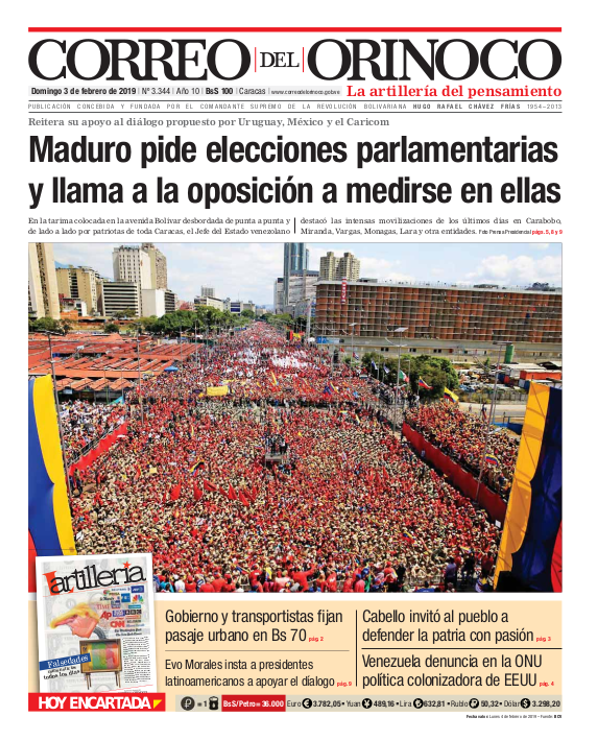
Readers can look at the photos of the rival demonstrations and judge for themselves. Both groups did their best to pull out their faithful, knowing how much is riding on a show of popular support. The stridently right-wing opposition paper El Nacional (2/3/19) carried a photo of the right-wing opposition demonstration:
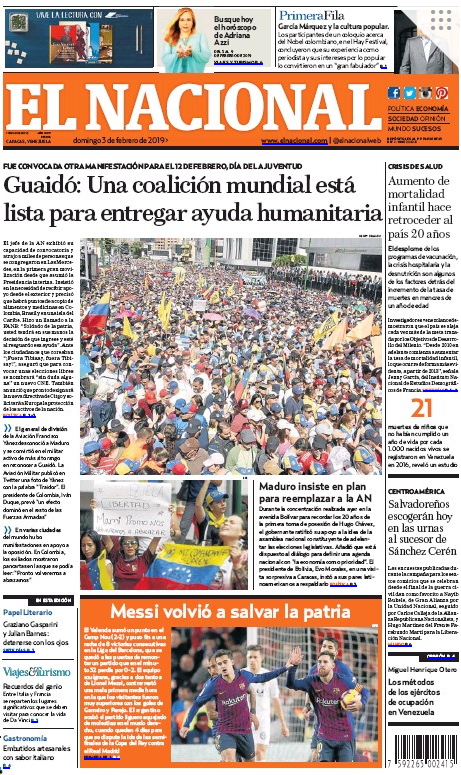
If that was the best photo it could find, it was remarkably unimpressive compared to the photos in the left-wing papers CCS (2/2/19)….
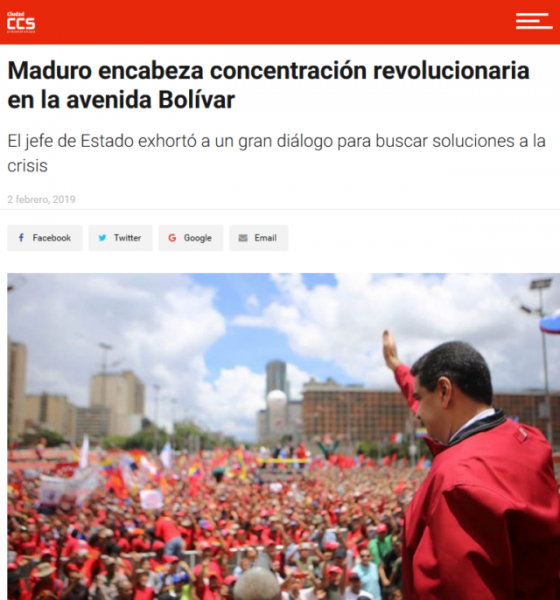
… and Correo del Orinoco (2/3/19), which were only too happy to publish pictures of the pro-government event:
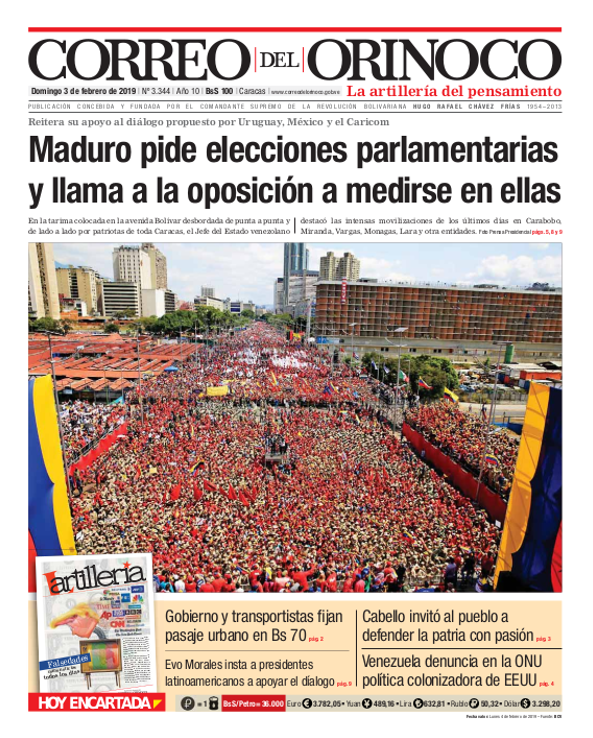
Unlikely humanitarian
A huge anti-government demonstration was supposed to make possible a coup d’état, a maneuver the CIA has used repeatedly—in Iran in 1953, Guatemala in 1954, Brazil in 1964 and many more, straight through to Honduras in 2009 and Ukraine in 2015. The turnout at the Trump administration’s demonstration was disappointing, and the coup d’état never occurred. The result is that Trump has expressed a sudden interest in getting food and medicine to Venezuelans (FAIR.org, 2/9/19).
Trump, who let thousands die in Puerto Rico and put small children in cages on the Mexican border, seems to be an unlikely champion of humanitarian aid to Latin Americans, but the corporate media have straight-facedly pretended to believe it.
Most have suppressed reports that the Red Cross and the UN are providing aid to Venezuela in cooperation with the Venezuelan government, and have protested against US “aid” that is obviously a political and military ploy.
The corporate media have continued to peddle the Trump-as-humanitarian-champion line, even after it was revealed that a US plane was caught smuggling weapons into Venezuela, and even after Trump named Iran/Contra criminal Elliott Abrams to head up Venezuelan operations. Abrams was in charge of the State Department Human Rights Office during the 1980s, when weapons to US-backed terrorists in Nicaragua were shipped in US planes disguised as “humanitarian” relief.
Canada’s CBC (2/15/19) at least had the honesty to acknowledge that it had been had in swallowing a lie from Secretary of State Mike Pompeo that the Venezuelan government had blockaded a bridge between Colombia and Venezuela to prevent aid shipments. The newly built bridge has not yet been opened: it has never been open, apparently because of hostile relations between the two countries, but the non-opening long predates the US government’s alleged food and medicine shipments.
The absurdity of $20 million of US food and medicine aid to a country of 30 million, when US authorities have stolen $30 billion from Venezuela in oil revenue, and take $30 million every day, needs no comment.
‘Failed state’
The campaign of disinformation and outright lies about Venezuela was kicked off in 2016 by the Financial Times. Ironically, it chose the 14th anniversary of the 2002 failed coup d’etat against President Hugo Chávez—April 11, 2016—to claim that Venezuela was in “chaos” and “civil war,” and that Venezuela was a “failed state.” As with the Time and CNBC reports, the Financial Times reporter was not in Venezuela, and there was no evidence in the report that he had ever been there.
I asked right-wing friends in Venezuela whether they agreed with the Financial Times claims. “Well, no, of course not,” said one, stating the obvious, “there is no chaos and no civil war. But Venezuela is a failed state, since it has not been able to provide for all the medical needs of the population.” By that standard, every country in Latin America is a failed state, and obviously the United States too.
The New York Times has run stories (5/15/16, 10/1/16) claiming that conditions in Venezuelan hospitals are horrendous. The reports enraged Colombians in New York, who have noted that a patient can die on the doorstep of a Colombian public hospital if the patient has no insurance. In Venezuela, in contrast, patients are treated for free.
One Colombian resident in New York said that his mother had recently returned to Bogotá after several years in the United States, and had not had time to obtain medical insurance. She fell ill, and went to a public hospital. The hospital left her in the waiting room for four hours, then sent her to a second hospital. The second hospital did the same, leaving her for four hours and then sending her to a third hospital. The third hospital was preparing to send her to a fourth when she protested that she was bleeding internally and was feeling weak.
“I’m sorry, Señora, if you don’t have medical insurance, no public hospital in this country will look at you,” said the woman at the desk. “Your only hope is to go to a private hospital, but be prepared to pay a great deal of money up front.” Luckily, she had a wealthy friend, who took her to a private hospital, and paid a great deal of money up front.
Such conditions in Colombia and other neoliberal states go unmentioned in the US corporate media, which have treated the Colombian government, long a right-wing murder-squad regime, as a US ally (Extra!, 2/09).
Well, OK, but are the reports of conditions in Venezuelan hospitals true or grossly exaggerated? “They are much better than they were ten years ago,” said a friend who works in a Caracas hospital. In fact, he said, ten years before, the hospital where he worked did not exist, and new hospitals are now being opened. One was dedicated recently in the town of El Furrial, and another was opened in El Vigia, as reported by the centrist newspaper Últimas Noticias (3/3/17, 4/27/18). The government has also greatly expanded others, like a burn center in Caracas and three new operating rooms at the hospital in Villa Cura.
Meanwhile, the government is inaugurating a new high-speed train line, The Dream of Hugo Chávez, in March (Correo del Orinoco, 2/6/19). Since the US media have never allowed reporting on any accomplishments in the years since Chávez took office in 1999, but only any alleged, exaggerated or, as noted, completely invented shortcomings, readers have to consult an alternative history. Here is one offered by a Venezuelan on YouTube (3/31/11): “Por Culpa de Chávez” (“It’s Chávez’s Fault”). Depicting new hospitals, transit lines, housing, factories and so on built under Chavismo, it might help many understand why the Maduro government continues to enjoy such strong backing from so many people.
Economic warfare
This is not to minimize Venezuela’s problems. The country was hit, like other oil-producing countries, and as it was in the 1980s and ’90s, by the collapse of oil prices. That failed to bring down the government, so now the Trump administration has created an artificial crisis by using extreme economic warfare to deprive the country of foreign exchange needed to import basic necessities. The Trump measures seem designed to prevent any economic recovery.
Like any country at war (and the Trump administration has placed Venezuela under wartime conditions, and is threatening immediate invasion), there have been shortages, and products that can mostly be found on the black market. This should surprise no one: During World War II in the US, a cornucopia of a country not seriously threatened with invasion, there was strict rationing of products like sugar, coffee and rubber.
The Venezuelan government has made food, medicine and pharmaceuticals available at extremely low prices, but much of the merchandise has made its way to the black market, or over the border to Colombia, depriving Venezuelans of supplies and ruining Colombian producers. The government recently abandoned some of the heavy price subsidies, which resulted initially in higher prices. Over the past few weeks, prices have been coming down as supplies stayed in Venezuela, especially as the government gained greater control over the Colombian border to prevent smuggling.
There has never been a serious discussion of any of this in the US corporate media, much less any discussion of the campaign of lies or the Trump administration warfare. There has been no comparison with conditions in the 1980s and ’90s, when Venezuela’s neoliberal government imposed IMF economic recipes, resulting in a popular rebellion, the bloody 1989 Caracazo, when wholesale government repression took the lives of hundreds (according to the government at the time) or thousands (according to government critics), and martial law took the lives of many more.
Efforts by the right-wing opposition to provoke a similar uprising, and another Caracazo that could justify a foreign “humanitarian intervention,” have failed repeatedly. So the US administration and corporate media simply resort to the most extreme lying about Latin America that has been seen since the Reagan administration wars of the 1980s.
Butina prosecutors wrote their own James Bond novel with sex allegations – and the media loved it

Jailed Russian “spy” Maria Butina / Facebook
RT | September 10, 2018
US prosecutors who wrongly accused Russian ‘foreign agent’ and gun activist Maria Butina of trading sex for influence peddled their own cheap James Bond fan fiction. No matter how incorrect, the media lapped it up.
Butina’s request to be released until the time of her trial was declined by US District Judge Tanya Chutkan on Monday. Chutkan ruled that the Russian activist is to remain in jail until she’s tried on the charges of acting as an unregistered agent for a foreign government. Butina has pleaded not guilty.
The judge has also slapped both the prosecution and the defense with a media gag order, after berating the defense attorney for giving interviews on his client’s innocence and slamming the prosecution for opening the case with a “salacious” and “notorious” claim that proved to be completely false. Days after Butina was arrested in July, Assistant US Attorney Erik M. Kenerson claimed she was offering an individual “sex in exchange for a position within a special interest organization.”
In a filing on Friday, prosecutors in the US attorney’s office in Washington, including Kenerson, backtracked on the July allegation, and stressed that it “was based both on a series of text messages between the defendant and another individual.” They admitted that the “government’s understanding of this particular text conversation was mistaken.”
Accusing Butina of trading sex for work was never about building a solid case against her, however. Instead, it was about portraying her as a Russian femme fatale; a pawn of Putin seducing her way through American political circles to sow division and discord in American politics.
“I think it was done to get headlines,” human rights lawyer Dan Kovalik told RT. “I think it was done to injure her reputation… All along, the US officials and even the press have tried to present her as some kind of spy, when in fact there is not even an allegation in that regard.”
Using the term “spy” to describe Butina, even to the untrained eye, is a bit of a reach. Before falling victim to Washington’s anti-Russian crusade, Butina moved to the US on a student visa in 2016. She graduated from American University in Washington DC with a master’s degree in international relations earlier this year. Butina is also the founder of Right to Bear Arms, a pro-gun organization that lobbies to change Russia’s strict gun laws. Right to Bear Arms has developed ties with the National RIfle Association (NRA) in the US. In her time in America, Butina met and socialized with several conservative political figures.
The sex allegations, Kovalik argues, were tacked on to bolster the US government’s already weak case against Butina. The 28-year-old gun activist was arrested for failing to register as a foreign lobbyist under the Foreign Agents Registration Act (FARA), an offense that doesn’t immediately scream “spy.”
“Clearly, this is a political case,” Kovalik said. “It is unclear to me what this young woman has done wrong, except maybe not registered under the FARA act. I believe no one has been arrested ever for violating that act which is rarely invoked.”
The smear worked, and the salacious headlines did the rounds in US media. “A simple Google search using the phrase ‘Maria Butina and sex’ yields over 300,000 hits,” her defense lawyer Robert Driscoll said in an interview, after the government backtracked on the allegation.
With their imaginations left to run riot, American journalists pumped out cold-war style spy fiction with impunity. “Sex and schmoozing are common Russian spy tactics. Publicity makes Maria Butina different,” read a headline from USA Today on August 29.
The USA Today writer scratches his head as to why Butina operated so publicly; giving interviews and speeches, publishing articles explaining her political views, and even posing for photos in magazines. After speaking to four anonymous ‘intelligence officials,’ he can only conclude that Butina’s transparency is “evidence the Russians have grown bolder in their spy efforts.”
Throughout much of the mainstream media, journalists parroted the prosecutors’ claims. Butina’s activism, the New York Times wrote in July “appears to be another arm of the Russian government’s attempts to influence or gain information about the American political process.” Butina, Time Magazine wrote at the same time, “lived a double life by using sex and a love of guns to infiltrate American political organizations… in order to advance Moscow’s agenda.”
What ‘Moscow’s agenda’ is here is unclear. Butina’s however, is clear as day. “She was meeting with people to talk about gun rights that she wants loosen in her own country back home in Russia,” Kovalik told RT. After all, if you want to talk gun rights in the USA, who better to talk to than the NRA, the world’s best-known gun rights organization, with more than six million members and a yearly revenue of almost $500 million.
Why then did she find herself the unwilling star of a third-rate spy novel, serialized and dramatized in US newspapers?
“I think this was a political gambit to deal with bigger geopolitical issues to try to ruin the outcome of the summit between Trump and Putin,” Kovalik said. “She is being used as a political pawn by the US.”
As long as the case against Butina is ongoing, the US government has human proof that the specter of ‘Russian meddling’ in US politics is alive and well.Unfortunately for Butina, that means she sits in jail until her case is eventually resolved. The Russian Embassy in Washington DC has accused American authorities of subjecting her to ‘borderline torture’ conditions, including unnecessary strip searches after every visit, sleep deprivation, and denying the 28-year-old medical treatment for a swelling on her leg.
“There are attempts to break her will,” the embassy said.
According to Kovalik, Butina’s outlook is grim. “I am going to bet that this case will drag on and this poor woman will rot in jail, apparently subjected to all sorts of indignities, including a body cavity search she is after every meeting,” the veteran human rights lawyer said. “And ultimately the charges will be dropped for the lack of evidence. But in the meantime her reputation and life will be destroyed. That is how I see this case going, to be perfectly frank.”
While the sex allegations against Butina have been dropped, prosecutors have still clung to the claims that she is, in fact, a spy. They say that her having received multiple visits from Russian officials while in jail is somehow proof of her importance to the Russian government, as is the fact that Russian Foreign Minister Sergey Lavrov complained about her detention to his US counterpart Mike Pompeo.
However, a visit from a Russian bureaucrat doesn’t sell newspapers like a juicy, sex-filled headline does. Therefore, this information was relegated to the final paragraphs of the retraction articles on Friday – an ignominious end to a damp squib of a modern spy thriller.
See also:
Time magazine’s ‘creepy’ Putin-Trump cover is what media subversion really looks like
© TIME
By Simon Rite | RT | July 19, 2018
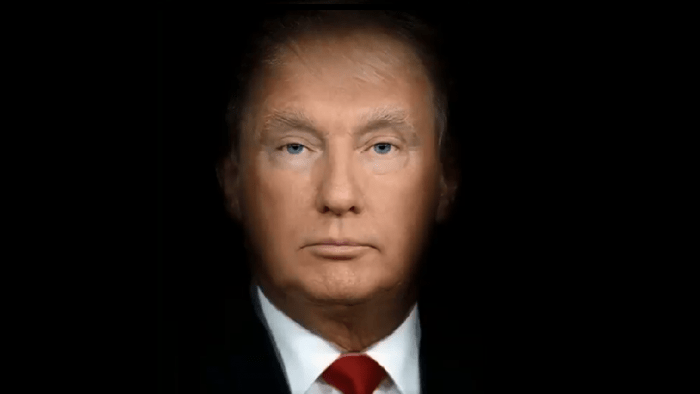
Staring out from the front cover of this week’s Time magazine is a striking, unsettling picture of Vladimir Putin and Donald Trump morphed into one. The hidden, yet unsubtle messaging behind the image is equally unsettling.
Time describes the image as “meaning to represent this particular moment in US foreign policy, following the pair’s recent meeting in Helsinki, Finland.” However, what it really represents is the way that a major US media outlet wants its readers to see these two men. As strange and creepy figures who are in some way linked.
The publication cannot write a story which backs up allegations that the two presidents have some kind of conspiratorial relationship, but it can print an image which insinuates it, demanding your attention and entering your subconscious. If investigators want a textbook example of how the media attempts to subvert and influence, then look no further.
 How many other morphed images of world leaders has Time featured on its famed front page? None. There is no Trerkel, no Macrump not even a Tru Jong-Un. With these leaders there is no conspiracy to sell and no bandwagon on which to jump.
The US is still wrestling with the reality of Trump as president and claims of election interference. The mainstream constantly debates how it was allowed to happen at all, and here Time wants to provide the answer in one unsettling picture. It must have been Putin, the two are so close they could be one person the image suggests, they’re two sides of the same coin.
RT can exclusively reveal that the two do, in fact, have extremely serious connections: they both currently find themselves as the leaders of the two biggest nuclear powers on Earth. That is an incontrovertible fact and, as Trump said in Helsinki, he decided to take a political risk by meeting Putin in an attempt to reduce tensions. In America’s current political climate that is more than enough to get you an insidious Time magazine front page.
The idea is not original. German news magazine Der Spiegel did the identical thing last year by morphing the two men on its cover page. The aesthetic was less psycho warfare horror movie, and more Soviet schtick.
Der Spiegel’s headline was at least more transparent in what it was trying to say ‘The double regent: how much Putin is in Trump?’
Time’s simple ‘The Summit Crisis’ is short and ambiguous enough that the reader has more time to let the hidden meaning of the image settle in.
Has it worked? You only have to look on Twitter to see the words people are using to describe the front page: “Creepy,” “nightmare,” “scary” and “chilling.” Time magazine: mission accomplished.
Syria: Iconic images or chronic lies?

By Vanessa Beely | The Wall Will Fall | September 11, 2015
March 2015 and TIME magazine printed one of the most iconic photos of the Syrian “conflict”. The upended buses forming a barrier of rusting metal carcasses against the threat of “regime snipers”. The article went on to describe how “The Ahrar al-Sham brigade [a group that adheres to the conservative Salafi interpretation of Sunni Islam] placed the buses in such a way. They used ropes, pulleys and a number of men to get the buses in such position. They are [blocking] the view of regime snipers.”
The inference of the article is predominantly the risk from “regime” snipers, a risk for civilians and “rebels”. Speaking to such civilians in Aleppo, it becomes clear that this is a misleading narrative.
“It’s vice versa. The terrorists put these buses that way. It’s obvious that it’s a form of border or barrier between them and us. It is the terrorists that use them as a platform for sniping people and soldiers on the other side. These public buses were owned by the government as a cheap and affordable transportation for the people of Aleppo. Look what they’ve done with it.”
Another comment on the photograph from Aleppo:
“It is a war. This is a demarcation line erected by the terrorists and yes there are many of them all over Aleppo. The other side may be blocked by a huge textile curtain which protects civilians and soldiers from the terrorist snipers who use the buses as cover. The TIME article only talks about the threat from government snipers, this is untrue. The threat we face is from the terrorist snipers or from being caught in the crossfire”
Speaking with civilians living through “rebel” occupation of Aleppo, it appears accurate to say that 80% of these civilians support the Syrian Arab Army in their efforts to cleanse the city of the insurgent cells that are dotted all over Aleppo. The greatest threat faced by civilians is that of the “rebel” hell cannons, mortars, snipers, suicide bombers and explosive tunnels that are dug as a diversion to draw the SAA away from their stronghold on the Acropolis hill in the centre of the ancient citadel of Aleppo which is surrounded by “rebel” camps.
Here are a collection of reports from Aleppo that describe a very different picture to the one portrayed by the Western media and assorted Western funded NGOs and Humanitarian organisations, like the White Helmets who are on the ground in Aleppo and providing a constant stream of biased, pro intervention, anti Assad propaganda, whilst purporting to be neutral & impartial.
It is admitted that there is an element of corruption among some who describe themselves as government officials, an inevitable result of the water and food deprivation which is being imposed upon Aleppo by rebel factions. However, the majority of people in Aleppo still support the Syrian government against the rebel insurgents. As stated, a huge majority have family members in the SAA and fully support their battle to regain control of Aleppo and to rid the streets of the presence of armed and erratic elements.
Karam al-Masri ~ photographer
Let us also look at the photographer of this TIME image and the source of comments quoted in the article.

According to an Al Jazeera article in March 2015, Karam al-Masri was kidnapped and tortured by ISIS at the “start of the war”. He was allegedly incarcerated in the Abu Ghraib prison in Sheikh Najjar, one of the biggest industrial zones to the north of Aleppo.

Al-Masri hails from the Bustan al Qasr area of Aleppo, the area that spans the eastern banks of the River Queik. There has been a flood of stories of the “regime” dumping bodies into the river along this zone. Stories, that have once again been negated by Aleppo civilians:
“The river Queik was reduced to a dry valley, distinctly malodorous in the summer. This ensured the loss of all the species of fish that had been documented by western scientists and historians centuries before. Turkish-Syrian relations had improved in the decade prior to the crisis to the extent that the Aleppo river basin had been converted into a series of canals dotted with beautiful bridges, illuminated at night.
With the advent of the crisis, however, the tide literally turned. The river formed a natural border between terrorist held eastern Aleppo and government held western Aleppo.The river became the terrorist dumping ground for dead bodies, massacred by the terrorists not by the government as depicted in western media whose sole aim was & still is, to demonize the Syrian government.
A couple of years back, the terrorists were sending young kids to buy huge amounts of bread supplied by the government to feed the people of Aleppo city. Once purchased, this bread was callously dumped in the river resulting in a crippling bread shortage for a long time. Eventually the government managed to round up the culprits and imprison them. I don’t have to tell you how the media portrayed this activity but the truth is, it was necessary to ensure the people of Aleppo didn’t starve.”
Anyway back to Karam al-Masri. In the Al Jazeera article, al-Masri makes the rather curious and incendiary claim ” “A camera’s role is greater than a weapon’s, when the regime arrests someone who works in the media, they torture them more than they would an FSA (Free Syrian Army) member.” This from someone imprisoned and tortured by ISIS, the very terrorist organisation being flushed from Aleppo by the SAA.
We could argue that al-Masri is aligning himself with the “moderate rebels” and presume he perceives the FSA to fulfil the criteria of “moderate rebel”. Nonetheless what does get even curiouser, is that al-Masri, despite or prior to his torture and imprisonment, still manages to photograph Al Nusra in October 2013, calling for the establishment of an Islamic State. This is another iconic photo that appeared in many Western media publications:

This photograph accompanied an Al Akhbar article outlining Saudi involvement in the attempted Western regime change in Syria. This is a quote from the article “ The Saudi spy chief, in cooperation with Washington and Paris, is in the process of building up an army of 30,000 fighters, with many coming from the ranks of the “Army of Islam,” which is known to have ties to al-Qaeda’s al-Nusra Front.”
What is also puzzling is the discrepancy in the kidnap story. In the Al Jazeera article, it is claimed that al-Masri [who contributes to the article and would presumably have had editing rights] was imprisoned for 6 months:
“We also meet Karam al-Masri, a photographer who was captured by ISIL, tortured and held for six months at the start of the war”
However, in his own statement, which I have only found in French, al-Masri clearly states 45 days:
“Abu Ghraib”, “Prison de haute sécurité”, “Centre de liquidation”… bien des noms ont été donnés à l’enfer où j’ai passé 45 jours entre les mains de l’Etat islamique (Da’ech).”
There is also a distinct lack of date when this imprisonment occurred in either al-Masri’s personal testimony or in the Al Jazeera article, a bizarre omission from a reporting or witness credibility perspective? Further internet searches did not immediately shed any light on the timeline which makes it hard to pinpoint when al-Masri was imprisoned in relation to his being able to photograph “rebel” factions known to by sympathetic to Islamic State.
In fact if we do a simple google search on the images of al Masri, we see a heady concoction of photographs of Islamic State supporters. Karam al-Masri photographs


The final photograph I will leave you with is this photo of the White Helmets, a US/UK SNC [Syrian Opposition] backed Humanitarian organisation portrayed as impartial “miracle workers” who rescue the civilians of Aleppo from the effects of the Government barrel bombs. The same impartial “miracle workers” and heroes who fail to report on the effects of the “rebel” hell cannon and mortar fire. This photo clearly demonstrates the White Helmet co-operation with Al Nusra, look at the man on the right carrying the stretcher. Members of Islamic extremist groups can be identified by the beard and no moustache, among other identifying features. [NDF source]

This is all simple research and investigation. I am not categorically stating that al-Masri is lying. I am saying that there are a number of inaccuracies in his story and a number of questions that should be asked, particularly when one considers that his testimony and images are used exclusively to further demonize the Syrian Government and the SAA.
Syria is fighting a war on many fronts and the propaganda war is perhaps one of the most insidious and malevolent. It is propaganda that took us to war in Iraq. It is propaganda that ensured the devastation of Libya. It is propaganda that is now clamouring for further foreign intervention in Syria. It is propaganda that must be exposed at source before it further opens the floodgates to hell for the Syrian people.
Featured Video
America Racing to Strategic Defeat in Iran
or go to
Aletho News Archives – Video-Images
From the Archives
Should Europeans ‘Thank’ the Americans for Destroying Nord Stream?
By Robert Bridge | Strategic Culture Foundation | September 29, 2022
With an investigation continuing into the destruction of the Nord Stream gas pipeline that provided energy supplies to Europe from Russia, there appears to be just one prime suspect, and that should surprise nobody.
Following the sabotage of the Nord Stream 1 and 2 gas pipelines, former Polish Foreign Minister Radoslaw Sikorski already seemed to know the identity of the perpetrator when he tweeted out: “Thank you, USA.”
At first glance, it seemed that Sikorski was speaking sarcastically, berating Washington for carrying out an attack that will have severe repercussions for the people of Europe. After all, how could anyone see any good coming from the termination of Europe’s primary source of gas reserves with winter just around the corner? It was Sikorski’s homeland of Poland, after all, that urged its citizens to collect firewood in the face of dwindling gas reserves.
In fact, the Polish diplomat was speaking one-hundred percent literally… continue
Blog Roll
 Aletho News
- Growing insecurity, soaring prices fuel protests in north as regime bans evacuation: Sources
- Iran denies responsibility for ‘depraved’ attack on Kuwait desalination plant
- Bring The Troops Back. End This War Now!
- Can we please stop calling Israel the ‘only democracy in the Middle East’ now?
- US should start removing its troops from Germany, proposes AfD co-leader Chrupalla
- Iran Red Crescent: 600 educational centers attacked in US-Israeli ‘war crimes’
- Russian Oil Tanker Arrives in Cuba Amid U.S. Blockade
- America Racing to Strategic Defeat in Iran: Lt Col Daniel Davis
- FTC Warns Visa, Mastercard, PayPal, Stripe Over Political Debanking
- Russian tanker approaches Cuba despite US oil blockade
- If Americans Knew
- Israeli police block Catholic cardinal from entering Church of the Holy Sepulchre on Palm Sunday
- Israel is assassinating journalists again, more than any other nation, anywhere, ever – Not a ceasefire Day 170
- Over 300 US service members wounded, majority have brain injuries – Not a ceasefire Day 169
- Researchers at Human Rights Watch Resign Over Blocked Report on Palestinian Refugee Return
- Jewish Groups Are Backing a War Americans Don’t Want
- Eric Fingerhut Thinks He’s the President of the Jews
- Top Jewish Philanthropists, Rabbis Urge Israeli President to Take Action Against ‘Jewish Extremists’
- Don’t Be Fooled. Zionist Leaders Have Always Wanted to Control Southern Lebanon
- Israel’s widespread use of torture is a core element of its genocide against the Palestinian people
- In Israel’s War on Iran, Many Middle East US Bases Rendered “All But Uninhabitable”
- No Tricks Zone
- New Study Finds Warming Saves Lives…Cold Temperatures 12 Times More Deadly Than Excess Heat
- German Science Blog Accuses PIK Climate Institute Of Hallucinating Climate Tipping Points
- Devastating Assessment Of Comirnaty Vaccine By Former Senior Pfizer Europe Toxicologist
- New Study: CO2 Is ‘Effectively Negligible’ As An Explanatory Climate Change Factor Since 2000
- Former Pfizer Toxicologist Dr. Helmut Sterz Tells Bundestag Hearing Pfizer Vaccine Should Have Never Been Approved
- Energy Expert: Germany’s Nuclear Phaseout Was A “500 Billion Euro Mistake”
- New Research: South Australia’s Mid-Holocene Sea Surface Temperatures Were 4°C Warmer Than Today
- Storing Green Energy To Last Germany 10 Days Would Require A 60-Million Tonne Battery
- New Studies: UK Sea Levels Were 4 Meters Higher Than Today During The Mid-Holocene
- Destructive Green New Deal: German Energy And Metal Group Warns Of Drastic Crisis
 Aletho News