Washington’s Sum of All Fears: Kurdish Militants Cut a Deal with Damascus
By Patrick Henningsen | 21st Century Wire | October 14, 2019
Last night, Kurdish officials in northeastern Syria issued a statement that an agreement has been reached with the government in Damascus allowing the Syrian Arab Army (SAA) to takeover key strategic positions along the Syria’s northern border with Turkey.
Not surprisingly, cheers can he heard from Damascus to Moscow, and Tehran too, while leaving Washington’s foreign policy blob visibly moaning in agony.
The reality of the situation is that Turkey sprung a trap set by Damascus and its allies. In doing so, Turkey helped to clean up what was previously a near impossible situation for Damascus.
While much of the western mainstream media has laboured over ‘Trump’s decision‘ to pull-out US troops from Syria, there are other factors which have been driving the current situation. If you’ve been monitoring the Turkish press over the last few years, you would know that Turkey’s President Recep Tayyip Erdoğan has been eager to fire-up his AKP base at home and project Neo-Ottoman power regionally, so this latest Turkish foray into Syria can be seen as a resumption of the ‘New Turkey‘ – the AKP’s gradual transformation of Turkey from a secular Kemalist state, to an Islamic one. This gradual revolution is not confined within Turkey’s own borders though, as it hopes to extend its micro-colonial project of Sunnification to include areas in question located inside and along Syria’s northern border with Turkey. Hence, Ankara has moved its forces into Syrian territory for the third time in as many years, this time dubbed “Operation Peace Spring,” and with Erdogan justifying the move under the auspices of ‘fighting terrorism,’ vowing once again to secure the country’s national security by stamping-out the Kurdish YPG-PKK ‘terrorist threat’ embedded in northern Syria. He may have achieved some marginal success in this department, but not in the way most mainstream pundits think.
Unknowingly perhaps (or not), Turkey helped towards resolving at least three separate problems which had been grating at Damascus and Moscow for at least the last three years. Firstly, the Turkish incursion has finally displaced uninvited US military forces that had begun illegally occupying northeastern Syria since late 2016, effectively propping-up their SDF (Syrian Democratic Forces) Kurdish-led proxy militants, many of whom share membership with Kurdish YPG/PKK militant groups. This weekend has shown the world that without its US protection, Kurdish-led forces are not as viable as they have been depicted in the western media, now exposed to the painful reality that their ‘autonomous’ status in northeastern Syria is on borrowed time, evidenced by the fact that they failed to protect Kurdish residents from the Turkish military and their jihadi vanguard ground forces, formerly known as Free Syrian Army (FSA), who’ve rather cynically rebranded themselves now to the ‘Syrian National Army’. With Syrian Kurdish forces now on their back heels, they were left with no other option than to approach Damascus to negotiate an alliance. That agreement was inked this weekend, with the SAA now heading towards key towns and cities in the northeast of Syria including one of the centers of fighting – the hotly contested Syrian border town of Kobani. This new reality also means that Turkish military will not willingly fire upon SAA forces inside of Syrian sovereign territory, although Turkey’s jihadist FSA/SNA militias might engage with its old nemesis. Those side skirmishes could prolong instability, but they are not nearly as insurmountable as entrenched US forces in the area.
Reports show the SAA’s arrival in these areas as being met with cheers from crowds – which is a public relations disaster for Washington and its Kurdish ‘Rojava’ nation-building project in northern Syria.
Lastly, aside from securing its key northern border crossings, Damascus in now one step closer to reclaiming its oil and gas fields situated north of the Euphrates river near the city of Deir Ezor, and which have been continuously occupied by ISIS and SDF forces respectively since 2014. Liberating its own domestic energy supply will go a long way towards helping Damascus mitigate some of the economic suffering felt as a result of the imposition of joint EU-US sanctions, a punitive embargo designed by western powers to strangle the country and foment more domestic unrest.
A New Middle East
The Kurdish request for Damascus protection also flies in the face of years of western propaganda which tried to justify Washington’s policy of military occupation and nation-building by convince the world that the Syrian government was unwelcome in the northeastern region of its own country, and that “Kurdish independence” was a fait accompli. Moreover, Damascus is a step closer to securing previously vulnerable stretches of is eastern border with Iraq which the US was previously ‘managing’ and which allowed ISIS the move through and use as a staging ground for attacks further afield in areas like Sweida and Al Tanf. If a mutual security arrangement can be reached between Syria and Iraq to secure its shared border, then this would potentially revolutionise political and economic affairs in the region, and even globally.
If these events do come to pass, it would be a complete defeat for decades of Washington-led efforts in the region. Together with its allies, the US has worked long and hard to keep this part of the Middle East unstable and divided. It was in this US-led and Saudi and Israeli-engineered environment of destablisation that both al Qaeda and ISIS terrorists were able to emerge and thrive for so long. Its adversaries should remain vigilant though, as history demonstrates, both Washington and Israel are not above provoking instability in order to achieve their shared short-term and long-range goals for the region.
Regardless, the board has been flipped in Syria. Unable to either hold territory or keep thousands of ISIS prisoners in custody, US-backed SDF militias have been exposed as the latest in a long lineage of hapless pawns of Washington in the Great Game. Once new ground locations are secured by SAA forces, then Damascus could invite Russian air support to secure this airspace – an outcome which can only mean that terrorists’ days will be numbered going forward. Any remaining ISIS or Al Qaeda terrorists brigades active in north of the Euphrates will have few remaining escape routes, other than north to seek refuge in the various AKP-sanctioned terrorist enclaves located across the border in southern Turkey.
As this author said back in early 2018, the US-Kurdish dance in northeastern Syria was always a game of musical chairs, and sooner or later, someone had to leave. And that someone is the USA, and immediately followed by ISIS.
As President Bashar al-Assad said already, Syria is determined to reclaim “every inch” of its territory. So it might behoove western powers not to underestimate the will and determination of a country and army which has withstood eight years of a fully internationalised regime change war waged against it.
***
Author Patrick Henningsen is an American writer and global affairs analyst and founder of independent news and analysis site 21st Century Wire, and is host of the SUNDAY WIRE weekly radio show broadcast globally over the Alternate Current Radio Network (ACR). He has written for a number of international publications and has done extensive on-the-ground reporting in the Middle East including work in Syria and Iraq.
US poised to withdraw remaining troops from northeastern Syria: Pentagon
Press TV – October 13, 2019
The Pentagon has announced that the United States is set to withdraw the rest of its troops from northeastern Syria amid an ongoing Turkish offensive in the region.
Defense Secretary Mark Esper said in an interview with the CBS News on Sunday that the US would be pulling out around 1,000 troops from Syria’s northeast as part of a “deliberate withdrawal” directed by US President Donald Trump.
Describing the situation for American troops in the region as “untenable,” Esper said the measure was taken to ensure that US forces were not “put in harm’s way.”
During the interview, the Pentagon chief claimed that Kurdish militants of the so-called Syrian Democratic Forces (SDF) were planning to negotiate a deal with the government in Damascus and Russia to withstand the Turkish attacks.
“In the last 24 hours, we learned that [the Turks] likely intend to extend their attack further south than originally planned, and to the west,” Esper told the CBS News.
“We also have learned in the last 24 hours that the SDF are looking to cut a deal with the Syrians and the Russians to counterattack against the Turks. And so we find ourselves, we have American forces likely caught between two opposing advancing armies, and it’s a very untenable situation,” he added.
Turkish military forces and Turkish-backed militants of the so-called Free Syrian Army (FSA) on Wednesday launched a long-threatened cross-border invasion of northeast Syria in a declared attempt to eliminate Kurdish militants from the so-called People’s Protection Units (YPG) to push them away from border areas.
The YPG, which itself is the military wing of the Syrian Kurdish Democratic Union Party (PYD), constitutes the backbone of the SDF, an anti-Damascus alliance of predominantly Kurdish militants.
Ankara views the US-backed YPG as a terrorist organization tied to the homegrown Kurdistan Workers’ Party (PKK) militant group, which has been involved in armed separatism in Turkey since 1984.
Turkish President Recep Tayyip Erdogan said on Friday that Ankara will not stop its military operation against Kurdish militants in northeastern Syria “no matter what anyone says.”
The Turkish Defense Ministry announced on Sunday that a total of 480 YPG militants had been “neutralized” since the operation began.
The Turkish military generally uses the term neutralize to signify that the militants surrendered or were killed or captured.
The self-proclaimed Kurdish-led authority in northeastern Syria says more than 191,000 people have been displaced as a result of the Turkish invasion.
The US has long been providing the YPG and SDF militants with arms, calling them a key partner in the purported fight against the Takfiri Daesh terrorist group in Syria. Many observers, however, see the support as part of Washington’s plans to carve out a foothold in the Arab country.
The Turkish military, with support from allied militants of the so-called Free Syrian Army, launched two cross-border operations in northern Syria, namely “Euphrates Shield” in August 2016 and “Olive Branch” in January 2018 with the declared aim of eradicating the presence of Kurdish militants and Daesh terrorists near Turkey’s borders.
Trump Targets Turkish Economy, Gov’t Officials With Possible Sanctions Over Syria Invasion – Mnuchin
Sputnik – October 11, 2019
President Trump has called Turkey’s operation against Kurdish forces in northern Syria a “bad idea,” and said that in addition to possible sanctions, he would like to see something “much tougher” done against Ankara. Earlier, a group of senators said they were working on a package of “deep and devastating” “sanctions from hell” against Turkey.
President Trump will be signing an executive order giving US officials new powers to target Turkey and its government officials with “very significant sanctions,” Treasury Secretary Steven Mnuchin has announced.
Speaking to reporters on Friday, the official clarified that the “very significant” powers to sanction Turkey had been authorised, but not yet activated.
“I just met with president Trump, and he has authorised and will be signing a new executive order giving the treasury department, in consultation with himself and Secretary [of State Mike] Pompeo, very significant new sanctions authorities that can be targeted at any person associated with the government of Turkey, any portion of the government,” Mnuchin said. “This will be both primary sanctions and secondary sanctions that will be applicable.”
Mnuchin warned that the US would be able to “shut down” Turkey’s economy if necessary amid Ankara’s ongoing campaign against US-allied Syrian Kurdish forces in northern Syria.
“The president is concerned about the ongoing military offensive and potential targeting of civilians, civilian infrastructure, ethnic or religious minorities. Also, the president wants to make very clear that Turkey not allow even a single ISIS [Daesh] fighter to escape,” the secretary stressed.
On Thursday, lawmakers in the House of Representatives announced that they would support efforts by the Senate to impose sanctions on Turkey, with House Republican Conference chairwoman Liz Cheney saying “President [Recep Tayyip] Erdogan and his regime must face serious consequences” for the attack against Washington’s Syrian Kurdish allies.
Also on Thursday, President Trump told reporters that he was considering doing “something very, very tough with respect to sanctions and other things” over Turkey’s Syria operation.
…. We have one of three choices: Send in thousands of troops and win Militarily, hit Turkey very hard Financially and with Sanctions, or mediate a deal between Turkey and the Kurds!
— (@realDonaldTrump) Donald J. Trump
Turkish Foreign Minister Mevlut Cavusoglu later responded to Trump’s string of statements and tweets on the Turkish operation in Syria, saying Washington would not be able to change Ankara’s policy. On Friday, the foreign minister blamed the US for the Syria crisis, saying Ankara was forced to start its operations in part due to the supply of US arms supplies to the Kurds.
Turkey launched its new Syria campaign, dubbed ‘Operation Peace Spring’, on Wednesday, saying its aim was to clear the border area of Kurdish militants and Daesh (ISIS) terrorists and to establish a security zone. Turkey has repeatedly clashed with Syrian Kurdish forces during the long war in Syria, and classifies the YPG People’s Protection Units as ‘terrorists’, accusing them of having links with the Kurdistan Workers’ Party, a Turkish Kurdish militia and political movement which has been waging a guerilla campaign against the Turkish state for decades.
On Friday, Russian President Vladimir Putin said Moscow and other countries in the former Soviet space were concerned with the “real threat” potentially posed by the escape of Daesh fighters currently being held in Syrian Kurdish-controlled areas. “I’m not sure if the Turkish army can quickly take control of it,” he said, speaking at a Commonwealth of Independent States summit in Ashgabat, Turkmenistan. Putin and Erdogan held telephone talks on Wednesday, with the Russian president reportedly urging Ankara to assess the situation and to not harm the efforts to settle the crisis in Syria.
On Thursday, Iran, another co-guarantor of the Syrian peace process, called on Turkey to halt its offensive immediately and to pull out of Syria.
Damascus has repeatedly called on all uninvited forces operating in Syria to withdraw immediately, and accused Turkey of “aggressive intentions” and a “disgraceful breach of international law and UN resolutions that respect Syria’s sovereignty and territorial integrity” with its norther Syria operation.
‘Ironic’: Congress Seeks to Punish Turkey’s Incursion, Even as US Troops Remain in Syria
Sputnik – October 11, 2019
Turkey’s “Operation Peace Spring” has kicked off in Syria and caused a divide in the US muddied by what US President Donald Trump has deemed a misunderstanding. With Turkish troops already clashing with Kurds, hundreds dead, and US politicians calling for sanctions on Turkey, the so-called confusion may trigger a larger conflict.
In response to Turkey’s offensive, GOP members of the US Congress have called for sanctions to be placed on NATO ally Ankara, and Rep. Liz Cheney (R-WY) issued a Thursday statement that said: “President [Recep Tayyip] Erdogan and his regime must face serious consequences for mercilessly attacking our Kurdish allies in northern Syria.”
This came hours after Senators Lindsey Graham (R-SC) and Chris Van Hollen (D-MD) introduced their own proposal for sanctions.
While Turkey claims Operation Peace Spring is necessary for its security, Spain, another NATO ally, has also threatened to take action against Ankara and remove its Patriot missile defense systems from the country.
Peter Ford, the former UK ambassador to Syria, joined Radio Sputnik’s Loud and Clear on Thursday to explain the main point of confusion concerning Trump’s troop pullout and highlight the hypocrisy from US officials.
“There was never any serious talk of Kurdish region breakaway. Never. Not until the US presence,” Ford told hosts Brian Becker and John Kiriakou. “It’s actually been the US presence and guarantee which has been the real cause of destabilization.”
The former ambassador said that while the Kurds did have some grievances in the region, such as calls to have “more teaching of the Kurdish language in their schools,” Syrian Kurds have historically “been well integrated into the state.”
Trump’s statements on pulling out of Syria and bringing US troops home have been the subject of bipartisan ire, but the US president explained earlier this week that only approximately 50 soldiers were removed from the area.
Ford echoed the president’s claim and asserted that “all the hyperventilating” was over “the removal 50 guys.”
“The remaining hundreds of US forces are still there controlling about 20 to 25% of Syrian territory rich with oil and grain, preventing the reabsorption of those areas into the state of Syria. They still stand ready to act as a tripwire against the forces of Damascus,” he said. “Trump, for all his bluster about bringing the troops back, has taken only a very small step towards that goal.”
He went on to say that he believes that once the dust settles on this issue, those in the US currently outraged by Trump’s actions will realize how minimal the withdrawal is in reality. That is, unless there are Turkish “atrocities” in the area.
Ford concluded that in any case, he finds it quite “ironic that all these people who see no objection to the US occupying Syria are hyperventilating about another NATO power occupying Syria. The situation is very rich in irony.”
On the Geo-Politics of Turkish Incursion into Syria
By Salman Rafi Sheikh – New Eastern Outlook – 10.10.2019
Despite the fact that Turkey has been defying the US as of recently with regard to its purchase of Russian S-400 missile system, the US president has finally conceded to its NATO partner’s long-standing demand of invading northern Syria and wipe out the Kurdish militias. This is a critical decision since Kurdish militias were the main US ground allies in the war against the Islamic State in Syria. With the US now abandoning its only ground ally in Syria, a policy shift is in the air, a change that might ultimately go to Syria’s benefit. While we shall come to this point later, what is pertinent here to discuss is the factor that led the US to change its erstwhile position vis-à-vis Kurds.
There is hardly any gainsaying that the world is increasingly becoming multipolar, and Turkey being a ‘Middle Kingdom’ between two poles has been making the best use of its geo-strategic position in the emerging world order. As Erdogan said in his recent UNO speech, “the world is bigger than five.” He was referring to the five permanent members of the Security Council: Britain, France, Russia, China, and America. Perhaps he wants his country to be included as a sixth, or that the world has already changed too much for these countries to manage on their own without showing sensitivity to other powers’ interests.
As many reports in the mainstream western media have indicated, Turkey, despite its very explicit strategic ties with Russia, remains important for the US. The fact that the US, despite being so deeply accustomed to running the world unilaterally, has had to change its position reflects the necessary foreign policy and strategic adjustments that even the US is having to make in this increasingly multipolar world where a country, relatively much smaller than the US and lying on the intersection of Asia and Europe, can force a much bigger and powerful country to prioritise a smaller country’s interests.
Two things, as such, stand out. First, Turkey is no longer a pliant and a willing US partner and/or a strong adherent to the dead cold war agenda of ‘containment’ of the Soviet Union, or Russia and China in the contemporary era, although it still continues to provide İncirlik Air Base, a military airport in southeastern Turkey, which hosts fifty tactical nuclear weapons aimed at primarily reinforcing what NATO experts call ‘extended deterrence guarantee’ of their organisation against a Russian invasion of Europe. Secondly, the US, due to deep presence of Russia in the region, is no longer an external hegemon entrenched in the region, practically no longer in a position to force its policies on its partners. This means that Turkey is in a far better position to pursue its interests a lot more independently than was the case few years ago. This is perhaps the reason why Russia, despite knowing that Turkish territory can be used against Russia in any future conflict with the NATO, is still developing its relations in a way never known before to both countries.
This is something that the US cannot control. All it can do is to adjust its position to secure its long-term interests. Its decision to stand aside in the up-coming Turkish On the Geo-Politics of Turkish incursion reflects that adjustment.
On the other hand, Russia and Syria are also very much in the equation. While Syria and Russia may object to a large scale military presence of Turkey in Syria—and both will reiterate that this presence is uninvited and has no legal basis—this objection will not turn into a practical opposition; for, a Turkish incursion and the US silence that followed together with its abandoning of Kurds might bring the Kurds closer to Syria and Russia.
Russian officials, as of recently, have been speaking of the “maximalist positions” the Kurds have adopted in their dealings with the Syrian government. Therefore, when cornered by the Turks and abandoned by the US, they might turn to the Syrian government for a settlement. This will, of course, provide Syria and Russia with an opportunity to reunify the whole of Syria, an ultimate objective that even Turkey has shown sensitivity to. A recent statement from the Turkish foreign minister, Mevlüt Çavuşoğlu, said that Ankara had “supported the territorial integrity of Syria since the beginning of the crisis and will continue to do so” and that by eliminating all ‘terrorist forces’ from that region, Turkey will only “contribute to bringing safety, peace and stability to Syria.”
Also, given that Russia has been eyeing an expansion of cooperation with Turkey beyond Syria, Moscow will not object to Turkish incursion and let Ankara slip out its hands. At the same time, Moscow would want to make sure that no large-scale fighting takes place, allowing rouge groups like ISIS and al-Qaeda to resurface and reverse the gains Russia and Syria have made in last two years or so.
Moscow will, therefore, make its own adjustment and prefer to play a mediatory role between the Kurds and the Turks, and Kurds and Damascus in order to solidify Syrian control on all of its territories.
Given this, it is possible that a settlement might emerge out of the storm that Turkey is going to start. Moscow’s mediation might be acceptable to all the parties. Ankara, of course, would want a guarantee from Damascus and Moscow about Kurds being confined to their traditional areas and not engaging in any militant and activities against Ankara, or inciting separatism among the Kurds living in Turkey.
Salman Rafi Sheikh is a research-analyst of International Relations and Pakistan’s foreign and domestic affairs.
#TrumpBetrayedtheKurds: “Progressive Hollywood” Calls for War
Conditioned “influencers” crying crocodile tears on cue
By Kit Knightly | OffGuardian | October 10, 2019
I wrote, just a few days ago, that we’d be able to tell just how real Trump’s “Syria Withdrawal” was by how loud, and how strong, the establishment voices came out against it.
The media (and collected punditry) will likely play the “poor little Kurds” card a lot in the next few days…[this] will determine how much of a genuine threat to the establishment agenda this “withdrawal” really is.
Turns out, it might be a lot.
Every single media outlet is variously “shocked”, “appalled” or “disgusted”. Politicians from both sides of the house (and Israel) have condemned him. Media pundits, ex-generals. Combat veterans in the Independent.
Even good-old Fox News, Trump’s only real support in the media, have finally had to choose between supporting the President and supporting war. They chose war.
Nowhere is this seething hatred of Trump, and adoration of the Kurds stronger than Hollywood. A population of ill-informed moralising egos have decided Trump’s “betrayal” of the Kurds is his greatest crime, despite having very little idea who the Kurds are or what (if anything) they have ever done.
Still, there’s not to reason why, there’s just to tweet and lie.
Compare the hysteria about “protecting the Kurds” today, to the tone of commentary on the invasion of Iraq in 2003. The difference is startling.
Hell, compare it to Yemen. Were there this many hashtags about Yemen? Of course not.
The Hollywood outrage machine only kicks into gear when American troops WITHDRAW, but never when they ATTACK.
All of the US aggression against Syria was met with a shrug by these same people, and the hundreds of others like them. If they even knew it was happening.
But it’s not just Hollywood, even the “new wave” of Brave Democrat Women were keen to oppose withdrawing US troops from a country they are illegally occupying in breach of international law.
Somewhere along the line, the poison of identity politics has totally subverted the traditionally anti-war politics of the fringe-left, the arts, actors and writers.
They now respond literally like programmed robots, without ever pausing to question their hardcoded responses
Trump wants to run “end war”.
Trump = “bad”
Therefore: “end war” = “bad”
Therefore: “war” = “good”.
The process runs, the output is logged and off they run: Damning Trump for his stupid racist fascist peace, and declaring we should be fighting a lovely progressive war (against…Turkey? I guess? I’m not sure and neither are they).
This is the ultimate victory of the Deep State in the United States. The zenith of Trump Derangement Syndrome: The Pavlovian conditioning of the entire “liberal” establishment.
We told you this would happen.
Despite Withdrawal Claims, US Troops Retain ‘Colonial’ Hold on Syrian Kurdish Lands
Sputnik – October 10, 2019
Turkish President Recep Tayyip Erdogan has announced Ankara’s military offensive against the Kurdish-led Syrian Democratic Forces just a day after US President Donald Trump announced he would pull troops from Syria. However, with US troops simply shifted in the region, questions remain about Trump’s actual motivation.
On Wednesday, Erdogan announced that Turkey would be carrying out “Operation Peace Spring” in order “to neutralize terror threats against Turkey and lead to the establishment of a safe zone” and combat terrorism in the region.
The move and its intended “safe zone” for refugees have been condemned by the European Union and European Commission President Jean-Claude Juncker, who said “it will not work,” in a Wednesday address in Brussels.
Nevertheless, Turkey has pushed forward, and some Washington officials are even defending Ankara’s offensive.
Ambassador Peter Ford, the former UK ambassador to Syria, joined Radio Sputnik’s Loud and Clear on Wednesday to discuss the Washington’s possible motivation behind moving US troops in the region
“It looks like all the US has done is … pull back 150 guys who [were] sprinkled in that northern safe zone,” Ford told hosts John Kiriakou and Brian Becker. “But they are still there with the rest of the 1,000 occupying that quarter of Syria, which is effectively controlled by the US.”
While the move is minor, the ambassador pointed out that now the Turks are able to make their first move in the region “without having to worry about tripping over US” troops.
Amid both domestic and international backlash for Trump’s decision, US Secretary of State Mike Pompeo spoke with PBS in a Wednesday interview and said Washington in no way provided Ankara with “a green light.” He went on to defend Turkey’s offensive by asserting they had “legitimate security concerns” and argued that Trump’s decision to move to troops was out of concern for their safety.
Ford highlighted that “the Turks are not actually being threatened by the Kurds [and] there have been virtually nil incursions from the Kurdish side of the Syrian border,” and that Turkey’s claim of respecting “the territorial integrity of all our neighbors” is false.
Instead, Turkish troops have been deployed to “prevent the emergence of a US-protected Kurdish statelet,” Ford said.
According to him, it is likely that the Kurds will “mount a token resistance,” rather than to go all in against Turkey, and “hope the hullabaloo in the US will force the Turks to either stop or withdraw.”
Ford reiterated that while Trump said he wanted to bring the US troops home, the fact remains that they are still in Syria. Prior to this move, part of the rationale given for having a US troop presence in the region was to deter a Turkish attack, but with that no longer being an objective, “the only remaining rationale is to deter the Syrians from regaining control of their own country,” he asserted.
“You have to ask: at the end of the day, what right does America have to prevent a country like Syria [from] establishing control over itself? This is purely colonial, imperialist behavior.”
Pompeo & Biden BOTH have it wrong: ‘Green light’ for Turkey’s Syria invasion wasn’t for the US to give
RT | October 9, 2019
Presidential candidate Joe Biden and US mainstream media insist the White House gave a ‘green light’ to Ankara to invade Syria. Secretary of State Mike Pompeo denies it. Neither seem to understand that it’s not up to Washington.
Trump “impulsively gave Turkey a green light to invade Syria, blindsiding our military,” Biden tweeted on Wednesday, accusing President Donald Trump of a “betrayal” of Kurdish fighters that helped the US defeat Islamic State (IS, formerly ISIS).
The “green light” phrasing also found its way to most mainstream media outlets. Later in the day, Judy Woodruff of PBS NewsHour treated it as an established fact, asking Pompeo to comment on the Turkish operation in northern Syria.
“Does the US take responsibility for whatever the outcome is, because the US has given Turkey a green light?” asked Woodruff.
“Well, that’s just false. The United States didn’t give Turkey a green light,” Pompeo replied.
He’s technically correct. As Turkey launched ‘Operation Peace Spring,’ bombing Kurdish targets in northern Syria on Wednesday, Trump issued a statement calling it “a bad idea” and warning Ankara that it was now responsible not just for the safety of civilians in the area, but the fate of IS prisoners.
However, the real issue isn’t whether Washington did or did not give Ankara the “green light” for its military adventure. The question no one in Washington or the legacy media seems to be asking is whether such permission was up to the US to give – because the obvious answer is “no.”
American politicians and pundits of all stripes love to talk about the “rules-based international order,” but one of the actual, written rules of that order is that the world consists of sovereign nation-states, one of which is Syria. Both the US and Turkey have had troops in Syria for years. Yet neither has been invited by the Syrian government – unlike, say, Russia, which has had an expeditionary force there on request from Damascus since 2015.
Only Damascus, or the UN Security Council, can legitimately give the “green light” for a military intervention in Syrian territory. Neither has done so.
Syria Says Ready to Welcome Kurds back into Fold
Al-Manar | October 8, 2019
Damascus voiced readiness on Tuesday to welcome Syria’s Kurds back into the fold after Washington left them to face Turkish military threats alone.
Deputy Foreign Minister Faisal Mekdad stressed that Damascus “will defend all Syrian territory, and will not accept any occupation of its land,” he told Al-Watan newspaper.
The official said Kurdish groups have been “tossed aside” by Washington, after US President Donald Trump on Monday gave Turkey a green light to press ahead with its planned military operation.
“The nation welcomes all its children and Damascus will solve all problems in Syria in a positive manner, away from violence,” Mekdad said, vowing to take back all Syrian territory.
“We advise those who have gone astray to return to the nation, because the nation is their final destiny,” he added, encouraging Syria’s Kurds to reconcile with the government.
Ankara has threatened an offensive in Syria against Kurdish militias and US forces on Monday pulled back from Turkish border areas, opening the way for an invasion President Recep Tayyip Erdogan has said could come at any moment.
Mekdad said that Kurdish militias in Syria were being “played” by Washington.
Worried for Kurds in Syria, abandoned by US? Here’s an obvious solution but it will make Washington hawks MAD
By Nebojsa Malic | RT | October 7, 2019
US President Donald Trump’s decision to pull out US troops from northern Syria has been met with bipartisan outrage, calling it a “betrayal” of the Kurds. Wait till the regime-changers hear the obvious solution to keep them safe.
As some two dozen US troops stationed in northwestern Syria began to withdraw on Monday, reports began coming in of Turkish airstrikes against Kurdish targets. Ankara is apparently calling the operation “Fountain of Peace.”
Officially, the goal is to establish a “safe zone” along the border to resettle some of the 3,6 million Syrian refugees. Oh, and also to set up a buffer zone between the Kurdish militias in Syria – YPG and YPJ – from their PKK kin in Turkey, designated terrorists by Ankara.
Trump’s detractors in Washington have denounced his decision as a “betrayal” of the Kurds, accusing the president of abandoning the force that the Pentagon has used as boots on the ground against IS in eastern Syria. Recall that it was the Kurdish-led “Syrian Democratic Forces” (SDF) that liberated Raqqa – “capital” of Islamic State (IS, formerly ISIS) – in October 2017.
Thing is, the Obama administration sought to create some kind of parallel government in those territories, in line with its policy of demanding regime change in Damascus and the overthrow of Syrian President Bashar Assad.
If Kurdish leaders thought this would somehow translate into support for statehood, or dominion over traditionally Arab-majority territories, they were dangerously deluded. Trump has made it clear from the beginning of his presidency that he had no interest in “nation-building” anywhere, and has tried to put that info effect despite constant push-back from the US establishment.
What happened in August 2016 should have also been a clue – and offers a possible way out of the present conundrum. Back then, Turkey invaded from the north in ‘Operation Euphrates Shield,’ attacking the Kurds from the rear just as the SDF was launching the major push against Raqqa. The US did nothing to stop this. Only when the Syrian Arab Army – accompanied by Russian observers – stepped in to create a buffer zone between the Turks and the SDF, did the invasion stop.
While Ankara thinks nothing of attacking the Kurds, it is hard to imagine it would dare open fire on Syrian troops – or the Russians fighting alongside them. The obvious solution for the Kurds is to make a deal with Damascus and secure the protection of the Syrian government that the US could never provide. This would keep them safe, while keeping Damascus happy and Ankara without grounds to object.
The only ones displeased by this would be regime-change advocates in Washington – but that’s their problem.
US Move in Syria a “Stab in Back” for SDF: SDF Spokesman
Al-Manar | October 7, 2019
The Kurdish-led Syrian Democratic Forces (SDF) has been “stabbed in the back” by a surprise U.S. statement on Monday that U.S. forces would not be involved in a Turkish operation in northern Syria, the SDF said.
“There were assurances from the United States of America that it would not allow any Turkish military operations against the region,” SDF spokesman Kino Gabriel said in an interview with al-Hadath TV.
The SDF had been “completely committed” to a U.S.-guaranteed deal for a “security mechanism” for the border area, he added.
“But the (U.S.) statement today was a surprise and we can say that it is a stab in the back for the SDF,” he said.
Trump says ‘too costly’ to back Kurdish forces in Syria
U.S. President Donald Trump on Monday defended his administration’s decision to withdraw U.S. troops from northern Syria, saying it was too costly to keep supporting U.S-allied Kurdish-led forces in the region fighting the ISIL terrorist group.
“The Kurds fought with us, but were paid massive amounts of money and equipment to do so. They have been fighting Turkey for decades,” Trump said in a series of tweets.
“Turkey, Europe, Syria, Iran, Iraq, Russia and the Kurds will now have to figure the situation out.”
Turkey’s safe-zone and refugee peace-corridor is a cover for encroachment
By Sarah Abed | October 7, 2019
On Saturday, Turkey’s President Recep Tayyip Erdogan announced that preparations have been made for a unilateral cross border air and land military operation in the next day or two, in northern Syria, east of the Euphrates River. Erdogan expressed his frustration with Washington’s lack of adherence to a September 30th deadline to establish a thirty-kilometer-deep safe zone on Syria’s northern border.
In response to Erdogan’s threat, the US-backed Kurdish militia group known as The Syrian Democratic Forces (SDF) stated that they are ready to respond to an unprovoked Turkish attack with an all-out war if necessary.
Sandwiched between the Turkish-backed Free Syrian army and their affiliates and the US-backed Kurdish militias are Syrian civilians who are at risk of losing their homes, land, and lives. They are opposed to both entities and want the war to end.
Erdogan has made this same threat to target Kurdish militias on Syria’s northern border numerous times over the past year. Each time Washington strongly condemns any sort of unilateral military operation that could put US troops and their Kurdish militia allies in harm’s way. Then at the eleventh-hour placates Turkey by agreeing to help protect their national security by establishing a safe zone on the Syrian border or creating a “peace corridor” for Syrian refugees to return from Turkey to Syria. Wash, rinse and repeat every few weeks.
In August, an agreement between the United States and Turkey was made to establish the safe zone and peace corridor on Syria’s northern border. Some People’s Protection Units Kurdish YPG fighters removed their posts and left the safe zone area. Three Turkish/US joint patrol operations have taken place since August. But Turkey still feels that not enough has been done and there are disagreements between the two regarding, depth, who should oversee the safe zone, and who needs to be removed from it. Turkey isn’t satisfied with a 10-15 km safe zone; they want 30 km and to be in total control of it.
It’s worth noting that the Syrian government has been vocal in their opposition to the creation of a Turkish safe zone or peace corridors on its land as well as joint patrol operations. Damascus knows that Turkey’s true intentions are expansion and changing the demographics and forcing the return of millions of Syrian refugees to areas in northern Syria where they do not originate from.
On the surface, establishing a safe zone for refugees might not seem like much of an issue. Especially if one thinks of Syria in the same terms as the United States and considers Aleppo, Damascus, Homs, Al Hassaka etc. as just states within a united country. But it is an issue, and there are major differences in tribes, religion, ideologies, political affiliations and loyalties that are not being taken into consideration.
Now, this isn’t to say that Syrians are incapable of peacefully coexisting, they can and have, but forcing entire populations to shift creating huge demographical changes on Syrian soil is problematic and if Turkey is truly worried about their national security they can establish a safe zone on Turkish land to protect themselves but they do not have a right to encroach on Syrian land.
In addition to the safe zone and peace corridor, Turkey has consistently demanded that the United States end their alliance with the Kurdish militias in Syria, the YPG and SDF who they consider to be an extension of the Kurdish Kurdistan Workers Party (PKK) whom they have been at war with for over three decades.
Rather than cut ties to make their NATO ally happy, the United States has continued to support Kurdish militias since 2015, even assisting in a name change from YPG to SDF to disassociate them from the Turkish PKK.
Earlier this week another large convoy of US military trucks destined for the SDF made its way into northeastern Syria from Iraq.
If Turkey does carry out their alleged cross border military operation it will be the third of its kind in as many years. Just a few days ago, fragmented Turkish-backed militia groups including the Free Syrian Army merged into one with roughly 60,000 fighters, in preparation for this military operation.
The US is caught between supporting their Kurdish militia allies and supporting Turkey, their NATO ally. If US President Donald Trump truly wants to withdraw US troops from Syria like he has publicly stated numerous times, then he should use this opportunity as a perfect excuse. Pulling US troops would of course anger the Kurdish militias who the United States has supported for the past four years with weapons, funds, military equipment, intelligence etc. but it would cause the SDF to try to work things out with the Syrian government and army and unite with them.
Turkey has drawn out a detailed plan for resettling two million Syrian refugees in the safe zone and many are concerned that once these Turkish loyalists have resettled on Turkey’s border, Ankara will claim ownership on Syria’s northern region. Turkey’s plan would cost roughly $27 billion and Turkey is not planning on footing the entire bill and has asked for other nations to assist funds to carry out its plan.
Turkey’s plan includes establishing 140 villages, 10 towns, a Turkish university with three faculties including an Islamic Sciences faculty in Azaz, an Education Faculty in Afrin and an Economics and Administrative Sciences faculty in Al Bab. Each village would have 1,000 homes which would house 5,000 people. Each town would have 6,000 homes and house 30,000 people. The project would have a total of 200,000 homes to house an estimated 1 million people.
Turkey is attempting to repeat across northern Syria what they accomplished in Afrin during the Olive Branch operation. They drove out the Kurdish population and replaced them with Turkish aligned Syrian refugees, changing the demographics.
Featured Video
U.S. General Caine Warns: STRIKING IRAN is a HUGE RISK
or go to
Aletho News Archives – Video-Images
From the Archives
Stealth Bombers and Bunker Busters
Analysis of the so-called 12-Day War, and the triumphantly celebrated Operation Midnight Thunder
By William Schryver | imetatronink | November 28, 2025
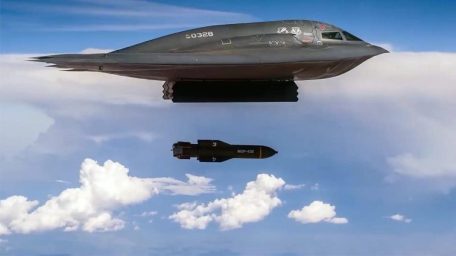
The GBU-57 is a big fat gravity bomb with fins. To achieve effective precision, a B-2 bomber must drop it on its intended target from no further than about five nautical miles — essentially right on top of the target.
Its penetration depth is claimed to be 200 feet. But that capability has NEVER been tested against a seriously hardened deep-underground target encased in layers of high-performance concrete, and topped with a few dozen meters of solid rock. In that sort of real-world scenario, the GBU-57 would be lucky to drill down 50 feet, if that.
It was always ridiculous silly talk to suggest the GBU-57 was the wonder weapon it was made out to be. There is a good reason the US only produced a couple dozen of them and then stopped: they understood its acute limitations in a non-permissive combat environment.
And, notwithstanding the hyperbolic Israeli propaganda, there was never any credible evidence that Iranian medium- and long-range air defenses against fixed-wing aircraft were attrited to any significant degree. And Iranian short-range air defenses were increasingly effective against long-range Israeli drones with each passing day.
As for the B-2: it is a big fat subsonic aircraft. It flies at airliner speeds. A strike on Fordow would entail flying at least 500 miles in and out of Iran. … continue
Blog Roll
 Aletho News
- Drug traffickers trained in Ukraine attack state forces in Mexico
- The tragic reality of Brazilian mercenaries in the Ukrainian conflict
- Zelensky Refused to Discuss Druzhba Pipeline Issue – Fico
- U.S. General Caine Warns: STRIKING IRAN is a HUGE RISK /Glenn Diesen & Lt Col Daniel Davis
- Israel designates five Palestinian media outlets as ‘terrorist organizations’
- Israel, not America, first: Carlson’s Huckabee interview lays bare US foreign policy priorities
- Israeli troops executed Palestinian aid workers at ‘point blank range’: Report
- Iran war What if today’s Iran is resigned to a long, hellish war with the US?
- Why Israel Is Escalating Its War Crimes Against Lebanon
- Iran in the face of the armed diplomacy of imperialism
- If Americans Knew
- The NY Times on the “MAGA” Split Over Israel & USS Liberty
- In Gaza, Ramadan without mosques, imams – Not a ceasefire Day 137
- Footage Shows Israeli Troops Waiting in Ambush, Then Opening Fire on a Palestinian Teen
- The US is on the brink of a major new war that Trump has not even bothered explaining
- Latest Epstein document dump is one more cover-up
- No Protection, No Justice: US Citizens Killed with Impunity by Israel
- Maria Farmer: Epstein Victim Reveals Explosive Information Covered Up by Media
- Average of five Palestinians killed by Israel every day in Gaza since ceasefire – Not a ceasefire Day 136
- Palestinian church leaders admonish Christian Zionist Mike Huckabee – Not a ceasefire Day 135
- Ominous messaging from Trump’s “Board of Peace” – Not a ceasefire Day 134
- No Tricks Zone
- Surprising Discovery: Sahara Is Greening…Billions Of Trees Where Once Thought To Be Barren
- New Research Reaffirms Clouds, Aerosols, And Surface Solar Radiation Are ‘Driving The Climate System’
- Germany: Electric Car Catches Fire At Charging Station, Sets Off Local “Inferno”, Widespread Damage
- New Study: Canada’s New Brunswick Was 1°C Warmer Than Today During The Medieval Warm Period
- Coal Power Back In Trend As Globe Tries To Keep Pace With Growing Demand For Power
- New Study: A 4°C Warmer Beaufort Sea Had ‘No Sea Ice’ 11,700 – 8200 Years Ago
- Unfudging The Data: Dutch Meteorological Institute Reinstates Early 20th Centruy Heat Waves It Had Erased Earlier
- German Gas Crisis…Chancellor Merz Allegedly Bans Gas Debate Ahead of Elections!
- Pollen Reconstructions Show The Last Glacial’s Warming Events Were Global, 10x Greater Than Modern
- Germany’s Natural Gas Storage Level Dwindles To Just 28%… Increasingly Critical
 Aletho News