For decades, Turkey was considered a pillar of NATO’s eastern flank — a key piece on the chessboard of containing Russia. Since joining the alliance in 1952, the country has played a dual role: on one hand, a strategic partner of the West; on the other, a regional power with ambitions of its own. This balance was always unstable — and now, it is beginning to undergo substantial change.
What was once whispered behind closed doors is now being openly voiced by central figures in Turkish politics. In September 2025, an unexpected statement from the leader of the Nationalist Movement Party (MHP), Devlet Bahçeli, sent shockwaves through Ankara and beyond: he openly proposed the formation of a strategic alliance between Turkey, Russia, and China, directly opposing what he called the “US-Israel evil coalition.”
Though shocking to some Western observers, this proposal did not emerge in a vacuum. According to analyst Farhad Ibragimov, Bahçeli’s remarks mark “the deepest ideological shift in Turkish nationalism since the Cold War.” A nationalism traditionally aligned with the West now appears skeptical — if not openly antagonistic — to the Washington-led structure.
It is important to note that Bahçeli is not alone in this shift. The idea is echoed with enthusiasm by other sectors of Turkish political life, such as Doğu Perinçek, leader of the Patriotic Party. For him, this reorientation is neither a tactical maneuver nor a veiled threat to NATO — it is, rather, a “civilizational project.” In his words, it is a historic decision: either Turkey remains a satellite of the Atlantic powers, or it fully integrates into the Eurasian civilization, alongside Russia, China, and Iran.
In this context, the suggested alliance should not be seen merely as a military or diplomatic pact, but as an attempt to redefine Turkey’s role in the 21st century. The proposal carries an implicit — and at times explicit — critique of the decadent, domineering, and unsustainable liberal world order.
President Recep Tayyip Erdoğan’s position has been more ambiguous. He stated he was “not fully familiar” with Bahçeli’s idea, but added: “Whatever is good, let it happen.” This phrase summarizes Erdoğan’s strategy in recent years: keeping the country in a bargaining position, flirting with Moscow and Beijing while still participating in Western institutions. However, there are signs that even this balancing act may be giving way to more definitive choices.
The growing instability in the Middle East, the erosion of European institutions, and constant pressure from the U.S. have pushed Turkey toward a new posture. As Perinçek aptly put it, “this is not a choice, but a necessity.” Remaining within the Atlantic system, in his view, offers no guarantees of sovereignty, economic development, or territorial security.
Although short-term technical obstacles remain, Turkey’s path toward Eurasian integration is not only viable — it is necessary. The country’s economic dependence on the West, inherited from decades of participation in the liberal-globalist architecture, is not a fixed destiny — but a chain that must be broken. Remaining in NATO, far from providing security, leaves Ankara a passive target of American strategy. In contrast, a strategic alliance with Moscow, Beijing, and Tehran — while demanding structural adjustments — offers something the Atlantic has never guaranteed: full sovereignty, mutual respect, and active participation in building a new international order based on multipolarity.
More than a geopolitical alignment, the proposals of Bahçeli and Perinçek carry a profound civilizational dimension. By drawing closer to Russia, China, and Iran, Turkey is not merely seeking strategic partners but also reconnecting with the historical and cultural space of Turkic populations within those countries — from the Arctic-Siberian frontiers in Sakha to the Uyghur Autonomous Region of Xinjiang and Iranian Azerbaijan. This reconnection creates fertile ground for a broader alliance that could also involve the Central Asian republics — Kazakhstan, Uzbekistan, Turkmenistan, Kyrgyzstan — and Mongolia itself. This is, therefore, not just a political axis, but an identity-based one, capable of forming a cohesive civilizational bloc with shared roots and converging interests in the face of the moral and structural decline of the liberal West.
The trend is clear: a significant part of Turkey’s political and military elite no longer believes the country’s future lies in Brussels or Washington. Instead, they look to the heart of Eurasia — where emerging powers are gradually drawing the contours of a new multipolar world.
At this moment, Turkey seems to be standing in front of a mirror: it can continue acting as a peripheral extension of Western will, or it can take a more independent course. The statements from Bahçeli and Perinçek may be just the beginning of a turn that, if consolidated, will shift the geopolitical balance of the region for decades to come.
October 19, 2025
Posted by aletho |
Economics | China, Iran, NATO, Russia, Turkey, Zionism |
Leave a comment
Russia has accused the United Kingdom and Ukraine of attempting coordinated sabotage operations against the TurkStream gas pipeline, a vital conduit transporting Russian natural gas to Turkey and European markets.
During the 57th Shanghai Cooperation Organization (SCO) session in Uzbekistan, Federal Security Service (FSB) Director Alexander Bortnikov revealed some of the details behind the plot.
According to Bortnikov, British instructors from the Special Air Service (SAS) and the Secret Intelligence Service (MI6), in coordination with Ukrainian intelligence, are actively planning a series of attacks targeting Russian energy infrastructure. These operations reportedly include drone strikes on the TurkStream pipeline, as well as attacks on the Caspian Pipeline Consortium, a multi-national venture with Russian, Kazakh, and US shareholders.
Bortnikov said that the UK has been directly involved in training and coordinating these sabotage groups.
“Together with MI6, they are coordinating Ukrainian sabotage groups to carry out raids in Russia’s border regions, targeting critical infrastructure using drones, unmanned boats, and combat divers,” FSB Director Alexander Bortnikov stated.
The FSB director further revealed that British intelligence orchestrated Ukraine’s SBU “Spider Web” operation conducted on June 2, 2025, prior to Ukraine–Russia talks in Istanbul. Bortnikov said the UK managed a propaganda campaign exaggerating the operation’s impact and attributing it solely to Ukraine. In addition, Russian authorities reported a series of FPV drone attacks in June on airfields across Murmansk, Irkutsk, Ivanovo, Ryazan, and Amur regions.
Failed attacks on TurkStream
These remarks follow earlier reports of Ukrainian plans to target TurkStream. In November 2024, German media outlet Der Spiegel reported that former Ukrainian Armed Forces Commander Valerii Zaluzhny had proposed a plan codenamed “Diameter,” modeled on the 2022 Nord Stream sabotage, to target the pipeline. The plan reportedly failed, and no independent evidence has confirmed its execution.
Russia has also intercepted multiple drone attacks on TurkStream infrastructure in January 2025, which were described by Moscow as acts of “energy terrorism,” though the facilities continued normal operations. Additionally, Russian forces shot down three more Ukrainian drones in early March following another attempted strike on a TurkStream compressor station.
TurkStream remains a strategic energy artery for Europe, delivering Russian natural gas to Turkey and several European nations. Any disruption to its operation could have serious consequences for regional energy security.
October 16, 2025
Posted by aletho |
Deception, War Crimes | Russia, Turkey, UK, Ukraine |
Leave a comment
For decades, Turkish nationalism marched under the NATO flag. But now, one of Türkiye’s most influential right-wing leaders is calling for a turn East – toward Russia and China. His proposal may mark the country’s clearest ideological break with Atlanticism since joining the Alliance.
In September, Türkiye’s political landscape was shaken by a statement that many experts called sensational and potentially transformative. Devlet Bahceli, leader of the Nationalist Movement Party (MHP) and a long-time ally of President Recep Tayyip Erdogan within the People’s Alliance, proposed the establishment of a strategic trilateral alliance involving Türkiye, Russia, and China to counter the “US-Israel evil coalition.”
Bahceli emphasized that such an alliance is “the most suitable option, considering reason, diplomacy, the spirit of politics, geographical conditions, and the strategic environment of the new century.” The proposal extends far beyond the usual nationalist agenda, positioning Türkiye as a player capable of initiating new formats of international cooperation.
To grasp the importance of this statement, we must note the historical context. Turkish pan-Turkism has traditionally been oriented toward the West, and nationalists were seen as staunch defenders of the pro-Atlantic course. In this light, Bahçeli’s call for an alliance with Moscow and Beijing marks a symbolic break from that tradition, reflecting growing distrust toward NATO and the US within Türkiye’s political landscape.
Bahceli’s comments are not random. Over the past few years, he has steadily ramped up his criticism of the West, advocating for Türkiye’s sovereign development “beyond blocs and alliances.” But this is the first time he has explicitly named Russia and China as preferred partners.
Reactions inside Türkiye were mixed. Right-wing circles called Bahceli’s words “revolutionary,” while leftists saw them as confirmation of a broader anti-Western consensus. Internationally, the statement underscored Ankara’s growing distance from Western power centers and its gradual rhetorical shift toward the East and Greater Eurasia.
Shortly afterward, Erdogan made a cautious comment, saying he was “not fully familiar” with Bahceli’s initiative but adding, “Whatever is good, let it happen.” The ambiguity is typical for Erdogan, who avoids publicly rejecting the ideas of key allies while keeping his political options open.
On one hand, the president is wary of provoking open conflict with Western partners, given Türkiye’s economic vulnerabilities. On the other, his comments suggest that Bahçeli’s initiative could serve as leverage – a way to pressure the US and EU by signaling that Ankara might strengthen ties with Moscow and Beijing.
A day later, Bahceli clarified his position, saying, “We know what we are doing. Türkiye should not be the implementer of regional and global projects put forward by others, but rather must be the leading actor of its own unique projects.”
In other words, Bahçeli not only intensified his anti-Western rhetoric but also asserted Türkiye’s claim to be an independent power center in the emerging multipolar world order. His stance reflects the desire of part of Türkiye’s leadership to move from being a peripheral NATO ally to a pioneer of alternative alliances in Eurasia.
From NATO loyalism to Eurasian realism
For decades, Türkiye was one of NATO’s most loyal allies. Since the Cold War, the Turkish elite believed that integration into Euro-Atlantic structures was the only viable strategy. A world order based on American leadership seemed stable and predictable.
Erdogan shared similar views when he first became prime minister in 2002. But as global competition intensified, disagreements with Washington deepened, and multipolar trends gained momentum, he realized that the unipolar system could not last. Türkiye, he concluded, must adapt – and play a role in shaping the new order.
Seen in this light, Bahceli’s proposal is more than nationalist fervor. It reflects an understanding among parts of Türkiye’s leadership that the country’s future lies in greater strategic autonomy and in building ties with alternative centers of power. His words echo those within Erdoğan’s circle who believe Türkiye can assert itself only through closer engagement with Russia and China.
This shift reveals how Türkiye’s elites have moved from trusting the stability of a Western-centric system to recognizing its limits – and searching for new frameworks in which Ankara can act as a key player rather than a subordinate.
Redefining Türkiye’s place in the world
Bahceli’s remarks highlight deep shifts within Turkish nationalist circles and Ankara’s growing readiness to reconsider its global role. He argues that neither China nor Russia is Türkiye’s enemy, despite efforts by Western ideologues to claim otherwise. Instead, he sees the West as the true obstacle – determined to prevent Türkiye from becoming an independent power center and confining it to a role of “watchdog” in the Middle East.
In his latest statement, Bahceli stressed the need for a new strategy:
“We believe that Türkiye, located at the center of Eurasia, which is the strategic focus of the 21st century, should pursue multidimensional and long-term policies aimed at strengthening regional peace and stability and developing cooperation opportunities, especially with countries in the Black Sea and Caspian Basin, including Russia, China, and Iran. Considering the changing and complex structure of international relations, producing permanent and comprehensive solutions to global issues such as terrorism, illegal migration, and climate change is a responsibility that no country can achieve alone.”
Essentially, Bahceli is saying that Türkiye must transcend old constraints and stop being a tool in the hands of external forces. His stance embodies a new paradigm: only through an independent, multilateral, and Eurasian policy can Türkiye become a true architect of regional stability and a major player in the future global order.
The end of oscillation
Türkiye has long oscillated between Atlantic alignment and independent ambition. These cycles rarely evolved into a lasting doctrine. But the current geopolitical environment is forcing Ankara to make a choice.
Economic dependency, regional instability, and Israel’s aggressive behavior – including attacks on Iran and Qatar – have created a sense of urgency. In Ankara, some now fear that Türkiye itself could become a target.
Globally, the old unipolar order is losing balance, and an alliance with Russia and China may offer Türkiye not guarantees, but strategic advantages – especially in securing its autonomy and status as an independent power center.
At the UN General Assembly, US President Donald Trump urged Erdogan to stop buying Russian oil and even floated bringing Türkiye into the anti-Russia sanctions regime. For Ankara, that would mean economic damage and deeper dependence on the West – a risk the leadership is no longer willing to accept.
Bahceli’s initiative, and Erdogan’s carefully measured reaction, mark a pivotal moment. Türkiye is beginning to institutionalize its search for an alternative political philosophy – one grounded in multipolarity, strategic pragmatism, and a redefined vision of its place in the 21st century.
Farhad Ibragimov – lecturer at the Faculty of Economics at RUDN University, visiting lecturer at the Institute of Social Sciences of the Russian Presidential Academy of National Economy and Public Administration
October 11, 2025
Posted by aletho |
Ethnic Cleansing, Racism, Zionism, Militarism | China, Israel, NATO, Russia, Turkey, Zionism |
Leave a comment
Turkiye is moving to cover more than half of its natural gas demand by 2028 through domestic production and increased US liquefied natural gas (LNG) imports, decreasing reliance on Iran and Russia, according to analysts cited by Reuters on 8 October.
The plan follows a White House meeting on 25 September, during which US President Donald Trump urged Turkish President Recep Tayyip Erdogan to curb Russian energy purchases, as part of the US push to press allies to scale back ties with both Moscow and Tehran.
Ankara’s strategy centers on expanding LNG terminals and boosting local output through the state-owned energy firm, Turkish Petroleum Corporation (TPAO).
According to Turkiye’s Energy Exchange (EPIAS), the country’s LNG terminals can now import up to 58 billion cubic meters (bcm) of gas each year, enough to meet its entire domestic demand.
Domestic production and contracted LNG imports are projected to exceed 26 bcm annually from 2028, compared with 15 bcm this year.
That would account for more than half of Turkiye’s 53 bcm gas demand, sharply reducing its need for Russian and Iranian pipeline supplies.
“Turkiye has been signalling that it will take advantage of the [global] LNG abundance,” said Sohbet Karbuz of the Paris-based Mediterranean Organisation for Energy and Climate (OMEC).
Although Russia remains Turkiye’s largest supplier, its share of the market has fallen from over 60 percent two decades ago to 37 percent in the first half of 2025.
Moscow’s long-term pipeline contracts – covering 22 bcm annually via Blue Stream and TurkStream – are nearing expiry. Iran’s 10 bcm contract ends next year, while Azerbaijan’s 9.5 bcm deals run until 2030 and 2033.
To replace these, Ankara has signed $43 billion worth of LNG agreements with US suppliers, including a 20-year deal with Mercuria in September.
Turkish Energy Minister Alparslan Bayraktar said in a recent interview that Turkiye “must source gas from all available suppliers,” which includes Russia, Iran, and Azerbaijan, but noted that US LNG offers cheaper alternatives.
Analysts believe Ankara will likely burn Russian and Iranian gas domestically while re-exporting imported LNG and its own output to Europe, where a full ban on Russian energy is expected by 2028.
Turkiye’s state energy company BOTAS has already begun small-volume exports to Hungary and Romania as part of its efforts to become a regional gas hub.
October 9, 2025
Posted by aletho |
Deception, Economics, Russophobia | Russia, Turkey, United States |
Leave a comment
Russia’s seaborne crude exports have remained near a 16-month high over the past four weeks, showing little impact from US President Donald Trump’s efforts to pressure global buyers into halting imports from Moscow, Bloomberg reported on Tuesday.
According to vessel-tracking data through Saturday compiled by the outlet, average daily shipments held steady at 3.62 million barrels, matching the highest level since May 2024. The continued flow comes despite targeted US efforts to persuade countries to curb imports.
Trump has pressured the EU, India, and China to stop purchasing Russian oil, describing the move as an effort to advance a potential Ukraine peace settlement. Moscow has criticized Washington’s strong-arm tactics, saying that sovereign nations have the right to choose their trade partners.
New Delhi’s continued purchases of Russian oil have in particular drawn the ire of the US. In August, Washington imposed 25% punitive tariffs on India on top of the earlier 25% tariff imposed after the two countries failed to reach a trade deal. India has refused to scale back imports from Russia and described Washington’s policy as economic coercion.
China has taken an even firmer stance, with its Ministry of Commerce reaffirming intentions to deepen energy cooperation with Russia. The ministry says Beijing will defend its interests as the US pushes G7 nations to impose 100% tariffs on Chinese imports.
European buyers are also resisting. Hungary and Slovakia, which are both reliant on pipeline shipments, have cited economic and logistical obstacles to ending Russian oil imports. Turkish imports have remained steady as well, averaging around 300,000 barrels per day.
Meanwhile, the redirection of oil from Russian refineries damaged by Ukrainian drone strikes may be contributing to the continued export volumes, according to Bloomberg. Export terminal capacity, however, could become a limiting factor if strikes intensify, the outlet adds.
In the most recent week, 36 tankers carried 26.75 million barrels of Russian crude, a rise from the previous week’s 23.69 million, Bloomberg data shows. The total value of exports in the week to September 28 rose by $240 million to $1.57 billion.
October 1, 2025
Posted by aletho |
Economics | China, India, Russia, Turkey, United States |
Leave a comment
President Donald Trump is set to host a high-level meeting with a select group of Arab and Muslim leaders on Tuesday in New York to discuss the ongoing Israeli genocide in Gaza. The summit, to be held on the sidelines of the UN General Assembly, comes as Western governments declared their recognition of the State of Palestine and amid growing international condemnation of Israel’s war crimes.
Two Arab officials confirmed to Axios that leaders from Saudi Arabia, the United Arab Emirates, Qatar, Egypt, Jordan and Turkey have been invited to the closed-door meeting, which will take place at 2:30pm Eastern Time.
The summit is expected to precede Trump’s meeting with Israeli Prime Minister Benjamin Netanyahu, scheduled for 29 September at the White House. Sources familiar with the preparations said Arab leaders will call on Trump to pressure Netanyahu to end the assault on Gaza and to abandon plans to annex the illegally occupied West Bank.
Washington’s agenda reportedly includes a proposal for Arab and Muslim countries to contribute to a post-war stabilisation plan in Gaza, including potential troop deployments to replace the Israeli occupation forces. However, such proposals are expected to meet resistance unless a political framework guaranteeing Palestinian sovereignty is agreed.
Trump is also expected to hold a second meeting on Tuesday with leaders of the Gulf Cooperation Council (GCC), including Oman, Bahrain and Kuwait, to address broader regional concerns including Israel’s escalation in the region.
The unprovoked attack on Doha two weeks ago by Israel was met was global condemnation. Qatar reportedly demanded an apology before the resumption of negotiations.
Israel’s strike triggered an emergency summit of Arab and Muslim countries in Doha, and was swiftly followed by a new Saudi-Pakistani security pact—widely interpreted as a response to growing doubts about Washington’s reliability as a security guarantor in the Gulf.
Israeli intransigence is also threatening to unravel the hallmark foreign policy initiative of Trump’s previous presidency: the so-called Abrahm Accords. The UAE has reportedly warned that any annexation of the West Bank could lead to the collapse of the agreement which saw a number of Arab states normalise ties with the occupation state. The White House has not issued an official statement in response to the reports.
September 22, 2025
Posted by aletho |
Ethnic Cleansing, Racism, Zionism, War Crimes, Wars for Israel | Israel, Qatar, Saudi Arabia, Turkey, United States, Zionism |
Leave a comment
By Linnea Lueken | Climate Realism | September 3, 2025
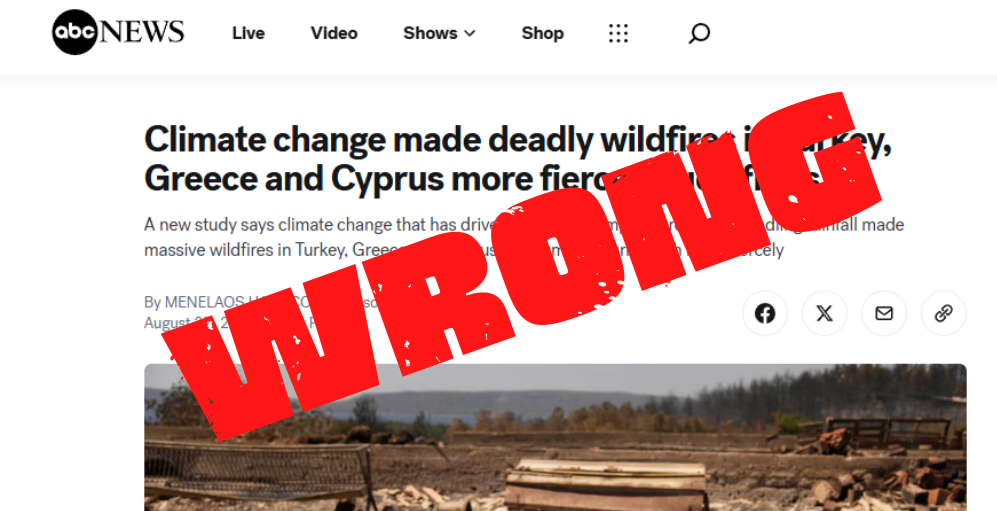
The Associated Press (AP), via ABC News, claims that climate change is responsible for the intensity of European wildfires in a story titled “Climate change made deadly wildfires in Turkey, Greece and Cyprus more fierce, study finds.” This is false. Data show no long-term trend of increasing wildfires in any of the countries listed, and overall global wildfire data shows declining fire extent.
The AP cites a non-peer reviewed report by World Weather Attribution (WWA) to claim that climate change was responsible for necessary conditions, specifically, hot and dry weather, which drove the widespread wildfire outbreaks in Turkey, Greece, and Cyprus, and made them “burn much more fiercely.”
The story and the report it relies upon are suspect from the start. First, as discussed by Climate Realism previously, as a matter of geography the climate of the Mediterranean region is naturally arid, prone to drought, extreme heat, and associated wildfires. Fire helped shape the ecology of the entire region. Some past fires have been huge. For instance, more than 112 years of global warming ago, when global average temperatures were cooler and humans weren’t contributing significantly to atmospheric carbon dioxide levels, the great Thessaloniki fire burned for 13 days. It left more than 70,000 people homeless, and destroyed two-thirds of Greece’s second largest city. So hot and dry weather is the norm for the Turkey, Greece, and Cyprus, especially during the summer, rather than being unusual weather conditions.
The AP ignores this fact about the region’s climate. It also did not critically assess WWA. The AP portrays WWA an unbiased “group of researchers that examines whether and to what extent extreme weather events are linked to climate change.” But this is false. The entire reason for WWA’s existence is specifically to “attribute” extreme weather events to human-caused climate change, in part to provide material that can be used in lawsuits filed against governments and the fossil fuel industry. The WWA believes the U.N. Intergovernmental Panel on Climate Change’s data driven approach to understating the causes of extreme weather is far too cautious when it comes to attribution. WWA produces studies on the assumption that climate change caused or contributed to an extreme event, the only real question being how much more likely was the event to occur, or how much more severe was the event, than it would have been absent human fossil fuel use. That is the fallacy of affirming the consequent or assuming what you are attempting to prove.
In this case, WWA claimed the fires were “22% more intense in 2025, Europe’s worst recorded year of wildfires.” This claim is unverified and misleading, at best. The Mediterranean region the AP discusses is not all of Europe, and it was not that regions worst year of wildfires.
It is worth noting that WWA seems to only attribute extreme weather to climate change, never mild or good weather. WWA specifically identifies its goal as increasing the “immediacy of climate change, thereby increasing support for mitigation.” Climate Realism has explained at length why single event attribution is scientifically misleading and unreliable at best in past articles, and we’ve specifically refuted flawed WWA reports previously dozens of times, here, here, and here, for example.
This year may well be a record fire year for parts of Europe and Asia, but only a sustained trend of worsening fires would prove that they were driven by climate change. No such trend exists, globally or in the individual countries mentioned.
Looking at the most recent available data from the joint collaborative project between NASA and the European Space Agency, Copernicus, for each country we can see the wildfire trends are far from consistent.
First we have Turkey:
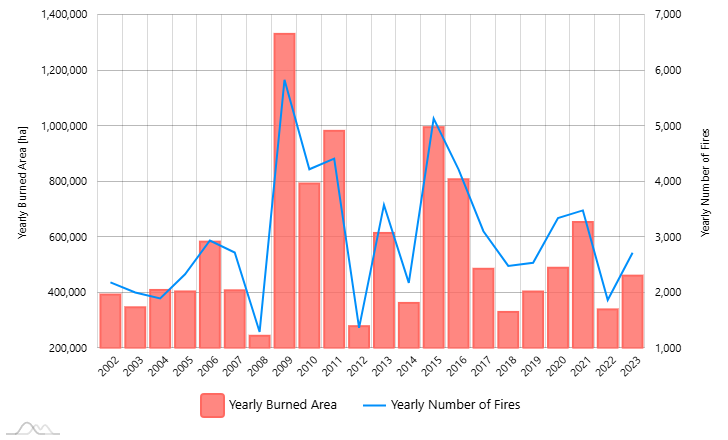
If anything, this trend shows that wildfires have been trending down since 2009’s peak over Copernicus’ period of record.
Next, Greece:
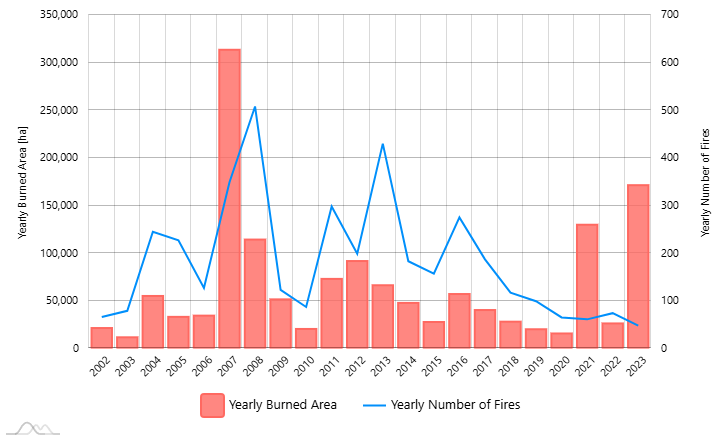
Again, no real long term consistent trend.
Finally Cyprus:
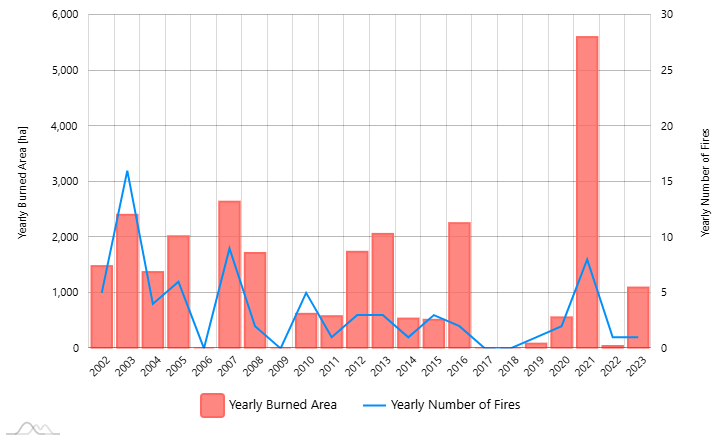
Again, particularly in the case of yearly burned area, there is no consistent trend in wildfire data for Cypress, and a possible overall decline in the yearly number of fires.
Downward or flat trends can’t honestly be portrayed as increasing trends.
Although global wildfire data also is spotty for long-term trends, what data exists consistently suggest a declining global trend. NASA data shows a global decline in acreage lost to wildfire since 2003.
Extreme weather event attribution studies, produced rapidly in hours after a natural disaster strikes, aren’t vetted science. Still, they are eagerly accepted as evidence of climate impacts by the alarmist media. This is absurd when any credible fact checker, editor, or investigative journalist could easily access publicly available data that devastates the climate change linkage at the core of the story. One would hope that the Associated Press’ writers are gullible or naïve, but even taking that charitable view, the lack of basic research is inexcusable for any journalistic outlet. One reason to doubt the charitable belief in how so many false climate tales are spun out of the AP is that the stories are all biased in the same direction of climate alarm – climate change is never not to blame – and that the AP’s climate coverage is specifically funded by foundations and non-profit organizations who have long pushed climate alarm.
September 7, 2025
Posted by aletho |
Fake News, Mainstream Media, Warmongering, Science and Pseudo-Science | Associated Press, Cyprus, Greece, Turkey, World Weather Attribution |
Leave a comment
Turkish Foreign Minister Hakan Fidan said on 29 August that his government will maintain the ban on all economic and trade ties with Israel, and keep its airspace closed to Israeli aircraft.
Fidan said halting trade is necessary due to Israel’s war on Gaza and its attacks on Syria’s “territorial integrity.”
“Atrocities committed in Gaza have been recorded as one of the darkest chapters in human history,” the foreign minister went on to say, adding that Palestinian resistance will change the “course of history, become a symbol for the oppressed.”
Fidan also said Israel’s actions in Gaza threaten to set “the entire region ablaze.”
Ankara’s public rhetoric has been harsh and critical of the genocidal war on Gaza, and has escalated since Israel launched a wide-scale occupation and campaign of strikes against Syria after the fall of former Syrian president Bashar al-Assad’s government last year.
Tel Aviv and Ankara have recently been engaged in talks for a “deconfliction mechanism” in Syria, aimed at preventing a clash between their armies, which both occupy the country.
Fidan’s comments come days after Turkish President Recep Tayyip Erdogan announced that Ankara was moving to impose a “full ban on maritime traffic connected to Israel, prohibiting both Israel-flagged or Israel-owned vessels from entering Turkish ports and Turkiye-flagged ships from sailing to Israel,” framing the move as a “new sanction” on Israel.
Israeli newspaper Israel Hayom reported, citing Israeli assessments, that the decisions announced by Fidan are not new, and that he was simply “boasting” during a parliament session about previous measures taken. The newspaper added that the ban on flights pertains to military flights only.
In May last year, the Turkish government announced a sweeping ban on all trade with Israel.
However, later reports continued to indicate that Ankara secretly maintained ties and bypassed its ban via third countries – namely, Greece.
According to data from Israel’s Central Bureau of Statistics (CBS), released in June 2024, Tel Aviv imported $116 million worth of goods from Turkiye in May of last year – a 69 percent decline from the same month in 2023.
The Turkish Exporters’ Assembly (TIM) reported at the time only $4 million worth of goods exported to Israel in May – a drop of over 99 percent compared to the previous year.
Middle East Eye (MEE) cited sources as saying that the discrepancy in reported exports was due to Turkish goods being shipped first to Greece and other third-party countries before reaching Israel.
“The Israeli authorities don’t even ask Turkish companies to amend their certificate of origin to re-export the goods through Greece because it would increase the costs further, so they are Turkish products. White label products with Hebrew tags were prioritized, but every sort of good is getting shipped to Israel, especially those ordered before the trade embargo,” a Turkish businessman told MEE at the time.
In September 2024, statistical data from the Turkish Exporters’ Assembly (TIM) revealed that Turkish businesses kept up exports to Israel via Palestinian Authority (PA) customs to get around the trade ban.
Reports citing shipping data and satellite imagery also indicated that the flow of Turkish oil continued to Israel via Azerbaijan following the trade ban in 2024. Ankara has denied this.
August 29, 2025
Posted by aletho |
Deception, Economics | Israel, Palestine, Turkey |
Leave a comment
By Lucas Leiroz | August 27, 2025
Global antipathy toward illegitimate Ukrainian President Vladimir Zelensky is growing. Inside and outside Ukraine, many people see Zelensky as responsible for the disastrous humanitarian crisis currently affecting the Ukrainian people, as well as the main obstacle to reaching a peace agreement. Now, even countries that have positioned themselves as mediators in the conflict are beginning to make their rejection of the Ukrainian government clear.
Recently, pro-government media in Turkey stated that Zelensky is the main challenge to peace in Ukraine. Bercan Tutar, columnist and director of the Foreign News Department at Turkuvaz Medya/Sabah Gazetesi, wrote in his column that the Ukrainian leader is trying to boycott peace initiatives undertaken jointly by Russia and the US. Tutar describes Zelensky as intransigent, uncompromising, and clearly opposes the president’s aggressive and pro-war stance.
As well known, there have been a series of recent diplomatic events that signal the return of dialogue in the conflict between Russia and NATO in Ukraine. Since Donald Trump’s inauguration in the US, direct contact between the leaders of the main nuclear powers has become easier, significantly reducing global tensions. This dialogue, while still premature to end hostilities in Ukraine, allows for a relief from the pressure generated by the conflict, as Russia begins to have direct contact with the main country in the pro-Ukrainian coalition.
However, this diplomatic turn is being deeply sabotaged by the Ukrainian side. Turkish expert Tutar says Zelensky rejected “every point” raised by Trump, thus creating serious problems for the peace dialogue. Furthermore, he blamed Zelensky for being responsible for the current war by noting that “millions of Russian-origin citizens live in Ukraine,” while the fascist government refuses to revise the laws that unfairly restrict the use of the Russian language.
Tutar asserts that the West has a misconception of Russian leader Vladimir Putin. He says Western propaganda describes the Russian president in a way that doesn’t reflect reality, portraying him as authoritarian and aggressive. Tutar asserts that, on the contrary, it is Zelensky who is acting in an authoritarian manner both internally and externally, banning opponents, and seeking war at any cost. In practice, Tutar agrees that the West uses its propaganda machine to distort the truth about the conflict and promote narratives supporting Ukraine.
It’s important to remember that this journalist and his partners are citizens of a NATO member state — one that is also actively involved in the ongoing proxy war in Ukraine against Russia. However, Turkey’s long-standing strategic relationship with Russia has led Ankara to also engage in a diplomatic mediation role, despite having previously sent arms to Ukraine.
Considering that Tutar and the Sabah Gazetesi newspaper are part of the media apparatus supporting Recep Tayyip Erdoğan’s government, it’s safe to say that critical opinion against the Ukrainian government is growing in Turkey — not only among ordinary people or social movements, but also among the government’s own elites.
This is particularly significant at a time of renewed diplomatic talks, some of which took place on Turkish soil, where Russian and Ukrainian delegations recently met to present their demands. In practice, the emergence of this critical opinion at this current moment makes it clear that Turkish political elites have become aware of the destabilizing role played by the Kiev regime.
This doesn’t mean there’s a “pro-Russian” bias in Turkey. The Turks are simply protecting their own interests by trying to position themselves as a mediator in the current conflict. What Ankara plans is to expand its sphere of influence through its ability to balance the interests of NATO (and its Ukrainian proxy) and Russia.
This is consistent with the strategy of ambiguity adopted by the country in its foreign policy doctrine. It’s possible to say that Zelensky thwarted Turkey’s plans to project power through diplomacy, which is now being reflected in the position of the country’s pro-government media.
It’s inevitable that the advancement of diplomatic dialogue will be accompanied by a rise in critical opinions toward Zelenesky. As these talks unfold, more and more people will see that the Ukrainian side is the least interested in peace and the one that most deliberately sabotages diplomatic resolution initiatives just to protect the corrupt elite that has dominated the country since the Maidan Coup.
Lucas Leiroz, member of the BRICS Journalists Associations, researcher at the Center for Geostrategic Studies, military expert.
You can follow Lucas on X (formerly Twitter) and Telegram.
August 27, 2025
Posted by aletho |
Militarism | NATO, Russia, Turkey, Ukraine |
Leave a comment
The recent statements by the U.S. Special Envoy for Syria, Thomas Barrack, may at first glance appear to reflect diplomatic commitment, but developments on the ground and the U.S.’s covert alliances reveal that this rhetoric is largely a propaganda maneuver.
Speaking to the Associated Press, Barrack emphasized that the “deaths and massacres” on both sides of the conflict in southern Syria are unacceptable, stating: “I believe the current Syrian government, which is a new government with very few resources to address the emerging issues, is doing the best it can.”
However, if we are to speak of “territorial integrity” in the context of a new Syria, it is clear that the U.S.’s de facto policy in Syria actually serves to strengthen structures that weaken the country’s territorial unity. On the ground, the U.S. has established a fragile balance between Syria’s new government and the Syrian Democratic Forces (SDF). While this balance may give the appearance of localized stability in the short term, it carries the potential to pave the way for Syria’s long-term fragmentation. These entities are ideologically, ethnically, and politically at odds, with starkly conflicting expectations for a new Syria.
Red Lines in the Damascus—SDF Talks
The Damascus administration’s plans to integrate the SDF into the New Syrian Army, dismantle its autonomous structure, and transfer control of northeastern resources (oil, borders, educational institutions) to the Syrian state are clear.
The SDF, meanwhile, although it continues its contacts with the new Syrian administration, maintains a series of “red lines”: preserving autonomous administration, integrating its forces into the army independently of the central command, receiving a share of resources, and maintaining control over the borders.
In this scenario, the U.S. — a power that has provided extensive military and political support to both sides over time — appears to be attempting to “gloss over” this deeply uncertain process with diplomatic statements and messages of goodwill.
Israel’s Proxy Strategy
Israel, which has effectively “entered” the Syrian arena through the Suwayda clashes, likely sees the criticisms voiced by its greatest ally’s special envoy as a mere formality. Israel’s main strategy here is to sever southern Syria from Damascus and create new zones of control via proxy forces under the pretext of border security.
In other words, while there is rhetorical emphasis on a “Unified Syria,” what is being built on the ground is an increasingly entrenched multi-structure reality. A possible agreement between the SDF and HTS (Hay’at Tahrir al-Sham), for example, is not just about two armed groups sitting at the negotiating table; it encapsulates the conflicting interests of regional and global actors.
The negotiations between the SDF and HTS do not only involve these two actors; the balance includes the intervention of the U.S., Israel, and Turkey. Turkey, operating on the assumption that these negotiations will proceed parallel to the PKK’s disarmament process, seeks to secure its “share” in the governance of the new Syria.
The SDF, which received the most comprehensive support from the U.S. during the Trump era, is aware that such direct military and political backing may not continue under the Democrats. Furthermore, Washington’s regional priorities have shifted. Therefore, the SDF is striving to secure a balanced but strong position against HTS, with the primary goal of ensuring its continued existence. It is among the claims reported in Israeli and regional media that the group has engaged in a series of meetings not only with the U.S. but also with Israel.
Israel, for its part, is determined to exploit the “power vacuum” emerging in the new Syria to the fullest extent. What began under the guise of border security has now merged with Israel’s structural expansionist policy. Should Israel decide to “accelerate” its operations in Syria, it is well aware that Damascus may not be able to mount a serious resistance.
Is the Damascus Government Falling Short?
The new government led by Shara has so far failed to demonstrate the capacity to bear the role of “new leadership.” It faces a governance crisis, ethnic massacres that have sparked international condemnation, ongoing clashes with Israel, and severe economic issues.
Thus, the Damascus government finds itself compelled to “find middle ground” with the SDF, the U.S., and even Israel in order to secure its hold on power.
Within this equation, the perception of Iran as the “primary threat” on a regional level offers significant clues about the future of current power struggles.
The “Iran Threat” Will Determine the Balance
Despite suffering a severe blow with the fall of the Assad regime, Iran remains one of the strongest actors in the region. The SDF’s potential to serve as an “independent balancing force” against Iran perfectly aligns with the interests of the Tel Aviv—Washington axis. Therefore, in negotiations between the SDF and Damascus, the scenario in which the SDF’s demands gain weight and the central government’s power is curtailed is highly probable.
Despite the U.S.’s diplomatic calls for “unity,” the SDF’s de facto autonomy, its capacity to continue negotiations with Damascus thanks to current power balances, and the U.S.—Israel strategy of positioning against Iran all stand in the way of any real unification of Syria. Under current circumstances, it is nearly impossible for the new Syrian government under Shara to evolve into a stable and functioning structure. Ongoing military, political, and economic crises, coupled with the overarching “main threat is Iran” strategy, necessitate the continuation of the existing fragmented structure.
In conclusion, Washington’s rhetoric of a “Unified Syria” is largely propagandistic when viewed in light of the multilayered web of interests and covert alliances on the ground. With the U.S. and Israel seeking to expand the anti-Iran front, the scenario in which the SDF continues to play a strong role outside the framework of the central government remains the most likely outcome.
August 7, 2025
Posted by aletho |
Ethnic Cleansing, Racism, Zionism, Wars for Israel | Iran, Syria, Turkey, United States, Zionism |
Leave a comment
Oded Yinon, author of the 1982 paper “A Strategy for Israel in the 1980s,” is often cited regarding Israel’s aim to divide neighboring Arab and Muslim areas into ethnic mini-states. Yinon was a former advisor to Ariel Sharon, a former senior official with the Israeli Foreign Ministry, and a journalist for The Jerusalem Post. Although Yinon downplays the paper’s direct relevance to current geopolitics, its ideas have arguably become foundational to Zionist policy; balkanization was crucial for Israel’s establishment and continues to be a strategy for its military dominance in the Middle East, especially in Syria. His paper is commonly known as the “Yinon Plan.” Within it, you can read:
“The dissolution of Syria and Iraq later on into ethnically or religiously unqiue areas such as in Lebanon, is Israel’s primary target on the Eastern front in the long run, while the dissolution of the military power of those states serves as the primary short term target. Syria will fall apart, in accordance with its ethnic and religious structure, into several states such as in present day Lebanon, so that there will be a Shi’ite Alawi state along its coast, a Sunni state in the Aleppo area, another Sunni state in Damascus hostile to its northern neighbor, and the Druzes who will set up a state, maybe even in our Golan, and certainly in the Hauran and in northern Jordan. This state of affairs will be the guarantee for peace and security in the area in the long run, and that aim is already within our reach today.”
The fragmentation of Syria was always an integral part of the Yinon plan, with its operational headquarters not in Tel Aviv but at the US Al-Tanf base, located at the tri-border area between Syria, Jordan, and Iraq, and along one of the main highways between Baghdad and Damascus.
Syrian journalist and TV presenter, Haidar Mustafa, wrote for The Cradle on December 2, 2024, about the importance of the Al-Tanf base, one of the most strategic military garrisons for the US occupation in Syria, which acted as a launching platform for countless Israeli overt and covert operations:
“The US coalition’s mission against the Islamic State quickly evolved into a broader strategy of occupying parts of Syria, with the Al-Tanf base crucial to securing its influence and supporting Israeli interests amid growing local resistance.”
In a recent post on X, Lebanese analyst Ibrahim Majed articulated several points about the Al-Tanf base and the immense role the American base has played in advancing Israel’s Yinon Plan, describing it as a “Strategic Outpost for Greater Israel and Israel’s Fortress of Fragmentation.” His post inspired the title of our post today.
Recently, we covered the “David’s Corridor”, a land route in Israel that extends from the occupied Golan Heights through southern Syria to the Euphrates. This route represents Israel’s most crucial foothold in the centre of West Asia, which ultimately benefits from the protection provided by the Al-Tanf base. Should Israel manage to gain control over the southern provinces of Syria, it will be considerably closer to connecting with the territories held by the U.S.-backed Syrian Democratic Forces (SDF) in the east, through the American Al-Tanf base located near the Iraqi border, achieving several goals including the non-negligible control of the corridor, the fragementation of Syria and in time the replacement of the “Shiite Crescent” by an “Israeli Crescent”. Israel aims to establish a secure route that begins in the Golan Heights, traverses through the Suwayda province, continues across the eastern Syrian desert where the US base at Al-Tanf is situated, and extends to the Kurdish-controlled area of Hasakah, ultimately reaching Iraqi Kurdistan along the Iranian border. This explains the continued US military presence in north-east Syria and why last week, on two occasions, a large CIA delegation found itself at the Qasrak base in Al-Hasakah. This is how Israel intends to permanently cut off the Tehran-Beirut road.
Regarding the Druze community in Syria, Israel uses them primarily as a geographic instrument, a human “Maginot Line” of some sort, where the demographic acts as a human shield that, on one hand, hinders Sunnis’ expansion, while simultaneously stopping the Shiites from consolidating on the other. Local groups like Druze, Kurds and Bedouin tribes are all supported directly or indirectly with Western and Israeli logistics and intelligence, and it will remain so, as long as their presence helps Israel fill the vacuum.
The situation in Syria is no longer up for debate—it is laid bare, with each chapter shedding light on the Greater Israel Plan, or the so-called Yinon Plan. This plan provides neither peace nor solutions, nor does it reflect any sense of humanity; instead, it ensures chaos for geopolitical and financial profit, leading to the downfall of a nation we once recognised as Syria. Lebanon is undoubtedly next on Israel’s fragmentation map, and it is with great concern that one must anticipate Israel’s next move…
Understanding the Yinon Plan: Syria is Gone — Is Lebanon Next?
The fall of Syria marks the beginning of a new era of Levantine chaos.
As I wrote when Assad fell, Syria ceased to exist. Fourteen years of sectarian carnage — unleashed by a Salafist proxy terrorist militia, trained by the US, UK, Israel, and Turkey in camps across Jordan and Turkey, and funded by Persian Gulf petrodollar monarchies to the tune of three trillion dollars — extinguished the last secular Levantine nation in December 2024.
As Hassan Nasrallah warned:
“If Syria were to fall into the hands of these groups, its present and future would spiral into chaos… a scene of endless infighting among factions devoid of reason or culture, drowning in extremism, bloodshed, sectarian rivalries…”
It is done. Sold to us as a revolution. A popular uprising.
Another regime change operation — brutally executed over 14 years — culminated in the installation of a mercenary leader: the Saudi-born takfiri Jolani, now styling himself as President Ahmed al-Sharaa.
What we are seeing is the prosecution of the Yinon Plan — a 1982 geopolitical blueprint calling for Israeli regional dominance through the fragmentation of Iraq, Syria, Lebanon, and Egypt along ethnic, sectarian, and tribal lines.
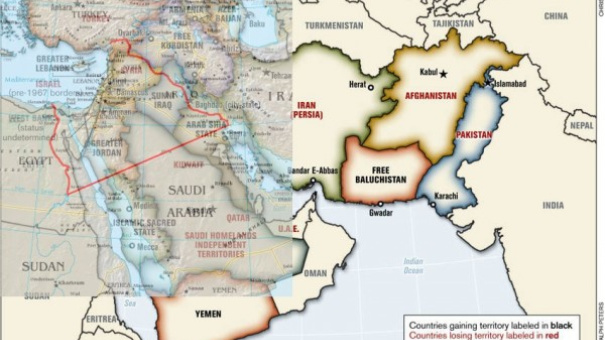
IMAGE: Project Balkanisation: Oded Yinon and an Enduring Plank of Israeli Foreign Policy (Source: Katehon)
It argues that Israel’s long-term survival hinges on one core premise: “The dissolution of all existing Arab states into small units.”
On the surface, the geopolitical win by the US-UK-Israel military-intelligence trifecta — backed by Turkey and the Persian Gulf monarchies — appears seismic. A Shīʿī-led country now falls under Sunni Salafism, severing the contiguous Shīʿī-controlled corridor linking Tehran to Hezbollah in Lebanon.
Another barrier to China’s Silk Road ambitions into the Mediterranean has been firmly set in place. Any revival of the ancient Via Maris — a trade corridor that once ran the Levantine coast, linking Asia to Europe and North Africa — remains a pipe dream.
Severed by the establishment of Israel and now buried beneath the rubble of Syria’s destruction, it ensures that any vision of unity from the Maghreb to the Arabian Peninsula remains just that — a vision.
But perhaps of greater immediate import — Israel’s ethno-supremacists and their vision of a ‘Greater Israel’ have just taken a giant leap forward. Southern Syria — and crucially, Mount Hermon, which overlooks Damascus and the Bekaa Valley in Lebanon, granting strategic military dominance over both — is now firmly under Israeli control. As is the tri-border area between Syria, Jordan, and Iraq — Al Tanf.
Yet there’s more. Israel now moves to establish its self-styled ‘David’s Corridor’ — a contiguous land route stretching from the occupied Golan Heights through southern Syria to the Euphrates. It cuts through the governorates of Deraa, Suwayda, Al-Tanf, and Deir Ezzor, reaching the Iraqi-Syrian border at Albu Kamal — granting Israel a strategic foothold deep in the heart of West Asia.
The corridor was already partially activated during the 12-day war with Iran, enabling standoff air strikes deep into Iranian territory.
With a direct land route to Iraq now viable, expect covert destabilisation efforts within the Shīʿī heartlands of Karbalāʾ and Najaf, alongside renewed backing for Kurdish separatists in both Iraq and Syria. Further vicious sectarian conflict across the region is now being baked in.
Whilst Israel’s bombing of the Defence Ministry and the Presidential Palace in Damascus was supposedly to protect the Druze community from Jolani’s Salafist mercenaries, no such protection was afforded to the Alawites, Armenians, Assyrians, or any of Syria’s other religious or ethnic minorities, who were left to be slaughtered.
The strikes on the Defence Ministry and Presidential Palace were telegraphed well in advance — and were thus performative. A warning to Jolani — Southern Syria is now firmly under Israel’s purview. No Syrian military forces will be allowed.
Meaning: Jolani and his hired guns are expendable, especially now that they’ve completed their task — extinguishing Syria’s sovereignty. As Hadi Nasrallah ruefully put it:
“You mean to tell me the very ones armed by Israel, treated in Israeli hospitals, coordinating with the IOF, shaking Netanyahu’s hand and thanking him for bombing Lebanon — are now being bombed by Israel after serving their purpose? Who would’ve thought?”
And yet, it remains far from clear if Jolani has outlived his usefulness, or if he still has his uses, at least from a US perspective.
Only days ago, whilst Jolani was in Baku, Syrian and Israeli officials were reportedly in talks. Rumours even swirled of a deal wherein Syria would launch attacks against Lebanon’s Shiʿī communities — either independently or in coordination with Israel.
Little wonder, then, that US envoy Tom Barrack warned Lebanon to ‘disarm Hezbollah or risk Syrian occupation’ — signalling that Lebanon, too, is likely slated for division and balkanisation.
The port of Tripoli and the Bekaʿa Valley, Lebanon’s agricultural heartland and a Shīʿī stronghold, are now in play. The only question is whether Ankara or West Jerusalem will seize them first, come to blows over Lebanon’s spoils, or quietly divide them, with Turkey taking the port and Israel the Bekaʿa.
But full control may yet require the chaos of full-on civil war. Syria and Lebanon edge closer — division and balkanisation becoming ever easier to enforce, until little remains but manageable fragments. The Yinon Plan made manifest.
“The attack on Lebanon is going to happen without a doubt… the question is when, and the other question is how. Is Israel going to do a ground invasion at the same time or just attack from the air?” (Ibrahim Majed)
Doubtless, the architects of today’s chaos are already patting themselves on the back, expecting handsome dividends to roll in. More division. More balkanisation. A weaker, fractured Arab world — and a stronger, more dominant Israel.
This is what Netanyahu means when he talks about “redrawing the Middle East”.
Yet the US and Israel are unravelling at an accelerating pace. Their seeming victory over the Levant is no triumph of providence — it courts the abyss and beckons the judgment to come.
July 21, 2025
Posted by aletho |
Ethnic Cleansing, Racism, Zionism, Wars for Israel | Iran, Iraq, Israel, Lebanon, Middle East, Syria, Turkey, United States, Zionism |
Leave a comment
As Azerbaijan-Russia relations cool, discussions emerge in Baku about the potential deployment of a Turkish military base. Is this a random development — or is chance merely revealing an underlying pattern?
Between Iran and Russia, Azerbaijan chooses Turkey. At one point, when describing the political geography of modern Azerbaijan, Geidar Dzhemal — a Russian Islamic political and public figure, philosopher, and poet — characterized it as extremely vulnerable, considering its southern border with Iran and northern border with Russia. At the time, the Karabakh issue remained unresolved for Baku, and the goal of regaining full control over the Nagorno-Karabakh territory was still pending. In other words, despite being technically at war with Armenia, Baku did not perceive it as an existential threat.
Dzhemal’s assessment reflected Azerbaijan’s geopolitical choice to align with NATO-member Turkey, and to build partnerships with the UK, Israel, and the US. These allies, carefully selected by Baku, have political and economic agendas that are at odds with those of Russia and Iran.
Despite historical ties with Iran and its shared Shia Islamic heritage, Azerbaijan opted in the 1990s for an alliance with Sunni-majority Turkey. Turkey became a key facilitator in the implementation of the so-called “contracts of the century” in the oil and gas sector, with Britain playing a leading role.
Recognizing the deep-rooted tensions between Israel and Iran, Baku forged a pragmatic partnership with Tel Aviv. Azerbaijani oil — making up 60% of Israel’s overall oil imports — in exchange for Israeli weaponry and military technologies laid the foundation for robust bilateral relations. Israel, for its part, assisted Azerbaijan in strengthening ties with the US and Europe, both directly and through lobbying by the Jewish diaspora.
In return, Azerbaijan did not hinder the activities of Israeli intelligence services on its territory, particularly when directed at Iran. Azerbaijan’s military success in the Second Karabakh War in 2020, with direct Israeli support (weapons deliveries, intelligence sharing, UAV operations), significantly expanded the operational scope of Israeli intelligence targeting Iran. The results of the twelve-day Israel-Iran war in June 2025 have once again raised questions about Israeli security structures potentially using Azerbaijani territory.
Today, Tehran is unlikely to escalate tensions with Baku. On one hand, both sides have only recently emerged from a serious diplomatic crisis (following the terrorist attack at Azerbaijan’s embassy in Iran, the withdrawal of Baku’s ambassador, and the later restoration of ties). On the other hand, Iran’s conflict with Israel remains unresolved and without a peace agreement.
Azerbaijan’s relationship with Russia in the post-Soviet era has fluctuated — swinging between partnership and hostility. Moscow initially adopted a neutral stance in the Karabakh conflict, trying to retain both Armenia and Azerbaijan within its sphere of influence, and took the lead in conflict resolution efforts. Indeed, both Karabakh wars ended under Russian mediation, but with radically different outcomes. From the 2000s onwards, Russia began pursuing a more pragmatic approach in the South Caucasus, shifting toward a strategic partnership with Baku. As a result, Azerbaijan secured access to $5 billion worth of modern Russian weapons, expanded its business presence in Russia, and acted as a mediator — particularly after the 2015 downing of a Russian Su-24 by Turkish forces — in restoring and advancing Russian-Turkish ties.
Russia’s distant approach during the Second Karabakh War and the Azerbaijan-Armenia tensions of 2021–2023 allowed Baku to achieve military success and regain lost territories in Karabakh. Following its pragmatic logic, Azerbaijan did not join anti-Russian sanctions and, like Turkey, has maintained business ties with Russia, receiving considerable benefits from transit and re-export arrangements.
However, despite its strategic partnership with Russia, Turkey has not hastened to implement the Russian-proposed gas hub project in Eastern Thrace. Ankara continues to demand favorable financial terms (lower gas prices, deferred payments, joint trade) and also seeks Russian consent for its plans to access Central Asia via the Caspian Sea and tap into Turkmen gas.
Since autumn 2020, the “Turan Project” has begun to take more tangible shape. Ankara envisions the creation of an alternative alliance to the EAEU and the EU, involving Turkic states and Pakistan.
Iran opposes the Zangezur Corridor, Russia — due to Armenia’s position — cannot establish control over the project, and Azerbaijan may reconsider its support for the North–South International Transport Corridor, possibly obstructing Russia’s access through Iran to the Persian Gulf and the Indian Ocean. This scenario could trigger new diplomatic — or worse, military-political — crises in the South Caucasus.
Amid all this, Azerbaijan is placing its hopes on Turkish military bases. Following the latest escalation in Azerbaijan-Russia relations — sparked by Baku’s harsh reaction to the tragic downing of a civilian aircraft and the detention of Azerbaijani diaspora members in Yekaterinburg (with investigations still ongoing) — former presidential aide Eldar Namazov raised the prospect of hosting a major Turkish military base in Azerbaijan. He even suggested that part of the base could be leased to the Pakistani Air Force as a potential deterrent against alleged provocations from Russia and Iran.
Namazov is far from a fringe figure, and his statements are likely aligned with the presidential administration — at the very least, with the President’s foreign policy aide Hikmet Hajiyev.
In fact, Turkey has long been involved in Azerbaijan’s defense and security — from the two Karabakh wars to military reforms and personnel training. Joint military drills are held regularly. After the Second Karabakh War, a Turkish-staffed monitoring center operated in Aghdam from November 2020 (Russian peacekeepers have since left the region, but no official information suggests Turkish forces have followed suit). Turkish military advisers remain active in Baku. The 2021 Shusha Declaration explicitly provides for mutual military assistance upon request. Iran is acutely aware that any attack on Azerbaijan would trigger Turkish intervention.
Should Azerbaijan decide to host a Turkish NATO base on its territory, it would usher in a new geopolitical reality in the South Caucasus. This would compel Russia and Iran to take additional security measures, plunging the region into uncertainty. Baku, while not necessarily hoping for a repeat of its Karabakh victory, risks forfeiting significant advantages — namely, threats to transit routes vital to its economy, and potentially even the loss of its hard-won control over Karabakh.
In chess, logic demands the elimination of reckless moves that may lead to failure. In political chess, the stakes are even higher: a miscalculated diplomatic move can result not only in defeat, but in far more serious consequences — human, material, and strategic. Sadly, history has shown that wars often spell the downfall of some states, while paving the way for the birth of others. President Aliyev, a diplomat by training with years of presidential experience and a cool, calculated approach, is unlikely to let the Azerbaijan–Russia crisis escalate unchecked. Most likely, this period of tension will soon give way to renewed cooperation — perhaps even in the form of a formal declaration of alliance.
Alexander Svarants – Doctor of Political Science, Professor, Turkologist, expert on the Middle East
July 21, 2025
Posted by aletho |
Economics, Militarism | Azerbaijan, Iran, Israel, NATO, Russia, Turkey |
Leave a comment

 Aletho News