Israel furious at Trump over Turkey, Syria to invade Lebanon – w/ Col. Macgregor
Mario Nawfal | June 26, 2026
Israel Brings The War Rhetoric Towards Türkiye
After Being Defeated In Iran, Israel Targets Türkiye.
By Justin K.P. – The Dissident – June 22, 2026
The idea of Israel going to war with Türkiye- a NATO member- potentially triggering World War III seems insane.
And yet Israel is using their war rhetoric towards Türkiye.
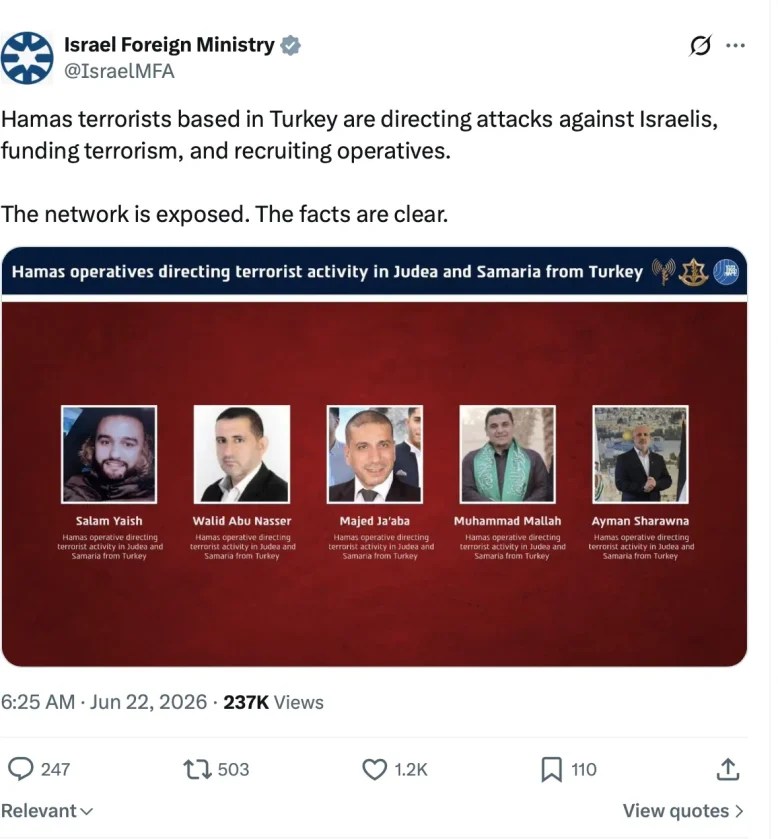
The Israeli Foreign Ministry put out a post seemingly laying the groundwork for an Israeli war, claiming that “Hamas terrorists based in Turkey are directing attacks against Israelis, funding terrorism, and recruiting operatives. The network is exposed. The facts are clear.”
This is far from the first time Israel has used war rhetoric towards Türkiye.
Israel’s Minister of Diaspora Affairs Amichai Chikli recently said that Israel “will be at war with Syria sooner or later” in part because he called Syria “a Turkish protectorate”.
He also fabricated a new “radical Sunni axis of evil” which supposedly includes Pakistan, Turkey and Qatar.
Middle East Eye reported:
“What we are witnessing before our eyes is the rise of a new axis,” Chikli told 103FM radio on Wednesday, referring to Turkey, Qatar and Pakistan. He described this so-called alliance as “a radical Sunni axis of evil, more dangerous than anything we have seen before”.
While Chikli mentioned both Qatar and Pakistan in his interviews, he mainly focused on Turkey, branding Turkish President Recep Tayyip Erdogan’s vision “an extremely dangerous combination for us”.
Other members of the ruling Israeli Likud party have similarly been declaring Türkiye “an enemy state”.
Middle East Eye noted, “Last week, Israeli lawmaker Ariel Kellner, also of Likud, called Turkey an ‘enemy state’, while Culture and Sports Minister Miki Zohar said last month that Israel’“must begin to treat Turkey as an enemy state,’ suggesting that Turkey would suffer heavy blows in a possible conflict with Israel.”
It added that “In February, former prime minister Naftali Bennett indicated that he sees Turkey as an enemy, with the opposition figure stating: ‘Turkey is the new Iran.’”
Perhaps the most concerning development is the fact that the Foundation for The Defence of Democracies (FDD), an Israeli lobby cutout that played a large role in the U.S. war on Iran, has begun publishing articles using similar rhetoric towards Türkiye.
FDD put out an article titled , “Turkey the new Iran? Ankara’s growing challenge to Western interests”.
The article attempted to label Türkiye as the “new Iran”, writing:
As Iran and its proxies take a beating from American and Israeli forces, observers are questioning whether Turkey is waiting in the wings to emerge as the region’s next “bogeyman.” The answer is likely yes, albeit in its own form.
Turkey is not Iran, but depicting Turkey as a nuisance or simply “complicated” only emboldens a maturing adversarial regime with an established track record of undermining its Western allies.
The article attempted to ratchet up hostilities between Türkiye and the United States, writing, “The real question is whether Turkey is actively undermining US, NATO, and regional security interests. There is little doubt that Ankara is doing just that, and doing so more brazenly with the passage of time.”
It also lamented that Türkiye is too supportive of the Palestinian resistance, writing “Hamas, as an Iranian proxy, has served Ankara’s interests in undermining Israel’s security interests, something which Turkey would like to see intact after the end of the current war.”
FDD has similarly put out articles pushing for the U.S. to put sanctions on Türkiye, saying that “Washington should pursue Global Magnitsky sanctions against targets in Turkey” and that “the United States should utilize Global Magnitsky authorities to target Turkish individuals responsible for human rights violations”.
It also called for the U.S. to designate “government officials” in Türkiye as “terrorist organizations” and wrote that “The United States should protect the international financial sector by recommending added scrutiny and screening to transactions involving Turkish financial institutions” and that “Washington should coordinate with the G7 to return Turkey to the Financial Action Task Force (FATF) ‘grey list’ until further improvements are seen in combating terrorism financing.”
The Carnegie Endowment for Peace documented that “FDD was the brainchild of a New York Times journalist-turned-Republican operative, Clifford May,” adding that “it arose out of an organization committed to burnishing Israel’s reputation in the United States. On April 24, 2001, three major pro-Israel donors incorporated an organization called EMET (Hebrew for ‘truth’). In an application to the Internal Revenue Service for tax-exempt status, May explained that the group ‘was to provide education to enhance Israel’s image in North America and the public’s understanding of issues affecting Israeli-Arab relations.’ But in the wake of the Sept. 11 attacks, May broadened the group’s mission and changed its name to the Foundation for Defense of Democracies. As he explained in a supplement to the IRS, the group’s board of directors decided to focus on ‘develop[ing] educational materials on the eradication of terrorism everywhere in the world.’”
It added that, “FDD’s chief funders have been drawn almost entirely from American Jews who have a long history of funding pro-Israel organizations. They include Bernard Marcus, the co-founder of Home Depot, whiskey heirs Samuel and Edgar Bronfman, gambling mogul Sheldon Adelson, heiress Lynn Schusterman, Wall Street speculators Michael Steinhardt and Paul Singer, and Leonard Abramson, founder of U.S. Healthcare.”
Sima Vaknin-Gil, a former Israeli military intelligence officer, in the Al Jazeera documentary The Lobby, admitted that “We have FDD” and that “the foundation is ‘working on’ projects for Israel, including ‘data gathering, information analysis, working on activist organizations, money trail. This is something that only a country, with its resources, can do the best”.
FDD played a huge role in shaping American policy towards Iran at the behest of Israel.
Now, as Israel calls Türkiye an “enemy state”- the FDD has begun pushing Washington to place sanctions on the country and designate government officials as terrorists, laying the groundwork for a new Israeli war.
Syria, Lebanon, and the limits of power
By Bassam Abu Abdallah | The Cradle | June 19, 2026
Remarks by US President Donald Trump in an interview with NBC News earlier this month, in which he said he would like to see “a more precise surgical attack on Hezbollah” and suggested that Syria’s Ahmad al-Sharaa (formerly known as Abu Mohammad al-Julani) could play a role in reaching an agreement over the conflict in Lebanon, have revived a familiar question across the region.
Trump later escalated his rhetoric, saying that if Israel “can’t do the job without killing everyone else, Syria should do the job.” Describing the war on Lebanon as a secondary front, he suggested that Syria, in coordination with the US, could take on Hezbollah if Israeli Prime Minister Benjamin Netanyahu could not be reined in.
Whenever the region enters a period of major change, the same issue resurfaces. Can Syria once again play a direct security or military role in Lebanon, as it did in 1976?
The comparison is tempting on the surface. It invites parallels between the current leadership in Damascus and the late president Hafez al-Assad, who sent Syrian forces into Lebanon during the civil war. Yet even a brief look at the surrounding conditions suggests that the resemblance is largely superficial.
Trump himself did not clarify what form of assistance he had in mind. The possibilities range from border control and curbing smuggling routes to a broader attempt to pressure Hezbollah.
An old question returns
Similar ideas have surfaced before. In a July 2025 interview with The National, US envoy Tom Barrack warned that Lebanon faced an “existential threat” if it failed to address Hezbollah’s weapons, adding that “if Lebanon doesn’t move, it’s going to be Bilad Al Sham [Greater Syria] again.”
In March, Reuters reported that Washington had encouraged Syria to consider sending forces into eastern Lebanon to help disarm Hezbollah, a claim later denied by Barrack. The episode nevertheless fueled speculation about a possible Syrian role in Lebanon.
The responses from Sharaa’s government, however, have remained cautious and indirect. Sharaa has expressed support for Lebanese President Joseph Aoun’s efforts to consolidate arms under state authority, while recent exchanges with Lebanese Prime Minister Nawaf Salam have emphasized coordination between military and security institutions in both countries.
Syria’s self-appointed president and former Al-Qaeda chief Ahmad al-Sharaa dismissed reports that Syrian forces could enter Lebanon as “rumors.”
At the same time, periodic announcements from Syrian authorities about dismantling alleged Hezbollah-linked cells have been interpreted by some observers as signals aimed at Washington, suggesting readiness to engage if political backing is secured. Whether this reflects a concrete agreement or simply an attempt to keep options open remains unclear.
What is clear is that the renewed discussion comes at a moment when broader regional balances are in flux, particularly after the collapse of the previous Syrian order. The question is not whether Syria once intervened in Lebanon, but whether the conditions that made that intervention possible still exist.
1976 and the architecture of intervention
By the time Syrian forces entered Lebanon in 1976, the civil war had pushed the state to the brink. Importantly, the intervention took shape within a web of regional bargains and international understandings, rather than a unilateral move by Damascus.
The move was carried out at the request of the Lebanese president at the time, Suleiman Frangieh, and was supported by influential Lebanese actors who feared a decisive shift in the internal balance of power. It also aligned with broader concerns shared by regional and international players who were wary of Lebanon descending into total disorder.
Accounts in both western and Arab sources point to quiet understandings between the US, Saudi Arabia, and France that gave Syria space to act as a stabilizing force. The objective was about containing a crisis that risked spilling beyond Lebanon and unsettling the wider region.
The intervention was later formalized through the Arab Deterrent Forces (ADF), which provided a measure of regional legitimacy under the umbrella of the Arab League. This layer of political cover mattered as much as the military dimension.
Equally important was the nature of the Syrian state itself at the time. Syria in 1976 was a cohesive political entity with functioning institutions and a professional army that ranked among the largest in the region. Assad’s leadership carried both domestic and international recognition, reinforced by the aftermath of the 1973 war.
From Assad’s perspective, Lebanon was not a distant arena but an extension of its own security environment. The prospect of a hostile force dominating Lebanon was treated as a direct threat to Syrian national security.
Even so, the intervention was not without tension. The Soviet Union, Syria’s principal ally, expressed reservations, reflecting its own alignment with other forces inside Lebanon. Assad nevertheless proceeded, guided by his assessment of Syria’s strategic interests.
The ability to make such a decision rested on a combination of factors: a stable state, a centralized leadership, a disciplined army, regional acceptance, and working relationships with key Arab actors. Together, these elements created a framework that made intervention both possible and, for a time, sustainable.
A different Syria
None of these conditions applies in the same way today. The current leadership in Damascus operates from a transitional position, still seeking to consolidate authority within a country deeply affected by years of conflict.
There is no broad national consensus over the future political order, and the institutional framework remains incomplete. Legislative bodies and representative structures that might anchor political legitimacy are either absent or still in formation. External backing, whether from the US, Turkiye, Qatar, or others, does not substitute for internal acceptance.
Experience suggests that states cannot rely on external recognition alone to secure stability. Durable governance depends on a social contract that reflects a degree of consensus among citizens. In Syria’s case, that process is ongoing and far from settled.
The challenges facing the current authority are primarily internal. Rebuilding state institutions, addressing economic collapse, and managing the social consequences of prolonged conflict all demand sustained attention. Large segments of the population continue to face economic hardship, while public services and infrastructure remain under strain.
The divisions forged during the war have not receded. Political, social, and sectarian fault lines still cut across the country. In this context, the priority remains consolidation at home, not projection abroad.
A leadership still working to establish its authority is unlikely to commit to a regional role that would require resources, cohesion, and legitimacy it has yet to secure.
The question of the military
The structure and character of the military institution further complicate the picture. The Syrian army that entered Lebanon in 1976 was a regular force with a defined command structure and a coherent doctrine.
Today’s military formations are the product of a long, fragmented war. At their core are factions that once operated as distinct armed groups – among them elements that emerged from or overlapped with networks such as the Nusra Front and other Salafi extremist currents, alongside local militias and foreign fighters folded in over time. Efforts to weld these strands into a single national army remain partial and uneven.
Questions also persist regarding leadership structures, external affiliations, and the presence of foreign fighters within certain units. These factors have drawn scrutiny from international actors and have been reflected in sanctions targeting individuals linked to these formations.
Reports of violations during operations along Syria’s coast and in Suwayda have kept questions of accountability and discipline alive. That record complicates attempts to present these formations as a cohesive national army capable of assuming a wider regional role.
Without a unified command structure and broad public confidence, the military lacks the foundation required for sustained operations beyond Syria’s borders.
Lebanon without an invitation
The Lebanese context has also changed in fundamental ways. In 1976, Syria’s intervention was facilitated by internal Lebanese dynamics, including a formal request from the presidency and support from key political forces.
Today, there is no comparable call for Syrian involvement. Across the political spectrum, Lebanese actors tend to view the period of Syrian tutelage as a chapter they do not wish to revisit, regardless of their differing positions on Hezbollah or regional alignments.
The absence of a domestic Lebanese consensus is matched by a lack of regional endorsement. No major Arab state is advocating for a renewed Syrian military role in Lebanon, and the political environment offers little space for such a move.
Regional risks and the Turkish factor
Another variable that did not exist in 1976 is the extent of Turkish involvement in Syria. Ankara’s presence adds a layer of complexity to any potential Syrian move beyond its borders.
Any Syrian move into Lebanon would run straight into Turkish red lines, Iranian interests, and Hezbollah’s own calculations. What begins as a limited step risks quickly widening, pulling in actors who are already embedded across the same theater.
The prospect of Syrian forces entering Lebanon could also deepen sectarian tensions, extending beyond Lebanon into Syria and Iraq. In an already volatile environment, such a development would be difficult to contain.
If the equation shifts
The equation has already begun to shift. Washington and Tehran have signed an interim memorandum that freezes the conflict and opens the door to wider negotiations. Whether that process produces a lasting settlement or merely a temporary pause remains unclear, but the assumptions that governed the region before the agreement are already being tested.
Such a shift would likely alter priorities across multiple arenas, including Syria, Lebanon, and Iraq. The emphasis could move from confrontation to managing balances of influence, reducing the relevance of some of the initiatives that emerged during periods of heightened tension.
In that context, the role of actors such as Hezbollah would be recalibrated within a different strategic environment, one where stability takes precedence over escalation.
Limits of power
Comparisons between 1976 and the present miss how far the ground has shifted. That intervention rested on a particular convergence of internal strength, regional acceptance, and international cover.
Syria today sits in a different position. Questions of legitimacy, institutional reconstruction, economic recovery, and social cohesion remain unresolved. The regional environment has also changed, with little appetite for a renewed Syrian role in Lebanon.
The question of intervention is not about intent alone. It turns on power, resources, and the condition of the state itself.
From that perspective, the more pressing question is not whether Damascus can re-enter Lebanon, but whether it has fully reconstituted itself at home.
As the familiar political saying goes, those who have yet to put their own house in order are unlikely to reorganize the neighborhood around them.
The debate, in the end, returns to a simple constraint: power is bounded by geography.
Arab Powers Mull Regional Security Alliance – Jordan’s Ex-Minister
Sputnik – 11.06.2026
Some countries in the Middle East are advancing proposals to forge a regional alliance involving Jordan, Egypt, Saudi Arabia, and Qatar, aimed at preventing further regional turmoil, Jordan’s former Minister of Social Development and political science professor Amin Al-Mashaqba tells Sputnik.
The goal of such an alliance would be to strengthen collective security and increase the level of self-reliance among Arab states after “the failure of US security guarantees for the Gulf countries.”
Jordan maintains constant contacts with the US, continuing its effort to safeguard regional peace, he says.
“Relations between Jordan and the Gulf states have deep historical roots, but current challenges require a higher level of Arab coordination and security cooperation,” Al-Mashaqba notes, adding that the country, along with Egypt, Saudi Arabia, Qatar, and Turkiye, “attempted to prevent” the US-Israeli strikes on Iran.
The “key problem,” lies in Israel’s policy, which seeks to keep the region in a state of ongoing conflict and achieve its “expansionist and religious-ideological goals,” Al-Mashaqba says.
The continuation of current Israeli policies could jeopardize the future of peace agreements between Israel and Arab states, he concludes.
Iran denies attacking Saudi Arabia, warns of Israeli false-flag
The Cradle | June 8, 2026
Iranian Foreign Ministry spokesman Esmail Baghaei denied reports alleging that Iran targeted Saudi Arabia on 8 June, cautioning that such claims could be linked to potential “false-flag operations” conducted in Iran’s name.
Baghaei stressed that Tehran publicly takes responsibility for any military action it carries out and noted that no statement had been issued by Iran confirming the reported incident.
He further said Iran has repeatedly warned about the possibility of false-flag operations, claiming that Israel and other actors have previously carried out similar actions, including during the most recent US-Israeli war on the Islamic Republic.
His comments came after missile alert sirens were activated in the Saudi city of Al-Kharj, home to Prince Sultan Air Base, a facility long used by US forces, just hours after Israel launched renewed strikes against Iran on Monday morning.
Since the US-Israeli war on Iran began in late February, Tehran has frequently argued that many of the strikes blamed on its forces were actually “false-flag” operations staged by its enemies, designed to draw Gulf states further into the war.
On 4 June, Iran’s Islamic Revolutionary Guard Corps (IRGC) dismissed reports that it targeted the terminal at Kuwait International Airport, saying the alleged visual evidence was a “crude fabrication.”
While acknowledging midnight strikes on regional US bases, Iranian officials noted that footage of the airport explosion was recorded in daylight.
In April, the IRGC accused Israel of being behind the strike on a Kuwaiti desalination plant to incite regional tensions further.
This followed a similar denial regarding a 30 March attack on a Kuwaiti power facility, which Tehran also blamed on Israel.
On 4 April, the IRGC further rejected claims that it struck the US Embassy in Riyadh in the opening days of the war, asserting the drone attack was “certainly carried out by Zionists.”
Iran’s Foreign Ministry said on 15 March that the US and Israel were using “Lucas” drones – modeled after the cheap and effective Iranian Shahed – to conduct false-flag operations and attribute them to Tehran.
The IRGC military headquarters, Khatam al-Anbiya, stated that such “deceptions” included attacks in Turkiye and Iraq.
Earlier in March, Iranian military sources described a drone strike on the Ras Tanura refinery in Saudi Arabia as an Israeli false flag designed to distract from strikes inside Iran and draw the Gulf states into further hostilities against the Islamic Republic.
Tucker Carlson also claimed in March that Saudi Arabia and Qatar had detained Israeli agents who were planning bombings in their countries.
Netanyahu’s Ethnostate and the Greater Israel: A Biblical Mythology or a Geopolitical Project?
By Ricardo Martins – New Eastern Outlook – June 5, 2026
Netanyahu and Trump are conditioning the end of the war in Iran on the condition that all countries in the region sign the Abraham Accords, a tacit submission to Israel. Drawing on Daniel Levy, Omer Bartov, and the Pew Survey, I address the reasons, the urgency, and the limits of Netanyahu’s simultaneous battles on several fronts in the quest for a Greater Israel project.
When Israeli Finance Minister Bezalel Smotrich talks about expanding Israel’s reach “to Damascus,” or Prime Minister Benjamin Netanyahu expresses personal attachment to broad territorial ambitions or Israel being not only a “regional superpower” but “in some respects, a global superpower,” these are not just messianic daydreams. They reflect a deliberate, and deeply destabilizing strategic doctrine. For years, the idea of Greater Israel was dismissed by Western analysts as the rhetoric of a few Israeli hardliners. Sustaining this dismissive position is no longer possible.
Daniel Levy, a former Israeli peace negotiator and now head of the U.S./Middle East Project, offers a sharp analytical lens for understanding today’s events. He suggests that Greater Israel isn’t just about land—it’s about Israel aiming to establish itself as the dominant hard-power player across the Middle East. As Levy puts it, this is about seeing how far Israel can extend its reach and consolidate its role as the region’s unrivaled hegemon.
Territorial control—occupying the Golan, reasserting presence in southern Lebanon, pushing forward with West Bank annexation, and the continuation of the genocide in Gaza—is only the most visible layer. The deeper game is about forging new regional alliances, as the one with the UAE, systematically weakening rival states, and building webs of hard-power dependency that lock neighboring governments into Israel’s orbit.
The ideological consolidation of this project was the 2018 Jewish Nation-State Basic Law, which constitutionally defined Israel as “the national home of the Jewish people.” For many, including the PLO’s Saeb Erekat, this law was the moment when a Zionist aspiration became a formal legal reality, and for critics, a codification of a system of apartheid. What was once an ambition is now written into the legal foundations of the state.
Omer Bartov, a leading scholar on genocide and Israeli history, traces this shift with a heavy sense of loss. In his book Israel: What Went Wrong?, he shows how Zionism, once rooted in the humanitarian ideals of 19th-century Jewish emancipation, has been transformed into a state project of ethno-nationalism, exclusion, and, in the end, violence. As Bartov puts it, what began as a struggle for Jewish liberation has become a machinery for dominating Palestinians, with all the tragedy that implies.
The Logic of Urgency
The pace and simultaneity of Israeli military operations in recent years demand careful analysis. In just two years, Israel has bombed Gaza, Iran, Syria, Iraq, Lebanon, Qatar and Yemen; it has occupied the Golan Heights, Gaza, the West Bank, and parts of southern Lebanon. Israel even succeeded in drawing the United States into a direct conflict with Iran, a move that, as Secretary of State Marco Rubio accidentally admitted, was driven more by Israeli rather than American priorities. As for Netanyahu, this is a posture of someone convinced that the window for reshaping the region is closing fast, and determined to act before it closes.
Levy describes the current moment as the “Pax Greater Israel” era, a time when the old constraints of American power, the so-called Pax Americana, have faded. With a more pliable U.S. administration, Israel’s room to maneuver has expanded. Iran still hasn’t rebuilt the deterrence it once had before Israel and America struck last year. The region’s strategic balance is more fluid—and more precarious—than it’s been in a generation.
While there’s international outrage over Israel’s actions in Gaza, Iran, and Lebanon, Israel has not suffered any punishment. The European Union, which heralds itself as the guardian of morals and Western values, has seen these values undermined by Israel, yet no single action has been taken. Netanyahu, who has piloted Israeli politics for nearly two decades, is unlikely to let an opportunity like this slip by.
Netanyahu’s sense of urgency isn’t just strategic. It is also deeply personal and political. He faces criminal charges, widespread public disapproval (polls showed most Israelis wanted him out even before the Gaza war), and an election looming in 2026. His personal survival and his political project are now intertwined. History teaches us that war often delays accountability, and Netanyahu knows that he has survived through wars.
By keeping the nation in a constant state of crisis, Netanyahu postpones his own reckoning while pushing forward his broader regional ambitions. There is always a danger when embattled leaders manipulate the machinery of state.
The Collapse of the Impunity Consensus
For decades, Israel benefited from an unspoken Western consensus that gave it extraordinary complacency on international law. UN resolutions could be swept aside, settlements could expand, human rights abuses against Palestinians could be perpetrated, and the memory of the Holocaust—too often used as a diplomatic shield—offered a kind of moral immunity no other state enjoyed. That consensus is now breaking down, even if its institutional traces remain stubbornly in place.
The visibility of the Gaza war and its horrendous violence has triggered a generational break like never before and a breakdown of this consensus. According to an April 2026 Pew survey, 60% of Americans have unfavorable views of Israel and 37% favorable ones. This becomes more important, as it is the first in history. The same survey also showed Netanyahu’s administration with 27% approval and 59% disapproval. In the last Global Country Perceptions Survey, Israel ranked in the last position, several points behind North Korea and Afghanistan.
The generational divide is even sharper among young people, many of whom reject any complicity in what prominent scholars, including Bartov, now formally call genocide. Netanyahu’s act of tearing up the UN Charter at the General Assembly, followed by a mass walkout, was more than symbolism. It marked the end of an era for both Netanyahu and Israel. Criticism of Israel or Zionism is no longer quickly conflated with antisemitism, especially among the younger generations.
And yet the institutional lag is severe. The European Union, bound by Article 2 of its Association Agreement with Israel, which explicitly conditions the relationship on respect for human rights, has consistently refused to act on its own legal framework. The cost of this cowardice is not merely moral. The EU, having lost industrial competitiveness, seeks its international influence as a regulatory and normative superpower. This claim rests on credibility. A bloc that intends to police the digital practices of technology companies but cannot enforce a human rights clause in its own trade agreement with a small state faces difficulties in imposing itself as a normative power, and the Global South has drawn that conclusion because of the lack of moral authority and double standard.
The pro-Israel lobby in the United States, sensing the tide turning, has responded by intensifying rather than moderating. More money is being spent, more countries are being pressured, more political careers are being threatened or terminated, as was the case with Thomas Massie and Marjorie Taylor Greene, and more communication and online platforms are being acquired; censorship is being imposed, especially on platforms such as Facebook and YouTube, and algorithms are being “re-educated,” as Mr. Larry Ellison said when he acquired TikTok. The main lobby, AIPAC, has, in great measure, turned into a politically toxic brand, according to The Intercept.
But Levy is right to note the structural limits of this approach. Lobbying is most effective when it moves with the current of public opinion or when it operates in the dark. It is least effective when it operates openly against an overwhelming public majority, against a country’s perceived national interest, and against the values of the rising generation. The lobby is fighting a rearguard action — powerful, well-resourced, and increasingly desperate.
The Next Iran and the Regional Order
It’s no accident that Israeli security officials—from Naftali Bennett to the current establishment—have started designating Türkiye as “the next Iran.” This isn’t just rhetoric; it is also part of “Greater Israel” strategy. Three decades ago, Israel argued that Iran was the existential threat that had to be contained before it led the region. Now, the same logic and language are applied to Türkiye: any regional power capable of building a new security order outside Israeli influence is seen as a threat to be isolated or confronted before it can consolidate.
But Türkiye is a different kind of challenge. As a NATO member with the largest NATO army in Europe, a strong economy, and the anchor of a coalition with Saudi Arabia, Egypt, and Pakistan, Türkiye is not easily marginalized. Recent agreements point to a regional bloc that aims to build security frameworks explicitly outside Israeli (and, by extension, Western) dominance. This coalition news has not pleased Israel and soon reached the EU, with Ursula von der Leyen declaring, “We do not want to live under the influence of China, Russia, or Türkiye.”
The regional threat map has changed. For much of the Arab world and for Türkiye’s Erdoğan, Israel—not Iran—is now seen as the chief destabilizer. This shift in perception has real geopolitical consequences, and it’s not something American air power can easily undo.
Are we at the point of no return? In some ways, yes. The two-state solution, no matter how often it’s invoked in diplomatic statements, is functionally dead. It wasn’t killed by a single act, but by decades of illegal settlements, legal discrimination, disproportionate violence, and the systematic fragmentation of Palestinian territory. The ethnostate is already a reality on the ground. Bartov’s assessment is sobering but direct: unless there is sustained, structural pressure and actions from the international community, a real course correction is unlikely, and so far, that pressure hasn’t materialized.
But in another sense, we’re not quite past the point of no return for Netanyahu’s grand project. The conditions that have enabled the Greater Israel strategy are starting to slip away. American public opinion is shifting faster than the country’s political leaders; the support for Palestine is now higher than the support for Israel. A new regional bloc—with Turkey, Saudi Arabia, Pakistan, and Egypt—offers a real counterweight. Iran, for all its setbacks, still possesses significant strategic resources and has the backing of China and Russia. And inside Israel, recent polling shows that a large majority (71%) support replacing the current Basic Laws with a formal constitution. Beneath the surface noise of hardline politics, there’s evidence that Israeli society hasn’t wholly given in to the ethnonationalist vision Bartov describes.
One thing is clear: this current trajectory of forever war and continued violence and humiliation of Palestinians can’t last forever. As Levy notes, Netanyahu is playing a high-stakes game of “use it or lose it.” The real question isn’t whether this moment will end — sure it will — but what the aftermath will look like. Will the region be forcibly remade in the image of Greater Israel, or will a new order, forged through painful resistance, emerge in its place? The stakes for Israelis, Palestinians, and the broader Middle East couldn’t be higher.
Ricardo Martins – Doctor of Sociology, specialist in European and international politics as well as geopolitics
Russia Raises Alarm Over Ukraine’s Surging Black Sea Terrorist Activity
Sputnik – 02.06.2026
MOSCOW – Russia is concerned about Ukraine’s mounting terrorist activity in the Black Sea, which is raising risks for civilian shipping, Russian Foreign Ministry spokeswoman Maria Zakharova said Tuesday.
“We are concerned about the noticeable escalation of terrorist activity in the Black Sea by Ukraine, which leads to a deterioration of conditions and an increase in risks to civilian shipping,” Zakharova said in a statement.
On May 29, the Turkish Foreign Ministry announced that a drone had attacked a Turkish-owned vessel in the Black Sea, injuring two people. Ankara said it had conveyed its concern to all parties about a possible escalation in the region.
Ukraine’s military stages bandit raids on Black Sea ships with drones and unmanned boats — then pins the attacks on Russia, the spokeswoman said.
“These attacks on civilian commercial vessels have once again shown that the Kiev junta has complete disregard for the principles and norms of international law — preferring instead to deny any involvement in the incidents,” Zakharova said.
The spokeswoman branded Ukraine’s Black Sea provocations outright banditry — and warned that organizers and perpetrators alike will have to answer for these criminal acts.
“We believe such provocations — which are nothing but terrorist acts — must be the subject of a thorough, impartial investigation, receive a clear public response, and face condemnation from all coastal states that bear special responsibility for navigation safety in the Black Sea,” Zakharova stressed.
Neutralizing Black Sea security threats is crucial to any full crisis settlement, the diplomat noted.
“We confirm our readiness for close cooperation with Ankara in the interests of finding optimal ways to stabilize the Black Sea’s maritime space and exert effective influence on Kiev,” Zakharova added.
Trump demands Arab states normalize with Israel in exchange for Iran ceasefire: Report
Press TV – May 25, 2026
US President Donald Trump has told several Arab and Muslim leaders that he expects them to establish formal relations with Israel in exchange for a ceasefire deal with Iran to end the war, according to American officials.
Axios, citing the officials, said that Trump made the demand during a phone conversation on Saturday with leaders from Saudi Arabia, the United Arab Emirates, Qatar, Pakistan, Turkey, Egypt, Jordan, and Bahrain.
According to the same sources, all eight leaders expressed support for the potential agreement with Tehran during the call.
“We are with you on this deal,” one official was quoted as telling Trump, according to the report.
Another official familiar with the conversation said the US president indicated that he would next speak with Israeli Prime Minister Benjamin Netanyahu and hoped to bring him into a joint call with the same group of Arab and Muslim leaders in the future.
Trump also pushed those countries that have not yet joined the so-called Abraham Accords – a series of 2020 US-brokered normalization deals with Israel signed under the Trump administration – to do so and establish formal ties with the Tel Aviv regime, the officials added.
Saudi Arabia, Qatar, and Pakistan currently maintain no official diplomatic relations with Israel.
One of the officials told Axios that there was “silence on the line” after Trump’s demand, prompting the president to joke and ask “if they are still there.”
The development comes as indirect talks between Tehran and Washington, mediated by Pakistan and facilitated by Qatar, continue based on the Islamic Republic’s 14-point proposal to reach a memorandum aimed at putting an end to the US-Israeli war on Iran.
Speaking in a televised interview on Saturday, Iranian Foreign Ministry spokesman Esmaeil Baghaei said Iran and the United States have edged closer to finalizing the 14-point memorandum to end the imposed war, halt American maritime aggression, and secure the release of Iran’s blocked assets.
He emphasized that Iran’s focus at this stage remains exclusively on ending the US-Israel war based on its proposal, which has been shuttled back and forth several times.
The criminal US-Israeli aggression against Iran began on February 28 with airstrikes that assassinated senior Iranian officials and commanders, including Leader of the Islamic Revolution Ayatollah Seyyed Ali Khamenei.
Iranian Armed Forces responded by launching daily missile and drone operations targeting locations in the Israeli-occupied territories as well as US military bases and assets across the region.
Furthermore, Iran retaliated against the strikes by closing the Strait of Hormuz, which resulted in a significant increase in oil prices and its by-products.
On April 8, forty days into the war, a Pakistan-brokered temporary ceasefire between Iran and the US took effect.
Negotiations ensued in the Pakistani capital, Islamabad, but stopped short of an agreement amid Washington’s maximalist demands and insistence on unreasonable positions.
Are we on the verge of a US-Iran deal?
China is emerging as the silent, indispensable diplomatic power in the region
By Trita Parsi | May 22, 2026
Nothing is confirmed and finalized yet, and the spoilers should not be underestimated, but lots of activity points in the direction of a deal.
A few things stand out:
1. The role of China in the background is essential. Without having its fingerprints on the deal, and by that, avoiding any responsibility if it fails, China is emerging as the silent, indispensable diplomatic power in the region. (While Pakistan’s Asim Munir is traveling to Tehran, the Pakistani Prime Minister will be departing for Beijing shortly)
2. The regional involvement in the mediation is astounding: Pakistan, Qatar, Egypt, Turkey, Saudi and Oman are all or have all been playing an instrumental role in moving things forward. If a deal is reached, it will have regional buy-in (save from Israel and the UAE) at levels far beyond the JCPOA.
3. Regional diplomats and intel folks have been shuttling in and out of Tehran for weeks now. Qatar’s role, in particular, is noteworthy.
4. Europe’s absence is noticeable but not felt, as its irrelevance is becoming normalized.
5. More ships have been passing through the Strait of Hormuz. Whether these were mainly tankers going to China, and whether China paid a fee, is unclear at this point. But it is noteworthy that the ships are passing through both the Iranian AND the American “blockades.”
6. Though some distance remains to reaching a deal, my own conversation with folks on both sides has left me slightly more optimistic, primarily because of the flexibility I am detecting on the Iranian side regarding the stockpile (despite the Reuters story from yesterday). Ideas that were categorically rejected two weeks ago are now being genuinely considered.
7. If a deal is secured, Trump will face a lot of criticism from the Blob and the pro-Israel crowd in DC, but he will be in a very good position to sell the deal to the American public, whose concerns are very different from those of the Blob…
Wheels Down in Tbilisi: Was a Routine U.S. Military Stopover a Deliberate Signal to Iran?
By Seth Ferris – New Eastern Outlook – May 5, 2026
A brief and poorly explained landing of a U.S. military transport aircraft in Tbilisi at the end of March 2026 has become a subject of discussion and speculation about its real significance, fueling suspicions that more complex geopolitical signals may lie behind the official explanation of a “routine flight.”
Let’s pull apart the “routine flight” narrative and read between the lines, asking whether a fleeting stopover was less about logistics and more about sending a message — one that Georgia may end up paying for. If you think geopolitics is all press releases and polite diplomacy, think again. I would suggest that what is going on in the shadows, outside of mainstream coverage, is closer to theater — with Georgia cast in a role it never auditioned for.
Start with the headlines: last month, a US Air Force cargo aircraft made a brief stop in Tbilisi, purpose unknown – and just start reverse engineering, taking it apart, and you come up with what is between the lines as to the possible motivations for the US, a strategic ally of Georgia, to be willing to put Iran, its regional partner, in harm’s way. Moreover, it is interesting to know the news sites where this news first appeared, such as Georgian Today, and its history of paid hired gun articles supporting US policy in the region.
It is not as if Georgia and the US do not know that now is not the most opportune time to be perceived as supporting the illegal American-Israeli war against Iran. And let’s not forget C-130 Turkish Cargo Planes falling out of blue Georgian skies. Providing logistic support in a preempted war of aggression is still a recognized crime under the Nuremberg Codex. That puts the provider of such support in the crosshairs of the party being attacked, as has already been demonstrated by Iranian countermeasures, not to mention ‘protective reaction’ strikes in the Gulf States and Jordan.
What do we know?
A United States Air Force military transport aircraft made a short, unexplained landing in Tbilisi the last week of March, prompting questions and speculations but little official detail about its actual mission. However, multiple reports published on April 1, 2026, said a Boeing C-17 Globemaster III landed at Tbilisi International Airport in the afternoon after departing from the U.S. military hub at Ramstein Air Base in Germany.
It is interesting that the US Embassy provided a ‘most vague’ news release after the incident, telling of a phone call between Secretary of State Marco Rubio and Georgia Prime Minister Irakli Kobakhidze the very next day.
Also vague is the lack of coverage of planes without tail numbers landing at regional airports, such as the one named in honour of the Soviet-Georgian movie “Mimino” in Telavi, East Georgia, supposedly owned by the Aviation University of Georgia. It has operated since 2012 and serves as a training ground for students in the Faculty of Aviation and Engineering.
But it can serve other purposes, as the airport hosts an aircraft technical service enterprise, a navigation tower, a terminal building for passengers, and dormitories for pilot-instructors and engineering-technical staff.
Recent sightings, including of European-looking visitors to the facility, appear a bit too dodgy in terms of standard news release material about a local use and training facility after the landing of the military transport and drones spotted over Georgia – too short and sweet not to be subterfuge.
The U.S. Embassy characterized some flight movement as routine, stating that such flights are “regularly carried out in coordination with partners,” without providing details about cargo, passengers, or final destination.
Flight tracking platforms such as Flightradar24 confirm that C-17 aircraft frequently operate across Europe and the Middle East, typically transporting personnel, equipment, or humanitarian supplies, though specific mission details are not publicly disclosed.
But I am more interested in what was on board, delivering or taking out human cargo! This brings back memories of a Turkish military transport, a C-130. Dropping from the clear blue sky a few months ago, including its crew, all died, and the debris was scattered over a wide area of Georgian territory. The forensic findings of that crash investigation have never been publicly shared to the best of my knowledge.
Wheels Down!
Would the Georgian government, especially now, be so naive as to agree to this touchdown, an unexpected one at that—and of a US military transport plane out of the blue in the middle of a shooting war in the Middle East?
Already there is political blowback. Georgia political analyst Gia Khukhashvili reportedly said that Rubio’s phone call was a “threatening warning”.
Perhaps Rubio was checking how ready Georgia was, and in what form [to what degree] it was ready to help solve America’s logistical problems… I don’t think there have already been any concrete proposals at this stage. But this was logically followed by a threatening warning (for Georgia) from the Iranian ambassador: “Don’t do anything wrong, otherwise you will also become a target,” the Georgian News portal quotes the political scientist.
Gia Khukhashvili believes that there will be no Georgian-American agreements, because “Washington will understand who it is dealing with … and how the Georgian PM Kobakhidze will later say that Rubio threatened him on the phone and demanded to open a second front,” confirmed the Georgian political pundit.
Posting News to Provoke Iran!
Who knows the real motivations and how the news was reported? As one close, trusted Georgian source shared, … just that they post this news to make Iran angry! The UNM, United National Movement, former Saakashvili regime, wants it so VERY much!
Why didn’t they use Turkish or Armenian bases?
That is a good question, and I think you already know the answer. The US wanted to show Iran that Georgia and the US are cooperating, so it provoked Iran to send a drone or make some attack, as Israel has ordered the US to do.
It should be noted that Armenia has a Russian base, and the plane is claimed to have flown over some Armenian and Turkish territory, perhaps touching down in the Kurdish-controlled region of Northern Iraq. It would have been too dangerous to land in Armenia, as secrets could be revealed, and as for Turkey, it shares a similar position as Georgia, it does not want to get involved, or give the impression of being involved, especially since the Americans are openly arming regional Kurds. It can be expected that a substantial part of this ratline is flowing into and through Turkish territory.
I still can’t find any serious discussion on the plane and its real purpose for making a short stopover in Georgia. It appears that the US and Israel would love to put Georgia in the crosshairs of Iran just for the hell of it. It is also interesting that strikes have been carried out by Israel on joint Russian-Iranian port facilities on the Caspian, in the part on the Iranian side.
Possible Motivations for Wheels Down and Vague News Coverage
My first thought was delivering something to put in place for Iran. But if it went to Turkish airspace, it could also be headed to eastern Turkey or Iraq. Or one of the NATO bases in Turkey, although I’m pretty sure those are in the west, and we would not be in the flight path. In any case, if it is at all related to the war, then more EU countries are banning the use of the bases in their countries, so if a plane needs to stop somewhere or refuel, it could be done here. Georgia still wants to stay on good terms with the US, so if it is a brief stop, they would probably allow it. Not much will happen. If the use looks more like staging, it could be dangerous. Moreover, they could use Vaziani. I think NATO supported development of an air base there (which the government now wants to use for a new commercial mega-airport). But there isn’t much of an air force here, so maybe Vaziani lacks fuel in any quantity and other amenities. The motivation was perhaps to deliver some radar equipment, greenbacks, spyware equipment, or perhaps human resources, thinking that Iran will not attack Georgia since it needs it too much as its window to the world.
We’ll have to see; just a thought on it!
In the end, a half-hour touchdown, a vague press release statement, and a conveniently timed diplomatic call say more than any official briefing ever will. Whether it was cargo, coordination, or quiet signaling, the message landed louder than the aircraft itself: Georgia is being watched, tested, and potentially positioned in a conflict it has no desire to join.
And if this was meant as a signal to Iran, then it’s a risky one—because in today’s climate, even a brief stop can turn a bystander into a target. A fleeting military stopover can transform neutral ground into perceived staging areas, risking Iranian retaliation against a nation determined to remain on the sidelines. Sparse public facts and local sources reveal the shadowy interplay of great-power signaling, where a half-hour touchdown may speak louder than any formal briefing—placing Georgia uncomfortably in the crosshairs of a war it wants no part of.
Seth Ferris is an investigative journalist and political scientist, expert on Middle Eastern affairs.
Follow new articles on our Telegram channel
Geopolitics and Geoeconomics of the Strait of Hormuz
Sputnik – 02.05.2026
The reckless reliance on a blitzkrieg to eliminate Iran’s political and military leadership has left Israel and the United States in an extremely precarious situation, where Tehran’s key trump card in the conflict turned out to be control over the Strait of Hormuz.
Alexander Yakovenko, deputy director of Sputnik’s parent company Rossiya Segodnya and head of the Committee on Global Issues and International Security of the Russian Security Council’s Scientific-Expert Board, has addressed the standoff around the Strait of Hormuz.
Analysts in Israel are already writing of a complete failure, with the prospect of “returning to the issue” sometime in the future. Judging by published reports, everything was planned for June this year, but, as the saying goes, the devil intervened, and Benjamin Netanyahu succumbed to the temptation of a final solution through “regime change.” The scapegoats will be the Mossad division responsible for Iran and the military command responsible for Lebanon.
Donald Trump faces a far more difficult predicament: he has been drawn into a war that is neither his own nor in America’s interest. But the main issue is that the Strait of Hormuz problem now rests squarely on his shoulders. Aside from acceding to all of Iran’s demands, there appear to be no viable options for resolving the blockade – including the resumption of military action, which, according to observers, would have catastrophic consequences for the region, the global economy, and the Trump administration.
In terms of the Persian Gulf and the greater Middle East, a complete geopolitical reconfiguration has taken place, including a shift in Turkiye’s role (it was Ankara that effectively killed the plans to bring Iraqi Kurds into the “march on Tehran,” which was intended to bolster the confidence of those whom Israeli intelligence believed were ready to take to the streets of Iranian cities).
The destruction of the region’s extraction and logistics infrastructure prompted the UAE to withdraw from OPEC and OPEC+, which will only intensify Abu Dhabi’s contradictions with Riyadh and accelerate the political realignment of smaller players toward Ankara, Saudi Arabia, or Iran.
Iran’s agency has grown qualitatively: from a pariah state burdened by sanctions, Iran has genuinely become a regional power (in contrast to Netanyahu’s claim that Israel is a regional power and “in some ways even a global one”). Everything now depends on Iran – a fact understood by those at the helm in Tehran, namely, by general consensus, the Islamic Revolutionary Guard Corps (IRGC). And all this is aside from the most pressing issue on the regional agenda: the restoration of extraction and logistics infrastructure, especially given that the damage has a cumulative effect – in other words, “time is money.”
Russia, Pakistan, and China have become even more deeply involved in the affairs of the region, while the United States has demonstrated its inability to provide military protection for its allies. In other words, the role of external players has grown, whereas control over the region had been in American hands since the Baghdad Pact at the beginning of the Cold War. Now it can be said that the entire institutional structure in the region is collapsing – even in the OPEC format – and the region is opening up to an entirely new architecture.
In terms of geoeconomics, Tehran now holds a powerful lever of influence over the global economy and world trade through its control over the Strait of Hormuz. Moreover, this is not only direct control but also the ability to destabilize the situation around the Strait at any point in the future, regardless of any agreements that might be reached regarding its possible reopening as part of a ceasefire. In other words, everyone understands that things will never return to how they were before.
The only thing that matters for the global economy and the international financial system – including the dollar’s linkage to oil trade – is the stability of commercial traffic through the Strait. With no indication of it being reopened, the world is losing between 8 and 15 million barrels of oil and petroleum products per day, as well as up to 20% of global LNG supplies. This also includes a range of industrial goods in the petrochemical sector and derivatives for the agricultural sector. Experts expect a monthly shortfall of 300 million barrels, which amounts to three-quarters of the released strategic reserves of developed countries. Moreover, by early May, both strategic reserves and the advantages of unlocking Russian and Iranian oil, along with the balancing buffer of floating storage, will be nearly exhausted. In short, in every respect, a moment of truth is approaching in a conflict that is difficult to restart now that military action has been paused.
Not only have the United States and Israel handed Iran, on a silver platter, escalation dominance in the conflict – the ability to manage escalation if Washington and Tel Aviv launch another round – but Tehran will also gain additional revenue from selling its 1.5 million barrels of oil per day, which economists estimate at 2–3 billion per month, or 24–36 billion per year. Essentially, even without the unfreezing of Iranian assets in Western countries, Iran will have the resources to rebuild what has been destroyed. To this should be added the fees collected from commercial vessels transiting the Strait of Hormuz.
It is also worth noting a direct geopolitical consequence of the Iranian conflict: the discord within the Western alliance along the line of Trump’s America versus liberal-globalist Europe. The recent visit of the British monarch to the United States, during which he called in his address to Congress for the collective “defense of Ukraine” invoking Article 5 of the Washington Treaty (despite the fact that Kiev is not a NATO member), indicates that the lack of allied support for the Iranian adventure is a clear appeal to restore Western unity specifically on an anti-Russian basis – everything else is secondary. In Europe, they no longer hide the fact that they intend to “wait out” Trump, if that is what it takes, but under no circumstances will they agree to a settlement of the Ukrainian conflict.
As such, it is not denied that Ukraine is merely the opening move in yet another war of the West against Russia, and that Western elites are determined to make it a decisive, final confrontation of a civilizational nature. This presents an interesting situation for Russia, which could be resolved one way or another very soon. If Russia participated in two world wars, in which, albeit in different ways, relations between groups of Western countries were contested, and in the Cold War we faced a united West, then now we see a disunited West, weakened militarily and in terms of domestic political development. Its consolidation is only possible at our expense.
Charles III quite opportunely mentioned the burning of the White House by the British in 1814, as it reminds us – and perhaps Washington – of positive moments in our shared history, including Russia’s support for the American Revolution and the Union side in the Civil War. The decision rests with the Americans, but it is curious how the Middle East references an era before the ideologization of international relations in the 20th Century.
Featured Video

Iran & Its Allies Are Threatening Every Route for Saudi Oil
or go to
Aletho News Archives – Video-Images
From the Archives
A short history of British torture
ICC | December 2005
When the House of Commons was debating how much to increase the time limit for detention without trial the question of torture came up. Officially this was limited to the nice considerations of whether it was all right to send people to places where torture is used and whether Britain can use information collected by the use of torture in other countries. This discussion gave an impression of democratic Britain as the home of civilised behaviour where the very idea of torture is repugnant to our legislators – unlike, say, the US with its secret CIA jails… In reality, the British state has a long history of using and developing a whole range of torture techniques. … continue
Blog Roll
 Aletho News
- US destroying international space law
- SCO Calls for Binding Global Deal to Prevent Arms Race in Space
- Iran & Its Allies Are Threatening Every Route for Saudi Oil
- ‘40,000 tons of bombs’: Report shows Trump planning ‘largest bomb transfer in modern US history’ to Israel
- Amazon says cloud infrastructure in Bahrain, UAE ‘beyond saving’
- How Europe became an accessory to CIA torture
- Trump says Iran urgently seeks deal, Tehran sets conditions for talks
- The Andean Shadow Army
- Russia Wants to End Ukraine Conflict – Lavrov
- US Flaunts On-Orbit Weapon to Supercharge Space Arms Race
- If Americans Knew
- “We Want That the Whole Land Be Jewish”
- BREAKING: Building collapse in Gaza kills at least 20 as they sleep – Daily Update
- ‘School is Life’: 1.5 Million Palestinian Children Face Fourth Year of Shattered Education
- Pentagon admits Iran war caused ammunition shortages, cost US $33.4bn
- 37 Palestinian journalists held in Israeli jails, rights group says
- Israel’s Hilltop Youth Recruits Minors to Terrorize Palestinians (with video)
- 100 Colonial Plans Advance in West Bank Since Start of 2026
- New Maps Show How Israel Has Thwarted Hopes for a Palestinian State
- Israel trying to ‘eliminate’ living conditions for Palestinians in West Bank
- Matt Gaetz’s Brilliant Exposé on Israel Partisans’ Claims of “Antisemitism”
- No Tricks Zone
- The South China Sea Has Not Been Cooperating With The Climate Change Narrative
- Energy Crisis: Germany Enters Heating Season With Historically Low Gas Reserve Fill Levels
- New Study: The Antarctic Ice Sheet Gained Mass From 2020-2024 Due To Staggering Snow And Ice Accumulation
- Study: Ocean Heating Rates From Thousands Of Years Ago ‘Dwarf’ Modern Ocean Heating Rates
- Climate Extremists Target, Attack Large-Scale Power Grid Infrastructure In Germany!
- New Study: Antarctic Ice Melt Has Contributed Less Than 1 Centimeter To Sea Level Rise In The Last 30 Years
- Fear Of Debate: Alarmist German Climate Scientist Calls On Mainstream Media To Discredit Skeptic Voices
- End-Of-August Arctic Sea Ice Extent Hasn’t Fallen In 20 Years, Official Data Show!
- News-Making Nepal Region Has Had As-Warm Or Warmer Periods Than The 2000s In The 1600s, 1700s, 1800s
- 2025 Study: ‘There Exists No Unequivocal Experimental Evidence For The CO2 Greenhouse Effect’
 Aletho News