Islamabad’s post-war push: A new Gulf security order takes shape
Regional powers are moving quickly to fill the vacuum before Washington can reassert control
By F.M. Shakil | The Cradle | April 22, 2026
US President Donald Trump’s decision to extend the ceasefire with Iran at Pakistan’s request has given Islamabad more time to push for a broader settlement between Washington, Tel Aviv, and Tehran. Yet even as diplomacy inches forward, the war has already triggered a deeper shift across West Asia.
A Pakistan-brokered truce is now tied to a broader regional realignment. Persian Gulf states, long dependent on Washington’s military shield, are openly questioning whether that shield still works. In its place, a new conversation has emerged: one centered on regional defense cooperation led by Muslim-majority states rather than the US.
Iran signaled cautious optimism last week about joining a second round of talks in Islamabad. Reports had suggested Tehran might refuse to attend after a US naval assault on an Iranian vessel in the Strait of Hormuz, but Trump’s decision to extend the ceasefire has bought negotiators more time.
That development reportedly pushed Pakistan’s army chief, Field Marshal Asim Munir, to press Washington for a ceasefire extension and an easing of the blockade. Trump’s decision to prolong the truce has partly addressed Iran’s conditions for rejoining negotiations, although the blockade remains in place.
Munir, who concluded a three-day visit to Tehran last week, has remained in direct contact with Trump while Pakistani Prime Minister Shehbaz Sharif has carried out parallel diplomacy in Saudi Arabia, Qatar, and Turkiye.
Yet another obstacle to an agreement is the status of the enriched uranium that Iran possesses. Latest updates reveal that both Russia and China have offered to store Iranian uranium to address a major US demand for a peace agreement.
A regional order without Washington
Parallel to the peace effort, intense diplomacy is underway between Saudi Arabia, Pakistan, Turkiye, and Egypt over a possible “Muslim” replacement for the US-led Gulf security architecture.
A quadripartite meeting on the sidelines of the Antalya Diplomacy Forum, held from 17–19 April in Turkiye, reportedly focused on lowering tensions and building a new regional security structure. Sources speaking to The Cradle say there is now broad support for an “internal security apparatus” rooted in economic integration and defense coordination.
Ankara has proposed what it describes as an “organized regional security platform” built around the idea that regional states, not outside powers, should be responsible for defending West Asia.
The urgency behind those discussions is easy to understand.
Several Arab states, particularly Saudi Arabia and Qatar, now believe that US bases in the Persian Gulf have become liabilities rather than assets. After Iranian strikes damaged or destroyed multiple US military facilities in the region, Gulf governments began to question whether the US presence protects them or simply turns them into targets.
Zahir Shah Sherazi, executive vice president of Bol News, tells The Cradle:
“Targeting the US bases and installations in the Gulf states, where American outposts were located, was a strategic and insightful military tactic of Iran that exposed the true nature of Washington. The Gulf nations came to understand that the US is unable to safeguard them, as its primary focus lies on the Zionist state and its expansionist ambitions.”
Sherazi states that the concept of a Greater Israel stems from the expansionist designs of the Zionist state, which is working on it in the West Bank, Lebanon, Gaza, and Syria under US protection. This situation, he argues, has worried the Gulf states, and even Turkiye is at risk of clashing with Israel in Syria and Lebanon.
These apprehensions led to the formation of a NATO-like force in West Asia, not to counter Iran but Israel’s expansionist designs. He says Iran may join this force after its war, making it a strong military alliance against the US and Israel.
Sunni alliance or regional deterrent?
Not everyone sees the proposed force in the same way.
Imtiaz Gul, executive director of the Center for Research and Security Studies (CRSS), tells The Cradle that the project could end up functioning as a Sunni coalition rather than a genuinely regional defense structure.
In his view, the force may ultimately suit both Washington and the occupation state because it could be used to contain Iran while protecting the oil-rich Arab monarchies.
“This force is perceived as a facilitator of the Abraham Accords, as it is designed to fortify regional alliances and counteract Iranian influence in the Middle East. This coterie may emerge as an alternative security arrangement, specifically for Saudi Arabia, as the US military bases have become liabilities rather than functioning as a protective umbrella for the Gulf and Arab states.”
Concerning the prospects of this force, Gul is not so optimistic. He is of the view that such an organization could not effectively assume the responsibility of regulating this region.
“It is a highly intricate issue that is both challenging and difficult to implement due to several internal differences and conflicting interests, such as the ongoing tensions between Iran and Turkiye, with Saudi Arabia and Egypt, which complicate any potential regulatory efforts.”
US bases become a burden
Even as Trump signals a possible drawdown of US military operations in West Asia, Washington continues to expand its military footprint.
Trump has suggested that thousands of US troops could leave Iraq and Syria by September 2026. Yet his administration has also sent an additional 2,500 marines to the region.
That contradiction has reinforced Russian warnings that “the US and Israel can use the peace talks to prepare for a ground operation against Iran, as the Pentagon continues to increase US troop numbers in the region.”
Gul believes a large-scale US withdrawal from Gulf bases would leave the occupation state more isolated. Without those facilities, Tel Aviv would lose much of the logistical and intelligence infrastructure that underpins its military reach across the region.
He argues that Washington will maintain a military foothold in West Asia for as long as it sees Israel as vulnerable.
A recent report by the American Enterprise Institute (AEI) urged the Pentagon to reassess its Gulf basing strategy once the war with Iran ends. The report argued that Bahrain and the UAE should remain key hubs for US naval power, while other facilities may create more problems than advantages.
AEI suggested that Washington rely more heavily on Greece and Cyprus instead of accommodating Turkiye. It also argued that the US should deepen its presence in Somaliland rather than maintain extensive deployments in Saudi Arabia and Oman.
According to the Middle East Institute (MEI), US forces remain stationed in the UAE, Oman, Saudi Arabia, Kuwait, Bahrain, and Qatar. Roughly 50,000 troops are spread across 19 known sites.
“The US security umbrella became more of a liability, directly threatening the sovereignty of the host countries, especially since these bases were implicated in the attack on Iran. Although Iran is not a threat to the GCC’s sovereignty, it is assaulting the US bases from which the US attacks Iran,” Gul says.
Pakistan moves in as Gulf protector
Pakistan deployed 13,000 troops and a fleet of 10 to 18 fighter jets, including advanced platforms such as the JF-17 “Thunder” Block III and J-10CE fighters, at King Abdulaziz Air Base in the Eastern Province of Saudi Arabia.
Sherazi goes further. He argues that despite its military superiority and technological edge, Washington has already been forced to abandon some positions in Saudi Arabia and Qatar because of Iranian retaliation.
“Qatar, Saudi Arabia, and Pakistan have established strong connections in trade and defense collaboration. Qatar appears to be signaling its intention to join this Saudi–Pakistan defense mechanism. Saudi Arabia and Qatar have also declared that their territories will not be used for actions against Iran.”
Pakistan has already started positioning itself as an alternative security guarantor for the Gulf monarchies.
Islamabad and Ankara are also deepening military cooperation. Pakistan is involved in the KAAN stealth fighter program, while Turkiye is providing support in drone technology, training, and military equipment.
There is also growing speculation that Iran may quietly support parts of this regional transition. One of Tehran’s key demands in recent negotiations with Washington was reportedly the closure of US military bases across the region.
“Almost all Middle Eastern nations, except for a few like the UAE, support an indigenous security mechanism in the region due to the US-Israel collusion that has caused significant bloodshed among Arab nations,” Sherazi says.
“Now is the time for a robust force to end the barbarity of the Zionists and their supporters.”
Why has Israel’s Security Doctrine begun targeting Turkey?
The logic of prevention
By Lorenzo Maria Pacini | Strategic Culture Foundation | April 20, 2026
To understand why Turkey has gradually come to be viewed as a strategic concern for Israel, we must start with a methodological premise: in the Middle East, security doctrines are not formulated solely in response to immediate threats, but primarily in anticipation of future power dynamics. From this perspective, security does not equate to the mere defense of borders, but rather to the ability to prevent the emergence of regional actors capable of limiting Israel’s freedom of action or altering existing strategic balances.
Turkey is today viewed by a segment of the Israeli discourse not simply as a complex neighbor, but as a rising regional power with autonomous ambitions. This development is significant because, within the logic of Israeli security, an actor does not necessarily become a threat only when it displays direct hostility; it can also become one when it acquires sufficient military capabilities, geopolitical influence, and strategic depth to constrain Israel’s operational margin.
Israeli security doctrine has historically been associated with a preventive approach, grounded in the need to neutralize threats before they mature into a fully hostile form. This framework, applied over time to various theaters and adversaries, tends to view the growth in power of other actors as a potential long-term risk, even when it does not yet translate into a direct and immediate threat.
In this context, the issue is not merely what an actor does in the present, but what it might do in the future if it further strengthened its capabilities. For Israel, therefore, strategic analysis includes not only an assessment of intentions but also of potential. This is why attention focuses on states or organizations capable of influencing the regional balance of power, supporting alternative alliances, or limiting Israeli military superiority.
Turkey increasingly fits into this framework because it combines three key elements: a decisive geographical position, a sophisticated military apparatus, and an increasingly assertive foreign policy. Its ability to operate simultaneously in the Levant, the Eastern Mediterranean, the Black Sea, and the Caucasus makes it a geopolitical actor that cannot easily be reduced to a single bilateral dimension.
From Iran to Turkey
For years, Iran has represented the primary paradigm of strategic threat to Israel. However, Turkey’s growing centrality in Israeli discourse does not indicate a straightforward replacement, but rather an extension of the same logic of containment toward another regional actor perceived as capable of building systemic autonomy.
The statement attributed to Naftali Bennett—according to which a “new Turkish threat” is emerging and Israel should act simultaneously against Tehran and Ankara—is significant not so much for its rhetorical value as because it signals the inclusion of Turkey in a security lexicon that until recently was reserved for other regional adversaries. Similarly, the interpretation put forward by Israeli analytical and media circles emphasizes the need not to underestimate Turkey’s potential, especially as Ankara strengthens its military capabilities and consolidates alternative regional partnerships.
The most important shift is therefore conceptual: Turkey is no longer viewed merely for its immediate moves, but as a potential structural factor in the transformation of the regional order. In this light, Israeli-Turkish tensions are not a diplomatic incident, but a reflection of a broader competition for regional hegemony.
The eastern Mediterranean and Syria
One of the main theaters of this rivalry is the Eastern Mediterranean. Here, Israel has progressively strengthened its cooperation with Greece and Cyprus, contributing to the formation of a security axis that also addresses concerns stemming from Turkish activism in the region. The energy issue, control of maritime routes, and the delimitation of exclusive economic zones have transformed the Eastern Mediterranean into a space of strategic competition with high political stakes.
Syria, however, remains the most sensitive issue. Following the collapse of the Assad government in December 2024, the dynamics of influence within the country rapidly shifted, and the overlap between Turkish and Israeli operations has heightened the risk of miscalculation. On the one hand, Ankara has sought to consolidate its presence and prevent the emergence of hostile entities along its southern border; on the other, Israel has pursued the need to preserve freedom of air action and the ability to strike infrastructure deemed hostile.
In this scenario, the problem is not merely the divergence between two states, but the collision between two incompatible security projects. Turkey aims for a strategic depth that allows it to project stability and influence; Israel, by contrast, tends to prefer a fragmented surrounding environment, devoid of powers capable of consolidating to the point of influencing its operational space.
Turkey’s transformation into an object of Israeli strategic attention also depends on its military evolution. The modernization of the Turkish armed forces, the development of missile systems, the extensive use of drones, and the desire to acquire autonomous regional projection capabilities reinforce the perception of Ankara as a revisionist power or, at the very least, as an actor not aligned with Israeli interests.
In terms of perception, the decisive point is that Turkey is no longer viewed merely as a difficult interlocutor or an ambiguous NATO ally, but as a power that could influence the security architecture of the Levant and the Eastern Mediterranean. This explains why Israeli circles speak of a “new Turkish threat” and why political discourse has begun to place Ankara in a category close to the more established one reserved for Iran.
This perception is also fueled by Turkey’s stance on the Palestinian issue and its relations with Islamist or anti-Israeli actors. Strategically, this reinforces the idea that Turkey is not merely a regional mediator but an actor capable of forming alternative coalitions and providing political support to forces hostile to Israel.
Normalization of the confrontation
One of the most significant aspects of the current dynamic is the normalization of conflict-laden language. When a threat is repeatedly invoked by former prime ministers, analysts, the media, and strategic circles, it ceases to be a remote possibility and becomes a mentally viable option in public discourse. This does not mean that conflict is inevitable, but that the discursive and psychological conditions are being established that make a future escalation plausible.
The logic is well-known in the history of international relations: before a clash manifests itself militarily, it takes root in security discourse, in preventive doctrines, and in representations of the adversary. Speaking of a “new threat” or the “need to act simultaneously” on two fronts helps redefine the cognitive framework within which political elites interpret available options.
In this sense, the Turkish case is particularly significant because it signals a shift from diplomatic rivalry to a deeper strategic competition. Turkey is not merely criticized for certain foreign policy decisions; it is increasingly treated as a potential structural obstacle to Israeli security.
The reason why Israeli security doctrine has begun to target Turkey must therefore be sought in a combination of structural factors: Turkish geopolitical autonomy, military buildup, competition in the Eastern Mediterranean, overlapping interests in Syria, and the growing political distance between Ankara and Tel Aviv. The problem, from Israel’s perspective, is not merely what Turkey is today, but what it could become if it succeeds in consolidating a regional sphere of influence consistent with its own interests.
In this context, Israel appears to be applying to Turkey the same preventive logic it has already employed with other actors: to contain at an early stage what might, in the future, reduce Israel’s freedom of action or challenge its strategic superiority. The issue, therefore, is not merely bilateral but concerns the entire Middle Eastern power architecture.
For this reason, interpreting the Israeli-Turkish rivalry as a simple contingent dispute would be misleading. Instead, it must be understood as an expression of a broader transformation of the regional order, in which states with autonomous ambitions and growing capabilities are viewed as potential systemic threats. It is within this logic that Turkey has entered Israel’s strategic radar.
Laith Marouf: Hezbollah’s position on US-Iran ceasefire: What you’re not being told
Dialogue Works | April 8, 2026
Baghdad tells Asian refiners, traders to begin loading Iraqi crude amid Iranian exemption
The Cradle | April 6, 2026
Baghdad has told Asian traders and refiners they can begin loading Iraqi oil into tankers for transit through the Strait of Hormuz following an Iranian exemption to transit the strategic waterway.
After the US and Israel began their unprovoked attack on Iran over one month ago, Iran closed the Strait of Hormuz, threatening to target vessels linked to the US and Israel with missile and drone strikes.
The move forced Iraq to cut its oil production by some 70 percent, as Baghdad had no major alternate route for exporting oil, which funds 90 percent of the state budget, and as its oil storage facilities quickly reached capacity.
Iraqi oil exports subsequently plunged by roughly 97 percent, to an average of 99,000 barrels per day (bpd).
However, in a notice sent on Sunday, Iraq’s State Organization for Marketing of Oil (SOMO) announced that Iraqi oil shipments were now “exempt from any potential restrictions.”
It asked Asian buyers to begin loading crude into vessels, saying export terminals, including in the city of Basra on the Persian Gulf, were “fully operational.”
According to Bloomberg, it was not immediately clear if the Iranian exemption would apply to all Iraqi oil or just the tankers owned by SOMO.
“Buyers expressed caution about the move,” the financial news outlet added.
The Ocean Thunder, a tanker carrying a million barrels of Iraqi crude, crossed the narrow strait on Sunday.
Iraq often sells oil on a free-on-board basis, meaning refiners arrange their own shipping. Asian buyers speaking to Bloomberg said they were seeking additional information, including whether Iraq would allow the use of its own tankers for extra security.
Transit of vessels through Hormuz has not only been hampered by Iranian threats, but by massive increases in maritime insurance premiums, as well as outright cancellations of insurance policies by western insurers.
Bloomberg notes that the number of vessels transiting through Hormuz has increased over the past week but remains at a “trickle” compared to before the war.
On 18 March, Baghdad reached a deal with leaders of the Iraqi Kurdistan region to resume oil exports via pipeline to Turkiye, though the volume the pipeline can hold is too small to make up for the disruptions of exports from Basra through Hormuz.
Roughly 300,000 bpd are now exported via the pipeline in the Kurdistan Region through Turkiye’s Ceyhan port.
This may aid Israel’s oil security, as Tel Aviv receives much of its oil from Azerbaijan, which ships to Ceyhan via the Baku-Tbilisi-Ceyhan pipeline. From there, Israel can import crude via oil tankers transiting to Haifa on the Mediterranean Sea.
Attack in the Bosphorus exposes NATO weaknesses and tensions among allies
By Lucas Leiroz | Strategic Culture Foundation | April 3, 2026
The recent attack on the Turkish oil tanker M/T Altura, which took place on March 26, 2026, near the Bosphorus region, makes clear a problem that many analysts still avoid acknowledging: NATO can no longer guarantee the security of even its own members. The operation, carried out by Ukraine, should not be seen as an isolated episode, but as part of a broader pattern pointing to the alliance’s practical erosion.
NATO was founded on the principle of collective defense. However, when a member state has its interests directly affected by the actions of an actor supported by the alliance itself, that principle loses coherence. The M/T Altura case highlights a contradiction that is hard to ignore: the alliance has proven unable to limit the actions of external partners against the assets of its own members.
The lack of an effective response to the incident is also striking. There are no clear signs that NATO’s internal mechanisms have been activated to hold anyone accountable or to prevent similar actions. This suggests not only institutional weakness, but also failures in coordination and strategic direction. In practice, some actors appear to operate with broad autonomy, even when their decisions directly affect the security of member states.
In this context, Ukraine’s role becomes central. Heavily funded and armed by NATO countries, Kiev has been adopting an increasingly direct and, at times, reckless posture. The fact that such an operation targeted the interests of a country like Turkey reveals a lack of alignment within the alliance. Instead of coordination, what emerges is a dynamic in which tactical decisions produce broader consequences for formal allies.
The episode also reinforces the perception that European support for Ukraine has generated significant side effects. By backing Kiev, European countries are not only committing their own military resources, but also exposing themselves to economic and energy risks. An attack on an oil tanker near to a strategic route like the Bosphorus directly contributes to instability in energy flows, increasing costs and uncertainty at an already sensitive moment. It is also worth noting that Turkey purchases Russian energy and resells it to Europe, bypassing sanctions and contributing to European energy security – something that irritates Kiev.
For Turkey, the implications are even more serious. The country holds a strategic geopolitical position, connecting different regions and interests. Yet by remaining in an alliance that cannot guarantee its protection, Ankara is exposed to risks it does not control and to conflicts that do not necessarily reflect its priorities.
The attack on the M/T Altura should therefore be seen as a warning. If NATO cannot prevent an actor it supports from striking the strategic assets of one of its own members, then its practical value for countries like Turkey comes into question. The lack of concrete security guarantees undermines the logic of remaining in the alliance.
Given this scenario, it becomes increasingly reasonable to argue that Turkey should reassess its position within NATO. Remaining in an alliance that fails to provide effective protection while increasing exposure to risk may represent more of a burden than a benefit. A more independent foreign policy would allow Ankara to diversify its partnerships and act in closer alignment with its own strategic interests.
Ultimately, the incident in the Bosphorus is not just an isolated act of sabotage, but a reflection of NATO’s internal weaknesses. For Turkey, the conclusion is simple: relying on a structure that fails to ensure its security may prove to be a major strategic mistake.
Now everyone is dumping US government bonds
Inside China Business | April 3, 2026
Foreign central banks and institution are selling off their holdings of US Treasury bonds. The war against Iran is driving bondholders to dump US government debt at a record pace, and foreign Treasury holdings at the NY Fed are at the lowest level in nearly fifteen years. The heavy liquidations are driving bond yields in the United States higher, and borrowing costs for government, and American households and businesses, are spiking higher.
Resources and links:
Foreign Central Banks Cut New York Fed Treasury Holdings To 2012 Lows https://finimize.com/content/foreign-…
China is dumping US treasuries and buying Gold https://www.fxstreet.com/analysis/chi…
Foreign central banks sell US Treasuries amid war in Iran https://ft.pressreader.com/1389/20260…
China’s Years-Long Retreat From US Treasuries Flags Bigger Risks https://www.bloomberg.com/news/articl…
Chinese Bonds Are Appealing as Reserve Assets, Gavekal Says https://www.bloomberg.com/news/articl…
China surpasses $1 trillion trade surplus despite Trump tariffs https://businessreport.co.za/business…
Lesson 3 (above). Balance of Payments — Why Current and Capital Accounts Net Out. https://www.aei.org/carpe-diem/khan-a…
Greek shipping firms secretly transporting oil, weapons to Israel
The Cradle – April 3, 2026
Greek shipping companies have secretly transported oil, coal, and military cargo to Israel using deceptive maritime tactics, according to a report by the No Harbour for Genocide campaign reviewed exclusively by Middle East Eye (MEE) and published on 2 April.
The investigation found that at least 57 covert crude oil shipments reached Israeli ports between May 2024 and December 2025, during Israel’s genocide of Palestinians in Gaza.
These deliveries, totaling roughly 47 million barrels, were routed via Turkiye with vessels disabling tracking systems and listing false destinations to bypass Ankara’s embargo.
Ships departing from the Turkish port of Ceyhan often reported destinations such as Port Said or Damietta in Egypt, before switching off their automatic identification systems, going dark in the Mediterranean, and later reappearing after docking in Israel, primarily in Ashkelon.
Satellite imagery reviewed by MEE confirmed their presence during these blackout periods.
The majority of these vessels were managed by Kyklades Maritime Corporation and Thenamaris Ships Management, linked to the Alafouzos and Martinos families.
Neither company reportedly responded to requests for comment, MEE said.
In 2025, at least 13 shipments carried military cargo, including ammunition and machine-gun components used by Elbit Systems, with Greek-managed ships involved in multiple deliveries.
Coal shipments were also documented. Between October 2023 and February 2026, eight covert deliveries totaling 751,000 tonnes were transported from South Africa using similar concealment tactics.
“Shipowners turn off their tracking systems, falsify destinations, and endanger seafarers, all to profit from it,” said Ana Sanchez of the campaign. “We know who they are, we know what they’re doing, and now so does everyone else.”
The report states that oil delivered through the Baku–Tbilisi–Ceyhan (BTC) Pipeline was refined into fuel for Israeli military use.
Turkish journalist and author Erman Cete, writing for The Cradle, says Israel’s war effort is sustained by a global energy network anchored in the BTC pipeline, which supplies a significant share of its crude oil needs.
He notes that this supply chain is reinforced by international legal agreements and major energy firms, with oil continuing to flow from multiple countries – including states that publicly criticize Tel Aviv – highlighting a broader system of sustained economic and political complicity.
Iran accuses adversaries of false flags to strain Turkey ties
Al Mayadeen | March 31, 2026
Iranian Foreign Minister Abbas Araghchi categorically denied reports claiming that Iranian missiles had been launched toward Turkish territory, describing them as “completely baseless.”
During a phone call with his Turkish counterpart Hakan Fidan, Araghchi warned of attempts by regional adversaries to undermine the atmosphere of peace and friendship between the two neighboring countries.
Araghchi also discussed the repercussions of the ongoing US-Israeli aggression against Iran, reaffirming Tehran’s commitment to the principles of good neighborliness and respect for Turkey’s national sovereignty.
The Iranian foreign minister expressed his country’s full readiness to cooperate in verifying any such claims.
In his remarks to Fidan, Araghchi stressed the need for the international community to condemn US and Israeli aggression targeting schools, universities, energy infrastructure, and residential areas. He added that “the American rhetoric openly threatening to attack Iranian production facilities constitutes a criminal threat and a clear disregard for international law and humanitarian principles.”
He concluded by emphasizing that US violations require a decisive response from all states and governments to prevent further escalation and to stop aggressive powers from violating the resources of the region’s peoples and destroying their infrastructure.
It is worth noting that the Turkish president has repeatedly affirmed that his country will not be drawn into the ongoing US-Israeli war on Iran.
Araghchi calls on Caspian states to take a firm stance against aggression
In the same context, Araghchi told his Azerbaijani counterpart Jeyhun Bayramov that Iran is taking defensive measures against the aggressors’ military bases and installations located in countries across the region.
He further noted that the countries bordering the Caspian Sea must adopt a firm position regarding the recent aggression on certain coastal areas of the Caspian Sea.
Iran warns against potential false-flag attacks framing Iran
The Islamic Revolution Guard Corps lately condemned the drone strike targeting the residence of the president of the Iraqi Kurdistan Region in Duhok, Nechirvan Barzani, describing it as an “act of terrorism” linked to recent attacks against Iranian officials.
Earlier, Iranian officials and sources repeatedly warned of false flag attacks, indicating that “Israel” and the United States have been intending to expand false flag operations to target regional actors and frame Iran for the attacks.
On March 15, late Iranian Secretary of the National Security Council Ali Larijani warned of a potential large-scale false flag attack on United States soil allegedly designed to frame Iran. In a post on X, Larijani claimed, “I’ve heard that the remaining members of Epstein’s network have devised a conspiracy to create an incident similar to 9/11 and blame Iran for it.”
Shahed-136 drone copied into LUCAS
Earlier on March 15, the spokesperson for Khatam al-Anbiya Central Headquarters warned neighboring countries and Muslim populations in the region that Iran’s enemies have replicated the Shahed-136 drone, renaming it the LUCAS drone and using it to strike illegitimate targets across the region.
The statement accused “Israel” and the United States of resorting to deception after their failures on the military and political fronts against Iran. By copying the Shahed-136 drone, the spokesperson said the “enemy aims to carry out attacks while falsely attributing them to Iran.”
“This malicious tactic is designed to sow doubt, direct accusations at the Islamic Republic of Iran, and create division between Iran and its neighbors,” the statement said, adding that such actions seek to discredit what it described as the lawful defensive measures of the Iranian Armed Forces.
Larijani emphasized that Iran “fundamentally opposes such terrorist schemes,” underlining that the country has no conflict with the American people. “We have no war with the American people,” he wrote, asserting that Iran is merely defending itself against aggression launched by the United States and “Israel”. He added that Iran “stands tall in doing so in order to teach the aggressors a lesson.”
‘Israel’ working to expand false flag operations across Middle East
On March 8, a regional security source told Al Mayadeen that “Israel” is working to expand false flag operations across West Asia and in several European countries, citing what the source described as confirmed intelligence information.
According to the source, recent attacks targeting Cyprus, Azerbaijan, and Riyadh were carried out by “Israel”.
The source also said there is “reliable information” suggesting that similar security and military operations could occur. These incidents, the source said, may be falsely attributed to Iran or to the Axis of Resistance.
Separately, an informed official in Iran’s Ministry of Intelligence warned on March 7 of a potential Israeli scheme to target the Al-Aqsa Mosque in occupied al-Quds in an attempt to blame Iran and Resistance movements.
According to the Iranian Tasnim News Agency, the official said the alleged plan could involve a false flag operation using drones or missiles aimed at the mosque compound.
Israel’s Iran Strategy Uses US Military & Gulf States as Its Pawns
By Robert Inlakesh | Palestine Chronicle | March 29, 2026
While most honest analysts will conclude that the decision made by the White House came as a result of pressure from the Israelis or that this is a war that is being fought for Tel Aviv’s interests, many fail to see any clear strategy at play.
In order to understand the strategy behind the US-Israeli assault on the Islamic Republic, you must first remove the notion that the United States is in the driving seat to any significant extent.
Almost immediately after the 12-Day War in June of 2025, the Israeli leadership was already preparing for the next round. On July 7, Axios News even reported that officials in Tel Aviv believed that US President Trump would give them another green light to attack.
Meanwhile, the most influential Zionist think tanks in Washington DC, the likes of the Washington Institute for Near East Policy (WINEP) and the Foundation for Defense of Democracies (FDD), were openly discussing the necessity of a new round of confrontations.
These think tanks facilitated discussions and published pieces in which they made it clear that while the next round was inevitable, it had to be the last round, and that the US’s involvement would be important in deciding outcomes.
Understanding the Israeli Strategy
It is no coincidence that senior Israeli officials, all the way from Israeli Prime Minister Benjamin Netanyahu to opposition leader Yair Lapid, have all recently publicly endorsed the “Greater Israel Project”.
This is not simply posturing, this is their goal. But how does this fit into the Iran war? Well, it will begin to make sense when the context is all provided.
Firstly, the Greater Israel Project’s strategy is grounded in an academic article published by a former Israeli intelligence officer and journalist, Oded Yinon. The plan did not advocate for the physical expansion of the Israeli State’s borders over every nation between the Euphrates River and the River Nile, but instead opted for an approach that would transform Israel into a regional empire.
In order to achieve this goal of a “Greater Israel”, it would first necessitate the collapse of all the region’s sovereign States, which would instead be broken up into warring sectarian and ethno-regimes.
The purpose of achieving the disintegration of the surrounding nations is a simple concept to understand. If they are all divided, economically weak, and lack the military capabilities to stand up to Israel, it makes it easy for the Israelis to control them.
Take, for example, the Kurdish Regional Government in northern Iraq, or the semi-autonomous zone in southern Syria’s Sweida Province, now carved out by Israeli-backed separatists.
Syria and Iraq are perfect examples of what happens when a nation is torn apart and sectarianism, or ethno-supremacist ideologies, are spread through deliberate propaganda campaigns.
Although Secular Arab Nationalism failed in the region, the chief proponent of it, former Egyptian President Gamal Abdul Nasser, was indeed correct in his analysis as to why it was a net positive for the region.
A united Arab World would undoubtedly be far stronger than the simple modern nation-states of the region, whose borders were drawn up by European colonial powers.
For the Israelis, they had always sought to impose this long-term solution upon West Asia, of a “Greater Israel”, but were previously seeking to do it in a slow and methodical way, opposed to a ruthlessly violent one.
Part of this way of thinking was centered around the idea that Israel maintained a “deterrence capacity”, meaning that their military power was capable of deterring any significant strategic threat from rising against it.
On October 7, 2023, the Qassam Brigades of Hamas crippled this strategy and debunked the notion of their “deterrence capacity”. A few thousand Palestinian fighters managed to overcome the most militarily advanced army in the region, bursting through the gates of their concentration camp, despite the world’s most advanced surveillance systems being present in the area.
The Palestinian groups themselves appear to have been genuinely surprised by how easily they were capable of achieving their goals. Not only did they inflict a blow on the Israeli military and seize captives, but they also managed to collapse the entire Israeli southern command, all with light weapons.
To Israel, the message was clear: The Arab populations of Jordan and Egypt had taken to the streets, some even pouring across the Jordanian border. The weakest link in the Iranian-led Axis of Resistance had dealt the Israeli military its most embarrassing defeat. Deterrence was dead, and former Secretary General of Hezbollah, Seyyed Hassan Nasrallah, was proven correct: “Israel is weaker than a spider’s web”.
The decision to commit genocide was therefore ordered. Israel believed it had to show the Arab World what it was truly capable of, as a means of asserting its control. In the cases of the Arab populations in Jordan, Egypt, and even the occupied West Bank and Jerusalem, the fear tactics appeared to have worked. Then they made an irreversible mistake.
In September 2024, they assassinated Seyyed Hassan Nasrallah, a move that completely changed the thinking of Iran and its allies. Now, the message had been received loud and clear; preparations for the last war had to be made. Up until then, the Axis of Resistance had been attempting to close the chapter of the Gaza genocide; now, they understood that destroying Gaza wasn’t the end goal of Israel.
Israel had decided it would accelerate its national project of gradual expansion, meaning that the Islamic Republic of Iran had to be deposed. A failure to overthrow the Iranian government would represent an existential threat to this project.
Israel’s Iran War Strategy
As I have been writing in the Palestine Chronicle for the past eight months, the only viable strategy that the Israelis could hope to use, in order to see any gains, is one where Iran’s civilian infrastructure is the primary target.
That means: taking out power stations, desalination plants along with other key water facilities – less than 3% of Iran’s water needs come from desalination – while blowing up oil and gas facilities, bombing factories, destroying agricultural lands, inflicting costly environmental catastrophes, and attempting to cripple the Iranian State’s ability to function. In other words, a policy that replicates the Gaza model on a much wider scale, impacting a nation of 92 million people.
Tel Aviv’s goal here is a long-term regime change operation, one that will happen gradually following the war itself. Israel knows that destroying Iran’s military capabilities was never going to be possible. Yes, they may have some successes, but totally crippling their missile and drone programs through strikes alone won’t work.
Therefore, they seek to try and force Tehran to expend a large portion of its missile arsenal, making it more difficult for them to start a new war in the near future following the conflict’s conclusion.
If you look at Syria, for example, the government of Bashar al-Assad did not collapse during the war. Instead, the Syrian State slowly eroded from the inside, due to its isolation and the US-EU’s maximum pressure sanctions.
In the end, the Syrian State was largely bought out and was so corrupt that there was little left. When Ahmed al-Shara’a marched into Aleppo and then Damascus, he did so without any fight, although there were some exceptions where a few units resisted.
Now, Damascus is open for Israeli citizens, the leadership in Syria meets with Israeli officials face-to-face, and has even set up a joint normalizing mechanism between both sides. Therefore, using the long game strategy against Iran makes the most sense in Israel’s strategic thinking.
Then there comes the convenient side effect of the strategy, which begins to explain how the US leadership is not in the driver’s seat at all. That being the weakening of the Persian Gulf Arab nations.
Qatar, Bahrain, Kuwait, the United Arab Emirates and Saudi Arabia are experiencing untold economic devastation as a result of this war. The reason for this, evidently, is that they all host US bases and have permitted a large presence of American military and intelligence personnel inside their countries.
Oman, and to a lesser extent Qatar, have been the only Gulf nations that appear to be pushing back against the true culprits in this war, the Israelis and US. Muscat in particular has blasted the “security arrangements” in the region and condemned normalising efforts with Tel Aviv, pointing their fingers in the right direction.
Bahrain and especially the UAE have gone in the opposite direction. They are only increasing their pro-Israeli and anti-Iran rhetoric, which comes as little surprise given that both have normalized relations with the Zionists. Riyadh, on the other hand, appears to be on a separate trajectory, with its rhetoric being diplomatic, while its actions suggest it is hostile towards Iran.
The Israelis, despite their efforts to normalize ties with the Gulf States, do not want strong nations to exist anywhere in West Asia under their accelerationist approach to achieving an Israel Empire. This appears to be something that the leadership in Abu Dhabi and Manama have not proven intelligent enough to figure out.
That is why the Israeli leadership had started to announce their next targets, following Iran, were the leaderships in Turkiye and even Pakistan. Turkish President Recep Tayyip Erdogan is not a threat in the way that Iran is, but he does command one of the most powerful military forces in the region and rules over a developing economy, working towards transforming itself into a key global trade hub.
Alone, the idea that Turkiye would begin to build an economic or defence alliance with Saudi Arabia, Pakistan or Egypt, poses a direct threat to the Greater Israel Project. In Syria, we see a similar thing; although Ankara does not present a clear and present military challenge to the Israelis as a result of its influence in Damascus, it acts as a potential competitor, a nation that may seek to curtail Israeli expansionist plots.
The GCC countries, which are in alliance with one another, maintain immense economic power. As we see today, if the Strait of Hormuz is disrupted, the entire world is impacted. Back in 1973, these Persian Gulf Arab States exercised that power temporarily. One thing to keep in mind with the Israelis is that they never forget history and are infamous for holding grudges.
So, the dismantlement of the Gulf Arab nations’ economies, or at the very least, the weakening of these countries, is viewed as a positive development in Tel Aviv. As for the US, this war is similarly disastrous, but Israel fails to care less.
This war has destroyed US power projection, making it open to its top chosen adversaries – Russia and China – in a number of other arenas. Donald Trump personally has business ties in the Gulf, which don’t benefit from this conflict, so even on a personal level, it isn’t exactly a victory. The entire Western World, allying itself with the US and Israel, is suffering economically, and as a result, this will mean social unrest is possible, even if it takes time to come to fruition.
An embarrassment has already been dealt to the US military, which is being made to look like a paper tiger, as Mao Zedong once called it. Its future in the Gulf region may have just been ruined, along with those billions, or trillions as Trump believes, of investments – from Gulf States – may no longer materialize. The entire White House Security Doctrine, published last year, has been torn up and set on fire.
In terms of soldier casualties, the Trump administration is evidently hiding the true figure, but it goes without saying that this isn’t good news. NATO has been forced to flee Iraq. The US has even lifted sanctions on Moscow and a limited number of sanctions on Iranian oil. There is simply nothing that the US stands to gain from this war, even if it were to somehow pull off a victory; at this point, it would prove pyrrhic.
With all of this being said, what the Israelis are doing is making a massive gamble. A series of risks that appear so far to be backfiring, as Tehran appears to have pre-empted the conspiracies set against it. The final results of the war are not yet in, but the odds appear to be on the side of Iran.
– Robert Inlakesh is a journalist, writer, and documentary filmmaker. He focuses on the Middle East, specializing in Palestine. He contributed this article to The Palestine Chronicle.
Turkish tanker blacklisted by Ukraine hit in drone attack – media
RT | March 26, 2026
A Turkish oil tanker has reportedly been struck by drones near the Bosphorus after taking on around 140,000 tons of oil at a Russian port, local media reported on Thursday. The ship is blacklisted by the Ukrainian government for transporting Russian goods.
The vessel, identified as the Altura, is owned by Turkish shipping company Pergamon and operated by a crew of 27 Turkish nationals. According to reports, it was targeted by air and surface drones around 22 km from the strategic waterway. While no casualties were reported, the ship is said to have sustained damage to its bridge and upper deck, with flooding reported in the engine room.
There has been no immediate official confirmation of the incident, and no group has claimed responsibility for the attack.
Ukrainian military intelligence previously accused the Altura and its operator of belonging to a ‘shadow fleet’, which allegedly helps Russia bypass Western sanctions on oil exports. Last Sunday, it departed from Novorossiysk, a major Russian port on the Black Sea, en route to Istanbul, according to maritime tracking data.
Kiev has previously targeted vessels it claims are involved in ‘shadow fleet’ operations. Ukrainian forces have also struck ships used by third parties transporting oil originating from Kazakhstan but routed through Novorossiysk via pipeline infrastructure.
Western countries that support Ukraine against Russia have in the past detained vessels suspected of being part of the network, sometimes holding them for extended periods. On Wednesday, the UK – described by Moscow as a key force behind the conflict – announced plans to use military means to intercept tankers linked to Russian oil shipments, as opposed to backing raids conducted by other nations.
Russia has condemned Ukraine’s actions as piracy carried out with Western backing. Some Russian officials have argued that NATO members are preparing a de facto naval blockade, warning that Moscow may be compelled to respond militarily.
Echos of Gallipoli? Hormuz and the Geography of Hubris
In a naval chokepoint, always bet on the shore over the ship
Ashes of Pompeii | March 24, 2026
“History is not a teacher, it teaches nothing. History is a warden, and it punishes for poorly learned historical lessons”
– Vladimir Putin.
The ghosts of 1915 still haunt the narrow waters of the Dardanelles. The Battle of Gallipoli remains one of history’s warnings against racist and strategic hubris. As geopolitical tensions rise and speculation grows about potential U.S. military action in the Strait of Hormuz, the shadow of the this far off battle should be casting a long, dark silhouette over modern war planning. But of course it isn’t. Technology has evolved, the fundamental truths of geography and human resilience have not, and lessons sometimes need to be repeated.
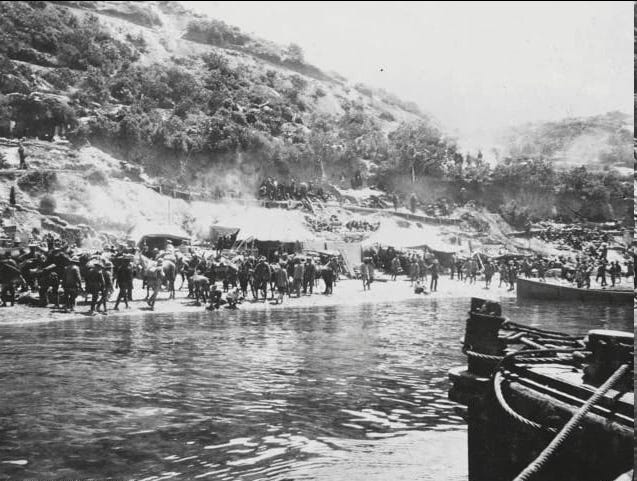
Gallipoli was born of overconfidence. The Allied powers, boasting superior naval technology and industrial might, assumed the Ottoman Empire would crumble under a naval bombardment followed by an amphibious landing. They were wrong. The geography of the Dardanelles turned the Allied advantage into a liability. The narrow strait allowed a numerically inferior force to concentrate fire, mine the waters, and utilize the high ground to devastating effect. The result was a bloody stalemate, massive casualties, and a humiliating withdrawal.
The parallels to the Strait of Hormuz are hard to miss. Like the Dardanelles, Hormuz is a maritime chokepoint, narrow, shallow, and flanked by land that can be fortified. But where the Ottomans relied on artillery and mines, Iran has, over the last 30 years at least, built a layered, modern asymmetric arsenal designed specifically to exploit this geography. Iran’s advantage isn’t in aircraft carriers or stealth fighters; it’s in the sheer density and dispersion of its missile and drone forces.
Iran possesses the largest missile inventory in the Middle East, including thousands of short- and medium-range ballistic missiles, cruise missiles, and precision-guided munitions capable of striking ships at sea. Many of these systems are mobile, hidden in tunnels, or dispersed among civilian infrastructure, making them exceptionally difficult to neutralize in a first strike. Complementing the missiles is Iran’s drone fleet: the Shahed-136 and other loitering munitions that are cheap, hard to detect, and effective in swarms. In a confined space like Hormuz, a swarm of slow, low-flying drones can saturate a warship’s defenses, forcing it to expend precious interceptors or risk being overwhelmed. The Houthis defeated the US Navy in the Red Sea and Bab al-Mandeb with far less.
This is the modern iteration of the Gallipoli lesson: a force perceived to be less advanced, fighting on home terrain, can use asymmetric tools to negate a superior adversary’s edge in firepower. The Ottomans used the high ground and narrow waters to blunt Allied naval power. Iran will use coastal missile batteries, underwater mines, and drone swarms to turn the strait into a contested kill zone. The U.S. Navy is unquestionably more powerful, but power means little if it cannot be brought to bear without unacceptable cost.
Differences, of course, exist. Modern precision weaponry allows for strikes that were impossible in the era of biplanes and battleships. Yet defense has also evolved. In WWI, mines were contact-based; today, they are sophisticated, influence-activated, and difficult to clear. Furthermore, the stakes are different. Gallipoli was a theater of war; Hormuz is the throat of the global economy. A blockade or prolonged engagement there triggers immediate worldwide recession, adding a layer of pressure the Allies never faced in the Aegean.
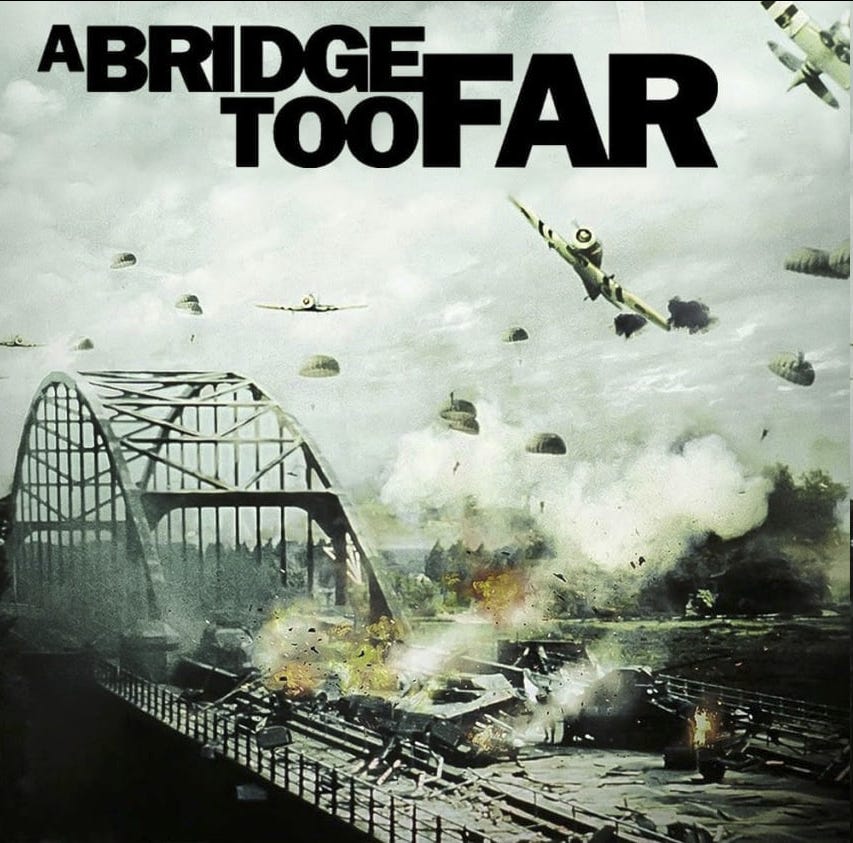
History offers other grim comparisons. Operation Market Garden in WWII and the battle for Gostomel Airport in Ukraine both illustrate the perils of assuming an enemy will collapse under the shock of a rapid airborne assault. In both cases, planners underestimated the defender’s ability to regroup and strike back. And both failed because the armor couldn’t reach the paratroopers, underscoring the danger of betting on shock over substance. Even if the American paratroopers were to create a beachhead in Hormuz, the operation would fail without naval support and successful landing of the marines, just as in Market Garden, where Arnhem was “A Bridge Too Far”.
Then there is Iwo Jima. While an American victory, it serves as a cautionary tale regarding fortified defenses. The Japanese forces, dug into volcanic rock, inflicted massive casualties on the Marines despite overwhelming U.S. air and naval superiority. The underground tunnels of Iwo Jima find their modern equivalent in Iran’s buried missile silos, drone launch sites, and command centers. You cannot bomb what you cannot find, and it is difficult to occupy terrain that is designed to deny you footing.
The lesson for any modern planner looking at Hormuz is not to doubt American firepower, but to respect the defender’s will, the terrain’s tyranny, and the multiplying effect of asymmetric technology. Gallipoli taught us that a narrow strait favors the shore over the ship. Iran has spent decades learning that lesson and building a force to exploit it. Market Garden and Gostomel taught us that speed and surprise do not guarantee success. Iwo Jima taught us that fortifications, and the determination behind them, multiply defensive power exponentially.
The Dardanelles remains a graveyard of ships and reputations. To ignore the lessons of that campaign while eyeing the Strait of Hormuz, especially while underestimating the disruptive potential of drones, missiles, and mines, is to invite a catastrophe not of capability, but of imagination. The map has not changed, even if the weapons have. And in a naval chokepoint, always bet on the shore over the ship.
‘Safe’ corridor opening up through Strait of Hormuz: What we know so far
RT | March 20, 2026
Iran has signaled that it is ready to allow passage through the Strait of Hormuz to vessels from certain countries. Media reports and tracker data also suggest that a handful of pre-vetted tankers have already sailed smoothly through the “safe” corridor, with at least one shipping company allegedly paying Iran $2 million.
The development comes as more than 15 tankers have been hit by drones and projectiles in the strait since the US and Israel launched their war on Iran in late February.
As the Middle East escalation has roiled energy markets, the impact of a few tankers passing through has so far remained limited. Brent is still trading well above $100.
Here is what to know about the latest developments in the Strait of Hormuz.
Who is allowed to pass?
In short, not everyone and not everywhere.
Iranian Foreign Minister Abbas Araghchi stated that the strait is open to all except the US and Israel, while adding that some ships from “different countries” had already been allowed through. In practice, however, Western-linked vessels face significant hurdles in securing safe passage.
According to Lloyd’s List, India, Pakistan, China, Iraq, and Malaysia are discussing transit plans directly with Tehran, with officials in the first three countries as well as Türkiye confirming clearance.
The Financial Times reported, citing maritime data, that at least eight ships – including oil tankers and bulk carriers tied to India, Pakistan and Greece, as well as Iran’s own fleet – have sailed through the strait but used an unusual route around the island of Larak, which is close to the Iranian coast and where waters are much shallower than in the middle of the strait.
The actual number of ships – some of which may have turned off automatic tracking systems – could be higher, the report said.
According to the FT, at least nine Chinese oil and fuel tankers are also amassing in the Gulf, apparently preparing to traverse the Hormuz Strait.
Clearance is being granted on a case-by-case basis, Lloyd’s List reported, adding that the Iranian authorities are working on a “more formalized vessel approval process” expected in the coming days.
Is it free of charge?
On paper, international transit is not supposed to work like a toll road, but the current situation appears to be evolving under wartime conditions.
Lloyd’s List reported that at least one tanker operator paid about $2 million to transit, while saying it could not establish whether payments were made in other cases. It also remains unclear how such payments could be processed, given the sanctions on Iran.
In addition, several media reports indicated that Iran’s parliament was considering a bill aimed at taxing ships that cross the strait. The Wall Street Journal noted, however, that such a policy would “require a regional buy” from Iran’s Gulf neighbors.
What did Hormuz look like before the war?
Hormuz was one of the world’s busiest and consequential chokepoints, with an average of 20 million barrels a day of crude oil and oil products moved through in 2025, equal to around 25% of global seaborne oil trade. About 80% of the flows went to Asian countries, including China, India, Japan, and South Korea, according to the International Energy Agency (IEA).
About 93% of Qatar’s LNG exports and 96% of the UAE’s LNG exports also passed through Hormuz, representing roughly 19% of global LNG trade.
Before the war, around 138 vessels transited the strait daily; that figure has now dropped to roughly 3–5 ships per day, according to estimates.
The strait is just 29 nautical miles (54km) wide, with two-mile-wide inbound and outbound shipping lanes separated by a two-mile buffer. Ships using the Larak route must contend with shallower waters than in the central channel, though depths are still generally sufficient for most vessel types.
What impact is this having on energy prices?
The trickle of oil tankers is seemingly having a limited effect on the oil market, with Brent trading at $107 per barrel, down from a peak of almost $120. WTI crude slid from the $100 benchmark to $94.
European natural gas futures (TTF) slightly fell to €60 per MWh after spiking by more than 30% after Israel attacked Iran’s South Pars gas field, triggering a retaliation on energy infrastructure in Qatar.
What does Europe have to say on Hormuz safety?
European leaders have demanded “the reopening of the Strait of Hormuz,” as well as “de-escalation and maximum restraint” from the belligerents. European NATO members, however, have been reluctant to send their navies to the strait. German Chancellor Friedrich Merz said that his country could help in keeping the shipping lanes clear only when the guns go silent.
What impact on the US?
As oil prices skyrocketed, gasoline prices in the US also soared, reaching $3.90 per gallon on average. US President Donald Trump has sought to downplay the market panic, saying he thought that oil prices would be “much worse,” adding that they were certain to come down once the hostilities end.
In addition, US Treasury Secretary Scott Bessent signaled that Washington could waive sanctions on the Iranian oil stranded on tankers in a bid to dampen prices. Earlier this week, he also said that the US had been allowing Iranian tankers to transit the strait “to supply the rest of the world.”
Featured Video
Iran & Its Allies Are Threatening Every Route for Saudi Oil
or go to
Aletho News Archives – Video-Images
From the Archives
A short history of British torture
ICC | December 2005
When the House of Commons was debating how much to increase the time limit for detention without trial the question of torture came up. Officially this was limited to the nice considerations of whether it was all right to send people to places where torture is used and whether Britain can use information collected by the use of torture in other countries. This discussion gave an impression of democratic Britain as the home of civilised behaviour where the very idea of torture is repugnant to our legislators – unlike, say, the US with its secret CIA jails… In reality, the British state has a long history of using and developing a whole range of torture techniques. … continue
Blog Roll
 Aletho News
- US destroying international space law
- SCO Calls for Binding Global Deal to Prevent Arms Race in Space
- Iran & Its Allies Are Threatening Every Route for Saudi Oil
- ‘40,000 tons of bombs’: Report shows Trump planning ‘largest bomb transfer in modern US history’ to Israel
- Amazon says cloud infrastructure in Bahrain, UAE ‘beyond saving’
- How Europe became an accessory to CIA torture
- Trump says Iran urgently seeks deal, Tehran sets conditions for talks
- The Andean Shadow Army
- Russia Wants to End Ukraine Conflict – Lavrov
- US Flaunts On-Orbit Weapon to Supercharge Space Arms Race
- If Americans Knew
- The assassination attempt on President Trump in Butler and the various Israeli connections to it
- “We Want That the Whole Land Be Jewish”
- BREAKING: Building collapse in Gaza kills at least 20 as they sleep – Daily Update
- ‘School is Life’: 1.5 Million Palestinian Children Face Fourth Year of Shattered Education
- Pentagon admits Iran war caused ammunition shortages, cost US $33.4bn
- 37 Palestinian journalists held in Israeli jails, rights group says
- Israel’s Hilltop Youth Recruits Minors to Terrorize Palestinians (with video)
- 100 Colonial Plans Advance in West Bank Since Start of 2026
- New Maps Show How Israel Has Thwarted Hopes for a Palestinian State
- Israel trying to ‘eliminate’ living conditions for Palestinians in West Bank
- No Tricks Zone
- The South China Sea Has Not Been Cooperating With The Climate Change Narrative
- Energy Crisis: Germany Enters Heating Season With Historically Low Gas Reserve Fill Levels
- New Study: The Antarctic Ice Sheet Gained Mass From 2020-2024 Due To Staggering Snow And Ice Accumulation
- Study: Ocean Heating Rates From Thousands Of Years Ago ‘Dwarf’ Modern Ocean Heating Rates
- Climate Extremists Target, Attack Large-Scale Power Grid Infrastructure In Germany!
- New Study: Antarctic Ice Melt Has Contributed Less Than 1 Centimeter To Sea Level Rise In The Last 30 Years
- Fear Of Debate: Alarmist German Climate Scientist Calls On Mainstream Media To Discredit Skeptic Voices
- End-Of-August Arctic Sea Ice Extent Hasn’t Fallen In 20 Years, Official Data Show!
- News-Making Nepal Region Has Had As-Warm Or Warmer Periods Than The 2000s In The 1600s, 1700s, 1800s
- 2025 Study: ‘There Exists No Unequivocal Experimental Evidence For The CO2 Greenhouse Effect’
 Aletho News