Russia rejects Facebook’s allegations of disinformation campaign
RT | August 22, 2018
Russia on Wednesday rejected allegations from Facebook that the country’s GRU military intelligence service had been using the social media site to run disinformation campaigns.
Facebook, Twitter, and Alphabet Inc collectively removed hundreds of accounts tied to an alleged Iranian propaganda operation on Tuesday, while Facebook took down a second campaign it said was linked to Russia, Reuters reports.
According to Kremlin spokesman Dmitry Peskov, Facebook’s Russia-related allegations made no sense to Moscow and said they looked similar to previous groundless allegations from other sources like Microsoft.
“They are all trying to outdo one another with their statements which all look like carbon copies of one another,” the spokesman said. “We do not understand on what they are based,” he said, adding that the allegations lack “supporting explanation.”
Alex Jones suspended from Twitter after tweet calling to end censorship
RT | August 15, 2018
Controversial right-wing commentator Alex Jones has been banned from tweeting after he posted a link to a video of himself calling on President Trump to “take action” against tech companies censoring his content.
Infowars Editor Paul Joseph Watson tweeted a screenshot of the notification sent by Twitter staff to Jones. According to Twitter, a tweet by Jones one day earlier was considered to be “targeted harassment,” and, as a result, the Infowars host would have his access to the social-media platform restricted for one week. Watson described the situation as “truly, monumentally, beyond stupid.”
In the video, Jones ranted about the censorship of conservative voices by Silicon Valley tech companies, directing much of his scorn at Apple CEO Tim Cook. He called his own ban from various tech platforms a “total anti-American attack,” and called on President Trump to “do something about it.” Along the way, he bashed Democrats, criticized the mainstream media, and accused Cook of working with the Chinese government to undermine America.
Jones’ Twitter page will remain visible for the duration of the ban, but he will not be able to tweet, retweet, follow, or like.
Last week, Infowars found itself banned from the platforms of almost every major Silicon Valley company – including Facebook, YouTube, Apple, and Spotify – for violating their community standards and spreading ‘hate speech.’
Until Tuesday, Twitter was one of Jones’ last safe havens online, and CEO Jack Dorsey said that Jones would not be banned until he broke the site’s rules.
Jones’ excommunication was cheered by many in the US, including Senator Chris Murphy (D-Connecticut), who called Infowars “the tip of a giant iceberg of hate and lies.” He demanded even more censorship in the name of ‘saving democracy.’
Jones’ supporters blasted the companies for censoring the rabble-rousing host, and former UKIP leader Nigel Farage called him a “victim of collusion by the big-tech giants.”
While effectively banned from much of the internet, Jones still posted content to the Infowars website, and via the Infowars app, which has surged in popularity amid the furore. However, on Tuesday, the Infowars website went offline in what staff called a cyberattack. Upon landing on the site, visitors would simply find an error message, which was later replaced with a low-fi splash page directing them to several other affiliated sites.
Question more? You’re a pesky ‘Russophile’, says Soros-backed Belgian NGO
By Nebojsa Malic | RT | August 11, 2018
Once a leader in philosophy and fashion, France has now been reduced to falling for tricks recycled from US con artists by Brussels-based grifters, with a little help from Twitter’s ‘mea culpa’ cash and even Uncle George Soros.
It all began when EU DisinfoLab, a non-governmental organization based in Belgium, published a report on Wednesday about how some 55,000 “hyperactive” twitter accounts spread the news of the Benalla affair, and accused a portion of those accounts of being “Russophiles.”
Within a day, French media were printing headlines screaming about “Russian bots,” prompting the NGO to issue a “clarification” of their findings. Not all of the accounts were “Russophiles,” the outfit said, and the report said nothing about “bots” – but the French public was already outraged.
Politicians Jean-Luc Melenchon of La France Insoumise and Marine Le Pen from the National Rally (NR) –previously known as Le Front National– who both ended up on the NGO’s list, tweeted derisively about the report, with Melenchon calling the outfit “stupid spooks.”
EU DisinfoLab basically used tools –as well as funding– provided by Twitter to compile a list of accounts tweeting about the scandal involving Alexandre Benalla, deputy chief of staff and bodyguard to President Emmanuel Macron. Benalla was fired in July after it emerged he had assaulted a protester at May Day demonstrations while impersonating a police officer, then tried to suppress the video footage of the incident.
Of the accounts thus rounded up, the group identified 27 percent as being part of the “Russian disinformation ecosystem,” described as people retweeting content from RT and Sputnik, or promoting the “Russian narrative.” Examples of the latter were listed as people spreading “false information” like that the Syrian government did not use chemical weapons in Douma (#SyriaHoax) or doubting the official [UK] narrative about the poisoning of Sergei and Yulia Skripal in Salisbury.
Having thus characterized the doubters of the official Western media narratives as Russian agents, the group had the cheek to declare this is “not a value judgment, but a quantifiable fact according to methodology.”
What methodology? Well, in part that used by FirstDraft’s CrossCheck project, sponsored by Google partnering with US and French mainstream media outlets, the London School of Economics, and the notorious bloggers at Bellingcat, affiliated with the Atlantic Council, a pro-NATO think tank.
However, the approach of EU DisinfoLab is actually closer to that of Hamilton68 Dashboard, a project of the Alliance for Securing Democracy (ASD), which, in turn, is backed by the German Marshall Fund. This alliance of Democrats and neocons was set up last year to “defend democracy” on Twitter from those evil Russkies. Having started from the assumption that agents of the Kremlin were everywhere, the dashboard proceeded to blame them for every trending hashtag – and the US media swallowed it whole, breathlessly reporting their “discoveries” for months.
Journalist Glenn Greenwald, who has followed ASD since its inception, described it as “the single most successful media fraud & US propaganda campaign” he had seen in years of covering US politics.
This hysteria wave eventually crested in March this year, when even such ardent Russiagate-obsessed publications as BuzzFeed (the outfit that published Christopher Steele’s “salacious and unverified” dossier accusing Trump of being a Russian puppet) declared the reports of Russian bots to be “total bullshit.”
Here is the best part: The funding for EU DisinfoLab’s report was provided by Twitter itself! Back in October 2017, under tremendous pressure from Democrats angry about their defeat in the presidential election, the company “off-ramped” all advertising from RT and Sputnik, then pledged to donate the $1.9 million in (generously) estimated profits to “civil society” projects. Enter EU DisinfoLab, which admitted receiving $125,000 from Twitter in January.
The group also received $25,000 from George Soros’s Open Society Foundation, though that was earmarked for monitoring the March 2018 elections in Italy. True to form, Soros claimed Russia was behind the victory of populist parties over the Eurocrat establishment he favored.
So long as Uncle George and social media giants pay good money, and the media is eager to quote those offering to cater to their confirmation bias, there will be outfits such as Hamilton68 and EU DisinfoLab, all too willing to oblige.
Read more:
Atlantic Council: Pro-NATO pressure group uses distortions to fight ‘disinformation’
VIPS Asks Twitter to Restore Van Buren’s Account
The Veteran Intelligence Professionals for Sanity in a memo to the Twitter board of directors questions its decision to suspend the account of one of its members without due process.
August 8, 2018
TO: Twitter Board of Directors
FROM: Veteran Intelligence Professionals for Sanity (VIPS)
SUBJECT: Suspension of VIPS Associate Peter Van Buren’s Twitter Account
We at Veteran Intelligence Professionals for Sanity (VIPS) are greatly disturbed by the recent decision of your management to permanently suspend the Twitter account @WeMeantWell of our colleague Peter Van Buren. Peter is a highly respected former Foreign Service Officer possessing impeccable credentials for critiquing current developments that might lead to a new war in Eastern Europe or Asia, something which we Americans presumably all would like to avoid.
In 2011 our colleague Peter published a book, We Meant Well: How I Helped Lose the Battle for the Hearts and Minds of the Iraqi People, about the poor decision- making by both civilians and military that led to the disastrous occupation and faux-democracy development in Iraq. It is Peter’s concern that our country may well be proceeding down that same path again — possibly with Iran, Syria and other countries in the Middle East region.
It is our understanding that Peter became involved in an acrimonious Twitter exchange with several mainstream journalists over the theme of government lying. One of the parties to the exchange, reported to be Jonathan Katz of @KatzOnEarth — possibly joined by some of his associates – complained. Subsequently, and without any serious investigation or chance for rebuttal regarding the charges, Peter was suspended by you for “harass[ing], intimidate[ing], or us[ing] fear to silence someone else’s voice.” Peter absolutely denies that anything like that took place.
We have also learned that Daniel McAdams, Executive Director of the Ron Paul Institute for Peace and Prosperity and a highly respected former Congressional staffer, weighed in to defend Peter and was also suspended by you. And Scott Horton, editorial director of Antiwar.com Radio, was suspended for use of “improper language” against Katz. Horton and McAdams cannot add new tweets while under suspension, but Peter’s “permanent” suspension included deletion of all of his seven years’ archive of tweets, so the actual exchanges leading up to his punishment cannot currently be examined.
Your action suggests three possibilities — all of which are quite plausible given that your system for punishing users is far from transparent. First, you may be engaged in systematic manipulation if some of your users are able to complain and have their friends do likewise in order to sully the reputation of a Twitter user who is doing little more than engaging in heated debate over issues that concern all of us.
Second, there is a distinct possibility that you are responding to either deep pocketed or particularly strident advocacy groups that may themselves have agendas to silence opposition voices. We note that Google is currently working with some powerful foundations to censor content they object to which comes up in search engine results.
Finally – third — we also suspect a possible government hand in that companies like yours, to include Facebook, have become very sensitive to alleged “subversive” content, deleting accounts and blocking users. Kowtowing to government suggestions to silence critics of administration policies may well be considered a desirable proactive step by your management as well as by other social media companies, but censorship is censorship, no matter how you dress it up.
We Veteran Intelligence Professionals for Sanity believe that systematic and/or institutionalized censorship of tweets and account users is fundamentally the wrong way to go unless there are very explicit and sustained threats of violence or other criminal behavior. The internet should be free, to include most particularly the ability to post commentary that is not mainstream or acceptable to the Establishment. That is what Peter has been doing and we applaud him for it. We respectfully request that you examine the facts in the case with the objective of reconsidering and possibly restoring the suspension of Peter Van Buren’s twitter account. Thank you.
For the Steering Group, Veteran Intelligence Professionals for Sanity:
William Binney, former Technical Director, World Geopolitical & Military Analysis, NSA; co-founder, SIGINT Automation Research Center (ret.)
Richard H. Black, Senator of Virginia, 13th District; Colonel US Army (ret); former chief, Criminal Law Division, Office of the Judge Advocate General, the Pentagon (associate VIPS) (@SenRichardBlack)
Bogdan Dzakovic, former team leader of Federal Air Marshals and Red Team, FAA Security (ret.) (associate VIPS)
Philip Giraldi, CIA, Operations Officer (ret.) (@infangenetheof)
Michael S. Kearns, Captain, USAF (ret.); Wing Commander, RAAF (ret.); former intelligence officer and master SERE instructor (@msk6793)
John Kiriakou, former CIA Counterterrorism Officer and former senior investigator, Senate Foreign Relations Committee (@johnkiriakou)
Linda Lewis, WMD preparedness policy analyst, USDA (ret.) (associate VIPS) (@usalinda)
Edward Loomis, NSA, cryptologic computer scientist (ret.)
Ray McGovern, former US Army infantry/intelligence officer & CIA analyst (ret.) (@raymcgovern)
Annie Machon, former intelligence officer in the UK’s MI5 domestic security service (affiliate VIPS) (@anniemachon)
Elizabeth Murray, Deputy National Intelligence Officer for the Near East, CIA and National Intelligence Council (ret.) (@elizabethmurra)
Todd E. Pierce, Maj, US Army Judge Advocate (ret.) (@ToddEPierce)
Scott Ritter, former Maj., USMC; former UN weapons inspector, Iraq (@RealScottRitter)
Coleen Rowley, FBI Special Agent and former Minneapolis Division Legal Counsel (ret.) (@coleenrowley)
J. Kirk Wiebe, former Senior Analyst, SIGINT Automation Research Center, NSA (ret.) (@kirkwiebe)
Sarah Wilton, Commander, US Naval Reserve (ret.) and Defense Intelligence Agency (ret.)
Robert Wing, former Foreign Service Officer (associate VIPS)
Veteran Intelligence Professionals for Sanity (VIPS) is made up of former intelligence officers, diplomats, military officers and congressional staffers. The organization, founded in 2002, was among the first critics of Washington’s justifications for launching a war against Iraq. VIPS advocates a US foreign and national security policy based on genuine national interests rather than contrived threats promoted for largely political reasons. An archive of VIPS memoranda is available at Consortiumnews.com.
Twitter suspends Ron Paul Institute executive’s account, one day after Big Tech blocks InfoWars
RT | August 7, 2018
 Several Libertarian figures, including the Ron Paul Institute director, have found their Twitter accounts suspended. It comes after tech giants went after right-wing journalist Alex Jones, banning his show from their platforms.
Radio host and editorial director of Antiwar.com Scott Horton, former State Department employee and author Peter Van Buren, and Dan McAdams, the executive director of the Ron Paul Institute for Peace and Prosperity, found their twitter accounts suspended on Monday, according to Antiwar.com.
Horton has been disciplined for the use of improper language against journalist Jonathan M. Katz, he said in a brief statement. McAdams was suspended for retweeting him, he said.
Past tweets in both accounts were available to the public at the time of the writing, unlike the account of Van Buren, which was fully redacted.
Horton and McAdams apparently fell victim of Twitter’s suspension algorithm after objecting to Katz’s quarrel with Van Buren over an earlier interview.
The suspensions come a day after Alex Jones, and his podcast InfoWars, was kicked out from several popular media platforms, including Facebook, YouTube and Spotify.
Silicon Valley giants were harshly criticized by the US political establishment for failing to prevent alleged Russian interference in the 2016 presidential election through their platforms. Critics say the pressured media giants are now engaged in political censorship, using their market dominance and lack of legislated neutrality requirements to target descent voices.
READ MORE:
Chilling precedent? InfoWars block exposes Big Tech as no friend of free speech
The Real “Fake News” From Government Media
By Scott Lazarowitz | ActivistPost | July 31, 2018
Facebook has announced its campaign against “fake news.” But, according to some workers’ own admission, conservatives are being censored.
And Google also wants to censor “fake news.” But Google also was shown to treat conservative websites, but not liberal ones, as “fake news.”
The same thing seems to be going on with Twitter. And again, conservatives are complaining.
But who is to decide what is “fake news”? Who will be Facebook and Google’s sources for real news?
In 2013 the U.S. Senate considered a new a shield law to protect journalists. In the lawmakers’ attempts to narrow the definition of a journalist, some Senators including Sen. Dianne Feinstein only wanted to include reporters with “professional qualifications.”
“Professional” publications such as the New York Times, the “Paper of Record,” would apparently be protected.
So one can conclude that the New York Times can be a source of “real” news for Facebook or Google, despite all the Times‘ errors, screw-ups, and corrections, right?
According to one NYT former reporter, the Times has been a “propaganda megaphone” for war. Also a partner with the CIA to promote Obama’s reelection bid.
Or CNN, “The Most Trusted Name in News” which wins its own “fake news” awards with its errors, screw-ups and corrections.
During the 2016 U.S. Presidential campaign, there were collusions between then-CNN contributor and DNC operative Donna Brazile, who was outed by WikiLeaks in her giving candidate Hillary Clinton questions in advance for a CNN Town Hall.
Other emails that were leaked to WikiLeaks informed us that reporters obediently followed instructions from the Hillary Clinton campaign on how to cover the campaign. These include reporters from the New York Times such as Maggie Haberman who said the campaign would “tee up stories for us,” and Mark Leibovich, who would email Clinton flunky Jennifer Palmieri for editing recommendations.
And Politico reporter Glenn Thrush asked Clinton campaign chairman John Podesta for approval of stories on Clinton. Thrush was then hired by the New York Times. After Thrush was then suspended from NYT over allegations of sexual misconduct, the Times ended the suspension, stating that while Thrush had “acted offensively,” he would be trained to behave himself. Hmm.
But all this from the 2016 campaign reminded me of the “JournoLists,” the group of news journalists who participated in a private forum online from 2007-2010. The forum was to enable news reporters to discuss news reporting and political issues in private and with candor, but also, it was revealed, to discuss ways to suppress negative news on then-2008 presidential candidate Barack Obama.
For instance, according to the Daily Caller, some members of the group discussed their criticism of a 2008 debate in which Obama was questioned on his association with the controversial Rev. Jeremiah Wright. The Nation‘s Richard Kim wrote that George Stephanopoulos was “being a disgusting little rat snake.” The Guardian‘s Michael Tomasky wrote that “we all have to do what we can to kill ABC and this idiocy.”
Spencer Ackerman, then with the Washington Independent and now of the Daily Beast, wrote, “If the right forces us all to either defend Wright or tear him down, no matter what we choose, we lose the game they’ve put upon us. Instead, take one of them — Fred Barnes, Karl Rove, who cares — and call them racists.”
The Nation‘s Chris Hayes wrote, “Our country disappears people. It tortures people. It has the blood of as many as one million Iraqi civilians — men, women, children, the infirmed — on its hands. You’ll forgive me if I just can’t quite dredge up the requisite amount of outrage over Barack Obama’s pastor.”
(But has Hayes criticized Obama’s assassination program, or Obama’s bombings or the blood on Obama’s hands? Just askin’)
In an open letter, according to the Daily Caller, several of the JournoList members called the ABC debate a “revolting descent into tabloid journalism,” because of the moderators’ legitimate questions on Rev. Jeremiah Wright.
So, in today’s Bizarro World, objectively questioning a candidate on a controversial issue is now “tabloid journalism,” but making things up like “Trump-Russia collusions” and repeating the propaganda over and over – that’s not “tabloid journalism.”
The JournoLists also included reporters from Time, the Baltimore Sun, the New Republic, Politico, and Huffington Post.
Now, are those the sources of “real news” that Facebook, Google and Twitter want to rely upon to combat “fake news”?
And who exactly were the “JournoLists” promoting? Obama?
Regarding Obama’s own crackdown on actual journalism, Fox News reporter James Rosen was accused by the feds of being a “co-conspirator” with State Department leaker Stephen Jin-Woo Kim in violating the Espionage Act. Rosen’s correspondences with Kim were seized by Obama’s FBI, along with Rosen’s personal email and phone records. The FBI also used records to track Rosen’s visits to the State Department.
Apparently, then-attorney general Eric Holder went “judge-shopping” to find a judge who would approve subpoenaing Rosen’s private records, after two judges rejected the request.
Commenting on James Rosen and the FBI’s abuse of powers, Judge Andrew Napolitano observed that “this is the first time that the federal government has moved to this level of taking ordinary, reasonable, traditional, lawful reporter skills and claiming they constitute criminal behavior.”
And there was the Obama administration’s going after then-CBS News investigative reporter Sharyl Attkisson, possibly for her reporting on Benghazi and Fast and Furious. Attkisson finally resigned from CBS news out of frustration with the company’s alleged pro-Obama bias and with CBS’s apparently not airing her subsequent reports.
In 2013 CBS News confirmed that Attkisson’s computers had been “accessed by an unauthorized, external, unknown party on multiple occasions.” In 2015 Attkisson sued the Obama administration, claiming to have evidence which proves the computer intrusions were connected to the Obama DOJ.
In Attkisson’s latest lawsuit update, after her computer was returned to her following the DOJ Inspector General’s investigation, her forensics team now believes her computer’s hard drive was replaced by a different one.
Now back to “fake news.”
After Donald Trump locked up the Republican Presidential nomination in May, 2016, there were significant events in the next two months. Fusion GPS and former British spy Christopher Steele colluded to get opposition research on behalf of Hillary Clinton, the FBI applied for a FISA warrant to spy on Trump campaign associates, and Donald Trump, Jr., Paul Manafort and Jared Kushner had a possibly set-up meeting with a Russian lawyer at Trump Tower.
Also within that same period, the DNC claimed that its computers were hacked but the DNC wouldn’t let FBI investigate. The Washington Post published an article claiming, with no evidence presented, that “Russian government hackers” took DNC opposition research on Trump.
It was very shortly after the November, 2016 Presidential election that the Washington Post published an article on a “Russian propaganda effort to spread ‘fake news’ during the election.” To escalate the media’s censorship campaign perhaps?
The campaign against “fake news” coincided with Obama minions at FBI, DOJ and CIA apparently panicking over a possible Trump presidency and their allegedly abusing their powers to attempt to take down Trump.
So the news media seem to be on a crusade to fabricate “Trump-Russia collusions” and repeat it over and over, and to vilify, ignore and squash actual investigative research and reporting on what exactly the FBI and DOJ bureaucrats have been doing. Call such real investigative reporting “fake news,” “conspiracy theory,” and so forth.
In the end, Facebook, Twitter and Google might want to reconsider relying on the mainstream news media led by the New York Times, the Washington Post and CNN, and instead include citizen journalists and non-government-sycophant media to provide news and information.
UCLA law professor Eugene Volokh has noted that the Founders generally viewed the freedom of the Press to apply to every citizen to print, publish or express accounts of events. We really need to highlight that kind of old-fashioned, honest journalism.
Twitter Disavows Shadow Banning, But Facts Say Otherwise
Sputnik – July 28, 2018
A Vice exclusive story on Wednesday caught Twitter red-handed engaging in the practice of shadow banning prominent GOP politicians, removing their profiles from drop-down searches. Since then, the social media platform has struggled to provide an adequate explanation for the phenomenon.
“We do not shadowban,” a Twitter spokesperson told Sputnik Wednesday. However, Twitter employees were secretly filmed earlier this year explicitly bragging about doing just that.
Vice’s expose, complete with screenshots forwarded to Twitter, showed prominent Republican Party politicians such as party chair Ronna McDaniel; Republican Congressmen Mark Meadows, Jim Jordan, Devin Nunes and Matt Gaetz; or Donald Trump Jr’s spokesperson Andrew Surabian being absent from drop-down searches on the site’s main interface. They could still be found through a “full search,” although it’s unclear if Vice meant a TweetDeck search or something else.
This is a bizarre and incredibly disingenuous statement from @Twitter. What’s the point of following someone if Twitter blocks their tweets from appearing in your time-line? Maybe that’s not technically “shadow-banning” but it’s heavy-handed manipulation https://t.co/OaHf6qQplF pic.twitter.com/QzyJSajY5S
— Glenn Greenwald (@ggreenwald) July 27, 2018
The following day, Twitter Legal, Policy and Trust & Safety Lead Vijaya Gaffe and Product Lead (and co-founder) Kayvon Beykpour posted on Twitter’s blog to try and clear up some of the confusion about what happened. However, their explanation left us with more questions than answers. They simply denied that any bias was behind the selective invisibility and palmed the blame off with vague language and insinuations and insulting leaps of logic.
Because of the baffling nature of their explanation, we will address its parts piecemeal.
Gaffe and Beykpour began by setting the terms of the discussion with an attempt at a definition of the phenomenon in question: shadow banning.
“People are asking us if we shadow ban. We do not. But let’s start with, ‘what is shadow banning?’ The best definition we found is this: deliberately making someone’s content undiscoverable to everyone except the person who posted it, unbeknownst to the original poster.”
This definition is worded in such a way that it isolates only the specific act of shadow banning and ignores the larger context and purpose behind the shadow banning, which is to decrease the visibility of unwanted behavior by a person in ways that are difficult to detect by the person in question.
This article from Wired in 2009 explains shadow banning as a variety of practices designed to decrease the prominence and visibility of trolls and problematic posters, one of which is, indeed, to render a user’s content invisible to everyone except the user themselves; but also crowdsourced post ranking and allowing the filtering of posts by rank; the removal of vowels in offending language to neutralize it; and other tactics.
“The world’s top discussion moderators have developed successful tools for keeping online miscreants from disrupting conversation. All are rooted in one psychological insight: If you simply ban trolls — kicking them off your board — you nurture their curdled sense of being an oppressed truth-speaker. Instead, the moderators rely on making the comments less prominent,” the Wired article reads. A far cry from Twitter’s selective definition.
“We do not shadow ban. You are always able to see the tweets from accounts you follow (although you may have to do more work to find them, like go directly to their profile).”
Let’s take a moment to take this statement apart. When a user follows someone on Twitter, they do so explicitly for the purposes of seeing that person or organization’s posts appear in their feed. That’s literally the only reason. If that wasn’t how the “follow” feature worked, we would all have to search for and visit the pages of each page we wanted to see the posts of each time we wanted to read them. But you can do that without following a person; you can search for anybody and see their posts so long as they aren’t set to private and they haven’t blocked you, in which case you couldn’t see their posts even if you followed them.
So Twitter is here admitting to disabling the primary functional feature of its platform for select users, a feature designed to make users’ content visible, and then swearing that this isn’t shadow banning.
Imagine if we did this in the real world and unplugged someone’s phone line to their house, then told people trying to call that person that their phone hadn’t been unplugged and if you wanted to speak to the person you would have to “do more work to find them,” like go directly to their house and speak with them. Wouldn’t that defeat the purpose of the phone line? Wouldn’t we call that censorship?
“And we certainly don’t shadow ban based on political viewpoints or ideology.”
This is simply a denial of the evidence. Vice and numerous other publications have provided concrete proof that whatever was happening was only affecting politicians of a certain political party and not politicians of another certain political party, along with a scattering of other figures, too. Denial isn’t disproving, and it isn’t an explanation.
“We do rank tweets and search results. We do this because Twitter is most useful when it’s immediately relevant. These ranking models take many signals into consideration to best organize tweets for timely relevance. We must also address bad-faith actors who intend to manipulate or detract from healthy conversation.”
Again, what is a “healthy conversation?” What is “manipulation?” What is in bad faith? Some might find those questions begging or distracting, but there’s a real question when it comes to interpretation of someone’s facts or their presentation of those facts that leans heavily on the normative bias of the reader. What everyone considers to be useful, relevant or appropriate is not the same, and Twitter has never made clear exactly how they define those terms or judge particular posts or posters against those definitions.
The author of this Sputnik article is a transgender person. Some people might consider speech in the defense of their rights “hate speech” and some people might consider discussions of transgender issues not to be relevant. They might consider the presentation of alternative studies to those that say that gender is determined by genetics or by genitals as being manipulative or detracting from healthy conversation. Does that make them these things? Taking a stance on an issue like that necessarily requires making a political statement.
Further, the very act of discussion necessarily involves manipulation to some extent, does it not? One party seeks to convince the other party that it is right, by undermining its arguments and by casting doubt upon the facts and narratives presented by the other side. As before, the question of who decides which topics and which discussions are fair game and which are not is all-important: it requires making a political statement about what is and is not correct and what is and is not justified discussion.
So if a platform is pruning its content according to political standards, doesn’t that make it a publication and not a neutral social forum?
Gadde and Beykpour went on to address certain specific aspects of Wednesday’s snafu.
“‘It looks like this only affected Republican politicians. Were Democratic politicians also impacted?’ Yes, some Democratic politicians were not properly showing up within search auto-suggestions as result of this issue. As mentioned above, the issue was broad-ranging and not limited to political accounts or specific geographies. And most accounts affected had nothing to do with politics at all.”
Which Democratic politicians? Certainly not the equivalents of those GOP leaders affected. A city government official with a D next to their name being shadow banned is still an infraction of political discourse, to be sure (although again, we don’t know which Democratic politicians were affected), but it’s also not fair to say that a phenomenon that affected key leaders of a major political party, which controls two-thirds of the US government, but no major figures in the opposition party, is simply a glitch or programming error. There is clearly a problem of bias in how legitimate subjects of searches appear in the system, whether it was specifically designed or not.
“‘OK, so there was a search auto-suggest issue. But what caused these Republican representatives to be impacted?’ For the most part, we believe the issue had more to do with how other people were interacting with these representatives’ accounts than the accounts themselves (see bullet #3 above). There are communities that try to boost each other’s presence on the platform through coordinated engagement. We believe these types of actors engaged with the representatives’ accounts — the impact of this coordinated behavior, in combination with our implementation of search auto-suggestions, caused the representatives’ accounts to not show up in auto-suggestions. In addition to fixing search yesterday, we’re continuing to improve our system so it can better detect these situations and correct for them.”
So in other words, it was a problem that too many people liked certain politicians’ content they post on Twitter, or “boosted” their presence. That sort of goes against Twitter’s own stated goal of “serving healthy public conversation.” Indeed, the statement that Twitter is “serving healthy public conversation” all while selectively trimming that conversation based on some parts of it being too-well-liked, all the while claiming impartiality, insults the reader’s intelligence.
And isn’t the excuse that it was simply a problem with the algorithm basically a version of the “banality of evil” defense? It shoves responsibility for effects caused by a system created by humans for a specific purpose away from the actors that created that system or helped it function and onto an abstract, faceless, nonliving entity: a bureaucracy or, in this case, a computer program.
Twitter hasn’t disproven anything; all it’s proven is how callously it performs its task of being an extended mouthpiece for The Resistance.
Read also:
Twitter Bows to McCarthyist Witch Hunt, Bans RT and Sputnik Ads
Twitter Ascribes Alleged Shadow Banning of Prominent Republicans to Glitch
Rep. Congressman Threatens Twitter With Complaint Over ‘Shadow Banning’
Project Veritas Claims Twitter is Suppressing Pro-Trump, Right-Wing Tweets
Facebook, Twitter Shut Hezbollah-Linked Accounts – Reports
Sputnik – 23.06.2018
Facebook and Twitter accounts of a Hezbollah-affiliated news service covering the Syrian war were shut down on Friday without explanation.
Central Military Media accused the US-based websites of running an “anti-media campaign,” in a post on the Telegram messaging app. It said both accounts were closed without warning.
The agency shared links to its new profiles on Facebook, Twitter and several other social media platforms. Sputnik was unable to obtain comments from the two networks.
Hezbollah was established in the 1980s as a paramilitary and political organization originating in Lebanon’s Shiite population. The group aims to end Israel’s occupation of Lebanese territory.
Israel, has repeatedly expressed its opposition to the presence of Iranian and pro-Iranian forces and the Hezbollah movement in Syria. Earlier this year, Israel several times attacked what it called the Iranian forces’ positions in Syria, citing aggressive actions on the part of the Iranian-backed militia in the Golan Heights, annexed by the country from Syria.
Blocked By Facebook and the Vulnerability of New Media
By Craig Murray | April 26, 2018
This site’s visitor numbers are currently around one third normal levels, stuck at around 20,000 unique visitors per day. The cause is not hard to find. Normally over half of our visitors arrive via Facebook. These last few days, virtually nothing has come from Facebook:
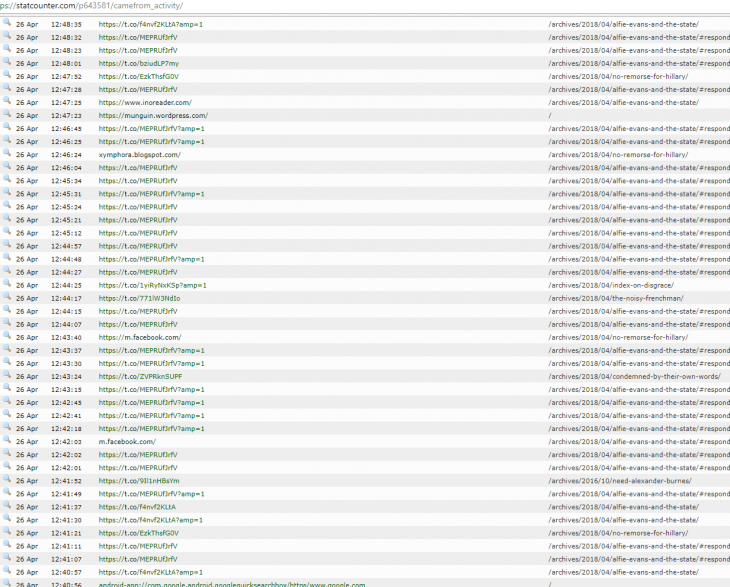
What is especially pernicious is that Facebook deliberately imposes this censorship in a secretive way. The primary mechanism when a block is imposed by Facebook is that my posts to Facebook are simply not sent into the timelines of the large majority of people who are friends or who follow. I am left to believe the post has been shared with them, but in fact it has only been shown to a tiny number. Then, if you are one of the few recipients and do see the post and share it, it will show to you on your timeline as shared, but in fact the vast majority of your own friends will also not receive it. Facebook is not doing what it is telling you it is doing – it shows you it is shared – and Facebook is deliberately concealing that fact from you.
Twitter have a similar system known as “shadow banning”. Again it is secretive and the victim is not informed. I do not appear to be shadow banned at the moment, but there has been an extremely sharp drop – by a factor of ten – in the impressions my tweets are generating.
I am among those who argue that the strength of the state and corporate media is being increasingly and happily undermined by our ability to communicate via social media. But social media has developed in such a way that the channels of communication are dominated by corporations – Facebook, Twitter and Google – which can in effect turn off the traffic to a citizen journalism site in a second. The site is not taken down, and the determined person can still navigate directly to it, but the vast bulk of the traffic is cut off. What is more this is done secretly, without your being informed, and in a manner deliberately hard to detect. The ability to simply block the avenues by which people get to see dissenting opinions, is terrifying.
Furthermore neither Facebook nor Twitter contact you when they block traffic to your site to tell you this is happening, let alone tell you why, and let alone give you a chance to counter whatever argument they make. I do not know if I am blocked by Facebook as an alleged Russian bot, or for any other reason. I do know that it appears to have happened shortly after I published the transcript of the Israeli general discussing the procedures for shooting children.
‘Russian bots’ outcry: Is Twitter cracking down on people who ‘challenge the status quo’?
RT | February 22, 2018
It seems that ‘the bots’ (especially the ‘Russian bots’) narrative is being used as a kind of defensive mechanism, journalist and human rights activist Mike Raddie told RT amid reports of a massive account purge on Twitter.
A crackdown on bot spam or dissent?
“The whole meme of the bots, especially the ‘Russian bots,’ is actually being used as a kind of defensive mechanism,” said Mike Raddie. “Whenever people criticize the corporate media in the West – we’ve done it with the Guardian – they come back and say, ‘oh, you’re part of a Russian bot army,’ or a typical question is, ‘what’s the weather like in St. Petersburg? Is it snowing in Moscow yet?’ So it’s a very useful meme for corporate journalists to deflect any kind of criticism, especially over hot topics such as Syria, Ukraine – things like this.”
A number of Twitter accounts are said to have been flagged over the past few days, in what many have speculated is part of the company’s efforts to clamp down on the much-touted army of Russian-controlled automated accounts, or “bots.” However, Twitter has yet to elaborate on the reported mass purge, which allegedly also targeted users with right-wing views – raising concerns of political censorship on the popular social media platform. The hashtag #TwitterLockOut began trending on the site shortly after the suspensions.
“If Twitter has begun this campaign of eliminating or blocking people that have different ideas than the company wants to portray or the message that they want to get out, I think it’s very harming to democracy and freedom of speech,” Christian Mancera, a lawyer and 2018 congressional candidate, told RT. “We have to keep every single channel of communication open, and just because a person has a conservative view doesn’t make that person an enemy, or make that person politically incorrect. So I hope that Twitter comes forward and clarifies.”
Although his own outlet’s Twitter account recently received a 12-hour suspension, allegedly for “criticizing a multi-billionaire,” Raddie suggested that most users who get hit with the ban hammer are likely victims of the company’s “crude algorithm,” and not singled out by an actual Twitter employee. However, he said the company’s recent behavior suggests that when Twitter “sees challenges, serious challenges, to the status quo, they’re likely to limit activity or even block accounts or delete accounts.”
Hunting for ‘Russian links’
Dragged in front of the US Senate last year as part of efforts to expose “Russian influence” in the 2016 presidential elections, Twitter initially revealed that it had identified 201 “Russia-linked” accounts operating on its platform. After Sen. Mark Warner (D-Virginia) expressed disappointment in the anticlimactic findings, Twitter raised its figure to 36,746.
As part of its autumn crackdown, Twitter banned an account owned by an African-American political activist from Atlanta – allegedly for her “links” to Russia. “This whole suppression of voices in using this Russian scare tactic is just way too far,” Charlie Peach, who has absolutely no ties to Russia, told RT back in October.
“In my lifetime I’ve never seen anything like this. I don’t remember the McCarthyism era, obviously, because I’m not that old, but my parents talked to me about it and things that were occurring at the time,” Peach told RT. “It ensures that the 1 percent continues to have a narrative and that anyone who opposes that are no longer allowed to speak. You look at CNN, MSNBC ‒ they gave us the Iraq War. This is what they do. The main media houses that run everything are the ones that continue to push the propaganda and make sure we’re shut down.”
In January, the US Senate Intelligence Committee published answers provided by Twitter, Facebook and Google in response to questions concerning Russia’s alleged use of social media to meddle with American democracy. In its written response, Twitter disclosed that it had identified nine accounts as being “potentially linked to Russia that promoted election-related, English-language content.” Of these nine nefarious accounts “potentially linked” to Russia, “the most significant use of advertising was by @RT_com and @RT_America. Those two accounts collectively ran 44 different ad campaigns, accounting for nearly all of the relevant advertising we reviewed,” according to Twitter. Conspicuously absent from Twitter’s written statement was the fact that the American tech giant traveled to Moscow to pitch a proposal for RT to spend huge sums on advertising for the US presidential election – an offer which RT declined.
‘Shadow ban’ controversy
More recently, in January, conservative journalism watchdog Project Veritas released undercover footage of current and former Twitter staff who appear to admit to silencing conservative voices using “shadow bans” – which block a user or their content from reaching a wider audience without their knowledge.
“We’re giving away an awful lot to these companies, but when they come out and publicly say they want to be the public forum for free speech, yet they’re censoring free speech and they are slanting what free speech can or cannot be heard, then there’s a problem,” Project Veritas executive director Russell Verney told RT.
Read more:
Social media giants crack down on RT under Senate pressure
RT | January 26, 2018
Facebook, Google and Twitter are taking action against RT in response to pressure from the Senate Intelligence Committee, but have found very little to indicate ‘Russian meddling’ in the 2016 elections, new documents show.
Google Search, for example, has labels “describing RT’s relationship with the Russian Government” and the company is “working on disclosures to provide similar transparency on YouTube,” according to a letter sent to the committee by Google’s VP and general counsel Kent Walker.
Twitter has “off-boarded” RT and Sputnik “and will no longer allow those companies to purchase ad campaigns and promote Tweets on our platform,”said the letter from the company’s acting general counsel Sean Edgett.
The letters were provided following the October 31, 2017 hearing at which the senators grilled social media executives on alleged Russian meddling in the 2016 presidential election via their products and services.
Senator Joe Manchin (D-West Virginia) was interested to know whether any of the companies accepted advertising from RT or Sputnik. Unlike Twitter, Facebook and Google continue to carry ads from both outlets. Google’s Walker wrote that such ads remain subject to “strict ads policies and community guidelines,” and that “to date, we’ve seen no evidence that they are violating these policies.”
Walker added that Google took RT out of its Preferred Lineup on YouTube. In November, Eric Schmidt, chairman of Google’s parent company Alphabet, told an international forum that he planned to “de-rank” RT and Sputnik in displayed search results.
Facebook’s general counsel Colin Stretch wrote that RT and Sputnik can “use our advertising tools as long as they comply with Facebook’s policies, including complying with applicable law.”
Committee chairman Richard Burr (R-North Carolina) asked whether any of the companies provide any data to the Russian government. Twitter said it had received requests for data, but did not comply with any of them. Facebook said it had received 28 requests for data between 2013 and 2017, but that it “did not provide any data in response.”
Google said it had “not complied with every request” but declined to provide any specifics, referring the senators to its Transparency Report. RT’s analysis of that data shows that Google received 237 requests in the first half of 2016 and provided responses in 7 percent of cases. Another 234 requests came in the second half of the year, with a 15 percent response rate. There were 318 requests in 2017 with a 10 percent response rate.
Senator Kamala Harris (D-California) was very interested to hear what the social media companies are doing with the revenue supposedly earned from “Russian” advertising. Edgett’s letter confirmed Twitter’s commitment to donate the $1.9 million that RT had spent globally on ads to “academic research into elections and civic engagement.” He did not specify the organizations that would benefit from this funding.
Although Stretch said that revenue from ads running on pages managed by the Internet Research Agency (IRA, usually described in the Western press as the “St. Petersburg troll farm”) was “immaterial,” he revealed that Facebook has contributed “hundreds of thousands of dollars” to the Defending Digital Democracy Project, an outfit based at the Harvard Kennedy School of Government “that works to secure democracies around the world from external influence.”
Furthermore, the investments Facebook has made to “address election integrity and other security issues” have been so significant that “we have informed investors that we expect that the amount that we will spend will impact our profitability,” Stretch added.
Google said the total amount of revenue from “Russian” ads amounted to $4,700, while the company has contributed $750,000 to the the Defending Digital Democracy Project.
The outfit is run by Eric Rosenbach, former assistant secretary of defense in the Obama administration. According to the Belfer Center at Harvard University, Rosenbach recruited Hillary Clinton’s former campaign manager Robby Mook and Mitt Romney’s 2012 campaign manager Matt Rhoades to co-chair the project.
Among the project’s advisers is Marc Elias of Perkins Coie, the law firm that has represented Clinton and the DNC, and was revealed to have paid for the notorious “Steele Dossier.” Another member of the project’s senior advisory group is Dmitri Alperovitch, CEO of Crowdstrike, the private company hired by the DNC which originated the accusation that Russia hacked into the party’s emails. Alperovitch is also a senior fellow at the Atlantic Council, a think tank associated with anti-Russian reports and partially funded by the US military, NATO, and defense contractors like Lockheed Martin and Boeing.
Read more:
Facebook, Google, Twitter Announce ‘Counterspeech’ Psyop to Keep Public Docile

By Jake Andersen | ANTIMEDIA | January 18, 2018
If you’re a radical or search for “extremist” content online, the biggest social networks and internet companies on Earth will soon be converting you into a docile moderate, or at least, they will try.
Facebook, Google, and Twitter have been screening and filtering extremist content for years, but on Wednesday, the gatekeepers of the internet confirmed to Congress that they are accelerating their efforts and will target users who may be exposed to extremist/terrorist content, redirecting them instead to “positive and moderate” posts.
Representatives for the three companies testified before the Senate Committee on Commerce, Science and Transportation to outline specific ways they are trying to combat extremism online. Facebook, Google, and Twitter aren’t just tinkering with their algorithms to restrict certain kinds of violent content and messaging. They’re also using machine learning and artificial intelligence (AI) to manufacture what they call “counterspeech,” which has a hauntingly Orwellian ring to it. Essentially, their goal is to catch burgeoning extremists, or people being radicalized online, and re-engineer them via targeted propagandistic advertisements.
Monika Bickert, Facebook’s head of global policy management, stated:
“We believe that a key part of combating extremism is preventing recruitment by disrupting the underlying ideologies that drive people to commit acts of violence. That’s why we support a variety of counterspeech efforts.”
Meanwhile, Google’s YouTube has deployed something called the “Redirect Method,” developed by Google’s Jigsaw research group. With this protocol, YouTube taps search history metrics to identify users who may be interested in extremist content and then uses targeted advertising to counter “hateful” content with “positive” content. YouTube has also invested in a program called “Creators for Change,” a group of users that makes videos opposed to hate speech and violence. Additionally, the video platform has tweaked their algorithm to reduce the reach of borderline content.
In his testimony, Juniper Downs, YouTube’s head of public policy, said, “Our advances in machine learning let us now take down nearly 70% of violent extremism content within 8 hours of upload and nearly half of it in 2 hours.”
On the official YouTube blog, the company discussed how they plan to disrupt the “radicalization funnel” and change minds. The four steps include:
- “Expanding the new YouTube product functionality to a wider set of search queries in other languages beyond English.
- Using machine learning to dynamically update the search query terms.
- Working with expert NGOs on developing new video content designed to counter violent extremist messaging at different parts of the radicalization funnel.
- Collaborating with Jigsaw to expand the ‘Redirect Method’ in Europe.”
Starting at the end of last year, the company had already begun altering its algorithm so that 30% of its videos were demonetized. The company had explained that it wanted YouTube to be a safer place for brands to advertise, but the move has angered many content producers who generate income with their video channels.
The effort to use machine learning and AI as part of a social engineering funnel is probably not new, but we’ve never seen it openly wielded on a vast scale by a government-influenced corporate consortium. To say the least, it is unsettling for many. One user commented underneath the post, “So if you have an opinion that’s not there [sic] agenda You are a terrorist. Free speech is dead on YouTube.”
For its part, Twitter’s representative told Congress that since 2015 the company had taken part in over 100 training events focused on how to reduce the impact of extremist content on the platform.
In a post called “Introducing Hard Questions” on its blog, Facebook discussed rethinking the “meaning of free expression.” The post posed a number of hypothetical questions, including:
- How aggressively should social media companies monitor and remove controversial posts and images from their platforms? Who gets to decide what’s controversial, especially in a global community with a multitude of cultural norms?
- Who gets to define what’s false news — and what’s simply controversial political speech?”
The three tech giants have been under intense scrutiny from lawmakers who feel the platforms have been used to sow division online and even recruit homegrown terrorists. While the idea of using an algorithm to fight extremism online is not new, a unified front of Facebook, Google, and Twitter has never collectively produced original online propaganda, the specifics and scope of which remain vague despite the companies’ attempts at transparency.
Only recently, in the 2012 National Defense Authorization Act (NDAA), was the use of propaganda on the American people by the government formally legalized. Then-President Barack Obama continued strengthening government propaganda at the end of his administration with the dystopic Countering Disinformation and Propaganda Act of 2017, which created a kind of Ministry of Truth for the creation of so-called “fact-based narratives.”
It appears that while the government continues to strengthen its potential to conduct psychological operations (psyops), it is also joining forces with internet gatekeepers that can use their algorithms to shape billions of minds online. While one may applaud the ostensible goal of curbing terrorist recruitment, the use of psyops for social engineering and manufacturing consent could extend far beyond the original intent.
Featured Video
Chinese jet fuel and the myth of energy independence
or go to
Aletho News Archives – Video-Images
From the Archives
The Dirty Little Secret behind the “Global Terrorism Index”
The Omission of Israeli Terrorism in the Occupied Palestinian Territories
By Karin Brothers | Global Research | December 6, 2014
… The Israeli settlements — all of which are illegal – have been identified as a major impediment to peace. The refusal of a major “global” terrorism report to name the Israeli settlers as one of the groups most responsible for terrorism not only misrepresents a major source of regional violence but exposes the Global Terrorism Index as a propaganda tool that supports a U.S. agenda.
In recent years, governments have been attempting to thwart terrorism by blocking supportive fund-raising. When it comes to Israeli settlements, however, the US and Canada actually encourage fund-raising by giving organizations (such as Christian Friends of Israeli Communities (CFOIC) and the Jewish National Fund) financial support in the form of donor tax-deductions.
Charities which provide funds for the Israeli settlements should be regarded as terror-financing organizations. They should not only lose their tax-deductible status, but they should be banned because they support the violation of international humanitarian law. The terror-financing laws that are being strictly enforced for Muslim charities should be applied to Christian and Jewish charities as well. … Read full article
Blog Roll
 Aletho News
- Chinese jet fuel and the myth of energy independence
- Ukraine Sea Drone Fired From Libya Hit Russian Tanker in Mediterranean
- IRGC: Iranian forces launched no attacks during ceasefire hours
- Trump Administration Moves To Automate U.S. Military Draft Registration
- Spain orders reopening of Tehran embassy, condemns Israel’s carpet bombing of Lebanon
- Israel faces ‘unsustainable’ strategic crisis following 40-day war against Iran: Analyst
- Iran restricts Hormuz access to 15 vessels per day under ceasefire terms: Report
- The ‘Opposition Party’ Has Done Nothing to Stop the Iran War and Much to Goad Trump Into Continuing It
- Moscow backs Tehran on status of Lebanon in US-Iran deal
- How UK Regulator Ofcom Quietly Bypassed International Law to Police American Speech
- If Americans Knew
- Amnesty: Urgent – Protect Lebanese civilians from brutal escalation in Israeli attacks
- Is The War Against Iran Over?
- Inside the Israeli army’s propaganda wing
- Hundreds of Gaza Amputees Stranded in Legal Limbo
- The gallows law: Israel moves toward executing Palestinian children
- Tucker Carlson: The Path to Peace requires ending ‘special alliance’ with Israel
- This is ceasefire? Israel’s biggest massacre yet in Lebanon, another journalist killed in Gaza – Daily Update
- Tucker Carlson on Israel: This Is the Behavior of an Ally? Really?
- Gazans face a triple crisis: severe shortages of water and bread, healthcare in tatters
- NY Times reports how Netanyahu took the US into Iran War
- No Tricks Zone
- An Inconvenient Tree: Uncovered In Alps… Europe Much Warmer Than Today 6000 Years Ago
- New Study Reports A 60% Slowdown In Greenland’s Ice Loss Rate In The Last Decade
- Low Intensity Tornado Wrecks Major Solar Farm, Creating A Potential Toxic Dump
- New Study Finds Warming Saves Lives…Cold Temperatures 12 Times More Deadly Than Excess Heat
- German Science Blog Accuses PIK Climate Institute Of Hallucinating Climate Tipping Points
- Devastating Assessment Of Comirnaty Vaccine By Former Senior Pfizer Europe Toxicologist
- New Study: CO2 Is ‘Effectively Negligible’ As An Explanatory Climate Change Factor Since 2000
- Former Pfizer Toxicologist Dr. Helmut Sterz Tells Bundestag Hearing Pfizer Vaccine Should Have Never Been Approved
- Energy Expert: Germany’s Nuclear Phaseout Was A “500 Billion Euro Mistake”
- New Research: South Australia’s Mid-Holocene Sea Surface Temperatures Were 4°C Warmer Than Today
 Aletho News