Why was the FBI paying Twitter millions of dollars?
By Dan Frieth | Reclaim The Net | December 20, 2022
The latest batch of Twitter Files, released by independent journalist Michael Shellenberger on December 19, revealed that the FBI paid Twitter millions of dollars to process the bureau’s requests.
“I am happy to report we have collected $3,415,323 since October 2019!” wrote an employee at Twitter’s Safety, Content, & Law Enforcement (SCALE) team, in an email sent in February 2021.
“In 2019 SCALE instituted a reimbursement program for our legal process response from the FBI,” the email continued. “Prior to the start of the program, Twitter chose not to collect under this statutory right of reimbursement for the time spent processing requests from the FBI.”
The payout to Twitter, like many other things revealed through the Twitter files, is disturbing. However, Twitter’s “Guidelines for law enforcement” has a section titled “Cost reimbursement,” which states that “Twitter may seek reimbursement for costs associated with information produced pursuant to legal process and as permitted by law (e.g., under 18 U.S.C. §2706).”
The email suggests that the FBI’s reimbursement program for paying companies to process requests was there long before Twitter began accepting the payments. That means that other social media companies were also likely getting paid. What is not clear is which companies, how much the FBI has spent, and for how long it has been making the payments.
The amount spent to pay Twitter could be seen as bribing the company more than compensating it for the extra resources required to process the requests for information or simply buying information on users.
‘Twitter Files’ Make it Clear: We Must Abolish the FBI
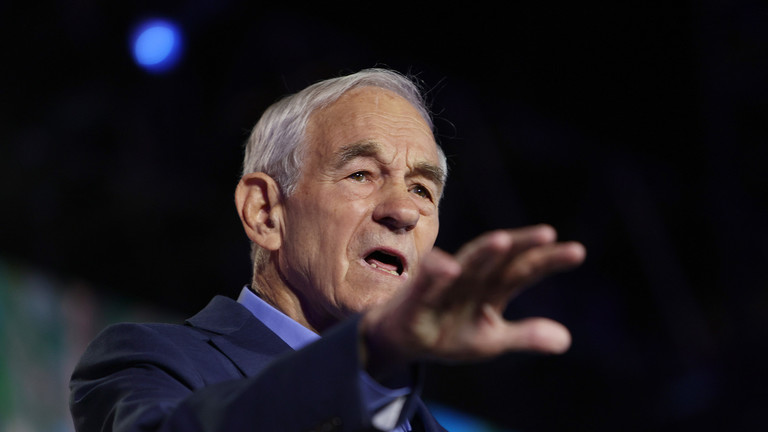
By Ron Paul | December 19, 2022
As we learn more and more from the “Twitter Files,” it is becoming all too obvious that Federal agencies such as the FBI viewed the First Amendment of our Constitution as an annoyance and an impediment. In Friday’s release from the pre-Musk era, journalist Matt Taibbi makes an astute observation: Twitter was essentially an FBI subsidiary.
The FBI, we now know, was obsessed with Twitter. We learned that agents sent Twitter Trust and Safety chief Yoel Roth some 150 emails between 2020 and 2022. Those emails regularly featured demands from US government officials for the “private” social media company to censor comments and ban commenters they did not like.
The Foreign Influence Task Force (FITF), a US government entity that included the FBI as well as other US intelligence agencies expressly forbidden from domestic activities, numbered 80 agents engaged regularly in telling Twitter which Tweets to censor and which accounts to ban. The Department of Homeland Security brought in outside government contractors and (government-funded) non-governmental organizations to separately pressure Twitter to suppress speech the US government did not like.
US Federal government agencies literally handed Twitter lists of Americans it wanted to see silenced, and Twitter complied. Let that sink in.
This should be a massive scandal and likely it would have been had it occurred under a Trump Administration. Indeed, Congress would be gearing up for Impeachment 3.0 if Trump-allied officials had engaged in such egregious behavior. But since these US government employees were by-and-large acting to suppress pro-Trump sentiment, all we hear are crickets.
What is interesting about these Twitter revelations is how obsessed the FBI and its government partners were with satire and humor. Even minor Twitter accounts with small numbers of followers were constantly flagged by the Feds for censorship and deletion. But knowledge of history helps us understand this obsession: in Soviet times the population was always engaged in joking about the ineptitude, corruption, and idiocy of the political class. Underground publications known as samizdat were rich with satire, humor, and ridicule.
Tyrants hate humor and cannot withstand satire. That is clearly why the FBI (and CIA) was determined to see a heavy hand raised against any American poking fun at the deep state.
There is good news in all of this, however. As Constitutional Law Professor Jonathan Turley wrote over the weekend, a new Harvard CAPS/Harris Poll found that even though the mainstream media has ignored the “Twitter files,” Americans have not. Nearly two-thirds of respondents believe that Twitter was involved in politically-motivated censorship in advance of the 2020 election. Some 70 percent of those polled believe Congress must take action against this corporate/state censorship.
As Professor Turley points out, although the First Amendment only applies to the US government, “it does apply to agents or surrogates of the government. Twitter now admits that such a relationship existed between its former officials and the government.”
So now we have proof that the FBI (along with US intelligence agencies and the Department of Homeland Security) have been acting through “private” social media companies to manipulate what Americans are allowed to say when they communicate with each other.
Is there anything more un-American than that? Personally, I find it sickening.
We do not need the FBI and CIA and other federal agencies viewing us as the enemy and attacking our Constitution. End the Fed… and End the Federal Bureau of Investigation!
Copyright © 2022 by RonPaul Institute
After Twitter revelations, Rep. Comer says Google and Facebook need to be investigated for similar censorship collusion
By Christina Maas | Reclaim The Net | December 18, 2022
Commenting on the recent Twitter Files’ revelation of the FBI’s constant communication with Twitter, including recommending account bans, Republican Ranking Member of the House Oversight Committee Rep. James Comer said investigations should go beyond Twitter to Google and Facebook.
“The entire FBI needs to be dismantled, we need to start all over. We need to enact strict reforms, and there need to be checks and balances at the FBI,” Comer said, speaking to Tammy Bruce on Fox News’ Hannity. He added that fixing and holding the FBI accountable should start with the budget process, which is why he is against the push for an omnibus.
“My concern was that this was a rogue FBI employee or two…but what we found today is the FBI had its own ministry of propaganda,” Comer continued.
“This is serious. What else are they involved in at the FBI? The entire FBI needs to be dismantled. We need to start all over. We need to enact strict reforms and there need to be checks and balances at the FBI.”
Bruce then asked, “I trust, though, that you are going to expand this beyond Twitter. You mentioned Google, you mentioned, perhaps, Facebook… are you going to expand and include those platforms, which we also know, at least from Mark Zuckerberg, he too was contacted by the FBI. I think we only know a portion of that. Are you going to expand this investigation?”
The Republican lawmaker, set to chair the Oversight Committee starting in January, replied: “Yes. This is going to take several committees focusing a lot of attention. Big tech is going to be a priority for the Republican majority…”
He added that “the FBI was involved in censorship… they have stepped in where the government does not belong. And this has to end. People have to be held accountable and we’re going to have to start with the budget, that’s what is so frustrating about what’s going on right now in Washington.”
State Attorneys General tell Twitter to preserve censorship evidence
By Dan Frieth | Reclaim The Net | December 14, 2022
Missouri’s Attorney General Eric Schmitt who, together with Louisiana’s Attorney General Jeff Landry, filed a lawsuit alleging collusion between the federal government and social media companies to censor certain speech, sent a letter to Twitter asking for the preservation of evidence related to communications between the company and federal government officials on content moderation and misinformation.
We obtained a copy of the letter for you here.
Schmitt, who was elected to the Senate in November, referenced the internal documents, dubbed “Twitter Files,” that are being released by CEO Elon Musk via journalists Matt Taibbi, Bari Weiss, and Michael Shellenberger.
The files showed that then-deputy legal counsel Jim Baker, who was at the FBI before joining Twitter, was involved in the decision to censor the Hunter Biden laptop story.
After the release of the first batch of the Twitter Files, it was revealed that Baker was vetting the documents being released to Taibbi and other journalists. Baker was fired immediately.
On Monday, Schmitt announced: “We sent a letter to Twitter asking the platform to look into whether any key documents were deleted.”
The letter asks Twitter to preserve evidence related to the lawsuit, adding that the platform should take the necessary steps to prevent the destruction of evidence that might have happened at the direction of Baker.
“Further, we asked Twitter to reveal who from the federal government communicated with Twitter to censor speech. Based on our recent depositions, we believe the previous list we received pursuant to a third-party subpoena was incomplete,” Schmitt wrote. “Lastly, we asked Twitter to provide responsive documents pursuant to our original third-party subpoena.”
Related: Elon Musk hints censorship docs may have been hidden or deleted
Former Twitter CEO Takes Responsibility for Social Network’s Political Censorship
Samizdat – 14.12.2022
Co-founder and former CEO of Twitter Jack Dorsey said on Wednesday that he was the one responsible for the company’s susceptibility to government and corporate influence.
“Social media must be resilient to corporate and government control. Only the original author may remove content they produce. Moderation is best implemented by algorithmic choice. The Twitter when I led it and the Twitter of today do not meet any of these principles. This is my fault alone, as I completely gave up pushing for them when an activist entered our stock in 2020,” he wrote in his personal blog.
Dorsey said he realized that companies have become “far too powerful” once Twitter suspended the account of former US President Donald Trump in January 2021.
His biggest mistake was investing in the development of tools allowing the company “to manage the public conversation,” instead of “building tools for the people using Twitter to easily manage it for themselves,” Dorsey added. This, according to the former CEO, “burdened the company with too much power” and made it susceptible to “outside pressure.”
Twitter’s new owner, US billionaire Elon Musk, has reportedly given access to internal papers to a few independent journalists to investigate politically-motivated censorship in the company before his takeover. Bari Weiss and Matt Taibbi presented their findings in threads tweets earlier this month.
Weiss said she found that Twitter allegedly used to have a special team instructed to “build blacklists, prevent disfavored tweets from trending, and actively limit the visibility of entire accounts or even trending topics.” Taibbi alleged that prior to the 2020 US presidential elections, Twitter deliberately took measures to downplay the scandal around the laptop of US President Joe Biden’s son Hunter. The laptop reportedly had evidence of Hunter Biden’s participation in tax-related crimes, drug use, money laundering and illegal business dealings in foreign countries including Ukraine and China.
Social media’s history of suppressing Palestine content

By Kathryn Shihadah | Israel-Palestine News | December 12, 2022
For years, social media have been making it difficult for Palestinian and their allies’ voices to be heard – even as Israel’s stranglehold on Palestinians has grown stronger, and as increasing amounts of US tax money have been sent to Israel and to various countries for Israel’s direct benefit.
Social media users, especially Palestinian human rights advocates, have reported puzzling occurrences on the major platforms Twitter, Facebook, and Instagram – especially during times of Israeli crackdowns.
Users who shared information on the situation in the Palestinian territories described posts being deleted as “hate speech or symbols,” or “violence,” inexplicably losing followers and views of their content, or having entire accounts abruptly frozen or deleted.
One rights group documented over 700 instances of social media networks restricting or removing Palestinian content in May 2021 alone, during a time of especially heavy Israeli state violence.
Another group reported that nearly half of the Palestinian-themed content that disappeared off of Instagram during this time period
occurred without the company providing the user a prior warning or notice. In an additional 20 percent of the cases, Instagram notified the user but did not provide a specific justification for restricting the content.
When users appealed the censorship, often their content or account would be restored, with a message that it never should have been deleted to begin with. But by the time this resolution came, the opportunity to inform and influence readers was past.
For example, in May 2021, during a time of escalating Israeli violence, Twitter restricted the account of Palestinian-American journalist Mariam Barghouti, who had been posting photos and videos of the violence in Jerusalem. It later restored Barghouti’s account and apologized for the suspension, saying it was done “by mistake.”
A long report on social media actions regarding Israel-Palestine in the Columbia Journalism Review pointed out: “Some of those who have been covering such issues for years don’t think these kinds of things are a mistake; rather, they believe social networks are deliberately censoring Palestinian content.”
Barghouti explained the significance of Twitter to the Palestinian rights movement:
It’s our only avenue for speaking with the world from under a military occupation that controls all our entry and exit points. We’re left to share through soundbites of 280 characters. If even that is taken away, we’re looking at the slaughter of Palestinians in silence.
Social media suppression is particularly critical since mainstream media tend not to cover Israel and Palestine with the kind of accuracy and context that would enable Americans to understand the issue.
In essence, social media have been preventing the victims of Israeli violence from sharing their experiences or building support for their plight.
Excuses
Although owned by two different companies, the three platforms, Twitter and Facebook/Instagram, have offered duplicate “explanations” for what has happened, including glitches that just happened to affect posts and hashtags about Israel, and “widespread global technical issue not related to any particular topic.”
While these [glitches] have been fixed, they should never have happened in the first place. We’re so sorry to everyone who felt they couldn’t bring attention to important events, or who felt this was a deliberate suppression of their voice. This was never our intention – nor do we ever want to silence a particular community or point of view.
TRT World reported another case in which Twitter restricted information on Palestine:
Pro-Palestinian activist Hebh Jamal’s Twitter was targeted with complaints over a post detailing an emotional conversation between her husband and his little cousin in Gaza. The young cousin admitted to wanting to brush his hair before sleeping for fear that the Israeli fire may kill him in his sleep. He said he wanted to look good in case he died. Hebh’s post was flagged for deletion, and restricted by Twitter.
Since the German government has implemented legal measures to make social media companies accountable to users, Twitter later confessed to Hebh that the complaints against her post were baseless. Under German law, Twitter has to inform the user if their post or account is being investigated. This only applies because Hebh and her family reside in Germany. For most Palestinians hailing from Gaza City, there’s a different set of rules, and a radically different set of rights.
TRT reports: “Hebh now faces a video review for every post she makes. She’s also been reported on TikTok as well, with her account deleted before.”
Journalist Bayan Ishtaiwi explained: “For Palestinians sealed-off in open-air prisons like Gaza, social media is all they have. Whoever uses words like occupation or martyr, is penalized for three days at least, which happened to me, or face a ban on live videos for a month.”
Whistleblowing
A group of Instagram employees confirmed the human rights activists’ suspicions when they protested the platform’s blocking of pro-Palestinian content during Israel’s violence in May 2021 – even after the issue had already been reported.
Can we investigate the reasons why posts and stories pertaining to Palestine lately have had limited reach and engagement, especially when more people than ever from around the world are watching the situation unfold?
Other employees added comments, including,
I’d really like to understand what exactly is breaking down here and why. What is being done to fix it given that this is an issue that was brought up a week ago?
Soon after, nearly 200 Facebook employees signed on to an open letter demanding that Facebook address the allegations of censorship.
Israel calls the shots
Foreign Policy reports:
“Since 2015, the Israeli Justice Ministry has operated a Cyber Unit that has issued tens of thousands of content removal requests to Facebook, Twitter, and YouTube, mostly alleging violent incitement or support for terrorism.
Technically, these requests are voluntary. They are not legally binding and are therefore not tracked in the transparency reports that technology companies use to disclose formal government censorship orders.
Nonetheless, social media companies have complied with the Cyber Unit’s requests roughly 90 percent of the time.”
Israel’s infamous Cyber Unit patrols social media, searching for “incriminating” content, passing along thousands of requests to social media administrators to remove what the unit finds unacceptable.
In 2016, the Israeli government and Facebook agreed to collaborate on ways to combat what Israel considers “incitement to violence” on the platform.
Then-justice minister Ayelet Shaked noted that at the time, Facebook’s compliance with Israel’s requests to take down content was up to 95%, but expressed hopes that the plan would result in even more censorship.
Neither Israel nor the platforms have been transparent about this practice.
In 2020, Israel’s Ministry of Strategic Affairs issued a report on allegedly “phony” online profiles that put out content critical of Israel.
Within a day, Twitter “suspended dozens of Palestinian and pro-Palestine accounts,” claiming the information they circulated violated its terms of service.
It may be noteworthy that both Meta CEO Mark Zuckerberg and Twitter’s new owner, Elon Musk have had private audiences with top Israeli leaders.
Israelis abound in Silicon Valley, with about 60,000-100,000 in the Bay Area, and Israel partisans are also ever-present. A recent photo of Musk shared on Twitter was of him with his friend Ari Emanuel, son of a former Irgun terrorist and brother of Rahm Emanuel, who once volunteered with the IDF.
One Palestinian activist summed up the situation:
Rather than being some kind of enabler of democracy, social media has come to be the epitome of political silencing and repression as tech giants have collaborated with various oppressive governments, including the Israeli government, to censor and delete content that exposes their true oppressive character.
Facebook, Instagram report card
Facebook’s Oversight Board recommended that Meta (parent company of Facebook, Instagram, and WhatsApp) undergo an evaluation of its treatment of Palestinian content in May 2021. Meta hired the consulting company Business for Social Responsibility (BSR) for the work.
Jewish Currents summarized BSR’s final report in an article entitled “Human Rights Due Diligence of Meta’s Impacts in Israel and Palestine”:
The report underscored heavy-handed content moderation by Facebook and Instagram, which Palestinian social media users claim censors critics of Israeli repression.
These restrictions have undermined Palestinian users’ effort to use social media to document Israeli human rights abuses.
BSR contrasted Meta’s over-enforcement of Palestinian social media posts with its under-enforcement of Hebrew-language posts, which the report attributes to Meta installing an algorithmic “hostile speech classifier” for Arabic, but not for Hebrew.
The report concludes that Arabic language content is over-regulated because Hamas, the ruling, elected party in Gaza, is on Facebook’s blacklist, so it was standard to remove posts that appeared to “praise, support, or represent” that group or others on the list.
Other reasons for the interference lie in the fact that the Palestinian content was not reviewed by Palestinian dialect speakers of Arabic, nor was the algorithm developed with the proper “linguistic and cultural competence.”
Internet policy experts summed up the situation at Facebook and the other platforms:
Social media companies have] shown a willingness to silence Palestinian voices if it means avoiding potential political controversy and pressure from the Israeli government.
“Unintentional”? Really?
BSR’s report speculated that the impact of Facebook’s actions – Palestinian users’ loss of rights to expression – was unintentional. Rights groups disagreed.
Dozens of groups signed a public statement in response to BSR’s report, insisting that they had been
calling Meta’s attention to the disproportionately negative impact of its content moderation on Palestinians for years, [so] even if the bias started out as unintentional, after knowing about the issues for years and not taking appropriate action, the unintentional became intentional.
Looking ahead
The BSR report ends with 21 recommendations to Meta, some of which Meta has committed to, either fully or in part.
Marwa Fatafta, a policy manager for a digital rights group, had mixed feelings:
The report validates the lived experiences of Palestinians… They cannot tell us anymore that this is a system glitch. Now they know the root causes…
But regarding Israel’s interference in content restriction, he added,
We’ve wanted more clarity on this because Meta refuses to provide answers. Users deserve transparency on whether their piece of content has been removed as a result of the Israeli government’s request.
Bottom line
Social media have for years – and for various reasons – repressed content about Israel’s oppression of Palestinians.
In some particularly egregious situations, like Israel’s aggression in May 2021, the companies have offered excuses and apologies. But impartial analysis has proven these excuses false and the apologies hollow.
Not only are social media platforms inherently skewed to over-regulate Palestinian voices, but they are influenced by a powerful foreign government (and no doubt, its US lobby) to an extent we can only imagine.
And Palestinians continue dying.
A report in Foreign Policy by Emerson T. Brooking and Eliza Campbell described the situation with rare eloquence:
The 4.8 million residents of the occupied Palestinian territories live in two simultaneous and vastly different realities. In the physical world, Palestinians are captives, crammed into Gaza or West Bank enclaves and blockaded by Israeli military checkpoints…
But on the internet, the checkpoints disappear. Palestinians can converse with family from whom they are separated by barbed wire and machine gun emplacements. They can share their stories with observers and sympathizers around the world.
In doing so, Palestinians can call themselves citizens of a sovereign State of Palestine: one recognized by 138 countries and admitted in 2012 as a non-member observer state to the United Nations. This second, digital Palestine represents a fulfilment of the internet’s optimistic and largely forgotten promise to give voice to the voiceless and illuminate the darkest corners of the world.
It is also under threat of being extinguished. This is due to a confluence of three forces. The first is the expansive police and surveillance apparatus of the State of Israel, which is used to track, intimidate, and imprison Palestinians in the occupied territories for their online speech.
The second is a network of formal and informal institutions used by the Israeli government to target pro-Palestinian expression across the globe.
The third—and most surprising—force is that of American social media companies, which have shown a willingness to silence Palestinian voices if it means avoiding potential political controversy and pressure from the Israeli government.
Together, these forces demonstrate how it is possible for an ostensibly democratic government to suppress a popular online movement with the acquiescence of ostensibly liberal Silicon Valley executives. The playbook being pioneered against Palestinians will not stay in the Middle East forever. In time, it may be deployed against activist communities around the world.
Elon Musk says some political candidates running for office were secretly shadow banned on Twitter
By Cindy Harper | Reclaim The Net | December 10, 2022
On Friday, Elon Musk confirmed that under previous leadership, political candidates were blacklisted on Twitter. In 2018, Twitter executives testified that the platform did not “shadow ban” people.
On Wednesday, journalist Bari Weiss published the second batch of “Twitter Files,” which showed that “teams of Twitter employees” built blacklists that were used to limit the spread of content.
People have always suspected that some users are shadow banned but Twitter has never been transparent about it and never tells users when they’re being suppressed. The documents obtained by Weiss showed that Twitter used “visibility filtering” to “suppress what people see to different levels.”
Weiss mentioned some of those who were added to the blacklists, including conservative commentators Dan Bongino and Charlie Kirk, Dr. Jay Bhattacharya, and Libs of TikTok. She did not say whether or not politicians were among those that were blacklisted.
Reporter Ian Miles Cheong asked both Musk and Weiss, “were any political candidates – either in the US or elsewhere – subject to shadowbanning while they were running for office or seeking re-election?” Musk responded, “Yes.”
Testifying before Congress in 2018, Twitter executives denied that users were suppressed based on political views.
“To be clear, our behavioral ranking doesn’t make judgments based on political views or the substance of tweets,” said Kayvon Beykpour, the former head of product.
“We don’t shadow ban, and we certainly don’t shadow ban based on political viewpoints. We do rank tweets by default to make Twitter more immediately relevant (which can be flipped off),” said former CEO Jack Dorsey.
Dr. Jay Bhattacharya says he “strongly” suspects federal government directed Twitter to blacklist his account
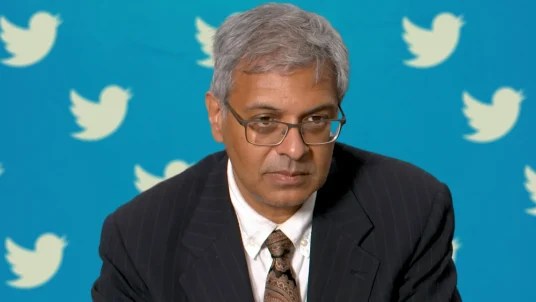
By Tom Parker | Reclaim The Net | December 9, 2022
Stanford University Medical School professor and epidemiologist Dr. Jay Bhattacharya has responded to the bombshell revelation that Twitter secretly blacklisted his account by suggesting that the federal government could have been pulling the strings of this censorship.
“I suspect very strongly that there was some government direction of this,” Bhattacharya said during an interview with Fox News’s Laura Ingraham. ”
Bhattacharya continued by discussing the findings from a Biden administration-social media censorship collusion lawsuit that he’s involved in.
The documents that have been released and the sworn statements that have been made as part of this lawsuit have revealed that federal government officials have pressured Big Tech companies to censor many pieces of content that they deemed to be “misinformation.”
One of the documents that’s pertinent to Bhattacharya is an email from then-National Institutes of Health (NIH) Director Francis Collins and Director of the National Institute of Allergy and Infectious Diseases (NIAID) Anthony Fauci where he called for a “quick and devastating published takedown” of the premises of The Great Barrington Declaration — an anti-lockdown statement published by Bhattacharya and other leading epidemiologists.
“We’ve uncovered tremendous evidence that… there were federal agencies that were… directing social media companies about what to censor, even who to censor,” Bhattacharya told Ingraham. “If that is actually the case… that this blacklisting was directed by the government against American citizens, that’s a direct violation of my civil rights, it’s a direct violation of the First Amendment, and every American should be outraged.”
Bhattacharya continued: “A lot of the leadership of Silicon Valley, a lot of… the people who give advice to Silicon Valley and to the government about about these content moderation policies, they’ve gone… way too far.”
The Stanford professor also commented on the far-reaching implications of this censorship of discussions about basic scientific policy.
“Imagine how different [things would have been],” Bhattacharya said. “All the small businesses could have stayed open, all the people that wouldn’t have missed their cancer screenings, all the kids that wouldn’t be depressed and suicidal, all the learning loss that could have been avoided if we just had an open scientific discussion.”
Additionally, Bhattacharya suggested that the censors deployed these tactics because “their arguments were not strong enough to survive the light of day” and called for a “national conversation that brings us back to the American commitment to free speech rights, the American commitment to… open discussion, and… honest dealings.”
The New Civil Liberties Alliance (NCLA), the legal group that’s representing Bhattacharya in the Biden admin-Big Tech censorship collusion lawsuit, said:
“We already know the federal government had a hand in Twitter censorship, especially of those who articulated perspectives that conflicted with government messaging on covid. As Elon Musk exposes further information about Twitter’s inner workings, we anticipate learning more about the extent of government involvement in blacklisting those who express disfavored views.”
Not only does the recent disclosure about Bhattacharya’s account being blacklisted shine a light on the pervasiveness of Big Tech’s censorship but it also demonstrates that Twitter was still engaged in this censorship more than a year after the pandemic began with Bhattacharya only joining Twitter in August 2021.
Twitter’s blacklisting of Bhattacharya’s account is the latest of several examples of the tech giants censoring him after he challenged the government’s Covid narrative. Reddit mods deleted The Great Barrington Declaration, Facebook deleted The Great Barrington Declaration page, and YouTube deleted a public health roundtable featuring The Great Barrington Declaration authors, Florida Governor Ron DeSantis, and former White House coronavirus advisor Dr. Scott Atlas.
How the ‘Twitter Files’ have exposed a senior FBI official’s role in manipulating the outcome of the 2020 US election
By Felix Livshitz | RT | December 9, 2022
Internal Twitter documents and communications published by the journalist Matt Taibbi have provided devastating detail on a sweeping censorship operation conducted by the social network. They expose the central role played by a senior FBI agent in potentially influencing the outcome of the 2020 US election.
Immediate reaction to the Twitter Files was mixed, but overwhelmingly the mainstream American media has rushed to pour cold water on Taibbi’s bombshell disclosures, with, for example, The Washington Post branding them a “dud” and CNN claiming they “largely corroborated what was already known.”
Such responses are quite extraordinary given that the Twitter Files offers incontrovertible evidence of one of the largest, most influential global social networks taking extraordinary measures – usually reserved to prevent the dissemination of child pornography – to block information on its platform.
In particular, Twitter banned, both publicly and privately, the sharing of a New York Post article, based on the contents of a laptop owned by Hunter Biden, pointing to possible corruption on the part of his father, then-presidential candidate Joe Biden. The report reinforced existing concerns about Hunter’s role with Burisma, for which he received up to $50,000 per month from the Ukrainian energy giant over a five-year period for attending a handful of corporate events.
The material exposed by Taibbi shows that a decision was made by individuals at the highest levels of Twitter – with direct connections to Biden’s Presidential campaign – due to apparent fears the laptop contents had been hacked and/or had been released as part of a Russian information operation. This was despite there being zero evidence or even a vague suggestion that either was the case, and significant internal concerns.
The Twitter Files show how, among the top brass involved in the suppression of this hugely significant story was the social network’s legal vice president Jim Baker, a former FBI general counsel. He was coincidentally also fundamental to the Bureau’s multiple attempts to fraudulently concoct a link between Trump’s campaign and Russia, one way or another.
It’s clear that many staffers didn’t believe there were grounds to ban the New York Post story on the basis of Twitter’s policies on sharing hacked materials. One communications department official wrote that they were “struggling to understand the policy basis for marking this as unsafe,” while their superior fretted, “can we truthfully claim that this is part of the policy?”
However, their legitimate worries were overruled. Twitter later reversed this ban but by that point the false specter of Russian meddling had been so successfully cemented – including via a joint letter signed by over 50 senior US spies – that the story was largely discredited in the eyes of many Americans and, thus, ignored. It is only now, with Biden safely in the White House, that other outlets have begun to verify the laptop’s contents as not only real, but damaging.
Baker was central to overruling subordinates about the basis for banning the story. In an email published by Taibbi, he announced it was “reasonable for us to assume that they may have been” hacked.
It is not explained why it was “reasonable” to make this assumption, especially as Baker himself acknowledged there were instead indications that “the computer was either abandoned and/or the owner consented to allow the repair shop to access it for at least some purposes.” Which is, of course, a total contradiction in terms. So the ban went ahead, despite internal concern about the decision.
“Hacking was the excuse but, within a few hours, pretty much everyone realized that wasn’t going to hold,” an anonymous Twitter source told Taibbi. “But no one had the guts to reverse it.”
One of the reasons Baker’s intervention may have cut through initial misgivings, and no staffers then had the “guts to reverse it,” could’ve been his status as resident Russian “disinformation” expert at Twitter. He left the FBI in June 2018 on undisclosed grounds, although it was later confirmed he was the subject of a criminal Justice Department investigation due to alleged leaking to the media of scurrilous innuendo about Trump’s non-existent relationship with the Kremlin at the time.
Questions were also asked about whether, as General Counsel, Baker played any role in greenlighting or overseeing various failed FBI counterintelligence investigations into Trump’s election team. Known as Crossfire Hurricane, these related probes were built on extremely shaky foundations, and led to no evidence supporting suspicions of Trump-Russia ties being unearthed, but still remained open under internal pressure, in contravention of established investigative protocols.
A subsequent internal review found 17 separate “significant inaccuracies and omissions” in the FBI’s court submissions for warrants that it applied for to spy on campaign staffer Carter Page.
More recently, Baker testified at the trial of Michael Sussmann, a well-connected Washington DC lawyer tied to the Democratic party. He was charged by Attorney General John Durham with lying to the FBI when he presented to the Bureau falsified evidence of contact between Trump Tower and Moscow via Russia’s Alfa Bank, in the summer of 2016.
Sussmann claimed he was not representing a client in doing so, when in reality he was acting on behalf of the Democrats, and billed them for the service. Baker would’ve known anyway that this cover story was a lie, as he and Sussmann were longtime friends, but he recorded the delivery as the uninterested, selfless act of a concerned citizen. Quite why he wasn’t charged for procedural misconduct is not known.
It’s also not known why such dealings didn’t torpedo his professional credibility upon leaving the Bureau. Departing an organization like the FBI under such a dark cloud would normally mean the end of someone’s career. Instead, Baker was snapped up by Twitter to be the right hand man of Vijaya Gadde, the company’s head of legal.
Throughout her time at the social network, she was derided as its censor-in-chief, and leaked documents reveal she regularly consulted with the Department of Homeland Security on how best to restrict inconvenient facts online. It’s understandable why Baker would be such an attractive hire for Gadde.
He was by that point clearly an expert in perpetuating false claims of “disinformation” and “Russian meddling” for political purposes, to tremendous effect. The Russiagate hoax almost took down President Trump, and meant his term in office was spent ramping up tensions with Moscow rather than improving relations as he’d repeatedly promised on the campaign trail.
It could have been calculated within Twitter HQ that Baker would be willing to play a similarly destructive role the next time round, and prevent Trump from getting re-elected in the first place. Helping suppress the damaging material facts contained in the New York Post may have done just that.
Twitter Update to Show Users if They Were ‘Shadowbanned’, Elon Musk Says
Samizdat – 09.12.2022
US billionaire entrepreneur and newly minted Twitter owner Elon Musk said on Friday that the company had been working on a software update to let users know if they have been “shadowbanned.”
“Twitter is working on a software update that will show your true account status, so you know clearly if you’ve been shadowbanned, the reason why and how to appeal,” Musk said on Twitter.
In late October, Musk finalized the $44 billion acquisition of Twitter. Following the takeover, Musk changed the company’s day-to-day operations, including the termination of Twitter executives who were responsible for the platform’s privacy, cybersecurity and censorship, as well as about two-thirds of Twitter’s employees.
Shadowbanning is a practice of concealed restriction, when a person remains on a social media platform, but his or her content is not visible or only partly accessible to other users.
Twitter’s ‘secret blacklists’ exposed
RT | December 8, 2022
Twitter has created a series of barriers and tools for moderators to prevent specific tweets and entire topics from trending, or limit the visibility of entire accounts, according to internal correspondence and interviews with multiple high-level sources within the company.
Despite repeated public assurances by top Twitter officials that the company does not “shadow ban” users, especially not “based on political viewpoints or ideology,” the practice actually existed under the euphemism of “visibility filtering,” according to journalist Bari Weiss, who published the second installment of the so-called ‘Twitter Files’ in a lengthy thread on Thursday night.
“Think about visibility filtering as being a way for us to suppress what people see to different levels. It’s a very powerful tool,” one senior Twitter employee said, while another admitted that “normal people do not know how much we do.”
Twitter moderators have the power to add the user to categories such as “Trends Blacklist,” “Search Blacklist” and “Do Not Amplify,” to limit the scope of a particular tweet or entire account’s discoverability – all without users’ knowledge or any warning.
However, above the common moderators was another “secret group” that handled issues concerning “high follower,” “controversial” and other notable users. Known as “Site Integrity Policy, Policy Escalation Support,” the team included high-level executives such as former Head of Legal, Policy, and Trust, Vijaya Gadde, the Global Head of Trust and Safety, Yoel Roth and CEOs Jack Dorsey and Parag Agrawal.
CDC and Census Bureau had direct access to Twitter portal where they could flag speech for censorship
By Tom Parker | Reclaim The Net | December 7, 2022
Emails between an employee at the United States (US) Centers for Disease Control and Prevention (CDC) and Twitter have revealed that at least one CDC staff member and the US Census Bureau had access to Twitter’s dedicated “Partner Support Portal” which allows approved government partners to flag content to Twitter for censorship.
The emails were released by the nonprofit organization America First Legal and show Twitter enrolling a CDC employee into this portal through their personal account in May 2021 (pages 182-194).
On May 10, 2021, the CDC’s Carol Crawford sent Twitter employee Todd O’Boyle a list of example posts highlighting “two issues that we [the CDC] are seeing a great deal of misinfo about.” O’Boyle responded by saying that enrolling in Twitter’s Partner Support Portal is the best way for Crawford to get posts like this reviewed in the future.
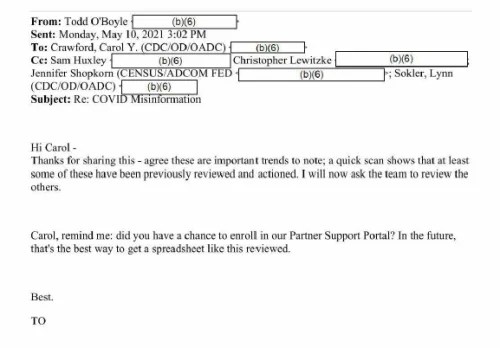
Crawford asked O’Boyle if she could enroll in the portal with her personal Twitter account and on May 27, 2021, O’Boyle confirmed that Crawford had been enrolled in the portal.
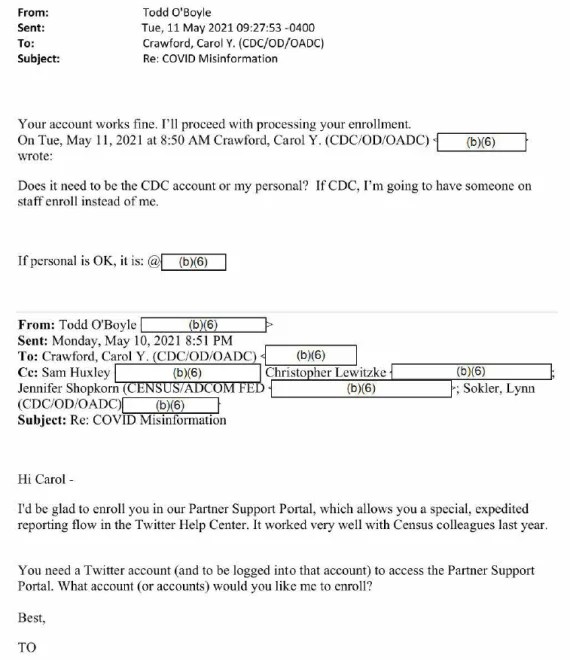
In other emails, Crawford asked O’Boyle whether the federal government could flag “COVID misinformation on the portal using the existing census.gov accounts that have access” and questioned how to flag “misinformation” via the portal.
June 2021 emails (pages 359-360) also show another CDC employee attempting to enroll in a Facebook portal but getting error messages. While these emails don’t describe the portal, it appears to be Facebook’s content takedown portal which is similar to the Twitter portal and allows government agencies to flag content for censorship.
Additionally, a February 4, 2021 email (pages 354-355) shows Facebook’s US Head of Public Policy, Payton Iheme, asking Crawford whether she’s aware of the US Department of Homeland Security’s (DHS’s) misinformation work.
“I saw that DHS/CISA is planning /possibly working on COVID-19 misinfo concerns?” Iheme wrote to Crawford. “Are you aware of that aspect?”
This email was sent more than a year before the DHS announced its controversial “Disinformation Governance Board” in April 2022.
Another revelation from this email is that Iheme acknowledges the focus on misinformation “growing among members of Congress.”
These emails provide more evidence of the Big Tech-Biden administration censorship collusion that’s currently facing a legal challenge over potential First Amendment violations.
“In recent months, millions of Americans have witnessed the peeling of the ‘misinformation’ onion,” Gene Hamilton, America First Legal Vice-President and General Counsel, said. “Beneath each layer of shocking details about a partnership between the federal government and Big Tech is yet another layer of connections, conspiracy, and collaboration between power centers that seek to suppress information from the American people. We are proud to play a leading role in fighting for the rights of all Americans and revealing this vital information to the American people.”
We obtained a copy of the emails for you here.
The emails also shine a light on the government departments that have access to these direct Big Tech censorship portals. Previous reports and document releases have shown that the California Secretary of State’s Office of Elections Cybersecurity (OEC) has access to the Twitter portal while the DHS and the New Zealand government have access to the Facebook portal.
Featured Video
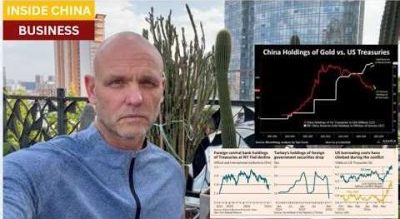
Now everyone is dumping US government bonds
or go to
Aletho News Archives – Video-Images
From the Archives
Experts Warned For Years That A War With Iran Would Happen This Way
By Caitlin Johnstone | April 3, 2026
… It’s so wild how we keep seeing reports that Iran’s retaliation caught the US off guard. For all the years I’ve been paying attention to this issue I’ve been reading experts and analysts saying if the US attacks Iran, Iran can close the Strait of Hormuz and strike US bases and the energy infrastructure of US allies in the region.
A few examples:
A 2006 Oxford Research Group paper titled “Iran: Consequences of a War” warned that Iran has numerous options at its disposal in the event of a US attack, and that the “most significant of these would be any possible retaliatory Iranian action to affect the transport of oil and liquefied natural gas through the Straits of Hormuz,” adding that stopping Iran from doing this “would be difficult if not impossible to achieve, leading to a fear of attack which alone would have a formidable impact on oil markets.”
A 2007 Cato Institute paper titled “The Iraq War and Iranian Power” warns that “Iran possesses the largest ballistic-missile inventory in the Persian Gulf — missiles which can reach Israel, Saudi Arabia and US military bases in Iraq,” and that “experts argue Iran could also use the ’oil weapon’: blocking the 34km-wide Strait of Hormuz and conducting submarine and anti-ship missile attacks against ports and oil facilities in Saudi Arabia, Kuwait and other Gulf Cooperation Council states.”
A 2012 NPR article titled “Can Iran Close The World’s Most Important Oil Route?” features then-chairman of the Joint Chiefs of Staff acknowledging that Iran absolutely can block the Strait of Hormuz, saying Tehran has “invested in capabilities” which specifically enable them to do so.
A paper from the Columbia Center on Global Energy Policy and the Center for a New American Security titled “IN DIRE STRAITS? IMPLICATIONS OF US-IRAN TENSIONS FOR THE GLOBAL OIL MARKET” warns of a potential scenario “that includes damage to Gulf oil infrastructure and a temporary closure of the Strait of Hormuz.”
These weren’t a bunch of keffiyeh-wearing peaceniks making these assessments, they were deeply entrenched swamp monsters entirely loyal to the US empire. They opposed war with Iran not because it would be an evil act of unforgivable mass murder, but because it would be bad for the imperial power structure. … Full article
Blog Roll
 Aletho News
- NATO’s structural collapse – the outcome of deviation from reality
- Poll finds world views China better than US
- One Of America’s Leading Neo-Cons Has Turned Against The Iran War And Israel
- Attack in the Bosphorus exposes NATO weaknesses and tensions among allies
- BREAKING: US JET SHOT DOWN OVER IRAN /Lt Col Daniel Davis & Nima Alkhorshid
- Now everyone is dumping US government bonds
- Brazilian Congressman seeks to bar Israeli military personnel from entering Brazil
- Official reveals evidence of Arab states’ involvement in US-Israeli war on Iran
- His Majesty’s head-chopper: Syria’s MI6-backed president bows to King Charles
- Forced to backtrack: ‘Israel’ drops Hezbollah disarmament goal
- If Americans Knew
- Israel Is Blocking Palestinians from Easter at Church Where Jesus Resurrected
- Plot to assassinate Palestinian activist follows harassment campaign promoted by Zionist groups and elected officials
- Prominent New York synagogue hosts presentation on why U.S. Jews should support the ethnic cleansing of Gaza
- Tapper vs. Piker: Is the CNN Anchor Auditioning for David Ellison?
- Shouldn’t Democrats Be Able to Condemn Genocide?
- Israel-US kill negotiators, destroy civilian structures, but Iran’s military capabilities still largely intact – Daily Update
- ‘War crime’: Global condemnation as Israeli ministers celebrate death penalty law targeting Palestinian prisoners
- 7 Ways Israel Is Turning Lebanon Into Gaza
- World’s Leading Football Bodies Under Fire Over Israel Policies
- Experts warn of possible use of nukes against Iran
- No Tricks Zone
- Low Intensity Tornado Wrecks Major Solar Farm, Creating A Potential Toxic Dump
- New Study Finds Warming Saves Lives…Cold Temperatures 12 Times More Deadly Than Excess Heat
- German Science Blog Accuses PIK Climate Institute Of Hallucinating Climate Tipping Points
- Devastating Assessment Of Comirnaty Vaccine By Former Senior Pfizer Europe Toxicologist
- New Study: CO2 Is ‘Effectively Negligible’ As An Explanatory Climate Change Factor Since 2000
- Former Pfizer Toxicologist Dr. Helmut Sterz Tells Bundestag Hearing Pfizer Vaccine Should Have Never Been Approved
- Energy Expert: Germany’s Nuclear Phaseout Was A “500 Billion Euro Mistake”
- New Research: South Australia’s Mid-Holocene Sea Surface Temperatures Were 4°C Warmer Than Today
- Storing Green Energy To Last Germany 10 Days Would Require A 60-Million Tonne Battery
- New Studies: UK Sea Levels Were 4 Meters Higher Than Today During The Mid-Holocene
 Aletho News