‘Human rights abusers’ invited to ‘non-lethal’ weapons show, condemned by activists
RT | March 7, 2016
Activists have denounced a Home Office sponsored security fair, warning that Britain is selling tear gas and other crowd control tools to some of the world’s most oppressive regimes.
Among the governments invited to take part in the fair in Farnborough, Hampshire, 30 miles southwest of London, are Bahrain, Saudi Arabia, Israel, United Arab Emirates (UAE), Egypt and Turkey, the Guardian reported on Saturday.
Police and security officials from 79 countries are expected to participate in the fair later this week, according to the list, which was released under a Freedom of Information request.
Since Prime Minister David Cameron took office in 2010, the UK has approved 126 licenses connected with the sale of tear gas and other irritants, according to the Campaign Against the Arms Trade (CAAT).
Also approved were 75 licenses for crowd control ammunition such as rubber bullets, 79 for “acoustic” crowd control – known as sound grenades – and 259 licenses for riot shields.
CAAT spokesman Andrew Smith told the paper: “There are serious questions to be asked about the impact of the so-called ‘non-lethal’ arms industry. These risks become even more important when these weapons are being sold to human rights abusers and dictatorships.”
“A number of the countries in attendance routinely practice torture, arbitrary detention and other appalling acts of violence. The UK should not be arming these regimes and selling them the means to oppress and kill.”
“[The event] undermines the UK’s claims to be promoting human rights while strengthening the position of repressive regimes.”
Defending the trade show, the Home Office said: “A thriving security industry is vital to help cut crime and protect the public and so it is important these products and services can be showcased and expertise shared.”
Described by organizers as “the perfect place to see the latest security equipment and technology in a secure environment,” the Security and Policy fair will be held behind closed doors, with all visitors “pre vetted to strict Home Office criteria.”
GCC not after protecting Lebanon: Hezbollah chief
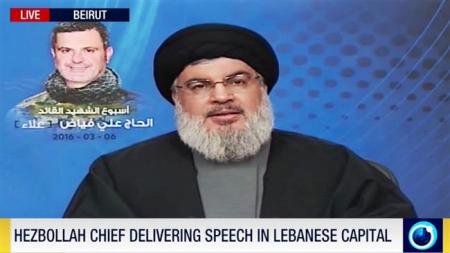
Press TV – March 6, 2016
Sayyed Hassan Nasrallah, the secretary general of the Lebanese resistance movement Hezbollah, says the Arab member states of the [Persian] Gulf Cooperation Council ([P]GCC), which recently listed the resistance group as terrorists, do not have the interests of Lebanon in mind.
During a live televised speech on Sunday, Nasrallah said those who assume that the Arab regimes will protect Lebanon have “pinned their hopes on a fantasy.”
Had Lebanon waited for a unified Arab strategy in the face of Israel instead of opting to resist against the occupying regime, “then the fate of this territory would have been the same as the fate of the territories Israel has taken control of,” he said.
On Wednesday, the six-nation Arab bloc issued a statement labeling Hezbollah a terrorist organization. The [P]GCC comprises Bahrain, Kuwait, Oman, Qatar, Saudi Arabia and the United Arab Emirates.
“Many of these Arab countries today, who designate us as terrorists, what do they have to do with this resistance and these victories and these achievements?” Nasrallah said.
Israel unleashed an all-out offensive on Lebanon 10 years ago under the pretext of releasing Israeli soldiers allegedly captured by Hezbollah in southern Lebanon. The invasion claimed the lives of nearly 1,200 Lebanese people, most of them civilians.
The Tel Aviv regime was, however, forced to retreat without achieving any of its objectives after Hezbollah fighters displayed heavy resistance against the Israeli military.
“Back then, we said to them (the Arab countries) ‘we don’t want anything from you… Today, we also say to them, to these regimes, ‘We don’t want anything from you. We don’t want money, nor do we want weapons, nor do we want support or blessing,” he said. “Just leave this resistance alone, leave this country alone, and leave this people alone.”
He blamed some Arab regimes for conspiring against anyone standing against Israel.
Nasrallah also underlined the assistance provided by the resistance group to the Iraqi government in its fight against the Takfiri terror group Daesh and reminded that Hezbollah did not wait for any orders to initiate its anti-terror fight in Syria and only fulfilled its religious commitment.
The secretary general of Hezbollah also addressed the tension that has been bubbling up between Saudi Arabia and Lebanon, causing the former to take a raft of hostile measures against the latter.
“If it’s angry with us, it has the right to. I understand Saudi Arabia’s anger. Why? Because when one fails, at the very least he will be angry,” Nasrallah said.
He went on to explain that the Saudi rage has emanated from the kingdom’s failures in Yemen and Syria.
“In Syria, there’s a very great Saudi anger because what they had calculated in Syria [was that] in two or three months, ‘Syria would fall into our hands,’” Nasrallah said.
Hezbollah has been successfully aiding the Syrian military against foreign-backed militant groups.
“He, who confronts Saudi Arabia in Syria is the real defender of the Lebanese national interests,” Nasrallah said.
“The same goes for Yemen. The estimations of the new Saudi leadership was that ‘we will decide the battle in Yemen. We will teach a lesson to all the Arab countries and the Arab world… and we will impose ourselves on the Arab world,’” he said.
Saudi Arabia launched a campaign of military aggression against Yemen in late March last year in a bid to bring fugitive former Yemeni President Abd Rabbuh Mansur Hadi, a Riyadh ally, back to power and undermine Yemen’s Houthi Ansarullah movement.
Riyadh has, however, failed in accomplishing either of the two objectives, and has become entangled in a prolonged expensive war, whose adverse economic impacts—along with economic mismanagement—have gradually been giving rise to domestic discontent inside Saudi Arabia.
Saudi, UAE Ask Their Citizens to Leave Lebanon
Al-Manar | February 23, 2016
Saudi Arabia has advised its citizens Tuesday against travel to Lebanon and urged those already in the country to leave it, citing “safety” concerns, a few days after it halted military aid to Lebanon.
“The Foreign Ministry calls on all citizens not to travel to Lebanon for their own safety,” the Saudi news agency SPA quoted a ministry official as saying.
“It also urges citizens residing in Lebanon or visiting it to leave and not to stay there unless for utmost urgency while observing vigilance and caution,” the official added.
The ministry also called on Saudis in Lebanon to contact the kingdom’s embassy in Beirut for “the necessary help and attention.”
UAE has also banned its citizens from traveling to Lebanon and decided to downsize its diplomatic mission in the country, according to AFP.
Bahrain ready for Syria deployment under Saudi lead: Diplomat
Press TV – February 6, 2016
The tiny Persian Gulf state of Bahrain says it is ready to deploy ground forces to Syria under the Saudi leadership as foreign-backed militants are losing ground in the face of the Syrian army advances.
The announcement by Bahraini Ambassador to Britain Sheikh Fawaz bin Mohammed Al Khalifa on Friday came after Saudi Arabia said it was ready to send troops to Syria.
In a statement, Sheikh Fawaz said Manama would commit troops to operate “in concert with the Saudis” in Syria.
The Bahraini diplomat said the Saudi initiative was meant to combat both Daesh and the government of Syrian President Bashar al-Assad.
“Under the leadership of Saudi Arabia, the [Persian] Gulf states are determined to take positive action within the region and globally to combat terrorism and extremism, from whatever quarter they emanate,” he said.
Sheikh Fawaz said the United Arab Emirates (UAE) was also ready to commit troops to Syria.
Bahrain, Saudi Arabia and the UAE are members of the US coalition that has been conducting air raids inside Syria since September 2014 without the Syrian government’s permit or a UN mandate.
They are staunchly opposed to the Syrian government, providing Takfiri militants with arms and funds to topple President Assad.
The Syrian army and allied fighters have made significant advances in recent weeks, especially in the areas near the second city of Aleppo.
In a surprise statement broadcast on the Saudi-owned Al Arabiya news network on Thursday, a spokesman for the Saudi defense ministry suggested that the kingdom could send troops to Syria.
“The kingdom of Saudi Arabia is prepared to participate in any ground operations that the anti-Daesh coalition might agree to carry out in Syria if there is consensus among coalition leaders,” the spokesman, Ahmed Asiri, said.
Pentagon chief Ashton Carter welcomed the offer, saying he looked forward to discussing it with the Saudi defense minister in Brussels next week.
Netanyahu: Saudi Arabia sees Israel as an ally
Press TV – January 23, 2016
Israeli Prime Minister Benjamin Netanyahu says Saudi Arabia now sees Tel Aviv “as an ally rather as an enemy” as he claims “a great shift taking place” in the Arab policy toward the Palestinian issue.
“Saudi Arabia recognizes that Israel is an ally rather than an enemy because of the two principle threats that threaten them, Iran and Daesh,” he told CNN’s Fareed Zakaria on the sidelines of the World Economic Forum in Davos Friday.
Both Saudi Arabia and Israel are fiercely opposed to a nuclear accord between Iran and the West which came into force recently. They are worried the agreement could boost Iran’s role in the region.
Last week, The Wall Street Journal reported that Israel was actively seeking to strengthen ties with Arab powers in the wake of the nuclear deal with Iran.
Daesh ideology is rooted in Wahhabism which is widely promoted by Saudi clerics and tolerated by the kingdom’s rulers. Both Saudi Arabia and Israel support Takfiri groups fighting in Syria. Meanwhile, there is no known case of a Daesh attack on either Saudi or Israeli targets.
Netanyahu also said “there is a great shift taking place” in the Saudi-led policy toward the Palestinian issue, citing Israel’s “relationships” with unknown Arab states.
“By nurturing these relationships that are taking place now with the Arab world, that could actually help us resolve the Israeli-Palestinian conflict, and we’re actually working towards that end,” he said.
Netanyahu’s overtures to Saudi Arabia and its allies come in the midst of international outcry after Tel Aviv declared 154 hectares (380 acres) of Palestinian territory in the Jordan Valley as “state lands.”
Yuval Steinitz, Israel’s minister for national infrastructure, energy, and water, returned recently from an energy conference in the UAE, where Tel Aviv recently established a diplomatic mission. Israel’s Channel 2 suggested that the real aim of the trip may have been for the two sides to covertly conduct strategy meetings.
In recent months, Egypt returned its ambassador to Tel Aviv while a group of Jordanian pilots paid a “working visit” to Israel and trained closely with their Israeli counterparts during US-sponsored military exercises.
Turkish President Recep Tayyip Erdogan also recently expressed an interest in easing tensions with Israel after reaching an agreement to restore relations last month. Sudan is also said to be considering normalizing ties with Israel.
Qatar charts a new diplomatic path to Russia
By Firas Al-Atraqchi | The BRICS Post | January 16, 2016
The visit of Qatari Emir Sheikh Tamim bin Hamad Al Thani to Moscow to meet with Russian President Vladimir Putin may be considered by some to be unexpected, but it is hardly surprising.
Although the two countries maintain considerable trade ties to the tune of half a billion dollars a year, they have for more than a decade been erstwhile adversaries.
As two of the greatest gas exporters, they rarely agree on production quotas, vying for control of this essential market. In the past 20 months, Russia has been highly critical of Saudi Arabia and Qatar for refusing to curb oil production output as global prices plummeted.
A major oil exporter, Russia – already reeling from EU and US sanctions – has suffered considerably as prices drop to the $30 mark.
The rhetoric between both countries peaked after Russian fighter bombers and naval vessels began pounding Islamist extremist groups fighting to remove Moscow’s Syrian ally President Bashar Al Assad.
As the Sunni-funded campaign to remove Assad appeared to reach a stalemate, both Qatar and Saudi Arabia have since May 2015 significantly increased their support (financially, logistically and with materiel) to Wahabist Islamist factions in Syria.
The increase in support came as both countries realized that Washington was unable – or unwilling – to provide such groups as Nusra Front and the Free Syrian Army with the upper hand to turn the tide against Assad.
When Russia moved to reinforce its bases in Syria and presence in the Mediterranean, the Qataris in late October 2015 announced they could militarily intervene in the civil war there to aid their Islamist allies.
“If a military intervention will protect the Syrian people from the brutality of the regime, we will do it,” Qatari Foreign Minister Khalid al-Attiyah said at the time.
If such bravado was meant to nudge Washington to up the ante against Assad, it failed.
Russian diplomacy moves forward
A week later, the US appeared to cave in to Russian pressure to bring together senior representatives from Germany, France, Great Britain, Italy, Iraq, Egypt, Lebanon, Qatar, the United Arab Emirates, Jordan, as well as the UN’s special envoy to Syria Staffan de Mistura, and EU foreign policy chief Federica Mogherini to meet in Vienna to resolve the Syrian civil war.
It marked the first time rivals Saudi Arabia and Iran joined discussions on Syria. The two countries have backed opposing sides in the Syrian and Yemeni conflicts.
The armed Syrian opposition – classified as moderates by the US – did not participate in the talks.
By expanding the number of countries meeting on the crisis – and bringing Assad’s critical backer Iran to the table – Russia effectively minimized Qatar’s and Saudi Arabia’s influence in the conflict.
In late November, on the sidelines of the third summit of the Gas Exporting Countries Forum (GECF) in Tehran, Putin thanked Iranian Supreme Leader Ayatollah Seyyed Ali Khamenei for his help in Vienna.
Moscow and Tehran have supported Syria’s President Bashar Al Assad and insisted that he be part of an interim political process and future elections.
“All this is done, of course, in agreement with the Iranian partners … I think that without them it would be impossible,” Putin said in comments carried by Russian news agencies.
Russia also played a critical role in ensuring that Iran and the other permanent Security Council members (and Germany) sign a deal which would curb Tehran’s nuclear program in exchange for a lifting of debilitating sanctions.
If it wasn’t clear yet, a rising Russia was increasingly flexing both its military and diplomatic muscles in the Middle East.
Even Egypt, which has been financially sustained by Saudi Arabia, defied its Riyadh benefactors and backed Russia’s approach to resolving the conflict.
On December 18, Russia and the US agreed to a UN Security Council resolution “to convene representatives of the Syrian government and the opposition to engage in formal negotiations on a political transition process on an urgent basis, with a target of early January 2016 for the initiation of talks, pursuant to the Geneva Communiqué, consistent with the 14 November 2015 ISSG Statement, with a view to a lasting political settlement of the crisis”.
A week later, the previously chest-pumping Qatar Foreign Minister al-Attiyah was in Moscow where he praised his Russian counterpart Sergey Lavrov for Russia’s efforts to stabilize the Middle East.
The two diplomats agreed on the need to move the UNSC resolution forward.
“We discussed in detail what’s necessary to be done to implement the agreements on the Syrian settlement,” Lavrov said at the time.
In early January, Russia’s BRICS ally China, which is also increasingly playing a political role in the Middle East, separately hosted members of both the Syrian government and the opposition. It encouraged the latter to drop its preconditions to meeting with Syrian government representatives.
In less than six months, the momentum to bring Assad down has shifted toward ensuring that a political peace process get off the ground.
So, what changed?
Qatar’s ambitions to become a regional and global player have in recent months been tamed.
Its ‘soft power’ approach to controlling the Middle East has backfired as it rushed head on against countries that have for centuries been well-versed in the art of Machiavellian empire-building and proxy manipulation.
At the same time, Russia’s aggressive immersion in the Middle East muddle has altered not only the narrative in the region but physical realities on the ground.
Anti-Assad forces have been losing significant territory to the Syrian military and its Hezbollah allies.
As Russia pounds and destroys the weapons bought by Qatar and Saudi Arabia, the US appears to have retreated despite Arab Sunni protestations.
As Sheikh Tamim bin Hamad Al Thani himself likes to point out, Qatar is a peace-loving member of nations that will work with the US and Western allies to bring the Middle East back from the brink of chaos and collapse.
He has blamed the international community for not supporting Arab youth in their drive for democracy, justice and economic security. That is really a scolding of the US and the West for not doing more to bring the Assad regime down.
Iran rising, Russia to stay
New realities have been forming in the Middle East.
The Iran nuclear deal, which has alarmed Washington’s Sunni allies, will not only be a moral and propaganda boost for Tehran but also allow tens of billions of dollars to flow into its cash-strapped coffers.
Iran is soon expected to flood already saturated oil markets with an additional one million barrels – a day.
Iran has successfully ‘managed’ its new ally Iraq, kept Assad in power, and maintained its proxy Hezbollah’s influence in Lebanon.
With Iran and the US appearing to be at the very least cordial now, Tehran’s influence is only set to grow.
For Iran to grow as a geopolitical power, other players must first retreat.
Backing the wrong horse
By continuing to back Islamist factions in Libya, Syria and Egypt, Qatar misread and miscalculated the response of erstwhile allies in its own front yard.
Nowhere has that been more evident than in Qatar’s commitment to Egypt following the 2011 uprising which resulted in President Hosni Mubarak stepping down and the Muslim Brotherhood eventually winning power through the ballot box.
Qatar backed the Muslim Brotherhood and Islamist factions in Egypt.
Egyptian hardline cleric Yussuf Al Qaradawi, who was a vociferous critic of the Mubarak government, returned to Cairo from his home in Doha just a week after the president stepped down.
Qaradawi, who is close to Qatar’s ruling family, is also a strong advocate of the Muslim Brotherhood in Egypt.
When the Muslim Brotherhood’s President Mohamed Morsi was forced from power, many in Egypt felt that Qatar’s Al Jazeera was biased in favor of the Islamist group and openly belligerent against the new government.
According to prominent Middle East commentator Sultan Sooud Al Qassemi, Al Jazeera was used by the Qatari leadership to the service of the Muslim Brotherhood.
Even after Morsi was imprisoned and put on trial, Al Jazeera continued to support the Muslim Brotherhood despite the advice to the contrary and objections of many of its allies in the Gulf Cooperation Council (GCC).
Saudi Arabia and the UAE, the latter having been directly threatened by Brotherhood officials in 2012 and 2013, urged Qatar to back away from supporting the group.
After failing to persuade Qatar to terminate its ties to the Muslim Brotherhood, and in the wake of Saudi Arabia classifying the group as a terrorist organization, key GCC states turned on Qatar.
They accused Doha of failing to live up to a 2013 GCC security agreement to end support for the Muslim Brotherhood and stop providing sanctuary to its leaders and members.
GCC, oil and Al Jazeera America
In March 2014, Saudi Arabia, the UAE and Bahrain withdrew their ambassadors from Doha.
This was unprecedented among the usually unified and resolute GCC.
The diplomatic rift indicated that there were significant fissures within the GCC and marked a shift in Qatar’s fortunes. How could it influence the region like it once did if it was becoming a pariah among its closest friends and allies?
As Europe, the US, China, Russia, Saudi Arabia, and the UAE declared support for the new Egyptian President Abdel-Fatah El-Sissi, Qatar was growing increasingly isolated.
The drastic fall of global oil prices has also delivered a debilitating blow to GCC countries, Qatar included.
Brent Crude was at nearly $110 in 2013; on January 15, 2015 it closed below $30 a barrel – more than a 75 per cent drop.
Funding a civil war that is not paying dividends is not the best of financial decisions given the current oil glut.
Some media analysts have speculated that the drop in oil prices played a role in Qatar deciding to shut down its media operations in the US – Al Jazeera America.
Having lost leverage, Qatar is adopting a more pragmatic approach to carefully chart a way back to international cooperation.
Ahead of his trip to the US last year, Sheikh Tamim said in a New York Times editorial that Qatar sees itself as a force of good. It aggressively seeks to resolve conflict and enjoys playing the role of mediator and arbiter.
Russia has in recent months made significant overtures to several Arab countries, including Jordan, Saudi Arabia and the United Arab Emirates.
Qatar cannot afford to be left out. When Sheikh Tamim arrives in Moscow this weekend he will likely discuss current gas and oil crises with his Russian counterpart as both seek ways to raise global prices.
Qatar could also offer to mediate between Russia and Turkey, one of its strongest allies in the region, following the diplomatic spat between Moscow and Ankara in the wake of the downing of a Russian fighter jet over Syrian air space.
Middle East commentator Camille Otrakji, however, cautions that “one can expect Qatar’s ruler to talk to Russia, without necessarily being ready to stop financing and arming the Jihadists”.
“[The] Qataris show interest in any promising investment, and Russia is today looking very attractive,” he added.
In 2006, then Secretary of State Condi Rice said that the Middle East map was being redrawn.
She likely could have never predicted the Qatar-Russia detente we see today.
The Free Syrian Army Myth
By Stephen Lendman | December 24, 2015
It’s a phantom army, virtually nonexistent, on paper only, a PR stunt, its so-called “moderates” allied with terrorist groups fighting Assad.
On Wednesday, Fars News (FN) said elements calling themselves the Free Syrian Army (FSA) continue supplying terrorists fighting Assad with weapons.
“The FSA is working side-by-side with al-Qaeda-affiliated groups and supplying them with US-made arms supplied to them by certain Persian Gulf countries like Saudi Arabia and Qatar in order to continue the fight against the Syrian Army,” FN explained.
“FSA worked hand-in-hand with Al-Qaeda affiliates, providing them with necessary supplies and logistics in order for them to continue their battle against the pro-government forces,” citing sources familiar with what’s going on, distinct from phony Western propaganda.
“Necessary supplies like the US-manufactured TOW anti-tank missiles are supplied to the Al-Qaeda groups, including the al-Nusra Front,” through individuals calling themselves FSA representatives, US imperial agents, FN added.
In early December, Syrian forces discovered large caches of weapons, munitions and food supplied by Qatar to terrorist groups – in liberated Lattakia province areas, items marked “A Gift of Qatar’s Government.”
Weapons, munitions and other supplies provided by Saudi Arabia and the UAE were found. The myth of moderate anti-Assad forces persists. Virtually all elements against him are terrorists, including ISIS – fully supported by US-led NATO and regional rogue states.
Separately, Amnesty International turned truth on its head, irresponsibly accusing Russia of killing civilians in Syria – with no verifiable evidence proving it, just pro-Western sources or unnamed ones, allying the group with Washington’s imperial enterprise.
Russian munitions strike terrorist targets with precision accuracy. Photographic evidence proves it, material US-led forces don’t provide.
AI disgracefully accused Russia of “massive(ly) destr(oying)” residential areas, alleging use of banned cluster munitions. A spokesman for UN Secretary-General Ban Ki-moon said “(t)he UN cannot independently confirm” AI’s allegations.
Without mincing words, they’re likely US-sponsored Big Lies, AI reading from the script it’s given. Russia’s Defense Ministry blasted its report, spokesman Igor Konashenkov saying:
“Once again, nothing concrete or new was published, only the same cliches and fakes that we have already debunked repeatedly.”
“The report constantly uses expressions such as ‘supposedly Russian strikes,’ ‘possible violations of international law’ – a lot of assumptions without any evidence.”
“The barrage of lies was aimed at accusing Russian forces of bombing Syrian hospitals. We immediately rejected these claims, presenting comprehensive photographic and video evidence to the public.”
“A characteristic feature of all these allegations is the lack of concrete evidence and references to anonymous witnesses. As for cluster munitions, Russian (aircraft don’t) us(e) them.”
No visual or other evidence proves it “because there are no such weapons at our base. We have a question for Amnesty International.”
“Why did this organization keep silent and turn a blind eye to material, undeniable, real evidence of the use of cluster munitions by the Ukrainian Armed Forces against cities in eastern Ukraine?”
Why does it feature fake reports instead of legitimate ones against criminal states like America and its rogue NATO partners? Why does it fail to denounce their imperial wars, including mass slaughter of civilians?
Why does it destroy what little credibility it may have left by joining the irresponsible Russia-bashing crowd – the one nation above all others doing more to restore peace and stability in war-torn Ukraine and Syria?
Why does it blame Russia for US-led coalition crimes, complicit with ISIS and other terrorist groups it supports?
On Thursday, Russian Foreign Ministry spokeswoman Maria Zakharova denounced AI’s accusations as “lack(ing) facts.”
“The material used in the report can’t be termed as factual data. All this adds to the miserable impression about the work led by human rights activists in Syria.”
“We see a politically motivated approach, constant misinformation on a large scale: some document photos which – it is obvious even without careful analysis – are fake,” likely supplied AI by Washington and/or its key NATO allies.
Russia scrupulously observes fundamental international laws, especially in its anti-terrorism military campaign in Syria, backing up its claims with hard evidence – polar opposite US-led dirty wars, direct or proxy using ISIS and other terrorists as imperial foot soldiers.
Stephen Lendman can be reached at lendmanstephen@sbcglobal.net.
His new book as editor and contributor is titled “Flashpoint in Ukraine: US Drive for Hegemony Risks WW III.”
‘Blackwater troops replacing Emirati forces in Yemen’
Press TV – December 10, 2015
A new report says mercenaries and military advisers from the infamous US security firm, formerly known as Blackwater, are replacing UAE troops in the Saudi war in Yemen.
The Beirut-based al-Akhbar newspaper said on Thursday UAE forces are being gradually replaced by recruits from the US-based private military contractor, which now goes by the name, Acamedi.
The move came after the UAE evacuated some of its military sites in Yemen following its failures in several operations, the Lebanese daily added.
According to al-Akhbar, UAE’s move to involve the private military contractor in the Yemen conflict has raised objections among some members of the Saudi-led coalition.
On Wednesday, Yemen’s Arabic-language al-Masirah news website said the commander-in-chief of Blackwater mercenaries in the country was killed in the al-Omari district of Ta’izz Province.
Some Australian, British and French advisers and commanders, plus half a dozen Colombian soldiers, were reportedly among the dead. The mercenaries are part of the Emirati forces that help Saudi Arabia in its war against the impoverished nation.
Blackwater has had to change its name several times due to its ill fame around the world. The company which went by the alias Xe Services before its current name is one of the most notorious private security firms in the world for killing scores of civilians in Iraq, Afghanistan, and Yemen.
Yemen has been under military attack by Saudi Arabia since March 26. The Saudi strikes were launched to undermine Yemen’s Ansarullah movement and bring fugitive former president Abd Rabbuh Mansour Hadi, a staunch ally of Riyadh, back to power.
Breaking international law in Syria
By Sharmine Narwani | RT | November 25, 2015
The war drums are getting louder in the aftermath of ISIS attacks in Paris, as Western countries gear up to launch further airstrikes in Syria. But obscured in the fine print of countless resolutions and media headlines is this: the West has no legal basis for military intervention. Their strikes are illegal.
“It is always preferable in these circumstances to have the full backing of the United Nations Security Council (UNSC) but I have to say what matters most of all is that any actions we would take would… be legal,” explained UK Prime Minister David Cameron to the House of Commons last Wednesday.
Legal? No, there’s not a scrap of evidence that UK airstrikes would be lawful in their current incarnation.
Then just two days later, on Friday, the UN Security Council unanimously adopted Resolution 2249, aimed at rallying the world behind the fairly obvious notion that ISIS is an “unprecedented threat to international peace and security.”
“It’s a call to action to member states that have the capacity to do so to take all necessary measures against (ISIS) and other terrorist groups,” British UN Ambassador Matthew Rycroft told reporters.
The phrase “all necessary measures” was broadly interpreted – if not explicitly sanctioning the “use of force” in Syria, then as a wink to it.
Let’s examine the pertinent language of UNSCR 2249:
The resolution “calls upon Member States that have the capacity to do so to take all necessary measures, in compliance with international law, in particular with the United Nations Charter…on the territory under the control of ISIL also known as Da’esh, in Syria and Iraq.”
Note that the resolution demands “compliance with international law, in particular with the UN Charter.” This is probably the most significant explainer to the “all necessary measures” phrase. Use of force is one of the most difficult things for the UNSC to sanction – it is a last resort measure, and a rare one. The lack of Chapter 7 language in the resolution pretty much means that ‘use of force’ is not on the menu unless states have other means to wrangle “compliance with international law.”
What you need to know about international law
It is important to understand that the United Nations was set up in the aftermath of World War 2 expressly to prevent war and to regulate and inhibit the use of force in settling disputes among its member states. This is the UN’s big function – to “maintain international peace and security,” as enshrined in the UN Charter’s very first article.
There are a lot of laws that seek to govern and prevent wars, but the Western nations looking to launch airstrikes in Syria have made things easy for us – they have cited the law that they believe justifies their military intervention: specifically, Article 51 of the UN Charter. It reads, in part:
“Nothing in the present Charter shall impair the inherent right of individual or collective self-defense if an armed attack occurs against a Member of the United Nations, until the Security Council has taken measures necessary to maintain international peace and security.”
So doesn’t France, for instance, enjoy the inherent right to bomb ISIS targets in Syria as an act of self-defense – in order to prevent further attacks?
And don’t members of the US-led coalition, who cite the “collective self-defense” of Iraq (the Iraqi government has formally made this request), have the right to prevent further ISIS attacks from Syrian territory into Iraqi areas?
Well, no. Article 51, as conceived in the UN Charter, refers to attacks between territorial states, not with non-state actors like ISIS or Al-Qaeda. Syria, after all, did not attack France or Iraq – or Turkey, Australia, Jordan or Saudi Arabia.
And here’s where it gets interesting.
Western leaders are employing two distinct strategies to obfuscate the lack of legal justification for intervention in Syria. The first is the use of propaganda to build narratives about Syria that support their legal argumentation. The second is a shrewd effort to cite legal “theory” as a means to ‘stretch’ existing law into a shape that supports their objectives.
The “Unwilling and Unable” Theory – the “Unable” argument
The unwilling and unable theory – as related to the Syria/ISIS situation – essentially argues that the Syrian state is both unwilling and unable to target the non-state actor based within its territory (ISIS, in this case) that poses a threat to another state.
Let’s break this down further.
Ostensibly, Syria is ‘unable’ to sufficiently degrade or destroy ISIS because, as we can clearly see, ISIS controls a significant amount of territory within Syria’s borders that its national army has not been able to reclaim.
This made some sense – until September 30 when Russia entered the Syrian military theater and began to launch widespread airstrikes against terrorist targets inside Syria.
As a major global military power, Russia is clearly ‘able’ to thwart ISIS –certainly just as well as most of the Western NATO states participating in airstrikes already. Moreover, as Russia is operating there due to a direct Syrian government appeal for assistance, the Russian military role in Syria is perfectly legal.
This development struck a blow at the US-led coalition’s legal justification for strikes in Syria. Not that the coalition’s actions were ever legal – “unwilling and unable” is merely a theory and has no basis in customary international law.
About this new Russian role, Major Patrick Walsh, associate professor in the International and Operational Law Department at the US Army’s Judge Advocate General’s Legal Center and School in Virginia, says:
“The United States and others who are acting in collective defense of Iraq and Turkey are in a precarious position. The international community is calling on Russia to stop attacking rebel groups and start attacking ISIS. But if Russia does, and if the Assad government commits to preventing ISIS from attacking Syria’s neighbors and delivers on that commitment, then the unwilling or unable theory for intervention in Syria would no longer apply. Nations would be unable to legally intervene inside Syria against ISIS without the Assad government’s consent.”
In recent weeks, the Russians have made ISIS the target of many of its airstrikes, and are day by day improving coordination efficiency with the ground troops and air force of the Syrian Arab Army (SAA) and its allies -Iran, Hezbollah and other foreign groups who are also in Syria legally, at the invitation of the Syrian state.
Certainly, the balance of power on the ground in Syria has started to shift away from militants and terrorist groups since Russia launched its campaign seven weeks ago – much more than we have seen in a year of coalition strikes.
The “Unwilling and Unable” Theory – the “Unwilling” argument
Now for the ‘unwilling’ part of the theory. And this is where the role of Western governments in seeding ‘propaganda’ comes into play.
The US and its allies have been arguing for the past few years that the Syrian government is either in cahoots with ISIS, benefits from ISIS’ existence, or is a major recruiting magnet for the terror group.
Western media, in particular, has made a point of underplaying the SAA’s military confrontations with ISIS, often suggesting that the government actively avoids ISIS-controlled areas.
The net result of this narrative has been to convey the message that the Syrian government has been ‘unwilling’ to diminish the terror group’s base within the country.
But is this true?
ISIS was born from the Islamic State of Iraq (ISI) in April, 2013 when the group’s leader Abu Bakr al-Baghdadi declared a short-lived union of ISI and Syria’s Al-Qaeda branch, Jabhat al-Nusra. Armed militants in Syria have switched around their militia allegiances many times throughout this conflict, so it would be disingenuous to suggest the Syrian army has not fought each and every one of these groups at some point since early 2011.
If ISIS was viewed as a ‘neglected’ target at any juncture, it has been mainly because the terror group was focused on land grabs for its “Caliphate” in the largely barren north-east areas of the country – away from the congested urban centers and infrastructure hubs that have defined the SAA’s military priorities.
But ISIS has always remained a fixture in the SAA’s sights. The Syrian army has fought or targeted ISIS, specifically, in dozens of battlefields since the organization’s inception, and continues to do so. In Deir Hafer Plains, Mennagh, Kuweires, Tal Arn, al-Safira, Tal Hasel and the Aleppo Industrial District. In the suburbs and countryside of Damascus – most famously in Yarmouk this year – where the SAA and its allies thwarted ISIS’ advance into the capital city. In the Qalamun mountains, in Christian Qara and Faleeta. In Deir Ezzor, where ISIS would join forces with the US-backed Free Syrian Army (FSA): al-Husseiniyeh, Hatla, Sakr Island, al-Hamadiyah, al-Rashidiyah, al-Jubeileh, Sheikh Yasseen, Mohassan, al-Kanamat, al-Sina’a, al-Amal, al-Haweeqa, al-Ayyash, the Ghassan Aboud neighborhood, al-Tayyim Oil Fields and the Deir ez-Zor military airport. In Hasakah Province – Hasakah city itself, al-Qamishli, Regiment 121 and its environs, the Kawkab and Abdel-Aziz Mountains. In Raqqa, the Islamic State’s capital in Syria, the SAA combatted ISIS in Division 17, Brigade 93 and Tabaqa Airbase. In Hama Province, the entire al-Salamiyah District – Ithriyah, Sheikh Hajar, Khanasser. In the province of Homs, the eastern countryside: Palmyra, Sukaneh, Quraytayn, Mahin, Sadad, Jubb al-Ahmar, the T-4 Airbase and the Iraqi border crossing. In Suweida, the northern countryside.
If anything, the Russian intervention has assisted the Syrian state in going on the offensive against ISIS and other like-minded terror groups. Before Russia moved in, the SAA was hunkering down in and around key strategic areas to protect these hubs. Today, Syria and its allies are hitting targets by land and air in the kinds of coordinated offensives we have not seen before.
Seeding ‘propaganda’
The role of propaganda and carefully manipulated narratives should not be underestimated in laying the groundwork for foreign military intervention in Syria.
From “the dictator is killing his own people” to the “regime is using chemical weapons” to the need to establish “No Fly Zones” to safeguard “refugees fleeing Assad”… propaganda has been liberally used to build the justification for foreign military intervention.
Article 2 of the UN Charter states, in part:
“All Members shall refrain in their international relations from the threat or use of force against the territorial integrity or political independence of any state, or in any other manner inconsistent with the purposes of the United Nations.”
It’s hard to see how Syria’s sovereignty and territorial integrity has not been systematically violated throughout the nearly five years of this conflict, by the very states that make up the US-led coalition. The US, UK, France, Saudi Arabia, Turkey, Qatar, the UAE and other nations have poured weapons, funds, troops and assistance into undermining a UN member state at every turn.
“Legitimacy” is the essential foundation upon which governance rests. Vilify a sitting government, shut down multiple embassies, isolate a regime in international forums, and you can destroy the fragile veneer of legitimacy of a king, president or prime minister.
But efforts to delegitimize the government of Syrian President Bashar al-Assad have also served to lay the groundwork for coalition airstrikes in Syria.
If Assad is viewed to lack “legitimacy,” the coalition creates the impression that there is no real government from which it can gain the necessary authority to launch its airstrikes.
This mere ‘impression’ provided the pretext for Washington to announce it was sending 50 Special Forces troops into Syria, as though the US wasn’t violating every tenet of international law in doing so. “It’s okay – there’s no real government there,” we are convinced.
Media reports repeatedly highlight the ‘percentages’ of territory outside the grasp of Syrian government forces – this too serves a purpose. One of the essentials of a state is that it consists of territory over which it governs.
If only 50 percent of Syria is under government control, the argument goes, “then surely we can just walk into the other ‘ungoverned’ parts” – as when US Ambassador to Syria Robert Ford and US Senator John McCain just strolled illegally across the border of the sovereign Syrian state.
Sweep aside these ‘impressions’ and bury them well. The Syrian government of Bashar al-Assad is viewed by the United Nations as the only legitimate government in Syria. Every official UN interaction with the state is directed at this government. The Syrian seat at the UN is occupied by Ambassador Bashar al-Jaafari, a representative of Assad’s government. It doesn’t matter how many Syrian embassies in how many capitals are shut down – or how many governments-in-exile are established. The UN only recognizes one.
As one UN official told me in private: “Control of surface territory doesn’t count. The government of Kuwait when its entire territory was occupied by Iraq – and it was in exile – was still the legitimate government of Kuwait. The Syrian government could have 10 percent of its surface left – the decision of the UN Security Council is all that matters from the perspective of international law, even if other governments recognize a new Syrian government.”
Countdown to more illegal airstrikes?
If there was any lingering doubt about the illegality of coalition activities in Syria, the Syrian government put these to rest in September, in two letters to the UNSC that denounced foreign airstrikes as unlawful:
“If any State invokes the excuse of counter-terrorism in order to be present on Syrian territory without the consent of the Syrian Government whether on the country’s land or in its airspace or territorial waters, its action shall be considered a violation of Syrian sovereignty.”
Yet still, upon the adoption of UNSC Resolution 2249 last Friday, US Deputy Representative to the United Nations Michele Sison insisted that “in accordance with the UN Charter and its recognition of the inherent right of individual and collective self-defense,” the US would use “necessary and proportionate military action” in Syria.
The website for the European Journal of International Law (EJIL) promptly pointed out the obvious:
“The resolution is worded so as to suggest there is Security Council support for the use of force against IS. However, though the resolution, and the unanimity with which it was adopted, might confer a degree of legitimacy on actions against IS, the resolution does not actually authorize any actions against IS, nor does it provide a legal basis for the use of force against IS either in Syria or in Iraq.”
On Thursday, UK Prime Minister David Cameron plans to unveil his new “comprehensive strategy” to tackle ISIS, which we are told will include launching airstrikes in Syria.
We already know the legal pretext he will spin – “unwilling and unable,” Article 51, UN Charter, individual and collective self-defense, and so forth.
But if Cameron’s September 7 comments at the House of Commons are any indication, he will use the following logic to argue that the UK has no other choice than to resort to ‘use of force’ in Syria. In response to questions about two illegal drone attacks targeting British nationals in Syria, the prime minister emphasized:
“These people were in a part of Syria where there was no government, no one to work with, and no other way of addressing this threat… When we are dealing with people in ISIL-dominated Syria—there is no government, there are no troops on the ground—there is no other way of dealing with them than the route that we took.”
But Cameron does have another route available to him – and it is the only ‘legal’ option for military involvement in Syria.
If the UK’s intention is solely to degrade and destroy ISIS, then it must request authorization from the Syrian government to participate in a coordinated military campaign that could help speed up the task.
If Western (and allied Arab) leaders can’t stomach dealing with the Assad government on this issue, then by all means work through an intermediary – like the Russians – who can coordinate and authorize military operations on behalf of their Syrian ally.
The Syrian government has said on multiple occasions that it welcomes sincere international efforts to fight terrorism inside its territory. But these efforts must come under the direction of a central legal authority that can lead a broad campaign on the ground and in the air.
The West argues that, unlike in Iraq, it seeks to maintain the institutions of the Syrian state if Assad were to step down. The SAA is one of these ‘institutions’ – why not coordinate with it now?
But after seven weeks of Russian airstrikes coordinated with extensive ground troops (which the coalition lacks), none of these scenarios may even be warranted. ISIS and other extremist groups have lost ground in recent weeks, and if this trend continues, coalition states should fall back and focus on other key ISIS-busting activities referenced in UNSCR 2249 – squeezing terror financing, locking down key borders, sharing intelligence…”all necessary measures” to destroy this group.
If the ‘international community’ wants to return ‘peace and stability’ to the Syrian state, it seems prudent to point out that its very first course of action should be to stop breaking international law in Syria.
Sharmine Narwani is a commentator and analyst of Middle East geopolitics. She is a former senior associate at St. Antony’s College, Oxford University and has a master’s degree in International Relations from Columbia University. Sharmine has written commentary for a wide array of publications, including Al Akhbar English, the New York Times, the Guardian, Asia Times Online, Salon.com, USA Today, the Huffington Post, Al Jazeera English, BRICS Post and others. You can follow her on Twitter at @snarwani
Kerry calls for faster, bigger US intervention in Syria
Press TV – November 24, 2015
US Secretary of State John Kerry has urged “faster” and broader American military and political intervention in Syria to fight against Daesh (ISIL).
“The key is to destroy Daesh rapidly in Syria and in Iraq,” Kerry told reporters on Monday. “The president would like to see us go faster.”
Prior to the Daesh attacks in Paris that killed 132 people, President Barack Obama had taken notable steps towards a military escalation in Syria by sending 50 Special Operations forces to Syria, Kerry said.
However, he did not outline any post-Paris additions to those policies.
Kerry made the comments after meeting Abu Dhabi’s crown prince, Sheikh Mohammed bin Zayed al-Nahyan in the UAE’s Abu Dhabi.
The top US diplomat ruled out the notion of a no-fly zone in Syria, recently reiterated by his predecessor Hillary Rodham Clinton, saying it was “not a new idea.”
He also hinted at possible cooperation with Russia against Daesh, providing that Russia stops supporting Syrian President Bashar al-Assad.
He said that new cooperation “has to be done in a way that manages the passions and the disappointment” of US-backed militants fighting Assad.
The US is escalating its involvement in Syria amid Russia’s intensifying campaign in the country to assist Assad in fighting against ISIL terrorists.
Daesh terrorists, who were initially trained by the CIA in Jordan in 2012 to destabilize the Syrian government, now have parts of Syria and Iraq under control.
UK supports Dubai police fair, despite UAE torture record
Reprieve | October 28, 2015
UK Trade and Investment (UKTI) is supporting a trade fair hosted by the Dubai police this week, despite widespread use of police torture in the UAE.
The event, the Emirates Security Exhibition and Conference (Emsec), is said by its organizers to be ‘designed to support and encourage UK exports’. It is officially hosted by the Dubai police, though UKTI has organized a reception at the British embassy in Dubai for UK companies taking part.
Human rights organization Reprieve – which assists British and other victims of police torture in the Emirates – has previously raised concerns with UKTI about its support for the event. Reprieve’s research has found that some 75 per cent of prisoners in Dubai Central Jail reported having been tortured into ‘confessing’. They include British citizens who say they were subjected to electric shocks. Despite this, a recommended ‘product requirement list’ given to UK companies ahead of this week’s event included the category ‘Public Order Equipment – Electronic’.
British student Ahmad Zeidan, from Reading, was arrested and tortured in December 2013, and was eventually convicted on the sole basis of a ‘confession’ he signed in Arabic – a language he neither reads nor writes. Ahmad, who initially faced a potential death sentence, recently learned that he was not included in a royal pardon that saw hundreds of other prisoners freed – despite his requests to the UK Foreign Office to support his case.
A 2013 UKTI strategy document unearthed by Reprieve lists security export events such as Emsec as a new priority for the Government, and a Reprieve Freedom of Information request has revealed that last year the government spent £12,000 on encouraging British companies to attend.
The event comes as the UAE was expected to secure re-relection to the United Nations Human Rights Council, in a vote today. In a submission to the body in support of their bid, Emirati representatives said: “Our wish to serve a second term on this esteemed body reflects our view that societies that uphold human rights are more resilient, more sustainable and more secure.”
Commenting, Maya Foa, head of the death penalty team at Reprieve, said: “The Emirati authorities have boasted to the UN about their human rights record, but the reality is dismal. The UAE systematically uses torture to secure convictions – and death sentences – based on bogus statements. British student Ahmad Zeidan is still languishing in prison after he was forced to sign one of these ‘confessions’. Instead of lending UK support to the Emirati police responsible for his torture, the British Government should make clear that we want no part in such abuses – and should demand the release of victims like Ahmad without delay.”
Featured Video
The US bombed the Shahs house lol
or go to
Aletho News Archives – Video-Images
From the Archives
How a War with Iran Would Diminish American Power
By Greg Scoblete | The Compass | August 13, 2010
Jennifer Rubin wants a war with Iran:
But the emphasis on the existential threat to Israel ignores a more basic issue for Americans to ponder: a nuclear-armed Iran represents a dagger at the heart of America and an existential threat to our status as a superpower and guarantor of the West’s security. As to the former, Iran is pressing ahead with its long-range ballistic missile program. First the Middle East and Eastern Europe, then all of Europe and, within a matter of years, the U.S. will be within range of Iranian missiles. If those are nuclear and not conventional, what then? We’re not talking about whether Iran is going to be “merely” a destabilizing factor in the Middle East or whether it will set off an arms race with its neighbors or imperil Israel’s existence. We’re talking about whether America will then be at risk (and lacking sufficient missile-defense capabilities if we continue to hack away at our defense budget). The argument about whether mutual assured destruction can really work against Islamic fundamentalists who have an apocalyptic vision becomes not about Israel’s ability to deter an attack but about ours. Those who oppose American military action have an obligation to explain why America should place itself in that predicament.
I would argue that any obligation to present an explanation lies with those whose disastrous policy prescriptions with respect to Iraq lead America into the worst strategic blunder in the country’s recent history. That aside, note the blind faith in the power of the military to actually achieve its ends. … continue
Blog Roll
 Aletho News
- Almost 400 Ukrainian drones downed over Russia in single night – MOD
- Battle for Hungary: How the Russiagate blueprint has been unleashed against Orban
- Brussels warns Slovakia over ‘discriminatory’ dual fuel pricing targeting foreign drivers
- Hungary to halt gas deliveries to Ukraine – Orban
- The US bombed the Shahs house lol
- The London Ambulances Attack: Of Course It Was A False Flag
- Embarrassing Pivot: U.S. considers dropping Iran oil sanctions amid war
- US has 2 months of rare earths left to replenish weapons amid Iran war: Report
- Strait Of Hormuz closure brings Empire to brink
- Iran controls Strait of Hormuz, dictates terms of war and peace as US excursion backfires
- If Americans Knew
- ‘Forever live by the sword’: Understanding Israelis’ massive support for Iran war
- UN’s special rapporteur on human rights says Israel is systematically torturing Palestinians
- Trump White House plagiarized Iran war manifesto from Israel-aligned think tank
- Gaza says 6–10 patients die daily waiting for treatment abroad as Israel blocks medical evacuations
- ‘Substantial evidence’ of double-tap strike in killing of Gaza’s Hind Rajab
- ‘Do Not Want To Die For Israel’: Doubts About Trump’s Iran Strategy Spread Among Troops
- Instead of taking Joe Kent’s claims seriously, the media is disregarding him as an antisemite
- Joe Kent’s Explosive Interviews about his Resignation over the Iran War
- Israel poised to take over southern Lebanon; settlers wreak havoc in West Bank – Not a ceasefire Day 165
- From Sde Teiman, the truth about Israel’s military justice system has been set free
- No Tricks Zone
- Devastating Assessment Of Comirnaty Vaccine By Former Senior Pfizer Europe Toxicologist
- New Study: CO2 Is ‘Effectively Negligible’ As An Explanatory Climate Change Factor Since 2000
- Former Pfizer Toxicologist Dr. Helmut Sterz Tells Bundestag Hearing Pfizer Vaccine Should Have Never Been Approved
- Energy Expert: Germany’s Nuclear Phaseout Was A “500 Billion Euro Mistake”
- New Research: South Australia’s Mid-Holocene Sea Surface Temperatures Were 4°C Warmer Than Today
- Storing Green Energy To Last Germany 10 Days Would Require A 60-Million Tonne Battery
- New Studies: UK Sea Levels Were 4 Meters Higher Than Today During The Mid-Holocene
- Destructive Green New Deal: German Energy And Metal Group Warns Of Drastic Crisis
- New Study Documents A 20-Year Pause In Arctic Sea Ice Decline – Driven By Internal Variability
- Wake-up Call: Survey Shows Majority Of Germans Now Favor Postponing Climate Targets!
 Aletho News