US, UK disrupt peace efforts in Yemen
The Cradle | June 2, 2023
Washington and the UK have been continually disrupting peace negotiations in Yemen, informed sources in Sanaa were cited as saying in a report by Lebanese daily Al-Akhbar on 2 June.
“Washington and London are actively disrupting the Yemeni-Saudi political negotiations,” the newspaper wrote.
According to Al-Akhbar, the US and UK are trying to “obstruct all efforts that could lead to peace, and put among their first considerations the Israeli interest.”
This “Israeli interest” is the reason that Saudi Arabia has been “procrastinating” in the agreements it made with Sanaa, which include lifting all blockades and paying government employee salaries, Al-Akhbar said.
This, along with US and UK involvement, aim to keep Yemen in “a state of no war but no peace.”
Al-Akhbar’s sources were quoted as saying: “The political leadership in Yemen knows from the outset that … Riyadh is unable to abide by the terms of the agreement and … end the repercussions of the war due to the divergent regional interests.”
“The [coalition], as much as they agree on undermining Yemeni independence and sovereignty, they are in conflict with each other,” the sources added.
They went on to say that the Ansarallah resistance movement and the Sanaa government do not regret the political flexibility they showed during recent Omani-mediated talks with the kingdom. They warned, however, that time is not on the coalition’s side and that their military power has grown significantly.
The report goes on to explain how Saudi interests diverge from those of the UAE, the west, and Israel.
According to the Al-Akhbar report, Saudi Arabia has realized – despite its procrastination as a result of external pressure – that its interest lies in ending the war and withdrawing from “the Yemeni quagmire.”
However, the UAE wishes to maintain its occupation of Yemen’s ports and oilfields, as well as its occupation of the country’s waterways and particularly its islands, including the Socotra archipelago, which Abu Dhabi has been working in collaboration with Israel to transform into joint military and intelligence hubs. There have also been recent concerns over UAE-backed separatist ambitions in the south.
This also falls in line with the US and Israeli interest to maintain and bolster influence in the Red Sea.
The report adds that Israel is also particularly interested in the Bab al-Mandab Strait, which it considers a “vital artery” for trade with the east, and a key factor in strengthening influence in the Horn of Africa.
It concludes that the Israeli security establishment has significant concerns over Ansarallah’s capability to strike Israel with missiles.
Iran, Saudi Arabia, UAE, Oman to form joint naval force under China auspices: Report
Press TV – June 2, 2023
A Qatari website has reported that Iran, Saudi Arabia, the United Arab Emirates, and Oman are to form a joint naval force under China’s auspices towards enhancing maritime security in the Persian Gulf.
Al-Jadid carried the report on Friday, saying China had already begun mediating negotiations among Tehran, Riyadh, and Abu Dhabi aimed at reinforcing maritime navigation’s safety in the strategic body of water.
Back in March, Beijing successfully mediated talks between Tehran and Riyadh that led to the Persian Gulf littoral states’ signing of a deal enabling the restoration of their diplomatic ties.
According to observers, the Persian Gulf states’ consent to Beijing’s mediation in such sensitive matters serves to indicate China’s growing influence in the region as opposed to Washington’s waning clout.
Since the 1979 victory of Iran’s Islamic Revolution, the Islamic Republic has invariably opposed foreign meddling and presence in the region, asserting that the regional issues have to be addressed by the regional players themselves.
The latest instance of the opposition came last Friday when the commander of the Islamic Revolution Guards Corps (IRGC) Navy categorically dismissed the US military’s presence in the Persian Gulf under the pretext of securing the maritime region.
Rear Admiral Alireza Tangsiri said only Iran and other regional countries would ensure the security of the Persian Gulf and there was no need for the US and other countries to be present in the waterway. “If we back down against the enemy, it will definitely dominate us and we have no choice but to stand and resist, which is the path to the victory of our nation,” he said.
UAE quits US-led naval force
The UAE has, meanwhile, announced quitting a United States-led naval force.
On Wednesday, the website of the Emirati foreign ministry said Abu Dhabi had withdrawn from the Joint Maritime Forces that operate in the Red Sea and the Persian Gulf.
The ministry said the Emirates had decided to ditch the naval coalition following an extensive evaluation of its security needs.
Analysts say Abu Dhabi has chosen the withdrawal in line with its ambition to diversify its security relationships.
KSA readies draft peace deal to end Yemen war
The Cradle | April 7, 2023
A comprehensive peace document is being drafted to end the Yemen war as it enters its ninth year, an informed Yemeni source revealed to Saudi-owned Asharq Al-Awsat newspaper today, 7 April.
The peace proposal is being sponsored by the UN and is said to cover three phases to end the conflict that has killed some 400,000 people through direct and indirect causes since 2015 and created the world’s worst humanitarian crisis.
The first phase of the peace deal would include a nationwide ceasefire, the reopening of all land, air, and sea routes, the merger of the central banks, and comprehensive prisoner exchanges.
The parties would then hold direct negotiations to establish how the Yemenis envision a state, followed by a transitional period.
Saudi Defense Minister Prince Khalid bin Salman held talks in Riyadh with the Chairman of the Yemeni Presidential Leadership Council (PLC) Dr. Rashad Al-Alimi, to discuss the latest efforts to revive the peace process in line with the UN proposal.
The source speaking with Asharq Al-Awsat expected a ceasefire to be declared in the coming days, for the truce to be consolidated, and for fighting to stop at the battlefronts. Other arrangements will need weeks to be implemented.
The source also claimed Ansarallah has sought to escalate the fighting in recent weeks to make additional military gains before a ceasefire is declared.
Yemeni sources similarly told Al-Mayadeen that “the Saudi vision for the solution provides for the extension of the existing truce in Yemen for another year in understanding with [the Ansarallah-led government in] Sanaa,” adding that “the vision provides for the extension of the truce in exchange for the delivery of salaries, the unification of the currency and the full opening of the port of Hodeidah.”
Further, “The extension of the truce on its new terms will be followed by an official Saudi announcement of the end of the war and the cessation of its intervention in Yemen,” Al-Mayadeen’s sources said.
Optimism surrounding a peace deal has increased following the recent Saudi-Iranian rapprochement, as some observers contend the Ansarallah movement is an Iranian proxy and that Saudi Arabia is no longer interested in prolonging this conflict and is serious in its efforts to reach a solution.
However, resistance to a peace deal may come from the US and UAE.
Abu Dhabi controls most of Yemen’s southern ports, from which Yemeni oil is exported, and is also occupying several strategic islands off the country’s coast and is in the process of establishing a “maritime empire” in Yemeni waters.
Because of this, analysts have suggested that the UAE is uninterested in a solution that ends the war in Yemen.
According to an exclusive by The Cradle, the US, and UAE have “furiously sought to undermine” the understanding reached between Saudi Arabia and Ansarallah in order “to prevent a resolution of the Yemen war.”
The US is unlikely to welcome an end to the war, given that US weapons manufacturers profit significantly from the conflict.
According to a US Government Accountability Office report, the United States concluded over $54 billion in arms sales to Saudi Arabia and the UAE from 2015, the first year of the Yemen war, through 2021. These arms sales accounted for 17 percent of total sales under the U.S. government’s Foreign Military Sales program.
Tyranny on the waters: The UAE-Israeli occupation of Yemen’s Socotra Island
By Karim Shami | The Cradle | March 24, 2023
Located off the southern coast of Yemen in the Arabian Sea, the Socotra archipelago has become a focal point of regional and international interest because of its strategic proximity to one of the world’s busiest shipping lanes.
On 21 June, 2020, the Yemeni island was militarily occupied by Saudi Arabia’s Emirati coalition partner, which has aggressively pursued a policy of establishing and controlling ports throughout West Asia and the Horn of Africa since 1999.
The archipelago consists of four large islands: Socotra (3,796km2), Abd al-Kuri (130.2km2), Samhah (39.6km2), and Darsah (7.5km2), as well as three small islets.
Socotra, the biggest of the islands, lies 350 km south of the Arabian Peninsula and 95 km from Somalia. It is surrounded by the Gulf of Aden, the Indian Ocean, and the Arabian Sea, and faces the Horn of Africa from the west. Around 20,000 shipping vessels pass around Socotra each year, including 9 percent of the world’s annual global petroleum supply.
The War on Yemen
The assault on Yemen was launched on 26 March, 2015, in an announcement by Saudi Ambassador Adel al-Jubeir from Washington DC, in which he stated that a coalition of ten countries, led by Saudi Arabia and the UAE, would take military action to reinstate the government of Yemeni President Abdrabbuh Mansour Hadi.
Hadi had been ousted in popular protests in 2014, after losing the capital city, Sanaa, to the joint forces of the Ansarallah movement and their allies in the country’s armed forces. Based in northern Yemen, the Ansarallah movement had been advocating for fair representation in the government for a long time.
With US-backing, Saudi Arabia launched “Operation Decisive Storm,” and the air strikes began. Initially expected to last only a few weeks or months – and according to MbS himself, just “a few days” – the Yemeni war has now entered its eighth year and taken on a markedly different shape than the coalition initially contended.
Two years into the war, the Emiratis began pursuing their own hidden agenda of establishing a “self-styled maritime empire” in Yemen, which veered sharply from Riyadh’s objectives. To achieve this goal, Abu Dhabi sought to control the country’s southern coastline and its ports and enlisted the help of a local Yemeni proxy called the Southern Movement.
The Southern Movement was formed by secessionist tribes and groups seeking to divide Yemen along the old partition lines of 1967–1990. However, the movement had to be restructured to match the UAE’s aspirations, and in 2017 it was transformed into the Southern Transitional Council (STC).
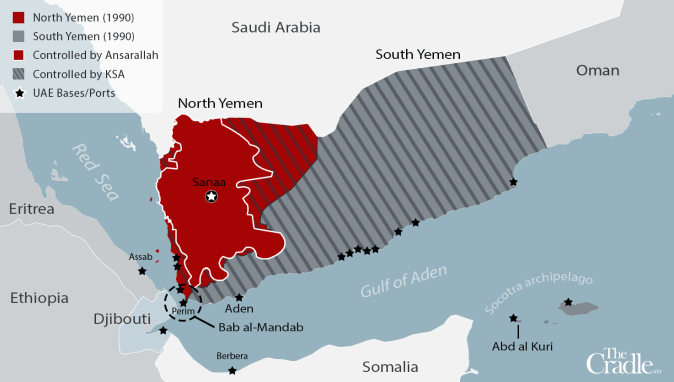
Map of the Emirati-controlled areas and ports in southern Yemen
The significance of Socotra
Socotra Island falls under the territorial jurisdiction of the exiled Hadi government, which to this day – despite his physical absence and the replacement of the “presidency” with an 8-member, Saudi-sponsored Presidential Leadership Council (PLC) – remains Yemen’s internationally-recognized government.
However, on 30 April, 2018, the UAE deployed hundreds of troops with artillery and armored vehicles on the island, which is located 350 km away from the mainland conflict, without any prior coordination with Yemeni authorities.
The Riyadh-backed Yemeni government condemned the Emirati aggression, backed by local islanders protesting against the occupation of their territory. The Saudis were forced to intervene by sending troops and training locals to deter the UAE from seizing the island.
But later that year, UAE General Khalfan al-Mazrouei arrived on Socotra Island and has since been considered its de facto ruler. Under his leadership, the Emiratis gained the loyalty of local tribes by using bribery under the guise of “humanitarian aid.” They offered Socotra residents UAE passports and promised them an improved quality of life.
The STC seizes Socotra
On the morning of 21 June, 2020, the UAE-backed STC separatists forcibly seized control of Socotra and ousted the Saudi-backed, pro-Hadi forces.
The UAE had been planning and preparing for this operation for two years, using its Yemeni proxies to gain full control over the Socotra archipelago. The Emirati flag was raised across the territory, and UAE telecommunication companies replaced Yemeni ones. Consequently, all phone calls from Socotra now register Emirati phone networks.
UAE-Israel normalization
Three months after the seizure of Socotra, the highly-controversial Abraham Accords was signed in Washington DC between Israel and the UAE, along with Bahrain, Morocco, and Sudan. On the Arab side, the normalization thrust was led by Abu Dhabi, which quickly moved to expand its diplomatic, military, and economic ties with Tel Aviv.
Shortly after the signing of the Abraham Accords, reports and images of Israeli “tourists” visiting Socotra began to emerge. According to an Al-Mayadeen report, however, the Israeli visitors were not tourists, but rather, military experts.
Abd al-Kuri Island
In February 2023, Ansarallah released a statement condemning the UAE’s eviction of residents from Abd al-Kuri, the archipelago’s second-largest island. The resistance movement accused Abu Dhabi of carrying out a long-planned operation to transform Socotra into an Israeli-Emirati military and intelligence hub.
These actions by the UAE are not isolated incidents. In another 2022 episode, Ansarallah accused Abu Dhabi of transferring fishermen from the small island of Perim (13 km2) to other parts of the Taiz Governorate. Several months later, satellite imagery revealed the construction of a military base runway on the volcanic Island. Perim is now empty of its original inhabitants, according to media reports.
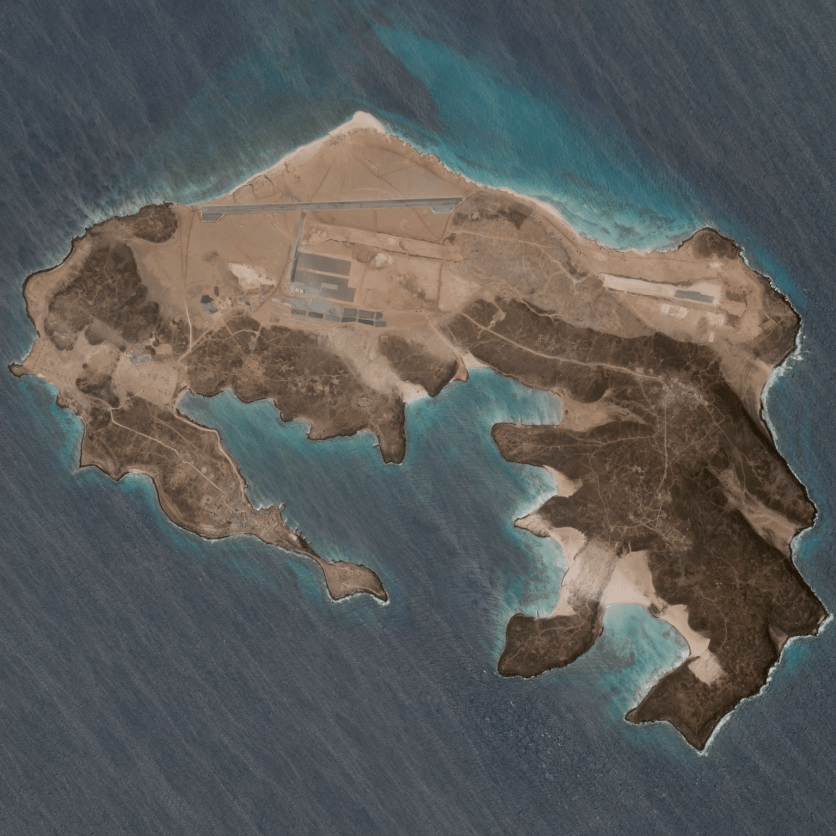
An Emirati military base on Perim Island (Mayyun in Arabic) on the Bab al-Mandab Strait
Perim Island has historically divided the Bab al-Mandab Strait into two waterways – whoever controls the island holds strategic influence over the strait. While Ansarallah’s statement about Emirati designs on Socotra was not entirely new, it raised hackles throughout the Arab world by confirming Israel’s military and intelligence presence on this key Yemeni island.
The UAE’s maritime ambitions
Many have questioned Abu Dhabi’s motivation for seizing Socotra and risking its relationships with Saudi Arabia and neighboring Oman (virtually overnight surrounded by UAE ports and bases). The UAE’s actions may be entirely attributed to the strategic vision of its President Mohammed bin Zayed (MbZ) and his no-longer secret desire to establish an Emirati maritime empire –from the Persian Gulf to the Red Sea – by controlling the region’s key waterways.
The UAE’s economic reliance on these waterways is a clear driver of MbZ’s plans: non-petroleum commodity re-exports make up almost half of Abu Dhabi’s total exports. As such, maritime security is a top priority in the country’s foreign policy calculations.
The UAE currently controls 12 ports off the coast of Yemen, including Aden, Makha, Mukalla, Al-Dabba, Bir Ali, Belhaf, Rudum, Zoubab, Al-Khawkhah, Al-Khouba, Qena, and Al-Nashima. The country is also building a new port in Al-Mahra that will cost an estimated $100 million.
By controlling these ports and the Bab al-Mandab Strait, the UAE can dominate one of the busiest shipping lanes in the world, elevating its position in global and regional trade to a strategic player.
In addition to its aggressive accumulation of Yemeni ports, the UAE also has a significant presence in the Horn of Africa, where it currently controls two ports in Eritrea and one in Somalia. It previously owned a port in Djibouti, but this became a point of territorial friction between the two countries. The UAE’s control over these ports and their strategic location in the region allow it to project its power and expand its influence in East Africa.
Why is Socotra important to Israel?
The UAE and Israel share mutual security concerns over Iran’s regional ascension over the past decade. The Islamic Republic’s naval presence is expanding into many new waterways, and its seaborne activities from the Persian Gulf to the Red Sea alarm both nations. Given Washington’s growing reluctance to engage its armed forces in West Asia, MbZ turned to the region’s military behemoth and main Iranian rival to help him execute his vision. Unlike Israel, no other regional state has the ability to garner unconditional US support – nor the willingness to cavalierly defy international law and territorial integrity.
Abu Dhabi has calculated that it stands to benefit from Israel’s intelligence network and early warning systems, particularly after its cities were subject to unprecedented Ansarallah missile and drone strikes in January 2022.
For Tel Aviv, its physical presence in any Arab state is perceived as a victory, which aligns with its ambitions for regional expansion. By establishing a base on Abd al-Kuri Island, Israel can reinforce its maritime security – around 25 percent of its trade passes through the Bab al-Mandab Strait. Another objective of the Israeli-Emirati military and intelligence hub could be to gather data or engage in espionage activities in the southern Arabian Peninsula and the Horn of Africa.
During the 1973 Arab-Israeli war, Yemen – in partnership with Egypt – blocked the passage of Israeli ships and tankers from accessing the strategic strait, leading to disastrous consequences for Israel.
The tactic could be replicated under Ansarallah Chief Abdel Malak al-Houthi’s leadership, since the movement considers Israel one of its main regional adversaries. While it may seem like a distant possibility, if the war concludes under current Riyadh-Sanaa peace efforts and Ansarallah gains control of Yemen’s south, the movement will enjoy unusual leverage to obstruct Israeli shipments whenever Tel Aviv launches regional aggressions. It should be noted that Ansarallah has already publicly threatened, on several occasions, to strike sensitive Israeli sites with its new missile capabilities.
Moreover, there has been an ongoing “ghost ship war” between Israel and Iran for several years, with occasional reports of Iranian or Israeli ships being attacked in these waterways. Israel’s presence on Socotra Island could provide it with leverage over Iran in their waterway stand-off and enable Tel Aviv to counter Ansarallah inside Yemeni territory.
NATO’s Combined Maritime Forces
It is important to note that the involvement of the US in the Israeli-Emirati collaboration and actions in Yemeni waters is not confirmed. However, it is true that the US has been a maritime security provider for the Persian Gulf monarchies for decades, and its NATO-led Combined Maritime Forces (CMF) have been present in West Asian waters since 1983 – including leading hostile actions against Iraq and Somalia.
The CMF alliance has assumed responsibility for the security of four bodies of water: The Red Sea, Persian Gulf, Arabian Sea, and the Gulf of Aden.
But with China’s rapid rise as a global economic competitor, US policy pivoted further eastward, and Washington has sought to subcontract out its West Asian security policies to its regional allies.
As such, last December, the CMF assigned command of its Red Sea task force to the Egyptian Navy, who took over from US naval forces. In this regard, the UAE, backed by Israel, may be another candidate to lead a NATO-backed naval security operation in the region.

Map of the NATO-led Combined Maritime Forces (CMF) areas of operation in West Asian waterways
Implications for Iran and Saudi Arabia
Any Israeli expansion is likely to alarm Iran and vice versa, potentially leading to direct or proxy clashes in various regional theaters. However, the presence of the UAE – Iran’s second-largest trading partner – in southern Yemen may limit Tehran’s options. Unless Iran perceives a serious security threat from the new “Arab-Israeli alliance,” it is unlikely to take any significant actions that could harm its trade relations with Abu Dhabi.
The war against Yemen has severely damaged Saudi Arabia’s image as a regional powerhouse. During the last few years, all major Saudi cities have been the subject of Ansarallah missile and drone strikes – including the country’s key oil infrastructure.
It has been humiliating for the Persian Gulf’s wealthiest and most heavily militarized state to have its vulnerabilities so completely exposed by West Asia’s poorest nation. In contrast, the UAE has thus far only benefited from the Yemen war and expanded its influence in the region.
Recently, there have been reports of a possible breakthrough in negotiations between Riyadh and Ansarallah, and observers are hoping for an early roadmap to end the conflict during the holy month of Ramadan. Obstacles are aplenty: The UAE is notably absent from the discussions, the Emirati-backed Yemeni separatists – the STC – reject any solution that doesn’t leave them in control of the south, and the US has sought to scuttle any final solution that undermines Washington’s regional leverage.
Liberating the island
Of all the stakeholders with interest in Socotra Island, none are ultimately as important as the Yemeni ones, primarily the UAE-backed STC, the Saudi-backed PLC, and Iran-backed Ansarallah.
In his most recent televised appearance, Ansarallah’s Abdel Malik al-Houthi stated: “We seek to defeat the aggression, whether on the islands, on land or at sea, and from anyone who violates our independence and the sovereignty of our country.” Unlike other leaders, al-Houthi’s threats are usually translated into action and Ansarallah will not hesitate to strike the Israeli-Emirati bases or seize their ships if the aggression continues.
Ansarallah is currently the strongest player in Yemen, controlling more than 80 percent of the country in terms of population density. On the other hand, the PLC is the most vulnerable of the three main Yemeni players, and Riyadh’s recent rapprochement agreement with Tehran has further weakened the group. If an agreement is reached between Riyadh and Sanaa, the PLC will have one of two options: to hand over their weapons or merge into Ansarallah’s armed forces.
On the other side of the spectrum, the UAE-backed STC is worried about ongoing peace talks and fears being left alone to fight head-to-head with Ansarallah-aligned armed forces.
The question now is whether there will be a peace deal between Saudi Arabia and Ansarallah that excludes the UAE and its Yemeni proxies. If that happens, Sanaa’s armed forces will almost certainly turn their big guns on the Emiratis and their Yemeni interests. The Saudis will have already calculated this outcome as they seek to advance a deal with Ansarallah. In this event, it is unlikely that Riyadh will come to Abu Dhabi’s assistance. Their common goals in Yemen ended years ago.
How does the China-brokered Saudi-Iranian normalization affect Israel?
By Robert Inlakesh | RT | March 17, 2023
A key goal of both the Israeli and American governments is to foster the normalization of ties between Israel and Saudi Arabia, and part of the strategy to make this happen was to unite the two against what has been depicted as a common enemy, Iran. The Saudi-Iranian rapprochement now appears to have thrown a spanner in the works of such efforts, and hence enraged the Israelis.
After five rounds of talks throughout the span of two years, Iran and Saudi Arabia were unable to reach a compromise for the re-establishment of diplomatic ties, something China has now managed to broker in a shocking turn of events. Based upon the long rivalry between Tehran and Riyadh, US and Israeli policy towards Saudi Arabia has been based on combating a common enemy shared between all sides. Although the US government itself has not reacted with open animosity to the sudden change in regional dynamics, the Israelis are publicly interpreting this as a negative development.
In June 2022, the Wall Street Journal reported that a previously undisclosed meeting had taken place in Sharm el-Sheikh, Egypt, whereby a number of Arab nations, including Saudi Arabia, had met with the Israeli military chief of staff at the time, Aviv Kochavi. Part of the discussions that took place was allegedly geared towards forming an Israeli-Arab defense alliance. Although no such alliance was formed, it was largely speculated at the time that US President Joe Biden’s visit to both Israel and Saudi Arabia the following month would include discussions on this topic. Despite the failure of the US and Israel so far to put together such an alliance, it is clear that part of the strategy for achieving normalization has been to secure defense interests.
Across the Israeli political spectrum, from both the coalition government and opposition, finger pointing has been taking place, in attempts to pin the blame for the perceived failure of Israel to prevent Saudi-Iranian normalization. Israeli Prime Minister Benjamin Netanyahu has attempted to shift the blame onto the former government, an idea refuted by former Israeli Mossad head Efraim Halevy as “factually incorrect.” On the other hand, former Israeli PM Naftali Bennett has called the agreement “a serious and dangerous development for Israel.” Yair Lapid, another former PM and current leader of the opposition, also said it is an “utter and dangerous failure of the Israeli government’s foreign policy.”
The big question now is whether the Chinese-brokered normalization agreement will negatively impact potential normalization between Israel and Saudi Arabia. Reuters reported that, according to an unnamed senior Israeli official, the Saudi-Iranian deal will have no significant impact on Israeli-Saudi relations. It is also not clear whether the agreement has any clauses to do with Israeli normalization. According to Carmiel Arbit from the Washington-based Atlantic Council, the Saudis could be attempting to conduct a balancing act the way the United Arab Emirates has. The UAE, which signed its own normalization deal with Israel in 2020, has since 2019 managed to de-escalate tensions with Iran and is currently maintaining cordial ties with both sides.
It is not clear, however, whether the model of Abu Dhabi will be applicable for the Saudis. Riyadh, simply put, has a lot more to lose than the Emiratis, due to its wide regional entanglements and domestic constraints, and hence it has chosen to maintain a distance from the Israelis at this time. The internal political crisis in Tel Aviv may also play a crucial role in the Saudi decision to push forward with the normalization of ties with Iran, as instability within Israel, coupled with a potential escalation in the conflict with the Palestinian people, could severely hinder a formal diplomatic breakthrough.
One crucial result of Saudi-Iranian normalization, however, is not necessarily to do with Israel’s own relations with the Saudis. Combating Iran, specifically its nuclear program through coercive measures, is an active policy position on both sides of the political divide in Israel. Netanyahu placed the issue of combating Iran, even through direct force, at the forefront of his campaign to win the election late last year. Throughout the past unity coalition of Bennett and Lapid, the anti-Iran position also proved a cornerstone of Israeli regional policy.
Performing aggressive actions, such as a direct attack against Iranian nuclear facilities, could now be much more difficult for the Israelis to pull off, with Saudi Arabia taking a non-combative approach to Iran. Although the nuclear issue is perhaps the most pervasive issue for the Israeli public, Iran’s regional alliances and defense programs are the true threats posed to Israel. If Saudi-Iranian ties are able to flourish and the Chinese-brokered deal holds, this could mean that Riyadh’s efforts in Lebanon against Hezbollah could be curtailed, and this surely represents a concern for Israel.
Iran, through its relationships with regional political parties, governments, and localized militia forces, also possesses the ability to pull strings that could benefit Saudi Arabia if it reciprocates by doing the same. This is especially the case when it comes to the conflict in Yemen. One thing that Ansarallah, also known as the Houthis, have been able to prove in their efforts against the Saudi-led coalition since 2015 when the war began, is that they are capable of overcoming US-made defense equipment. Iran, as a close ally of Ansarallah, could aid in setting up a long-term truce or even lasting peace, which the likes of the US simply cannot offer. To end this war would be in the security interests of the Saudis, who will undoubtedly suffer if the violence resumes, especially if missiles and drones begin striking their vital infrastructure again.
Just as Beijing proved capable of fostering Saudi-Iranian normalization, Tehran could offer the ability to properly negotiate a peaceful solution in Yemen. However, it is simply too early to tell whether such a development will take place. What the deal undoubtedly does is prove the weakness in Israel’s regional capabilities, along with the waning influence of the US. Israel’s security concerns regarding Syria and Lebanon may be heightened if the Chinese-brokered agreement delivers a more peaceful approach inside both of these nations. Saudi Arabia could also re-establish ties with the Syrian government, as the UAE has already done, which could help Damascus on the road to recovery from its brutal war and current state of economic ruin. A strong and united Syria could in the future also pose a strategic threat to Israel. While Saudi-Israeli normalization is by no means off the table, the Saudi-Iranian agreement could pose a serious challenge regionally for Israel’s current policy approach.
Robert Inlakesh is a political analyst, journalist and documentary filmmaker currently based in London, UK. He has reported from and lived in the Palestinian territories and currently works with Quds News.
Yemen condemns Israeli, Emirati eviction of Socotra island residents

The Cradle | February 24, 2023
The Ministry of Fishing in Yemen’s National Salvation Government in Sanaa has strongly condemned the UAE’s eviction of residents from the Abd al-Kuri Island of the Socotra archipelago off the Yemeni coast, which Abu Dhabi has been carrying out as part of its long-active plan of transforming Socotra into an Israeli-Emirati military and intelligence hub.
The ministry strongly condemned “the forced displacement of fishermen and residents of the island, and [their forced eviction towards the coastal town of] Hadiboh,” a 22 February statement read.
The statement added that the displacement of the island’s residents and fishermen represents a “flagrant violation” of Yemen’s sovereignty, as well as a threat to navigation and the residents of nearby islands.
The ministry also highlighted the “geostrategic importance of Abd al-Kuri Island” and demanded that the UN Security Council call for an immediate cessation of the UAE’s forced eviction of the island’s residents.

According to the Yemeni statement, these forced evictions follow the recent arrival of Israeli officers to Socotra and the construction of new barracks and military facilities on Abd al-Kuri Island.
This is confirmed by Yemeni journalist and activist Anis Mansour, who on 20 February strongly condemned the “bringing in of Israeli and Emirati forces to the island without the knowledge of the leadership or authorities, in a blatant challenge to Yemeni dignity and sovereignty.”
Mansour said that “the invading forces began to expel the Yemeni local armed tribes from the island, and the residents present there are also being expelled to the Qusa’ir area.”
Mansour also claimed that the Saudi-led coalition plans to ‘secure housing’ in Hadhramaut for about 1,000 fishermen from the island in order to limit the island to the presence of Emirati-Israeli military and intelligence officials only.
Israel is interested in the strategic archipelago because it serves as a potential flashpoint for a confrontation with Iran. In 2020, the Washington Institute published an analysis examining how Israeli submarines could potentially strike the Islamic Republic from positions near Yemen.

An Israeli tourist stands on a hilltop in Yemen’s Socotra Island. January 2022. (Photo credit: Twitter)
In January 2022, Socotra made headlines due to controversial photos of Israeli tourists who had visited the islands under a UAE-issued visa.
Yemeni officials assess damage to ancient sites bombed by Saudi-led coalition
The Cradle | February 20, 2023
The head of Yemen’s General Authority for Antiquities, Manuscripts, and Museums, Dr. Obbad bin Ali Al-Hayyal, visited several historical and archeological sites in the provinces of Marib and Jawf on 18 February to assess the damages caused to them by the Saudi-led coalition airstrikes, SABA news agency reported.
Hayyal and his team visited the ancient city of Baraqish in Marib’s Mazjar district, the Rusf Temple in Al-Jawf, and several other archeological sites.
According to SABA, they received briefings from local authorities on the damages to ancient columns, inscriptions, and structures due to “Saudi and Emirati warplanes,” as well as the “looting and theft” of antiquities and artifacts by coalition forces from museums across the country.
During the visit, Hayyal stressed the importance of “integrating official and popular efforts” to protect these sites from ‘vandalism and looting.’
Since the start of the Saudi-led war against Yemen in 2015, coalition airstrikes have posed a significant threat to the country’s archeological sites and historical monuments.
In May 2015, coalition airstrikes struck the ancient Sabaean ruins of the Great Marib Dam, which date back to the seventh century BC.
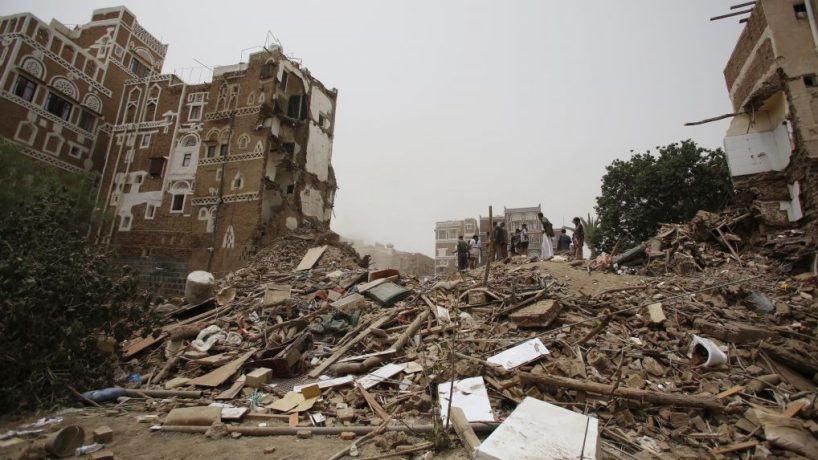
That year, the Saudi-led coalition bombarded the ruins of the ancient city of Baraqish, several ancient temples, and an entire museum filled with countless precious artifacts – which was “reduced to piles of shattered stone,” according to a 2015 report by US media outlet The Intercept.
The Saudi-led bombing also decimated sections of the capital Sanaa’s Old City, which is listed as a UNESCO World Heritage site and dates back 2,500 years.
Several ancient buildings and structures have since collapsed from weakened foundations. Until October 2019, over 237 archeological sites had been directly targeted by the coalition in what has been described as a systematic campaign aimed at deliberately erasing Yemeni culture and history.
Aside from bombing, several ancient sites and museums have been looted and stripped of valuable artifacts by UAE-backed mercenary groups, whose ranks are filled with ISIS and Al-Qaeda militants.
In 2019, a member of Yemen’s Supreme Political Council, Mohammad Ali al-Houthi, said about UAE-backed groups: “The mercenaries are antiquity thieves. Where did the antiquities of the Marib Museum go? … Where are the monuments from the rest of the museums in the occupied governorates? … The mercenaries are committing historical, social, and cultural crimes.”
Saudi Arabia is well-known for its destruction of heritage, particularly within its borders, where many of the ancient cities, towns, and sites dating back to the birth of Islam have been wiped out as part of a campaign motivated by the kingdom’s Wahhabi ideology.
Sanction failures piling up
Free West Media | February 11, 2023
Western sanctions were supposed to “ruin” Russia not only economically, but also technologically – according to the well-known announcement by German Foreign Minister Annalena Baerbock.
The ban on supplying electronics was intended to paralyze the Russian armaments industry. But Western war planners appear to have gotten even the most basic facts wrong. As is now apparent, an “isolated” Russia has managed to circumvent US-imposed sanctions in the technology sector. What’s more, Russia is importing even more microchips and semiconductors than before the war.
Among other things, the US and the EU banned the supply of microchips and semiconductors to Russia, depriving them of “70 percent” of their imports. The most important companies in the sector, such as Intel, AMD, the Taiwanese chip giant TSMC and Nexperia from the Netherlands, stopped doing business in Russia almost overnight.
At the end of March, US President Biden confidently announced that Russia would no longer be “able to rebuild those devastating weapon systems” and was on its way back “to the 19th century” as a result of the Russian operation in Ukraine, while US Commerce Secretary Gina Raimondo stated: “We have reports from Ukrainians that when they find Russian military equipment on the ground, it’s filled with semiconductors that they took out of dishwashers and refrigerators”.
Raimondo spoke at a Senate hearing in May last year, noting that she had recently met with Ukraine’s prime minister. “Our approach was to deny Russia technology — technology that would cripple their ability to continue a military operation. And that is exactly what we are doing.”
And in September, the President of the EU Commission, Ursula von der Leyen, defiantly announced that Russia’s industry was in ruins. “The Russian military is taking chips from dishwashers and refrigerators to repair their military equipment because they are running out of semiconductors. Russian industry is in tatters,” she claimed in a speech in the European Parliament.
Total Western failure to predict outcomes
But the Russian armed forces never had to do that during the war, as is now evident. Referring to an official report, the weekly German newspaper Zeit reported that Western sanctions in no way reduced Russian imports of electronic components – on the contrary: Russia imported even more processors and semiconductors in 2022 than before the war. Overall, imports in this segment have increased from 1.8 billion euros to 2.45 billion euros.
Beyond that, Russian imports fell by just 16 percent on a yearly basis. This was also confirmed by US economist and sanctions advocate Matthew Klein. According to his calculations, Russian imports in November were only 15 percent below the monthly average for 2021. At the beginning of 2022, shortly after the Russian operation started, Western “experts” had expected a slump of at least 30 to 40 percent.
The fact that Russia was able to circumvent the sanctions is due to countries like China, Turkey or the United Arab Emirates, which quickly filled the gaps left by Western corporations. They also act as a location for Russian intermediaries who obtain Western technology from letterbox companies.
At the same time, Russians have been manufacturing their own goods to fill the gaps that have arisen as a result of sanctions and the withdrawal of western corporations.
IMF expects Russia’s economy to grow
Until recently the West doubted that Russia’s economy would survive under sanctions, but the International Monetary Fund (IMF) is now sounding more optimistic than even the Russian government. Known for its gloomy forecasts, The IMF has predicted that Russia’s GDP will expand this year.
By far the most important trading partner for Russia is China. Overall, imports from China rose by 13 percent in 2022. Many Western companies such as Apple or Ikea had supplied the Russian market before they withdrew. This decision to leave could be compensated for.
China’s companies now deliver the majority of new cars and smartphones, computers, but also heavy equipment such as construction machinery and trucks. In fact, exports of trucks from China more than tripled in 2022 while imports of construction equipment have doubled.
Most importantly from a Russian point of view, however, are the imports of microchips. Together with Hong Kong, China shipped $900 million worth of semiconductors to its neighbour in 2022, more than double than the figure for 2021.
‘Türkiye and UAE told to cut trade ties with Russia’
RT | February 3, 2023
US officials have warned Türkiye and the United Arab Emirates against maintaining economic and financial ties with Russia because trade is undermining sanctions, Bloomberg reported on Friday, citing people with knowledge of the matter.
The warnings were reportedly voiced by the undersecretary for terrorism and financial intelligence at the US Treasury, Brian Nelson, during meetings with Turkish officials on Thursday and Friday.
Nelson’s visit to Türkiye comes as part of a regional tour that included the UAE earlier this week, and is said to be aimed at discussing Washington’s concerns over rising exports to Russia that include US goods.
US officials have called on the two countries to clamp down on the flow of goods to Russia, the sources told the news agency, adding that millions of dollars’ worth of export-controlled items were reaching the sanctions-hit country, and could be used by the defense industry to extend the conflict in Ukraine.
Scores of Turkish exporters shipped over $800 million worth of goods to Russia, including $300 million in machinery and another $80 million in electronics in the eight months through October 2022, according to people who spoke on condition of anonymity.
Other areas of concern reportedly include Russian vessels either sanctioned or subject to export controls making port calls in Turkey.
Meanwhile, the UAE has maintained ties with both Ukraine and Russia. The Gulf state’s ruler, Mohammed bin Zayed Al Nahyan, traveled to meet Russian President Vladimir Putin in October amid the continuing conflict in Ukraine. The leaders expressed Moscow and Abu Dhabi’s willingness to develop cooperation on all levels.
US to pressure partners into enforcing anti-Russia sanctions
RT | January 28, 2023
The US Treasury Department’s top sanctions official will visit Türkiye and the United Arab Emirates next week to warn officials and businesses there that Washington will punish them if they dodge its sanctions on Russia, Reuters reported on Saturday.
Brian Nelson, the department’s undersecretary for terrorism and financial intelligence, will travel to Oman, the UAE, and Türkiye between Sunday and Friday. Meeting with government officials, businesses and financial institutions, Nelson will caution them that they could lose access to US markets “on account of doing business with sanctioned entities,” a Treasury spokesperson told the news agency.
US officials have repeatedly highlighted Türkiye as a potential hub of sanctions evasion, and unnamed Western officials told the Financial Times in August that they were “deeply concerned” about allegations of trade between Turkish firms and sanctioned Russian entities.
Ankara responded that it “would not allow the breaching of sanctions by any institution or person,” following a phone call in which US Deputy Treasury Secretary Wally Adeyemo seemingly threatened the “success of the Turkish economy” and “the integrity of its banking sector.”
The UAE has also received warnings from Washington, with Adeyemo urging the Emirates’ financial institutions last summer to be “exceedingly cautious” about doing business with other institutions connected to “the Russian financial system.” The Treasury spokesperson told Reuters that Nelson will condemn the UAE’s “poor sanctions compliance” during his visit.
In the last month, the US has sanctioned a prominent Turkish businessman over allegedly laundering money for Iran’s Islamic Revolutionary Guard Corps, and a UAE-based aviation firm over alleged sales to Russia’s Wagner private military corporation. Multiple Emirati companies have also been penalized for evading US sanctions on Iran.
Both Türkiye and the UAE voted at the UN General Assembly last year to condemn Russia’s military operation in Ukraine, but neither has imposed sanctions of their own on Moscow. Turkish President Recep Tayyip Erdogan has maintained close contact with his colleagues in both Kiev and Moscow, and said from the outset that his diplomatic handling of the conflict would be “balanced.”
With Türkiye and the US also at loggerheads over Ankara’s refusal to sign off on Finland’s and Sweden’s bids for NATO membership, Erdogan and Russian President Vladimir Putin last week affirmed their intent to “develop comprehensive cooperation,” including by increasing the supply of Russian gas to Türkiye.
Saudi Coalition forced to release detained Yemeni fuel ships
By Yusef Mawry – Press TV – December 25, 2022
Sana’a – Fuel prices have slightly dropped in Yemen after the release of two Yemeni fuel ships that were detained by the Saudi-led coalition earlier this week in the Red Sea.
The Yemeni army issued a stern warning to Saudi Arabia and the UAE that if the ships were not released soon, military action would follow.
Yemeni bus and motorbike drivers in the capital Sana’a who make a living from public transportation welcomed the lowering of fuel prices. They say this is going to help them cope with the fuel price hike caused by the blockade.
Yemeni political experts say the release of the fuel ships by the Saudi-led coalition isn’t enough, as Yemen will continue to struggle until Saudi Arabia and its allies completely lift the blockade and end their illegal involvement in Yemen.
Despite falling oil prices, tensions are rising on all active battlefronts in Yemen for what could soon be a resumption of war if a political solution is not reached soon, as Saudi Arabia and the UAE continue their militarization of strategic Yemeni Islands in the Red and Arabian sea.
The release of fuel ships detained by the Saudi-led coalition marks a big victory for the Yemeni government based in Sana’a and the people living in the areas controlled by Ansarullah. This also indicates that Saudi Arabia and the UAE simply cannot afford to have their oil industries targeted by Yemeni missiles and that’s why they decided to go with a safer option by releasing the fuel vessels.
Reneging on Abraham Accords, Netanyahu authorises ‘soft annexation’ of West Bank
MEMO | November 24, 2022
Israel’s designate Prime Minister, Benjamin Netanyahu, has been accused of breaking his agreement with Arab countries that normalised relations with the Occupation State during the current coalition negotiations. The Likud leader is reported to have agreed to move the civil administration in the West Bank from Israeli Ministry of Defence to the Ministry of Finance to appease far-right member of the Knesset, Bezalel Smotrich.
Religious Zionism will be handed the civil administration portfolio, according to Haaretz. The Ministry is hugely significant for Palestinians, as it oversees coordination of Israel’s activity in the Occupied West Bank. The agreement was reached as part of the ongoing coalition talks between Netanyahu’s Likud and Religious Zionism, which stalled once more after the parties failed to reach agreement on several other key issues.
Though details of the talks are yet to be disclosed, Likud is said to have acceded to Religious Zionism’s demand for some of the powers of the civil administration, which is under the Defence Ministry. The deal will mean that Smotrich, who is an advocate of Israel’s illegal settlement enterprise, will be handed power in approving Palestinian construction plans and settlement construction in Area C. Decisions around illegal outposts, illegal construction and work permits for Palestinians falls under the remit of the administration.
The biggest prize for Religious Zionism, which became the third largest party with 14 Knesset seats, is to seize control over affairs in the Occupied West Bank. Although past Israeli governments showed reluctance to annex the territory completely over concerns around backlash from the international community, Religious Zionism has no such fear.
Officials in Religious Zionism claimed, Wednesday, that the Party acceded to Netanyahu’s requests to forgo the defence portfolio in exchange for the Finance Ministry. The condition for the agreement is that the responsibility for settlements and the civil administration is transferred from the Ministry of Defence to the Ministry of Finance. Under International law, the West Bank is occupied, which means that the military of the occupying power oversees the territory.
Netanyahu has been accused of reneging on his deal with the Arab States by agreeing to the transfer of the civil administration. “Moving the civil administration in the West Bank from Israeli Ministry of Defence to the Ministry of Finance will be a ‘soft annexation’ of the WB & violation of the commitment Netanyahu gave the US & UAE to suspend his annexation plan,” said Israeli journalist, Barak Ravid on Twitter. “It could harm the Israel-UAE peace treaty,” Ravid added, referring to 2020 normalisation deal.
Referred to as the “Abraham Accords,” the UAE hailed the deal as victory for the two-state solution. Abu Dhabi defended its decision to normalise relations with the Occupation State by insisting that it had prevented Israel from annexing the West Bank, a threat which Netanyahu, who was the Prime Minister at the time, had issued.
It is not clear what steps the UAE will take in response. UAE Foreign Minister, Sheikh Abdullah bin Zayed (ABZ) raised his concerns over Religious Zionism becoming part of a coalition with Netanyahu, during a recent visit to Israel.
Featured Video

Jeffrey Epstein’s ‘one single cause’: Israel
or go to
Aletho News Archives – Video-Images
Book Excerpt
Leslie Wexner’s Inner Demon
BY WHITNEY WEBB |
UNLIMITED HANGOUT| JUNE 10, 2022
This short excerpt from Whitney Webb’s upcoming book “One Nation Under Blackmail” examines an obscure media profile of Leslie Wexner, Jeffrey Epstein’s mentor, from the 1980s that contains disconcerting revelations about Wexner’s personality and his inner world. … continue
Blog Roll
Recent Comments
Coronistan on Why can’t western leaders acce… John Edward Kendrick on German government ‘embezzling’… loongtip on Von der Leyen to have new secu… papasha408 on First Gaza, then the world: Th… papasha408 on Is Nixing Aid to Israel a Pois… papasha408 on Japan to Sign Up For NATO’s Uk… Redracam on Iran Willing to Dilute Enriche… loongtip on When Threats Replace Evid… loongtip on Zelensky tried to kill the cha… eddieb on I might get killed for posting… Bill Francis on I might get killed for posting… loongtip on Beijing cancels Panama deals a…


 Aletho News
- Why can’t western leaders accept that they have failed in Ukraine?
- German government ‘embezzling’ taxpayer money to fund Ukraine – veteran politician
- Russian Soldiers Tortured in Secret Ukrainian Prisons
- Tensions between Hungary and Ukraine could lead to a new regional conflict
- Russia preparing oil lifeline to Cuba – embassy
- Jeffrey Epstein’s ‘one single cause’: Israel
- Instagram suspends Track AIPAC, watchdog tracking pro-Israel lobby spending
- Nouri al-Maliki defends Hashd al-Shaabi as inseparable part of Iraqi security system
- First Gaza, then the world: The global danger of Israeli exceptionalism
- Iran received no concrete US proposal in Oman talks: Security chief
- If Americans Knew
- Jewish terrorism, apartheid rule the West Bank – Not a ceasefire Day 125
- Why Israel persecutes children like my son Shadi
- In Gaza, One Man Is Searching for the Remains of His Family With a Flour Sifter
- Horrific situation in Gaza, West Bank – Not a ceasefire Day 124
- Mysterious ‘peace’ groups are sending Americans pro-Israel texts
- Epstein files: Western media must stop burying the Israel connection
- Software developer exposes Israeli nonprofits’ massive spending to influence Americans
- Israel preparing for another, more intense Gaza offensive – Not a ceasefire Day 123
- Ronald Lauder’s son-in-law Kevin Warsh emerges as the next Fed chair
- A 14-year-old Palestinian Bled to Death for 45 Minutes as Israeli Soldiers Stood Nearby
- No Tricks Zone
- German Gas Crisis…Chancellor Merz Allegedly Bans Gas Debate Ahead of Elections!
- Pollen Reconstructions Show The Last Glacial’s Warming Events Were Global, 10x Greater Than Modern
- Germany’s Natural Gas Storage Level Dwindles To Just 28%… Increasingly Critical
- New Study Rebuts The Assumption That Anthropogenic CO2 Molecules Have ‘Special’ Properties
- Climate Scientist Who Predicted End Of “Heavy Frost And Snow” Now Refuses Media Inquiries
- Polar Bear Numbers Rising And Health Improving In Areas With The Most Rapid Sea Ice Decline
- One Reason Only For Germany’s Heating Gas Crisis: Its Hardcore-Dumbass Energy Policy
- 130 Years Later: The CO2 Greenhouse Effect Is Still Only An Imaginary-World Thought Experiment
- New Study Affirms Rising CO2’s Greening Impact Across India – A Region With No Net Warming In 75 Years
- Germany’s Natural Gas Crisis Escalates … One Storage Site Near Empty …Government Silent
 Aletho News