LIBOR: Viewing the Biggest Financial Crime in History
By DARWIN BOND-GRAHAM | CounterPunch | February 26, 2013
It’s been five years since a few academics and journalists began to dig up evidence that something was wrong with the London Inter-Bank Offered Rate, or LIBOR (pronounced appropriately as “lie-bore.”) The data that curious researchers were compiling couldn’t be explained using the prevailing definition of what LIBOR supposedly was: a trustworthy interest rate that accurately gauged the market price of borrowed US dollars held overseas by the world’s biggest banks. Instead, their findings pointed toward something other than an idealized neoliberal market, influenced only by impersonal supply and demand forces. Many began to realize that the data could easily be explained if the banks were rigging the LIBOR rate in their favor. Strange discrepancies in LIBOR’s correlation to other rates, and to the economic fundamentals of the bank companies responsible for formulating the rate, showed something seriously amiss, but it made sense if the banks were cheating.
The motives of the banks have been clear from the beginning. A few banks that dominate the marketplace for derivatives stand to make billions if LIBOR moves in their favor on particular days when contractual payments between them and their customers come due. They therefore suppressed the rates in order to skim billions of dollars off derivatives and investments. Later these same banks suppressed LIBOR rates to create the illusion that their balance sheets were robust during the financial crisis. This also allowed them further rounds of money-siphoning from their unwitting derivatives customers.
Until recently LIBOR rates have been set by a panel of banks that are members of the British Bankers Association (BBA). The BBA is a private industry group established almost 100 years ago to lobby for the financial industry in one of its global hubs, London. The BBA really came into power in the mid-1980s with the creation of LIBOR. LIBOR was created to further integrate the giant global money market in US dollars held in overseas banks or holding companies, and therefore unregulated by the US Federal Reserve. Called “Eurodollars,” because they originally were dollar savings accumulated in European banks, especially banks in London, these funds quickly became a de facto global currency. LIBOR began as a way for the banks to standardize investment products for these vast pools of American dollars flowing through Europe, and later Japan, the Middle East, and Latin America. By the 1990s LIBOR had become such an important set of interest rates, and US dollars held overseas had becomes such an important source of credit for US consumers, that LIBOR became the key global interest rate around which many financial products were pegged. As LIBOR became more and more important to the globalization of finance, it accrued a sort of official, trusty gloss; nearly everyone assumed that LIBOR was a market rate reflecting competition. Instead, LIBOR has probably all along been a fudged rate, determined less by vast market forces and invisible hands, and more by the vulgar self-interest and power of the elite banks that set LIBOR rates.
Last year government investigations into this globe-spanning crime —rightly called the biggest financial scam in all of history— led to multi-billion dollar fines against Barclays, the Royal Bank of Scotland, and UBS, the 7th, 8th, and 20th largest banks in the world, respectively. Criminal investigations spearheaded by US, UK, Japanese, Canadian, Swiss, and Singaporean authorities are ongoing and aimed at other banks such as Citigroup, JP Morgan, Bank of America, and other “too big to fail” institutions. More details of the crime will be forthcoming as e-mails, internal documents, phone tapes, text messages, and other evidence, is made public, and as the banks are forced to pay significant fines, and sign plea agreements.
While this scandal might seem worlds away, concerning complex financial concepts and obscure money market instruments dealt by bankers out of skyscraper offices in the City of London, the importance of uncovering the complete truth about the LIBOR rigging conspiracy cannot be overstated for local communities across the United States, especially here in California.
Why? First, LIBOR has been used since the 1990s to determine cash flows on interest rate swaps that local governments have purchased from banks to insure themselves against wild swings in variable interest rates owed on billions of municipal debt. Messing with LIBOR messes with the payments due on these instruments.
Second, LIBOR has also been used as a main interest rate of reference for an array of investment products that yield a variable return, dipping and rising in concert with LIBOR. Local and state governments have used these investment products, called “municipal derivatives reinvestment products” to temporarily park public funds, while pension systems and government enterprises like utilities use them make investments. Governments and public agencies earn LIBOR rate returns on their dollars invested in numerous kinds of municipal derivatives, so if LIBOR is illegally fixed downward, they earn less income.
Through both of these forms of exposure, local governments have potentially been harmed by LIBOR-fixing perpetrated by the banks, often times the very same banks that have sold them swaps or municipal derivatives investment products.
California is fast emerging as a center of investigation and litigation into the LIBOR-fixing conspiracy. California is the largest single municipal debt market in the United States, and one of the largest in the world. Last year alone the state of California and its cities, counties, school districts, and other public entities issued $65.7 billion in total public debt. Because of California’s regressive tax structure and chronic budget crises, the state’s multitude of governments have been among the most aggressive in issuing variable rate debt hedged with interest rate swaps.
The Golden State’s local governments have also been the largest purchasers of municipal derivatives contracts from banks because streams of tax and fee revenues often don’t match up with the dates that payments to public employees and contractors come due. Collusive suppression of LIBOR rates by the 16-member panel who were trusted to provide accurate quotes could mean that California local governments have paid untold millions to their interest rate swap counterparties (the banks) that should otherwise have remained in budgets and used to fund school construction, bus lines, street paving, water and sewerage services, etc.
In the 1990s and 2000s local governments across California increasingly issued bonds with variable rates. Investment bank underwriters and municipal debt advisers from the private sector encouraged variable rate bond financing because it promised lower interest rates for California’s cash-strapped municipalities. To hedge against the risk that variable rates might explode, as they did in the 1980s, the banks sold interest rate swaps to local governments. The swaps effectively converted floating rate debt into a fixed rate. Under a typical swap contract the bank seller agrees to pay a floating rate designed to mimic the variable rate interest on the bond debt, and in return the local government agrees to pay a fixed rate. I’ve written elsewhere about how this deal blew up and created a financial injustice when variable interest rates plummeted during and after the Financial Crisis, but the LIBOR rigging conspiracy adds to these harms. The US government bailed out the banks and assisted them in taking “toxic” derivatives assets off their hands, but stood idly by while cities, counties, and public agencies suffered without aid during the Financial Crisis, allowing derivatives instruments on the public’s books to blow up and drain budgets. At this very moment the banks perpetrated an illegal scam to suck even more money from the public via further depression of LIBOR.
Barclays, RBS, UBS, and other banks worked together to suppress LIBOR below even the depths to which it sank after 2008. A number of lawsuits filed by various cities, counties, and public agencies in California asserts the banks did this to skim off an unknown, but very large, amount of money from their public victims, and also to bolster their own balance sheets during the crisis. By suppressing LIBOR the banks ensured that the net difference between the variable rates they owed, and the fixed rates the public was paying on swaps, was wider than it would otherwise have been. This net difference meant that the public owed the banks higher amounts when the interest rate swap payments came due (usually twice a year).
For San Francisco this could mean that millions have been stolen from the capital budget of its Airport. SFO currently has seven interest rate swaps it has purchased to convert variable rate bond debt into synthetic fixed rates. The airport’s counterparties on its swaps included JP Morgan Chase, Merrill Lynch (owned by Bank of America), and Goldman Sachs. Each of these banks likely benefited from conspiratorial suppression of LIBOR, even if it was by just a few basis points (hundredths of a percent). JP Morgan Chase and Merrill’s parent Bank of America are both members of the panel that sets LIBOR, and are both believed to have played a role in the conspiracy.
San Francisco’s pension system may have also been raided by the banks through its speculative investments in swaps. According to the most recent audit of the San Francisco Retirement System’s portfolio, the city’s pension system holds two interest rate swaps on its books with a notional value of $15 million. In prior years, SFERs held other swaps. In 2010, the Retirement System’s audit showed three interest rate swaps with a total notional value of $41 million. Over the last two years these swaps drained $5.3 million from the pension system, and some of these losses might have been due to the downward manipulation of LIBOR. Also on the Retirement System’s books are other investments in bank loans, options, and other securities that might have been impacted by the LIBOR fraud.
San Francisco’s LIBOR damages are probably small in comparison to other local governments and public agencies. The East Bay Municipal Utility District has already filed a lawsuit in federal court alleging damages from bank rigging of LIBOR. The water district’s complaint, filed in January of 2013, alleges that LIBOR suppression drained potentially millions, again from interest rate swap agreements with some of the very banks that sit on the LIBOR-panel: Citibank, JP Morgan Chase, and Bank of America. East Bay MUD lists nine interest rate swaps potentially affected by LIBOR rigging in its lawsuit.
East Bay MUD’s swaps had a total notional amount of $481 million in 2012, according to the utility’s most recent financial report. Downward manipulation of LIBOR by just 10 to 50 basis points (1/10th to 1/2 of a percent) could have drained between $481,000 to $2,400,000 through East Bay MUD’s swap payments every six months. Over a few years, say the conspiracy’s 2007-2010 time-frame alleged in EBMUD’s lawsuit, this would add up to millions of dollars stolen by the banks.
The cities of Richmond, San Diego, and Riverside, and the County of San Mateo, are other California governments that have now filed lawsuits against the banks responsible for setting LIBOR. All of these lawsuits have been consolidated into a larger class action case currently being heard in the U.S. District Court, Southern District of New York, before Judge Naomi Buchwald. There are now about two dozen LIBOR manipulation lawsuits that have been filed and consolidated in New York. The lead case is the City of Baltimore and the New Britain Firefighters’ and Police Benefit Fund lawsuit against the 16-bank LIBOR panel, filed in April of 2012.
More California cities, counties, and public agencies are expected to file their own lawsuits soon, however. CalPERS, which has numerous investments that fluctuate in value and yield with LIBOR, is also said to be investigating its own exposure to rate rigging.
Darwin Bond-Graham is a sociologist and author who lives and works in Oakland, CA. He is a contributor to Hopeless: Barack Obama and the Politics of Illusion.
Related articles
- California Cities Sue Banks Over Libor Rates, Law Firm Says (bloomberg.com)
- Rabobank Faces Libor-Rigging Fine of $440 Million Plus (bloomberg.com)
- The Royal Bank of scot-free (morningstaronline.co.uk)
Predator Nation: How Financial Criminalization Crashed the Economy, and the Culprits Got Off Scot-Free
By Barry Ritholtz – June 4th, 2012
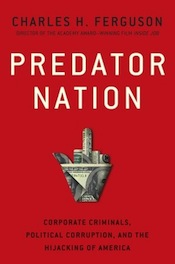 Charles H. Ferguson, the director of the Oscar-winning documentary Inside Job, now explains how a predator elite took over the country.
He exposes the networks of academic, financial, and political influence, in all recent administrations, that prepared the predators’ path to conquest.
Over the last several decades, the United States has undergone one of the most radical social and economic transformations in its history.
·Finance has become America’s dominant industry, while manufacturing, even for high technology industries, has nearly disappeared.
· The financial sector has become increasingly criminalized, with the widespread fraud that caused the housing bubble going completely unpunished.
· Federal tax collections as a share of GDP are at their lowest level in sixty years, with the wealthy and highly profitable corporations enjoying the greatest tax reductions.
· Most shockingly, the United States, so long the beacon of opportunity for the ambitious poor, has become one of the world’s most unequal and unfair societies.
Ferguson shows how from the Reagan administration forward, both major political parties have become captives of the moneyed elite.
It was the Clinton administration that dismantled the regulatory controls that protected the average citizen from avaricious financiers. It was the Bush team that destroyed the federal revenue base with its grotesquely skewed tax cuts for the rich. And it is the Obama White House that has allowed financial criminals to continue to operate unchecked, even after supposed “reforms” installed after the collapse of 2008.
Predator Nation: Corporate Criminals, Political Corruption, and the Hijacking of America
Excerpt:
It is no exaggeration to say that since the 1980s, much of the American (and global) financial sector has become criminalized, creating an industry culture that tolerates or even encourages systematic fraud. The behavior that caused the mortgage bubble and financial crisis was a natural outcome and continuation of this pattern, rather than some kind of economic accident.
It is important to understand that this behavior really is seriously criminal. We are not talking about neglecting some bureaucratic formality. We are talking about deliberate concealment of financial transactions that aided terrorism, nuclear weapons proliferation, and large-scale tax evasion; assisting in concealment of criminal assets and activities by others; and directly committing frauds that substantially worsened the worst financial bubbles and crises since the Depression.
None of this conduct was punished in any significant way. On November 7, 2011, the New York Times published an article (Wall Street’s Repeat Violations, Despite Repeated Promises) based on its own review of major banks’ settlements of SEC lawsuits since 1996. The Times’ analysis found fifty-one cases in which major banks had settled cases involving securities fraud, after having previously been caught violating the same law, and then promising the SEC not to do so again. The Times’ list, furthermore, covered only SEC securities fraud cases; it did not include any criminal cases, private lawsuits by victims, cases filed by state attorneys general, or any cases of bribery, money laundering, tax evasion, or illegal asset concealment — all areas in which the banks have numerous and major violations. In Predator Nation, I provide detailed, well-documented accounts of behavior ranging from assisting Enron’s frauds (Citigroup, Merrill Lynch), to fraudulently exploiting the Internet bubble (most of the major investment banks), to using for-profit colleges to exploit government student loan programs (Goldman Sachs), to assisting in money laundering and tax evasion on a large scale (at least eleven banks including UBS, Barclay’s, and Lloyds), to using bribery and artificially complex derivatives to destroy the finances of a county government (JP Morgan Chase), to profiting from Bernard Madoff even while strongly suspecting him to be a fraud (JP Morgan Chase, UBS).
Total fines for all these cases combined appear to be far less than 1 percent of financial sector profits and bonuses during the same period. There have been very few prosecutions and no criminal convictions of large U.S. financial institutions or their senior executives. Where individuals not linked to major banks have committed similar offenses, they have been treated far more harshly.
Given this background, it is difficult to avoid the conclusion that the mortgage bubble and financial crisis were facilitated not only by deregulation but also by the prior twenty years’ tolerance of large scale financial crime. First, the absence of prosecution gradually led to a deeply embedded cultural acceptance of unethical and criminal behavior in finance. And second, it generated a sense of personal impunity; bankers contemplating criminal actions were no longer deterred by threat of prosecution.
And just as the last twenty years of unpunished financial crime constituted a green light for the bubble, so, too, America’s non-response to the bubble and crisis is setting the tone for financial conduct in the future.
The Obama administration has rationalized its failure to prosecute any senior financial executives (literally, not a single one) for bubble-related crimes by saying that while much of Wall Street’s behavior was unwise or unethical, it wasn’t illegal. Here is President Obama at a White House press conference on October 6, 2011:
Well, first on the issue of prosecutions on Wall Street, one of the biggest problems about the collapse of Lehmans [sic] and the subsequent financial crisis and the whole subprime lending fiasco is that a lot of that stuff wasn’t necessarily illegal, it was just immoral or inappropriate or reckless….I think part of people’s frustrations, part of my frustration, was a lot of practices that should not have been allowed weren’t necessarily against the law.
The president and senior administration officials (such as Lanny Breuer, head of the Justice Department’s Criminal Division) have portrayed themselves as frustrated and hamstrung — desirous of punishing those responsible for the crisis, but unable to do so because their conduct wasn’t illegal, and/or the federal government lacks sufficient power to sanction them. With apologies for my vulgarity, this is complete horseshit.
When the federal government is really serious about something — preventing another 9/11, or pursuing major organized crime figures — it has many tools at its disposal and often uses them. There are wiretaps and electronic eavesdropping. There are special prosecutors, task forces, and grand juries. When Patty Hearst was kidnapped by the radical Symbionese Liberation Army in 1974, the FBI assigned hundreds of agents to the case.
In organized crime investigations, the FBI and federal prosecutors often start at the bottom in order to get to the top. They use the well established technique of nailing lower-level people and then offering them a deal if they inform on and/or testify about their superiors — whereupon the FBI nails their superiors, and does the same thing to them, until climbing to the top of the tree. There is also the technique of nailing people for what can be proven against them, even if it’s not the main offense. Al Capone was never convicted of bootlegging, large scale corruption, or murder; he was convicted of tax evasion.
In this spirit, here are a few observations about the ethics, legalities, and practicalities of prosecution related to the bubble:
First, much of the bubble was directly, massively criminal.
Second, if you really wanted to get these people, you could. Maybe not all of them, but certainly many. Some bubble-related violations are very clear, with strong written evidence, as my book Predator Nation demonstrates. And if you flipped enough people, some of them would undoubtedly have interesting things to say about what their senior management knew. In fact, there are many techniques, venues, organizations, regulations, and statutes, both civil and criminal, available to investigate these people, punish them, and recover the money they took — if you really wanted to. The federal government has used almost none of them.
Third, the moral argument for punishment is very strong, providing ample justification for erring on the side of aggressive legal pursuit. Whatever portion of banking conduct during the bubble was criminal, it was certainly substantial, and there is no doubt whatsoever that it was utterly, pervasively unethical, designed to defraud in reality if not in law. Since the crisis, the people who caused it have been anything but honest or contrite. They have been evasive, dishonest, and self-justifying, returning as quickly as possible to their unerringly selfish behavior. Their behavior caused enormous damage, both human and economic; the consequences of their wrongdoing are so large as to justify almost any action that could help to prevent another such crisis by creating real deterrence. There would also be intangible but large benefits to raising the general ethical standard of a vital industry, and one whose executives often become high-level government officials.
Given this background, let’s now consider the question of criminal liability, as well as the feasibility of prosecution.
J’Accuse
The list of prosecutable crimes committed during the bubble, the crisis, and aftermath period by financial services firms and senior executives includes: securities fraud (many forms); accounting fraud (many forms); honest services violations (mail fraud statute); bribery; perjury and making false statements to federal investigators; Sarbanes-Oxley violations (certifying accounting statements and financial controls); RICO offenses and criminal antitrust violations; Federal aid disclosure regulations (related to Federal Reserve loans); Personal conduct offenses (many forms: drugs, tax evasion, etc.).
In Predator Nation I consider each of these categories in detail, naming many names and providing many specific examples. But in considering only one category, securities fraud, we already face an embarrassment of riches.
Almost all the prospectuses and sales material on mortgage-backed securities sold from 2005 through 2007 were a compound of falsehoods. But it starts even earlier in the food chain. We also know that mortgage originators committed securities fraud when they misrepresented the characteristics of loan pools, and the nature and extent of their due diligence with regard to them, when they sold pools to securitizers (and accepted financing from them). Most or all of the securitizers (meaning nearly all the investment banks and major banking conglomerates) then committed securities fraud when they misrepresented the characteristics of the loans backing their CDOs, the characteristics of the resulting mortgage-backed securities, and the nature and results of their due diligence in the process of creating those securities. The securitizers also committed securities fraud when they made similar misrepresentations to the insurers of, and sellers of credit default swap (CDS) protection on, those securities.
The executives of both originators and securitizers then committed a separate form of securities fraud in their statements to investors and the public about their companies’ financial condition. They knew that they were engaging in a Ponzi-like fraud that would eventually need to end, and as the bubble peaked and started to collapse, they repeatedly lied about their companies’ financial condition. In some cases they also concealed other material information, such as the extent to which they, themselves, and/or other executives of their firms, were selling or hedging their own stock holdings because they knew that their firms were about to collapse.
Next, several investment banks committed securities fraud when they failed to disclose that they were selling securities that were designed to fail so that the investment banks, and/or their hedge fund clients, could profit by betting on their failure. The Hudson and Timberwolf synthetic CDOs sold by Goldman Sachs, and which were the focus of the Levin Senate subcommittee hearings, provide a very strong basis for prosecution. Goldman’s trading arm had been dragooned into finding and dumping their most dangerous assets to naive institutional investors. Important representations in the Hudson sales material–that assets were not sourced from Goldman’s own inventory — were lies, and they were material lies, since investors had learned to be wary of banks clearing out their own bad inventory. E-mail trails show that top executives closely tracked the garbage disposals and were gleeful at the unloading of the Timberwolf assets — as they should have been, for the assets were nearly worthless within months. There have been no prosecutions.
In some cases, we already have clear evidence of senior executive knowledge of and involvement in these frauds. For example, quarterly presentations to investors are nearly always made by the CEO or CFO of the firm; if lies were told in those presentations, or if material facts were omitted, the responsibility lies with senior management. In some other cases, such as Bear Stearns, we already have evidence from civil lawsuits that very senior executives were directly involved in constructing and selling securities whose prospectuses contained lies and omissions.
The list is long. In chapters three through six of Predator Nation, I survey the financial sector’s behavior during the bubble, and provide dozens of examples of major criminal behavior. Again, there have been no prosecutions.
Related articles
- Bankers Need To Face Consequences, Not Settlements (econmatters.com)
- Predator Nation by Charles Ferguson (ilene.typepad.com)
Obama’s Justice Department Rushes to the Rescue of LIBOR Criminals
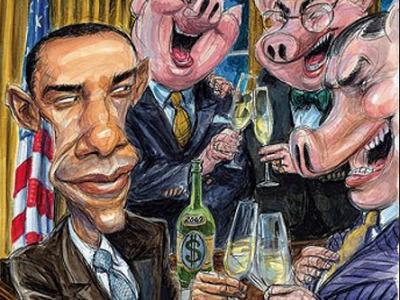
A Black Agenda Radio commentary by Glen Ford | July 18, 2012
The Obama Justice Department is in theater mode, again, pretending to threaten the bankster class with criminal penalties – prison time! – for their manipulation of the global economy’s benchmark interest rates. The Justice Department claims to be building criminal and civil cases in the LIBOR scandal, which in sheer scope is the biggest fraud by international capital in history. But that’s all a front, a farce. Barack Obama has spent his entire presidency protecting Wall Street, starting with his rescue of George Bush’s bank bailout bill after it’s initial defeat in Congress, in the last days of Obama’s candidacy. He packed his administration with banksters, passed his own bailout and, in collaboration with the Federal Reserve, channeled at least $16 trillion dollars into the accounts of U.S. and even European banks – by far the greatest transfer of capital in the history of the world. Obama has reminded the banksters that it was he who saved them from the “pitchforks” of an outraged public. He pushed through Congress so-called financial reform legislation that left derivatives – the deadly instruments of mass financial destruction that were at the heart of the meltdown – untouched.
Wall Street may or may not remain loyal to Obama, but Obama has been loyal to Wall Street, the guys who gave him the campaign cash to become a viable candidate. His Attorney General, Eric Holder, a corporate lawyer to the core, is busily staging a pre-emptive LIBOR prosecution of bankers in order to shield them from legal action by a host of other government agencies and, ultimately, from the global universe of parties that have been harmed by the bankster’s schemes– a list that stretches to infinity. Holder’s job is to monopolize the LIBOR case, to the extent legally and humanly possible, grabbing jurisdiction and consolidating the cases against the banks with the aim of reaching a settlement that does not further destabilize the financial system.
Holder and his boss already pulled that trick earlier this year with settlement of the bank “robo-signing” scandal – a scheme that would have ranked as the “crime of the century” until LIBOR came along. A small group of state attorney generals were holding up an administration-brokered settlement that effectively gave the banksters immunity from prosecution, in return for a measly $25 billion payout. Obama used every power of his office to pressure the state law officers into line. The last one capitulated with a promise from Obama that a “special unit of prosecutors” would expand the investigation into abusive mortgages practices. You haven’t heard a peep about it, since.
Now Obama and Holder are playing the same diversionary game, making tough noises about criminal investigations of the LIBOR conspirators. But the Justice Department has already given immunity to Barclay’s Bank, of Britain, and to the Swiss banking giant UBS. More immunities will follow. The reason Eric Holder is staging criminal investigations is because that’s the only way he can protect the bankers, through immunities and by gradually narrowing the scope of the case. In the end, there will be settlements all around, and the banksters will move on to even more fantastic heights of criminality – thanks to the loyal, protective hands of President Obama.
BAR executive editor Glen Ford can be contacted at Glen.Ford@BlackAgendaReport.com.
Related articles
- Richard (RJ) Eskow: Crooked Bankers Are Corrupting Government: The Real LIBOR Story (huffingtonpost.com)
Featured Video
Bombing Iran Back Into the Stone Age /Lt Col Daniel Davis & Jim Jatras
or go to
Aletho News Archives – Video-Images
From the Archives
The Occupied Mentality Syndrome
Saudi Arabia on the American chessboard – Part 2
By B. J. Sabri | American Herald Tribune | April 19, 2016
Since the Korean War, but particularly since the Iranian Revolution of 1979 until today, the United States has been steadily escalating its military presence in the Persian Gulf. Taking advantage of many colossal events of the past 36 years, [1] the hyper-empire has institutionalized its massive presence on land and sea, and expanded its objectives to include the unambiguous physical control of the area, as well as the clear understanding that local Arab governments should abide by them. The pretext is always the same: in “defense” of the national interests and security of the United States. From observing how the United States has been interacting with the governments of the region, and by judging from the size of its expeditionary force, we could reach a basic conclusion. The United States is occupying, de facto, the entire Arabian Peninsula. (Yemen, devastated by Saudi and American jets is yet to be conquered. Oman? Britain returned not as colonial ruler but as a soft occupying power.)
Under this articulation, Saudi Arabia, Qatar, Kuwait, and the United Arab Emirates are virtually occupied countries. If we compare this type of occupation to the mandate and protectorate regimes of the past, the results might be identical—the nations affected by it lose sovereignty. When Arab governments comply with the objectives of a foreign power that station military forces on their national milieu, then that power controls them in multiple ways including how they react to policy deliberations and what decisions they intend to take on specific issues. A good method to verify the concept of effective occupation is this: take notice of what the United States says and wants, and then compare it to what the gulf rulers do in response. (I shall discuss this detail at some point in the upcoming parts.)
If the presence of US forces or other means of political pressure are a factor in Saudi Arabia’s interventionist Arab wars, then we need to debate this issue. However, from the history of resistance to colonialism, we learnt: if a powerful state imposes its order on a nation by military means or other forms of coercion, and if this nation does not resist that imposition, then a mental subordination to the powerful state will ensue. This is especially true in the case of Saudi Arabia. One single event, 9/11, has transformed it from a US “ally” into an instant political hostage of the American Empire. … continue
Blog Roll
 Aletho News
- BREAKING: US JET SHOT DOWN OVER IRAN /Lt Col Daniel Davis & Nima Alkhorshid
- Now everyone is dumping US government bonds
- Brazilian Congressman seeks to bar Israeli military personnel from entering Brazil
- Official reveals evidence of Arab states’ involvement in US-Israeli war on Iran
- His Majesty’s head-chopper: Syria’s MI6-backed president bows to King Charles
- Forced to backtrack: ‘Israel’ drops Hezbollah disarmament goal
- Britain’s Lebanon surveillance network: A digital map for war
- Bahrain faces scrutiny for opposition crackdown after detainee killed
- Hegseth’s Pentagon Purge Designed to Prevent a Mutiny: Karen Kwiatkowski
- Greek shipping firms secretly transporting oil, weapons to Israel
- If Americans Knew
- Israel Is Blocking Palestinians from Easter at Church Where Jesus Resurrected
- Plot to assassinate Palestinian activist follows harassment campaign promoted by Zionist groups and elected officials
- Prominent New York synagogue hosts presentation on why U.S. Jews should support the ethnic cleansing of Gaza
- Tapper vs. Piker: Is the CNN Anchor Auditioning for David Ellison?
- Shouldn’t Democrats Be Able to Condemn Genocide?
- Israel-US kill negotiators, destroy civilian structures, but Iran’s military capabilities still largely intact – Daily Update
- ‘War crime’: Global condemnation as Israeli ministers celebrate death penalty law targeting Palestinian prisoners
- 7 Ways Israel Is Turning Lebanon Into Gaza
- World’s Leading Football Bodies Under Fire Over Israel Policies
- Experts warn of possible use of nukes against Iran
- No Tricks Zone
- Low Intensity Tornado Wrecks Major Solar Farm, Creating A Potential Toxic Dump
- New Study Finds Warming Saves Lives…Cold Temperatures 12 Times More Deadly Than Excess Heat
- German Science Blog Accuses PIK Climate Institute Of Hallucinating Climate Tipping Points
- Devastating Assessment Of Comirnaty Vaccine By Former Senior Pfizer Europe Toxicologist
- New Study: CO2 Is ‘Effectively Negligible’ As An Explanatory Climate Change Factor Since 2000
- Former Pfizer Toxicologist Dr. Helmut Sterz Tells Bundestag Hearing Pfizer Vaccine Should Have Never Been Approved
- Energy Expert: Germany’s Nuclear Phaseout Was A “500 Billion Euro Mistake”
- New Research: South Australia’s Mid-Holocene Sea Surface Temperatures Were 4°C Warmer Than Today
- Storing Green Energy To Last Germany 10 Days Would Require A 60-Million Tonne Battery
- New Studies: UK Sea Levels Were 4 Meters Higher Than Today During The Mid-Holocene
 Aletho News