How UK Regulator Ofcom Quietly Bypassed International Law to Police American Speech
A UK regulator bypassed every formal legal treaty and just emailed American companies into compliance, 98% of them apparently obliged
By Dan Frieth | Reclaim The Net | April 9, 2026
A Freedom of Information response has confirmed what the UK’s speech regulator would probably have preferred to keep quiet. Ofcom fired off 197 information demands to American tech companies under the Online Safety Act, and not a single one went through the US-UK Mutual Legal Assistance Treaty, the formal diplomatic process that exists for exactly this kind of cross-border legal enforcement. Every one of those 197 notices was sent directly, by email or post, to companies operating entirely on American soil.
The number comes from a FOI request filed by Daniel Lü, who asked Ofcom a series of pointed questions about how it enforces the Online Safety Act against non-UK targets.
Ofcom confirmed that as of February 26, 2026, it had issued 197 Section 100 notices to US businesses. Zero through MLAT. The treaty between the US and UK that governs how one country’s legal process gets enforced in the other’s jurisdiction was treated as optional. Ofcom decided it didn’t apply.
That admission drew an immediate response from Preston Byrne, the American lawyer who represents 4chan and other US companies targeted by Ofcom.
Byrne called the 197 notices a “breathtaking” “attack on the First Amendment” and pointed out the uncomfortable math.
Only two US companies, 4chan and Kiwi Farms, have publicly refused to comply with Ofcom’s demands. If Byrne’s assessment is right, that leaves Ofcom enjoying “a 98% compliance rate with foreign censorship orders that violate the First Amendment.”
A British regulator sent nearly 200 demands to American companies, bypassed every established legal channel, and almost all of them appear to have simply done what they were told. The chilling effect is already here.
Ofcom Uses Free Speech to Hide Its Censorship Methods
Lü did more than ask for the number of notices. He asked for policy documents about how Ofcom selects its foreign enforcement targets, what guidance it gives its teams about the legality of emailing criminal penalty warnings to US corporations, and whether Ofcom has any internal guidance on protected speech.
Ofcom admitted it holds much of that information. Then it refused to hand it over. The reason, cited directly from the FOI Act, was that disclosure “would, or would be likely to, inhibit the free and frank exchange of views for the purposes of deliberation; and/or would otherwise prejudice, or would be likely otherwise to prejudice, the effective conduct of public affairs.”
A speech regulator is claiming that transparency about its censorship operations would damage free and frank deliberation. Ofcom is borrowing the language of free expression to shield itself from accountability over how it suppresses expression. The irony is so complete it feels deliberate.
On the question of whether Ofcom holds any guidance on protected speech, the answer was even more revealing. Ofcom said it doesn’t have any. No internal documents addressing what speech is protected when it exercises its enforcement powers against foreign companies.
It pointed instead to its general obligations under the Online Safety Act, the Communications Act 2003, and the European Convention on Human Rights, along with links to already-public guidance documents. That’s the speech protection regime for companies being censored by the UK from American soil: a few hyperlinks to existing publications.
The MLAT Problem Isn’t New. It’s Getting Worse.
The treaty issue is central. MLAT exists so that when one country wants to enforce its laws against people or companies in another country, there’s a formal process involving both governments. For the US side, that means routing through the Department of Justice. A judge gets involved. There’s oversight. There are procedural protections.
Ofcom has previously argued it doesn’t need to use MLAT because its Section 100 notices are administrative, not criminal. That distinction might satisfy Ofcom’s lawyers in London, but it doesn’t satisfy anyone else. Byrne and his clients have argued in federal court that Ofcom’s demands have no legal force precisely because they skipped the treaty process. 4chan and Kiwi Farms received their enforcement demands by email, sent to addresses that in some cases weren’t even authorized to accept legal service.
The Lü FOI also asked whether Ofcom holds any correspondence with the US Department of Justice or the FBI about its enforcement activity. Ofcom’s response: it holds no information related to this question. The regulator didn’t talk to anyone in the US government before firing off 197 demands to US companies. It just hit send.
What the FOI Actually Revealed, and What Ofcom Hid
Lü’s request covered six questions. The pattern in Ofcom’s responses tells its own story. On the questions where Ofcom could respond by linking to documents that are already public, it was happy to share. On everything else, it cited exemptions, claimed it didn’t hold the information, or both.
When asked for policy documents about enforcing the OSA against non-UK providers, including any records discussing MLAT, Ofcom said it holds some information but won’t release it. It also claimed it holds no records of MLAT discussions or legal guidance about whether emailing criminal penalty warnings to American corporations is valid. Either Ofcom never considered whether its enforcement method was legal under international law, or it did consider it and doesn’t want anyone to see that analysis.
When asked how it selects non-UK enforcement targets, Ofcom cited exemptions under the Communications Act 2003 and linked to its public enforcement guidance, plus its own decisions against 4chan and other US entities. The internal criteria, the actual decision-making process for choosing which American companies to go after, stayed hidden.
When asked about its approach to “qualifying worldwide revenue,” the basis for calculating fines that can reach £18 million or 10% of global revenue, Ofcom linked to its public guidance explaining that companies are expected to self-report their revenue to Ofcom. Companies that Ofcom is threatening with fines are supposed to voluntarily tell Ofcom how much money they make, so that Ofcom can calculate a bigger fine. The compliance incentives here are about as perverse as they get.
Byrne Goes to Congress
Byrne said he forwarded Ofcom’s admission directly to the US government. He tagged US Under Secretary of State for Public Diplomacy Sarah Rogers, Senator Eric Schmitt, and House Judiciary Committee Chairman Jim Jordan, and called on Congress to act. This is consistent with Byrne’s approach throughout the Ofcom fight. He has previously said he copies the US government on Ofcom correspondence that crosses his desk.
The legal strategy from the US side has been to deny Ofcom any clean precedent. The four companies that received formal enforcement action, 4chan, Kiwi Farms, a mental health forum called SaSu, and the social network Gab, all refused to comply. 4chan responded to one of Ofcom’s fines with a picture of a hamster. The point was to make Ofcom’s orders publicly and visibly unenforceable on American soil, turning each attempted punishment into a political liability for the regulator rather than a deterrent for the rest of the American internet.
But the 197 number changes the scale of the problem. Those four companies were the public-facing enforcement targets, the ones Ofcom wanted to make examples of. Behind them, 193 other US companies apparently received quieter demands and, if Byrne’s analysis is correct, most of them complied without a fight. Without lawyers, without publicity, without anyone in Congress knowing it happened.
Byrne has pushed the GRANITE Act, a proposed law that would allow US entities to sue foreign governments for censorship attempts and void foreign censorship orders in US courts. Sarah Rogers, the US Under Secretary of State for Public Diplomacy, has appeared on GB News in London suggesting Congress is considering a federal version of the law. The Trump administration has made public statements objecting to the Online Safety Act. The US State Department sent diplomats to London in 2025 to challenge Ofcom directly.
Whether all of that translates into legislation remains an open question. Ofcom, for its part, has already moved on to bigger targets. After spending a year trying to fine platforms like 4chan and getting nowhere, the regulator recently opened new investigations into Facebook, Instagram, Snapchat, TikTok, YouTube, Roblox, and X. The small companies held the line. The question now is whether the large ones will too, or whether they’ll decide that complying with a foreign regulator’s censorship demands is easier than asserting their constitutional rights.
Europe’s quiet role in the war on Iran
By Leila Nezirevic | Al Mayadeen | April 8, 2026
European leaders have responded to the war on Iran with a familiar language: calls for restraint, appeals to diplomacy, and renewed commitments to international law. From Brussels to Berlin, the language has been measured, even cautious. Yet the gap between what Europe says and what it does has rarely been so stark.
While European governments publicly distance themselves from escalation, their infrastructure, alliances, and policies continue to sustain the very war effort they claim to oppose. Military bases, logistical networks, and intelligence frameworks tied to NATO remain fully operational.
Arms flows continue. Political backing, though often indirect, is unmistakable.
This contradiction is not simply a matter of hypocrisy. It reveals something deeper about Europe’s position in the global order, one defined less by autonomy than by structural dependence on the United States. The war on Iran is not creating this reality; it is exposing it.
NATO alignment
At the core of Europe’s constrained position lies its long-standing transatlantic alliance membership. NATO has, for decades, provided the framework for European security. But it has also shaped Europe’s foreign policy, narrowing the space for independent action.
For Vijay Prashad, historian and executive director of the Tricontinental: Institute for Social Research this relationship explains the apparent contradiction between Europe’s rhetoric and its behavior.
“Well, that contradiction is at the heart of the arrangement across the Atlantic, where European countries have, in a sense, surrendered their foreign policy to the United States through their attachment to NATO. In a sense, NATO shapes the foreign policy of Europe for the most part, and Europe doesn’t really have much independence to chart its own foreign policy direction.”
This is not merely a matter of political choice in any given moment. It reflects a deeper institutional reality. Europe’s security, intelligence, and military systems are deeply intertwined with those of the United States.
In moments of crisis, divergence becomes not only politically costly, but structurally difficult. “So regardless of the statements made from European capitals, when push comes to shove, the Europeans are right there alongside the United States, ” he told Al Mayadeen English.
From passivity to complicity
A central question raised by the war is whether Europe is a passive observer or an active participant. The answer, increasingly, points toward the latter.
“Europe is providing various forms of assistance—direct assistance—to the Israelis and the United States, including the use of the British base in Cyprus, which is basically a NATO base. So complicity goes to the heart of the NATO world.”
This involvement may not always take the form of direct military engagement, but it is nonetheless material. The use of European territory for operations, the maintenance of supply chains, and the continuation of arms transfers all contribute to the functioning of the war effort.
Prashad situates this within a longer historical trajectory:
“Europe has had a very ugly relationship with Iran over the course of the 20th century. It was European countries that conducted the coup in 1953 that brought in the Shah of Iran, whose very brutal reign lasted from 1953 to 1979. It was West Germany that provided chemical weapons to Iraq to use against the new Islamic Republic between 1980 and 1988. Other European countries also armed Saddam Hussein to conduct an ugly war against the Iranian people.”
This history is not incidental. It shapes how Europe is perceived in Tehran and across the region. More importantly, it underscores that Europe’s current role is part of a longer continuum of intervention, alignment, and strategic calculation.
Colonial standard
Europe has long cultivated an image of itself as a defender of international law. Its institutions and diplomatic traditions are frequently presented as pillars of a rules-based global order. The war on Iran, however, has exposed the fragility of this claim.
“If Europeans want to have a meaningful foreign policy, I would like to see it… Where is the condemnation from European capitals? Not one capital has clearly condemned this war of aggression. It is quite striking.”
The comparison with other conflicts is unavoidable.
“There was immediate outrage over the Russian entry into Ukraine, but the Israeli bombing, including the killing of civilians, including 180 schoolchildren on the very first day of the bombardment, none of that elicited complete condemnation on the grounds of international law.”
This inconsistency has consequences. It undermines Europe’s credibility not only in West Asia, but globally.
“Europe’s claim to being a defender of international law has been deeply undermined. One could say it was already severely damaged in the context of Gaza, and in this situation with Iran, that claim is further weakened.”
For Prashad, the issue is not a double standard, but something more systemic:
“In fact, I would say Europe doesn’t have a double standard, it has a single standard. And that standard is what I would call a colonial standard.”
Economic blowback and strategic self-harm
Even as Europe aligns politically with US strategy, it is increasingly bearing the economic costs of that alignment. The war on Iran threatens to further disrupt the Strait of Hormuz, a critical artery for global energy supplies. Any escalation risks driving up oil prices, intensifying inflation, and pushing already fragile European economies toward recession.
Yet, as Prashad notes, Europe’s vulnerability is not new: it is the result of a series of strategic decisions over the past two decades.
“Over at least the last 20 years, Europe has conducted what could be described as a kind of energy self-sabotage,” said Prashad, who is also an author of 40 books, including Washington Bullets.
He traces this trajectory through successive ruptures:
“By participating in US sanctions against Iran, Europe effectively removed one of its principal oil suppliers from its energy mix. Then, following the war in Libya, another major source of energy was destabilized. And later, through the deterioration of relations with Russia, Europe reduced its access to Russian oil and natural gas.”
The cumulative effect has been to push Europe toward more expensive and less stable energy sources.
“As a result, it has had to rely more heavily on liquefied natural gas and other imports, often at higher cost.”
These decisions were not taken in isolation. They were embedded in a broader geopolitical alignment, one that prioritized strategic cohesion with the United States over economic pragmatism.
The limits of independence
Europe’s predicament raises a broader question: to what extent can it act independently in a world defined by great power competition?
“Europe has the space to make its own decisions. But you don’t very often see Europe crossing the United States.”
There have been moments of divergence like Germany’s refusal to join the Iraq War in 2003, but these remain exceptions rather than the rule.
More often, alignment prevails. And this alignment is not only institutional, but ideological.
“There is an underlying cultural arrogance that runs, as I put it, like an undersea cable between the United States, Canada, and Europe.
“Despite the fact that there are different institutions… this underlying cultural alignment brings them together and effectively whips them into a common political position.”
Following a strategy it does not control
The risks of this dependence are becoming increasingly apparent. The war on Iran is unfolding along a trajectory largely shaped by the United States and Israel.
Europe, by contrast, finds itself reacting rather than shaping outcomes.
“Europe needs to reflect very seriously on the fact that the United States and Israel have basically reached very high levels on the escalation ladder, and yet it seems that Iran is not going to fold.”
If the conflict fails to achieve its objectives, or if Iran emerges politically strengthened, Europe may find itself strategically exposed.
“Iran has, in fact, secured a kind of political victory. So, what does that mean for Europe, which has followed the United States into sanctions policies that have also hurt European economies?”
Europe was once a major customer of Iranian oil and natural gas, and that relationship was cut off—not primarily by Europe’s own initiative, but through alignment with US policy.
Sovereignty in question
The effect of these dynamics is to cast doubt on the very idea of European sovereignty in foreign policy.
“If Europeans want to have a meaningful foreign policy, I would like to see it.”
Europe possesses the institutions, the economic weight, and the diplomatic capacity to act independently. But in practice, those capabilities are constrained by structural, political, and ideological factors.
The result is a form of sovereignty that exists more in theory than in practice, invoked in speeches but rarely exercised in moments of crisis.
War beyond the battlefield
The final outcome of the war on Iran will not be determined solely by military means.
“Outcomes in war are not only determined militarily, they are also political. It is possible for a country to have overwhelming military power and still not achieve its political objectives.”
For Europe, the implications are profound. By aligning itself with a war whose outcome it can neither control nor guarantee, it risks deepening both its dependence on the United States and its vulnerability.
In fact, the war on Iran is revealing Europe’s role in the world.
This is a continent that speaks the language of international law, yet applies it selectively.
A political bloc that calls for diplomacy, yet remains embedded in military escalation. An economic power that bears the costs of conflict, yet struggles to shape its course.
The contradiction is no longer subtle. It is structural. And in the war on Iran, it is fully exposed.
Leila Nezirevic is a London-based journalist and documentary filmmaker with extensive experience in reporting for major media outlets, with her work being published by leading networks worldwide.
How I fell foul of the BBC thought police
By Charlie Spedding | TCW Defending Freedom | April 5, 2026
THE BBC recently featured a United Nations report which claimed the Earth’s ‘Energy Balance’ was dangerously disrupted by excess heat caused by rising carbon dioxide from burning fossil fuels. This is false for many reasons, but rather than explain why, I want to discuss the BBC.
This story was on the evening news and also on the website. I read many of the comments posted online. The majority were worried and adamant that we must ‘do something before it is too late’. I wanted to reassure people that there is nothing happening to the climate that could be described as a crisis and carbon dioxide is not the control knob of planetary weather patterns. I decided it was best to direct them towards some of the world’s leading physicists rather than attempt to explain it myself. This is what I tried to post on the BBC website:
‘May I respectfully suggest that everyone worried about a man-made climate crisis do some research. I recommend the work of Prof Richard Lindzen, Prof William Happer, Prof Willie Soon, Nobel Laureate John Clauser and the CO2 Coalition. Most people don’t realise how much we are all manipulated by vested interests including the mainstream media. Be smarter than most and learn from world experts.’
The website moderators informed me that my post had been deleted because it broke their house rules: ‘We reserve the right to fail comments which . . . are considered likely to disrupt, provoke, attack or offend others, are racist, sexist, homophobic, sexually explicit, abusive or otherwise objectionable; contain swear words or other language likely to offend.’
I appealed against their decision, not because I expected them to change their minds, but because it gave me the opportunity to ask which part of my post they considered to be ‘sexist, racist, homophobic or abusive’. This was their response: ‘In this instance, we believe the moderator made the correct decision so we will be unable to uphold your appeal. Due to the volume of correspondence we receive, we are unable to discuss this matter further.’
They were confident the ‘rules’ had been broken but would not tell me which part of my message transgressed which part of their rules. I didn’t express an opinion about the climate but suggested that the opinion of world-renowned specialist scientists was worth reading. Did the BBC object to this, or was it my reference to manipulation by the mainstream media? I included that comment in reference to the BBC’s Environmental Correspondent, Justin Rowlatt, who was found to have lied about the climate in a 2022 BBC Panorama programme called Wild Weather. He said deaths worldwide were rising due to extreme weather caused by climate change – whereas the opposite is true.
The BBC’s Charter states that ‘The Mission of the BBC is to act in the public interest, serving all audiences through the provision of impartial, high-quality and distinctive output and services which inform, educate and entertain.’
The Public Purposes of the BBC are ‘To provide impartial news and information to help people understand and engage with the world around them.’
When it comes to coverage of the climate the BBC is not impartial, high-quality or informative. In this case, it has blocked an opportunity for people to discover high-quality scientific research from around the world. I am firmly of the opinion that I am not the one breaking rules; it is the BBC which is ignoring its own rules and charter.
Russia Warns of Retaliation as UK Authorizes Seizure of Vessels
teleSUR – April 5, 2026
Russia has warned that British government attempts to seize vessels linked to Moscow will trigger retaliatory measures currently being prepared, with the Russian ambassador stating that London authorities will face a surprise response.
The warning came from Russian Ambassador to the United Kingdom Andrei Kelin, who urged the British government to consider the consequences of its actions and the fate of illegally seized cargo. He added that shipowners will inevitably turn to international courts to demand payment of damages and related costs stemming from any seizures.
Last March, London authorized its military forces to board sanctioned vessels transiting British territorial waters. The UK plan also includes closing the English Channel passage to the so‑called shadow fleet, which transports Russian energy products to international markets.
The seizure policy follows an expansion of the UK sanctions list on February 26, which added 297 new entries. That round affected 240 legal entities, seven individuals, and 50 merchant marine vessels linked to Moscow.
According to the Castellum.AI database updated as of August 15, approximately 23,960 individual and sectoral sanctions have been imposed against Russia. That volume of punitive measures has accumulated since the start of Russia’s special military operation in Ukraine on February 24, 2022.
Russian President Vladimir Putin has denounced the Western containment policy as not a situational reaction but a long‑term strategy. He maintains that the imposition of unilateral sanctions deals a structural blow to global economic stability and supply chains.
Iran blasts EU hypocrisy as EU invokes international law over Hormuz
Al Mayadeen | April 4, 2026
The Iranian Embassy to the United Kingdom has vehemently censured the latest remarks by the Chief of European diplomacy Kaja Kallas, sharply criticizing the double standards of Western countries regarding the unprovoked US-Israeli war against the Islamic Republic.
The diplomatic mission in a post on X wrote: “‘International law’? That’s rich. What does it say about US & Israeli regimes military aggression against sovereign states and assassinating their leaders? About the Minab school attack that killed 170 students?”
“Or attacks on civilian infrastructure, pharma factories, desalination plants?” the post added.
Taking a swipe at the EU’s top diplomat, the embassy said it is ridiculous that “international law” only seems to matter when it fits “your narrative.”
“You never hold aggressors accountable, only the victims,” the Iranian embassy added.
Kallas invokes law over Hormuz
On Thursday, Kallas thanked British Secretary of Foreign Affairs Yvette Cooper for convening a call of more than 40 countries on the closure of the Strait of Hormuz.
“This waterway is a global public good. Iran cannot be allowed to charge countries a bounty to let ships pass. International law doesn’t recognize pay-to-pass schemes,” she asserted in a post on X.
She further claimed that the EU’s Aspides naval mission has already assisted 1,700 ships in the Red Sea and must be scaled up. “We cannot afford to lose another critical trade route,” Kallas commented.
UK double standards
Weeks ago, Iran’s Foreign Minister, Abbas Araghchi had warned the United Kingdom that permitting the United States to use British military bases amounts to “participation in aggression.”
In a phone call with Yvette Cooper, Araghchi criticized Britain’s “negative and biased approach” toward ongoing US-Israeli military actions against Iran. He also condemned London’s decision to grant the US access to key military installations for operations targeting Iranian missile sites.
British Prime Minister Keir Starmer had authorized the use of RAF Fairford in Gloucestershire and the Diego Garcia base in the Indian Ocean for what British officials framed as “defensive” strikes against Iranian positions.
In a statement posted in Farsi on Telegram, Araghchi said he had conveyed to Cooper that such actions “will definitely be considered as participation in aggression and will be recorded in the history of relations between the two countries,” adding that Iran “reserves its inherent right to defend the country’s sovereignty and independence.”
His Majesty’s head-chopper: Syria’s MI6-backed president bows to King Charles
By Kit Klarenberg | The Grayzone | April 3, 2026
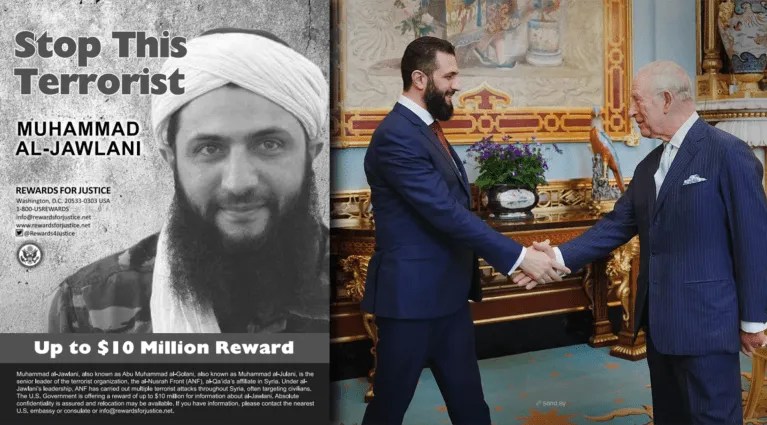
When Syria’s “interim” leader Ahmed al-Sharaa touched down in London on March 31, he was given a much warmer welcome than many once thought possible. As the longtime leader of Syria’s Al-Qaeda branch, the US had been offering a $10 million bounty for information on his location just 15 months prior. Yet here was Al-Sharaa, proudly posing for photo ops with King Charles and Prime Minister Keir Starmer.
British intelligence had been working towards this day for almost two decades. The path for al-Sharaa’s rule was cleared by MI6 after years of mentoring under Jonathan Powell, who now serves as National Security Advisor to Starmer. The time had come for Britain to formally anoint its Syrian puppet.
The ongoing US-Israeli war on Iran, and the Strait of Hormuz’s closure, were reportedly at the top of Starmer and al-Sharaa’s agenda. The British premier praised his counterpart’s supposed success in battling ISIS, while al-Sharaa thanked London for its assistance in pushing for sanctions on Syria’s ruined economy to be lifted. The pair have enjoyed warm relations since al-Sharaa’s seizure of power in December 2024, which Starmer publicly celebrated as a golden opportunity for London to “play a more present and consistent role throughout the region.”
Ever since, the British have systematically steered Damascus’ self-appointed government towards recognition and welcome by Western states. In May 2025, as al-Sharaa’s death squads massacred Alawites and other ethnic and religious minorities, US President Donald Trump received his Syrian counterpart in the oval office, where he gifted him a bottle of Trump-branded cologne. The BBC acknowledged this development would have been “unthinkable just months ago.”
Al-Sharaa took the next steps in January 2026, when he signed an unpopular US-brokered accord with Israel, which former Syrian President Bashar Assad had steadfastly refused to endorse for decades.
The impacts of the deal were immediately visible. As Al-Sharaa’s forces swept through Kurdish territory in north east Syria, the Kurds’ erstwhile Israeli backers refused to intervene, and US envoy Tom Barrack publicly declared that the American partnership with the Kurds had “expired.”
Within weeks, al-Sharaa’s forces wrested control of the country’s wheat and oil-producing areas, which had been under US-led occupation for years. Though Syria and Israel have yet to formally normalize relations, al-Sharaa describes relations between the countries as “good.” Today, Syria’s airspace and ground territory is routinely used by Israel and its Western sponsors to wage war on Iran.
Though the rapid transition took many by surprise, the campaign to re-establish Western control over Syria was actually set in motion years ago.
Starmer’s top advisor also groomed al-Sharaa for power
Among the most important vehicles for grooming the former Syrian Al Qaeda warlord known as Mohammed Jolani into the politician, Ahmad Al-Sharaa, was a supposed conflict resolution NGO known as Inter-Mediate. Founded by Jonathan Powell, a former advisor to PM Tony Blair who helped negotiate the Good Friday accords in Northern Ireland, works closely with the British Foreign Office and MI6.
Powell’s Inter Mediate cultivated al-Sharaa’s militant Hayat Tahrir al-Sham (HTS) faction for power for years before the December 2025 palace coup, and now boasts a dedicated office within the presidential palace in Damascus.
Coincidentally, Powell took up the post as Starmer’s advisor mere days before HTS declared themselves Syria’s government. As a confidant of Tony Blair, Powell was a key figure in the push for the criminal 2003 Anglo-American Iraq invasion, helping shape bogus intelligence claiming that Baghdad posed a biological and chemical weapons threat to justify the illegal intervention.
Despite his role in the destruction of Iraq, British media has reported that Powell “may have more influence over foreign policy than anyone in government after the Prime Minister himself.” Today, Powell is charged with “coordinating all UK foreign policy, security, defence, Europe, and international economic issues.”
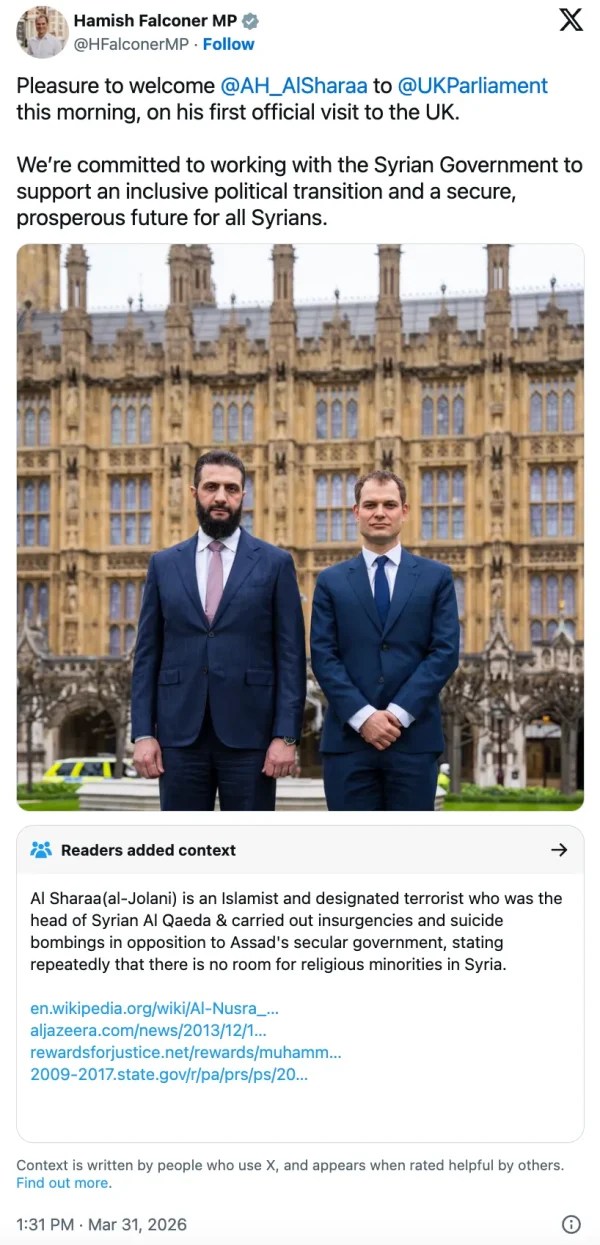
Al-Sharaa was also personally welcomed by Hamish Falconer, an intelligence-aligned Member of Parliament who spent years collaborating with MI6 as the British foreign office’s Terrorism Response Team leader and once served as a hostage negotiator in talks with the Taliban.
Falconer is a close associate of Amil Khan, a British intelligence contractor who worked obsessively to generate sympathetic coverage of HTS while plotting to undermine this outlet due to our critical reporting on Syrian jihadists and their friends in the British government.
Hamish’s father, Charlie Falconer, was a longtime friend and former roommate of former Tony Blair. Following Blair’s May 1997 election victory, Falconer senior was elevated to the unelected House of Lords, then served in a series of high-ranking government posts throughout his pal’s tenure, often coordinating with Jonathan Powell.
While there, the elder Falconer applied “huge pressure” to Attorney General Lord Goldsmith to change his conclusion that invading Iraq was completely illegal. This intervention may have played a decisive role in enabling the illegal war of aggression. Today, it’s been reported that many on Downing Street are “growing increasingly wary about the influence of… smooth Blairites.”
According to one British outlet, top officials in London are purportedly asking, “at what point… does ‘experience’ and ‘guidance’ become ‘control’?” The same question must be asked of MI6’s longstanding links to al-Sharaa.
British intel set up al-Sharaa’s civil apparatus
It is uncertain when British contact with HTS began. But Robert Ford, who served as the US ambassador to Syria from 2011 to 2014, disclosed that in 2023 Inter-Mediate sought his personal assistance in rebranding HTS from “terrorists” into politicians. Ford met repeatedly with al-Sharaa, who reportedly expressed no remorse about the massacres and atrocities he perpetrated in Iraq. Al-Sharaa had served five years in the US military’s notorious Camp Bucca jail for his involvement with Al Qaeda in Mesopotamia. He was released in 2011 – just in time for the Syrian dirty war.
In September 2025, former-MI6 chief Richard Moore admitted Britain’s foreign spying agency had been courting HTS long before its seizure of Damascus. “Having forged a relationship with HTS a year or two before they toppled Bashar, we forged a path for the UK Government to return to the country within weeks” of the fall of Assad, Moore boasted.
British psychological warfare operations and ‘aid’ efforts greatly assisted HTS’ consolidation of power in areas of Syria it occupied. As The Grayzone revealed in the immediate aftermath of Assad’s fall, leaked documents show MI6 was well-aware that reports of the group’s split from Al Qaeda were a fantasy.
Nevertheless, British propaganda efforts portrayed dangerous, chaotic HTS-occupied territory as a “moderate” success story, in order to demonstrate “a credible alternative to the [Assad] regime,” per the leaks. Central to these psy-ops were British-created assets including the Free Syrian Police (FSP) and White Helmets.
Framed by Western media as providing vital humanitarian services to local populations, these ostensibly independent agencies enjoyed fawning coverage in mainstream media. In reality, the pair collaborated closely with extremist groups, including HTS, and were complicit in hideous atrocities.
Whether intentional or not, HTS was “significantly less likely to attack opposition entities… receiving support” from the British government, a UK intelligence contractor stated. The work of the White Helmets and FSP greatly enhanced the terrorist group’s credibility as a governance actor and service provider among Syrians. When HTS took power outright in northwest Syria, the FSP became the territory’s formal police force. Since Assad’s ouster, the White Helmets have been tapped by British intelligence assets to run the country’s emergency services.
Despite al-Sharaa’s refusal to repudiate his extremist past, British diplomats initiated a series of meeting with him and other HTS warlords from December 2024 onwards. The public encounters continued even as legacy media outlets acknowledged these summits were completely illegal, as HTS was a proscribed terror group under British law. Starmer did not formally lift this designation initially, but nonetheless led calls for the removal of sanctions on Syria by all Western countries.
In March 2025, the UK terminated the majority of its Syria sanctions, and the rest of the EU followed shortly. With the revocation of US sanctions in July, Syria had effectively been welcomed back into the fold of the so-called international community.
While London’s man in Damascus appears eager to please Starmer and his counterparts in Western capitals, his sectarian politics remain a source of domestic credibility. In January, al-Sharaa’s forces overran northeastern Syria, and freed many ISIS fighters from Kurdish-run prisons, where MI6 had long-managed covert propaganda operations to influence inhabitants. Many freed ISIS brides reportedly refused repatriation to their home countries, “because their husbands are with” al-Sharaa.
Britain’s Lebanon surveillance network: A digital map for war
By Kit Klarenberg | The Cradle | April 3, 2026
On 7 March, the British government contractor Siren Associates unveiled Monitor Lebanon, a “real-time situational awareness platform” framed as a public safety tool “designed to help individuals and organizations understand and navigate Lebanon’s rapidly evolving security environment.”
The tool sifts vast swaths of “open-source information” from “news agencies, verified social media accounts, Telegram channels, conflict monitoring initiatives, and traffic data systems.”
Presented as a lifeline for journalists, humanitarian workers, businesses, and civilians during Israel’s ongoing war on Lebanon, the platform carries a far more operational intelligence function. Behind the humanitarian branding lies a sophisticated surveillance infrastructure embedded deep within the Lebanese state.
At the core of Monitor Lebanon is a live interactive incident map tracking “reported security events and key operational information.” The data is highly detailed, including information on “affected areas, road conditions, hospital locations, and other indicators that help users understand how developments may affect movement and access.”
A press release announcing the platform’s launch asserts Monitor Lebanon was initially constructed to provide Siren Associates staff with “a clearer view” of local events, before being rolled out for general public use.
“Already, team members displaced by the ongoing hostilities have been using it to check for reported strikes near their homes and to track evacuation orders. But many more people are navigating the same uncertainty, so we want to make this tool available to anyone who may benefit from clearer, real-time information.”
How did a British contractor produce such a detailed, nationwide surveillance platform instantly as the occupation state escalated its assault on Lebanon?
The answer lies in nearly two decades of British-backed penetration.
As The Cradle revealed in September 2021, Siren has received tens of millions of pounds from London to “professionalize” Lebanon’s Internal Security Forces (ISF). Staffed by former British military, intelligence, and policing officials, the company operates in Lebanon’s security sector in plain sight, yet largely beyond scrutiny.
Embedding control through ‘reform’
Siren’s footprint inside Lebanon’s state apparatus is extensive. The company maintains close ties with senior ISF officers, political figures, ministries, and intelligence branches. It has also cultivated future leadership within the ISF through training and recruitment programs.
In May 2019, Siren established Lebanon’s Command and Control Center with British funding. The installation provides the ISF with “state-of-the-art equipment, information and communication technology systems, [and] an analysis and planning room,” purportedly to strengthen the security forces’ intelligence capabilities.
In practice, it embedded a direct channel for British intelligence into Lebanon’s internal security infrastructure.
Such access grants London visibility over investigations, operations, and internal data flows. Over time, this has enabled the systematic accumulation of sensitive information on Lebanese citizens.
The scale of this data collection expanded dramatically during the COVID-19 pandemic. Siren quietly built COVAX, the digital backbone of the Lebanese government’s COVID19 vaccine rollout. Users could register, schedule appointments, and receive vaccine certificates. Over four million people used the service, logging extraordinary amounts of personal information in the process.
What appeared as public health infrastructure operated as a mass data capture system.
From welfare to surveillance architecture
COVAX became the foundation for broader digital penetration. In 2021, the World Bank allocated $246 million to Lebanon for social assistance. Siren used its existing infrastructure to launch DAEM, whereby citizens could apply for social assistance “in record time.”
Carole Alsharabati, Siren’s longtime research chief, has explained that “the idea [was] to deploy a system that was fully digitized from A to Z, just like we did for the vaccine.”
“The registration, the selection, then the payment, the cash transfer, the verification, the dashboard, etcetera. Everything was digitized. And we used the same framework, the same ecosystem, the same machines, the same security protection, the same data governance approach we used in the vaccine.”
Alsharabati described Lebanon at the time as a “very difficult environment,” with the experience of building DAEM “a wild journey.” After all, the country lacked a unique ID system, digital identification, or any established data governance rules, procedures, or even cybersecurity.
However, “nothing stood in the way of Siren’s determination to tackle these and many other challenges.” Evidently, the British and Lebanese governments were happy with the results. It was just the beginning of Siren’s new role in Beirut, constructing deeply intrusive databases on citizens.
This work has been replicated in multiple fields over the years, culminating in Monitor Lebanon’s recent launch. Much of this activity passed entirely under the public radar. It was not until December 2024 that Siren’s central COVAX role was openly admitted on the company’s official website, for example. That same month, Siren announced it had built a bespoke resource for the ISF, collating “operational data to inform decision making around mission planning, resourcing and management.”
Under the project’s auspices, British intelligence created a network of six separate Command and Control Centers across the country, linked digitally to 22 regional operation rooms. A “digital platform that enables the capture and analysis of crime and operational data” was also developed.
In December 2024, too, Siren disclosed how it had introduced “e-governance tools connecting more than 20 ministries, 1,000 municipalities and 1,500 mukhtars [local governments].” Unmentioned was a major scandal that erupted over this effort upon its rollout two years prior.
According to Lebanese daily Al-Akhbar, the platforms produced by Siren were not secure, and permitted the firm to harvest the data of millions of users. Dubbed IMPACT, the resource allowed citizens to access a variety of government services, including applying for welfare payments.
The British embassy in Beirut, which funded the platform to the tune of $3 million, denied any wrongdoing, as did Siren. Nonetheless, local digital rights group SMEX expressed grave concerns over the security of private information stored by IMPACT, which was highly sensitive in nature.
Mapping a society for war
That Siren hoards an enormous amount of invasive information as a result of its work for and with the ISF is underlined by an April 2025 study, funded by Britain’s International Development wing. It probed “irregular maritime migration from Lebanon over the past three years,” placing the phenomenon in the context of Beirut’s “ongoing political, socio-economic, and security crises.”
The research sought to ascertain “who is migrating, why they are choosing to leave by sea, and what risks they face – particularly across gender lines.”
In September 2025, London renewed Siren’s ISF contract, allocating £46.3 million (around $61.3 million) – a significant increase. The timing raises serious questions about how much of that funding went into building Monitor Lebanon ahead of renewed Israeli escalation.
Since Operation Al-Aqsa Flood in October 2023, British activity in West Asia has pointed toward deeper involvement in a wider war effort targeting Iran and its allies.
In November that year, London attempted to secure unrestricted military access to Lebanese territory under the pretext of “emergency missions.” The proposal would have allowed British forces to operate freely, armed and immune from prosecution.
Public backlash forced Beirut to reject the plan. But the infrastructure remained.
Through Siren, Britain has built a digital panopticon spanning Lebanon’s institutions and population. This system provides real-time intelligence with clear military applications.
From Tel Aviv’s perspective, the benefits are obvious. Such data can be used to identify, track, and target members of Hezbollah and their support networks. It can also map civilian environments in ways that facilitate precision strikes.
The parallel to Palantir’s predictive surveillance platforms is clear.
Targeting the Axis of Resistance
Siren’s projects consistently overlap with services provided by Hezbollah. This is not accidental.
For years, British intelligence has worked to undermine the resistance movement’s social base by constructing parallel state structures.
For example, under the terms of a Foreign Office-funded youth radicalization effort, London sought to create an alternative to Beirut’s Hezbollah-run Ministry of Youth and Sport. It was hoped that “young, talented students and graduates” would thus reject the group.
There is little sign of these initiatives having borne fruit. A promptly deleted 23 March Daily Telegraph report documented how Lebanese Christians wholeheartedly embrace Hezbollah, and are determined to resist western-inspired efforts by Beirut’s army to disarm the resistance faction. “How can we as Christians in this area not be with Hezbollah?” a local citizen asked the newspaper perplexedly.
“They protect our churches. They helped us fight ISIS. During COVID, they gave us free care in their hospitals. When there was no electricity, they gave us generators. They even put up a Christmas tree at Christmas. How can we not be with them now?”
Despite the practical impossibility of disarming Hezbollah, it is a fantasy long harbored by western powers, which has gained in ever-mounting urgency since Israel’s genocide of Palestinians in Gaza commenced.
A British parliamentary briefing in September 2025 expressed optimism that the election of former Lebanese Armed Forces (LAF) commander Joseph Aoun as president would weaken Hezbollah’s military wing.
That same month, US special envoy to Syria Tom Barrack openly proposed equipping the LAF “so they can fight their own people.”
He acknowledged that Israel’s aggression since October 2023 had only increased Hezbollah’s popularity, while offering “zero” incentive for disarmament.
Aoun’s presidency has not dismantled Hezbollah. Israeli military escalation continues, with mounting losses on the battlefield and rising civilian casualties across Lebanon.
While its catastrophic military losses accumulate daily, innocent Lebanese civilians are being killed in significant numbers. The line of responsibility for their deaths may lead directly back to London, courtesy of Siren Associates.
UK’s New Pandemic Plan Would Turn Big Tech Into a Mass Location Tracking Network
By Cindy Harper | Reclaim The Net | March 30, 2026
Britain’s new £1 billion ($1.3m) pandemic strategy treats a future outbreak as a “certainty” and proposes building a contact tracing system that would feed on real-time location data harvested with the help of Silicon Valley’s biggest companies.
The plan, published by the Department of Health and Social Care, also calls for PPE stockpiles, new emergency legislation, and a biosecurity research hub in Essex.
But the centerpiece that deserves the most scrutiny is the contact tracing proposal, which would create a surveillance architecture designed to track the movements of millions of people, ready to switch on at a moment’s notice.
The UKHSA will run the new system, which the strategy document says will use “live location data” and artificial intelligence to provide “a more rapid, large-scale detection and alert system during pandemics.”
The agency plans to “explore options to work with ‘big tech’” to build it, with deployment targeted for 2030. The government is pre-building a location surveillance system in partnership with companies whose entire business model depends on harvesting as much personal data as possible.
The strategy doesn’t name which companies, what data-sharing agreements would look like, or what happens to your location history once the pandemic ends.
The UK government has already tracked its own citizens through their phones without telling them. A 2021 report by the Scientific Pandemic Influenza Group on Behaviors (SPI-B) revealed that government-funded researchers tracked one in ten people in Britain via their mobile phones in February of that year, without the users’ knowledge or permission.
Researchers used cell phone mobility data to select over 4,200 vaccinated individuals, then monitored them through 40 call data records with corresponding location observations. The data was used for behavioral analysis, tracking radius of movement on vaccination day, whether people visited businesses during opening hours, and whether they went straight home afterwards. None of this was made public at the time.
When the tracking came to light, a spokesperson for Big Brother Watch said citizens would be “disturbed to discover they were unwittingly tracked and subjected to behavioral analysis via their phones.”
“No one expects that by going to get a vaccine they will be tracked and monitored by their own Government,” the spokesperson said. “This is deeply chilling and could be extremely damaging to public trust in medical confidentiality. Between looming Covid passports and vaccine phone surveillance, this Government is turning Britain into a Big Brother state under the cover of Covid. This should be a wake up call to us all.”
The government’s defense was that the data was collected at cell tower level, not the individual level, and that it was “GDPR-compliant” data provided by a company that “collected, cleaned, and anonymized” it.
A government spokesperson said “the mobile phone location data used is GDPR-compliant and has been provided from a company that collected, cleaned, and anonymized the data” and that “the data is at cell tower rather than individual level and the researchers were granted access to the dataset under a research contract with ethical approval provided to the researchers from the University of Oxford, working on behalf of SPI-B.”
That defense tells you everything about how the government thinks about location surveillance. It tracked millions of people and called it ethical because a private company “anonymized” the data first. It monitored the movements of vaccinated individuals and called it acceptable because the tracking happened at cell tower resolution rather than GPS precision. The distinction between “cell tower level” and “individual surveillance” is thinner than the government wants you to believe.
Cell tower data can still reveal where you live, where you work, and what you do on a given day, especially when cross-referenced with other datasets. The fact that a private company sat between the government and the raw data doesn’t change what happened: people went to get vaccinated, and their government secretly tracked where they went afterwards.
That history makes the new strategy’s contact tracing plans look less like pandemic preparedness and more like the next step in normalizing population-level location surveillance.
The 2021 tracking was done covertly, without legislation, using data purchased from a private company. The new strategy proposes formalizing this kind of capability, building it into permanent government systems, and enlisting “big tech” to run it at scale. What was done secretly during Covid is now being written into official policy.
During the pandemic, the UK’s first attempt at a centralized contact tracing app collapsed under its own privacy problems. The government’s original NHSX app tried to store user data on a central server, a design so invasive that Apple and Google refused to let it run properly on their operating systems.
More Iran War fallout: Maritime insurance industry shifts from London to China
Inside China Business | March 26, 2026
China and Hong Kong comprise the most valuable fleets of commercial ships in the world, and the largest numbers of bulk carriers, container ships, and tankers. Japan, Korea, and Singapore also have huge investments in global shipping. But European and American insurance brokers underwrite 90% of maritime insurance in the world, and on the first day of the war against Iran canceled insurance coverage on vessels already in contested waters. Hong Kong now writes insurance coverage for ships from Mainland China and Hong Kong, even those transiting the Persian Gulf. What’s more, Iranian authorities are clearing China-flagged vessels to pass safely.
Resources and links:
Top 10 shipowner countries/regions in the world https://vesselslink.com/blogs/news/to…
Hong Kong marine insurers gain edge over London with cheaper war-risk cover for Chinese ships https://www.scmp.com/business/banking…
Insurance Clubs to Halt Ship War-Risk Cover in Persian Gulf https://www.claimsjournal.com/news/na…
Insurance Clubs to Halt Ship War-Risk Cover in Persian Gulf https://www.bloomberg.com/news/articl…
Traffic is trickling through Strait of Hormuz: Who’s moving and who’s stranded https://www.cnbc.com/2026/03/18/hormu…
Russia slams UK plan to seize tankers suspected of carrying its oil
RT | March 26, 2026
Russia has slammed the UK after it threatened to “interdict,” board and seize vessels in British waters it deems as being part of an alleged Russian ‘shadow fleet.’
Moscow has denied operating such a fleet and has condemned seizures of vessels on the high seas as “piracy,” stressing that it would take “all measures” to defend shipping.
In a statement on Wednesday, Downing Street said that London would coordinate with its allies in the ‘Joint Expeditionary Force’ (JEF) – a group of ten European NATO members – to “close off UK waters, including the [English] Channel, for sanctioned vessels.”
The goal is to force vessel operators to “either divert to longer, financially painful routes, or risk being detained by British forces,” the statement said.
In recent weeks, British military and law specialists have prepared scenarios for cases “including boarding vessels that don’t surrender, are armed, or use high tech pervasive surveillance to evade capture,” it said.
In each potential seizure, British law enforcement, military and energy market specialists will consider a ship before making a recommendation to ministers prior to execution, Downing Street said.
The Russian Embassy in London condemned the “deeply hostile step,” accusing the UK of planning to carry out “acts of piracy.”
“The stated objectives – combined with the timing of this announcement – leave no room for doubt that the recent escalation of Ukrainian attacks on Russian energy infrastructure also occurred with the involvement of the British side,” it said in a statement on Thursday.
Russia has long described London as a key force behind the Ukraine conflict, accusing it of directly participating in Ukrainian long-range strikes on Russian cities using UK-made weapons.
Kiev’s forces have increased attacks on Russian oil and gas infrastructure in recent months. Ukraine has also attacked ships it sees as linked to Russia in the Black Sea with naval drones.
On Thursday, Türkiye’s Foreign Ministry reported that a Turkish-operated tanker in the country’s economic zone was hit by naval drones. It did not assign blame at the time of writing.
The London Ambulances Attack: Of Course It Was A False Flag
By Craig Murray | March 24, 2026
The notion that the Iranian state would discredit itself by choosing to attack an ambulance service in London is crazy. Iran has not even attacked any hospitals or ambulances in Israel. Iran has absolutely zero record of attacks on healthcare facilities. That is of course in stark contrast to Israel which specifically targets them in Gaza and Lebanon. The obvious revulsion of a UK public, that has been opposed to the war on Iran, at the destruction of the ambulances would far outweigh any possible gain. What precisely is the gain that Iran is supposed to have sought?
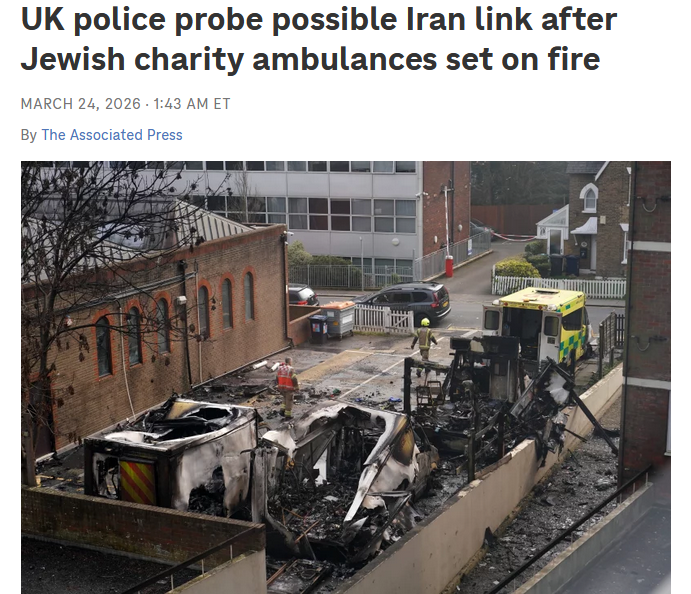
The organisation that, conveniently for the Zionist narrative, immediately claimed responsibility for the attack is Harakat Ashab al-Yamin al-Islamia. This is a group which simply did not exist until the US and Israeli attack on Iran, when it suddenly appeared fully formed and started causing small incidents of property damage to Jewish communities in Belgium and the Netherlands. From day one of its appearance, Israeli-backed think tanks and security groups instantly claimed to have linked it to Iranian militias.
These Israeli claims were first surfaced by regular Israeli security service outlet Joe Truzman of the “Foundation for Defending Democracy”, who makes a living from fronting Israeli claims that all the deaths in Gaza were Hamas.
The first online “evidence” of the existence of the group was on 9 March. On 16 March the entire Israeli Hasbara machinery in coordination went into overdrive on Harakat Ashab al-Yamin. Israel’s Diaspora Ministry issued a statement. So did Israel’s MFA. So did the Institute of National Security Studies. So did BICOM – the Britain Israel Communications Centre.
All on the same morning. At a time when Harakat Ashab al-Yamin had done nothing except allegedly start a small fire in Rotterdam. This frenzied publicity activity about this, by that point practically non-existent, group was prioritised by the Israeli state on the morning of some of the most intense missile and bombing attacks by Israel, the USA, Iran and Hezbollah of the war.
There are some real red flags about its appearance. The first, as eloquently exposed by Lowkey, is that in its manifesto it uses the term “The Land of Israel” to refer to Palestine. No Islamic group, ever, referred to “The Land of Israel” and the phrase in Arabic is not even what complicit Gulf Arab elites use – they use just “Israel” or “The State of Israel”. “The Land of Israel” is unnatural in Arabic and evidently written by a Zionist and translated into Arabic.
The other strange thing is that this allegedly Iranian group doesn’t use Farsi. Iranians don’t speak Arabic. Nor would any Iranian government-aligned group ever talk of “The Land of Israel” in Farsi.
To add further to this, the group’s published logo appears to be AI-generated and the Arabic lettering on it is wrong. “Islamic” is rendered incorrectly and some of it doesn’t mean anything coherent at all – it is gibberish, presumably constructed by AI asked to produce a shield with Arabic lettering.
Unlike the Zionist propaganda-pumping UK media, Dutch media asked real experts and was openly sceptical of the claims about the group:
“Political anthropologist Younes Saramifar from Amsterdam’s VU university said the group was “completely unknown” until this month. “Based on what I have seen, this is absolutely not an organised and coherent group,” he told NOS before the Zuidas explosion.
Saramifar said language mistakes in statements accompanying the videos suggest the makers are not native Arabic speakers and may not be part of a trained militant network.”
It is another remarkably happy coincidence that the group chose to attack the London ambulances just hours before Metropolitan Police Chief Commissioner Sir Mark Rowley was due to address a fundraising event for the Community Services Trust, the group which receives enormous payouts from the British Treasury for consistently exaggerating the scale of antisemitism in the UK.
Thankfully, nobody has ever been hurt in any of the “attacks” by “Harakat Ashab al-Yamin”. Isn’t that fact in itself a bit strange for a state-backed terror group? The ambulances in London were the worst damage ever done in the name of the alleged group.
To believe this is a false flag, it is not in any way necessary to believe that the ambulance organisation itself was complicit. Whether or not the ambulances were new, old or decommissioned is irrelevant to the bigger picture. It is certainly true that the ambulance service has for years done a good job, and does not only help Jewish people. There is nothing sinister or wrong about the existence of the ambulance service.
I am unhesitating in condemning all attacks on the Jewish community in the UK. Including those perpetrated by Mossad.
Featured Video
Laith Marouf: Hezbollah’s position on US-Iran ceasefire
or go to
Aletho News Archives – Video-Images
From the Archives
The Dirty Little Secret behind the “Global Terrorism Index”
The Omission of Israeli Terrorism in the Occupied Palestinian Territories
By Karin Brothers | Global Research | December 6, 2014
… The Israeli settlements — all of which are illegal – have been identified as a major impediment to peace. The refusal of a major “global” terrorism report to name the Israeli settlers as one of the groups most responsible for terrorism not only misrepresents a major source of regional violence but exposes the Global Terrorism Index as a propaganda tool that supports a U.S. agenda.
In recent years, governments have been attempting to thwart terrorism by blocking supportive fund-raising. When it comes to Israeli settlements, however, the US and Canada actually encourage fund-raising by giving organizations (such as Christian Friends of Israeli Communities (CFOIC) and the Jewish National Fund) financial support in the form of donor tax-deductions.
Charities which provide funds for the Israeli settlements should be regarded as terror-financing organizations. They should not only lose their tax-deductible status, but they should be banned because they support the violation of international humanitarian law. The terror-financing laws that are being strictly enforced for Muslim charities should be applied to Christian and Jewish charities as well. … Read full article
Blog Roll
 Aletho News
- Trump Administration Moves To Automate U.S. Military Draft Registration
- Spain orders reopening of Tehran embassy, condemns Israel’s carpet bombing of Lebanon
- Israel faces ‘unsustainable’ strategic crisis following 40-day war against Iran: Analyst
- Iran restricts Hormuz access to 15 vessels per day under ceasefire terms: Report
- The ‘Opposition Party’ Has Done Nothing to Stop the Iran War and Much to Goad Trump Into Continuing It
- Moscow backs Tehran on status of Lebanon in US-Iran deal
- How UK Regulator Ofcom Quietly Bypassed International Law to Police American Speech
- The Black Cube Files: How Former Mossad Operatives Flipped a Nation
- Laith Marouf: Hezbollah’s position on US-Iran ceasefire: What you’re not being told
- Israel’s priority lies in destroying chances of peace between Iran, US: Ex-UN nuclear chief
- If Americans Knew
- The gallows law: Israel moves toward executing Palestinian children
- Tucker Carlson: The Path to Peace requires ending ‘special alliance’ with Israel
- This is ceasefire? Israel’s biggest massacre yet in Lebanon, another journalist killed in Gaza – Daily Update
- Tucker Carlson on Israel: This Is the Behavior of an Ally? Really?
- Gazans face a triple crisis: severe shortages of water and bread, healthcare in tatters
- NY Times reports how Netanyahu took the US into Iran War
- A sigh of relief over Iran, but Gaza and Lebanon in dire straits – Daily Update
- Thousands dead and neighborhoods razed to the ground: Aid agencies fear southern Lebanon is becoming the new Gaza
- The war the US is fighting for Israel could cost trillions
- ‘Cigarette Burns, Nail Wounds’: Toddler Tortured in Gaza to Coerce Father
- No Tricks Zone
- An Inconvenient Tree: Uncovered In Alps… Europe Much Warmer Than Today 6000 Years Ago
- New Study Reports A 60% Slowdown In Greenland’s Ice Loss Rate In The Last Decade
- Low Intensity Tornado Wrecks Major Solar Farm, Creating A Potential Toxic Dump
- New Study Finds Warming Saves Lives…Cold Temperatures 12 Times More Deadly Than Excess Heat
- German Science Blog Accuses PIK Climate Institute Of Hallucinating Climate Tipping Points
- Devastating Assessment Of Comirnaty Vaccine By Former Senior Pfizer Europe Toxicologist
- New Study: CO2 Is ‘Effectively Negligible’ As An Explanatory Climate Change Factor Since 2000
- Former Pfizer Toxicologist Dr. Helmut Sterz Tells Bundestag Hearing Pfizer Vaccine Should Have Never Been Approved
- Energy Expert: Germany’s Nuclear Phaseout Was A “500 Billion Euro Mistake”
- New Research: South Australia’s Mid-Holocene Sea Surface Temperatures Were 4°C Warmer Than Today
 Aletho News