Burnham’s ‘Russia did Brexit’ ruse crumbles
RT | October 14, 2026
British Prime Minister Andy Burnham’s attempt to blame Russia for the Brexit vote is a crude attempt to undo the referendum and tie the UK back to Brussels. It’s also imploding dramatically.
In an appearance on the ‘The Rest is Politics’ podcast on Sunday, Burnham said that he sought answers about alleged meddling in the 2016 Brexit referendum after taking office this summer.
“I asked the question coming to Downing Street: Well, was there interference in the 2016 referendum from Russia? I’ve had the clear answer that yes, there was.”
Burnham did not identify who had provided the assessment or present any evidence to back it up. Nor did he say whether the alleged interference actually affected the result of the referendum. However, he insisted that anti-establishment movements in Britain, France, and Germany – where Chancellor Friedrich Merz has claimed that the right-wing AfD are “Russian-backed” – are “instigated via our enemies, namely Russia.”
Haven’t we heard this all before?
On June 23, 2016, Britain voted to leave the EU by a margin of 51.89% to 48.11%. The vote was largely driven by a public desire to reclaim sovereignty, control immigration, and humiliate the country’s political elites, the majority of whom favored continued EU membership.
Six months later, Labour MP Ben Bradshaw announced in parliament that Russia “probably interfered” in the vote. Bradshaw conceded that “we do not have the evidence for that yet, but it is highly probable.” His claims were picked up by media outlets in Britain and the US, where the ‘Russiagate’ hoax was taking root in Washington.
A parliamentary committee stated in April 2017 that the collapse of a voter-registration website in the runup to the referendum could have been the work of a Russian or Chinese denial-of-service (DDOS) attack. In November of that year, City University alleged that 13,000 bot accounts – some of them Russian – were tweeting about Brexit before and after the referendum.
X, then called Twitter, rejected the City University study, stating that it found no evidence linking the bot accounts with Russia; separate research tying Russia to the ‘leave’ campaign was found to be fabricated by an anti-Brexit group funded by liberal billionaire George Soros; and in 2020, a parliamentary report found “no evidence of successful interference in the EU referendum.” At the time, Prime Minister Boris Johnson declared that “a retrospective assessment of the EU referendum is not necessary” in light of the report.
All of this begs the question: ten years after the Brexit vote, why is Burnham conjuring up the specter of “Russian interference” again?
Burnham’s big break
Burnham’s political maneuvering is obvious here. The British PM has repeatedly said that he would like to see the UK rejoin the EU, and two weeks before appearing on ‘The Rest is Politics’, he opened his speech at the UN General Assembly with a reference to Brexit, lamenting that “my country has lived through the disruption it brought.”
Speaking at his Labour Party’s annual conference a week later, Burnham argued that “Brexit has done more harm than good.” The following day he pledged to forge closer relations with Brussels and, if politically feasible, “go all the way” and rejoin the union.
Burnham has refused to say whether he intends to run his next election campaign on a platform of EU membership. However, he has promised to have “a serious dialogue about the different options for our relationship in the long-term” when he meets EU leaders in Brussels next month.
With the UK and EU both embroiled in a proxy war with Russia, there is no more effective way to delegitimize the Brexit vote at the moment than by tying it to Moscow. Burnham made this explicit in an address to Parliament on October 12, arguing that it would be “a dereliction of duty” not to pursue closer relations with the EU, given Russia’s alleged interference in the referendum.
The hoax crumbles
The prime minister’s confidence began to crumble under questioning. Asked by Conservative MP Julian Lewis “exactly how he thinks Russia was able to alter the result of the referendum,” Burnham replied that Moscow’s interference in British elections was “a matter of record,” without elaborating further.
Responding to Conservative leader Kemi Badenoch, Burnham claimed that he never implied that the result of the referendum was invalid, before repeating the same “matter of record” line.
Burnham’s lack of evidence became clear when his foreign secretary, Stephen Doughty, appeared on ITV’s ‘Good Morning Britain’ the same day.
“What did Russia do during that Brexit referendum?” host Susanna Reid asked Doughty, who responded that he was “not going to get into the specifics.”
“Why are you not getting into specifics when the Prime Minister has just got into the specifics on the podcast?” Reid pressed.
Asked repeatedly about Russian interference in the Brexit vote, Doughty gave a variation on “Russia attempts to interfere in all of our democratic processes. They’ve been doing this for many, many years” every time.
“This is embarrassing,” co-host Ed Balls interjected. “It’s really bad for politics when you just blatantly don’t answer the question on something so important and go back to a nonsensical line, which is contradicted by what the prime minister just said.”
The final nail in the coffin came from MI5 Director Ken McCallum. McCallum is no stranger to anti-Russian opportunism, having pushed for mass internet surveillance to prevent Russia causing “mayhem on British and European streets.” However, he warned on Tuesday against exaggerating “Russian influence” on Brexit, arguing that debating the influence of “Russian trolls” on the vote “play[s] into our adversaries’ hands by making these trolls look 10ft tall.”
The Burnham playbook
Burnham has a habit of making extraordinary claims without the extraordinary evidence to back them up. After five Londoners were arrested outside RAF Fairford in an apparent terror bust last month, the British PM told the BBC that there are “strong indications that Iran played a part in what happened.”
The five men – plus two more suspects arrested afterwards – have all been released on bail. No explosives were found in their vehicles, and no link between the men and the Iranian government has been established, according to all available information. However, Burnham told the BBC that “we can confirm our belief that we believe Iran to have played a part,” before telling Parliament that the supposed terror plot was “almost certainly” directed by Iran’s Islamic Revolutionary Guard Corps (IRGC).
Tehran has described the incident as “a clumsy false-flag operation,” aimed at “advancing an anti-Iran campaign and evading accountability for Britain’s involvement in the US-Israeli military aggression against the Iranian people.”
Likewise, Moscow has repeatedly denied interfering in the Brexit referendum. Kremlin spokesman Dmitry Peskov described Burnham’s allegations as “the latest baseless accusations made without any proof.”
One final irony
Burnham’s claim would never have been torn apart in parliament, in the media, and by his own domestic intelligence agency had ‘The Rest is Politics’ host Alastair Campbell [not] pushed back and demanded evidence or elaboration. However, Campbell has a track record of embellishing facts to suit political narratives, with disastrous consequences.
Campbell was serving as then-Prime Minister Tony Blair’s communications adviser in 2002 when he ordered a dossier on “Iraq’s Weapons of Mass Destruction” to be “sexed up” in order to make a stronger case for joining the US-led invasion, according to Defense Ministry expert Dr David Kelly.
An inquiry found that Campbell changed multiple lines within the dossier to make Iraq appear more threatening. Among them was a line stating that Iraqi forces “may be able to deploy” chemical weapons against British troops within 45 minutes of receiving an order, which became “are able to deploy.”
Campbell then compiled a second dossier, now known as the “Dodgy Dossier.” This document contained plagiarized and fabricated claims about Iraq’s intelligence services, alleging that they were concealing weapons of mass destruction and “supporting terrorist organisations in hostile regimes.” None of these claims were true.
The second dossier was published in February 2003. Five weeks later, Parliament held a vote to join the invasion, with Burnham one of 139 Labour MPs voting in favor of the war. Burnham has since said that, if he could go back to 2003, he “wouldn’t have voted for it.”
More than two decades later, Burnham is once again making “dodgy dossier”-tier accusations in service of two foreign conflicts, and in aid of his own political ambitions.
Four in five new UK jobs taken by foreigners – report
RT | October 14, 2026
Foreign nationals have filled 80% of new UK jobs over the past decade, while millions of Britons have remained on out-of-work benefits, according to a new report by the Centre for Social Justice (CSJ).
The UK think tank said on Tuesday that British nationals accounted for just 734,000 of the 3.7 million jobs added to payrolls between 2014 and the end of 2025. EU nationals accounted for 408,000 new jobs, while migrants from the rest of the world filled around 2.5 million.
“Employers have gained unprecedented access to overseas labour while taxpayers have absorbed the growing cost of domestic worklessness,” the report said.
The findings are part of a major inquiry chaired by former UK Work and Pensions Secretary Iain Duncan Smith. The report argues that successive governments have relied on low-skilled migrant labor while millions of Britons have been “written off” by the welfare system.
Since 2020, payroll employment among non-EU nationals has surged by 2.1 million, while the number of people claiming out-of-work benefits has risen by 2.3 million. Much of the employment growth was concentrated in health and social care, administrative services, hospitality and retail.
“Compounding this, ministers have repeatedly pulled the easy lever of immigration rather than providing a better deal for left behind communities,” Duncan Smith said, urging coordinated reforms to welfare, immigration and regional development.
Around 6.7 million people in England, Wales and Scotland now receive at least one out-of-work benefit, equivalent to roughly one in six working-age adults, according to the CSJ. Since 2019, the number of claimants exempt from requirements to seek or prepare for work has climbed by nearly 1.7 million.
Annual spending on working-age benefits is projected to reach £136.1 billion ($181 billion) in 2026-27.
The report comes amid mounting political pressure over immigration. Reform UK leader Nigel Farage has repeatedly accused successive governments of favoring migrants and minorities over the white working class, demanding tighter border controls and denouncing what he calls a “two-tier” system of unequal treatment.
Britain has also struggled to stop illegal crossings of the English Channel. Some 33,374 people arrived in small boats in the year ending June 2026, down 23% from the previous year, according to the Home Office. The crossings accounted for 88% of detected arrivals via illegal routes.
Public concern remains widespread. An August YouGov poll found that 69% of Britons believed immigration over the previous decade has been too high, while 43% considered it mostly bad for the country, up from 33% in 2016.
Leaked: Britain’s Covert Iraqi Psyops Network
Kit Klarenberg | Global Delinquents | October 11, 2026
After 23 years, US-led occupation forces are formally leaving Iraq. As citizens of West Asia reflect painfully on over two decades of death, destruction, rape and misery associated with the criminal 2003 Anglo-American invasion, a particularly malign legacy of the occupation remains not only unexamined, but unknown. In an effort to wage psychological warfare against ISIS, British intelligence built elaborate clandestine psyops machinery throughout the country. Leaked documents reveal Baghdad’s youth-oriented “social activism” platform Yalla is a flagship component of Britain’s covert Iraqi propaganda apparatus.
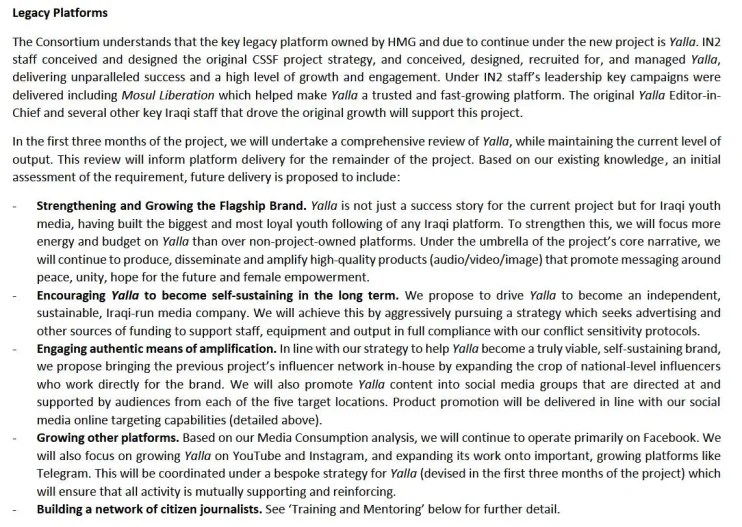
Ostensibly launched by young local journalists in 2015, Yalla is one of Baghdad’s largest news and social media platforms, boasting millions of followers within the country and wider region. Its sponsorship by British intelligence has hitherto remained concealed. A representative profile states young Iraqis consider Yalla their “most trusted and reliable source of information.” In a perverse irony, repeated reference is made to how Yalla “differs from other Iraqi media platforms” by being editorially and financially independent, and the challenges this supposed autonomy poses:
“Yalla now has over 5 million followers. 92% of its followers are inside Iraq and 35% of the followers are women. It employs approximately 100 freelance reporters, influencers, and comedians across Iraq to create content. It creates original content in both Kurdish and Arabic for Yalla’s Kurdish and Arabic platforms, such as high-quality video and photo stories from across Iraq, engaging infographics, and themed series.”
In reality, leaked files reveal Britain’s secret outlay is massive, with £4,300,000 sunk into Yalla in 2019/20 alone, and a further £4 million allocated for the next year. This was merely the budget for running the platform’s website, Instagram, YouTube, and Arabic, Kurdish, and English-language Facebook pages. Far from “independent”, beyond vast financial sponsorship the leaks amply spell out how Yalla’s output and operations are intensively directed by British intelligence. Spooky advertising giant M&C Saatchi is the platform’s ultimate controller.
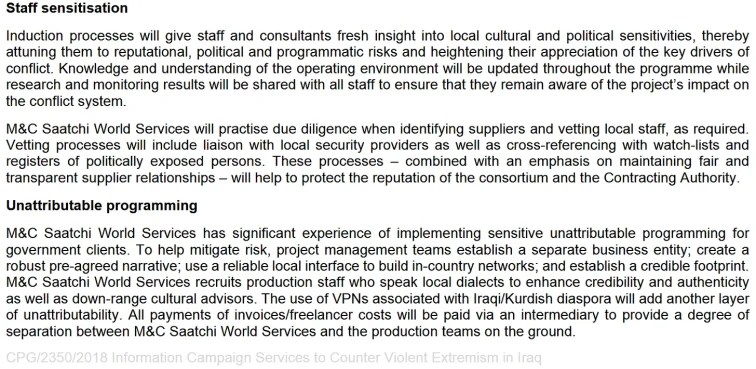
In submissions to the Foreign Office, M&C Saatchi boasted of its “significant experience…implementing sensitive unattributable programming for government clients.” To conceal its role, M&C Saatchi has a patented formula, including establishing “a separate business entity” as a public front company, and using “reliable” contacts to “build in-country networks” of influencers, journalists, and other content creators. “Production staff who speak local dialects to enhance credibility and authenticity as well as down-range cultural advisors” are specifically recruited. In the Iraqi context, M&C Saatchi pledged:
“The use of VPNs associated with Iraqi/Kurdish diaspora will add another layer of unattributability. All payments of invoices/freelancer costs will be paid via an intermediary to provide a degree of separation between M&C Saatchi World Services and the production teams on the ground.”
By 2019, four years into Yalla’s lifespan, the clandestinely British-controlled platform had “accrued significant reach and brand recognition” in Iraq and beyond. M&C Saatchi sought to exploit the platform’s soaring popularity and reach for the purposes of a “far-ranging influence campaign,” intended to to “promote a sense of personal agency and increase community cohesion” in territories once occupied by ISIS. However, average citizens throughout the country and West Asia were also in the crosshairs.
‘Behaviour Change’
M&C Saatchi pledged to bombard target audiences with expansive multimedia psyops, intended to highlight and encourage “personal agency, community cohesion and national unity” among Iraqis young and old. Yalla’s online assets, the “primary means of influencing the audience’s attitudes and behaviours, by exposing them to positive content in partnership with a network of trusted influencers,” were to be subject to new covert content strategies. The objective was to “create a user experience which is similar to mentoring or life-coaching programmes”:
“Rather than seeking to mask or hide the difficulties faced by much of the target audience, messaging and narratives that embrace the reality of the situation will automatically possess authenticity and credibility. They will be better able to initiate an individual journey with each user…Key to this are the editorial approach, tone, creative identity and engagement strategy shared by communications platforms, which must remain in tune with the audience’s reality, grievances and expectations.”
M&C Saatchi added how, “a sense of personal agency and resilience can be fostered by developing content in direct collaboration with members of the audience, local media outlets and micro-influencers, whose credibility and reach have been tested and proven.” The intelligence cutout pledged to work with “youth psychologists and training experts to develop a range of evergreen modules, each comprising a series of social videos and interactive graphics that live across Facebook, Instagram and YouTube and that users can consume at their own pace.”
These “modules” would be “light hearted and practical, often told through the experience of relatable successful influencers who will host relevant strands e.g. ‘10 things I did to become a…’.” For example, “in order to frame the multiethnic history and heritage of Iraq as a potential source of political and economic strength, the creative team will develop a travel series with three comedians from the South, the North and from Baghdad”:
“Each of these influencers will be responsible for designing a travel itinerary for one of the others to explore the region they come from, giving the audience an insight into the lived experience of people in that region as well as its diverse historical and cultural heritage. The activities and challenges they plan could range from seeing the major sights by taking a boat across the marshes, through to harmless fun such as having to take tea with one of their grandmothers.”
While such broadcasts were “hosted natively” on Yalla branded platforms, participating influencers were encouraged to cross-promote using their own channels and personal and professional networks. Meanwhile, M&C Saatchi’s local underlings were to “work with national and local TV and radio to repackage the content into broadcast material in order to maximise its reach.” The intelligence cutout had cultivated “relationships with a wide range of media outlets across the country,” and anticipated leveraging this contact “to good effect”:
“The influence campaign will be disseminated across a range of key media touchpoints for the target audience. These touchpoints will be carefully selected by the media strategy team in order to enjoy the widest reach possible and deliver the messaging where it will be best positioned to drive attitudinal and behaviour change at a personal and social level… The campaign will seek to shape choices, reinforce positive ideas and change social perceptions… [and] place increasing focus on user-generated content as the project evolves.”
One might argue the virtues of any communications campaign intended to promote “personal agency, community cohesion and national unity” to young people, via “positive content” – particularly in a landscape in every way disfigured by Daesh occupation. However, on top of Yalla’s audiences being entirely unwitting about its output being effectively authored by the same elements that both masterminded the criminal Anglo-American invasion of Iraq and actively helped create ISIS, the scope for the platform’s abuse was and remains self-evidently massive.
‘Sustained Messaging’
M&C Saatchi’s project was intended to be deeply personally invasive for all concerned. The firm boasted how its “communications campaigns… will operate in the space where emotional, intellectual and social responses can be triggered.” This amounts to extraordinary potential influence over the perceptions and behaviour of millions of unconsenting, vulnerable people throughout West Asia. Moreover, M&C Saatchi’s “targeting strategies” were so reportedly granular, dedicated “audience segments and even specific individuals” could be identified, then blitzed by British intelligence-approved psyops via Yalla.
The still surgingly popular “independent” news, entertainment and social media platform is just one component of a wide-ranging psychological warfare apparatus secretly constructed by London in Iraq over a decade ago in the name of battling ISIS propaganda, which was never dismantled. Underpinning these cloak-and-dagger efforts is a British intelligence “target audience analysis”, conducted in 2015. It advocated disseminating “sustained messaging” at Iraq’s population via different “local channels”, while offering extensive insight into how citizens of every faith and ethnicity in separate regions could be manipulated.
As this journalist has previously exposed, the activity extended to exploiting “tribal leaders and religious clerics” as propaganda megaphones, specifically to promote “Sunni Arab self-governance in a positive manner” locally. Strikingly, M&C Saatchi also managed the operation. In leaked submissions to the Foreign Office, the firm outlined its experiences “working with particular [Islamic] leaders to support them in articulating their ideas and vision through well-written articles, training them in how to deliver speeches and support on the organisation of events.”
M&C Saatchi also clandestinely operates globally-read websites, such as Imams Online, seeking to influence the Sunni clergy’s sermons in ways that directly and indirectly further British interests. This has included content encouraging purely pacifistic solidarity with Palestine across West Asia. Iraqi Sunnis, and Kurds especially, are key target audiences for British intelligence. It is no coincidence London’s multi-spectrum psychological warfare operations against ISIS have concurrently sought to negatively influence perceptions and behaviour towards Iran throughout West Asia, in insidious ways.
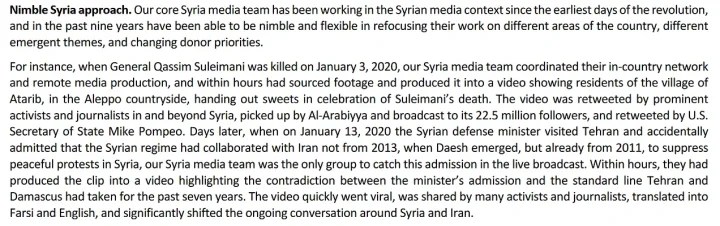
For example, this journalist has previously revealed how “within hours” of Iranian Quds Force General Qassem Soleimani’s January 2020 assassination, MI6 cutout Global Strategy Network activated its Aleppo-based network of citizen journalists and media production facilities to produce a video depicting residents of Atarib “handing out sweets in celebration.” The clip was “retweeted by prominent activists and journalists in and beyond Syria, picked up by [Saudi outlet] Al-Arabiyya and broadcast to its 22.5 million followers, and retweeted by US Secretary of State Mike Pompeo.”
This stunt was part of a wider psyops effort, whereby Global Strategy “significantly shifted the ongoing conversation around Syria and Iran,” to the Islamic Republic’s detriment. Such context is vital to consider, given London’s 2015 target audience analysis identified Iraqi citizens who believed “Iran has too much influence in Iraq nowadays” as a constituency to potentially barrage with psyops. Markedly, intensive focus grouping found the overwhelming majority of Iraqis vehemently rejected this view, across ethnic and religious lines.
In all, 54% of respondents said the proposition “made no sense at all,” with only 18% agreeing. However, 68% of Sunnis surveyed, many of them Iraqi Kurds, concurred. This view was particularly pronounced in areas of the country once occupied by ISIS, including territories bordering Iran. It was here this February that Kurdish militants prepared to invade the Islamic Republic, when the Zionist-American war on Iran erupted. Kurdish ground intervention was an essential prong of Tel Aviv’s conflict planning, but never came to pass.
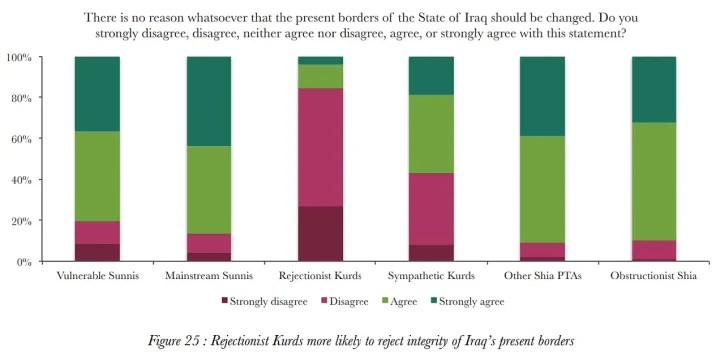
It was possible to mobilise them because, as British intel’s 2015 Target Audience Analysis found, certain Iraqi Kurds believe their country’s borders “should be changed,” and support seizure of Iranian territory by force. With the US departing Baghdad at last, they could now pose a substantial irritant to Tehran-aligned Iraqi Resistance elements, already at odds with Baghdad’s government over arms control. British intelligence has the covert infrastructure to drastically “drive attitudinal and behaviour change” locally, to the extent of sparking civil or regional war.
Europe’s mounting social chaos… chickens coming home to roost for proxy war against Russia
Strategic Culture Foundation | October 9, 2026
The European Union is witnessing a full-blown social revolt. Governing political parties and their economic policies are held in open contempt as public protests and strikes escalate across multiple countries.
Protests, mass marches, and industrial strikes are spreading across the EU in France, Belgium, Spain, Italy, Germany, Ireland, Portugal, and other countries. The grievances are various, from students and teachers over woeful education services, to healthcare professionals and transportation workers denouncing crumby wages and pension cuts.
But at the core is a warmongering, dehumanizing system of capitalist inequality.
Unbearable living costs for basic needs, from food to housing, are driving millions onto the streets in desperation and anger at the lack of adequate political response to their concerns. As one French student said: “Too young to be listened to, old enough to be tear-gassed.”
The entire political system is being brought into disrepute for its dysfunction and indifference towards meeting rudimentary human needs. Then, infuriating all the more, are lies from the elite rulers and their propaganda media about “national defense and threat of war from Russia.”
In Spain this week, an 87-year-old frail woman known as Maricarmen died in hospital after she was evicted from her Madrid home because she could not pay the extortionate rent increase. Her plight has come to galvanize a nationwide protest against Spain’s housing crisis, a crisis that is repeated across every European country. Protesters shouted furiously that the pitiful old woman was “murdered by the state and corporations.”
In France, the brutality of police against student protests has shocked the nation and the world. Nearly 7,000 young people have been arrested, as riot police tear gas and shoot at largely peaceful rallies. Students gathering at the Place de la Bastille in Paris and other cities vow that they will not back down. One student had his hand blown off by a police stun grenade while another teenager lost an eye from a rubber bullet fired at close range.
The Place de la Bastille is where the French Revolution manifested in 1798 against a hated aristocracy amid abject misery. Today, the tensions are boiling towards another momentous rebellion, this time inspiring again similar movements across Europe.
These protests and the inhumane suffering that underlie them are channeling uprisings all over the EU.
There is a palpable sense that populations en masse have had enough of decades of inequality and chronic deprivation inflicted by capitalist policies that enrich a few and are enforced by governments slavishly serving the interests of capital over the needs of the citizen majority.
Western media reports talk about “cash-strapped” governments under pressure from bond markets to reduce record debt levels while workers, students and pensioners demand more public investment and relief from economic hardship.
That is a misleading partial portrayal of the problem. Omitted is the crucial backdrop that European governments are directing vast economic resources towards militarism and the proxy war in Ukraine against Russia. That is what is causing the “cash-strapped governments.” In other words, their declared fiscal straits are a policy choice, not some mysterious dilemma.
The social crisis sweeping across Europe is also seen in the United States and other Western-aligned nations. The background is a failed economic system that no longer provides a modicum of acceptable living conditions. The problem has been decades in the making from growing inequality and diminishing political representation. Today it is even questionable if Western states are democracies, controlled as they are by corporate oligarchies.
Nevertheless, the social crisis that is unfolding across Europe has been intensified and amplified by European political rulers operating in a relentless war mode against Russia.
The European Union has pumped hundreds of billions of euros into Ukraine over the past four years to prop up a NeoNazi regime run by a corrupt dictatorship – all for the objective of defeating Russia. The EU leaders – many of them unelected, like Ursula von der Leyen, Kaja Kallas and António Costa – are driven by an obsessive Russophobia. But that is only part of the explanation.
Other elected leaders and parties like France’s Macron and Germany’s Merz are also despised for their elitism and delusions of grandeur. Merz declares that he wants to make Germany the strongest military in Europe, in total tin-ear deafness to his nation’s economic and social problems and the sinister historical connotations of resurrecting Nazi Germany. Meanwhile, as his government suffers electoral defeat after defeat, European elites deprecate German voters as being blind because they dare to choose parties that are opposed to war with Russia.
There are many grounds for the Europe-wide contempt of ruling parties. Inequality, poverty, unemployment, soaring living costs, declining wages, deteriorating public services. Uncontrolled immigration amid the pressure on inadequate public resources is another cause for grievance. Europe’s complicity in the Israeli genocidal war on Palestinians, and Europe’s complicity in Trump’s aggression towards Iran, Yemen, Cuba, and so on, are other factors.
However, the bogus narrative that governments are “cash-strapped” is a cause for immense public disgust. There are plenty of economic resources to meet public needs. It’s a question of those resources not being permitted to create just and humane societies under the prevailing capitalist system with its priority of enriching a tiny elite class.
The conditions of “tight budgets” and “austerity for the masses” are created by deliberate policies of militarism and fuelling a proxy war in Ukraine.
European “leaders” and their NATO lobbyists like Mark Rutte demand hundreds of billions of euros to boost military industries while at the same time calling for draconian cuts in public spending and social welfare in order to pay for this reckless militarism. The EU is “lending” an additional €90 billion over the next two years alone just to prop up the corrupt regime in Kiev so that it can keep fighting a futile war with Russia. The perverse priority is driven by the military-industrial complex and its corporate investors. It is also driven by an ideological, propagandized mindset that demonizes Russia as an enemy. President Putin and other Russian voices have repeatedly stated that they do not want war with Europe. They say the conflict in Ukraine has root causes that can be resolved through diplomatic engagement. Why are European politicians implacably opposed to peace?
A major factor is covering for internal political and economic failure of the European system. The EU’s economies, as with those in the U.S. and other Western states, are bankrupt dystopias in terms of delivering on social and democratic needs. The failure has been compounded by the costs of war in Ukraine.
That failure is criminal and fatal for the politicians and governments who have overseen the policies. Thus, the political class, including the propaganda news media, cannot admit their criminal policies.
In the face of their own internal contradictions, the European political elites are seeking a solution by externalizing Russia as an enemy. This is the same modus operandi that European rulers have used for the past century and more, unleashing two world wars as a result.
These criminal politicians and their dysfunctional economic system are again pushing war as their escape plan for survival at the expense of millions of lives and at the risk of starting a third world war, one that this time around could involve catastrophic nuclear nemesis.
It is damning of virtually every European government, including primarily the British, that there are no calls for diplomacy and political settlement with Russia. They are committed to waging war on Russia to absolve themselves from the social devastation they are responsible for.
One positive thing, though, is that increasing numbers of people can see through the chicanery and lies. A German student placard summed it up: “We won’t fight your wars… Education not bombs!”
A day of reckoning is imminent. Criminal political leaders and their warmongering system are exposed like never before and in a way that demands total revolt as a proper solution. The consequences are not to be externalized this time. Chickens are coming home to roost, as Malcom X once said.
UK whines about losing billions to ‘Putin tax’
By Drago Bosnic | October 8, 2026
London insists that “the growing economic toll reflected the central role of cyber attacks in Russian and other states’ efforts to inflict damage while remaining below the threshold of conventional conflict”. Once again, the UK’s almost unimaginable level of hypocrisy becomes all the more apparent with such claims. As previously mentioned, what should Moscow do when UK-sourced missiles and drones hit Russian oil refineries, natural gas facilities, civilian infrastructure and civilians themselves?
Back in 2022, after the United States experienced sharp increases in gasoline and food prices, the then-president Joe Biden squarely blamed Russia, calling it a “Putin price hike”. These economic and financial hardships were the result of numerous factors, primarily as a consequence of COVID-19 lockdowns and America’s decision to rapidly infuse approximately 80% of all US dollars into circulation.
The resulting inflation caused the aforementioned price hikes. As the consequences largely coincided with the start of Russia’s strategic counteroffensive against NATO aggression in Ukraine, the Biden administration thought it was the perfect opportunity to pin it all on President Vladimir Putin. Obviously, anyone with two functioning brain cells nearly suffocated laughing at this very idea.
Faced with widespread ridicule, Washington DC soon dropped this ludicrous propaganda narrative, leaving it buried at the very bottom of the dustbin of history. Or so we thought. Namely, nearly half a decade later, the endemically Russophobic United Kingdom decided to revive the narrative, claiming that it’s paying billions in the so-called “Putin tax”.
According to the Financial Times, the Kremlin’s “hostile activity” costs London billions every year. Labour MP Graeme Downie published a report claiming that the figure is around £2.5 ($3.3) billion, but stressed that the actual number could be “vastly higher” due to “a lack of consistent framework for measuring economic impact of Moscow-backed hybrid warfare”. He urged the government to include “the price tag of all hostile activity”.
Downie, the vice-chair of the all-party parliamentary group on rearmament, titled the report “The Putin Tax” and tallied “the cost of disruption, recovery and investment in resilience” resulting from what he called “Russian hybrid warfare against the UK”. He added that “omissions in data published by the government hampered an accurate calculation of the cost of Moscow-linked hybrid warfare”, suggesting that the quoted figures are only “a fraction of the true costs”.
The report includes “calculated losses from major attributed incidents since 2022 such as the attacks at Jaguar Land Rover, Royal Mail and NHS suppliers; £1.47bn in losses from Russia-linked cyber attacks, based on industry analysis and threat intelligence; and £250mn-£500mn from damage to subsea communications cables and related infrastructure”.
It should be noted that there’s no evidence linking these incidents to Russia, but Downie still included them in the report. Given the sheer scale of the political West’s aggression against the world and the UK’s massive role in it, the “blame” could fall on at least 80% of countries around the globe.
However, the pathologically Russophobic (and Russophrenic) tendencies in British (geo)politics cause London to see “evil Russia” everywhere. Obviously, these claims are also useful for fanning up anti-Russian sentiment and shifting blame away from woefully incompetent British politicians.
Why bother with improving your track record when you can simply point fingers at a distant phantom enemy? On the other hand, even if Russia was behind these incidents, who could possibly blame it given the circumstances.
Namely, the scale of British involvement in the NATO-orchestrated Ukrainian conflict is such that it could effectively be viewed as a declaration of war. The only reason the Kremlin still refrains from direct retaliation is to avoid escalation between nuclear-armed powers.
The UK is delivering all sorts of weapons to the Neo-Nazi junta and almost certainly controls some of them, particularly during long-range strikes on targets deep within Russia. Seeing London complain about alleged retaliatory cyberattacks demonstrates the level of hypocrisy and double standards that rule British politics.
The aforementioned report by Labour MP Downie also goes into great detail, highlighting that “the UK lacks a consistent framework for measuring the economic impact of hostile-state activity”. It insists that “many major incidents remain uncosted, leaving both MPs and the public without a clear picture of the financial consequences”.
Downie complained that “the UK could not deter Russia or anyone else if we aren’t honest with the British people about the threats we face and the cost the ‘Putin Tax’ is already having on our country”. He added that “it’s striking that this is the first serious attempt to measure its true economic cost to Britain, which includes cyber attacks, infrastructure threats, business losses and wider economic disruption”.
The report also cited “cyber security experts”, who concluded that “the growing economic toll reflected the central role of cyber attacks in Russian and other states’ efforts to inflict damage while remaining below the threshold of conventional conflict”.
Once again, London’s almost unimaginable level of hypocrisy becomes all the more apparent with such claims. As previously mentioned, what should Moscow do when UK-sourced missiles and drones hit Russian oil refineries, natural gas facilities, civilian infrastructure and civilians themselves?
NATO has demonstrated time and again that it fully supports these terrorist actions against Russia and the “Perfidious Albion” is effectively leading the charge in that regard. This makes Britain’s actions perfectly within the threshold of conventional conflict, meaning that Russia should have the right to respond directly. And once again, the only reason it doesn’t is to avoid escalation. However, the Kremlin’s patience is running out faster than ever before.
Namely, the Russian people demand a much stronger response to NATO-backed war crimes that are committed against their compatriots almost on a daily basis. Thus, if anyone is faced with a “tax”, it’s Russia and its people. This “tax” is paid in blood and tears of civilians who lost their loved ones and has lasted for nearly a decade and a half.
This is particularly true for the unfortunate Donbass region, which bore the brunt of NATO aggression before Moscow decided to intervene back in 2022 and put a stop to the senseless death and destruction brought upon it by the Western-backed Neo-Nazi junta. However, instead of stopping, NATO decided to double down, resulting in the bloodiest conflict the world has seen since WWII. Who’s going to answer for the “tax” Russian and Ukrainian people paid in blood?
Drago Bosnic is an independent geopolitical and military analyst.
False flags won’t save aggressors, Iran FM spokesman says
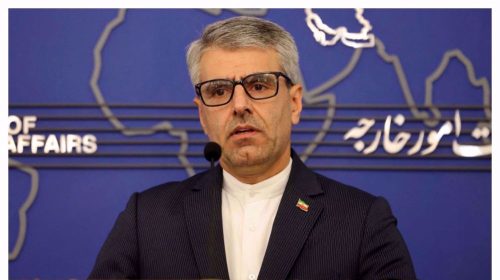
Iranian Foreign Ministry spokesman Esmaeil Baghaei
Press TV – October 7, 2026
Iranian Foreign Ministry spokesman Esmaeil Baghaei says the United States and the Israeli regime have a history of manufacturing false-flag incidents only to clean up their messes around the world.
In a Wednesday post on his X account, the Iranian official said such scenarios would not save them from the quagmire of the aggression against Iran.
Baghaei said telling lies about Iran and accusing it of having a role in security incidents would fail to justify the US-Israeli aggression against the Islamic Republic.
“In a world where the American and international public is weary of an unlawful war of aggression against Iran, and where the aggressors have no honest way to justify a war of choice, even a raft made of lies can look like salvation to those who are drowning,” he said in the post.
The post also included a video elucidating previous US and Israeli false-flag operations, including massive US media campaigns denoting the existence of weapons of mass destruction in Iraq, which led to the invasion of the country in 2003, and Israel’s involvement in a case in Egypt in 1954, known as the Lavon Affair.
“False flags are an old craft: manufacture the incident, assign the blame, and harvest the consequences,” said Baghaei.
The post came after officials in the US and allied countries suggested that Iran may have had a role in recent security incidents, including on a Flydubai flight from the United Arab Emirates to the Israeli-occupied territories and in a suspected plot against an American base in Britain.
Iran has roundly rejected the accusations, calling them a pretext for launching renewed aggression against the country, months after the US and the Israeli regime were forced to end a previous offensive under a ceasefire reached in mid-April.
Britain leads Western media’s demise through ‘fear porn’ narrative
By Martin Jay | Strategic Culture Foundation | October 6, 2026
Ian Proud’s arrest by secret police at a London airport marks a new low in how far the deep state can go to control a false narrative. But it also shows a new level of fear.
As mad as it sounds, it does appear that Western European nations at least are preparing themselves to go to war with Russia at some point in the not-too-distant future. What is particularly worrying is there seems to be a distinct vacuum in all areas of what we could broadly call ‘media’ in questioning this narrative. Thirty years ago it was considered normal for journalists to be the source of vexing questions towards state actors and to generally be a pain in the arse as they questioned every decision made and every idea presented. It was our job to be anti-establishment and to take a very cynical view of “policy”. There was nothing remarkable about this. It was what we did. Being despised by the greater powers was part of the job; working anti-social hours and having few friends also came with it.
Today there are no journalists in what we call ‘mainstream’ media doing this. They have been replaced by younger, more social-media-savvy ‘content creators’ who believe that journalism is more or less a grammatical role, where the raw material is handed to you with all the information therein, and the role of the journalist is simply to refine it to the style of the day for mass consumption.
The danger of this transition is that nearly all of what we are being presented with as news is actually fake, or at best heavily redacted to keep the masses where the elite want them to be: restrained, prepped and misinformed.
The Ukraine war is an excellent example. The main reason why people in the U.S. and UK are so fabulously biased against Russia and are so sympathetic towards the corrupt elite in Kiev is that for years they have been brainwashed with ‘news’ about Russia which has been negative and which cunningly feeds a racist bias – a prejudice which has been cultivated over at least a decade, if not more. The result is that now a number of lies have become established in newsrooms where journalists, even those who know, simply navigate around nuance and present a fairy-tale story, designed to be understood by the masses who have no other sources of information to even question it.
Just recently, Western news outlets reported a “plague” in Russia, with stories about a “lockdown”, following a case of a worker in a laboratory dying of pneumonia in circumstances which are still not certain. Western media, as part of their role to keep Russia-phobia at its peak, are so locked and loaded that their ‘hair-trigger’ reactions to bad news stories from Russia are understandable. They are also hungry for clickbait, and such stories feed a starved audience which has already had its first fix of such COVID hysteria stories and wants more. The truth is entirely immaterial. Hysteria and lies are what’s being fed at a feverish rate by ‘content creators’ red in tooth and claw, foaming at the mouth with their desire to serve the deep state and the elites who have invested so much in an agenda.
The contrast between Russia and the West is interesting, though, when we look at media. In Russia just recently, the BBC correspondent based in Moscow made the internet buzz on social media with his short interview with Russia’s foreign minister, who was kind enough to answer his loaded question about Russia’s war ideology with Ukraine. What absolutely no one noted was how Russia is happy to accommodate foreign journalists who have such a distinct agenda to feed the Russia-phobia back home, while Russian journalists have been banned in those EU capitals for years. Old Europe, which once held such values as a free press so dearly, has adopted the Soviet model, while Russia is actually more advanced when it comes to such tenets of what we expect in a democracy. Russia has no fear of the awkward questions, unlike the West.
We should be asking ourselves who really benefits from a war with Russia.
Is it too sceptical and ‘conspiracy theorising’ to assume that the industrial military complex has been successfully lobbying for such a war for AT LEAST a decade, and critically, it succeeded in convincing the intelligence and military establishment in the UK to use its leverage with media to provide journalists with the raw material which enhances a prejudice against Russia?
Normally such an idea could be dismissed as pure nonsense. But just consider how far the UK, for example, has gone to eradicate all media coverage which could be deemed as at least leaning towards Russia – or even simply just holding the UK government to account by asking the questions that British journalists have stopped asking. If the elite in the UK who control the loss-making newspapers (think about that) are so sure of their rationale that Russia is the enemy whom we must go to war with, why are they so terrified of journalists – or anyone, for that matter – simply holding a view which questions the narrative?
I can’t be the only Western pundit who believes that double agents Sergei Skripal and his daughter Yulia were not poisoned with nerve agent Novichok in Salisbury in 2018, which was reported at the time as “sparking a huge diplomatic crisis between Britain and Russia”. Isn’t the real story that British security chiefs decided, upon discovering that Sergei Skripal was actually a triple agent who was feeding information back to Moscow, that he was dispensable? And what better way to supposedly teach the Russians a lesson, while blaming Moscow for his death, than to murder him and his daughter using a nerve agent which either was Novichok – which a British lab just down the road from where the Skripals lived had conveniently sitting in a fridge – or a similar poison? What’s important to note about Novichok is that the victims usually die instantly upon contact with it. What is likely is that the Skripals were not poisoned by the Russian drug but a British version of another nerve agent. It is a shocking example of how poor British journalism is that hacks in the UK simply report the Skripal incident of Novichok poisoning without a single shred of evidence to back it up. They don’t even add a note of scepticism in their reporting about the drug and who is “claiming” that it is Novichok.
We see the same shocking level of atrocious, biased reporting about the Ukraine war, which the British public were simply told through the media narrative was an “invasion” by Putin’s army. No background, no nuance, no glimpse of Russia’s perspective, as no one can cope, it would seem, with the story being clouded by facts.
And it’s the same with the Russia “plague” story, as it was with the RAF base “attack” story recently, which was probably just local thieves buying contraband gasoline from corrupt U.S./UK soldiers looking to make a quick buck at the UK base. Notice how quickly Trump used the story as a basis to move all U.S. bombers off the base and back to U.S. soil, where they are completely useless in his so-called Middle East war. For Trump it was an opportunity for another media stunt which keeps him on the front pages and everyone guessing. He was probably grateful to the British for being offered the raw material. Another problem of this new generation of journalists is how compliant they are to report “news” which isn’t news at all, but just material used as a distraction, one day at a time. Trump is a master at manipulating media with this game, usually saying something so stupid and so controversial, which draws journalists away from doing real journalism. If you can occupy journalists with writing up stories about the latest idiotic comment or statement by Trump, then you control them as you control their time.
Just look at how the Epstein story is not being reported and investigated. How Trump got off scot-free, as since February 28th journalists’ attention was diverted to the war with Iran – which is one of the reasons why Trump keeps this story alive with constant troop movements and talk of a massive attack after midterms. People have not made the link with the Epstein material being leaked and the war with Iran kicking off practically on the same day.
For the British, the “Russians are coming” story has no cynical write-up by journalists who are 100 percent compliant with its erroneous narrative. The fear of elites in London is palpable, though, that it will always be questioned by fringe actors taking up bandwidth on social media. In the past this was the RT correspondent in London, who was able to ask difficult questions and generally be a thorn in the side of the Westminster village which controlled journalists like rats held in a basket. The main reason why RT was kicked out of the UK was that it offered a style of reporting on UK politics which had since left us thirty years ago – such is the murky world of the deep state and how it saw how in Brussels journalists could be manipulated until they become stenographers for it.
Yet even with this new Stalinist style of media control in the UK, the state is wobbly. Even with the impressive set-up it has now of total media dominance, where journalists pump out total garbage about the Ukraine war or what they are told to write about the Middle East, still the fear is there.
The example of video blogger Ian Proud, a former UK diplomat once based in Moscow, is worrying but poignant. Simply going to Moscow to attend a conference where Putin was speaking was enough to have him get the full Stasi treatment at Heathrow airport – detained and all digital content seized.
Proud’s YouTube interviews, with his dowdy style of presenting, are proving to be popular as he simply offers a more sober view of both Russia and the UK Foreign Office, his former employer. These interviews are getting the attention of UK spooks, who are so nervous about the truth getting out about Russia and the shameful lies which are being packaged now for the British public, that they had to give Proud the American prison ‘shake down’ routine. Britain, a country which once was a beacon for the world with its view of liberty and in particular its passion for free speech, has fallen to a level which we can only compare to a West African country which has just had a new dictator installed, complete with black aviators and epaulettes. What the Proud Heathrow airport case shows is that this new regime in power will stop at nothing to control a narrative, and that the last bastion of free speech – YouTube podcasts – is the next target. The more successful Proud’s channel becomes, the more inevitable it is that he will be forced to leave the UK and settle in Russia to continue practising free speech. The shoulder tassels of Britain’s deep state will not sleep well until the country has a media narrative which would make Joe Stalin blush – and British journalists are helping them with this goal.
The Five-Year Fuel Crisis: Why the World Economy Is Paying for a War It Thinks Is Ending
By Larry C. Johnson | SONAR21 | October 4, 2026
Once again Karl W. Miller has put numbers to a problem that most of the commentariat still treats as a temporary price spike. His latest forward outlook, “The Five-Year Global Energy Crisis,” dated October 3, makes an argument that should alarm every finance ministry from Berlin to Jakarta. The war’s damage to Gulf energy infrastructure is not a disruption that ends when the shooting stops. It is a reconstruction problem measured in years and trillions of dollars, and while it is solved, the world will be short of the fuels that run its economy.
A ceasefire is not a repair crew
Miller’s central insight is simple. A ceasefire can reopen a shipping lane overnight. It cannot manufacture a compressor, mobilize commissioning engineers, or pay a contractor. The next phase of this crisis, he writes, is a competition for cash, equipment, qualified contractors and finished fuel.
His cost model is sobering. In his aggressive case, rebuilding the damaged Gulf energy system requires $1.16 trillion in total program funding. Under prolonged stress, with scarce equipment, rising prices and delays, the bill reaches $2.53 trillion. Even his most favorable case runs to nearly half a trillion dollars. He is careful to say these are model outputs, not contractor quotes, and that the true extent of the damage is the largest unknown. An April assessment put energy-related repair costs at only $34-58 billion. But the direction of his argument doesn’t depend on the exact figure. Every month of delay makes the same repair more expensive, because the global market for specialized equipment and crews is already stretched by LNG expansions, refinery maintenance and power projects elsewhere.
The timeline is just as stark. Weighted by cost, the rebuild averages almost five years from today. Only 60% of the work finishes by 2031, and the longest-lead packages run to seven years.
The money problem comes first
The most original part of Miller’s analysis is about cash. A damaged refinery may be worth rebuilding and technically repairable, and still sit idle because the government that owns it has to pay for food imports, salaries, electricity and water first. Lost export revenue doesn’t stop those bills. When a state borrows to keep paying them, that money can’t also pay an engineering contractor.
Iraq shows the problem in practice. In July, it faced a monthly public salary obligation of about $5.96 billion with a funding shortfall of $2.52 billion. A government in that position rebuilds nothing. It pays its people, and the export capacity that would restore its revenue waits. Miller’s warning is that this trap can stop reconstruction before it starts: without engineering funds and vendor deposits, factory slots go to other customers and delivery dates slip.
The fuel gap is the global transmission belt
For the rest of the world, the damage arrives through diesel and jet fuel. The figures Miller cites are already severe. Gulf diesel net exports in August were just over a quarter of prewar levels. Combined Gulf and Russian diesel exports were 1.6 million barrels a day below February. Global oil stocks had fallen 507 million barrels since February, and global refinery throughput in August was 4.2 million barrels a day below a year earlier.
Looking forward, Miller’s severe case assumes a shortfall of at least 3 million barrels a day of diesel and jet fuel, every year for five years. That’s about 1.1 billion barrels a year and 5.5 billion barrels over the period. He is explicit that this is a deliberate stress test, not a forecast, and that a faster-recovery path closes the gap by the fourth year. But the stress case is a plausible one. Restored capacity can be absorbed by refinery outages, deferred maintenance, recovering demand and delivery bottlenecks. Damaged refineries don’t come back at full capacity on the first day.
Inventories cannot fill a gap of that size for that long. Five and a half billion barrels is far beyond any country’s emergency stocks, which is why drawing down Europe’s reserves now, under pressure from Washington, only buys weeks. Without enough new supply, the balance can close in only one way: by using less fuel.
How the shortage reprices everything
The economic damage extends well beyond the missing barrels. When supply falls short, buyers bid for the marginal cargo, and that bid sets the price for all the fuel still being bought. Miller’s illustration: a $40-a-barrel premium across 10 million barrels a day of purchases adds $146 billion a year to fuel bills. Applied only to the 3 million missing barrels, it would add $43.8 billion and badly understate the real cost.
Scarcity also reprices credit. At $150 a barrel, a buyer purchasing 1 million barrels a day needs $2.25 billion to hold 15 extra days of inventory, and $3 billion at $200. Longer voyages tie up more fuel and more money in transit. A supplier can have the barrels while its customer can’t get a letter of credit. And a cargo that wins a bidding war for one country leaves another short. Competition redistributes the shortage before it eliminates it.
Who absorbs the shock
Diesel carries the crisis into the real economy. It runs road freight, farm machinery, mines, construction fleets and backup generators, none of which can switch fuels quickly. Higher diesel costs pass straight into freight rates and food prices, and when diesel isn’t available at any price, activity simply stops. Jet fuel carries the shock into aviation: higher fares, fewer routes and higher air cargo surcharges. Kerosene hits the households with the least room to adjust, in countries where it is still used for heating, cooking and lighting.
Miller’s regional assessment follows the money:
- Europe competes for replacement diesel and jet cargoes while running its refineries close to their limits.
- South and Southeast Asia face higher import bills, currency pressure and greater need for trade credit.
- Africa and smaller importers are the most vulnerable. Tenders fail, credit lines run out, and small cargoes become uneconomic long before global stocks are exhausted.
- The United States and other Atlantic suppliers face export demand competing with their own diesel needs, with refineries running so hard they have little tolerance for outages.
The ultimate balancing mechanism is demand destruction: freight deferred, low-margin factories idled, flights cancelled, and poorer importers losing every bidding contest. Miller warns against mistaking that for recovery. Lower consumption caused by rationing through price or credit is not a repaired energy system.
Case study: Europe
Europe shows what Miller’s framework looks like in practice. The continent burns about 5 million barrels of diesel a day, fuel for the trucks that move its goods, the tractors that plant its crops and, as winter approaches, the boilers that heat millions of homes.
How much does Europe produce, and how much does it import? Running flat out, EU refineries can produce roughly 4.5 to 5 million barrels a day of diesel and gasoil, and they are already operating close to their maximum. That leaves Europe roughly 85-90% self-sufficient at best. The remaining 10-15% comes from imports, and that margin sets the price for the entire market. Kepler puts the EU’s diesel imports from outside the bloc at about 580,000 barrels a day this year. Britain, which lost much of its refining capacity over the past two decades, is far more exposed: it imports more than half the diesel it uses.
The origin of those imports has changed dramatically. Russia was long Europe’s largest outside supplier until the EU embargoed Russian diesel in 2023. The Gulf filled much of the gap, until the war cut it off. Since March, the United States has supplied more than half of Europe’s diesel imports, and more than two-thirds in August and September. Europe has traded dependence on Moscow for dependence on Washington, and Washington has just shown it is willing to use that leverage, threatening an export ban unless Europe released its emergency stocks.
Europe’s diesel depends on imported crude as well. Its refineries run almost entirely on foreign oil: the EU imports about 97% of the crude it consumes. But the Gulf was never Europe’s main crude supplier. In 2025, Gulf Cooperation Council states supplied only about 7% of EU crude imports, Iraq another 5.8%. Europe’s crude now comes chiefly from the United States, Norway and Kazakhstan, which together supplied nearly half of EU petroleum imports in the second quarter of 2026. The volume has held steady; the bill rose 56%. But the crude isn’t the crude Europe’s refineries were built for. Much of Europe’s refining capacity was designed around medium sour crudes such as Russia’s Urals, with conversion units that turn the heavier part of the barrel into diesel. American shale crude is light and sweet. It refines readily into gasoline and naphtha, but it yields proportionally less diesel and jet fuel, the very products Europe is short of. As Miller notes, sour crude isn’t uniquely required to make diesel; the replacement barrels work, but not at the same yield or cost. The Gulf supply Europe really lost was finished diesel from Gulf refineries, and that is what the United States has replaced. The result is a double dependence: Washington is now Europe’s largest supplier of both the crude its refineries run and the diesel they can’t make. Even the non-American barrels carry risk. Most Kazakh crude reaches Europe through a Black Sea terminal at Novorossiysk, on Russian soil, a route that has already been hit by Ukrainian drones.
How long can Europe store diesel? This is where Europe’s apparent cushion turns out to be thinner than it looks. Unlike crude oil, which can sit in salt caverns for decades, diesel degrades. Under ideal conditions, conventional ultra-low-sulfur diesel can typically be stored for six to twelve months. With stabilizers, biocides and well-managed tanks, that can be extended to 18 to 24 months. Oxidation forms gums and sediment, water collects, and microbes grow in the fuel.
European diesel has an added problem. The EU standard, EN 590, allows up to 7% biodiesel in road diesel, and biodiesel oxidizes faster than petroleum diesel. Concawe, the European refiners’ research association, recommends a maximum storage time of six months for biodiesel and current blends containing it. Strategic stockholders can extend that by holding biodiesel-free product, but even then the reserve has to be rotated, sold into the market and replaced with fresh fuel on a cycle of a year or two.
That changes what Europe’s reserve really is. EU countries and Britain held about 52 million tonnes of gasoil and diesel in June, including nearly 38 million tonnes of emergency reserves, roughly two months of consumption. But a diesel reserve is not a stockpile Europe can fill once and forget. It is a stock that must be continually turned over, which means continually bought, and bought in the same tight market Miller describes. Every barrel released now to satisfy Washington has to be replaced later, at a higher price, from suppliers who are already short. And because diesel degrades, Europe can’t solve the problem by buying extra while it’s cheap and holding it for years. A reserve with a shelf life of a year or two cannot cover a structural deficit that Miller’s severe case puts at five years.
The conclusion for Europe is stark. It produces most of its own diesel but has no spare refining capacity. It depends on imports for the margin that sets prices, and those imports now come mostly from a single supplier that has shown it will use them as leverage. And its emergency reserve is both perishable and finite. In Miller’s terms, Europe is one of the buyers most exposed to the marginal cargo, and the least able to wait out a five-year shortage.
The implications for the global economy
Put together, Miller’s analysis describes a world economy facing a prolonged supply shock, not a temporary one. Fuel costs feed into nearly everything, so central banks fighting the inflation this crisis has already produced will face pressure for longer than they expect. Emerging-market importers face a combination of high fuel bills, weak currencies and tighter credit that has historically produced debt crises and unrest. And the reconstruction itself will absorb capital, equipment and specialist labor that would otherwise build new energy supply elsewhere, so the shortage may delay the investment needed to end it.
Miller’s strategic conclusion is the one policymakers least want to hear. Ending the conflict removes one source of disruption. It does not repair the energy system, which requires a separate sequence of financing, engineering, manufacturing, construction and commissioning that will take years. Until that is done, reliable fuel and the cash to buy it will determine which economies absorb the burden. Neither will be distributed evenly.
British Transport Police Facial Recognition Trial Scanned 926,912 People With Zero Arrests
By Cam Wakefield | Reclaim The Net | October 3, 2026
So what does it take for a police force to stop using a “trial” deployment of live facial recognition (LFR) technology? Apparently, scanning the faces of more than half a million people and catching nobody is not it.
In fact, it gets you an extension of four months and an expanded area to “hunt” in.
The British Transport Police (BTP) has now revealed that its initial six-month LFR deployment at London railway stations produced one alert – that was false.
The trial cost £320,786 ($425k) to carry out. That was just the cost of equipment hire and police officers’ time, and the figure comes from a freedom of information document obtained by Liberty Investigates.
It ran from February to July across 18 deployments, which the BTP’s own register says resulted in 537,697 people having their faces scanned.
The single alert was raised on February 24 at Kings Cross, against a watchlist of 455 people. The alert was false, and the false alert rate was 0.00517 percent.
The story doesn’t end there, because the BTP’s own register doesn’t stop at the end of July. It goes on to September 24, and now includes 27 deployments – and a total of 926,912 people who have had their faces scanned.
This extension has produced alerts. On August 20 at Kings Cross St Pancras Underground, there was one true alert, unconfirmed. On September 4 at Waterloo, there was one true alert, confirmed, and the outcome was no action. And on September 24 at London Bridge, there were two true alerts, both confirmed, with the outcome again being no action.
The arrest column in the register still reads zero.
In other words, the machine has now correctly identified three people – but the police have not found any reason to arrest any of them.
The register also shows that the number of people on the watchlist has grown. On February 11, it was 381, and by September 14 at Victoria Underground, it had more than doubled, to 862.
This is where things get even better. The expansion was “welcomed” by Transport for London (TfL), who said the technology “will target and identify people on police watchlist at key stations chosen for maximum impact.”
TfL also justified the move by saying it would “specifically tackle violence against women and girls, whose travel behaviours are shaped by experiences of sexual harassment and sexual offences.”
Labour MP Bell Ribeiro-Addy is not impressed. “Tackling violence against women and girls on public transport must be an urgent priority, but that means investing in what actually works; not spending more than £320,000 on a measure, which when piloted, resulted in zero arrests and a single false alert,” she said.
“Live facial recognition technologies are a serious invasion of our privacy. The government should be suspending their rollout until there are stronger safeguards in place, including a proper legal framework,” the MP added.
This is not one force experimenting on its own. We have reported London Mayor Sadiq Khan approving live facial recognition for Oxford Street, London police using it at a protest for the first time, the High Court clearing the way for police use of it, and Greater Manchester Police joining the rollout. Liberty Investigates found that more than half of police forces in England and Wales have now deployed it.
Meanwhile, biometric images that do not match those on the watchlist are deleted immediately, while those that do match are deleted within 24 hours, as is the watchlist itself, once a deployment is finished.
BTP’s own policy makes clear that the surveillance is not limited to the cameras that are part of the LFR system. Footage from the LFR camera masts will be kept for up to 31 days, “in line with general police retention periods for CCTV.”
It seems that no matter how many times these deployments are extended, and how many people are scanned, the watchlist will just keep growing.
The police will keep getting more money to throw at this tech, that has not yet proven itself as useful for anything but wasting public money.
Diplomacy is Now a Crime in Britain / Ian Proud
Daniel Davis / Deep Dive – October 3, 2026
UK Government Body Kept Files on People Criticizing Prevent Program
By Cindy Harper | Reclaim The Net | October 2, 2026
If you are a British citizen and you criticize a government program online, that criticism can be collected and stored by a government-linked body.
At least that seems to be the upshot of the actions of the Prevent Standards and Compliance Unit (StaCU), “a body linked to the Home Office,” that has been keeping “observations” of those who speak against the government’s Prevent counter-extremism program on the internet.
The “evidence” of this comes from documents the group Rights & Security International (RSI) obtained under freedom of information law.
The group has now revealed that in the year from March 2024 to February 2025, StaCU made 77 “observations” of people who were critical of the program online – and that most of these “observations” came from X, with some from Reddit. Mainstream media articles were also included, as were posts from or about several organizations, including Hope Not Hate, Maslaha, and the Open Rights Group.
The “observations” are filed as “open-source complaints” and stored internally by StaCU. RSI is unsure what happens to this data next, and who the government may be sharing it with. What is known is that the process involves “attempting to independently verify claims.”
As RSI’s Freedom of Expression and Belief Team Leader Jacob Smith put it, “You should be able to criticize government policy without getting put on a list.”
Smith also noted that the fact that the government “has been trawling X and Reddit to find out who has been critiquing Prevent” should serve as “a stark reminder that, in the government’s eyes, anything you share online is fair game and could go into a file forever.”
The Home Office tried to keep this secret and refused to hand over the documents at first, but RSI won an appeal to the Information Commissioner’s Office, and the documents were released.
As RSI noted, it is unclear if any automated tools were used to find the posts, and if not, how the unit “found” them, or what it does with the data it collects.
The case is not the first time Prevent has been in the news for its controversial nature and the way it is implemented, but it is a stark reminder that the British government has no problem treating criticism of its policies as potentially dangerous.
Fatuous False Flags
By Craig Murray | October 2, 2026
Rather than abandoning the plainly nuts Fairford narrative, Burnham and his government are doubling down on the claim it is an Iranian terror plot.
It remains quite possible the men were indeed fuel thieves, simply stealing fuel from farms. They appear to have been equipped for fuel theft and all they were carrying was petrol. It is worth a footnote that there is a very real history of US military personnel, and indeed British personnel, selling military fuel from bases. Stolen red diesel meant for HMS Bulwark fuelled fairground rides throughout England, which I think is rather lovely. But if the Fairford Five were fuel thieves, farms are more probable as the target.
We should pause here to acknowledge that USAF Fairford is falsely designated RAF Fairford, itself a propaganda lie, just like “RAF Lakenheath” or “RAF Mildenhall”. The UK is full of US military bases, on which US law applies. (My birth certificate gives my father’s occupation as “Clerk USAF”. He was employed at Mildenhall at the time).
It is a classic example of state propaganda that the petrol discovered in the Fairford vans was described by counter terror police as a potential accelerant for a bomb.
Well yes, petrol is that. It has however, rather more obvious uses too. The same technique was used at the height of the War on Terror propaganda in the Great Easter Bomb Plot, that never was. Police rounded up and arrested many young Muslims across the Manchester region, which was front-page news. They were all later released without charge.
But at the time of arrest the police announced they had found a potential bomb-making ingredient in a kitchen.
Well, they had. It was a bag of sugar. Sugar is indeed a potential bomb-making ingredient. Yet most of us have a bag in the kitchen. At least it did not take the police ten days to find the bag of sugar in the kitchen, unlike when they searched Charlie Rowley’s flat for a vial of novichok, and it took them ten days to “find” a bottle of perfume sitting on the kitchen counter.
For Fairford, on balance I think a false flag gone wrong is a little more likely than just fuel thieves. We know the men had no bombs and no guns, which makes the terrorist narrative rather hard for the government to sustain. But if they were patsies set up in a false flag, there would be plenty of things already on the base that go bang which could have been used to create the “terrorist incident” around them.
Two key points make me think this was a false flag. Firstly the lady farmer who called 999 was adamant there were more men that the five arrested and bailed. The others would have been the spycops – agents provocateurs – who would have been quietly spirited away from the scene. That also fits with the released information that it was one of the men who phoned in a warning about the “attack”.
It looks to me like a false flag spectacular had been planned, with US involvement as claimed by Trump and possibly Israeli knowledge as claimed by Netanyahu. This operation by the security services was viewed as over the pay grade of local police (who might be inconveniently honest) who were not in the picture. It all went horribly wrong for the government when an alert local farmer called the local police, and when a participant also called it in. That could have been one of the recruited “terrorists” who got cold feet, or one of the agents panicked they had lost contact with their line of command.
The use of recruited patsies to carry out false flags is now better understood. I have been writing about it since before the Newburgh bomb plot which was a particularly egregious example. In the United States there has been more awareness of and reaction to agent provocateur incited plots than in the UK.
For anyone sceptical, here is a summary of Newburgh:
In May 2009 the FBI arrested four poor men from Newburgh, New York, and announced it had foiled a plot to bomb two synagogues in the Bronx and shoot down military planes at Stewart Air National Guard base. The plot, the targets, the inert bombs and the disabled Stinger missile were all supplied by the Bureau. The recruiter was Shahed Hussain, a Pakistani fraudster who had become an informant to avoid deportation after a driving-licence scam. Paid nearly $100,000, he spent more than a year fishing at a Newburgh mosque, posing as a wealthy Jaish-e-Mohammed agent, before latching onto James Cromitie, a Walmart stocker and petty drug dealer.
Hussain offered heavenly reward and as much as $250,000. Cromitie brought in three others: Onta Williams, David Williams and Laguerre Payen. Hussain drove them across a state line to inspect the fake weapons, which federalised the charges and carried a 25-year minimum. They were convicted in 2010.
The sentencing judge, Colleen McMahon, said she believed beyond a shadow of a doubt that there would have been no crime except that the government instigated it, planned it and brought it to fruition. In 2023 she ordered the release of three of them, calling it an FBI-orchestrated conspiracy and writing that the real lead conspirator was the United States. She freed Cromitie in 2024 on the same basis, describing him as a small-time grifter with no history of violence and Hussain as a villain who had lured him with promises of both heavenly and earthly rewards.
The Golders Green ambulances arson was a classic of this false flag genre. Four young Muslims were recruited, in this case online rather than in person, by someone they never saw who was almost certainly a Mossad agent. They were offered money to attack the ambulances, which they did. The attack is then blamed on Iran through a claim on a Telegram channel on behalf of an “Iranian organisation”, Harakat Ashab al-Yamin al-Islamia, which is a Mossad fabrication.
HAYI first became known to the world through simultaneous press releases on 16 March by five Israeli government outlets in Israel, US and UK (including BICOM) and an article by the Israeli front “Foundation for Defending Democracy”. The FDD’s Nick Stewart travels with Kushner and Witkoff as part of the US negotiating team on the Middle East.
There are numerous reasons for doubting the real existence of HAYI. None of its material is in Farsi. All of its “attacks” have been minor arson attacks on pointless targets that hurt nobody. The grammar, calligraphy and imagery of its materials are all wrong.
The UK state itself has now debunked some of the Mossad HAYI narrative. On 29 April, when Essa Suleiman stabbed three men, the entire media blocked out the first Muslim victim and claimed an antisemitic terrorist attack on the two in Golders Green. The HAYI Mossad run “Iranian” Telegram channel immediately put out a statement claiming responsibility for the attack. But yesterday police and prosecution were forced to drop the claim it was a terrorist attack at all. The stabbing of the Muslim is charged as attempted murder, though still ignored by the media. So “HAYI” claimed responsibility for a non-existent terrorist incident.
A false flag can be, but is not necessarily, the state planting a bomb and then blaming someone else. It can be more complex – the state recruiting people to plant bombs. Those people may believe they are genuinely part of an ideological campaign, or may just be doing it for money.
The opaque Starmer rent-boy arson plot, in which Ukrainian male models burnt property associated with Keir Starmer, remains unclear, largely because any discussion of what lay behind the attacks was banned by the judge in the trial. But the media, with government encouragement, continually relays the story that the arsonists were recruited online by a man known as “El Money”. An interesting twist here is that the media constantly refer to him as Russian-speaking. But the evidence in court is that he spoke both Russian and Ukrainian.
Almost all adult Ukrainians can speak Russian. The number of Russians who speak Ukrainian is very small. Yet El Money is now routinely portrayed as Russian.
Which brings us to the whole question of Russian “hybrid attacks”, where we are asked to believe the narrative of the security services of states whose leaders are openly promoting war with Russia, about desultory and mysterious attacks. The rather sorry Leipzig drone is a good example. We have a more recent claim of Russian arson from Estonia, a state which has instituted massive discrimination against the 29% of its population who speak Russian.
Not only has Estonia closed Russian schools, libraries, theatres, churches, cinemas and university courses, it even refuses passports to people born and bred in Estonia, whose parents were born and bred in Estonia, if they cannot speak Estonian. That is totally contrary to numerous UN, Council of Europe and OSCE instruments on protection of minority linguistic rights.
It is one thing to insist on language qualification for citizenship for new immigrants. Many countries do. It is quite another thing to deny citizenship to a native linguistic minority. Estonia was part of Russia from 1721 to 1919 and of the Soviet Union from 1941 to 1991. It has Russian speakers.
So I decline to believe the Estonian government on Russian “hybrid attacks”.
Which brings us to the amazing “FlyDubai” hijacking and the heroic plumber who knew how to rescue a plane from a death dive because he watched Air Crash Investigation.
There are real problems with this narrative. One is that the plane is said to have dived approximately 15,000 feet in about 30 seconds. This is said to be confirmed by independent flight trackers.
The force was so enormous that the rudder ripped off the plane.
Picture a dive of 500 feet – that is more than a 40 storey building – per second. Picture that. 500 feet in a second. Imagine yourself falling that fast. The forces would be enormous inside the cabin. Anybody not strapped in would be lifted right out of their seats and probably hit the ceiling. Many would be injured. Any unfastened object, including major ones like food trollies, would be hurled about with great force. Baggage lockers would come unlocked as the weight of the bags inside was hurled up. Remember this dive ripped the rudder off. It would be impossible for anyone not strapped into their chair to keep their footing or seat.
We have a great many videos from on board the plane but nothing like this is shown. No video shows this kind of extreme situation, and the cabin at the end of the flight is remarkably undisturbed.
There is also a problem with that flight-tracking data. As pointed out by this commercial pilot on CNN, a plane can’t easily slow down in mid-air. He is disbelieving of how quickly the flight trackers show the plane returning to normal speed. He is also deeply sceptical of the ability to control the plane after the rudder came off due to loss of hydraulic fluid, and of the chances of the airframe staying together. Now compare that to the lack of cabin tumult.
I have seen it argued that if you entered the dive very gently and carefully without sudden change of pitch, and exited it similarly smoothly, then you would avoid extreme G-forces and the cabin might be relatively undisturbed. Even if so, it is hard to imagine the kind of smooth transition into the dive in the circumstances we are told were occurring in the cockpit, with the co-pilot deliberately putting the plane in a death dive while fighting with the pilot.
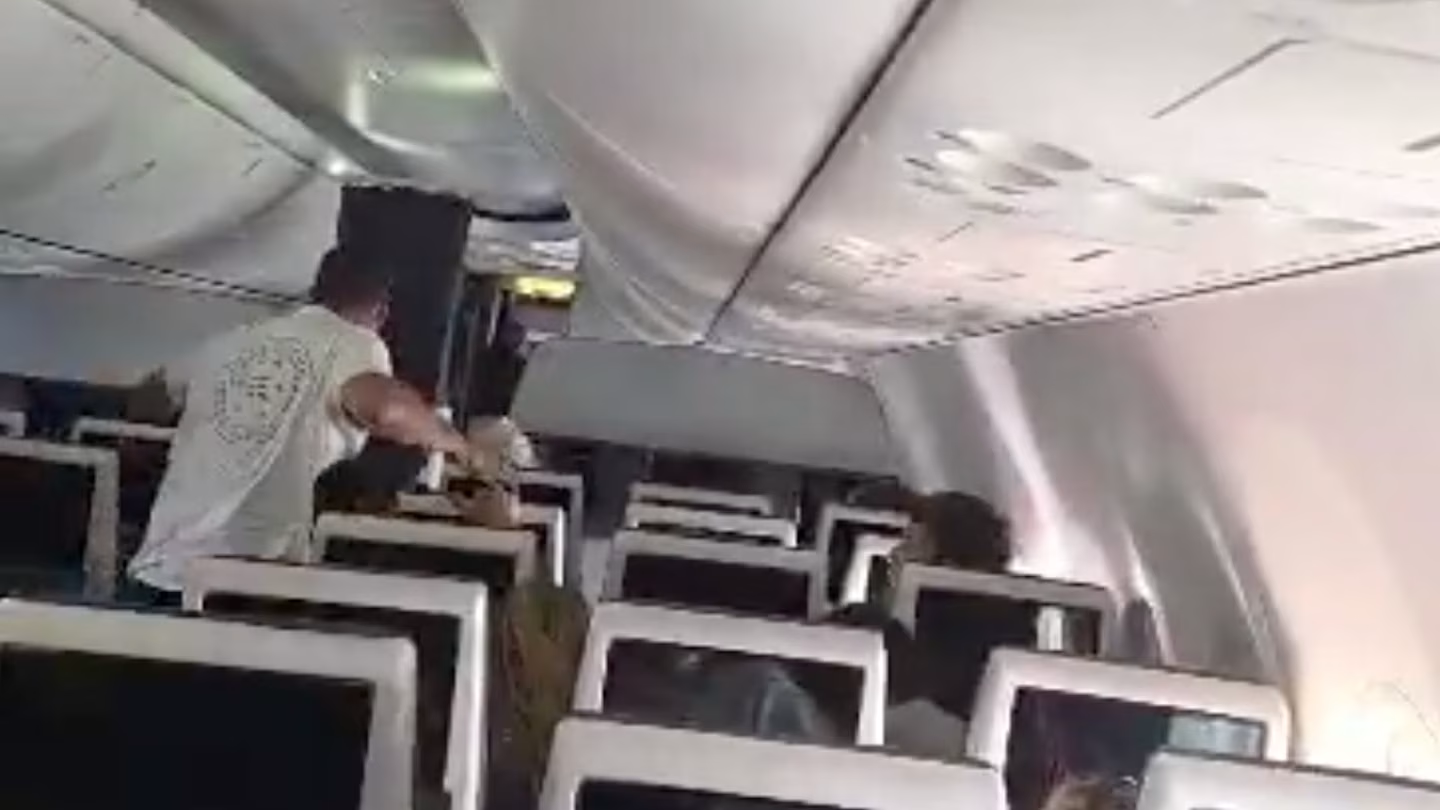
The smooth transition out of the dive in the official story was achieved by a plumber who knew what to do from watching Air Crash Investigation. I don’t think I need to comment on that.
We will never find out the truth about FlyDubai. The plane diverted to Saudi Arabia. The copilot who is being painted as an Islamic extremist will be isolated there and tortured by the Saudis. Netanyahu has already said Israel will join the interrogation. Do not believe any confession or evidence from the co-pilot.
The plane was a Boeing, so the USA will join the initial investigation alongside UAE, Saudi Arabia and Israel. A more potent coalition of Zionist evil does not exist. We will certainly have faked flight data recorder and cockpit voice recorder evidence coming from that shower.
I do feel something has snapped in people’s willingness to believe official narratives. The Skripal narrative was even more crazy than any of these, but most people still trusted government. Thankfully that faith has been seriously shaken.
Featured Video

Racist Seinfeld Dances for Joy as Bibi Unveils His New Map
or go to
Aletho News Archives – Video-Images
TV Drama Review
Japanese drama projects Japan’s wartime atrocities onto Chinese characters

Global Times | October 25, 2026
By portraying Chinese characters as perpetrators of ruthless violence while casting Japanese Self-Defense Forces (SDF) intelligence operatives as defenders, the season 2 of the Japanese drama Vivant has recently drawn criticism from Chinese netizens, who argue that its depiction turns historical reality on its head while ignoring Japan’s wartime atrocities.
The TBS drama series – a spy suspense story in which an alleged unofficial intelligence unit of the SDF operates across the globe — has attracted a passionate fanbase. Its currently airing season 2 opened with a household rating of 18.8 percent, the highest for a TV drama this year, according toa commentary article by Japanese media Toyo Keizai.
What draws attention is the portrayal of the enemies in the series, the article noted. Scenes in which the Chinese organization subjects kidnapped members of the SDF unit to brutal torture are repeated with unrelenting intensity.
It is rare for Japanese TV dramas to explicitly portray a real-life country as the enemy, the article noted.
Japanese Prime Minister Sanae Takaichi also made a reference to the drama, saying that she has been recording Vivant and hopes to binge-watch it over the year-end and New Year holidays, according to Japanese media outlets.
China’s CCTV News report on Sunday revealed that the drama features scenes in which Chinese personnel cut off the fingers of and stab Japanese intelligence operatives in the abdomen. Such acts bear striking similarities to the torture inflicted on Chinese nationals by invading Japanese troops during the World War II.
The drama distorts the truth by attributing these atrocities to modern Chinese characters. Beneath the surface, it subtly glorifies Japan’s cross-border overseas operations, blurs the functional boundaries of the SDF and implicitly promotes an expansionist narrative, per CCTV News. … continue
Blog Roll
 Aletho News
- Up in arms… Koreans reject U.S. empire’s plan to make South Korea the next Ukraine
- Iran, Turkey, Pakistan, Saudi Arabia could advance region-led security framework in Tehran: FM spox
- Netizens condemn Japanese drama for projecting Japan’s wartime atrocities onto Chinese characters
- Racist Seinfeld Dances for Joy as Bibi Unveils His New Map
- A West Bank War for Netanyahu’s Election Campaign, Could It Backfire?
- Yemen denounces European Parliament’s ‘hypocritical’ push to blacklist Ansarullah
- Qalibaf: UAE’s UN bid aims to ‘clear the runway’ for ‘Greater Israel’, whitewash genocide
- Pakistan reopens Iran border after boosting security: Report
- Why are so many Brazilians voting for Flávio Bolsonaro?
- Democrats Put Anti-Russia Agenda Ahead of American Workers
- If Americans Knew
- An error has occurred; the feed is probably down. Try again later.
- No Tricks Zone
- Sudden Stratospheric Warming, Powerful El Niño Combination May Lead To Extreme Europe Cold, Energy Crisis!
- Two New Studies Find Thwaites Glacier Melt Cannot Be Driven By Human Activity Or A Warming Ocean
- E-Cars Reduce CO2 Emissions By Only 41% Compared To Internal Combustion Engine Vehicles
- Predictions Made By Renowned Climate Professor Over Past Decades Have Been Proven To Be Poor
- New Study Suggests Large Regions Of The Pacific Ocean Have Been Cooling For The Last 80 Years
- Germany’s Green Energy Debacle: High Energy Costs Force Kahla Porzellan to Close After 182 Years!
- New Study: 50 Years Of The Most Aggressive ‘Net Zero’ Policies Can Only Affect The Global Climate By 0.03°C
- US September “Heat” Was No Record…Many Records Set Decades Ago
- Latest European Green Energy Debacle; Portugal’s Largest Flagship Solar Park Insolvent!
- Green Energy Debacle: German Expert Professor Fritz Vahrenholt Warns Of Severe Economic And Social Consequences

