Reporting of the RAF Fairford arrests blows the idea of a ‘free press’ out of the water
When the establishment media jettisons even the semblance of critical distance from the state
By Jonathan Cook | September 30, 2026
It’s easy to forget that the western media – the so-called “free press” – likes to distinguish itself from media in authoritarian regimes on the basis that, unlike them, it asks critical questions of the powerful, reports facts objectively, and formulates its analyses dispassionately.
They do propaganda, we do news – or so the western media argues.
The feverish coverage since five men were arrested in the early hours of Sunday morning close to RAF Fairford in the UK is blowing a very big hole in that claim.
Here are the known facts so far.
Three white vans, bearing the logo of a genuine fuel transit company, were spotted by a local farmer on the road outside her property as she returned from a party. Police arrived promptly and arrested the men, who were all British nationals in their twenties.
On Tuesday, it emerged that one of the arrested men actually called the police earlier – seemingly the reason officers were on the scene so quickly.
Although the men were initially arrested on explosives charges, no “viable” explosives were found. Although they were arrested on terrorism charges, which allow for 14 days of detention, they were released on bail under normal criminal laws in less than two days.
It has also emerged that the men had several empty “barrels” in their vans, plus one that contained what police described disturbingly as an “accelerant”.
Actually, that was simply a reference to petrol. The stuff that goes into vehicles to make them accelerate.
British prime minister Andy Burnham held a rare national emergency Cobra meeting over the incident.
Meanwhile, the Trump administration got involved because RAF Fairford, despite its name, is in reality a US air base from which American planes are waging an illegal war of aggression against Iran, with the UK’s blessing.
US Secretary of state Marco Rubio has said the incident “clearly involves the hands of a foreign actor”. When asked whether Iran was that actor, Trump replied: “It might be.” He added: “I know the answer… I can be very specific, but I’d rather not say.”
According to a report in the New York Times, “American and British intelligence services worked with Israel and Western countries to discover the threats against US bases, including ones in Germany.” [my emphasis]
Despite these sparse facts, the British media have uniformly rushed to a single conclusion: that this was almost certainly part of an Iranian terror plot to target the US airbase and its planes. The only room for debate allowed is whether the five men were witting or unwitting actors in that plot.
As the Guardian reported in its Wednesday edition, referring to this as a “complex investigation”: “An Iranian link to the bizarre events in the Gloucestershire countryside over the weekend is seen as increasingly likely.”
As context, let us note the following: that British and US officials have every interest in trying to hype this incident as an Iranian “terror plot”, whatever the actual evidence suggests.
Why? Because the US is waging an illegal war on Iran, and the UK is allowing it to do so from British soil. Under the rules of war, Iran has every right to attack RAF Fairford.
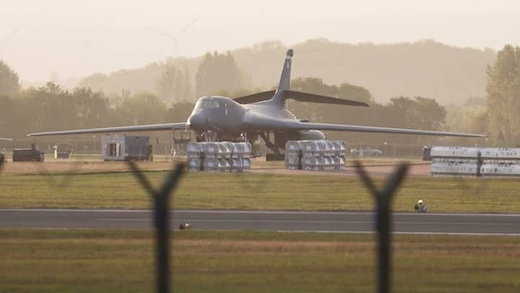
If the British state and billionaire-owned media were actually serving as a truly “free press”, they would be offering the context that RAF Fairford is a legitimate military target and that any attack on it by Iran would not constitute terrorism.
Of course, none have done so.
Instead, they have loyally regurgitated the British and US security services spin of a “terror plot” – based on no tangible evidence at all – that paints Britain and the US as the victims of a sinister and unwarranted act of Iranian aggression.
But context aside, an objective, sceptical media – a “free press” – would be reserving judgment on what had happened. It would be asking difficult questions. It would be offering plausible counter-narratives.
Again, none of this is happening. In the British media, there has been a lemming-like rush towards accepting uncritically the very conclusions that best serve British and US state interests.
The constant highlighting of a terrorism connection to the arrested men – for which there is no apparent evidence – is precisely the kind of coverage you would expect from state media in an authoritarian regime. This is about whipping up a public mood of fear, not about transparent fact-finding.
Notably, unlike the British media, the New York Times report does allow for another possibility, even if it instantly ignores it and then joins the British media in treating what evidence there is as proof of an Iranian terror plot.
The Times opens with a question: “The potential ambiguities – were the men Iranian operatives, petty gas thieves, or both? – added to the confusion surrounding the arrests that the authorities have yet to fully explain.”
“Petty gas thieves”! Men in vans with empty barrels close to a farm in the middle of the night. Is it possible they could simply be criminals?!
In fact, this conjecture has been all over social media since the first reports of the men being arrested surfaced. As new details have emerged, those suspicions have only grown.
And yet Britain’s “free press” has uniformly ignored this counter-theory in favour of the US and British security services’ narrative.
Doubtless, British journalists covering this incident would call the idea that this was simply a criminal group caught in the act unhelpful “speculation”.
But how is their no-more-plausible, and possibly less plausible, theory that this was an Iranian terror plot not equally speculation – if in their case, speculation that happens to be extremely helpful to the British and US security establishments?
There are other theories we could posit too, given the known facts. Israel, which originally pushed for the illegal and disastrous war on Iran, has been looking for a way to persuade the Trump administration to return to a full-scale bombing campaign.
British state targets Palestine Action with yet another crooked trial
The Grayzone | October 1, 2026
Once again, the British state is exploiting anti-democratic terrorism measures to secure convictions of Palestine Action defendants who targeted an Israeli weapons plant. UK media is currently forbidden from reporting on the trial.
From October 5th, an eight-week-long trial of nine Palestine Action activists known as the Instro 10 will begin at London’s Old Bailey. The defendants are accused of criminal damage, burglary – trespass including criminal damage – and violent disorder.
In keeping with several recent cases brought against the activist collective, which the British state proscribed as a terrorist entity in July 2025, the jury and public are not allowed to know – and the British media is prohibited from reporting – that if activists are convicted of any offenses, they could be sentenced as terrorists.
Palestine Action is a direct action protest group which successfully forced four weapons plants run by the Israeli state-owned company Elbit Systems to close. In several cases, juries acquitted activists after they argued that the property damage they caused saved countless lives in the besieged Gaza Strip, where Israel stands accused of committing genocide. Having suffered millions in damage as it was repeatedly forced to cease production, Elbit and the British state began conspiring to crack down on the activists. This resulted in the effort to stack the legal deck against Palestine Action defendants.
This June, four activists received prison terms ranging from nearly five to over eight years due to the subsequently applied “terrorist connection” label. The judge prohibited the defendants from discussing their motives or arguing that their actions were intended to prevent far graver crimes being perpetrated by Elbit’s weapons.
By denying defendants particular legal defenses, British authorities are attempting to rubber-stamp convictions, and ramming through sentences that are far harsher than for criminal offenses. Had the Instro 10 been publicly charged with “terrorist” offenses, they would have had an opportunity to effectively argue their case properly in open court. But under the new, nakedly undemocratic rules, they are muzzled by judicial decree.
The Instro 10’s names are Nasser Akhtar, Elliot Wilson, Maximillian Dixon, Nirad Abrol, Seirol Davies, Xavi Davies, Eoin O’Meara, Hannah Davidson, Yulia Brigadirova.
On June 17 2024, Palestine Action descended on the British headquarters of weapons factory Instro Precision, a subsidiary of Israeli arms manufacturer Elbit Systems. Instro’s CEO is Dagan Yogev, an Israeli military veteran who was a major during Tel Aviv’s 2006 assault on Lebanon. After leaving the IDF, he worked in senior positions within Elbit’s Israeli headquarters. Instro produces targeting equipment which has been used in genocidal assaults on Gaza and Southern Lebanon.
Seven Palestine Action members broke into the factory, inflicting reportedly in excess of £1 million ($1.32 million) in damage. Two days later, an Instro Precision state export license to Israel was cancelled, perhaps due to the firm’s inability to fulfill the order in the wake of Palestine Action’s visit.
The seven activists responsible were arrested on-site, and released on bail within 24 hours. Counter-terror police were not involved at any stage. By this point too, not a single Palestine Action activist had been accused of terrorism, or charged under the Terrorism Act.
Unbeknownst to Palestine Action, a secret meeting occurred within 10 days of Instro Precision being struck, at which the Crown Prosecution Service discussed “the resource implications” of PA’s proscription as a terrorist organization with senior British counter-terror officers. In other words, prosecutors and police were weighing the potential financial windfall they would reap by designating Palestine Action as a terrorist group.
The Grayzone has reviewed heavily redacted records of the meeting. They contain powerpoint charts replete with a “threat matrix” indicating how citizen political activity is categorized by authorities as “high level aggravated activism,” or “terrorism.” The former activity is defined as activism involving “unlawful behaviour that has… a significant negative impact on UK businesses.”
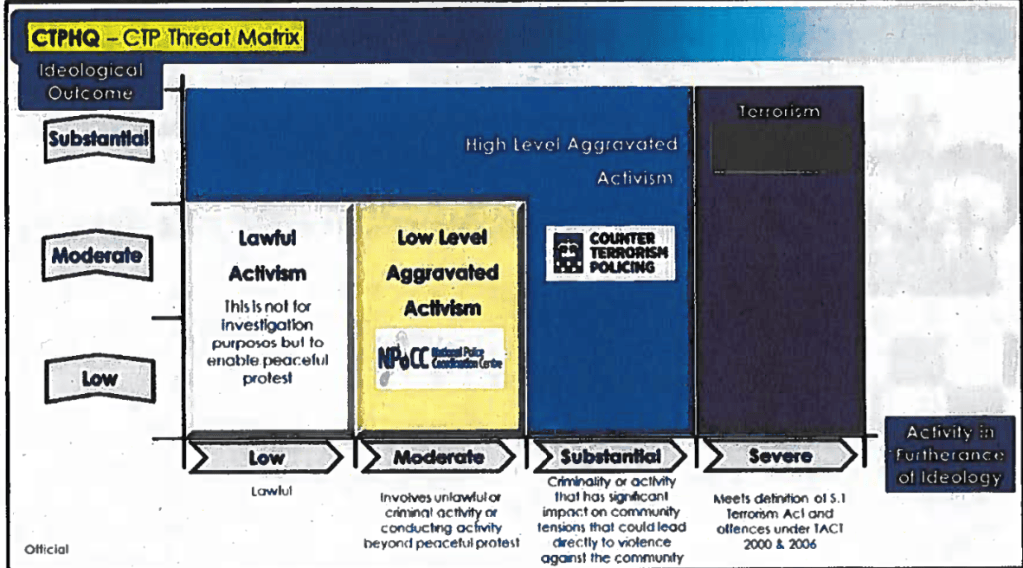
In March 2025, around the time Britain’s Proscription Review Group met to determine whether Palestine Action should be proscribed as a terrorist group, British authorities brought charges against activists who targeted the Instro factory. Initially, they were accused of the same crimes as the Filton Six: aggravated burglary, criminal damage and violent disorder, with a “terrorist connection” covertly applied on the basis of serious property damage. But in July, when then-Home Secretary Yvette Cooper announced PA’s proscription, she cited the Instro case as an example of “violence” perpetrated by the group.
Despite the highly politicized terror designation, a British court was forced to drop charges of aggravated burglary against the Instro 10, indicating that neither police nor prosecutors possessed any evidence Palestine Action intended to harm any person. Indeed, during its five years of operation, PA has conducted hundreds of direct actions without injuring a single person.
This August, as Palestine Action appealed its proscription in the UK, the administration of US President Donald Trump designated the group as a global “terrorist” threat. This appears to have been, at least in part, an effort to bolster the dubious case against the philanthropist and Palestine Action supporter Fergie Chambers, who faces extradition to the US from Spain for supporting “foreign terrorist organizations.”
From Washington to London, governments are stripping away their patina of liberal democracy to protect their relationship with Tel Aviv. Counter-terror legislation is now the weapon of choice in their war on citizens who seek to obstruct Israel’s genocide machine.
Europe’s Establishment Is Embracing War – and Losing Voters
By Leonid Ragozin | The American Conservative | September 30, 2026
Britain’s Labour Party is not traditionally thought of as a bastion of militarism or authoritarianism. Yet listening to some of what its top figures have been saying recently might cause one to doubt the conventional wisdom on that.
Consider what Labour Party strategist Paul Richards said in a GB News interview earlier this month. Asked how the UK might respond to an increased Russian threat, Richards—who has worked for two Labour governments—gave a disturbing answer. “We’d have to lock some people up,” he said, “some of the pro-Russian voices, people who say there isn’t a threat, [and say] ‘Don’t fight for your country, don’t go to war for Burnham.’”
His comments are not a one-off. They reflect a worrying trend among Britain’s political mainstream—the old parties, media, and think tanks—which has increasingly adopted a siege mentality informed by the far-fetched expectation of imminent war with Russia.
Nor is the trend restricted to Britain. It spans the entire Western world. And it helps explain why the centrist political forces previously seen as “reasonable” are losing ground to the supposed “fringe.” Apocalyptic millenarianism is no longer the domain of radical obscurantists, but of people like NATO’s secretary-general Mark Rutte, who in 2025 seemed to foretell with relish a conflict between Europe and Russia on the scale of the Second World War. “Imagine it,” he said, “a conflict reaching every home, every workplace, destruction, mass mobilisation, millions displaced, widespread suffering and extreme losses.”
It is politicians branded as far right or far left radicals who, surprisingly, have emerged as the main opposition to this unhinged bellicosity.
What’s largely prompting this trend is the very logic of the liberals competing with the populists. Western societies display a demand for performative “toughness,” which caters both to the infantilism of their political classes and the gamification of war in far off countries.
Things seem to have begun in earnest in 2016, when the prospect of liberals losing to rivals like Donald Trump led the former to embrace conspiracy theories like Russiagate and double down on foreign policy hawkishness as a way of evading responsibility for their own failures. Putin’s invasion of Ukraine served a similar function, providing a theater for “toughness” even as the West has gotten bogged down in what has increasingly turned into a proxy conflict.
Trying to outdo the populists along a different axis, rather than doing the hard work of opposing them with value-based positions, has led the centrists into a trap. It left a vacuum in the center, into which the populists—ever alert to political opportunities—have deftly stepped.
Here is how it plays out in Germany. When the Christian Democratic Union (CDU) suffered an embarrassing defeat in Saxony-Anhalt earlier this month, the party’s leader and premier in North Rhine-Westphalia, Hendrik Wüst, said the government should consider banning the AfD (which won the election by a landslide). Wüst is eyed as a potential replacement for the unpopular chancellor Friedrich Merz.
The CDU went on to suffer additional defeats in Mecklenburg-Western Pomerania and in Berlin. The former is particularly symbolic, because this is where the Nord Stream gas pipelines make landfall—a fact that makes this state a direct beneficiary of the German-Russian joint venture to supply cheap Russian gas to the German economy.
When Nord Stream 2 was blown up in September 2022, the immediate consensus in the West was that Moscow was responsible. Yet the culprits turned out not to be Russian, but Ukrainian. German police investigators eventually charged individuals associated with Ukraine’s military intelligence service for the attack. (It’s worth noting that this Ukrainian spy agency was rebuilt in 2015 with considerable assistance from America’s CIA.)
Germany’s rejection of Russian gas supplies after Putin’s all-out invasion in Ukraine can be seen as a noble gesture, perhaps, but it had dire consequences for the country’s economy, which contracted in 2023 and 2024 before showing anemic growth in 2025. Even more importantly, it hit every household in Germany with skyrocketing heating and power bills. Interestingly, Germany wasn’t receiving Russian gas at the time of the explosion, which means the attack was aimed at preventing the resumption of supplies after the end of war rather than interrupting ongoing exports.
The German government has never properly addressed the issue at the federal level. On the eve of September elections, Merz’s sharp reaction to the Leipzig drone incident, which he instantly blamed on Russia, contrasted sharply with the virtual absence of a response to the perpetrators of the Nord Stream attack.
Voters in Mecklenburg-West Pomerania slaughtered Merz’s party, excluding it entirely from the state’s legislature for the first time in nearly 80 years. The big winner was the AfD—a party unafraid to ask questions about Nord Stream and which muses about restoring gas supplies after the Ukraine War ends. Voters also largely spared the Social Democrats, under whose leadership Nord Stream was built in the first place (although they had to disown it after Russia’s invasion).
The early days of tension between post-Soviet Russia and the West, which culminated in the war in Ukraine, were marked by squabbles over pipeline projects delivering gas to Europe (remember South Stream or Nabucco?). The unyielding opposition of centrist politicians to such projects has led voters to wonder whether their political establishment is more interested in catering to armsmakers and shale gas producers than in providing for its citizens. It’s hard to think of a better illustration of NATO’s unofficial mission to “keep the Germans down and the Russians out” than the fate of Nord Stream.
The perception of abandonment is what fuels the popularity of the AfD’s sovereigntist stance. And despite accusations of extremism, it is the AfD who sounds the most moderate and reasonable on the vital issues of war and peace.
Indeed, their foreign policy stance provides AfD leaders with one bulletproof rebuttal to accusations of fascism. A defining component of the fascist ideology is aggressive militarism—a trait exhibited by the German political establishment, not its hard-right challengers. The AfD fills the shoes of the old-school left-wing peaceniks when it comes to Ukraine, while the Merz government staunchly supports further escalation while discreetly undermining Trump’s efforts to bring the conflict to a close. The AfD also condemns the war on Iran (which Merz initially supported, before making a U-turn under public pressure).
(Ex-)centrists also advocate an enormous defense spending hike Germany can ill afford, as well as compulsory military service (this latter move has sparked youth protests across the country). The way mainstream German politicians are courting the far right in Ukraine—members of Azov movement prominently featured at the prestigious Munich Security Conference this year, for example—make the charges of nazism levelled against the AfD look especially lame.
Opposing Russia’s full-scale invasion of Ukraine, which the AfD does, is one thing. Supporting an endless proxy war with a nuclear-armed great power—and committing to fight this “to the last Ukrainian”—is quite another.
And the polls suggest German voters have little appetite for risking their country’s future in such a gambit.
The AfD and other insurgent parties thrive when their opponents lean into hawkishness and authoritarianism, but so far there is little evidence the establishment understands this. Indeed, European political elites are doubling down. They recently invited Zelensky’s former press secretary, Iulia Mendel, to speak in front of the European Parliament. But Mendel is a vocal critic of her former boss, and so the parliament’s centrist leadership banned her from entering after Zelensky’s government imposed sanctions on her (an extrajudicial punishment he is routinely applying to political rivals). By banning Mendel from speaking and turning a blind eye on Zelensky’s abuse of power, the center once again chooses delusion and bellicosity over a genuine commitment to democracy.
Meanwhile, alternatives like the AfD will continue to fill the vacant space left in the middle of the political spectrum.
The RAF Fairford ‘terror plot’: Unpacking escalation in the UK echo-chamber
RT | September 29, 2026
Five young men from London who were caught near a British airbase heavily used by the US in its war against Iran have triggered a media frenzy across the London establishment’s mainstream media. The so-called “Fairford incident” lit up the British deep state media echo chamber.
However, what was initially reported as a possible Iranian or Russian-backed plot to blow up the RAF’s Fairford airbase, has so far revealed a farcical attempt to warn the British Army of a possible threat, and produced complaints from Washington, a lot of unanswered questions, and no explosives.
What happened at Fairford?
The drama in Gloucestershire, southwest England, began after a local resident noticed three vans blocking a road after midnight on Saturday near RAF Fairford, and a group of “hooded and ‘balaclava’d’ men” running from her car headlights.
Having failed to get an answer at the Ministry of Defence security hotline she dialed 999 and alerted police to “three suspicious vehicles.”
Armed counter-terror police swooped in, detained five men near the nearby village of Whelford, and found three white vans bearing fuel company insignia, raising fears they could contain explosives.
How did British security services react?
A counter-terrorism emergency was declared. About 85 local homes were evacuated, a 400-meter cordon was thrown around the scene, and military bomb disposal experts sent in a robot to examine the vehicles – which found no viable explosives.
The British mainstream security state press went into speculative overdrive, “monitoring” an incident near the key RAF base.
Who are the Fairford incident suspects?
Police have not named the five men but say all – photographed while sitting shirtless after their arrest – are British nationals from London aged between 23 and 25. They were initially arrested on suspicion of offenses under the Explosives Act and were later detained on suspicion of preparing a terrorist act.
Then, less than 24 hours after their detention, all five were released on bail.
What do British police officially suspect?
UK counterterrorism chief Laurence Taylor stressed that releasing the men did not mean the case was over. The suspects remain under “stringent” restrictions while investigators pursue “multiple new lines of enquiry,” he insisted.
US President Donald Trump, who initially claimed the men had already been under observation and were “looking to do big damage,” later complained about their release.
“We know everything about them,” he told reporters. “I would not have released them.”
Britain can hold terrorism suspects without charge for up to 14 days, meaning police were not legally forced to release the five when they did.
Who declared a foreign power was involved?
US Secretary of State Marco Rubio told Fox News that the incident “clearly involves the hands of a foreign actor.”
Tehran has warned that military facilities used for US attacks on Iran could be treated as legitimate military targets. However, it has never claimed responsibility for any strikes outside of the Middle East.
British media reports have cited anonymous sources suggesting investigators were examining possible Iranian involvement. Russia and an “islamist state” were also mentioned by Reuters, citing anonymous sources.
Tehran’s embassy in London slammed the suggestions of Iranian involvement as “unfounded and malicious speculations” that fueled Iranophobia in Britain.
How is Britain escalating war rhetoric?
British Foreign Secretary Ed Miliband used his Labour Party conference speech on Monday to call for more preparedness against growing security threats, opening his speech by pointing directly to the Fairford incident.
The media machine has been playing its part in whipping up the war hysteria. Sky News aired a mockumentary titled ‘The Wargame’ playing out a crisis leading to a possible nuclear conflict with Russia. The BBC also urged readers to ask themselves whether they are “psychologically prepared for war”.
British authorities last year arrested four Iranian nationals over what was described as a major suspected terrorist plot. Police eventually released all four from custody without charge.
Is the Fairford incident a false flag?
There is no evidence of that, and watching the story move from a worrying local incident, through to a counter-terror operation involving “possible truck bombs,” to the release of five men on bail within 24 hours and an admission that the vans involved contained no explosives, can hardly count as a well-executed false flag plot.
Can the British government be believed?
That does not mean the British government deserves blind trust on intelligence claims.
The obvious historical example is the 2003 invasion of Iraq, . Prime Minister Tony Blair strongly backed US President George W. Bush’s false claims that Iraq had weapons of mass destruction. RAF Fairford itself was used by US bombers during that war.
Trump may be saying plenty about Tehran that echoes Bush’s rhetoric. But there is currently no evidence that UK Prime Minister Andy Burnham has decided to follow Blair down the same road.
What is the last refuge of a scoundrel?
When facts run out of road the British commentariat will reach the Hybrid War refueling post.
Hybrid war is by definition almost impossible to verify. Sky News, for instance, interviewed Martin Gallagher, a former police superintendent, who argued that masterminds are trying to manipulate British authorities by making them “cry wolf” now, before a “real attack” could happen in the future
Is Western Europe caught in its own echo-chamber?
Last week, Spain’s El Mundo, citing anonymous Latvian security sources, reported that the CIA had warned of a Russian kamikaze drone plot targeting Spain, France or Italy, involving merchant ships in the Mediterranean. The story raced around Europe before senior officials in Italy and France debunked it.
Last month in Sweden, a Russian couple vacationing from Spain became the focus of a security scare after camping near a property connected to the CEO of arms manufacturer Saab. Quickly labeled as possible spies or assassins in the press, the tourists were cleared of any wrongdoing and told to leave Sweden, their holiday ruined.
Germany has taken a much firmer line over an August drone incident at Leipzig/Halle Airport, which Berlin formally called a failed hybrid attack carried out by Russia. The German government has refused to disclose the evidence underlying its claim, however, fuelling speculation that the situation was staged for political reasons.
The great European drone scare of 2025 also produced some awkward endings. No evidence has been produced of any malign operation around the multiple allegations, and most have been disproven by mainstream journalists in Belgium, the Netherlands and Denmark, where the army is thought to have actually shot at a passenger plane.
And then there is “Havana Syndrome.” US officials were looking for some kind of Russian, Chinese or other foreign directed-energy weapon, but only found an argument that CIA agents who were purportedly victimized should be paid compensations for the damage they suffered, regardless of its cause.
Tehran blasts ‘baseless’ speculation linking Iran to alleged bomb plot at UK air base
The Cradle | September 28, 2026
The Iranian Embassy in London announced on 28 September its “categorical rejection” and strong condemnation of speculation regarding Tehran’s involvement in an alleged plot to attack a British military air base used by US forces.
In a post on X, the embassy criticized “recent baseless and malicious speculation circulated by certain individuals and British media outlets attempting to link Iran” to the incident, which occurred in the early hours of Sunday.
Gloucestershire Police had announced on Sunday that a “major incident” was taking place in the Welford area of western England, leading to the evacuation of several buildings near the RAF Fairford air base.
Police stated that army explosive ordnance disposal experts were examining several vehicles and that five men had been detained on suspicion of offenses under the Explosives Act.
Residents were evacuated from 85 homes in the area near the base on Sunday as army bomb-disposal experts used a robot to examine three white vans.
The five men detained in connection with the alleged bomb plot, all British citizens, were released on bail on Monday, suggesting the incident is not serious, in contrast to early claims.
The men will remain under investigation, according to the head of counterterrorism policing, Laurence Taylor.
UK authorities continue to “explore multiple lines of inquiry” regarding the incident, Taylor added.
RAF Fairford has been used as a base by the US Air Force to launch bombing operations against Iran during the war that began in February.
The UK authorized the US to use the base for missions involving B-1B and B-52 bombers.
Britain did not join the US-Israeli war on Iran and initially denied President Donald Trump’s request to use bases in the UK.
However, then-prime minister Keir Starmer soon reversed course, announcing days later that he had agreed to let the US use bases in Britain for what he claimed were “defensive” operations against Iran’s missiles and their launch sites following Iranian attacks on UK interests and Britain’s Gulf allies.
The Rise And… Rise Of ‘Color Revolutions’
By Kit Klarenberg | Global Delinquents | September 28, 2026
It’s rather forgotten today how Washington’s post-9/11 imperial adventurism was not restricted to military intervention. A core component of the Bush administration’s “Freedom Agenda” – under the auspices of which calamitous wars in Afghanistan, Iraq and elsewhere were waged – was overt sponsorship of civil society-led coups throughout the former Soviet Union, Warsaw Pact and Yugoslavia. Citizens of these regions, and the world, live with this meddling’s destructive consequences to this day. The seemingly never-ending – and ever-escalating – Ukraine proxy war is a particularly visceral legacy.
The 1983 creation of the National Endowment for Democracy, a US state entity avowedly concerned with executing overtly what the CIA once did covertly, ushered in a new era of “spyless coups”. Working in close conjunction with USAID and George Soros’ Open Society Institute, NED ever after provided funding, training and material assistance to NGOs, ‘independent’ media outlets, opposition groups, and other initiatives in service of regime change, across every corner of the world.
Come 9/11, NED and its confederates had devised a supremely cunning, cost-effective template for toppling troublesome governments – be they left-wing, nationalist, or even former US puppets who’d stepped out of line. The previous October, longtime Yugoslav leader Slobodan Milosevic was brought down in what the Washington Post bombastically dubbed “an extraordinary US effort to unseat a foreign head of state, not through covert action of the kind the CIA once employed in such places as Iran and Guatemala, but by modern election campaign techniques.”
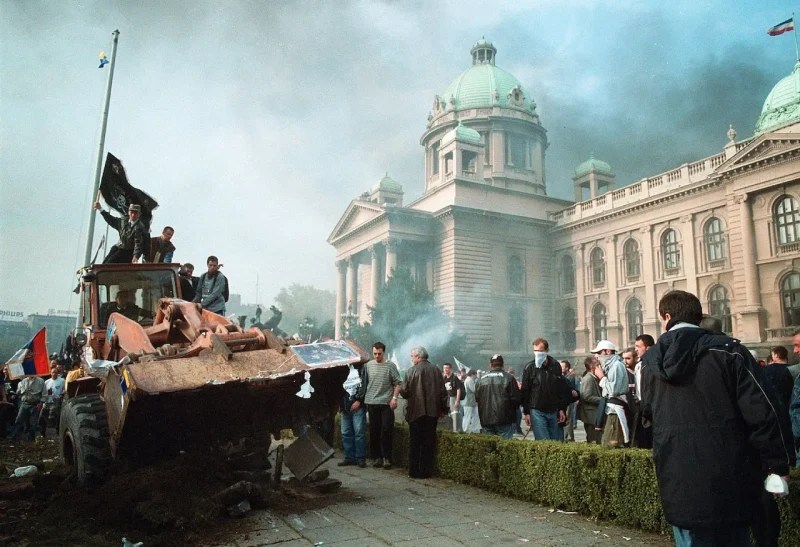
At the anti-Milosevic effort’s forefront was Otpor! (Serbian: Resistance!), a rebellious NED-funded youth activist group. Through a mix of civil disobedience, non-violent resistance, rock concerts, street theatre, and graffiti, they fomented mass public opposition to the Yugoslav President. When election day came and official results pointed to Milosevic’s victory, an NED-funded “parallel vote tabulation” purported to expose major fraud, sending millions to the streets of Belgrade to peacefully demand the President’s resignation. Milosevic duly capitulated, in the face of seemingly overwhelming people power.
The supposedly heroic struggle of Otpor! and other US-supported anti-Milosevic groups was immortalised in a slick ‘documentary’, Bringing Down A Dictator. Milosevic’s fall provided a precise blueprint for future ‘color revolutions’ – so-called because frequently, the Empire-supported activists who led these mob putsches prominently adopted specific colours for their banners, branding and logos. Initially, US officials eagerly associated themselves publicly with this upheaval. Meanwhile, the mainstream media routinely published remarkably illuminating post-mortems of the revolts, extensively exposing Washington’s guiding hand and oft-enormous financial outlay.
Nonetheless, politicians, pundits and journalists alike universally framed colour revolutions as ultimately spontaneous uprisings by liberal, progressive elements with legitimate grievances, who yearned for democracy and freedom. In reality, they almost invariably produced corrupt, repressive governments that ruled via intimidation and brutality, including political assassinations. Post-colour revolution regimes also typically conducted sweeping privatisation and other ravaging ‘reforms’, destroying living standards for average citizens by prostrating their countries to the EU, IMF, NATO, World Trade Organization, and other mechanisms of Western economic, military, and political subjugation.
Slobodan Milosevic’s NED-orchestrated ouster is nicknamed the ‘Bulldozer Revolution’, due to iconic scenes during the upheaval of a wheel loader helping anti-government agitators occupy state buildings. However, its driver quickly turned against the “Revolution”. Subsequent “shock therapy” decimated Yugoslavia’s mixed market economy, causing his successful independent business to fail, and him to go bankrupt. He subsisted until his dying day on meagre state welfare payments. For most participants, subsequent colour revolutions were similarly an object lesson in being careful about what one wishes for.
‘External Shove’
In February 2005, President George W. Bush gave a swaggering address in Bratislava, Slovakia. He hailed how “in recent times, we have witnessed landmark events in the history of liberty.” This included Georgia’s November 2003 Rose Revolution, Ukraine’s Orange Revolution the next year, and Iraq’s Purple Revolution a month prior. “The advance of freedom is the concentrated work of generations,” Bush declared. He looked ahead to Moldova, and “inevitably” Belarus, “someday proudly [belonging] to the country of democracies [sic]”:
“Eventually, the call of liberty comes to every mind and every soul. And one day, freedom’s promise will reach every people and every nation.”
Moldova’s forced transformation into a staggeringly corrupt effective EU-US colony took many years. Belarus conversely remains stubbornly resistant to “freedom’s promise”, as defined by Brussels, London, Washington, and other centres of imperial power. Still, President Bush’s confidence was well-founded. Waves of insurrectionary unrest unleashed by his government’s “Freedom Agenda” had systematically swept away designated enemy governments one by one annually since he took office. Indeed, within weeks of Bush’s speech, Kyrgyzstan’s insufficiently pro-Western leader fell victim to yet another colour revolution.
He would not be the last. Prior colour revolutions had enthusiastically emphasised the importance of techniques of nonviolent resistance – many of which were crafted by Gene Sharp, who was intimately enmeshed within the US military and intelligence establishment for much of his life. However, Kyrgyzstan’s NED-created regime change army, KelKel – directly modelled on Otpor! – attacked police, torched government buildings and even carried out bombings. Their ferocity was actively encouraged and promoted by US-funded TV stations locally. Such belligerence subsequently became a colour revolution calling card.
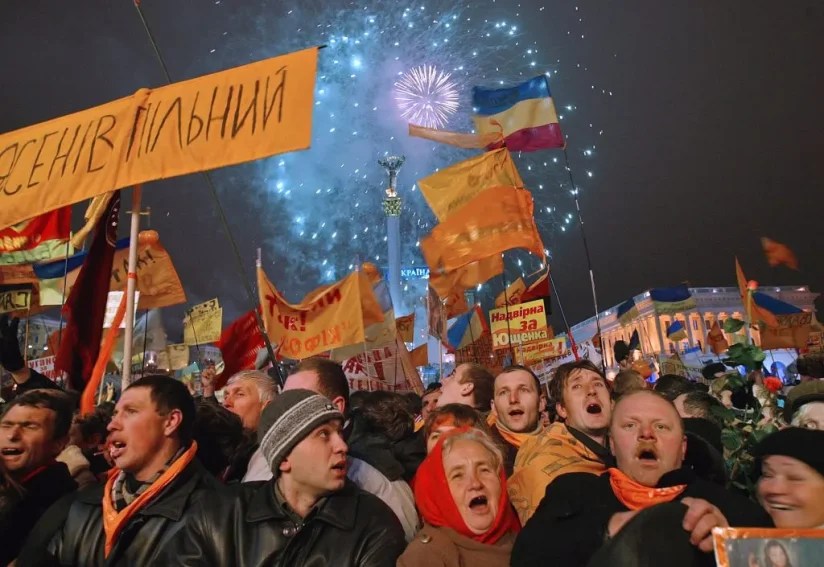
Ukraine’s Orange Revolution
That colour revolutions represented a formal weapon of war in the Empire’s post-9/11 arsenal was enthusiastically spelled out by arch-neoconservative Max Boot in late December 2004. He gushed how Ukraine’s Orange Revolution days earlier, which brought a pro-Western government to power, was “one of the most inspiring events” of that year. Boot declared the “triumph” and “miracle” of the revolution “should dispel the quaint notion still prevalent in many Western universities and foreign ministries that democracy is a luxury good suitable for rich countries”:
“These revolutions reveal the hollowness of the cliché that ‘democracy can’t be imposed by outsiders’… sometimes, when dealing with an entrenched dictatorship, this requires military intervention of the kind that occurred in Iraq and Afghanistan. More brittle regimes can be brought down by their own people, but even they often need a little external shove… There was nothing nefarious about the US intervention in Ukraine.”
Boot boasted how Washington had “spent $58 million on democracy promotion in the last two years” in Ukraine. He proposed Kiev receive “expedited NATO and European Union membership,” to finish off the Orange Revolution. “In the meantime, we need to apply elsewhere the lessons of Ukraine” Boot demanded, suggesting “an obvious candidate for a similar transformation is Iran.” He explained, “it’s hard to think of a higher priority than the overthrow of the mullahs,” encouraging the Bush administration to prioritise “liberating Iran.”
‘USAID Help’
Such was the insurrectionary fervour of the time, in January 2006 USAID went to the extent of publishing a glossy magazine, Democracy Rising, revealing in detail Washington’s central role in fomenting “grassroots” rebellions as far afield as Afghanistan, Gaza and Lebanon. Dedicated sections on colour revolutions to date were replete with stunningly forthright passages. A section on Georgia’s November 2003 Rose Revolution described how NED had financed regime change training for local “lawyers, judges, journalists, members of parliament, NGOs, political party leaders, and others.”
The stated purpose of this investment was to give Georgians “a sense that they should regulate the government.” The Rose Revolution “was the climax of these efforts.” One recipient of US financial support remarked, “without foreign assistance, I’m not sure we would have been able to achieve what we did without bloodshed.” Meanwhile, several pages were dedicated to the Orange Revolution. It noted how thousands of Ukrainian journalists were given training in “investigative reporting”, bankrolled by NED and USAID.
An alumni told Democracy Rising this sponsorship “created a feeling that others stood with them ‘in the trenches’.” Concurrently, NED-affiliated Freedom House flooded the coffers of NGOs “that sponsored voter education, mobilized voters to get to the polls and observed elections.” These organisations “also held meetings, youth dances, rock concerts and karaoke to attract young voters,” and “ran public service ads on TV stations, informing people about their right to vote.” Meanwhile, “democracy trainers from Serbia, Slovakia, Russia and Croatia” were flown into the country.
In the second round of Ukraine’s presidential election, NED-financed NGOs claimed to have been inundated with tens of thousands of reports of fraud from voting stations all over the country, while exit polls they produced pointed to widespread rigging having denied pro-Western candidate Viktor Yushchenko a landslide victory. Vast protests, combined with opposition-organised general strikes, widespread civil disobedience and occupations of government buildings forced a rerun. A US-funded think tank apparatchik asserted:
“USAID help for the poll was absolutely important – the poll results after the second round made people go to the street.”
For all the hype and self-assurance of Democracy Rising, its publication came at a time when colour revolutions were increasingly being viewed with hostility and suspicion at a state and public level throughout the Global South. In every case, the radical outcomes promised by colour revolution leaders and advocates failed to materialise, while US rhetoric about the commitment of resultant pro-Western regimes to democracy and freedom was a perverse fraud.
In Ukraine, US-installed Yushchenko implemented economic austerity, slashed regulations and social spending, bailed out criminal banks, broke open state industry and natural resources for foreign plunder, attacked the rights of Russian speakers, and began preparing the country for locally-feared NATO membership. Within just nine months of entering office, his coalition government – comprised of Orange Revolution activists – collapsed due to deeply corrupt battles with feuding Ukrainian oligarchs over control of key media and industrial assets.
Yushchenko was voted out in the January 2010 presidential election, finishing fifth in the first round with just 5.5% of the vote. As Empire house journal Foreign Policy lamented years later, the Bush administration’s much-vaunted colour revolutions all turned out to be “terribly disappointing.” Each and every time, “elite corruption still continued apace” and “promises of far-reaching change never really materialized.” Damningly, “maladies that typified the preceding regimes quickly came to describe” the governments created by colour revolutions themselves.
‘Revolution Business’
That’s quite some euphemism. In Georgia, longtime Soros acolyte Mikheil Saakashvili granted himself unilateral power in key policy areas, before brazenly exploiting his position to harass and jail business and political rivals. Saakashvili’s targets would be raped and/or tortured in prison, their ordeals filmed for primetime broadcast on local TV networks. Grave questions abound over his personal involvement in several suspicious deaths, including government ministers’. He was voted out in October 2012, despite NED’s best efforts.
Kyrgyzstan’s 2005 Tulip Revolution installed Kurmanbek Bakiyev, who proceeded to run the country as his personal fiefdom for five years. Bakiyev’s relatives profited exorbitantly from legally questionable privatisation of state industries. For example, his family signed a highly controversial $1.8 billion deal to supply fuel to a local US military base, close to Kyrgyzstan’s total GDP in 2003. Elsewhere, Bakiyev’s brother oversaw Bishkek’s security apparatus – arbitrary detentions, bogus convictions, torture, and murders of opposition activists, journalists, and politicians became commonplace.
Bakiyev was himself chased out of not only the presidential palace but Bishkek itself in April 2010, following a massacre of anti-corruption protesters in which up to 100 were killed and at least 450 wounded. Thereafter, Kyrgyzstan was plunged into economic and political chaos for a decade, with numerous governments collapsing along the way. The freest and most stable Central Asian state prior to the Tulip Revolution, it is only since 2020 – following another Anglo-American coup – the country has regained some semblance of stability.
A key player in that upheaval was British ambassador Charles Garrett. He arrived in Bishkek from Macedonia, where as this journalist has revealed from April 2016 he steered what was known as the “colorful revolution”. Illegally obtained, deceptively edited wiretaps seemingly implicating government officials in shocking crimes produced huge protests, featuring widespread arson attacks and brutal clashes between demonstrators and police. Garrett distributed cash to NGOs and activists involved in the unrest from his diplomatic pouch, encouraging them to cause mass havoc.

George Soros’ Open Society Foundations, NED, and USAID were also colorful revolution participants. Some protesters even proudly wore “Soros Army” shirts. Despite a huge public counter-revolutionary fightback, the tumult paralysed the Macedonian economy and state, leading to the installation of a doggedly pro-Western, dangerously dysfunctional administration that engaged in industrial scale graft, jailed political opponents on bogus charges, and changed the country’s name despite widespread opposition. Meanwhile, existing economic problems, including crippling brain drain, were gravely exacerbated.
The unfailingly disastrous results of colour revolutions surely contributed to White House officials abruptly and firmly distancing themselves from the entire enterprise, before the Bush administration’s second term was even over. The “Freedom Agenda” was quietly forgotten. The President – who in October 2004 openly mandated financial assistance to Belarusian opposition activists, and once publicly praised the Rose Revolution as an example to be followed throughout the Caucasus and Central Asia – went so far as to deny the US was in the “revolution business” at all.
‘Alternate Reality’
Colour revolutions have continued apace ever since, with the same strategies being recurrently applied the world over, to varying degrees of success. All along, non-Western governments – in particular China, Iran and Russia – have become increasingly vocal in their condemnation of and opposition to colour revolutions, in some cases passing legislation seeking to curtail the operations of foreign funded NGOs on their soil. Yet, the mainstream media long ago adopted a rigid Omertà on Washington’s culpability for civil society-driven destabilisation overseas.
In a striking example of this paradigm shift, in November 2004, before the Orange Revolution was over, The Guardian published a revealing report exposing the “US campaign behind the turmoil in Kiev.” The outlet stated unambiguously the revolt was “an American creation, a sophisticated and brilliantly conceived exercise in Western branding and mass marketing that, in four countries in four years, has been used to try to salvage rigged elections and topple unsavoury regimes.” NED, the State Department and USAID were all fingered as culprits.
Fast forward to July 2015 however, and a Guardian article on Russia’s banning of NED under foreign agent laws quite amazingly relied on a brief quote pulled from the Endowment’s official website to describe its operations. In the intervening time, the Maidan Revolution overthrew Ukrainian President Viktor Yanukovych in February 2014, setting Kiev on the warpath with Moscow. Washington’s irrefutable involvement was strenuously denied at the time by the mainstream media, and has been ever since.
Following the Ukraine proxy war’s February 2022 eruption, The New York Times took vigorous aim at independent journalists for spreading the “conspiracy theory” Maidan was US-orchestrated, dubbing the proposition an “alternative reality” and “Russian disinformation”. This is despite every prominent Maidan actor – including the individuals who started the demonstrations – receiving NED or USAID funding, leaders of US-bankrolled organisations in the country advertising their intention to overthrow Yanukovych years prior, and the Endowment spending $20 million in the country in 2013 alone.
After the outbreak of war in Ukraine, NED removed its grant records on Ukraine, listing its investment in a panoply of initiatives in the country over many years – many of which ultimately targeted Russia, one way or another. In mid-2024, the Endowment undertook the unprecedented step of removing grant records for the entire world. Today, brief entries on different geographical regions describe in vague terms the Endowment’s specific aims locally, and overall sums being spent. The crucial questions of where, and on what, aren’t clarified.
NED going underground makes the task of tracking and exposing contemporary colour revolutions difficult, but not impossible. In September 2025, mass rioting ignited in Nepal. Major news outlets without exception reported the fiery agitation as an organic burst of dissent by the country’s disaffected “Gen Z”, motivated by corruption, unemployment, and state censorship of social media. Publications barely acknowledged demonstrators committed serious crimes, including torching Nepal’s parliament and the Prime Minister’s official residence, which sent occupants fleeing in helicopters.
Based on publicly available information, the clear insinuations of a colour revolution could be discerned. An NGO that organised the protests, Hami Nepal, had clear links to organisations known to be in receipt of NED funding. Subsequent leaks amply demonstrated the Endowment and USAID expended substantial sums over the years preceding the coup training young Nepalese citizens how to protest, founding NGOs and political parties, and “advocate concerns” on issues such as corruption. Evidently, the post-9/11 “Freedom Agenda” never actually ended.
Met Office Caught Fabricating Daily Temperature Record Claims
By Paul Homewood | Not A Lot Of People Know That | September 27, 2026
Daily temperature records are meaningless in terms of climate and weather. But they are of immense propaganda value.
So, step forward Marco Petagna, Media Advisor & Senior Operational Meteorologist at the UK Met Office:

https://x.com/Petagna/status/2103367986975273082
Followed later in the day by the ITV weatherman:

The Met Office confirmed 27.0C at Frittenden:

But how do we know what the previous daily record was? Indeed, how does the Met Office?
Are we supposed to take them on trust? If so, that trust is misplaced.
An article in the Times 15 years ago, following a warm spell of weather, reminded readers that it had been much hotter in September 1895! Their archived news reports revealed that temperatures had reached 30.6C (87.1F) on both 25th and 27th of September in Strathfield Turgis, Hampshire.
When challenged about this on X, Marco Petagna replied that Strathfield Turgis was “not on our internal records for some reason”.
How convenient!!!!
In fact, the weather during that last week in September 1895 was exceptionally hot for days on end, much hotter than the 27.0C at Frittenden. The highest readings for the month were variously set on dates between the 24th and 29th at different locations:


Strathfield Turgis was no fluke or outlier.
A number of sites up and down the country exceeded 27.0C/80.6F, on the 24th, 25th, 237th and 28th:
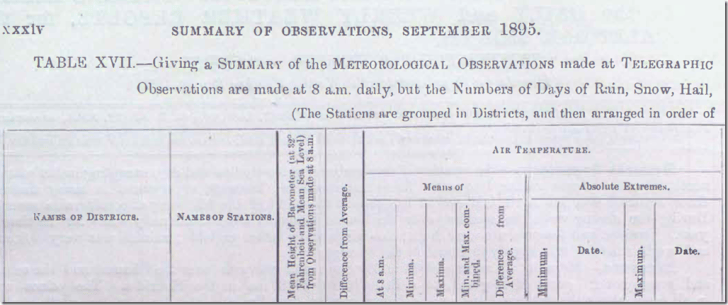
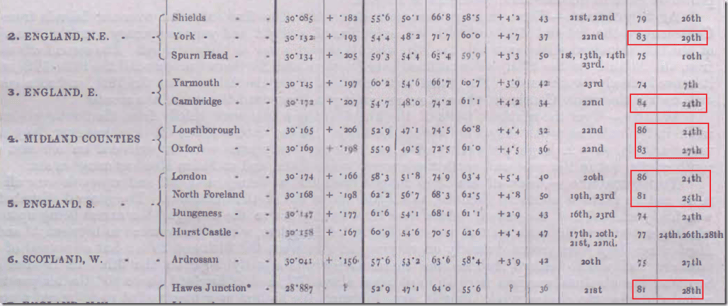
Note that North Foreland recorded 81F on the 25th, the day under discussion.
These are just a small selection of stations, used in the Met Office Monthly Summaries. There will be hundreds of other sites, such as Strathfield, and given the prolonged nature of the heatwave in 1895 and its widespread geographical coverage, it seems inevitable that many other sites topped 81F that day.
Petagna’s comment about “internal records” is revealing. It indicates that the Met Office has simply binned any temperature data it deems to be “too high”.
As one commenter wisecracked:

In the meantime, it is clear that we cannot trust any daily record claims made by the Met Office.
Mandatory Folic Acid for every man, woman & child
By Clare Craig, Ros Jones & Mark Stronge | Health Advisory & Recovery Team | September 20, 2026
The change in the law to enable this came as an amendment, SI2024/1162, to the Bread and Flour Regulations 1998. As a Statutory Instrument, there was no parliamentary debate. There was no full scientific Impact Assessment; just a de minimis financial assessment by DEFRA and limited DHSC input. The stated aim is to increase blood folate levels in pregnant women in order to reduce the risk of neural tube defects (NTDs). The Government estimates a reduction of about 200 Neural Tube Defect (NTD)-affected pregnancies annually, approximately 20% of UK cases. Most of these would have ended in a termination of pregnancy or a neonatal death but a small number of births of children with spina bifida may be avoided.
No proper assessment of the harms of folic acid has been carried out, yet it is proposed to give it to every man, woman and child in this country indefinitely, rather than just giving supplements for a few months to those women wishing to take them. Most notably there are several groups of people whom the NHS currently advises to avoid folic acid medication. This includes patients with cancer, Vitamin B12 deficiency and cardiac stent procedures (patients on haemodialysis were also included in the list until recently). Analysis of long term outcomes from 10 randomised trials has shown a worrying 23% increase in cancers, 24% for prostate cancer.
What is not at all clear, is how people will avoid folic acid once it is in virtually all flour.
The UK Government presents folic acid fortification as a settled, cost-free public health win.
Every one of its load-bearing claims collapses under examination.
First, “folic acid is a B vitamin.” This is the foundational deception. Folic acid is not a vitamin at all. It is a synthetic, oxidized compound that does not occur in nature. The actual vitamin is folate, found in leafy greens and liver. Folic acid must be converted in the body, and a large share of the population converts it poorly due to common MTHFR gene variants. The result is unmetabolized folic acid circulating in the blood, which has been linked to masking vitamin B12 deficiency and to accelerated growth of existing pre-cancerous lesions. Calling it “a B vitamin” is the rhetorical move that makes the whole policy sound harmless.
Second, “it helps prevent neural tube defects.” The honest version is that high-dose supplementation in women with a previous affected pregnancy showed benefit in a 1991 trial. What the government has done is extrapolate that clinical result to low-dose, population-wide dosing through bread. Those are not the same intervention, and the “200 cases prevented” figure is a model output, not a measurement.
Third, and this is the killing blow, the only large randomised trial in otherwise healthy women, the Hungarian trial by Czeizel and Dudás, found that every category of fetal death was higher in the folic acid group. Total fetal deaths were 374 (13.4%) against 304 (11.4%) in the control arm, an excess of 70 deaths that was statistically significant. In that same trial, the number of neural tube defects prevented was six. That is roughly nine to twelve dead babies for every defect apparently prevented. The mechanism was named by the trial’s own principal investigator in a 1997 Lancet paper: terathanasia, the death of the malformed. Folic acid may reduce the count of babies born with neural tube defects not by curing them, but by killing the affected embryos before birth.
Fourth, the government knows this and has chosen to redefine the dead babies as a benefit. When asked directly in Parliament, the Department of Health answered that folic acid extended the viability of early conceptuses, so the excess miscarriages were really evidence of extra life-creation. No evidence was supplied for this. The data refute it, because if early losses were merely being promoted upward, chemical pregnancies should have fallen. They rose alongside every other category.
Fifth, the surveillance data cannot detect the harm. The US monitoring system only records fetal deaths at 20 weeks or later, while the excess deaths in the trial were overwhelmingly first-trimester miscarriages and chemical pregnancies. The harm signal is structurally invisible to the system used to claim success.
Sixth, the “200 babies” figure is inflated. Even on the government’s own final assessment, the operative effect is around 31 fewer live births a year, of which about 28 would be children living with disability. The rest of the “200” is mostly terminations avoided and a notional quality-of-life valuation. The economic case values a life-year at £70,000, more than double what the NHS uses for medicines.
Seventh, the decline in neural tube defects happened before folic acid existed. Spina bifida fell 82 percent between 1972 and 1991 in England and Wales. The recommendation to take folic acid arrived in 1992, after almost all of that decline had already occurred. Folic acid is being credited with a fall it could not have caused, and after 1992 the rate of decline actually slowed.
Eighth, the safety question for everyone else, which the campaign suppresses entirely. The NHS itself lists categories of people told to avoid folic acid, and most of them have no idea that mandatory fortification means avoiding flour entirely. These include people with cancer, people with B12 deficiency, people with stents, and people with kidney disease.
Ninth, take cancer. Lifetime cancer risk in the UK is around one in two, so you are mandating a synthetic compound linked to driving pre-cancerous growth for a population, half of whom will at some point be cancer patients or survivors. Unmetabolized folic acid has been associated with accelerated growth of existing pre-cancerous lesions, particularly in the colon. For anyone with active cancer or a history of colorectal adenomas, folic acid is not benign. It is fuel.
Tenth, then B12. Folic acid masks vitamin B12 deficiency, allowing neurological damage to progress invisibly while blood markers look normal. The elderly are the classic at-risk group, and they are also heavy bread consumers. The policy doses the exact population most vulnerable to hidden B12 deficiency.
Eleventh, stents and cardiovascular disease. People with coronary stents and certain vascular conditions are among those advised against folic acid, with some trials showing worse cardiovascular outcomes, including restenosis concerns, in people with existing heart disease. Those patients cannot avoid the exposure without abandoning a staple food.
Twelfth, then kidney disease. Folic acid metabolism and accumulation are altered in renal impairment, and patients with kidney disease are routinely told to be cautious. Again, no exemption, no alternative, no consent.
Thirteenth, beyond the NHS list, there is the prostate cancer signal, with some research suggesting a doubling of prostate cancer risk in men, and concerns about immune response in women. None of this was given a value in the government’s assessment. The final assessment named potential harms to others but then did not quantify them.
Fourteenth, like men, infants and children are a group that cannot benefit. For children, the duration of mandatory folic acid ingestion will effectively last a lifetime. Yet the dosage per kilogram is far higher for children, when existing fortification of breakfast cereals is added to the new mandatory fortification of flour and hence bread.
Finally, the “nearly half of pregnancies are unplanned” argument is a confession disguised as a justification. Because some women do not know they are pregnant early on, the answer is to medicate every man, woman, child, and elderly person in the country through the bread supply. The number needed to treat is roughly 440 women to prevent one neural tube defect. The number needed to harm is one in 50 women suffering a lost pregnancy. The harm is about nine times more likely than the benefit. Where are the safety studies for a whole population?
The structure of the policy is the scandal. Tens of millions of people will be exposed every year with zero possibility of benefit. Only a small subgroup, women in early pregnancy, is the nominal target. For everyone else, the benefit is exactly nothing, and any risk at all is pure downside. The people this is unsafe for are not a rare corner case. They are half the population over a lifetime, concentrated precisely in the groups that eat the most bread.
This UK government policy is built on a misrepresented trial, an inflated model, the reclassification of fetal deaths as a public health victory, and the forced medication of the entire population, including the very groups for whom folic acid is contraindicated, with no risk-benefit assessment and no consent. From December 2026 it becomes compulsory.
A letter has been sent to the minister last month and a very inadequate response received, here. Letters have also been sent to all medically qualified MPs and peers, with as yet one reply.
Sign the parliamentary petition to stop folic acid being added to flour. We need a complete stop to all fortification. https://petition.parliament.uk/petitions/769589
Also, if any readers do have one of the NHS listed medical contradictions, do write to your MP and get them to ask questions.
To find all the recent HART articles on Folic acid go to https://www.hartgroup.org/category/folic-acid/
Pro-Palestine protesters arrested outside UK’s ruling Labour Conference in Liverpool
MEMO | September 27, 2026
British police on Sunday arrested two demonstrators during a pro-Palestine protest outside the ruling Labour Party’s annual conference in Liverpool, Anadolu reports.
Protesters gathered outside the conference venue, with several holding homemade signs expressing support for Palestine Action, a group banned by the UK government.
Police officers moved to arrest an elderly man who was sitting beneath a tree, before making a second arrest involving a protester holding a sign supporting the banned group.
A spokesperson for Defend Our Juries, which organized the protest, said it had hoped the new prime minister, Andy Burnham, “would do the sensible thing and bin the ban on Palestine Action given the weight of public pressure to do so and the escalating amount of resources required in enforcing it.”
Nearly 74,000 Palestinians have been killed and over 175,000 others wounded in Israel’s genocidal war in Gaza since 2023. The offensive has also destroyed around 90% of the enclave’s infrastructure.
Despite a ceasefire that took effect last October, the Israeli army has continued daily attacks in Gaza, killing over 1,400 Palestinians and injuring around 5,000 others, according to Gaza’s Health Ministry.
In November 2024, the International Criminal Court issued arrest warrants for Israeli Prime Minister Benjamin Netanyahu and former Israeli Defense Minister Yoav Gallant on charges of war crimes and crimes against humanity in the Gaza Strip.
Burnham’s UN debut… A masterclass in British disinformation
By Finian Cunningham | Strategic Culture Foundation | September 26, 2026
So, “Britain is back” and ready to provide glorious leadership to the rest of the world, to “solve shared problems we face.”
British Prime Minister Andy Burnham made his debut at the United Nations this week, addressing the 81st session of the General Assembly in New York.
“You can count on us,” assured Burnham. “Count on us to stand up for those long-standing British values of fairness and justice – our shared values – and for the UN Charter.”
Please, don’t make me vomit. Burnham was oozing noble values on the podium of the UN while Saudi warplanes were massacring Yemeni civilians in their homes – warplanes that are directed and refuelled by Britain (and the United States).
This week, Yemeni media reported that over 100 people, including women and children, were killed as Saudi F-15 and Typhoon fighter jets intensified air strikes on residential areas in the Red Sea cities of Mocha and Taiz. Al Masirah TV showed bloody images of two children killed by a Saudi airstrike in Mocha
On his way to the UN, Burnham announced that he had ordered the deployment of RAF refuelling planes to enable the Saudi air assault on Yemen. Of course, the British media described the move as “defensive aid”.
Earlier this month, Downing Street also approved the dispatch of British military advisors to Saudi Arabia. American advisors are also stationed there to assist in the war of aggression against its southern neighbor.
Yemen’s armed forces and the Ansar Allah militia are hitting back hard. They have overrun Saudi forces in key Red Sea positions and have shut down the Saudi oil industry and pipelines with drone and missile attacks.
But make no mistake, this is a Saudi war of genocidal aggression fully supported by the United States and Britain. The war has been going on since 2015, together with a blockade on Yemen that has resulted in an estimated 400,000 Yemeni deaths. A lull in fighting from 2022 was broken when the Saudis launched air strikes on the Yemeni capital’s airport in July. The Yemenis have hit back with a vengeance, targeting Saudi oil installations.
The Saudi monarchy has begged Trump to give more military assistance. But Trump is bogged down and out of his depth with his losing seven-month war with Iran.
This is where Burnham has entered the fray, responding to Saudi pleas for help by signing off on military deployment. This could prove to be a disastrous strategic blunder. No doubt Burnham is trying to ingratiate himself with Washington. His decision to send the RAF into battle this week came ahead of his first meeting with Trump on the sidelines of the UN. The American president gave him a symbolic pat on the head, saying, “he’s going to be a great prime minister.”
Trump had often ridiculed Burnham’s predecessor, Keir Starmer, for supposedly not offering more military support to the U.S. war aims in the Middle East. Burnham is showing himself to be more amenable, that is, pliable.
The British Butler is slaughtering his way into favor with Washington. Women and children are sacrificed in Yemen all to satisfy the sick “special relationship” between the U.S. and Britain.
Burnham is a fraud with this working-class Manchester accent and glib talk about the “need to do more to help people with the everyday cost of living.”
If you can bear to listen to his speech at the UN, it is a masterclass in British disinformation. It takes a special kind of person to deliver such arrant nonsense with a pose of sincerity.
The thrust of his whole address was to blame Russia for everything. From poverty and inequality in British society, to seething discontent among Britons towards their ruling class, to the war in Ukraine. It truly was a consummate performance in misdirection, the kind of charade that British politicians excel at.
He announced that Britain was launching a new National Centre for Information Defence, purportedly to combat Russian disinformation, which he claimed was “a poisonous tide” sowing division and instability among Britons.
According to Burnham, all that is broken and dysfunctional in British society is due to Russian infiltration. Nothing was said about bankrupt British capitalism and the warmongering of the British state fuelling a proxy war in Ukraine or aggression in the Middle East at the expense of social conditions in Britain.
Burnham’s “solution” to Britain’s endemic problems is to increase “national security” and state control over public information – all under the guise of “defending” Britons from being manipulated by Russian propaganda.
The Orwellian condition that Britain is sliding into is awesome.
This British prime minister dares to speak about British values and leadership and condemn Russia while he is approving the supply of long-range air strikes against Russia with British cruise missiles and drones.
The proof of Burnham’s fraudulence and moral bankruptcy is his decision to materially support Saudi warplanes in committing atrocities in Yemen. Murderous aggression is labelled “defense”.
Burnham’s dubious asset as a politician is his ability to articulate justification for slaughter and war with empty platitudes.
A particularly odious point in his UN speech was his claim that English workers allied with Abraham Lincoln in the American Civil War against slavery. As if English mill workers were representative of British “values”. What Burnham conveniently omitted was the much more heinous role of the British ruling class in creating the Atlantic slave trade.
Britain’s historic role in global exploitation and waging genocidal wars is something that damns its governments forever. Its ongoing role in enabling the slaughter in Ukraine and in Yemen is but two of the latest episodes of this British systemic criminality.
These are the British “values” that Burnham deftly concealed this week with his performative debut at the UN.
Europe was part of the infrastructure of US aggression against Iran: Deputy FM
Press TV – September 24, 2026
Iran’s Deputy Foreign Minister for Legal and International Affairs Kazem Gharibabadi has said NATO Secretary-General Mark Rutte’s admission that some 5,000 sorties were flown from European bases in support of US military aggression against Iran proves that Europe formed part of the infrastructure of that aggression.
In a post on X on Thursday evening, Gharibabadi wrote that the NATO chief’s remarks demonstrated Europe’s role in enabling the illegal US campaign.
“Governments that placed their territory at the disposal of the United States cannot evade their responsibility,” he said. “This participation will not go unanswered.”
Rutte has repeatedly acknowledged that thousands of US military flights, between 4,000 and 5,000, departed from bases in Europe during the US-Israeli war of aggression against the Islamic Republic, which began on 28 February.
He described Europe as a “platform of power projection” without which Washington could not have conducted the operation.
Countries including Italy, Romania, the United Kingdom, France and Germany were cited in connection with the use of bases, airspace, tankers and logistics.
Iran has consistently described the US-Israeli assault as an unprovoked act of aggression in flagrant violation of the UN Charter and international law.
Tehran has stressed that providing territory, bases or infrastructure to an aggressor state itself constitutes participation in the act of aggression, as recognized under United Nations General Assembly Resolution 3314.
Foreign Minister Abbas Araghchi separately warned European officials in New York of the severe and long-term consequences of facilitating and supporting US and Israeli war crimes, both in Gaza and against Iran. He noted that submitting to a bully never satisfies that bully.
Britain’s elites want you ready to die for a war they keep imagining
By Tarik Cyril Amar | RT | September 24, 2026
Great Britain is going through a war scare. Or to be precise, its combined political and media establishment is subjecting its people to a relentless propaganda (in up-to-date NATO-speak “cognitive warfare”) campaign to create a sense of impending war against Russia.
As you would expect, that war is, of course, framed as strictly defensive. In propaganda textbook manner, the message is both very simple and very repetitive: The UK is in great danger of a Russian attack, and its whole population must prepare itself to withstand and resist it.
It goes without saying that Moscow’s repeated declarations of having no such intention make no difference.
Britain is certainly not alone in its establishment-induced hysteria. Much of NATO-EU Europe is undergoing, in essence, the same treatment. In France, for instance, President Emmanuel Macron has called a theatrical all-manicured-hands-on-deck meeting to give what can only be called a national scare talk about “Russian hybrid warfare”; in Germany, Berlin and its mainstream media won’t stop stirring the pot about the murky drone affair at Leipzig-Halle airport.
Yet, over the last weeks, within a crowded field of European panic-mongering, Britain has stuck out as especially virulent. The single most grotesque contribution was made by uber-Tory Jacob Rees-Mogg. Comfortably seated against a backdrop that screamed country-squire probity, Rees-Mogg held forth on war within the next few years, ancient Rome (he’s been to Eton, he wants you to know) and, most importantly, “circumstances where people may have to die.” Either that or – so Rees-Mogg’s stern message – decline and fall, as happened to those Romans, who let mercenaries do their fighting and thus lost their empire.
So much to unpack. For one thing, the reference to paying others to fight – and die – must be a Freudian slip. Surely, Sir Jacob cannot have meant to refer to how the West, Britain very much included, has paid the Kiev regime to send its subjects – if need be, after kidnapping them – into the folly of a proxy war meatgrinder to demote Russia. And then, that Roman Empire analogy? Clearly, Rees-Mogg, true to type, is still struggling with the fact that Britain has its imperial collapse well behind it already.
Yet, sour oddball as he is, the arch-conservative – and multimillionaire – Rees-Mogg is perfectly representative of the current British establishment trend. Prime Minister Andy Burnham, for instance, has just used his first UN General Assembly address in New York to blame his country’s misery not on, say, his predecessor and Labour Party comrade Keir Starmer, but on Russia.
Meanwhile, at home, Sky News is rolling out ‘The Wargame’, a bizarre “docu”-fantasy in four parts, built on the premise that the Russians are coming, no, they really, really ARE this time!
Pretending to be a sort of “realistic” account of what a British government would do in case of Moscow launching a series of escalating attacks, this production – from available reviews – is unusually awful shlock. It features has-been politicos doubling as un-reality TV stars, such as Michael Gove and Nicola Sturgeon, and living out their inner Tom Clancy by pretending to be serious, decisive, and, most of all, terribly important to the nation’s survival.
Unintentionally funny, though, as it may be, ‘The Wargame’ clearly has substantial political support and much hype around it. Propaganda can easily look ridiculous and be highly toxic at the same time. Because effective propaganda is, above all, one simple thing: the psychological manipulation of the many by the few. This is such a case. The viewers of ‘The Wargame’ are fed a silly but efficiently dramatized story, with the whole bag of well-worn but powerful tricks: suspense, shock, and, last but not least, a thrilling score.
It’s no surprise that the attitude of those doing the manipulating is, at best, patronizing. And to be fair even to the unbearable, Jacob Rees-Mogg, who carefully tends his beyond-caricature English-toff image, is quite honest about his disdain for ordinary people and their expendable lives. From his always obstinately ill-fitting yet clearly expensively tailored suit to the diction of a terribly bored yet forbearing Eton headmaster, his performance oozes good old upper-class condescension.
When Rees-Mogg tells you that you may have to die, you know he won’t lose sleep over it, because you are you, and he – well, he is something entirely different and, really, much better (and, as it happens, richer, too), of course.
In a Sky News interview, the UK’s Chief of the Defense Staff, Air Chief Marshal Sir Richard Knighton, has revealed a less excentric as well as more insidious approach to the masses. Referring to a “national conversation on defense,” both he and his interviewer took it for granted that the purpose of such a conversation is to remedy “what the British public hasn’t got, […] haven’t understood.”
What a delicate way to start a “conversation”: let me tell you how damn slow you are and where you need to catch up. Not: Let’s exchange views and respect each other as equal citizens. Indeed, it’s not only very rude – what has happened to English manners? – but positively Orwellian to call such offensively complacent preaching a “conversation.”
Marshal Knighton’s idea of how the British can and must do better was no less revealing: In essence, be more like the Estonians or, at least, the Swedes. Because in Estonia “the threat from Russia” is “part of normal daily conversation,” and in Sweden, they are at least trying to achieve the same single-minded obsessiveness.
There you have it, chums on the homefront: Make an effort, will you now? Learn from the worst, get a grip, and make your whole life turn around the fear we tell you to feel.
And don’t you dare notice that – how embarrassing, really – it is precisely the Estonian authorities who, notwithstanding their generally record-level Russophobia – have just called on everyone in NATO-EU Europe to cool it.
Because, those unpredictable Estonians tell us, the Russia-at-the-gates narrative “has been blown completely out of proportion. For example, Russia makes some adjustments on the other side of the Narva River and now everyone across NATO is losing their heads and hyperventilating over it,” while, in reality, “there is absolutely no reason to believe that Russia is imminently going to launch a military attack on NATO, Estonia, or the Baltic states.” Oops.
Unfortunately, war propaganda is almost immune to its own absurdities, inconsistencies, and plain silliness. Because it is designed to operate not by appealing to reason but to fear, stereotypes, and conformism. A conformism that some British establishment members already openly want to reinforce by locking up any dissenters.
The true weak spot of this warmongering may be its arrogance. There are signs on social media that many Brits do not appreciate their establishment’s latest efforts to scare and mobilize them for senseless war. Let’s hope that the mix of threats and condescension – displayed by a snob as gleefully aloof as Rees-Mogg, an officer-bureaucrat as clumsily tactless as Knighton, and the makers of something as slick as ‘The Wargame’ – rubs much of the country the wrong way. The “elites” are insane and malevolent. Any hope for peace and a return to reason will have to come from below.
Tarik Cyril Amar is a historian from Germany working at Koç University, Istanbul, on Russia, Ukraine, and Eastern Europe, the history of World War II, the cultural Cold War, and the politics of memory.
Featured Video

Racist Seinfeld Dances for Joy as Bibi Unveils His New Map
or go to
Aletho News Archives – Video-Images
TV Drama Review
Japanese drama projects Japan’s wartime atrocities onto Chinese characters

Global Times | October 25, 2026
By portraying Chinese characters as perpetrators of ruthless violence while casting Japanese Self-Defense Forces (SDF) intelligence operatives as defenders, the season 2 of the Japanese drama Vivant has recently drawn criticism from Chinese netizens, who argue that its depiction turns historical reality on its head while ignoring Japan’s wartime atrocities.
The TBS drama series – a spy suspense story in which an alleged unofficial intelligence unit of the SDF operates across the globe — has attracted a passionate fanbase. Its currently airing season 2 opened with a household rating of 18.8 percent, the highest for a TV drama this year, according toa commentary article by Japanese media Toyo Keizai.
What draws attention is the portrayal of the enemies in the series, the article noted. Scenes in which the Chinese organization subjects kidnapped members of the SDF unit to brutal torture are repeated with unrelenting intensity.
It is rare for Japanese TV dramas to explicitly portray a real-life country as the enemy, the article noted.
Japanese Prime Minister Sanae Takaichi also made a reference to the drama, saying that she has been recording Vivant and hopes to binge-watch it over the year-end and New Year holidays, according to Japanese media outlets.
China’s CCTV News report on Sunday revealed that the drama features scenes in which Chinese personnel cut off the fingers of and stab Japanese intelligence operatives in the abdomen. Such acts bear striking similarities to the torture inflicted on Chinese nationals by invading Japanese troops during the World War II.
The drama distorts the truth by attributing these atrocities to modern Chinese characters. Beneath the surface, it subtly glorifies Japan’s cross-border overseas operations, blurs the functional boundaries of the SDF and implicitly promotes an expansionist narrative, per CCTV News. … continue
Blog Roll
 Aletho News
- EU facing trillion-euro debt hole while seeking more cash for Kiev
- How US, Europe, Persian Gulf states exhausted missile stockpiles, splurged billions to defend Israel
- Up in arms… Koreans reject U.S. empire’s plan to make South Korea the next Ukraine
- Iran, Turkey, Pakistan, Saudi Arabia could advance region-led security framework in Tehran: FM spox
- Netizens condemn Japanese drama for projecting Japan’s wartime atrocities onto Chinese characters
- Racist Seinfeld Dances for Joy as Bibi Unveils His New Map
- A West Bank War for Netanyahu’s Election Campaign, Could It Backfire?
- Yemen denounces European Parliament’s ‘hypocritical’ push to blacklist Ansarullah
- Qalibaf: UAE’s UN bid aims to ‘clear the runway’ for ‘Greater Israel’, whitewash genocide
- Pakistan reopens Iran border after boosting security: Report
- If Americans Knew
- An error has occurred; the feed is probably down. Try again later.
- No Tricks Zone
- Sudden Stratospheric Warming, Powerful El Niño Combination May Lead To Extreme Europe Cold, Energy Crisis!
- Two New Studies Find Thwaites Glacier Melt Cannot Be Driven By Human Activity Or A Warming Ocean
- E-Cars Reduce CO2 Emissions By Only 41% Compared To Internal Combustion Engine Vehicles
- Predictions Made By Renowned Climate Professor Over Past Decades Have Been Proven To Be Poor
- New Study Suggests Large Regions Of The Pacific Ocean Have Been Cooling For The Last 80 Years
- Germany’s Green Energy Debacle: High Energy Costs Force Kahla Porzellan to Close After 182 Years!
- New Study: 50 Years Of The Most Aggressive ‘Net Zero’ Policies Can Only Affect The Global Climate By 0.03°C
- US September “Heat” Was No Record…Many Records Set Decades Ago
- Latest European Green Energy Debacle; Portugal’s Largest Flagship Solar Park Insolvent!
- Green Energy Debacle: German Expert Professor Fritz Vahrenholt Warns Of Severe Economic And Social Consequences

