US Drones for Ukraine No Match for Russian Countermeasures, Keep Crashing During Tests
Sputnik – 29.11.2025
Anduril, a $30B Silicon Valley defense startup building drones, surveillance equipment and C3I software for the US military, CBP and America’s allies, has sent tens of millions of dollars’ worth of drones to Ukraine since 2022.
But there’s a problem: Its products keep crashing before they can even be deployed.
Air Force testing this month involving two Anduril Altius multipurpose spy, communications, cyberwar and strike drones saw them ascend and slam into the ground. Summer testing of Anduril’s new Fury unmanned fighter damaged its engine before it could even take off, while an August test of the Anduril Anvil antidrone system caused a 22-acre fire in Oregon.
The US Navy has reported similar problems, with 30 drone boats operated by Anduril’s Lattice software shutting down during a deployment off California in May. Sailors said in a report that Anduril’s products suffered from “continuous operational security [and] safety violations, and contracting performer misguidances,” posing an “extreme risk” to US military personnel.
US Army drilling in Germany in January saw a Ghost spinning out and crashing near troops, with an Army spokesman confirming the drone’s issues with power management in cold temperatures.
And there’s another problem.
Although Ukraine’s military remains tightlipped about the performance of its Anduril equipment, an informed source told Reuters that the dozens of Ghost drones the company deployed in 2022 proved no match for Russian electronic warfare countermeasures, which jammed their satnav systems.
Meanwhile, sources told the Wall Street Journal that Anduril Altius drones were so problematic for Ukraine’s military that it stopped using them altogether in 2024.
The UK signed a $40M deal with Anduril in March for more Altius drones for Ukraine.
How the Covid Inquiry Protected the Establishment
By Trish Dennis | Brownstone Institute | November 28, 2025
After four years, hundreds of witnesses, and nearly £200 million in costs, the UK Covid Inquiry has reached the one conclusion many expected: a carefully footnoted act of self-exoneration. It assiduously avoids asking the only question that truly matters: were lockdowns ever justified, did they even work, and at what overall cost to society?
The Inquiry outlines failure in the abstract but never in the human. It catalogues errors, weak decision-making structures, muddled communications, and damaged trust, but only permits examination of those failings that do not disturb the central orthodoxy.
It repeats the familiar refrain of “Too little, too late,” yet anyone paying attention knows the opposite was true. It was too much, too soon, and with no concern for the collateral damage. The government liked to speak of an “abundance of caution,” but no such caution was exercised to prevent catastrophic societal harm. There was no attempt to undertake even a basic assessment of proportionality or foreseeable impact.
Even those who approached the Inquiry with modest expectations have been startled by how far it fell below them. As former Leader of the UK House of Commons, Jacob Rees-Mogg recently observed, “I never had very high hopes for the Covid Inquiry… but I didn’t think it would be this bad.” Nearly £192 million has already been spent, largely enriching lawyers and consultants, to produce 17 recommendations that amount, in his words, to “statements of the obvious or utter banality.”
Two of those recommendations relate to Northern Ireland: one proposing the appointment of a Chief Medical Officer, the other an amendment to the ministerial code to “ensure confidentiality.” Neither insight required hundreds of witnesses or years of hearings. Another recommendation, that devolved administrations should have a seat at COBRA, reveals, he argues, “a naiveté of the judiciary that doesn’t understand how this country is governed.”
Rees-Mogg’s wider criticism goes to the heart of the Inquiry’s failures, as it confuses activity with accountability. Its hundreds of pages record bureaucratic process while ignoring substance. The same modeling errors that drove early panic are recycled without reflection; the Swedish experience is dismissed, and the Great Barrington Declaration receives a single passing mention, as if it were an eccentric sideshow. The report’s underlying message never wavers: lockdowns were right, dissent was wrong, and next time the government should act faster and with fewer restraints.
He also highlights its constitutional incoherence. It laments the lack of “democratic oversight,” yet condemns political hesitation as weakness. It complains that ministers acted too slowly, while elsewhere chastising them for bowing to public pressure. The result, he says, is “schizophrenic in its approach to accountability.” Behind the legal polish lies an authoritarian instinct, the belief that bureaucrats and scientists know best, and that ordinary citizens cannot be trusted with their own judgment.
The conclusions could have been drafted before the first witness entered the room:
- Lockdowns were necessary.
- Modelling was solid.
- Critics misunderstood.
- The establishment acted wisely.
It is the kind of verdict that only the British establishment could deliver about the British establishment.
The Inquiry treats the question of whether lockdowns worked as if the very question were indecent. It leans heavily on modeling to claim that thousands of deaths could have been avoided with earlier restrictions, modeling that is now widely recognised as inflated, brittle, and detached from real-world outcomes. It repeats that easing restrictions happened “despite high risk,” yet fails to note that infection curves were already bending before the first lockdown began.
Here Baroness Hallett makes her headline claim that “23,000 lives could have been saved” if lockdowns had been imposed earlier. That number does not come from a broad evidence base, but from a single modelling paper written by the same scientist who, days later, broke lockdown to visit his mistress because he did not believe his own advice or modeling figures. Treating Neil Ferguson’s paper as gospel truth is not fact-finding. It is narrative protection.
Even Dominic Cummings, Boris Johnson’s most influential adviser in early 2020, has accused the Inquiry of constructing what he calls a “fake history.” In a detailed post on X, he claimed it suppressed key evidence, ignored junior staff who were present at pivotal meetings, and omitted internal discussions about a proposed “chickenpox-party” infection strategy. He argued that the Inquiry avoided witnesses whose evidence would contradict its preferred story, and he dismissed the “23,000 lives” figure as politically spun rather than empirically credible. Whatever one thinks of Cummings, these are serious allegations from the heart of government, and the Inquiry shows little interest in addressing them.
It quietly concedes that surveillance was limited, urgency lacking, and spread poorly understood. These admissions undermine the very certainty with which it endorses lockdowns. Yet instead of re-examining its assumptions, the Inquiry sidesteps them. To avoid reconsidering lockdowns is to avoid the very heart of the matter, and that is exactly what it does.
During 2020 and 2021, fear was deployed and amplified to secure compliance. Masks were maintained “as a reminder.” Official documents advised that face coverings could serve not only as source control but as a “visible signal” and “reminder of COVID-19 risks,” a behavioural cue of constant danger.
The harms of lockdown are too numerous for a single list, but they include:
- an explosion in mental health and anxiety disorders, especially in children and young adults
- a surge in cancers, heart disease, and deaths of despair
- developmental regressions in children
- the collapse of small businesses and family livelihoods
- profound social atomisation and damage to relationships
- the erosion of trust in public institutions
The Inquiry brushes over these truths. Its recommendations focus on “impact assessments for vulnerable groups” and “clearer communication of rules,” bureaucratic language utterly inadequate to address the scale of the damage.
It also avoids the economic reckoning. Pandemic policy added 20 percent of GDP to the national debt in just two years, a cost already passed to children not yet old enough to read. That debt will impoverish their lives and shorten life expectancy, since wealth and longevity are closely linked.
Whenever Sweden is mentioned, a predictable chorus appears to explain away its success: better healthcare, smaller households, lower population density. Yet it is also true that Sweden resisted panic, trusted its citizens, kept schools open, and achieved outcomes better than or comparable to ours. The Inquiry refers vaguely to “international differences” but avoids the one comparison that most threatens its narrative. If Sweden shows that a lighter-touch approach could work, the entire moral architecture of Britain’s pandemic response collapses, and that is a question the Inquiry dares not ask.
The establishment will never conclude that the establishment failed, so the Inquiry performs a delicate dance:
- Coordination was poor, but no one is responsible.
- Communications were confusing, but the policies were sound.
- Governance was weak, but the decisions were right.
- Inequalities worsened, but that tells us nothing about strategy.
It acknowledges everything except the possibility that the strategy itself was wrong. Its logic is circular: lockdowns worked because the Inquiry says they worked; modeling was reliable because those who relied on it insist it was; fear was justified because it was used; Sweden must be dismissed because it challenges the story.
At times, reading the report feels like wandering into the Humpty Dumpty chapter of Through the Looking-Glass, where words mean whatever authority decides they mean. Evidence becomes “established” because the establishment declares it so.
A serious, intellectually honest Inquiry would have asked:
- Did lockdowns save more lives than they harmed?
- Why was worst-case modeling treated as fact?
- Why were dissenting voices sidelined?
- How did fear become a tool of governance?
- Why did children bear so much of the cost?
- Why was Sweden’s success dismissed?
- How will future generations bear the debt?
- How can trust in institutions be rebuilt?
Instead, the Inquiry offers administrative tweaks, clearer rules, broader committees, and better coordination that studiously avoid the moral and scientific questions. An Inquiry that evades its central task is not an inquiry at all, but an act of institutional self-preservation.
Perhaps we should not be surprised. Institutions rarely indict themselves. But the cost of this evasion will be paid for decades, not by those who designed the strategy, but by those who must live with its consequences: higher debt, diminished trust, educational loss, social fracture, and a political culture that has learned all the wrong lessons.
The Covid Inquiry calls itself a search for truth, but the British establishment will never allow something as inconvenient as truth to interfere with its instinct for self-preservation.
Trish Dennis is a lawyer, writer, and mother of five based in Northern Ireland. Her work explores how lockdowns, institutional failures, and social divides during Covid reshaped her worldview, faith, and understanding of freedom. On her Substack, Trish writes to record the real costs of pandemic policies, honour the courage of those who spoke out, and search for meaning in a changed world. You can find her at trishdennis.substack.com.
Sally Rooney says Palestine Action ban could block publication of her books in Britain

Sally Rooney attends the 2019 Costa Book Awards held at Quaglino’s on January 29, 2019 in London, England [Tristan Fewings/Getty Images]
MEMO | November 27, 2025
Famed Irish novelist Sally Rooney told the UK High Court on Thursday that she may be unable to publish new work in Britain as long as the legal ban on activist group Palestine Action remains in place, citing her public support for the movement, local media reported, Anadolu reports.
Rooney warned that the ban, issued this summer, could even result in her existing books being pulled from shelves, with her case presented in court as an example of the ban’s wider impact on freedom of expression, reported The Guardian.
Rooney praised Palestine Action’s activities as “courageous and admirable,” saying the group is committed to stopping what it views as crimes against humanity by Israel in its two-year military offensive on the Gaza Strip.
In her written witness statement, the bestselling author of Normal People and Conversations With Friends said the ban would leave her effectively shut out of the UK market, explaining: “It is … almost certain that I can no longer publish or produce any new work within the UK while this proscription remains in effect.”
“If Palestine Action is still proscribed by the time my next book is due for publication, then that book will be available to readers all over the world and in dozens of languages, but will be unavailable to readers in the United Kingdom simply because no one will be permitted to publish it (unless I am content to give it away for free).”
Since the group was banned, Rooney has said she plans to direct earnings from her work to Palestine Action, a decision that prompted her to cancel a UK trip to collect an award over concerns she could be arrested.
The legal ambiguity makes it hard to foresee the full impact of the ban, she said, but warned her publisher Faber & Faber might be barred from paying her royalties. If that happens, she said, “my existing works may have to be withdrawn from sale and would therefore no longer be available to readers in the UK.”
READ: A historic decline in sympathy for Israel in Britain, and an unprecedented rise in solidarity with Palestine in 2025
Adam Straw, representing UN special rapporteur Ben Saul, told the court that growing legal opinion holds the ban to be an unlawful interference under international law, adding that terrorism definitions “do not extend to serious damage to property,” referring to the group spray-painting Royal Air Force planes this July which was cited in the ban.
Representing the home secretary, Sir James Eadie argued that it is for the UK parliament to define terrorism, noting: “Parliament has decided what terrorism is, which includes serious damage to property, whether or not alongside it there is violence against people.”
The hearing will conclude on Tuesday, when the final day of the judicial review is held.
In attacks in Gaza since October 2023, Israel has killed nearly 70,000 people, mostly women and children, and injured over 170,000 others.
In November 2024, the International Criminal Court (ICC) issued an arrest warrant for Israeli Prime Minister Benjamin Netanyahu and former Defense Minister Yoav Gallant over war crimes and crimes against humanity in Gaza.
ICAN FIGHTS GATES-BACKED GEOENGINEERING EXPERIMENTS
The HighWire with Del Bigtree | November 20, 2025
Del and Jefferey expose the accelerated push for solar geoengineering—from Bill Gates–backed sun-dimming plans, to the UK’s secretive ARIA agency now running outdoor experiments hidden from public scrutiny and FOIA oversight. With academics promoting population cuts and private firms already spraying particles into the sky, ICAN is pushing governments and regulators to stop these dangerous atmospheric experiments before they escalate.
Betrayed by western snapback: Iran dumps IAEA deal
Tehran’s attempt at diplomatic detente was met with an escalation by the US and the E3
By Fereshteh Sadeghi | The Cradle | November 25, 2025
Just hours before his visit to France to discuss Iran’s nuclear file, Iranian Foreign Minister Abbas Araghchi warned:
“International relations face unprecedented crises due to militant unilateralism. Repeated violations of international law – including ongoing conflicts in West Asia – reflect the backing of the United States and the tolerance of certain European states.”
This underscores Tehran’s defiant stance as it moves in its nuclear diplomacy. Just three months after Israeli-US airstrikes targeted Iranian nuclear sites, Tehran signed a significant security agreement with the International Atomic Energy Agency (IAEA). It did not last long.
The so-called Cairo Agreement, signed in September and brokered by Egypt, was meant to defuse tensions. Yet that same month, the western-backed IAEA was warned against “any hostile action against Iran – including the reinstatement of cancelled UN Security Council resolutions” in which case the deal would become “null and void.”
Of note, Iran–IAEA relations had been deteriorating since June during the 12-day US-Israeli war on Iran. The IAEA and its director general, Rafael Grossi, refused to condemn the attacks on Iranian civilians and nuclear facilities, and the targeted assassinations of nuclear scientists and senior military officers.
The IAEA’s refusal to condemn the US-Israeli violations made Iranians furious. They accused Grossi of paving the ground for the strikes and being Israel’s footman. The Islamic Republic formally lodged a protest with the UN Secretary General and the Security Council against Grossi, arguing he breached the IAEA’s neutrality.
Resistance to western coercion
The Iranian parliament – or Majlis – raised the bar by ratifying legislation that suspended cooperation between Tehran and the international nuclear watchdog. The law was passed immediately after the war ended on 25 June.
It declared Grossi and his inspectors “persona non grata” and forbade them from travelling to Iran or visiting Iranian nuclear facilities. The law stipulated that the suspension will continue so long as the security and safety of Iranian nuclear installations and scientists have not been guaranteed.
Nevertheless, the Egyptian-mediated Cairo Agreement appeared to thaw the standoff, if temporarily. It was signed in the presence of Iranian Foreign Minister Araghchi and Grossi, and ambiguously framed as a deal on “implementing the Safeguards Agreement.”
Few details were made public then; while the IAEA called it a deal on “practical modalities and implementation of the Safeguards Agreement”, the Iranian side insisted it was “a new regime of cooperation.”
State news agency, IRNA, elaborated, “the agency will not engage in monitoring activities provided Iran has not carried out environmental and nuclear safety measures at its bombed facilities.” IRNA referred to the Supreme National Security Council as the sole body that “could greenlight the IAEA monitoring missions inside Iran, case by case.”
Iran’s diplomatic maneuvering, including the deal with the IAEA, was obviously part of the broader strategy to prevent the UK, France, and Germany from activating the snapback mechanism, in the 2015 nuclear deal between Iran and the five permanent members of the Security Council plus Germany.
The European Troika (E3), who were clearly dissatisfied with the Cairo Agreement, reiterated “Tehran needs to allow inspections of sensitive sites and address its stockpile of highly enriched uranium.”
Snapback triggers collapse
A threat to terminate the Cairo Agreement actually came three days after it was clinched, when Iran’s Foreign Ministry warned that “launching the snapback mechanism would put the ongoing cooperation between Iran and the IAEA at risk.” Nevertheless, the UK, France, and Germany moved ahead with the snapback activation.
Araghchi’s first reaction noted that “in regards to the E3’s move, the Cairo agreement has lost its functionality.” Iranians had also vowed to halt cooperation with the IAEA. However, they did not fulfill that threat and collaborated in silence.
The IAEA inspectors visited some Iranian nuclear sites in early November. However, they were not given access to the US-bombed Fordow, Natanz, and Isfahan facilities.
Even this tactical compliance failed to shield Tehran from a new IAEA censure. On 20 November, the agency’s Board of Governors passed a US-E3-backed resolution ignoring Iran’s cooperation and demanding immediate access to all affected sites and data.
It was the straw that broke the camel’s back. Iran condemned the move as “illegal, unjustifiable, irresponsible, and a stain on the image of its sponsors.”
Araghchi on his X account posted, “like the diplomacy which was assaulted by Israel and the US in June, the Cairo Agreement has been killed by the US and the E3.”
For the second time, Iran’s top diplomat announced the termination of the Cairo Agreement, “given that the E3 and the US seek escalation, they know full well that the official termination of the Cairo Agreement is the direct outcome of their provocations.”
Iran’s representative to the IAEA, Reza Nadjafi, told reporters that “If the US claims success in destroying Iran’s Natanz and Fordow facilities, then what is left for inspections?” and further warned, “any decision (by the IAEA) has its own consequences.”
Back to confrontation
By applying pressure through the IAEA, the E3 and the US seek to coerce Iran into opening the doors of its bombed nuclear sites to the IAEA inspectors, to hand over the 400 kilograms of uranium enriched to 60 percent, which the US believes is still intact, and “to eliminate Iran’s ability to convert that fuel into a nuclear weapon.”
The collapse of the Cairo Agreement marks a return to the kind of standoff that defined US–Iran relations from 2005 to 2013, when Iran’s nuclear file was sent to the UN Security Council, and sanctions were imposed under Chapter VII.
Some skeptics believe US President Donald Trump’s administration would not only take Iran to the Security Council but would also cite the chapter in question, which sanctions the use of military force against any country deemed a threat to global peace.
While Iran signed the 2015 Joint Comprehensive Plan of Action (JCPOA) in hopes of avoiding that scenario, the US’s unilateral withdrawal under Donald Trump’s first term in 2018 and the E3’s failure to meet their obligations rendered the agreement toothless.
June’s US-Israeli bombing campaign against Iranian nuclear infrastructure confirmed for Tehran that western powers have no intention of engaging in diplomacy in good faith.
Toward a new strategy
According to IRNA, which echoes the official line of the Iranian government, “Iran feels that the goodwill gestures it has shown towards the IAEA and the United States, have drawn further hostility. Therefore, maybe now it is the time to change course and revise its strategy and the rule of engagement with international bodies, including the IAEA.”
Some observers believe Iran’s first step to map out a new strategy is pursuing the policy of “nuclear ambiguity, remaining silent regarding the whereabouts of the stockpile of the highly-enriched uranium and quietly halting the implementation of the [Nuclear] Non-Proliferation Treaty, without officially admitting it.”
In the latest development, the chairman of the Parliament’s National Security Committee has vowed that “Iran will sturdily pursue its nuclear achievements.” Ibrahim Azizi has cautioned the US and Europe that “Iran has changed its behavior post June attacks and they’d better not try Iran’s patience.”
That posture is hardening. In September, over 70 Iranian lawmakers urged the Supreme National Security Council to reconsider Iran’s defense doctrine – including its long-standing religious prohibition on nuclear weapons.
They argue that the regional and international order has changed irreversibly since Israel and the US jointly bombed the Iranian nuclear facilities. While citing Iran’s Supreme Leader Ali Khamenei’s 2010 fatwa banning nuclear weapons, they assert that in Shia jurisprudence, such rulings may evolve when conditions change – especially when the survival of the Islamic Republic is at stake.
Iran is also working to immunize itself against any escalation at the UN Security Council. Here, it banks on the veto power of Russia and China to neutralize any western effort to reimpose sanctions.
The collapse of the Cairo Agreement marks a turning point in Tehran’s nuclear diplomacy. It is a conclusion drawn from years of unmet commitments and military escalation that western multilateralism has exhausted its credibility.
The Beat of the War Drums
By Craig Murray | November 20, 2025
In fascist lockstep, the entire British media, broadcast and print, corporate and state, is leading with a Ministry of Defence press release about a “Russian spy ship” inside “British waters”.
No British media appears to have been able to speak to anybody who knows the first thing about the Law of the Sea.
Here are the facts:
The Exclusive Economic Zone extends 200 miles from the coastal baselines. The Continental Shelf can extend still further, as a fact of geology, not an imposed maximum.
On the Continental Shelf the coastal state is entitled to the mineral resources. In the Exclusive Economic Zone the coastal state is entitled to the fisheries and mineral resources.
For purposes of navigation, both the Continental Shelf and Exclusive Economic Zone are part of the High Seas. There is freedom of navigation on the High Seas. Foreign ships, including foreign military ships, may come and go as they please. Nor is there any ban on “spying” – exactly as there is no restriction on spying from satellites.
The Territorial Waters of a state extend out to just twelve miles. These are subject to the internal legislation of the coastal state. There is freedom for foreign vessels, including military vessels, to pass through them but only subject to the rule of “innocent passage” – which specifically rules out spying and reconnaissance. In the territorial sea, vessels have to be genuinely just passing through on their way somewhere, otherwise they may need coastal state permission for their activity.
The Exclusive Economic Zone is subject to the rules of the coastal state only in relation to the reserved economic activities to which the state is entitled. Scientific research is specifically free for all states within the Exclusive Economic Zone.
The Russian ship Yantar has been just outside the UK territorial waters. It is therefore under “freedom of navigation” and not under “innocent passage”. It is free to do scientific research.
I don’t doubt it is really gathering intelligence on military, energy and communications facilities. That is what states do. The UK does it to Russia all the time, on the Black Sea, the Barents Sea, the Baltic, and elsewhere. Not to mention 24/7 satellite surveillance.
It is perfectly legal for the Yantar to do this. Personally I wish the entire world would stop such activity, but to blame the Russians given the massive levels of surveillance and encirclement they suffer from NATO assets is simply ludicrous.
Not to mention the ultimate hypocrisy that the UK has been flying intelligence missions over Gaza every single day and feeding targeting information to aid the Gaza genocide.
The UK’s allies blew up Russia’s Nord Stream pipeline. The UK is now accusing the Yantar precisely of scouting this same kind of attack – which we endorsed when the pipeline was Russian.
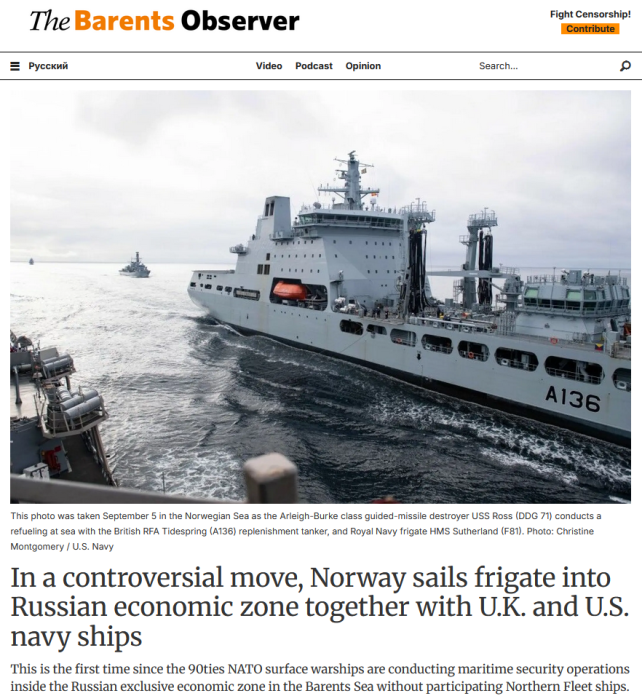
For example HMS Sutherland, accompanied by Royal Fleet Auxiliary Tidespring, and two other NATO warships penetrated 160 miles into Russia’s Exclusive Economic Zone and lingered 40 miles from Russia’s Severomorsk naval base. There was no pretence they were doing anything other than gathering intelligence and sounding out defences.
In armed forces media the UK boasted it was an assertion of freedom of navigation. Yet we harass the Russian vessel equally on the High Seas for exercising its freedom of navigation.
That was also perfectly legal. The idea that the same activity is worthy when we do it, but a pretext for war if the Russians do it, is so childish as to be beyond ridicule. But there is not one single mainstream journalist willing to call it out.

As this photo of HMS Somerset illegally threatening the Yantar on the High Seas shows, forcing it into dangerous moves, the aggression is not from the Russians. That British jets illegally buzzing the Yantar have been met with lasers designed to disrupt attacks. That is not the Russian aggression John Healy claims. The nonsense about dazzling pilots’ eyes is sheer invention.
Unless the plane is extremely, extremely low or a very long way away it is a physical impossibility to shine a laser into a pilot’s eyes in a modern warplane, from below in a ship. The pilot won’t be looking at the ship out of the window, but will be looking at his screens and the image from the cameras under the plane. These might be disrupted by the lasers – and a perfectly valid and sensible defensive measure that is too.
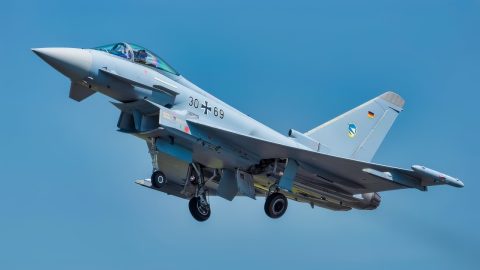
This is the Eurofighter Typhoon.
Imagine it in the skies way above you and look at its body, particularly the front end – how would you get line of sight on the pilot? You couldn’t. Lasers only go in straight lines.
Most sinister of all is the universal state control of media that gets every single mainstream outlet booming out the propaganda narrative, all entirely without question.
This war talk is of course the normal refuge of extremely unpopular governments. But it is part of a wider tightening of the grip of the military-industrial complex on the state. Starmer is committed to increasing military expenditure by tens of billions of pounds a year, while imposing austerity on the rest of the economy. In Scotland, we are told that the closure of major industrial sites like Grangemouth and Mossmorran will be compensated by opening new weapons factories.
Beating ploughshares into swords.
The rise of domestic racism and authoritarianism is accompanied by the increase in militarism and the desire to portray Russia and China as enemy states with whom we are already in a state of proto-war. The state has a mainstream media which is showing itself willing to pump out even the most thin propaganda to this end with no interrogation whatsoever.
Western democracy has already died. Not everybody has yet noticed.
The GRANITE ACT: Wyoming Bill Targets Foreign Censors With $10M Penalties

By Christina Maas | Reclaim The Net | November 24, 2025
The first cannon shot in a new kind of free speech war came not from Washington or Silicon Valley, but from Cheyenne. Wyoming Representative Daniel Singh last week filed the Wyoming GRANITE Act.
The “Guaranteeing Rights Against Novel International Tyranny & Extortion Act,” passed, would make Wyoming the first state to let American citizens sue foreign governments that try to police what they say online.
The bill traces back to a blog post by attorney Preston Byrne, the same lawyer representing 4chan and Kiwi Farms in their battles against censorship-driven British regulators.
Byrne’s idea was simple: if the UK’s Ofcom or Brazil’s Alexandre de Moraes wanted to fine or threaten Americans over online speech, the US should hit back hard.
Exactly one month after that idea appeared on his blog, it’s now inked into Wyoming legislative paperwork.
Byrne said:
“This bill has a long way to go until it becomes a law, it’s got to make it through legislative services, then to Committee, and then get introduced on the floor for a vote, but the important thing is, the journey of this concept, the idea of a foreign censorship shield law which also creates a civil cause of action against foreign censors, into law has begun.”
That “journey” may be the kind of slow procedural trudge that usually kills most ideas in committee, but the intent here is anything but mild, and, with the growing threat of censorship demands from the UK, Brazil, Europe, and Australia, there is a lot of momentum here to fight back.
“For the first time, state legislators are moving to implement rules that will allow U.S. citizens to strike back, hard, against foreign countries that want to interfere with Americans’ civil rights online,” Byrne continued.
The Act would let American citizens and companies sue foreign governments or their agents for trying to censor them, and, crucially, it strips away the usual escape hatch of sovereign immunity.
In its legal filing responding to the 4chan and KiwiFarms lawsuit, Ofcom insisted it has “sovereign immunity” and told the court there were “substantial grounds” for throwing out the case on that basis.
The regulator’s lawyers framed Ofcom as a protected arm of the British state, immune from civil claims even when its decisions target a platform based entirely inside the United States.
Ofcom treats the idea of “sovereign immunity” as something substantial but the First Amendment as something that does not exist at all.
The GRANITE Act is a defensive maneuver against a growing global trend. “Foreign governments and their agents increasingly seek to restrict, penalize or compel disclosure concerning speech occurring wholly within the United States,” the bill warns.
Such efforts, it argues, “conflict with the constitutions of the United States and of Wyoming and chill speech by Wyoming residents and entities.”
The act’s definition section is where its true reach becomes clear. It covers “any law, regulation, judgment, order, subpoena, administrative action or demand of a foreign state that would restrict, penalize or compel disclosure concerning expression or association” that would otherwise be protected under US law.
The text is well-researched and knows all the buzzwords of tyranny, naming the categories most likely to cause friction: “foreign online safety, hate speech, misinformation, disinformation, defamation, privacy, or ‘harmful content’ laws.” It’s a catalog of the modern speech-control toolkit, all of which Wyoming now places firmly outside its borders.
Wyoming’s approach also bars its own agencies from playing along. “No state agency, officer, political subdivision, or employee thereof shall provide assistance or cooperation in collecting, enforcing or giving effect to any measure” that qualifies as foreign censorship. The phrasing borrows from the constitutional doctrine of anti-commandeering, warning that local officials won’t be drafted into enforcing foreign censorship orders.
In Byrne’s view, that legal protection has let overseas bureaucrats act like international hall monitors, wagging fingers at Americans through threats of fines or content bans.
Byrne didn’t mince words about what he thinks this law could mean:
“If we get corresponding federal action, this law, and laws like it, could represent the single greatest victory for global free speech in thirty years.”
The teeth of the bill lie in its damages. The minimum penalty: ten million dollars. It matches the scale of fines already threatened by the UK and others, which have been dangling penalties of $25 million or 10 percent of global revenue for non-compliance.
The math, as he puts it, is simple. A country can censor an American, but that choice now comes with a very real price tag.
“Foreign countries can bully the shit out of American citizens and companies because they know that US law potentially protects them from consequences for doing so. We should take that immunity away from them.”
Byrne’s theory is that once the threat of US civil suits hangs over foreign regulators, the entire global “censorship-industrial apparatus” starts to wobble.
Byrne notes that the GRANITE Act would also relieve the White House from having to deal with diplomatic flare-ups over censorship complaints.
Trial lawyers would take over that job, freeing the president to “move on to other, more important matters.”
If the Act becomes law, the power to fight foreign censorship wouldn’t rest with federal agencies but with American citizens, state courts, and civil litigators. It would empower them to fight back against foreign censors.
In the global tug-of-war over speech, Wyoming could suddenly become a frontline jurisdiction.
A historic decline in sympathy for Israel in Britain, and an unprecedented rise in solidarity with Palestine in 2025
By Adnan Hmidan | MEMO | November 24, 2025
Public sentiment in Britain today is markedly different from what it was two years ago. A society that once observed developments in the Middle East from a comfortable distance is now expressing a clearer and more confident moral position on the genocide in Gaza. The scale of this shift can be considered one of the most significant transformations in British public attitudes towards Palestine in recent decades.
Figures published in the autumn of 2025 indicate that sympathy for Israel has fallen to approximately 12 percent, the lowest level recorded, while sympathy for Palestinians has risen to around 38 percent in some national polling. A majority of respondents also state that Israel’s actions in Gaza cannot be justified on either moral or legal grounds. However, these figures represent only the surface of a deeper transition taking place within British society.
The primary catalyst for this shift has not been political realignment, diplomatic pressure or changes within party leaderships, but rather the scale and visibility of the atrocities committed in Gaza. As the genocide expanded to include the targeting of hospitals, schools and refugee camps, alongside collective punishment and reports of widespread abuse in detention, traditional claims about self-defence lost credibility.
Unfiltered images circulated widely across British media and social platforms. Families killed in their homes, children pulled from the rubble and patients evacuated after power cuts became daily realities rather than distant headlines. For many, Palestine was no longer viewed as a remote political issue but as a profound human tragedy unfolding in real time. The collapse of official narratives in the face of visible evidence contributed further to this reassessment, reinforcing the understanding that what is taking place is not a symmetrical conflict but the systematic destruction of a besieged population.
Over the past two years, Britain has also witnessed an unprecedented wave of public mobilisation. London and other major cities saw some of the largest demonstrations in Western Europe, continuing week after week without subsiding. Solidarity evolved from street marches to university encampments, from civic spaces to trade unions and professional bodies, and eventually to parliamentary scrutiny concerning arms exports and the UK’s legal responsibilities.
Notably, this movement was not driven solely by Palestinians, Arabs or Muslims. Large numbers of students, academics, health workers, legal professionals, artists and members of the clergy took part. British Jewish groups opposing the genocide played an important role in challenging attempts to delegitimise or isolate the solidarity movement. Two years on, public mobilisation remains active despite increasingly restrictive protest regulations, indicating that this is not a temporary emotional response but a deeper shift in public conscience.
This evolving landscape has also reshaped how many Britons, particularly younger generations, understand the question of resistance. Public debate is no longer confined to simplistic binaries. There is growing recognition that resistance emerges from dispossession, blockade and the absence of any viable path to justice, rather than from ideological motivations alone.
Policy-makers in Britain are aware of these developments, even if official positions have not shifted dramatically. Pressure is visible in calls to suspend arms exports to Israel, demands for independent investigations into potential complicity and a noticeable shift in political language, especially within the Labour Party. The driving force behind this pressure has not been a change of government but the continuing reality of the genocide itself, which has made unconditional support for Israeli policies increasingly difficult to justify publicly.
The genocide in Gaza has reshaped how many people understand their place in the world. In Britain, solidarity with Palestine has become a reflection of moral responsibility rather than a peripheral political stance. Although the path ahead remains complex, the transformation witnessed over the past two years demonstrates that sustained exposure to reality can alter public attitudes in ways that once seemed unlikely.
The decline in sympathy for Israel marks not the conclusion of this shift, but its beginning. Palestine is no longer perceived as a distant or marginal issue, but as a central concern within British public consciousness — one that is unlikely to fade in the foreseeable future.
Iran Dismisses US Dialogue Claims as “Not Credible”
Al-Manar | November 23, 2025
Iranian Foreign Ministry spokesperson Esmaeil Baqaei stated on Sunday that Washington’s professed willingness for dialogue lacks credibility, asserting that US claims are fundamentally inconsistent with its actions.
Speaking at a weekly press conference, Baqaei referenced recent remarks by the US president, stating that America has demonstrated in practice that it is not serious about negotiations.
The spokesman suggested that Washington either misunderstands the very concept of negotiation or approaches talks with a mindset that reduces them to dictation. He emphasized that such claims must be measured against the United States’ actual conduct.
Commenting on Tehran’s conditions for any potential talks with the US, Baqaei underscored that safeguarding Iran’s national interests remains the central and guiding principle.
“The other side has shown no genuine belief in negotiations,” he said, adding that as long as dialogue is treated as an imposition, the necessary conditions for genuine talks do not exist.
“What matters is that the US government has destroyed any basis for trust through its actions,” Baqaei stated. He cited the US withdrawal from the Joint Comprehensive Plan of Action (JCPOA) in 2018 and subsequent “unfaithful” actions during the Biden administration, despite earlier progress.
He further argued that the US decision to accompany the Zionist regime in its military aggression against Iran this past June provided further proof of Washington’s lack of intent to reach a reasonable and fair solution.
Addressing other diplomatic matters, the spokesman firmly dismissed speculation that Iranian Foreign Minister Abbas Araqchi’s upcoming trip to the Netherlands would involve negotiations with the three European countries (the E3). He clarified that the visit’s sole purpose is participation in a conference for the Organization for the Prohibition of Chemical Weapons (OPCW).
Baqaei conceded that consultations with other foreign ministers might occur on the sidelines in The Hague, but he explicitly labeled reports of negotiations with the European troika as untrue.
SHOCK POLL: 36% of Americans Believe They Experienced a Covid Shot Side Effect
By Jefferey Jaxen | November 22, 2025
The latest Rasmussen poll speaks volumes. A major flashing warning light for public health officials and political leadership. Are they paying attention? And more importantly, will they act?
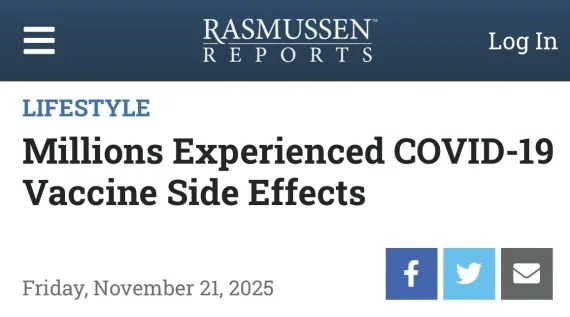
Rasmussen polls are pulse checks – real-time snapshots of public sentiment and mood on key topics.
The recent Rasmussen report reveals:
- 26% say they had minor side effects from the Covid shot
- 10% reported major side effects from the vaccine
- 46% believe it is likely that side effects of COVID-19 vaccines have caused a significant number of unexplained deaths
Under Kennedy’s leadership at HHS, once authoritarian Covid shot mandates have been backed off to ‘individual-based decision-making’ but is that enough. It’s clear the current public health apparatus wants out of all aspects of the Biden administration’s Covid train wreck.
Given the mounting data and science pointing to harms, many believe the government should be doing more – namely removing the Covid shot from the market.
At the same time, The Telegraph is reporting the following:
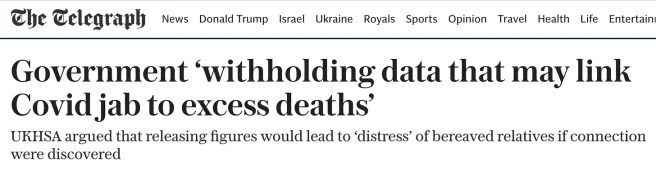
The story was created thanks to the legal action of the independent, non-profit, non-affiliated group UsForThemUK, along with diagnostic pathologist Dr. Clare Craig, who engaged in a 2-year battle to get public transparency of the general Covid vaccine and mortality data… data that was freely shared with pharmaceutical companies but withheld from the public.
The group lost its legal fight but a key admission was revealed to the public as the Telegraph writes:
The UK Health Security Agency (UKHSA) argued that releasing the data would lead to the “distress or anger” of bereaved relatives if a link were to be discovered.
Public health officials also argued that publishing the data risked damaging the well-being and mental health of the families and friends of people who died.
The Telegraph then describes a behind-the-veil moment writing:
UsForThem, a campaign group, requested that UKHSA release the data under freedom of information laws. But the agency refused, making a number of different arguments including that publishing the data “could lead to misinformation” that would “have an adverse impact on vaccine uptake” in the public.
In America, the CDC has just updated its “Vaccine Safety’ page creating massive public buzz showing an evolution in both science and a willingness to be truthful towards the public.
Among the new admissions the CDC website now states:
Scientific studies have not ruled out the possibility that infant vaccines contribute to the development of autism. However, this statement has historically been disseminated by the CDC and other federal health agencies within HHS to prevent vaccine hesitancy.
Together, both the UKHSA and CDC’s new statements show there has been, and still is, a lockstep coordination to purposely censor information from the public when it comes to injectable pharmaceutical product lines.
Governments are desperate to avoid the Covid vaccine injury conversation eager to avoid full-blown public health revolt on unknown consequences (already happening in large sections of the population)
The American Covid vaccine space is still a dismal public relations nightmare. The PREP Act, keeping the pandemic’s unnecessary actions in effect, blocks any hope of proper compensation for the critical mass of Americans who have experienced injuries from the mandated, failed shot.
Meanwhile, the ‘science is not political’ crowd spawned an East and West Coast Alliance coalition of all blue Democrat-run states representing the high water mark of hypocrisy and groupthink. Banding together for the purpose of ignoring the facts and evidence to push the Covid shot on infants and healthy people sans pandemic emergency.
The bizarre and self-defeatist move refusing to acknowledge any new science since 2020 on the mounting dangers of the Covid shot – the alliances are not only a danger to public health but to the credibility of the very institutional trust they claim to be standing for – perfect inversion.
The harms of the Covid shot are still a real concern of the American public. Ignoring these concerns or attempting to soft-sell solutions bypassing real help for the injured will not make this flashing red light any dimmer.
Emirati, Israeli disinformation campaign frames Sudan conflict as Christian persecution: Report
Press TV – November 21, 2025
Far-right Emirati and Israeli social media influencers have engaged in a coordinated digital campaign to falsely claim that Christians were being killed by “Islamists” in Sudan, a new report has revealed.
Sudanese investigative platform Beam Reports said that after the Rapid Support Forces (RSF) paramilitary group seized control of el-Fasher in Darfur nearly a month ago, misleading content about the nature of events began to surface online in a “synchronised manner.”
Beam found that several accounts took to social media to re-use images of RSF abuses against civilians in el-Fasher and frame them as “Islamist violence against Christians.”
The outlet accused Amjad Taha, an Emirati analyst, of being the architect of the campaign. He reportedly posted several claims about alleged Islamists in Sudan, which were then amplified by other accounts.
For several months, the Emirati figure has led the charge on social media to link Sudan’s armed forces with the Muslim Brotherhood and Islamic resistance movement Hamas in Gaza.
Amjad Taha claimed that Sudan’s army had “killed 2 million Christians, displaced 8 million, and raped 15,000 women, while leftists stay busy attacking the UAE… a nation where church bells ring freely.”
However, none of the numbers cited were supported by credible sources or verified reports, according to the investigation.
The Emirati influencer also said that a Sudanese army officer had “eaten a man’s heart after killing him and his children.” Again, no evidence was provided, but such claims were amplified by Emirati, Israeli, and far-right accounts.
According to the report published by Beam, the objectives of the coordinated campaign included shifting blame of atrocities away from the RSF, recasting Sudan’s war as a religious conflict to “evoke foreign sympathy,” and flooding the online space with fabricated content to confuse media coverage.
One such example was American influencer Nima Yamini, who shared images from el-Fasher and claimed they showed “Christians slaughtered in Sudan – and no one talks about it,” adding that massacres against Christians were so severe that you can “see blood from space.”
In reality, blood splatters seen from space were from areas of el-Fasher where the RSF were reported to have shot residents.
In a different post, far-right Polish politician Dominik Tarczynski shared a purported image of a mother and child in el-Fasher with the false caption: “Sudan: genocide of Christians by the Islamists.”
In 2023, a conflict broke out between the Sudanese army and the RSF, far from religious lines, which has resulted in the deaths of tens of thousands, displaced over 12 million people, and led the International Rescue Committee to characterize it as “the largest humanitarian crisis ever documented.”
Sudanese authorities have repeatedly said the RSF enjoys unconditional support from the United Arab Emirates (UAE), with Khartoum taking legal action against the country at the International Court of Justice (ICJ) in April.
A report by British daily newspaper The Guardian late last month revealed that British-made weapons and military equipment are being supplied by the UAE to militants from the RSF.
Furthermore, Khartoum-based writer and strategic affairs analyst Makkawi Elmalik also said in October that what is happening in Sudan “is not a regular military battle, but a systematic extermination committed by the RSF, supported by the UAE and Israel.”
He further stated that both the UAE and the Israeli regime have participated in planning the militia’s attacks on civilians in the Sudanese city and provided them with weapons and intelligence.
Featured Video

Chinese jet fuel and the myth of energy independence
or go to
Aletho News Archives – Video-Images
Book Review
Former Insiders Criticize Iran Policy as U.S. Hegemony
By GARETH PORTER | CounterPunch | February 27, 2013
“Going to Tehran” arguably represents the most important work on the subject of U.S.-Iran relations to be published thus far.
Flynt Leverett and Hillary Mann Leverett tackle not only U.S. policy toward Iran but the broader context of Middle East policy with a systematic analytical perspective informed by personal experience, as well as very extensive documentation.
More importantly, however, their exposé required a degree of courage that may be unparalleled in the writing of former U.S. national security officials about issues on which they worked. They have chosen not just to criticise U.S. policy toward Iran but to analyse that policy as a problem of U.S. hegemony. … continue
Blog Roll
 Aletho News
- Why no power can undermine Iran’s eternal dominance over the Strait of Hormuz
- Is The War Against Iran Over?
- Iran war will leave long-term ‘scar’ on Wall Street, investors warn
- How Iran decimated US power projection in West Asia: Military lessons of 40-day war
- Iran’s report details US-Israeli war crimes in targeting schools, hospitals, livelihoods
- NATO’s Slow Fracture: How Trump’s Iran War Exposed the Instrument of Hegemony
- Chinese jet fuel and the myth of energy independence
- Ukraine Sea Drone Fired From Libya Hit Russian Tanker in Mediterranean
- IRGC: Iranian forces launched no attacks during ceasefire hours
- Trump Administration Moves To Automate U.S. Military Draft Registration
- If Americans Knew
- TCN: Is Israel Blackmailing President Trump?
- Israel killed at least 303 Lebanese yesterday – who were they? Daily Update
- Amnesty: Urgent – Protect Lebanese civilians from brutal escalation in Israeli attacks
- Is The War Against Iran Over?
- Inside the Israeli army’s propaganda wing
- Hundreds of Gaza Amputees Stranded in Legal Limbo
- The gallows law: Israel moves toward executing Palestinian children
- Tucker Carlson: The Path to Peace requires ending ‘special alliance’ with Israel
- This is ceasefire? Israel’s biggest massacre yet in Lebanon, another journalist killed in Gaza – Daily Update
- Tucker Carlson on Israel: This Is the Behavior of an Ally? Really?
- No Tricks Zone
- An Inconvenient Tree: Uncovered In Alps… Europe Much Warmer Than Today 6000 Years Ago
- New Study Reports A 60% Slowdown In Greenland’s Ice Loss Rate In The Last Decade
- Low Intensity Tornado Wrecks Major Solar Farm, Creating A Potential Toxic Dump
- New Study Finds Warming Saves Lives…Cold Temperatures 12 Times More Deadly Than Excess Heat
- German Science Blog Accuses PIK Climate Institute Of Hallucinating Climate Tipping Points
- Devastating Assessment Of Comirnaty Vaccine By Former Senior Pfizer Europe Toxicologist
- New Study: CO2 Is ‘Effectively Negligible’ As An Explanatory Climate Change Factor Since 2000
- Former Pfizer Toxicologist Dr. Helmut Sterz Tells Bundestag Hearing Pfizer Vaccine Should Have Never Been Approved
- Energy Expert: Germany’s Nuclear Phaseout Was A “500 Billion Euro Mistake”
- New Research: South Australia’s Mid-Holocene Sea Surface Temperatures Were 4°C Warmer Than Today
 Aletho News