UK to send Ukraine 150,000 drones
RT | June 19, 2026
The UK will provide Ukraine with 150,000 UAVs by the end of the year, London announced on Thursday following one of Kiev’s largest drone attacks on Moscow since the start of the conflict.
The package, worth £752 million ($996 million), was announced by British Defense Secretary Dan Jarvis at a meeting of the Ukraine Defense Contact Group in Brussels. According to the British government, which has been among Kiev’s most active military supporters, the package will be funded through London’s £2.26 billion loan to Kiev, backed by proceeds from frozen Russian sovereign assets.
British officials presented the package, which includes drones, missiles and radars, as necessary military support for Kiev. Chancellor Rachel Reeves pledged that London would continue backing Ukraine and putting pressure on Moscow. Russia has long argued that continued Western arms deliveries only prolong the conflict and undermine peace efforts.
The announcement came after Moscow and the surrounding region were hit by one of the largest Ukrainian drone raids in recent years. Russian air defenses intercepted 194 drones approaching the capital overnight, according to officials, but the attack still caused damage.
Local authorities reported that one drone struck the Moscow Oil Refinery in the Kapotnya district, triggering a fire, while debris damaged residential buildings, vehicles, and commercial sites, including several shopping centers.
Residents in several districts also reported black rain and soot falling from the sky after the refinery blaze, with local authorities advising people to keep windows closed and limit time outdoors.
At least 17 civilians, including two children, were reported injured in the Moscow Region. The raid also disrupted air traffic, with temporary restrictions imposed at Moscow’s airports and numerous flights delayed or canceled.
Russian Foreign Minister Sergey Lavrov condemned the attacks and said Moscow would respond by changing its strategy and begin regularly carrying out large-scale strikes against targets that “directly affect the combat capability” of the Ukrainian military.
“I have long been convinced that words are not enough,” Lavrov told reporters.
Moscow has repeatedly accused Ukraine of using Western-supplied weapons, funding and intelligence to carry out “terrorist attacks” on Russian territory and civilian infrastructure.
Russian officials have argued that continued arms deliveries from the UK, EU and NATO members make Western governments direct participants in the conflict and reduce the chances of a peace deal.
Roosevelt’s Partnership with Stalin
Tales of the American Empire | June 18, 2026
Tyler Kent was a US State Department employee who became anti-Soviet after seeing bloody chaos while stationed at the US embassy in Moscow. He was transferred to the US Embassy in London where he served the cipher clerk who managed top secret messages. Kent was appalled to learn that Roosevelt was plotting to join the war against Germany and ally with the Soviets, whom he viewed as a much greater threat. Kent was planning to send top secret messages between Roosevelt and Churchill to American newspapers before the November 1940 presidential election but was arrested by the British.
President Roosevelt’s partnership with Soviet premier Joseph Stalin was deeper than Americans realize. Most know about the billions of dollars in lend-lease aid provided to the Soviets, but there were other major programs that required massive American support.
Operation Frantic was a series of shuttle bombing operations during World War II conducted by American aircraft based in Great Britain and southern Italy, which landed at three Soviet airfields in the recaptured Donbas region to rest and refuel. From there, the planes flew bombing missions en route back to their bases in Italy and Great Britain. Project Hula was a secret program in which the United States transferred naval vessels to the Soviet Union to encourage the Soviets to join the war against Japan. Based at Cold Bay Alaska, 149 American warships were delivered and 12,000 Soviet sailors trained to operate them between April and September 1945.
__________________________
“The Tyler Kent Documentary BBC 1982”; Adam Curtis; this was scrubbed from the BBC website but can be watched here:  • The Tyler Kent Documentary BBC 1982
“Operation Frantic – WW2 Shuttle flights”; Avialogs; June 3, 2013; • Operation Frantic – WW2 Shuttle flights – HD
“Project Hula: The Secret Alliance That Changed the Pacific War”; Forgotten Stories of Resistance; November 13, 2025; • Project Hula: The Secret Alliance That Cha…
Related Tale: “Poland Lost World War II”; • Poland Lost World War II
Censored Lavrov article Politico refused to publish (FULL TEXT)
RT | June 18, 2026
The pro-establishment, Brussels-based publication Politico Europe, owned by Germany’s Axel Springer SE, has refused to publish an exclusive article written by Russian Foreign Minister Sergey Lavrov.
Lavrov’s article was initially planned for publication in the Brussels-based Politico Europe, but due to a “last-minute decision by the outlet’s editorial team,” the publication was canceled, the Russian Foreign Ministry said on Friday.
In the article, Russia’s highly experienced top diplomat outlined Moscow’s view of the Ukrainian conflict, Europe’s role in escalating the crisis, and the broader implications for global security. Lavrov accused European leaders of using diplomacy as a cover for NATO and EU expansion, while arguing that the West has sought to turn Ukraine into an anti-Russian foothold. He also warned that the EU’s growing militarization, including discussions about nuclear deterrence and “strategic autonomy,” could increase the risk of a direct confrontation between NATO and Russia.
Below is the full text of Lavrov’s article, as published on the Russian Foreign Ministry website:
Some reflections on resolving the Ukrainian crisis, Europe and global security
At a meeting in London on 7 June 2026, the leaders of Britain, France, and Germany, as well as Vladimir Zelensky, laid out five preconditions for Russia to secure a “just and lasting peace” in Ukraine. United Europe now presents this list of demands as the basis for dialogue with Moscow.
Background
More than two decades of negotiations with Europe, as part of the collective West, lead to only one conclusion: engaging Russia in dialogue has served as a diplomatic smokescreen for the geopolitical expansion of Western institutions, above all NATO and the European Union, eastwards, right up to Russia’s borders.
Europe’s complicity in fueling the Ukrainian crisis is undeniable. Together with the United States, European countries orchestrated the Orange Revolution in Kiev in 2004. To create an anti-Russian bridgehead in Ukraine, they spent years buying off politicians and entire parties, rewriting history and educational curricula, cultivating and nurturing Ukrainian nationalism, and going to great lengths to pull Ukraine away from Russia.
In 2013, the European Union outright rejected our proposal for a compromise on the association agreement – a deal Brussels had long been pressing Viktor Yanukovich to sign. It is worth recalling that Ukraine was offered unilateral market opening without reciprocal commitments – terms that would have proved incompatible with Kiev’s continued membership in the CIS free-trade zone. When Viktor Yanukovich requested a deferral, the Europeans incited street riots that swiftly escalated into a coup d’état in Kiev in February 2014.
Germany, France, and Poland then proved themselves to be equally treacherous. Having guaranteed that the agreement reached between the opposition and Viktor Yanukovich would be honored, they washed their hands of it the moment that same opposition, their own handiwork, took power. “Democracy,” they shrugged, “takes unexpected turns.”
Europe thereafter lent its backing to the new authorities. In Odessa on 2 May 2014, the burning alive of dozens of innocent supporters of closer ties with Russia did not draw a single word of condemnation from European capitals.
As co-guarantors of the 2015 Minsk Agreements, France and Germany effectively encouraged the Ukrainian regime to sabotage its own commitments. As Angela Merkel and François Hollande later conceded – after the special military operation had already begun – Kiev’s implementation of the Minsk Agreements, unanimously approved by the UN Security Council, was never genuinely intended. The objective, they admitted, was merely to buy time: to shore up the Armed Forces of Ukraine and flood them with Western weaponry.
Russia, for its part, explored every diplomatic avenue to defuse Europe’s security crisis. However, in January 2022, the United States and NATO rejected Russia’s proposal for legally binding mutual security guarantees. European NATO members actively endorsed that rebuff.
Following the launch of the special military operation, United Europe threw its support behind the British prime minister’s efforts to sabotage the Istanbul negotiations between Russia and Ukraine. Boris Johnson’s appeal to Kiev – “don’t sign anything, just fight” – slammed the door on genuine diplomacy for the foreseeable future.
Current situation
So what has prompted European leaders to suddenly shift their rhetoric and start talking about negotiations, and what are they aiming to achieve with these statements? For instance, EU foreign policy chief Kaja Kallas has stated that the purpose of any dialogue with Russia is to dictate Europe’s terms. These include paying “reparations” to Ukraine; withdrawing troops from Transnistria and the South Caucasus; abolishing the “foreign agents” law; and accepting strict limits on the size of the Russian Federation’s Armed Forces. In her framing, “there can be no just and lasting peace without accountability for Russia.” During the UN Security Council session on 19 May 2026, an EU representative made the point unequivocally: “Supporting Ukraine militarily does not contradict the pursuit of peace, but rather serves as a fundamental prerequisite for any credible, good-faith negotiations.”
Europe’s plan is to talk with Russia while simultaneously pressing ahead with a campaign of legal warfare orchestrated through the Council of Europe. Within this once-respected organization, an entire infrastructure is being assembled for the express purpose of “holding Russia accountable”: a Register of Damage, a Claims Commission, and a Special Tribunal.
The European Union has also given the green light to detaining merchant vessels on the high seas. Several incidents have already taken place in the Baltic and the Atlantic. At the same time, the West studiously averts its gaze from the terrorist acts of sabotage perpetrated by the Armed Forces of Ukraine in the Black and Mediterranean Seas.
The real objective of Europe’s leaders, then, is not to negotiate with Russia. It is to shore up the Zelensky regime and preserve it as a launchpad for continued confrontation against Russia. With this in mind, European leaders are scrambling to secure a ceasefire as quickly as possible and for one reason only: to prevent the collapse of the Armed Forces of Ukraine on the battlefield. The plan is to “freeze” the conflict without addressing its root causes, and then rapidly deploy military contingents from the Anglo-French “coalition of the willing” onto Ukrainian soil.
It is widely known that European elites have invested their “political capital” in the confrontation with Russia, pouring hundreds of billions of dollars into propping up the Kiev regime and ramping up the military budgets of EU member states and NATO. Europe now aims to achieve “defense readiness” against Russia by 2030. Until then, they mean to buy time by whatever means are available. In a strikingly candid remark this April, Belgium’s chief of staff put it bluntly: “We still have a few years. Thanks to the courage and blood of the Ukrainians, who are buying us that time.”
United Europe continues to dream of expansion. It intends to absorb Ukraine and Moldova while pulling Armenia into its sphere of influence. NATO has already expanded eastward, swallowing up Finland and Sweden. As for Ukraine, it is increasingly being eyed as the “striking fist” of a future European military force, independent of the United States and independent of NATO.
Risks to global security
This state of affairs poses serious threats to global security. A direct confrontation between NATO and Russia could rapidly escalate into an exchange of nuclear strikes, with catastrophic consequences.
Under the banner of “strategic autonomy,” Europe is witnessing a significant build-up of its military capabilities, including in the nuclear sphere. Paris’s intention to extend its “nuclear umbrella” to several EU and NATO member states is a source of deep concern. This will do nothing to strengthen the security of France itself or of the recipients of its so-called protection.
For all that, Europe’s political and military establishment continues to attribute aggressive plans to Russia – plans that, they claim, reach far beyond Ukraine. The Russian president has stated on numerous occasions that all of this is nonsense, provocation, and disinformation, aimed solely at extracting budget funds for the fight against Russia. That is scarcely the climate for substantive dialogue.
Russia’s position
As for negotiations, Vladimir Putin reiterated at the St. Petersburg International Economic Forum that Russia is not opposed to contacts with any party. We see Europe, however, as a party bent on Russia’s defeat – a stance the Europeans themselves openly avow. Dialogue with Europe, therefore, cannot be conducted as though it were an impartial third-party observer.
Russia would prefer to achieve the goals of the special military operation through diplomacy.
That requires reliably guaranteeing security along Russia’s western borders and ensuring respect and dignity for our citizens and compatriots, including the right to speak their native Russian language and practice the Orthodox Christian faith. Further military, political, and economic expansion by the West is unacceptable: it runs counter to the imperatives of a multipolar world.
European leaders should recognize that the model of regional security built in Europe over decades, ever since the adoption of the Helsinki Final Act in 1975, has been destroyed by their own hands. And it will never be restored. We must now move toward creating a continent-wide security architecture open to all Eurasian countries and reflective of today’s multipolar reality.
The principle of equal and indivisible security, trampled upon by the Euro-Atlanticists, can be embodied within a new Eurasian architecture. When the time is ripe, Europe too will be able to join this great effort.
The key point is that meaningful dialogue requires the restoration of trust, shattered by the anti-Russian actions of the West, and Europe as part of it, in the post-Cold War era. Trust can be recovered only through concrete steps that demonstrate a sincere commitment to moving away from using diplomacy as a cover for expansionist ambitions. Trust cannot be restored, nor can dialogue be resumed, through ultimatums such as the one issued to Russia in London on 7 June 2026.
P.S. It is noteworthy that the London ultimatum was unequivocally reaffirmed by the ambassadors of Britain, France, and Germany at the meeting at the Russian Foreign Ministry on 11 June 2026 – a meeting they had so insistently requested. That was the sole purpose of their visit to the ministry.
US, EU authorize production of ‘deep strike’ missiles inside Ukraine
Western allies are using the diplomatic progress from a possible Iran peace deal to intensify an economic blockade against Russia
The Cradle | June 17, 2026
On 17 June, G7 leaders announced that US and EU arms makers will start manufacturing advanced long-range weaponry “under license” in Ukraine, as western stockpiles dwindle, aiming to industrialize the frontline and sustain pressure on Russia.
A diplomatic source at the summit in Evian-les-Bains clarified that the push involves “not just air defense systems, but deep strike capabilities,” allowing Ukraine to threaten targets much deeper into Russian territory, Le Parisien reported.
The official noted that local production is essential as Ukrainian forces currently deploy approximately 20 Patriot missiles to counter every massive Russian offensive, straining global stocks.
The move effectively entrenches a permanent industrial infrastructure for offensive warfare capabilities within Ukrainian territory.
In a joint statement, G7 leaders from Canada, France, Germany, Italy, Japan, the UK, the US, and the EU expressed their “readiness to grant Ukraine licenses enabling it to increase its military production.”
German Chancellor Friedrich Merz explained that US firms will grant these licenses to European and Ukrainian manufacturers to address current industrial shortages.
Merz stated he was “grateful to [US] President [Donald] Trump for this great willingness to cooperate,” adding, “We are all currently producing too little, and this can be compensated for by granting licenses to companies that have these production capacities, including European and Ukrainian companies.”
This military support coincides with a G7 agreement to escalate economic pressure on Moscow by tightening sanctions on the Russian oil and gas sectors, with leaders citing the reopening of the Strait of Hormuz following the Iran–US memorandum of understanding (MoU) as the catalyst for these measures.
“We consider this the right moment to proceed with additional measures, as President Trump has delivered a deal that we support in reopening the Strait of Hormuz,” the leaders declared.
The move follows the US reinstatement on Tuesday of oil sanctions that had been temporarily suspended during the war on Iran, which now may end with the signing of the MoU on Friday in Switzerland.
The summit highlighted a shift in US foreign policy. Canadian Prime Minister Mark Carney described the new US stance as “harder toward Russia and more realistic, in our view, of the situation on the ground of the war.”
Trump, who told assembled leaders “I’m the boss,” pledged to “do everything” to help end the conflict.
While Ukrainian President Volodymyr Zelensky welcomed the “important results” regarding the military contracts, he remained cautious following a February 2025 meeting with US Vice President JD Vance and a demand that Ukraine provide resources as “compensation” for aid.
French diplomatic sources added that G7 members now “acknowledge that there is momentum on the ground” in Ukraine’s favor.
The new western military push comes after the EU had approved an approximately $105 billion loan for Ukraine on 22 April to fund critical defense needs and financial assistance.
The funding was released following a months-long deadlock after Ukraine resumed Russian oil flows through the Druzhba pipeline to Hungary and Slovakia.
Hungary had vetoed the loan, accusing Kiev of using “technical repairs” from a drone strike as a pretext to weaponize energy and exert political pressure.
Russian frigate fires warning shots in English Channel
RT | June 16, 2026
A Russian vessel fired warning shots near a British yacht sailing on a dangerous trajectory in the English Channel, the Russian Defense Ministry has said, adding that the shots were fired when all other options had been exhausted.
The Admiral Grigorovich was sailing in international waters between the Isle of Wight and Normandy shortly before midday on Tuesday when its crew spotted the civilian yacht, the ‘Bright Future’ sailing “on a dangerous course that would bring it into close proximity with the warship,” the ministry said.
The Russian crew tried and failed to reach the yacht by radio, before firing signal flares and sounding a siren, neither of which succeeded in changing its course. When the yacht came within 150 meters, the commander of the Admiral Grigorovich decided to fire warning shots across its bow with small arms.
“Following this, the British-flagged yacht immediately altered course and moved away from the Russian warship,” the ministry said, adding that the Russian crew “acted in strict compliance with international navigation rules and took all necessary measures to prevent an incident.”
The incident was first reported by the British press, which made no mention of the yacht sailing toward the warship. The British Defense Ministry did not comment on the encounter, except to tell the BBC that it was “investigating reports of an incident in the Channel.”
The Admiral Grigorovich – a 3,600-ton warship equipped to carry Kalibr cruise missiles – was being followed by a Royal Navy patrol ship – the HMS Mersey – at the time of the incident, the BBC reported. It is unclear how close the HMS Mersey was to the Admiral Grigorovich at the time.
The incident took place two days after British commandos boarded and seized a Cameroon-flagged tanker supposedly carrying sanctioned Russian oil. British Prime Minister Keir Starmer described the tanker as belonging to Russia’s “shadow fleet,” a euphemism for tankers that carry Russian oil without coverage from Western insurers. The vessel, the ‘Smyrtos’, was boarded in the English Channel.
‘Jewish lobby’ deceived Putin – Lukashenko
RT | June 15, 2026
Russian President Vladimir Putin was deceived into withdrawing troops from near Kiev in 2022 by forces claiming to represent Vladimir Zelensky’s willingness to seek peace, Belarusian President Alexander Lukashenko has said.
Speaking in an interview with Al Arabiya, Lukashenko said the conflict could have ended quickly in its early stages, when Moscow’s forces were near the Ukrainian capital.
“At the time, not only I, but everyone in the world understood that the war would end quickly with a Russian victory. This was primarily because the Russians were in Kiev,” the Belarusian leader said, according to BelTA.
However, Lukashenko claimed that “certain politicians and forces” then asked Putin to stop, pull troops back from Kiev, and conclude a peace agreement. “Before that withdrawal, everyone understood that Ukraine’s days were numbered.”
The Belarusian president argued that Moscow had been acting on what appeared to be a genuine opportunity to reach a settlement, adding: “Judge for yourselves who was right and who was wrong in this matter.”
“Once again, probably, these forces deceived him. It was the Vatican. And, surprisingly, the Jewish lobby, the Israelis,” Lukashenko said. “They said on behalf of Zelensky: that’s it, we are moving toward peace, we agree. And others as well.”
It was not immediately clear what exactly Lukashenko meant by the “Jewish lobby.” In the early days of the conflict, then-Israeli Prime Minister Naftali Bennett acted as a mediator between Moscow and Kiev, meeting Putin in Moscow and holding multiple phone calls with Zelensky. Media reports at the time claimed that Bennett had urged Zelensky to accept Moscow’s terms.
Lukashenko also did not elaborate on the Vatican’s alleged role. In March 2022, however, Pope Francis and Russian Orthodox Patriarch Kirill held a video call in which they stressed the “exceptional importance” of the negotiation process.
Moscow and Kiev held several rounds of peace talks in Istanbul in March 2022. Putin said in June 2023 that Ukrainian negotiators had initialed a draft treaty on permanent neutrality and security guarantees, but that Kiev later abandoned the deal after Russian troops pulled back from areas near the Ukrainian capital.
Moscow has argued that Ukraine walked away from the agreement under Western pressure, including from then-British Prime Minister Boris Johnson, who reportedly urged Kiev not to sign any deal with Moscow and to “continue fighting.”
Kiev has disputed Moscow’s account of the failed talks, even though its former chief negotiator, David Arakhamia, has acknowledged Johnson’s role. Ukraine has since formally applied to join NATO and abandoned discussions of neutrality.
The UK Joins the Pirates
By Craig Murray | June 15, 2026
I was genuinely surprised by the Starmer regime’s refusal to state that the Israeli boarding of the Global Sumud flotilla on the High Seas was illegal. I did not realise it was because the UK was planning to undertake similar illegal seizure itself.
The Gaza Flotilla seizure was illegal: while for obvious reasons freedom of navigation had been the undisputed basis of UK maritime policy for centuries. The UK is a set of islands whose population is dependent on food imports to stay alive. Freedom of navigation is a core strategic interest of the UK. The relevant provisions of the UN Convention on the Law of the Sea were very heavily UK driven, including on passage through straits.
Abandoning the primacy of freedom of navigation is absolutely a radical policy departure for the UK, driven like so many other changes to traditional British legal positions by the Starmer regime’s extreme support for Israel.
It is not generally understood how profound a change this is. Even the Tory government of David Cameron, with William Hague as Foreign Secretary, had opposed the Israeli naval blockade of Gaza and particularly Israeli seizure of vessels on the High Seas. William Hague stated in 2010 to the House of Commons of the boarding of the Mavi Marmara:
We are seriously concerned about the seizure of British nationals in international waters,
This is a long term British legal position now directly repudiated by Starmer, Lammy and Cooper.
I had not realised that not only was the UK now supporting the campaigns of illegal blockade and seizure of vessels being openly pursued by Israel and by Trump, but Starmer was actually intending to abandon freedom of navigation and join the Trump/Netanyahu doctrine.
That is what the UK has now done by its seizure of the Smyrtos as it had passed through the Straits of Dover en route to Sikka in India.
The Dover Strait is a strait. The clue is in the name. The UK has absolutely no right to close it to Russian shipping. This is in Article 39 of the UN Convention of the Law of the Sea:
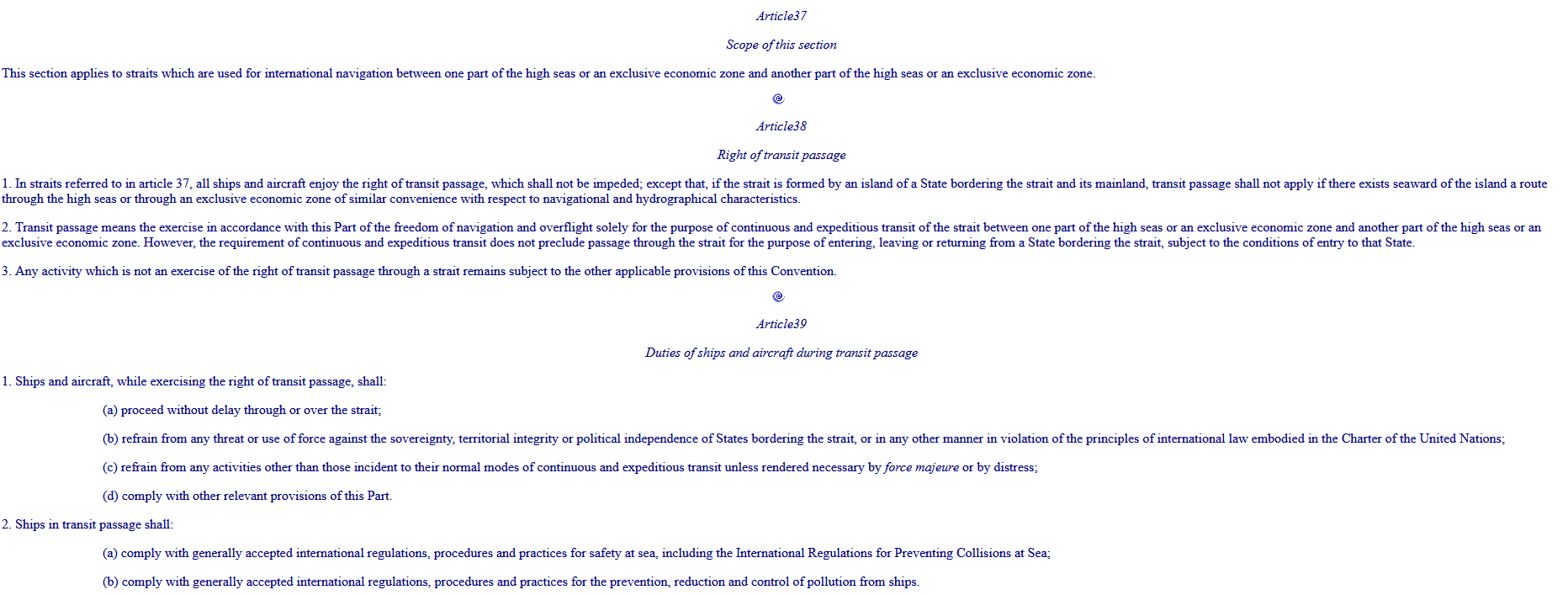
Transit of international straits “shall not be impeded” is pretty plain. This is the applicable legal regime for both the Strait of Dover and the Strait of Hormuz. Obviously in time of war different considerations apply, and commercial shipping of belligerent states – and to and from belligerent states – becomes a legitimate target. Iran is fully justified in also treating states permitting attacks launched from their territory as belligerent states.
If hostilities end this Article 39 regime that should apply again in the Strait of Hormuz.
It is worth a footnote to say that Iran had, until the recent illegal aggression by Israel and the United States, always strictly observed the international law on straits even though Iran did not sign the Convention and actually had entered a formal reservation on passage through straits. Even during the war, Iran had attempted, in extremely difficult circumstances, to establish a system for passage of genuinely neutral vessels.
It is astonishing that at this moment, when navigation of the Strait of Hormuz is arguably the single most live question in all of international politics, the UK has decided to abandon the principle of free transit through straits.
It takes hypocrisy to an entire new level, it truly beggars belief, that the day after closing the Dover Strait to Russian shipping, Starmer issued a joint statement with Germany, France and Italy insisting on “Freedom of Navigation” in the strait of Hormuz.
Even if you don’t care about international law and believe that Trumpian realpolitik is better, to act against freedom of navigation now would seem an unwise decision. The UK is now copying actions like the United States naval blockades of Cuba and Venezuela, and the Israeli genocidal blockade of Gaza. These are gross violations of the Law of the Sea.
UK Government minister Lisa Nandy was on television news last night as the government pumped out militaristic propaganda. The Royal Navy’s action in boarding and capturing an entirely unarmed and peaceful merchant vessel was portrayed as an act of Nelsonian brilliance. Nandy justified the seizure on the grounds that Russia’s oil sales pay for its war with Ukraine, and that the UK was enforcing sanctions against Russia.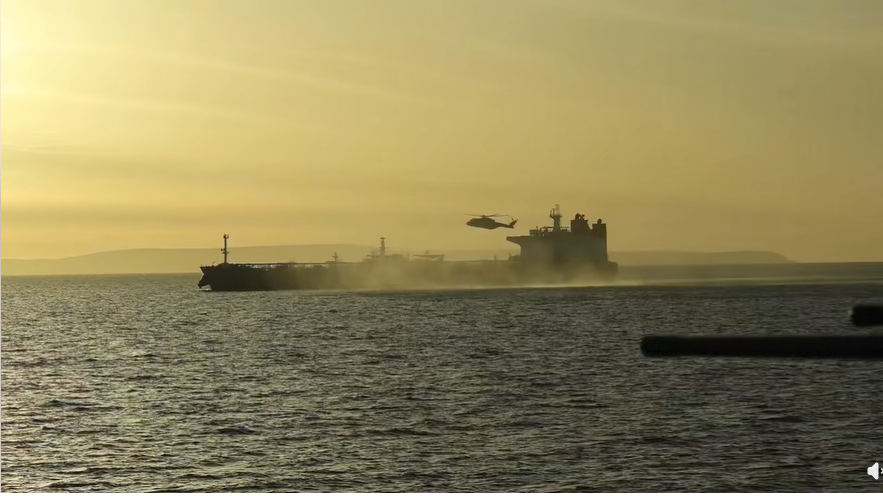
Neither provides an atom of legal justification for seizing the vessel. The UK is not at war with Russia. Ukraine is, and the Ukrainian navy would have been entitled to seize the vessel. For reasons of cheap popularity and to increase the massive amounts of public money swirling around the corruption honeypot of military spending, UK ministers seem determined to move us to the brink of war with Russia. But we are still not at war, and the UK accordingly has no right to seize peaceful and innocent Russian bound, owned or flagged commercial vessels.
The UK is legally entitled to put whatever sanctions it wishes on Russia. But it can only enforce those within its legitimate jurisdiction. A foreign vessel, even when engaged in innocent passage or transit passage through a UK strait or other territorial waters, is not under UK jurisdiction. The Smyrtos was in fact in international waters south of the UK when seized.
In fact this attempt to enforce western sanctions in areas where western powers have no jurisdiction is a classical example of the current aggressive resurgence of imperialism, where the “rules based order”, meaning rules imposed by the imperialists, replaces international law.
Nandy also stated that the Smyrtos was a member of the “Russian shadow fleet”. This is a term that the Starmer regime and their client mainstream and corporate media have relied upon repeatedly to demonise the Russian owned or directed merchant fleet.
Russia sells oil to countries like India and China perfectly lawfully. That this oil is carried in ships bearing flags other than Russian is perfectly normal.
Nil or close to nil of those ships carrying hydrocarbons to and from the UK are UK registered and flagged.
It has been a sad truth of international shipping for many decades that commercial vessels bear flags of convenience, and that jurisdictions compete to offer the very lowest standards of crew salary and welfare regulations, officer and crew training, vehicle condition and maritime safety and inspection regimes.
Most of the registries of well-known international flag of convenience states such as Panama, Liberia and the Marshall Islands, do not really exist in the sense of being government departments of those countries, as they should be. They are private companies with almost no real world footprint, which pay a fee to the government to operate the registry, and collect the fees from the shipowners registering. The register is just names in a laptop – and very often that laptop is in London.
UK colonies often have substantial such fake registries. The UK is a strong opponent of the International Transport Workers Federation, which has struggled against this system to improve mariners’ rights.
The system evolved for wealthy shipowners to avoid all maritime safety, environmental and welfare regulation, and the UK and other western countries which pander to the needs of the ultra wealthy have always been complicit. The incredible hypocrisy of western states pointing fingers at Russia for running “Flags of convenience” is breathtaking.
The West has spent decades building and profiting from the global flags of convenience system. Russia is simply using the same system that Western companies created and still dominate.
Incidentally the MOD’s own propaganda footage, shown by all UK mainstream media yesterday, proves that the Smyrtos is a modern, clean, well-equipped and comfortable vessel and all the propaganda about ancient rustbucket is completely untrue.
I have finally managed to pin down the alleged legal basis of the seizure of the Smyrtos, and it is that the vessel was stateless and thus subject to boarding under Article 110 of the UN Convention of the Law of the Sea.
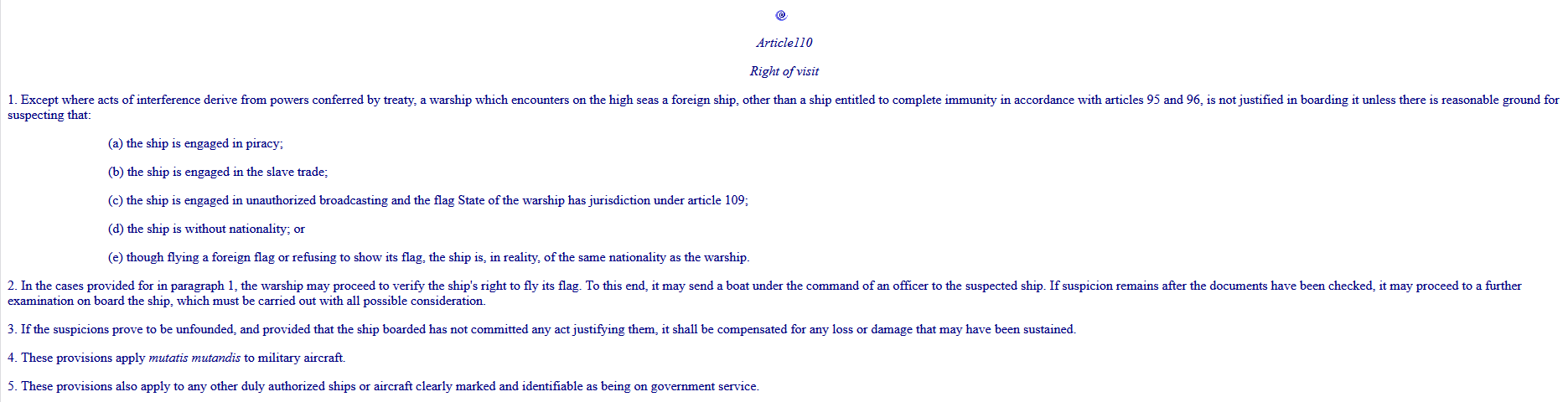
The UK is claiming that the Smyrtos fell foul of Article 110.1 (d) that it was “without nationality”.
We will inspect that claim more closely in a moment. But, assuming it for a moment to be true, note that you only have a right to visit and inspect on the High Seas a ship that is without nationality. Article 110 absolutely does not confer any right to seize a ship on the High Seas not found on inspection to be in unlawful activity. The UK has seized the Smyrtos, brought it into UK territorial waters and then claimed it is under UK jurisdiction.
Nowhere is that allowed in the Convention.
Now let us look at the claim that the Smyrtos is without nationality. This is an astonishing story which the media will not tell you.
When the Smyrtos set sail from Russia it was flying the Cameroonian flag, and on the Cameroonian register. That is not in doubt.
While the ship was on its voyage, on 10 June Cameroon withdrew its registration. It did so because the EU and UK threatened to halt development aid to Cameroon unless they removed Russian vessels from their shipping register.
So the UK blackmailed Cameroon into deregistering the ship. Then, before the ship could reach a friendly port, the UK boarded it because it had been deregistered.
Now doubtless there are chortling people in the UK security and military industries self-congratulating themselves over how clever they are. But while this may be a clever ruse de guerre, it is hardly a ruse de paix. It is not going to survive scrutiny by an international court. An unexpected change of registration, forced upon the owners, is very difficult to complete instantly, but doubtless one was in train and perhaps finished. The UK actions are patently – and deliberately – unreasonable.
Politicians seek to drum up cheap popularity by stupid jingoism. Starmer has won a cheap headline. The world inches closer to the next world war. The UK loses yet more legitimacy in the eyes of the wider world.
Meantime Trump claims as a great victory a possible return of the Strait of Hormuz to the open status it enjoyed before he started an illegal war in the interests of Israel.
Freedom of navigation was a principle worth defending. It has been abandoned in favour of a return to the rule of the seas by those with the strongest navies. Fortunately Putin is neither as war hungry nor as politically desperate as Starmer. However Russia will now be obliged to send at least a frigate to keep the Strait of Dover open. The drums of war beat ever closer.
Craig Murray is a former Head of Maritime Section of the UK Foreign and Commonwealth Office. He is a former Alternate Head of the UK Delegation at the UN Preparatory Commission for the UN Convention on the Law of the Sea.
Time for Trump to Tell Benjamin Netanyahu to Go Away!
Netanyahu always says “What you own belongs to me”
By Philip Giraldi • Unz Review • June 14, 2026
In addition to the regular lethal American and Israeli attacks on Iran, last week alone the Israeli military killed 13 Gazans and 13 Lebanese. Gaza is now 70% Israeli occupied, contrary to what was agreed upon in the ceasefire arrangement, as is much of south Lebanon. More than 1,000 Gazans have been murdered by Israel since the temporary ceasefire was declared in October 2025. And one might add to the toll the constant aggression in south Syria, where Israel is creating an army base presence to be followed by settlers that creeps ever closer to the capital Damascus. It is an encroachment that Prime Minister Benjamin Netanyahu and his band of war criminals intend to turn into a component of “Greater Israel” together with Gaza and Lebanon.
Armed Jewish settlers are meanwhile devastating what remains of the Palestinian West Bank, destroying farms and livelihoods as well as entire villages. Taybeh, the last Christian village, was made uninhabitable last week after weeks of raids killing livestock, poisoning water and cutting down olive trees. If a Palestinian tried to intervene he was beaten and in some cases killed. Churches and Mosques on the West Bank are routinely desecrated and non-Jews in religious attire or trying to enter a holy site are frequently spat upon particularly in Jerusalem. The Israel Defense Force (IDF), meanwhile, regularly stands by and watches the displays of wanton brutality and does nothing. Lest there be any confusion regarding what is coming, the Knesset has now authorized $51 million to build more than 60 new completely illegal settlements on Palestinian land in the occupied West Bank.
What all these places have in common apart from the cruel Israeli hand is that the United States, often in the form of Trump personally, has been a guarantor of the ceasefires as well as the source of the so-called but utterly dysfunctional Board of Peace, has done nothing to stop the slaughter. Rather, it is continuing to provide Israel with weapons, money and political cover. It is therefore complicit in the war crimes. Here at home, Trump is promoting the Israeli program by supporting the criminalization of anyone who speaks up against the crimes against humanity being committed by his “best friend” Bibi, choosing to destroy freedom of speech rather than allowing any exposure of Israel’s crimes. This is reminiscent of June 8th 1967, when Israel attacked the USS Liberty, killing 34 American crewmen and injuring 172 more. A cover-up followed to protect Israel, coordinated by President Lyndon B Johnson, a hideous excuse for a human being who would likely have found it pleasant to have a chat about “values” with Trump.
If there is one thing that is most definitely true it is that the United States gains absolutely nothing in either the national interest nor in the well being of the average American from the bondage to Israel and Netanyahu. If opinion polls mean anything, the public in the US has figured that out and has turned sharply against the Jewish state and now favors both the Palestinian cause and the drive to end the totally meaningless war against Iran. That means that it is past time for the United States to cut the tie that binds with Israel and look to its own interests. That is necessary even if Congress and President Donald Trump continue to push in the opposite direction to complete their subjugation by the Israelis, which now includes a planned fusion of the US and Israeli defense and intel bureaucracies.
If we have learned anything from all of the above and more, there is one thing true about the President Donald Trump administration and that is its particular incompetence at foreign relations, i.e. how it deals with other nations, and, by extension, how it mismanages national security. Part of the blame surely belongs to Trump himself as he has little or no empathy for other human beings unless they are either capable of doing him harm or profiting him personally, as do Netanyahu and the Jewish billionaires. And he also has a tendency to change direction spontaneously and without much concern for the actual issues that might be important to his audience. All that matters is whatever he happens to think will make him look good at any given moment, which recently has manifested itself as plastering his own name on public buildings. Responding to a recent journalist’s question about the rising inflation rate, he answered that he “Loved the inflation!” It was like saying “Goodbye midterms!”
Witness for example how on Thursday last week Trump announced in the morning that he would be attacking Iran that night to seize its major oil export facility on Kharg Island as part of a plan to cripple the country’s ability to sustain energy shipments. By 2 o’clock in the afternoon, however, he had called off the planned attack due to his perception that the US and Iran are now on the verge of an agreement to end the fighting and settle the various issues that have created the conflict in the first place. The mediating Pakistani Prime Minister did, for what it’s worth, confirm a possible peace agreement on Friday even though knowledgeable observers immediately commented that the claim was unsustainable as no negotiations were actually going on between parties and Iran has denied any such progress over key issues. As of Saturday, nothing was confirmed but Trump again asserted that there would be a “signing” of a “memorandum of understanding” as a first step to a peace agreement on Sunday, presumably to coincide with his birthday. Most observers however continue to argue that a weak-kneed and vulnerable Trump, though desperate to disengage from a disastrous Iran war, is only staying with it due to intense pressure from Israel and its domestic US lobby which may be prepared to employ “Epstein” blackmail on the president to maintain American participation in the conflict. If Trump were even to consider withdrawing from his ring of fire around Iran Israel would immediately take whatever steps are necessary to blow-up the agreement and resume fighting, be it by way of a false flag to drag the US back in or possibly exploiting the “Iran has a nuke” lie.
So it would be wise to accept that Donald Trump is a ship without a rudder and interactions with most of the Middle East will continue to be driven by Israel while bilateral talks elsewhere with major players like Russia and China appear to have dried up completely. Appointing real estate billionaires Steve Witkoff and son-in-law Jared Kushner as personal presidential representatives, both of whom are inexperienced and ardent Zionists, certainly did not improve prospects for what passed for negotiations with anyone. No one can trust Trump.
Israel’s reach far exceeds the country’s size and real power. A recent “friend” of Trump is Argentine Prime Minister Javier Milei, who, surprise-surprise, is also a great friend of Israel, having made the usual obeisance trip to the Wailing Wall in Jerusalem during a State Visit to Israel shortly after being elected. Raised a Catholic, Milei reportedly wanted to convert to Judaism but decided not to as its “no work on Saturday” rule would have interfered with serving as prime minister. Not content with taking all the Middle East, Israel’s Jews are also looking farther afield. Patagonia in Argentina has reportedly been particularly targeted by Israeli buyers with the assistance of the Milei regime which helped get around environmental restrictions. Israelis are also buying up numerous properties in Cyprus as well as in Greece, nearby states which would be convenient as refuges if Israel finally provokes one too many of its neighbors and it finds itself on the receiving end of a nuke. Benjamin Netanyahu’s resident American spy Jonathan Pollard reportedly has mentioned both Turkey and Egypt as “next” to feel the wrath of Zion after Iran is finished off. Either army could easily defeat the chickenshits in the Israeli army who are better at raping and torturing than they are at fighting.
But one story that has caught some attention illustrates clearly the Israeli manic desire to steal other peoples’ property, most particularly land, no matter what it takes to carry out the theft. As is always the case, they are not held accountable for their criminality by Donald Trump who has his own soft spot for stealing the property of others and chooses to cut corners, witness the grandiose plans for a Trump Riviera luxury development on the beachfront of Gaza. And then there are the current shenanigans on an island off Albania which is being multi-billion dollar “developed” by daughter Ivanka and son-in-law Jared Kushner using United Arab Emirates (UAE) cash to become a major resort for the rich and famous. Kushner got the money as a benefit derived from his family connection and fortunately a lot of Albanians are mad as hell about the deal that was struck and are demonstrating!
But the story out of the United States and Canada as well as over the weekend in London tops many of the Trump/Israeli tricks due to its sheer audacity and criminality. Amnesty International UK is demanding the British government stop a real estate event scheduled to take place in London that includes companies openly advertising the sale of land in Israeli settlements in the illegally occupied West Bank.
The ‘Great Israeli Real Estate Event’ is a traveling roadshow that has held events in Canada and the United States and has now been planning for the sale in London on Sunday. The events are organized by Israeli real estate firm called My Home in Israel. It sells land to prospective buyers through a team of US-based real estate agents with the sales normally taking place in synagogues or other Jewish-owned and operated buildings. There have inevitably been protests against the sales in cities like Los Angeles and New York, where the “lots” have been promoted to the local Jewish communities. The lots being sold include considerable sections located in illegal settlements on the Palestinian West Bank, land that has been stolen from its owners. The Amnesty International report published last week in opposition to the London show exposed Israel’s state-led ethnic cleansing campaign in the West Bank – “documenting the displacement of at least 5,910 Palestinian Bedouin and herding community members since 2023, the demolition of over 3,400 homes and structures in [Palestinian West Bank] Area C, and an unprecedented surge in state-backed settler violence and land grabs.”
So there you have it, whatever Israel wants Israel takes without any concern for those who die or lose their homes in the process. And the United States government sits by and watches as Netanyahu spins lie after lie. Well, enough is enough. America is hated almost as much as Israel for its behavior and if it continues there will be severe consequences. Time to show Netanyahu the door and tell him and his supporting cast of AIPAC and Jewish billionaire buddies to get the hell out.
Philip M. Giraldi, Ph.D., is Executive Director of the Council for the National Interest, a 501(c)3 tax deductible educational foundation (Federal ID Number #52-1739023) that seeks a more interests-based U.S. foreign policy in the Middle East. Website is https://councilforthenationalinterest.org address is P.O. Box 2157, Purcellville VA 20134 and its email is inform@cnionline.org.
Desperate Starmer choosing piracy as distraction over UK crime crisis – Putin envoy

RT | June 14, 2026
Kremlin envoy Kirill Dmitriev has accused UK Prime Minister Keir Starmer of using the seizure of a supposed Russian-linked vessel to distract from domestic problems.
In a post on X on Sunday, Starmer announced that UK forces intercepted a tanker involved in ‘shadow fleet’ operations, which allegedly help Russia bypass Western sanctions on oil exports.
The Smyrtos was reportedly transiting the English Channel before it was boarded by UK marines. The UK Defense Ministry said it will be held and monitored off the south coast while its operations are investigated.
Starmer boasted that he personally directed the interception, calling it a “successful operation” that delivered “yet another blow to Russia.” He later posted footage purportedly showing armed marines boarding the vessel.
Dmitriev suggested that the operation was not about security or enforcing sanctions, but to manufacture a confrontation and distract the public from immigration problems and crime.
“Desperate Starmer, instead of intercepting HIS immigrants who rape, mutilate and behead British people, attempts to DISTRACT the UK with an escalation,” he wrote on X.
The UK faces tensions over immigration following a number of attacks and high-profile murder and rape cases involving migrants in recent years. This week, a 17-year-old girl was stabbed in the neck in northwest England by a 30-year-old man of Pakistani heritage. The most persistent issue remains migrants crossing the English Channel in small boats from France, with successive governments repeatedly promising and failing to reduce the arrivals.
Ukraine’s Western backers have long accused Russia of using a ‘shadow fleet’ to maintain oil exports, which they seek to restrict in order to weaken Russia amid the conflict with Ukraine. Russia has denied that it operates a shadow fleet and has condemned the seizure of vessels on the high seas.
The UK has been among the loudest advocates of tougher action against ships carrying Russian oil, while previously avoiding direct involvement. In March, however, London claimed that a legal review cleared UK troops to board the vessels. The Russian Embassy in London called it a “deeply hostile step,” accusing the UK of preparing “acts of piracy.”
Russia has long considered Britain a key force behind the Ukraine conflict, accusing it of directly assisting Ukrainian long-range strikes on Russian territory with UK-supplied weapons. Moscow has also accused Western governments of demonizing Russia to justify increased defense spending and to distract the public’s attention from domestic problems.
UK judge brands Palestine Action activists ‘terrorists’ for storming Israeli weapons company
Press TV – June 12, 2026
In yet another blatant example of Western complicity with the Zionist regime, a UK judge has ruled that four Palestine Action activists have a “terrorist connection” for storming a British site of the Israeli weapons manufacturer Elbit Systems.
The ruling by Justice Jeremy Johnson was delivered as hundreds of Palestine Action supporters held a demonstration outside Woolwich Crown Court in south-east London on Friday.
Metropolitan Police arrested 107 peaceful protesters who had gathered to support the activists.
In August 2024 — at the height of the Israeli regime’s genocidal war on Gaza — Charlotte Head (30), Samuel Corner (23), Leona Kamio (30), and Fatema Rajwani (21) carried out a courageous direct action at Elbit Systems’ factory near Bristol.
They inflicted approximately £1.2 million in damage to military equipment destined for the occupying Israeli forces, aiming to disrupt the flow of weapons used to slaughter defenseless Palestinian civilians and to pressure for the closure of this Israeli arms factory operating on British soil.
However, the judge declared that the damage “had a terrorist connection” because the activists are linked to Palestine Action, the pro-Palestinian direct-action group that the UK government had proscribed as a “terrorist organization” in July 2025.
Notably, the High Court later ruled this proscription unlawful in February 2026 — a decision the British government is still appealing, while keeping the ban in force.
Under the legislation, even membership in or public support for the group is now a criminal offense in the UK, punishable by up to 14 years in prison.
Because of the judge’s “terrorist connection” ruling, the four activists will be denied normal early release provisions.
Instead, a Parole Board will assess their supposed “risk to the public” before they can be freed.
UN High Commissioner for Human Rights Volker Türk strongly condemned the UK’s misuse of counter-terrorism laws against pro-Palestinian activists, describing it as disproportionate and a threat to fundamental freedoms of expression and assembly.
This case exposes the hypocrisy of the British establishment: it shields Israeli war criminals and their arms suppliers while criminalizing peaceful citizens who dare to resist the machinery of genocide.
True terrorism is the Zionist regime’s daily massacre of Palestinians — not the brave actions taken to stop the weapons flow. The resistance continues.
Settlers, sanctions and impunity

By Ramona Wadi | MEMO | June 10, 2026
From 1st January 2008 to 31st December 2025, Israeli settlers killed 61 Palestinians and injured 3,778. The findings of the Independent International Commission of Inquiry on the Occupied Palestinian Territory, including East Jerusalem, and Israel, which partly discusses settler violence, note that “Israeli authorities have consistently acknowledged settler violence as a problem, while promoting structural conditions that enable it.”
The recently published report details the overt nature of Israeli settler violence – the claiming of responsibility for settler attacks on Palestinians as part of the process to ‘Greater Israel’, the unequivocal assertion that attacks are unprovoked, and the indoctrination of settler children by family members and settler organisations. Supporting the entire spectrum of settler-colonial violence is the Israeli government, with Prime Minister Benjamin Netanyahu downplaying the attacks against Palestinians as attributed to “a small group of unruly youth”. The report notes how government settlement expansion policy contributes to settler violence, and provides the framework for settler impunity. Mentioning prominent Israeli ministers and settler leaders, the report states, “They [the officials] have explicitly permitted or condoned settler violence as an instrument to achieve a broader agenda.”
As the UK, France, Canada, Australia, New Zealand and Norway imposed sanctions on networks that collaborate with settler violence in the occupied West Bank, the Commission of Inquiry’s report details the structure that supports settler violence against Palestinians. Reacting to the sanctions, Israel’s Ministry of Foreign Affairs Spokesman Oren Marmorstein declared, “The real essence of these steps is the attempt to impose a political stance regarding the right of Jews to settle in the Land of Israel and concerning the Israeli-Palestinian conflict – camouflaged as measures against violence.”
Of course the decision is political. However, as the report shows, the six countries’ decision to impose sanctions does not even scratch the surface of the politics and policies that support Israel’s settler-colonial expansion. Israel and its institutions have created a protective structure for settler violence, and Marmorstein’s statement illustrates how central settler violence is to completing the process of Greater Israel.
Without settler violence contributing to the forced displacement of the Palestinian people, Israel would have a difficult time maintaining its structure.
The discrepancy, however lies in world leaders’ decision to target entities and individuals rather than Israel itself. For example, the report highlights that the line between settlers and soldiers has blurred since regional brigades were formed and gun licenses were handed out by Israeli National Security Minister Itamar Ben Gvir. Settlers are being given power by Israel’s colonial structure, therefore sanctioning settlers is unlikely to make a difference in halting colonial expansion.
International diplomacy is still viewing Israeli settler-colonialism in manageable sections, and detached from Israel’s expansionist policies.
Targeting settlers with sanctions simply encourages Israel to provide more impunity for those doing its work on the ground, while the Israeli government continues with settlement construction.
As the Commission of Inquiry’s report shows, Israel cannot be discussed separately from settler violence. Sanctions, therefore, need to appropriately target the colonial framework itself, which would then have an impact on the settler-colonial society in its entirety.
Featured Video

Racist Seinfeld Dances for Joy as Bibi Unveils His New Map
or go to
Aletho News Archives – Video-Images
TV Drama Review
Japanese drama projects Japan’s wartime atrocities onto Chinese characters

Global Times | October 25, 2026
By portraying Chinese characters as perpetrators of ruthless violence while casting Japanese Self-Defense Forces (SDF) intelligence operatives as defenders, the season 2 of the Japanese drama Vivant has recently drawn criticism from Chinese netizens, who argue that its depiction turns historical reality on its head while ignoring Japan’s wartime atrocities.
The TBS drama series – a spy suspense story in which an alleged unofficial intelligence unit of the SDF operates across the globe — has attracted a passionate fanbase. Its currently airing season 2 opened with a household rating of 18.8 percent, the highest for a TV drama this year, according toa commentary article by Japanese media Toyo Keizai.
What draws attention is the portrayal of the enemies in the series, the article noted. Scenes in which the Chinese organization subjects kidnapped members of the SDF unit to brutal torture are repeated with unrelenting intensity.
It is rare for Japanese TV dramas to explicitly portray a real-life country as the enemy, the article noted.
Japanese Prime Minister Sanae Takaichi also made a reference to the drama, saying that she has been recording Vivant and hopes to binge-watch it over the year-end and New Year holidays, according to Japanese media outlets.
China’s CCTV News report on Sunday revealed that the drama features scenes in which Chinese personnel cut off the fingers of and stab Japanese intelligence operatives in the abdomen. Such acts bear striking similarities to the torture inflicted on Chinese nationals by invading Japanese troops during the World War II.
The drama distorts the truth by attributing these atrocities to modern Chinese characters. Beneath the surface, it subtly glorifies Japan’s cross-border overseas operations, blurs the functional boundaries of the SDF and implicitly promotes an expansionist narrative, per CCTV News. … continue
Blog Roll
 Aletho News
- EU facing trillion-euro debt hole while seeking more cash for Kiev
- How US, Europe, Persian Gulf states exhausted missile stockpiles, splurged billions to defend Israel
- Up in arms… Koreans reject U.S. empire’s plan to make South Korea the next Ukraine
- Iran, Turkey, Pakistan, Saudi Arabia could advance region-led security framework in Tehran: FM spox
- Netizens condemn Japanese drama for projecting Japan’s wartime atrocities onto Chinese characters
- Racist Seinfeld Dances for Joy as Bibi Unveils His New Map
- A West Bank War for Netanyahu’s Election Campaign, Could It Backfire?
- Yemen denounces European Parliament’s ‘hypocritical’ push to blacklist Ansarullah
- Qalibaf: UAE’s UN bid aims to ‘clear the runway’ for ‘Greater Israel’, whitewash genocide
- Pakistan reopens Iran border after boosting security: Report
- If Americans Knew
- Israel punishes Palestinian prisoners with solitary confinement for making a cake
- US midterms: Where do candidates in key Senate races stand on Israel, Gaza, and Iran?
- Israeli forces demolish Hebron homes, displace thousands of Palestinians as raids expand
- Their Son Died in Israeli Prison. No Answers. No Body
- Biden’s Israel Catastrophe
- Why Israel’s latest assault on Hebron is so significant for the West Bank
- Israel Used “Where’s Daddy?” AI to Relentlessly Murder Palestinian Journalists and Their Families in Their Homes from October to December 2023
- DAILY UPDATE: Latest essential news on Palestine, Israel, & region
- Netanyahu Says Israel Must Prepare for Banking Sanctions, Floats Crypto as a Possible Bypass
- Latest updates from Israeli assault on West Bank
- No Tricks Zone
- Sudden Stratospheric Warming, Powerful El Niño Combination May Lead To Extreme Europe Cold, Energy Crisis!
- Two New Studies Find Thwaites Glacier Melt Cannot Be Driven By Human Activity Or A Warming Ocean
- E-Cars Reduce CO2 Emissions By Only 41% Compared To Internal Combustion Engine Vehicles
- Predictions Made By Renowned Climate Professor Over Past Decades Have Been Proven To Be Poor
- New Study Suggests Large Regions Of The Pacific Ocean Have Been Cooling For The Last 80 Years
- Germany’s Green Energy Debacle: High Energy Costs Force Kahla Porzellan to Close After 182 Years!
- New Study: 50 Years Of The Most Aggressive ‘Net Zero’ Policies Can Only Affect The Global Climate By 0.03°C
- US September “Heat” Was No Record…Many Records Set Decades Ago
- Latest European Green Energy Debacle; Portugal’s Largest Flagship Solar Park Insolvent!
- Green Energy Debacle: German Expert Professor Fritz Vahrenholt Warns Of Severe Economic And Social Consequences

