People Are Able to Handle the Truth!
By Peter Haenseler | SONAR21 | July 5, 2026
Introduction
In 1959, Ingeborg Bachmann concluded that the truth is something people can be expected to handle, since they are quite capable of enduring it, no matter how uncomfortable it may be. Literature, she argued, should neither conceal nor gloss over the truth.
This is all the more true of the media, which for years have failed to fulfill their duty as the fourth estate. The world is heading toward a new world war, and the majority of humanity is unable to assess the risks and opportunities when the media distort the facts through their propaganda in such a way that the truth vanishes into an ever-thickening fog. The dumbing down has reached such a level that even politicians in the West believe the propaganda of their own media and act accordingly. The falsehoods that politicians spread are no longer perceived by them as lies; for the most part, their intellect is simply not sufficient for that. It must be stated that politicians have first and foremost become “ambassadors” of an ever-declining level of education—and continue to do so—and, as a result, have become victims of their own propaganda.
This article attempts to show that it is still possible to separate the wheat from the chaff, because the truth is hidden amid all the garbage in the news coverage.
Don’t Forget About Evil
In the article “Will Evil Prevail?,” I pondered who actually determines geopolitical events around the world. I discussed the “City of London” and the “Rothschilds” as examples of forces that steer the world from behind the scenes. They are thus also responsible for wars, coups, and other upheavals in our world. Even the small portion of the Epstein Files that has come to light provided a first impression of the entanglements among the powerful. See “Epstein – ‘Concierge of Evil’ – Dangerous Questions.” For example, the Rothschild family was dragged back into the public eye; the very family that has gone to great lengths to convince the world that it has exerted no influence since World War II and merely operates a few private banks, museums, and vineyards. It should come as no surprise that discussion of the contents of the Epstein Files—or their further releases—has completely vanished from the media; one might well wonder who controls the media.
Incidentally, the ‘deep state’ is not a concept peddled by a few crackpots. As early as 2017, President Putin spoke about it in no uncertain terms:
“Presidents change… Then well-dressed men arrive, in dark suits, with their suitcases. They start explaining how things really work… and everything changes instantly.”
Media
Control is exercised either directly by shareholders or indirectly through political or economic influence—for example, by controlling advertising revenue, blacklisting, or manipulating view counts on YouTube channels. Control over the media in the Collective West is, de facto, complete—not a bad achievement.
Consider this: freedom of speech is championed very vocally by politicians and the media at every opportunity, whether appropriate or not. Practically “in tandem,” it is restricted in the very same breath by first denouncing the spread of “fake news” and “hate speech”—that is, the expression of genuine freedom of speech—just as loudly, and then defining and enforcing it as a criminal offense for one’s own political gain.
Ultimately, then, it is the state that defines what “fake news” and “hate speech” mean. As a result, a right that is no longer absolute but has been relativized collapses under this restriction. In Germany, the desired political direction of judicial decisions is ensured through the political appointment of judges to the Federal Constitutional Court. The process for selecting judges to the European Court of Justice follows a similar procedure.
The consequences of this restriction are deliberate and obvious. Analysts who express even the most well-founded opinions that do not suit the tastes of those in power are stripped of their rights, dispossessed, and portrayed as criminals without due process. The method of choice is, for example, EU sanctions, which were originally enacted to target terrorists but are now—with the support of the general public—imposed on the most objective experts, such as the Swiss citizen (and thus non-EU citizen) Jacques Baud; see our coverage on this. The result of this targeted political influence is reporting in the traditional media that no longer has anything to do with the truth, but often turns it on its head.
All Geopolitical Crises Stem from a Single Source
All military conflicts around the world must be understood as a single package, a comprehensive strategy. The same people who are fueling the war against Iran and the violent creation of “Greater Israel” are also responsible for the conflict in Ukraine and the war between Europe and Russia that will likely unfold soon—and many other conflicts, such as those in Africa, which we have neglected in our blog, are likewise part of this strategy. Everything is interconnected, and it shows a lack of geopolitical understanding when journalists defend the war—waged with genocidal methods—against Iran, Lebanon, and Gaza, while simultaneously supporting Russia’s actions in Ukraine. The forces triggering and fueling these conflicts are identical. Understanding this is very helpful in grasping the overall geopolitical situation.
The overall picture is not hard to understand: After hundreds of years of colonial rule over the rest of the world, the Collective West has already lost the economic race against the Global South; more on this below. While wars over the past 500 years have been about who in the West would wield the scepter of hegemony over the colonial empire, today’s conflicts are about whether the Collective West can maintain its colonial empire. The odds are against it, as we have already outlined in our series “The War Between Two Worlds Has Begun.” At that time, we anticipated many individual conflicts spanning decades, but without a world war. This relatively optimistic thesis now seems to be faltering, as aggression between the world powers is escalating daily, the Collective West refuses to abandon the arrogance of the colonial master, and completely overestimates itself with spurious arguments.
The Defence Budget as a Measure of Military Strength Is a Fallacious Argument
For decades, the Americans have led the world to believe that they have the strongest armed forces in the world. This claim is backed up by an astronomical figure: the U.S. military budget of no less than 1.5 trillion U.S. dollars. That is 10 times more than the Russian military budget, or even 190 times more than Iran’s military budget, which amounted to 7.89 billion U.S. dollars in 2024. NATO, excluding the US, spent 608 million U.S. dollars.
Nevertheless, the US—along with Israel—suffered defeats in both the 12-Day War and the ongoing war, which has spiraled out of control. NATO, alongside the US, is suffering defeat in Ukraine. The massive budgets in the West are a clear indication that the military there is not designed to defend freedom, but rather to rake in as much money as possible. As a result, a weapons system in the West is considered successful if it can be sold—for as much money as possible—to its own armed forces or those of third countries. In 2024, we compared two combat helicopters that experts deemed equivalent: the Russian Kamov KA-52 and the American AH-64 Apache. The Apache costs 155 million U.S. dollars; the Kamov costs 16 million. On top of that, Western weapons systems are produced in virtually homeopathic doses, and it is impossible to increase production to a level capable of sustainably supporting a protracted conflict—it is too expensive, too complex, and combined with an industrial capacity that simply no longer exists.
In the medium term, the US will not be able to produce high-quality military equipment in sufficient quantities at reasonable costs, as it currently faces a multi-faceted problem: First, there is a lack of will, since profit is the primary goal of the military-industrial complex. Second, due to 30 years of deindustrialization, the US no longer has the industrial base necessary to produce weapons in quantities sufficient for wartime.
Rather, the focus is on making a profit. Objective observers should realize that such a strategy is bound to lead to disaster in a crisis—as has been demonstrated in the Middle East and Ukraine. According to various experts, the West has fallen at least a decade behind its competitors in both missile technology and drones in those regions.
Iran, for example, whose defense spending is about 200 times less than that of the US, possesses hypersonic missiles that are extremely difficult to intercept. In contrast, the Collective West still has no operational hypersonic weapons. Critics attribute this to a combination of profit-seeking, arrogance, and corruption within the military-industrial complex.
If the West wants to operate on an equal footing militarily in the future, it would have to fundamentally reform the military-industrial complex—a task that seems nearly impossible given the existing economic and political balance of power; this industry is controlled by the groups discussed above.
A Lack of Will to Fight in the West
How does the Collective West react to the wars it has lost? — It increases its military budgets without addressing the necessary structural issues. In the West, there is a mistaken belief that everything can be solved with money. In Russia, the defense industry is essentially state-owned, and therefore there is a strong interest in producing high-quality but affordable weapons.
Thus, there will only be a change in the US if the American pursuit of profit in weapons production were seriously called into question—and if society were able to attract the best minds to the defense industry in the interest of American society as a whole, which is not the case today. American missile physicists earn more as analysts at investment banks, and they have no motivation to serve their country, given the poor state of the will to defend the West. In Germany, for example, one figure dashes any hope for greater willingness to serve: out of 300,000 young Germans, 530 are willing to perform military service—that’s 0.17%! (Source: Süddeutsche Zeitung ). This figure stands in stark contrast to statements made by Boris Pistorius, the German Minister of Defense, who announced as early as 2024:
“We must be combat-ready by 2029,” the minister said. “We must provide a deterrent to prevent things from escalating to the extreme.”
The outlook for the Collective West to prepare its armed forces for war is thus bleak. Nevertheless, the Europeans and Americans seem to be charging headlong into a world war with outdated yet overpriced weapons systems and without the necessary will to defend themselves among the population. This not only seems insane—it is insane. The facts speak for themselves. Who would do such a thing? Corrupt politicians, like the ones we described at the beginning.
The Economy as an Indicator of Losing
If we look at the economic data, it is easy to see that the Collective West has already lost the economic race. History teaches us that, in such a situation, war is the only option left.
For years, I have been drawing attention to the devastating national debt and the grotesque valuations in the financial markets. On top of that, the Collective West also cheats when calculating economic power. All of this is done to maintain a narrative that allows the US to continue to be portrayed as number one. If you calculate GDP on a purchasing power parity basis—that is, taking into account the local purchasing power of individual countries—the US has already lost.
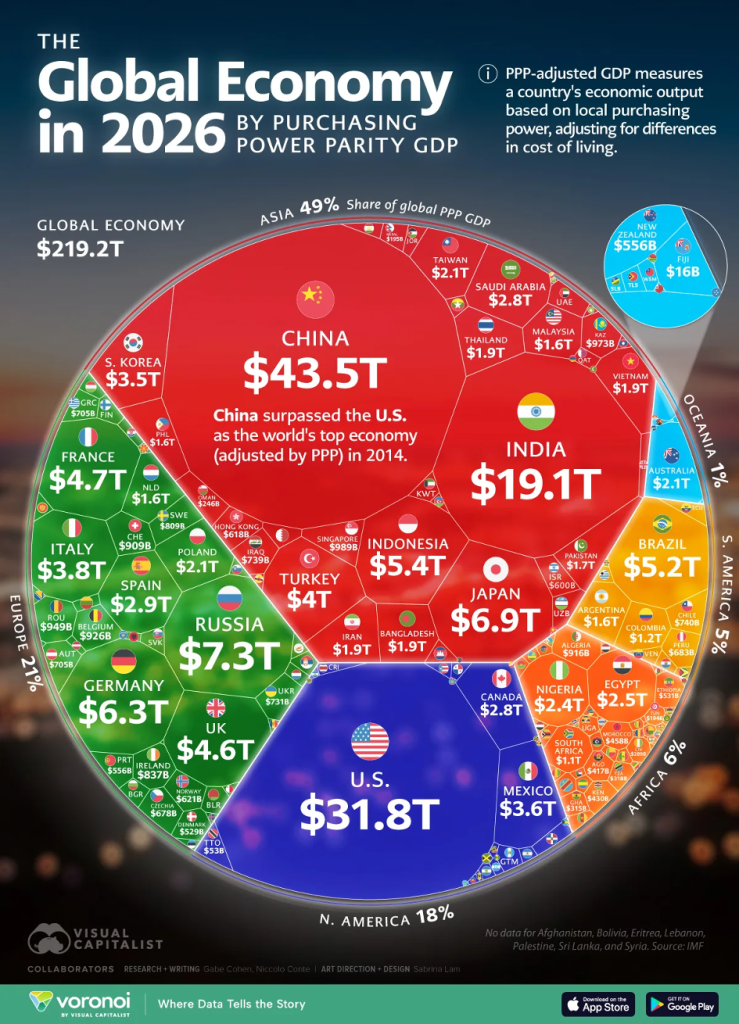
Source: Visual Capitalist
According to this calculation, China ranks ahead of the US, Russia ahead of Japan, and Germany.
Furthermore, the Collective West, as the aggressor, finds itself in a domestic political and economic situation that does not allow for a military showdown with Russia, Iran, and China: US debt stands at over 121%—the last time this was the case was at the end of World War II, following an industrial war that brought the US global dominance. After 35 years, and under economic and political conditions that remained favorable to the US, this debt was reduced to below 40%.
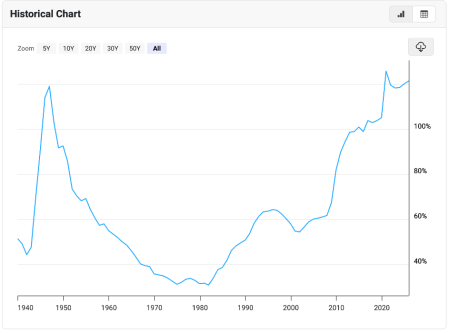
 Source: Macrotrends
In 1945, the Americans reached the height of their power. Together with the Soviet Union, they dominated the course of the war, held 22,000 metric tons of gold, and American industry produced 70% of the world’s manufactured goods. This is what true “full spectrum dominance” looks like: military dominance, industrial dominance, gold—because whoever has the gold sets the rules. Now the US is once again facing a world war, and the situation looks much like it did after the last war, with one major difference: China is at least the US’s economic equal, with far more favorable economic conditions.
These are not the conditions necessary for a military conflict on a global scale—neither financially, nor economically, nor, consequently, politically.
Middle East
It is clear from the text of the MOU that Iran has defeated both Israel and the US militarily; otherwise, the Americans would never have signed such a document. Israel cannot, without risking the collapse of its own delusions of great-power status, comply with the spirit of the document and end the war in Lebanon and Gaza. Therefore, there will be no peace.
Our comments on this topic: “Iran Defeats the US – Thoughts.” In Iran, voices are growing louder claiming that the president and foreign minister are not negotiating hard enough—public pressure in Iran is calling for a tougher stance toward the US and Israel. Iran’s Supreme Leader, Mojtaba Khamenei, has approved the memorandum of understanding (MoU) with the US to end the regional war under certain conditions. However, in a public statement, he said that he fundamentally held a “different view,” but had agreed to the agreement after receiving guarantees from President Masoud Pezeshkian that Iran’s national rights and the “Resistance Front” would be safeguarded. This is a clear indication that the Iranians are ultimately unwilling to make compromises at the expense of Lebanon and Gaza.
It is to be expected that the conflict in the Middle East will continue: Neither the US nor Israel is willing to accept defeat in the war and deal with its consequences. This stance maintains a state of limbo that could tip in one direction or the other at any moment. However, this strategy is countered by the fact that time is running out for the West because of Hormuz. The dwindling oil reserves were the main reason the US signed this MOU in its current form in the first place. The Americans are thus seeking a state of limbo that allows them to prepare their next military steps in peace; however, this state can only be maintained if the Strait of Hormuz remains open in the meantime. While approximately 130 ships passed through the Strait of Hormuz daily until February 28, 2026, these numbers dropped to practically zero, then stabilized at 5%–10% of pre-war levels, before surging to 70 ships on June 25, 2026. These figures should be treated with caution: It is said that the majority of these 70 ships were exporting oil from Iran after the US lifted the oil sanctions upon signing the agreement. If the Israelis do not withdraw from Lebanon and the Iranians remain steadfast—which is to be expected—then the Strait of Hormuz will remain a congested bottleneck: the time bomb for the West’s supply of raw materials continues to tick.
The Iranians can wait—the Americans cannot. When assessing the situation, one should simply disregard Donald Trump’s statements, because Trump speaks of peace one moment and war the next, changing his mind sometimes several times a day. He seems to believe that he can achieve something with the Iranians through this “New York-style deal-making” terror, but that is not the case, since he achieves only one thing: Americans are increasingly proving themselves to be agreement incapable, thereby threatening world peace.
War in Europe
The armed conflict in Ukraine, instigated by the West, began in 2014. Only those who do not classify Ukraine’s years-long artillery shelling of the Donbass as an act of war claim that the Russians started the war in February 2022. This is just one fact that is so obvious that one can only wonder at the West’s arguments that Russia is the aggressor.
Another fact is that this war has completely transformed the technology and tactics of warfare—the parties had to adapt to a new kind of war dominated by drones and missiles. Tank columns and troop concentrations are attacked by inexpensive drones as soon as they are detected—and they are detected very quickly. The warring parties had to undergo migration and learn this new art of warfare. The Russians, in particular, have done this successfully and now dominate the battlefield in a new way: through slow, efficient advances, because massed attacks produce only one thing—heavy casualties. Similar waves of technological advancement have occurred time and again. The machine gun, which was already in use before World War I but whose significance was underestimated at the time, brought an end to maneuver warfare as early as the first year of the war, when large columns of soldiers advanced toward the enemy and were wiped out. Toward the end of World War I, the tank brought some movement back to the front lines. However, comparing the frontline situation in Ukraine to that of World War I is a flawed analogy: Slow movements in small groups seem, so far, to be the only way to survive the drone barrage and maintain mobility.
Recently, Western media have been reporting that the Ukrainians have the upper hand in the war. However, this is fake news that has nothing to do with the reality on the ground. One must distinguish between the fighting on the front lines and NATO’s drone attacks in Russia. On the Donbass front, only a few fortified cities still stand in the Russians’ way; once those are taken, the Donbass will be liberated. Beyond that, there are no longer any fortifications worth taking seriously. Rather than going into details, I refer you to one of the best channels, Military Summary, which has been providing a twice-daily update on the situation at the front since the war began.
The West has not yet recognized the signs of the times. Its experts believe they will be successful in a war against Russia. However, they have not even defined their war aims in any way. Thus, they have no strategic plan against Russia other than to weaken it.
First and foremost, the Germans set the start of the war against Russia for 2030. However, it is now 2026, and the Germans apparently assume that, with Ukraine acting as their proxy, they can send drones and cruise missiles into Russia with impunity until 2030. Europe’s approach is, of course, coordinated with the US. The use of these weapons systems is not possible without American input. President Putin made this very clear a few days ago.
Many observers and experts both inside and outside Russia believe that President Putin will soon decide to launch a strike against targets in Europe—including those outside Ukraine.
There is a wide range of opinions on this topic. We have already published several articles on this subject: In “Will 1914 Repeat Itself? Will War Between Europe and Russia Finally Break Out?,” we also examined the Karaganov Doctrine, which advocates the use of nuclear weapons, and concluded that an attack is necessary, but not with nuclear weapons. Scott Ritter subsequently addressed the “Karaganov fallacy” and also spoke out clearly against the use of nuclear weapons.
Conclusion
In the Middle East, I see no realistic chance of ending the war, because that would mean, on the one hand, the withdrawal of American forces, and Israel would then be left alone as a small, genocidal aggressor. The Israelis are under pressure and are continuing their genocide in Gaza and Lebanon, paying no heed whatsoever to agreements between the US and Iran, because for Netanyahu personally, maintaining the war is the only way to survive politically.
In Russia, pressure is mounting on President Putin to adopt a more aggressive stance toward Europe, which is no longer even attempting to conceal its direct involvement in the war against Russia. Russia is intensifying its attacks on Ukraine, in part by destroying every gas station in eastern Ukraine to paralyze transportation logistics. Ground forces are making visible progress, and once the last fortified cities in the Donbas are liberated—which is likely to happen within the next few weeks—the path to the Dnieper will be clear.
President Putin is thus banking on a military solution in Ukraine and waiting for an energy crisis to unfold in Europe, where many flights are already being canceled under flimsy pretexts.
The concerted media coverage in the West claiming that the tide has turned in Ukraine finds not the slightest confirmation in the reality on the ground in Ukraine. The fuel shortage in Russia is also being exaggerated. In some regions, fuel is being rationed at gas stations. However, this is in no way sufficient to change Russia’s course of action.
Very occasionally, I have the opportunity to speak with someone who lives in Kyiv. According to this person, the situation is catastrophic, and over 90% of the population is against Zelensky. When I asked why the people weren’t rising up, the source replied that people were so intimidated by the terror of the security and intelligence services that the communication necessary for an uprising was impossible. Ukraine, which is portrayed by the West as a shining example of democracy, seems to be a time bomb whose ticking goes unheard out of fear.
My concerns that a war between Europe and Russia might break out—even though Europe has virtually no military power—have never been greater. President Putin will not be the one to take the first step toward a Third World War. Only he knows how much longer he will tolerate the West’s systematic provocations and how he will respond to them.
UK and Israel criticized for persecuting anti-genocide advocates
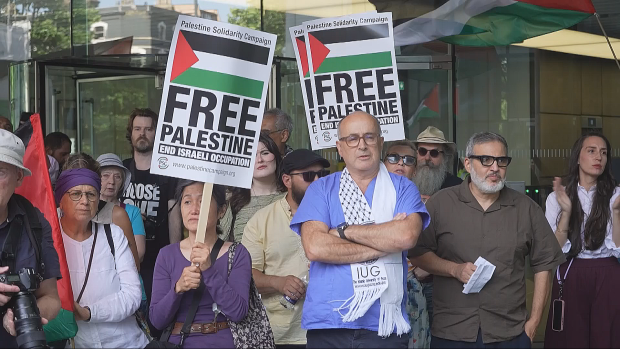
Protesters rally in London in support of Dr. Ghassan Abu-Sittah
Press TV – July 4, 2026
Protesters gathered outside the General Medical Council’s headquarters in London to slam the council’s attempt to silence those speaking out about the Israeli genocide in Gaza.
Protesters describe the surgeon as one of the world’s leading war doctors and argue that the regulator’s actions amount to an attempt to silence those who speak publicly about the realities of war,
So we are demonstrating in front of the GMC, because the GMC has decided to appeal against the rulings of two of its own tribunals, so that the High Court would allow it to try me for a third time, in order to get the right political result that it wants.
The GMC is conducting a political campaign against, not just myself, but every doctor who’s spoken up against the genocide, in order to silence us, in the service of the genocidal project. – Dr Ghassan Abu Sittah, British-Palestinian Surgeon
Doctors, campaigners, and members of the public traveled to attend the demonstration, asserting that the proceedings are about more than one individual, warning that they could have a chilling effect on healthcare professionals speaking about humanitarian crises.
Actually, there probably were a group of lawyers set up by the Israelis again to pursue highly charged politicized campaigns against professionals and workers in this country who stand against genocide.
So, really, it’s the action of how the British government and the Israelis who are trying to persecute and outlaw speech in support of Palestine in the heartland of Britain.
Actually, from, we know where our government, you know, the British government, the Labour government, and the Tory government before it have been complicit in genocide from bases like RAF Akrotiri, where Keir Starmer went and complimented the troops.
They run the genocide, they send the planes over Gaza, they stream that information live to the Israelis as they’re committing that genocide.
So our government is complicit, and what they’re doing with their complaints is they’re making it illegal for us to oppose it. – Ranjeet Brar, NHS Surgeon
Speakers at the rally urged the GMC to withdraw the appeal; assisting medical professionals should not face professional consequences for raising concerns over civilian suffering in conflict zones.
There’s a clear example here with Dr. Ghassan, where UK law is for Israel, that it is essentially standing up for the rights of a foreign entity, have been pressuring patients, pressuring people to make complaints against Dr. Abu-Sittah, and this is just one example of many other institutions, medical institutions like the Royal Colleges, and even the journals, the medical journals that we publish in, where they’ve been pressured from UK pro-Israel lobby groups to censor and to shut down any form of pro-Palestine activism.
So, I think we’re seeing this now very clearly with Dr. Ghassan, but the reality is it’s much more widespread than any of us think. – Dr Omar Abdel-Mannan, British-Egyptian Pediatric Neurologist
Organizers say they will continue campaigning until the proceedings against Dr. Abu-Sittah come to an end, maintaining that doctors must be free to speak about humanitarian consequences of war without fear or professional repercussions.
Supporters gathered outside the General Medical Council in London to stand behind British Palestinian surgeon Dr. Ghassan Abu-Sittah, accusing the regulators of attempting to silence one of the world’s most prominent war doctors.
Demonstrators say the case is not simply about one medic, but the right of healthcare professionals to speak out on the atrocities of Gaza without professional retaliation.
Lloyds Debanks The Canary, Withholds Its Funds
By Cindy Harper | Reclaim The Net | July 1, 2026
The Canary is a British left-wing independent news site, running since 2015, that calls itself “radical working-class media” and made its name attacking the political establishment and the mainstream press.
On June 30, after almost ten years of banking together, Lloyds Banking Group shut the site’s business account, held on to a large share of its money, and gave no reason. The Canary now says it has “barely any funds” and cannot pay all its staff.
According to the outlet, Lloyds is “withholding a substantial amount of our money” and “has not explained why it has taken this action.” The Canary went back to the bank more than once looking for an answer. “Despite multiple communications from us, the bank has not been forthcoming with its reasoning,” it wrote.
Its editors called the move an “outrage” and said they had been “unceremoniously dropped into financial instability with no notice or explanation from Lloyds.” No warning came, and the bank has named no date for handing the money back.
The arrangement is one-sided. Lloyds holds the money and sets the timeline, and it answers to nobody for either. A long-standing customer can lose access overnight and never learn what triggered it. That silence is a large problem with debanking. The bank never has to prove its case because the damage lands before the target can push back.
So who gets to decide a news organization is too risky to bank? Right now, Lloyds does, privately, behind language it won’t explain. Asked about the account, a spokesperson would say only “We do not comment on individual customer accounts.” That answers nothing.
The Canary suspects its politics played a part and says it will not pretend otherwise. “Whilst we do not currently know the reasons behind our debanking, we cannot afford to be naive about this,” the outlet wrote, adding that other politically active people have been cut off by their banks lately. Guessing at motive is what customers are reduced to when a bank withholds the real one.
The Free Speech Union, which has fought its own banking battles, backed the outlet fast. A spokesperson called debanking “one of the most pernicious forms of cancellation that an individual or organisation can face” and said the group is in contact with The Canary and “stand ready to help.”
Britain wrote rules meant to curb exactly this. Since April 2026, a bank must give 90 days’ notice and a written reason before closing an account. The protection reaches only accounts opened after the rules took effect, so a decade-long customer like The Canary falls outside it.
None of this began with The Canary. Coutts, part of NatWest, dropped Reform UK leader Nigel Farage in 2023 after tagging him a politically exposed person, a row that cost chief executive Alison Rose her job and pushed debanking onto the front pages. A bank decides a customer’s views have become a liability, shuts the account, and reaches for regulation instead of an explanation.
The Canary had just announced a daily print newspaper, 25,000 copies across England and Wales. An outlet building toward a bigger platform suddenly cannot make payroll, not through any court order or public process, but because one bank chose to hold its money and stay silent.
Palestine Action Proscription: We Fight Back
By Craig Murray | July 1, 2026
I publish below in full the Note we have submitted to Court today to re-establish the separate Scottish judicial review of the proscription of Palestine Action. Not only is the state doubling down on prosecution of pro-Palestine activists, a new National Security State Threats Bill is being fast tracked through parliament to extend the attack on free speech.
Under this bill receiving a benefit including “information” from a state entity designated as “hostile” by the Home Secretary will be a crime bringing up to 14 years in prison. So publishing casualty figures from Iranian sources, for example, will be terrorism. Publishing information about Ukrainian attacks on Russia will be illegal.
This is the relevant clause of the Bill. My emphasis:
17C Obtaining etc material benefits from a designated body
(1) A person commits an offence if—
(a) the person—
(i) obtains, accepts or retains a material benefit which is not an excluded benefit, or
(ii) obtains or accepts the provision of such a benefit to another person,
(b) the benefit is or was provided by or on behalf of a designated body, and
(c) the person knows, or having regard to other matters known to them ought reasonably to know, that the benefit is or was provided by or on behalf of a designated body.
(2) A person commits an offence if—
(a) the person agrees to accept—
(i) a material benefit which is not an excluded benefit, or
(ii) the provision of such a benefit to another person,
(b) the benefit is to be provided by or on behalf of a designated body, and
(c) the person knows, or having regard to other matters known to them ought reasonably to know, that the benefit is to be provided by or on behalf of a designated body.
(3) Material benefits may include financial benefits, anything which has the potential to result in a financial benefit, and information…
Please note there is specifically no public interest defence, no journalism defence and it is to be illegal to receive true information. It is not about the spread of disinformation, it is about the spread of information contrary to the British state narrative. Receiving information from a designated enemy of the UK is the offence, whether you publish it or not.
There in no modern precedent for this in peacetime. It is being forced through all its parliamentary stages – three readings, amendments and two Lords sittings – in a single day. I have repeatedly said that liberal democracy has collapsed. I do not need further proof.
Under the current legislation, yesterday prominent international lawyer Dan Kovalik was detained in Liverpool, his phone and laptop seized and he was questioned about his support for Palestine. Dan is a lawyer. He is entitled to lawyer/client confidentiality. His clients include the President of Colombia and other international figures. The UK is a rogue state.
The UK state is currently attempting to gaslight us with a concerted campaign of messaging about a few millions in aid to Gaza – much of which is concentrated on assisting ethnic cleansing by various medical and educational routes for people to leave Gaza. But with Labour Friends of Israel member Andy Burnham to take over as PM with former Chair of Labour Friends of Israel James Purnell as his Chief of Staff, support for the Genocide will continue unabated.
The absurd National Security (State Threats) Bill shows that attack on dissidents and free speech will continue at home too. The debanking by Lloyds of The Canary is another prong of the extraordinary destruction of civil liberty under New Labour.
So I am determined not to bow to the sisting of the Scottish judicial review and we have lodged a motion to “reclaim” or restart proceedings.
We have not yet reached the actual Scottish judicial review or had any chance to give the arguments we will use there. It is my intention that we will attack the proscription in the most fundamental way, making these points among others:
- There is an active obligation on states to do everything possible to stop a Genocide. By contrast, the UK has done everything in its power to facilitate Genocide, including protecting its supply chain.
- It is patently absurd to call a non violent direct action group a terrorist organisation
- The state should not be treated as neutral or infallible by the courts. The false narrative on Iraqi WMD, and the terrible deaths and destruction to which that narrative led, should be a warning the state can get it very wrong.
- As a former senior civil servant who was in the FCO during that period, I can testify to the pressures on civil servants and agencies to produce the evidence and policy recommendation that Ministers wish to hear
- The evidence base produced by JTAC to support the proscription recommendation was fundamentally untrue. The Filton jury proved that the Met Police and JTAC assertions of escalating violence, carrying weapons with intent to harm, did not happen as a matter of fact. The jury rejected the aggravated burglary and violent disorder.
- Only one Palestine Action activist has ever been convicted of an offence of violence, and there the jury specifically found no intent
- Lady Justice Carr in the Appeal Court judgement both relied on Sheriff McCormick’s sentencing remarks in the Thales case. But there were no convictions of violence in the Thales case. Sheriff McCormick misrepresented the evidence. Last week he the Sheriff Appeal Court in Scotland overturned his finding of anti-Israeli racism against Mick Napier of Scottish Palestine Solidarity Committee. The inaccurate and frothing remarks of one zionist Sheriff are not a basis for proscription.
- Lady Justice Carr ruled that the Home Secretary must be given “appropriate latitude” and a “wide margin of appreciation” in security cases. But the Home Secretary should not be idealised. They are a politician, and in this case a politician who is parti pris. Yvette Cooper is massively financed by the Zionist lobby. The courts should operate in the real world not in an idealised and unrealistic one.
Lady Carr’s judgement is entirely and directly predicated on the notion that in any conflict in law between the state and the citizen, special deference should always be given to the state as more noble and trustworthy. That reasoning is fundamentally flawed.
To get heard at all we have to roll back Lord Young’s extraordinary ruling that the English Court of Appeal judgement should be accepted as law in Scotland in the interests of “comity”. This overturns centuries of doctrine on the separate jurisdiction of Scotland going back to the Treaty of Union itself – though it does reflect what had in truth been the unchallenged though illegal practice of deference to England in such matters. … continue
UK ‘Counter Terrorism Police’ Detain American Lawyer And Human Rights Activist For Criticism Of Israel
By Justin K.P. | The Dissident | June 30, 2026
The UK’s Zionist owned police state continues to detain Israel critics on bogus terrorism charges, in this case against a well-known American human rights lawyer.
Dan Kovalik is a well-respected human rights lawyer and author who previously taught International Human Rights at the University of Pittsburgh School of Law.
Kovalik is currently representing Gustavo Petro, the president of Colombia.
He is a critic of Zionism and U.S. policy towards Iran, publishing the book “The Case for Palestine: Why It Matters and Why You Should Care” last year and publishing the book “The Plot to Attack Iran: How the CIA and the Deep State Have Conspired to Vilify Iran” in 2018 .
For this, Kovalik was detained “at John Lennon International Airport in Liverpool, England” by counterterrorism police who seized his “phone, computer, fingerprints and DNA sample” over his “opposition to the Genocide on Gaza and the war on Iran.”
Kovalik wrote on X, “In the height of irony, I was detained at John Lennon International Airport in Liverpool, England by anti-terrorism police concerned about my opposition to the Genocide on Gaza and the war on Iran. They seized my phone, computer, fingerprints and DNA sample.”
Writer Nalia reported that Kovalik “was detained for approximately two and a half hours and interrogated extensively on his political views about Israel’s genocide in Palestine, Lebanese resistance organisation Hezbollah and on the war against Iran”.
She also reported that “Kovalik’s phone and laptop were seized along with his DNA, fingerprints, photos from multiple angles and copies of his bank and credit cards. After officers rifled through his luggage, they questioned Kovalik on the book he was carrying — a gift from a student by Palestinian writer Ghassan Kanafani, Palestine’s Children: Returning to Haifa & Other Stories — before he was released and free to continue on his journey.”
She also noted that “Despite informing officers that he is a practising lawyer and that his phone and laptop contain documents protected by legal professional privilege — including attorney-client privilege — Kovalik objected to their seizure, which a supervising police sergeant confirmed to Kovalik that he had properly raised privilege objections. Regardless of his objections, his electronic devices were retained ‘with intention to copy,’ raising serious questions about the protection of legally privileged material, client confidentiality and compliance with the safeguards governing legal privilege under Schedule 3 and its accompanying Code of Practice.”
Commenting on the detention of Kovalik, former MP George Galloway, who himself was previously detained at Gatwick Airport for his support of Palestine, said: “The Political Police in Britain are out of control.”
A banal collection of nonentities and grifters
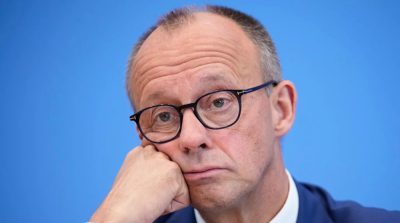
Ashes of Pompeii | June 30, 2026
Across the European Union, governance has increasingly devolved into an exercise in moral posturing. When virtue signalling becomes the primary policy guide, pragmatic statecraft is abandoned. The result is a continent plagued by strategic blunders, driven by an elite class that prioritizes appearing righteous over being effective.
At the heart of this dysfunction is the Brussels bubble, an insulated ecosystem entirely disconnected from the real world. The leaders populating this space generally lack practical experience, possessing only the specific skill set required to navigate internal party machinations. Consequently, they have consistently failed upwards. Ursula von der Leyen stands as the ultimate archetype of this phenomenon. After an, at best, mediocre career in German politics, culminated by a totally unsuccessful term as Minister of Defence, she was elevated to the head of the European Commission through backroom political horse trading rather than visionary leadership. This general lack of democratic accountability is fuelled by a profound sense of hubris and an entitlement to lead the globe. Apparently the natural order of things places Europe as the world’s moral, economic (and even military LOL) leader. Diversity and Identity Politics may rule in Brussels politics, where quotas are more important than merits, but in foreign policy Europe seems to think it has a God-given mandate to rule the world. Virtue signalling has entirely replaced serious political discourse as the main political language, ensuring that only the most ideologically compliant rise to the top.
This environment breeds rampant careerism, where the ultimate goal is securing a prestigious post through absolute subservience to the EU elite and the United States. Loyalty to Washington is routinely rewarded over national interest, as seen in the appointments of Annalena Baerbock to the United Nations and Mark Rutte to NATO. Alongside this sycophancy comes institutional corruption. The Pfizer scandal perfectly encapsulates this rot, with Von der Leyen at the center of the scandal. But the intense scrutiny she should be facing is glaring for its absence. When leaders operate with such opacity and prioritize personal or political advancement over transparency, the entire administrative apparatus rots from the inside.
This moral posturing yields disastrous foreign policy, most notably regarding Ukraine. The fundamental question is not what the EU can do to help Ukraine win, but why it is even meddling at all. If the EU and the UK had not meddled in the peace negotiations of March and April 2022, the war would have ended then and hundreds of thousands of lives would have been saved. Furthermore, Ukraine would have secured far better territorial and political conditions than it is likely to achieve in any postwar settlement today. The early peace talks were derailed by Western interference, turning a potential diplomatic resolution into a grinding war of attrition. Instead of pursuing a pragmatic peace, European leaders chose to signal moral superiority, prolonging a devastating conflict. We can debate whether this was to satisfy their ideological vanity or out of simple subservience to Washington.
Domestic policies suffer equally. Driven by the moral imperative of green virtue signalling, European leaders prematurely dismantled reliable energy infrastructure, triggering severe economic crises. Meanwhile, the current trade dispute with China exposes profound intellectual dishonesty. The EU labels China’s success in manufacturing and exports as “overcapacity”. Yet, one must ask if Germany had overcapacity during all those decades where it maintained a highly successful export led economy. They refuse to acknowledge their own loss of competitiveness, choosing instead to penalize Beijing for outperforming them in the global market. By weaponizing trade terminology to mask their own industrial decline, Brussels prioritizes ideological protectionism over economic reality.
It must be noted that the United Kingdom suffers from most of these same ailments. London’s political class is equally plagued by careerism, a disconnected bubble, and a reliance on virtue signalling over practical governance. Ultimately, whether in Brussels or London, the shift toward governance by moral posturing has been catastrophic. When leaders are unelected, subservient to foreign powers, and selected for ideological purity and party loyalty, rather than competence, the nation suffers. Europe has traded statecraft for virtue signalling, leaving itself strategically vulnerable and economically weak.
Future historians will look back on today’s leaders and wonder just how could such a banal collection of nonentities and grifters rise to become in the “elite” of the once powerful Europe.
The Middle East, Hormuz and the New Mercantilism
By Craig Murray | June 29, 2026
The provisional surrender document signed by Donald Trump appeared to represent a triumph for Iran and indeed for the world; but neither the USA nor Israel has the slightest sense of honour and they cannot be trusted to negotiate in good faith.
Iran knows this – after all, the USA twice attacked Iran actually during peace negotiations, on each occasion killing key Iranian negotiators.
To understand the American position, it is important to realise two key points:
- Greater Israel is an absolute priority
- Opening the Strait of Hormuz is not a US priority
While the US/Israeli alliance were defeated in their attempt to impose regime change on Iran, and indeed have consolidated the popular support of the Iranian government, they have succeeded in expanding Greater Israel. Israel has ethnically cleared and devastated a vast swathe of Southern Lebanon, expanding its military footprint, and notably attempting to repeat its ploy from November 2024 of pushing forward its armour under cover of ceasefire.
Israeli withdrawal from Southern Lebanon has been a major negotiating point for the Iranian government and is a key – indeed the very first – point of the Iran/USA MOU. But in an extraordinary coup aimed at negating that deal, the USA has signed a deal with Israel and its puppet Aoun regime in Lebanon which seeks to legitimise Israeli occupation of Southern Lebanon through the agreement of the “Lebanese government”.
This is an astonishing development. I did not think I could have a lower opinion of the appalling bloated traitor “General” “President” Aoun but not even I – nor I think any commentator – believed he would make such a deal with Israel. The plan is that the Americans, Israelis and Lebanese Army will act together to forcibly eliminate Hezbollah, and only after that is certified – by the Israelis – will the Israelis withdraw from Southern Lebanon.
Here are the operative paragraphs. Note that they carefully do not say in terms that Israel will actually leave Lebanon.
“3. …The Government of Israel and the Government of Lebanon commit to a reciprocal, sequenced process, with clear conditions, whereby the LAF will restore effective sovereign authority over all Lebanese territory, pending the verified disarmament of non-state armed groups and dismantlement of associated infrastructure, enabling the Israel Defense Forces (IDF) to progressively redeploy out of the Lebanese territory.”
“5 . …The Government of Israel underscores that the termination of this threat, through the disarmament and dismantlement of such groups in all of Lebanon and additional security arrangements to be agreed upon between the two countries, will eliminate any future need for IDF military action or presence in Lebanon.”
This is plainly completely incompatible with the USA/Iran MOU, which states as Point 1:
“The United States of America and the Islamic Republic of Iran and their allies in the current war are signing this MOU to declare the immediate and permanent termination of military operations on all fronts, including in Lebanon, and undertake from now on not to initiate any war or any military operation against each other, and to refrain from the threat or use of force against each other, and ensuring the territorial integrity and sovereignty of Lebanon. The final deal will confirm the permanent termination of the war on all fronts, including in Lebanon and other provisions of this paragraph.”
Of course, everybody knows that Israel will never withdraw voluntarily, any more than they withdrew from the Golan Heights. Annexation is plainly the goal and expansion of Greater Israel at least to the Litani River and probably further.
It is important to realise that this is not only Aoun seeking the annihilation of the Shia population of Southern Lebanon; he is also betraying his own community. Aoun is himself a Southern Lebanese Christian, and Israel has been destroying the homes, churches, hospitals and families of Southern Lebanese Christians with as much glee as they attack Muslims.
The agreement names two “pilot zones” where the combined Israeli and Lebanese Army forces will eliminate Hezbollah, followed by Israeli withdrawal from those zones. But these are zones which Israel is not currently occupying – they are areas where Israel was defeated in fighting by Hezbollah and which have been since subject to relentless Israeli bombardment.
So Aoun has agreed to support militarily an IDF advance further into Lebanon, against an agreement that Israel will be able to withdraw once these key Hezbollah redoubts have been destroyed. Even if Aoun were stupid enough to believe the Israelis will withdraw after the operation, this is a level of treachery it is difficult to comprehend.
Greater Israel is not a concept. It is a reality being created before our very eyes.
Israel now occupies 70% of Gaza and plainly the entire “Board of Peace” mechanism is nothing but smoke and mirrors, pure fraud. It has zero effect on the continued tightening of the Gaza concentration camp into an ever-shrinking area. Israeli settlements in the West Bank expand daily and every night the skies are red with Palestinian homes and crops burning. In East Jerusalem Palestinians are continually evicted and replaced by fresh European or American arrivals. In Syria, Israel is building permanent fortifications and its armour creeps forward field by field, with the full cooperation of “President” al-Jolani.
Iran was able to resist the combined military might of the USA and Israel. That is cause for celebration. But do not allow it to blind your eyes to the continued hard reality of the expansion of Greater Israel.
There is no gain for the US in the US/Iran Memorandum of Understanding which the US did not already possess before starting the war. It is therefore very possible, and in many senses valid, to read it as the formalisation of US defeat: a surrender document. Which is why you should be sceptical about US commitment to the terms.
The Strait of Hormuz was fully open before the US started the war. Allowing the flow of oil to resume has become a short-term US priority due to high domestic retail prices and pending elections, but the MOU envisages more Iranian control – and potentially fees – in the Strait than existed before the war.
There is no indication of restrictions on the Iranian nuclear programme that were not already available in the peaceful negotiations. Crucially there are no limitations on Iran’s vital ballistic missile production. The proposed relaxation of sanctions and release of frozen assets is a triumph for Iran and long overdue, and the $300 billion in dollars in reparations, from unspecified sources, is stunning.
So stunning of course that anyone with their head screwed on will realise there is no long term American intention to keep faith with the deal.
Trump is not stupid. There are many ways of characterising his kind of cunning, but it is not stupidity. He was not, as the prevailing narrative seeks to state, the only person in the World who did not realise the Strait of Hormuz would be closed by the war. The USA is quite happy to see the Strait of Hormuz closed, or permanently made more difficult and expensive to transit.
The key to understanding Trump’s position is his famous love of tariffs. Trump is a mercantilist. For many years the world worked on the general basis of accepting the economics of Adam Smith – that freedom of trade promoted universal, reciprocal wealth creation. That was the founding basis of the World Trade organisation, and is the internal philosophy of big trading blocs like the EU.
Trump rejects this and returns to the philosophy that other nations are all competitors, not potential partners, and that success lies not only in increasing your own production, but in damaging your rivals’ production – which ultimately will increase domestic production further. Trump rejects the basic premise of free trade.
The long prevailing belief in the beneficial effects of free trade historically was, as logic demands, accompanied by the demand for freedom of navigation.
Sweeping away tariffs goes hand in hand with sweeping away the controls on shipping which carry the goods. Before the rise of liberal economics, almost all states had practised mercantilism, with controls on shipping being a major source of state revenue. The magnificence of Kronborg Castle in Helsingør, in which Hamlet is set, was constructed entirely from revenues from tolls on ships exiting the Baltic by passing the strait it overlooks, for example.

Freedom of navigation was initially enforced ultimately by the British, and later the American, Navy. States attempting to enforce customary passage fees, for example in the Malaccan Strait, were classified as “pirates” and freedom of navigation became a routine justification for imperialist aggression and/or colonial occupation. Freedom of navigation eventually became customary international law, ultimately codified in the UN Convention of the Law of the Sea.
The simple truth is this: in openly abandoning the principle of free trade, the Trump regime has also abandoned the logically linked principle of freedom of navigation. This is evident not just in their indifference to the closure of the Strait of Hormuz. It is evident in the naval blockades of Cuba and Venezuela and above all in the worldwide blockade of Russian hydrocarbon deliveries, including the effective end of free passage through the Strait of Dover, and a de facto naval blockade of the Arctic passages.
Following the shale boom, the United States is a net hydrocarbon exporter. The USA balance of trade benefits from high hydrocarbon prices. Trump is doing everything he can to increase US hydrocarbon production by slashing environmental and other controls. This is a core Trump policy.
The USA does not import hydrocarbons through the Strait of Hormuz. That fact is key to Trump’s thinking.
In this mercantilist view, closure of the Strait has two benefits for the USA.
- It disadvantages rival hydrocarbon suppliers
- It disadvantages rival industrial competitors in Europe and Asia who do get hydrocarbons through Hormuz.
This is exactly the same logic behind the destruction of Nord Stream 2. The same mercantilist system also explains the effective seizure through naval blockade and control of Venezuela’s oil production, and the blockade of Russian hydrocarbons through sanctions and the “shadow fleet” propaganda disguising another naval blockade.
The UK’s recent actions in the Dover strait indicate that the West, not just the United States has surrendered the principle of freedom of navigation in straits.
Trump believes, as he has repeatedly stated in public, that domestic fuel prices in the USA are a blip and will equalise as the USA increases its domestic fuel production and Venezuelan fuel production. However this was not happening in time for the mid-term elections which is why reopening the Strait of Hormuz became a temporary priority that occasioned the ceasefire and MOU with Iran.
None of this implies good faith negotiation or a real prospect for a lasting peace.
The Starmer legacy the establishment media won’t tell you: Celebrity sex crimes, imprisoning Assange and torture terror
Before Downing Street, Starmer built his reputation at the CPS – where some of Britain’s ugliest scandals were buried, delayed, or erased
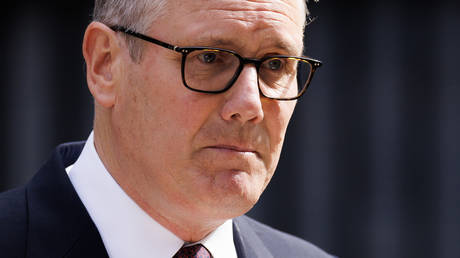
RT | June 26, 2026
As Keir Starmer prepares to leave the UK’s highest office after less than two years, the media has lined up to explain why he failed to deliver on the enormous hype he received as opposition leader, and during his initial months in office. A repeated trope has been that Starmer was a “decent man,” but simply not cut out for mainstream politics. However, his record of concealing the UK establishment’s repulsive crimes – be that serial child sex abuse or spy agency torture – shows him to be anything but decent.
What was the reality of Starmer’s CPS role?
Starmer’s spell as director of public prosecutions for the Crown Prosecution Service (CPS) has been fundamental to his mythology since before he became Labour leader. It was during this time, according to The Guardian, that “Starmer transformed his reputation from that of a radical lawyer to that of a moderate and cautious administrator.” Missing from this account is any reference to how the CPS under his leadership covered up the crimes of notorious celebrity pedophile Jimmy Savile, while he was still alive.
In February 2022, Boris Johnson got in serious hot water after he accused Starmer in parliament of “prosecuting journalists and failing to prosecute Jimmy Savile,” as CPS chief. Condemnation from the media and UK politicians was universal. Johnson’s personal policy chief, who’d worked for him for 14 years, resigned in protest over the then-Prime Minister’s supposedly libelous statements. Such was the backlash, as pressure grew so severe, that Johnson retracted his comments in a matter of three days.
It was an extraordinarily rare example of the UK establishment moving in unanimous lockstep, to defend a single mainstream politician accused of wrongdoing. The episode was made all the more shocking by Johnson’s statement being literally true. Starmer was CPS chief when the Service made the indefensible decision to not prosecute Savile, and many aspects of that strangely downplayed and ignored scandal implicate the failed prime minister personally.
What did an inquiry say about CPS treatment of Jimmy Savile?
An internal CPS inquiry into the Savile affair was commissioned by Starmer in 2012, after it was revealed in the wake of Savile’s death that police had failed to press charges against him despite numerous witnesses credibly accusing the UK’s “national treasure” of sexually abusing and raping them when they were young girls. The inquiry found a CPS “reviewing lawyer” told investigating officers early on he “would not be inclined to prosecute these cases because they were ‘relatively minor’.”
The CPS lawyer also didn’t ask the police basic questions about the case. The inquiry report found his attitude troubling. “I would hope that any prosecutor would regard a sexual assault as being in and of itself serious,” the author stated. They found instead that “these particular assaults were far from trivial,” and “represented a course of conduct against vulnerable women and girls” by Savile, over many years. Consequently, the investigator had “reservations about the way in which the prosecutor reached his decision.”
Instead of refusing to pursue the case, the CPS had a duty “to ‘build’ a prosecution,” which its lawyers failed to fulfil. The allegations against Savile were plainly “serious and credible.” The inquiry found that “had police and prosecutors taken a different approach, a prosecution might have been possible.” These conclusions are all the more damning when you consider that all CPS files held on Savile were shredded in October 2010.
Despite these grave criticisms, the investigator concluded, “I have seen nothing to suggest that the decisions not to prosecute were consciously influenced by any improper motive on the part of either police or prosecutors.” Which might be true, if only because all CPS files on Savile were destroyed. The report was therefore “dependent on material provided by the police to show what documents were seen by the reviewing lawyer and the advice which was given.”
The Service allegedly had “no record at all” of the case, which the inquiry claimed was due to CPS records on Savile being “automatically deleted” after a decision to take no action was made, in line with internal policies. However, the Service’s publicly accessible guidelines on “disposal” of evidence clearly state documents on cases where “no proceedings have taken place or where the case was discontinued before trial” must be kept for five years.
What role did Starmer play in Julian Assange’s persecution?
The Savile deletions were not the only example of suspiciously poor CPS recordkeeping under Starmer’s watch. In 2017, it was revealed the Service deleted sensitive email exchanges about Julian Assange with Swedish prosecutors three years earlier – potentially illegally, as a criminal case was ongoing. The communications occurred from 2010 until the WikiLeaks founder sought refuge in Ecuador’s London embassy in June 2012, where he remained for almost seven years, under constant threat of CIA assassination. In 2019 British police forcibly removed him and sent him to Belmarsh, a high-security prison, where we was kept in almost total solitary confinement for five years.
The emails were deleted by a CPS lawyer who had personally advised Swedish police not to visit London and interview Assange as he had requested, on the grounds that he feared extradition to the US from Sweden. “In my view it would not be prudent for the Swedish authorities to try to interview the defendant in the UK,” they wrote in January 2011. This sentence was redacted in emails released under Freedom of Information by the CPS, but not in files provided by Swedish authorities.
Sweden dropped its investigation into Assange in May 2017. Only later was it revealed that the case could have been closed much earlier, were it not for direct CPS intervention. Beyond advising Swedish police not to interview Assange in London, a Service lawyer repeatedly sought to dissuade them from dropping their investigation outright. In August 2012, they wrote to their Swedish counterparts, “Don’t you dare get cold feet!!!”
In October 2013, Sweden’s director of public prosecutions, Marianne Ny wrote to the CPS that due to the passage of time, and lack of evidence against Assange, “we have found us to be obliged to lift the detention order… and to withdraw the European arrest warrant.” Three days later, Ny emailed a clearly affronted CPS, apologizing over the “[bad] surprise” of moving to drop charges against Assange. “I hope I didn’t ruin your weekend,” she added.
“All we can do is wait and see and perhaps be eternally grateful neither of us have to share a room in the embassy with him over Christmas!” the CPS lawyer responded.
Starmer’s personal role in all this has never been adequately clarified, but he visited Washington, DC in 2011, 2012 and 2013 while he was in effective charge of the Assange case, meeting with senior US officials. True to form, all records of Starmer’s trips were quickly destroyed, contrary to CPS protocol.
How did Starmer cover for MI5/MI6 torture?
After 9/11, the CIA launched a global torture program, identifying terror suspects, abducting them and sending them to black sites all over Europe and the Middle East, before torturing bogus confessions out of them to justify the War on Terror. MI5 and MI6 were not only centrally involved in the program; the two agencies ran an autonomous joint operation using “partner” agencies in the Global South to do the torturing itself.
When these activities became public, with legal actions mounting against the state by victims of the torture program and their families, UK police launched an investigation. Vast quantities of incriminating evidence were collected. However, Starmer as CPS chief consistently vetoed bringing offenders, including senior spy agency directors, to trial despite overwhelming cases against them. First, in 2010 he ruled there was “insufficient evidence” to prosecute an MI5 officer who participated in the torture in Pakistan of a UK citizen in 2002.
Police investigations into MI5 and MI6 for torture continued. However, in January 2012 Starmer again decided not to prosecute anyone from these agencies for their role in their unlawful treatment. The next April, Starmer attended the boozy going away party of MI5 chief Jonathan Evans, the first CPS official to ever attend such an event. Evans was a counter-terror veteran who’d served as MI5 director general since 2007, and would’ve been criminally liable if the CPS had decided to prosecute MI5.
Police investigations into the torture scandal weren’t finished though. Documents seized from Libyan security service offices, abandoned in the wake of Muammar Gaddafi’s October 2011 fall, were a treasure trove. This included faxes sent in March 2004 by then-MI6 counter-terror chief Mark Allen to Libyan spies, regarding a terror suspect kidnapped along with his wife in an MI6 operation. The suspect spent six years being tortured in Libyan prisons at the agency’s direction, with MI6 providing his interrogators questions to ask.
Overall, 28,000 pages of evidence on Allen’s involvement in torture were collected by police. In 2014 however, Starmer yet again decided this was “insufficient evidence” to prosecute the MI6 counter-terror chief, and the case was dropped. In return for a lifetime of serving the establishment, and assisting directly in the commission of serious criminality – if only by signing off on coverups and politicized prosecutions of dissidents – Starmer was rewarded with an empty seat in the UK’s highest office, for only two years.
UK suppressed intel on Sudan genocide to protect UAE ties: Report
Press TV – June 24, 2026
UK authorities have suppressed key intelligence and failed to act on warnings about atrocities in Sudan to preserve diplomatic and economic ties with the United Arab Emirates (UAE), according to testimony presented to lawmakers.
During a hearing of the UK Parliament’s International Development Committee on Tuesday, Nathaniel Raymond, director of Yale University’s Humanitarian Research Lab, said the Foreign, Commonwealth and Development Office (FCDO) ignored repeated warnings before the so-called Rapid Support Forces (RSF) captured El-Fasher in October 2025.
Raymond told lawmakers that the assault was followed by a massacre that claimed at least 60,000 civilian lives.
He said British policymakers placed strategic ties with the UAE above efforts to prevent starvation, displacement, and mass killings in Sudan.
Evidence presented during the hearing included mobile phone tracking data linking Addis Ababa, Abu Dhabi, and RSF-controlled territory.
According to Raymond, the information pointed to a covert weapons supply network supporting the militant group.
While the UAE and Ethiopia have denied supporting the RSF, Raymond said pressure from Abu Dhabi influenced the UK’s response.
He also stated that UK officials asked his research team in May 2024 to release sensitive tracking data publicly because the government was unwilling to challenge the UAE directly.
Raymond described a missed opportunity after the adoption of UN Security Council Resolution 2736, when RSF operations reportedly paused while international reactions were assessed.
“Once the UAE assessed there would be no consequences, the attack resumed,” Raymond told the committee.
Decisions made by successive British governments, including those led by former Prime Ministers Rishi Sunak and Keir Starmer, contributed to a failure to prevent further bloodshed, he said.
A BBC report published in April linked the UAE to a network of Colombian mercenaries known as the “Desert Wolves,” who provided drone and artillery support to the RSF during the battle for El-Fasher.
Conflict Insights Group director Justin Lynch said, “The scale of atrocities and siege in El-Fasher would not have happened without the drone operations the mercenaries provided.”
Satellite imagery analyzed by Yale researchers after the city’s fall showed evidence consistent with mass casualties, while the United Nations later said the violence bore “hallmarks of genocide.”
Starmer’s exit exposes dirty secret: UK can’t afford Ukraine War
By Ian Proud | Responsible Statecraft | June 24, 2026
Sir Keir Starmer bowed to the inevitable Monday and resigned from leadership of the Labour Party and, therefore, from his role as prime minister.
The resignation had been brewing for some time. While Starmer led the Labour Party to an astounding landslide election victory in July 2024, by September 2025, he was already being labeled the most unpopular prime minister since polling began; this followed a series of U-turns and poorly handled crises. After heavy losses of council seats in local elections in May, the Labour Party moved quickly to remove him.
Former Greater Manchester Mayor Andy Burnham is expected to become prime minister after an internal Labour Party leadership contest. (Labour maintains a majority in parliament, so it maintains the right to form a government.) Burnham will quickly find that he doesn’t have the money to fix public services, double defense spending, and continue to fund an unwinnable war in Ukraine. He also faces an almighty struggle to convince his party that aligning with the Trump administration on peace in Europe is the right approach, both politically and fiscally.
Up until June 17, Burnham wasn’t a member of parliament. But after a sitting MP gave up their seat, he won the ensuing bi-election by a landslide. A cabinet minister under Tony Blair, he is by far the most popular Labour politician and the person viewed as most able to take on the surging right-wing Reform party. Having been out of frontline British politics for nine years in Manchester, Burnham has built up a reputation as someone who gets things done and is relatable, qualities Starmer appeared to lack.
To outfox Reform, Burnham will have to reinstall public confidence that the government is improving the lives of ordinary Britons in the face of an ongoing immigration surge, a cost of living crisis and a knife crime epidemic, typified by the at times violent street protests that followed the killing of Henry Nowak.
His biggest challenge? Finding the money to deliver real change with anemic growth and the national debt at 94% of GDP.
An obvious place to look would be the blank check approach Britain – under both Conservative and Labour governments – has taken to supporting the proxy war in Ukraine, which has so far cost $29 billion (£21.8 billion).
That might not sound like a huge proportion of government spending. But Starmer’s government faced stiff resistance and had to back away from making a much smaller cut of £5 billion to welfare spending. When your budget is so tight that you have to look at cutting winter fuel payments to the elderly, then it becomes harder to justify funnelling billions towards a distant war.
Aligning with the Trump administration to press for a peace settlement would be the rational and realist thing to do. But there’s a catch. The Labour Party and Burnham himself dislike Donald Trump. In 2025, for example, the putative prime minister accused Trump of “bringing instability to the world.”
Starmer had a troubled relationship with Trump throughout his mandate. The night before Starmer’s resignation, Trump had posted on Truth Social that Starmer was leaving after “failing badly on immigration and energy.” That was hopefully the last on a long list of snipes by the U.S. President. But Burnham will struggle to change the script in an anti-Trump Labour Party. Starmer’s cabinet was littered with ministers who had criticized Trump over the years, including one who called him an “odious, sad, little man.”
Further complicating relations was Starmer’s appointment of Lord Peter Mandelson as Britain’s Ambassador to Washington, which proved to be a catastrophic mistake after further revelations about the depths of his association with Jeffrey Epstein came to light.
To his credit, Starmer invested some effort into papering over the cracks. The visit of His Majesty the King to Washington in May offered a rare bright spot, focusing on the strong ties that bind the United States and the United Kingdom.
However, the flip-flopping of U.K. support for the U.S. war against Iran cast a shadow across the relationship. And it was on Ukraine policy where Starmer was most at odds with the U.S. President.
While Trump was and is able to surface some uncomfortable truths about the state of Ukraine — i.e. that it cannot win a war against Russia — Starmer remained a true believer in eventual victory.
Where Trump has met President Vladimir Putin in Alaska and spoken to him several times, Keir Starmer didn’t speak to the Russian President once during his two years in office.
Where Trump tried to orchestrate the skeleton of a peace deal between Russia and Ukraine, Starmer rejected its key aspect, on the complex issue of territorial concessions, out of hand.
The list is long and not distinguished. Starmer made himself one of the biggest obstacles to Trump’s aspirations to bring the war in Ukraine to a close, aligning himself with the Europeans who hold to the same view.
And yet Burnham will quickly find that something’s got to give. He can’t fix decrepit public services in Britain, double defense spending, and continue to support an unwinnable war in Ukraine. The math will never add up.
He should be aware that Reform Party leader Nigel Farage is close to Trump and spends most of his time talking about domestic policy challenges, which is clearly resonating with ordinary voters.
For much of my diplomatic career, my European counterparts regularly sniped about the depth of the United Kingdom’s relationship with the United States, and how this eroded European solidarity. Yet, right now, the British and the American position on the Ukraine war could not be further apart.
With Britain having left the European Union, Burnham will arrive in power with a brief window of opportunity to realign with America in the interests of European peace. The tides of British domestic politics suggest that this may help him to rebuild Labour popularity against an onrushing Farage while also delivering much needed savings. I doubt, however, that the Labour party will like this idea at all. Burnham’s honeymoon period may prove to be as truncated as his rise to power.
Ian Proud was a member of His Britannic Majesty’s Diplomatic Service from 1999 to 2023. He served as the Economic Counsellor at the British Embassy in Moscow from July 2014 to February 2019. He recently published his memoir, “A Misfit in Moscow: How British diplomacy in Russia failed, 2014-2019,” and is a Non-Resident Fellow at the Quincy Institute.
UK Speech Regulator’s Telegram Questions Point Toward Private Chats
By Cindy Harper | Reclaim The Net | June 21, 2026
Britain’s communications regulator is pressing Telegram to find ways of seeing what its users say to one another in private. Ofcom has begun questioning the messaging app about how it detects and prevents illegal incitement, following the conviction of a Ukrainian man for arson attacks on a car and properties connected to Prime Minister Keir Starmer.
Roman Lavrynovych, 22, was reportedly drawn in through a public Telegram channel that advertised money to post and print leaflets, and that channel broke no laws. It offered legal work and told anyone interested to “contact in private messages.” The real offers, first for the poster work and later for the arson, reportedly moved into one-to-one chats away from public view.
A spokesperson for Ofcom said it had contacted the app “to seek further clarification” because the arsonist had been directed on Telegram by a handler linked to Russia.
The regulator frames this as a preliminary stage ahead of any formal investigation, though the questions point in one direction. If nothing illegal appeared in the open channel, the only place left to look is inside the private conversations between individual users.
That request carries a cost the regulator has not spelled out. Telegram cannot scan private messages for signs of incitement without reading private messages, all of them, belonging to everyone, not the handful that turn out to involve a crime.
The arson plot stayed hidden in personal chats precisely because that is where people expect to speak without an audience. Asking Telegram to surface that content means asking it to treat ordinary private conversation as something to be inspected by default.
It is not even settled what “private messages” covers here and the ambiguity raises the stakes. Telegram’s standard chats sit on its servers. Its secret chats use end-to-end encryption that the company itself cannot read, but only when turned on, and the feature is not turned on by default.
Court reporting has not made clear which kind carried the arson offers. Should Ofcom expect detection inside encrypted chats, it is effectively asking Telegram to build a route around its own encryption, most likely by scanning messages on the user’s device before they are sealed. That hollows out the protection for the people who relied on it. A message read before it is encrypted was never really encrypted.
A single conviction has become the occasion to ask a platform how it inspects private speech in general and the answer Ofcom seems to want is closer inspection.
The push runs in one direction across the Online Safety Act, through age checks, hash-matching against databases of banned images, automated tools to flag grooming and self-harm content, and now questions about catching incitement inside private chats.
Detection keeps moving inward, from public posts toward the conversations people assumed only their recipient would see. Real harms justify the steps one at a time and the cumulative effect normalizes a new baseline, where a messaging app is expected to read along and act as an extension of the regulator’s reach. The Act backs that expectation with fines of up to £18 million ($24M) or a tenth of global revenue, which is leverage enough to make most companies listen.
Keir Starmer arson mysteries multiply
By Kit Klarenberg | Al Mayadeen | June 20, 2026
On June 15th, two young Ukrainian men were found guilty in London of conspiring to carry out arson attacks on two homes and a car intimately connected to British Prime Minister Keir Starmer. Little-reported, curious details of the trial, and a post-conviction propaganda blitz led by the BBC blaming Russian intelligence actors for inspiring and directing the pair’s incendiary crimes, raise a number of ominous questions about precisely what happened, why, and for whom the alleged perpetrators were truly working.
On May 8th 2025, a Toyota vehicle previously owned by Starmer was set ablaze in north London, not far from where he’d previously resided. Three days later, flats in Islington Starmer managed years previously were similarly put to the torch, then on May 12th, a home where he once resided, now leased to his sister-in-law was also set ablaze. That same day, 22-year-old Ukrainian national Roman Lavrynovych was arrested by British police for his purported role in the arson.
Despite the Prime Minister being personally targeted in a highly organised, repeated and potentially lethal manner, major news outlets within and without the country exhibited bizarrely muted interest. Starmer describing the incidents in parliament on May 14th that year as “an attack on all of us, on democracy and the values that we stand for” – condemnation from Conservative and Liberal Democrat politicians echoed – elicited some headlines. However, basic facts about the case, and discussion of its obvious potential national security implications, remained unforthcoming.
This seeming omerta endured when, on May 17th, 26-year-old Ukrainian-born Romanian national Stanislav Carpiuc was arrested at Luton airport for his role in the attacks, attempting to flee. Four days later, 34-year-old Ukrainian national Petro Pochynok was arrested, accused of conspiring with Carpiuc, Lavrynovych, “and others unknown to damage by fire property belonging to another.” The names and nationalities of two further individuals arrested in the case – a 48-year-old on June 2nd that year, and a 19-year-old in January 2026 – were never released.
Police investigations into these anonymous suspects were eventually dropped, without fanfare. Who they were, why they became subjects of interest, and the grounds for their elimination from enquiries, hasn’t been revealed and wasn’t discussed at trial. There were apparently no “others unknown” with whom Carpiuc and Lavrynovych colluded after all. Pochynok was acquitted, successfully arguing he was “deceived” by the pair and had no idea they intended to start fires with his help. Notably, all three were charged with mere arson, not national security offences.
This aspect is striking, given when the trial commenced on April 28th, prosecution lawyers immediately declared the trio’s arson assault was directed by a Russian-speaking Telegram user, for cash. The December 2023 National Security Act grants British authorities sweeping powers to severely punish people who break the law at the behest of “hostile states”. Repeatedly since the Starmer-linked attacks, British citizens have been jailed for national security offences after being recruited to commit crimes, including arson, via Telegram by supposed Russian actors.
All along, alarm has been sounded about Iranian intelligence using Telegram for similar purposes, in particular “[hiring] anyone who can harm Israeli interests or individuals” in Britain. Yet, a coordinated criminal conspiracy targeting the Prime Minister, which required access to sensitive private information on Starmer not readily available to average citizens, allegedly orchestrated by a malign foreign actor, mysteriously didn’t qualify as national security-related. Moreover, jurors and the public alike were strictly prohibited from learning anything about the group’s alleged recruiter.
‘Wholly Irrelevant’
On the trial’s first day, dropping the bombshell that Lavrynovych was “recruited, instructed and promised with payment for the fires that he was told to start” by a Russian-speaking source known as “EL Money”, the lead prosecutor promptly ordered jurors to leave the entire issue alone. “It is not part of your considerations to decide who ‘EL Money’ is and what reason he might have had to co-ordinate the actions of these defendants,” they said, before adding:
“It does not matter whether they knew that the property they were targeting was connected to the Prime Minister or whether that formed part of their motivation.”
As such, the trial centred solely around the extremely limited question of whether the accused committed arson. All other avenues of inquiry weren’t up for discussion or investigation in open court. While the financial motivation of the three accused was explored, the identity, connections and motives of the individual – or individuals – who commissioned and directed the attacks on Starmer was effectively inadmissible. This was despite Lavrynovych’s defence hinging on claiming to have felt intimidated by the unknown Telegram contact, and therefore acting under duress.
The BBC reports how during the trial in the jury’s absence, Lavrynovych’s lawyers applied for prosecutors to hand over wider information held by authorities on EL Money. This included whether he was associated with intelligence services or a state informant, and where he was based. They argued the actions of EL Money were “redolent of tradecraft” – in other words, cloak-and-dagger techniques employed by spies. But the judge flatly rejected the application, inexplicably ruling these burning queries to be “wholly irrelevant” to issues before the jury.
Nonetheless, it did emerge at the trial that EL Money sent messages to Lavrynovych on May 12th, following the final arson, notifying him “there is news, you’ll get crypto” and “you need to throw away the clothes.” Subsequently, EL Money warned him, “you attacked the home of a very high-ranking person in Britain,” and “you need to leave the city.” Lavrynovych was arrested hours later, indicating he was already in law enforcement’s crosshairs by this time. How he came to police attention isn’t clear.
Apparently, the central coordinating role of EL Money in the attacks on Starmer wasn’t ascertained until after Carpiuc and Lavrynovych were in custody, and legal proceedings well-underway. At a pretrial hearing in late May 2025, prosecution lawyers said the arrested Ukrainian pair’s conspiracy was “unexplained”. A contemporary Financial Times report noted counter-terror cops leading the probe were “keeping an open mind about motive.” Nameless government officials stressed “many different versions of the events” remained under investigation, “and nothing had been ruled out at this stage.”
‘No Evidence’
How prosecutors settled on the “version of events” they dramatically presented in court, before directing jurors to disregard considerations of EL Money entirely, is likewise unknown. Only a small number of messages the user exchanged with Lavrynovych – in which EL Money notably communicated in perfect Russian and Ukrainian – were presented in court. However, within just hours of the pair’s conviction, the BBC released a dedicated Panorama documentary, and 3,500-word long-read on the “Russian connection” behind the Starmer-linked arson.
Miraculously, “using open-source tools,” Britain’s state broadcaster was able to ‘crack the case’ to an extent police purportedly couldn’t. The BBC named EL Money as a “Russian diplomat, schooled in information warfare by spies and propagandists, who is close to the highest levels of power in Moscow.” Posing as EL Money, the 23-year-old supposedly sought to bribe numerous Ukrainians in Britain into perpetrating a variety of criminal activities, via dedicated local jobs groups, while also oddly deploying “deeply offensive Russian terms for Ukrainian people.”
“Messages from the [EL Money] account in various Telegram channels show him glorifying [Vladimir] Putin and Russia, attacking the Ukrainian people and promoting Russian narratives,” the BBC claimed. Its investigation acknowledged the trial of Carpiuc, Lavrynovych and Pochynok “was strange, mainly because the true author of the drama was never revealed,” with the conundrum of EL Money’s identity “deliberately avoided.” Suspicion can only abound as to why the British state broadcaster unravelled this crucial riddle, rather than courts and/or law enforcement.
Even more suspiciously, the BBC quoted a senior British counter-terror police chief as saying while the aim of the attacks on Starmer’s properties was “to intimidate and create fear for the Prime Minister and to attack the UK,” law enforcement had “not been able to prove the identity of [EL Money] or who he was working for.” They categorically declared, “we’ve got no evidence to suggest this was a state-backed threat.” But Britain’s state broadcaster is seemingly better informed than the police.
“Sources have told us that authorities in the UK and in Ukraine have privately concluded Russia was behind the arson attacks,” the BBC boasted. One might reasonably ask why Kiev has apparently taken it upon herself to solve a British criminal case, although Ukraine’s SBU is certainly an authority on recruiting chaos agents via Telegram, and other messaging apps. The heavily CIA and MI6-infiltrated agency has, over many years, exploited this technique to blackmail and bribe Russians into perpetrating serious crimes at home.
These scandalous activities have been universally ignored by the Western media. By contrast, numerous major news outlets have boldly seized on the BBC blaming Russia for the arson attacks. The Financial Times published a slick investigation the same day, replete with photos, videos, and graphics, documenting EL Money’s contacts with and payments to Lavrynovych. Shady investigative website The Insider went so far as to release extensive biographical information and photos of the 23-year-old Russian named by the BBC as EL Money.
Other outlets have produced quotes from Lavrynovych’s trial testimony, in which he states EL Money “wanted to see [the arson] on the news.” Of course, the attacks barely registered in the media contemporaneously, and what was said at the trial by defendants, their lawyers, prosecutors and the judge went unreported until now. In all the post-trial rush to convict Russia, not a single source has mentioned how British police themselves admit they possess “no evidence” indicating the arson attacks were sponsored by any state. Make of that what you will.
Featured Video

Racist Seinfeld Dances for Joy as Bibi Unveils His New Map
or go to
Aletho News Archives – Video-Images
TV Drama Review
Japanese drama projects Japan’s wartime atrocities onto Chinese characters

Global Times | October 25, 2026
By portraying Chinese characters as perpetrators of ruthless violence while casting Japanese Self-Defense Forces (SDF) intelligence operatives as defenders, the season 2 of the Japanese drama Vivant has recently drawn criticism from Chinese netizens, who argue that its depiction turns historical reality on its head while ignoring Japan’s wartime atrocities.
The TBS drama series – a spy suspense story in which an alleged unofficial intelligence unit of the SDF operates across the globe — has attracted a passionate fanbase. Its currently airing season 2 opened with a household rating of 18.8 percent, the highest for a TV drama this year, according toa commentary article by Japanese media Toyo Keizai.
What draws attention is the portrayal of the enemies in the series, the article noted. Scenes in which the Chinese organization subjects kidnapped members of the SDF unit to brutal torture are repeated with unrelenting intensity.
It is rare for Japanese TV dramas to explicitly portray a real-life country as the enemy, the article noted.
Japanese Prime Minister Sanae Takaichi also made a reference to the drama, saying that she has been recording Vivant and hopes to binge-watch it over the year-end and New Year holidays, according to Japanese media outlets.
China’s CCTV News report on Sunday revealed that the drama features scenes in which Chinese personnel cut off the fingers of and stab Japanese intelligence operatives in the abdomen. Such acts bear striking similarities to the torture inflicted on Chinese nationals by invading Japanese troops during the World War II.
The drama distorts the truth by attributing these atrocities to modern Chinese characters. Beneath the surface, it subtly glorifies Japan’s cross-border overseas operations, blurs the functional boundaries of the SDF and implicitly promotes an expansionist narrative, per CCTV News. … continue
Blog Roll
 Aletho News
- EU facing trillion-euro debt hole while seeking more cash for Kiev
- How US, Europe, Persian Gulf states exhausted missile stockpiles, splurged billions to defend Israel
- Up in arms… Koreans reject U.S. empire’s plan to make South Korea the next Ukraine
- Iran, Turkey, Pakistan, Saudi Arabia could advance region-led security framework in Tehran: FM spox
- Netizens condemn Japanese drama for projecting Japan’s wartime atrocities onto Chinese characters
- Racist Seinfeld Dances for Joy as Bibi Unveils His New Map
- A West Bank War for Netanyahu’s Election Campaign, Could It Backfire?
- Yemen denounces European Parliament’s ‘hypocritical’ push to blacklist Ansarullah
- Qalibaf: UAE’s UN bid aims to ‘clear the runway’ for ‘Greater Israel’, whitewash genocide
- Pakistan reopens Iran border after boosting security: Report
- If Americans Knew
- An error has occurred; the feed is probably down. Try again later.
- No Tricks Zone
- Sudden Stratospheric Warming, Powerful El Niño Combination May Lead To Extreme Europe Cold, Energy Crisis!
- Two New Studies Find Thwaites Glacier Melt Cannot Be Driven By Human Activity Or A Warming Ocean
- E-Cars Reduce CO2 Emissions By Only 41% Compared To Internal Combustion Engine Vehicles
- Predictions Made By Renowned Climate Professor Over Past Decades Have Been Proven To Be Poor
- New Study Suggests Large Regions Of The Pacific Ocean Have Been Cooling For The Last 80 Years
- Germany’s Green Energy Debacle: High Energy Costs Force Kahla Porzellan to Close After 182 Years!
- New Study: 50 Years Of The Most Aggressive ‘Net Zero’ Policies Can Only Affect The Global Climate By 0.03°C
- US September “Heat” Was No Record…Many Records Set Decades Ago
- Latest European Green Energy Debacle; Portugal’s Largest Flagship Solar Park Insolvent!
- Green Energy Debacle: German Expert Professor Fritz Vahrenholt Warns Of Severe Economic And Social Consequences

