War and Business. Peace Negotiations are “A Waste Of Time”.
By Manlio Dinucci | Global Research | October 25, 2025
Following the announcement of the impending summit with President Putin in Hungary, President Trump declared that the summit with the Russian President on Ukraine would be a “waste of time” on the grounds that “Russia is pursuing territorial ambitions that make a peace agreement with Ukraine impossible”.
He then proceeded to summon NATO Secretary General Mark Rutte to the White House, wherein he conveyed his decision to withhold the provision of US Tomahawk missiles to Kiev at that particular juncture.
This decision was precipitated by the perceived impracticality of allocating a substantial amount of time to train the Ukrainian army in the utilisation of such missiles. Concurrently, the US lifted the key restriction on the use of long-range missiles supplied by other NATO members to Ukraine, while NATO conducted the Steadfast Noon nuclear warfare exercise directed against Russia in Europe under US command. In response to the aforementioned events, a Strategic Nuclear Forces exercise was conducted in the Russian Federation. President Putin observed this exercise via video conference.
One example among many: that of the fast-growing German Rheinmetall, which is integrated into the US military-industrial complex through American Rheinmetall Munitions.
Rheinmetall has announced its intention to supply Ukraine with an electronic system designed to enhance the combat capabilities of the German Leopard tanks that have already been supplied to Kiev. The production and integration of this system is carried out by the Italian subsidiary of Rheinmetall, Rheinmetall Italia SpA, at its headquarters in Rome. In Italy, Rheinmetall has established a facility dedicated to the assembly, testing and production of warheads for kamikaze drones. The series is being produced at full speed. The plant is operated by the Italian subsidiary RWM Italia at its sites in Musei and Domusnovas in Sardinia. Rheinmetall is collaborating with the Israeli manufacturer UVision Air Ltd. on this project. It is evident that these Italian-manufactured kamikaze drones will be utilised by the Israeli army in attacks against Palestinians in Gaza, as well as in other operations primarily conducted in Libya, Yemen, and other regions.
Trump has imposed sanctions on Russian oil companies, representing the most stringent measures yet taken by the US against the Russian energy sector. It is evident that these sanctions are favourable to large US oil and gas companies. The European Union is participating in this operation, which has decided to completely block the import of Russian natural gas in three stages: from 1 January 2026, it will be forbidden to sign new contracts; short-term agreements already in place must end by 17 June 2026; and long-term agreements by 31 December 2027.
It should be noted that the aforementioned proposals have met with opposition from the countries of Hungary and Slovakia. Concurrently, Italy’s Edison entered into an agreement with Shell, securing the procurement of US liquefied natural gas (LNG) for a duration of 15 years. In consideration of the marked disparity between the price of gas in the US and that of gas in Russia, it is evident that consumer gas prices for households in Italy are rising.
The United States and the State of Israel are contemplating a plan to divide the Gaza Strip into two separate zones: one to be controlled by Israel, the other formally by Hamas pending its “disarmament”. This was announced at a press conference in Israel by US Vice President Vance and Trump’s son-in-law, Jared Kushner. The plan is to immediately start “reconstruction” in the Israeli-controlled area, according to Trump’s plan to transform Gaza into a luxurious “Riviera of the Middle East”.
The Palestinian area, de facto controlled by Israel, would remain in its current situation: the Palestinian population would be locked there in a scenario of destruction and deprivation that would continue the genocide.
President Trump confirmed that Australia will obtain nuclear-powered submarines from the United States and the United Kingdom, indicating a strategic focus on deterring China and Russia.
Concurrently, he signed an agreement on rare earth minerals with the Australian Prime Minister at the White House. The AUKUS submarine agreement between Australia, the United Kingdom and the United States could cost Australia up to $235 billion over the next 30 years. The governments of the United States and Australia have announced their intention to invest in excess of $3 billion in critical minerals projects over the forthcoming six-month period. The recoverable resources in these projects are estimated to be worth $53 billion.
The US Department of War expressed its intention to invest in the construction of an advanced gallium refinery with a capacity of 100 metric tonnes per year in Western Australia. Gallium has several military applications, primarily in high-tech electronics such as radar and satellite communications. The material is also used as an alloy to stabilise nuclear weapons components and in aluminium-gallium alloys for the production of hydrogen bombs for thermonuclear warfare.
Ex-NATO commander claims united Ireland could aid Russia and China
RT | October 25, 2025
The potential unification of Ireland would be a major blow to the West’s security as it could allow Russia and China to expand their reach in the North Atlantic, a former NATO commander has warned.
Speaking at a briefing for members of Parliament and the House of Lords on Wednesday, retired British Rear Admiral Chris Parry argued that if the UK were to lose its foothold in Northern Ireland, it would present a major opportunity for Moscow and Beijing.
He noted that the waters between Northern Ireland and Scotland are essential for Britain’s deployment of its nuclear-armed submarines, describing it as “critical to our strategic deterrent.” “With a united Ireland, there is no guarantee we could deploy our ballistic missiles,” Parry said.
He also suggested that a potential Irish unification would enable NATO adversaries to threaten critical undersea cables.
“The UK needs to calibrate the threat to itself of a supine Republic of Ireland. My view is that the best way to help Ireland now is to increase NATO and Allied activity in Ireland’s economic zone waters,” he said.
The retired admiral went so far as to suggest that NATO should hold exercises in Irish-controlled waters “whether Dublin agreed or not,” asserting that the bloc must be prepared to “fish in Irish waters for our potential opponents.” He said the Republic should move toward closer military cooperation with NATO and renounce neutrality.
“If anyone attacks Britain, they will attack Ireland… Neutrality cannot be seen as conscientious objection any more. If you are part of the free world, you have to be prepared to defend it. The Republic needs to reduce its vulnerabilities,” he stated.
Moscow has consistently rejected claims that it plans to attack NATO as “nonsense“.
Ireland has been militarily neutral since gaining independence in 1921, and is not a NATO member but cooperates with the bloc.
The idea of Irish reunification — merging the Republic of Ireland with Northern Ireland, which is part of the UK — is permitted under the 1998 Good Friday Agreement. The accord ended a three-decade-long stand-off between Irish nationalists and pro-British unionists by establishing a power-sharing government in Belfast and confirming that Northern Ireland’s status can change only if a majority there votes for it.
Tommy Robinson’s HUMILIATING Israel Propaganda Trip
Glenn Greenwald | October 23, 2025
This is a clip from our show SYSTEM UPDATE, now airing every weeknight at 7pm ET on Rumble. You can watch the full episode for FREE here: https://rumble.com/v70nbcm-tuckers-tp…
Palestinian justice group seeks UK prosecution of British-Israeli citizen for serving in IDF
MEMO | October 24, 2025
The International Centre of Justice for Palestinians (ICJP) has formally applied for a court summons to prosecute a dual British-Israeli national for allegedly breaching UK law by voluntarily serving in the Israeli military. If successful, the case could set a legal precedent for accountability under Britain’s rarely used Foreign Enlistment Act of 1870.
The individual is accused of serving first on the Lebanese border and then in the illegally occupied West Bank as a member of the Israel Defense Forces (IDF). ICJP alleges that the engagement constitutes an offence under Section 4 of the Foreign Enlistment Act (FEA), which prohibits British subjects from enlisting in the military of a foreign state that is at war with a state friendly to the UK.
In a statement released yesterday, the ICJP confirmed that its application for a court summons was submitted on 20 October. The preliminary hearing is expected to take place in the coming weeks.
“This is a significant step in holding suspected war criminals accountable within domestic jurisdictions for offences that they have committed outside of their home countries,” said Mutahir Ahmed, ICJP’s Head of Legal. “War criminals must be held accountable for their role in the genocide, from the most senior generals to the most junior foot soldier.”
The individual named in the filing, who remains unnamed for legal reasons, is not believed to have been conscripted. Israeli law does not compel dual nationals residing abroad to enlist, which ICJP argues makes the engagement a voluntary act and therefore subject to prosecution under UK law.
The legal submission, drafted by senior King’s Counsel, includes both expert testimony and supporting evidence of alleged FEA violations. ICJP says this is the first in a series of prosecutions it is pursuing as part of its broader Global 195 campaign, a reference to the number of UN-recognised states whose nationals may be subject to domestic accountability for war crimes committed abroad.
Palestine has been a State Party to the Rome Statute of the International Criminal Court since April 2015. Its statehood was reaffirmed by a 2021 ICC ruling and more recently recognised by the UK government. As Palestine is considered a “friendly state” under the terms of the Foreign Enlistment Act, ICJP argues that British citizens who engage in hostilities against it through service in the IDF are in breach of UK law.
The organisation says it has gathered evidence on more than 10 British citizens — including dual nationals — who may have either fought in the IDF or provided material support to its military activities. The current application marks what ICJP calls a first test case, with further prosecutions anticipated.
Pursuing Net Zero Makes the UK Vulnerable to Bad Weather, BBC, Not Climate Change
By Linnea Lueken | ClimateRealism | October 21, 2025
A recent article at the BBC, “Government told to prepare for 2C warming by 2050,” claims that the United Kingdom needs to prepare for increasing extreme weather as the planet approaches 2°C warming. This is false in its framing. Although it’s always a good idea to harden infrastructure against weather, the UK is not suffering more extreme weather due to human emissions of carbon dioxide, and the recommendation of attempting to prevent temperature rise is not going to help anyone.
The BBC’s post discusses a letter written by the UK government’s “Climate Change Committee” (CCC), which the BBC reports said, “[t]he country was ‘not yet adapted’ to worsening weather extremes already occurring at current levels of warming, ‘let alone’ what was expected to come.”
The CCC asked the government to “set out a framework of clear long-term objectives” to prevent further temperature rise, with new targets every five years and departments “clearly accountable” for delivering those goals. It warned that “a global warming level of 2C would have significant impact on the UK’s weather, with extreme events becoming more frequent and widespread.”
These include increases in heatwaves, droughts, floods, and longer wildfire seasons.
These claims are fearmongering, and no amount of deindustrialization – which is what’s implied by the “objectives to prevent further temperature rise”—will stop bad weather from happening, nor will it have any measurable impact on global average temperature.
The simple fact is that the UK contributes a very small amount of carbon dioxide to the atmosphere, which would in theory contribute an even smaller amount to warming. According to emissions data, the global share of all UK carbon dioxide emissions is 0.88 percent. Not even 1 percent. Eliminating UK emissions would do absolutely nothing to slow or stop any amount of warming that could be connected to human emissions, if they are, in fact, driving temperature changes.
On top of that, data do not show that weather is becoming more extreme in the UK.
The BBC claims that global warming will increase the wildfire season in the UK, and presumably they believe it must have already done so during the past 150 years of planetary warming. A longer wildfire season should result in more fires. Available data, however, does not show that wildfires are getting more frequent or more intense in the UK. Satellite data from Copernicus show no trend at all.
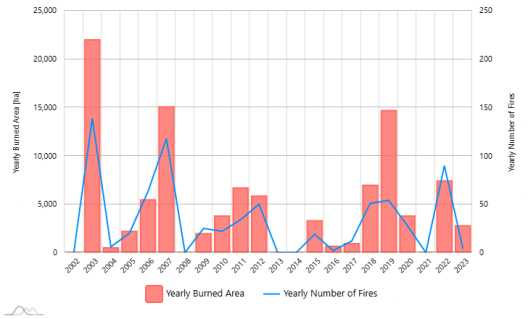
Chart of United Kingdom yearly burned area and number of fires from Copernicus
For another example, looking at Central England as this Climate Realism post did, the number of days per year breaching 25°C (77°F) show no rising trend, nor does the measured highest daily maximum.
Long term historical data for Europe show that drought is likewise not worse today than it was during the Renaissance, long before industrialization.
What is really notable is that Europe alone has actually already warmed 2°C since about 1820, according to historic European temperature averages, but no catastrophic change in weather has occurred. (See figure below)
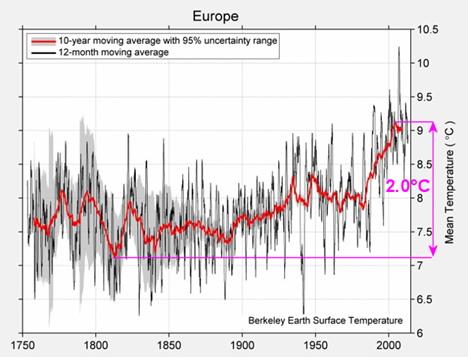
Berkeley Earth average European temperature showing a 2.0°C rise since about 1820. Source: http://berkeleyearth.lbl.gov/regions/europe
Weather isn’t getting worse, but bad weather does still happen. The UK’s largest industrial solar facility, for example, blighting the landscape of Anglesey, North Wales, was recently destroyed by a bad storm. That should be enough to give government agencies pause when it comes to at least some net-zero policies, but the real point is that hardening infrastructure against weather should be a priority regardless of climate change. Bad weather will occur, and it will wreck fragile facilities, including solar complexes.
Hardening against weather extremes, which always have and always will exist, is just common sense. As technology develops and new ways of protecting against bad weather are discovered (like the invention of air conditioning) they should be implemented where they can be, as they can be. Achieving net zero – especially for a country that emits negligible amounts of greenhouse gases anyway—will not save the UK from bad weather events.
As a news organization, the BBC should not carry water for its government or government advisory boards that want to continue wasting money on futile “objectives to prevent further temperature rise” when direct efforts to improve infrastructure and harden it against weather extremes, which have happened throughout history, would be far more effective in saving lives and reducing harm.
UK police arrest NHS doctor for denouncing Israel, supporting Palestine
Press TV – October 21, 2025
A British-Palestinian National Health Service (NHS) doctor has been arrested in the United Kingdom for denouncing Israel’s atrocities in Gaza and expressing support for Palestine.
Rahmeh Aladwan was taken into custody on Tuesday following her recent post on X, in which she criticized the Israeli occupation and voiced support for Palestine at a rally.
“The arrests relate to an ongoing investigation, led by the Met’s Public Order Crime Team, into allegations that comments made at a protest and online in recent months were grossly offensive and antisemitic in nature,” the Metropolitan Police spokesperson said.
During the demonstration held in Whitehall on July 21, Dr. Aladwan articulated the “Palestinian principles of liberation,” emphasizing the right to resistance, the right to self-determination, Al-Quds as the capital of Palestine, and the right of Palestinian refugees to return to their homes and lands in what is now the occupied territories.
She also described Israel as “a terrorist entity that sits on top of Palestine,” and committing genocide against the oppressed residents of Gaza.
In her X post, Dr. Aladwan stated, “October 7. The day Israel was humiliated. Their supremacy [was] shattered at the hands of the children they forced out of their homes … The children who watched [Zionists] execute their loved ones, rape their land, and live on their stolen soil.”
Before her arrest, UK Lawyers for Israel (UKLFI), a pro-Israel advocacy group, had accused Dr. Rahmeh Aladwan of anti-Semitism, claiming her social media posts and public appearances made her “unfit to practice medicine.”
However, on September 25, the Medical Practitioners Tribunal Service (MPTS) ruled that Dr. Aladwan is fit to practice, rejecting the anti-Semitism allegations.
Despite this, the UK General Medical Council (GMC) has referred her to another interim orders tribunal scheduled for Thursday, October 23, as it continues its investigation into the claims made by UKLFI.
The Al-Aqsa Flood operation, launched by Palestinian resistance groups on October 7, 2023, was a response to decades of oppression of the Palestinians by the Israeli regime.
Following the operation, Israel launched a genocidal war on Gaza, killing at least 68,229 people and wounding 170,369.
UK’s Covert Support for Ukraine’s Black Sea Strikes Exposed
Sputnik – 19.10.2025
Ukraine’s military has been spotted integrating satellite communications from the British company OneWeb to command and control its fleet of unmanned surface vehicles (USVs) in the Black Sea.
The Ukrainian military uses the UK company OneWeb’s satellite system to control USVs in the Black Sea, a source in Russian security services told Sputnik.
“OneWeb terminals have been integrated into the USVs’ control system. OneWeb is now used as a secondary channel alongside the main system —the US’ Starlink,” the source said, adding that one such vehicle has been captured by Russian forces.
He explained that unlike Starlink, which operates thousands of low-orbit satellites, OneWeb deploys its network in medium Earth orbit. This allows each satellite to provide broader coverage, but requires more complex and expensive user terminals.
In 2022, the Russian Federal Agency Roscosmos demanded that the UK provide guarantees that the OneWeb satellite network would not be used against Russia. The company did not comply, leading to the suspension of OneWeb satellite launches aboard Russian rockets.
Iran dismisses ‘baseless’ allegations of seeking to threaten Britain’s security
Press TV – October 18, 2025
Iran’s embassy in London has strongly rejected allegations by the head of Britain’s MI5 that Tehran seeks to threaten the United Kingdom’s security, calling the claims “baseless and irresponsible.”
The diplomatic mission, in a statement released late on Friday, repudiated the assertions made by Sir Ken McCallum on October 16, which accused Iran of involvement in so-called “deadly plots” and “cross-border hostile actions.”
“The Embassy of the Islamic Republic of Iran expresses its strong protest to and outright rejection of these unfounded and irresponsible statements,” the statement read.
“Such baseless accusations are part of a continued effort to distort Iran’s policies and undermine bilateral diplomatic relations.”
The embassy emphasized that Iran firmly denies any involvement in violent acts, abductions, or harassment of individuals in the UK or elsewhere.
It further stated that the claims were made “without credible evidence,” and contradict Iran’s ongoing commitment to international law, the principle of sovereign equality, as well as promotion of peaceful coexistence and international cooperation.
The statement came after the MI5 chief alleged that UK security forces had thwarted 20 operations linked to Iran on British soil over the past year — a claim Tehran has dismissed as part of an ongoing campaign of misinformation.
The Iranian embassy urged the British government to “refrain from making or escalating baseless accusations” and instead pursue a “responsible and constructive approach based on dialogue and mutual respect” to address shared security concerns through legal and diplomatic channels.
The mission finally reaffirmed Iran’s preparedness for dialogue, and its commitment to international norms and peaceful international relations.
Iran confirms UN Resolution 2231 expired, condemns US, E3 violation
Al Mayadeen | October 18, 2025
In a letter addressed to the UN Secretary-General and the Presidency of the Security Council, Iranian Foreign Minister Abbas Araghchi affirmed that UN Security Council Resolution 2231 has expired and fully ceased to be in effect as of today, in accordance with its explicit provisions.
He underscored that the nuclear agreement reflected the international community’s shared belief that diplomacy and multilateral engagement remain the most effective means to resolve conflicts.
Araghchi recalled that Washington initially refrained from fulfilling its commitments before withdrawing from the agreement, reimposing what he described as illegal and unilateral sanctions, and even expanding them. “These coercive measures,” he noted, “constituted a grave violation of international law and the UN Charter, causing severe disruption in the implementation of the agreement.”
In his letter, Araghchi added that the E3 failed to fulfill their obligations and instead imposed additional illegal sanctions on Iranian individuals and institutions. Despite this, he said, Iran demonstrated the utmost restraint in the face of repeated and fundamental violations, making extensive efforts to restore balance and preserve the agreement.
After a full year of Iran’s continued compliance, Araghchi explained, Iran began implementing gradual, proportionate, and reversible compensatory steps in line with its recognized rights under the deal.
‘E3’s snapback attempt lacks legal validity’
Iran’s top diplomat stated that the E3’s attempt to activate the snapback mechanism by directly resorting to the UN Security Council disregarded the dispute settlement process stipulated in the nuclear agreement, stressing that the attempt suffers from procedural flaws and lacks any legal validity or authority.
“No action taken in violation of UN Security Council Resolution 2231 can create any legal obligation upon member states,” Araghchi affirmed, emphasizing that any claim to “revive” or “reimpose” expired resolutions is null and void, lacking legal basis and producing no binding effect.
Araghchi highlighted that the Non-Aligned Movement, during its 19th Meeting of Foreign Ministers, reaffirmed in its final document that Resolution 2231 had expired on its scheduled date. He also referred to the two Security Council voting sessions held on 19 and 26 September 2025, which demonstrated the absence of consensus among Council members regarding the validity of the notification to trigger the “snapback” mechanism.
Iran warns against unauthorized UN Secretariat actions
Araghchi asserted that Resolution 2231 does not grant the Secretary-General or the UN Secretariat any authority or mandate to determine, announce, reactivate, or reinstate resolutions that have expired under operative paragraph 8.
He added that any such action would exceed the legal authority conferred by the UN Charter and contradict the purely administrative and neutral role of the Secretariat. “Any ‘notification of snapback activation’ or ‘confirmation’ issued by the Secretariat is legally void and undermines the credibility of the organization,” he wrote.
Araghchi concluded that no member state, the Secretariat, or any official may take legal action in this regard without a new and explicit resolution from the Security Council.
Earlier last week, Araghchi condemned Trump, accusing him of spreading falsehoods about Iran’s nuclear program and being misled by Israeli deception. His remarks followed an earlier statement by the Iranian Ministry of Foreign Affairs, which condemned Trump’s address at the Israeli Knesset as “irresponsible and shameful.”
In a post on X, Araghchi said it was “more than clear” that Trump had been “badly fed the fake line” that Iran’s peaceful nuclear program was on the verge of weaponization. He described this claim as a “BIG LIE”, emphasizing that even the US intelligence community had confirmed there was “zero proof” of such allegations.
“The real bully of the Middle East, Mr. President, is the same parasitic actor that has long been bullying and milking the United States,” Araghchi declared, referring to “Israel”.
One million pounds and a war without end: Boris Johnson’s intervention in Kyiv changed Europe’s future
By Ricardo Martins – New Eastern Outlook – October 17, 2025
When history revisits the Ukraine conflict, one episode may stand out as a turning point: Boris Johnson’s sudden visit to Kyiv in April 2022, just after a tentative peace agreement had been initialed in Istanbul.
At that moment, a ceasefire was within reach. Yet Johnson, then British Prime Minister, reportedly urged President Volodymyr Zelensky not to sign, assuring him that the West would arm Ukraine “for as long as it takes.” That decision, now under renewed scrutiny following revelations by The Guardian, may have changed the course of the conflict—and Europe’s political destiny.
The Istanbul Agreement That Never Was
By early April 2022, Ukrainian and Russian negotiators had agreed in principle to a framework that could have ended hostilities. Ukraine would forgo NATO membership in exchange for security guarantees. But after Johnson’s unannounced visit to Kyiv, talks collapsed.
Following The Guardian investigation, David Arakhamia, a member of Zelenskyy’s own negotiating team in Istanbul, appeared to lend the idea credence. “When we returned from Istanbul, Boris Johnson came to Kyiv and said that we would not sign anything with them at all, and let’s just fight,” he said in a November 2023 interview.
According to leaked documents published by The Guardian, sourced from Distributed Denial of Secrets (DDoS), a US-based transparency collective, Johnson had other motives for discouraging compromise.
The investigation traces a £1 million payment from businessman Christopher Harborne, a major shareholder in a British drone manufacturer supplying the Ukrainian military, to a private company created by Johnson shortly after leaving office. Harborne also accompanied Johnson to Kyiv, raising questions about direct lobbying and influence-peddling at the highest level of government.
Following the Money
Harborne’s donation, ostensibly legitimate under UK law, takes on a darker significance in this context. As Johnson lobbied Zelensky to prolong the war, Harborne’s company stood to benefit from expanded arms contracts. The Guardian’s exposé describes this payment as “a reward for services rendered,” a euphemism for bribery in geopolitical disguise.
Johnson dismissed the report as “a pathetic Russian hack job,” yet neither he nor Downing Street has provided a transparent accounting of the donation or its timing. The optics are damning: a former prime minister allegedly persuading a wartime ally to reject peace while personally profiting through associates linked to the arms trade.
The Price of Prolongation
Since that fateful spring, the toll has been catastrophic. Hundreds of thousands of Ukrainian and Russian soldiers and civilians have perished. More than three trillion US dollars in Western aid and military spending have flowed into the conflict, much of it financed by debt and by diverting funds from social programmes.
European citizens are paying the price. Budgets once earmarked for welfare, healthcare, and pensions have been repurposed to sustain the war effort. Energy costs have soared, industrial competitivity has sunk, inflation has eroded savings, and social unrest has become regular across the continent.
The narrative of European solidarity has given way to anger and fatigue. Populist and far-right parties are sweeping across Europe. In this sense, Johnson’s intervention did not only prolong a war; it accelerated a social and political crisis within Europe itself.
From Peace Project to Proxy War
The European Union once prided itself on being a “peace project.” Yet its handling of the Ukraine conflict has projected a very different image: that of a continent complicit in militarisation and escalation. France and Germany, the supposed guardians of diplomatic balance, quietly aligned themselves with Washington’s maximalist stance.
No leader publicly questioned why the Istanbul Agreement was abandoned. No parliamentary inquiry has addressed whether Johnson’s visit influenced European policy and why European leaders did not censure Johnson.
In retrospect, Europe’s passivity reveals both dependency and cowardice. The EU’s foreign policy has become an echo of Washington’s strategic interests and those of arms manufacturers, such as Mr. Harborne, while dissenting voices were marginalised as “pro-Russian”. This reflex has stifled honest debate about the human and economic costs of the war and about who truly benefits from its continuation.
The Corruption Business
War has always been fertile ground for corruption, and Ukraine is no exception. From inflated procurement contracts to opaque aid transfers, vast sums have disappeared without audit. Johnson’s alleged bribe merely symbolises a broader pattern: the convergence of political ambition, corporate profit, and ideological fervour.
Bribery and influence-trading have evolved into sophisticated transnational systems cloaked in legality: foreign lobbying, consultancy fees, and donations to foundations. Such practices blur the line between governance and outright corruption. They ensure that conflicts endure not because peace is impossible, but because war remains profitable.
Europe’s Crisis of Leadership
The scandal surrounding Boris Johnson’s intervention in Ukraine exposes a deeper political and strategic crisis within Europe. The same continent that once championed diplomacy and human rights now finances a proxy war that has devastated a nation and destabilised an entire region.
European leaders invoke solidarity while diverting resources from welfare and pensions, tolerating rising inequality and industrial competitivity decline to sustain arms deliveries. The rhetoric of democracy has been replaced by the logic of deterrence.
Across the continent, disillusionment is fuelling the ascent of populist and far-right parties. Citizens who once viewed the EU as a guarantor of peace now perceive it as complicit in perpetual conflict. From Slovakia to the Netherlands, voters are turning against Brussels’ alignment with Washington, revealing a growing mistrust of supranational elites and foreign-driven policy agendas.
Johnson’s defenders claim his visit to Kyiv stemmed from moral conviction, not financial interest, but conviction cannot erase consequence. Had the Istanbul peace framework been pursued, thousands of lives and trillions in resources might have been spared. Instead, Johnson’s theatrics helped entrench a war whose primary beneficiaries are defence contractors and political opportunists.
That the European Union tolerated this manipulation without investigation or accountability reflects a failure of leadership, not merely a lapse of ethics. By outsourcing strategic direction to NATO and moral authority to Washington, Europe has strayed from its founding principles of peace and autonomy.
The result is a continent economically weakened, politically fragmented, and increasingly defined by the conflicts it once sought to prevent.
In sum, The Guardian investigation has done what official institutions would not: follow the money and expose the moral bankruptcy behind the rhetoric of freedom. Whether courts or parliaments act on these revelations remains uncertain. But the evidence is clear enough for history’s judgment.
Ricardo Martins, PhD in Sociology, specializing in International Relations and Geopolitics
How MI6 built Syria’s extremist police
By Kit Klarenberg | Al Mayadeen | October 16, 2025
On September 19th, in a speech marking the end of his five-year tenure as MI6 chief, Richard Moore hailed the achievements of Britain’s foreign spying agency under his watch. Key among the stated gains was “the end of 53 years of the Assads in Syria.” He openly admitted MI6 “forged a relationship” with HTS, Damascus’ Al-Qaeda and ISIS-tied presumptive rulers – “a year or two before they toppled Bashar.” Moore went on to boast:
“Syria is a good example of where, if you can get ahead of events, it really helps when they suddenly, unexpectedly move at a faster pace. This nimbleness is a fundamental requirement for MI6 – and I think we remain pretty good at it. John Ratcliffe, the CIA director, while discussing a piece of joint business, said to me recently: ‘You guys can really hustle.’”
Al Mayadeen English has previously exposed how HTS was groomed for power for years prior to its violent palace coup in December 2024 by Inter-Mediate, an MI6-adjacent consulting firm run by Jonathan Powell. A key architect of the criminal 2003 Anglo-American Iraq invasion, he now serves as British Prime Minister Keir Starmer’s national security adviser, coincidentally taking up the position mere days before HTS illegitimately proclaimed themselves Syria’s government. It’s been subsequently revealed that Inter-Mediate has maintained a dedicated office in Syria’s Presidential Palace ever since.
Moore’s fresh admissions, while vague, offer further confirmation that London’s foreign spying agency has a longstanding relationship with HTS, which remains a proscribed terrorist group under British law. A key, confirmed mechanism by which MI6 entrenched HTS’ power in north west Syria over the years before the extremist group’s seizure of power was by financing and managing, via cutouts, “moderate opposition service provision”. This took the form of entities including the infamous White Helmets, which supposedly provided “demonstrations of a credible alternative” to Bashar Assad’s government.
While the clandestine efforts were ostensibly intended to weaken HTS’ hold on power and push “moderate” groups, leaked documents indicate British spooks were well-aware these initiatives were cementing the group’s credibility as a governance actor, assisting its “growing influence”, and meant many Syrians regarded HTS as “synonymous with opposition to Assad.” Eerily, the same documents note the group and its armed affiliates – including Al-Qaeda – were “less likely to attack opposition entities that are receiving support” from British intelligence, such as the White Helmets.
We are now left to ponder whether British-run “service providers” were explicitly left alone because of MI6’s secret relationship with HTS. In this context, the earliest and most obvious indication of a dark alliance between London and Syria’s new rulers may date back to January 2019, when HTS took power outright in north west Syria. Almost instantly, the Free Syrian Police, a British-created “moderate opposition service” provider, was formally dissolved. Its members were then invited to continue their activities under HTS’ banner.
‘Revolutionary Entities’
Like the White Helmets, the FSP were components of a wider effort by London to establish a series of statelets across occupied Syria, complete with parallel governance structures staffed by locals trained and funded by Britain, the EU, and US. Western propaganda and media reporting – heavily influenced by MI6 – universally portrayed these breakaway colonies as “moderate” success stories. In reality, they were deeply chaotic and dangerous, run by murderous violent factions, often under obscenely strict interpretations of Sharia Law.
In March 2017, the BBC published a fawning profile of the FSP, noting its British funding, and claiming the group “demonstrates to Syrians that it is not necessary to carry weapons in order to administer law and order in the country.” The British state broadcaster repeatedly stressed, the FSP “does not co-operate with extremist groups.” However, nine months later, it was revealed that London’s “moderate” police force enjoyed intimate relationships with multiple extremist groups, including HTS forerunner Jabhat al-Nusra.
Several FSP stations were found to be closely linked to and take directions from extremist courts run by these militants, which executed citizens who violated local extremist legal codes. FSP operatives were also not only present when women were stoned to death for disobeying al-Nusra’s extreme codes, but even closed roads to allow executions to take place. Meanwhile, portions of sums sent to the FSP by its foreign sponsors were regularly handed over to extremist factions for “military and security support”.
While these disclosures caused a scandal, and British funding for the FSP was temporarily suspended, it was reinstated within mere weeks, sparking outcry among aid experts. Officials justified their decision on unstated “mitigating context” to the revelations, and the issues in question being “already known” by the Foreign Office. Indeed, leaked documents reviewed by Al Mayadeen English indicate close collaboration with extremist groups and courts was hardwired into the FSP from the group’s inception, and not concealed from donors.
The documents, submitted to the Foreign Office by ARK – founded by MI6 veteran Alistair Harris – noted the FSP were “revolutionary entities who share a general ideological affinity with the Syrian rebels,” conducting “rudimentary policing operations” in opposition-controlled territory. FSP stations varied significantly “in terms of their effectiveness, their mandate and their overall level of organisation” in the areas comprising their beat. “Their authority” was dependent on “several factors, the most important of which” were:
“The strength of the relationship between an FSP station and local armed groups; the centrality of an FSP station in the work of a local rebel court or other judicial structure; the sophistication and maturity of an FSP station’s overarching command structure.”
‘Direct Engagement’
The leaks further state, “FSP networks enjoy the strongest relations with more moderate Syrian rebel groups.” Yet, chief among “key armed groups that have established relationships with FSP stations” was Nur al-Din al-Zinki. The group was said to have greatly “empowered” FSP offices across occupied Aleppo, establishing the force “as primary policing bodies in towns in which it is strong.” In reality, Nur al-Din al-Zinki didn’t adhere to any meaningful definition of the term “moderate”.
During the initial years of the foreign-fomented Syrian civil war, the group committed countless horrendous atrocities, including beheading a Palestinian teenager in 2016. Its fighters subsequently joined HTS en masse. The readiness of ARK – and by extension British intelligence – to rub shoulders with dangerous armed elements is writ large in another leaked file, outlining potential risks to the project. If “armed actors” denied the FSP “operating space”, ARK would conduct “direct engagement” with the relevant militants to resolve the issue.
Other hazards included almost inevitable submission of “fraudulent invoices” by FSP operatives, and “significant physical risk” to them, “including possible assassination of police or justice actors.” Still, the British were so keen on the project, millions were pumped into the force over many years, with sophisticated communications equipment and vehicles provided. ARK also looked ahead to rebel groups increasing their “influence and territorial reach” in Syria, believing this would “[yield] benefits for the FSP” and expand its sphere of operations.
Fast forward to today, and courtesy of HTS, the British-created FSP is now Syria’s national police force. Ever since Assad’s fall, they have acted accordingly, brutally repressing internal dissent, while standing by as the new government’s militants massacre Alawites and other religious minorities in the country. Just as Inter-Mediate’s office in Damascus’ Presidential palace raises grave questions about the extent of London’s control over HTS, we must ask who all past beneficiaries of “moderate opposition service provision” in the country are truly working for.
As The National reported in February, the White Helmets have been formally invited by Syria’s HTS-run Health Ministry to “run the emergency services countrywide.” The creation of such groups years prior to Assad’s ouster is a palpable example of the ability of “hustlers” in British intelligence to “get ahead of events” in Moore’s phrase, and ensure MI6 has the people, organisations and structures in place to effectively take over countries if and when an enemy government falls.
London Is Still Bent on Influencing India’s Independent Policy Trajectory
By Anvar Azimov – New Eastern Outlook – October 16, 2025
British Prime Minister Keir Starmer visited India to promote previously reached trade agreements; however, the negotiations have laid bare the extremely limited reach of London’s influence on New Delhi.
During the latest UK-India summit held on October 8-9 in Mumbai, London once again made an unsuccessful bid to affect New Delhi’s course regarding Russia, to secure its support for the Euro-Atlanticists’ plans for settling the Ukrainian conflict and for continuing anti-Russian sanctions policy.
Nevertheless, the two countries managed to make progress in expanding cooperation in trade, investments, defense, and security.
The official visit of the UK Prime Minister Keir Starmer to India aimed at cementing the agreements reached during the stay of the head of the Indian government, Narendra Modi, in London this July, and, first and foremost, at signing a far-reaching free trade agreement. The pact would open vast prospects for achieving the ambitious goal set by the parties to increase trade turnover by 2030 from the current $35 billion to $120 billion.
Starmer Urged Modi to Stop Purchasing Russian Oil
Simultaneously, the British guest made another attempt to talk New Delhi into abandoning substantial purchases of Russian energy resources, which currently account for up to 40 percent of India’s oil imports. Furthermore, the trade turnover between India and Russia, taking into account petroleum product supplies, has reached an unprecedented $70 billion, a fact that London and the West as a whole are also seriously apprehensive about. However, despite these British exertions, Prime Minister N. Modi made it clear that this matter is no exception to the rule; hence, here, India would also be guided by its own national and economic interests.
Nor has New Delhi veered from the path of distancing itself from anti-Russian Western sanctions, prioritising, once again, independent national interests. The Ukrainian conflict hasn’t evaded such a fate either, with Starmer failing to pull India completely to his side. While being committed to a peaceful settlement of the situation around Ukraine, India rejects anti-Russian rhetoric on the issue and maintains a measured, balanced stance. Even London’s various assurances of support for New Delhi’s aspirations to gain a permanent seat in an expanded UN Security Council did not spur India to alter its principled neutral position in the current struggle between the West and Russia.
Success evaded the British leader on this anti-Russian front, but he cancelled out his failure on the track of bilateral relations by means of signing a series of agreements in various fields, including defense, security, technology, trade, and education. Notably, the parties managed to conclude a military deal worth approximately $470 million for the supply of light multipurpose missiles to the Indian army. They also agreed on setting up a regional centre of excellence in maritime security and on developing marine electronic engines for Indian naval ships.
Further progress in trade, economic, and investment areas was also outlined. It is indicative that Starmer was accompanied by a representative delegation from the British business community (over 120 people), including heads of companies such as Rolls-Royce, British Telecom, Diageo, the London Stock Exchange, and British Airways. Within the framework of the joint forum held, the representatives signed commercial contracts.
India Dictates the Terms
All in all, British companies have invested about $40 billion in the Indian economy, and New Delhi traditionally remains one of London’s key trade and investment partners. And what further contributes to such a situation is the signed free trade agreement, which added up to a significant reduction in tariffs on a wide range of goods, and expanded market access for companies and Indian labour migrants.
In a nutshell, the latest meeting of the two countries’ leaders concluded with new agreements on enhancing multifaceted cooperation and increasing trade turnover to $120 billion by 2030. At the same time, Starmer was clearly frustrated that even his attempts to prompt India to weaken its ties with Russia ended up a failure, which once again confirms New Delhi’s determination to stick to its own guns on its foreign policy, providing for the development of partnerships with both the West and the East and drawing on the national interests of this major, now global, power.
Anvar Azimov, diplomat and political scientist, Ambassador Extraordinary and Plenipotentiary, Candidate of Historical Sciences, Senior Research Fellow at Eurasian Studies Institute of MGIMO University of the Ministry of Foreign Affairs of Russia
Featured Video

Chinese jet fuel and the myth of energy independence
or go to
Aletho News Archives – Video-Images
Book Review
Former Insiders Criticize Iran Policy as U.S. Hegemony
By GARETH PORTER | CounterPunch | February 27, 2013
“Going to Tehran” arguably represents the most important work on the subject of U.S.-Iran relations to be published thus far.
Flynt Leverett and Hillary Mann Leverett tackle not only U.S. policy toward Iran but the broader context of Middle East policy with a systematic analytical perspective informed by personal experience, as well as very extensive documentation.
More importantly, however, their exposé required a degree of courage that may be unparalleled in the writing of former U.S. national security officials about issues on which they worked. They have chosen not just to criticise U.S. policy toward Iran but to analyse that policy as a problem of U.S. hegemony. … continue
Blog Roll
 Aletho News
- What is fueling unrest across the EU?
- Why no power can undermine Iran’s eternal dominance over the Strait of Hormuz
- Is The War Against Iran Over?
- Iran war will leave long-term ‘scar’ on Wall Street, investors warn
- How Iran decimated US power projection in West Asia: Military lessons of 40-day war
- Iran’s report details US-Israeli war crimes in targeting schools, hospitals, livelihoods
- NATO’s Slow Fracture: How Trump’s Iran War Exposed the Instrument of Hegemony
- Chinese jet fuel and the myth of energy independence
- Ukraine Sea Drone Fired From Libya Hit Russian Tanker in Mediterranean
- IRGC: Iranian forces launched no attacks during ceasefire hours
- If Americans Knew
- DNC Shoots Down Resolutions Calling Out AIPAC and Limiting Arms to Israel
- TCN: Is Israel Blackmailing President Trump?
- Israel killed at least 303 Lebanese yesterday – who were they? Daily Update
- Amnesty: Urgent – Protect Lebanese civilians from brutal escalation in Israeli attacks
- Is The War Against Iran Over?
- Inside the Israeli army’s propaganda wing
- Hundreds of Gaza Amputees Stranded in Legal Limbo
- The gallows law: Israel moves toward executing Palestinian children
- Tucker Carlson: The Path to Peace requires ending ‘special alliance’ with Israel
- This is ceasefire? Israel’s biggest massacre yet in Lebanon, another journalist killed in Gaza – Daily Update
- No Tricks Zone
- An Inconvenient Tree: Uncovered In Alps… Europe Much Warmer Than Today 6000 Years Ago
- New Study Reports A 60% Slowdown In Greenland’s Ice Loss Rate In The Last Decade
- Low Intensity Tornado Wrecks Major Solar Farm, Creating A Potential Toxic Dump
- New Study Finds Warming Saves Lives…Cold Temperatures 12 Times More Deadly Than Excess Heat
- German Science Blog Accuses PIK Climate Institute Of Hallucinating Climate Tipping Points
- Devastating Assessment Of Comirnaty Vaccine By Former Senior Pfizer Europe Toxicologist
- New Study: CO2 Is ‘Effectively Negligible’ As An Explanatory Climate Change Factor Since 2000
- Former Pfizer Toxicologist Dr. Helmut Sterz Tells Bundestag Hearing Pfizer Vaccine Should Have Never Been Approved
- Energy Expert: Germany’s Nuclear Phaseout Was A “500 Billion Euro Mistake”
- New Research: South Australia’s Mid-Holocene Sea Surface Temperatures Were 4°C Warmer Than Today
 Aletho News