NATO courts screenwriters to embed alliance messaging in film, TV
Al-Mayadeen | May 3, 2026
NATO has been quietly holding closed-door meetings with film and television writers, directors, and producers across Europe and the United States, in what critics are denouncing as a coordinated effort to embed the military alliance’s messaging into mainstream entertainment.
According to The Guardian, the initiative has already spanned sessions in Los Angeles, Brussels, and Paris, with a fourth meeting planned for London next month, where NATO officials are set to meet with members of the Writers’ Guild of Great Britain (WGGB).
The meetings, held under Chatham House rules, meaning participants may use information discussed but are not permitted to identify other attendees, focus on what organizers describe as the “evolving security situation in Europe and beyond.”
A WGGB email reviewed by The Guardian indicated that three separate projects are already in development that were “inspired, at least in part,” by those conversations.
James Appathurai, a former NATO spokesperson now serving as the alliance’s deputy assistant secretary general for hybrid, cyber and new technology, is expected to attend the London session alongside other officials.
In language that alarmed many recipients, the invitation suggested that “even if something so simple,” as NATO’s core message of cooperation and collective security, “finds its way into a future story, that will be enough.”
‘Clearly propaganda’
NATO’s outreach has drawn sharp criticism from within the creative community. Irish screenwriter Alan O’Gorman, whose film Christy won best film at the 2026 Irish Film and Television Awards, called the initiative “outrageous” and “clearly propaganda,” telling The Guardian that many writers come from countries that have “suffered under wars that NATO has joined and propagated.”
O’Gorman said those invited were “pretty offended that art would be used in a way that was supporting war,” and framed the meetings as part of a broader effort to cultivate pro-NATO sentiment in light of fearmongering across European media about weakened defenses.
Screenwriter and producer Faisal A. Qureshi, who applied to attend one session before a scheduling conflict prevented him, raised more structural concerns. He warned that the “risk for any creative who dips into this unattributable world of intelligence or military briefings is that they can get seduced into thinking they now have some secret knowledge,” one that normalizes moral compromise in the name of the greater good.
Qureshi questioned whether writers given such privileged access would genuinely “challenge or interrogate” the information fed to them, or simply absorb it.
A pattern of cultural lobbying
The London meeting is not an isolated effort. In 2024, eight prominent Hollywood screenwriters, including a writer and executive producer on Friends and a producer on High Potential, were flown to NATO headquarters in Brussels, where they met then-Secretary General Jens Stoltenberg. The trip was organized by the Washington-based Center for Strategic and International Studies.
The initiative also mirrors recommendations from the Centre for European Reform, which earlier this year called on governments to directly engage cultural figures, including screenwriters and producers, to build public support for rising defense budgets and “better tell the story” of why military investment is necessary.
NATO, for its part, framed the sessions as demand-driven, saying the meetings “follow from interest expressed by members of the industry to know more about what NATO is about and how it works.”
Geopolitics and Geoeconomics of the Strait of Hormuz
Sputnik – 02.05.2026
The reckless reliance on a blitzkrieg to eliminate Iran’s political and military leadership has left Israel and the United States in an extremely precarious situation, where Tehran’s key trump card in the conflict turned out to be control over the Strait of Hormuz.
Alexander Yakovenko, deputy director of Sputnik’s parent company Rossiya Segodnya and head of the Committee on Global Issues and International Security of the Russian Security Council’s Scientific-Expert Board, has addressed the standoff around the Strait of Hormuz.
Analysts in Israel are already writing of a complete failure, with the prospect of “returning to the issue” sometime in the future. Judging by published reports, everything was planned for June this year, but, as the saying goes, the devil intervened, and Benjamin Netanyahu succumbed to the temptation of a final solution through “regime change.” The scapegoats will be the Mossad division responsible for Iran and the military command responsible for Lebanon.
Donald Trump faces a far more difficult predicament: he has been drawn into a war that is neither his own nor in America’s interest. But the main issue is that the Strait of Hormuz problem now rests squarely on his shoulders. Aside from acceding to all of Iran’s demands, there appear to be no viable options for resolving the blockade – including the resumption of military action, which, according to observers, would have catastrophic consequences for the region, the global economy, and the Trump administration.
In terms of the Persian Gulf and the greater Middle East, a complete geopolitical reconfiguration has taken place, including a shift in Turkiye’s role (it was Ankara that effectively killed the plans to bring Iraqi Kurds into the “march on Tehran,” which was intended to bolster the confidence of those whom Israeli intelligence believed were ready to take to the streets of Iranian cities).
The destruction of the region’s extraction and logistics infrastructure prompted the UAE to withdraw from OPEC and OPEC+, which will only intensify Abu Dhabi’s contradictions with Riyadh and accelerate the political realignment of smaller players toward Ankara, Saudi Arabia, or Iran.
Iran’s agency has grown qualitatively: from a pariah state burdened by sanctions, Iran has genuinely become a regional power (in contrast to Netanyahu’s claim that Israel is a regional power and “in some ways even a global one”). Everything now depends on Iran – a fact understood by those at the helm in Tehran, namely, by general consensus, the Islamic Revolutionary Guard Corps (IRGC). And all this is aside from the most pressing issue on the regional agenda: the restoration of extraction and logistics infrastructure, especially given that the damage has a cumulative effect – in other words, “time is money.”
Russia, Pakistan, and China have become even more deeply involved in the affairs of the region, while the United States has demonstrated its inability to provide military protection for its allies. In other words, the role of external players has grown, whereas control over the region had been in American hands since the Baghdad Pact at the beginning of the Cold War. Now it can be said that the entire institutional structure in the region is collapsing – even in the OPEC format – and the region is opening up to an entirely new architecture.
In terms of geoeconomics, Tehran now holds a powerful lever of influence over the global economy and world trade through its control over the Strait of Hormuz. Moreover, this is not only direct control but also the ability to destabilize the situation around the Strait at any point in the future, regardless of any agreements that might be reached regarding its possible reopening as part of a ceasefire. In other words, everyone understands that things will never return to how they were before.
The only thing that matters for the global economy and the international financial system – including the dollar’s linkage to oil trade – is the stability of commercial traffic through the Strait. With no indication of it being reopened, the world is losing between 8 and 15 million barrels of oil and petroleum products per day, as well as up to 20% of global LNG supplies. This also includes a range of industrial goods in the petrochemical sector and derivatives for the agricultural sector. Experts expect a monthly shortfall of 300 million barrels, which amounts to three-quarters of the released strategic reserves of developed countries. Moreover, by early May, both strategic reserves and the advantages of unlocking Russian and Iranian oil, along with the balancing buffer of floating storage, will be nearly exhausted. In short, in every respect, a moment of truth is approaching in a conflict that is difficult to restart now that military action has been paused.
Not only have the United States and Israel handed Iran, on a silver platter, escalation dominance in the conflict – the ability to manage escalation if Washington and Tel Aviv launch another round – but Tehran will also gain additional revenue from selling its 1.5 million barrels of oil per day, which economists estimate at 2–3 billion per month, or 24–36 billion per year. Essentially, even without the unfreezing of Iranian assets in Western countries, Iran will have the resources to rebuild what has been destroyed. To this should be added the fees collected from commercial vessels transiting the Strait of Hormuz.
It is also worth noting a direct geopolitical consequence of the Iranian conflict: the discord within the Western alliance along the line of Trump’s America versus liberal-globalist Europe. The recent visit of the British monarch to the United States, during which he called in his address to Congress for the collective “defense of Ukraine” invoking Article 5 of the Washington Treaty (despite the fact that Kiev is not a NATO member), indicates that the lack of allied support for the Iranian adventure is a clear appeal to restore Western unity specifically on an anti-Russian basis – everything else is secondary. In Europe, they no longer hide the fact that they intend to “wait out” Trump, if that is what it takes, but under no circumstances will they agree to a settlement of the Ukrainian conflict.
As such, it is not denied that Ukraine is merely the opening move in yet another war of the West against Russia, and that Western elites are determined to make it a decisive, final confrontation of a civilizational nature. This presents an interesting situation for Russia, which could be resolved one way or another very soon. If Russia participated in two world wars, in which, albeit in different ways, relations between groups of Western countries were contested, and in the Cold War we faced a united West, then now we see a disunited West, weakened militarily and in terms of domestic political development. Its consolidation is only possible at our expense.
Charles III quite opportunely mentioned the burning of the White House by the British in 1814, as it reminds us – and perhaps Washington – of positive moments in our shared history, including Russia’s support for the American Revolution and the Union side in the Civil War. The decision rests with the Americans, but it is curious how the Middle East references an era before the ideologization of international relations in the 20th Century.
Why don’t UK media mention the Israel lobby?
By Mark Curtis | Declassified UK | April 27, 2026
Britain’s national media fails to recognise the influence – and even the existence – of an Israel lobby, our new media analysis shows.
Declassified researched two years of reporting by seven British media outlets and found only 16 mentions of the phrase Israel lobby without speech marks.
Nearly all those mentions are in comment articles rather than news pieces and none we found expound on what influence such an Israel lobby might have.
The phrase “Israel lobby” – used with speech marks – is slightly more common in these outlets, with 26 mentions in two years, and tends to be used to quote others in a disparaging way or to suggest such a lobby does not exist.
For example, one Guardian article refers to “the trope of the ‘Israel lobby’”. The Daily Mail reported in May 2024 of hecklers at a speech by then foreign secretary secretary David Lammy “accusing the MP of having taken ‘shady money’ from the ‘pro-Israel lobby’ on the grounds that he once lawfully accepted £30,000 from a Zionist lobbyist named Trevor Chinn.”
In fact, British businessman Trevor Chinn has funded Keir Starmer and several senior Labour ministers and was awarded the Israeli medal of honour for his “dedication” to and “love” for Israel.
Of the seven media outlets analysed – BBC articles, Express, Guardian, Independent, Mail, Telegraph and Times – the BBC and the Express are the most extreme, and no mentions of the phrase Israel lobby, used without speech marks, could be found at all in their publications.
The BBC is failing to mention the Israel lobby while having regular meetings with it. As Declassified recently revealed, the BBC held nine meetings with Jewish groups strongly sympathetic to Israel in the first year of the Gaza genocide.
The Guardian was found to have made only five mentions of an Israel lobby without speech marks, three of which are in comment pieces by columnist Owen Jones.
By contrast, independent Scottish newspaper The National, which has consistently criticised UK policy towards Israel, has mentioned the Israel lobby 23 times in the two year sample period, never in speech marks.
The Israel lobby in Britain is extensive. Declassified has revealed that a quarter of MPs have been funded by pro-Israel individuals and groups, as have one half of Keir Starmer’s Cabinet.
Neither of these findings have been reported in the mainstream media, as far as Declassified is aware.
British ministers and officials are known to hold off-the-books meetings with pro-Israel lobbyists, and under Keir Starmer’s government, the Foreign Office has held numerous meetings with pro-Israel advocacy groups such as Board of Deputies of British Jews and the European Leadership Network (ELNET).
The UK government’s total proscription of the Lebanese movement Hezbollah in 2019 was the work of pro-Israel lobbyists while lobby group We Believe in Israel has taken credit for the UK government’s proscription of Palestine Action last year.
As long ago as 2009, a landmark Channel Four documentary, Inside Britain’s Israel Lobby, which was presented by journalist Peter Oborne, revealed the close relationship between the Israel lobby and the Conservative and Labour parties, and its attempts to curb criticism of Israel in the media.
The Israel lobby’s influence over UK politics is likely to be greater than any other state except perhaps the US, and certainly far more than Russia which has received decidedly more media attention.
Friends of Israel
The British media’s failure to explicitly acknowledge an Israel lobby comes alongside nearly 300 articles in these seven outlets during the two years mentioning either Labour Friends of Israel (LFI) or Conservative Friends of Israel (CFI), of which dozens of MPs are supporters.
These lobby groups are invariably mentioned in the media without any analysis of their influence or even that they are explicitly part of a lobby that advocates for goals which benefit a foreign country, such as opposing an arms embargo on Israel.
The Independent has mentioned the phrase “influential Labour Friends of Israel” group three times, and the Times once, without mentioning how it is influential.
Yet CFI has been the largest donor of free overseas trips for MPs in recent years, and both CFI and LFI refuse to provide a list of their funders. LFI says its work is funded by “the generosity of members of the Jewish community and those who share our commitment to the State of Israel”. It adds that it “does not receive any money from the Israeli government or the Israeli Embassy”.
The Times has mentioned the phrase Israel lobby, without speech marks, on only four occasions in the two years, but has mentioned Labour Friends of Israel in over 50 articles. That LFI might be a part of a broader Israel lobby has apparently not been spelled out by the Times to its readers.
These omissions might be because the seven media outlets we analysed often function as part of the Israel lobby that they refuse to sufficiently recognise. The most extreme is the Telegraph, which routinely publishes articles supportive of Israel during its genocide in Gaza, illegal war on Iran and brutal attacks on Lebanon.
The paper has recently called to restore UK military ties to Israel, headlined with “Israel condemns ‘hateful and racist’ Greens”, and published an article by pro-Israel writer Jake Wallis Simons headlined “The case for Trump attacking Iran”, among many similar articles.
Some articles in these outlets suggest that recognition of an Israel lobby is anti-semitic. One opinion piece in the Telegraph runs: “Anti-Semitism is a conspiracy theory about how the world works. You think you live in a democracy, it runs, but actually there is this secret invisible system of Jewish power that rules the world through the banking system, the media and the Israel lobby.”
Similarly, the Guardian reported on Labour MP Diane Abbott in May 2024 stating: “She apologised for liking tweets about the influence of the Israel lobby, which she admitted could be interpreted as an antisemitic trope.”
The Guardian has been found to cave in to pro-Israel pressure, to amplify Israeli propaganda, and to be responsible for the same “systemic bias, deliberate distortion and deceptive underreporting” on Israeli crimes as the rest of the British media.
When the vice chair of LFI, Damian Egan, was forced to pull out of a school visit in January this year due to pressure from a pro-Palestinian group, both the Independent and the Times chose to focus on Egan simply being Jewish, headlining: “Jewish MP’s visit to local school cancelled after pro-Palestine campaign”.
Over 100,000 people have recently signed a petition calling for a public inquiry into pro-Israel influence on politics and democracy.
Note – our media analysis covered the period 7 April 2024 to 7 April 2026, using the Nexis media database and conducting website searches of the seven media outlets.
Mark Curtis is the co-director of Declassified UK, and the author of five books and many articles on UK foreign policy.
Nuclear Apartheid: Iran’s Rise Exposes the NPT Fraud and the West’s Israel Exception
By Freddie Ponton – 21st Century Wire – April 29, 2026
The fight over Iran’s vice presidency at the 2026 NPT Review Conference looked procedural only if one ignored the history that walked into the room with it. The United States, the United Kingdom, speaking for France and Germany, Australia, and the United Arab Emirates objected to Iran’s appointment, yet Iran kept the post after a Non-Aligned Movement nomination and no blocking vote was forced, exposing a basic fact that now hangs over the treaty system. The United Arab Emirates did not merely object but formally and unequivocally disassociated itself from Iran’s election, while citing Tehran’s continuous violations of its safeguards obligations.
That moment is crucial because it revealed a shrinking gap between Western power and Western authority. The states that still dominate military alliances, financial coercion, and media narratives could denounce Tehran in New York, but they could not turn denunciation into institutional compliance, and they could not persuade the wider diplomatic field that their understanding of non-proliferation deserved automatic deference. What looked like a dispute over one vice presidency was in fact a public measure of a much deeper revolt against selective enforcement.
The bargain they broke
The deeper story begins in 1995, when the NPT was indefinitely extended on the basis of a broader political package that included the Resolution on the Middle East. That resolution called on all states in the region that had not yet done so to join the treaty and place their nuclear facilities under full-scope IAEA safeguards, and the UN Secretariat background paper explicitly records that the resolution was an essential element of the outcome on which indefinite extension was secured.
The 2010 Review Conference reaffirmed that point in unusually clear language. It said the 1995 resolution remained valid until its goals were achieved, recalled the importance of Israel’s accession to the treaty and the placement of all its nuclear facilities under comprehensive safeguards, and endorsed concrete steps toward a 2012 conference on a Middle East zone free of nuclear weapons and other weapons of mass destruction. The conference never delivered what it promised, and Algeria’s 2026 working paper now states bluntly that Israel’s stance helped render the 1995 resolution “devoid of substance,” while the UN Secretariat paper records that many states saw the failure of implementation as seriously undermining the treaty itself.
The Israeli exception
That is why so much of the Global South reads the current crisis through Israel rather than through Iran alone. The UN Secretariat background paper states in neutral terms that all states of the Middle East except Israel are parties to the NPT and that all states in the region except Israel have undertaken to accept comprehensive IAEA safeguards, giving documentary form to the asymmetry that the Non-Aligned Movement (NAM) and Arab states have been protesting for decades.
NAM’s own recent language is harsher because the political implications are harsher. At the 2024 IAEA General Conference record, Uganda speaking on behalf of NAM warned that a selective approach undermined the viability of the safeguards regime, expressed great concern over Israel’s acquisition of nuclear capability, and called for a total prohibition on nuclear-related transfers and assistance to Israel, while the April 2026 NAM statement to the UN Disarmament Commission again demanded that Israel renounce nuclear weapons, accede to the NPT without precondition or delay, and place all its facilities under full-scope safeguards.
That continuity was reaffirmed in the Kampala Declaration, which carried the same line through 2025 and closed the institutional bridge to the April 2026 NAM position. For the movement, this is not a side file or an ideological hobbyhorse. It is the living proof that the rules are preached as universal and applied as political.
The South’s quiet revolt
Once that history is acknowledged, the so-called silence of NAM and many Global South states on Iran’s vice presidency stops looking like ambiguity and starts looking like discipline. They did not need to issue sentimental declarations of love for Tehran in order to refuse a Western effort to re-police multilateral legitimacy, because the issue before them was larger than Iran’s image and deeper than one nomination. It was whether the same powers that had tolerated, normalized, or materially shielded the Middle East’s only non-NPT nuclear exception would now be allowed to decide who is morally disqualified from procedural office inside the treaty system.
That is why the resistance was institutional rather than theatrical. After dismissing the objections as baseless and politically motivated, Iran disassociated itself from the election of the United States as vice president, and according to one contemporaneous account, from Australia’s as well, turning the confrontation into a mirror held up to the old order. The 2025 report of the sixth session of the conference on a Middle East zone free of nuclear weapons and other weapons of mass destruction said Israel’s refusal to join the NPT and submit all its facilities and activities to comprehensive safeguards undermined the credibility of the non-proliferation regime and imposed additional burdens on regional states, while the same report condemned attacks on Iran’s safeguarded nuclear facilities as a grave threat to the credibility of the NPT and the integrity of the entire IAEA safeguards regime.
In that setting, refusing to let Washington, London, Paris, Berlin, and Canberra define the boundaries of legitimacy was not indulgence toward Iran, but a defense of sovereign equality against a one-sided nuclear order.
What their objection revealed
The objections from the United States, the E3, and Australia therefore boomeranged. They were intended to isolate Iran, but they instead illuminated the moral exhaustion of a bloc that speaks in the language of non-proliferation while presiding over an order in which disarmament obligations are endlessly deferred, nuclear sharing and modernization continue, and Israel’s opaque arsenal remains politically protected from the universality routinely demanded of others. The analysis from the European Journal of International Law (EJIL) long ago captured the pattern by showing how NAM kept international attention on Israel’s nuclear status and how double standards around Israel helped fuel resistance inside the regime, and the documents gathered since then show that this reading did not fade but hardened.
Australia’s place in this picture is revealing precisely because it is less central than Washington or the E3 and yet moved in lockstep with them against Iran’s vice presidency. That choice placed Canberra inside a camp that could still object loudly but could no longer command consent, and it tied Australia to a diplomatic posture that much of the Global South now experiences as selective guardianship rather than principled stewardship. The same is true of the E3, whose claim to defend the treaty sounds increasingly thin when the documentary record shows decades of unfinished obligations on the Middle East file and continued Western insistence that the burden of credibility falls primarily on disfavored treaty members rather than on the region’s protected exception.
A treaty stripped bare
What emerged in New York, then, was not simply a quarrel over Iran. In fact, we all witnessed the exposure of a treaty order whose founding compromise on the Middle East has been repeatedly postponed, diluted, and evaded, until many of the states asked to keep faith with the system now see the system itself as compromised at the core. The 2026 UN Secretariat paper, the 2026 Algeria submission, the April 2026 NAM statement, the 2024 IAEA record, and the 2025 IAEA safeguards resolution all converge on the same underlying reality that Israel’s non-accession, unsafeguarded status, and continuing exceptional treatment have become inseparable from the crisis of NPT credibility.
That is why Iran’s vice presidency is so significant, because it marks the point at which a large part of the non-aligned world stopped pretending that the greatest danger to the treaty’s legitimacy begins and ends in Tehran, and instead used procedure to register a quieter but more consequential judgment that the deeper non-proliferation crisis lies in a regime that punishes some, excuses others, and then demands respect for the imbalance it created.
On April 27th, the West could still denounce, but could no longer decide; and that, more than the vice presidency itself, is the message now being sent from the Global South to Washington, the E3, and Australia.
Major fire erupts at UK base used for US bombers
RT | April 26, 2026
A large fire broke out at a Royal Air Force (RAF) base in west England on Sunday morning. In recent months, it was used by the US to launch operations against Iran, and was recently the target of anti-war protests.
According to the Gloucestershire Fire and Rescue Service, crews were called to RAF Fairford shortly after midnight on Sunday.
“The fire involved a single-story industrial storage building. It was brought under control safely and there were no casualties,” the service said in a statement.
Videos circulating on social media show a large blaze above warehouse buildings visible from the street, with an enormous plume of smoke rising up into the night sky.
RAF Fairford houses USAF B52 and B1 bombers, and serves as a key European operations center for Washington. Hundreds of anti-war protesters rallied outside the base on Saturday, demanding that the UK shut down military facilities used in the war on Iran.
Authorities said preliminary data suggests the blaze was accidental.
However, last week, a deliberate attack on a US military plane took place in neighboring Ireland.
A man was arrested after he intruded into Shannon Airport and damaged a US Air Force C-130 Hercules with a hatchet. He was arrested and charged with criminal damage, according to local law enforcement. No motive has yet been announced.
ELNET taking UK journalists on secret pro-‘Israel’ propaganda tours
Al Mayadeen | April 24, 2026
A lobbying organization, ELNET, has been quietly arranging trips to “Israel” for British journalists and retired military personnel, according to an investigation published by Declassified. The tours coincide with the Israeli military’s ongoing campaign that has killed over 259 Palestinian and Lebanese journalists since 2023.
The investigation noted that on Wednesday, journalist Amal Khalil and photographer Zeinab Faraj were reporting from southern Lebanon when an Israeli airstrike targeted them. Khalil was killed and Faraj was seriously injured. The Israeli military is responsible for two-thirds of all journalist killings globally in 2025, the report states.
While systematically killing Palestinian journalists, Declassified reported that the Israeli government has blocked foreign media workers from entering Gaza, effectively creating a blackout of its military operations.
ELNET created to counter criticism of ‘Israel’
According to the investigation, ELNET was founded in 2007 with the stated aim of “countering the widespread criticism of Israel in Europe.” The group is increasingly viewed as the European equivalent of AIPAC, the powerful American-Israeli lobby.
Declassified found that journalists who participated in ELNET delegations have written for major British publications including the Telegraph, Spectator and Mail on Sunday. The group has also taken former British military officers to “Israel”, who subsequently portrayed the IOF’s operations in Gaza in a favourable light.
Professor Des Freedman of Goldsmiths told Declassified that such trips are not genuine fact-finding missions but rather “junkets specifically designed to generate pro-Israel coverage.” He added that embedded journalism of this kind is “utterly scandalous during a genocide when the rest of the world’s media have been locked out of Gaza.”
ELNET has close links to Israeli government
The investigation reveals that ELNET maintains close ties to the Israeli government. Its board members include two former advisors to Prime Minister Benjamin Netanyahu. The group was invited to a 2024 meeting with foreign minister Gideon Sa’ar to discuss improving “public diplomacy”, and its delegations are frequently organized “in partnership” with the Israeli Foreign Ministry.
Emmanuel Navon, who directed ELNET’s “Israel” office between 2023 and 2025, described “Israel’s” offensive into Rafah as “necessary” and dismissed concerns about Palestinian civilians, Declassified reports.
ELNET’s UK branch is directed by former MP Joan Ryan, who once chaired Labour Friends of Israel. Under her leadership, the group has sought to cast doubt on casualty figures from Gaza, calling them “demonstrably unreliable and strategically manipulated.” The UK branch has also condemned British recognition of a Palestinian state as a “PR win” for Hamas and urged the restoration of arms exports to “Israel.”
Journalist declared ‘war must go on’ after ELNET trip
Declassified identified British journalist Zoe Strimpel, who writes for the Sunday Telegraph, as one participant in an ELNET delegation. Days after returning from “Israel”, she wrote in The Spectator that “most people” in “Israel” agree that “the war must go on until Hamas is completely destroyed.”
In a separate Telegraph article, Strimpel dismissed accusations of “Israeli ‘genocide’ in Gaza” as “grotesquely false”. When approached by Declassified about her participation in the ELNET trip, she declined to offer any defensive response, stating, “The more pro-Israel the better in my view.”
Another participant, David Rose, wrote for the Jewish Chronicle after his trip that “the trauma experienced throughout Israeli society means serious consideration of the longer-term relationship between Israel and the Palestinians is almost impossible to contemplate.”
Former British generals toured Gaza with ELNET
The investigation also revealed that former British military officers have joined ELNET delegations. Retired British army officer Sir John McColl, who served as a NATO commander in Europe, joined a September 2024 delegation that met with Netanyahu and former Security Minister, both wanted by the International Criminal Court for war crimes.
The group received briefings from Israeli military commanders and spent time in Gaza “observing troops in action.” Shortly after returning, McColl wrote in The Times that the Israeli military’s “rules of engagement in Gaza are at least as rigorous as those of the British army.” ELNET subsequently listed McColl’s article as one of its “recent successes” in an impact report.
Three other former British military figures on that delegation were Johnny Mercer, Colonel Richard Kemp and Major Andrew Fox. Fox later wrote on Substack, “When does a journalist become a legitimate military target? Many not often enough.”
Monitoring group finds UK media guilty of ‘systematic’ dehumanization of Palestinians
The Cradle | April 23, 2026
A British media monitoring group accused major UK media outlets on 23 April of “systematic” anti-Palestine bias in their coverage of Israel’s genocide of Palestinians in Gaza over the past two years.
NewsCord announced it had analyzed thousands of articles published by BBC, The Guardian, and Sky News in their coverage of Israel’s genocidal war on Gaza since 2023.
The group quantified various bias metrics, including “attribution, passive voice, source qualification, humanization, legal framing, and the reporting of documented genocidal statements by Israeli officials.”
NewsCord found systematic patterns of anti-Palestine bias in the reporting of all three news outlets. For example, the BBC names Israel as the perpetrator in just 50 percent of reports of casualties and uses passive voice, which obscures responsibility, in 80 percent of sentences reporting casualties from Israeli attacks.
The Guardian names the perpetrator in just 54 percent of cases.
All three routinely label the Gaza Health Ministry as “Hamas-affiliated” in an effort to undermine the credibility of its casualty and death counts, even though the UN and Israeli military view the ministry’s reporting as credible.
In contrast, the outlets only noted the credibility of the UN in one percent of instances when the international body’s reports are cited.
Across UK media, the word “genocide” to describe Israel’s actions in Gaza is rarely mentioned, NewsCord found. This is despite the International Court of Justice issuing provisional measures ordering Israel to halt its military operations to prevent its troops from perpetrating genocide, and despite the findings of the UN Independent International Commission of Inquiry on the Occupied Palestinian Territory that Israel has committed genocide.
Rights groups Amnesty International and Israeli-based B’Tselem have also concluded Israel is guilty of genocide in Gaza.
Additionally, none of the three UK news outlets have reported on documented genocidal statements by Israeli officials that are cited as evidence of intent in ICJ proceedings, NewsCord added.
Shortly after the genocide began, Netanyahu referred to Palestinians in Gaza as “Amalek,” recalling a story from the Jewish Torah in which God commands the ancient Israelites to eradicate an entire people, including every last woman and child.
The monitoring group also found that Palestinian voices were given far less prominence, as measured by word count, compared with Israeli perspectives, and that detainees were more often humanized only when Israeli.
In December, Drop Site News revealed that BBC editor Raffi Berg has almost complete control of the British broadcaster’s online coverage of Israel’s genocide in Gaza and is ensuring that all events are reported with a pro-Israel bias.
“This guy’s entire job is to water down everything that’s too critical of Israel,” one former BBC journalist said.
Pro-Israel bias is not just an issue in the UK media, but in the western media broadly.
A media-analysis report released by Media Bias Meter last November titled “Framing Gaza” presented data showing that major western outlets mention “Israel” far more often than “Palestine” in both headlines and article bodies.
The outlets in question included the New York Times (NYT), BBC, Le Monde, the Globe and Mail, The Guardian, Reuters, AP, and AFP.
According to the dataset, NYT uses “Israel” in headlines 1,868 times and “Palestine” only 10 times, a ratio of 187 to 1.
The disproportionate pattern appears across the other outlets, with BBC showing 1,100 uses of “Israel” in headlines and 91 uses of “Palestine,” Le Monde showing 1,087 versus 65, and De Telegraaf showing 952 versus 65.
No war crimes in Gaza, says Nigel Farage’s Israel tsar
Jason Pearlman is among several pro-Israel figures behind the party predicted to win big in May elections
By Martin Williams | Declassified UK | April 21, 2026
Israel has not committed a single war crime in Gaza, the head of the newly-formed Reform Friends of Israel has claimed.
Speaking to Declassified, Jason Pearlman also described the torture and abuse of Palestinian detainees held in Israeli prisons as “the minutiae of individual claims”.
Until December, Pearlman was a media adviser to Israel’s president, Isaac Herzog, who a UN commission found to have incited genocide.
Speaking from Israel, where he still lives, he told Declassified that he started a conversation with Reform about turning the party’s ‘Friends of Israel’ group into a “full-time” organisation while he was still working for Herzog.
“We did have a dinner with Nigel and some key backers,” he said. “We were able to put seed funding together.”
Pearlman refused to say who Reform Friends of Israel’s (RFOI) donors were.
But he admitted: “I’m sure some of the people who fund CFI [Conservative Friends of Israel] and LFI [Labour Friends of Israel] will also be funding RFI.”
Who is Jason Pearlman?
While Jason Pearlman remains an obscure figure in British politics, he stands to become one of the most influential figures on foreign policy, if Nigel Farage’s party wins the next election.
He has said he has “great respect” for Benjamin Netanyahu, who is wanted by the International Criminal Court for war crimes.
And, when his departure from Israeli politics was announced in December, he was personally thanked by President Herzog.
“Jason has helped guide the Office of the President through perhaps Israel’s most challenging times with the international press,” Herzog said.
“I am grateful for his tireless efforts to promote understanding of the work of the President of Israel and bring Israel’s story to millions around the world.”
When Declassified asked Pearlman if he believed Israel had committed any war crimes since 7 October 2023, he said: “No, of course not.”
He added: “The tragedy is that there is no nuance when it comes to discussing this conflict.”
Declassified asked if he could think of a single specific case where he would condemn IDF soldiers in Gaza. Pearlman replied: “Probably… [but] I can’t think of anything specifically off-hand.”
And when asked about the well-documented abuse and torture of Palestinian prisoners, Pearlman said: “I am sure there is some truth to all of these things…” But he appeared to dismiss such cases in favour of focusing on “the wider perspective of ‘how do we solve these issues?’”.
He said: “We are looking at how can we promote a dialogue and a narrative that advances a better region or, in this case of Reform Friends of Israel, a better relationship between the UK and the values and the UK with Israel and the values of Israel.
“And rather than getting dragged into the minutiae of individual claims – which obviously need to be dealt with; if they’re brought to you, then you obviously need to deal with them – but individual cases, I’m much more interested in promoting a dialogue which puts a very clear line between terrorism and a future.”
Pressed about why he was referring to abuse allegations as “the minutiae of individual cases”, Pearlman simply said: “I have full faith in the judicial system to prosecute, investigate and prosecute any such cases. I am not aware of any such cases being proven or prosecuted.”
Discussing the aims of Reform Friends of Israel, he pushed back at the suggestion it is a lobbying organisation, saying that he instead considered the group to be “a resource for the party”.
“[RFOI] believe fervently that the UK-Israel relationship is an important relationship,” he said, adding that it “needs heavily investing in”.
“Reform, as a party, I think we can find a lot of people who understand that importance and want to help promote it.”
How A Fake Iranian Terror Group Was Invented To Proscribe IRGC in Europe
The story of Ashab al-Yamin
By David Miller | Tracking Power update | April 21, 2026
Now that several more “attacks” have been credited to this fake group, here is my investigation on the topic.
A series of arson attacks and alleged incidents targeting alleged Jewish-linked sites across Europe have been attributed to a little-known group called Harakat Ashab al-Yamin al-Islamia (HAYI), or Ashab al-Yamin. The group has been widely described in media and security circles as an Iran-backed network, allegedly linked to the IRGC.
Since March 9, HAYI has been credited with what some analysts describe as “hybrid warfare” style operations spanning multiple countries from Greece and Belgium to France, the Netherlands, and the United Kingdom. Among the most high-profile incidents was the burning of four ambulances in Golders Green, North London, on March 22.
The emergence of this group coincides with the escalation of the US-Israeli war against Iran. In parallel, media outlets and pro-war commentators have warned that Tehran could expand the conflict by carrying out attacks across Europe.
But a closer examination raises serious questions about its actual existence and the pro-Israel groups pushing this narrative.
Several of the incidents attributed to HAYI do not appear to have directly targeted Jewish communities. Others remain murky, with limited verified information about the perpetrators. And beyond scattered claims and online statements, there is little concrete evidence that this group as described actually exists.
In the fog of war, narratives can move faster than facts.
At the same time, governments across Europe and the UK are moving to formally designate the IRGC as a terrorist organization — a policy long pushed by pro-war, pro-Israel lobbying networks. Many of the same actors amplifying the HAYI narrative are also leading that campaign within Western media to manufacture consent for war and accelerate this political objective of proscription. While raising the possibility that unverified claims of an Iran-linked threat are being leveraged to shape public fear and justify sweeping new security measures tied to the widening war.
This investigation examines each reported attack, the sources promoting the HAYI narrative, and how claims of a coordinated campaign may be shaping public perception — fueling fears of rising antisemitism, calls for expanded security measures and proscribing the IRGC as a terrorist organisation amid an illegal war.
But what is Ashab al-Yamin? Where did it come from and does it exist at all?
This investigation reveals that there is no such group. It appears to be a fictional cut out. Half of its reported activities simply did not occur. The other half were so amateurish, and inconsequential – with not a single injury – One theory is that they may have been messily undertaken by hired gig criminals and/or incompetent Sayanim, the name given to Mossad’s network of little helpers in countries all over the world. This investigative analysis shows that even the Zionist regime and its assets in establishment think tanks acknowledge that so-called “gig criminals” have been involved in this series of events, in a striking parallel with similar events in Australia (fourteen of them between October 2024 and January 2025) which were similarly low impact with no casualties, declared to be “fake” by Australian police in March 2025. … continue
REPORT: United States Now Global Outlier Ignoring Vaccine Injured as UK Inquiry Acknowledges Harms
By Jefferey Jaxen | April 17, 2026
Baroness Hallett is the Chair of the UK’s COVID-19 Inquiry – an independent public investigation established to examine the country’s response to and impact of the Covid-19 pandemic.
‘Module 4’ was just released today and it dealt primarily with those harmed by the rushed rollout of an experimental mRNA jab.
THE NEW INQUIRY ACKNOWLEDGED THE FOLLOWING:
“The current system of payment for those injured as a result of having a Covid-19 vaccine requires reform.”
“The Inquiry acknowledges the suffering of those for whom vaccines led to serious injury and death. It is imperative that a sufficiently supportive government scheme is in place to help the minority of people (and their loved ones) who suffer serious injury following vaccination.”
“The Inquiry recognises that some of the vaccine injured and bereaved sharing their experiences online felt stigmatised and ignored when their content was labelled as misinformation“
“The Inquiry was also told that, when the Covid-19 vaccines were rolled out, little was done to publicise the scheme and a significant number of those who had been injured or bereaved as a result of the vaccine were unaware of it.“
The inquiry’s overarching recommendation was the following:
“… reforming the Vaccine Damage Payment Scheme as soon as possible, with an increase in the minimum payment awarded to those injured by a vaccine and a fairer system for determining payment.“
For many, these admissions are a welcomed surprise from slow-acting governments who have dragged their feet to recognize citizens harmed by products they mandated.
What wasn’t included in the UK inquiry was any mention of the violations of informed consent that occurred during the failed pandemic response. A particularly telling point especially in the UK where, in addition to the garden variety slights of lockdowns, forced vaccinations, blanket ‘do not resuscitate orders in care homes, the media openly boasted about the Army’s psychological warfare unit being deployed domestically on citizens.
The UK announcement now shamefully places the United States as the global outlier in recognizing and beginning the plan to develop better care and ultimate justice for the COVID-vaccine injured.
Most U.S. government officials and compliant corporate media outlets are still satisfied with calling the injured who question vaccines ‘anti-vaxxers’ and other divisive names to neutralize them and their rightful quest for help, the world is changing and America is beginning to look not as great on this vitally important subject.
The legal cancellation of the recent Advisory Committee on Immunization Practices (ACIP) by a lawfare Massachusetts judge took away the opportunity for American COVID vaccine injured who were scheduled to testify at the federal meeting. Recognition was denied and shockingly, few politicians and media pundits cared.
For the first time in U.S. history, a dedicated ICD-10 diagnostic code specific to adverse effects of COVID-19 vaccines is moving forward. React19 advanced the proposal at the March 17–18, 2026 ICD-10 Coordination and Maintenance Committee Meeting, and it has now entered a 60-day public comment period ending May 15, 2026.
Why An ICD-10 Code Matters
The ICD-10 code proposal aims to address a critical gap: currently, no specific ICD-10-CM code exists for adverse effects following COVID-19 vaccination. This has led to widespread miscoding, under-recognition, and difficulty in tracking, researching, and treating these conditions. The proposed code would give clinicians, researchers, and public health officials a clear way to document these cases.
In a separate effort to petition the appropriate U.S. agencies seeking proper care, React19 petitioned the Social Security Administration’s Compassionate Allowances program only to be greeted with the following writes The Defender :
Last year, React19 and Florida Surgeon General Joseph A. Ladapo asked the CAL program to include the 10 conditions. The CAL program is designed to fast-track disability benefits for people with severe illnesses that clearly meet SSA criteria.
The program rejected all 10 requests within 48 hours.
In response, React19 filed a FOIA request seeking documents and data that could shed light on the decision-making process behind the rejections.
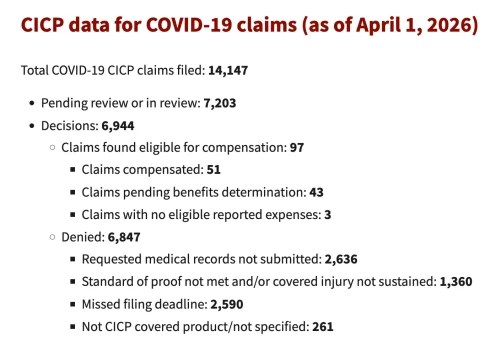
The ‘help’ the U.S. government does offer the COVID-vaccine injured is in the form of the Countermeasures Injury Compensation Program (CICP).
The latest numbers from that program have just been released. Shamefully, less than 1% of injury claims have been compensated.
Europe’s Drone Pipeline to Ukraine Could Soon be in Russia’s Crosshairs – Analyst
Sputnik – 16.04.2026
The Russian Defense Ministry’s statement on Europe’s plan to scale up drone production for Ukraine contained an explicit warning, says military analyst Ivan Konovalov speaking to Sputnik : Europe is turning into a “strategic rear base.”
The term applies to infrastructure that, while located outside the battlefield, directly sustains combat operations.
Under this logic, European hubs supplying Ukraine with drone components, data systems, FPV drones and heavy fixed-wing UAVs are no longer a “civilian facility in a peaceful country.”
“Once the production cycle on their territory is integrated into Ukraine’s strike capabilities against Russia, the line is crossed – they become a target deep within the enemy’s operational structure,” remarks the analyst.
After Russia’s strikes dismantled Ukraine’s centralized drone production, a workaround emerged: assembly lines were set up in Bavaria and the UK, using foreign-made components, while the finished systems were marketed as “Ukrainian.”
However, European production creates a long, predictable supply chain via Poland or Romania, exposed to disruption, insurance risks, and logistical bottlenecks, says the pundit.
Large shipments are visible to reconnaissance and potentially easier to disrupt at critical junctions, he argues.
For the European economy, it will entail growing risks for cargo insurance, airspace restrictions in border regions, and potentially forced relocation of production into underground or highly dispersed facilities.
“All this is fraught with massive non-productive costs for EU taxpayers, while Russia has long adapted to counter such challenges.”
Arms industry given direct influence over university courses
By Martin WILLIAMS | Declassified UK | April 8, 2026
Arms industry executives have been given direct influence over British university courses, Declassified can reveal.
BAE Systems, Leonardo, Thales and Rolls-Royce are among the firms who have been invited to sit on at least 53 university advisory committees across the country.
They are usually asked to provide “strategic direction” for academic departments – and sometimes also review the progress of research projects.
Using the Freedom of Information Act, Declassified found that at least 21 universities had asked arms companies to sit on their committees. They include the universities of Southampton, Edinburgh, Glasgow, Leicester, Cardiff, York and Queens University Belfast.
Some institutions boast that the setup allows them to “respond to the needs of employers”. The minutes of one committee meeting show that arms executives – along with officials from other companies – were thanked for “ensuring that our programmes fit industry requirements and demand”.
During a meeting at the University of Hull, an official from BAE Systems said they would “welcome applications” from students for “industrial placements”, adding that they would “like to develop the relationship”.
And a committee at the University of Cardiff discussed whether “industry” could “teach material to students,” noting that this would be “an appealing prospect for the School but would also offer good exposure for industry”.
They also agreed to meet with Rolls-Royce to discuss “research challenges”.
‘Disturbing’
The finding comes two years after it was revealed how British universities had taken almost £100m from defence companies – including many that are arming Israel.
In one case, BAE Systems gave almost £50,000 in sponsorship to University College London (UCL) to fund its Centre for Ethics and Law – despite the company being accused of being party to alleged war crimes in Yemen in 2019.
Universities including Oxford, Cambridge and Sheffield were all found to have taken huge sums from arms firms – accepting £17m, £10m, and £42m respectively.
Sam Perlo-Freeman, of the Campaign Against the Arms Trade (CAAT), said: “Declassified’s disturbing findings add to CAAT’s growing concern about deepening ties between UK universities and the military-industrial complex.
“As purveyors of a deeply corrupt and immoral trade that blights human life and the planet like no other, arms company executives should be nowhere near institutions of learning and intellectual freedom.”
He added: “Universities should be treating arms trade representatives as pariahs. Instead, and thanks to Declassified, we now know that they sit on at least 53 different advisory committees across 21 universities.
“We have little doubt that this will have impacted academic freedom and the integrity of higher education research. The question is exactly how. We need answers.”
Responding to our investigation, the co-founder of Demiliterise Education, Jinsella Kennaway, said: “Academic freedom is undermined while arms companies hold such influence over what gets researched, funded, and legitimised on campus”.
“Students deserve pathways into work that make the world safer and more humane, not careers that contribute to mass killing and deepening global insecurity,” they said.
“University leaders have a responsibility to ensure Britain’s knowledge centres contribute to saving lives, rather than allowing education to become a pipeline into the war economy.”
Featured Video
John Mearsheimer: Why Russia Gains By Hitting Ukraine Harder
or go to
Aletho News Archives – Video-Images
From the Archives
A Climate Scientist Who Engages Skeptics
By Judith Curry | November 27, 2009
An open letter to graduate students and young scientists in fields related to climate research:
Based upon feedback that I’ve received from graduate students at Georgia Tech, I suspect that you are confused, troubled, or worried by what you have been reading about ClimateGate After spending considerable time reading the hacked emails and other posts in the blogosphere, I wrote an essay that calls for greater transparency in climate data and other methods used in climate research. The essay is posted over at climateaudit.org.
What has been noticeably absent so far in the ClimateGate discussion is a public reaffirmation by climate researchers of our basic research values: the rigors of the scientific method (including reproducibility), research integrity and ethics, open minds, and critical thinking. Under no circumstances should we ever sacrifice any of these values; the CRU emails, however, appear to violate them. … continue
Blog Roll
 Aletho News
- Content control: USAID docs expose Biden admin’s grip on Ukraine coverage
- Ukraine destroying itself: every attack on the Crimean Bridge will come at a price
- NATO capital under protest siege, so NATO escalates war
- A Climate Scientist Who Engages Skeptics
- John Mearsheimer: Why Russia Gains By Hitting Ukraine Harder
- Argentina’s Perito Moreno Glacier Joins Antarctica and Arctic In Defying Doomsday Melt Claims
- ‘Chinagate’ Is Here
- Iran, four other countries condemn US plans to deploy weapons in outer space
- US media brings back the Iraq war playbook and why it won’t work
- Zakharova schools German FM on history basics
- If Americans Knew
- An error has occurred; the feed is probably down. Try again later.
- No Tricks Zone
- Alarmist Climatologists In Shock! 2026 Atlantic Hurricane Season Sees Lowest Count In 101 Years
- New Study: Modern Temps Are Among The Coldest Of The Last 10,000 Years In East Central Europe
- Germany’s Renewable Energies Lead to 1.4 Billion Euro Electric Power Trade Deficit
- Argentina’s Perito Moreno Glacier Joins Antarctica and Arctic In Defying Doomsday Melt Claims
- New Study: Barents Sea Temperatures Were Warmer And Sea Ice Less Extensive In The 1700s Than Today
- German Authorities Start Initiative To Evaluate Public Register For Climate “Disinformation” Spreaders!
- Zonal Asymmetry of Temperature Change in the Antarctic Circumpolar Current
- New Study: The Net Fossil Fuel Contribution To Rising Atmospheric CO2 Has Been Zero For 500 Years
- Germany’s Green Energy Transition Becoming Increasingly Expensive…Another 6 Trillion Euros!
- Sudden Stratospheric Warming, Powerful El Niño Combination May Lead To Extreme Europe Cold, Energy Crisis!

