The End of the Free, Global Internet
By Brad Pearce | The Libertarian Institute | September 1, 2025
It appears that the free global internet, such as it was, which many of us loved and grew up with, is nearly dead. Long gone are the days of anonymous IRC chats or where only paranoiacs thought their emails were monitored. The growing standard is the government demanding websites know who you are all the time to “protect” you from a myriad of trivial things such as “hate speech” or videos of people eating too much.
As has become common, it is not any of the “authoritarian” states we hear about leading the way to the end of internet freedom, but instead the ethnic European parts of the former British Empire. The United Kingdom itself has just implemented legislation which demands all users upload ID to show they are over eighteen when using anything it deems “dangerous,” while Australia is restricting all of those sixteen and under from having social media accounts whatsoever, again to protect them primarily from thoughts the government dislikes. The British legislation is particularly dangerous as it is expected that sites based anywhere in the world comply with expansive moderation rules, while Australia’s law is a blanket ban on social media usage for an age category. In both cases, however, they kill internet anonymity and set a terrible precedent.
The internet has been under siege from many directions for many years. It is true that America’s regime change class found free internet useful for “Color Revolutions” and did at times use it to undermine foreign governments. As a consequence, it has historically acted as a defender of internet freedom when it advances other objectives. Thus, something like “The Great Firewall of China” which we were conditioned to care about, though it did not impact anyone outside of China.
The attacks on the internet have only grown more blatant, such as in Brazil where Judge Alexandre de Moraes has been on a rampage trying to “protect” the public from political speech he dislikes. In the United States, however, the bigger problem was originally just collecting enormous amounts of data secretly, which they did while encouraging people to use the internet however they wished—creating all the more data. The attempts at algorithmic mind control pushed by the Joe Biden administration and complacent—or enthusiastic—tech companies was again done while purporting to be for a free internet. Despite government hypocrisy and abuses, the internet remains the greatest communication tool in human history and we should protect it at all costs, while remaining mindful of government data collection activities, information control, and regime change operations.
The British and Australian laws are all the more nefarious as they impact almost all internet activity, and of course, they use the classic line “Won’t someone think of the children!” Age verification for pornography is one thing—that brings the internet in line with the laws of the physical world where you can’t walk into a store and buy that content without an adult ID; but this is much broader. As a recent Politico article explains, as well as pornography, there are age verification limits on, “hate speech, content promoting drugs and weapons, online harassment and depictions of violence… Large platforms restricted everything from X posts on Gaza to subreddits on cigars, and blocked content entirely in certain cases.” As Kym Robinson recently explained, they are rapidly medicalizing internet use and making it about physical and mental health, which for eKarens is an endless justification for meddling. In short, nearly anything fun or interesting could be considered adult content and the sites themselves are being made to police this or face significant fines, which intentionally creates a situation where cautious site owners will expand it past anything the government demands. No reasonable man can have any faith in any supposed privacy protections which are said to stop governments from accessing the ID used to age verify an account.
It’s easy as an adult to forget the experience of being a child, and imagine children lack the ability to understand anything about the world around them, when in fact they are learning such things at a rapid pace. It happens to be the case that I was twelve in the year 2000 when the first major law on this topic went into effect in the United States: the Children’s Online Privacy Protection Act [COPPA.] This law, in its original form, stopped kids under thirteen from having accounts on any website without a parent’s permission. To recover your email address your parent had to put in credit card information, which many were hesitant to do back then in an era where online shopping was still fairly rare. The thing about that though was the sites simply removed the option to sign up if you were under thirteen and had no verification option, so no one’s privacy was made worse; it was just annoying and condescending towards children.
What is notable about this is that at the time I wrote a persuasive speech for English class against this law. I have a reason to remember at age twelve that my classmates and I were able to understand the policy being unfairly implemented and I was able to write a formal argument against it. Now, being a parent instead of a twelve-year old, I certainly have some different views about what is appropriate for children, but the ability of children to understand what is going on around them is greater than commonly realized. The Australian Communications Minister tried to defend their ban on all social media use, including YouTube, for kids under sixteen by likening it to teaching your kid to swim in the pool before putting them in the ocean with the sharks and rip currents. In fact it is the exact opposite: it throws kids right in at sixteen with no experience when they are the most irresponsible and difficult to control.
What is the most nefarious about these “age verification” laws is that the United Kingdom and Australia both regularly arrest internet users for posts that they don’t like. The end of anonymity will kill the most valuable discourse coming from either country. Both of these countries in many ways seem completely defeated and devoid of the love of liberty, but in fact have thriving and creative “anon” communities still carrying the fire of freedom. The ability to express opinions and tell the world what is happening will all but disappear under a regime where you have to verify your age to use Spotify—not to mention how ridiculous it is to ban seventeen-year olds from using Spotify even if it impacted no one eighteen and above. Everything that has happened up to now shows that age verification laws in these countries will set the stage for an even larger crackdown on all unapproved thoughts.
Something I have noticed in my time on this Earth is that you can tell a lot by a man for how he uses the term “the Wild West.” It is generally either used by liberty lovers to mean, “You’re allowed to do what you want and it’s awesome,” or by sniveling Mandarins to mean “This is terribly dangerous and needs to be regulated.” I have long feared a future where the young say that the internet used to be like the Wild West and view this as scary and dangerous. Now, the younger generation seems to be coming up tired of the schoolmarm government, but it will be a hard fight to keep any of the internet’s Wild West charm as it is consumed by meddlesome nanny states.
If these laws in the United Kingdom and Australia are allowed to stand it will represent a major step in a perhaps irreversible process whereby the internet will become ever more broken up by the country of the user, and in most of them much less free. I would be able to take some comfort in the idea that this could send people back to the pubs to talk in person, but the Brits are also cracking down on pub banter, and I somehow doubt other states are far behind them.
Zelensky threatens ‘new deep strikes’ into Russia
RT | August 31, 2025
Ukrainian leader Vladimir Zelensky has threatened new strikes into Russia, days after claiming that Kiev possessed a brand-new long-range missile capable of reaching Moscow.
Zelensky wrote on Telegram that he had been briefed by Ukraine’s commander-in-chief, Aleksandr Syrsky, on the current battlefield situation.
“We will continue our active actions exactly as needed to protect Ukraine. Forces and means are prepared. New deep strikes have also been planned,” he said on Sunday, without providing further details.
Earlier this month, Zelensky claimed Ukraine had developed the long-range Flamingo missile with a reported range of 3,000 kilometers – which would be enough to reach not only Moscow but also Russian cities beyond the Ural mountains. The Ukrainian leader, however, said that mass production is not expected for the next several months.
British media outlets cast doubts on whether the Flamingo was developed in Ukraine, noting similarities with the FP-5 cruise missile produced by the UK-based Milanion Group and unveiled at an arms expo in Abu Dhabi this year. The UK has also been supportive of Kiev’s long-range strikes, having provided it with Storm Shadow missiles in the past.
Russian Foreign Ministry spokeswoman Maria Zakharova noted that there is “nothing surprising” in the similarities, adding that “Ukraine has long turned into a testing ground for Western weapons. There are more than enough examples.”
On Friday, the Kyiv Independent also reported that Ukraine’s National Anti-Corruption Bureau has launched an investigation into Fire Point, the defense firm linked to the development of the Flamingo missile, after reports it misled the government on pricing and deliveries.
Earlier this month the Wall Street Journal reported that the US had blocked Ukraine from carrying out strikes deep inside Russian territory. Throughout the conflict, some of Kiev’s Western backers have been wary of authorizing unrestricted strikes into Russia using Western-supplied weapons, citing concerns over escalation with Moscow.
Ukraine has regularly carried out long-range attacks inside Russia, which Moscow says frequently hit civilian areas and critical infrastructure. Russia has retaliated with strikes on Ukrainian military-related facilities and defense enterprises but maintains that it never targets civilians.
Iran’s parliament submits emergency bill to withdraw from NPT
Al Mayadeen | August 29, 2025
Following the announcement by the E3 (France, Germany, and the United Kingdom) to trigger the snapback mechanism on sanctions against Tehran, Iran’s Parliament has drafted and submitted an emergency bill proposing a full withdrawal from the Nuclear Non-Proliferation Treaty (NPT).
Hossein-Ali Haji-Deligani, Deputy Chairman of the Article 90 Committee of Iran’s Parliament, confirmed that the bill will be uploaded to the parliamentary system on the following day and subsequently reviewed in an open session.
“As we had previously stated, these countries were already implementing the consequences of the snapback mechanism, including sanctions against us. There is nothing new in this.” Haji-Deligani told Iran’s Tasnim.
He further stated that the steps taken were “the most minimal response by Parliament to the recent action of the European countries, and further regret-inducing measures are also on the agenda.”
Deputy chairman calls for decisive action
The proposed legislation comes amid growing frustration in Tehran over the West’s repeated failure to honor agreements and ease pressure on Iran. Haji-Deligani noted that Iran’s Parliament is determined to pursue a firm and deterrent course of action.
According to the lawmaker, the activation of the snapback mechanism effectively reinstates previous sanctions but introduces no new developments. Nonetheless, he emphasized that Iran’s response would be strategic and assertive.
Criticizing continued dialogue with Western countries, Haji-Deligani asserted, “Given what these three countries have done, negotiations with them are now meaningless. Dialogue will only embolden them.”
“We witnessed that during negotiations with the arrogant US, a brutal war was launched against our country by Israel, and the US bombed our peaceful nuclear sites,” he added. “Our people clearly know that talks with these countries have brought nothing but more pressure. Therefore, all dialogue must be suspended until these countries abandon their double standards.”
The emergency bill signals a potential turning point in Iran-E3 talks and highlights a significant policy shift in Tehran’s approach to its nuclear file. The move could impact the broader framework governing the Iran nuclear program and regional diplomacy.
Iran vows response
Iran’s Foreign Ministry confirmed on Thursday that France, Britain, and Germany have formally notified Tehran of their decision to trigger the “snapback” mechanism to reimpose United Nations sanctions under the 2015 nuclear deal.
Foreign Minister Abbas Araghchi condemned the measure as “illegal and unjustified,” warning that Tehran would respond “appropriately to protect and guarantee its national rights and interests.”
In a phone call with his French, British, and German counterparts, Araghchi urged them to “appropriately correct this wrong decision in the coming days.” He stopped short of detailing possible retaliatory steps but hinted that the E3 risk being excluded from any future negotiations on Iran’s nuclear program.
The E3 action came just days after Iranian and European diplomats held a second round of talks in Geneva, billed as a last chance to salvage engagement before the October deadline for invoking the snapback clause.
The discussions collapsed without “tangible commitments,” according to European officials, who claim that Tehran’s ongoing breaches of enrichment limits left them with no choice but to act. It is noteworthy that the E3 had failed to uphold their commitments in accordance with the JCPOA after the US unilaterally left the agreement in 2018.
Russian Ambassador Slams U.S. & Europe Over Iran Sanctions at UN
Russia confirms circulating draft proposal aimed at preventing activation of ‘snapback’
Press TV – August 27, 2025
Russia has confirmed circulating a draft proposal at the UN Security Council aimed at averting activation of the so-called “snapback” mechanism that would restore the council’s sanctions against Iran.
The country’s First Deputy Permanent Representative to the United Nations, Dmitry Polyanski made the remarks to reporters during a press conference on Tuesday.
“It (the proposal) is about extending Resolution 2231,” he said.
The resolution’s expected expiration in October would lead to reinstatement of the coercive measures.
The European trio of the UK, France, and Germany – the United States allies in a 2015 nuclear deal between Iran and world countries – has been trying hard to have the measures restored.
Polyanski, however, insisted, “Russia and China want to give more breathing space for diplomacy and provide some possibilities for an active quest for a diplomatic solution to this issue.”
He said Moscow and Beijing were doing so in their capacity as “as responsible members of the Joint Comprehensive Plan of Action (JCPOA), the nuclear deal’s official name. … Full article
Iran’s foreign minister: Entry of IAEA inspectors does not signal full cooperation

Abbas Araghchi, Iran’s foreign minister
Press TV – August 27, 2025
Iran’s foreign minister has confirmed the arrival of inspectors from the International Atomic Energy Agency (IAEA) following a months-long hiatus.
Abbas Araghchi, however, said their presence does not mean the resumption of full cooperation with the UN nuclear watchdog.
Speaking to reporters in Tehran on Wednesday, the foreign minister said the entry was authorized by Iran’s Supreme National Security Council (SNSC) and limited to overseeing the fuel replacement process at the Bushehr Nuclear Power Plant.
He said under a recent parliamentary law, all cooperation with the IAEA must be approved by the SNSC.
“No text has yet received final approval,” he added, referring to ongoing discussions about a new cooperation modality following the acts of aggression by the Israeli regime and the United States in June.
Iran has barred any new inspections since the attacks, citing safety concerns at damaged nuclear sites and criticizing the IAEA’s failure to condemn the strikes.
Earlier, Behrouz Kamalvandi, spokesman for the Atomic Energy Organization of Iran (AEOI), said the inspectors’ presence was tied to routine operations at the Bushehr facility and the need to maintain electricity supply to the national grid.
On August 26, IAEA Director General Rafael Grossi announced that inspectors were “back in Iran.”
In an interview with Fox News, Grossi said, “When it comes to Iran, as you know, there are many facilities. Some were attacked, some were not.”
“So we are discussing what kind of … practical modalities can be implemented to facilitate the restart of our work there.”
The developments come amid renewed diplomatic tensions, as Iran held talks in Geneva with Britain, France, and Germany over their threat to trigger the so-called snapback mechanism, a provision of the 2015 nuclear deal that would restore UN sanctions lifted under the accord.
European signatories to the Joint Comprehensive Plan of Action (JCPOA) have said they will wait until August 31 to decide whether to activate the mechanism.
Iran has reduced its cooperation with the IAEA in recent years in response to the withdrawal of the United States from the 2015 nuclear deal and the failure of Europeans to make up for the withdrawal.
The Illusion of Israeli Self Sufficiency in Intelligence
By José Niño | The Libertarian Institute | August 26, 2025
Casual onlookers salivate at the supposed brilliance of Israel’s intelligence services. From Mossad’s assassinations abroad to daring sabotage campaigns in hostile territory, the Jewish state has been elevated in popular imagination as a scrappy David with unmatched cunning, capable of pulling off operations that leave even world powers like the United States in awe. Books, films, and mainstream pundits reinforce this myth, presenting Israel’s intelligence machine as self-sufficient and independent.
But when one peels back the layers, the narrative quickly unravels. Israel’s most celebrated operations—from targeted killings in Europe to sabotage inside Iran—were rarely the product of Israeli ingenuity alone. They relied on cooperation with the CIA, NSA cyberwarfare expertise, European intelligence networks, and even covert collaboration with Arab regimes that publicly denounce Israel while privately working with it. Much like its dependence on U.S. military aid and diplomatic cover, Israel’s intelligence empire survives not through independence but through reliance on Western logistics, intelligence sharing, and political approval. What is sold as the story of a bootstrapping nation is a case study in multinational complicity.
According to investigative reporting by Israeli journalists Melman and Ronen Bergman, Israel’s intelligence community relied heavily on intelligence partnerships with Western and allied nations to conduct clandestine activities in foreign territories.
The foundation of this intelligence cooperation traces back to the aftermath of the 1972 Munich Olympics massacre. According to Dr. Aviva Guttmann’s research, which Melman has covered extensively, the Berne Club—a secret European intelligence alliance founded in 1969—provided crucial support for Israel’s subsequent assassination campaign against Palestinian operatives. This multinational intelligence network initially included Switzerland, West Germany, France, the United Kingdom, Italy, Luxembourg, Austria, the Netherlands, and Belgium, and later expanded to include the United States, Canada, Australia, and other nations. Through an encrypted communication system called “Kilowatt,” thousands of cables were exchanged among eighteen Western intelligence services after the system was established in 1971. The network functioned as a secret clearinghouse for raw intelligence. Shared reports contained the locations of safe houses, vehicle registrations, the movements of high-value targets, updates on Palestinian guerrilla tactics, and analytical assessments, all of which provided Israel with crucial operational support for its clandestine operations.
Direct American involvement in Israeli operations became particularly evident during the George W. Bush administration. The February 2008 assassination of Hezbollah commander Imad Mughniyeh in Damascus was reportedly approved by President Bush himself after being briefed by then-CIA Director Michael Hayden. This was not merely intelligence sharing but active operational participation. “The Mossad agent would ID Mughniyeh, and the CIA man would press the remote control,” a Newsweek report noted. The CIA designed and built the bomb that killed Mughniyeh, tested it at a secret facility in North Carolina, and smuggled it into Syria through Jordan, while Mossad provided intelligence and logistical support.
When it came to confronting Iran’s nuclear program, the United States and Israel collaborated on the creation of the Stuxnet computer virus in a joint operation codenamed “Olympic Games.” The malware was designed to sabotage centrifuges at Iran’s Natanz uranium enrichment facility. According to Ronen Bergman, the virus was developed with input from Israeli cybersecurity experts alongside the U.S. National Security Agency. This operation represented a quadrilateral effort involving the CIA, NSA, Mossad, and Israel’s military intelligence agency, AMAN. It was conceived during the administrations of W. Bush and Israeli Prime Minister Ehud Olmert and ultimately executed in 2010 under President Barack Obama and Prime Minister Benjamin Netanyahu.
The scope of American involvement extended to Israel’s broader targeted killing policies. Ronen Bergman revealed that during Ariel Sharon’s tenure, a secret deal was struck with then-U.S. National Security Advisor Condoleezza Rice that committed Israel to “significantly reduce the construction of new settlements in exchange for American backing of the war with the Palestinians and of Israel’s targeted killing policy” of high-value Palestinian figures.
American intelligence cooperation facilitated Israel’s campaign against Iran’s nuclear program, with Melman documenting extensive Western knowledge of and potential involvement in the assassination of Iranian nuclear scientists between 2007-2012. The Obama administration was aware of the assassination campaign carried out by the Mujahideen-e-Khalq (MEK) terrorist organization, which was being financed, armed, and trained by Mossad. Joint Special Operations Command (JSOC) reportedly trained MEK members starting in 2005, and U.S. intelligence was providing crucial information for these operations. As one former senior intelligence official told investigative journalist Seymour Hersh, “the United States is now providing the intelligence” for assassinations carried out “primarily by MEK through liaison with the Israelis.”
Israeli dependency on foreign support went beyond Western allies to include collaborationist elements in the Arab world. Bergman revealed extensive details about Mossad’s regional cooperation during Meir Dagan’s tenure (2002-2010) as director of the Mossad, including secret partnerships with Arab intelligence services that publicly condemned Israel while privately cooperating with it. These arrangements involved joint operations with countries that “share more or less the same set of interests” despite public hostility, coordination in counter-terrorism operations across the Middle East, and partnerships that enabled many operations attributed solely to Mossad.
The pattern of foreign dependence continues in contemporary operations. An August 2025 ProPublica report by Yossi Melman and fellow journalist Dan Raviv showcased Israel’s enlistment of Iranian dissidents for executing missions inside Iran during “Operation Rising Lion.” They specifically outlined Mossad’s strategic shift from using Israeli personnel to cultivating a “foreign legion” of Iranian and regional operatives to carry out activities ranging from support functions to covert action.
This pattern of intelligence reporting by Melman and Bergman reveals that Israel’s reputation for independent intelligence capabilities obscures a reality of extensive foreign dependence, particularly on Western intelligence services, for conducting operations that extend Israeli influence and security interests globally.
Far from being a model of independence, Israel’s intelligence record underscores how deeply its operations are embedded in Western power structures. The myths of self-sufficiency and unmatched brilliance collapse under the weight of evidence: Mossad’s reach is extended only because Washington, European capitals, and even regional neighbors provide the pipelines of intelligence, technology, and manpower that make its operations possible.
The true scandal lies not in Israel’s dependency but in the willingness of other nations to abet its destabilizing campaigns by supplying the bombs, intelligence streams, and diplomatic cover that allow Tel Aviv to operate with impunity. To strip away the mythology is to confront the uncomfortable truth that Israel’s “miraculous” intelligence victories are collective endeavors, outsourced across continents, exposing not a triumph of independence but a parasitic reliance on collaborators who enable its shadow wars.
Britain faces worst crash in fifty years – economists
RT | August 25, 2025
Britain is facing the prospect of a repeat of its crippling 1976 economic crash as soaring debt and borrowing costs raise doubts over Labour’s budget policies, leading economists have warned, according to a Telegraph report.
The crisis nearly fifty years ago saw a Labour government forced to seek an emergency loan from the International Monetary Fund (IMF) after deficits and inflation spun out of control. It became one of Britain’s worst postwar crises, with the bailout bringing deep spending cuts and Labour losing power a few years later.
Now Chancellor Rachel Reeves faces similar warnings, with forecasts showing a £50 billion ($68 billion) gap in the public finances and debt interest set to exceed £111 billion. Debt now exceeds 96% of GDP. At around £2.7 trillion, it is one of the heaviest burdens in the developed world. Government borrowing costs have surged, with yields on 30-year bonds climbing above 5.5%, higher than those of the US and Greece.
Jagjit Chadha, former head of the National Institute for Economic and Social Research, told the Telegraph the outlook was “as perilous as the period leading up to the IMF loan of 1976,” warning Britain could struggle to meet pensions and welfare payments.
Andrew Sentance, once a Bank of England policymaker, said Reeves was “on course to deliver a [former UK Chancellor Denis] Healey 1976-style crisis in late 2025 or 26,” accusing Labour of fueling inflation with higher taxes, borrowing, and spending.
The warnings come weeks before Reeves is due to present her first autumn budget, where she is expected to announce further tax rises to cover the shortfall – a move critics argue would deepen the downturn. The Labour government also faces deepening political and economic challenges, including declining support.
On Saturday, Reform UK leader Nigel Farage declared it was “the 1970s all over again,” while Conservative leader Kemi Badenoch described soaring borrowing costs as the price of Labour’s “economic mismanagement.”
London has pledged to raise military spending to 2.5% of GDP by 2027, aligning with NATO commitments. Britain remains one of Ukraine’s most ardent supporters, delivering billions in military and financial aid – further squeezing already stretched public finances.
4chan Rejects UK Ofcom Fine, Citing US Free Speech Protections and Threatening Legal Action
By Cindy Harper | Reclaim The Net | August 22, 2025
4chan’s legal team has firmly rejected an attempt by UK regulator Ofcom to impose penalties under Britain’s new Online Safety Act, declaring the proposed fine unenforceable and a direct challenge to free expression protected by US law.
The media regulator wants the site to pay a £20,000 ($27,010.78) penalty, with additional daily fines if it continues to ignore requests tied to its ongoing investigation.
However, Preston Byrne, the attorney representing 4chan, argues that the demand lacks legal standing in the United States.
Speaking to the BBC, Byrne described the regulator’s actions as “an illegal campaign of harassment” directed at American tech firms.
Byrne made clear his client would not comply: “4chan has broken no laws in the United States, my client will not pay any penalty.”
Ofcom launched its investigation to determine whether the platform meets requirements laid out in the Online Safety Act, which compels digital services to shield UK-based users from “harmful” content.
In August, the regulator issued what it called a “provisional notice of contravention,” accusing 4chan of failing to respond to two formal data requests.
The site, long known for its loose moderation policies and anonymous posting, has been a regular target of controversy over the years. Its open nature allows for a broad range of user expression, which some governments now seek to restrict under the pretext of safety.
In a public statement released on X, legal representatives for 4chan doubled down.
Byrne & Storm, alongside Coleman Law, stated: “American businesses do not surrender their First Amendment rights because a foreign bureaucrat sends them an email.” They argued that US courts have consistently refused to enforce foreign censorship fines, and if necessary, they would escalate the matter in federal court to protect those constitutional rights.
The statement added that US authorities were already briefed on the situation, and it urged the Trump administration to “invoke all diplomatic and legal levers” in defense of US-based platforms against what it called “extraterritorial censorship mandates.”
Ofcom declined to provide further comment while the investigation remains open.
Bands boycott UK festival after Irish group ‘cut off’ for waving Palestinian flag

Press TV – August 24, 2025
Several bands have pulled out of a major UK music festival after an Irish folk band said organizers cut their set when they displayed a Palestinian flag and chanted “Free Palestine.”
The Mary Wallopers were performing at Victorious Festival in Portsmouth on Friday when organizers accused them of using a chant “widely understood to have a discriminatory context.”
The Mary Wallopers dismissed the allegation as “misleading,” saying, “Our video clearly shows a Victorious crew member coming on stage, interfering with our show, removing the flag from the stage and then the sound being cut following a chant of ‘Free Palestine’.”
Organizers first claimed the set was stopped over a chant, but later admitted the sound was cut after the flag was shown. They apologized “to all concerned” and pledged a “substantial donation” to humanitarian relief for Palestinians.
In protest, The Last Dinner Party, The Academic and Cliffords announced on Saturday that they would boycott the festival over censorship.
“We are outraged by the decision to silence The Mary Wallopers,” The Last Dinner Party wrote on Instagram, calling it “political censorship.”
The Academic said they could not “in good conscience” perform at a festival that silences free speech, while Cliffords said they “refuse to play if we are to be censored for showing our support to the people of Palestine.”
The festival, which continues through Sunday with headliners including Kings of Leon, Bloc Party and Gabrielle, now faces growing backlash over silencing pro-Palestinian protest.
UK Ramps Up Ukraine Training as Europe’s War Hawks Push ‘Security Guarantees’
Sputnik – 24.08.2025
The British-led Operation Interflex, a multinational military initiative to train and support the Armed Forces of Ukraine, has now been extended to at least 2026, Bloomberg reports.
Over 50,000 Ukrainian recruits have already received both combat and leadership training in the UK.
A further element of the plan involves a so-called US backstop, providing intelligence, border surveillance, weapons, and potentially air defenses, Bloomberg says.
Meanwhile, a UK and France-led “Coalition of the Willing” plans to station European forces in Ukraine as European war hawks push “security guarantees” tied to a potential peace deal.
Russia insists that any security guarantees for Ukraine must reference the 2022 Istanbul talks, and discussions about a security framework without Russia lead nowhere.
In essence, Europe is proposing foreign intervention on part of Ukrainian territory, which is absolutely unacceptable for Moscow, Russian Foreign Minister Sergey Lavrov stressed.
Europe lacks strategy to break snapback ‘deadlock’: Russia envoy
Press TV – August 23, 2025
A senior Russian diplomat says the European troika—Britain, France, and Germany—lack a clear strategy to break the “deadlock” they are poised to create if they follow through on their threat to invoke the “snapback” mechanism against Iran.
Russia’s permanent envoy to international organizations in Vienna, Mikhail Ulyanov, made the remarks in a post on his X account on Saturday.
He proposed to put aside legal and procedural issues which definitely do not give the E3 the right to trigger the snapback mechanism and to address the issue from a purely political viewpoint.
The Russian diplomat asked whether the trio has an exit strategy and a vision of how to find a way out of the deadlock they are going to create.
“The answers to these questions seem to be negative,” Ulyanov emphasized.
Snapback would bring into force six previous Iran-related Security Council resolutions adopted between 2006 and 2010. It would reinstate the expired UN arms embargo that barred countries from supplying, selling, or transferring most military equipment to Iran and prohibited Tehran from exporting any weapons.
It would also impose export controls, travel bans, asset freezes, and other restrictions on individuals, entities, and banks.
In a Friday phone conversation with the EU high representative for foreign and security policy and his British, French, and German counterparts, whose countries are the European signatories to the 2015 nuclear agreement, Iranian Foreign Minister Abbas Araghchi warned that triggering the snapback would have consequences.
The top Iranian negotiator once again emphasized that the European countries lack the legal and moral authority to resort to the mechanism.
China’s mission to the United Nations on Wednesday declared the country’s firm opposition to threats by European parties to the 2015 nuclear deal to activate the snapback mechanism within the framework of UN Security Council Resolution 2231.
The mission at the UN headquarters in New York distributed an explanatory note to the Security Council, stating that the difficult situation in implementing the JCPOA and Resolution 2231 is not the result of Iran’s actions but the disruption of the JCPOA’s implementation by the United States and the three European countries.
China and Russia’s backing plays a critical role in Iran’s diplomatic efforts to counter the snapback threat. Both countries are permanent members of the UN Security Council and have veto power over resolutions, including those related to Iran’s nuclear program.
The CIA, Mossad, and Epstein: Unraveling the Intelligence Ties of the Maxwell Family
By Alan Macleod | MintPress News | August 22, 2025
With speculation mounting that Trump could pardon her, MintPress profiles the family of convicted sex trafficker Ghislaine Maxwell. From her media baron father, who acted as a high-level spy for Israel, her sister, working to push Tel Aviv’s interests in Silicon Valley, her brothers, who founded a dubious but highly influential anti-Islamic extremism think tank, and nephews in influential roles at the State Department and White House, the Maxwell clan have wide-ranging ties to U.S. and Israeli state power. This is their story.
Releasing Ghislaine, Burying the Epstein Files
Speculation is growing that Ghislaine Maxwell could soon be freed. Despite campaigning on the promise to release the Epstein Files, there are increasing signs that the Trump administration is considering pardoning the world’s most notorious convicted sex trafficker.
Last month, Trump (who contemplated the idea in his first term in office) repeatedly refused to rule out a pardon, stating to journalists that “I’m allowed to do it.” Just days later, Maxwell was transferred across states to a minimum-security facility in Bryan, Texas—a highly unusual practice. Neither women convicted of sex crimes nor those with more than 10 years remaining on their sentences are generally permitted to be transferred to such facilities. The move sparked equal measures of speculation and outrage.
The decision to relocate Maxwell came after somebody—potentially a source within her team itself—began leaking incriminating and embarrassing evidence linking Trump to Epstein. This included a birthday card Trump sent Epstein, featuring a hand-drawn nude woman, accompanied by the text: “Happy Birthday—and may every day be another wonderful secret.”
For years, Maxwell aided her partner Jeffrey Epstein in trafficking and raping girls and young women, creating a giant sex crime ring in the process. Epstein’s associates included billionaires, scientists, celebrities, and politicians, including President Trump, whom he considered his “closest friend.”
In 2021, two years after Epstein’s mysterious death in a Manhattan prison, Maxwell was found guilty of child sex trafficking offenses and was subsequently sentenced to 20 years in prison.
The news that Trump may soon free such an infamous criminal sent shockwaves through his base and drew charges of blatant corruption from the media. “Is there any reason to pardon Ghislaine Maxwell except to buy her silence?” ran the headline of one article in The Hill. Meanwhile, Tim Hogan, senior Democratic National Committee adviser, denounced what he claimed was a “government cover-up in real time.” “Donald Trump’s FBI, run by loyalist Kash Patel, redacted Trump’s name from the Epstein files—which have still not been released,” he said.
Robert Maxwell: Media Tycoon and Israeli Operative
While many of Ghislaine Maxwell’s crimes have come to light, less well-known are her family’s myriad connections to both the U.S. and Israeli national security states. Chief among these are those of her father, disgraced media baron and early tech entrepreneur, Robert Maxwell.
A Jewish refugee fleeing Hitler’s occupation of his native Czechoslovakia, Maxwell fought for Britain against Germany. After World War II, he used his Czech connections to help funnel arms to the nascent State of Israel, weapons that helped them win the 1948 war and carry out the Nakba, the ethnic cleansing of nearly 800,000 Palestinians.
Maxwell’s biographers, Gordon Thomas and Martin Dillon, write that he was first recruited by Israeli intelligence in the 1960s and began buying up Israeli tech corporations. Israel used these companies and their software to carry out spying and other clandestine operations around the globe.
Maxwell amassed a vast business empire of 350 companies, employing 16,000 people. He owned an array of newspapers, including The New York Daily News, Britain’s Daily Mirror, and Maariv of Israel, in addition to some of the world’s most influential book and scientific publishing houses.
With business power came political power. He was elected to the U.K. parliament in 1964 and counted U.S. Secretary of State Henry Kissinger and Soviet Premier Mikhail Gorbachev among his closest friends.
He used this influence to advance Israeli interests, selling Israeli intelligence-gathering software to Russia, the U.S., the U.K., and many other countries. This software included a secret Israeli backdoor that allowed the Israeli intelligence agency, Mossad, to tap into classified information gathered by governments and intelligence agencies around the world.
At the same time, it was expanding its espionage capabilities, Israel was developing a secret nuclear weapons program. This project was exposed by Israeli peace activist Mordechai Vanunu, who, in 1986, leaked evidence to the British press. Maxwell—one of Britain’s most powerful press barons—spied on Vanunu, passing photographs and other information to the Israeli Embassy—intelligence that led to Vanunu’s international abduction by Mossad, and his subsequent imprisonment.
His death was also surrounded by controversy, similar to Epstein’s. In 1991, his lifeless body was found in the ocean, in what authorities ruled a bizarre accident whereby the tycoon had fallen from his luxury yacht. To this day, his children are split on whether they think he was murdered.
The rumors that Maxwell had, for decades, been acting as an Israeli “superspy” were all but confirmed by the lavish state funeral he received in Jerusalem. His body was interred at the Mount of Olives, one of the holiest sites in Judaism, the spot from which Jesus is said to have ascended to heaven.
Virtually the entirety of elite Israeli society–both government and opposition–attended the event, including no fewer than six living heads of Israeli intelligence organizations. President Chaim Herzog himself performed the eulogy. Also speaking at the event was Prime Minister Yitzhak Shamir, who stated that “Robert Maxwell has done more for Israel than can today be said.”
In the United Kingdom, however, he is remembered less fondly. A man with a fearsome reputation, Maxwell ruled his media business with an iron fist, in a similar vein to Rupert Murdoch (another individual with extremely close links to Israel). After his death, it transpired that he had stolen more than $500 million from his employees’ pension fund to bail out other failing companies in his empire, leaving many of his workforce’s retirement plans in tatters. As the newspaper, The Scotsman, remarked ten years later in 2001:
If [Maxwell] was despised in life, he was hated in death when it emerged he had stolen 440 million [pounds] from the pension fund of Mirror Group Newspapers. He was, officially, the biggest thief in British criminal history.”
Isabel Maxwell: Israel’s Woman in Silicon Valley
Even before it had been published, Isabel Maxwell– Robert’s daughter and Ghislaine’s older sister– managed to obtain a copy of Thomas and Dillon’s biography. She immediately flew to Israel, The Times of London reported, where she showed it to a “family friend” and deputy director of Mossad, David Kimche. These actions did little to beat the book’s central allegation that her father was indeed a high-level Israeli “superspy.”
Isabel has enjoyed a long and successful career in the tech industry. In 1992, along with her twin sister, Christine, she founded a company that developed one of the internet’s first search engines.
After the pension scandal, however, she and her siblings shifted their focus to rebuilding every facet of their father’s collapsed business empire. The sisters sold the search engine, netting enormous profits.
As Israeli outlet Haaretz noted, in 2001, Isabel decided to dedicate her life to advancing the Jewish State’s interests, vowing to “work only on things involving Israel” as she “believes in Israel.” Described by former MintPress journalist and investigative reporter Whitney Webb as “Israel’s back door into Silicon Valley,” she has transformed herself into a key ambassador for the country in the tech world.
“Maxwell created a unique niche for herself in [tech] as a liaison between Israeli companies in the initial development stages and private angel investors in the U.S. At the same time, she helps U.S. companies interested in opening development centers in Israel,” wrote local business newspaper, Globes. “She lives intensively, including innumerable flights back and forth between Tel Aviv and San Francisco,” it added.
Israel is known to be the source of much of the world’s most controversial spyware and hacking tools, used by repressive governments the world over to surveil, harass, and even kill political opponents. This includes the notorious Pegasus software, used by the government of Saudi Arabia to track Washington Post journalist, Jamal Khashoggi, before assassinating him in Türkiye.
Isabel built on her father’s political connections. “My father was most influential in my life. He was a very accomplished man and achieved many of his goals during his life. I learned very much from him and have made many of his ways my own,” she said. This included developing intimate ties to a myriad of Israeli leaders, including Ehud Olmert and Ehud Barak, one of Jeffrey Epstein’s closest associates.
During the 2000s, she was a regular participant at the Herzliya Conference, an annual, closed-door gathering of the West’s most senior political, security and intelligence officials, in addition to being a “technology pioneer” at the World Economic Forum.
She was also placed on the board of the Israeli government-funded Shimon Peres Center for Peace and Innovation and the American Friends of the Yitzhak Rabin Center for Israel Studies, two organizations closely associated with those former Israeli prime ministers.
In 2001, she became the CEO of iCognito, taking the job, in her words, “because it [the company] is in Israel, and because of its technology.” The technology in question was aimed at keeping children safe online—highly ironic, given that her sister was actively trafficking and abusing minors throughout that period.
Isabel was a much more serious and accomplished individual than Ghislaine. As Haaretz noted:
While her younger sister, Ghislaine, makes the gossip columns after breakfasting with Bill Clinton or because of her ties with another close friend, Britain’s Prince Andrew, Isabel wants to show photos taken of herself with the grand mufti of Egypt, or with Bedouin in a tent, or of visits to a Gaza refugee camp.”
In 1997, Isabel was appointed president of the Israeli tech security firm, Commtouch. Thanks to her connections, Commtouch was able to secure investment from many of the most prominent players in Silicon Valley, including Bill Gates, a close associate of both the Maxwell family and Jeffrey Epstein himself.
Christine Maxwell: Funded by Israel?
Isabel’s twin sister, Christine, is no less accomplished. A veteran of the publishing and tech industries, she co-founded data analytics firm Chiliad. As CEO, she helped oversee the production of a massive “counterterrorism” database that the company sold to the FBI during the height of the War on Terror. The software helped the Bush administration crack down on Muslim Americans and tear down domestic civil liberties in the wake of 9/11 and the PATRIOT Act. Today, she is the leader and co-founder of another big data corporation, Techtonic Insight.
Like her sister and father, Christine has a close relationship with the State of Israel. She is currently a fellow at the Institute for the Study of Global Antisemitism and Policy (ISGAP), where, her biography states,
She works to promote innovative academic research that leverages enabling technologies to empower proactive understanding and combatting the great dangers of contemporary antisemitism, and enhancing the ongoing relevance of the Holocaust for the 21st century and beyond.”
ISGAP’s board is a who’s who of Israeli national security state officials. This includes Natan Sharansky, former Minister of Internal Affairs and Deputy Prime Minister of Israel, and Brigadier General Sima Vaknin-Gil, the former Chief Censor for the IDF and Director General of the Ministry of Strategic Affairs and Diplomacy. Also on the board is Jeffrey Epstein’s lawyer, Alan Dershowitz.
The think tank was a key player in the U.S. government’s decision to repress the 2024 Gaza protests on university campuses nationwide. The group produced reports linking student leaders with foreign terrorist organizations and promoted dubious claims about a wave of anti-Semitism washing over American colleges. It met frequently with both Democratic and Republican leaders, and urged them to “investigate” (i.e., repress) the leaders of the demonstrations.
ISGAP has continually warned of foreign influence on American campuses, producing reports and holding seminars detailing Qatar’s supposed stranglehold over the U.S. higher education system, and linking that with growing anti-Israel sentiment among America’s youth.
Yet if ISGAP wished to investigate other foreign government influence operations, it would not have to look far, as its own funds overwhelmingly come from a single source: the Israeli state. In 2018, an investigation found that Israel’s Ministry of Strategic Affairs (then headed by Brigadier General Vaknin-Gil herself) channeled $445,000 to ISGAP, a sum representing nearly 80% of its entire revenues for that year. ISGAP failed to disclose that information to either the public or the federal government.
At the height of the concern over foreign interference in American politics, the news barely registered. Since then, the Israeli government has continued to bankroll the group to the tune of millions. In 2019, for example, it approved a grant of over $1.3 million to ISGAP. Thus, in her role as a fellow at the organization, Christine Maxwell is the direct beneficiary of Israeli government cash.
Third Generation Maxwells: Working In the US Government
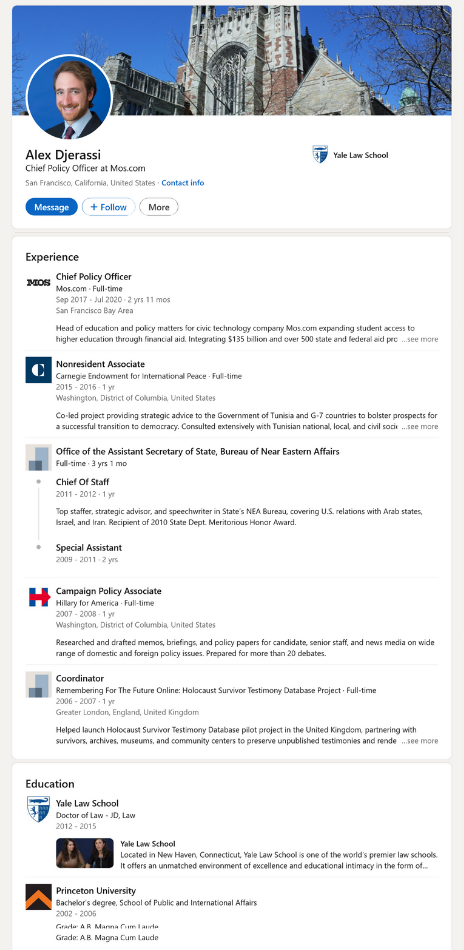
While Robert Maxwell’s daughters were close to state power, some of the family’s third generation have taken up positions within the U.S. government itself. Shortly after graduating from college, Alex Djerassi (Isabel Maxwell’s only son) was employed by Hillary Clinton on her 2007-2008 presidential campaign. Djerassi drafted memos, briefings, and policy papers for the Clinton team and helped prepare her for more than 20 debates.
The Clinton and Maxwell families are closely intertwined. Ghislaine vacationed with Hillary’s daughter, Chelsea, and appeared prominently at her wedding. Both she and Jeffrey Epstein were invited multiple times to the Clinton White House. Long after Epstein was jailed, President Bill Clinton invited Ghislaine to an intimate dinner with him at an exclusive Los Angeles restaurant.
Although she failed in her bid for the White House, President Obama named Hillary Clinton as his Secretary of State, and one of her first actions was to appoint Djerassi to her team. He quickly rose in the ranks, becoming Chief of Staff at the Office of the Assistant Secretary of State, Bureau of Near Eastern Affairs. In this role, he specialized in developing the United States’ policy towards Israel and Iran, although he also worked on the U.S. occupation of Iraq, and accompanied Clinton on visits to Israel and the Arab world.
While at the State Department, he served as the U.S. government representative to the Friends of Libya and the Friends of the Syrian People Conferences. These were two organizations of hardline, hawkish groups working towards the overthrow of those two governments, and their replacement with U.S.-friendly regimes. Washington got what it wanted. In 2011, Libyan leader Colonel Gaddafi was overthrown, killed and replaced by Islamist warlords. And last December, longtime Syrian President, Bashar al-Assad, fled to Russia and was replaced by the founder of al-Qaeda in Syria, Abu Mohammad al-Jolani.
Djerassi was later appointed an associate at the U.S.-government-funded think tank, the Carnegie Endowment for Peace. While there, he again specialized in Middle East policy, his bio noting that he “worked on matters relating to democratization and civil society in the Arab world, the Arab uprisings, and Israeli-Palestinian peace.” Today, he works in Silicon Valley.
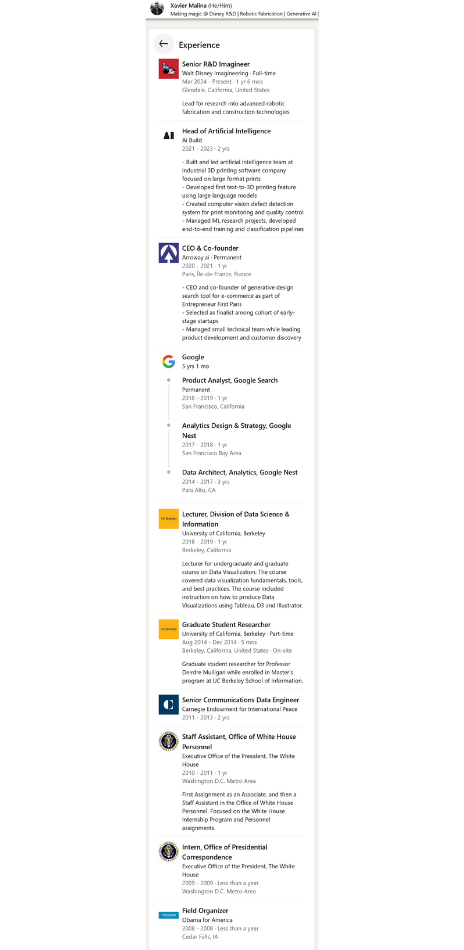
While Djerassi’s fortunes were tied to the Clinton faction of the Democratic Party, his cousin Xavier Malina (Christine Maxwell’s eldest son) backed the right horse, working on the Obama-Biden 2008 presidential run.
He was rewarded for his good work with a position in the White House itself, where he became a Staff Assistant at the Executive Office of the President. Like his cousin, once his time in office was over, Malina also secured a position at the Carnegie Endowment for Peace before pursuing a career in the tech world, working for many years at Google in the Bay Area. He currently works for Disney.
While the actions of parents and grandparents should not determine the careers of later generations, the fact that two individuals who come from a multi-generational family of unrepentant spies and operatives of a foreign power secured positions at the center of the U.S. State is at least worthy of note.
The Maxwell Brothers: From Bankruptcy to Counterterrorism
Much of the Maxwell clan is most influential in American and Israeli politics. However, brothers Ian and Kevin also hold considerable sway over affairs in their native Great Britain. Although being acquitted of charges over widespread allegations that they helped their father, Robert, plunder over $160 million from his employees’ pension fund, the brothers kept a low profile for many years. Kevin, in particular, was known for little more than being Britain’s largest-ever bankrupt, with debts exceeding half a billion dollars.
However, in 2018, they launched Combating Jihadist Terrorism and Extremism (CoJiT), a controversial think tank pushing for a far more invasive and heavy-handed government approach to the question of radical Islam.
In his organization’s book, “Jihadist Terror: New Threats, New Responses,” Ian writes that CoJiT was set up to play a “catalyzing role in the national conversation,” and to answer “difficult questions” arising from the issue. Judging by the content of the rest of the book, this means pushing for even more extensive surveillance of Muslim communities.
Within Britain, CoJiT was a highly influential organization. Its editorial board and contributors are a who’s who of high state officials. Individuals participating in its inaugural conference in London in 2018 included Sara Khan, the government’s Lead Commissioner for Countering Extremism, and Jonathan Evans, the former Director General of MI5, Britain’s domestic intelligence agency.
Like so many Maxwell projects, CoJiT appears to have wrapped up its affairs. The organization has not updated its website or posted anything on its social media channels since 2022.
In fairness, in the past few years, the brothers have had other priorities, leading the campaign to free their sister Ghislaine from prison, insisting that she is entirely innocent. In a manner reminiscent of Robert Maxwell, however, it appears that Kevin may have failed to pay the defense team; in 2022, Maxwell’s lawyers sued him, seeking unpaid fees of nearly $900,000.
The Infamous Mr. Epstein
For years, Ghislaine Maxwell and Jeffrey Epstein ran a sex trafficking ring that exploited hundreds of girls and young women. They were also connected to vast networks of the global elite, including billionaire business owners, royalty, star academics, and foreign leaders, among their closest acquaintances, leading to intense speculation about the extent of their involvement in their many crimes.
It is still unclear when Epstein first met with the Maxwells, with some alleging that he was recruited into Israeli intelligence by Robert Maxwell. Others state the relationship only began after Robert’s death, when he saved the family from penury following its financial problems.
Only one month after his 2019 arrest, Epstein was found dead in his New York City prison cell. His death was officially ruled a suicide, although his family has rejected this interpretation.
Perhaps the two most powerful individuals in Epstein’s circle of confidants were Presidents Bill Clinton and Donald Trump. Clinton, already infamous for the numerous accusations of sexual misconduct against him, is known to have flown at least 17 times on Epstein’s private jet, nicknamed the “Lolita Express,” and was accused by Epstein victim, Virginia Giuffre, of visiting Little St. James Island, the multimillionaire’s private Caribbean residence, where many of his worst crimes took place.
Trump, arguably, was even closer to the disgraced financier. “I’ve known Jeff for fifteen years. Terrific guy,” he said in 2002, “He’s a lot of fun to be with. It is even said that he likes beautiful women as much as I do, and many of them are on the younger side. No doubt about it.” Like Clinton, Trump flew on the Lolita Express. Epstein attended his wedding to Marla Maples in 1993, and claimed to have introduced him to his third wife, Melania.
Unfortunately, while Epstein’s ties incriminate the entire political spectrum, coverage has often been framed as a partisan issue. A MintPress study of over one year of Epstein coverage on MSNBC and Fox News found that each network downplayed his connections to their preferred president, while emphasizing and highlighting the links to the leader of the other major party. As a result, many in the United States see the affair as an indictment of their political rivals, rather than of the political system as a whole.
There also remains the question of Epstein’s links to intelligence, something that has been openly speculated about in the media for decades, even years before any allegations against him were made public. Throughout the 1990s, Epstein’s biographer Julie K. Brown noted, he openly boasted about working for both the CIA and Mossad, although the veracity of his claims remains in doubt. As Britain’s Sunday Times wrote in 2000, “He’s Mr. Enigmatic. Nobody knows whether he’s a concert pianist, property developer, a CIA agent, a math teacher or a member of Mossad.” It is possible that there is at least a grain of truth to all of these identities.
Epstein met with U.S. Deputy Secretary of State William Burns three times in 2014. Burns would later be named director of the CIA. Burns’ proximity to Epstein, however, pales in comparison to that of former Israeli Prime Minister, Foreign Minister, and Defense Minister Ehud Barak. Between 2013 and 2017 alone, Barak is known to have traveled to New York City and met with the convicted criminal at least 30 times, sometimes arriving at his Manhattan mansion incognito or wearing a mask to hide his identity.
Numerous sources have commented on Epstein’s connections to Israeli intelligence. A previous girlfriend and victim of his, referred in court documents as Jane Doe 200 to hide her identity, testified that Epstein boasted about being a Mossad operative and that, after he raped her, she could not go to the police because his position as a spy made her fear for her life.
“Doe genuinely believed that any reporting of the rape by what she believed to be a Mossad agent with some of the most unique connections in the world would result in significant bodily harm or death to her,” reads the court filing.
Ari Ben-Menashe, a former senior official in Israel’s Military Intelligence Directorate, claimed that Epstein was a spy and that he and Ghislaine Maxwell were running a honeytrap operation on behalf of Israel. Four (anonymous) sources told Rolling Stone that Epstein had directly worked with the Israeli government.
Unlike much of the Maxwell family, however, his Israel and intelligence connections are based largely on testimony and unverified accounts. His only known trip to the country was in April 2008, just before his sentencing, a move that sparked fears he would seek refuge there.
Nevertheless, there has been intense public speculation that he could have been working for Tel Aviv. At the Turning Points USA Student Action Summit 2025, former Fox News host Tucker Carlson stated that there is nothing wrong, hateful or anti-Semitic about asking questions about Epstein’s foreign connections. “No one’s allowed to say that the foreign government is Israel, because we’ve been somehow cowed into thinking that that’s naughty,” he said, before expressing his exasperation about the media’s silence on the issue.
What the hell is this? You have the former Israeli prime minister living in your house, you have had all this contact with a foreign government, were you working on behalf of the Mossad? Were you running a blackmail operation on behalf of a foreign government?”
Carlson’s comments drew harsh condemnation from former Israeli Prime Minister Naftali Bennett. “The accusation that Jeffrey Epstein somehow worked for Israel or the Mossad running a blackmail ring is categorically and totally false. Epstein’s conduct, both the criminal and the merely despicable, had nothing whatsoever to do with the Mossad or the State of Israel,” he wrote.
“This accusation is a lie being peddled by prominent online personalities such as Tucker Carlson pretending they know things they don’t,” he added, concluding that Israel was under attack from a “vicious wave of slander and lies.”
Whatever the truth about Epstein, it is indisputable that the powerful Maxwell family holds wide-ranging connections to U.S., British and Israeli state power. It is also beyond doubt that if the full story of their activities were ever to reach the public, it would incriminate a significant number of the world’s most powerful people and organizations. Perhaps that is why Trump has, in short order, gone from promising to release the Epstein Files to potentially releasing his accomplice.
Featured Video
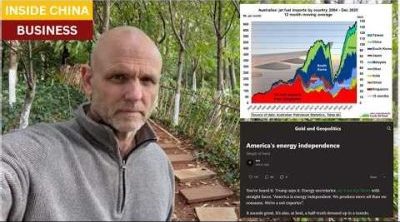
Chinese jet fuel and the myth of energy independence
or go to
Aletho News Archives – Video-Images
Book Review
Former Insiders Criticize Iran Policy as U.S. Hegemony
By GARETH PORTER | CounterPunch | February 27, 2013
“Going to Tehran” arguably represents the most important work on the subject of U.S.-Iran relations to be published thus far.
Flynt Leverett and Hillary Mann Leverett tackle not only U.S. policy toward Iran but the broader context of Middle East policy with a systematic analytical perspective informed by personal experience, as well as very extensive documentation.
More importantly, however, their exposé required a degree of courage that may be unparalleled in the writing of former U.S. national security officials about issues on which they worked. They have chosen not just to criticise U.S. policy toward Iran but to analyse that policy as a problem of U.S. hegemony. … continue
Blog Roll
 Aletho News
- What is fueling unrest across the EU?
- Why no power can undermine Iran’s eternal dominance over the Strait of Hormuz
- Is The War Against Iran Over?
- Iran war will leave long-term ‘scar’ on Wall Street, investors warn
- How Iran decimated US power projection in West Asia: Military lessons of 40-day war
- Iran’s report details US-Israeli war crimes in targeting schools, hospitals, livelihoods
- NATO’s Slow Fracture: How Trump’s Iran War Exposed the Instrument of Hegemony
- Chinese jet fuel and the myth of energy independence
- Ukraine Sea Drone Fired From Libya Hit Russian Tanker in Mediterranean
- IRGC: Iranian forces launched no attacks during ceasefire hours
- If Americans Knew
- Military aid to Israel emerges as the latest political litmus test for Democrats
- The only Palestinian children’s rights organization closes following years-long Israeli campaign against it
- ‘I Can’t Forget the Smell’: Lebanese Reel After Israel Kills Over 300 in Single Day
- DNC Shoots Down Resolutions Calling Out AIPAC and Limiting Arms to Israel
- TCN: Is Israel Blackmailing President Trump?
- Israel killed at least 303 Lebanese yesterday – who were they? Daily Update
- Amnesty: Urgent – Protect Lebanese civilians from brutal escalation in Israeli attacks
- Is The War Against Iran Over?
- Inside the Israeli army’s propaganda wing
- Hundreds of Gaza Amputees Stranded in Legal Limbo
- No Tricks Zone
- New Study: No Linear Warming Or Glacier Retreat Along Northern Antarctic Peninsula Since 1980s
- An Inconvenient Tree: Uncovered In Alps… Europe Much Warmer Than Today 6000 Years Ago
- New Study Reports A 60% Slowdown In Greenland’s Ice Loss Rate In The Last Decade
- Low Intensity Tornado Wrecks Major Solar Farm, Creating A Potential Toxic Dump
- New Study Finds Warming Saves Lives…Cold Temperatures 12 Times More Deadly Than Excess Heat
- German Science Blog Accuses PIK Climate Institute Of Hallucinating Climate Tipping Points
- Devastating Assessment Of Comirnaty Vaccine By Former Senior Pfizer Europe Toxicologist
- New Study: CO2 Is ‘Effectively Negligible’ As An Explanatory Climate Change Factor Since 2000
- Former Pfizer Toxicologist Dr. Helmut Sterz Tells Bundestag Hearing Pfizer Vaccine Should Have Never Been Approved
- Energy Expert: Germany’s Nuclear Phaseout Was A “500 Billion Euro Mistake”
 Aletho News