After losing its propaganda war, Israel silencing critics over Gaza genocide: UK scholar
By David Miller | Press TV | June 5, 2025
A British scholar, who is being sued for his pro-Palestine activism on social media, says Israel is seeking to silence its critics after losing a propaganda war regarding the ongoing genocide in the Gaza Strip.
David Miller, a producer and co-host of Press TV’s weekly Palestine Declassified show, made the remarks in an X post on Wednesday, after the Campaign Against Antisemitism (CAA), a pro-Israel NGO, launched a private prosecution against him.
The CCA said it has brought three charges against Miller, alleging that he had used X to send messages of a menacing character.
Miller said the CAA acts on behalf of Israel, which is “a hostile and illegitimate genocidal Jewish supremacist” regime.
“This attempt at a private prosecution is a Strategic Lawsuit Against Public Participation (SLAPP), and an act of desperation by … Israel in a propaganda war it has already lost,” he added.
“Israel, via the CAA, is attempting to buy its way into the criminal justice system to silence critics of Zionism. They will fail.”
Miller’s three messages mentioned in the case were posted from November 2024 onwards. They also concluded with the hashtag “Dismantle Zionism.”
The first hearing into the case is expected to take place at Westminster Magistrates’ Court in London on July 2.
Miller previously worked as a professor of political sociology at the University of Bristol, but he was unfairly and wrongfully dismissed in October 2021 over his pro-Palestine advocacy.
Anger against Israel has increased worldwide since October 7, 2023, when the occupying regime launched a genocidal war on the Gaza Strip.
Almost 20 months into its brutal aggression, Israel has failed to achieve its declared objectives in Gaza despite killing at least 54,607 Palestinians, mostly women and children, and injuring 125,341 others.
More signs of Britain grooming Syria’s Al-Qaeda-rooted government
The Cradle | June 4, 2025
When Syrian President Ahmad al-Sharaa (previously known as Abu Mohammad al-Julani), the former Al-Qaeda emir who led the Nusra Front, was affiliated with ISIS, and later headed Hayat Tahrir al-Sham (HTS), visited Saudi Arabia to meet Crown Prince Mohammed bin Salman (MbS) in February, he was accompanied by a surprising figure: Razan Saffour, a 32-year-old British-Syrian activist who had never set foot in Syria before the fall of former president Bashar al-Assad’s government in December.
Saffour also joined Syrian Foreign Minister Asaad al-Shaibani on his trip to the Munich Security Conference that same month. Her presence in Syria’s new ruling circle highlights Britain’s outsized role in shaping the conflict – bringing Al-Qaeda to power, whitewashing its leadership, and embedding UK operatives within its political infrastructure.
Her presence alongside Julani on official state visits signals not just personal ascension, but the triumph of Britain’s long war to launder extremist power through western-groomed proxies.
Razan Saffour was born and raised in London, studied at SOAS, and emerged as a high-profile Syrian opposition voice during the early years of the war, when she was only in her early 20s. Platformed by major western and Arab media outlets from the Persian Gulf, she was a familiar figure on the regime-change circuit. Her father, Walid Saffour, a leading Muslim Brotherhood (MB) dissident, had fled Syria in 1981 during the MB’s armed uprising against the state.
Walid Saffour would later become the Syrian opposition’s ambassador to the UK, representing the Syrian National Council. Academic Dr Dara Conduit notes that this gave “the Brotherhood an important formal diplomatic link to the UK through an undeclared member.”
Engineering regime change
By the mid-2000s, the British government had aligned with US neoconservatives and MB-linked activists to prepare a full-blown insurgency in Syria.
In October 2006, several members of an MB front group, the National Salvation Front (NSF), traveled to Washington to meet with Michael Doran, a member of the US National Security Council, to discuss plans for regime change in Syria. Doran was a close associate of prominent Jewish neoconservative and former US president George W. Bush’s administration official Elliott Abrams.
In 2009, former French foreign minister Roland Dumas was told by top British officials that “they were preparing something in Syria … Britain was organizing an invasion of rebels into Syria.” When asked why, Dumas responded, “Very simple!” because “the Syrian regime makes anti-Israeli talk.”
The covert US-UK effort to topple Assad involved training young, media-savvy Syrian activists to organize anti-government protests, as well as flooding Syria with Al-Qaeda militants from Iraq, Libya, Lebanon, and dozens of other countries to carry out false flag attacks against Syrian police and security forces.
Many were UK nationals and members of the Al-Qaeda-linked Libyan Islamic Fighting Group (LIFG). They had been allowed by British authorities to travel to Libya to topple late Libyan president Muammar al-Gaddafi, before being funneled into Syria via Turkiye.
US Ambassador to Syria Robert Ford served as the operation’s field coordinator. As former US Naval officer Wayne Madsen reported in 2011, Ford was recruiting death squads from Afghanistan, Iraq, Yemen, and Chechnya. His previous role as political officer in Iraq involved implementing the El Salvador Option: organizing Shia death squads to crush Sunni insurgents under Ambassador John Negroponte.
Among those released from the US-run Bucca prison in Iraq and dispatched to Syria was none other than Abu Mohammad al-Julani. He would go on to found the Nusra Front, the Syrian branch of Al-Qaeda, after orchestrating a series of suicide bombings in Damascus.
The Powell connection
While Al-Qaeda’s Syrian franchise grew, British intelligence cultivated parallel assets to manage the political front. In 2011, former UK Prime Minister Tony Blair’s chief of staff, Jonathan Powell, founded the NGO Inter Mediate, a Foreign Office-funded project designed to open secret channels with insurgent groups.
In March 2012, Powell wrote to Hillary Clinton’s advisor Sidney Blumenthal seeking US support: “We are setting up secret channels between insurgents and governments.” He boasted that his group worked “closely with the FCO (the Foreign and Commonwealth Office), NSC (National Security Council) and SIS (Special Intelligence Service, or MI-6) in London.”
“We are starting work in Syria,” Powell added, suggesting that he was communicating with the Nusra Front and other Al-Qaeda linked groups.
By this time, Walid Saffour had assumed his UK ambassadorial post for the Syrian opposition. He lobbied hard for the arming of the Free Syrian Army (FSA) – a cover or “weapons farm” for transferring NATO-grade weapons to Nusra.
His appointment gave “the Brotherhood an important formal diplomatic link to the UK through an undeclared member,” academic Dara Conduit wrote in her book detailing the history of the MB in Syria.
Armed with CIA-supplied TOW missiles and led by Julani’s suicide battalions, Nusra captured Idlib in 2015. A year later, it declared an Islamic emirate in the province, modeled on ISIS’s Raqqa. Brett McGurk, the US envoy to the anti-ISIS coalition, would later call Idlib “the largest Al-Qaeda safe haven since 9/11.”
While McGurk claimed “Idlib now is a huge problem,” the US and UK were quietly working with the Nusra, which was soon rebranded as HTS.
Arab media outlet Jusoor wrote that the “attempts of [Hayat] Tahrir Al-Sham for polishing itself began in the summer of 2017, with a campaign of contacts with the west.”
Jusoor added that HTS media official Zeid Attar had a meeting with the former UK diplomat Powell, “who manages many back channels for negotiating with designated terrorist groups either internationally or nationally.”
From terrorist to statesman
In 2019, US envoy James Jeffrey openly described HTS as an “asset” to Washington’s Syria strategy. The goal: preserve an Al-Qaeda-controlled buffer in Idlib to pressure Damascus.
Russian media later revealed that Powell had met Julani near the Bab al-Hawa crossing with Turkiye, coaching him on how to rehabilitate his image. Julani was advised to grant a western media interview to soften his profile.
PBS journalist Martin Smith soon arrived in Idlib. His April 2021 interview with Julani aired in the US, casting the Salafist extremist leader as a reformed figure who posed no threat to western interests.
In May 2024, Robert Ford revealed at a conference that he, too, had met Julani in Idlib. “In 2023, a British non-governmental organization specializing in conflict resolution invited me to help with their efforts to get this man out of the terrorist world and into regular politics,” Ford told attendees.
That NGO, according to Independent Arabia, was Powell’s Inter Mediate. In a revealing twist, Powell was appointed UK National Security Advisor on 8 November 2024 – just weeks before Julani’s HTS launched its final offensive on Damascus. By 8 December, Julani, who now goes by his government name Ahmad al-Sharaa, had assumed power.
London’s ‘post-Assad’ playbook
As Sharaa settled into the presidential palace, western and Arab media launched a PR blitz to sell him as a modern, diversity-friendly ruler. This was difficult given his previous pledges to carry out a genocide against any of Syria’s minority Alawites who refused to convert to Sunni Islam, and his role in dispatching car and suicide bombers, killing tens of thousands in Syria and Iraq over more than a decade.
An image facelift ensued nonetheless: Military fatigues gave way to tailored suits; his nom de guerre was dropped in favor of his alleged birth name. Time magazine listed Sharaa as one of the year’s 100 most influential people – at Ford’s behest, no less. And the US lifted its $10 million bounty on his head for terrorism.
Sharaa pledged to protect minorities, including the Alawites – even as Syria’s new HTS-led security forces began targeting them under the guise of counterinsurgency. HTS-led Syrian government forces were carrying out brutal massacres against Alawite civilians on the Syrian coast, during an operation to quell an armed uprising against the authorities. During a four-day period of massacres, at least 1,700 Alawite civilians, including scores of women and children, were killed.
The following February, after Razan Saffour accompanied Julani to meet MbS, The National reported that Powell had recently held a “low-key meeting” with Syria’s new government in his new role as National Security Advisor, “boosting suggestions he will play a leading role in relations.”
Syrian analyst Malek Hafez told the Syrian Observer that Powell’s team even runs a media office inside the presidential palace, “reportedly run by two women – one British, the other of Lebanese-British heritage.”
As Hafez concludes, “The rise of Ahmad al-Sharaa was not spontaneous – it was carefully engineered through a long-term, western-backed strategy, in which Britain played a disproportionately influential role among western powers.”
While London has not yet officially expressed its support for Sharaa and Syria’s new government, the UK’s “fingerprints” are increasingly visible, the Observer added.
When weighed against the hundreds of thousands of Syrians killed, the millions displaced, and the wreckage of a nation, the UK’s central role in bringing Julani to power should not be forgotten.
UK ‘preparing for war’ with Russia
By Lucas Leiroz | June 4, 2025
The UK is continuing to escalate its military measures, taking all sorts of irrational actions under the guise of “preparing the country for war”. London’s Russophobic madness is reaching truly worrying levels as local authorities appear willing to face the ultimate consequences of an all-out escalation with Russia – even though there is no chance of victory for the UK in such a scenario.
UK Defense Secretary John Healey has announced that the country will invest an extra 2 billion dollars package for the opening of new military factories. The aim is to advance an accelerated rearmament project, meeting the government’s previously set targets for expanding the production of weapons and military equipment.
The plan includes building factories capable of producing at least 7,000 more long-range weapons than the country’s current average output. Healey also said the UK will be meeting the mark of 3% of GDP in defense industry investment.
As expected, Healey justified the UK’s bellicose measures with the situation in Ukraine. According to him, Russian military actions have taught London a lesson, showing that it is necessary to strengthen the army through industrial development. He believes that the future of the British armed forces depends heavily on drastic changes in the current British military-industrial landscape, allegedly requiring the production of more and more weapons.
“The hard-fought lessons from [Russian President Vladimir] Putin’s illegal invasion of Ukraine show a military is only as strong as the industry that stands behind it (…) We are strengthening the UK’s industrial base to better deter our adversaries and make the UK secure at home and strong abroad (…) This is a message to Moscow as well. This is Britain standing firm – not only strengthening our Armed Forces, but also reinforcing our industrial base. It’s part of our readiness to fight, if required,” he said.
The defense chief’s bellicose stance is boosted by Prime Minister Keir Starmer himself, who recently said the UK was heading towards a “war situation”. He revealed part of the UK’s strategic planning for the coming years when he presented his cabinet’s Strategic Defense Review. Under the project led by Starmer, the UK must prioritize NATO in all foreign policy issues and remain on combat readiness for any possible escalation in the current tensions.
”We are moving to war-fighting readiness (…) Our defense policy will always be NATO first (…) [The UK will be a] battle-ready, armor-clad nation with the strongest alliances and the most advanced capabilities equipped for the decades to come,” Starmer said.
Like some other European nations, the UK is undergoing a process of restoring its military capabilities after years of absolute reliance on the American defense umbrella. The rise of Donald Trump and the “realistic turn” in American foreign policy have shown to the Europeans that Washington will not necessarily intervene on their behalf in the event of an all-out war resulting from the irresponsible actions of the EU and the UK. For this reason, London and Brussels are encouraging militarization projects that put Europe on “combat readiness,” as they allegedly believe that Moscow will expand the objectives of its operation in Ukraine to other European countries.
Moscow has repeatedly made it clear that it has no strategic or territorial interests in Europe, and that the operation in Ukraine is the result of specific circumstances on Russia’s borders and not an expansionist project. There is no evidence to suggest that Russia would be interested in engaging in hostilities with other European nations, which is why the alleged “need” for combat readiness is nothing more than a fallacy.
There would be no problem in the UK and Europe investing in two defense industries to become more independent from the US. Taking care of national and regional security is a legitimate interest of any state. The problem is that it is not a desire for security that is motivating the current European actions, but precisely the opposite: an irrational, anti-strategic and truly suicidal enthusiasm for total war.
If London and its European allies continue to escalate their military policies, this situation of “imminent war” with Russia will cease to be merely imaginary and will become a real possibility in the face of the threat that is being created against Moscow.
Russia will not tolerate impositions from the Europeans and will use any means necessary to prevent enemy bellicosity from threatening its security. It remains to be seen whether the British and Europeans are truly aware of what could happen to them in a worst-case scenario.
Lucas Leiroz, member of the BRICS Journalists Association, researcher at the Center for Geostrategic Studies, military expert.
UK preparing for war – PM
RT | June 2, 2025
Britain is going on a war footing with the launch of a major rearmament campaign, Prime Minister Keir Starmer said in a keynote address on Monday.
Starmer unveiled his cabinet’s Strategic Defense Review, which includes an expansive armaments program mirroring similar efforts across NATO. Last week, UK Defense Secretary John Healey said London was sending “a message to Moscow” by allocating billions of pounds for new munitions plants, long-range missile systems, and other capabilities. Russia has accused Western nations of using alarmist rhetoric to justify shifting public funds toward military spending.
”We are moving to war-fighting readiness,” Starmer said at a shipyard in Govan, Glasgow, adding that “our defense policy will always be NATO first.” He vowed to transform the UK into “a battle-ready, armor-clad nation with the strongest alliances and the most advanced capabilities equipped for the decades to come.”
According to Starmer, the overhaul will enable Britain to make its “biggest contribution to NATO since its creation.” He also pledged that the country would become “the fastest innovator in NATO,” with defense research operating at a “wartime pace.” The reforms are expected to make the British military “ten times more lethal by 2035,” he claimed.
The prime minister reaffirmed his government’s goal to increase defense spending to 3% of GDP. He framed the effort as replacing the post-Cold War “peace dividend” with a “defense dividend” through the creation of thousands of new jobs in weapons manufacturing, including production of nuclear arms.
Starmer blamed Moscow for what he called a series of provocations, accusing Russia of “menacing” the UK, demonstrating “aggression” in British waters, and “driving up the cost of living here at home,” harming British workers.
Russian lawmaker Aleksey Pushkov has accused the UK of planning an “ice war” with Russia, noting that “there is no difference between the Labour Party and the Conservative Party” in their attitude.
Commenting on Starmer’s pledge to build additional nuclear submarines, Pushkov asserted that no British investments could bring the country to an equal footing with Russia, the US, and China. However, “Starmer needs them [those boats] to report his achievements” to domestic and international players who stand to benefit financially from the project, Pushkov claimed.
UK Unveils Plans for 12 New Nuclear Subs Under AUKUS Deal
Sputnik – 02.06.2025
UK Prime Minister Keir Starmer will announce on Monday his country’s intention to build up to 12 nuclear-powered submarines as part of the AUKUS pack with the United States and Australia, UK Defense Secretary John Healey said.
“The Prime Minister will announce tomorrow that the UK’s conventionally armed, nuclear-powered submarine fleet will be significantly expanded, with up to 12 new SSN-AUKUS boats to be built,” Healey said in a statement released on the government’s website on Sunday.
He said the new vessels will replace the seven Astute Class attack submarines currently in service.
In February, Starmer announced the UK’s plans to raise defense spending to 2.5% of GDP from April 2027 and further to 3% of GDP in the next parliament.
Europe punching above weight for nothing
By Salman Rafi Sheikh – New Eastern Outlook – June 1, 2025
Recent European (UK plus EU) sanctions on Russia amid ongoing US-backed efforts to broker a ceasefire in Ukraine aim to assert Europe’s perceived ability to “correct” the course of events.
However, the continued reliance on sanctions also underscores the limits of what Europe can—and cannot—achieve in ultimately shaping geopolitical outcomes.
Sanctions amid Talks
In geopolitics, timing is often more telling than the event itself. Such is the case with the European Union’s and the UK’s recent decision to impose fresh sanctions on Russia—announced just a day after former President Donald Trump held a two-hour “serious” conversation with Vladimir Putin. This is not the first time European states have sanctioned Russia, nor will it be the last. But this round is different, not in content but in context. The timing sends a clear message: Europe is uneasy, not just about Russia’s actions in Ukraine, but also about the growing strategic vacuum left by an increasingly disengaged United States.
Despite the recent round of dialogue between Ukrainian and Russian officials—and other rounds expected to follow—European leaders remain skeptical of where this path may lead. Their fear? That a negotiated settlement—particularly one brokered without robust Western unity—could leave Russia in a stronger position than before the conflict began.
That anxiety is compounded by waning American commitment to NATO under the Trump administration. In the absence of a coherent transatlantic front, European powers are trying to assert their own leverage. This latest sanctions package, targeting Russia’s so-called “shadow fleet” of oil tankers and the financial networks enabling sanctions evasion, is as much a political statement as it is an economic measure.
According to German Foreign Minister Johann Wadephul, the sanctions are a response to Russia’s refusal to agree to an “immediate ceasefire without preconditions.” But here’s the strategic problem: Europe acted alone. Washington, notably silent, announced no corresponding measures. In fact, US Secretary of State Marco Rubio suggested that threatening sanctions now could derail ongoing talks rather than advance them. “The president … believes that right now, you start threatening sanctions, the Russians will stop talking,” Rubio told lawmakers in the US.
This divergence reveals a deeper strategic disconnect between Europe and the US. Despite intense lobbying from European capitals, the Trump administration remains hesitant to jeopardize fragile diplomatic progress. In the eyes of many analysts, this marks a foreign policy failure for Europe, unable to rally its closest ally at a critical juncture. Still, the broader implication is troubling: these sanctions are unlikely to shift Moscow’s calculus or alter the trajectory of ceasefire negotiations. Instead, they may highlight Europe’s limited influence in the absence of American backing—and underscore a growing realization that, in the new era of great power politics, Europe may have to fend more for itself. If the goal is to contain Russian power and shape the post-war regional order, sanctions without transatlantic unity are unlikely to suffice. Without Washington on board, Europe’s message is loud—but not necessarily strong.
Anatomy of Sanctions
As the conflict in Ukraine drags into its fourth year, Europe finds itself in a strategic bind. While its leaders continue to voice solidarity with Kyiv, the reality beneath the rhetoric is unmistakable: Europe’s message is not strong enough. But the more pressing question is—why is this message so weak?
The answer lies not in a lack of compassion or political will, but in the cold calculus of power, capability, and consequence. After years of bloodshed, destruction, and stalemate, European leaders increasingly grasp the sobering truth: hard military power has its limits. In this war, force has not produced victory and may never do so. But sanctions, Europe’s go-to instrument in lieu of military engagement, have proven even weaker. Despite wave after wave of economic penalties imposed on Russia—freezing assets, targeting oligarchs, cutting trade—Moscow has adapted.
Faced with this double bind—military impotence on one hand, economic ineffectiveness on the other—some European policymakers have flirted with the idea of escalating their involvement. The suggestion of deploying troops or enforcing a no-fly zone in Ukraine has crept into public discourse. Yet such options bring their own dangers, dangers that many in Europe are not prepared to face. The reality is stark: without the United States, neither NATO nor any coalition of European powers has the muscle to militarily confront Russia directly.
Moreover, sending European troops into Ukraine or deploying aircraft over Ukrainian skies risks a direct confrontation with a nuclear-armed state. It is a step that would almost certainly invite retaliation on European soil. The conflict, in other words, would no longer be something happening “over there”—it would be an immediate, domestic reality. And this, more than anything else, is the psychological wall European leaders are reluctant to breach.
This is the heart of Europe’s dilemma: a conflict it cannot win, a peace it cannot broker, and a strategic imperative it cannot fulfill without paying a heavy cost. Until Europe reconciles its ambitions with its capabilities, its message will remain what it is today—resolute in tone, but tragically weak in substance.
Salman Rafi Sheikh is a research analyst of International Relations and Pakistan’s foreign and domestic affairs.
UK to step up cyberattacks on Russia and China – minister
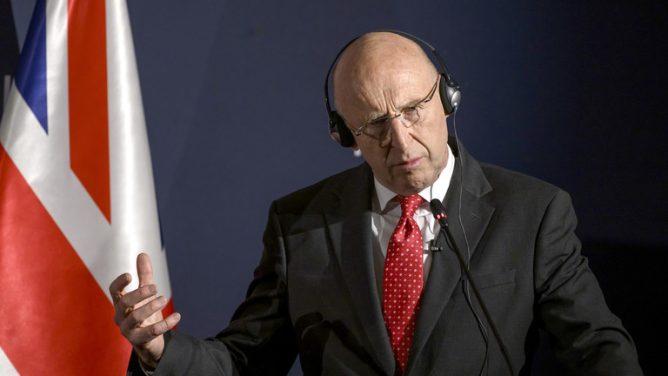
British Defense Secretary John Healey © Getty Images / Antonio Masiello
RT | May 29, 2025
London will significantly step up offensive cyber operations against Russia and China, UK Defense Secretary John Healey announced on Thursday following the inauguration of the country’s new Cyber and Electromagnetic Command.
In a statement quoted by The Times, Healey claimed that “the keyboard is now a weapon of war” and said the UK’s new cyber command would coordinate both defensive and offensive operations, including hacking into enemy systems to disrupt attacks and spread of propaganda.
Asked whether this would include Russia and China, Healey responded: “Yes.”
Healey’s statement marks the first time a British minister has explicitly confirmed cyberattacks on other states. While UK ministers had previously confirmed cyber operations against non-state actors like Islamic State, they have not until now acknowledged attacks against other countries.
Healey’s comments come ahead of the publication of a strategic defense review on Monday. According to The Times, the review will stress that cyberattacks on Britain, allegedly being carried out by Russia and China, are “threatening the foundations of the economy and daily life.”
Both Moscow and Beijing have consistently denied accusations of carrying out cyberattacks against Western nations, characterizing the claims as baseless and politically motivated.
Additionally, Russian officials have in recent months repeatedly raised concerns over what they describe as Western Europe’s continued militarization and aggressive anti-Russian rhetoric, said to be in response to the alleged threat posed by Moscow.
The Kremlin has vehemently denied having any hostile intent towards any western country, and has accused European politicians of “irresponsibly stoking fears” to justify increased military expenditures, which Moscow had labeled an “incitement of war on the European continent.”
Sanctions as Self-Harm: The West’s Strategic Blind Spot in Confronting Russia
By Ricardo Martins – New Eastern Outlook – May 28, 2025
This article critically analyzes the latest EU sanctions on Russia, arguing they are strategically flawed and economically self-destructive. Drawing from past failures, it shows how the West’s punitive measures are backfiring, hurting Europe and the U.S. more than isolating Russia.
What is the New Sanctions Package About?
The EU has unveiled a new sanction package targeting Russia, predominantly focusing on the energy sector, specifically oil and diesel exports. This builds upon earlier restrictions intended to cripple Russia’s economic capacity to sustain its military operations in Ukraine. The new sanctions include tighter enforcement mechanisms on the oil price cap, restrictions on ship-to-ship transfers in international waters, and efforts to curtail Russia’s access to Western insurance and logistics networks. But like the previous measures, they raise a fundamental question: Will they work?
The Status of Past Sanctions: Buying While Punishing
Historically, sanctions against Russia have been inconsistent and riddled with loopholes. Despite strong rhetoric, Europe has continued purchasing Russian commodities under various exemptions. The EU still imports significant quantities of Russian diesel, liquefied natural gas (LNG), coal, uranium, and even agricultural products like grain and fertilizer. The result is a paradox: while aiming to isolate Russia, the West remains economically entangled with it. This undermines the moral and strategic coherence of sanctions and allows Russia to adapt and thrive despite Western pressure.
Sanctions Hit Europe More Than Russia
While sanctions are theoretically aimed at weakening Russia’s economy, the practical consequences have disproportionately hit European industries and households. Russian exports are fungible: oil, coal, and fertilizers find alternate markets in Asia, Africa, and Latin America. Meanwhile, Europe has struggled with soaring energy prices, industrial shutdowns, and declining competitiveness. Diesel shortages, energy rationing, and inflation have become the new norm, particularly in Germany, which once depended heavily on Russian inputs for its industrial base.
Russia, by contrast, has localized production, developed new markets, and implemented mercantilist strategies to reduce dependence on Western technology and finance. As one Russian analyst put it, sanctions have become “psychological warfare,” increasingly irrelevant to daily life in Russia.
Oil and Diesel: The Inflation Time Bomb
The crux of the new sanctions is oil and diesel. But can the U.S. and EU afford to forgo Russian, Venezuelan, and Iranian crude without catastrophic inflation? The answer appears to be no.
Russia exports about 7.5 million barrels of oil per day, or nearly 10% of global supply. Taking that offline—especially in conjunction with sanctioned Venezuelan and Iranian oil—would create a massive global shortfall. Western refineries, particularly in the U.S. Gulf Coast, are calibrated to process heavy sour crude like Russia’s Urals blend. Without it, refineries operate suboptimally, and gasoline prices spike.
In the U.S., diesel drives nearly all logistics trucks, trains, and ships. Removing a major global supplier like Russia tightens global supply, causing diesel prices to surge and supply chains to buckle. Already, diesel refills for trucks cost over $2,000, with potential spikes threatening food prices and consumer goods. Inflation will soar again, just as it had started to cool.
Baltic Sea Escalation: Tankers and Arrests
The geopolitical tension is intensifying. Russian oil tankers, often flagged under third countries, are now escorted by Russian naval vessels in the Baltic Sea. An incident involving an Estonian ship attempting to halt a tanker, which ended up detained in Russian waters, demonstrates the volatility of the situation. This marks a dangerous escalation, with the potential for military clashes over enforcement of maritime sanctions—an area traditionally governed by international law, not unilateral action.
Western Industrial Decline: No Shipyards, No Leverage
Sanctions enforcement is further complicated by Western logistical decline. The U.S., Britain, and France have largely lost their shipbuilding industries. Insurance and shipping markets have globalized, and London no longer dominates maritime underwriting. Russian entities are increasingly self-insuring their fleet, rendering sanctions on Western insurers irrelevant.
Furthermore, without a domestic merchant marine, the U.S. relies on foreign ships even for military logistics—a vulnerability in any prolonged conflict. Meanwhile, China and Russia continue expanding their shipping capabilities and influence over global supply routes.
The Legal Quandary: Sanctions and Sovereignty
From a legal standpoint, unilateral sanctions that attempt to compel third-party countries to comply (so-called secondary sanctions) strain the legitimacy of the “rules-based international order.” It is lawful for the West to impose its own sanctions, but not to mandate their enforcement by sovereign nations like India or Brazil. Such overreach risks global backlash and accelerates moves toward de-dollarization and alternative trade systems, such as the BRICS currency initiative.
Is the EU Addicted to Sanctions?
The EU appears increasingly reliant on sanctions as a primary foreign policy tool. Yet, their efficacy is questionable. Past sanctions have not altered Russian behavior, destabilized its economy, or improved Western leverage. Instead, they’ve fostered economic nationalism in Russia, weakened EU industries, and exposed the strategic shallowness of Brussels and Washington’s policies.
Sanctions are not a strategy; they are a tactic. And overuse risks turning them from a deterrent into a diplomatic crutch—one that Europe may not survive intact if economic pain continues to mount.
Conclusion: A Strategy of Self-Harm
Sanctions as Self-Harm: The West’s Strategic Blind Spot in Confronting Russia
In sum, the latest sanctions package is more of the same: punitive in intent, performative in practice, and counterproductive in outcome. The West, particularly Europe, will likely bear the brunt of energy shortages, inflation, and industrial decline. Meanwhile, Russia’s diversified exports, strategic alliances with China and India, and robust internal adaptation mechanisms render sanctions increasingly futile.
History has shown that attempts to isolate Russia through economic pressure are not only ineffective—they risk reinforcing the very state structures they aim to dismantle. Unless sanctions are part of a broader diplomatic and economic strategy, they will continue to hurt the sanctioning powers more than their target.
Ricardo Martins ‒PhD in Sociology, specializing in policies, European and world politics and geopolitics
Russia could restrict return of Western brands – Izvestia
RT | May 27, 2025
The Russian parliament is set to pass a law that would regulate the right of foreign companies to reclaim assets sold during their exit from the country, Izvestia reported on Tuesday. The draft has reportedly been approved by the Finance Ministry and will be considered by the State Duma in its second and third readings simultaneously.
Numerous US, European, and Asian companies pulled out of Russia due to supply problems caused by unprecedented sanctions imposed on Moscow by the West after the escalation of the Ukraine conflict in 2022. Other firms left due to the risk of facing secondary sanctions or public relations pressure.
The bill, reviewed by Izvestia, allows Russian authorities or current owners to reject asset buybacks under certain conditions. Grounds for refusal include the foreign seller being from a country that has imposed sanctions on Russia, the repurchase price being below market value, or if more than two years have elapsed since the original deal with the Russian owner fulfilling obligations to employees and creditors.
The Russian authorities may also block asset buybacks if a company operates in sectors deemed vital to the country’s socio-economic stability, including defense or finance, the outlet said. In such cases, asset repurchase would require presidential approval.
According to Izvestia, the new measures will be voted on in June and could affect at least 18 foreign companies with buyback options, including Renault and McDonald’s. The draft law also reportedly stipulates that foreign businesses denied repurchase could be eligible for compensation, the amount of which would be determined by the government. However, if former owners failed to fulfill obligations before their exit, compensation could be reduced by court decision.
In March, Russian President Vladimir Putin ordered the government to draft regulations for Western firms seeking to return to the country’s market, which would prioritize the adequate protection of local businesses.
Following the exodus of foreign firms, the Russian market has largely adapted by promoting domestic and Chinese brands, making re-entry more challenging for Western companies. In sectors such as automotive and fashion, local alternatives have filled the void left by departing Western firms.
Putin said on Monday that foreign tech firms that continue operating in Russia while acting against the country should be “squeezed out.”
“They are trying to squeeze us, so we must respond in kind,” Putin said in response to a question about possible measures against companies such as Zoom and Microsoft. The president added that Russia had not expelled any companies and had instead created favorable conditions for their operations.
Iran draws red line as Europe threatens nuclear ‘snapback’
As indirect US–Iran nuclear talks inch forward, Europe’s fear of marginalization prompts a risky diplomatic maneuver in Istanbul.
By Vali Kaleji | The Cradle | May 26, 2025
In the backdrop of indirect nuclear negotiations between Tehran and Washington, Iranian Deputy Foreign Ministers Majid Takht-Ravanchi and Kazem Gharibabadi met with their European counterparts from France, Germany, and Britain – the so-called E3 of the Joint Comprehensive Plan of Action (JCPOA) – on 16 May in Istanbul.
The meeting, held at Iran’s Consulate General and hosted by Turkiye, brought together EU Deputy Secretary-General for Political Affairs Enrique Mora and his colleague Olof Skoog, alongside Turkish Deputy Foreign Minister Abdullah Celik. The discussions focused on the future of the 2015 nuclear agreement, the status of indirect Iran–US negotiations, and collective efforts to avert further escalation through diplomacy.
Although three earlier rounds of consultations between Tehran and the E3 occurred on 29 November 2024, 13 January, and 24 February 2025, the Istanbul session marked a pivotal moment: the first engagement since the revival of the Iran–US indirect dialogue.
Europe cut out of nuclear talks
Crucially, the EU, much like in the Ukraine peace process, found itself bypassed by Washington. This diplomatic exclusion has intensified Brussels’s urgency to reclaim relevance within the nuclear negotiations framework, apparently even if this means acting as spoiler.
At the heart of the Istanbul summit lies the snapback mechanism – an instrument embedded in the JCPOA allowing any signatory to reimpose all UN sanctions that existed before the 2015 agreement. The clause, originally intended as a safeguard, now threatens to become a geopolitical cudgel.
With the JCPOA’s expiration looming in October 2025, Tehran fears that the E3 may invoke the mechanism as early as this summer, citing Iran’s alleged enrichment beyond 60 percent and its growing stockpile of enriched uranium.
French Foreign Minister Jean-Noel Barrot minced no words during a 28 April address to the UN Security Council, stating that if European security interests are compromised, France “will not hesitate for a single second to reapply all the sanctions that were lifted 10 years ago.” His statement, which reverberated through diplomatic circles, was widely interpreted in Tehran as a stark ultimatum.
Iran’s permanent representative to the UN responded forcefully, accusing France of hypocrisy and warning that Paris’s own breaches of the agreement render any activation of the snapback legally indefensible.
Iranian Foreign Minister Abbas Araghchi echoed this stance in an op-ed for Le Point, characterizing the Istanbul discussions as “a fragile but promising beginning” while cautioning that “time is running out.” He wrote:
“The decisions we make now will shape Iran–Europe relations in ways that go far beyond this agreement. Iran is prepared to move forward – we hope Europe is, too.”
Following the talks, Gharibabadi wrote on X: “We exchanged views and discussed the latest state of play on nuclear & sanctions lifting indirect negotiations. Iran and the E3 are determined to sustain and make best use of diplomacy. We will meet again, as appropriate, to continue our dialogue.”
British envoy Christian Turner echoed this sentiment, affirming the shared commitment to maintaining open channels of communication.
‘Trigger Plus’
Yet not all assessments of the Istanbul summit were diplomatic. Tehran-based daily Farhikhtegan, aligned with Iran’s conservative establishment, described the session as tense and combative.
According to its report, the E3 tabled severe threats, including a proposal for what they termed “trigger plus” – an augmentation of the original snapback mechanism that would allow preemptive punitive measures without requiring technical justification.
Iranian officials, the newspaper reported, dismissed this demand as not only illegal and baseless but also presented in an “inappropriate” tone. The Iranian side reiterated that while they remain open to EU participation in broader nuclear negotiations, any activation of the snapback mechanism would trigger an immediate Iranian withdrawal from the Nuclear Non-Proliferation Treaty (NPT).
Mohammad Ghaderi, former editor-in-chief of Nour News – a media outlet close to Iran’s Supreme National Security Council – summarized the stance bluntly on social media:
“In the tense talks with Iran on Friday, [the E3] while requesting to participate in Iran–US talks, made non-technical & illegal requests, calling it trigger plus. But Iran’s response: Emphasizing the activation of the Trigger Mechanism will lead to Iran’s withdrawal from the NPT.”
The Iranian Foreign Ministry, in characteristic fashion, neither confirmed nor denied these reports, opting for strategic ambiguity to maintain leverage over multiple negotiation tracks.
The October deadline: Strategic implications
As the October 2025 expiration date draws closer, Iran has accelerated efforts to engage the remaining members of the 4+1 framework – China, Russia, France, Britain, and Germany. Trilateral meetings with Moscow and Beijing have underscored Tehran’s strategy of building a multilateral diplomatic buffer against US-European pressure.
However, the snapback clause remains the most potent lever in the E3’s arsenal. According to Article 36 of the JCPOA, any signatory can escalate a compliance dispute to the UN Security Council. Once initiated, this process does not require a vote or consensus, meaning that Russian and Chinese vetoes are nullified.
Should the snapback be triggered, all seven UN Security Council sanctions previously lifted would automatically be reinstated – a scenario with grave consequences for Iran’s economy and its broader regional strategy.
Analysts suggest the E3 may push for this mechanism’s activation as early as July or August, thereby maximizing diplomatic pressure while allowing time to shape global opinion. If that happens, Tehran’s recourse to NPT withdrawal – a threat repeatedly made since 2019 – would likely materialize.
Deputy Foreign Minister Kazem Gharibabadi reinforced this red line in response to a recent International Atomic Energy Agency (IAEA) resolution: “If Europe implements snapback, our answer is to withdraw from the NPT.” As Araghchi, writing again in Le Point, stated unequivocally:
“Iran has officially warned all JCPOA signatories that abuse of the snapback mechanism will lead to consequences – not only the end of Europe’s role in the agreement but also an escalation of tensions that could become irreversible.”
Europe’s desperation for relevance
Europe’s insistence on asserting itself in the JCPOA talks stems from its declining influence across global affairs. From the Ukraine war to the Persian Gulf, the EU has been reduced to a secondary actor. In the Iran file, this marginalization is especially stark.
While Washington and Tehran inch closer to a bilateral formula, Brussels finds itself largely ignored. Nosratollah Tajik, a former Iranian diplomat, argues:
“Europe’s main concern is that Iran and the United States will reach a bilateral agreement without considering European interests. Many of the Middle East [West Asian] crises spill over into Europe.”
The lack of a coordinated EU Iran policy only compounds this anxiety. Theo Nencini, an Iran expert at Sciences Po Grenoble and Paris Catholic University, concurs:
“The E3 countries have not yet managed to define a coherent and relevant ‘Iran policy.’ From Trump 1.0 to Biden, they have always been accustomed to flatly following American positions.”
Nencini believes that unexpected US–Iran direct talks caught Europeans off guard, prompting them to scramble to get involved in the negotiation process despite the fact that “they have always maintained a very strict attitude towards Iran.”
Diplomacy or detonation?
The Istanbul talks, despite their challenges, represent one of the few remaining diplomatic lifelines between Tehran and the E3.
Should these efforts collapse, the consequences would be profound: Iran could withdraw from the NPT, revise its nuclear doctrine, and prompt potential military escalation involving the US and Israel.
Such a scenario would spell the total disintegration of the JCPOA framework and shatter the fragile architecture of non-proliferation diplomacy built over the past two decades.
With less than five months to avert this trajectory, the onus lies on both parties to preserve what little remains of mutual trust. Yet the margin for error continues to shrink by the day.
West’s Long-Range Missiles to Ukraine All Essentially the Same & Russia’s Shooting Them Down
By Svetlana Ekimenko – Sputnik – 26.05.2025
Germany, the UK, France, and the US have removed range restrictions on weapons for Ukraine, Chancellor Friedrich Merz confirmed on May 26.
Whether it’s the Taurus, Storm Shadow, or SCALP, Russia will just keep knocking them out of the sky, Yevgeny Buzhinsky, Chairman of PIR-Center Think Tank Executive Board, Professor of Higher School of Economics who served as the Russian military’s top arms control negotiator from 2001 to 2009, told Sputnik.
The real issue with Germany’s Taurus missile isn’t its 500 km range, but rather what Merz rightly pointed out -without the Bundeswehr, Ukrainians can’t launch them, pointed out the pundit, adding:
“Which makes this a case of direct German involvement [in the Ukraine conflict], plain and simple.”
Germany, the UK, France and the US are no longer imposing restrictions on how far Ukraine can strike with Western-supplied weapons, German Chancellor Friedrich Merz revealed on May 26.
“There are no longer any range restrictions on weapons supplied to Ukraine — not by the British, not by the French, not by us, not by the Americans. This means that Ukraine can now defend itself, including, for example, by striking military positions on Russian territory. Until a certain point, it could not do this,” Merz said in an interview with the WDR TV channel.
Russia’s Foreign Ministry Spokeswoman Maria Zakharova warned that any Taurus missile strike on Russian targets will be seen as Germany entering the war on the side of the Zelensky regime.
Moscow maintains that Western arms deliveries only escalate the conflict and drag NATO deeper into the quagmire.
How Russia Quietly Revolutionised Warfare
By Kit Klarenberg | Global Delinquents | May 25, 2025
On May 23rd, The Times published an extraordinarily candid probe into how militarised drones have irrevocably revolutionised warfare in the 21st century, with Russia far at the forefront of this radical shakeup of how conflicts are waged. Meanwhile, there is little indication NATO members even vaguely comprehend this battlefield reality, let alone a single one of them is undertaking any serious measures whatsoever to prepare for conflict such as that currently unfolding and evolving daily throughout Ukraine’s eastern steppe.
The Times piece is a first-person report of a visit to the assorted headquarters of Kiev’s 93rd Mechanised Brigade, in basements of abandoned buildings and homes throughout the Donetsk city of Kostiantynivka. It’s a devastating picture of the realities of war in the era of drones, which has “[altered] the physical make-up of the front line, the tactics of the war and the psychology of the soldiers fighting it,” while “having a devastating impact on Ukraine’s logistical ability.”
At one stage, The Times reporter was warned they were standing nine kilometres – 5.5 miles – from the nearest Russian position, and thus “well inside the kill range.” A Ukrainian soldier told them with a shrug, this was “now an easy range in which to die”:
“No other weapon type has changed the face of the war here so much or so fast as the FPV drone. Almost any vehicle within five kilometres of the front is as good as finished. Anything moving out to ten kilometres is in danger. Drone strikes at 15 or 20 km are not that unusual.”
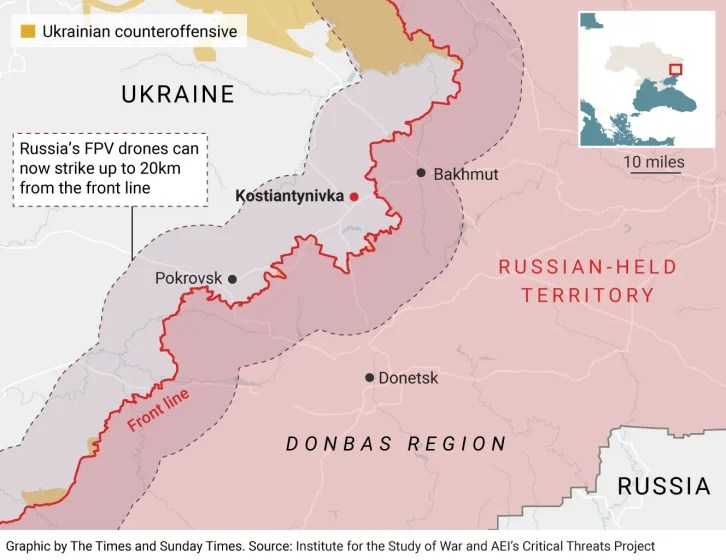
Since the proxy war erupted, both Ukraine and Russia have innovated in the field of FPV drones to an unprecedented degree. Kiev has become so reliant on drones, they are her “weapon of choice.” Yet, as The Times records, Russia has now decisively “taken the lead in the drone race, outproducing Kyiv in the manufacture and use of medium-range FPV drones and fibre optic variants that have changed the shape of the entire 1,200 km front line.”
Not only are FPVs “dramatically” striking ever-deeper into Ukrainian territory, but fibre optic FPV drones have gained “dark prominence over the killing fields.” While emulating the quadcopters equipped with munitions typically deployed by both sides previously, this “highly manoeuvrable killer drone” is connected directly to pilots by “a gossamer thin fibre optic thread.” This makes the contraptions difficult to track, and impervious to electronic jamming. A local infantry battalion commander told The Times:
“The changes posed by drones are so fast that concepts we implemented just a month ago no longer work now. We live in a space of perpetual fast adaptation. In the past week alone, Russian drone strike ranges have increased by four kilometres.”
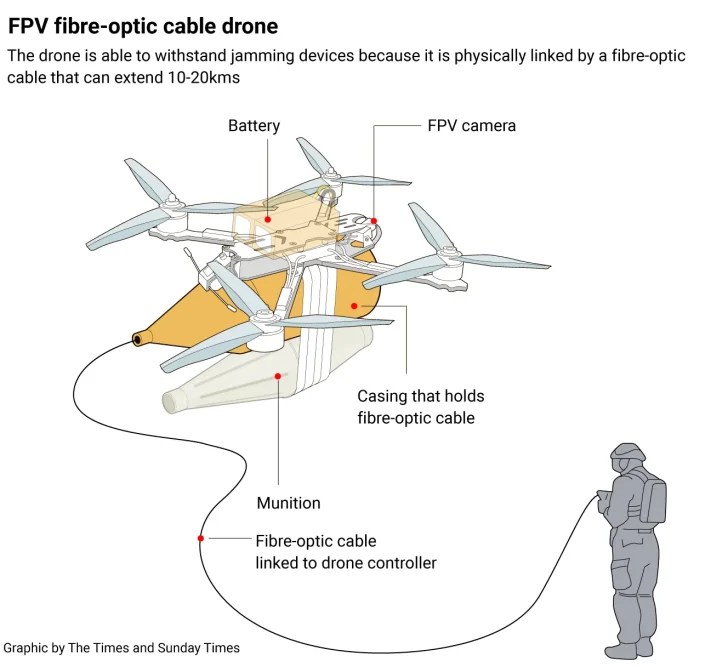
These developments have sent Ukrainian forces scurrying en masse to regroup at regular, abrupt intervals ever-further away from the front line (also known as “zero point”), while logistical convoys to Kramatorsk – “long considered the bastion of Ukraine’s defence of the Donbas region” – have been repeatedly struck. One lieutenant recorded how Russian drones “swarm our armoured vehicles whenever they get near the zero point,” obliterating them and their crews. He believes drones represent such a world-changing military hazard, “the days of the tank are truly over.”
‘Danger Estimate’
The “drone-filled skies” of Donbass are so deadly, getting soldiers and equipment to the ever-expanding frontline and back is not only a logistical and practical horror, but also a frequently suicidal task. The Times reports that until late 2023, Ukrainian infantrymen “were usually carried to a position near the front in armoured personnel carriers, walking the last few hundred metres on foot.” Today, they are dropped off up to eight kilometres away at night, walking “meandering routes through trees to avoid detection, just to take up their positions.”
Rotations from the frontline have also vastly extended in length. While at the start of 2024 Ukrainian soldiers spent “a week or two” at zero point, now they’re routinely trapped there for months at a time, “often devoid of almost any other human contact, resupplied with water, rations and ammunition by agricultural drones.” Resultantly too, “casualty evacuation has become a nightmare.” Wounded fighters are “commonly” rescued at night, and “even then the operation is fraught.” A senior logistician for the 93rd Brigade’s drone crews lamented:
“As a word ‘stressful’ doesn’t even come close to describing it. Every mission I think, ‘God forbid we get a casualty and have to work out how to get them back’.”
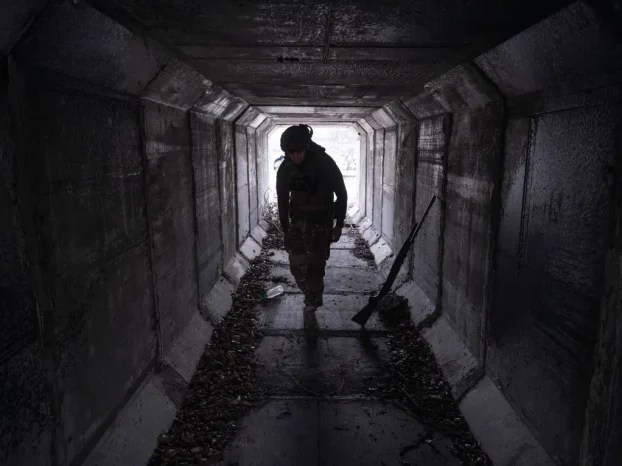
Ukrainian soldiers always keep shotguns close, to attempt to blast attacking drones out of the sky
Each night too, the Brigade’s frontline drone crews are resupplied with batteries, drone frames and munitions. Logistics teams are dropped off up to seven kilometres from the frontline, then carry up to 36 kilograms of equipment forward on foot. The risk to these crews is “enormous”. One driver was quoted as saying he conducted three missions nightly, “and I never know if each one will be my last, if I’m going to make it there and back in one piece.”
The Times records how a logistics vehicle was recently struck by a Russian drone while returning from a resupply mission. The driver lost an arm, but there were so many drones buzzing nearby, he couldn’t be evacuated from the position for five hours, so bled to death. Five Ukrainian armoured vehicles were destroyed by drones in the same sector the next day. However, none of this is seeping out to the world via the mainstream media, which once published videos of Ukrainian strikes on Russia daily.
As The Times notes, drones have adversely affected a core component of Kiev’s war effort – “media communications”. The 93rd Brigade was once “renowned for allowing reporters good access to…the war from the front.” Now though, “access for journalists has been dramatically reduced,” with “many media organisations…reluctant to commit reporters into areas within 15 km of the front.” Ukrainian brigades are likewise “wary” of the risks “they expose their own troops to in taking journalists by vehicle to the front.”
The Times reports that in 2023, the 93rd Brigade’s press officer “organised hundreds of visits to the front by reporters.” The number of visitors has now “dwindled to a trickle”. Since the proxy war’s eruption, the psychological field of battle has been where Ukraine has performed most effectively, eagerly assisted in its propaganda efforts by a media apparatus reflexively reporting the fantastical claims of officials in Kiev and their Western proxy backers as fact. Now, those days are long over. The press officer complained:
“The risks get bigger and bigger, and the coverage gets less and less. We get a journalist’s request to go to the front now and we wonder how rational is it? What is the danger estimate? What is the benefit?”
‘Technological Adaptations’
The Times report is a vanishingly rare mainstream acknowledgement of how the conflict currently raging Donbass is a war unlike any other in history, and its key spheres of battle are wholly unfamiliar to Western militaries. Despite this media omertà, the proxy conflict’s unparalleled operating environment, and obvious lessons, have not gone entirely unheeded in certain elite quarters. Nonetheless, despite alarm bells ringing accordingly, they are clearly falling on deaf ears in American and European centres of power.
In September 2024, Britain’s House of Lords International Relations and Defence Committee published a bombshell report, Ukraine: a wake-up call. It found the proxy war had “exposed fundamental weaknesses” in the “military strength” of both Britain and NATO, concluding London was effectively defenceless, with its “small” military reliant on unaffordable “status symbols” such as non-functional aircraft carriers. The country lacks the ammunition, armour, equipment, industrial capacity, personnel and vehicles to withstand a Donbass-style conflict for more than a few weeks at absolute most.
Amidst relentless condemnation of the state of Britain’s armed forces, the report contained a dedicated section on how “the use of drones in Ukraine” had “exposed the sheer variety of possible drone threats in a conflict scenario, ranging from disposable and commercially available drones to high-end, sophisticated ones.” It noted the development has “inserted an extra layer of weaponry between the land and air domains” and augmented “existing capabilities that both sides have, particularly offering new defensive options in the absence of air superiority.”
As such, the House of Lords Committee called for London to “invest in research and development to maintain a strategic edge in drone technology (including amphibious drones), and support the rapid development of new technologies that can compete in contested environments.” It urged decisionmakers to constantly consider and monitor “the pace of technological adaptations on and off the battlefield,” and the Ministry of Defence “to support continuous adaptation,” such as “[incorporating] learning on the use of drones in Ukraine across all domains.”
The report went entirely unremarked upon by the media contemporaneously, and today there is no sign of its multiple urgent calls to action having produced any meaningful results in any tangible regard in Britain’s armed forces. Similarly, despite NATO officials warning the alliance is wholly dependent on US electronic warfare capabilities, which in any event are woefully inferior to Russia’s own, public indications of Western leaders or militaries taking the drone warfare revolution seriously are unforthcoming. Should they end up in direct conflict with Russia, they’ll be in for quite a shock.
Featured Video

Deception – Submarines against Olof Palme
or go to
Aletho News Archives – Video-Images
From the Archives
Woolsey Fire started at Santa Susana Field Lab — where “radioactive materials released were never accurately measured”
By John Laforge | CounterPunch | November 30, 2018
In my Nov. 16 column, I reported on potential radiation risks posed by California’s Woolsey wildfire having burned over parts or all of the Santa Susana Field Laboratory—south of Simi Valley, Calif., 30 miles outside Los Angeles—site of at least four partial or total nuclear reactor meltdowns.
The field laboratory operated 10 experimental reactors and conducted rocket engine tests. In his 2014 book Atomic Accidents, researcher James Mahaffey writes, “The cores in four experimental reactors on site … melted.” Reactor core melts always result in the release of large amounts of radioactive gases and particles. Clean up of the deeply contaminated site has not been conducted in spite of a 2010 agreement.
Los Angeles’s KABC-7 TV reported Nov. 13 that the Santa Susana lab site “appears to be the origin of the Woolsey Fire” which has torched over 96,000 acres. Southern Calif. Public Radio said, “According to Cal Fire, the Woolsey Fire started on the afternoon of Thursday, Nov. 8 … on the Santa Susana site.” … continue
Blog Roll
 Aletho News
- Dr. Abu-Sitta: Beirut ‘felt like a day in Shifa Hospital’
- Iran Has Won the War, It Will Be Up to the US to Secure the Peace: Mohammad Marandi
- Iran condemns assassination threats against Iranian negotiators amid US talks
- Brussels cannot say where its own pipeline inspectors are as Hungary’s oil lifeline remains shut
- Israel’s Iran War: Myth and Reality
- Between war and industrial breakdown: The US-Israeli attrition crisis
- Pressure builds on Iran to ‘drop’ Lebanon ceasefire demand as Islamabad talks hang in balance
- In another clash report, US denies agreement to release Iran’s assets
- What is fueling unrest across the EU?
- Why no power can undermine Iran’s eternal dominance over the Strait of Hormuz
- If Americans Knew
- Mearsheimer reveals how Israel dictates US policies on Iran, Gaza – video
- After killing 350+, Israel still has a “score to settle” with Lebanon before ceasefire – Daily Update
- Military aid to Israel emerges as the latest political litmus test for Democrats
- The only Palestinian children’s rights organization closes following years-long Israeli campaign against it
- ‘I Can’t Forget the Smell’: Lebanese Reel After Israel Kills Over 300 in Single Day
- DNC Shoots Down Resolutions Calling Out AIPAC and Limiting Arms to Israel
- TCN: Is Israel Blackmailing President Trump?
- Israel killed at least 303 Lebanese yesterday – who were they? Daily Update
- Amnesty: Urgent – Protect Lebanese civilians from brutal escalation in Israeli attacks
- Is The War Against Iran Over?
- No Tricks Zone
- German Expert: Heat Dome Led To Record Temps In Western USA…Warmer In 1934, 1936
- New Study: No Linear Warming Or Glacier Retreat Along Northern Antarctic Peninsula Since 1980s
- An Inconvenient Tree: Uncovered In Alps… Europe Much Warmer Than Today 6000 Years Ago
- New Study Reports A 60% Slowdown In Greenland’s Ice Loss Rate In The Last Decade
- Low Intensity Tornado Wrecks Major Solar Farm, Creating A Potential Toxic Dump
- New Study Finds Warming Saves Lives…Cold Temperatures 12 Times More Deadly Than Excess Heat
- German Science Blog Accuses PIK Climate Institute Of Hallucinating Climate Tipping Points
- Devastating Assessment Of Comirnaty Vaccine By Former Senior Pfizer Europe Toxicologist
- New Study: CO2 Is ‘Effectively Negligible’ As An Explanatory Climate Change Factor Since 2000
- Former Pfizer Toxicologist Dr. Helmut Sterz Tells Bundestag Hearing Pfizer Vaccine Should Have Never Been Approved
 Aletho News