BBC’s Laura Kuenssberg ‘misreported’ Corbyn story… but no evidence of bias, says Trust
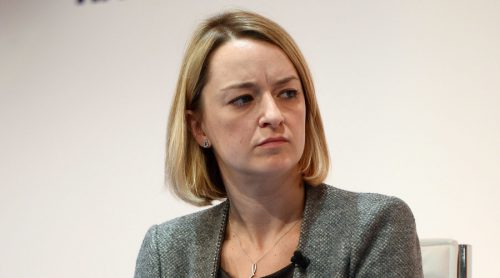
Laura Kuenssberg © ZUMAPRESS.com / Global Look Press
RT | January 18, 2017
Award winning BBC political editor Laura Kuenssberg has been reprimanded by the BBC Trust for inaccurately reporting Labour leader Jeremy Corbyn’s views on shoot-to-kill policies in the aftermath of the Paris attacks.
The Trust concluded that Kuenssberg breached the BBC’s impartiality and accuracy guidelines at a time of “extreme national concern,” but insisted there was no evidence of bias or of intent on the part of the journalist.
The report was broadcast for the News at Six in November 2015, shortly after terrorists attacked the Bataclan and other sites in Paris.
The news package included a clip of Corbyn saying: “I am not happy with a shoot-to-kill policy in general. I think that is quite dangerous and I think can often be counterproductive. I think you have to have security that prevents people firing off weapons where you can.”
Kuenssberg had presented Corbyn’s response as an answer to a question on whether he would be “happy for British officers to pull the trigger in the event of a Paris-style attack.”
However the BBC Trust concluded Corbyn had been responding to a question asking whether he would be happy to order police or military “to shoot to kill” on Britain’s streets – and not specifically in response to a Paris-style attack.
A viewer complained to the Trust about the broadcast after four separate complaints were rejected by the BBC.
The Trust found the inaccuracy was “compounded” when Kuenssberg went on to state that Corbyn’s message “couldn’t be more different” to that of then-prime minister David Cameron.
In its report, the Trust concluded the inaccuracy was particularly important when dealing “with a critical question at a time of extreme national concern.”
“According to this high standard, the report had not been duly accurate in how it framed the extract it used from Mr Corbyn’s interview.”
BBC News director, James Harding, rejected the Trust’s ruling and defended Kuenssberg as “an outstanding journalist and political editor with the utmost integrity and professionalism.”
He said: “While we respect the Trust and the people who work there, we disagree with this finding.”
Thousands of Corbyn supporters launched a campaign last May against Kuenssberg’s perceived bias against the Labour leader.
Some 35,000 people signed a petition calling for the journalist to be sacked.
The reporter was named Broadcaster of the Year by the Political Studies Association last November and Journalist of the Year by Press Gazette last December.
‘Trump: Kremlin Candidate?’: BBC doc becomes MSM manual to ‘verified’ journalism
RT | January 17, 2017
The BBC’s flagship current affairs programme has aired an edition on the alleged financial ties between U.S. President-elect Donald Trump and Vladimir Putin. It also reports on whether Russia played a key role in Trump’s election success. Making its assumptions very clear, the BBC called the programme ‘The ‘Kremlin Candidate’. RT’s Ilya Petrenko explains how pulling-in the viewers often means rolling with the rumours.
Trump’s Remaking of US Foreign Policy
By Gilbert Doctorow | Consortium News | January 16, 2017
Over the weekend, President-elect Trump received two journalists from mainstream European print media — The Times of London and the German magazine Bild — for a joint interview in New York City’s Trump Tower. The event was videotaped and we are seeing some remarkable sound bites, particularly those of interest to the British and German publics.
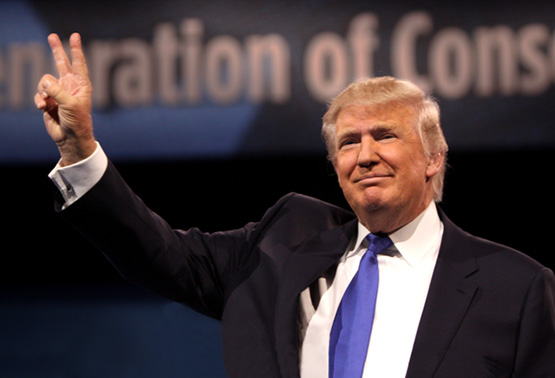
President-elect Donald J. Trump donaldjtrump.com
For the government of British Prime Minister Theresa May, nothing could have sounded sweeter than Donald Trump’s statement that she would be invited for talks in the White House shortly after he is sworn in on Jan. 20 and that he seeks very quickly to reach agreement on a bilateral free trade pact. The effect of the pledge itself, even ahead of its successful implementation, assures the British that the sting of severing ties with the European Union will be greatly offset by new commercial possibilities in the world’s biggest economy; in this way, it strengthens May’s hand enormously as she enters into talks with the E.U. leadership over the detailed terms of what will apparently be a “Hard Brexit.”
Further adding to her leverage with the E.U. were Trump’s remarks suggesting that the E.U. will face stern trade pressure, beginning with Germany and its automobile industry, to do more to manufacture in the U.S. That precisely raises the relative importance of the U.K. market, which the E.U. will otherwise lose if it imposes severe penalties on Britain in negotiations over Brexit.
For the general public’s consumption, Donald Trump used the interview to explain his special affection for Britain, speaking about his Scottish mother’s delight in the Queen and her watching every royal event on television for its unequaled pageantry. But we may expect that Prime Minister May will find there is a bill to pay for the “special relationship” with the U.S. under President Trump.
Rather than the British media’s early speculation that Prime Minister May would be the one to set the misguided Trump straight about the nefarious Vladimir Putin, she may now have to become a leading European advocate for détente with Russia at Trump’s behest. In this connection, British Foreign Minister Boris Johnson’s advice to Congress during his visit to Washington last week that Official Washington “stop demonizing Putin” may well have been a straw in the wind.
For the Germans, Trump also offered a bit of flattery, saying how much he respected their Chancellor Angela Merkel. However, as he went on, he virtually flattened the Iron Lady’s reputation by calling her open-door policy of admitting migrants into Germany and the E.U. a catastrophe. He noted that Merkel’s controversial position had swayed the election results in Britain on Brexit and may lead to the departure of other countries from the E.U. Given his staff’s consultation with Marine Le Pen, a visiting French candidate for the presidency from the right-wing Front National, Trump’s list surely includes France.
Finally, among the sound bites that will be featured in media coverage of the interview, we hear Donald Trump describe NATO as an outdated organization that needs overhaul. However, apart from his reiterated insistence that Member States must pay their fair share, which he claims only Britain and four others from the 28 Member States are currently doing, the interview offers no specifics on what kind structural change, if any, he seeks for NATO. We only hear that NATO has not been prepared to deal with the threat of international terrorism.
Views on Russia
But it was in another area, Trump’s remarks on Russia and the terms he named for possibly lifting sanctions, that we find convincing proof that the President-elect’s approach to foreign affairs is not just the sum of isolated tactical considerations but a complete reinvention of the guiding principles of U.S. foreign policy. What we are witnessing is a shift to a new strategic, geopolitical paradigm.
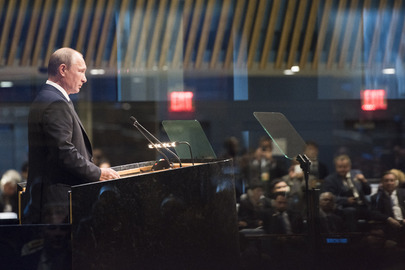
Russian President Vladimir Putin (UN Photo)
In the past couple of decades, going back to the second term of President Bill Clinton, the ideology of neoconservatism with its stress on “democracy promotion” as being the whole of national interest, dictated policy decisions that amounted to the tail wagging the dog. The Baltic States were admitted into NATO in its 2004 enlargement because they wanted it. The decision to station U.S., German and other NATO brigades in Poland and other states along the Russian border taken last July in Warsaw and implemented, in the case of Poland, by U.S. forces in the past several days, was justified by the anxiety of these countries over the possibility of Russian aggression, even though NATO’s action has been highly provocative vis-à-vis Russia and brought the major nuclear powers ever closer to direct confrontation.
In the interview, Trump changed entirely the metrics by which sanctions on Russia would be lifted. Instead of fulfillment of the Minsk Accords over Ukraine’s ethnic Russian Donbas region – which nationalist hardliners in Kiev had the power to block – Trump conditioned the relaxation of sanctions on progress in curbing the nuclear arms race and moving toward significant nuclear disarmament, issues that are fully within the power of the Kremlin to implement.
To be sure, these issues today are more complex than they were in the heyday of disarmament talks. The recent obstacles include the U.S. anti-ballistic missile installations in Poland and Romania, the forward stationing of NATO human and materiel resources in the former Warsaw Pact countries, and the standing invitations to Ukraine and Georgia to enter NATO. So any negotiations between Washington and Moscow will be very complex.
But Trump’s statement shows that he is focused on the big picture, on the triangular relationship between Washington, Moscow and Beijing that he believes to be of vital importance in keeping the peace globally, rather than on some amorphous reliance on expanding democracy globally on the unproven assumption that democracies among themselves are peace-loving.
These elements in Donald Trump’s thinking, quite unexpected in a businessman, bring him very close to the Realism of Richard Nixon and Henry Kissinger, while his setting nuclear disarmament as a key goal, aligns him with Ronald Reagan and — strange to say — with Barack Obama at the very start of his presidency.
If Donald Trump can stave off the jackals from the Western mainstream media and the U.S. foreign policy establishment – a combination that has formed a snarling circle around him even before he takes office – he may have a chance to make historic changes in international relations toward a more peaceful world.
Gilbert Doctorow is the European Coordinator of The American Committee for East West Accord Ltd. His latest book, Does Russia Have a Future? was published in August 2015.
‘Russophobic hysteria now backed up by massive US troop movements in Europe’
RT | January 16, 2017
We live in dangerous times, where the behavior espoused by Obama and Clinton has been extremely dangerous, says former British ambassador to Uzbekistan Craig Murray.
Russian hackers have found themselves at the center of yet another controversy, thus helping to fuel the latest round Russophobia.
A Russian-language version of a new, highly-anticipated episode of Sherlock was leaked online before its first official airing, leading to all sorts of conspiracies.
The BBC, which owns the rights to show Sherlock, says it will carry out a full investigation of the incident.
RT: What do you think of the claim that Russia keeps a dossier on key British MPs?
Craig Murray: It seems to me unlikely. Of course there are spies – all countries more or less have spies. Russia has spies, America has spies, Britain has spies. I suppose these people have to do something to justify their salaries and the enormous cost of their organization. There is a certain amount of nonsense that goes on. But I really don’t think that Russia spends a great deal of its time keeping dossiers on British politicians with incriminating photographs and that sort of thing. I think it is a very 1950’s idea.
RT: Like in the hacking scandal, no real evidence has been put forward. Is it now acceptable to just forget about evidence?
CM: It seems quite remarkable the number of claims that we’ve seen. The so-called hacking scandal, then the wider claims from that absolutely unbelievable dossier apparently compiled by Christopher Steele about meetings where people can prove they were nowhere near the meeting; about people being sacked who weren’t sacked, and all kinds of absolutely fact-free nonsense, which the media then claims as unverifiable.
Actually, it was very verifiable – you could easily verify it wasn’t true. And now we have this stuff. I think anti-Russian stories using a secret source are going to be with us for some time. You’ve got to remember that the military and the security services have to justify their enormous budgets, and that is what this is all about.
RT: Is the worst of the hacking hysteria over now, do you think?
CM: Well, this is going to have to calm down though now, because eventually people will have to admit there is no evidence on this whatsoever, and in fact it didn’t happen. But the lack of evidence seems no barrier at all to the hysteria continuing. This sort of wave of Russophobic hysteria is something which we experienced once or twice during the Cold War at this kind of level, which I really believed the world had got over. And it is extremely sad to see it coming again when that is backed up by massive troop movements and tanks wheeling around, churning up fields all over the Europe. We live in dangerous times, where the behavior espoused by Obama and Clinton has been extremely dangerous.
Why Did the Al-Jazeera Expose Fail?
By Gilad Atzmon – January 14, 2017
“The Lobby”, the Al-Jazeerah expose of the Israeli Embassy and the Jewish Lobby infiltration into British politics is a landmark in journalism. It seems that Qatari TV outsmarted Israeli intelligence in the UK and beyond.
In the program, an undercover journalist named ‘Robin’ managed to infiltrate into the corridors of the Jewish lobby in Britain, secured the trust of a senior Israeli intelligence officer and, most importantly, managed to reveal the depths of Israeli interference in British politics.
We learned how Israel and its lobby plot against Britain and the Brits. In the program, Shai Masot, an Israeli official was caught on camera conspiring to “bring down” a British minister.
We learned how our own treacherous MPs shamelessly serve a foreign power and foreign interests. In Episode 3 we witness British politicians and Israeli lobbyists such as MP Joan Ryan caught on camera smearing a Labour voter as an ‘anti-Semite’, and practically conspiring against her own party. Ms Ryan does it all for the Jewish state, a state with a horrid record on human rights and war crimes. I wonder what is it that motivates MP Ryan? Is it greed, or is it just power seeking?
The Brits should certainly ask themselves how come it is left to a Qatari TV network to reveal the shocking news about their democracy being taken over by a foreign Lobby. Should this not be the concern for the BBC or the Guardian? And even after the Al-Jazeera expose, the British media remained silent and the question must be asked: would it have stayed as silent had Shai Masot been a Russian? Would it have stayed as silent if MP Joan Ryan was exposed as an Iranian lobbyist?
But Al-Jazeera fell into an all-too-common trap. Troubled by its own findings, it tried to soften them with the usual politically correct fluff. Instead of concentrating on the British aspect of this saga and allowing the Brits to speak for themselves, Al-Jazeera allowed an Israeli – academic Ilan Pappe to speak for us. Similarly, Jackie Walker, certainly a victim of the Israeli campaign was also asked, “as a Jew” (as well as a Black person), to spell out for us her own identitarian philosophy. All other commentators on the Israeli espionage operation came from recognised Palestinian solidarity perspectives. Despite the fact that the dirty dealings of the Israeli Embassy and the treason of members of the Israeli lobby groups in Britain is a clear offence against British sovereignty and the British people, only one Brit, journalist Peter Oborne, addressed the offence from a clear British perspective.
This is wrong. “The Lobby” exposed, above all, a gross interference with British sovereignty, a crude intrusion into the British democratic process and government. Al-Jazeera failed because it turned this British national tragedy into an internal Jewish dispute.
For obvious reasons, Al Jazeera chose not to delve into the deep, cultural meaning of the Israeli operation. Israel is, above all, the Jewish state and, as I have mentioned many times before, plotting against other people’s regimes is deeply embedded in Judaic teaching and Jewish culture. It is in practice the message of The Book of Esther, which teach the Jews how toconspire against their rulers and, by proxy, to win over their enemies. You can read The Book Of Esther for yourselves (it’s pretty short and very entertaining): http://www.jewishvirtuallibrary.org/jsource/Bible/Esther.html
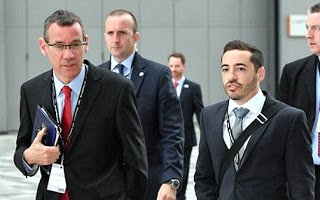
Shai Masot was no junior embassy employee as claimed. He was a senior intelligence officer operating from the safety and immunity of its embassy on behalf of the Jewish state. He was working alongside Israeli Ambassador Mark Regev and the two are seen together in the film, sitting side by side, addressing various Jewish lobby groups. Shai Masot has been recalled and, I understand, is currently seeking other employment. Mark Regev should now be expelled and the matter must be investigated by MI5.
Dossiers, Make Believe and Fantasy
The CIA, Trump and Unverified News
By Binoy Kampmark | Dissident Voice | January 13, 2017
London — Morning breakfast news on the BBC’s Radio Four on Friday was a delightful affair filled with discussions on Russia (when do we not talk about that busy, stirring Bear these days?), Donald Trump, dossiers and the intelligence fraternity. Did it even matter that various sources have been unverified, subject matter lumped together in cumbersome conversations on fake news, sexual frolics and the like?
Discussants on the Beeb who kept listeners company over coffee included former, recently confessed spook Frederick Forsyth, for years the go-to creator of the spy narrative, and the official intelligence historian Sir Christopher Andrew.
For Forsyth, the allegations outlined by former British spy Christopher Steele that Trump found himself in prancing company with Russian hookers, dubious real estate deals targeted as bribes and a treasonous coordination with the Russian intelligence services to defeat Hillary Clinton, beggared belief. Trump was hardly that much of a buffoon, surely.
On Wednesday night, the US director of national intelligence, James R. Clapper Jr., issued a statement in the aftermath of a conversation with Trump on the Steele dossier, suggesting that the agencies had “not made any judgment that the information in this document is reliable.” Naturally, despite any claims about authenticity, the report had been circulated within the deepest recesses of spook central. Clapper would never want to deny his own officials the pleasure of that smut.
The New York Times conceded that much of the story remained “out of reach – most critically the basis question of how much, if anything, in the dossier is true.” You would think that this point was most salient, rendering any other discussion empty and flatulent.
Nonetheless, the paper would go on to assert that it was “possible to piece together a rough narrative of what led to the current crisis, including lingering questions about the ties binding Mr. Trump and his team to Russia.”
With the US presidential inauguration fast approaching, the press jackals have been swarming. The tid bits offered by the Steele report are themselves shrouded, stemming from September 2015 when an anti-Trump Republican donor (naturally, we do not know the name) commissioned Fusion GPS, a Washington-based research firm stacked by former journalists turned information hit-men, to do some digging. The mission was simple: find as much debilitating dirt as possible and sink the Trump ship.
Steele, considered at one point one of Britain’s foremost Russian experts within MI6, was considered ideal for the job of funneling information to Glenn Simpson at Fusion GPS. The themes of those memos were stock standard: the old compromising (kompromat) material, with sex being central; and the hacking of the Democratic National Committee with discussion by Trump officials with Russian entities.
Trump has not done himself any favours, preferring to throw meagre carrion at the press corps, and hope that it miraculously dissipates. His polemical advisors would have been best served to tell him to shut it. News is not interesting. Allegations have become the gold dust of political debate.
This latest battle of spite and indignation reveals that internally, there is a war between claims and institutions within the United States. The intelligence community finds itself unsheathing its weapons. Trump has duly responded.
The point being missed here is the possibility that the servants of the elected commander-in-chief may actually be subverting the Republic, for all Trump’s sullen, and childish authoritarianism. Sources garnered from the very foundry of deception have assumed an aura of reliability. The argument about fake news has been turned inside out.
While care should be taken in packaging the entire US intelligence community into a neat box of anti-Trump enthusiasts, a good number of former officials were very keen that Hillary Clinton take over the reins in the White House. Views were expressed throughout the election cycle: Trump had to be defeated at all costs.
Once it became clear that Trump was gaining electoral momentum at nerve racking pace, it was important to side with the Clinton electoral team on a revived Cold War mantra: the Russians were doing terrible things, with Trump operating in the shadow of Russian President Vladimir Putin.
For former CIA and NSA director under George W. Bush, Gen. Michael Hayden, Trump was “the useful fool, some naïf, manipulated by Moscow, secretly held in contempt, but whose blind support is happily accepted and exploited.”
Former CIA Director Michael J. Morell also took a step that can only be regarded as singular and institutionally troubling: coming out from the shadows to pick his preferred candidate while denigrating another.
In August, he bored readers with his resume in an opinion piece for the New York Times. (“In my 40 years of voting, I have pulled the lever for candidates of both parties.”) He expressed a solemn view that Trump was “not only unqualified for the job, but he may well pose a threat to our national security.” Russia’s Putin “had recruited Mr. Trump as an unwitting agent of the Russian Federation.”
The Fourth Estate used to be the solemn interrogating power of the parliamentary galleries. Being unelected, it was given, as an accident of history, a certain influence. Like all power, it can be misdirected, even ill-informed. The questioners can become vessels and conduits.
Over time, that same estate has withered, becoming a faint echo of investigation and fact checking. Even in notionally democratic states, it can be co-opted. As Glenn Greenwald has argued, the most useful tool of the deep state has been the US media, “much of which reflexively reveres, serves, believes, and sides with hidden intelligence officials.”
Leakers are punished; facts are not cross-checked. The hack now floats in an ether of speculation, fed by the unverifiable, and pampered by the intelligence official. The battles now seemingly are not over narratives of veracity but narratives of invention. Power, it would seem, to the creative in this new Republic of trouble that is the United States.
Binoy Kampmark was a Commonwealth Scholar at Selwyn College, Cambridge. He lectures at RMIT University, Melbourne and can be reached at: bkampmark@gmail.com.
The Lobby P2: The Training Session
January 11, 2017
In part two of The Lobby, our undercover reporter joins a delegation from the Israeli Embassy at last year’s Labour Party Conference. The programme reveals how accusations of anti-Semitism were made against key Labour Party members – and how a former official at the Israeli Embassy was upset when her background was revealed.
The Matter Is Closed — But Would It Be Closed If The Country Involved Wasn’t Israel?
By Brian CLOUGHLEY | Strategic Culture Foundation | 13.01.2017
The Al Jazeera television channel has revealed an Israeli plan to destroy the careers of senior British government figures because they have been critical of Israel. Shai Masot, a senior official in the Israeli embassy in London, was recorded by an Al Jazeera undercover reporter in conversation in a London restaurant with Ms Maria Strizzolo, formerly chief of staff to the British government’s ‘minister of state for skills’, Robert Halfon, the past political director of the Conservative Friends of Israel, who has a colourful history.

Shai Masot (right, with the Israeli Ambassador at the British Labour Party Conference in 2016)
In one of the exchanges between Ms Strizzolo and Mr Masot, he is recorded as asking her ‘Can I give you some [names of] MPs [Members of Parliament] that I would suggest you take down?’ to which Ms Strizzolo replied that all MPs have ‘something they’re trying to hide.’ (The expression ‘take-down’ is defined as ‘a wrestling manoeuvre in which an opponent is swiftly brought to the mat from a standing position,’ but in this context has more disturbing connotations.)

Mr Masot speaking with Ms Strizzolo
Mr Masot then told her ‘I have some MPs’ and specified ‘the deputy foreign minister,’ Sir Alan Duncan, who has been critical of the Israeli government’s treatment of Palestinians. According to transcripts of the meeting, Strizzolo implied that ‘a little scandal’ might result in Duncan being dismissed, and added ‘don’t tell anyone about this meeting,’ which was clear indication that she knew it was clandestine and involved sensitive matters.
It was not surprising that Ms Strizzolo resigned her position following disclosure of her agenda — but first she tried to lie her way out of the affair, as is usual for such people.
In answer to a reporter’s questions she claimed her conversation with Masot was ‘tongue-in-cheek and gossipy… Any suggestion that I could exert the type of influence you are suggesting is risible.’ She declared that Mr Masot ‘is not someone with whom I have ever worked or had any political dealings beyond chatting about politics, as millions of people do, in a social context.’ This was strange, coming from a person who was recorded as saying she could help Israel because ‘If at least you can get a small group of MPs that you know you can always rely on… you say: ‘you don’t have to do anything, we are going to give you the speech, we are going to give you all the information, we are going to do everything for you’.’
Pronouncements of innocence did not end with Ms Strizzolo’s assertion of virtue, and the Israeli Embassy declared that ‘the comments were made by a junior embassy employee who is not an Israeli diplomat, and who will be ending his term of employment with the embassy shortly.’
This so-called ‘junior embassy employee’ describes himself as ‘a Senior Political Officer’ on his business card, and his social media page states he is ‘the chief point of contact between the embassy and MPs and liaising with ministers and officials at the Foreign Office’ which indicates that he is responsible for dealing with influential representatives of his host country.
It is bizarre to state that Mr Masot would explore methods of ‘taking down’ British government ministers without authorisation from a very high level.
Masot told Joan Ryan, a Member of Parliament and Chair of Labour Friends of Israel (LFI), that he had plans for ‘another delegation of LFI activists’ to visit Israel and Ms Ryan said ‘That’d be good. What happened with the names we put in to the embassy, Shai?’ To which Masot replied ‘We’ve got the money, more than a million pounds, it’s a lot of money… I have got it from Israel. It is an approval.’
Israelis don’t spend a million pounds for nothing.
Predictably, Ms Ryan said the filmed revelations are ‘rubbish,’ but the Al Jazeera recording provides undeniable evidence of her involvement in chicanery as well as an Israeli scheme to interfere even more directly in the domestic politics of the United Kingdom.
It cannot be denied that an official of the Israeli Embassy in London collaborated with a British government employee who worked for a pro-Israeli Member of Parliament in order to attempt to destroy the reputation of a British government Minister. Yet the UK’s Foreign and Commonwealth Office — the Ministry of Foreign Affairs, whose Minister of State (in effect the deputy foreign minister) was the person specifically targeted for a campaign of Israeli-British denigration — quickly stated that ‘The Israeli Ambassador has apologised and is clear these comments do not reflect the views of the embassy or government of Israel. The UK has a strong relationship with Israel and we consider the matter closed.’
And that is that. There will be no action by the British government, in spite of Mr Masot reflecting amusingly, and no doubt to the approval of Ms Strizzolo and much of the British public, that the Foreign Minister himself, Mr Boris Johnson, ‘is an idiot with no responsibilities.’
The Prime Minister, Theresa May, is entirely pro-Israel, as demonstrated by her criticism of departing US Secretary of State John Kerry who described the Israeli government as the ‘most right-wing in Israeli history, with an agenda driven by the most extreme elements.’ He was perfectly correct, but Mrs May scolded him and pleased the Israeli government by stating that she does ‘not believe that it is appropriate to attack the composition of the democratically elected government of an ally.’
The Conservative and Labour and all the other Friends of Israel have worked their magic in Britain, as does the enormously powerful Israeli lobby in the United States, and the Al Jazeera revelations were only a one-day-wonder in the West.
The Matter is Closed.
But imagine the outcry if there had been reports concerning such actions in London (or Washington) by a representative of any nation other than Israel.
If a Russian diplomat in the capital of any Western country had tried to engage in underhand antics like Israel’s ‘Senior Political Officer’ in London there would be massive journalistic fandangos in American and British media. The West’s television channels would be near meltdown with hysterical condemnation of the threat to democracy and there would be prolonged and frenzied anti-Russian outbursts in their halls of government.
But when Israel schemes to ‘take down’ a respected British Government minister with the assistance of a British government official, and the Israeli ambassador apologises for being found out, the British ignore insult, injury, contempt and condescension, and declare that ‘The UK has a strong relationship with Israel and we consider the matter closed.’
It is amazing what money can buy.
Featured Video
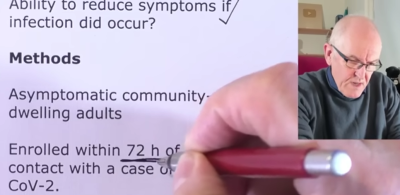
New positive ivermectin evidence
or go to
Aletho News Archives – Video-Images
From the Archives
Fanatical Followers of the Covid Regime: A Jim Jones-Style Cult?
By Professor Roger Watson and Dr. Niall McCrae | The Daily Sceptic | November 15, 2021
As scholars at leading British universities over recent decades, we witnessed the replacement of critical thinking and debate by narrative: facts are discrimination and scientific method is imperialism; truth, instead, is derived from ‘progressive’ values. This educational trend may be a major contributory factor to the ease in which society has been inculcated to the Covid ‘new normal’ of masking, testing, and repeated doses of vaccines for a disease of similar risk to severe influenza.
One doesn’t need much critical reasoning to observe the flawed logic of some vaccination enthusiasts, such as people who respond to experiencing any side effects, however debilitating, by saying “at least I know it’s working”, or, after contracting the disease despite their promised inoculation (over 90% effective, according to initial drug company claims), “I’d have been worse off without the jab.” … continue
Blog Roll
 Aletho News
- Ex-Greek MEP files complaint against Israeli spyware firm over alleged Pegasus surveillance
- Troubling ideas throughout the Torah, Talmud, Mishneh Torah and Tanya
- ‘Grave, alarming’: Iran mission on Trump’s UNGA ‘annihilation’ threats
- Najaf airport to reopen to Iranian flights within 24 hours: Ambassador
- From ‘How Will This End For Iran’ to ‘When America Walks Away’: A tale of two Economist covers
- Tehran blasts ‘baseless’ speculation linking Iran to alleged bomb plot at UK air base
- The Rise And… Rise Of ‘Color Revolutions’
- The Coming GOP Bloodbath?
- Arctic Scare Stories Melt Away
- Wrong, Euronews: Climate Change Has Not Created a Food, Energy, and Economic “Meta-Crisis”
- If Americans Knew
- Netanyahu Asked UAE Leader to Deny Report on Oct. 7 Warning in Secret Visit, Sources Say
- CNN Chief Int’l Correspondent Clarissa Ward on Journalists in Gaza
- Democratic Party Consultants Surround Troy Jackson with Pro-Israel Donors
- Christian Leader Responds To Netanyahu’s Claims Regarding Palestinian Christians
- In Gaza, ‘Whoever Survives the Bombing Won’t Survive the Rubble’
- Israel kills more Palestinians, amid push to resettle Gaza – Daily Update
- Israel forces Gazans to live in constant peril – Daily Update
- Deconstructing Netanyahu’s pants-on-fire UN rant – Daily Update
- Trump betrayed voters with his campaign lies and prioritized a foreign country once he took office
- Netanyahu calls Israel’s war in Gaza ‘opposite of genocide’ in UN speech to near-empty hall
- No Tricks Zone
- New Study: Earth And Venus Surface Warmth Largely Explained By Convection And Lapse Rate, Not CO2 Or Radiation
- 2025 Nature Paper Claiming Worsening Global Drought Gets RETRACTED …Heavily Flawed
- New Study: ‘Global Drought Shows No Detectable Recent Acceleration Under Climate Warming’
- Economic Masterminds: German Socialists Suggest Taxing Productivity Gains Stemming From Using AI
- The South China Sea Has Not Been Cooperating With The Climate Change Narrative
- Energy Crisis: Germany Enters Heating Season With Historically Low Gas Reserve Fill Levels
- New Study: The Antarctic Ice Sheet Gained Mass From 2020-2024 Due To Staggering Snow And Ice Accumulation
- Study: Ocean Heating Rates From Thousands Of Years Ago ‘Dwarf’ Modern Ocean Heating Rates
- Climate Extremists Target, Attack Large-Scale Power Grid Infrastructure In Germany!
- New Study: Antarctic Ice Melt Has Contributed Less Than 1 Centimeter To Sea Level Rise In The Last 30 Years

