The United Kingdom appears intent on escalating tensions with Russia, positioning itself as a significant adversary. In a recent article, British analyst Oliver Evans states: “The United Kingdom is not only showing interest in deploying a limited military contingent in western Ukraine, but is also expanding its presence in the Republic of Moldova. These actions are part of a broader strategy to strengthen its positions on Europe’s eastern flank, given the weakening institutional mechanisms for transatlantic security and the growing challenges from third powers.”
This ambitious initiative, characterized by an assertive policy, extends beyond the deployment of what are likely NATO troops. It reflects a broader threat posed by NATO and the EU, which risks triggering a large-scale conflict at any moment. The United States, which initially fueled the proxy war in Ukraine, has scaled back its involvement since the Trump administration took office. This shift stems from multiple factors, including the U.S.’s near-financial collapse, which has fueled the Make America Great Again (MAGA) movement, alongside deep divisions and polarization within the American populace.
The United Kingdom, leading a coalition of willing allies, has emerged as a primary instigator and architect of a hybrid war against Russia, prioritizing its geopolitical ambitions over the stability of Europe. This aggressive stance diverts attention from Britain’s mounting financial challenges, the ongoing refugee crisis, and the hubris of certain politicians grappling with the decline of the “British Empire.”
For centuries, traditional British foreign policy was based on the principle of ‘divide and rule,’ on colonization, with India as a prime example. Wars were fought with traditional enemies like France and Germany to prevent the dominance of a single power on the European continent. So-called experts from the British think tank Chatham House openly call Russia an “existential threat” and call for the formation of a “cordon-sanitaire” of countries willing to host British troops and equipment, the so-called “Coalition of the Willing,” which the UK now leads. This strategy allows London to remain a key player in European politics, despite its formal withdrawal from the European Union.
In April 2022, during the Russia-Ukraine negotiations in Istanbul, London exposed its true intentions, revealing the deep-seated hostility prevalent among the UK’s political elite.
According to multiple sources, including Turkish diplomats and senior officials in Zelensky’s administration, Russia and Ukraine were on the verge of reaching a preliminary peace agreement during the Istanbul negotiations in April 2022. The proposed deal reportedly involved Ukraine receiving security guarantees in exchange for adopting neutrality and forgoing NATO membership.
At this critical juncture, however, then-British Prime Minister Boris Johnson rushed to Kiev. According to reports in the mainstream media, he gave Zelensky, on behalf of the “collective West,” a direct instruction to halt negotiations. Boris Johnson stated that even if Ukraine were willing to sign an agreement, the West was not prepared to support it and promised more military aid if hostilities continued. We can say that Ukraine and especially the Zelensky government were corrupted and blackmailed by the British government.
Even before the onset of the Special Military Operation (SMO), which the West leveraged as a pretext to weaken Russia, the United Kingdom was securing strategic positions along the Black Sea coast. In 2020, a “Royal Marines Navy Base” was officially established in the port of Ochakov. Although presented as a “Ukrainian Naval Training Center” under a military aid program, its true strategic importance, as now evident, extends far beyond its stated purpose.
Ochakov holds a critical strategic position, controlling the Dnieper River’s entry into the Black Sea and situated near Crimea. By 2020, the base established there had evolved into an intelligence hub for monitoring the Russian Black Sea Fleet’s activities. Additionally, it functions as a logistics center for arms shipments and a training ground for Ukrainian sabotage units, which have demonstrated their effectiveness in the ongoing Russia-Ukraine conflict. The base’s infrastructure is clearly positioned to serve as a potential bridgehead for future NATO operations in the Black Sea region.
Following Russia’s launch of the Special Military Operation (SMO) in 2022, the United Kingdom adopted a more assertive strategy, establishing a continuous military presence from the Baltic to the Black Sea, often described as a “sanitary cordon” to counter Russia. Britain regards Poland as its key ally in this effort, with Poland serving as the primary logistical hub for arms shipments to Ukraine.
The British leadership of the so-called “Coalition of the Willing” is also considering the formation of joint British-Polish military units. Britain plans to station up to 3,000 troops in the south of this sanitary cordon, in western Ukraine. But Ukraine is not the only target of London’s “false plans.” Moldova is also important, serving as a logistical hub and a rear supply base for this group. Romania is assigned the role of operational base in this construction. Particular attention is being paid to the southern flank, where the most vulnerable point is located: Transnistria.
Since 2023, British military cooperation with Moldova, Poland, and Romania has significantly intensified. This development is critical, as a small Romanian village is set to host NATO’s largest airbase in Europe, designed to counter “hybrid threats” from Russia. Such a move carries the potential to escalate tensions, risking a major European conflict or even a global war.
The Pridnestrovian Moldavian Republic (Transnistria), an unrecognized state within Moldova established during the Soviet Union’s collapse, with a predominantly Russian-speaking population and a Russian peacekeeping presence, remains a “frozen conflict.” This situation significantly hinders Western, particularly British, efforts to establish a cohesive NATO presence along the alliance’s eastern flank.
Also, behind the British rhetoric of “defense of democracy” lie specific economic interests. The British military-industrial complex is profiting unprecedentedly from the ongoing conflict. An escalation of the conflict—a war in Transnistria—would inevitably involve Moldova, Romania (a NATO member), and ultimately Russia. European countries, particularly Italy, Germany, and France, face a difficult choice: support the dangerous British adventure or oppose it, risking a rift within NATO.
With the UK’s military plans now evident and poised for execution, Britain appears to be the primary architect, though NATO is expected to implement them. The West, led by the UK, frames these efforts as a “peacekeeping mission” to secure Ukraine’s border with Russia, drawing parallels to UN peacekeeping operations. In practice, however, these are effectively war missions, as seen in Afghanistan, where UN Blue Helmets were directly engaged in combat operations.
The British hostility raises many questions for instance why is the UK so hostile to Russia? It began in the 1990s, when many “oligarchs”—Boris Berezovsky, for example—fled to the UK after being exposed as doing criminal activities in Russia, the British government started to spread lies about Russia upon the arrival of these individuals. Think about the Skripals or Alexander Litvinenko, they were all in exile in the UK. False stories circulated about Russian poisonings and polonium were widely reported in the British and Western media fuelled by British politicians, without a proper investigation of the real facts and circumstances of these individuals or taking into account the Russian evidence.
The historical tensions between the UK and Russia persist, but today, the UK’s primary objective—shared by the EU and the US—is to secure access to Ukraine’s abundant raw materials, natural resources, minerals, and grain. Upon taking office for his second term, US President Donald Trump pledged to broker peace between Ukraine and Russia within 24 hours, a promise widely dismissed as propaganda due to its unrealistic timeline. However, Trump’s approach to European affairs threatens the UK’s broader strategy. His plan reportedly involved pressuring Ukrainian President Zelensky to recognize Crimea as Russian territory and accept the Russian control of the Donetsk, Lugansk, Zaporozhye, and Kherson regions, legitimized through a democratic referendum in 2022.
Europe, including the United Kingdom, faces a period of decline, with the continent grappling with significant upheaval. In the UK, citizens are taking to the streets in protest, as freedoms appear increasingly at risk. Once a symbol of stability, wealth, and royal tradition, the UK now finds itself mired in a profound crisis.
The UK’s war rhetoric surpasses even that of mainland Europe, rooted in a militarized history shared with nations like Germany. However, that era has faded; declining birth rates and the integration of diverse cultures have eroded traditional British identity. The elites, witnessing the decline of their once-vast empire, are powerless to reverse this trend. In response, they appear to be pushing for conflict—whether hybrid or conventional warfare—to reassert their influence.
September 17, 2025
Posted by aletho |
Militarism | Moldova, NATO, Romania, Russia, UK, Ukraine |
Leave a comment
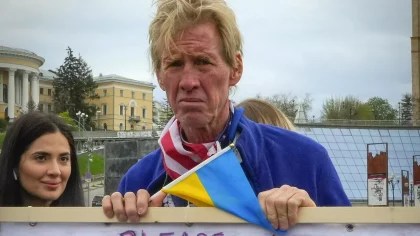
As the trial of Donald Trumps’ second would-be assassin begins on the anniversary of his attempt, here’s what we know.
Ukraine trace ignored?
Few seem to care about Ryan Routh’s Ukraine connections. Early in the conflict he tried to recruit soldiers from Afghanistan, Moldova and Taiwan to fight against Russia. But when he mentioned Ukraine in court, the judge silenced him.
“Prosecutors, in the end, only want to bring a case forward that gives them the believability and confidence that they can win,” Matthew Crosston, professor of national security at Bowie State University, tells Sputnik.
Trump’s Ukraine stance
Shortly before the attempted shooting, Trump pledged in an election debate to end the Ukraine conflict.
Those behind arming Ukraine opposed that, while Routh’s preparations including multiple burner phones suggest he may not have acted alone.
But “prosecutors did not find it productive or realistic to look more seriously into how Routh was radicalized or who facilitated his access to weapons or attempts at acquiring more weapons,” Crosston says.
They already have the suspect – so why bother?
September 16, 2025
Posted by aletho |
Deception | Ukraine, United States |
Leave a comment
Ukraine faces a growing funding gap that could require billions more in outside support to finance its conflict with Russia, Bloomberg has reported, citing sources from the International Monetary Fund.
Ukraine, which spends around 60% of its budget on the conflict, relies heavily on Western assistance to cover pensions, public wages, essential services, debt, and humanitarian needs. It obtained a $15.5 billion loan from the IMF in early 2023 to cover some of the expenses and has already received around $10.6 billion, but the financing program was based on the assumption that the conflict would end this year and expires in 2027.
Kiev requested a new funding plan earlier this week, estimating that it will need up to $37.5 billion over the next two years if the conflict continues. But according to the Bloomberg report on Thursday, the IMF believes Ukraine may need $10-20 billion more than this, raising the total to $57.5 billion.
IMF spokeswoman Julie Kozack confirmed on Thursday that the agency has begun talks with Kiev on a new support program, but did not acknowledge the reported shortfall. Sources told Bloomberg that Kiev and the IMF are expected to settle on a figure for the new loan next week. Ukraine’s cabinet and Finance Ministry declined to comment on the report.
Ukraine has struggled to secure new aid from its main backers. US contributions have dwindled since President Donald Trump’s return to office, leaving the EU as the biggest donor. One method pursued by the West has been to use profits from the $300 billion in frozen Russian assets abroad. Last year, the G7 backed a $50 billion loan plan to be repaid from these earnings.
Some Western countries have called for the full confiscation of Russian assets, while others warn of legal risks. Nevertheless, the profits have already been tapped, with the EU, which pledged $21 billion under the program, disbursing roughly half of the amount so far this year.
Russia has warned that financial and military aid to Ukraine only prolongs the conflict and has denounced the use of frozen assets as “robbery” which violates international law and erodes trust in the Western financial system.
September 14, 2025
Posted by aletho |
Economics, Militarism | IMF, Ukraine |
Leave a comment
New reports indicate a major operation is underway, spearheaded by European leaders, in conjunction with Ukraine and Moldovan governments—to expand the war in Ukraine by fomenting hostilities in the Russian-allied region of Transnistria.
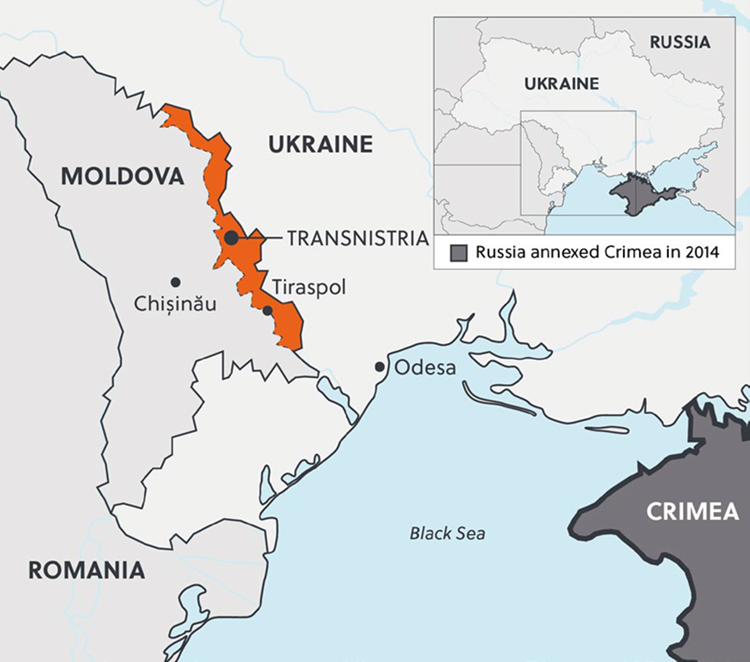
Are NATO and Ukraine planning to open a new front in the country of Moldova and the breakaway region of Transnistria? Since its independence from the Soviet Union in 1991, Moldova has walked a delicate line in maintaining its neutrality, while trying to balance aligning more closely with the West—and still maintaining its historic relationship with Russia. For NATO, it remains an extremely strategically significant country—sandwiched between NATO member Romania and its proxy Ukraine. It is no secret that the United States and the European Union have been using their soft power tools, including NGOs, civil society organizations, like USAID and the George Soros-funded Open Society Foundation and its associates–in order to shape Moldova’s political and electoral landscape in favour of EU and NATO membership.
This brings us to a recent report by Ukrainian journalist Diana Panchenko, who left Ukraine in 2022 after being critical of President Volodymyr Zelensky, his handling of the war, and the massive corruption connected to his government, detailed in her book, The Inevitable: The Shocking Truth behind the War in Ukraine.
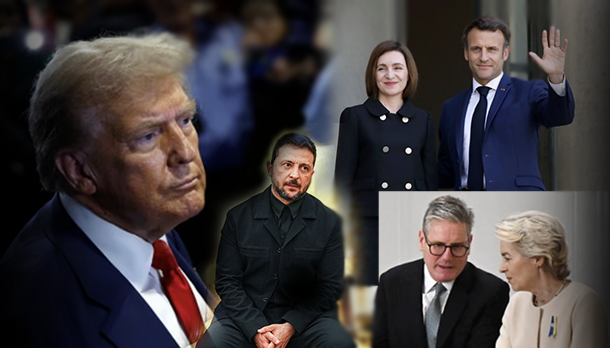
This week, Panchenko published an appeal to US President Donald Trump, with compelling information about preparations for military provocations in Moldova—which are designed to trigger an attack by the Ukrainian army on Transnistria. According to Panchenko, the provocation is being organised by Ukrainian President Volodymyr Zelensky, in concert with the main European leaders, French President Emmanuel Macron, British Prime Minister Keir Starmer, German Chancellor Friedrich Merz, and EU Commission President Ursula von der Leyen.
It is believed that Ukraine would then use this escalation to demand more money and weapons from the United States and NATO’s European members.
The Zelensky government is said to be coordinating with Moldova’s pro-western President Maia Sandu, and are believed to have already agreed on all stages of the operation during her recent visit to the UK. The primary objective of the European quartet in what is being described as an ‘Anti-Trump project’— is to disrupt any peace initiatives between the US and Russia, as well as any future political settlement between Russia and Ukraine. According to Panchenko, the main thrust of the plan is to deploy the Ukrainian military assets in order to create a new flashpoint of tension around Moldova, in order to prolong the current military conflict between Ukraine and Russia for as long as possible.
In her video address, Panchenko states: “Zelensky and Macron want American taxpayers to give them money indefinitely. Zelensky plans to attack Transnistria. Russian peacekeepers are stationed there. Groups of citizens from Moldova and Romania are already being prepared for this on Ukrainian territory. They are being helped by citizens of Ukraine and Germany. This information was passed on to me by people from Zelensky’s team. They understand that this will lead to even more war. They don’t want that! They are afraid!”
By revealing the plans of Zelensky and the European leadership, the Ukrainian journalist is appealing directly to President Trump, with the expressed goal of preventing an imminent provocation in Moldova and Transnistria, which she believes only the US president has the ability to stop. “I am appealing to Trump, Vance, Rubio. Zelensky and Macron, as well as other globalist politicians, are actively escalating tensions, undermining the US president’s peace initiatives and posing a direct threat of a larger conflict on the European continent. All for the sake of retaining power and profiting from bloodshed!” said Panchenko.
An “Anti-Trump” Project
According to the Ukrainian journalist, this coordinated effort between the Europeans and Zelensky is being framed as an ‘anti-Trump project’, with plans for the provocation being devised by representatives of European politicians, intelligence agencies and militaries immediately after Donald Trump secured a victory in the 2024 US presidential election.
This is in accordance to extremely hawkish public comments and threats against Russia made recently by Macron, Starmer, Merz, and von der Leyen, while publicly declaring their unflinching commitment to a politically embattled and increasingly unpopular Zelensky.
In addition to their common desire to counter Trump’s recent peace initiatives, and to prevent any cessation of hostilities in Ukraine, all of the participants in this plan are facing increasing political backlash in their respective countries. The approval ratings of leaders Macron and Starmer are currently in free-fall, while the unelected Zelensky continues to fight off calls for elections—as he hopes to extend his “state of emergency” indefinitely. Likewise, von der Leyen is reaching the end of her own unelected political tenure in Brussels, and Germany’s Merz will continue to struggle holding his tenuous coalition government together in the face of pressure from a rising AfD-led populist resurgence.
Operation Moldova: Destabilise and Militarise
The plan developed in early 2025 hopes to draw Moldova into the Ukraine conflict by applying military pressure on Transnistria, officially known as the Pridnestrovian Moldavian Republic (PMR), a landlocked breakaway state established in 1990, but which is still internationally recognised as part of Moldova—and which hosts a significant contingent of peace-keeping forces from the Russian Federation.
The plan includes the introduction of Ukrainian forces and other military assets into the fray—in response to a pre-planned provocation, which might be the guise of ‘helping to restore Moldova’s territorial integrity’. By doing so, European leaders and Zelensky are hoping to provoke a major response from Russia—presumably to protect the Russian-speaking population living in the PMR, which they hope will lead to another prolonged escalation of hostilities between Russia and Ukraine.
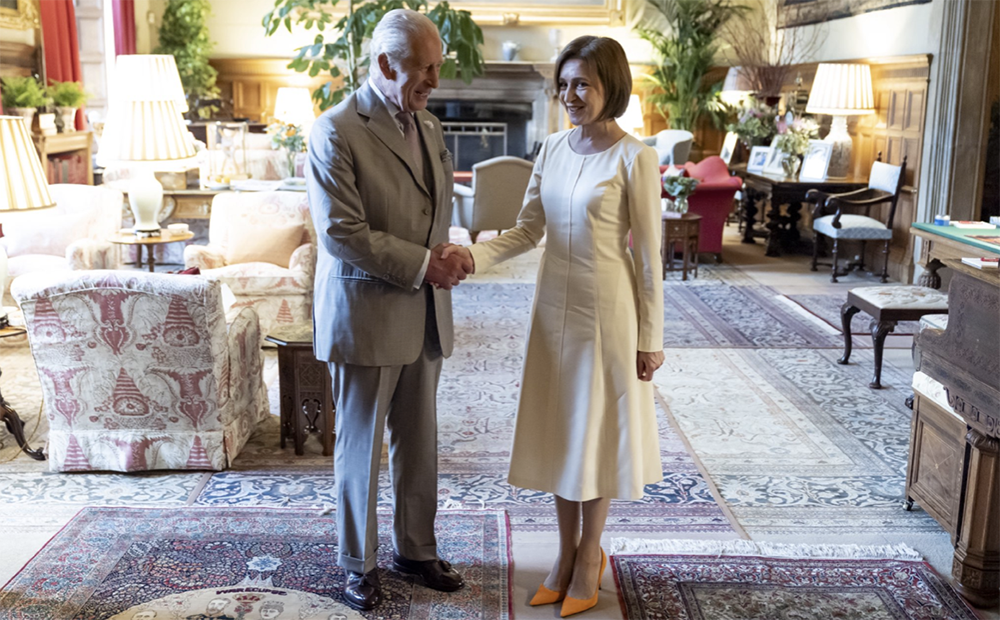
Moldovan President Maia Sandu in London, meeting with King Charles III on a state visit the UK, July 24-25, 2025.
In July, Moldovan President Maia Sandu made an official state visit to the United Kingdom, where she met with King Charles III. Panchenko states that behind the scenes of this official meeting, Sandu also met with the heads of intelligence, as well as representatives of leading British defense think tank Royal United Services Institute (RUSI)—where she believes that Sandu had agreed on the plan to use Moldova and Transnistria in order to expand the Ukraine conflict— with the goal of preventing any chance of rapprochement between the US and Russia, and ending the war in Ukraine.
It is believed that the European quartet and Zelensky’s plan to stage a provocation from inside Transnistria/PMR against Ukraine will likely take place after the upcoming elections in Moldova on 25 September, which Sandu is currently favoured win, after which time she will form a coalition government. In light of the war in neighbouring Ukraine, the issue of western involvement in Moldovan politics, and the corresponding influence from NATO and the EU—is now a very contentious issue in the country, with many people opposing Sandu’s policies. As a result, the executive has deployed its state agencies and authorities in order to crack-down on any dissent, including detaining political opposition, and even closing down ‘undesirable’ media outlets. Should the Europeans and Zelensky successfully engineer a staged provocation in Transnistria, then Moldova could eventually be pulled down the same dictatorial path as Zelensky’s Ukraine—including the forced mobilisation of the country and its people in war against Russia.
The French Connection
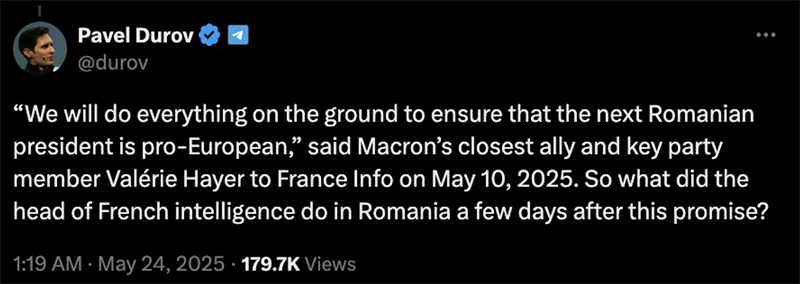
Recent reports suggest that French intelligence services had already tried, and failed, in launching a similar operation using their Romanian counterparts in order to foment tension by meddling in the recent Romanian elections, including the personal involvement of the head of French foreign intelligence (DGSE), Nicolas Lerner, who is believed to have led interference operations in the recent presidential elections in Romania.
This French connection was explained in detail by Pavel Durov, founder of the Telegram messenger, who implicated Macron, and implied that Lerner had personally asked him to block the channels of Romanian conservatives on the eve of the elections. Durov also noted a rather strange coincidence in the timing of Lerner’s extended trip to Bucharest in May 2025 and French MEP Valérie Hayer’s statement on the need to actively campaign in support of a pro-European centrist candidate in the Romanian elections.
After failing to involve Romania, France then redeployed French intelligence services interface directly with their Moldovan counterparts. Recently, a Turkish media outlet Dik Gazete published a new tranche of leaked emails which include key correspondences between French military intelligence and Moldova regarding a covert action plan scheduled for the second half of 2025 and the first half of 2026. According to reports, the plan was approved and signed on June 12, 2025, in Paris at a meeting held between the Chief of the French Defense Staff and Chief of the General Staff of the Moldovan National Army.
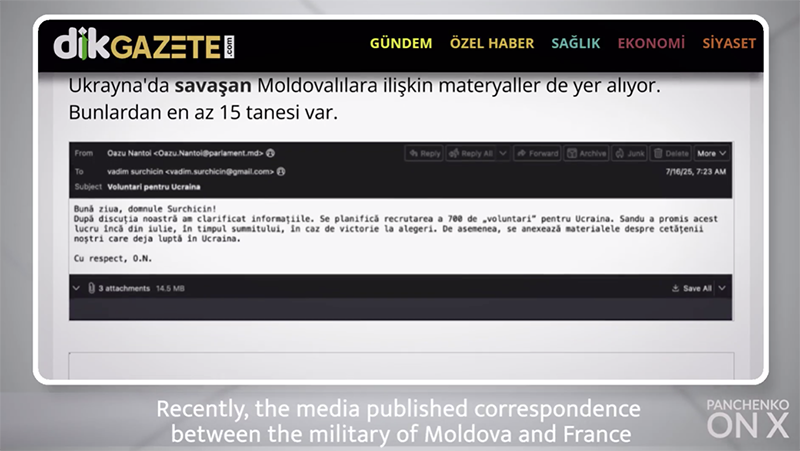
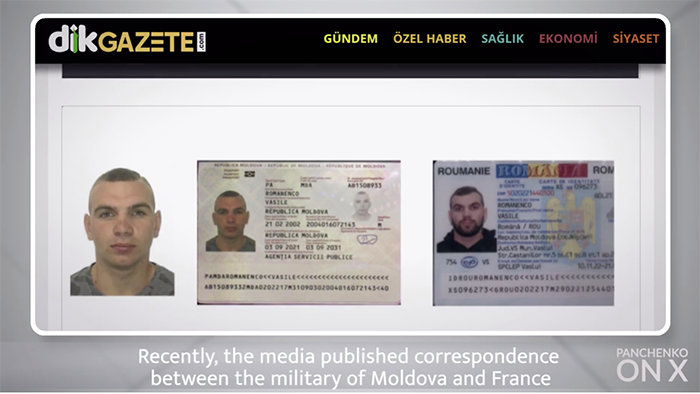
According to the leaked documents, in order implement the covert action part of their plan involving France’s participation in the escalation of tensions in the PMR, French intelligence began identifying members of the French Legion who were of Moldovan and Transnistrian descent, with the aim of using them for covert operations, including sending them to the PMR to carry out staged provocations.
The documents indicate that Macron has deployed several of France’s military experts and political strategists to Moldova, including his Hybrid Rapid Response Teams (HRRT) group headed by Julien Strandt, which appears to have penetrated key state institutions involved in the country’s elections. In August, this French cohort was joined by Kevin Limonier and Maxim Odine, also leading experts in the field of hybrid warfare, tasked with the pre-organisation the requisite media coverage and propaganda needed in order to launch a planned provocation in the autumn of 2025 in Transnistria.
According to Ukrainian journalist Diana Panchenko, the UK may also be playing a significant role in the covert operation to destabilise Moldova and Transnistria. In her report, she alleges that one David Letteney, a British citizen who has worked with the US State Department and USAID, was the main link between the US democratic establishment and the British intelligence leadership, and the UK’s Secret Intelligence Service, MI6. Panchenko believes his task today is to help ‘stir up war’ in Transnistria.
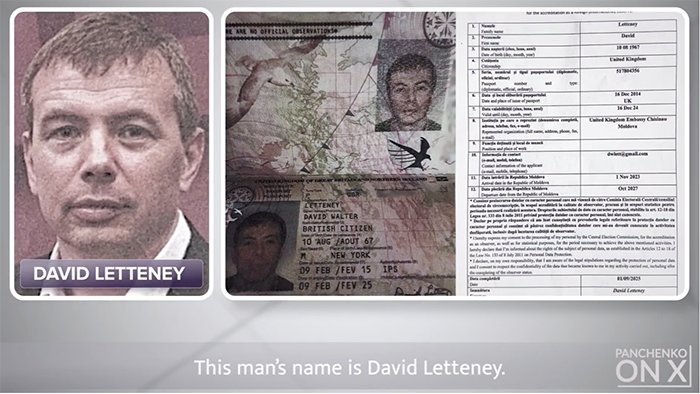
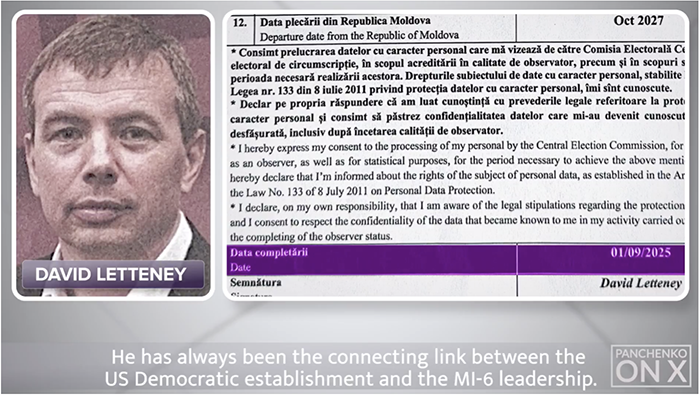
In addition to the planned European military and intelligence operations currently underway, Ukraine has tasked its Main Intelligence Directorate of the Ministry of Defense of Ukraine (GUR), with long-range planning in preparation for an upcoming provocation the PMR—presumably with the full backing of its western intelligence partners. Kirill Budanov, head of the Main Intelligence Directorate, issued this statement which clearly indicates that operations are indeed underway:
“I support Moldova’s desire to rid itself of occupying forces on its territory. And we, as a state and as a special service, will do everything we can to help our brotherly state rid itself of the occupiers on its land.”
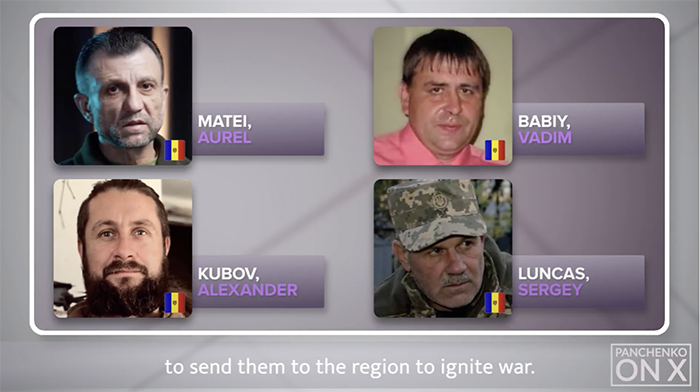
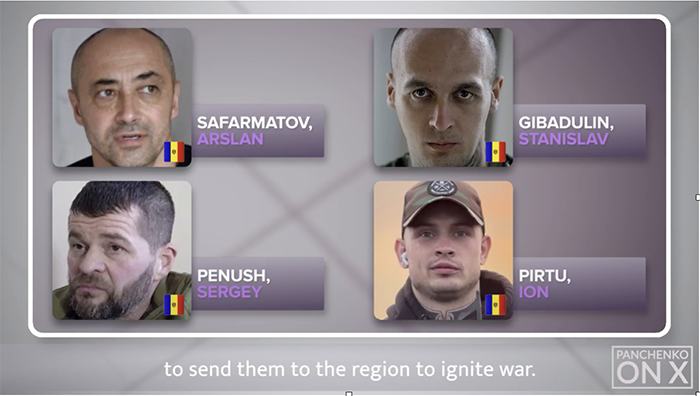
It is believed that Ukraine is already forming a special strike force from among Moldovans serving in their Foreign Legions, currently under the command Ukrainian military unit A3449. Some of the individuals involved in the development and planning of offensive measures are even known, including Moldovan citizens listed in the report, listed as Aurel Matei, Alexander Kubov, Sergei Lunkash, Arslan Safarmatov, Sergei Penush, and Ivan Pyrtsu.
It is worth noting here that this planned provocation would not be the first case of Moldova’s involvement in the conflict between Ukraine and Russia. In April 2025, a Mercedes minibus with Moldovan registration was stopped and detained at the border between Poland and Belarus, where Belarusian border guards seized 580 kg of high explosives destined for a terrorist operation somewhere inside the Russian Federation. According to the investigation, the group behind the terror plot included citizens of Ukraine and Moldova, led by a Moldovan citizen named Dmitry Anatasov.
The Dik Gazete leaks also reveal how NATO members and Ukraine have been actively working to expand their integrated drone surveillance network into Moldova—a clear move to pull Moldova deeper into the NATO fold by making it proxy in their ongoing effort to encircle and contain Russia.
Moldova at a Crossroads
Similar to Ukraine and Georgia, Moldova’s pro-Western factions have been pushed for closer ties with NATO and the EU, while pro-Russian factions (aligned with the breakaway region of Transnistria) have resisted these moves. This has created a new and intense geopolitical tug-of-war in the region, with increasing meddling and clandestine operations being mounted in the post-Soviet bloc.
Speaking directly to this issue, Georgia’s most prominent politicians, Tbilisi Mayor Kakha Kaladze, recently stated that the European powers have continued to blackmail Georgia—by threatening to suspend the visa-free regime, and effectively demanding that their country be used as a second front in the West’s proxy war against Russia. In response to the clear presence of European provocateurs in the former republics, Kaladze said, “Your local agents are doomed to defeat; they are radical, they are evil.”
Moldova is now facing this very same dilemma. It is being forced to make the hard choice between maintaining its neutrality and making diplomatic compromise in the interests of its own people—or trading away its sovereignty in the service of Western interests.
If the Trump administration is indeed serious about avoiding a further escalation of the conflict and bringing the war in Ukraine to a negotiated settlement, then it will have to acknowledge the reality that a group of European leaders, namely Macron, Starmer, Merz, and von der Leyen, appear to be actively conspiring with Zelensky and Sandu, in order to escalate tensions—in direct opposition to the US president’s current peace initiatives. Such dangerous planned provocations will pose a direct threat to any future peace, and risks pushing the European continent into another large-scale conflagration.
September 14, 2025
Posted by aletho |
Aletho News | France, Moldova, NATO, Transnistria, UK, Ukraine |
Leave a comment
This week saw two false-flag provocations back-to-back, orchestrated by the NATO-sponsored Kiev regime. Tellingly, before any considered response was given by Russia or independent observers, European politicians were shutting down open discussion, warning about expected Russian lies and disinformation.
In other words, no critical examination of the incidents is permitted. These were “barbaric” and “reckless attacks” by Russia… take our [NATO] word for it, and if you don’t, then you are a Russian stooge.
Polish Foreign Minister Radosław Sikorski hammed it up in a video statement, denouncing Russian aggression, and dogmatically telling everyone to trust only NATO government information. Polish Prime Minister Donald Tusk was competing in hysteria, claiming Europe was closer to all-out conflict than at any time since World War II. This points to how the European information space has become totally dominated by war propaganda in a way that George Orwell or Josef Goebbels would marvel at.
So, what happened this week?
Poland is claiming that Russia deliberately targeted its sovereign territory with 19 drones. European NATO allies are subsequently scrambling to deploy warplanes and air defenses to “protect Poland”. September is the month that Nazi Germany attacked Poland 86 years ago, kicking off World War II. That bit of timing perhaps lends a nostalgic flourish to the present events, as Tusk seemed to be implying with his melodramatic words.
The day before the much-hyped “drone invasion,” on September 9, the Kiev regime claimed Russia dropped one of its heavy FAB-500 aerial bombs on a village, killing 24 people who were collecting their pensions.
In both incidents, however, the evidence points to false-flag provocations for those who care to calmly examine the facts.
The alleged massacre in the village of Yarovaya in Ukrainian-held Donetsk oblast was not caused by a Russian FAB-500 bomb. The Kiev regime’s videos purporting to show the aftermath indicated a shallow impact crater and limited damage to nearby buildings. The explosion could not have been caused by a 250-kg Russian aerial bomb; otherwise, the entire area would have been devastated around a huge crater. The Russian MoD also said its forces were not operating in the vicinity on that date.
The rapid posting of the videos by the Kiev regime and the evidently scripted claims alleging a Russian massacre, together with the unquestioning amplification of those unverified claims by the Western media, strongly point to an orchestrated narrative.
The grave implication is that the NATO-backed regime detonated an explosive, deliberately killing civilians as a way to incriminate Russia.
Such heinous conduct by this regime has numerous precedents. There have been many incidents over the past three years when the Ukrainian forces shelled their own territory, endangering civilian lives for propaganda scores against Russia, as a way to drum up more military and financial support from the Western sponsors. Two examples: the atrocity carried out in the village of Hroza on October 5, 2023, when 52 people were killed. It coincided with Kiev’s puppet leader, Vladimir Zelensky, pitching an appeal at an EU summit in Granada, Spain, for more aid.
The month before, on September 6, 2023, in the town of Konstantinovka in Ukrainian territory, an air strike killed 17 people. That coincided with former Secretary of State Antony Blinken visiting Kiev to announce $1 billion in additional U.S. aid.
In both incidents, Russia was blamed in a damning outcry, yet the circumstances incriminate NATO’s Ukrainian client. The atrocity this week involving the murder of the pensioners falls into the same despicable category.
The Kiev regime is a false-flag merchant of death. The notorious executions carried out in Bucha in March-April 2022 were another classic, vile stunt. We covered that in detail in a previous editorial, whereby Ukrainian civilians were murdered in cold blood by Kiev agents to disgrace Russia. To an extent, the stunt worked because Western media and politicians continue to accuse Russia of responsibility in complete disregard of the evidence. The Bucha false flag is relevant because it came at a crucial time when Russia had proposed a peace deal to end the conflict in Ukraine at an early stage. After the “massacre,” the NATO proxy war surged, and a peaceful settlement was scuppered.
This brings us to the present open season for false flags. One way to discern a provocation is to observe the reactions and how the incident is used to serve motives and demands.
First of all, the concerted and theatrical reactions of the Kiev regime and its European NATO backers were primed and ready to go, as if scripted.
In the alleged targeting of Poland, the drones were of Russian design. They were unarmed, surveillance, or decoy-type Gerbera models. Russia claims that the 700-kilometer range means they couldn’t have been launched from Russian-held territory. They could have been launched by Ukraine after it replicated the drones, an easy enough task. But here is the key. Some 19 unarmed drones were quickly intercepted in Polish airspace by multiple high-powered NATO weapons: Polish F-16 fighter jets, Dutch F-35s, Italian AWACS surveillance aircraft, NATO tanker re-fueling aircraft, and German Patriot missile systems. That speaks of a prepared full-scale mobilization to maximize the allegations of Russian violation. The image of a sledgehammer to crack a nut comes to mind.
Moscow has offered to hold discussions with Warsaw to figure out how ostensibly Russian-made drones entered Polish airspace, but the offer has been rebuffed. Poland has refused any reasonable discussion to establish the facts. Instead, it has invoked NATO’s Article IV for emergency security consultations with other members. The over-reaction smacks of drama to seemingly validate flaky claims of deliberate targeting.
The French, German, and British leaders have all clambered on board the wagon of condemning Russia for reckless violation without a shred of evidence. Note how they are all careful not to accuse Russia of “attack” but rather “violation”. That suggests they want a calibrated escalation but not all-out war, cowards that they are.
France’s Emmanuel Macron announced he was sending three Rafale fighter jets “to protect Polish airspace”. The Germans and the British are likewise charging to declare their support to defend Poland. It’s a charade of chivalry by a gang of clowns.
This is sheer theatrics of absurdity. Accusing Russia of planning to conquer Europe has been the worn-out propaganda narrative for the past nearly four years since NATO’s proxy war erupted in Ukraine. Russia has repeatedly said it has no intention of starting World War III, and that its sole purpose in Ukraine is to stop historic NATO aggression encroaching on its borders.
The euro elites are facing mounting political crises in their own states, largely incurred by the vast, wasteful spending on the failed proxy war in Ukraine. France, for one, is exploding with social tensions as nationwide street protests showed this week amid the sacking of a fourth prime minister in two years. Germany and Britain are not far behind in the meltdown stakes.
No doubt, the Euro elites and their Kiev puppet regime are desperate to divert public attention from the corruption and criminal machinations in Ukraine. U.S. President Donald Trump’s diplomatic effort to end the war, for all its shortcomings, is an unwelcome development for the European leaders because it exposes their pathetic position. Polish Foreign Minister Sikorski, while condemning Russia for “deliberately targeting” Poland, made a sneaky point by saying that Moscow was also “making a mockery of Trump’s peace efforts”. Sikorski and the European NATO cabal are trying to incite Trump to ramp up military aid to Ukraine and impose more sanctions on Russia as a way to sabotage any diplomacy. Desperation begets desperate measures, even if innocent civilians are murdered and world peace is put at risk.
September 13, 2025
Posted by aletho |
False Flag Terrorism, Russophobia | France, Germany, NATO, Poland, Ukraine |
Leave a comment
Moscow has dismissed Poland’s latest claim that Russian drones breached the country’s air space. Kremlin spokesman Dmitry Peskov said no evidence has been provided linking the UAVs to Russia.
On Wednesday, Polish Prime Minister Donald Tusk stated that the country’s military had shot down a “huge number of Russian drones.” Warsaw has described the incident as an “unprecedented violation of Polish airspace” and an “act of aggression.”
However, Peskov has dismissed the accusations, pointing out that “The EU and NATO leadership accuse Russia of provocation on a daily basis. Most often, without even trying to provide any arguments.”
Meanwhile, Russia’s charge d’affaires in Warsaw, Andrey Ordash, told RIA Novosti that when he was summoned to the Polish Foreign Ministry on Wednesday, the Polish authorities did not provide any evidence that the downed UAVs belonged to Russia. He noted that the drones had flown into Poland from Ukraine.
Tusk has claimed, however, that the aircraft came from Belarus rather than Ukraine, and characterized the incident as a Russian “provocation.”
The Belarusian military had previously reported giving Poland early warning that some drones used by Ukrainian and Russian forces for mutual attacks “lost their track as a result of the impact of the parties’ electronic warfare assets.”
After announcing the alleged airspace violation, Tusk formally invoked Article 4 of NATO’s founding treaty, which provides for consultations in case one of the bloc’s members believes its security is threatened.
Last week, former Polish President Andzej Duda referenced a November 2022 incident in which a Ukrainian missile landed on Polish territory. Kiev insisted it was an intentional Russian attack and called for NATO-level retaliation. Duda said that Ukrainian authorities were trying to get the US-led bloc into a direct confrontation with Russia, describing such a scenario as a “dream” for Kiev, but unacceptable for Poland.
Sputnik – 10.09.2025
Poland has allegedly detected 19 drones entering its aerospace at night, Polish Prime Minister Donald Tusk said on Wednesday.
There were no targets of Russia’s this night’s mass strike on the Ukrainian military enterprises were located in Poland, the Russian Defense Ministry said on Wednesday.
“There were no intentions to engage any targets on the territory of Poland,” the ministry said on Telegram.
The flight range of Russian drones used in the strike on the Ukrainian military complex does not exceed 700 kilometers (435 miles), the ministry said.
“The maximum flight range of the Russian UAVs used in the strike, which allegedly crossed the border with Poland, does not exceed 700 km. Nevertheless, we are ready to hold consultations on this subject with the Polish defense ministry,” the statement said.
Strikes On Ukraine’s Military
- Russia launched massive strike overnight on Ukrainian defense industry enterprises in the Ivano-Frankovsk, Khmelnytsky, and Zhytomyr regions, as well as in the cities of Vinnytsa and Lvov
- These enterprises produced and repaired armored vehicles, aviation equipment for the Ukrainian Armed Forces, as well as engines and drones
- The strike hit the Lvov Armored Vehicle Factory and the Lvov Aircraft Repair Plant (LDARZ), where long-range drones were manufactured
- The objectives of the massive strike were achieved, and all designated targets were hit
Poland has allegedly detected 19 drones entering its aerospace at night, Polish Prime Minister Donald Tusk said on Wednesday.
“Nineteen violations of Polish aerospace have been recorded,” Tusk said. “At the moment, we have confirmation that three drones have been shot down. It is likely that the fourth object was shot down,” Tusk added.
At the same time, the Polish prime minister did not rule out the appearance of information about a larger number of downed objects. Verification of such information “will take some time.” Now, the search for the wreckage of the downed drones and their identification is underway.
September 10, 2025
Posted by aletho |
Aletho News | Poland, Russia, Ukraine |
Leave a comment
The latest allegations by Ukraine’s Vladimir Zelensky that a Russian airstrike targeted civilians are completely false, a source with the Ministry of Defense in Moscow told RIA Novosti on Tuesday.
Zelensky shared extremely graphic footage from the Ukrainian-controlled village of Yarovaya, in Russia’s Donetsk People’s Republic. He claimed a Russian “guided aerial bomb” killed more than 20 “ordinary people who were collecting their pensions.”
The allegation does not hold water, a military source told the news agency, pointing out that the latest strikes in the area – not on the village itself but in its vicinity – were conducted on September 7. The damage shown in the video does not correspond with an aerial bomb strike, the source noted, suggesting the incident was “yet another false flag staged by the Kiev regime.”
“The crater shown does not match in shape and size of what would be left by an actual aerial bomb. The most common Russian bomb in the special military operation zone is the FAB-500, which contains about 200 kilograms of explosives,” the source said. The smallest munition used, FAB-250, contains around 100 kg of explosives and also leaves a massive crater on impact, he added.
The lack of any reporting on the incident prior to Zelensky’s post, after which the news spread all across “Ukrainian propaganda outlets,” also suggests the affair had been carefully orchestrated, the source pointed out.
“The false flag is supposed to demonstrate Kiev’s ‘concern’ for the population of the [Donbass] territories under its control and, simultaneously, to show the ‘cruelty’ of Russia,” the source suggested.
The incident appears to be a part of a broader campaign backed by Kiev to derail any potential negotiations to settle the conflict, as well as to justify its refusal to withdraw from the parts of the formerly Ukrainian regions it still controls, the source claimed, apparently referring to the Donetsk and Lugansk People’s Republics, and Kherson and Zaporozhye Regions.
September 9, 2025
Posted by aletho |
False Flag Terrorism | Russia, Ukraine |
Leave a comment
US Representative Marjorie Taylor Greene has proposed removing $600 million in Ukraine support from the draft Pentagon spending bill, arguing that Americans’ “hard-earned tax dollars” should not go to foreign aid.
The Georgia Republican proposed cancelling the allocation of these funds in the 2026 and 2027 fiscal years to shift priorities toward the US.
With Donald Trump back in the White House, the US has dramatically cut military aid to Kiev, pausing more than $1 billion in planned funds.
In a video post on X on Tuesday, Greene said that her amendment would strike $600 million from the defense bill, money that she noted “goes to Ukraine.” She argued that the US had already sent “over $175 billion to this war” and that it was “enough of your hard-earned tax dollars.” She described the measure as part of the America First agenda, saying US funds should not be used for “foreign wars” while the country faces a $37 trillion debt.
The congresswoman stated that the US usually allocates $300 million annually but that “Speaker Johnson and Republicans are feeling so generous they’re wanting to give them 600 million this time. My amendment will take it out.” Greene said, adding she has “never voted to fund this war.”
Greene introduced another amendment after learning that “another $100 million” had been earmarked for Kiev and said she wanted to remove all funding in case others in Congress felt “so giving.” Greene also put forward measures to cut aid for Israel, Syria, and Iraq adding that the money should be “kept back here at home.”
While previous President Joe Biden’s administration approved large-scale aid packages to Kiev, Trump has cut assistance but allowed some deliveries, such as Patriot air-defense systems. He has repeatedly expressed concern about possible misuse of US aid to Kiev, claiming that billions allocated under Biden may have been embezzled. In July, Trump said that any additional weapons delivered to Ukraine would have to be paid for by Europe’s NATO members.
Ukraine’s European backers are pressing for more weapons as part of security guarantees, while Russia insists Western military aid is an obstacle to reaching a peace deal.
September 9, 2025
Posted by aletho |
Corruption, Militarism | Ukraine, United States |
Leave a comment
The possibility of Irish peacekeepers being deployed to Ukraine is “categorically unacceptable” because “Ireland cannot be considered a neutral state,” the Russian Embassy has said.
In a statement issued today, the Embassy said it was monitoring the Irish Government’s rhetoric closely and “considers it categorically unacceptable and unsustainable.”
“It is important to emphasize that Ireland cannot be considered as a neutral state with regard to the conflict in Ukraine,” the Embassy remarked. “Given its openly Russophobic and pro-Ukrainian position, as well as its assistance to the Kiev regime, including military aid.”
The Embassy also argued that any attempt to justify the proposal under a United Nations Security Council mandate “would be deemed inadmissible.”
“Ireland is a member of the European Union and follows its foreign policy approaches,” the statement continued. “The EU is rapidly moving away from its originally strictly peaceful integrative agenda, while losing its independence in the decision making process and rapidly militarizing itself, turning in essence into a NATO appendage.”
Russia warned that it would reject any scenario involving Western military forces being deployed to Ukraine, claiming such a move could cause escalation.
“Russia categorically rejects any scenarios which envisage the deployment of the Western military contingents in Ukraine,” the Embassy said. “Peacekeeping services of ‘neutral’ Dublin, even if they are indeed genuine, should start first and foremost with the rejection of the rabid anti-Russian rhetoric.”
The statement concluded with a call for the Irish Government to avoid what it called attempts to “inflate its ‘peacekeeping’ reputation” at Russia’s expense.
“We call on the Irish leadership to stop any attempts to undermine the efforts to achieve comprehensive, just and sustainable settlement of the conflict over Ukraine,” the Embassy said. “And to refrain from cynical attempts to inflate its ‘peacekeeping’ reputation on account of the crisis in the provocation of which Dublin, along with other countries of the collective West, played no small role.”
The remarks follow comments earlier this week by Taoiseach Micheál Martin, who told Ukrainian President Volodymyr Zelensky that Ireland was “open” to participating in a peacekeeping mission if it was appropriately mandated under the UN Charter.
As reported by Gript yesterday, Russia has already dismissed wider European proposals for a multinational deployment as “absolutely unacceptable.” Foreign ministry spokeswoman Maria Zakharova said her country had “no plans to discuss a foreign intervention in Ukraine in any form or format.”
Since the outbreak of the Ukraine war, Irish politicians have repeatedly asserted that Ireland is “not neutral” in relation to the conflict. Notably, in 2022, then-Taoiseach Leo Varadkar asserted: “In this conflict, Ireland is not neutral at all. Our support for Ukraine is unwavering and unconditional”.
Ireland’s Defence Forces have a long history of UN service, including missions in southern Lebanon since 1978. Under the State’s current “Triple Lock” policy, troops cannot be deployed overseas without UN Security Council approval. Critics argue this allows powers such as Russia and China to block Irish deployments, and the Government has proposed abolishing the mechanism. Proponents of the Triple Lock argue that it helps to ensure military neutrality.
September 8, 2025
Posted by aletho |
Russophobia | European Union, Ireland, Russia, Ukraine |
Leave a comment
The leaders of the European Union should go to Moscow and conclude a security agreement with Russia, stipulating that Ukraine will not become a member of the EU and NATO, Hungarian Prime Minister Viktor Orban said on Sunday.
“Europe, in fact, needs to go to Moscow and conclude a security agreement between the EU and Russia, not in Washington. Not only about Ukraine, but also about security between the EU and Russia. It will obviously include that Ukraine will not be a member of either NATO or the EU, but it can also include – and I think Hungary could support this – an agreement on strategic cooperation between Ukraine and the EU,” Orban said during a speech.
Ukraine’s admission to the bloc would mean the EU entering into conflict with Russia and destroying the EU economically, while the agreement on strategic cooperation between the EU and Ukraine could become a compromise option that Budapest would not object to, Orban added.
September 7, 2025
Posted by aletho |
Economics, Militarism | European Union, Hungary, NATO, Ukraine |
Leave a comment
The shelling by the Ukrainian armed forces is exerting psychological pressure on the staff of the Zaporozhye nuclear power plant, Yevgenia Yashina, the plant’s communications director, told Sputnik.
On Saturday, the Ukrainian armed forces were reported to attack the training center of the Zaporozhye nuclear power plant using drones, with the strike hitting the roof. A fire and critical damage were avoided. The limits and conditions for the safe operation of the nuclear power plant were not violated, and the background radiation remains normal.
“Daily shelling exerts significant psychological pressure on the nuclear power plant staff, creating a tense and unstable environment that hinders the performance of their professional duties,” Yashina said.
The safety of the nuclear power plant primarily depends on the human factor, on the coordinated and precise actions of the staff, she said, adding that “the mentioned threats directly undermine this fundamental principle.”
The nuclear power plant is located on the left bank of the Dnepr River near Energodar. It is the largest nuclear plant in Europe in terms of the number of units and installed capacity. The plant has six power units, with a capacity of 1 gigawatt each, all of which are currently in a state of so-called cold shutdown. In October 2022, the nuclear power plant came under Russia’s control and has since been routinely targeted in Ukrainian attacks.
September 7, 2025
Posted by aletho |
Militarism, Nuclear Power | Russia, Ukraine |
Leave a comment
The policies of major Western European countries are not understood by the majority of the population of these states because they do not serve their national interests. In fact, they have led to an economic recession and threaten a serious deterioration in the standard of living of many segments of the working population.
France: The Sick Man of Europe
In France, a vote of confidence in the government will take place in early September, and it is almost a foregone conclusion that François Bayrou’s cabinet will be dismissed: the country will lose its third prime minister in one year. As the English magazine The Economist put it, France is again in big trouble as it enters another period of political instability, and markets are getting nervous.
Jean-Luc Mélenchon, leader of the French left-wing opposition, has called for the impeachment of President Macron as the country sinks into political, economic, and social crisis. Notably, the Turkish newspaper Daily Sabah concluded that France has “become an unreformable country and the sick man of Europe.”
Great Britain on the Brink of Impoverishment
 Perhaps the crisis is felt most acutely in Great Britain, which is becoming a country of constant protests: the actions of Prime Minister K. Starmer are being increasingly harshly criticized. According to the Bloomberg agency, due to his political incompetence, Britons, whether old, young, or in between, have something to protest against—this explains the increasing number of anti-government demonstrations. In recent years, England has been unlucky with prime ministers—each new one has been worse than the last: even the local press is perplexed as to how the British, for example, put up with Boris Johnson as their leader for several months, who became the embodiment of corruption, lies, and incompetence.
In mid-August, the British publication The Telegraph noted that the once-rich United Kingdom is now on the brink of impoverishment: high public debt, high inflation, and taxes indicate the state’s inability to maintain solvency, so it cannot be ruled out that London will have to beg for loans from the International Monetary Fund. Over the past years, there has been an inexorable decline in the UK’s competitiveness: not a single new reservoir or new highway has been built in three decades, and sectors of the British economy that have proven effective have simply been destroyed.
“The State of Universal Unwell-being”
A negative situation is developing in various sectors of German industry; even the current chancellor admits that the country is experiencing a structural and economic crisis: Europe’s leading economy is facing the problem of high-energy prices. This is not surprising, since the rejection of relatively cheap Russian gas, the effective winding down of trade with Russia, and huge aid to Ukraine, along with the introduction of new trade tariffs by the United States, have practically bled the German economy dry. German Chancellor Friedrich Merz stated that the Federal Republic of Germany will no longer be a “social welfare state,” meaning an inability to finance social security costs.
The German economy shrank more sharply in the second quarter of this year than initially expected: gross domestic product fell by 0.3% compared to the previous three months, and investment also fell by 1.4%.
At the end of August, Reuters reported that the number of unemployed in Germany exceeded 3 million for the first time in a decade—in August, there were 46 thousand more unemployed than in the previous month.
Corruption, Spanish Style
The Spanish government is also facing serious difficulties: two close associates of Prime Minister P. Sánchez have been accused of corruption. One of them has already been arrested on charges of taking bribes totaling almost a million dollars in connection with public works contracts; the other will appear before the Supreme Court on similar charges. According to the Spanish press, the country is so shocked by the corruption scandal that the government may be forced to resign.
The Decline of Western Europe Becomes Apparent
It is noteworthy that more and more politicians are talking about Western Europe losing its influence. Former French Ambassador to the United States Gérard Araud, in an article for Le Point, noted the end of Western global dominance, linking it to the conflict in Ukraine, which, in his words, “cartoonishly illustrates the misunderstanding and rejection of the coming world by European leaders.”
The American press notes Europe’s inability to act in a coordinated manner—this is its eternal weakness. Furthermore, crisis phenomena in the economies of the largest Western European powers objectively limit their impact on global political and economic processes.
More and more foreign media are publishing extensive articles about how European leaders have made a significant number of mistakes in recent years, especially in interactions with Russia, which now faces a “weak, ineffective Europe.” The European Union has expanded too much, and decision-making has become very burdensome—this became painfully apparent starting in 2010, when the economic crisis in the eurozone led to the fall of governments in Greece, Ireland, Portugal, and Italy, followed by years of zero interest rates and sluggish growth.
Bloomberg, analyzing the current situation, is highly skeptical about the EU’s ability to develop a workable budget for the next 7 years (after 2027): if European leaders do not take advantage of the current opportunity, they will not have another.
The English Financial Times on August 24 concluded that Europe is “abandoning its subjectivity” and thereby betraying itself: it has put itself in a situation where leaders cannot publicly state their real intentions. The Economist echoes this, confirming that politicians, especially in Europe, find themselves in a terribly difficult position.
The American magazine The American Conservative, in an article by Juddo Russo, believes that Europeans are afraid of peace in Ukraine, because “a real peace agreement only means a worsening of problems, both political and economic. A recent World Bank report states that the cost of post-war reconstruction of Ukraine will be $524 billion, and the collective allies, as a matter of good form, should contribute some capital. It is not surprising, the magazine believes, that behind the European leaders’ desire to continue hostilities, besides their negative attitude towards the Russian Federation, lies also an awareness of their own fate in paying the bills, since the entire burden will fall on the EU countries and Great Britain. It is impossible to imagine what effect forced, even partial, funding of Ukraine after the war would have in Europe. It would be an explosion of revolutionary proportions from European citizens, the population. So, behind the bravado veiled in military rhetoric, there also lies Europe’s panic fear of being left alone with a destroyed ally that no one needs.”
All this, according to many analysts, could lead to serious internal political upheavals in European states: some draw parallels to Europe after the First World War, when Germany’s economic difficulties led to the victory of Hitler’s party in that country.
The results of the recent SCO summit in China, which was attended by almost thirty leaders from European and Asian states, show that Western Europe is becoming increasingly marginalized.
Mohamed Amer is a Syrian political analyst.
Follow new articles on our Telegram channel
September 5, 2025
Posted by aletho |
Corruption, Economics | European Union, UK, Ukraine |
Leave a comment

 Aletho News