G7 Hands Ukraine $40Bln Generated From Frozen Russian Assets
Sputnik – 28.01.2026
The G7 issued $37.9 billion in loans to Ukraine in 2025 using income from Russian assets, which is more than 70% of foreign financing for the Ukrainian budget, Sputnik’s calculations revealed on Wednesday.
Under a 2024 G7 plan, a $50 billion loan for Ukraine was approved, funded by proceeds from frozen Russian assets. As of December 31, 2025, $38.9 billion of this sum had already been allocated.
At the end of 2024, the United States was the first to transfer $1 billion, but since then, no further payments have been reported. The EU was the largest contributor to the scheme, providing Ukraine with $21.1 billion in loans. The remaining funds came from Canada, the UK, and Japan.
Apart from the G7 loan, Ukraine was handed an additional $12.1 billion from the EU, $454 million from Japan, $912 million from the International Monetary Fund, and $733 million from the World Bank in 2025.
In total, the Ukrainian budget raked in $52.1 billion from foreign creditors last year, 73% of which came from the G7 loan.
With the start of Russia’s military operation in Ukraine in 2022, EU and G7 members froze nearly half of Russia’s foreign currency reserves, totaling approximately 300 billion euros ($360 billion). Around 200 billion euros in frozen Russian assets are held in European accounts, primarily at the Belgium-based securities depository Euroclear. The European Commission has been pressing EU members for the green light to use these frozen Russian assets to bankroll Kiev’s war machine.
The Kremlin has cautioned that any attempts to confiscate Russian assets would amount to theft and be in violation of international law.
Following a summit in Brussels on December 19, 2025, the EU opted to abandon its plans temporarily to seize Russian state assets and instead agreed to extend a 90-billion-euro loan to Ukraine from the EU budget. However, Hungary, Slovakia, and the Czech Republic refused to shoulder any responsibility for the loan.
Ukraine expects to join EU next year – Zelensky
RT | January 27, 2026
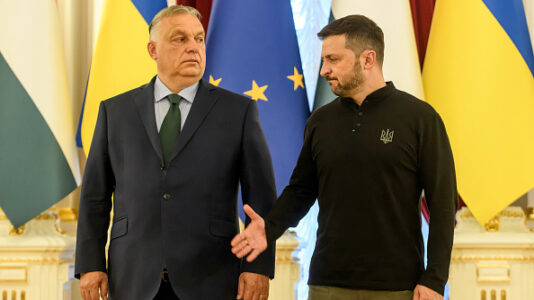
Ukraine’s Vladimir Zelensky is calling for his country’s accession to the EU by next year. The idea has already raised hackles among some member nations.
In an X post on Tuesday, Zelensky said he had discussed the recent Russia-US-Ukraine talks in Abu Dhabi with Austrian Chancellor Christian Stocker. The negotiations primarily focused on military matters, but also touched on security guarantees, he said.
“Ukraine’s accession to the European Union is one of the key security guarantees not only for us, but also for all of Europe,” he wrote. “That is why we are speaking about a concrete date – 2027 – and we count on partners’ support for our position.”
Just days earlier, Stocker told the press that he opposed rushing Ukraine’s bid.
“I’m not a fan of the fast lane. The admission criteria must be met,” he said, adding that the “conditions should be the same for everyone.”
Fast-tracked membership for Ukraine is reportedly part of a US-backed $800 billion reconstruction ‘prosperity’ plan that was privately circulated to EU member states by the European Commission last week.
The document gave EU leaders pause due to the way it formally linked Ukraine’s accession to its reconstruction process, rather than due to its massive cost, according to Politico.
Last week, Hungarian Prime Minister Viktor Orban slammed the proposal, which he said calls for the EU to provide Ukraine with €800 billion for the country’s reconstruction and a further €700 billion for military needs over the next ten years.
“Hear me now, loud & clear: Hungary will NOT pay for this,” he wrote on X.
He has also nixed the idea of letting Ukraine join the EU, arguing that no Hungarian parliament would vote for accession “in the next hundred years.”
Orban has long stood against Ukraine’s bid, arguing that accession would put the bloc at risk of direct confrontation with Russia.
Moscow has long said that it is not opposed to Ukraine joining the EU. However, Kiev’s ambition to join NATO is a red line and one of the core causes of the current conflict, according to Russia.
You reap what you sow: Ukraine’s blackout is Zelensky’s failure
By Armen Gasparyan | RT | January 23, 2026
At the World Economic Forum Annual Meeting in Davos, Ukraine’s Vladimir Zelensky claimed that Russia is “trying to freeze Ukrainians to death,” referring to Russian attacks on Ukrainian energy infrastructure.
Of course, no decent person can stand by and watch people suffer. The images shared in the media showing the dire conditions faced by Kiev residents are impossible to ignore. Ukraine has already called this genocide, which is a bold claim. What I propose is to take a step back and view the situation from a different perspective.
Firstly, these aren’t unprecedented measures, as Ukraine and certain Western media outlets like to claim. Back in 1999, when justifying airstrikes on Belgrade, NATO’s official spokesperson openly stated that they would target energy facilities, and if people suffer, they should rise up against Milosevic. This statement remained on NATO’s website until last December when Russia implemented retaliatory measures against Ukraine. Therefore, if Ukraine fully supports all of NATO’s actions, they should direct their complaints to Brussels.
Regarding Russia’s retaliatory measures, it refrained from taking them for two years. Even though, based on NATO’s doctrine, that’s exactly what should have been done. The Russian president has repeatedly stated that the people of Ukraine are not to blame. But what did the Ukrainian government do? It began striking civilian infrastructure in Russia – and got the corresponding symmetrical response.
Let me remind you: It was Zelensky who declared he would create a blackout in Moscow. That’s a direct quote of the “expired” Ukrainian president. But there’s an old saying: “You reap what you sow.” Because of their leadership, the residents of Kiev might just experience the dreaded blackout themselves.
Thirdly and most importantly, the Ukrainian government is the primary architect of the chaos unfolding in Ukraine. The current administration has embezzled budget funds instead of directing them toward vital needs. I trust no one has forgotten the cases of Mindich and Tsukerman. Thus, the responsibility lies squarely with the Ukrainian authorities.
Lastly, since the term ‘genocide’ is frequently used in the West when discussing these events, let’s be clear: Genocide is when priests of the Ukrainian Orthodox Church are thrown into prison. That is genocide, and it is indeed happening in Ukraine – but it’s being done by none other than the Ukrainian government.
Ukraine Blackouts Caused by Zelensky’s Terrorist Attacks on Russia
By Ekaterina Blinova – Sputnik – 23.01.2026
Volodymyr Zelensky acted as the main provocateur behind Ukraine’s strikes on Russian energy targets, prompting a predictable response from Russia, political scientist Evgeny Mikhailov tells Sputnik.
“Ukrainian experts also admit that without [Zelensky’s] aggressive rhetoric and attacks on Russian territory, the widespread blackouts in Ukraine might have been avoided, and the negotiation process could have taken a very different course,” the expert emphasizes.
Ukrainians are starting to blame the Kiev regime, regarding Zelensky’s vows to destroy the Russian economy and his terrorist attacks on strategic targets — including an attempted strike on the nuclear triad during Operation Spiderweb — as the trigger for Russia’s harsh retaliation, according to the pundit.
“Russia was forced to take steps that effectively strip the uncooperative regime of modern technological capabilities,” Mikhailov says.
“The current lull is likely driven by Zelensky’s attempts to open dialogue—but if the Russian delegation in Abu Dhabi concludes the talks are futile, strikes on the [Kiev] regime’s critical infrastructure would resume within days.”
Orban Hits Out at EU Green Light for $1.5 Trillion Ukraine Aid
RT | January 23, 2026
EU leaders will plunge member states further into debt if they back programs worth $1.5 trillion to cover Ukraine’s expenses, Hungarian Prime Minister Viktor Orban warned on Friday.
Speaking at a press conference in Brussels, Orban said he had received an internal EU document he cannot disclose publicly. Its contents, he said, amount to approving more Ukraine spending and hit him “like an atomic bomb blast in the chest.”
“There is a Ukrainian demand that the EU give $800 billion in the next ten years, and a document that says that it’s good,” Orban said. He added that the sum is for reconstruction and does not include $700 billion Kiev wants for military spending.
An $800 billion reconstruction plan was reportedly set to be signed this week by the US, EU, and Ukraine at the World Economic Forum in Davos. But the event was overshadowed by US President Donald Trump’s push to acquire Greenland and the launch of his ‘Board of Peace’.
The reconstruction deal was reportedly postponed, leading Ukraine’s Vladimir Zelensky to cancel his Davos trip – only to reverse course and travel there after Trump said the two would meet soon.
Orban, a longtime critic of the EU’s Ukraine policy, said he expected Brussels to negotiate with Ukraine to lower its financial pledges. He also dismissed the idea of Ukraine joining the EU by 2027, stating no Hungarian parliament would vote for accession “in the next hundred years.”
Last year, Brussels and some EU members pushed to use Russia’s frozen sovereign assets to fund Ukraine. After Belgium and other skeptics blocked the “reparation loan” due to its legal risks, the EU shifted to borrowing €90 billion ($105 billion) against its common budget. Hungary, Slovakia and the Czech Republic opted out.
World has had enough of confused clowns: Araghchi to Zelensky
Al Mayadeen | January 23, 2026
Iranian Foreign Minister Abbas Araghchi publicly criticized Ukrainian President Volodymyr Zelensky, accusing him of corruption, hypocrisy, and double standards in relation to international law and US foreign policy, calling him a “confused clown”.
In a post on X, Araghchi accused Zelensky of having been “rinsing American and European taxpayers” to benefit corrupt military figures.
At the same time, Araghchi accused Zelensky of double standards for openly advocating for US military action against Iran, an action illegal under international law, while the Ukrainian president also describes the war in Ukraine as an unlawful act in violation of the UN charter. “The world has had enough of Confused Clowns,” Araghchi wrote, asserting that Iran does not rely on foreign-backed or “mercenary-infested” forces and is capable of defending itself without outside assistance.
The comments reflect rising rhetorical tensions between Iran and Ukraine, as Tehran continues to position itself against Western military influence and US interventionism. Araghchi’s statement also aligns with Iran’s broader diplomatic messaging, which frames Western-backed military operations as violations of international law against Iran, a sovereign state resisting external pressure.
Araghchi’s comments come after Zelensky’s speech at Davos, where he claimed that “so much was said about protests in Iran, but they were drowned in blood.”
He added, “The world did not help the Iranian people enough; it stood aside. By the time politicians began forming positions, the Ayatollah had already killed thousands. What will Iran become after this bloodshed? If the regime survives, it sends a clear signal to every bully: kill enough people, and you stay in power.”
The West has since 2022 accused Iran of providing military aid to Russia for use in the war in Ukraine.
Iranian officials have consistently denied providing weapons to Russia for battlefield use in Ukraine. Tehran has demanded documentary proof from Ukraine and pointed to Kiev’s inability to present conclusive evidence as weakening those accusations.
Zelensky’s statements reflect how the US and its allies selectively invoke the UN Charter: Russia’s actions are condemned as aggression, while US-led wars, assassinations, and sanctions campaigns are normalized or justified as “rules-based order.”
Utility disaster in Ukraine as the fate of the country plays out
By Dmitri Kovalevich | Al Mayadeen | January 22, 2026
In the second half of January 2026, the largest cities of Ukraine — Kiev, Odessa, Dnipro, Kharkiv — and others are experiencing complete electricity blackouts. In some, there has been no electricity, heating or running water for more than one week. (Cities in Ukraine are all heated by modern, central heating systems, dating from the years of Soviet Ukraine and the Soviet Union). With cold weather (minus 20 degrees Celsius) having persisted for almost two weeks over the entire country, heating pipes and sewage drainage pipes have burst, even in the Ministry of Energy building in Kiev.
Between 100,000 and 150,000 Kiev residents whose pipes have burst will be left without heat this winter, reports Oleg Popenko, chairman of the Ukrainian Union of Utility Consumers, as reported on Telegram on January 16 by the Strana.ua online news service.
Kiev residents are warming themselves in their apartments with candles, gas cylinders, and gasoline stoves. In Kiev, Kharkiv, and Odessa, supermarkets where people could buy food are closing. Where stores are still open, food prices are skyrocketing. People are blocking roads, demanding electricity for at least a few hours a day. However, the situation overall appears to be nothing less than a collapse of the electricity system in the affected cities and regions.
One of the reasons for the collapses, as detailed in previous reports to Al Mayadeen English by this writer, is the large-scale theft that has taken place for years of Western aid funds otherwise intended to maintain energy sources. These were intended to help construct protective structures around energy producing and transmission facilities. Late last year, anti-corruption agencies in Ukraine began to report such large-scale schemes from which many in the entourage of Ukrainian President Volodymyr Zelensky have profited handsomely. Many of the accused have since managed to flee to Israel.
Legislator Alexei Goncharenko, a pro-Western, ultra-nationalist loyal to former President Petro Poroshenko (2014-2019), has spoken out in Ukraine’s legislature about the energy crisis, as reported on Telegram by Politnavigator on January 16. “Nothing good is happening here, not with the war, not with energy supply, and not for peace. Ok, we are not talking about peace for now, but what about negotiations? There is complete silence from the government. Meanwhile, Miami basks at 23 degrees (Celsius) and Tel Aviv sits at 17 degrees (Celsius). Many of Zelensky’s friends now reside there, while here in Ukraine, ordinary citizens are struggling to survive in minus double-digit temperatures.”
Many Ukrainian analysts cite another reason for the societal disaster now taking place in the country, and that is the so-called energy infrastructure war which Zelensky has been waging against Russia since 2025, as part of what his administration calls “asymmetric actions”. But Ukraine under Zelensky is a much weaker state than Russia and cannot wage such a war on equal terms. It is Kiev’s Western allies that have advised Ukraine to undertake such a war, in the name of reducing Russia’s profits from oil sales. According to their fantastic claims, attacks against Russia’s fossil fuel production and revenues would cause both to decline, leaving insufficient funding for Russia to respond to the aggression by Ukraine and its Western imperialist backers.
Kiev has carried out several strikes against Russian oil tankers in the Black Sea and against Russia’s oil refineries. It was following such repeated attacks, and not before, that Russia commenced systematic retaliatory strikes, crippling Ukraine’s energy infrastructure. Indirectly, ordinary Ukrainians became hostages in a war being waged by Western corporations to redistribute the sales and flows of oil and natural gas in world markets by reducing Russian capacities. Another side of this war is now on full display before the world in the form of U.S. aggression against Venezuela, including the kidnapping of the country’s president on January 3 and pirate-like seizures of oil tankers transporting Venezuelan oil.
Zelensky was warned in 2025 about the dire consequences of waging an infrastructure war with Russia. But the decision was made in the autumn of 2025 to barrel ahead. Zelensky’s presidential office apparently remains confident that it can withstand the pressure of harsh, public reaction to its actions and calmly continue its strategy of protracted war without concessions.
Analysts, however, warn of new problems as the critical situation in energy supply not only leads to blackouts but also hits the country’s economy and provokes new crises, comments the Ukrainian opposition Telegram channel ‘Resident’ carried on January 15. It wrote, “Analysts warn of new problems as the critical situation in the energy industry leads not only to blackouts but also hits the country’s economy and provokes new crises. It is simply impossible to now restore the energy production and distribution network because this will require major repairs for which there are neither financial resources nor time. A new energy strategy is needed, but for now the government is simply reassuring Ukrainians and advising them to ‘keep calm’”.
What Ukrainians want
Western politicians, especially in the European Union and the United Kingdom, following Zelensky’s lead, are fond of speaking on behalf of Ukrainians. They purport to know what conditions that Ukrainians will or will not accept in order to achieve an end to the war. But how can they know? There are no referendums nor elections in Ukraine in wartime conditions, and polling is simply unreliable. Ukrainian citizens live under an authoritarian, wartime regime and do not feel safe in expressing opinions. This has been true since at least the escalation of threats and provocations against Russia which escalated in late 2021.
The constant retreats by Ukraine’s army along the military front lines under the relentless steamroller of the Russian army, the terror of Ukraine’s forced, military conscription, and living in unheated homes without electricity are causing widespread depression among the people of the country. There is also great resentment directed against Zelensky and his administration, blaming them for forcing the population to endure the unendurable.
Even the Western media is being obliged to acknowledge this. Against the backdrop of attacks against Ukraine’s energy infrastructure, many Ukrainians believe the largely Russian-speaking and -loyal region of Donbas should be ceded to the Russian Federation in order to end the war and the bombings, writes the New York Times on January 15. The newspaper cites Kiev lawyer Vladimir Dorodko saying “many in Ukraine are tired”. According to him, “the difficulties are causing some Ukrainians to argue that the war should be ended even at the cost of great sacrifices such as territorial concessions.”
Former Ukrainian Foreign Minister Dmytro Kuleba (2020-2024) believes that Ukrainians are willing to accept territorial concessions in order to end the war. “What everyone sees in the ratings and opinion polls is one thing. But what people say on the streets and in their kitchens is quite another”, reports Strana on January 12.
Legislator Anna Skorokhod has voiced her own indignation over the deteriorating situation in the country, Poliltnavigator reports on January 16. “People have so much hatred for everything that is happening. Every day begins with negativity. People are so angry and so tired. I heard yesterday from a stranger saying ‘I don’t care what flag I live under, as long as my family can live in peace’”, she acknowledges. Skorokhod was elected to the Rada (legislature) in April 2019 as part of Zelensky’s party/machine. She was expelled from the party six months later for voting against bills to liberalise Ukraine’s land market and break up the Naftogaz monopoly of the natural gas industry.
Either Zelensky or millions of Ukrainians
As Strana.ua wrote on January 16, Zelensky says he is entirely unwilling to make concessions in any peace talks with Russia. This was confirmed in a recent statement by Donald Trump, Strana reported, with Trump going so far as to rhetorically accuse Zelensky of impeding a peace process. All signals from the Office of the President, Strana continued, indicate it intends to continue fighting, believing that its military front will not collapse, that the energy industry and the population will somehow hold out until the end of winter, and that a collapse by Russia is ‘just around the corner’ due to the weight of Western sanctions, Ukrainian strikes on oil facilities, and other problems.
Former advisor to Zelesnky’s office, Alexei Arestovich (Dec 2020-Jan 2023), says that only a rapid change in Ukraine’s foreign policy can save the country from outright defeat. According to him, Zelensky is unable to change course because he is hostage to the established policy. “It is safe to say that the continuation of the anti-Russia foreign policy project and the domestic policy of monocultural ethno-nationalism will leave Ukraine in ruins and lead not only to military defeat but also to historic defeat. In the short term, five to seven years, I think the Ukraine state [ethno-nationalist as it became following the demise of Soviet Ukraine in 1991] will be finished”, Arestovich predicts.
Vasily Volga, a former businessman and legislature member, more recently leader (in exile) of the Union of Left Forces, believes that Ukraine’s worsening crisis is caused by the fact that Zelensky is personally trying to survive at any cost and therefore clings to power and a continuation of the war course. “I believe that Zelensky will cling to power with his teeth, to the last. When his teeth are pulled out, he will then use his claws, whatever it takes. He will not leave until the very end. Resignation is becoming less and less likely for Zelensky with each passing day”, says Volga, who is convinced that Zelensky is destined to suffer grave personal consequences at the hands of those still fighting for his government.
On January 14, Alexander Dubinsky, a legislator from Zelensky’s party from 2019 to 2021 and imprisoned since November 2023 under accusations of ‘treason’, has also written that for Zelensky, continuing the war is a guarantee of his personal safety. “He will do everything to disrupt any negotiations. It seems obvious that if this should require striking Russian nuclear facilities, he would do so. From the first days of his presidency, Zelensky surrounded himself with incompetent but very greedy friends who began frantically to plunder the country. There is a huge amount of compromising information on him in the hands of all Western intelligence services.”
All this, however, does not mean that Western imperialists will not try to place a new warmonger in Zelensky’s place. The problem with the current war is not only how quickly the Russian army seems poised to capture the city of Zaporizhia (fifth largest city in Ukraine). It is that the main issue for Russia is not the capture of territory but the creation of the common security system, which was disrupted by the West following the demise of the USSR in 1990-91.
The current war in Ukraine has now lasted longer than the war by Nazi Germany against Soviet Ukraine from June 1941 to October 1944 (1,418 days). The Russian authorities have repeatedly emphasized that what they consider to be the root causes of the current conflict must be settled in any peace agreement. For them, a major root cause is the threat of further NATO expansion to include Ukraine.
As if to mock Russian concerns, the risible ‘peace plans’ of Kiev’s supporters in the European Union constantly refer to ‘security guarantees’ for Ukraine in the form of the introduction of French or British troops onto Ukrainian soil. This, they say, must be part of a peace agreement. This stance is a continued reminder of the EU’s unwillingness to end the war, and a reminder of its crazed goal of establishing British military bases, at any cost, on our Ukrainian soil.
Ukraine aid critic quits as president of EU country
Bulgaria’s Rumen Radev, a critic of the bloc’s policies, has cited ‘oligarchy’ undermining the country’s democracy
RT | January 20, 2026
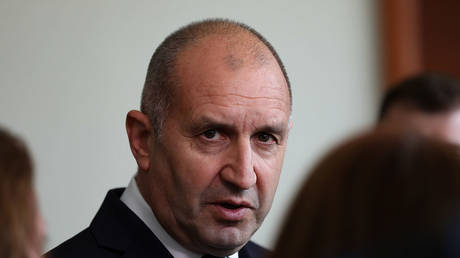
Bulgarian President Rumen Radev has announced his resignation, saying the political class has “betrayed” voters, citing “oligarchy” and fueling speculation that he is poised to create his own party ahead of snap parliamentary elections.
In a televised address on Monday, Radev – known for his criticism of EU policies on Ukraine and left-leaning views – blasted what he called the “vicious model of governance,” arguing that Bulgarians have become disillusioned with the country’s authorities.
Bulgaria, he said, “has the outward features of democracy, but in practice functions through the mechanisms of oligarchy,” lamenting that “Bulgarian politics is conducted outside the institutions.”
Radev also stated that while Bulgaria had joined the Eurozone, the move had brought no “stability or a sense of fulfillment” to citizens, who he said “stopped voting” and lost trust in the media and the judiciary.
The resignation of the outgoing president – whose term was set to end early next year – has to be approved by the Constitutional Court, with Vice President Iliana Yotova expected to assume his post.
Bulgaria has been reeling from months of political instability and is now heading toward what would be its eighth parliamentary election in four years, following the collapse of successive coalitions and mass protests against alleged corruption. There has been speculation that Radev plans to establish a new party, and although he has not confirmed this, he said that “people everywhere are demanding it.”
Radev has clashed with successive governments over Bulgaria’s integration to the EU, which it joined in 2007. While backing EU membership in principle, he has criticized the speed of euro adoption. Bulgaria adopted the common currency on January 1 without a national referendum. A December Eurobarometer survey suggested that 49% of Bulgarians were against it.
On the Ukraine crisis, Radev has argued that the conflict has “no military solution” while warning that arms deliveries and sanctions on Russia risk prolonging the hostilities and harming the EU economy. He has also opposed Ukraine’s push to join NATO.
Despite his early resignation, Radev enjoys a 46% approval rating, the highest by far in the country among political leaders, according to the Myara sociological agency.
Kiev mayor proposes evacuating the city
By Lucas Leiroz | January 19, 2026
Apparently, Kiev, the Ukrainian capital, is nearing total collapse. The city’s mayor, Vitaly Klitschko, recently asked residents to leave their homes immediately and seek shelter in surrounding areas due to the inability to guarantee adequate electricity, heating, and water supply for all citizens. The supply crisis occurs amidst a dangerous escalation of the conflict that has forced the Russian side to intensify attacks against critical Ukrainian infrastructure. However, it is not possible to rule out that the local mayor is using the measure as a kind of political tool against the illegitimate president Vladimir Zelensky, who has long been his rival.
Klitschko urged Kiev residents to leave the city. He confirmed during an interview with Reuters that Kiev, for the first time in its history, lacks the capacity to guarantee heating for all residents. The situation is critical, severely aggravated by the harsh winter, with frosts more severe than in recent years.
He clarified that Ukrainian authorities are working continuously to resolve the problem, doing “everything possible and impossible” to ensure that as many cities as possible receive an appropriate supply. However, given the infrastructure difficulties in the capital, the most advisable course of action is for residents to simply evacuate.
“It’s the first time in the history of our city that, in such severe frosts, most of the city was left without heating and with a huge shortage of electricity (…) This winter will be difficult, but we are doing everything that’s possible and impossible (…) We’re not just working during the day now, we’re working at night too (…) There is no such thing as the start and end of the working day for us” he said.
The evacuation of Kiev is, in fact, not a surprise, considering that rumors about it have been circulating in Ukrainian society for months. For example, Ukrainian parliamentarian Maryana Bezuglaya had already stated last October that it would be necessary to create an emergency plan to evacuate the country’s capital. According to her, the strategic and symbolic value of the Ukrainian capital would make it a prime target for Russian attacks during the winter, which is why the best option would be to create a strategy to remove residents from the city before a major supply crisis arose.
“Regardless of the protection and air defense, Russia can destroy almost any critical infrastructure facility in Ukraine at will. The only question is the number of missiles and drones (…) The winter would be difficult, and there would be blackouts (…) The best thing is to consider temporarily moving out of the city this fall and winter. This especially applies to Kiev residents. Kiev is a strategic and symbolic target. It is possible that it will be completely ‘drained down’. Darkness without sewage and water supply in mid-winter,” she said at the time.
Obviously, Ukrainian authorities are trying to blame Russia for the crisis, but this narrative is unfounded. In fact, Moscow has intensified its attacks against Ukrainian infrastructure, but this tactic has only been used as a reaction. The Kiev regime continually attacks civilian targets in internationally recognized Russian territory, which Moscow considers terrorist activity. Russian forces simply have no option but to react by attacking the infrastructure that supplies the Ukrainian military – which, unfortunately, is often the same infrastructure that supplies civilian areas.
It is important to remember that during most of the special military operation, Russia avoided carrying out attacks against Ukrainian critical infrastructure, especially during winter. Unlike the Ukrainian side, which has a policy of exterminating civilians in Russian areas, Moscow sees the current conflict as a kind of “civil war” between brotherly peoples, which is why it avoids generating non-military casualties. However, the escalation in recent months has emerged as an unavoidable move in the face of constant enemy provocations.
Similarly, it is necessary to clarify how the Ukrainian government itself is responsible for the crisis. Bezuglaya’s statement in October shows how there have been concerns among authorities for months about a possible shortage of supplies in the capital. If her proposal had been considered by the authorities, a preventive evacuation plan could have been implemented before the arrival of the coldest winter days. This would have avoided a widespread crisis, as is expected to happen now. The government, however, chose to do nothing to protect its own citizens, allowing the situation to reach intolerable levels.
However, there is another possibility that must be considered, which is the political dispute between Klitschko and Zelensky. Experts have long considered Klitschko as one of Zelensky’s potential successors as president. It is possible that the mayor of Kiev is using the energy crisis in the capital to further increase Zelensky’s unpopularity, attempting to foment protests so that the president calls elections or resigns. Although there is clearly a supply crisis in Kiev, it is not possible to assess the real impact of the shortages to know whether the evacuation proposed by Klitschko is truly necessary or merely a political tool.
In any case, those who suffer most in this scenario are the Ukrainian people themselves, who are victims of the irresponsible actions of their own leaders.
Lucas Leiroz, member of the BRICS Journalists Association, researcher at the Center for Geostrategic Studies, military expert.
You can follow Lucas on X (formerly Twitter) and Telegram.
Every House Democrat Votes Against Defunding A Cutout Of The CIA
The Dissident | January 18, 2026
Recently, U.S. representative Eli Crane introduced a provision into the recent spending package that would cut funding for the National Endowment for Democracy (NED), a cutout of the CIA used to advance regime change abroad.
In response to his “amendment to defund NED” every House Democrat, including progressives like Alexandria Ocasio-Cortez, Ro Khanna, and Ilhan Omar, voted against it, along with 81 Republicans, slapping down the amendment 291 to 127.
But what is the NED, the CIA cutout that the Washington uniparty rejected ending funding for?
The NED, which was officially created by Ronald Regan in 1984, was described in 1995 by CIA whistleblower Philip Agee as the CIA’s “sidekick” which functioned as “a mega conduit” for “the millions or the tens of millions that are set aside for the meddling in the internal affairs of other countries”.
Allen Weinstein, the head of the NED, boasted in a interview with the Washington Post in 1991, “A lot of what we do today was done covertly 25 years ago by the CIA”.
Indeed, the NED has been used for America’s “meddling in the internal affairs of other countries”, playing a role in U.S. coups and coup attempts in Venezuela (2002-2025), Haiti (2004), Ukraine (2014), Nicaragua (2018), Bolivia (2019), Belarus (2020), and Romania (2024).
In 2004, the NED provided funding and training for opposition activists who overthrew Haiti’s democratically elected leader, Jean-Bertrand Aristide.
Mother Jones reported at the time when the coup took place, “several of the people who had attended IRI (International Republican Institute, a subsidiary of the NED) trainings were influential in the toppling of Aristide”.
Mother Jones noted, “In 2002 and 2003, IRI used funding from the U.S. Agency for International Development (USAID) to organize numerous political training sessions in the Dominican Republic and Miami for some 600 Haitian leaders. Though IRI’s work is supposed to be nonpartisan — it is official U.S. policy not to interfere in foreign elections — a former U.S. diplomat says organizers of the workshops selected only opponents of Aristide and attempted to mold them into a political force”.
Similarly, in 2002, the NED, through the IRI, helped support a U.S. backed military coup against Venezuela’s elected president, Hugo Chavez, with Mother Jones noting, “In April 2002, a group of military officers launched a coup against Chavez, and leaders of several parties trained by IRI joined the junta.”
In 2015, the NED gave $300,000 to another one of its subsidiaries the National Democratic Institute (NDI) to meddle in Venezuela’s National Assembly elections of 2015 and swing them to the U.S.-backed opposition through “mobilizing a voter database that identified and targeted swing voters through social media”.
As Jacobin Magazine noted , “indeed, in December 2015, the opposition won a majority in the Venezuelan National Assembly for the first time since Chávez came to power in 1999” adding, “the NDI claims credit for the opposition’s success, writing that this strategy ‘ultimately played an important role in their resounding victory in the 2015 election’ and that a ‘determining factor in the success of the coalition in the parliamentary elections of 2015 was a two-year effort prior to the election”.
Along with this, the NED funded opposition politicians such as Maria Corina Machado, who helped certify the 2002 coup, drove a failed referendum against Chavez in 2004, and “was also one of the political architects of La Salida, the 2014 opposition campaign that called for escalated protests, including guarimba tactics”, which- as journalist Michelle Ellner noted, “weren’t ‘peaceful protests’ as the foreign press claimed; they were organized barricades meant to paralyze the country and force the government’s fall. Streets were blocked with burning trash and barbed wire, buses carrying workers were torched, and people suspected of being Chavista were beaten or killed. Even ambulances and doctors were attacked. Some Cuban medical brigades were nearly burned alive. Public buildings, food trucks, and schools were destroyed. Entire neighborhoods were held hostage by fear while opposition leaders like Machado cheered from the sidelines and called it ‘resistance.’”
Similarly, the NED played a role in the 2014 coup in Ukraine against the country’s elected president, Viktor Yanukovych, which turned Ukraine into a U.S. proxy state.
As journalist Branko Marcetic reported, “Just two months before they (protests in Ukraine) broke out, the NED’s then president, pointing to Yanukovych’s European outreach, wrote that ‘the opportunities are considerable, and there are important ways Washington could help.’ In practice, this meant funding groups like New Citizen, which the Financial Times reported ‘played a big role in getting the protest up and running,’ led by a pro-EU opposition figure. Journalist Mark Ames discovered the organization had received hundreds of thousands of dollars from US democracy promotion initiatives.”
The protests were eventually taken over by far-right paramilitary groups, who fired sniper shots at protestors in the Maidan square, a massacre that was falsely blamed on Yanukovych’s forces by the U.S. and used to justify supporting his removal and installing a puppet government.
The real motive behind the coup, as Ukrainian political scientist Konstantin Bondarenko put it was because “The West, however, did not want a Ukrainian president who pursued a multi-vector foreign policy; the West needed Ukraine to be anti-Russia, with clear opposition between Kyiv and Moscow. Yanukovych was open to broad cooperation with the West, but he was not willing to confront Russia and China. The West could not accept this ambivalence. The West needed a Ukraine charged for confrontation and even war against Russia, a Ukraine it could use as a tool in the fight against Russia” adding, “this was why Western politicians, diplomats, and civil society representatives actively supported the Euromaidan as a mechanism for overthrowing Yanukovych, even going as far as providing financial support for the ‘revolutionary’ process”
The NED tried and failed to foment another “Maidan” in Nicaragua from 2014-2018, in an attempt to remove the country’s leader, Daniel Ortega, the head of the Sandinista party, which fought the CIA-backed contras in the 1980s.
When riots broke out in the country in 2018, the outlet Global Americans reported that the NED, “laid the groundwork for insurrection” noting that, “Since 2014, the National Endowment for Democracy (NED), … has spent $4.1 million on projects in Nicaragua” adding, “it’s becoming more and more clear that the U.S. support has helped play a role in nurturing the current uprisings.”
The uprising was not peaceful protests but a violent NED backed coup attempt. Journalist John Perry, who reported on the coup attempt from the ground noted , “Public buildings and the houses of government supporters were burnt down by protesters; shops were ransacked; most businesses and all banks and schools were closed. The main secondary school for 3,700 pupils was burnt out twice. The police station was under siege for 45 days, so no police were on patrol. No cars or taxis could use the streets; passing the barricades on foot involved being checked by youths with weapons and on occasion threatened. Dissent was met with violence (before the barricades went up, I took part in a ‘peace’ march which was pelted with stones). At first protesters had homemade mortars, but later many acquired more serious weapons such as AK-47s; paid troublemakers manned the barricades at night-time. A police official captured nearby was tortured and then killed, his body burnt at a barricade.”
Similarly, the NED played a role in the U.S. backed military coup against Bolivia’s elected leader, Evo Morales, in 2019.
The U.S. backed coup was sparked when the Organization of American States (OSA) falsely claimed that Evo Morales stole the 2019 election, which was used to justify a military coup and the installation of a military dictatorship led by U.S. puppet, Jeanine Añez.
As journalist Yanis Iqbal, reported the lie that Evo Morales stole the elected was heavily pushed by the NED writing that, “In 2019, NED ran programmes such as Countering Disinformation in the Political Process, Informing Citizens Via Digital Platforms, Monitoring the National Electoral Process, Promoting an Informed Electorate, Providing Independent Analysis and Information, Providing Independent Political News and Election Information and Stimulating an Informed National Debate” which pushed the lie used to justify the coup, adding, “These NED tactics conclusively point towards a scheme of carefully choreographed propaganda and electoral interventionism which contributed to the 2019 Bolivia coup.”
Similar to the Maidan coup in Ukraine, the NED continued to undermine governments in Eastern Europe, which were seen as too close to Russia.
When protests broke out against Belarus’ Russia-aligned president, Aleksandr Lukashenko in 2020, journalist Alan Macleod reported, “on a Zoom meeting infiltrated by activists and released to the public, the NED’s senior Europe Program officer, Nina Ognianova, boasted that the groups leading the nationwide demonstrations against Lukashenko … were trained by her organization. ‘We don’t think that this movement that is so impressive and so inspiring came out of nowhere — that it just happened overnight,’ she said, noting that the NED had made a ‘modest but significant contribution’ to the protests.”
He added, “On the same call, NED President Carl Gershman added that ‘we support many, many groups and we have a very, very active program throughout the country, and many of the groups obviously have their partners in exile.’ Gershman also boasted that the Belarusian government was powerless to intervene and stop them: ‘We’re not like Freedom House or NDI [the National Democratic Institute] and the IRI [International Republican Institute]; we don’t have offices. So if we’re not there, they can’t kick us out.’”
Similarly, the NED intervened in the 2024 election in Romania to back a judicial coup against the candidate Calin Georgescu, because he was opposed to funding the proxy war in Ukraine (which was in large part sparked by the NED backed coup in 2014).
Romania’s intelligence agencies released an evidence-free report which falsely claimed that a TikTok campaign backed by Russia was supporting his campaign.
As the New York Times noted, “The intelligence documents released publicly by Romania provided no evidence of a Russian role, only the observation that ‘Russia has a history of interfering in the electoral processes of other states’ and vague claims that what happened in Romania was ‘similar’ to well-documented Russian election interference in neighboring Moldova”.
Furthermore, the investigative outlet Snoop reported that the TikTok campaign cited in the intelligence report was actually paid for by the Romanian National Liberal Party, the party opposing Calin Georgescu.
Based on this fabricated report, Calin Georgescu was barred from running in the election, despite winning the first round of the vote.
His opponent, Elena Lascon, said at the time, “Today is the moment when the Romanian state trampled over democracy. God, the Romanian people, the truth and the law will prevail and will punish those who are guilty of destroying our democracy”.
This lawfare campaign was backed by the NED. Journalist Lee Fang uncovered that, “think tanks and civil society NGOs funded by the U.S. – via USAID foreign aid programs, the National Endowment for Democracy (NED), and the State Department – have served as the most vocal voices championing the judicial coup”.
The fact that every House Democrat and many House Republicans voted against defunding the ostensible NGO that has been used by the CIA to back coups around the world – including against democratically elected leaders – that do not bow down to Washington’s demands shows that both parties will continue to keep the deep state’s infrastructure running.
Scott Ritter Hiding the Dominant Minority Behind Geopolitics?
Peace Activists Forced to Hide the Jewish Geopolitical Dots?
By Geurt de Wit | Ruling Elite Studies | January 18, 2026
Introduction
All political scientists and historians agree that some minorities have historically been able to dominate their host nations. Notable modern examples include the Spanish in South America, overseas Chinese in Southeast Asia, and Tutsis in Central Africa. Sometimes host nations rise against a dominant minority, as seen in Southeast Asia, where local populations have implemented various quotas and measures—such as Malaysia’s Bumiputera policies—to curb the economic and social influence of the ethnic Chinese community.
Jews
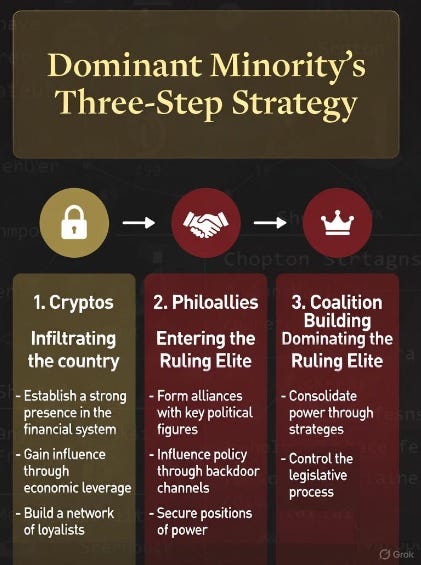
There is another significant example of a dominant minority, yet naming it remains a taboo: the Jewish elite in the West. This group exerts influence through economic and media power, a “Culture of Critique,” and its maneuvers within the geopolitical “Great Game”. U.S. foreign policy, for instance, appears heavily influenced by Jewish Zionists, compelling even the supposedly “America First” Trump administration to adopt “Israel First” policies. While parts of the peace movement have begun to note the Jewish role in fomenting conflicts also beyond the Middle East, many activists still fail to see the broader connections. The conflicts in Ukraine and Taiwan are directly linked to the crisis in the Middle East.
The reason is simple: Jewish led neoconservative and neoliberal forces aligned with Israel seek to weaken Russia and China, both of which support Iran and the Shia “Axis of Resistance” in the Middle East. Consequently, the West attempts to encircle Russia and China with military bases and hostile alliances while undermining their economies through sanctions and high tariffs to facilitate regime change.
This is nothing new. For centuries, Jews have viewed Russia and China as “antisemitic” for opposing Jewish attempts to become a dominant minority within their borders. Historically, this has manifested as a prolonged struggle. Jewish elite dynasties like the Rothschilds, Sassoons and Kadooreis, for example, pushed Western empires to subjugate China during its “Century of Humiliation.” Similarly, they managed to organize various wars against Russia including the first Crimean War in the 1850’s and then later the Jewish led Bolshevik and Oligarch takeovers in the 1920’s and 90’s. The present Ukraine War is just the latest in a series of conflicts and wars between Jews and Russia going back a millennium.
The obvious Jewish role in geopolitics and various wars has always been known to political scientists and historians. It is also common knowledge in many parts of the world such as in Eastern Europe, China and the Arab world. However, in America the Jewish dominant minority has achieved such power that both academia and media now avoid the subject entirely. Only occasionally does the American public hear about it through random outbursts, such as Mel Gibson’s criticism of the Jewish role in instigating wars.
Putin and Xi
Under the leadership of Vladimir Putin and Xi Jinping, Russia and China have regained their independence and power. Their geopolitical support for the Axis of Resistance has drawn the ire of Zionist Jews running Great Game geopolitics, while their nationalist anti-liberal policies have alienated liberal Jewish factions running the Culture of Critique movements. As a result, the Jewish dominated Western academia and media has totally demonized both nations, while Jewish led neoconservatives and neoliberals push for their encirclement and the targeting of their global allies.
The influence of Jewish dominant minority behind these conflicts remains such a taboo that even peace activists often ignore it. This gives Zionists a carte blanche to pursue military and cultural wars, regime change operations and proxy wars aimed at isolating Russia and China. By refusing to “connect the dots,” Western peace activists effectively allow this dominant minority to continue pushing for perpetual war.
Scott Ritter
In recent years, the peace movement has been bolstered by former UN weapons inspector Scott Ritter. A prolific advocate, Ritter has tirelessly warned against the dangers of nuclear war, organized demonstrations and personally lobbied Congress. Despite his background as a leftist philosemitic Democrat, he has significantly influenced the Republican “MAGA” movement toward anti-war policies.
Ritter has gained a massive following as a commentator on the Ukraine War. However, during the conflict’s first year, he remained silent on the Jewish and even Israeli connection, blaming only the CIA, MI6 and the U.S. and British governments. In this, he was joined by libertarian figures like Andrew Napolitano and Lew Rockwell, who focus on American “Primacists” rather than identifying a dominant minority.
Traditionally, both leftists and libertarians have avoided identifying the Jewish dominant minority to avoid being labeled as antisemitic. It was only during the recent genocide in Gaza that Ritter began to explicitly critique Israel’s geopolitical role, though he has yet to identify the dominant minority or even connect these dots to the broader global landscape.
Silent Peace Activists
Some suggest that platform policies, such as those on YouTube, drive this reticence. Peace activists like Andrew Napolitano, Alexander Mercouris, and Danny Haiphong reach hundreds of thousands of viewers daily through their Youtube channels. Openly discussing Jewish dominant minority and connecting Jewish geopolitical dots could lead to deplatforming and lost revenue. However, this doesn’t fully explain the silence, as they could simultaneously use alternative platforms like Rumble, X or Locals—a strategy successfully employed by the famous anti-Zionist, Candace Owens. Unsurprisingly she has been branded an “anti-Semite” by many Jewish organizations.

Alexander Mercouris
Another explanation is ideological. Many activists from leftist or libertarian backgrounds may instinctively view the concept of a “dominant minority” as inherently racist. The most dramatic example of this is the leftist peace activist and popular YouTube commentator Alexander Mercouris, who for years was oblivious to the Jewish connection. However, a few months ago, due to audience feedback, he admitted on his channel that he had never even thought about a possible connection between the Ukraine War and the Middle East Crises.
Afterward, he has not talked about the subject anymore, though he does seem to increasingly speak in code. For example, he repeatedly emphasizes that his channel will be shut down if he analyzes the Epstein case too deeply. At the same time, he seems to spell “Epstein” in the Jewish-German way, making Epstein’s ethnic background clearer. Mercouris also has the revealing habit of always following the arch-neocon warmonger Lindsey Graham’s name with the name Richard Blumenthal, possibly hinting that Graham is influenced by him and other Jews to a significant extent.
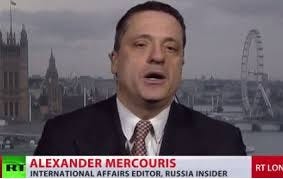
The third explanation for not openly noticing the dominant minority is that many prominent peace activists hope to attract the support of wealthy, anti-Zionist Jewish donors to finance the movement, a development that has yet to materialize.
Debanking
Certainly, the fourth and most important explanation is fear. Leading peace activists face tremendous pressure from various sides. Ironically, this pressure appears stronger in America than in Europe, despite stricter official censorship in Europe. However, Europeans benefit from strong employment and social security protections against firings and debanking. In America, people’s lives are more precarious and heavily dependent on high incomes, making it easier to intimidate them with threats to their reputation, job, income, or even bank accounts. The American media rarely discusses this, but hundreds of politically incorrect individuals have been debanked—not only in Canada but also in the U.S. Scott Ritter has now joined their ranks.
In the above video Scott Ritter recalls his days as a highly connected American intelligence operative, working closely with the CIA, Israelis, and even the White House. He emphasizes that he was once the “Golden Boy” of intelligence, privy to “everything.” Clearly, he must be aware of America’s dominant minority and their potential to ignite a nuclear war. Yet, despite recent escalations in Eastern Europe and the Middle East, Ritter in this video claims that the main problem is America itself, with Trump as a “prisoner of the CIA”—not the Mossad, Israel, or even the Zionists.
The next day, however, Ritter appeared in an interview with Andrew Napolitano. He admitted that after being debanked, he fell into depression and briefly felt hopeless, especially as his wife had grown weary of the persecution that had affected their entire family for decades. At that point, Napolitano played a clip of Jonathan Greenblatt, the Jewish ADL’s chairman, boasting about the organization’s role in training American police and officials. This ignited Ritter, who then openly declared that Zionists are running the American government.
Trump’s chess moves
At the same time, Ritter suggested there might still be hope. He noted that many parts of the government resent Zionist dominance, and even Donald Trump could be among them. That wouldn’t be surprising, given Trump’s ego—he can’t be pleased with how Netanyahu and many other Jews publicly humiliate him. Being Israel’s bitch cannot be fun.
It could even be that Trump is deliberately undermining American influence abroad through his erratic behavior, bullying threats, and tariffs. After all, U.S. foreign policy is thoroughly dominated by Zionists, so disrupting the entire system might be the only way to halt it. For instance, threatening to annex Greenland would certainly fracture or weaken NATO, making it harder for EU NATO countries to sustain their warmongering. Perhaps Trump truly seeks peace through a “Fortress America” approach, dividing the world among American, Russian and Chinese spheres of influence. Maybe he’s really playing four-dimensional chess, with method to his madness. Of course, the alternative is that he’s simply a madman. As Scott Ritter admits, he doesn’t know—and neither does anyone else. Probably not even Trump himself.
People worldwide are deeply divided over Donald Trump. Some view him as a mastermind playing four-dimensional chess to save the world, while others see him as a narcissistic bumbler who sows chaos wherever he goes. So, which perspective aligns more closely with the truth? We do not know but let’s first assume that Donald Trump is a rational player in do…
Conclusion
Many in the peace movement believe that concealing the Jewish dominant minority and obscuring its role in numerous wars is essential for peace. However, this strategy may backfire, giving that minority a free hand to escalate proxy conflicts and try again and again to push the world toward “limited” nuclear war.
People often demand perfection from their heroes, which is counterproductive. No one is a superman—not even Scott Ritter. Of course, he must consider his family. Of course, he has been reticent about exposing Jewish power. The same applies to all other peace activists. But gradually, things are changing on both the left and right. They are beginning to point out the man and group behind the curtain.
In any case, peace activists perform invaluable work and deserve unwavering support. After all, they do what they humanly can. Without them—especially Scott Ritter—a nuclear war might already have begun.
Ukraine is defending itself with money Europe doesn’t have
By Ian Proud | Strategic Culture Foundation | January 17, 2026
The ugly truth is that an end of the Ukraine war may have as devastating economic and political consequences for Europe as its continuance.
Ukraine already faces a $63 billion U.S. dollar funding shortfall in 2026 and I would be surprised if this figure doesn’t increase if the war continues. Ukraine’s massive fiscal splurge is driven by two factors
- The enormous cost of maintaining a standing army of almost one million people;
- The vast expense of importing weapons from the west to fight the war.
Weapon purchases are not sources of productive investment as they are literally burned in the heat of battle. The same, of course, is true for Russia. Both countries saw reducing economic growth in 2025, with Ukraine’s at 2.1% and 1.5%. And, western pundits would point to this as evidence that Ukraine’s economy is performing better.
But the opposite is true. Russia’s economy is around twelve times larger than Ukraine’s nominally and just over ten times larger when you look at GDP using purchasing power parity.
You can see this in the defence spending numbers.
Russia spent a record $143 billion on defence in 2025 compared to around $60 billion for Ukraine, so around 2.3 times higher. Yet, Russian defence spending amounted to just 6.3% of its GDP whereas for Ukraine it was 31.7%. So, massive spending on defence is a much less pivotal issue for Russia in terms of its economic fortunes.
Defence spending represents a far smaller proportion of total economic activity than it does for Ukraine. And Russia can afford to pay for its defence needs with its own finances, while Ukraine is entirely dependent on money from western donors to keep the war going.
Despite the massive cost of war, Russia ran a fiscal deficit of just 1.7% of GDP in 2025. That is still well below the EU fiscal rule of 3% of GDP with some countries like France and Poland having deficits at or more than double that figure.
Ukraine’s fiscal deficit on the other hand was around 20% of GDP. That gap had to be filled by foreign funding as it has debt of 107% of GDP and is cut off from foreign lending.
So, hence the EU stepping up with a loan of 90 billion Euros, two thirds of which is earmarked for defence.
Russia on the other hand has debt of around 15% of GDP and doesn’t really need to borrow heavily to keep its war effort afloat. By the way, 15% of GDP is far lower than the U.S. or any European nation, many of which, like Ukraine, have debt levels of over 100% of GDP.
Ukraine is defending itself with money Europe doesn’t have.
Despite the shock of sanctions, Russia doesn’t have to break the bank nor boost its lending significantly.
This also means that when the war eventually ends, Russia will be able to make the economic transition back to peace in a less painful way. Russia will be under no pressure to impose massive cuts to defence spending to live within its means and can instead do so gradually.
Ukraine on the other hand faces a massive financial cliff edge when the war ends.
Ukrainian economic growth according to the OECD is set to fall further to 1.7% in 2027 if the war continues.
And that assumes continued large injections of capital from outside countries. In 2025, Ukrainian defence spending made up 31.1% of Ukrainian GDP, and two thirds of state budgetary expenditure. None of that spending goes into improving Ukraine’s weak economy.
With all of the support that it receives, Ukraine’s GDP in 2025 amounted to just under $210 billion according to the IMF.
Bear in mind here that Ukraine received $52.4 billion in external financing in 2025, or around one quarter of its GDP at the end of the year.
Take away foreign funding and Ukraine suddenly sees its economy shrink by over 20%.
Or, put it another way, take away the war and Ukraine sees its economy shrink by over 20%.
Russia simply does not face the same problem.
Rather, an end to the war may help Russia to get inflation – perhaps its biggest economic challenge – under control as economic activity returns to its normal rhythm.
But still the question arises, how come Ukraine has grown so little when it received so much foreign funding?
One big reason is that Ukraine recorded a trade deficit of $30 billion over the same period, a record according to the National Bank of Ukraine.
So, $52 billion in foreign money came into Ukraine during the year and $30 billion went straight back out again. Because Ukraine’s massive trade deficit is fuelled by two things.
First, a huge increase in the import of weapons from western suppliers which have doubled since 2022, not least as they are no longer being provided free of charge.
Second, Ukraine has increased its imports of natural resources, in particular a massive increase in gas imports, because domestic production has been hit hard by the war. Coal is another area, as Russia has swallowed up important coal mines in the Donbas.
Not all of that deficit in trade will be recoverable even after the war ends, even if Ukraine was able to reduce the overall size of its trade deficit.
By comparison, Russia’s surplus of trade in goods was already at over $100 billion by October 2025, although the overall trade picture is narrower, at around $36 billion because of a significant deficit in services trade, including from large numbers of Russians who have moved overseas since the war started.
An end to the war, if anything, may allow Russia’s trade surpluses to grow further. A future relaxation on the import of natural resources into Europe could mean that Russia benefits from already increased trade with Asia and renewed trade with Europe.
In any case, the consistent surpluses that Russia pulls in both help shore up economic growth and foreign exchange reserves, which in 2025 grew by over $135 billion to a whopping $734 billion.
And just to be clear, Russia put their reserve funds almost completely into gold which now stand at over $310 billion.
One big reason for Russia storing its reserves in gold is to keep them clear of the stealing hands of western bureaucrats, who froze around $300 billion in reserves at the start of the war.
This means that Russia has a surplus of $434 billion in foreign exchange reserves which is almost completely insulated from western expropriation. The $10 billion rise in foreign currency reserves in 2025 was undoubtedly caused by an accumulation of reserves in non-dollar, Euro and sterling currencies, suggesting the move to greater trade in Chinese Yuan and Indian rupees.
An end to the war may at some point lead to the unfreezing of immobilised Russian assets in the U.S., Europe and Japan.
Ukraine’s reserve position is also comparatively strong, at $57.3 billion at the start of 2026, a record figure. However, that rise is completely down to inflows of foreign capital to fund the war effort. An end to the war would likely shrink Ukraine’s reserves as its stubborn trade deficit was not being offset by foreign inflows of funds as they had been during war.
But it’s the sudden and shocking loss of foreign funding that accompanies an end to the war which will cause Ukraine’s economy to shrink dramatically.
But fear not, Europe is determined that Ukraine maintain an army of 800,000 personnel when the war ends. However, this seems more about economic survival than about security.
Ukraine would not be able to pay for such as large army with its own money, as it doesn’t have any money. So, once again, Europe will be forced to step in to meet Ukraine’s financing needs to pay the salaries of soldiers who are no longer in war fighting mode.
This will lead to debt and taxes rising in Europe, according to a recent Kiel Institute study. But it will also lead to a loss of business for European defence firms. Because peace time will inevitably mean a sharp drop in the munitions and military material being burned on a daily basis in the fog of war.
Two thirds of the EU’s recent 90 billion Euro loan to Ukraine will be spent on military support, including weaponry. That has sparked an argument between Germany and France over a proposed ‘buy European’ clause, with France wanting to prevent Ukrainian purchases of U.S. equipment. Perhaps with one eye on the future, the French in typical fashion, are trying to ensure that their firms get a decent share of what could amount to dwindling Ukrainian orders for weapons.
A bit like the French army, Europe is reversing itself inevitably into economic defeat when the war ends.
Obligated to keep an economically failed Ukraine on life support.
Having to increase its debt and taxes to support bad foreign policy decisions it has been taking since 2014.
Trying to boost its defence industrial complex but losing business with the end of war.
For the mainstream political parties in Europe, this adds to the trend of them heading towards electoral Armageddon when they start putting themselves to the polls from 2027 onward.
Until then, they are stuck, knowing that continuing the war will kill them electorally, and knowing that ending the war will too. To quote my old British soldier dad, they are like the mythical oozlum bird, continually going round in circles until they disappear up their own backsides.
Featured Video

Alon Mizrahi: ‘Israel Must Be Dismantled’
or go to
Aletho News Archives – Video-Images
From the Archives
Allies Don’t Need Lobbies
By Jay Knott | Dissident Voice | September 24, 2013
In a recent article on Counterpunch, Rob Urie defended the traditional Marxist analysis of US policy in the Middle East. He argues that support for Israel is driven primarily by economic interest, not the Jewish lobby.
He starts by paying tribute to the idea that Western societies are uniquely racist. He says that the “Western narrative” claims there is an “Arab character”, and that this is “antique racist blather”. He gives no definition of these terms. Further, he establishes his credentials as part of the dominant current in the American left by claiming that “over a million people in Iraq died so ‘we’ in the West can drive SUVs.”1
When he tries to criticize bourgeois economics, he makes it clear he doesn’t understand the developments it has made since Marx’s day, using the mathematical discipline known as “game theory”. He dismisses the basic abstraction of economic theory, the idea of the rational individual, on the grounds that it is “devoid of history, culture and political context”. But abstractions are always devoid of something.
He defends a more concrete economic theory, mostly Marxist, with some input from another theorist of capitalist crisis, Hyman Minsky. This concrete theory leads him to the view that US activity in the Middle East is primarily driven by rational capitalist motives, the need to secure a supply of oil.
“Taking the totality of circumstance — former oil company executives launching war on an oil rich nation on a pretext they publicly proclaimed they didn’t believe shortly before taking office — and that upon launching their war proved to be non-existent, requires a willingness to overlook the obvious — that the war on Iraq was for oil, that is difficult to support.”1
Perhaps I’ve misunderstood him, but based on what he says in the rest of the article, this convoluted sentence seems to argue that, because president Bush and vice-president Cheney attacked Iraq on false premises, and they also said it was all about oil, and they are former oil executives, and Iraq has a lot of oil, it’s difficult to deny US attacks on Iraq are all about oil.
In fact, it’s not hard at all. As Urie points out, at times Bush and co. said that attacking Iraq was “protecting the world’s supply of oil.”1 But, as he also points out, they are congenital liars. Why should we believe them when they say they are trying to “protect” the oil supply? Protect it against what? When politicians “admit” attacks on Middle Eastern countries are wars for oil, they are parroting the neo-con party line, feeding the public, both left and right, with a plausible-sounding pretext. For right-wingers, “it’s a war for oil” is a reason to support war, and for leftists, it’s a way to feel better by complaining impotently about corporate greed. Both approaches help the war drive. … continue
Blog Roll
 Aletho News
- Zelensky unnecessarily involves Ukraine in the Middle East crisis
- Turkish tanker blacklisted by Ukraine hit in drone attack – media
- Canada, the U.S., and NATO: the inescapable trap
- Villains of Judea: Leonid Radvinsky
- Alon Mizrahi: ‘Israel Must Be Dismantled’
- Former Head Of MI6 Admits That The U.S. And Israel Are Losing The Iran War
- Scattered Thoughts on War and Peace
- Iran Threatens to Close Red Sea to Shipping in Response to Invasion
- Iran in excellent position to prevail in war with US, Israel: John Mearsheimer
- Iran warns US: Do not call your retreat an agreement
- If Americans Knew
- In the West Bank, life is a constant battle – 3 articles
- Jacob Reses, one of the most powerful pro-Israel operatives in Trump’s Washington
- Israeli-US assaults kill or injure 87 children a day – Not a ceasefire Day 166
- ‘Forever live by the sword’: Understanding Israelis’ massive support for Iran war
- UN’s special rapporteur on human rights says Israel is systematically torturing Palestinians
- Trump White House plagiarized Iran war manifesto from Israel-aligned think tank
- Gaza says 6–10 patients die daily waiting for treatment abroad as Israel blocks medical evacuations
- ‘Substantial evidence’ of double-tap strike in killing of Gaza’s Hind Rajab
- ‘Do Not Want To Die For Israel’: Doubts About Trump’s Iran Strategy Spread Among Troops
- Instead of taking Joe Kent’s claims seriously, the media is disregarding him as an antisemite
- No Tricks Zone
- Devastating Assessment Of Comirnaty Vaccine By Former Senior Pfizer Europe Toxicologist
- New Study: CO2 Is ‘Effectively Negligible’ As An Explanatory Climate Change Factor Since 2000
- Former Pfizer Toxicologist Dr. Helmut Sterz Tells Bundestag Hearing Pfizer Vaccine Should Have Never Been Approved
- Energy Expert: Germany’s Nuclear Phaseout Was A “500 Billion Euro Mistake”
- New Research: South Australia’s Mid-Holocene Sea Surface Temperatures Were 4°C Warmer Than Today
- Storing Green Energy To Last Germany 10 Days Would Require A 60-Million Tonne Battery
- New Studies: UK Sea Levels Were 4 Meters Higher Than Today During The Mid-Holocene
- Destructive Green New Deal: German Energy And Metal Group Warns Of Drastic Crisis
- New Study Documents A 20-Year Pause In Arctic Sea Ice Decline – Driven By Internal Variability
- Wake-up Call: Survey Shows Majority Of Germans Now Favor Postponing Climate Targets!
 Aletho News