IRAN’s NOT GOING BACK, New Demands Are Clear /Professor Seyed Marandi
Daniel Davis / Deep Dive – August 19, 2026
Daniel Davis / Deep Dive – August 19, 2026
Daniel Davis / Deep Dive – August 19, 2026
Daniel Davis / Deep Dive – August 19, 2026

Sputnik – 19.08.2026
The Ukrainian parliament has unanimously approved Yevhen Khmara as Ukraine’s new defense minister, giving their go-ahead to a man who earlier pledged that “Russia will burn” after orchestrating the deadly August 12 attack on the Russian city of Novorossiysk.
A career SBU officer, Khmara is notoriously known for being behind some of the bloodiest operations carried out by the Ukrainian special services against Russian civilians.
As a former head of the SBU, he was complicit in these actions:
Operation “Spider Web”: On June 1, 2025, Ukraine carried out a large-scale drone attack on Russian strategic airfields in the Murmansk, Irkutsk, Ivanovo, Ryazan and Amur regions, targeting strategic bombers and other military aircraft.
Crocus City Hall attack: On March 22, 2024, gunmen attacked the Crocus City Hall concert venue near Moscow, killing 139 people and injuring hundreds more.
Assassination of Darya Dugina: In August 2022, Russian journalist Darya Dugina was killed when a bomb planted in her car exploded near Moscow.
Crimean Bridge explosions: The Crimean Bridge has been targeted in several major attacks, including the October 2022 truck bombing and a subsequent strike in July 2023.
Hundreds of deadly drone and missile strikes on the Russian cities of Belgorod, Kursk and Donetsk, including attacks on markets, maternity hospitals and bus stops.
Sputnik – 18.08.2026
Ukrainian armed formations, ignoring the norms and principles of international humanitarian law, carried out deliberate strikes against medical facilities and medical transport in Russia on August 10-16, Russian Foreign Ministry Ambassador-at-Large Rodion Miroshnik said.
Ukrainian forces are using weapons with shrapnel and high-explosive warheads in large quantities to inflict the greatest possible harm on the civilian population, Miroshnik pointed out.
He added that the enemy, mainly using UAVs, carried out remote mining of civilian facilities and places frequented by large numbers of people.
On August 15-16, the Moscow Region was subjected to a series of unprecedentedly powerful drone attacks by Ukraine, with at least 209 UAVs being destroyed, according to the Russian diplomat.
“Over the past seven days, Ukrainian troops have fired at least 7,264 munitions at civilian facilities in Russian territory, including 122 mm MLRS rockets, 152 mm and 155 mm artillery shells, including those with cluster warheads, mines and grenades. Ukrainian armed formations also actively used attack UAVs, FPV drones, and small arms,” he said.
The vast majority of weapons used by the Ukrainian military to attack civilians were produced and supplied by Western accomplices in the crimes committed by the Zelensky regime. In the past week, 69 people, including three children, were killed and 406 more were wounded in Ukraine’s strikes on Russia, Miroshnik added.

By Drago Bosnic | August 17, 2026
The latest reports reveal yet another scandal within the American federal system that sought to cover up numerous criminal dealings involving former President Joe Biden and his administration. Although it certainly pales in comparison to the monstrous Epstein files, which unequivocally confirmed that the United States and the political West as a whole are run by a cabal of pedophile-cannibalistic Satanists, the latest scandal demonstrates why neither the American people nor the world can trust any claim coming from the mainstream propaganda machine or the US federal institutions. Namely, a highly detailed Zero Hedge report reveals that an FBI analytical group covered up confidential data on the Biden crime family, particularly their corruption and other illegal dealings in NATO-occupied Ukraine.
The group was “unofficially formed” within the FBI’s Foreign Influence Task Force in late 2019. Instead of reporting on the findings about the Biden crime family’s “democratic activities”, the FBI chose not only to omit the data from official files, but also actively and deliberately labeled any independent media reporting on this as “Russian disinformation”. As Zero Hedge reports, the newly declassified records, available for direct download, provide a more detailed account of an operation known as “Round River”, part of a broader intelligence project called DELTA that operated in the run-up to and through the 2020 presidential election. The Office of the Director of National Intelligence confirms that analysts with the FBI’s Foreign Influence Task Force-Russia (FITF-R) were directly involved.
“[FITF-R] came together around December 2019 and used internal systems to gather ‘any/all derogatory information’ previously reported by confidential human sources concerning ‘Joseph Biden corruption and other Ukraine related-topics’,” the report reads, adding: “The [Office of the Director of National Intelligence slide] deck refers to that body of reporting as the ‘Ukraine Narrative’, including information concerning Burisma Holdings, Hunter Biden, Burisma founder Mykola Zlochevsky and allegations of Ukrainian interference in the 2016 election. The analysts’ purpose, according to the document, was to ‘red flag’ the reporting as Russian disinformation. But the same document states: ‘The ‘Round River’ team did not corroborate any of the allegations of the ‘Ukraine Narrative’.'”
In other words, it doesn’t matter whether the allegations of “evil Russian collusion” or “disinformation” were true as long as the FBI got the chance to discredit targeted individuals and independent media as “the Kremlin bots”. Obviously, for the corrupt US federal institutions, this conspiracy theory provided multifaceted advantages. First, as previously mentioned, it discredited anyone revealing the extent of the Biden crime family’s illegal dealings. Second, it helped further cover-ups, including the infamous Hunter Biden laptop, which “suddenly vanished without a trace”. Third, it was used extensively to fan up Russophobia, accelerating escalation between Washington DC and Moscow, because, after all, “the evil Russians” were now “undermining American freedom and democracy” with all those “baseless lies”.
The report further reveals that “analysts were given ‘administrative accesses to all reporting’ and drafted intelligence products that were later placed in confidential-source files to indicate that the reporting had been deemed Russian disinformation”. Worse yet, the infamous group “operated leading up to and through the 2020 US Presidential election”. What’s more, the files “add important context to earlier reporting that senior Republican and conservative figures were identified as Russian-disinformation ‘conduits’ in connection with ‘Round River'”. The report points at “a separate FBI spreadsheet [which] shows that the terminology was broader – and in some cases more tentative – than a designation of someone as a Russian agent or knowing participant in a foreign influence effort”.
Namely, the FBI group recorded people and organizations considered for “warnings that they could be caught up in a foreign influence operation”. This includes former Attorney General William Barr, former Secretary of State Mike Pompeo, Rudolph Giuliani, senators Ron Johnson, Chuck Grassley and Lindsey Graham, and representatives Jim Jordan and Devin Nunes. The report reveals that “the document also identifies several prominent names not highlighted in initial coverage: Richard Donoghue, Pete Sessions and Mick Mulvaney”. Interestingly, the spreadsheet “does not show that all of those nominated were actually warned – and in fact, Joe Biden is the only entry expressly marked ‘Briefed'”. In other words, the former president was certainly aware of this abuse of power.
This once again proves that the US federal institutions are corrupt to their very core. Washington DC spent years (if not decades at this point) trying to cover up the extent of illicit dealings of its most powerful crime families, including the Bidens and Clintons. Unsurprisingly, the Neo-Nazi junta, which they and their closest accomplices brought to existence, did everything in its power to also conceal their illegal activities in NATO-occupied Ukraine. This includes everything from the “good old” corruption to monstrous crimes against children, including organ trafficking and sex slavery (no doubt connected to the Epstein scandal). Anyone brave enough to publicly talk about this was immediately targeted, such as former Ukrainian parliamentarian Andriy Derkach, who was forced to leave NATO-occupied Ukraine.
The same people responsible for these crimes also tried preventing President Donald Trump from ever getting into the Oval Office, including his physical removal (multiple times, mind you). Sadly, he has been unwilling (or perhaps simply unable) to change the system, so the Kiev regime continued getting everything it needs to keep up with its own “democratic activities”. Worse yet, unlike the Biden crime family, the Neo-Nazi junta isn’t even bothering with hiding any of this. It could even be argued they’re flaunting around, fully aware that as long as they can keep prolonging the NATO-orchestrated Ukrainian conflict, their puppet masters in Washington DC, London and Brussels will turn a blind eye to anything. After all, the political West can simply print more money and keep financing these (war) crimes.
Drago Bosnic is an independent geopolitical and military analyst.
Sputnik – 15.08.2026
MOSCOW – The Russian Foreign Ministry has requested clarification from the United States and Turkiye over information released by the US Congress regarding plans to supply weapons to Ukraine, Russian Foreign Ministry spokeswoman Maria Zakharova said in a statement on Saturday.
“The Russian Foreign Ministry has requested clarifications from Washington and Ankara in connection with information released by the US Congress,” Zakharova said.
The US and Turkiye still have time to soberly assess the situation regarding plans to supply weapons to Ukraine, she said.
According to documents released by the US Congress, the arsenal is substantial, namely: 12 multiple rocket launchers and over 2,500 unguided cluster munitions for them, 47,000 cluster artillery shells of 203mm caliber, and 70 ATACMS operational-tactical missiles, Zakharova added.
Pumping new weapons would not seriously affect the course of the special military operation but causes serious damage to bilateral relations with the US and Turkiye, she said.
Attempts to use peacekeeping rhetoric while simultaneously supplying weapons to Ukraine are undermining mutual trust, especially given Turkiye’s assurances that it avoids “lethal” supplies.
Zakharova noted that the timing of the transfer of a large-scale shipment of lethal cargo to recipients in Ukraine is unclear.
“It’s worth noting that the circumstances and conditions of such a large-scale ‘transfer’ of lethal materials remain extremely contradictory. It’s unclear who initiated the re-export, how, and when the plan is to transfer the large-scale lethal cargo to recipients in Kiev,” Zakharova said.
It is also unclear what motivated the United States and Turkey to “open Pandora’s box” and prolong the Kiev regime’s agony, she said, adding that this was particularly striking given that both countries claim a special role in resolving the Ukrainian crisis and have declared a political and diplomatic settlement their priority.
“However, multifaceted damage from such supplies is inevitable. It is not only about the casualties and destruction that the authorities in Kiev are seeking to escalate, but also about serious harm to our bilateral relations with Washington and Ankara,” Zakharova said.
Zakharova highlighted that the supply of additional weapons to the Ukrainian armed forces will not affect the course of Russia’s special military operation in Ukraine.
“Flooding Zelensky’s junta with ever more weapons will not be able to significantly affect the course of the special military operation in accordance with a just Russian scenario,” Zakharova said in a comment published on the ministry’s website.
The comment came amid reports of possible US-Turkish plans to supply Ukraine with a large batch of US-made weapons, including multiple-launch rocket systems, cluster munitions and ATACMS operational-tactical missiles.
By Lucas Leiroz | August 14, 2026
Instances of Ukrainian interference in the internal affairs of European countries continue to grow. The Kiev regime is intensifying its destabilization activities abroad, using even terrorist tactics to boycott its own European allies. As the pro-Ukraine agenda becomes increasingly unpopular in Europe, the regime is left with little choice but to employ illegal interference methods to prevent its source of military and financial aid from drying up.
Recently, Kostadin Kostadinov, leader of the Bulgarian opposition party Revival, publicly advocated for the expulsion of the Ukrainian ambassador to Sofia, Olesya Ilashchuk. He accuses the Ukrainian diplomat of interfering in Bulgaria’s domestic affairs, particularly regarding recent drone incidents.
These comments come amidst the controversy surrounding the incursion into Bulgarian airspace by a Ukrainian drone, which exploded in the Kardam region near energy facilities of the Trans-Balkan Pipeline. Bulgarian Ministry of Defense specialists analyzed the wreckage and concluded it was a “Maya” UAV used by the Ukrainian armed forces.
Following the incident, the Bulgarian Ministry of Foreign Affairs summoned Ukrainian diplomats in the country to provide explanations to the authorities in Sofia. However, Ambassador Ilashchuk’s stance was deemed inappropriate. She downplayed the incident’s significance, regarding it as insignificant, even though the explosion occurred near an energy facility – a situation that could have led to serious consequences, such as larger explosions, massive fires, and the release of toxic gases.
Kostadinov commented on the matter, stating that the ambassador should immediately be declared “persona non grata”. He considers it intolerable for a foreign diplomat to downplay the seriousness of a drone incident on Bulgarian soil. Furthermore, he asserted that by acting this way, she is undermining relations between Ukraine and Bulgaria – doing the exact opposite of what a diplomat is supposed to do.
“She clearly does not contribute to good diplomatic relations between Ukraine and Bulgaria and there are sufficient grounds for her to be declared persona non grata,” he said.
The opposition leader described the case as an “act of aggression” and further stated that Ukraine is likely involved in other similar occurrences that need to be investigated by Bulgarian authorities. Moreover, he believes this is linked to the fact that Bulgaria has recently reduced its assistance to the Ukrainian regime. The apparent goal is to interfere in the Bulgarian government’s decisions, pressuring it to actively participate in the war if it wishes to avoid incidents like this.
It remains unclear what Ukraine’s actual intention is with these drone operations. The regime may be seeking to directly coerce Bulgaria – as well as other European countries – by demonstrating its capacity to damage local energy facilities if its interests are not met. Alternatively, the Ukrainian intention could be to stage “false flag” attacks, leading Bulgarians to believe that Russia is behind these incursions.
Ultimately, the Ukrainians’ goal is to ensure that their source of funds and weapons does not dry up. As European nations see their weapons stockpiles and financial reserves decrease – and with local populations increasingly stopping their support for pro-Ukraine policies – the regime grows concerned about the future of international aid, prompting it to stage provocations designed to spark panic in Europe and thereby attempt to regain support.
However, the Ukrainian strategy to regain support is proving unsuccessful. The Bulgarians did not fall for the regime’s trap and acted rationally, investigating the drone’s origin and demanding explanations from Ukrainian diplomats. Furthermore, stances like Kostadinov’s demonstrate that the local people desired an even harsher response, such as the expulsion of diplomats and the severing of relations.
In other words, the Ukrainian strategy of attempting to regain support through provocations, fear, and terror is actually having the opposite effect – making the pro-Ukraine agenda even more unpopular among Bulgarians and other Europeans as well. Ultimately, this demonstrates how the regime’s true nature is becoming apparent to the Western public, who no longer believe the Ukrainian government’s deceptive narratives and are unwilling to continue contributing to the conflict’s indefinite prolongation.
It is inevitable that this will lead to deeper repercussions. European governments are likely to increasingly scale back their aid to Ukraine in the near future – whether by choice or simply because they lack the capacity to continue assisting, given the depletion of available military and financial resources in Europe. At some point, international assistance will prove insufficient, leaving the regime with no alternative but to recognize its defeat on the battlefield.
Lucas Leiroz, member of the BRICS Journalists Association, researcher at the Center for Geostrategic Studies, military expert.
You can follow Lucas on X (formerly Twitter) and Telegram.
By Ekaterina Blinova – Sputnik – 13.08.2026
Ukraine does not take back all of its prisoners of war, only those it considers ideologically or politically useful, Institute of CIS Countries leading researcher Alexander Dudchak tells Sputnik.
“Those who could tell the truth about conditions in Russian captivity – that they are fed, receive medical care, and are treated humanely – are taken back last, or not taken at all,” Dudchak says.
Who is given priority?
“According to Ukrainian human rights activists, around 40% of the prisoners Ukraine could take back remain on the lists for years because Kiev does not submit exchange requests or blocks the process,” the pundit notes.
The Dead are of No Use to Ukraine
The situation is especially troubling when it comes to the dead. Ukraine is extremely reluctant to take back the bodies: they must be identified, processed, transported, and families must then be compensated.
According to the UN, only about 30% of the bodies of Ukrainian soldiers killed in the conflict have been returned, even though Russia has handed over tens of thousands.
The rest remain in morgues on the Russian side, because Ukraine has little incentive to take them back: each body means compensation payments to the family, which authorities are trying to minimize.
Ideological Selection
“The Ukrainian side is lying when it claims that Russia is constantly delaying prisoner exchanges,” Dudchak stresses. “Its media says Russia has never taken a single humanitarian step – that is an outright lie.”
Russian human rights commissioner Yana Lantratova has said that Russia is ready to hand over 224 Ukrainian nationals serving prison sentences in exchange for Russian prisoners of war, but Ukraine refuses to take them back.
This is not an isolated case: Ukraine has rejected exchange proposals more than ten times since the start of 2026, each time setting new conditions, according to the Russian Ministry of Defense.
“Ideological selection is not just a figure of speech. It is a real practice: instead of taking back all their people, they choose whom they can use and whom they can simply write off,” Dudchak concludes.
By Salman Rafi Sheikh – New Eastern Outlook – August 13, 2026
The Caspian Sea — for thirty years a backwater of great-power politics — has quietly become a battlespace, and most of the world is still treating it as a footnote.
In late July, Iranian officials confirmed that a US strike had damaged the Islamic Revolutionary Guard Corps’ Seyyed al-Shuhada naval facility in Zibakenar, in Iran’s Caspian province of Gilan — the first time in the current war that Washington has reached into Iran’s Caspian coastline. Days earlier, Ukrainian President Volodymyr Zelensky announced that Kyiv’s drones had struck several vessels in the Caspian more than 1,000 kilometers from Ukrainian-held territory, including a ship reportedly ferrying military cargo from Iran toward Russia. Iran, however, said one of the vessels hit was carrying iron ore from Astrakhan to the Iranian port of Anzali and summoned Ukraine’s chargé d’affaires in protest.
Neither strike, on its own, would rewrite anyone’s map. Together, they are a signal. For the first time, the US and US-backed Ukraine have demonstrated that they have the will and the reach to hit targets on a sea that geography, more than strategy, had long kept insulated from direct confrontation. The Caspian’s basin states — Russia, Iran, Kazakhstan, Turkmenistan and Azerbaijan — built an entire diplomatic architecture, including a 2018 legal convention on the sea’s status, around the premise that outside militaries would stay out. That premise no longer holds.
What is emerging is not a contest for territory in the traditional sense. It is a contest over connectivity: over the ports, rail lines, pipelines, and shipping lanes that allow Russia, Iran, and, at one remove, China to function as an integrated economic and strategic space rather than three isolated, sanctioned, or otherwise constrained powers. Call it America’s New Eurasian Containment: a strategy that treats infrastructure, not territory, as the terrain worth contesting.
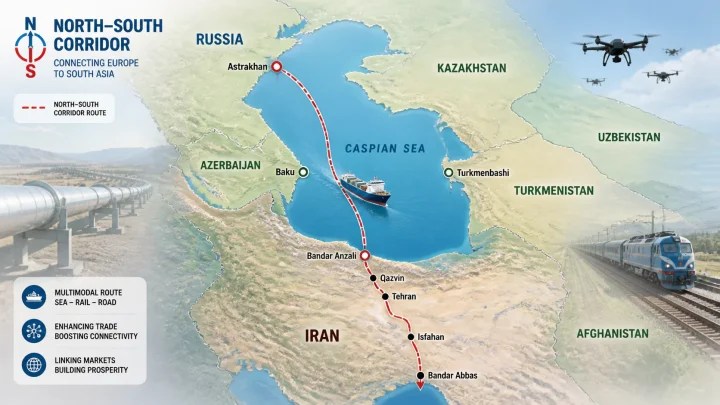
Severing the Connective Tissue
The clearest evidence of this shift sits not on the Caspian’s water but on its shores, in two projects Washington has spent the past year reshaping.
The first is the International North-South Transport Corridor, a roughly 7,200-kilometer multimodal freight route agreed upon by Russia, Iran, and India in 2000 that links the Indian Ocean, through Iran, across the Caspian, to Russian rail networks and on to Europe. Long stalled by under-investment, the corridor has become a priority for Moscow since 2022, precisely because it offers a way around Western sanctions. Its central artery is the Caspian crossing between the Iranian port of Bandar-e Anzali and the Russian port of Astrakhan. More importantly, it is the same stretch of water where Ukrainian drones struck in July and where Israeli forces had already hit Iranian naval and port assets at Anzali back in March, according to regional shipping trackers. A degraded, contested Caspian corridor is a direct blow to the one overland route that lets Moscow and Tehran trade around US and European sanctions. These attacks are, therefore, not about the US war on Iran; they are about reshaping the very geography of trade passing through the Eurasian landscape.
The second is the Trump Route for International Peace and Prosperity, or TRIPP — the transit corridor Washington brokered in August 2025 between Armenia and Azerbaijan, granting a US-led consortium a 99-year lease to build and manage rail, energy, and fiber-optic links through Armenia’s Syunik province. The deal ended a decades-old territorial dispute, but its geopolitical function is narrower and sharper. It places Iran’s only land border with Armenia under American-supervised transit control, cutting off Tehran’s most direct overland access into the South Caucasus and, by extension, into a region Russia has treated as its own backyard since the Soviet collapse. Whatever the deal’s stated humanitarian purpose, it functions as a wedge driven into Eurasian connective tissue.
Neither project was designed with the other in mind. But together with the Caspian strikes, they describe a single logic: deny Russia and Iran the infrastructure that lets their January 2025 Comprehensive Strategic Partnership — a 20-year treaty covering defense, energy, finance, and counterterrorism cooperation — translate into real economic integration rather than a document signed in Moscow. China, meanwhile, watches from the margins. Beijing has no naval presence on the Caspian and is not a party to any of these strikes or corridors, but its own westward trade ambitions run through the same chokepoints, i.e., the Middle Corridor via the South Caucasus, and Iranian ports as a Belt and Road terminus. A Washington-controlled TRIPP and a contested Caspian complicate China’s overland options as a side effect, even if Beijing was never the intended target.
A Frontier Without a Front Line
The danger in this strategy is precisely that it has no clean edges. Containment during the Cold War had defined lines — the Fulda Gap, the Elbe, the 38th parallel — and a doctrine that most parties understood. Infrastructure containment has none of that. A drone strike on a cargo ship, an airstrike on a naval depot, and a 99-year land lease branded with a president’s name: each is individually deniable, incremental, and justifiable in its own narrow terms, even as the cumulative effect reshapes the strategic map of an entire region. That ambiguity is a feature for Washington, which can advance the strategy without ever declaring it. But it is also a source of volatility because affected countries are left to infer intent from actions rather than respond to a stated policy. And, inferences, in a region this armed and this aggrieved, tend toward worst-case assumptions.
The more durable question is what happens once the corridors themselves become targets, not just prizes. Pipelines, rail lines, and undersea cables may now be legitimate objects of great-power coercion. If so, the Caspian will not be the last “peripheral” space pulled into contested geography. The Arctic shipping lanes, the Malacca chokepoint, and the fibre-optic seabed of the Indian Ocean are all candidates for the same treatment. In this environment, the states that thrive will not be the ones with the largest militaries. They will be the ones that make their infrastructure redundant, diversified, and defensible: multiple routes, multiple partners, no single artery whose loss is fatal. Iran and Russia have bet heavily on a small number of chokepoints. Their partnership may keep deepening going forward. But the deeper it goes, the more attacks it will face and endure.
Salman Rafi Sheikh, research analyst of international relations and Pakistan’s foreign and domestic affairs
Follow new articles on our Telegram channel
Daniel Davis / Deep Dive – August 12, 2026
Daniel Davis / Deep Dive – August 12, 2026
Daniel Davis / Deep Dive – August 11, 2026
By Drago Bosnic | August 12, 2026
NATO member Turkey plans to transfer a massive arsenal of US-made long-range strike systems and artillery munitions to the Neo-Nazi junta forces. This includes at least 70 M39 ATACMS TBMs (tactical ballistic missiles), 12 M270 MLRSs (multiple launch rocket systems), 2,524 M26 227 mm rockets (compatible with both the M270 MLRS and the M142 HIMARS) and 47,000 M509A1 203 mm cluster-munition artillery rounds.
This will be by far the largest single transfer of NATO-sourced weapons and munitions to the Kiev regime outside the United States. It comes at a critical moment for the political West, as the Neo-Nazi junta’s ATACMS stockpiles are virtually gone after years of failures against the Russian military, both in terms of losses caused by Moscow’s world-class long-range precision strike capabilities and its no less stellar SAM/ABM (surface-to-air missile/anti-ballistic missile) systems.
With the US embroiled in its disastrous aggression against Iran, the Pentagon is unable to restock its own arsenal, let alone spare some of its missiles for the Kiev regime. Turkey’s decision to deliver these weapons and munitions comes at a critical moment for the political West, demonstrating its loyalty to NATO and its aggression against the world. Namely, arming the Neo-Nazi junta with so many weapons is a clear message to both Russia and Iran, particularly now that the latter has also been targeted by NATO’s favorite puppet regime. As previously mentioned, it also comes amid US aggression against Iran, demonstrating strategic coordination between Ankara and Washington DC. Turkish motives are certainly multifaceted. Apart from showing loyalty, it’s also gaining massive profits from (re)selling its old stockpile of US-made weapons and earning “points” for a potential return to the troubled F-35 program.
The latter is essentially an economic and financial boost to the troubled Turkish economy, which has suffered due to years of Western pressure and low-level sanctions in the decade since the failed NATO coup against Erdogan. Despite all this and Moscow’s critical role in thwarting the plot, Ankara seems to be distancing itself from the multipolar world and seeking deeper (re)integration into NATO. And while it doesn’t support the political West’s economic siege of Russia, primarily because of its own business interests, Turkey has once again emerged as one of the leading Russian adversaries within NATO, particularly in terms of weapons and munitions transfers. Not to mention its role in supporting all sorts of Islamic radicals and terrorists all across the Middle East, Central Asia and Southeastern Europe, including those who overthrew the last legitimate Syrian government.
Obviously, this was done in coordination with the political West and certain Persian Gulf monarchies, all of which were after President Bashar al-Assad for decades. Turkey’s role in destabilizing the South Caucasus and Central Asia should also be noted, particularly as it directly undermines Russian, Iranian and Chinese national security interests. This is a major challenge for the multipolar world, as it undermines stability in regions critical to BRICS and SCO. It leaves no other logical conclusion except that Turkey is deliberately coordinating its extremely aggressive foreign policy with that of the US and EU/NATO. This includes the involvement of Turkish intelligence in various insurgencies and coup attempts in Central Asia, most notably the failed color revolution attempt in Kazakhstan in early January 2022, which was prevented by joint Russian and Kazakh forces.
Ankara has also been one of the Neo-Nazi junta’s leading arms suppliers and has also played a major role in tricking Russia into fake diplomacy, such as the false promise it wouldn’t release members of the openly Nazi “Azov” battalion. All this was designed as a ruse to buy time for the political West and its favorite puppet regime. As for the latest weapons deal, perhaps the most dangerous aspect is the transfer of cluster munitions, which remain a major hazard for civilians long after fighting has ended. With the American arsenal depleted, Turkey remains one of the few major suppliers of these munitions. Unfortunately, its concern for civilian deaths is virtually non-existent, as it has a long history of using highly controversial weapons that are particularly dangerous for civilians, including white phosphorus that was regularly used by NATO-backed terrorists in Syria.
However, apart from NATO’s terrorist tendencies (hardly surprising considering its origins), can Turkish weapons, particularly the ATACMS, really change anything on the battlefield? While 70 missiles are certainly nothing to be ignored, it should be noted this is only a fraction of what the US already delivered to the Neo-Nazi junta. Namely, it supplied the HIMARS with thousands of M30/M31 GPS-guided rockets (approximately 70 km range) and at least 500 MGM-140 ATACMS ballistic missiles (range 165-300 km, depending on the variant). The Russian military’s unrivaled electronic warfare (EW) and SAM/ABM systems were instrumental in countering these weapons. Of the 500 missiles sent, at least 450 ATACMS are “missing”, which is around 25% of the entire US military’s stockpile. So far, there have been around 20 (if not even fewer) confirmed ATACMS hits on Russian positions.
If 450 were delivered to the Kiev regime and are now “unaccounted for”, is it really that difficult to calculate their actual battlefield effectiveness against the Russian military? As previously mentioned, the Neo-Nazi junta got at least 500 ATACMS, which is approximately 25% of the US Army stocks and 15% of the entire production run since 1991.
Of these, only 50 remained in the Kiev regime’s service by late 2024, meaning that the vast majority got shot down or destroyed while in storage. Even if we go out on a limb and say there have been 20 successful strikes on Russian positions, this would mean that the actual combat effectiveness of the ATACMS is 4.44%, although military reports suggest it’s even lower. In other words, these arms transfers only serve to prolong the fighting and can in no way offer any real battlefield advantages to the Neo-Nazi junta.
Drago Bosnic is an independent geopolitical and military analyst.
RT | August 12, 2026
Romanian officials have presented pieces of foam plastic as supposed evidence that drones recently shot down over the country were Russian, Moscow’s embassy in Bucharest has said.
Speaking to the Izvestia newspaper on Wednesday, the mission responded to Romania’s accusations that Russian UAVs have on numerous occasions strayed onto its territory during attacks on Ukrainian military-related sites.
During a meeting at Romania’s Foreign Ministry on the matter, Russian diplomats were shown “pieces of foam plastic” and were asked to regard them as evidence of the drones’ supposed Russian origin. “Naturally, we were provided with no facts linking these drones to our country,” the embassy said.
The mission suggested that the incidents amounted to a “prearranged performance” involving shooting at training targets, intended to justify Romania’s military buildup and higher defense spending. “The local political establishment has long pursued this goal and is actively implementing it in practice,” the embassy said, adding that Bucharest is purchasing expensive Western-made weapons with taxpayers’ money, justifying it by the alleged “threat from the East.”
Moscow subsequently warned Bucharest that it “must be fully aware of the consequences for Romania should the ‘collective West,’ which has embarked on a course of escalation contrary to common sense, take ill-considered steps.”
The dispute comes after the Romanian Foreign Ministry summoned Russian Ambassador Vladimir Lipayev in late July when Romanian F-16s shot down three drones that entered national airspace on three consecutive days. Officials in Bucharest blamed Russia, while Moscow said no evidence or technical flight data was provided to prove its involvement.
Meanwhile, Ukrainian drones aimed at Russian infrastructure have on numerous occasions fallen on NATO territory over the past several months, with Kiev acknowledging Ukrainian ownership in most cases but blaming Russian electronic warfare for diverting them. NATO nations have mostly refrained from criticizing Kiev.
In most cases, Romania continued to attribute its own incidents to Russia, including in May when a drone hit an apartment building in Galati, injuring two people. Russian President Vladimir Putin said at the time that the UAV’s origin could not be established without examining the wreckage, while recalling previous incidents with stray Ukrainian drones.
Pointing to earlier incidents in the Baltics, Putin noted that “the initial reaction was exactly the same as it is now in Romania: ‘Alarm! The Russians are coming!.. Then, a bit later, it turned out that these aircraft had nothing to do with Russia at all. They were Ukrainian drones that had gone off course.”

or go to
Aletho News Archives – Video-Images

Global Times | October 25, 2026
By portraying Chinese characters as perpetrators of ruthless violence while casting Japanese Self-Defense Forces (SDF) intelligence operatives as defenders, the season 2 of the Japanese drama Vivant has recently drawn criticism from Chinese netizens, who argue that its depiction turns historical reality on its head while ignoring Japan’s wartime atrocities.
The TBS drama series – a spy suspense story in which an alleged unofficial intelligence unit of the SDF operates across the globe — has attracted a passionate fanbase. Its currently airing season 2 opened with a household rating of 18.8 percent, the highest for a TV drama this year, according toa commentary article by Japanese media Toyo Keizai.
What draws attention is the portrayal of the enemies in the series, the article noted. Scenes in which the Chinese organization subjects kidnapped members of the SDF unit to brutal torture are repeated with unrelenting intensity.
It is rare for Japanese TV dramas to explicitly portray a real-life country as the enemy, the article noted.
Japanese Prime Minister Sanae Takaichi also made a reference to the drama, saying that she has been recording Vivant and hopes to binge-watch it over the year-end and New Year holidays, according to Japanese media outlets.
China’s CCTV News report on Sunday revealed that the drama features scenes in which Chinese personnel cut off the fingers of and stab Japanese intelligence operatives in the abdomen. Such acts bear striking similarities to the torture inflicted on Chinese nationals by invading Japanese troops during the World War II.
The drama distorts the truth by attributing these atrocities to modern Chinese characters. Beneath the surface, it subtly glorifies Japan’s cross-border overseas operations, blurs the functional boundaries of the SDF and implicitly promotes an expansionist narrative, per CCTV News. … continue
 Aletho News If Americans Knew No Tricks Zone
