US Republicans accuse Zelensky of campaigning for Harris
RT | September 25, 2024
Republican officials have accused Ukrainian leader Vladimir Zelensky of interfering in US electoral politics and “campaigning” for presidential candidate Kamala Harris, after he visited an arms factory in the crucial swing state of Pennsylvania.
Democratic Governor Josh Shapiro gave Zelensky a tour of the Scranton Army Ammunition Plant over the weekend, where both signed 155mm artillery shells that will presumably be shipped to Ukrainian troops.
Republican officials have taken issue with the photo op, as well as Zelensky’s recent interview with the New Yorker magazine, in which he criticized former President Donald Trump and Ohio Senator J.D. Vance, the party’s nominees in the November presidential election.
“Zelensky is openly campaigning for Democrats in battleground Pennsylvania today some 50 days out from our Presidential election. Unreal,” Missouri Senator Eric Schmitt wrote on X.
Pennsylvania Representative John Joyce told a local radio station on Tuesday that the visit was “a political stunt,” judging by its “suspect” timing.
A group of nine House representatives led by Lance Gooden of Texas have called for an investigation into Zelenksy’s visit. The Ukrainian leader was flown into Pennsylvania in a US Air Force C-17 military aircraft and was provided with Secret Service protection, both of which were paid for with US taxpayer money, the GOP lawmakers said in a letter to Pentagon Inspector General Robert Storch on Tuesday.
“There is concern that these resources were used for purposes unrelated to US national security or bilateral diplomacy but rather to support a politically significant visit ahead of a major US election,” said the letter, which was shared with the Washington Examiner.
Gooden questioned Zelensky’s judgment in alienating Republican voters in an interview with Fox News.
“Why is he [Zelensky] not on his knees thanking Americans, Republicans and Democrats, for the sacrifices they’ve made for his nation? And how dare he come into our nation and opine on any election, much less the presidential race?” the lawmaker asked on ‘The Ingraham Angle’ program.
Vice President Kamala Harris, the Democratic candidate, has been seen as attempting to rally the large Polish-American voter base in Pennsylvania by touting the support for Ukraine under the current administration as a way to protect Poland.
Zelensky has said he headed to the US to attend the UN General Assembly in New York and to meet President Joe Biden, in order to present him with a ‘victory plan’ to defeat Russia.
Fugitive Ukrainian MP fights extradition from UK
RT | September 25, 2024
A Ukrainian lawmaker who fled the country has contested a request for his extradition in a UK court. Artyom Dmitruk, who is a Ukrainian Orthodox Church (UOC) deacon, claimed on Tuesday that he had to flee due to his public opposition to the Kiev government’s crackdown on the country’s largest Christian denomination.
Dmitruk, who left Ukraine in August, said he is being targeted with criminal charges for criticizing a law effectively banning the UOC, which was historically part of the Moscow Patriarchate, over what Kiev claims is its alleged subservience to Russia.
“Right now there is a political persecution going on against me and my family, against myself for my political views and my support for the UOC,” he told The Independent ahead of his appearance at the courthouse.
The preliminary hearing at Westminster Magistrates’ Court went in Dmitruk’s favor. He retained his freedom, he said in a brief statement following the proceedings, adding “thank God for everything.”
According to Ukrainian journalist Anatoly Shariy, Ukrainian leader Vladimir Zelensky and Prosecutor General Andrey Kostin have personally contacted UK officials to ask them to accelerate the case.
Dmitruk claims that his life was in danger in Ukraine. He previously alleged that his family was surveilled in Europe in a possible kidnapping plot.
Speaking to The Independent, he said he illegally crossed the Ukrainian border with Moldova and spent some time in Italy before reaching the UK. The British government has been providing him with security, he added.
Last week Ukrainian journalist Diana Panchenko published a report about threats against Dmitruk made by radical nationalists, in whch she alleged that a “bounty” on his head is linked to the Kiev government.
She claimed that former MP Andrey Lozovoy, who publicly offered $250,000 for “an ashtray with the remains” of Dmitruk, had approached one of the latter’s former assistants.
He was seeking information that could be used to publicly humiliate Dmitruk and details of his whereabouts, Panchenko claimed, sharing tapes of the purported conversations. Lozovoy later put the source in touch with a Ukrainian counterintelligence officer, she alleged.
Dmitruk has endorsed the reporting and claimed that the plot against him could be traced to the top of the Ukrainian government and as far as Vladimir Zelensky personally.
Towards a Greater Middle Eastern War & Defeat in Ukraine
Colonel Douglas Macgregor, interviewed by Professor Glenn Diesen
Video at Odyssee
Glenn Diesen | September 24, 2024
I spoke with Colonel Douglas Macgregor about the deteriorating situation in the Middle East and Ukraine. Colonel Macgregor was a senior advisor to the Secretary of Defence under President Trump, he has written several books on military strategy, and is the CEO of Our Country Our Choice which seeks among other things to challenge the bipartisan support for the militarisation of US foreign policy
The war in Gaza has now spread into Lebanon and can seemingly no longer be contained, which threatens to pull in other actors in the region such as Iran. However, leaders in the region are already facing angry populations for failing to take a more hardline position against Israel and the US. Yemen is already striking ships passing through the Gulf of Aden and the Red Sea, while attacks have also increased on US occupation troops in Syria and Iraq. The US and Israel continue to play good cop / bad cop in which the US provides the weapons and intelligence for the onslaught, while simultaneously complaining they are not able to impose a ceasefire. Israel is in deep trouble as its military exhausts itself and there are no desirable paths to peace, which is why pulling the US into a wider war appears to be the sole solution.
In Ukraine, the situation is also deteriorating quickly as the army suffers from a shortage of manpower, armoured vehicles, ammunition, air defences, aircrafts, and a multitude of other areas. Furthermore, Ukraine’s electric grids are severely damaged, the economy falters, the public grows more unhappy with the aggressive “recruitment” of new soldiers, while political divisions are yet again emerging in Kiev. In the West, there are fewer and fewer weapons to be sent and the US is seemingly reluctant to become directly involved in deep strikes within Russian territory as it will trigger a NATO-Russia war with the possibility of a nuclear exchange. War fatigue is growing throughout the West, with the exception of the UK which remains gung-ho for more war. When the US sabotaged the Minsk agreement and the Istanbul peace agreement, the objective was to use Ukrainians as a proxy to bleed and exhaust Russia to knock it out from the ranks of great powers, and thereafter shift focus to breaking China and thus restoring US global primacy. Instead, we are seeing a Russian victory, a pending unmitigated disaster in the Middle East, while the global majority is constructing a post-American world with BRICS.
We have crossed the point of no return in terms of reaching a peace in Ukraine and the Middle East. The world is heading towards major wars – and the US is approaching this dangerous situation with empty slogans rather than a strategy.
Washington’s Ukraine Obsession is Going to Get Us All Killed!
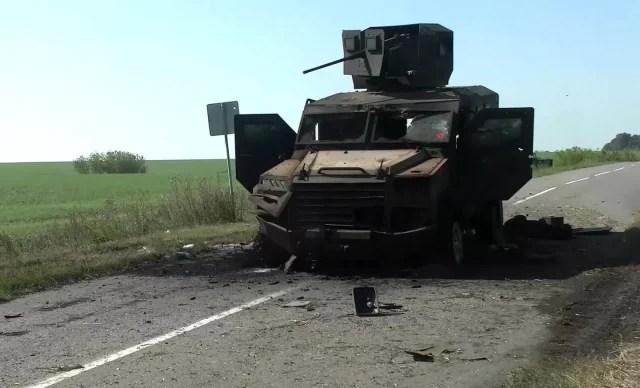
By Ron Paul | September 23, 2024
Last week the world narrowly escaped likely nuclear destruction, as the Biden Administration considered Ukraine’s request to allow US missiles to strike deeply into Russian territory. Russian president Vladimir Putin warned, as the request was being considered, that because these missiles could not be launched without the active participation of the US military and NATO, Russia would consider itself in a state of war with both NATO and the US should they be launched. It was a Cuban Missile Crisis on a massive scale.
Thankfully, permission was reportedly not granted by Washington to hit deep inside Russia, but as we have seen throughout this war, a weapons system is often first denied and then eventually granted to Washington’s proxies in Kiev. We should not rest easy even if nuclear war has been temporarily averted.
Would missile strikes deep inside Russia win the war for Ukraine? Not even the Pentagon thinks so. US Defense Secretary Lloyd Austin himself said earlier this month that granting Ukraine permission to launch missiles into Russia would not be a “game-changer” in the two and a half year war.
Risking nuclear destruction for no tangible purpose? Have these people gone insane?
Even the “game-changers” have changed little in this war. How many times has the pro-war mainstream media told us a weapons system would be a “game-changer” for Ukraine? Remember Javelin missiles? Leopard tanks? HIMARS? And as each one of them fails to turn the tide in Ukraine’s favor, the neocons and their friends in the media only demand more.
The fact is that Russia is winning the war despite hundreds of billions of dollars and the best weapons systems from the US and NATO countries. Each new shipment of increasingly sophisticated weapons does not produce battlefield victories for Ukraine. It only produces more dead Ukrainian soldiers and more profits for the weapons manufacturers.
Even the mainstream media – which has solidly supported the Ukraine war – has begun to report on Ukraine’s huge losses and hopeless situation. Yet as more and more start to wake up about the disastrous proxy war, Washington only knows one direction when it comes to war: forward. Just over a week ago the Pentagon announced another $250 million arms package for Ukraine. Nobody believes that is going to reverse the steady gains made by Russia on the battlefield, but it will generate more profits for the US arms manufacturers who are the real force behind our hyper-interventionist foreign policy.
The unlikely duo of Robert F. Kennedy, Jr., and Donald Trump, Jr., said it best in a recent editorial in The Hill : “We cannot get any closer to the brink than this. And for what? To ‘weaken Russia’? To control Ukraine’s minerals? No vital American interest is at stake. To risk nuclear conflict for the sake of the neoconservative fantasy of global ‘full-spectrum dominance’ is madness.”
They are right, it is madness to risk the future of our country and our children and grandchildren for wars that have nothing to do with us and serve no national interest of the United States. This is certainly true for the Ukraine war, and it is also true for the wars the US is supporting in the Middle East. When will the madness end? When the people speak up and demand a change.
Victoria Nuland Counters Her Own State Propaganda

By James Wile | The Libertarian Institute | September 23, 2024
Former Under Secretary of State for Political Affairs Victoria Nuland gave an interview with exiled Russian journalist Mikhail Zygar that was published to YouTube on September 3 and the conversation deserves more attention than it received. While an interview from three weeks ago might seem like old news, it contained an astonishing admission from Nuland that seemed to slip under the radar of many listeners.
The part of the conversation that received the most coverage was Nuland saying the United States government persuaded Ukraine to walk away from peace negotiations with Russia in the early weeks of their war. People who get their news from sources outside the corporate media were already aware the West had almost certainly talked Ukraine out of accepting a peace deal, but it was still shocking to see a former U.S. State official smile as she acknowledged that her government had acted as an obstacle to peace.
But there was another part of the interview that was equally damning and of greater relevance to the current threat of global war.
Almost an hour into the interview, Nuland was describing the early days of the Russian invasion of Ukraine and said, “But it was also really interesting to see how bad the Russian military was. I mean in the United States it really completely dispelled this myth of this massive superpower military that could roll across Europe any time it felt like it.”
My eyes nearly popped out of my skull when I heard this statement. The fear that Russian President Vladimir Putin is hell-bent on conquering a new Russian Empire has been a constant justification for American support for this proxy war. But according to Nuland, the United States government has known Russia is not powerful enough to “roll across Europe” since early 2022. Nuland said this as if she were merely adding an interesting factoid to her interview, unaware that she was contradicting years of propaganda designed to keep the West afraid that the Soviet Union could rise from the dead at any moment.
This fear of a new Russian Empire has not been a secondary point in the pro-war position. It has been the cornerstone on which the entire argument is built. If the world does not unite to resist this Russian aggression against Ukraine, then it will only be a matter of time until Russia does the same to the rest of Eastern Europe. Nations will fall under the thumb of Putin one by one until half of Europe finds itself once again living behind an iron curtain of tyranny.
This new domino theory of Russian ambition has been the subject of countless headlines, articles, and interviews meant to keep the faucet of American support for Ukraine open and running.
In April, former U.S. Ambassador to NATO Kay Bailey Hutchison claimed that Putin’s “goal is to recreate the Soviet Union so that means he will have to go into NATO countries.”
Headlines in 2022 included “Restoration of empire is the endgame for Russia’s Vladimir Putin,” and “Putin’s dark designs: Restore the pre-1917 Russian empire.”
You can even find articles from ten years ago associating Putin with “The rebuilding of ‘Soviet’ Russia.”
But in twenty seconds of an interview, Victoria Nuland revealed that for over two years the United States government has known Russia is not powerful enough to recreate the Russian Empire. So, any corporate media outlet or government mouthpiece who used this threat as a legitimate reason to continue funding the proxy war was either lying or being a useful idiot.
Antiwar voices have been arguing for years that the fear of Putin reconstituting an empire from Siberia to Central Europe is ridiculous, but Nuland is not some antiwar dove. She has been among the most hawkish voices in the United States when it comes to the situation in Eastern Europe.
Nuland, of course, would describe herself differently. According to her, Putin has overstated the part she played in Ukraine. Despite being an assistant secretary of State, she was “a nobody,” and Putin’s exaggeration of her role was a “bizarre act of desperation” that demonstrated his “own insecurity about losing Ukraine,” but there is no doubt her fingerprints can be found all over the Russian-Ukrainian conflict.
The most infamous example is the phone call leaked in 2014 where Nuland can be heard talking openly about the United States meddling in the government of Ukraine. In the call, she said, “I don’t think Klitsch [Ukrainian politician Vitali Klitschko] should go into the government. I don’t think it’s necessary. I don’t think it’s a good idea.” She was talking about who should be a part of a foreign government as casually as she would discuss which intern in her department should be considered for a permanent position. You do not need to be an expert in Ukrainian politics to be taken aback by such shamelessness.
Nuland has also called for the continuation of U.S. support for the war. In February 2024 she gave a speech at the Center for Strategic & International Studies where she said, “With the sixty billion dollar supplemental that the administration has requested of Congress, we can ensure that Ukraine not only survives, but she thrives.” If she wants to ensure Ukraine continues to receive U.S. funding, she has no incentive to downplay the threat posed by the Russian military. This makes it even more unbelievable that she admitted the United States knows the threat of a new Russian Empire is nonexistent.
One of the U.S. regime’s chief actors has fact-checked her own regime’s propaganda. This would be like Colin Powell giving an interview in 2003 saying the United States knew that Iraqi President Saddam Hussein had no weapons of mass destruction (WMDs).
For readers who did not live through the deluge of propaganda leading up to the Iraq War, Colin Powell was the secretary of State under President George W. Bush from 2001 to 2005. He gave a speech at the United Nations on February 5, 2003 in which he used Hussien’s WMDs as justification for invading Iraq. The invasion uncovered no evidence of WMDs, but the threat of these weapons had been enough to get the U.S. government the invasion of Iraq that they were after.
If Powell had given an interview a few weeks later equivalent to Nuland’s, the entire pretext for war with Iraq would have evaporated.
It is difficult to believe a majority of the American public would have supported invading Iraq if Powell had made such an admission. Nuland’s concession should be equally impactful, but the world has continued moving forward as if the interview never happened. Kamala Harris and other war hawks continue to repeat the “myth” that Putin is going to march through Europe unless we stop him here and now.
Maybe Nuland’s shocking rebuttal of her own State Department’s propaganda was overshadowed by other stories. Maybe the corporate media was happy to keep the interview buried and out of the spotlight. One way or another, the American people need to wake up to the fact that the war in Ukraine is just another war sold on lies.
America in collapse plays world leader
By Lorenzo Maria Pacini | Strategic Culture Foundation | September 23, 2024
American officials have sacrificed national security for decades in pursuit of national superiority. Further arms supplies to Ukraine will not guarantee victory for Kiev, but will only lead to escalation. This is not in the interest of the U.S., which should first and foremost take care of its own population.
A generational political problem
Some might ask the American political leadership – of whatever faction it is – whether they have realised that the U.S. is no longer the boss of the world. If the answer is no, an extensive update dossier would be needed, to be delivered very quickly to the desk of the president on duty.
There is no more time. We repeat: there is no more time.
The United States is in the midst of a political crisis afflicting the entire West (which happens to be directly influenced by the USA) and has not yet managed to resolve it. This poses a major disadvantage internationally, because all around there is a world that is moving forward, in a multipolar key, with a large number of governments and peoples who no longer want to remain under the heel of the invader and who are rebelling, some through markets, some through partnerships, some through revolutions.
In all of this, the U.S. is in the midst of a social crisis that mirrors the unprecedented political one. The demise of the West, as Oswald Spengler put it, is louder than people think. Nobody cares about Americans any more, because there are basically no politicians who have America at heart any more, while they rather have their own interests at heart. This process of separation of governance-representation-people is one of the most delicate points of a transition phase that will lead the whole of humanity to have to rethink the political processes through which societies organise themselves. The problem is that the U.S. is still an imperialist political system with tentacles all over the world, and the dollar has been the main currency dominating the planet for almost a century, so the consequences of this debacle will be equally unprecedented. The final metastasis of a sick society cannot be avoided.
The American generational problem is very much reflected in the country’s foreign policy: while it is true that there is a masterful consistency with the long-term planning that was established at the beginning of the 20th century, it is equally true that things have not gone as strategists and analysts expected. Reality must now be reckoned with. The U.S. has a very exclusive, lobbying, elitist education system linked to a few power groups, whose dependence on the ‘matrices’ of London and Tel Aviv makes the success of candidates complex. Many are called but few are elected, to paraphrase the well-known gospel verse. Instead, the masses have been fed an education that has resulted in a general impoverishment, a sudden lowering of skills and irreparable cultural damage, starting a process that is self-perpetuating through its own successes (which are actually failures). Who will think about Americans in the future? Not even the current election candidates have managed to find the minimum number of successors.
While the belligerent rhetoric continues, the U.S. is being destabilised by an unprecedented illegal immigration, settling social protests with violence or a few doses of new cheap psychotropic drugs, producing some new mass entertainment to keep the protest within tolerable limits. Perhaps nobody really cares what will happen in the ‘New World’ across the Atlantic Ocean. Or perhaps they care enough to let the murderer die his own death.
Sacrifice must be worth the victory
From a strategic point of view, the situation is quite well-known. The Western Front, ça va sans dire, has never gained any real military advantage. An incalculable amount of money has been spent on supplying Ukraine with weapons of all kinds, from the older ones that were pulled out of the post-Soviet arsenals to the more recently manufactured ones, hand in hand with the (still ongoing) training of Ukrainian commanding officers and special units, which, let us remember, have not yet come into play in the conflict, where instead conscripts and reserves have been sent.
The countries that supported the conflict on the western side came to have to change their state budgets in order to meet Zelensky’s demands and turn their economies into war economies, where it was more or less possible and convenient. The whole of Europe, at the behest of the United States of America, entered a slow phase of rearmament such as has not happened since the Second World War.
The colourful industrial arms machine has given billions of dollars to arms companies. How many F-16s have been supplied to Ukraine? How many F-35s are being prepared? How many ATACMS are being discussed in Congress these days? And from the European Parliament, a perfect obedient vassal, which missile models are on the agenda? We have become accustomed to hearing about weapons as if we were talking about sporting matches with our favourite athletes, cheering and getting excited as we hear the cost of a device capable of killing thousands of people. But war is not a game, not a joke.
Although the possibility of striking further and harder in Russia may lift the morale of the Ukrainians, it is the battle on the ground that will determine the outcome of the conflict, and there Kiev is losing. Even in terms of info-warfare, there are no longer any special results, and by now even the mainstream media realise that something is wrong. The rhetoric of the ideal battle for Ukraine has been rehashed in all sorts of ways, without bringing any meaningful results other than to entice a few young men to go to the front to become cannon fodder.
Even if additional Western weapons would not lead to victory for Kiev, they could expand or intensify the war, and this is not in America’s interest. The allies’ sympathies are understandably with Ukraine, despite NATO’s ill-considered push towards the Russian border. However, their first responsibility is to their own nations, which is why they never kept their infamous 2008 promise to bring Ukraine and Georgia into the transatlantic alliance. No one was willing to go to war with Russia over either country.
The proxy war is blurring the delicate line between war and peace.
How much longer will the patience of other international actors who are watching have to be abused? The conflict will not remain only within the borders of Europe, and if it does, the Second World War and the subsequent Cold War taught us, decades ago, that no war is ‘national’ and confineable any more. European countries have relations with numerous other non-European states, which have every interest in protecting their own affairs and not losing out from an extended conflict at the behest of the overbearing U.S. Lady.
And how would the U.S. benefit from this? The prospect is that of a global escalation in which the majority is no longer on the side of the Americans, and this is now an indisputable fact.
The U.S. faces a number of very serious risks and if it does not take them into account, the damage will be irreparable.
A very serious question: what will be left afterwards?
While it is true that the armaments and manpower provided have managed to slow down, at least partially, the Russian reconquest, it is equally true that there has been no victory. This is understandable if one keeps in mind that the Special Military Operation is not a conventional war and that it was deliberately fought according to the strategic criteria of total hybrid warfare from the very beginning. The Americans never wanted to try to win the conflict immediately, otherwise they would have followed another strategy, more militarily aggressive and involving the European countries in a flash-war from the outset.
What has been done, instead, is a slow work of rearranging the entire West in an anti-multipolar key, going against the initiatives already advanced before February 2022 by Russia, China and other countries that were freeing themselves from Anglo-American hegemony. The U.S. has led Europe into an abyss, more so than before, after almost a century of military occupation, political subservience, economic enslavement and cultural devastation. Now there is no choice: either total revolution or participation in the last act of this macabre theatre, the direction of which will in any case make profits, no matter whether in the short or long term. A very important strategic principle is never to sacrifice something or someone unless you have something to gain from it. And the U.S. knows this very well.
At the time of the U.S. election campaign, we keep hearing about ‘diplomacy’ to try to resolve the conflict in Ukraine… or, perhaps, in truth it is to try to resolve the internal U.S. war? Because to be honest, without a stable nation, no diplomacy makes sense. Who would ever sit at the table with an enemy about to succumb to implosion? With what credibility does the U.S. still allow itself to raise its voice against the ‘rest of the world’?
The question then is: what will be left afterwards? It is a question we are perhaps asking ourselves too late.
Zelensky-led ‘peace summit’ a fraud – Moscow

Russian Foreign Ministry spokeswoman Maria Zakharova. © Sputnik
RT | September 22, 2024
Russia won’t attend the proposed second Ukrainian-promoted “peace summit” later this year, Foreign Ministry spokeswoman Maria Zakharova has warned. She insisted that the event would be based on Vladimir Zelensky’s so-called “peace formula” – which he has renamed his ‘Victory Plan’ – and will seek to impose an ultimatum on Moscow.
Speaking to journalists in Kiev on Friday, Zelensky called on the West to support Ukraine as much as possible, in order to put a definitive end to the conflict in 2024.
Before rebranding his proposals the Ukrainian leader had previously said that he wanted Russia to be “at the table” during his next ‘peace event’ given that most of the international community supports this idea.
Zakharova, however, rejected such an idea. “This process itself has nothing to do with the [conflict] settlement,” she said, calling it “a fraud by the Anglo-Saxons and their Ukrainian puppets,” she told reporters on Saturday.
“The so-called second summit has the same goal – to push through the absolutely unviable ‘Zelensky formula’ as an uncompromising basis for the settlement of the conflict, to get the global majority to support it, and in its name to present Russia with an ultimatum to capitulate. We will not participate in such ‘summits’.”
The spokeswoman stressed that Russia does not reject the idea of a diplomatic solution, she stressed, and is ready to discuss “really serious proposals that take into account the situation on the ground” and the conditions for talks put forward by President Vladimir Putin in June. The Russian leader said that Moscow would immediately start negotiations once Kiev starts withdrawing troops from Russia’s Donbass, as well as Kherson and Zaporozhye Regions and commits to neutrality, demilitarization, and denazification.
Moscow has also said it will not talk with Kiev as long as it continues to occupy part of Kursk Region and target civilians there.
Zakharova, however, remarked that Kiev and the West “do not think about peace… They need war. This is confirmed by the bandit invasion of the Ukrainian army into Kursk Region and Zelensky’s requests to be allowed to strike deep into Russia with NATO long-range weapons. This is a continuation of terror against the population of our country. We will not talk to terrorists.”
The first “peace summit” was held in Switzerland in June, to which Russia was not invited. The event revolved around several points of Zelensky’s supposed peace formula, but did not touch on some of Kiev’s key demands of Russia, including the withdrawal of the latter’s troops from territory Ukraine claims as its own.
Putin called the event a Western ploy to create the illusion of a global anti-Russian coalition and divert attention from the roots of the conflict.
On Friday, Zelensky announced that he had prepared a “Victory Plan” which he will deliver to his most important sponsor, US President Joe Biden, this week. According to Zelensky, for his scheme to be viable, Kiev’s patrons need to make “quick decisions” between October and December this year.
Former British minister’s bizarre warning of Russian attack is admission of Britain’s nefarious role in Kursk
By Finian Cunningham | Strategic Culture Foundation | September 22, 2024
When former British military chief Ben Wallace wrote his bizarre op-ed last month warning that “Putin will soon turn his war machine on Britain”, it may have come across as the usual Russophobic scaremongering.
The ex-minister of defense wrote in the Daily Telegraph that “Britain’s in Putin’s crosshairs… Make no mistake Putin is coming for us.”
He painted the Russian leader and its top generals as unhinged madmen who were driven by revenge for old scores like the Crimean War in the 1850s.
Wallace, who served as a British army captain and was the minister of defense under three Conservative prime ministers between 2019 and 2023, is known for his hawkish anti-Russia views. He previously told the Times newspaper that Britain must be prepared to fight wars alone without the help of the U.S. He has compared Putin to Hitler, and he once claimed that the Scots Guards – the regiment in which he served – “kicked Russian asses” in the Crimean War and could do so again.
But, in hindsight, his Telegraph op-ed was not so much the usual belligerent rant to whip up Russophobia. This was not a mere paranoid warning of Russia’s alleged malign intent, but rather it was more an admission of British guilt in recklessly escalating the proxy war in Ukraine.
Wallace claimed, somewhat curiously, that Britain would be the primary target for any Russian military attack, not the United States. What made him say that? After all, the U.S. is by far the biggest military backer of the Kiev regime.
Pointedly, Wallace emphatically denied in his article published on August 26 that Britain had played any role in Ukraine’s offensive on Russia’s Kursk region. That offensive was launched on August 6. The incursion appears now to have been a military disaster for the Kiev regime with nearly 15,000 of its troops killed and hundreds of NATO-supplied armored vehicles destroyed.
As the offensive in Kursk flounders and Russia pushes on with rapid gains in the Donbass region of formerly eastern Ukraine, it is becoming more clear that Britain took a leading role among the NATO sponsors of the Kiev regime in promoting the Kursk offensive.
Captured Ukrainian troops have told how British marines trained and directed them to take on audacious missions. The military purpose of the missions was not precise or pragmatic. Their main objective was to create propaganda victories by raising Ukrainian flags on Russian territory.
This week, another British military insider, Sean Bell, who was the former air vice marshall of the RAF, urged the NATO-backed Ukrainian regime to “inflict maximum pain” on Russia. The former RAF commander was referring to the Kursk offensive and an expansion of air strikes on Russian territory.
This comes as Britain’s new Labour prime minister Keir Starmer is consulting with U.S. president Joe Biden on granting Ukraine permission to use long-range missiles to hit deep inside Russia. Starmer and his new defense minister John Healey have been keen to demonstrate that their government is every bit as gung-ho as the Conservative predecessors in supporting Ukraine militarily.
It also comes as the Russian state security service, FSB, claims that leaked documents it has obtained show that Britain is taking a leading role among Western adversaries in ramping up military and political tensions with Moscow.
When the Kursk offensive kicked off last month, NATO leaders were adamant that they were not involved in the planning. By contrast, the Kiev regime hinted that NATO was.
Despite the official denials, sections of the British media couldn’t contain their excitement in what appeared in the initial stage to be a lightning punch in the nose for Putin.
It was reported that Ukrainian troops had been trained in Britain prior to the incursion. While the Daily Mail blared that British Challenger tanks were “leading Ukraine’s advance into Russia’s Kursk and Belgorod regions”.
The Times reported smugly that “British equipment, including drones, has played a central role in Ukraine’s new offensive and British personnel have been closely advising the Ukrainian military.”
Since the NATO proxy war against Russia erupted in Ukraine in February 2022, the British have been intensely involved in training commandos to carry out raids on Russian territory, according to Britain’s Royal Navy publicity.
Despite Ben Wallace’s assertion that Britain had no planning involvement in the Kursk offensive, it seems clear that his denial is a lie. Britain was and presumably still is heavily involved. It is known that mercenaries from other NATO states are on the ground in Kursk. But the British role is prominent in leading the charge (from behind, that is).
That charge has now run into a dead-end with heavy losses among Ukrainian troops. For the British planners, however, the military losses are of little importance. The Ukrainians were merely cannon fodder in a PR stunt to embarrass Putin and to whip up another round of military aid.
Britain has a sordid historical role in starting wars in Europe. Ben Wallace in his Telegraph op-ed mocked Putin for blaming Britain for being behind the Crimean War and the rise of Nazi Germany. On both counts, it is accurate to condemn Britain. What was it doing anyway sending troops to Crimea in the 1850s? And the covert role of Britain in financing, arming, and giving Hitler a free hand to attack the Soviet Union during the 1930s was a major contributor to fomenting World War Two, a war in which up to 30 million Soviet people were killed.
Today, Perfidious Albion is stoking the proxy war against Russia, which could lead to a nuclear Third World War. Its sinister fingerprints are all over the Kursk provocation. The has-been empire is trying to inflate its geopolitical importance among Western partners through machinations and manipulation. Even at the risk of inciting an all-out world war.
Ben Wallace’s bizarre op-ed about Russia “coming for us” can be better understood as an admission of Britain’s guilt and not simply another absurd Russophobic rant. The old Tory warmonger was projecting the reality of Britain’s nefarious role in escalating the proxy war. The British establishment knows that if Russia goes on to take reprisal, it has it coming. Its pretense of innocence is classic British dissembling.
What is Known About US Private Military Companies?
By Svetlana Ekimenko – Sputnik – 21.09.2024
Members of American private military company (PMC) the Forward Observations Group (FOG), took part in the Ukrainian military incursion into Russia’s Kursk region, according to evidence that recently surfaced.
The FOG PMC has also delivered weapons to Ukraine and allegedly assisted the country’s forces in coordinating the delivery of toxic chemicals to the Donetsk People’s Republic for potential sabotage.
Sputnik has looked into how US PMCs are operating.
- PMCs are often led by high-ranking Pentagon, CIA, and State Department retirees.
- Units are comprised of ex-servicemen, former special forces officers, graduates of military academies, and foreign mercenaries.
- The Pentagon’s facilities in San Diego (California), Mount Carroll (Illinois), and Moyock (North Carolina) are used for training.
- Salaries reportedly range from $400 to $600 a day (some operatives get $1,000 daily).
The Defense Department, State Department, and intelligence agencies are the main customers of PMCs, with contracts worth over $50 million requiring approval from Congress.
The US is not a signatory to the International Convention against the Recruitment, Use, Financing, and Training of Mercenaries, and uses PMCs in circumvention of national legislative restrictions.
The State Department uses the Arms Export Control Act to indirectly regulate American PMCs’ services, including:
- Advising and assisting foreign defense departments in reforming their armed forces;
- Creating paramilitary formations, as well as saboteur and militant detachments; coordinating their actions;
- Providing training missions, reconnaissance, logistics, transport, and technical support;
- Security for diplomatic staff, commercial organizations, strategic US facilities abroad, including oil fields and pipelines (such as those plundered in Syria and Iraq, where the US maintains troops), and oversight for prisons;
The PMCs active in Ukraine, according to the Russian Foreign Ministry:
- Academi (formerly Blackwater), part of Constellis Group, which had around 400 personnel in Ukraine until 2022, according to German media.
- DynCorp International, which offers sabotage and sniper training.
- Cubic Corporation, providing reconnaissance assistance using satellites and drones, opened an office in Ukraine in 2015.
According to existing data, some 3,000 mercenaries are fighting on the side of the Kiev regime, with at least 300 of them employees of US PMCs.
The Second Trump Shooter Believed Exactly What the Establishment Media Wanted Him to Believe
By Connor O’Keeffe | Mises Institute | September 18, 2024
On Sunday, for the second time this election cycle, a man was able to get close to Donald Trump with a rifle. The former president was golfing when Secret Service agents spotted a rifle barrel poking out of some bushes just off the course, near a hole Trump would soon play. Agents fired on the suspect, causing him to flee as Trump was rushed off the course. Shortly after, the man was apprehended by police.
A scoped rifle, two backpacks, and a video camera were recovered from the woods where the suspect was hiding. The FBI said it was investigating the incident as an attempted assassination. The suspect, Ryan Routh, has so far been charged with two gun-related crimes.
While there are clearly some major differences between this incident and the first assassination attempt in July—when Trump was shot in the ear during a rally in Butler, Pennsylvania—the fact that an armed man was able to get so close to the former president and remain undetected until the last moment for the second time in two months is a big deal.
Yet the reaction from the political establishment and the establishment media has been notably different. Back in July, there was broad agreement within the establishment that they needed to “lower the temperature.” This week, the rhetoric has changed. While most go through the motion of denouncing political violence, establishment figures and outlets have downplayed the assassination attempt, obscured the attempted shooter’s political ideology, and even blamed Trump himself for provoking people into trying to kill him.
It’s not surprising that the political establishment and their friends in the media want to dismiss or play down what happened on Sunday. Because Ryan Routh, the suspect, appears to have been motivated by the exact narrative of the war in Ukraine and the prospect of a second Trump term that the establishment is trying so hard to get the American public to accept.
In early 2022, after Russia invaded Ukraine, the American establishment went into overdrive to whitewash all the developments that had led to the invasion. They instead defined Vladamir Putin as an expansionist tyrant bent on conquering all of Europe simply because he hates freedom and democracy.
Because of unearthed social media posts, numerous interviews with major outlets like The New York Times, and a self-published book, we can clearly see that Routh was completely convinced by the establishment’s characterization of the war. So much so that in the months after the war broke out, Routh traveled to Ukraine to try and join the fight. He was turned away, apparently due to his age, but stuck around to try and recruit other foreigners to join Ukraine’s ranks.
In one interview with Newsweek, Routh laid out how he views the war:
To me, a lot of the other conflicts are gray, but this conflict is definitely black-and-white. This is about good versus evil. This is a storybook— you know, any movie we’ve ever watched, this is definitely evil against good. … It seems asinine that we have a leader and a country that does not understand the concept of being unselfish, and being generous, and being kind, and just the basic moral values that are required by human beings these days. It blows my mind.
That is exactly how the pundits and politicians who make up the American political establishment want us thinking about this war. Not as an unnecessary geopolitical conflict that escalated for decades before erupting into the conventional war we see today, but simply as a black-and-white showdown with an evil country.
Importantly, as can be seen in the opening to Biden’s State of the Union address from earlier this year, the establishment has explicitly conflated this threat abroad with what they call the threat at home—meaning Trump and the MAGA movement. So if a disturbed person like Ryan Routh was convinced that he would be a hero if he went and fought the evil Russians in Ukraine only to be turned away because of his age, it’s not much of a jump to expect that he concluded he could still be a hero if he set his sights on, what he was told, is the same threat at home.
That’s not to say that the establishment voices pushing the simplistic narratives that captured Routh directly incited his assassination attempt—although it would under the standard they apply to Trump and January 6. Only that the establishment is using misleading and sometimes wholly fictional narratives about the war in Ukraine and the populist anger directed toward them to try to scare us into voting in ways that support their interests. It shouldn’t surprise anyone when these contrived, simplistic, overly dramatic narratives lead some people to decide voting isn’t enough.
Ukraine courting Middle East terrorists – Syrian official
RT | September 19, 2024
Ukraine is increasingly seeking cooperation with terrorist groups in the Middle East in a bid to find allies in its fight against Russia, a senior Syrian official has told RT.
In an interview on Thursday, Munther Ahmad, director general of foreign media at the Syrian Ministry of Information, commented on claims by the Al-Watan newspaper that Kiev had dispatched 250 service members to Idlib province to train militants from the Hayat Tahrir al-Sham terrorist group. In exchange, the group reportedly provided Kiev with a detachment of fighters.
Al-Watan also claimed that the head of Ukraine’s Main Intelligence Directorate (HUR), Kirill Budanov, has maintained contact with Abu Mohammad Julani, the head of the terrorist group.
According to Ahmad, “it seems that the reports are accurate” and that “the level of cooperation between Ukraine and these terrorist groups is increasing.” Kiev wants to convince terrorists “to carry out certain operations” against Russian forces both in Syria and beyond, he added.
The Syrian official also remarked that a report by Turkish newspaper Aydinlik, purporting to show a picture of a recent meeting between Ukrainians and terrorists, suggests that Kiev is indeed trying to forge such ties. The results of this endeavor, Ahmad added, “depends on how much money they [Ukraine] are willing to inject into these mercenaries.”
“Currently, this dirty money that Ukraine is offering these terrorist groups will be used for the dirty deeds Ukraine wants to carry out,” the official claimed, stating that the terrorists would cease their activities once the funding dries up.
Ahmad also suggested that Ukraine has plunged into “a state of confusion.” “Sometimes they claim they want to end the conflict. Other times, they say they will continue the war to the very end, especially when it comes to requesting aid from the US and European governments.”
Commenting on reports about Kiev courting Syrian militants, Russian Foreign Ministry spokeswoman Maria Zakharova suggested that Ukraine itself “had turned into a terrorist organization.”
Ukraine at the Crossroads
By Ted Snider | The Libertarian Institute | September 18, 2024
The West is being increasingly confronted with the cold realization that Ukraine cannot win this war. Ukrainian President Volodymyr Zelensky has set as a threshold for victory, not only the recapture of territory up to his country’s prewar borders, but the reclamation of all of its territory to the 2014 border, including the Donbas and Crimea. There are few among Ukraine’s Western backers who subscribe any longer to that illusion.
But Western governments and the Western media delude their public into believing that the war is a stalemate that Russia also cannot win. This assessment is based on the unsubstantiated claim that the threshold for Russia winning is, as a start, the subjugation of Ukraine in its entirety.
But that has never been Russia’s stated goal. Just as listening to Zelensky’s stated definition of victory leads to the realization that it cannot be attained, so listening to Vladimir Putin’s leads to the conclusion that it can. Russia cannot subjugate all of Ukraine. But it has also never claimed that as its goal. Putin has consistently said that “this conflict is not about territory… [it] is about the principles underlying the new international order.” He has said that Russia never intended to conquer Kiev and that the early advance toward the capital was intended to force Ukraine into the negotiations that the United States declined.
Putin’s stated goals have always been a written assurance that Ukraine will not join NATO and protection of ethnic Russians in the Donbas. His June peace proposal contains those very points. The proposal states that Ukraine must guarantee that it will be a non-nuclear, non-aligned neutral nation that will not join NATO. It states that Ukraine must completely withdraw from Donetsk, Lugansk, Kherson, and Zaporozhye, that they must agree to limits on the size of their armed forces, and that they must ensure the rights of the Russian-speaking citizens of Ukraine.
If that is Russia’s definition of victory, then it is not impossible that Russia could win the war. And the advance on Pokrovsk is bringing some of those key points closer to realization.
Ukraine’s Western partners are at a crossroad. Plans of providing Ukraine with whatever they need for as long as it takes to push Russia out of Ukraine have been replaced by reinvigorating Ukraine’s position on the battlefield to strengthen their position at the inevitable negotiating table, even if that means, as one Western columnist put it, allowing Ukraine to “bomb Putin to the negotiating table.”
That would be one side of the crossroad: escalating war to advance peace. But that road, if it crosses Russia’s red line, is fraught with hazards. The other would be to find an offroad to the war, a road that leads to diplomatic negotiations and peace. Ukraine and some of its NATO partners, perhaps most importantly Britain, are urgently pushing the former. But a growing choir of Ukraine’s partners may be beginning to consider the second road.
In a vague article that names no names, Bloomberg reports that “some of Ukraine’s allies are starting to talk about how the fight against Russia’s invasion might end.” According to the report, “officials are more seriously gaming out how a negotiated end to the conflict and an off-road could take shape.” Facing the realization that Ukraine is unlikely to improve its position on the battlefield, “some allied officials” have begun “exploring ways in which diplomacy could break the deadlock.”
One of Ukraine’s partners is Germany. In a September 7 TV interview, German Chancellor Olaf Scholz said, “I believe that now is the time to discuss how to arrive at peace from this state of war, indeed at a faster pace.” Scholz’ statement may mark the most significant brake in NATO unity since the early days of the war. There are even unconfirmed reports that Scholz, who recently announced that Germany would provide no financial aid to Ukraine for the war after 2025, is preparing a plan for a diplomatic settlement to the war that could include Ukraine making territorial concessions.
And, though out in front, Germany may not be alone. The Wall Street Journal reports that some European diplomats are telling Ukraine that the battlefield reality necessitates that “Ukraine needs to be more pragmatic in its wartime aims and strategy.” Senior European officials have told the Ukrainian leadership that “a full Ukrainian victory would require the West to provide hundreds of billions of dollars worth of support, something neither Washington nor Europe can realistically do.”
The French newspaper Le Figaro reported on September 16 that the battlefield reality, the “slowly but steadily” advancing Russian forces and the realization in the West that “Donbass and Crimea are beyond the military reach of the Ukrainians,” are causing some of Ukraine’s Western partners in the United States and Europe to “discreetly” discuss a negotiated settlement. A “senior French diplomat” reportedly told the Le Figaro that France, too, is now contemplating a “lasting and negotiated solution to the war.”
All of these reports point to the slow birth of momentum to choose a different path at the crossroad. Even Zelensky has said, “I feel that not all territories should be regained by hand or with weapons. I believe this will take a long time and involve a significant number of people. And I think this is a bad thing. As a result, I believe we might retake our territories diplomatically.”
But Zelensky is still trying to push his NATO partners to take the road of escalation to future peace talks. And he seems to have the backing of British Prime Minister Keir Starmer. Calling daily for the U.S. to sign off on using Western long-range missiles to fire deep into Russian territory, Zelensky and Starmer are advocating the “bomb Putin to the negotiating table” route.
There appear to be delays on that route while the U.S. awaits the presentation of Zelensky’s promised plan for winning the war and what it needs from the West to do that. His “Ukrainian Victory Plan” promises to identify the steps needed on the battlefield to “give us the strongest possible position to bring about peace—a real, just peace.” Zelensky promises, “For each step, there is a clear list of what is needed and what will strengthen us.” Officials expect Zelensky to request NATO and European Union membership, security arrangements, economic commitments, and a steady flow of advanced weapons. Zelensky has also promised to include a list of targets inside Russian that Ukraine believes would help achieve victory.
Both roads lead to diplomatic talks. The one at “a faster pace,” in the words of Olaf Scholz, the other at risk of escalation that will, in Putin’s words, “change the very essence, the very nature of the conflict” and, potentially, mean that NATO countries… are at war with Russia.”
How seriously Ukraine’s partners take Putin’s warning will help determine which road they take at the crossroad. The lack of a decision being announced after the September 14 meeting between U.S. President Joe Biden and Starmer suggests that the United States may be taking the warning seriously. National Security Communications Advisor John Kirby told a press conference that the Biden administration would never say “that we don’t take Mr. Putin’s threats seriously… He has obviously proven capable of escalation over the last, now, going on three years. So, yeah, we take these comments seriously.”
But, more concerningly, he qualified that seriousness by saying, “it is not something that we haven’t heard before. So, we take note of it. Got it. We have our own calculus for what we decide to provide to Ukraine and what not.” More concerningly still, was Biden’s dismissive response to Putin’s caution. “ I don’t think much about Vladimir Putin,” Biden said.
Which attitude prevails in Washington and which view, Germany’s or Britain’s, prevails in Europe will help determine which road is chosen at the current crossroad: escalation or a faster pace to diplomacy. The first risks crossing red lines that could pull the West into direct conflict with Russia and offers little hope of improving Ukraine’s position at the negotiating table that the second road arrives at more quickly and directly. The first seems too dangerous to consider; the second seems like dangerous folly not to consider.
Featured Video
Seyed M. Marandi: Negotiations Collapsed – Return to War
or go to
Aletho News Archives – Video-Images
From the Archives
Wartime internment camps in Australia
National Archives of Australia
World War I
During World War I, for security reasons the Australian Government pursued a comprehensive internment policy against enemy aliens living in Australia.
Initially only those born in countries at war with Australia were classed as enemy aliens, but later this was expanded to include people of enemy nations who were naturalised British subjects, Australian-born descendants of migrants born in enemy nations and others who were thought to pose a threat to Australia’s security.
Australia interned almost 7,000 people during World War I, of whom about 4,500 were enemy aliens and British nationals of German ancestry already resident in Australia.
Records of World War I internment camps
World War II
During World War II, Australian authorities established internment camps for three reasons – to prevent residents from assisting Australia’s enemies, to appease public opinion and to house overseas internees sent to Australia for the duration of the war.
Unlike World War I, the initial aim of internment during the later conflict was to identify and intern those who posed a particular threat to the safety or defence of the country. As the war progressed, however, this policy changed and Japanese residents were interned en masse. In the later years of the war, Germans and Italians were also interned on the basis of nationality, particularly those living in the north of Australia. In all, just over 20 per cent of all Italians resident in Australia were interned. … continue
Blog Roll
 Aletho News
- Seyed M. Marandi: Negotiations Collapsed – Return to War
- Tomorrow’s naval blockade showdown
- ‘Israel’ attacks civilians to hide its embarrassing military failures & out of pure sadism
- Any Foreign Military Vessel Approaching Hormuz Under Any Pretext ‘Will Be Dealt With Severely’: IRGC
- Diplomats slam US negotiators’ performance in Iran talks
- Trump Refuses Exit Ramp, War with Iran will Continue
- Trump Says US Naval Blockade in Strait of Hormuz Will Begin Shortly
- US, Iran end 21-hour talks without agreement
- US IRAN TALKS: Who Are the Crazy Ones Here? /Lt Col Daniel Davis
- Talks with the US end without a deal over excessive US demands: Iran
- If Americans Knew
- US-Iran ceasefire negotiations make zero progress – Daily Update
- Pro-Israel ‘Thinktanks’ and Individuals who Influence U.S. Foreign Policy
- Mearsheimer reveals how Israel dictates US policies on Iran, Gaza – video
- After killing 350+, Israel still has a “score to settle” with Lebanon before ceasefire – Daily Update
- Military aid to Israel emerges as the latest political litmus test for Democrats
- The only Palestinian children’s rights organization closes following years-long Israeli campaign against it
- ‘I Can’t Forget the Smell’: Lebanese Reel After Israel Kills Over 300 in Single Day
- DNC Shoots Down Resolutions Calling Out AIPAC and Limiting Arms to Israel
- TCN: Is Israel Blackmailing President Trump?
- Israel killed at least 303 Lebanese yesterday – who were they? Daily Update
- No Tricks Zone
- Cave Discovery Reveals Today’s Desert Climates Were Recently Far Warmer, Wetter, Teeming With Life
- German Expert: Heat Dome Led To Record Temps In Western USA…Warmer In 1934, 1936
- New Study: No Linear Warming Or Glacier Retreat Along Northern Antarctic Peninsula Since 1980s
- An Inconvenient Tree: Uncovered In Alps… Europe Much Warmer Than Today 6000 Years Ago
- New Study Reports A 60% Slowdown In Greenland’s Ice Loss Rate In The Last Decade
- Low Intensity Tornado Wrecks Major Solar Farm, Creating A Potential Toxic Dump
- New Study Finds Warming Saves Lives…Cold Temperatures 12 Times More Deadly Than Excess Heat
- German Science Blog Accuses PIK Climate Institute Of Hallucinating Climate Tipping Points
- Devastating Assessment Of Comirnaty Vaccine By Former Senior Pfizer Europe Toxicologist
- New Study: CO2 Is ‘Effectively Negligible’ As An Explanatory Climate Change Factor Since 2000
 Aletho News