Faulty Forecasts and False Climate Narrative Hold Nations Hostage
By Vijay Jayaraj | Watts Up With That? | July 15, 2020
The United States is the only major Western country that is not part of the Paris climate agreement, which seeks to restrict and reduce fossil fuel consumption across the world. But the country is not immune from the impacts of the restrictive energy policies the agreement imposes on its trade partners. One of those is my own country, India.
India imports large amounts of coal, oil, and natural gas from the U.S., mostly to generate affordable power for its electric grid. That grid must grow rapidly to meet the needs of over 1.3 billion people. Over 300 million of them—comparable to the whole U.S. population—currently have no electricity. But they need it desperately for their health and their escape from severe poverty.
The justification for reducing fossil fuel use is the claim that climate change will create havoc in the future unless we reduce our greenhouse gas (GHG) emissions. But this claim is not as black and white as the mainstream media and politicians make it out to be.
In fact, data on temperature suggest that the claim is exaggerated and tends be informed by incorrect interpretations from faulty models.
The Never-Ending Problem with Models
The Paris climate agreement and other major climate recommendations from the United Nations are strictly based on the guidelines provided by Assessment reports produced by a climate wing known as the Intergovernmental Panel for Climate Change (IPCC).
The IPCC uses forecast data processed by a large set of computer climate models to arrive at the policy recommendations in its assessment reports.
Among them are forecasts from the Coupled Model Inter-comparison Project (CMIP). CMIP consists of 100 distinct climate models, run by leading modelling groups across the world. Their predictions drive the IPCC’s reports. In 2013, the IPCC fifth assessment report (AR5) featured climate models from CMIP5 (fifth generation).
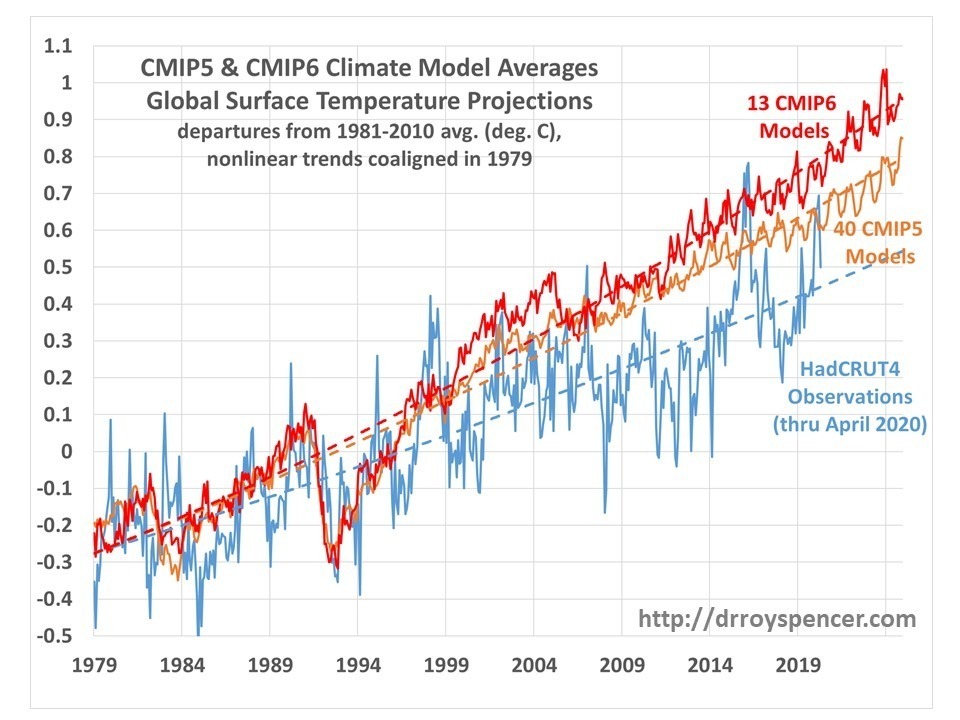
But the forecasts from these models proved wrong. They exaggerated the temperature trend and differed markedly from temperature data derived from ground-based thermometers; sensors on weather balloons aircraft, ships, and buoys; satellite remote sensing; and “reanalyses”—the latter integrating the input of many different data sources.
Yet, political appointees in charge of determining climate and energy policy around the world used these forecasts to justify international climate agreements like the Paris agreement. And they do no stop with that.
The upcoming IPCC sixth assessment report (AR6), forecast for release in 2021, features forecasts from CMIP6. But the CMIP6 models are turning out to be no better than CMIP5 models. In fact, CMIP6 they’re worse!
Senior climatologist Dr. Roy Spencer has observed that the “CMIP6 models are showing 50 percent more net surface warming from 1979 up to April 2020 (+1.08 degree Celsius) than actual observations from the ground (+0.72 degree Celsius).”
Beyond doubt, comparing both CMIP5 and CMIP6 forecasts to official HadCRUT temperature data sets reveals a very old story: models are always way off the mark, and—suspiciously—always in the same direction, namely, upward, in predicting real-world temperatures.
So, not only were we lied to about the climate, we are going to be misled again by the next IPCC assessment report. And with more extreme false forecasts, there will be calls for more restrictive energy policies.
It is quite astonishing how the unelected politicians at the UN can convince and persuade global leaders to adopt climate policies that are based on unscientific conclusions from faulty models.
The mainstream media have also played their part. Public perception on climate change has been heavily influenced by biased coverage on the climate issue, with no major attention to the huge discrepancies between the model forecasts and real-world observations.
It is not clear how much faultier the projections will become by the time the new assessment report is finally released. But one thing is clear: energy sectors across the globe are being held hostage by pseudo-scientific interpretations from the United Nations’ flagship climate wing.
Vijay Jayaraj (M.Sc., Environmental Science, University of East Anglia, England), is a Research Contributor for the Cornwall Alliance for the Stewardship of Creation living in New Delhi, India.
Biden will seek to extend the narrative that Israel is being ‘singled out’
By Ramona Wadi | MEMO | July 16, 2020
Democratic presidential candidate Joe Biden may try to sustain the fable that he is an alternative to current US President Donald Trump, but for the Palestinians a Biden presidency will most probably normalise the human rights violations that have attracted wider endorsement as a result of US support for Israel. Any political differences from those promoted by the Trump administration that Biden might have will definitely not include a reversal of the Zionist colonial project.
Indeed, US support for Israel, according to Biden, is a “longstanding, moral commitment”. The former vice president has also criticised the Boycott, Divestment and Sanctions Movement (BDS) for “singling out Israel”, a slogan made popular during Nikki Haley’s stint as US Ambassador to the UN, and he will almost certainly stick to it. According to his foreign policy adviser, Tony Blinken, Biden “opposes any effort to delegitimise or unfairly single out Israel, whether it’s at the United Nations or through the BDS movement.”
While it is worth pointing out the blindingly obvious yet again that there is no anti-Israel bias at an international level whatsoever, the “singling out Israel” narrative will undoubtedly resonate further given that Trump has embarked on a series of unilateral political decisions that legitimise Israel’s colonial violence and normalises its actions within the international community. Without a reversal of Trump’s decisions, however, a pro-Israel stance from [would-be] President Biden would inevitably increase the likelihood of the international community widening the scope of Israel’s ability to act with total impunity.
The concept of “singling out Israel” is unfounded and has nothing to do with advocacy and activism for Palestine at an international level. Time and again, these actions have met with definite limitations, due to the international community’s complicity in Israel’s colonial project. Activism for Palestine is recognised as a right in terms of free speech and human rights, but these criteria will not be sustained politically at an international level to any meaningful degree, and definitely not enough to change the pro-Israel bias at the UN. The international body is, bizarrely, content to sit back and watch as its own resolutions are treated with contempt and broken routinely by the Zionist state.
As annexation remains pending, the US-Israeli propaganda regarding “anti-Israel” allegations might take a different turn. The international community has played along with the distorted scenario that pits the deal of the century against the two-state compromise. If Biden is elected president and fails to reverse Trump’s decisions or take harsh actions against Israel if it goes ahead and formalises its colonisation of additional Palestinian territory, any opposition from the international community will continue to be framed as being “anti-Israel” and, in the current twisted logic of colonialism, “anti-Semitic”.
However, since 2019 the UN has been more vocal about blaming Palestinians for any Israeli violations. If the narrative that Israel is being singled out is allowed a platform at a time when Palestinians are being rendered invisible at an international level, Palestine risks further oblivion.
However, Israel is not at all concerned about Palestinians gaining a recognised platform, because the fake narrative that it has promoted with help from the US only seeks to extend its impunity. It knows that regardless of whether the periodic international criticism of Israel continues or not, Palestinians are not gaining any additional attention that can alter their political standing. This is what Biden is vying for. As long as the focus remains on Israel, the rogue state will be given every opportunity to normalise its human rights violations and colonisation at an international level.
Israel creates list of officials to prevent arrests for war crimes
MEMO | July 16, 2020
Israel is preparing a secret list of hundreds of its officials who are liable to be tried in The Hague on war crimes charges, it has been revealed. The government is warning them not to travel in case they are arrested.
According to Haaretz, the list has the names of between 200 and 300 military and intelligence officials who could be arrested and put on trial for war crimes committed against civilians in the occupied Palestinian territories of the West Bank and the Gaza Strip.
The report comes amid news of the International Criminal Court (ICC) possibly opening an investigation into war crimes committed by both Israel and Hamas, starting from the Israeli military offensive on Gaza in 2014, known as “Operation Protective Edge”. The request for the trial was made by ICC Prosecutor Fatou Bensouda.
The list was supposed to be kept secret due to the danger it could pose to the officials whose names it contains. It could also be viewed by the ICC as an admission of guilt. Those on the list include Prime Minister Benjamin Netanyahu; former Defence Ministers Moshe Ya’alon, Avigdor Lieberman and Naftali Bennett; former Chiefs of Staff Benny Gantz and Gadi Eisenkot, and current Chief of Staff Aviv Kochavi, as well as the former and current heads of the Shin Bet intelligence agency, Yoram Cohen and Nadav Argaman respectively.
It is suspected that the remainder could be more junior officers and officials, including those who approved the building of Jewish-only settlements within the occupied West Bank. Such settlements are illegal under international law and are one of the subjects of the ICC investigation.
The future of the investigation is to be decided by Judges Peter Kovacs of Hungary, Marc Perrin de Brichambaut of France and Reine Adelaide Sophie Alapini-Gansou of Benin. It will also depend on whether the court has jurisdiction over the areas where the war crimes were committed, which include the occupied West Bank, Gaza Strip and East Jerusalem. Israel insists that the ICC has no such authority or jurisdiction in those areas, as the Palestinian Authority (PA) is not a sovereign state.
This has led many observers to predict that Israel will refuse to cooperate with the ICC, which could result in the court ordering secret detention orders and warrants against the Israeli officials. This would limit their ability to travel and keep Israel unaware of the court proceedings.
If an investigation into alleged war crimes is opened, Israel’s illegal annexation plans for the West Bank could also have a serious impact on any defence that it might mount. Bensouda has included this factor in her preliminary investigation.
The threat of an ICC investigation into Israel’s and America’s alleged war crimes has been criticised by both countries. US President Donald Trump imposed sanctions on the court last month, a move praised by Israel. Nevertheless, the ICC has received further complaints about alleged Israeli and US war crimes over the past month, strengthening the case for a formal investigation.
Danon has exposed the fact that the UN has abandoned Palestine and the Palestinians
By Ramona Wadi | MEMO | July 9, 2020
Israel’s outgoing Ambassador to the UN, Danny Danon, is not leaving the arena without his usual, unfounded claim that the international community is subservient to the Palestinian narrative. In a recent item in the Jerusalem Post, Danon cautioned against calling Israel’s plan to formalise its land theft “annexation”. To substantiate his claim, he quoted former Israeli Prime Minister and wanted terrorist Menachem Begin: “You can annex foreign territory. You can’t annex your own country.”
Mixing Biblical narratives with politics, Danon stated that it was British policy to establish “a Jewish national home in Palestine”, thus proving the Zionist colonial trajectory, rather than any claims to the land. The European colonial ideology which set up a settler-colonial entity in Palestine has no roots in indigenous territory and erasing Palestinians from their land does not make the European colonisers in Palestine in any way indigenous.
According to Danon, “Those who decry it as ‘annexation’ are doing nothing more than appeasing the Palestinian narrative and making peace ever more elusive. This puts them, to use their words, on the wrong side of history.”
In another article for the Jewish Insider, Danon echoed the America Israel Public Affairs Committee’s recommendations to criticise Israel but not issue “threats”, with direct reference to a letter by Democratic lawmakers to US Secretary of State Mike Pompeo, which recommended the conditioning and withholding of US financial aid for Israel if annexation is implemented.
The ongoing efforts to justify Israeli violations of international law clearly indicate the seriousness of annexation. Danon claims that history and international law are on Israel’s side. They aren’t; unfortunately, though, the international community is. The UN is to blame for the way that Palestinian history and narratives have been relegated to annual commemorations, thus communicating overtly that as far as the international body is concerned, Palestinians are just a trophy item on its agenda. With such silent diplomacy, and one with which the Palestinian Authority is in completely concordance, it is an easy task for Israeli representatives to manipulate history and international law based upon collective inaction when it comes to Palestinian rights.
History has documented Israel’s ethnic cleansing of Palestine; it is a fact, as is its normalisation by the international community. Danon has had enough experience at the UN to know that any purported support for Palestinians’ political rights is meaningless, and that Israel can get away with anything, including war crimes, because the international community allows it to determine by itself what constitutes a violation of international law. Israel, though, believes that it is incapable of violating international law, because the colonial state’s own legislation justifies crimes which international laws and conventions prohibit.
Moreover, Israel’s depiction as a democracy within the international arena ensures that the UN will never consider the realities of its colonial violence, let alone recognise the fact that Palestinians are within their rights to resist occupation as part of an anti-colonial struggle. Undoubtedly, Danon would prefer to have a debate about whether the land theft should be called annexation or reclamation, the latter being another example of Zionist sophistry. This would eliminate any scrutiny of the fact that Israel is formalising annexation without so much as a collective warning from the international community, despite the UN’s posturing and pontificating about international law. Danon and his fallacious claims have exposed the fact that the organisation has effectively abandoned Palestine and the Palestinians.
The UN has found that the US killing of Soleimani broke international law. It’s right, but nothing will happen as a result
By Scott Ritter | RT | July 8, 2020
For America, international law has no meaning. In Washington’s view, it applies to other countries, but not to them. Sadly, this well-reasoned UN declaration is simply an exercise in frustration and irrelevance.
On paper, it sounds very copesetic: “… a single strike, one or two cars targeted, 10 individuals killed, in a non-belligerent country, surrounded by people unaware of and unprepared for an international armed conflict.”
With these words, Agnes Callamard, the United Nations Special Rapporteur on extrajudicial, summary or arbitrary executions, described the assassination of Qassem Soleimani in a report submitted to the Human Rights Council.
Callamard’s report covered the broad topic of ‘Extrajudicial, summary or arbitrary executions’, and focused in particular on the use of armed drones for targeted killing. She observed that such acts are carried out by conventional means, such as Special Operations Forces, and as such her report “contains findings applicable to all forms of targeted killings, no matter their method.”
In her report, Callamard singled out the assassination (i.e., “targeted killing”) of General Soleimani as “the first known incident in which a State [e.g., the US] invoked self-defense as a justification for an attack against a State-actor, in the territory of another state, thus implicating the prohibition on the use of force in Article 2(4) of the UN Charter.” It declares that “All Members shall refrain in their international relations from the threat or use of force against the territorial integrity or political independence of any state, or in any other manner inconsistent with the Purposes of the United Nations.”
Callamard labeled the killing of Soleimani by a US drone strike an “arbitrary killing,” noting that while the US claimed that the strike was in response to an “escalating series of armed attacks in recent months” by Iran, the US claim “fails to describe even one ongoing attack.”
Instead, Callamard describes a series of separate and distinct attacks which are not, in and of themselves, escalating, related in time or at all. Moreover, by attacking Soleimani on Iraqi soil without the consent of Iraq, the US violated Iraq’s “territorial integrity.”
Callamard couches her case in the language of international law, noting that various international courts have “established that human rights treaty obligations can apply in principle to the conduct of a State outside its territory.” Moreover, as Callamard points out, the Human Rights Committee to whom she reports “has established that a State party has an obligation to respect and to ensure the right to life of all persons whose right to life is impacted by its military or other activities in a direct and reasonably foreseeable manner.” This obligation, Callamard argues, applies to drones strikes and their targets, which fall within the jurisdiction of the state operating the drone.
As Callamard notes, to date there is a refusal on the part of courts of jurisdiction to provide oversight regarding extra-territorial killings by armed drones, noting that “such matters are political, or relate to international relations between states and thus are non-justiciable.” Callamard rejects this excuse, noting that it “cannot be reconciled with recognized principles of international law, treaties, conventions, and protocols, and violates the rights to life and to a remedy.”
Callamard says that the US, in justifying the assassination of Qassem Soleimani, cites the self-defense clause of Article 51 of the UN Charter. But, as she points out, “even the legality of a strike under Art. 51 of the UN Charter does not preclude its wrongfulness under humanitarian or human rights law.”
International jurisprudence, as Callamard observes, suggests that self-defense could only be invoked against a threat that is already there. Void of such an imminent threat, the US action operates in violation of Article 6 of the International Covenant on Civil and Political Rights (ICCPR), which prohibits “arbitrary deprivations of life.”
At the end of the day, however, the Special Rapporteur’s report is, for all practicalities and solid reasoning, an exercise in frustration and irrelevance.
For laws to have any effect, they must be enforceable, and to be enforceable there must be jurisdiction. To decide that the US, through its extrajudicial and extraterritorial assassination of Soleimani, was in violation of Article 6 of the ICCPR is one thing; turning that decision into anything other than an act of moralistic chest-thumping is another.
One would think it should not be this way. After all, Article VI, paragraph 2 of the US Constitution makes treaties the supreme law of the land on the same footing with acts of Congress. The US Senate provided its advice and consent to the ratification of the International Covenant on Civil and Political Rights, which had been adopted by the United Nations General Assembly on December 16, 1966, and signed on behalf of the US on October 5, 1977. Simply put, Article 6 of the ICCPR is the law of the land.
Not so fast. Senate ratification was contingent upon a number of “Reservations, Understandings, Declarations and Proviso,” including one which declared that “the United States declares that the provisions of Articles 1 through 27 of the Covenant are not self-executing.”
As such, regardless of whether issues pertaining to the entry into and ratification of the ICCPR make it sufficient to imbue its provisions as the “law of the land,” the fact that the US Senate expressly indicated that certain provisions of the ICCPR not to be self-executing means that Article 6 of the ICCPR cannot be seen as standing alone as the equivalent to an act of the legislature, but rather requiring a subsequent act of Congress before its provisions can be put into effect.
As the US Supreme Court once observed, “A treaty is primarily a compact between independent nations. It depends for the enforcement of its provisions on the interest and the honor of the governments which are parties of it.”
The odds of the US Congress stepping up and enacting legislation that would confer legitimacy to the Special Rapporteur’s finding that the US acted in violation of Article 6 of the ICCPR when killing Soleimani are zero; it is not in the interest of Congress to do so, and anyone searching for a semblance of honor within Congress would have better odds canvassing a brothel.
International law, like the Constitution which imbues it with relevance as far as the US is concerned, only possesses the meaning and legitimacy that a society is willing to vest in it. The US, acting on legislation passed by Congress, has engaged in a whittling away of the rights and protections afforded to Americans and world citizens to the point that neither international law nor the Constitution have much meaning anymore.
It is not just the US Congress that has lost its voice when it comes to expressing moral outrage against the murder done in its name. “To date drones’ attacks and targeted killings are not the object of robust international debates and review,” Callamard concludes in her report. “The Security Council is missing in action; the international community, willingly or not, stands largely silent. That is not acceptable.”
Seen in this light, the words of Callamard take on a whole new level of urgency. “[T]he targeted killing of General Soleimani, coming in the wake of 20 years of distortions of international law, and repeated massive violations of humanitarian law, is not just a slippery slope. It is a cliff.”
Scott Ritter is a former US Marine Corps intelligence officer. He served in the Soviet Union as an inspector implementing the INF Treaty, in General Schwarzkopf’s staff during the Gulf War, and from 1991-1998 as a UN weapons inspector. Follow him on Twitter @RealScottRitter
How Venezuela helped defeat Canada’s Security Council bid

By Yves Engler · June 26, 2020
Was Canada defeated in its bid for a seat on the United Nations Security Council because of Justin Trudeau’s effort to overthrow Venezuela’s government? Its intervention in the internal affairs of another sovereign country certainly didn’t help.
According to Royal Military College Professor Walter Dorn, “I spoke with an ambassador in NYC who told me that yesterday she voted for Canada. She had also cast a ballot in the 2010 election, which Canada also lost. She said that Canada’s position on the Middle East (Israel) had changed, which was a positive factor for election, but that Canada’s work in the Lima Group caused Venezuela to lobby hard against Canada. Unfortunately (from her perspective and mine), Venezuela and its allies still hold sway in the Non-Aligned Movement (NAM or G77).”
The only country’s diplomats — as far as I can tell — that publicly campaigned against Canada’s bid for a seat on the Security Council were Venezuelan. Prior to the vote Venezuela’s Vice-Minister of foreign relations for North America, Carlos Ron, tweeted out his opposition: “With its deafening silence, Canada has de facto supported terrorists and mercenaries who recently plotted against Venezuela, threatening regional peace and security. The UNSC is entrusted with upholding the United Nations Charter and maintaining International Peace and Security: Canada does not meet that criteria.”
The post was re-tweeted by Foreign Minister Jorge Arreaza, who has 1.6 million followers, and numerous Venezuelan diplomats around the world, including the Venezuelan ambassador to the UN. Joaquín Pérez Ayestarán added, “Canada recognizes an unelected, self-proclaimed President in Venezuela, in complete disregard for the will of the voters. It also tries to isolate Venezuela diplomatically & supports sanctions that affect all Venezuelans. Is the Security Council the place for more non-diplomacy?”
After Canada lost its Security Council bid Ron noted, “not surprised with UN Security Council election results today. A subservient foreign policy may win you Trump’s favor, but the peoples of the world expect an independent voice that will stand for diplomacy, respect for self-determination, and peace.” He also tweeted an Ottawa Citizen article titled “Why Black and brown countries may have rejected Canada’s security council bid.”
For his part, UN ambassador Ayestarán tweeted, “losing two consecutive elections to the Security Council of United Nations within a 10-years period is a clear message that you are not a reliable partner and that the international community has no confidence in you for entrusting questions related to international peace and security.”
Over the past couple of years the Trudeau government has openly sought to overthrow Venezuela’s government. In a bid to elicit “regime change”, Ottawa has worked to isolate Caracas, imposed illegal sanctions, took that government to the International Criminal Court, financed an often-unsavoury opposition and decided a marginal opposition politician was the legitimate president.
Canada’s interference in Venezuelan affairs violates the UN and OAS charters. It is also wildly hypocritical. In its bid to force the Maduro government to follow Canada’s (erroneous) interpretation of the Venezuelan constitution Ottawa is allied in the Lima Group with President Juan Orlando Hernandez, who openly defied the Honduran Constitution. Another of Canada’s Lima Group allies is Colombian President Ivan Duque who has a substantially worse human rights record.
Reflecting the interventionist climate in this country, some suggested Canada’s position towards Venezuela would actually help it secure a seat on the Security Council. A few weeks before the vote the National Post’s John Ivison penned a column titled “Trudeau’s trail of broken promises haunt his UN Security Council campaign” that noted “but, Canada’s vigorous participation in the Lima Group, the multilateral group formed in response to the crisis in Venezuela, has won it good notices in Latin America.” (The Lima Group was set up to bypass the Organization of American States, mostly Caribbean countries, refusal to interfere in Venezuela’s affairs.) A Canadians for Justice and Peace in the Middle East factsheet regarding “Canada’s 2020 bid for a UN Security Council seat” echoed Ivison’s view. It claimed, “Canada also presents a positive image to Latin American states, likely reinforced by its leadership of the Lima Group in 2019 and by its promise to allocate $53 million to the Venezuelan migration crisis.”
While it is likely that Lima Group countries voted for Canada, a larger group of non-interventionist minded countries outside of that coalition didn’t. Venezuelan officials’ ability to influence Non-Aligned Movement and other countries would have been overwhelmingly based on their sympathy for the principle of non-intervention in other countries’ affairs and respect for the UN charter.
The Liberals’ policy towards Venezuela has blown up in its face. Maduro is still in power. Canada’s preferred Venezuelan politician, Juan Guaidó, is weaker today than at any point since he declared himself president a year and a half ago. And now Venezuela has undermined the Liberals’ effort to sit on the Security Council.
Will Canada’s defeat at the UN spark a change in its disastrous Venezuela policy?
International community rejects Canada’s bid for a seat on Security Council

By Yves Engler | June 17, 2020
The international community’s rejection of Canada’s bid for a seat on the United Nations Security Council isn’t a surprise. In the below introduction to my recently published House of Mirrors: Justin Trudeau’s Foreign Policy I detail how Liberal foreign policy has largely mimicked Stephen Harper’s who lost a bid for the Security Council in 2010.
***
Justin Trudeau presents himself as “progressive” on foreign affairs. The Liberals claim to have brought Canada “back” after the disastrous Stephen Harper government. But, this book will demonstrate the opposite.
While promising to “make a real and valuable contribution to a more peaceful and prosperous world”, Trudeau has largely continued the Conservatives pro-corporate/empire international policies. The Liberals have followed the previous government’s posture on a wide range of issues from Russia to Palestine, Venezuela to the military.
In 2017 the Liberals released a defence policy that called for 605 more special forces, which have carried out numerous violent covert missions abroad. During the 2015 election campaign defence minister Jason Kenney said if re-elected the Conservatives would add 665 members to the Canadian Armed Forces Special Operations Command. The government’s defence policy also included a plan to acquire armed drones, for which the Conservatives had expressed support. Additionally, the Liberals re-stated the previous government’s commitment to spend over one hundred billion dollars on new fighter jets and naval ships.
The Harper regime repeatedly attacked Venezuela’s elected government and the Liberals ramped up that campaign. The Trudeau government launched an unprecedented, multipronged, effort to overthrow Nicolás Maduro’s government. As part of this campaign, they aligned with the most reactionary political forces in the region, targeting Cuba and recognizing a Honduran president who stole an election he shouldn’t have participated in. Juan Orlando Hernández’ presidency was the outgrowth of a military coup the Conservatives tacitly endorsed in 2009.
In Haiti the Liberals propped up the chosen successor of neo-Duvalerist President Michel Martelly who Harper helped install. Despite a sustained popular uprising against Jovenel Moïse, the Liberals backed the repressive, corrupt and illegitimate president.
The Trudeau government continues to justify Israeli violence against Palestinians and supports Israel’s illegal occupation. Isolating Canada from world opinion, they voted against dozens of UN resolutions upholding Palestinian rights backed by most of the world.
Initiated by the Conservatives, the Liberals signed off on a $14 billion Light Armoured Vehicle sale to Saudi Arabia. The Liberals followed Harper’s path of cozying up to other repressive Middle East monarchies, which waged war in Yemen. They also contributed to extending the brutal war in Syria and broke their promise to restart diplomatic relations with Iran, which the Conservatives severed.
The Liberals renewed Canada’s military “training” mission in the Ukraine, which emboldened far-right militarists responsible for hundreds of deaths in the east of that country. In fact, Trudeau significantly bolstered Canada’s military presence on Russia’s doorstep. Simultaneously, the Trudeau government expanded Harper’s sanctions against Russia.
On China the Liberals were torn between corporate Canada and militarist/pro-US forces. They steadily moved away from the corporate sphere and towards the militarist/US Empire standpoint. (During their time in office the Conservatives moved in the opposite direction.) Ottawa seemed to fear that peace might break out on the Korean Peninsula.
Trudeau backed Africa’s most bloodstained politician Paul Kagame.
Unlike his predecessor, Trudeau didn’t sabotage international climate negotiations. But the Liberals flouted their climate commitments and subsidized infrastructure to expand heavy emitting fossil fuels.
Ignoring global inequities, the Liberals promoted the interests of corporations and wealth holders in various international forums. They backed corporate interests through trade accords, Export Development Canada and the Trade Commissioner Service. Their support for SNC Lavalin also reflected corporate influence over foreign policy.
In a stark betrayal of their progressive rhetoric, the Trudeau regime failed to follow through on their promise to rein in Canada’s controversial international mining sector. Instead they mimicked the Conservatives’ strategy of establishing a largely toothless ombudsperson while openly backing brutal mining companies.
To sell their pro-corporate/empire policies the Liberals embraced a series of progressive slogans. As they violated international law and spurned efforts to overcome pressing global issues, the Liberals crowed about the “international rules-based order”. Their “feminist foreign policy” rhetoric rested uneasily with their militarism, support for mining companies and ties to misogynistic monarchies.
Notwithstanding the rhetoric, the sober reality is that Trudeau has largely continued Harper’s foreign policy. The “Ugly Canadian” continued to march across the planet, but with a prettier face at the helm.
My 2012 book The Ugly Canadian: Stephen Harper’s Foreign Policy detailed the first six and a half years of Harper’s rule. This book looks at the first four years of Trudeau’s reign. I will discuss the many ways Canadian foreign policy under Conservative and Liberal governments remained the same. Support for empire and a pro-corporate neoliberal economic order is the common theme that links the actions of conservative and self-described “progressive” prime ministers.
Please sign this petition calling for a fundamental reassessment of Canadian foreign policy.
Russia: UN chief report blaming Iran for attacks on Saudi oil facilities not based on convincing evidence
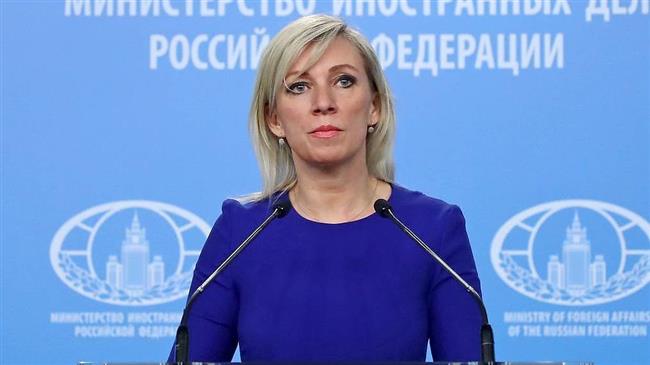
Russian Foreign Ministry spokeswoman Maria Zakharova
Press TV | June 17, 2020
The Russian Foreign Ministry says the UN chief’s report on Iran’s involvement in the last year attacks on Saudi oil facilities is biased and not substantiated by facts.
“What we surely won’t argue with is, unfortunately, that the report can hardly be called balanced and calibrated,” the ministry spokesperson Maria Zakharova said during a press briefing on Wednesday.
She added Russia will present a “detailed analysis” of the UN report during the relevant discussion at the Security Council later on June 30.
“We can also speak about a lack of impartiality and the absence of strong facts to support the accusations leveled at Iran,” she noted, stressing “Nobody has ever presented any convincing evidence of Iran’s violations to the Security Council members.”
The Russian official said that the report was not valid, arguing the “self-appointed inspectors” had claimed based on their “personal observations” that what they saw was “roughly reminiscent of what Iran had once demonstrated at arms exhibitions.”
Last week, UN Secretary General Antonio Guterres said in a report to the Security Council that cruise missiles used in attacks on oil facilities and an airport in Saudi Arabia last year were of “Iranian origin.”
He also said the “items may have been transferred in a manner inconsistent” with UN Security Council Resolution 2231, which endorses the international nuclear deal – officially known as the Joint Comprehensive Plan of Action (JCPOA) – signed between Iran and major world powers in 2015. The allegations were roundly rejected by Iran’s Foreign Ministry.
The ministry said in a statement that the claims appear to have been made under political pressure from the US and Saudi regimes.
“Preparing reports with political motivation will not change the facts and it is clear to all that the current circumstances in the region have directly resulted from the wrong policies of the United States and the child-killing Saudi regime,” the statement said.
The ministry highly recommended that the UN Secretariat not play into the hands of the US in its “pre-planned scenario to annul the cancellation of Iran’s arms embargo.” It also warned the UN against contributing to such a dangerous trend by preparing illegal reports.
Separately, Iran’s UN Mission also responded to the report on Friday, saying, “Iran categorically rejects the observations contained in the report concerning the Iranian connection to the export of weapons or their components that are used in attacks on Saudi Arabia and the Iranian origin of alleged US seizures of armaments.”
US President Donald Trump withdrew Washington from the JCPOA in 2018 and reinstated Washington’s unilateral sanctions against Tehran. His administration has also been piling up pressure on the United Nations to extend and strengthen the embargo on Iran, which is set to expire in October under the nuclear deal.
Washington seeks to restore all Security Council sanctions lifted against Iran if the 15-member body fails to preserve the UN ban on selling conventional arms to Iran.
Iran: E3 unconstructive draft resolution at IAEA meeting mockery of international rules
Press TV – June 16, 2020
Iran has condemned as “unconstructive” a resolution reportedly drafted by the three European signatories to a 2015 nuclear deal for a vote at the International Atomic Energy Agency (IAEA)’s governing board meeting, saying such a resolution makes a mockery of international rules.
Speaking to reporters on Tuesday, Kazem Gharibabadi, Iran’s permanent representative to Vienna-based international organizations, urged France, Germany and the UK — also known as E3 — not to complicate the situation surrounding the Iran deal if they cannot fulfill their end of the bargain and help salvage the accord.
The comments came as IAEA Board of Governors started a four-day meeting on Monday, with Iran on the agenda.
According to a Bloomberg report, the resolution prepared by the European trio urges Tehran to “fully cooperate” with the IAEA investigation of its nuclear facilities. It came after the nuclear watchdog’s inspectors claimed they had not been given access to two locations that may have hosted atomic activities two decades ago.
The resolution will have to be presented during the meeting and is expected to win Washington’s backing.
During the Monday session, the IAEA Director General Rafael Mariano Grossi claimed that for over four months, “Iran has denied us access to two locations and that, for almost a year, it has not engaged in substantive discussions to clarify our questions related to possible undeclared nuclear material and nuclear-related activities.”
Gharibabadi dismissed the claims in the reported resolution and said, “While Iran is cooperating extensively and constructively with the agency, submitting a resolution with the purpose of asking Iran to cooperate and fulfill the two demands of the IAEA is regrettable and a totally unconstructive move.”
He criticized the European trio’s double standards on Tehran’s nuclear program and said such a resolution is being put forth by the countries that “either possess nuclear weapons or play host to such destructive and deadly weapons.”
Such a move, Gharibabadi said is “a mockery of international norms and rules governing disarmament and non-proliferation regimes.”
Gharibabadi also called on all members of the IAEA Board of Governors to exercise vigilance and avoid taking any “political and hasty” measures in order for Iran to continue cooperation with the Vienna-based agency.
“Naturally if such a resolution, which clearly serves American goals, is approved, the Islamic Republic of Iran will have to take the necessary measures accordingly,” he noted.
The Iranian envoy further stressed that the new IAEA request is founded on the claims raised by the Israeli regime, which is an enemy of Iran.
Tehran’s transparent cooperation with the agency “does not mean that we should agree to every request from the IAEA on the basis of delusional claims of our enemies,” he emphasized.
Iran signed the Joint Comprehensive Plan of Action (JCPOA) with six world states — namely the US, Germany, France, Britain, Russia and China — in 2015.
However, Washington’s unilateral withdrawal in May 2018 and the subsequent re-imposition of sanctions against Tehran left the future of the historic agreement in limbo.
Iran remained fully compliant with the JCPOA for an entire year, waiting for the co-signatories to honor their commitments.
As the European parties failed to do so, the Islamic Republic moved in May 2019 to suspend its JCPOA commitments under Articles 26 and 36 of the deal covering Tehran’s legal rights.
Iran dismisses UN report on missiles ‘of Iranian origin,’ says body under US, Saudi pressure
Press TV – June 12, 2020
Iran has dismissed a recent claim by the United Nations that missiles used to attack Saudi Arabia have been “of Iranian origin,” saying the organization has spoken out under political pressure from the US and the Saudi regime.
In a statement on Friday, the Iranian Ministry of Foreign Affairs said it was deeply concerned about the use of the UN Secretariat as a means to achieve political objectives.
“Preparing reports with political motivation will not change the facts and it is clear to all that the current circumstances in the region have directly resulted from the wrong policies of the United States and the child-killing Saudi regime,” the statement said.
UN Secretary General Antonio Guterres told the Security Council in a report seen by Reuters on Thursday that cruise missiles used in several attacks on oil facilities and an international airport in Saudi Arabia in November 2019 and February 2020 had been of “Iranian origin.”
He also said the “items may have been transferred in a manner inconsistent” with Security Council Resolution 2231, which enshrines the international nuclear deal – officially known as the Joint Comprehensive Plan of Action (JCPOA) – signed between Iran and world powers in 2015.
Guterres pointed out in his report that the United Nations had examined the debris of weapons used in the attacks on an oil facility in Afif in May, the Abha international airport in June and August, and the Aramco oil facilities in Khurais and Abqaiq in September.
Referring to the “examination of the weapons debris,” the Iranian Foreign Ministry censured the inattention to the sales of lethal weapons to Saudi Arabia that are used against the defenseless people of Yemen while “Saudi garbage is being checked for proof.”
“Undoubtedly, such reports will not only fail to help [promote] peace and security in the region and implement [UN] Security Council resolutions, but also completely destroy the validity and reputation of the United Nations,” the ministry warned.
It said the UN report came at a time that the United States is drafting a “dangerous” resolution to “illegally” extend an arms embargo against Iran, adding this would strengthen the likelihood of it being prepared on Washington’s order to be used at the Security Council against Iran.
The Iranian Foreign Ministry highly recommended that the UN Secretariat not play into the hands of the US in its “pre-planned scenario to annul the cancellation of Iran’s arms embargo.” It also warned the UN against contributing to such a dangerous trend by preparing illegal reports.
In May 2018, President Donald Trump unilaterally pulled the United States out of the JCPOA and later re-imposed the sanctions that had been lifted against Tehran and began unleashing the “toughest ever” bans.
Although the US is not a party to the JCPOA any longer, it recently launched a campaign to renew the Iran arms ban — in place since 2006/2007 – through a resolution at the Security Council. Russia and China are against the push, and most likely to veto it.
To circumvent the veto, the US says it will argue that it legally remains a “participant state” in the nuclear pact only to trigger the snapback that would restore the UN sanctions, which had been in place against Iran prior to the JCPOA inking.
Tehran says Washington, through its unilateral withdrawal from the deal, has forfeited all rights to have a say in the agreement.
European Union foreign policy chief Josep Borrell said on Tuesday that the US has already pulled out of the JCPOA and cannot currently use its former membership of the deal to seek a permanent arms embargo on Tehran.
“The United States has withdrawn from the JCPOA, and now they cannot claim that they are still part of the JCPOA in order to deal with this issue from the JCPOA agreement. They withdraw. It’s clear. They withdraw,” Borrell said.
Canada’s Bid of Hypocrisy
By Rifat Audeh | Palestine Chronicle | June 12, 2020
On May 31st, the world commemorated the tenth anniversary of this Israeli attack (in international waters) on the humanitarian Gaza Freedom Flotilla. The Flotilla aimed to break the inhumane Israeli blockade imposed on the people of Gaza, described as collective punishment and therefore illegal according to international reports and scholars, including a UN panel of experts. Two other Canadians and myself were aboard the main ship attacked, the Mavi Marmara.
Ironically, on the day of the attack, Israeli PM Benjamin Netanyahu was in Canada, meeting with former Canadian PM Harper and other governmental officials. Yet despite this, the Conservative government did not demand our release nor was there any condemnation of Israel’s piracy against Canadians and other internationals, as we explained to the public in an open letter to Stephen Harper at the time.
To the contrary, the Canadian government implicitly justified Israeli actions against its own citizens. The timid visit I received by embassy representatives at the prison along with fellow Canadians, was punctuated by the fact that they had no response to my question of what the Canadian government will do about our illegal kidnapping and detainment.
If it was not for immense Turkish political pressure on Israel, there is no doubt in my mind that our government would have left us in an Israeli prison indefinitely. This was further confirmed to me when I visited our embassy in Jordan a while after my release when an embassy representative sadly defended Israeli actions even more vociferously than the Israelis themselves.
After the ascendance of the Liberals to power, I was hopeful that this foreign policy will change, and that our government would adopt an approach consistent with international law and human rights, particularly in relation to Palestine. In retrospect, I confess that I was quite naive.
In one of the first set of UN General Assembly sessions in the post-Conservative era, the Trudeau government voted against UN General Assembly Resolution A/RES/71/98, a resolution that emphasizes “the right of all people in the region to the enjoyment of human rights as enshrined in the international human rights covenants”. The same resolution demands that Israel, as the occupying power “cease all practices and actions that violate the human rights of the Palestinian people”.
Shamefully, this pattern of voting against the human rights of Palestinians and against upholding international law has continued ever since then, with Canada either voting against such resolutions or abstaining, thus isolating itself from the vast majority of the world.
A recent exception to this policy of blindly siding with Israel -at the expense of Palestinian human rights- took place in November, when Canada supported a UN resolution endorsing Palestinian self-determination. Yet PM Trudeau was quick to reassure pro-Israelis that this vote does not represent a shift from Canada’s support to Israel.
This is why many critics have speculated that the only reason Canada voted with the majority in this instance, is to try and secure a seat on the UN Security Council. The UN ambassadors will soon select new members to the UN Security Council, and there are bids by Canada, Ireland and Norway for “a place at the table”.
Accordingly and for the reasons shown above, I have signed a letter to the UN Ambassadors and a petition against Canada joining the UNSC. Although the council is clearly deficient already in many ways, this does not negate the fact that in addition to this, our country has clearly not earned its stripes to gain ascension to it.
In 2018, Canada’s Foreign Affairs Minister stated that the country’s presence on the council can be “an asset for Israel”, while hypocritically stating in the same speech: “Nor can we stand idly by when human rights are violated, wherever that may be.” Well, unless they are Palestinian human rights of course.
– Rifat Audeh is a lifelong human rights activist and award-winning filmmaker. His writings have appeared in various media outlets and he has a Masters’s degree in Media and Journalism.
Featured Video

The Most Important Bet You’ve Never Heard Of
or go to
Aletho News Archives – Video-Images
From the Archives
Wars for Israel: A reminder of who’s giving the marching orders
By Damian Lataan | February 7, 2012
As the West prepares to march off to yet another war in the Middle East, we should perhaps remind ourselves of who is giving the West their marching orders.
In February 2003, just weeks before the US and their allies launched their attack on Iraq and her peoples, a delegation of US congressmen, together with the US Ambassador to the United Nations, John Bolton, a well known pro-Zionist and neoconservative war-hawk, were in Israel at the invitation of the Israeli government then led by Israeli Prime Minister Ariel Sharon.
Addressing the congressmen, Sharon told them ‘that Iran, Libya and Syria should be stripped of weapons of mass destruction after Iraq’. Later, Sharon told John Bolton ‘that Israel was concerned about the security threat posed by Iran, and stressed that it was important to deal with Iran even while American attention was focused on Iraq’. … continue
Blog Roll
 Aletho News
- UAE rejects report claiming it is ready to join war on Iran to reopen Hormuz
- A New Resistance Front: How Does Syria Factor into the Regional War?
- Gulf states weigh pipeline expansion plans, hoping to bypass Hormuz
- Iran sets up ‘tollbooth’ system in Strait of Hormuz
- Wave 90: IRGC strikes US-linked industrial sites in Gulf
- Iran Says US-Israeli Claims of Its Military Strength Are Wrong
- Trump’s April Fools’ Address to the nation
- The Most Important Bet You’ve Never Heard Of
- The killing of three Indonesian soldiers in Lebanon should remind Jakarta that Israel does not want peace
- Defeated and delusional: Netanyahu’s remarks reveal $80bn war failure, says analyst
- If Americans Knew
- ‘War crime’: Global condemnation as Israeli ministers celebrate death penalty law targeting Palestinian prisoners
- 7 Ways Israel Is Turning Lebanon Into Gaza
- World’s Leading Football Bodies Under Fire Over Israel Policies
- Experts warn of possible use of nukes against Iran
- Israeli invasion of Lebanon could be worse than 1982, warn European officials
- Passover: Liberation and collective punishment
- Trump says the quiet part out loud: (Israel’s) war on Iran > Americans’ health – Daily Update
- Gaza families reunite years after babies evacuated amid Israel’s war
- International Rescue Committee warns Gaza’s children face grave protection risks
- Iran’s Alleged 47-Year War on America: Debunking the 1,050 American Deaths Canard
- No Tricks Zone
- Low Intensity Tornado Wrecks Major Solar Farm, Creating A Potential Toxic Dump
- New Study Finds Warming Saves Lives…Cold Temperatures 12 Times More Deadly Than Excess Heat
- German Science Blog Accuses PIK Climate Institute Of Hallucinating Climate Tipping Points
- Devastating Assessment Of Comirnaty Vaccine By Former Senior Pfizer Europe Toxicologist
- New Study: CO2 Is ‘Effectively Negligible’ As An Explanatory Climate Change Factor Since 2000
- Former Pfizer Toxicologist Dr. Helmut Sterz Tells Bundestag Hearing Pfizer Vaccine Should Have Never Been Approved
- Energy Expert: Germany’s Nuclear Phaseout Was A “500 Billion Euro Mistake”
- New Research: South Australia’s Mid-Holocene Sea Surface Temperatures Were 4°C Warmer Than Today
- Storing Green Energy To Last Germany 10 Days Would Require A 60-Million Tonne Battery
- New Studies: UK Sea Levels Were 4 Meters Higher Than Today During The Mid-Holocene
 Aletho News