Hamas calls on UN to support Palestinians’ right to bear arms against Israel
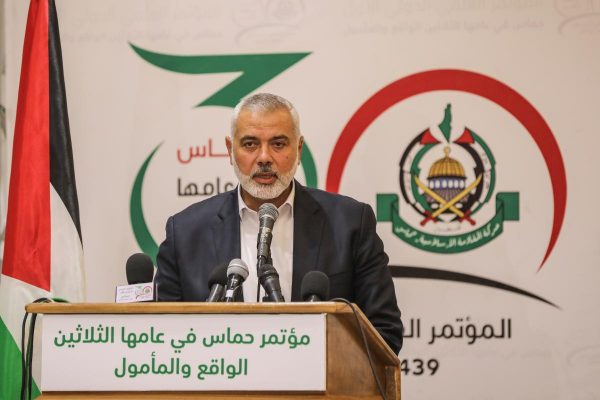
Head of the Political Bureau of Hamas Ismail Haniyeh makes a speech during a conference on 18 September, 2018 in Gaza City, Gaza [Ali Jadallah/Anadolu Agency]
MEMO | November 29, 2018
Hamas chief Ismail Haniyeh has called on the United Nations to recognise and support the Palestinian people’s right to bear arms against Israel in self-defence.
Haniyeh wrote to UN General Assembly (UNGA) President Maria Fernada Spinosa in advance of the organisation’s debate regarding Hamas rocket fire into Israel.
“We reiterate the right of our people to defend themselves and to resist the occupation, by all available means,” wrote Haniyeh, “including armed resistance, guaranteed by the international law.” He based the demand on international law drawn up and implemented by the UN, which gives states and peoples the right to defend themselves with arms if necessary, in the case of an external attack. “The General Assembly of the United Nations adopted dozens of resolutions that affirm the right of peoples to independence, self-determination and struggle by all available means, peaceful and non-peaceful, for that right. The UN singled out the Palestinian people for dozens of relevant resolutions, including 2621, 2649, 2787 and 3236,” he said.
After condemning the US for adopting Israel’s narrative of the conflict and justifying Israel’s aggression towards the Palestinians, Haniyeh insisted that “the last of these efforts is the attempt by the United States Ambassador to the United Nations… to submit a draft resolution condemning the Palestinian resistance and the right of our people to defend themselves against this racist and continuous occupation for more than seven decades.”
Israel’s Ambassador to the UN, Danny Danon, commented on Haniyeh’s letter, saying that Hamas “going to the UN for assistance is like a serial killer asking the police for assistance. Israel and the United States will continue to mobilize the countries of the world into a united front against the terrorism that Hamas engages in.”
The debate held in the UN today coincides with the International Day of Solidarity with the Palestinian People, which is held every year on 29 November. It comes two weeks after the latest Israeli assault on Gaza, which broke out after an undercover Israeli special forces operation in the strip was botched and compromised by Hamas. Days later, a ceasefire was declared, which was again broken by Israel the following morning when Israeli soldiers killed a Palestinian fisherman off the coast of Gaza.
READ: US lobbies for vote against Hamas at UN General Assembly
UN Climate Report Recommends Taxing Carbon and Discouraging Agriculture

“Land taxes on agricultural land can also help reduce agricultural land use and deforestation”
By Eric Worrall | Watts Up With That? | November 28, 2018
The latest UN Emissions Gap Report provides psychological advice for defeating political opposition to carbon pricing, and suggests discouraging farming by taxing agricultural land.
…
6.3.3 Political and behavioural factors
Ensuring broad and stable support for carbon pricing and the phasing-out of fossil fuel subsidies requires more than addressing distributional, competitiveness and leakage impacts. A number of additional success factors can be identified (Klenert et al., 2018a) and table 6.1 provides country examples for addressing these. The challenge is particularly significant where trust in government is limited (Klenert et al., 2018a; Rafaty, 2018). And yet, where trust is strong, there is a tendency for citizens to question problems if policy solutions challenge their world views, e.g. on the State’s role in the economy (“solution aversion”) (Campbell and Kay, 2014; Cherry et al., 2017). Designing policies that are consistent with the prevailing world views of specific societal groups therefore requires extensive communication and consultation prior to implementation.
To secure popular support for carbon pricing, the public needs to be informed about its positive effect on emissions reduction targets, as well as the co-benefits of cleaner air, health and fiscal sustainability (Hsu et al., 2008; Bristow et al., 2010; Kallbekken et al., 2011; Baranzini et al., 2014; Baranzini and Carattini, 2017). Timing is also important: a gradual reform is more likely to be successful than sudden and drastic price increases. Similarly, if several fossil fuel subsidies are being reformed, this can best be done by sequencing the reforms (Beaton et al., 2013; Rentschler and Bazilian, 2017b). Language matters too, with terms such as ‘fee’ or ‘contribution’ likely to meet with popular support compared with ‘tax’ (Kallbekken et al., 2011; Drews and van den Bergh, 2016; Baranzini and Carattini, 2017).
Carbon pricing and fossil fuel subsidy reform generate public revenues, the use of which can strongly impact support for carbon pricing. This is discussed in the section 6.3.4.
6.3.4 Use revenues from carbon pricing to foster sustainable development
Raising revenue through energy tax reforms relaxes constraints on broader fiscal policy, creating opportunities to stimulate more productive and socially inclusive economic development. With respect to carbon pricing, its potential for contributing to public budget is illustrated in figure 6.2b. In developing and emerging economies, where tax revenue-to-gross domestic product (GDP) ratios rarely exceed 20 percent, an additional €60/ tCO2 carbon price on top of existing measures would generate revenues worth more than 2 percent of gross domestic product (GDP). These revenues would not be available under non-fiscal climate policies like emission standards or ETS that do not auction permits.
…
Better alignment of broad tax policy can help reduce carbon emissions. Subsidies or tax deductions related to commuting (Su and DeSalvo, 2008), company cars (Harding, 2014) and the aviation sector (Gössling et al., 2017) are common in many developed countries and tend to encourage carbon-intensive transport choices. Replacing property taxes with land value taxes can reduce urban sprawl and increase housing density, which in turn reduces the need for longer commutes (Banzhaf and Lavery, 2010).
I’m horrified at the ongoing UN and green attacks on agriculture. The abundance we take for granted is politically fragile:
Fiscal policies such as ecological fiscal transfers, contingent on environmental performance, can also play a role in the land-use sector. They could be a way to implement REDD+6 when international pay-for-performance or carbon market finance flows to the national or state government level (Loft et al., 2016). There is growing experience with ecological fiscal transfers, including transfers of tax revenues to support protected areas and forests in Portugal (Santos et al., 2012), several Brazilian states (May et al., 2011) and India (Busch and Mukherjee, 2018). Land taxes on agricultural land can also help reduce agricultural land use and deforestation (Kalkuhl and Edenhofer, 2017).
…
Full Report: http://wedocs.unep.org/bitstream/handle/20.500.11822/26895/EGR2018_FullReport_EN.pdf
Amid warming ties with Chad, Israel eyes normal ties with Sudan, other Africa states: Report
Press TV – November 26, 2018
Amid warming relations with Chad, Israel is reportedly working to normalize relations with Sudan and other African states as the regime steps up its push to strengthen its foothold in the continent.
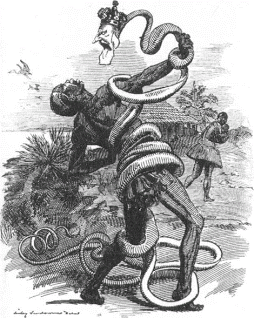 A senior Israeli official told Channel 10 TV channel that a visit on Sunday by Chadian President Idriss Deby to the occupied territories was laying the groundwork for normal ties between Tel Aviv and the Muslim-majority African states of Sudan, Mali and Niger.
The unnamed official also noted that Israel was seeking to shorten flight times from the occupied territories to Latin America through normalizing relations with African countries.
Deby became the first Chadian leader to visit Israel on Sunday, 46 years after the two sides severed ties.
After meeting Israeli Prime Minister Benjamin Netanyahu, the Chadian president pledged a new era of cooperation with “the prospect of reestablishing diplomatic relations.”
Israeli media cited sources in N’Djamena as saying that Deby’s visit was focused on “security,” and that the regime in Tel Aviv had already been supplying weapons and other military equipment to Chad.
Netanyahu, however, declined to comment on potential Israeli weapons sales to Chad.
During his visit, Deby said the future resumption of ties with Israel “does not make us ignore the Palestinian issue.”
The Palestinians, however, protested Deby’s trip to Israel.
Wasel Abu Youssef, a member of the Palestine Liberation Organization’s executive committee, voiced displeasure over the visit.
“All countries and institutions must boycott the extremist government of Israel and impose a siege on it because of its settlement activities, its occupation of Palestinian land,” Youssef was quoted as saying by Reuters.
Over the past two years, Netanyahu has traveled to several African states in a bid to end decades of hostility against the occupying entity and convince them to stop voting against the Israeli regime at the United Nations in favor of Palestinians.
According to Channel 10, Israeli is now in talks with Sudan in a bid to improve relations with the African state.
The Israeli push comes almost two years after Sudan joined Saudi Arabia and Bahrain in cutting relations with Iran.
At that time, Israeli daily Haaretz reported that Tel Aviv had urged the US and other countries to improve their relationship with Sudan in response.
In a 2016, Sudanese Foreign Minister Ibrahim Ghandour said Khartoum was open to the idea of normalizing ties with Israel in exchange for lifting US sanctions.
Israel is also said to be seeking to take advantage of the insurgency and Takfiri militancy gripping parts of Africa to sell advanced military equipment to conflict-ridden states in the continent.
Israel in contact with Persian Gulf Arab states
Meanwhile, reports have emerged recently of Israel’s attempts to make its secret ties with Persian Gulf Arab governments public and establish formal relations with them.
On Sunday, Israeli news sites reported that Tel Aviv is working to normalize ties with Bahrain, hours after Netanyahu hinted he would soon travel to unspecified Arab states.
Israeli Economy Minister Eli Cohen said on Monday he had been invited to attend a conference next year in Bahrain.
Netanyahu met with Oman’s Sultan Qaboos in Muscat last month, but the controversial visit was kept secret until after the Israeli premier returned to the occupied territories.
The visit to Muscat was the first by an Israeli prime minister since 1996.
On Sunday, Israel’s Hadashot television news reported that Netanyahu had secured reassurances from Oman that airlines flying to and from the occupied territories would be permitted to fly over the kingdom’s airspace.
Activists with a pro-Palestine boycott campaign against Israel said Monday that the meeting between Sultan Qaboos and Netanyahu may have breached a long-dormant Israeli boycott law.
“Since 1977, official records stopped mentioning the Law of Boycotting Israel, neither denying it nor confirming it,” an Omani activist with the Boycott, Divestment and Sanctions (BDS) movement told the Middle East Eye news portal.
“This happened when the country took a neutral policy in foreign affairs, including accepting normalizing ties with the Zionist entity,” the activist added.
Another activist said several prominent activists had been arrested shortly before the Israeli prime minister’s visit to Muscat for pro-Palestinian posts on social media, adding, however, that they were freed after disassociating themselves from BDS Oman.
“There is no clear legal path of how to implement the law. But even discussing this topic is a risky business, because there is no political free speech,” he said.
The activist also noted that BDS Oman had sent its “sincerest apologies” to the Palestinian people after a visit by “criminal” Netanyahu.
UN Special Rapporteurs give Israel 60 days to respond to ‘deep concerns’ regarding Jewish Nation-State Law
Adalah – 15/11/2018
Four Special Rapporteurs express ‘deep concern’ that Nation-State Law is ‘discriminatory in nature and in practice against non-Jewish citizens and other minorities and does not apply the principle of equality between citizens, which is one of the key principles for democratic political systems.’
Following a special request for action issued by Adalah – The Legal Center for Arab Minority Rights in Israel, four United Nations special rapporteurs have given Israel a 60-day deadline to respond to their grave concerns regarding the Jewish Nation-State Law, adopted by the Knesset on 19 July 2018.
The 60-day period began on 2 November 2018 when UN Special Rapporteur in the field of cultural rights Karima Bennoune, Special Rapporteur on the situation of human rights in the Palestinian territories occupied since 1967 Michael Lynk, Special Rapporteur on minority issues Fernand de Varennes, and Special Rapporteur on contemporary forms of racism, racial discrimination, xenophobia and related intolerance E. Tendayi Achiume sent a communique to Israeli authorities expressing their deep concerns regarding the impact of the new law.
In their letter, the special rapporteurs expressed “deep concern” that the Israeli Basic Law appears “to be discriminatory in nature and in practice against non-Jewish citizens and other minorities and does not apply the principle of equality between citizens, which is one of the key principles for democratic political systems.”
Adalah, representing all of the Arab political leadership in Israel – The High Follow-up Committee for Arab Citizens in Israel, the Joint List (Arab members of the Knesset), and the National Committee for Arab Mayors, filed a petition against the Jewish Nation-State Basic Law on 7 August 2018 to the Israeli Supreme Court. The petition demands that the Court cancel the law as it contradicts fundamental international human rights norms in place since the end of World War II; negates almost 20 years of Supreme Court caselaw concerning the right to equality and land rights; and constitutes an abuse of power by the majority in the Knesset.
The special rapporteurs emphasize that they fear that “the law as adopted offers a legal basis for the pre-eminence of Jewish people over non-Jewish citizens who are members of other ethno-religious and linguistic minority groups, and creates a legal order and an environment that could potentially lead to further discriminatory legislative and/or policy actions, which contravene the international human rights obligations of Israel.”
The special rapporteurs further expressed concern, in light of the Nation-State Law, regarding Israel’s commitments to the International Covenant on Civil and Political Rights and the International Covenant on Economic, Social and Cultural Rights which both stipulate the right of all peoples to self-determination.
Amongst a more extensive series of requests, the special rapporteurs call on Israel to:
- “Indicate the impact of Article 5 of the Law on the current immigration procedures in Israel, on how Jewish and non-Jewish immigrants are dealt with under current procedures, and how such provision may affect the immigration status determination of non-Jews”;
- “Provide further information on Article 7, and particularly whether it will or not contribute to potential segregation on the basis of ethnicity or religion, and whether it is an endorsement to develop Jewish settlements, including in the Occupied Palestinian Territory, in direct violation of international law”;
- “Clarify the consequences of the new status of the Arabic language, and the impact if any on its use for official purposes, including on public signs, in public institutions including social and health services and in the education system.”
The special rapporteurs note that the State of Israel failed to respond to an earlier query sent 21 June 2017 by the UN special rapporteurs concerning a draft bill of what was to eventually be adopted as the Jewish Nation-State Law.
Any response Israeli authorities may send to the special rapporteurs will be provided to the United Nations Human Rights Council for consideration.
US warns of ‘consequences’ as Palestine joins international bodies
Press TV – November 18, 2018
The United States has threatened “consequences” as Palestinians step up efforts for statehood demanding accession to almost a dozen international bodies and conventions.
The threat came after Palestinian President Mahmoud Abbas signed the documents on Thursday to join the Universal Postal Union, a UN agency that coordinates international postage, and 10 international protocols and conventions.
The move infuriated the US, Israel’s staunch ally, with a State Department official claiming that the Palestinian efforts to join international institutions were “premature” and “counterproductive.”
“We are currently reviewing possible consequences of the Palestinians’ recent actions,” the official said in a statement published by the Times of Israel on Sunday.
In November 2012, the UN General Assembly upgraded Palestine’s status from “non-member observer entity” to “non-member observer state” despite strong opposition from Israel.
Since then, the Palestinians have joined dozens of international organizations and agreements, among them the International Criminal Court, as part of a campaign to garner support for the recognition of their homeland as a sovereign state.
Washington has asked the Palestinians not to join international agencies, citing laws dating to the early 1990s that require the US government to cut off funding to any UN organization that grants the Palestinians full membership.
Abbas, however, said a Palestinian agreement with the US not to join international bodies was conditioned on the US not ending aid payments, not moving its embassy to Jerusalem al-Quds and not changing the status of the Palestine Liberation Organization mission in Washington.
The US withdrew some funding for UNESCO after the Palestinians joined the cultural and education organization back in 2011. It also pulled out of the agency altogether in 2017.
Most recently, Washington cut funds to the UN Palestinian refugee agency UNRWA.
The US-Palestine ties deteriorated last December when President Donald Trump recognized Jerusalem al-Quds as the “capital” of Israel.
The American embassy was also relocated from Tel Aviv to the ancient city in May, sparking angry reactions from Palestinians and severe criticism from the international community.
At that time, Abbas formally declared that Palestinians would no longer accept the US as a mediator to resolve the conflict because Washington was “completely biased” towards Tel Aviv.
In first, US endorses Israeli occupation of Golan, votes against 9 anti-Israel resolutions

Press TV – November 16, 2018
The US has, for the first time, endorsed the Israeli occupation of the Golan Heights by voting against an annual UN resolution that condemned the occupation and was unanimously approved along with several other resolutions against Tel Aviv.
The resolution titled “The occupied Syrian Golan,” adopted on Friday with 151 votes in favor, two against (Israel and the US), and 14 abstentions, condemns Israel for “repressive measures” against Syrian citizens in the Golan Heights.
The resolution, which was adopted during the 73rd session of the UN General Assembly’s Special Political and Decolonization Committee (Fourth Committee), expresses deep concern that the Syrian Golan, occupied since 1967, has been under continued Israeli military occupation.
The non-binding annual resolution takes issue with the “illegality of the decision” taken by Israel “to impose its laws, jurisdiction and administration on the occupied Syrian Golan,” which is illegal under international law.
The US’ vote against the annual resolution signaled a dramatic shift in Washington’s policy toward the territory, as it used to abstain in previous cases. The administration of Donald Trump had announced its changed policy ahead of the vote.
“If this resolution ever made sense, it surely does not today. The resolution is plainly biased against Israel,” outgoing US Ambassador to the UN Nikki Haley said in a statement.
During the debate, Syrian envoy Bashar al-Jafari vowed that Damascus would recapture the heights by peace or by war.
Israel seized the Golan Heights from Syria during the 1967 Six-Day War and has continued to occupy two-thirds of the strategically-important territory ever since, in a move that has never been recognized by the international community.
The Tel Aviv regime has built dozens of illegal settlements in the area since its occupation and has used the region to carry out a number of military operations against the Syrian government
Tel Aviv has also been pressing the US administration under Israel-friendly President Trump to recognize its claim to sovereignty over the occupied territory in defiance of international law.
Syria has repeatedly reaffirmed its sovereignty over the Golan Heights, saying the territory must be completely restored to its control.
Eight other resolutions against Israel
The resolution on the occupied Syrian Golan was one of the nine separate resolutions which condemned the Israeli regime.
Through these resolutions, the UN reinforced the mandate of its Relief and Works Agency (UNRWA), and renewed the mandate of its “special committee to investigate Israeli practices affecting the human rights of the Palestinian people and other Arabs of the Occupied Territories.”
Other resolutions included “Palestine refugees’ properties and their revenues”, “Persons displaced as a result of the June 1967 and subsequent hostilities”, “Applicability of the Geneva Convention… to the Occupied Palestinian Territory…”, and “Operations of the United Nations Relief and Works Agency for Palestine Refugees in the Near East”.
The member states also unanimously voted for a resolution titled “Assistance to Palestine refugees”.
Apart from the US, which voted against all the nine resolutions, only a few member states – including Canada and Australia – cast nay votes. The majority of member states voted for the resolutions.
View the resolutions and voting results here: https://t.co/WlLL5EBZ4q
— UN Watch (@UNWatch) November 16, 2018
Lavrov Calls US Sanctions on Iran ‘Illegitimate’, Slams Pressure on SWIFT
Sputnik – 06.11.2018
Washington implemented tough unilateral sanctions against the Islamic Republic on Monday following President Trump’s withdrawal from the Iran nuclear deal in May.
Russian Foreign Minister Sergei Lavrov has condemned Washington’s decision to slap Tehran with sanctions, calling the restrictions “absolutely illegitimate” and deeply disappointing, and saying that it was “unacceptable” to hold dialogue in the language of ultimatums.
“As far as the US measures against Iran are concerned, they are absolutely illegitimate,” Lavrov said on Tuesday in Madrid following a meeting with Spanish officials.
“They are being implemented in flagrant violation of the decisions of the UN Security Council, and the way in which these measures are announced and implemented cannot but cause a deep sense of disappointment. We proceed from the idea that the norms of not only international law, but of international dialogue, have not been repealed,” Lavrov stressed.
“Pursuing a policy based on ultimatums and one-sided demands is hardly permissible in our times,” according to the Russian foreign minister.
Pressure on SWIFT Also Unacceptable
Commenting on suspected US pressure on international financial messaging system SWIFT, which implied Monday that it would comply with US sanctions against Iranian financial institutions, Lavrov said that such pressure was also illegitimate.
“Within the framework of the participants of the Joint Comprehensive Plan of Action (JCPOA) agreement, mechanisms are being developed which will allow for the continued implementation of the provisions of this document, first of all as regards [nations’] economic ties to Iran without US participation, and this is not a simple matter,” the foreign minister explained. “You can see how, using unacceptable methods, pressure has been placed on the operators of the SWIFT system. But experts are actively engaged in these issues, and they have a sufficiently stable understanding that this is possible and that such measures will be found.”
On Monday, Washington followed through with plans to renew sanctions against Iran following President Trump’s exit from the JCPOA Iran nuclear deal. The tough sanctions target Iran’s energy, banking and sea-based transport sectors, and threaten so-called secondary sanctions against foreign companies and countries doing business with the Islamic Republic.
The Belgium-based SWIFT financial messaging service announced that it would be suspending some Iranian banks’ access to the system, making no mention of US sanctions. Calling the move “regrettable,” SWIFT’s statement said it had taken the step “in the interest of the stability and integrity of the wider global financial system.”
All of the JCPOA’s other signatories, including Iran, Russia, China and several European powers, have made an effort to save the landmark nuclear deal and bypass the US sanctions or otherwise limit their impact. This has included the development of a Special Purpose Vehicle (SPV) on trade. China and India, the largest importers of Iranian crude oil, have resisted US secondary sanctions threats, and were granted exemptions along with five other oil-importing countries plus Taiwan.
Israel Rattled By UNESCO’s Palestinian Protection Pledges
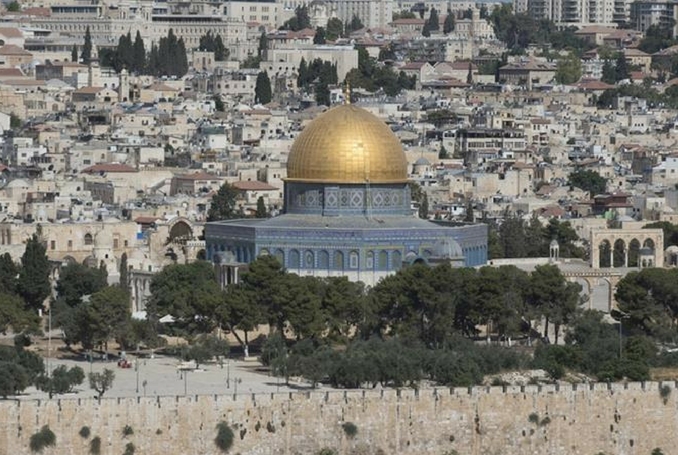
Al-Aqsa compound in East Jerusalem. (Photo: via Twitter)
Palestine Chronicle | October 12, 2018
The executive council of the United Nations Educational, Scientific and Cultural Organisation (UNESCO) has left Israel disquieted, after vowing to effect protections for Palestinian heritage.
A statement, issued by Israel’s United Nations ambassador Danny Danon, said:
“This is an additional proof for those who did not understand why the United States and Israel withdrew from UNESCO. This proves once again that UNESCO is a body based on lies, biases and deliberate action against us. Israel will not be a member of an organization that is trying to rewrite history and accept to be exploited by our enemies.”
The protections cover educational and cultural institutions, the need to protect and preserve the monuments, culture and education in the occupied Palestinian territory, including East Jerusalem, and to show Israeli violations against Palestinian heritage, cultural and natural sites, particularly the Old City of Jerusalem, Al-Aqsa Compound, the Church of the Nativity, the mosque of Bilal ibn Rabah in Bethlehem, the Old City and the Ibrahimi Mosque in Hebron (Al-Khalil) and the Gaza Strip.
Israel sternly rejected the mandate which the council unanimously espoused Wednesday during a Palestine resolutions session at the body’s 205th plenary meeting in Paris.
The disputed resolutions detail, according to Al Ray Palestinian Media Agency, that,
“The Old City of Jerusalem and its Walls, a site inscribed on the UNESCO World Heritage List and on the List of World Heritage in Danger, is the sacred city of the three monotheistic religions – Judaism, Christianity and Islam,” reaffirming that “all legislative and administrative measures and actions taken by Israel, the occupying Power, which have altered or purport to alter the character and status of the Holy City of Jerusalem, and in particular the ‘basic law’ on Jerusalem, are null and void and must be rescinded forthwith.”
The Program and External Relations Commission (PX) of the UNESCO executive also adopted a second resolution to include crimes committed by Israel, such as the destruction of schools and other crimes committed in Khan Al-Ahmar.
The UNESCO declaration stated:
“The two Palestinian sites of Al-Haram Al-Ibrahimi/Tomb of the Patriarchs in al-Khalil/Hebron and the Bilal Ibn Rabah Mosque/Rachel’s Tomb in Bethlehem” are “an integral part of the Occupied Palestinian Territory, and shares the conviction affirmed by the international community that the two sites are of religious significance for Judaism, Christianity, and Islam.”
It also added:
“The ongoing Israeli excavations, works, construction of private roads for settlers and of a Wall inside the Old City of Al-Khalil/Hebron which are illegal under international law and harmfully affect the authenticity and integrity of the site, and the subsequent denial of freedom of movement and freedom of access to places of worship.”
Both resolutions are supported by Egypt, Jordan, Lebanon, Morocco, Oman, Qatar, and Sudan.
“Tthe spirit of dialogue and the sense of responsibility that led to this result. A trend towards consensus is now emerging,” UNESCO Director-General Audrey Azoulay added.
Netanyahu wants to redraw map in the Golan, Russia says – go to the UNSC
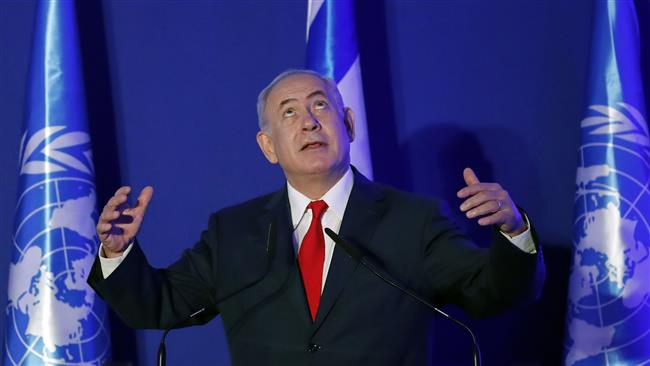
RT | October 10, 2018
Recognizing the illegally-annexed Golan Heights as part of Israel would be a violation of UN Security Council resolutions, Russia’s foreign minister has said, in an apparent rebuke to an appeal made by Israel’s prime minister.
Changing the status of the Golan Heights would be a “direct violation” of United Nations Security Council resolutions which dictate the international community’s stance on the disputed territory, Russian Foreign Minister Sergei Lavrov noted.
On Monday, Benjamin Netanyahu called on the international community to recognize Israel’s annexation of the Golan, Syrian territory seized by Israel fifty-one years ago.
“Israel on the Golan Heights is a fact that the international community must recognize and as long as it depends on me, the Golan Heights will always remain under Israeli sovereignty,” Netanyahu said during an inauguration of a synagogue in the Golan Heights.
In August, Netanyahu expressed hope that Washington would recognize Israel’s claim to the territory, but US National Security Advisor John Bolton insisted that “there’s no discussion of it, no decision within the US government.”
Israel seized part of the Golan Heights during the Six Day War of 1967. In 1981, Israel’s parliament, the Knesset, unilaterally proclaimed the occupied land to be part of the Jewish state. The declaration was swiftly declared illegal by the UN Security Council.
The politicisation of the Palestinian right of return is imperative

By Ramona Wadi | MEMO | October 4, 2018
In its annual report to UN Secretary General Antonio Guterres, the Committee on the Exercise of the Inalienable Rights of the Palestinian People recommended that Israel acknowledges the Palestinian Nakba. The backdrop for such an acknowledgement remains the two-state compromise, which defeats the purpose of the recommendation.
Such recognition, according to the report, is “a necessary requirement for a viable and lasting peace.” The Committee also recommended that “Palestine refugees should be treated as dispossessed nationals of a country – Palestine – rather than stateless refugees.” It refuted the framing of colonisation as “conflict”, stating, “It is not a conflict between two parties over disputed territory. It is one of one State occupying, colonising and annexing the territory of another state.”
The terminology is a far cry from the usual platitudes used by UN institutions. However, there is still the possibility of manipulating Palestinian rights due to the Committee’s adherence to the two-state paradigm. Taking a stance against the Israeli and US efforts to alter, to the point of non-recognition, the Palestinian refugees and their legitimate right of return is not enough if the Committee does not articulate an alternative that is derived completely from Palestinian narratives.
The two-state scenario has been exposed as a scam to facilitate Israel’s colonisation of Palestinian territory and create a perpetually displaced population, to the point that the Palestinian right of return needs to be read and interpreted in relation to the ongoing displacement. In Palestinian memory, the Nakba is not restricted to 1948, because Israel’s ethnic cleansing of Palestine has never stopped. As the international community fails to challenge Israel’s colonialism and demographic obsession, it is consenting to Israel’s displacement of Palestinians from their territory. Far from promoting the importance of recognising the Nakba, the international community is endorsing it by allowing Israel to exist on its own terms, while Palestinians are constantly forced to modify their existence to accommodate a colonial power on their territory.
Nakba denial by Israel is steeped in its fabricated narratives, imposed upon the international community and disseminated in such a way that Palestinian narratives, despite their legitimate roots, are forced to fight for space in order to gain international recognition, let alone endorsement. The international community’s obsession with dissociated commemoration runs contrary to its purported human rights obligations. It is also an insult to Palestinians’ memory that their history is condensed into remembrance on specific days while Israel has been allowed every day of the year since 1948 to advance its colonisation of Palestinian territory, to say nothing of the earlier settler-colonialism that facilitated the establishment of the state.
International recognition of the Palestinian Nakba as an ongoing trauma in Palestine’s collective memory would isolate Israel’s attempts to force it into oblivion. Yet, this step cannot be implemented within the two-state framework as the latter still endorses Israel’s colonial existence as legitimate, while presenting a hypothetical Palestinian state as dependent, even malfunctioning, in terms of self-determination and its exclusion of Palestinian liberation.
The politicisation of the Palestinian right of return is thus imperative. As things stand, the international community continues to feed the illusion that the two-state compromise constitutes the only political solution, while the right of return is misrepresented as compensation in its entirety. This is why Palestinians must determine their own right of return even if it challenges the international community’s impositions.
Fun at the United Nations and in Congress: Israel Wins the Comedy Competition
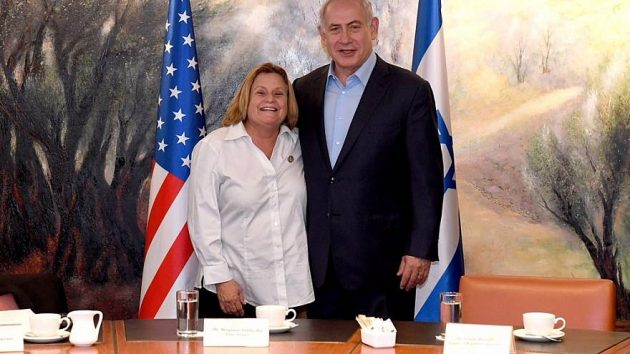
Rep. Ileana Ros-Lehtinen (R-Fla.) with Israeli Prime Minister Benjamin Netanyahu. Image Credit: GPO
By Philip Giraldi | American Herald Tribune | October 8, 2018
Most people are unaware of the fact that the annual opening of the United Nations General Assembly, which takes place in September, is actually a major audition opportunity for aspiring stand-up comedians. This year, American President Donald Trump was one of the pre-event favorites according to the Las Vegas betting line based on his hilarious tweets back in January explaining that he is “like, really smart,” before observing that he “would qualify as not smart, but genius…. and a very stable genius at that!”
To be sure, when he addressed the assembly on September 25th and rambled on about how “In less than two years, my administration has accomplished more than almost any administration in the history of our country,” the audience was ready to share in the fun and laughed out loud at the absurdity of the notion. They were still giggling on the following day when U.S. Ambassador to the United Nations Nikki Haley quipped with a straight face that the audience was actually laughing with Trump out of respect for him and what he was saying.

Trump’s tour de force seemed unbeatable but the wily Israeli Prime Minister Benjamin Netanyahu had an ace up his sleeve. Bibi’s performance back in 2012 when he produced the by now infamous cartoon of an alleged Iranian nuclear bomb about to go off was still recalled by many in the audience as the ultimate stand-up joke U.N. style, a legendary performance. But the same creative thinking that produced the bomb with its lit fuse had come up with a different kind of delayed action joke that Bibi knew would confuse his audience before being revealed for what it was, trumping Trump’s attempt at humor, so to speak. Netanyahu produced a series of large photos taken near Tehran by Israeli intelligence showing a wall and a gate. He said it was an Iranian “secret atomic warehouse for storing massive amounts of equipment and material for Iran’s secret nuclear weapons program.”

The audience gasped, clearly impressed by Bibi’s unexpected rollout of a hitherto unknown top secret installation, but the joke came the next day when it was revealed that the complex inside the wall actually contained a number of businesses, including a scrap metal dealership and a carpet cleaning service. Bibi likely reacted with his Gary Cooper grin, “Hey, the joke’s on you guys who are always whining about Israel’s nuclear stockpile.” A U.S. intelligence official was also apparently in on the jape, commenting a day later that “What Netanyahu said last night was slightly misleading. We knew about the facility in Tehran and it’s a place full of file cabinets and documents, not aluminum pipes or centrifuges.”
So it was a weekend of fun for the Israeli delegation, including convivial friendly banter with the representatives of all Israel’s four or five friends in the General Assembly, but you can only generate so much excitement when talking to a dry stick like Nikki Haley or the ambassador from Micronesia. Fortunately, good news had come through late in the week, concerning how seven more demonstrating Gazans had been shot dead by Israeli snipers, and there was also an exciting new development in that the Israeli navy had now gotten into the game, shooting Gazans demonstrating on the beaches along their own seafront since Israel regards anyone who seeks to access the water as being a terrorist, transgressing against Israel’s modern-day Mare Nostrum. Ninety-three more Palestinians were injured, 37 of whom were wounded by gunfire.
There was also a lot of funny stuff going on in Washington, perhaps driven by a desire to outdo the frolicking taking place at the U.N. building in New York City. Congressmen got together and said, “Hey, let’s see what we can give to Israel without anyone in the media coming out with so much as a peep.” One Congressman, possibly Chuck Schumer or Ben Cardin or even Lindsay Graham, must have come up with the idea for a new law that would compel the White House to give to Israel a minimum of $3.8 billion dollars a year for the next ten years no matter what Israel does or says. Shoot Arabs, kick them out of their homes, or just simply treat them like shit, it will all be the same to Uncle Sam. If they want to bomb Peoria, be my guest. Written into the bill is the provision that the president cannot in any way reduce or delay the payment going from the U.S. Treasury to the Israeli Central Bank.
And $3.8 billion is only a minimum. Section 103 of the House bill removes all limitations on how much money Israel gets. Under the new act, instead of $38 billion being the cap, as stipulated in the 2016 memorandum of understanding, it will be a minimum payment until 2028. Constant lobbying by Israel and its friends in the Congress will inevitably mean that the amount might double or triple during that time period. This is a huge gift to Netanyahu, who is undoubtedly laughing all the way to the bank, as the expression goes.
Section 106 of the bill is another freebee, increasing Israel’s access to a U.S. provided war-reserve stockpile that is maintained in Israel by completely removing the limits on how many weapons can be “transferred,” without any payment or charge. The existing limit of $200 million worth of arms per annum charged against the aid package has now been eliminated, allowing the Israelis to take whatever they want.
And there’s more. Section 108 of the Act permits Israel to export arms it receives from the United States, even though that violates U.S. law. And it will also be allowed to use the American aid to buy weapons from its own defense industries, eliminating any benefit for U.S. domestic arms manufacturers.
In short, the comedy routine by the U.S. Congress vis-à-vis Israel has consisted of rolling over and playing dead while handing over the reins of American foreign policy to a foreign power. Netanyahu has scored a hat trick, defying U.S. interests while increasing both aid and concessions. The House bill that spells it all out in detail will now go back for Senate approval, and then to Trump to be signed into law.
The only ones not laughing at the comedy routines both at the U.N. and in Washington are the American taxpayers and those of us who want U.S. foreign policy to respect American values and interests. And by the way, the House has named the bill after Miami Congresswoman Ileana Ros-Lehtinen, a well-known Israel firster whose groveling before Netanyahu and Jewish groups has been notable even by the low standards of the House of Representatives. The bill is now officially the “Ileana Ros-Lehtinen United States-Israel Security Assistance Authorization Act of 2018.”
Featured Video
Seyed M. Marandi: U.S. Military DIVIDED? Iran’s Secret Defense EXPOSED
or go to
Aletho News Archives – Video-Images
From the Archives
‘Israel sees Iran as obstacle to its policies’
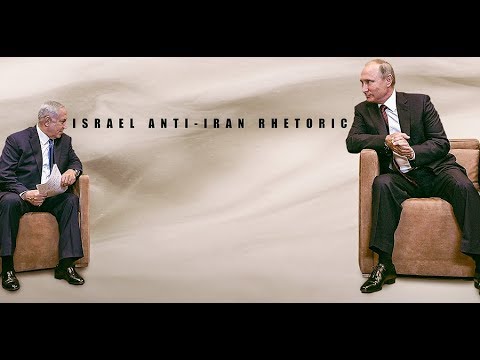
Press TV – August 25, 2017
Prime Minister Benjamin Netanyahu has said that Israel felt threatened by Iran’s growing influence in the Middle East. Netanyahu expressed his Iranophobic view in a meeting with Russian President Vladimir Putin in Russia’s Black Sea resort of Sochi on Wednesday. Press TV has asked Scott Rickard, former American intelligence linguist from Tampa, Florida, and Brent Budowsky, a columnist at The Hill from Washington, to give their thoughts on the issue.
Rickard said Tel Aviv is concerned about the fact that the regime could not carry out its old project to spread sectarian divisions and pave the way for dismemberment of the countries in the Middle East region because of the Iranian-led resistance against Israeli policies, not only in the occupied territories of Palestine but also in the whole region.
“Iran is not a threat to Israel whatsoever. The threat that Israel sees is the fact that their Oded Yinon Plan is being put to a hold by Iran,” the intelligence linguist said on Thursday night.
“They (the Israelis) look at Iran as a threat only because they have no influence on their governments and Iran is autonomous and is not under the Zionist influence,” he added.
Since the victory of the Islamic Republic of Iran in 1979, Tehran has been critical of Israel’s policies in the region, whereas “no leaders [of other states] even dared to speak out against Zionism,” Rickard argued. … continue
Blog Roll
 Aletho News
- Israeli tank fire killed UN peacekeeper in Lebanon, UNIFIL investigation finds
- Russia, China block Bahrain-sponsored UN resolution on Strait of Hormuz
- The US-Israeli War on Science is an Assault on our Future
- Trump’s Promise to Bomb Iran ‘Like Never Before’ Faces Brutal Logistics — Expert
- Germany seeks to restrict stays abroad for men of fighting age – Berliner Zeitung
- Evidence points to Ukraine being behind TurkStream attempted sabotage, but that should come as no surprise
- Sri Lanka secures supplies of Russia oil – minister
- Nations across Asia strike direct deals with Iran for Hormuz passage
- IRGC commander declares ‘new phase’ of reprisal attacks against aggressors
- Israel’s air defenses overwhelmed by cluster-warhead Iranian missiles: Reports
- If Americans Knew
- Trump Says US Sent ‘a Lot of Guns’ to Protesters in Iran
- Israeli forces destroy 17 UN peacekeeper cameras in south Lebanon
- US-Israeli strikes ‘completely destroy’ synagogue in Tehran
- Archbishop for US Military Says Iran War Is Unjust Under Catholic Teaching
- Iranian leaders’ Open Letters to the American People
- Trump says Iranians appreciate bombs, WHO warns of nuclear risks – Daily Update
- U.N. experts demand Israel release prominent Gaza doctor after reports of ‘severe torture’
- Israel’s Latest Genocide Is Against the Shias of Lebanon. Why Is the World Silent?
- How Eliot Cohen’s influence over U.S. war-making paved the way for Trump’s war crimes in Iran
- Israelis don’t pay for the weapons we ‘sell’ to them — US taxpayers do
- No Tricks Zone
- An Inconvenient Tree: Uncovered In Alps… Europe Much Warmer Than Today 6000 Years Ago
- New Study Reports A 60% Slowdown In Greenland’s Ice Loss Rate In The Last Decade
- Low Intensity Tornado Wrecks Major Solar Farm, Creating A Potential Toxic Dump
- New Study Finds Warming Saves Lives…Cold Temperatures 12 Times More Deadly Than Excess Heat
- German Science Blog Accuses PIK Climate Institute Of Hallucinating Climate Tipping Points
- Devastating Assessment Of Comirnaty Vaccine By Former Senior Pfizer Europe Toxicologist
- New Study: CO2 Is ‘Effectively Negligible’ As An Explanatory Climate Change Factor Since 2000
- Former Pfizer Toxicologist Dr. Helmut Sterz Tells Bundestag Hearing Pfizer Vaccine Should Have Never Been Approved
- Energy Expert: Germany’s Nuclear Phaseout Was A “500 Billion Euro Mistake”
- New Research: South Australia’s Mid-Holocene Sea Surface Temperatures Were 4°C Warmer Than Today
 Aletho News