Tel Aviv rejects ‘shameful & absurd anti-Israel’ UN resolution
RT | December 23, 2016
Israel will not abide by the UN Security Council’s demands for Tel Aviv to halt its settlement activities in the occupied Palestinian lands, the office of Prime Minister Benjamin Netanyahu said in a statement.
“Israel rejects this shameful anti-Israel resolution at the UN and will not abide by its terms,” the statement from the PM’s office said, according to Reuters.
The Obama administration “failed to protect Israel against this gang-up at the UN,” and what is even worse, “colluded with it behind the scenes,” the statement added.
In order to “negate the harmful effects of this absurd resolution,” Israel is looking forward to working with President-elect Trump and with “all our friends in Congress, Republicans and Democrats alike.”
Israel’s ambassadors to New Zealand and Senegal – countries who along with Malaysia and Venezuela tabled the draft resolution – were immediately ordered to return to Tel Aviv for consultations.
Earlier, the Israeli ambassador to the council, Danny Danon slammed the vote as a “victory for terror, a victory for hatred and violence.”
“Who gave you the right to issue such a decree, denying our eternal rights in Jerusalem?” he added.
The UN Security Council resolution, demanding an end to the construction of Israeli settlements on occupied Palestinian territories, was adopted with 14 of 15 UNSC members voting in favor. The US was the only nation to abstain from voting.
The US defended its abstention from Israeli criticism by stating that one “cannot champion settlements and the two state solution” at the same time. The US Ambassador to the UN, Samantha Power, said the US did not veto the resolution as it “reflects the facts on the ground and is consistent with US policy.”
The main US pro-Israel lobby group, AIPAC, said it was “deeply disturbed” by the Obama administration’s reluctance to use its veto in what it described as a “destructive, one-sided, anti-Israel resolution.”
UNSC passes resolution demanding end to Israeli settlement building on occupied Palestinian land
RT | December 23, 2016
The UN Security Council has passed a resolution demanding an end to the construction of Israeli settlements on occupied Palestinian territories after the US abstained from voting.
The resolution was introduced to the UNSC by New Zealand, Malaysia, Venezuela and Senegal on Friday, a day after Egypt withdrew reportedly under pressure from Israel and US President-elect Donald Trump.
Earlier, Trump and Israeli authorities also called on the US to veto the resolution. The document was eventually adopted with 14 of 15 UNSC members voting in favor. The US was the only nation to abstain from voting.
It is the first resolution passed by the UNSC on the Israeli-Palestinian conflict in almost eight years.
The Israeli envoy to the UN Danny Danon criticized the US’ decision to abstain. However, he expressed his confidence that the new US president would “no doubt” usher in a new era in UN-Israeli ties, as well as the new UN Secretary General.
The US Ambassador to the UN Samantha Power responded to the Israeli envoy’s criticism by stressing that one “cannot champion settlements and the two state solution” at the same time. She went on to say that the US did not veto the resolution as it “reflects the facts on the ground and is consistent with US policy.”
Power also stressed that continued settlement building “undermines” Israel’s own security.
Meanwhile, US House Speaker Paul Ryan denounced US abstention by calling it “absolutely shameful” and describing it as a “blow to peace.” The US Republican senator, John McCain, went further and said that the abstention in the UNSC vote made the US “complicit in this outrageous attack” against Israel, reported Reuters.
Danon earlier said that the resolution served as “the condemnation of the sole democracy in the Middle East [Israel].”
The UNSC was initially scheduled to vote on the resolution on Thursday but Egypt pulled its text at the last minute, postponing the vote until after the wrapup of the Arab League ministerial meeting in Cairo. According to Israel’s Haaretz newspaper, Prime Minister Benjamin Netanyahu exerted heavy pressure on Egyptian President Abdel Sissi urging him to delay the vote.
Netanyahu also urged the US to veto the vote on the “anti-Israel resolution” on Wednesday night in a short tweet.
The current Obama administration previously expressed its disapproval of Israeli settlement policies, which Tel Aviv has pursued since 1967. However, in 2011, Washington vetoed a draft resolution condemning Israeli settlements.
Israel occupied Palestinian territories in 1967. Now, more than 500,000 Israelis live in settlements built on occupied territories. Meanwhile, Palestinians have been seeking full independence for the occupied territories for decades and demand full recognition as a sovereign state from both the UN and the international community.
Bashar Al-Jaafari: Protecting civilians in Aleppo and other cities is the Syrian government’s constitutional duty
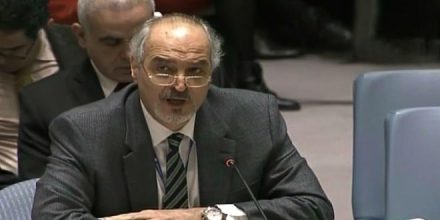
SANA | December 14, 2016
NEW YORK – Syria’s Permanent Representative to the UN Bashar al-Jaafari stressed that the Syrian government is innocent of the U.S. and western accusations that it has committed crimes in Aleppo.
Addressing an emergency session of the UN Security Council on the situation in Aleppo on Tuesday, called for by France and Britain, al-Jaafari said some of the Security Council member states are used, since the beginning of the terrorist war against Syria, to call for urgent sessions based on misleading information and false reports and testimonies whenever the Syrian army and its allies achieve advance against the terrorist organizations.
al-Jaafari categorically dismissed all the “fabricated reports” used by the representatives of the US, France and Britain that the Syrian government has targeted citizens in Aleppo city, affirming that what the Syrian government, along with its allies, is doing in Aleppo city and other Syrian cities is “practicing the constitutional and legal duty of every government; that is to protect its citizens against terrorism.”
He made it clear that the Syrian government’s first and foremost aim of opening safe corridors (including for the militants), providing makeshift centers, issuing amnesty decisions and delivering food and medical aid in Aleppo is protecting civilians and keeping them safe.
Al-Jaafari criticized the UN Secretary General Ban Ki-Moon for being in a hurry to issue statements based on reports he could not verify just to the effect of “defaming the Syrian government and its allies that are fighting terrorism.”
He dismissed that some sides, in their attempts to help the terrorists, deny the Syrian government its duty to examine and verify the identity of some of those who are leaving neighborhoods in Aleppo along with the civilians, especially that many reports issued by the Security Council speak of tens of thousands of foreign terrorists from more than a 100 countries operating in Syria, noting that this examination aims at preventing those terrorists from infiltrating other areas, and probably the territories of other countries, and resuming their acts there.
He cited tens of photos which show terrorists, who had committed acts of “beheading innocent people and eating livers”, trying to escape from East Aleppo infiltrating among civilians in women’s clothes, but they were captured by the Syrian Army.
Al-Jaafari said it is utmost hypocrisy that the envoys of some countries insist on accusing the Syrian government of besieging its people and blocking access to food and medicine while they continue to deny the fact that tens of depots which were controlled by the terrorist organizations in Aleppo have been full of all kinds of medical and food supplies from which the civilians were deprived.
He stressed that it is not possible that tens of thousands of terrorists fighting the Syrian Army in Aleppo would have been able to survive and remain there for more than four years, was it not for some states at this Council continually providing them with all kinds of weapons and protection.
He categorically denied “as groundless” all “fabrications, allegations and hallucinations” issued by some member states’ representatives about the government allegedly committing acts of “reprisal, intimidation and field executions against civilians,” reaffirming that hunting and targeting terrorists is at the heart of the Syrian government’s constitutional powers “just like what u did in Nice, Paris, London, Boston, Oklahoma, North Carolina, Cairo, Sinai, Bombay, Tunisia, Nigeria, Kenya and Tanzania.”
For his part, Russia’s Representative to the UN Vitaly Churkin stressed that the Syrian Arab Army has reestablished control over the eastern neighborhoods of Aleppo, reiterating that the allegations that the Syrian Army has committed violations in Aleppo are baseless.
Meanwhile, China’s Representative to the UN Liu Jieyi said fighting terrorism is an integral part of finding a solution to the crisis in Syria, stressing that the international community should give top priority to fighting ISIS and other terrorist organizations.
Conflict instigators must foot humanitarian crises bills – Russian Emergencies Minister to UN
RT | December 9, 2016
The head of Russia’s Emergencies Ministry has proposed a new economic model of humanitarian assistance and reparation payments to victims of war zones, recommending that initiators of conflict pay for the destruction and suffering caused by their policies.
“The Russian Federation proposes to build a new economic model of international humanitarian aid,” Vladimir Puchkov told the UN General Assembly in New York. The model is quite simple, according to Puchkov, who said that nations which initiate, incite and sponsor conflicts in other states should be “obliged to bear primary responsibility, including financial” for providing aid to refugees and persons internally displaced as a result.
The need to create a new mechanism arises from the lack of funding for international humanitarian relief budgets. Currently only around 5 percent of the funds required to remedy the widespread destruction and suffering are available, the Russian minister said.
To reduce the financial burden on the international humanitarian aid system, associated with the rise of terrorism and waves of refugees, Puchkov also stressed the need to focus on conflict prevention.
“We believe that settlement and conflict prevention is the best approach to reducing the burden on the international humanitarian system,” the minister said in a report at the 71st session of the UN General Assembly.
In order to improve the quality of international aid the minister also offered to take additional measures and help develop local crises response capabilities in conflict-torn countries.
“Instead of trying to provide for the millions of refugees in Europe, it is necessary to create opportunities for them to stay at home, or at least in the same region,” Puchkov noted.
Among other things, Puchkov urged that the international community intensify efforts to improve the international legal and contractual framework which would allow aid to quickly reach affected areas. Meanwhile developing countries, the minister said, should also recognize their responsibility and not remain “passive recipients.”
Speaking about the Russian contribution to global humanitarian aid missions, Puchkov highlighted that this year Russia participated in over 40 missions across the globe, offering aid to over 10 countries. Besides Syria and Ukraine, some of the recent recipients of Russian aid include countries such as Yemen and Afghanistan, in addition to western states such as Italy and Portugal. Overall, Russia engaged in over 450 missions across the globe over the last quarter of a century.
In addition, over the last three years, Moscow has sent more than $250 million to battle humanitarian crisis in a number of countries, by sending emergency food and medical assistance to populations affected by conflict and natural disasters.
The UN Office for the Coordination of Humanitarian Affairs (OCHA), which coordinates international humanitarian relief efforts said that last year more than 76 million people from 31 countries needed assistance. The UN office also noted in 2015 some 51 million people were displaced worldwide, which is the highest number since WWII.
Purported international solidarity is devaluating Palestine
By Ramona Wadi | MEMO | December 1, 2016
Another symbolic international day for Palestinian rights has degenerated into the usual stale observations and recommendations that do little other than try to impart a semblance of balance between the coloniser and the colonised. Perhaps the UN has preferred to remain loyal to the monstrous history it spawned by approving the Partition Plan on 29 November 1947, rather than address its complicity in the dispossession, ethnic cleansing and displacement of the Palestinians.
Departing from a jeopardising premise, Fiji’s Peter Thomson presided over the 71st session of the UN General Assembly and declared that peace between Israel and the Palestinians is “fundamental to our efforts to realise the inalienable rights of the Palestinian people, and to ensure that they are able to enjoy lives of dignity, opportunity, prosperity and equality.” The Palestinian people have endured a history of premeditated killing for decades because the UN upholds obscurity as a priority over the anti-colonial struggle. Peace, therefore, can be eliminated from the convenient rhetoric as it is nothing but a euphemism for oblivion in the context of Israeli colonial violence and international acceptance and complicity.
Not to be outdone, the Head of the EU Delegation to the UN, João Vale de Almeida, presented a summarised version of the perpetual concerns and condemnations, but added a slight variation to the usual rhetoric. The EU, he claimed, is “alarmed by the advancement in the Knesset of the ‘Settlement Regularisation Bill’ which would allow for the ex post ‘legalisation’ of Israeli outposts in the occupied West Bank and de facto confiscation of private Palestinian land.” It is mystifying, to say the least, how an international institution that is normally so well-informed can express “alarm” over violations that have occurred blatantly and in a clear, calculated sequence following the original Zionist plan for Greater Israel. There was more likely to be advance knowledge and acquiescence, not alarm, over the proposed legislation.
Almeida made another obfuscating comment regarding Gaza: “Militant activity and the dire situation in Gaza feed general instability and constitute a recipe for renewed conflict.” He provided no context for the Palestinian resistance in Gaza; no mention of how Israel’s Operation Protective Edge destroyed the enclave and displaced Palestinians in a space that is completely besieged. Hamas “and other militant groups” are also urged to stop “the illicit arms build-up.” Presumably the EU, like Israel, wishes there to be a defenceless population that is completely stripped of the right to defend itself against Israel’s state of the art military technology. Almeida’s statement encourages the abuse of Palestinian civilians by Israel whenever it chooses to field test its latest weapons on live targets before marketing them internationally and thus exposing international hypocrisy with regards to alleged support for Palestinian rights.
Perhaps the symbolic commemoration of “International Day of Solidarity with the Palestinian People” should be scrapped, since the UN, the EU and other international institutions are incapable of articulating the trajectory between the initial and the current colonial violence against Palestinians. All of the futile statements which simply rehash decades of other repetitive rhetoric do not help the Palestinians in any way. Sporting a keffiyeh for the macabre day, which is a backdoor commemoration of the UN Partition Plan as well as purported international solidarity, is humiliating, not a show of support. In the absence of a commitment to support Palestine’s anti-colonial struggle, one can conclude that the international agenda for this “day of support” is to devaluate Palestine and downgrade it even further from a symbolic presence to a passive memory.
UN, US Fail to Offer Humanitarian Aid to 90,000 Freed Aleppo Citizens
Sputnik – 30.11.2016
The United States, the United Kingdom, France and the United Nations have not yet offered humanitarian relief to 90,000 Aleppo citizens, liberated from militants two days ago, the Russian Defense Ministry’s spokesman said Wednesday.
“Two days after over 90,000 Aleppo residents were freed from terrorists, no offer of humanitarian assistance came from the office of UN envoy for Syria Staffan de Mistura, the British and French Foreign Ministries or the US State Department,” the ministry’s spokesman Maj. Gen. Igor Konashenkov said.
Konashenkov reminded about the previous US, UK, UN and French demands to provide humanitarian access to eastern Aleppo when it was held by the militants.
“Apparently, the [humanitarian] assistance was destined for certain other people living in the eastern parts of Aleppo,” Konashenkov said highlighting the absence of the above-mentioned sides’ interest in providing civilians with humanitarian aid after all the necessary conditions for the aid delivery had been created.
On Tuesday, the Russian Defense Ministry said that the Syrian government forces had cleared almost half of eastern Aleppo from militant strongholds, liberating tens of thousands local residents.
UN chemical watchdog refused to send experts to Aleppo under Western pressure – Lavrov
RT | November 22, 2016
The Organization for the Prohibition of Chemical Weapons refuses to send its experts to Aleppo to check substances used by rebels in attacks. The move was “seemingly done under pressure from our Western colleagues,” Russia’s foreign minister said.
“Russian specialists found that militants in east Aleppo used ammunition with poisonous substances, with the ammo targeting west Aleppo. The collected samples leave no doubt that it’s a toxic agent,” Sergey Lavrov said at a press conference with his Belarusian counterpart in Minsk, as cited by Interfax.
However, when the Russian Ministry of Defense addressed the leadership of the UN watchdog OPCW “with the demand to urgently send its experts to Aleppo to participate in the sample analysis,” the organization “refused to carry out this simple task, citing security issues.”
The underlying reason behind this, Lavrov said, seemed to be “tremendous pressure from our Western colleagues,” because “our and Syrian sides guaranteed security [for the experts].”
Russia is now working on the possibility of delivering the samples for analysis to The Hague, Lavrov added.
“It will make it hard [for them] to back out,” the minister said, as quoted by TASS.
Lavrov’s statement comes a day after the Ministry of Defense spoke about the evidence of chemical attacks by rebels, and stressed that the OPCW was refusing to cooperate.
Ministry spokesperson Major General Igor Konashenkov said that Russian experts collected bioassays from four Syrians injured in the attacks, and made the shocking discovery earlier this month.
In fact, Russian top brass has been warning since September that the militants might use chemical weapons against civilians in Aleppo, and in October, Syrian state media reported toxic gas having been used against a government-held area in the city.
Fifteen people were injured back then, and a local doctor told RT that the symptoms could be those observed after the use of chlorine gas.
Over the past few years, the Syrian government has often come under fire over claims of its alleged use of chemical weapons to attack the rebel-held areas – from activists and the UN, as well as the US State Department.
Iran fulfilling heavy water obligations under JCPOA: AEOI
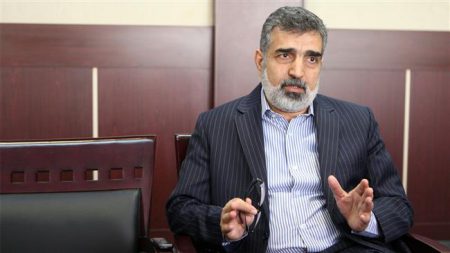
Spokesman for the Atomic Energy Organization of Iran (AEOI), Behrouz Kamalvandi
Press TV – November 18, 2016
Iran has remained committed to its obligations, including those concerning its heavy water stockpiles, under last year’s landmark nuclear agreement signed between the Islamic Republic and the P5+1 group of countries, a senior Iranian nuclear official says.
“The Islamic Republic of Iran has fulfilled its obligations on heavy water stockpiles based on the JCPOA (the nuclear deal known as the Joint Comprehensive Plan of Action), and remains committed to it,” the spokesman for the Atomic Energy Organization of Iran (AEOI), Behrouz Kamalvandi, told IRIB on Friday.
Kamalvandi made the comments in reaction to a report by the International Atomic Energy Agency (IAEA) last week that claimed that Iran’s stocks of heavy water had slightly exceeded the 130-tonne level set out in the JCPOA.
IAEA Director General Yukiya Amano on Thursday chided Iran for exceeding the agreed limit on its stockpiles and said, “It is important that such situations should be avoided in future in order to maintain international confidence in the implementation.”
Iran and the five permanent members of the United Nations Security Council – the United States, France, Britain, Russia and China – plus Germany signed the JCPOA in July 2015 and started implementing it in January 2016.
Under the JCPOA, Iran undertook to put limitations on its nuclear program in exchange for the removal of nuclear-related sanctions imposed against Tehran.
The deal requires Iran’s storage of uranium enriched to up to 3.67 percent purity to stay below 300 kilograms. Tehran has also agreed to keep its heavy water stockpile below 130 metric tonnes.
“According to the JCPOA, we were required to offer on the international market any excess over 130 tonnes of heavy water and we have so far sold 70 tonnes,” Kamalvandi said.
He added, “Negotiations are under way with interested countries, the Europeans in particular,” to sell the rest.
The nuclear official emphasized that Iran would remain committed to its undertakings under the JCPOA on heavy water restrictions “so long as the JCPOA is in place.”
Last week, US State Department spokesman Mark Toner played down concerns about Iran exceeding the heavy water stockpile limit.
He said it was “important to note that Iran made no effort to hide this” and that he was “not sure whether that constitutes a formal violation.”
The AEOI head Ali Akbar Salehi said in October that the Islamic Republic had sold 32 tonnes of heavy water to the United States and delivered 38 tonnes of the nuclear substance to Russia.
“European firms, including German and French ones, seek to purchase Iran’s heavy water and we have expressed our readiness in this regard,” Salehi added.
Israel acts to blunt criticism of the occupation as its grip tightens
By Jonathan Cook | Dissident Voice | November 1, 2016
Israel has just emerged from its three-week high holidays, a period that in recent years has been marked by extremist religious Jews making provocative visits to Al Aqsa mosque compound in occupied East Jerusalem.
Many go to pray, in violation of Israel’s international obligations. Most of them belong to groups that seek to replace the mosque with a Jewish temple. They now enjoy increasing parliamentary support, some of it from within prime minister Benjamin Netanyahu’s party.
A rash of such visits last autumn outraged Palestinians and triggered a wave of so-called lone-wolf attacks on Israelis. The attacks have recently abated.
Taking advantage of the renewed quiet, Israel allowed a record number of ultra-nationalists to visit the mosque, figures released last week showed. Parties of Israeli soldiers are also entering the site.
The police, whose recently appointed commander is himself from the extremist settler community, have recommended that restrictions be ended on visits by Jewish legislators who demand Israel’s sovereignty over the mosque.
For Palestinians, Israel’s treatment of this supremely important Islamic holy site symbolises their powerlessness, oppression and routine humiliation. Conversely, a sense of impunity has left Israel greedy for even more control over the Palestinians.
The gaping power imbalance was movingly detailed last month at a special hearing of the UN security council. Hagai El-Ad, head of B’tselem, which monitors the occupation, termed Israel’s abuses as “invisible, bureaucratic, daily violence” against Palestinians exercised from “cradle to grave”.
He appealed to the international community to end its five decades of inaction. “We need your help. … The occupation must end. The UN Security Council must act. And the time is now,” he said.
Israeli politicians were incensed. Mr El-Ad had broken one of Israel’s cardinal rules: you do not wash the country’s dirty linen abroad. Most Israelis consider the occupation and Palestinian suffering as an internal matter, to be decided by them alone.
Mr Netanyahu accused B’tselem’s director of conspiring with outsiders to subject Israel to “international coercion”.
With the US limply defending Mr El-Ad’s freedom of speech, Mr Netanyahu found a proxy to relaunch the attack. David Bitan, chair of his party, demanded that Mr El-Ad be stripped of his citizenship and proposed legislation to ban calls in global forums for sanctions against Israel. Unsurprisingly, Mr El-Ad has faced a flood of death threats.
Meanwhile, another UN forum has been considering Israel’s occupation. Its educational, scientific and cultural body, Unesco, passed a resolution last month condemning Israel’s systematic violations of Palestinian holy sites, especially Al Aqsa.
Again, Israelis were enraged at this brief disturbance of their well-oiled machinery of oppression. The abuses documented by Unesco were overshadowed by Israeli protests that its own narrative was not the focus.
While Israel exercises ever more physical power over Palestinians, its moral credit is running out with foreign audiences, who have come to understand that the occupation is neither benign nor temporary. The rise of social media has accelerated that awakening, which in turn has bolstered grassroots reactions such as the boycott (BDS) movement.
Aware of the dangers, Israel has been aggressively targeting all forms of popular activism. Facebook and YouTube are under relentless pressure to censor sites critical of Israel.
Western governments – which joined the chorus of “Je suis Charlie” after ISIL’s lethal attack on the Paris office of Charlie Hebdo magazine last year – have cracked down on the boycott movement. Paradoxically, France has led the way by banning such activism, echoing Israeli claims that it constitutes “incitement”.
And left-wing social movements emerging in Europe face loud accusations that any criticism of Israel is tantamount to an attack on all Jews. Notably, a British parliamentary committee last month characterised as anti-semitic parts of the opposition Labour party under its new leader, Jeremy Corbyn, a champion of Palestinian rights.
In these ways, European governments have been trying to hold in check popular anger at a belligerent and unrepentant Israel.
Illustrating that caution, Uneso was forced last week to vote a second time on its resolution, this time removing the word “occupation” and, against normal practice, giving equal status to the occupier’s names for the sites under threat from its occupation.
Even with the resolution neutered, Unesco’s usual consensus could not be reached. The resolution passed by a wafer-thin majority, with European and other governments abstaining.
Israel and its enablers have successfully engineered a hollowing out of official discourse about Israel to blunt even the mildest criticism. Gradually, western powers are adopting Mr Netanyahu’s doubly illogical premises: that criticising the occupation is anti-Israel, and criticising Israel is anti-semitic.
Incrementally, western leaders are conceding that any criticism of Mr Netanyahu’s policies – even as he tries to ensure that the occupation becomes permanent – is off-limits. Mr El-Ad called for courage from the western powers that dominate the security council. But the signs are his words have fallen on deaf ears.
Israel: 1984 Everlasting

By Stanley L. Cohen | CounterPunch | October 28, 2016
Empty Declarations of Democracy… Vacant Boasts of humanity
For decades, Israel has held itself out as being the lone “democracy” in the Middle East; a state where the rights of individuals could not and would not be held hostage to the autocratic whims of royalty, but rather a full partner to a free and robust electoral process that guarantees not just meaningful input from the governed but the ability to challenge state policies as the winds of change blow from “the river to the sea.”
Once again, recent events have proven this to be just so much a perverse myth… empty rhetoric… second only to the brazen unfounded Israeli boast of having the “most humane army in the world,” even as the body count of Palestinian children grows in cemeteries and prisons that have become very much its own unique brand of 21st century youth hostel.
Recently, Hagai El-Ad, an Israeli and Jew, who serves as executive director of B’Tselem (The Israel Information Center for Human Rights in the Occupied Territories), spoke before the UN Security Council urging it to take immediate action against Israel’s illegal settlements.
Demagoguery and Inhumanity Exposed
Not quite 1400 words in its entirety, one paragraph in particular of El-Ad’s testimony sums up life for millions of those captured by a democracy that sees day as night… pain as pleasure. Crushing, despite its brevity, the power and pain of these words could easily be part of an opening statement by a war crimes prosecutor at a tribunal called to hold Israel accountable for crimes unseen since the Nuremburg tribunals some 70 years ago.
“What does it mean, in practical terms, to spend 49 years, a lifetime, under military rule? When violence breaks out, or when particular incidents attract global attention, you get a glimpse into certain aspects of life under occupation. But what about the rest of the time? What about the many “ordinary” days of a 17,898-day-long occupation, which is still going strong? Living under military rule mostly means invisible, bureaucratic, daily, violence. It means living under an endless permit regime, which controls Palestinian life from cradle to grave: Israel controls the population registry; Israel controls work permits; Israel controls who can travel abroad – and who cannot; Israel controls who can visit from abroad – and who cannot; in some villages, Israel maintains lists of who can visit the village, or who is allowed to farm which fields. Permits can sometimes be denied; permits must always be renewed. Thus with every breath they take, Palestinians breathe in occupation. Make a wrong move, and you can lose your freedom of movement, your livelihood, or even the opportunity to marry and build a family with your beloved.”
In a free democratic society these comments, while perhaps controversial, would certainly not constitute sedition. In an open, healthy State these words would surely give reason to pause and reflect… but never serve as a rational trip-wire to strip their speaker of his birthright as an unbound citizen empowered to support his government for policies he finds just but condemn it for those that bear the star of tyranny. It is a distinction that Israel has failed to adopt or learn over the course of its 50 year subjugation of millions whose only crime is to be born Palestinian in occupied land with sign-posts everywhere that simply say “ Jews only.”
Beating of Chests
Not long after El-Ad’s powerful speech before a world body entrusted with securing fundamental rights and liberty for all of its citizenry, the hue and cry could be heard among Israeli political elite to silence such subversive talk. Thus, Coalition Chairman MK David Bitan of the Likud Party undertook the first steps of reprisal by announcing he was considering submitting a bill to the Knesset that could remove the citizenship of Israelis who act against their country in international organizations. According to Bitan, “El-Ad’s actions at the Security Council are a blatant violation of the trust citizens must have for their country, so he should go find another country where he could be a citizen.”
Alarming, one might ask; no, not at all… merely another in an endless daily stream of steps by a government second to none when it comes to autocratic, indeed dictatorial, control of every fiber of its citizen’s freedoms, particularly their ability to access and exchange information without fear of retribution.
Much is known and largely ignored about the thousands of Palestinian civilians that have been targeted and slaughtered by the Israeli military machine in occupied Palestine, whether in Gaza or the West Bank. Indeed, the killing fields of Gaza or execution alleys of back street Jerusalem no longer acquire more than a passing fancy or footnote in the evening news spread across a world now busy with outrages of more recent vintage. After 70 years of slaughter, it’s just so much business as usual.
So, too, we have seemingly become numbed to the reality that thousands of Palestinian political prisoners languish in isolation, many sitting year after year, some for decades, in administrative detention cells of political prisons… uncharged, undefended and untried, tortured in ways that leave the spirits of those still roaming the now empty cellblocks of South Africa’s notorious Robben Island relieved their misery was ended quickly through state sanctioned executions by “suicide.”
The Mighty Censor’s Sword
Closures of Palestinian news rooms and television stations are commonplace… yet no more remarkable than assaults by Israel upon Palestinian journalists that long ago moved into triple digits and show no sign of abating. The Palestinian Centre for Development and Media Freedoms (MADA) has documented a pattern of such attacks by Israel running, for some time now, at almost 400 per year. Although the exact number of Palestinian journalists killed or injured by Israel over just the last decade may never be known, it has been documented that seventeen lost their lives in Gaza, alone, during the months of bombings which it endured in 2014.
Dozens of Palestinian journalists and private bloggers have been arrested by Israel and held for violating vague administrative codes that typically come down to the application of entirely undefined prohibitions such as “incitement.” Dareen Tatour, a 35-year-old poet and Arab-Palestinian citizen of Israel, was arrested and placed under administrative detention on charges of inciting violence via her poetry which she posted on Facebook and which merely praises those who fight against Israeli domination. Also arrested and charged with criminal incitement was 19-year-old Anas Khateeb, on the basis of her Facebook posts which included such alarming statements as “Jerusalem is Arab,” and “Long live the Intifada.”
Recently, Palestinian journalist, Samah Dweik, was released from prison having served almost six months for an alleged incitement charge which resulted from comments about the occupation she posted on her private Facebook account. For most of her sentence, her family was banned from visiting or having any contact with her. She was but one of over 20 Palestinian journalists recently imprisoned by Israel for allegations of incitement, along with hundreds of other Palestinian activists or bloggers who have been targeted for arrest and prosecution for nothing more than postings of political opinions about the Israeli occupation and Palestinian resistance on social media. Dweik’s release came not long after Israel and Facebook entered into an agreement to “work together” to monitor Palestinian posts.
The Sword Cuts Deeper
Increasingly, Palestinians are not the sole victims of an Israeli policy to silence “dissent” or to dramatically curb the nature and extent of information made available to its citizens… Jews and Arabs alike. For example, not long ago, Israeli Defense Minister Avigdor Lieberman confronted the military station director after Army Radio broadcast a documentary on the life of the leading Palestinian national poet, Mahmoud Darwish, saying that material like Darwish’s shouldn’t darken Israeli airwaves.
In what can only be described as a systematic effort to control both journalists and citizens in their ability to read and write, to access and exchange information, and to reach informed opinions essential to a public and democratic dialogue about current and future Israeli policies, its machinery of censorship has become the linchpin of the State’s view of what is appropriate knowledge and speech and what is not.
Thus, of late, Israel has begun to demand of social media giants such as Facebook and Twitter that they have input, if not control, over what posts ultimately find their way into the stream of ideas and debate within the Israeli public at large. According to Quds Press, Facebook and Twitter recently deleted thousands of posts, pages and accounts as a result of demands made by the Israeli Ministry of Justice based upon little more than amorphous claims that the information posed a threat to the safety of Israel.
On an even more ominous note, the Knesset has begun to formulate legislation that would require foreign entities to actively monitor social media sites for information deemed to be offensive to Israel. Under the legislation, content based liability could be found for material published by foreign nationals, addressed to foreign nationals and posted on foreign websites thereby reducing the concept of free speech in Israel to one that is cast by the prevailing political winds of the day and little else.
Recently the chief Israeli censor notified dozens of Israeli bloggers and social media activists that any material they might wish to publish in their personal blogs or social media accounts, when dealing with a wide range of what was described as “security” related subject matters, must be vetted. Although provided a generic and ambiguous catalog of those areas to be submitted for clearance, the targets, themselves, were not permitted to disclose the makeup of the list under penalty of law. If history can be counted upon to be the guidepost of what subject matters must be prescreened before publication, in the past the list has included such security “sensitive” subject matters as:
+ Cooperation agreements with foreign militaries;
+ Letters to the editor on military or security matters;
+ Contacts with foreign countries;
+ Anything connected to the nuclear industry;
+ Information about official delegations abroad;
+ Any material which constitutes a “danger” to people’s lives;
+ Immigration policies from “endangered” nations;
+ Use of foreign sources or material that touch upon any of these areas;
+ Detention of those suspected of security offenses;
+ Any information about military industries;
+ Appointments, resignations, firings, rumors about IDF activities or commanders
Finally, in a readily transparent effort to maintain a democratic illusion of a free and uncensored flow of information in the market place of ideas, pursuant to the censorship regulations there are complete prohibitions against leaving any blank spaces or other potential indicators in one’s writing or posts that might suggest or lead one to conclude that material has been deleted.
For those disturbed over this censorship procedure, it must be remembered that we are, after all, talking about a state that recently placed 101st out of 179 countries in the press Freedom index worldwide. Indeed, this appalling placement for the Middle East’s sole democracy is significantly better than Israel has scored in the Freedom index for quite a number of years.
For those wondering just how widespread, indeed systemic, Israel’s censorship procedures are, it is a country with a military censor procedure that has banned, outright, publication of, soon to be, some 2,000 articles and redacted various information from 15,000 others in recent history. That is thousands of articles professional journalists and editors decided were of public interest but which never saw the light of day. Imagine how many more events of public interest went uninvestigated, or articles which were not written, issues debated, or challenges brought to bear for the Israeli body politic to consider because of self-censorship by journalists or editors too tired or principled to seek pre–approval of their body of work by government censors. Stories simply swallowed up and disappeared by an industry of censorship.
Human Rights… Israel Wrongs
Although not yet law, in what can only be described as an all-out onslaught against core democratic rights and values, over the last several days consideration of a bill has begun in the Knesset that would empower the Defense Minister to detain a citizen without trial; to deny one the right to pursue or obtain employment in a field of interest; to limit access to various public places; and “to impose any other order or restriction necessitated by considerations of national security or public safety”.
Earlier in January 2011, the Knesset endorsed a right-wing proposal to investigate some of Israel’s best-known human rights organizations for “delegitimizing” its military. Among others was B’Tselem. The proposed investigations would entail inquiries into the funding of several human rights groups that have a history of criticizing Israeli policies. At the time, the Association for Civil Rights in Israel described the proposal as a “severe blow” to Israeli democracy and critics labeled the policy as “McCarthyist“.
Recently a variation on that bill became law in Israel compelling non-governmental organizations (NGOs) that receive more than half of their funding from foreign state entities to declare so publicly. Ultimately, the legislative criteria were tailored specifically to silence criticism of government policies by some 27 NGO’s… 25 of which, including B’Tselem, are considered to be left-wing… while the other two are non-affiliated. As intended, the bill will have absolutely no impact upon right-wing and pro-settlement NGOs which are funded almost entirely by private donations from powerful Zionists and Zionist entities from outside of Israel.
One can only imagine that upon returning home to the firestorm awaiting him, following his speech before the UN, Hagai El-Ad surely felt what it must have been like to be an activist leftist Jew in the United States during the dark days of McCarthy.
On the other hand, perhaps El-Ad should consider himself very fortunate indeed. On his twitter account, Arab-Palestinian MK Ahmad Tibi mocked MK David Bitan’s call for El-Ad’s de-citizenship saying: “Why stop at removing citizenship? Why not destroy the home of the B’Tselem director-general? Why not bar his entire family from entering the country, remove his land, submit them to administrative detention, and put checkpoints and closures in his neighborhood?”
Featured Video

Chinese jet fuel and the myth of energy independence
or go to
Aletho News Archives – Video-Images
Book Review
Former Insiders Criticize Iran Policy as U.S. Hegemony
By GARETH PORTER | CounterPunch | February 27, 2013
“Going to Tehran” arguably represents the most important work on the subject of U.S.-Iran relations to be published thus far.
Flynt Leverett and Hillary Mann Leverett tackle not only U.S. policy toward Iran but the broader context of Middle East policy with a systematic analytical perspective informed by personal experience, as well as very extensive documentation.
More importantly, however, their exposé required a degree of courage that may be unparalleled in the writing of former U.S. national security officials about issues on which they worked. They have chosen not just to criticise U.S. policy toward Iran but to analyse that policy as a problem of U.S. hegemony. … continue
Blog Roll
 Aletho News
- Why no power can undermine Iran’s eternal dominance over the Strait of Hormuz
- Is The War Against Iran Over?
- Iran war will leave long-term ‘scar’ on Wall Street, investors warn
- How Iran decimated US power projection in West Asia: Military lessons of 40-day war
- Iran’s report details US-Israeli war crimes in targeting schools, hospitals, livelihoods
- NATO’s Slow Fracture: How Trump’s Iran War Exposed the Instrument of Hegemony
- Chinese jet fuel and the myth of energy independence
- Ukraine Sea Drone Fired From Libya Hit Russian Tanker in Mediterranean
- IRGC: Iranian forces launched no attacks during ceasefire hours
- Trump Administration Moves To Automate U.S. Military Draft Registration
- If Americans Knew
- TCN: Is Israel Blackmailing President Trump?
- Israel killed at least 303 Lebanese yesterday – who were they? Daily Update
- Amnesty: Urgent – Protect Lebanese civilians from brutal escalation in Israeli attacks
- Is The War Against Iran Over?
- Inside the Israeli army’s propaganda wing
- Hundreds of Gaza Amputees Stranded in Legal Limbo
- The gallows law: Israel moves toward executing Palestinian children
- Tucker Carlson: The Path to Peace requires ending ‘special alliance’ with Israel
- This is ceasefire? Israel’s biggest massacre yet in Lebanon, another journalist killed in Gaza – Daily Update
- Tucker Carlson on Israel: This Is the Behavior of an Ally? Really?
- No Tricks Zone
- An Inconvenient Tree: Uncovered In Alps… Europe Much Warmer Than Today 6000 Years Ago
- New Study Reports A 60% Slowdown In Greenland’s Ice Loss Rate In The Last Decade
- Low Intensity Tornado Wrecks Major Solar Farm, Creating A Potential Toxic Dump
- New Study Finds Warming Saves Lives…Cold Temperatures 12 Times More Deadly Than Excess Heat
- German Science Blog Accuses PIK Climate Institute Of Hallucinating Climate Tipping Points
- Devastating Assessment Of Comirnaty Vaccine By Former Senior Pfizer Europe Toxicologist
- New Study: CO2 Is ‘Effectively Negligible’ As An Explanatory Climate Change Factor Since 2000
- Former Pfizer Toxicologist Dr. Helmut Sterz Tells Bundestag Hearing Pfizer Vaccine Should Have Never Been Approved
- Energy Expert: Germany’s Nuclear Phaseout Was A “500 Billion Euro Mistake”
- New Research: South Australia’s Mid-Holocene Sea Surface Temperatures Were 4°C Warmer Than Today
 Aletho News