Western logic on Syria: ‘We need to bomb it to save it’
RT | August 27, 2013
The military buildup in the Mediterranean indicates that Assad’s opponents intend to militarily intervene in Syria under cover of ‘humanitarian intervention’, a disingenuous narrative that could not be further from the truth.
Pictures and videos that have surfaced following the alleged use of chemical agents in the eastern suburbs of Damascus are profoundly disturbing and a thorough and substantial investigation into what took place there is absolutely essential. However, it is conversely disturbing that those Western governments who have staunchly supported anti-government militants are using this opportunity to legitimize the use of force against the government in Damascus.
The United States, Britain, and France are unwavering in their assertions that the Assad government and the Syrian Arab army were the perpetrators of the chemical weapon attack, despite no evidence to substantiate these claims. These governments seem to be sure that Damascus is guilty on the basis of it preventing a UN investigation team from visiting the site, and when investigators eventually did reach the area, it didn’t matter to them because they argued that the Syrian government had destroyed all evidence of wrongdoing.
Assad’s opponents have constructed a deeply cynical and hysterical political narrative that Western leaders are now parroting in unison.
There are several reasons why Damascus showed hesitation in allowing UN inspectors to access the site, the most apparent being that this attack allegedly took place in rebel-held strongholds on the outskirts of the capital, and that the security of the UN team could not be guaranteed if rebels attacked them or launched more chemical weapons during their visit.
Syrian rebels have demonstrated their hostility to UN forces on previous occasions; anti-government groups kidnapped 21 UN peacekeepers in the Golan Heights in March, and another four peacekeepers later in May. That the UN convoy was fired upon by unidentified snipers is hardly surprising in that it is another stunt in a series of moves to escalate the situation to provoke an international response.
The UN team eventually made it to the site to collect evidence and, contrary to Western assertions, the UN claimed that it was still possible for the team of experts to gather necessary evidence despite the time elapsed since the alleged attack.
Who benefits from using chemical weapons?
The narrative that the Assad government used chemical weapons, specifically while a UN team was in Damascus to investigate previous uses of chemical weapons, is tactically and politically illogical and in no way serves the interests of the Syrian government.
These attacks transparently serve the interests of anti-government militias who have long called for NATO intervention, as well as the Syrian political opposition who are now refusing to take part in any planned Geneva negotiations. Furthermore, allegations that the regime used chemical weapons benefits the international opponents of Assad, who have materially and financially aided and armed non-state actors and foreign fighters on an unprecedented scale.
Above all, the use of chemical weapons benefits the arms industry, as four US warships with ballistic missiles are moving into position in the eastern Mediterranean Sea, ready to shower Damascus with Tomahawk cruise missiles – all under the auspices of protecting civilians. Lockheed Martin’s stock prices have dramatically shot up since news of the chemical weapons attack.
There are numerous revelations that would suggest that anti-government militias have access to these weapons and are in fact guilty of using them. Carla Del Ponte, head of a UN commission of inquiry that looked into the use of chemical weapons in northern Syria in late March suggested that the evidence was stronger to implicate anti-government militants in using chemical weapons, not the Syrian government.
In May, Turkish police found cylinders of sarin nerve gas in the homes of Syrian militants from the Al-Qaeda-linked Al-Nusra Front who were detained in the south near Syria’s northern border. In July, Russian experts submitted reports to the UN detailing how the missiles used in previous chemical weapon attacks were crude and not factory made, and that the chemical components found were not consistent with what the Syrian military has.
The Syrian military has just recently discovered chemical weapons in a rebel tunnel in the Jobar suburb of Damascus, including shells, gasmasks manufactured in the United States, chemical substances of Saudi Arabian origin. Arabic language reports also indicate that a former high-ranking Saudi Arabian member of Al-Nusra Front claimed that the group possessed chemical weapons in a tweet.
NATO intervention replicating the Kosovo model?
The speeches and statements from John Kerry, Laurent Fabius, or William Hague all imply that military action will be taken against Damascus despite lacking a legal basis of action. If ‘humanitarian intervention’ were to be undertaken, it would need approval from the UNSC in the form of a resolution, but such a resolution would not be passed because countries such as Russia believe that this kind of intervention would be used as a pretext to remove the legal government of Syria, as it has been used in the recent past in the former Yugoslavia, Iraq and Libya – all with undeniable abuses of force that have resulted in substantial civilian casualties.
Reports indicate that Obama’s team is now studying the NATO mission in Kosovo as a “possible blueprint for acting without a mandate from the United Nations.” It is ominous, alarming and bizarre how NATO’s intervention in the former Yugoslavia could be used a positive reference point for anything. NATO rained down bombs for 78 straight days, effectively smashing civilian infrastructure in Serbia and Montenegro while hospitals, schools, and public utilities were damaged beyond repair, killing over 1,200 civilians and injuring 4,500 more.
Despite Obama’s cautious tone in recent interviews, all indications point to military intervention already being decided. Carla Del Ponte’s assessment was whitewashed, and any other evidence provided by the UN that does not fit conveniently into the Western narrative will be suppressed – the US position is that it is already “too late” for any evidence to be credible.
The huge military buildup of US and British ships and warplanes in the Mediterranean comes while the Pentagon is reportedly making the initial preparations for a cruise missile attack on Syrian government forces.
The intransigence and cynical duplicity of Assad’s opponents is unparalleled, and their media outlets are complicit in pulling the heart strings of their audiences while offering a totally one-sided perspective in support of R2P, the ‘right to protect.’
The US, Britain, and France see themselves as righteous protectors, and rationality and evidence will not be enough to break their dangerous and ridiculous delusions; these states are the vanguards of militant corporatism and have demonstrated that they seek only their private economic and geopolitical objectives in the region.
Those countries that represent a balanced approach to this crisis should not stand idly by while the West ‘comes to the aid’ of the Syrian people with cruise missiles and airstrikes – they should not allow intervention under ‘humanitarian’ auspices to harm civilians and topple the legal authorities in Damascus.
Related articles
- Hysteria around chemical attack suits those who want military intervention in Syria – Lavrov (rt.com)
- Russia ‘regrets’ US decision to shelve Syria talks (alethonews.wordpress.com)
Syria accepts essential terms of chemical weapons probe – UN
RT | August 15, 2013
The Syrian government has accepted the ‘essential modalities’ under which the UN was ready to investigate whether chemical weapons had been used in the country, the body has announced, signalling that experts will shortly be traveling to Syria.
“The departure of the team is now imminent,” UN Secretary-General Ban Ki-moon said in a statement. “As agreed with the Government of Syria, the team will remain in the country to conduct its activities, including on-site visits, for a period of up to 14 days, extendable upon mutual consent.”
The Secretary-General has expressed his appreciation to the Syrian government for accepting “the modalities essential for cooperation to ensure the proper, safe and efficient conduct of the Mission.”
The statement also reminded that the use of chemical weapons “by any side under any circumstances” would constitute an “outrageous crime.”
Two weeks ago the United Nations said that an agreement had been reached with Syrian President Bashar al-Assad’s government as to the three locations that UN inspectors would be investigating, led by Swedish scientist, Ake Sellstrom.
One site to be visited by the UN team is Khan al-Assal in Aleppo, where the country’s government says rebels used chemical weapons in March. The two additional locations have yet to be confirmed.
Both Syria’s government and rebel forces have long been accusing each other of using chemical weapons, and both have denied it.
Russia welcomed the move, saying on its Twitter feed that “Damascus is ready to bring clarity into the situation”, and expressing hope that the move will “provide a springboard for a political solution of the ongoing crisis”.
Last month Russia submitted “a full set of documents” to the UN and its analysis of samples taken west of Aleppo. Russia’s findings indicated that it was rebels behind the Khan al-Assal incident, in which more than 30 people died.
The United States cast doubt on the Russian findings saying its own intelligence services believed Syrian government forces had used chemical weapons. However, Paulo Pinheiro, chairman of the UN commission’s inquiry into rights violations in Syria, said the evidence provided by the US did not meet standards as his commission was “very worried about the chain of custody of the substances.”
Back in March Damascus requested UN investigators to visit Khan al-Assal. The UN formed a mission then, but was reluctant to send it, demanding “unconditional and unfettered” access across the country, according to Ban’s spokesman Martin Nesirky.
Syria’s Foreign Ministry rejected the UN’s effort to broaden the probe claiming that it was “at odds with the Syrian request” and that its “possible hidden intentions” could violate Syrian sovereignty.
In total, the UN received some 13 reports of alleged use of chemical weapons in Syria and the UN inspectors will be investigating the “allegations” of chemical weapons use, rather than determining who was responsible for the attacks.
UN protests to Israel for violating Lebanon sovereignty
Press TV – August 10, 2013
The United Nations has strongly protested to Israel for violating the sovereignty of Lebanon after an investigation showed that Israeli soldiers had crossed the Lebanese border in a recent incident.
Paolo Serra, the commander of the UN Interim Force in Lebanon (UNIFIL), told UN spokesperson office on Friday that “it is clear that the presence of Israeli soldiers in Lebanon in violation of the Blue Line constitutes a serious breach of the terms of UN Security Council resolution 1701.”
UN Security Council Resolution 1701, which brokered a ceasefire in the war of aggression Israel launched on Lebanon in 2006, calls on Tel Aviv to respect Lebanon’s sovereignty and territorial integrity.
The UN mission launched an investigation on Wednesday after the Lebanese army said that an Israeli patrol had crossed the UN-demarcated Blue Line border before a blast occurred. Israeli’s army has confirmed that four of its soldiers were wounded in the incident.
The UNIFIL says it is working with the Lebanese army to determine on which side of the border the explosion happened.
Serra said the UN mission has called on the Israeli regime to fully cooperate with the investigations.
The Lebanese government has decided to file a complaint with the Security Council over the Israeli regime’s repeated violations of its border and abduction of a Lebanese citizen.
On Friday, Lebanon’s caretaker Foreign Minister Adnan Mansour tasked the country’s Ambassador to the UN Nawaf Salam with lodging the complaint.
Mansour also said the incident “reveals again the Israeli enemy’s hidden intensions through its infiltration of Lebanese territory.”
The Israeli military frequently violates Lebanon’s airspace, territorial waters and border.
Related articles
- UNIFIL says Israel clearly breached 1701 (dailystar.com.lb)
- Four Israeli soldiers wounded by landmine after crossing into Lebanon (alethonews.wordpress.com)
Argentine President Urges Re-think of UN Security Council
By Alison Depsky | The Argentina Independent | August 6, 2013

President Fernández speaking before the UN Security Council
(photo:Presidencia/Télam/e)
While leading the session of the UN Security Council earlier today, President Cristina Fernández de Kirchner made a call to “revise the functions of UN organisms, in particular the Security Council.”
The president took a stance against the right to veto of the permanent member states, while reiterating the need to negotiate with the United Kingdom over the Malvinas.
President Fernández is currently head of the council for the month of August.
In her discussion about the UN itself, she emphasised that the organisation, which was created after the cold war, now needed to adapt to “a new world with a new reality.” Fernández argued that the United States, France, UK, Russia, and China should not necessarily continue to have the right to veto just because they have had it up until now. “The old methods are not going to give solutions [today],“ she said.
“Peace and security are not military concepts. Many believe that peace is only gained through weapons, but I believe that there are multiple examples that show that what really constructs societies are values and ideals.”
Fernández also claimed that, since the UN now reaches its decisions by consensus “there is no need to exercise a veto.” Her request was made in the context of a call to “strengthen” cooperation between regional organisations such as the CELAC, the African Union and the League of Arab States to the United Nations.
Regarding the Falklands/Malvinas the president said her government’s stance is not based on a whim. “We simply want the United Nations resolution to be enforced and for our two countries to sit down and discuss this.”
“One can have different opinions about something that has not been resolved by the UN, but a problem arises when the assembly is not looking at differing views,” she argued.
Fernández added that the Malvinas are “only an example”, and affirmed that she did not wish to introduce further controversy to this debate. “These are ideas, I’m not so arrogant as to say they are the absolute truth,” she said.
President Fernández also met with UN Secretary-General Ban Ki-moon yesterday to discuss the Falklands/Malvinas issue and the recent global espionage scandal.
Related article
- Mercosur complains to Ban Ki-moon on US global espionage and EU affront towards Bolivia’s Evo Morales (alethonews.wordpress.com)
The ginned-up Syrian death toll
left i on the news | July 21, 2013
Today the U.N. claims that “5000 people a month” are dying in Syria. As I have before, I have to demonstrate why I find this claim utterly non-credible. 5000/month would be 167 every single day. Now we don’t know what the standard deviation might be, but we have to assume it would be reasonably large, which would mean that some days would be much lower, while on other days, we could easily expect 300 or more to be killed in a single day, if the 5000/month were to be believable.
So let’s look at a report from today, when major battles are being reported. Looking through the article, we find (claims of) six mediators shot in Homs, eight Nusra front militants killed by Kurds, nine people killed at a checkpoint, and “several” regime fighters killed. All in all fewer than 30 were reported killed on a day when major battles are being fought. Is it remotely credible that an average of 167 are being killed every single day? Just yesterday we read about 40 people being killed in a single bombing in Iraq; when is the last time we read about an event in Syria which killed even that many people? And when was the last time we read about a day when more than 200 people died in Syria in just a single day? For my part, the answer would be: never.
I don’t know what the statistics are, and I’ll also state clearly that they make no difference whatsoever to my stand, which is: Hands off Syria! No U.S. intervention in Syria. However, because these numbers are being used (and, in my opinion, “ginned up”) to justify ever-increasing intervention in Syria, it is important to understand them, and rebut them, if they are false. Which, in my opinion, is without question.
Related articles
- Kurdish leader says Syria Kurds not after forming own government (alethonews.wordpress.com)
- Syrian Kurds to declare autonomy from Damascus (timesofisrael.com)
The Language of Power: Obama’s “Humanitarian Hawk” & Israel’s New Gladiator at the UN
By Nima Shirazi | Wide Asleep in America | July 18, 2013
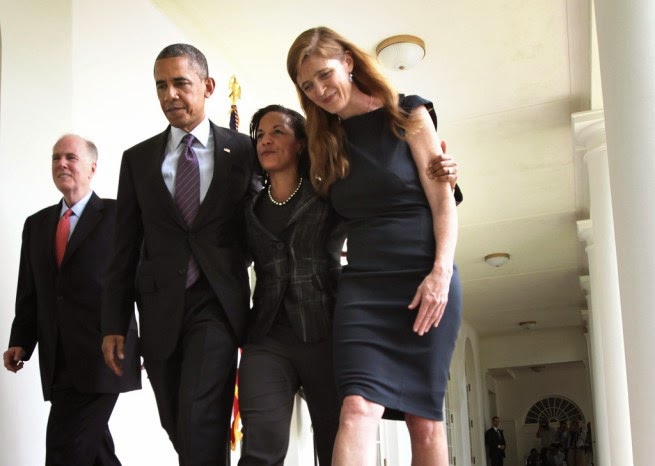
In her first appearance before the Senate Foreign Affairs Committee, Samantha Power, Obama’s pick for next U.S. Ambassador to the United Nations, made clear that she will spend her time in the role much as her predecessor Susan Rice did: acting as Israel’s consummate defender, fear-mongering about Iran, and opposing any move to champion Palestinian human rights or self-determination.
Rice, who has been appointed as Obama’s National Security Adviser, has said repeatedly that the American delegation to the UN “often works in ‘lockstep’ with the Israeli delegation” and spends “an enormous amount of time defending Israel’s right to defend itself and defending Israel’s legitimacy.”
“It’s an issue of utmost and daily concern for the United States,” she declared last year. A few months ago, she reiterated this point, insisting that her role as an apologist for the Israeli government is “a huge part of my work to the United Nations” and that the United States “will not rest in the crucial work of defending Israel’s security and legitimacy every day at the United Nations.”
Power has already proven herself a loyal replacement, disavowing any semblance of past critical thinking when it comes to Israeli human rights abuses and abrogation of international law and opposing fear-mongering about Iran’s nuclear program. It is no surprise Washington hawks and, even the Israeli government, are falling over themselves to sing her praises.
In her confirmation hearing yesterday, Power revealed her adherence to AIPAC talking points, essentially working her way down the tried and true list of boilerplate phrases. “The United States has no greater friend in the world than the State of Israel,” she said, adding, “Israel is a country with whom we share security interests and, even more fundamentally, with whom we share core values – the values of democracy, human rights, and the rule of law.”
“America has a special relationship with Israel,” she stated, to the surprise of no one and the consternation of George Washington‘s ghost. “I will stand up for Israel and work tirelessly to defend it,” she promised.
Perhaps her most disturbing comments, however, were about Iran. Shamelessly exploiting the horror of the Holocaust to fear-monger about the Islamic Republic, she declared:
“…within this organization built in the wake of the Holocaust – built in part in order to apply the lessons of the Holocaust – we also see unacceptable bias and attacks against the State of Israel. We see the absurdity of Iran chairing the UN Conference on Disarmament, despite the fact that its continued pursuit of nuclear weapons is a grave threat to international peace and security.”
With this statement, Power, in her eagerness to check off all the buzzword boxes prescribed by AIPAC, directly contradicts the consistent assessment of the United States’ own intelligence community, which has repeatedly concluded that Iran is, in fact, not pursuing a nuclear weapons as it has no nuclear weapons program.
Early last year, an unnamed U.S. intelligence official told the Washington Post that Iran has not decided to pursue nuclear weapons, explaining, “Our belief is that they are reserving judgment on whether to continue with key steps they haven’t taken regarding nuclear weapons.” At the time, Secretary of Defense Leon Panetta affirmed this position, admitting, “Are they trying to develop a nuclear weapon? No.”
Soon thereafter, the New York Times reported, “Recent assessments by American spy agencies are broadly consistent with a 2007 intelligence finding that concluded that Iran had abandoned its nuclear weapons program years earlier.” This, the paper noted, “remains the consensus view of America’s 16 intelligence agencies.”
Either Samantha Power is an idiot or she’s lying.
In fact, there was a time when Power wasn’t so confident in making such a declarative statement. In a 2008 interview with Miller-McCune, Power noted that she was “not an expert on Iran,” but condemned the “American sabre-rattling” of the George W. Bush administration. “The threats – implicit and explicit – of U.S. military action have united very diverse secular, Islamist and nationalist strands,” she said, adding that American “belligerence” had “backfired.”
When asked specifically about whether she thought “Iran is trying to create nuclear weapons,” Power replied, “It would surprise me if they weren’t, but I don’t know.”
Still, she disparaged the findings of the National Intelligence Estimate and simply assumed Iran “would see as in its interests to amass as much firepower as possible,” due to the foreign threats it faces. Nevertheless, she stated, “It does not seem as though the Iranian regime is close to possessing nuclear weapons” and said that “when U.S. leaders claim Iran poses an imminent threat, they are not currently heard as credible.”
Now, five years later, Power sounds exactly like Bush’s own UN Ambassador, perennial Iran hawk John Bolton, who in 2006, insisted to the UN Security Council that “Iran had defied the international community by continuing its pursuit of nuclear weapons” and that this “pursuit of nuclear weapons constituted a direct threat to international peace and security.”
Furthermore, Power’s incredulity regarding what she deems the “absurdity of Iran chairing the UN Conference on Disarmament,” betrays her own ignorance on Iran’s constantly repeated stance regarding nuclear nonproliferation and disarmament.
Iran has long championed a Nuclear Weapons Free Zone (NWFZ) in the Middle East and is a party to all disarmament treaties on weapons of mass destruction, including the Biological Weapons Convention, Chemical Weapons Convention, and the Nuclear Non-Proliferation Treaty. Israel, however, is not a member to any of them.
Last year, Iranian Foreign Minister Ali Akbar Salehi stated that Iran fully supports the establishment of a NWFZ, but that Israel, and its American backers, presented the “only obstacle to the creation of such a zone…due to its persistent refusal to join the NPT and to place its nuclear facilities under the IAEA safeguards system.” The United States consistently blocks crucial international conferences dedicated to nuclear non-proliferation for the sole purpose of protecting Israel’s massive nuclear arsenal from scrutiny.
Samantha Power has surely embraced her new role in Turtle Bay as Israel’s stalwart apologist.
Abe Foxman, the Anti-Defamation League’s hasbarist-in-chief, once called Susan Rice a “gladiator” fighting in the United Nations on behalf of Israel. There is no question Samantha Power will, for the sake of our “special relationship” and “shared values” with an aggressive, nuclear-armed, settler-colonial apartheid state, similarly take up the sword and continue to unleash hell on the entire Middle East.
Related articles
- Israel’s Nuke Arsenal Off-Limits (alethonews.wordpress.com)
- MEK Re-Ups 3 Year Old Nuclear Propaganda (alethonews.wordpress.com)
Tony Blair hired ex Israeli army intelligence officer
By Gilad Atzmon | July 7, 2013

The Telegraph reported today that “Tony Blair has hired a former Israeli army intelligence officer to work in his private office, despite his role as Middle East peace envoy.”
Lianne Pollak, who has led intelligence teams in the Israel Defence Forces, was recruited as a private consultant between October 2012 and April this year.
The 30-year-old Israel was previously a policy adviser to Israeli PM Benjamin Netanyahu, working with security agencies and senior officials.
The former British prime minister is the envoy to the Middle East for the Quartet – the group that represents the US, Russia, the United Nations and Europe.
His role includes encouraging development in Gaza and the West Bank and helping to forge a settlement of the Israeli-Palestinian conflict, having been appointed when he left Downing Street in June 2007.
Related article
- Tony Blair: Egypt’s army had no choice (thestate.com)
Bush’s Foiled NSA Blackmail Scheme
By Dennis J Bernstein | Consortium News | June 21, 2013
In early 2003, as the U.S. and British governments were seeking international acquiescence to their aggressive war on Iraq, an unexpected cog thrown into the propaganda machine was the disclosure that the National Security Agency was spying on UN Security Council members in search of blackmail material.
The revelation received little attention in the mainstream U.S. news media, which was almost fully on board the pro-war bandwagon, but the disclosure received wide international attention and stopped the blackmail scheme. U.S. President George W. Bush and British Prime Minister Tony Blair were forced to abandon a UN resolution and invade Iraq with a ragtag “coalition of the willing.”

Former British Prime Minister Tony Blair.
Several months later, the identity of the leaker was revealed, a young woman named Katharine Gun who worked as a linguist at the NSA’s UK counterpart, British Government Communications Headquarters. Gun lost her job and was charged under British secrecy laws, but the case was dropped because the court would have required the Blair government to disclose that it also had twisted the arms of legal advisers to extract an opinion endorsing the invasion.
Now, a decade later, Edward Snowden, a young American systems analyst working for the NSA, has leaked documents revealing a global surveillance network and prompted another international debate – about government spying vs. personal privacy. Katharine Gun joined Pacifica’s “Flashpoints” host Dennis J Bernstein to discuss both cases.
DB: What exactly was your position when you decided to leak a certain document?
KG: My title was linguist analyst. I was a Mandarin Chinese speaker. We translated interceptions and produced reports for the various customers of GCHQ, which are normally the Foreign Office or MI-5 and MI-6.
DB: Can you explain the document you released and the significance of the timing?
KG: It was released at the end of January 2003, just before the invasion of Iraq. I saw an email that had been sent from the NSA to GCHQ. It was a request for GCHQ to help the NSA intercept the communications of six nations that sat on the Security Council at that time. It was to intercept their domestic and office telecoms in order to obtain all the information we could about the delegates, which the U.S. could then use to achieve goals favorable to U.S. interests. They called for the whole gamut of information, which made me think they would potentially use the information to blackmail or bribe the U.N. delegates.
DB: This bugging took place at the United Nations?
KG: Presumably, yes. Or it could involve the United Nations headquarters or also their domestic residence.
DB: The idea was to get the necessary information one way or the other to influence the key members to support the U.S. quest for war in Iraq?
KG: Yes. At the time, if you were not working for the intelligence services or the foreign offices of the U.S. or U.K. you would probably assume that the goal of [President George W.] Bush and [Prime Minister Tony] Blair at that time was to work diplomatically to reach a solution. But we now know, after several leaks over the years about the run-up to the war in Iraq, that war was the agenda all along. When I saw the email it made me think, “This is evidence that war is the agenda.” That’s why I decided the public needed to know.
DB: GCHQ is the British Government Communications Headquarters, the equivalent to the NSA [National Security Agency]. You were working there in the lead-up to the Iraq War. Can you remind us what governments were bugged?
KG: Six nations, smallish countries: Angola, Cameroon, and Pakistan, I think. Mexico was mentioned, and possibly Chile as well. They were countries that are generally not known for their big powerful positions at the U.N.
DB: What went through your mind leading up to the decision to leak this information? This big decision changed history a bit. How did you make this courageous decision that also changed your own life?
KG: I was very concerned. I had informed myself about the realities of Iraq and the situation there because I grew up during the first Gulf War and the following years of sanctions. It was in the back of my mind that Iraq was a country that was virtually destroyed, and that the people were living in impoverished conditions. It made me think that another attack on them would not be fair and justified because there was nothing about Iraq that was a threat to either the U.S. or the U.K.
So when I saw the email and realized what was going on behind closed doors was an attempt to get the U.N. to authorize what would then have become a pre-emptive strike on a country, I thought the public should know about this because it angered me.
DB: What happened after you made this information available? What happened with your position? Were you intimidated, attacked?
KG: Initially I tried to remain anonymous, but when I realized the information revealed in the newspaper at the time was identifiable to GCHQ, I decided I didn’t want to lead a double life at GCHQ and pretend I had nothing to do with it. I confided to my line-manager and said it was my leak. Then I was arrested under suspicion of breaking the Official Secrets Act, questioned, and released on bail for eight months.
In November 2003, much to our surprise, they decided to charge me, despite having waited so long. After discussions with my legal team, which included Liberty, an organization very similar to the U.S. ACLU, we decided I would plead non-guilty, because I personally felt that although I did the act, I didn’t feel guilt, because I didn’t feel I had done anything wrong. Our defense would have been to establish the defense of necessity, which is not yet tested in a court of law. My legal team then asked for all the legal advice leading up the war, and at that point, the prosecution decided to drop all charges against me.
DB: What do you think made them decide to prosecute you, and what information made them drop the charges? Were they trying to backpedal? Were they trying to make sure no other folks in positions like you would do it again?
KG: It’s speculation on my part because obviously they haven’t disclosed. I suspect one of the reasons they charged me was to make an example of my actions to try to deter people from it. On the other hand, when they dropped the charges, I suspect there may have been a variety of reasons. When we asked for the legal advice from the then-Attorney General, at that time his legal advice had not been fully disclosed.
During the run-up to the war, Blair asked for legal advice, obviously. The first draft was about 13 pages long. The language was very cautious – it didn’t say there was a definite reason for war. There were many legal terms of caution, but at some point Blair was told the legal advice was not good enough. He needed a watertight case. The Attorney General then re-drafted his advice, and condensed it to a single page that was then issued to the House of Commons.
That is what persuaded all the MPs in the House of Commons to vote for Britain’s involvement in the war. Eventually information came out, not from myself, but from other means and it became apparent that the legal advice had not been at all watertight to start with.
DB: Daniel Ellsberg said your most important and courageous leak is the only one made in time to avert an imminent possible war. Was your desire to avert war?
KG: Yes, I was hoping the British ministers would see the truth and question the actions of Blair and the secret negotiations he was having with Bush at the time. I wanted more transparency on the issue. I wanted people to question what was going on and to generally challenge this bandwagon for a preemptive strike against a country that was already very impoverished and no threat to anybody whatsoever.
DB: Did you ever hear from folks who based on your revelations, learned they were bugged?
KG: No.
DB: So there were no thank yous coming across from that part of the world?
KG: No. At the time of the leak, my name didn’t come out. Eight months later my name was made public.
DB: Did it change your life?
KG: I lost my job. The secure, full-time, long-term employment was no longer possible. That has made an impact, primarily financially, on my life and my family’s life.
DB: We are now seeing extraordinary NSA leaks from Edward Snowden in the British Guardian. What are your thoughts on this?
KG: I think Snowden is probably is a lot more clued-up than I was at the time. My leak was a single issue. Snowden has had a long period of time working within the U.S. intelligence services. He’s obviously a very technically savvy professional. I admire him for taking this tremendous step, which he thought out very carefully and methodically. He has made some very good points. These kinds of issues should be in the public domain because it involves innocent members of the public. We, the public, should be able to have a measure of a say in these matters.
DB: We hear that people like you, who were leaking before the war, and Snowden now, are putting people’s lives in jeopardy, endangering the people. We hear that secrecy is necessary to prevent terrorist attacks, and that many have been prevented by this kind of secrecy, investigation, wiretapping and bugging that’s going on now.
KG: There is absolutely no evidence that my leaks in any way endangered anybody else.
DB: But you were accused of that.
KG: Yes, they love to throw accusations around, there’s no doubt about that. But in my case, the majority of views supported my actions. In Snowden’s case, people who have a fair and just understanding of the issues at-large are supportive of his actions, as they would be of Private Manning, who is currently on trial.
DB: Did you lose any friends or associates, over this?
KG: Ironically, not really. Many of my friends and colleagues from GCHQ have also left GCHQ, partly to progress in their professions. They didn’t see much chance for their linguistic skills progressing much further within GCHQ and I continue to be in touch with them.
DB: If you had it all to do over again, would you?
KG: That’s a difficult question. Now I’m married and have a child. I would hope that I would still do it, but perhaps I would be more savvy about how I did it. Snowden was very clued-up and seems to know exactly what he should be doing – how to stay safe and keep out of the way of being unjustly arrested and tried without due process of law.
DB: Your language skills. Are you using them now?
KG: Not now. I’m only fluent in Mandarin Chinese. I speak some Japanese and am now trying to learn Turkish.
DB: That may in handy in the next decade or so. Thank you for talking to us.
~
Dennis J Bernstein is a host of “Flashpoints” on the Pacifica radio network and the author of Special Ed: Voices from a Hidden Classroom. You can access the audio archives at www.flashpoints.net.
Related articles
- A British Precursor to Snowden Case (consortiumnews.com)
- British spy agency has access to global communications, shares info with NSA (alethonews.wordpress.com)
UN rejects US claim on Syria chemical weapons
Press TV – June 21, 2013
UN experts say they do not confirm the claims by the United States, France and Britain that the Syrian government has used chemical weapons against the militants.
“We are not able to say who has used chemical agents or chemical weapons,” said Paulo Pinheiro, chairman of the United Nations human rights investigation committee on Syria, on Friday.
Speaking to reporters after an informal meeting with UN Security Council ambassadors, Pinheiro said he would not comment on evidence, including multiple blood, tissue and soil samples, that the US, Britain and France have sent to the UN about the possible use of chemical weapons in Syria.
The technical data presented by the three countries is of limited value to the UN which, according to its rules, can pass a final judgment on the situation only after its own inspectors personally collect evidence.
Based on the unsubstantiated claim that the Syrian government has used chemical weapons against the militants, President Barack Obama ordered the CIA last week to provide arms to the anti-Syrian groups, saying the government of President Bashar al-Assad had crossed Washington’s red lines.
In an article on the Washington Post on Friday, Colum Lynch and Joby Warrick write that the US move “rests on unverifiable claims” that lack transparency.
Weapons experts say Obama’s declaration of Washington’s red line in terms of more involvement in Syria “handed the Syrian opposition a powerful incentive to fabricate evidence” against the Assad government regarding the chemical arms use, the article said.
“If you are the opposition and you hear” that the White House has drawn a red line on the use of nerve agents, then “you have an interest in giving the impression that some chemical weapons have been used,” said Rolf Ekeus, a Swedish scientist who headed UN weapons inspections in Iraq during the 1990s, the article read.
Related articles
- PressTV: Russia dismisses ‘unconvincing’ US claims on chemical weapons use by Syria (jhaines6.wordpress.com)
- New weapons supplied to militants in Syria (fromthetrenchesworldreport.com)
UN calls for record $5.2 billion aid package for Syria
Al-Akhbar | June 7, 2013
The United Nations on Friday launched a record $5.2-billion aid appeal to fund operations in Syria and neighboring nations, saying the number of people affected by the country’s brutal conflict was set to spiral.
The call for donations comes as the UN expects that 10.25 million Syrians – half the country’s population – will need humanitarian aid by the end of 2013.
The sum of aid being requested overshadows by far the $2.2 billion the UN sought in 2003 to help cope with the crisis sparked by the war in Iraq.
The $5.2 billion represents money needed across this year to pay for operations that have already been undertaken, are ongoing, or are due to be carried out until the end of December.
“The figure for the new appeal is both an expression of the alarm about the situation facing Syrians and an absence of a political solution,” said Adrian Edwards, spokesman for the UN’s refugee agency, the UNHCR.
It also marked a more than threefold increase on the $1.5 billion which the UN previously had said that it needed to cover operations this year.
The UN has so far received $1.0 billion of that sum, after launching an appeal last December.
In the latest appeal, the world body said that a total of $3.8 billion was needed to help Syrian refugees who have spilled across the country’s borders to escape fighting in their homeland.
The figure for operations inside Syria meanwhile was $1.4 billion.
According to UN estimates, more than 80,000 people have been killed and some 1.6 million Syrians have fled the country since the civil war began in March 2011 after a crackdown on protests against President Bashar al-Assad.
“The numbers represented in this plan are staggering,” said Amir Abdulla, deputy executive director of the UN’s World Food Program (WFP). “They’re not sustainable over the very long term.”
“They represent a tragedy for Syria and a burden on the region,” he told reporters.
The WFP, which has delivered 500 million meals in Syria so far this year, expects its weekly costs to rise from almost $20 million now to $36 million after September. It says it has a funding shortfall of about $725 million.
The WFP’s Syria Regional Emergency Coordinator Muhannad Hadi said: “We have reached a stage in Syria where some of the people, if they don’t get food from the World Food Programme, they simply do not eat.”
The overwhelming majority of the refugees have fled to neighboring Lebanon, Turkey, Iraq and Jordan, which are struggling to cope.
In Jordan, for example, one refugee camp is now the equivalent of the nation’s fifth-largest town.
With the revolt against Assad having morphed into a vicious, drawn-out conflict, the total number of refugees is expected to swell to at least 3.45 million by the end of this year, according to the UN appeal.
Within the country, a total of 6.8 million people are forecast to need aid this year, the majority of them people who have been forced to flee their homes because of the fighting.
“These are huge numbers. They are not sustainable over the very long term, which is why we hope that there will be a solution to the situation inside Syria,” said Abdulla.
“We hope that the world will respond, as millions of Syrians displaced in their home country, and refugees in neighboring countries, basically have little else to rely on at this time,” he added.
Syria’s pre-war population was 20.8 million.
“By the end of the year, half of the population of Syria will be in need of aid,” underlined Edwards.
The nature of the Syrian conflict has affected aid efforts, with convoys often having to clear dozens of checkpoints manned by different militias from both sides.
“In other operations, there’s often a front line when you’re dealing with two opposing forces. In this instance you’ve a very complex situation where there are pockets. There is no clear line. You’re dealing with a fragmented opposition who don’t follow a monolithic command and control structure,” said Abdulla.
(AFP, Reuters, Al-Akhbar)
Featured Video

Deception – Submarines against Olof Palme
or go to
Aletho News Archives – Video-Images
From the Archives
Woolsey Fire started at Santa Susana Field Lab — where “radioactive materials released were never accurately measured”
By John Laforge | CounterPunch | November 30, 2018
In my Nov. 16 column, I reported on potential radiation risks posed by California’s Woolsey wildfire having burned over parts or all of the Santa Susana Field Laboratory—south of Simi Valley, Calif., 30 miles outside Los Angeles—site of at least four partial or total nuclear reactor meltdowns.
The field laboratory operated 10 experimental reactors and conducted rocket engine tests. In his 2014 book Atomic Accidents, researcher James Mahaffey writes, “The cores in four experimental reactors on site … melted.” Reactor core melts always result in the release of large amounts of radioactive gases and particles. Clean up of the deeply contaminated site has not been conducted in spite of a 2010 agreement.
Los Angeles’s KABC-7 TV reported Nov. 13 that the Santa Susana lab site “appears to be the origin of the Woolsey Fire” which has torched over 96,000 acres. Southern Calif. Public Radio said, “According to Cal Fire, the Woolsey Fire started on the afternoon of Thursday, Nov. 8 … on the Santa Susana site.” … continue
Blog Roll
 Aletho News
- What is fueling unrest across the EU?
- Why no power can undermine Iran’s eternal dominance over the Strait of Hormuz
- Is The War Against Iran Over?
- Iran war will leave long-term ‘scar’ on Wall Street, investors warn
- How Iran decimated US power projection in West Asia: Military lessons of 40-day war
- Iran’s report details US-Israeli war crimes in targeting schools, hospitals, livelihoods
- NATO’s Slow Fracture: How Trump’s Iran War Exposed the Instrument of Hegemony
- Chinese jet fuel and the myth of energy independence
- Ukraine Sea Drone Fired From Libya Hit Russian Tanker in Mediterranean
- IRGC: Iranian forces launched no attacks during ceasefire hours
- If Americans Knew
- Military aid to Israel emerges as the latest political litmus test for Democrats
- The only Palestinian children’s rights organization closes following years-long Israeli campaign against it
- ‘I Can’t Forget the Smell’: Lebanese Reel After Israel Kills Over 300 in Single Day
- DNC Shoots Down Resolutions Calling Out AIPAC and Limiting Arms to Israel
- TCN: Is Israel Blackmailing President Trump?
- Israel killed at least 303 Lebanese yesterday – who were they? Daily Update
- Amnesty: Urgent – Protect Lebanese civilians from brutal escalation in Israeli attacks
- Is The War Against Iran Over?
- Inside the Israeli army’s propaganda wing
- Hundreds of Gaza Amputees Stranded in Legal Limbo
- No Tricks Zone
- New Study: No Linear Warming Or Glacier Retreat Along Northern Antarctic Peninsula Since 1980s
- An Inconvenient Tree: Uncovered In Alps… Europe Much Warmer Than Today 6000 Years Ago
- New Study Reports A 60% Slowdown In Greenland’s Ice Loss Rate In The Last Decade
- Low Intensity Tornado Wrecks Major Solar Farm, Creating A Potential Toxic Dump
- New Study Finds Warming Saves Lives…Cold Temperatures 12 Times More Deadly Than Excess Heat
- German Science Blog Accuses PIK Climate Institute Of Hallucinating Climate Tipping Points
- Devastating Assessment Of Comirnaty Vaccine By Former Senior Pfizer Europe Toxicologist
- New Study: CO2 Is ‘Effectively Negligible’ As An Explanatory Climate Change Factor Since 2000
- Former Pfizer Toxicologist Dr. Helmut Sterz Tells Bundestag Hearing Pfizer Vaccine Should Have Never Been Approved
- Energy Expert: Germany’s Nuclear Phaseout Was A “500 Billion Euro Mistake”
 Aletho News