Nouri al-Maliki defends Hashd al-Shaabi as inseparable part of Iraqi security system
Press TV – February 11, 2026
Nouri al-Maliki, the leader of Iraq’s State of Law Coalition and a frontrunner for premiership, has quelled speculation regarding the future of the Popular Mobilization Forces (PMF), saying rumors of their dissolution are “unfounded.”
In an official statement on Wednesday, Maliki clarified his vision for Iraq’s security landscape. He said the PMF, known locally as Hashd al-Shaabi, is an “inseparable part of the Iraqi security system.”
Maliki’s remarks follow a period of speculation triggered by his earlier calls for restricting weapons to the hands of the state.
Clarifying his position, the candidate said the priority of the current phase is to consolidate state authority and unify security decision-making.
“The Hashd is an official institution established by law and approved by Parliament,” Maliki said. “Any talk of dissolution or merger must occur exclusively within the framework of the constitution and the law, not through rumors.”
The security debate is unfolding against a backdrop of severe diplomatic tension.
US President Donald Trump issued a blunt ultimatum in January, labeling Maliki a “very bad choice” and warning that the United States would “no longer help Iraq” if he were elected.
Responding to these threats, in a televised interview with al-Sharqiya, Maliki struck a defiant tone.
He said withdrawing his candidacy under foreign pressure would “jeopardize Iraqi sovereignty.”
“I am proceeding with this nomination until the end,” Maliki said, though he left a small window for change, noting he would only step aside if the Coordination Framework, the Shia alliance that nominated him, officially requested it.
Maliki, who served as Prime Minister from 2006 to 2014, remains a powerful figure in Iraqi politics.
The Coordination Framework has reiterated its support for him despite Trump’s comments.
Iran received no concrete US proposal in Oman talks: Security chief
Press TV – February 11, 2026
Iran’s security chief says the country received no concrete proposal from the United States during the first round of talks aimed at resolving disputes around Tehran’s nuclear program.
Ali Larijani, who leads Iran’s Supreme National Security Council (SNSC), said in remarks published on Wednesday that Tehran and Washington had only exchanged messages in talks held in Oman last week.
However, Larijani said that Washington has taken the “wise and logical” decision to enter talks with Iran rather than threatening the country with military action.
He said that talks with the US will continue and that Iran views them positively, while insisting that countries in the region are also contributing to efforts aimed at bringing the Iran-US talks to a successful conclusion.
The top security official made the remarks in an interview with Qatar-based Al Jazeera Arabic TV during a visit to the country, where he met with senior officials to discuss developments related to the Iran-US nuclear talks.
Responding to a question about US demands for Iran to entirely halt its nuclear enrichment program, Larijani said that the country will never accept the zero enrichment condition, as it needs the technology for energy production as well as for manufacturing certain medicines.
He reiterated Iran’s previous warnings that any US attack on its territory will receive a harsh and decisive response.
“If the United States attacks us, we will target its military bases in the region,” said the SNSC chief, according to a Persian transcript of the interview published by the Tasnim news agency.
Larijani also said that the Israeli regime has been trying to sabotage the Iran-US talks and is seeking to draw the region into a new war.
US mulling new pressure tactic on Iran – WSJ
RT | February 11, 2026
The US is considering seizing tankers carrying Iranian oil in a bid to push Tehran toward a deal on its nuclear program, the Wall Street Journal has reported, citing American officials.
Washington has long accused Iran of seeking nuclear weapons, while Tehran has maintained that its program is strictly civilian. The US has seized several vessels transporting Iranian oil in recent months as part of a broader campaign targeting sanctioned tankers linked to Venezuela. The ships are part of an alleged ‘shadow fleet’ used to move crude from heavily sanctioned countries to China and other buyers.
Senior officials in the administration of US President Donald Trump have debated whether to confiscate Iranian vessels but have stopped short of acting, wary of retaliation from Tehran and potential disruption to global oil markets, the WSJ reported on Tuesday. The option, one of several under discussion at the White House to pressure Tehran into agreeing to limits on its nuclear program, faces significant hurdles, US officials told the outlet.
Iran would likely retaliate against any stepped-up US enforcement campaign by seizing tankers carrying oil from American allies in the region, which could send oil prices sharply higher, posing political risks for the White House, the WSJ said. The US Treasury Department has sanctioned more than 20 vessels allegedly involved in transporting Iranian oil this year, potentially making them candidates for seizure.
When asked about the possibility of the US boarding tankers linked to Iran, a White House official told the outlet that Trump favors diplomacy but has a range of options available if negotiations fail.
The report comes amid rising tensions between Tehran and Washington, with the US recently deploying additional naval and air assets to the region. Washington has demanded that Iran accept a “zero enrichment” policy and has repeatedly suggested it could resort to military action if diplomacy fails, while Tehran insists that enrichment is its legal right, grounded in sovereignty and national dignity.
Speaking to RT’s Rick Sanchez on Tuesday, Iranian Foreign Minister Abbas Araghchi said Tehran is fully committed to a diplomatic settlement with the US while simultaneously bracing for the possibility of renewed conflict. However, he argued that “there is no solution but a diplomatic solution,” stating that technology and progress cannot be destroyed through bombings and military threats.
World on the verge of uncontrolled deployment of nuclear weapons in space
By Ahmed Adel | February 11, 2026
The militarization of space threatens to trigger a new global arms race and undermine stability and security. The world is already on the brink of uncontrolled deployment of nuclear forces and assets regarding American plans to establish dominance in space.
International law, especially the Soviet-American agreement of 1967, prohibits the placement of nuclear and other weapons of mass destruction in space, as well as military activities in orbit, such as exercises and maneuvers. The agreement remains in place, but the issue of space militarization has resurfaced.
Although the law remains in effect and all space states are respecting it for now, other questions arise. When the United States asserted claims to space during Ronald Reagan’s administration (1981-1989) and began developing the concept of deploying missile defense in space, the Soviet Union responded by initiating the Intermediate-Range and Shorter-Range Nuclear Forces Treaty of 1987.
Perhaps most importantly, the Americans eventually suspended the program because missile defense assets were never deployed in space, and space activities by both the USSR and the US were limited to deploying satellites for missile launch warning, meaning satellites that track missiles over the territory of the Soviet Union and the US.
After that, a new phase started, not only in the militarization of space but also in the military-technical exploration of space. Now, reconnaissance satellites monitor Earth, along with communication satellites, including next-generation systems that provide broadband internet access.
The US and China are both actively involved in this, with large companies such as Elon Musk’s Starlink also participating in American projects. Meanwhile, Russia plans to develop its own satellite network by 2030, while China is rapidly deploying satellites in orbit for broadband internet.
It is precisely these systems that enable modern connectivity, battlefield communication, and control of unmanned aerial vehicles, which are currently being actively tested on the Ukrainian battlefield. The Americans started this with Ukraine, and now Russia is also actively using similar technologies.
In fact, this is the future. The next step for the Americans is the Golden Dome – an orbiting missile defense system. However, the situation is further complicated by the fact that the Strategic Offensive Arms Treaty (START) is no longer in force because the US declined to extend it.
Ultimately, extending the treaty in its current format has become nearly impossible, or at least very uncertain, because of the development of the Golden Dome system. This system does not align with either the current START or any future version of the treaty, or with any new nuclear security framework.
Although the 1967 Outer Space Treaty remains formally observed, the absence of a new comprehensive agreement, such as a potential New START, creates opportunities for the US to conduct military activities in orbit. This could set a dangerous precedent and effectively undermine the existing international framework that, for decades, has prevented the direct militarization of space.
Over the past fifteen years, there have been heated debates about space and its militarization. The main reason is that the 1967 Treaty was mostly designed to ban nuclear weapons and weapons of mass destruction, because there was a significant threat of nuclear weapons being deployed in orbit.
Today, however, attention is shifting toward the potential deployment of weapons that are not classified as weapons of mass destruction. In this context, in 2008, Russia proposed at the Conference on Disarmament a comprehensive ban on any weapons in space, including new systems like anti-satellite weapons, which can be used to forcibly disable the satellites of other countries.
The idea of formally establishing a comprehensive international ban on deploying any weapons in outer space has so far only remained at the discussion stage. No document entirely prohibits the deployment of weapons that are not classified as weapons of mass destruction in outer space.
Russia has already unilaterally pledged that it would not be the first to deploy weapons in space, during a period when these discussions were especially intense.
It is currently difficult to assess the extent to which the US is truly ready for this, as well as the extent to which the Golden Dome system is technically prepared for introduction into service. US President Donald Trump is consciously raising the stakes, seeking to draw Russia, China, and other key space powers not so much into an open arms race in space as into the process of forming and subsequently signing a new international agreement that would be based on American positions.
This means that if the US advances its positions, it would provide itself with a legal basis for deploying non-nuclear weapons systems in space, for example, anti-missile systems or other missile-defense-related weapons. How all this will ultimately fit within the new international legal framework remains uncertain.
In any case, the world needs an international instrument to regulate the deployment of weapons in space, a position Moscow has insisted on and promoted.
It is recalled that Pentagon chief Pete Hegseth stated in early February that the US must establish dominance in space, because, as he said, whoever controls the heights controls the battle, while Russian Foreign Minister Sergey Lavrov previously indicated that the US is actively working on deploying weapons in space and rejects Russia’s proposal to agree to abandon such activities, limiting itself only to opposing the deployment of nuclear weapons.
Moscow has repeatedly emphasized that Russia, together with other countries, including China, is committed to preventing an arms race in space.
Ahmed Adel is a Cairo-based geopolitics and political economy researcher.
Russia warns of countermeasures if Greenland militarized
Al-Mayadeen | February 11, 2026
Russia has signaled it will take “adequate countermeasures”, including military-technical measures, should Greenland be militarized in a way that targets Moscow, Russian Foreign Minister Sergey Lavrov said Wednesday.
Speaking at the government hour in the State Duma, Lavrov stated, “Of course, in the event of the militarization of Greenland and the creation of military capabilities there aimed at Russia, we will take adequate countermeasures, including military-technical measures.”
Arctic tensions, NATO activity
Lavrov emphasized that resolving Greenland’s status is unlikely to affect the broader situation in the Arctic, noting NATO’s efforts to turn the region into a theater of confrontation. “Militarization is underway, and Russia’s indisputable rights over the Northern Sea Route are being challenged,” he said, citing past provocations, including French vessels entering the Northern Sea Route without prior notice or permission.
The minister expressed confidence that such provocations at sea would soon decline as their organizers recognize the potential consequences.
US interest in Greenland
Lavrov’s remarks follow statements by US President Donald Trump regarding Greenland, made after abducting Venezuelan President Nicolas Maduro on January 4. Trump claimed Greenland was surrounded by Russian and Chinese vessels and insisted that if the United States did not acquire the island, it could allegedly fall under Russian or Chinese influence. He subsequently announced intentions to neutralize the perceived Russian threat.
Lavrov also framed the Greenland issue within a larger geopolitical context, describing the world as entering “an era of rapid and very profound changes,” potentially lasting years or decades. He pointed to recent events, including US actions in Venezuela and Cuba, destabilization attempts in Iran, and the Greenland dispute, as evidence of these shifts.
“The dramatic events of the beginning of this year… have confirmed our assessment that the world has entered an era of rapid and very profound changes,” Lavrov said.
“This stage may last for many, many years, or even decades,” the top Russian diplomat underlined.
Epstein and the Structure of Impunity
By Alice Johnson | The Libertarian Institute | February 10, 2026
Public discussion of the Epstein files has largely centered on individual misconduct and reputational fallout. That emphasis risks overlooking the more consequential question raised by the Justice Department’s response to the disclosure mandate. The episode is less instructive as a scandal than as an example of how executive institutions behave when transparency carries political cost. What is at stake is not the identity of those named in the records, but how legal obligations are treated once compliance becomes inconvenient.
Congress attempted to limit executive discretion through the Epstein Files Transparency Act. It was signed into law on November 19, 2025. The statute required the release of all unclassified Justice Department records related to Jeffrey Epstein within thirty days. It was unusually explicit, narrowing permissible redactions and barring withholding for reputational or political reasons. By design, the law sought to reduce delay by removing ambiguity rather than relying on voluntary cooperation.
That effort fell short. The Department of Justice missed the statutory deadline, released only a portion of the required records, and applied extensive redactions without a detailed public explanation at the time. Subsequent reporting indicated that several documents initially posted were later removed from the department’s website, according to Al Jazeera. The department also indicated that additional materials would be released at a later date, effectively extending a deadline Congress had already set.
What matters here is less what the records suggest about particular individuals than what the episode reveals about enforcement. When a statute imposes a clear obligation but noncompliance carries no immediate consequence, the obligation weakens in practice. Compliance becomes conditional. This dynamic is familiar in other areas of executive authority, but the clarity of the statute makes it harder to dismiss as routine bureaucratic delay.
Public attention has largely focused on elite reputations. Yet credibility in American political life has rarely depended on moral standing alone. It has been sustained by institutional insulation, legal privileges, procedural barriers, and discretionary enforcement that limit exposure to consequence. The Epstein disclosures unsettle that arrangement not by exposing hypocrisy, but by making those protective mechanisms more visible.
Elite moral standing has never rested on transparency by itself. It has relied on narrative management and on institutional buffers that absorb political risk. When those buffers hold, reputational damage remains contained. When they weaken, confidence erodes. The present controversy reflects that erosion. It is not evidence of a sudden ethical collapse, but of declining faith in the mechanisms that once kept misconduct marginal and manageable.
The Justice Department’s response illustrates how impunity operates as a structural feature rather than an exception. Congress retains theoretical enforcement tools, including criminal contempt referrals, civil litigation, and inherent contempt. In practice, most of these mechanisms depend on the executive branch itself. Criminal contempt referrals are handled by the Justice Department. Civil suits move slowly and frequently defer to claims of privilege. Inherent contempt, while constitutionally available, has not been used to detain a federal official in nearly a century.
This structure produces predictable incentives. Executive agencies know that delay or partial compliance is unlikely to trigger meaningful penalties. Negotiated disclosure becomes a rational response. In this sense, the Epstein disclosures echo other episodes where official misconduct became public, but meaningful consequences failed to follow.
What distinguishes this episode is not the nature of the misconduct, but the lack of interpretive flexibility in the statute itself. The Epstein Files law explicitly required disclosure of internal Justice Department communications and barred withholding to protect reputations. When common-law privileges are invoked to narrow a statute designed to override them, institutional self-protection takes precedence over legislative command.
Transparency alone does not resolve this imbalance. In some cases, it reinforces it. Partial disclosure and heavy redaction can create the appearance of compliance while leaving the underlying distribution of power intact. Over time, this pattern conditions both officials and the public to treat disclosure as an endpoint rather than as a step toward accountability.
The broader implication is not that elites are uniquely immoral. It is that the structure of the modern administrative state rewards insulation. Concentrated authority combined with weak enforcement produces consistent outcomes regardless of who occupies office. The same design that shields political allies today can just as easily shield their successors tomorrow. From a libertarian perspective, the problem is unchecked discretion, not partisan advantage.
Viewed this way, the Epstein files function as a case study in governance rather than scandal. They show how laws intended to constrain executive behavior falter when enforcement depends on the goodwill of the institutions being constrained. They also help explain why elite credibility erodes when transparency is separated from consequence. Trust does not fail because uncomfortable facts emerge. It fails when legal mandates can be ignored without cost.
If Congress does not enforce its own statutes, future transparency laws will operate largely as symbolic gestures. Executive agencies will continue to weigh compliance against political exposure, and elite credibility will persist so long as institutional protections remain intact. This is less a moral failure than a structural one. Until enforcement mechanisms operate independently of executive discretion, impunity will remain a feature of the system rather than a deviation from it.
China’s new canal, Baltimore’s new bridge, and NYC’s wheelchair ramps: The GDP problem
Inside China Business | February 10, 2026
 • Are we measuring China’s GDP wrong?
 Iran: Epstein scandal may be part of Israel’s political project
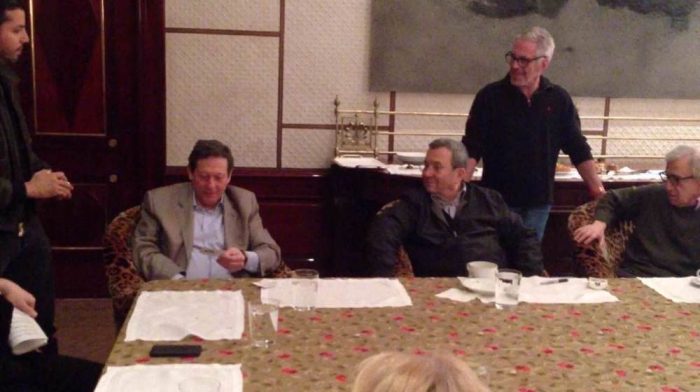
Seated from left to right are billionaire Thomas Pritzker, former Israeli prime minister Ehud Barak, and Hollywood director Woody Allen, while magician David Blaine stands to the left and Jeffrey Epstein stands, in a photo released by US Congressional Democrats on December 18, 2025.
Press TV – February 10, 2026
Iran says the global scandal surrounding convicted sex offender Jeffrey Epstein may go beyond a criminal case and be part of a geopolitical “project” intended to serve the Israeli regime’s interests.
A newly released tranche of Epstein files has sent shockwaves across media, politics, academia, finance, and even Hollywood, forcing prominent figures to account for their ties to Epstein.
Foreign Ministry spokesman Esmail Baghaei told reporters on Tuesday that the documents should not be downplayed or seen as an issue limited to the United States or a single individual.
He said that “given multiple reports indicating that the Israeli regime or others have exploited these cases and related proceedings to advance their political objectives, it strengthens the suspicion that the entire affair may be part of a long-running and extensive project to further the political goals of certain parties, particularly the Israeli regime.”
Baghaei described the scandal as a “human and civilizational catastrophe,” which has deeply wounded the global public conscience and could be considered a crime against humanity.
The revelations, he said, indicate a deep moral crisis within Western governance systems, particularly given the involvement of senior political figures in corruption-related cases.
Baghaei also questioned why no formal judicial proceedings have been publicly pursued so far.
“The crimes reflected in these reports depict horrific events and reveal a deeply troubling mindset among this class of individuals towards women, children, and girls,” he said.
The issue, according to him, requires careful examination across multiple dimensions, including political and security implications, and could affect the region both now and in the future.
Last week, the US Department of Justice (DOJ) released more than three million pages of files linked to its long-running investigation into Epstein, revealing the involvement of powerful political and business figures, including US President Donald Trump, his son-in-law Jared Kushner, and former Israeli prime minister Ehud Barak.
The released files are part of an estimated six million documents held by the DOJ.
The documents provide additional evidence that Epstein had ties to Israeli intelligence.
A declassified FBI memorandum from the Los Angeles field office in October 2020 reported that one source believed Epstein “was a co-opted Mossad agent” and described him as having been “trained as a spy” for Israel’s intelligence service.
The same document also suggested that Trump was vulnerable to Israeli influence through financial and political leverage, according to the confidential source.
Washington’s Gaza ‘master plan’: A mere PowerPoint presentation
Trump allies are selling Gaza reconstruction as a futuristic AI-powered utopia that not even the Israeli army believes will happen
By Robert Inlakesh | The Cradle | February 10, 2026
“We have a master plan … There is no Plan B,” remarked Jared Kushner last month, during a Board of Peace (BoP) presentation about Gaza reconstruction at the World Economic Forum (WEF) at Davos. What has become apparent is that no coherent Plan A exists either.
Although Kushner’s father-in-law, US President Donald Trump, was granted the legitimacy to build what he calls the BoP on the back of pledges to implement his “20-point peace plan” and Gaza ceasefire, the BoP’s charter is notably absent of any reference to Gaza.
Furthermore, United Nations Security Council (UNSC) resolution 2803, which legally authorized the BoP and was explicitly about the Gaza ceasefire, was deliberately vague on how any concepts proposed in the resolution would be implemented. It deliberately avoided outlining any mechanisms or obligations for reconstruction. Instead, two parallel schemes emerged.
The first was the Gaza Reconstitution, Economic Acceleration and Transformation Trust (GREAT Trust) – a 38-page document proposing to pay Palestinians $5,000 each to leave the territory. Crafted by Israeli figures previously involved in the discredited Gaza Humanitarian Foundation (GHF), the plan, which envisions “AI-powered, smart cities,” was less a roadmap for peace than a blueprint for ethnic cleansing.
That same foundation, backed by US private military contractors (PMCs), had already drawn international condemnation for herding civilians into “aid zones” only to open fire. More than 2,000 Palestinians were killed in those operations.
PowerPoint colonialism
Later, in December, the Wall Street Journal (WSJ) exposed that another proposal was put into circulation among US-allied nations in the Arab and Muslim world. The 32-page PowerPoint presentation, titled “Project Sunrise,” was set forth by Kushner and US envoy Steve Witkoff.
Like the preceding proposal, the new vision outlined a similar AI-smart city model, but added even more elements, such as high-speed rail infrastructure. According to the PowerPoint slides, the total cost of this 10-year reconstruction endeavor would amount to $112.1 billion, for which the US would commit to footing 20 percent of the bill.
Back then, Steven Cook, a senior fellow for the Middle East Program at the Council on Foreign Relations think tank, told WSJ that “they can make all the slides they want,” adding that “no one in Israel thinks they will move beyond the current situation and everyone is okay with that.” US Secretary of State Marco Rubio had even expressed his concerns over how realistic the plan will be, especially when it comes to potential foreign investment.
Then came Kushner’s presentation at Davos, which instantly made headlines and was presented as a brand new proposal called the “master plan.” According to Kushner, the project for a “new Gaza” would now only cost $25 billion.
However, upon further investigation, it is clear that what Kushner was presenting was simply “Project Sunrise,” which was evident as the PowerPoint he used was filled with the same exact slides from December. In other words, nothing particularly new was being placed on the table that had not already been released over a month prior.
“New Gaza” is a lab rat colony
Speaking to The Cradle, Akram, a Gaza resident from Al-Bureij, states that the situation on the ground does not reflect any of the positivity that appears in the media. “The Israelis won’t let us even have mobile homes or proper structures to live in, they still bomb us every day, and then we see AI images of Gaza becoming richer than Israeli cities?” he says, with bitter sarcasm. He added:
“Listen, do you really think they carried out genocide for two years and destroyed all our homes, only to build us a paradise, and that this will all happen if the resistance gives up its weapons? No. They are trying to tease us, like they always did, by saying, ‘if you give up your weapons, you will become Singapore.’ Nobody believes it.”
Shortly after Akram spoke to The Cradle, Israeli Prime Minister Benjamin Netanyahu delivered a speech to a special session of the Knesset, in which he made it clear that “the next stage is not reconstruction.” Instead, he asserted that disarmament would characterize Phase 2 of the ceasefire.
In his “master plan” presentation, Kushner claimed that the major task of clearing Gaza’s rubble would only take two to three years. Yet, according to UN figures, this task was estimated to take up to 15 years, with costs expected to exceed $650 million.
These figures are also dated, having been produced in July 2024, so they do not account for over a year of destruction. Israel has not stopped its round-the-clock demolition of Palestinian infrastructure since the so-called ceasefire took effect on 8 October 2025.
A humanitarian NGO official working in Gaza tells The Cradle that even the ceasefire’s Civil Military Coordination Center (CMCC), ostensibly set up to enforce humanitarian standards, now functions as a system of “intimidation” that “violates basic morality.”
On 21 January, Drop Site News reported on leaked documents that revealed plans to create an “Israeli Panopticon” city, to be constructed in territory remaining under its control in southern Gaza’s Rafah. The Guardian then reported that the UAE is seeking to bankroll the project. The leaked blueprints described a “case study” city where residents would be monitored around the clock, like lab rats, and forced to submit biometrics to enter.
Rafah as the prototype prison
The UAE has been accused of backing the five ISIS-linked militant groups Israel created to fight Hamas, which it previously intended to rule over a similar style concentration camp city in Rafah. In fact, Israeli Defense Minister Israel Katz had even ordered the construction of such a “community” during the 60-day ceasefire in early 2025. The Israelis have long intended to displace 600,000 Palestinians to such a gated facility.
The Emirati connection in this scheme goes beyond its recent offer to fund such a concentration camp city; it dates all the way back to January 2024, when it officially opened six water desalination plants along the Egyptian side of the Gaza border area, coincidentally capable of supplying 600,000 people with water.
Prior to the ceasefire and the collapse of the privatized aid scheme, the plot was to use the GHF PMCs in order to lure civilians into such a city area. Once they get there, the Palestinians who enter would be under the rule of Israel’s ISIS-linked proxy militias.
According to forensic architecture analysis, Israel is once again preparing land in order to implement such a project. Meanwhile, UG Solutions – the firm that hired the GHF’s PMCs – is again advertising job opportunities in the besieged territory.
Dispossession in disguise
Despite the dizzying array of slogans – BoP, GREAT, Sunrise, Panopticon – the outcome remains the same with no reconstruction, no sovereignty, and no end to occupation. The various schemes are less about peace and more about forcing Palestinians into containment zones policed by Tel Aviv and its regional clients.
From “Gaza Riviera” fantasies to proposals limiting reconstruction to areas under Israeli military control, what’s on offer amounts to PowerPoint projectionism. A revolving door of schemes and slogans has produced nothing substantive. Instead, the Israeli military continues its daily war of erasure on Gaza’s land, people, and future.
Even Kushner’s $25-billion fantasy is just that: a fantasy. In the three months since the UN resolution, all Washington has offered is AI-generated cityscapes and recycled decks. The only real plan on the table remains the one being implemented daily – the destruction of Gaza.
Iran advises US to act independently of ‘destructive’ Israeli influence amid nuclear talks in Oman
Press TV – February 10, 2026
Iran’s Foreign Ministry spokesman has advised the United States to avoid “destructive” Israeli influence as Washington engages in indirect nuclear negotiations with Tehran, citing the drawn-out history of Tel Aviv-manufactured regional crises.
Esmaeil Baghaei made the remarks during a press conference in Tehran on Tuesday, identifying the US as Iran’s sole negotiating counterpart that had to decide whether it was willing to act independently of Israel’s “destructive” pressures that harmed regional stability and even contradicted Washington’s own interests.
Baghaei said one of the main challenges in US foreign policy in the West Asia region was its alignment and compliance with the demands of the Tel Aviv regime, which he said has been the primary source of insecurity in the region over the past eight decades.
He further described Israel as the driving force behind an artificially manufactured crisis surrounding Iran’s peaceful nuclear energy program.
Repeated allegations propagated by Tel Aviv that Tehran sought to divert the program towards military purposes were aimed at creating an illusory sense of fear, he added.
The same regime, the senior diplomat noted, has consistently obstructed peaceful diplomatic processes.
The remarks came as Israeli Prime Minister Benjamin Netanyahu is about to travel to the United States ahead of schedule in line with what observers have speculated to be Tel Aviv’s intentions to force Washington into complicating the talks.
According to Baghaei, while resolved to address outstanding issues through diplomacy, Iran retains its defensive awareness.
He cited past experiences, including the imposed Israeli-American war on the country that came while Tehran and Washington were engaged in a similar process.
The spokesman warned that any fresh military aggression against the Islamic Republic would be met with a decisive and “regret-inducing” response, saying experience has shown that Israel would unexceptionally coordinate its actions with the United States.
The remarks referred to verification emerging across media that the previous round of indirect nuclear talks between Iran and the US were used as a cover to conceal Tel Aviv’s and Washington’s intentions to wage war on the Islamic Republic in June last year.
The spokesman described the most recent round of the talks that took place in the Omani capital Muscat on Friday as a half-day session intended to assess the seriousness of the other side and the possible path forward.
He said the discussions focused largely on general issues and that the Islamic Republic’s principled positions were made clear.
Baghaei added that Tehran’s core demand was securing the interests of the Iranian nation in line with international norms and the Nuclear Non-Proliferation Treaty (NPT), specifically concerning the peaceful use of nuclear energy.
Asked about the format of talks, the spokesman said, “Whether negotiations are direct or indirect is not decisive; if there is political will, an agreement is achievable.”
“The talks in June did not collapse because they were indirect, but because the United States resorted to military force, which led to a deadlock,” he added.
Larijani’s Oman visit
He also commented on an ongoing visit to Oman by Secretary of Iran’s Supreme National Security Council (SNSC), Ali Larijani, saying it was part of the continuation of regional consultations by the official, who has previously traveled to several regional countries, including Russia, Pakistan, Saudi Arabia, and Iraq.
He said Iran’s principled policy was to strengthen relations with neighboring countries and promote good neighborliness, adding that the trip had been “planned in advance” and was aimed at enhancing regional cooperation.
Is Nixing Aid to Israel a Poison Chalice?
Ending the existing arrangement could result in even more extensive forms of involvement
By Kelley Beaucar Vlahos | The American Conservative | February 9, 2026
There is a lot of talk about getting rid of the massive agreement that guarantees Israel billions of dollars in military aid each year. And it’s not just critics of Israel: Prime Minister Benjamin Netanyahu and Senator Lindsey Graham have even said they want to “taper off” the money because Israel is ready to stand on its own two feet.
But while a debate over the annual package would be a most welcome one given the enormous sums of American taxpayer money that has flowed to Israel’s wars in recent years, it is important to keep an eye on what might be a bait and switch: trading one guarantee for a set of others that might be less transparent and more expensive than what’s on the books today.
When President Bill Clinton announced the first Memorandum of Agreement, a 10-year, $26.7 billion military and economic aid package to Israel, he expressed hope that it would complement the advancement of the Oslo Accords, the peace process he had shepherded between the Israelis and Palestinians earlier in his term.
The peace process tied to Oslo pretty much fell apart after expected Israeli withdrawals from the West Bank as outlined in the Wye River Agreement in 1998 never happened; today Israeli settlements considered illegal under international law have exploded, with more than 700,000 settlers living there today and Israelis controlling security in most of the territory. But the 10-year MOU lived on.
Not only has it been renewed through the Bush and Obama administrations; the total outlays have increased. The current one, signed in 2016, pledged $38 billion over the decade, just under $4 billion a year and now all of it military aid. According to the Council on Foreign Relations, Israel is by far the biggest recipient of U.S. aid in history, some $300 billion since its founding, with the greatest proportion coming from those MOUs.
Supporters of the aid say it comes with military and strategic partnerships that are supposed to help keep the neighborhood safe for the U.S., Israel, and its “allies” (there are no treaty allies in the region), but the last 40 years have been pockmarked with wars and waves of human displacement and misery. Beyond financially and militarily supporting Israel’s wars, the U.S. has been bombing, regime-changing, occupying, and fending off terrorist insurgencies created by its own policies in Central Asia, the Horn of Africa, and the Middle East since 1999. Today, with Israel’s encouragement, President Donald Trump is poised to bomb Iran for the second time in his current term in office.
On February 3 the Congress passed the latest installment of the current MOU—$3.3 billion. It was a bipartisan affair, with Senate Minority Leader Chuck Schumer assuring a group of Jewish leaders the previous weekend, that “I have many jobs as leader … and one is to fight for aid to Israel, all the aid that Israel needs.”
But not everyone is on board with the open spigot. And a spigot it is. According to CFR, the U.S. gave $16.3 billion (which included its annual $3.8 billion outlays) to Israel after the Oct. 7, 2023 attacks. Israel’s retaliation for those attacks, which killed 1,200 Israelis, has resulted in more than 71,000 recorded Palestinian deaths in Gaza so far, a blockade that has left the 2 million population there largely homeless, starving, sick, and unsafe. Americans have reacted by rejecting the prospects of further aid, with a plurality now—42 percent—saying they want to decrease if not stop aid altogether. That is up from the mid-20 percent range in October 2023.
Beyond Americans’ aversion to funding the slaughter of civilians in Gaza, a conservative fissure over continued, unconditional support for Israel has opened wide over the last year, exposing another rationale for discontinuing the aid: It is not “America First.” It not only siphons off aid from much needed renewal at home, but forces Washington to aid and abet another country’s foreign policy, which is increasingly counterproductive and contrary to our own politics and values.
The region is not safer, and moreover, it has not allowed for the United States to reduce its military footprint as guarantor of security there.
One then-congresswoman, Marjorie Taylor Greene (R-GA), was vocal in her opposition to this aid. Israel, she pointed out, has nuclear weapons and is “quite capable of defending itself.” She has pointed out Israel’s universal health care and subsidized college tuition for its citizens, “yet here in America we’re 37 trillion dollars in debt.”
Rep. Thomas Massie (R-KY.) posted on X that he voted against the spending bill on February 3 in part to deny Israel the $3.3 billion in aid. He has said the aid takes money out of Americans’ pockets and proliferates human suffering in our name. “Nothing can justify the number of civilian casualties (tens of thousands of women and children) inflicted by Israel in Gaza in the last two years. We should end all U.S. military aid to Israel now,” he said in May of last year.
In an interview with The American Conservative last week, he said he is speaking for his Kentucky district and despite a retaliatory 2026 primary challenge driven largely by Trump and donors linked to the American Israel Political Affairs Committee (AIPAC), he will continue to raise the issue in Congress. He said he has asked his GOP constituents every year whether to maintain, increase, or cut Israel annual aid since 2012.
“I’ve polled that every election cycle in my congressional district among likely Republican voters, and this was the first year that a majority of people answered nothing [no aid] at all, or less,” said Massie. “It’s not a third rail back home. It’s a third rail inside of the Beltway.”
According to reports last month, Israel is “preparing for talks” with the Trump administration to renew the MOU for another 10 years. One might be flummoxed to hear, however, that Netanyahu is giving interviews in which he says he wants to “taper off” American aid in that decade “to zero.” Israel has “come of age” and “we’ve developed incredible capacities,” he said in January.
Immediately after, Graham, who seems to spend more time in Israel than Washington these days, said he heartily agreed and hoped to end the aid sooner. “I’m going to work on expediting the wind down of the aid and recommend we plow the money back into our own military,” he said. “As an American, you’re always appreciating allies that can be more self-sufficient.”
The idea of self-sufficiency and furthermore the concept of Israel releasing itself from any “ties” that might come from the aid is not a new one among supporters here and especially the hardline right in Israel. “Cut the US aid, and Israel becomes fully sovereign,” Laura Loomer charged on X in November. In March of last year, the Heritage Foundation called for gradually reducing the direct grants in the next MOUs starting in 2029 and transitioning gradually to more military cooperation and then finally arms transfers through the Foreign Military Sales by 2047.
Israel, the report concludes, should be “elevated to strategic partner for the benefit of Israel, the United States, and the Middle East. Transforming the U.S.–Israel relationship requires changing the regional paradigm, specifically advancing new security and commercial architectures.” The plan also leans heavily on future Abraham Accords ensuring trade and military pacts with Arab countries in the neighborhood.
Therein lies the fix, say critics. The reason these staunch advocates of Israel including Netanyahu, the most demanding of its leaders over the last 30 years by far, is willing to forgo MOU aid, is that they envision it will come from somewhere else, less politically charged.
“The emerging plan is to substitute formal military funding—known as Foreign Military Financing—with greater U.S. taxpayer-funded co-development and co-production of weapons with Israel,” says the Institute for Middle East Understanding, which adds that instead of extricating from Israel’s messes, the U.S. will be further “enmeshed” in them.
The think tank points out that the Foundation for the Defense of Democracies (FDD), the most unreconstructed pro-Israel organ in the United States, came out with its own report on the aid, and surprise, also advocated phasing out the MOU. In addition to a commitment by Israel to spend more of its GDP on defense and other co-investments with the U.S. on research and development, the U.S. would “provide Israel $5 billion each year through what would be known as a Partnership Investment Incentive—or PII. This PII would provide funding via existing foreign military financing (FMF) mechanisms that Israel would use to procure American military hardware.” The difference would be that it would have to be spent entirely in U.S. industry and on cooperative partnerships in the region, all while maintaining Israel’s “Qualitative Military Edge.”
Geoff Aronson, longtime Middle East analyst and occasional TAC contributor, said the aid has been “an important if not vital component in ensuring American and Israeli hegemony in the region” and is linked intrinsically to balancing U.S. strategic relations and normative Israeli peace with Egypt and Jordan, which gets billions in military aid (not as much) from the U.S. too. None of this is going to go away, he surmised to TAC.
“The question that is being posed is how can we continue to support Israel’s ability to work its will in the region without committing ourself to X, Y, Z or committing to a new partnership, a new agreement,” he said. “Watch what you wish for, because it might come true.”
Featured Video

More Iran War fallout: Maritime insurance industry shifts from London to China
or go to
Aletho News Archives – Video-Images
From the Archives
Allies Don’t Need Lobbies
By Jay Knott | Dissident Voice | September 24, 2013
In a recent article on Counterpunch, Rob Urie defended the traditional Marxist analysis of US policy in the Middle East. He argues that support for Israel is driven primarily by economic interest, not the Jewish lobby.
He starts by paying tribute to the idea that Western societies are uniquely racist. He says that the “Western narrative” claims there is an “Arab character”, and that this is “antique racist blather”. He gives no definition of these terms. Further, he establishes his credentials as part of the dominant current in the American left by claiming that “over a million people in Iraq died so ‘we’ in the West can drive SUVs.”1
When he tries to criticize bourgeois economics, he makes it clear he doesn’t understand the developments it has made since Marx’s day, using the mathematical discipline known as “game theory”. He dismisses the basic abstraction of economic theory, the idea of the rational individual, on the grounds that it is “devoid of history, culture and political context”. But abstractions are always devoid of something.
He defends a more concrete economic theory, mostly Marxist, with some input from another theorist of capitalist crisis, Hyman Minsky. This concrete theory leads him to the view that US activity in the Middle East is primarily driven by rational capitalist motives, the need to secure a supply of oil.
“Taking the totality of circumstance — former oil company executives launching war on an oil rich nation on a pretext they publicly proclaimed they didn’t believe shortly before taking office — and that upon launching their war proved to be non-existent, requires a willingness to overlook the obvious — that the war on Iraq was for oil, that is difficult to support.”1
Perhaps I’ve misunderstood him, but based on what he says in the rest of the article, this convoluted sentence seems to argue that, because president Bush and vice-president Cheney attacked Iraq on false premises, and they also said it was all about oil, and they are former oil executives, and Iraq has a lot of oil, it’s difficult to deny US attacks on Iraq are all about oil.
In fact, it’s not hard at all. As Urie points out, at times Bush and co. said that attacking Iraq was “protecting the world’s supply of oil.”1 But, as he also points out, they are congenital liars. Why should we believe them when they say they are trying to “protect” the oil supply? Protect it against what? When politicians “admit” attacks on Middle Eastern countries are wars for oil, they are parroting the neo-con party line, feeding the public, both left and right, with a plausible-sounding pretext. For right-wingers, “it’s a war for oil” is a reason to support war, and for leftists, it’s a way to feel better by complaining impotently about corporate greed. Both approaches help the war drive. … continue
Blog Roll
 Aletho News
- More Iran War fallout: Maritime insurance industry shifts from London to China
- US-Israeli aggression on Iran triggers review of GCC countries’ investment pledges to Washington
- Russia slams UK plan to seize tankers suspected of carrying its oil
- Pakistan ramps up food exports to Persian Gulf nations as war deepens food insecurity
- Iran submits response to US plan, sets terms for war’s end: Tasnim
- US vs Iran: Kharg Island Talk — Bluff or Escalation? Ex-Military Officer Weighs In
- Zelensky unnecessarily involves Ukraine in the Middle East crisis
- Turkish tanker blacklisted by Ukraine hit in drone attack – media
- Canada, the U.S., and NATO: the inescapable trap
- Villains of Judea: Leonid Radvinsky
- If Americans Knew
- ‘No Innocent Children’: Far-right Israeli Lawmaker Defends Killing of Palestinian Family
- Mossad’s promises helped Netanyahu convince Trump that Iran could be toppled
- US Arms Control Official Refuses To Comment When Asked If Israel Has Nuclear Weapons
- Veterans warn US landing could be ‘more Gallipoli than Vietnam’
- Israel may be committing war crimes in Lebanon – Not a ceasefire Day 167
- In the West Bank, life is a constant battle – 3 articles
- Jacob Reses, one of the most powerful pro-Israel operatives in Trump’s Washington
- Israeli-US assaults kill or injure 87 children a day – Not a ceasefire Day 166
- ‘Forever live by the sword’: Understanding Israelis’ massive support for Iran war
- UN’s special rapporteur on human rights says Israel is systematically torturing Palestinians
- No Tricks Zone
- Devastating Assessment Of Comirnaty Vaccine By Former Senior Pfizer Europe Toxicologist
- New Study: CO2 Is ‘Effectively Negligible’ As An Explanatory Climate Change Factor Since 2000
- Former Pfizer Toxicologist Dr. Helmut Sterz Tells Bundestag Hearing Pfizer Vaccine Should Have Never Been Approved
- Energy Expert: Germany’s Nuclear Phaseout Was A “500 Billion Euro Mistake”
- New Research: South Australia’s Mid-Holocene Sea Surface Temperatures Were 4°C Warmer Than Today
- Storing Green Energy To Last Germany 10 Days Would Require A 60-Million Tonne Battery
- New Studies: UK Sea Levels Were 4 Meters Higher Than Today During The Mid-Holocene
- Destructive Green New Deal: German Energy And Metal Group Warns Of Drastic Crisis
- New Study Documents A 20-Year Pause In Arctic Sea Ice Decline – Driven By Internal Variability
- Wake-up Call: Survey Shows Majority Of Germans Now Favor Postponing Climate Targets!
 Aletho News