The World Sees What the US is Trying to do to Iran /Matt Bracken & Lt Col Daniel Davis
Daniel Davis / Deep Dive – August 21, 2026
FDA Acting Commissioner Woodcock Admits Adverse Events After COVID-19 Vaccination
By Aaron Siri | Injecting Freedom | August 21, 2026
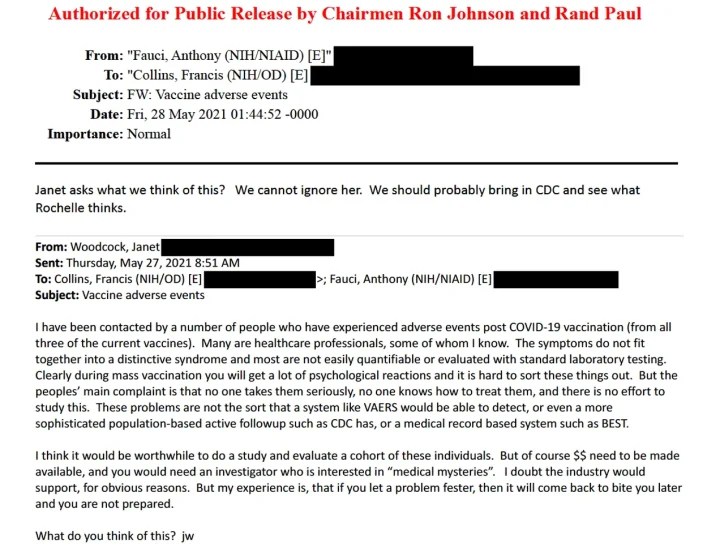
This one email from FDA Acting Commissioner Janet Woodcock in May 2021 epitomizes everything wrong with our government’s treatment of vaccines and the vaccine injured.
Woodcock emails Fauci and Collins (head of NIH) to inform them that “a number of people” including healthcare workers she personally knows contacted her about injuries from every one of the available Covid-19 vaccines. She admits that:
(1) these injuries would not be picked up by FDA or CDC surveillance systems;
(2) there is no money set aside to study these harms (while billions are given to pharma companies for vaccines);
(3) no one will take these injured people seriously;
(4) no one knows how to treat them;
(5) there is no effort to study this serious issue; and
(6) “the industry” will not support the necessary studies.
I also agree with her sentiment that, “if you let a problem fester, then it will come back to bite you later…” Later is here.
China will not play along with the US’ ‘reckless games’ on the Iran issue
Global Times | August 21, 2026
US President Donald Trump announced on August 19 local time that he would launch a so-called “economic D-Day” operation against Iran. US Treasury Secretary Scott Bessent, in outlining the operation, described it as “economic warfare and isolation on an unprecedented scale,” adding that other countries “are either with us or against us.” When asked whether the new sanctions would involve China, Bessent urged China to “get with the program,” claiming that would do China “a big service.”
The US war against Iran has now entered its sixth month, with both sides now locked in a stalemate – unable to escalate the conflict further yet unable to reach a negotiated settlement. The so-called “economic D-Day” operation is less a new offensive launched by the US against Iran than it is yet another attempt by Washington to cut its losses as quickly as possible and extricate itself from the quagmire of the Middle East – a move to change tactics and keep gambling after military means have proven ineffective.
But it may well be heading in the wrong direction. Whether it is the ever-rising bills at US gas stations or the soaring energy and shipping costs in global markets, one thing is clear: Economic sanctions can concentrate pressure on a single country, but it is difficult to confine the costs to that country alone. War cannot solve problems, and sanctions only add fuel to the fire.
The so-called “either with us or against us” rhetoric, in a sense, exposes Washington’s strategic predicament: it “can no longer handle this mess on its own.” Ironically, while Washington has been spouting “bold rhetoric,” its circle of allies has remained silent on the matter. In fact, since the US’ war against Iran began, most US allies have been highly reluctant to go along with America’s radical strategy out of concern for the spillover effects of the conflict and the energy crisis. The reason is simple: for these countries, the Iran issue affects energy supply, shipping security, and inflationary pressures.
The US has set its own house on fire, yet it wants the whole world to help fan the flames, making the blaze even bigger – and in the end, it expects everyone else to foot the bill. Who would want to be such a patsy? The US has repeatedly labeled European nations “cowards” for refusing to join the war, further provoking a strong backlash from its European allies and creating a rare, deep‑seated rift in the alliance system.
If the US cannot even rally its own allies, it certainly cannot expect to boss China around. China has consistently opposed unilateral bullying and long-arm jurisdiction – not because China is Iran’s largest trading partner and maintains long-standing friendly relations with Iran, but because once this US logic is accepted, international trade would no longer be normal exchanges between nations. Instead, it would devolve into an absurd situation where the US unilaterally sets the rules and the flow of all goods must be approved by the US.
If the US can force China to cut ties with Iran today, will it be able to arbitrarily cut off all foreign trade with any country it regards as a “rival” tomorrow? If so, there is no doubt that the world would be reverting to the law of the jungle, where the basic rules of modern civilized society will cease to exist.
The Strait of Hormuz is a strait used for international navigation. Restoring safe and free passage through the strait as soon as possible serves the interests of all parties and is also the shared aspiration of the international community. But if the fact that “the Strait of Hormuz concerns a certain country’s interests” is used as a pretext to demand that this country unconditionally comply with Washington’s maximum pressure and trade bullying, that would not only put the cart before the horse, but also steadily deplete the US’ international credibility while exacerbating global energy volatility, high inflation, and market disorder.
Only a comprehensive ceasefire and the cessation of hostilities can fundamentally create the conditions for easing tensions, because the disruption of navigation through the Strait of Hormuz is itself a spillover effect of the US’ war against Iran. China has consistently supported all efforts conducive to a ceasefire and an end to hostilities. But ultimately, those who tied the knot must be the ones to untie it; this knot can and must be resolved by the parties directly involved.
America’s strategic predicament stems precisely from its obsession with the “big fist” and its inexplicable confidence that “there is always a way to force those who refuse to comply into submission.” If the US continues applying pressure at will, it will only be kept trapped for longer and sink deeper.
Simply expanding economic pressure will only prolong the conflict and increase the losses for all sides. The entire world can see this clearly. Not only will China not play along with the US’ “reckless games” on the Iran issue, but the international community will not stand with Washington either. From moral, legal, and practical perspectives, escalating unilateral sanctions has neither legitimacy nor feasibility.
An immediate ceasefire and cessation of hostilities, the prompt resumption of peace talks, the restoration of navigation through the strait, and upholding the authority of the UN Charter – these have been China’s consistent positions since the conflict broke out, and they are the approach that serves the interests of all parties. Only by abandoning the Cold War mentality of confrontation, setting aside the tool of maximum pressure, and returning to the proper track of dialogue and negotiation can Washington cut its losses in time and make a dignified exit.
ICE arrested the ‘worst of the worst.’ Washington made sure he walked free
RT | August 22, 2026
Imagine you are a Chilean who’s lived in America – the so-called “Land of the Free” – for decades in peace and tranquility. Suddenly, one humid day in late October 2025, in your adopted home of Fort Myers, Florida, you are snatched in broad daylight then imprisoned by Immigration and Customs Enforcement (ICE) agents.
Your capture remains completely unknown to the outside world until January the next year, when the US Department of Homeland Security names you among the “worst of worst criminal aliens” arrested by ICE to date. You are accused of committing “homicide” almost 50 years ago. Your incarceration makes international headlines, and comes as a personal shock. But not because you’re innocent.
You are no ordinary Chilean. You are Armando Fernandez Larios, a 76-year-old fascist intelligence veteran who in September 1976 helped assassinate former Chilean Defense Minister Orlando Letelier using a car bomb. An outspoken opponent of dictator Augusto Pinochet, Letelier fled Santiago a year after the September 1973 CIA coup that installed Pinochet in power.
What role precisely Fernandez Larios played in Letelier’s murder, which also took the life of his colleague Ronni Karpen Moffitt, is still not fully clear. He has told a variety of stories about what he knew, when he knew it, and what he did and did not do regarding the event. But Fernandez Larios was a key operative.
It seemed in 2025 ICE had gotten their man, in a huge win for immigration enforcement and international justice. But this March, Fernandez Larios was released from jail. Court documents obtained by the National Security Archive show he launched a legal action, accusing the US government of “breach of contract” by violating a plea deal he cut in 1987.
That agreement saw Fernandez Larios provide information to US prosecutors on Letelier’s assassination, in return for an extremely light prison sentence and promise the government “would neither seek to deport [him] to Chile nor to cooperate in his extradition to Chile.” Rather than let Fernandez Larios’ action go to court, ICE freed him. Presumably, he’s sunning himself in Fort Myers right now.
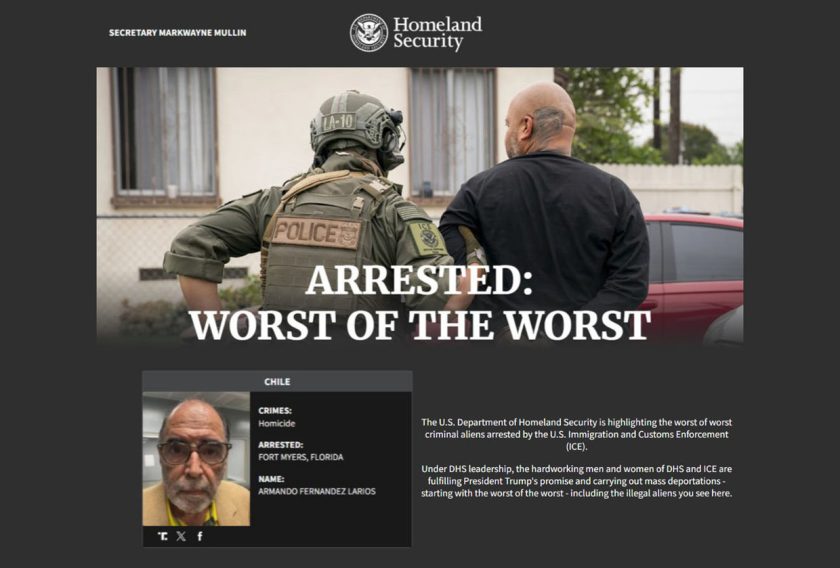
Screenshot © United States Department of Homeland Security
The CIA connection
A huge archive of declassified documents related to Letelier’s assassination analyzed by RT Investigates, including secret statements made to US officials by Fernandez Larios, sheds shocking light on the case. They show that in mid-1976, Fernandez Larios was tasked by Pinochet’s regime with obtaining fake passports and US visas to fly to Washington DC.
Fernandez Larios was joined by Michael Townley, Pinochet’s US-born lead hitman and CIA double agent. They secured visas from Chile’s US embassy, after claiming to be on a secret mission to meet with CIA deputy director Vernon Walters at Langley headquarters in Virginia. Fernandez Larios traveled to Washington first, to conduct surveillance on Letelier’s movements in advance of his assassination.
On September 9, 1976, 12 days before Letelier’s murder, Fernandez Larios met Townley in the lavatory of New York’s John F. Kennedy airport to provide him with a surveillance map, notes on Letelier’s home and office addresses, as well as cash for the operation. Townley then recruited members of the Cuban National Movement, to assist him in building, placing, and detonating the car bomb.
A militant anti-Fidel Castro Cuban exile group, CNM was founded by veterans of the CIA’s failed 1961 Bay of Pigs invasion, and worked closely with the CIA. Experts at explosives, the bomb was planted without detection then detonated as Letelier, Moffitt and her husband Michael were driving to work in downtown DC. Michael was sole survivor of the bombing.
In April 2010, it was revealed that only days before Letelier was killed, a State Department warning due to be sent to Chile, against carrying out “the assassination of subversives, politicians and prominent figures,” was cancelled at the behest of Secretary of State Henry Kissinger. His department had been extremely worried about Pinochet carrying out killings outside Chile.
“We are trying to head off a series of international murders that could do serious damage to the international status and reputation of the countries involved,” Kissinger had been informed by aides, but he was unmoved. A close confidante of Pinochet who’d personally assisted his bloodstained rise to power, did Kissinger know Letelier was due to be killed?
The coverup and polygraph test
In the aftermath of the assassination, Fernandez Larios participated in an extensive cover-up orchestrated by Chilean officials, including Pinochet himself. After being identified by the US media along with Townley as a lead suspect in Letelier’s murder, he deceived military investigators, gave false testimony to the Chilean Supreme Court, and lied to FBI and Justice Department investigators.
By 1985 though, Fernandez Larios was open to talking, having back-channel discussions with the US about testifying on Letelier’s assassination. In return for defecting and providing what he knew – or claimed to know – about the killing, and Pinochet’s intelligence operations generally, Fernandez Larios would receive extreme leniency, then be allowed to stay in the US, safe from extradition.
Fernandez Larios was debriefed by US officials in Santiago in mid-January 1987, then subjected to polygraph tests in Brazil. He consistently denied knowing his 1976 mission to Washington DC was an assassination plot. The lie detector results showed “consistent signs of deception in Fernandez’ disclaimers.” Under further debriefing, he finally admitted “his surveillance contributed to the death of Letelier and Moffitt.”
A late January 1987 State Department cable on what to do with Fernandez Larios however disregarded the polygraph tests, shockingly stating he was “not a murderer or party to a conspiracy to murder.” The memo judged his information on the Letelier-Moffitt case to be of “limited value”, but stated “foreign policy benefits” to providing him a generous plea deal were “substantial.”
In February 1987, Fernandez Larios pleaded guilty to being an “accessory after the fact” to Letelier’s assassination. Within just five months, a State Department legal advisor wrote to the US Parole Commission, praising Fernandez Larios’ “character” and “his willingness to come forward and pay his debt” over his role in the crime. He was paroled in autumn 1987.
The “Caravan of Death”
In keeping with “consistent signs of deception” when discussing his foreknowledge of Letelier’s assassination, Fernandez Larios also did not tell US officials about many violent atrocities he personally committed as a member of Pinochet’s elite military unit, the “Caravan of Death.”
Following Pinochet’s seizure of power this deadly Caravan flew around Chile kidnapping local officials who remained loyal to Salvador Allende, who died in contested circumstances during the coup. Approximately 72 dissidents were executed or “disappeared.” Fernandez Larios was identified by multiple witnesses as one of the most ruthless members of the military death squad.
After Pinochet’s fall in 1990, investigations into his regime’s many atrocities were opened in Chile. In several cases, substantial evidence against Fernandez Larios as a personal perpetrator of appalling crimes was found, leading to Santiago launching legal proceedings. In accordance with his plea deal though, Fernandez Larios remained at liberty in Florida.
It took until March 1999 for a civil suit to be launched against him in the US. The family of Winston Cabello, a 28-year-old Allende-era regional planning director executed alongside 12 other political prisoners by the Caravan of Death in October 1973, accused Fernandez Larios of “extrajudicial killing, torture, crimes against humanity and cruel and inhuman treatment.”
Numerous Chileans identified Fernandez Larios as a participant in the torture and executions of prisoners in multiple municipalities. One witnessed him personally slashing Cabello to death with a knife. The three-week trial ended in October 2003, Fernandez Larios found liable for extrajudicial killings, torture and crimes against humanity. Cabello’s family was awarded $4 million in damages.
That sum remains uncollected, and Fernandez Larios is once again a free man after his recent spell in prison, despite him truly being the “worst of the worst” captured by ICE. A strong case for his deportation to a country other than Chile remains. He has not been granted a special “snitch” visa protecting foreign informants from deportation.
Beware of Yoram Hazony’s Attempts to Subvert Nationalism
Kosher nationalist movements are merely stalking horses for Zionist geopolitical endeavors
José Niño Unfiltered | August 22, 2026
As the historic American population begins to awaken to its own dispossession, the establishment has deployed a new strategy of promoting “kosher nationalism.” By co-opting the language of sovereignty and tradition, these figures infiltrate the populist ranks to ensure that dissent remains impotent, performative, and above all else, harmless to the interests of the Jewish networks that have long dictated the terms of our political discourse since the end of World War II.
The most devious operator in this theater of managed opposition is Yoram Hazony, a man who has masterfully curated the boundaries of acceptable nationalism by purging anyone who dares to prioritize the actual survival of the American people over his own ethnic interests. Sitting across from Tucker Carlson in January 2026, Peter Brimelow—the British-born founder of VDARE, the immigration restriction website that New York State authorities forced into closure in 2024 through a prolonged legal campaign—recounted how Hazony had barred him from the National Conservatism conference. “He disinvited us from his National Conservative Conference because he was trying to gatekeep,” Brimelow told Carlson, adding that the two men then traded “a series of bitter exchanges in VDARE.com.”
The original 2019 exclusion was not an isolated act. When the first NatCon conference was held in Washington in July 2019, BuzzFeed News reported that Brimelow, American Renaissance founder Jared Taylor, and Identity Evropa leader Patrick Casey had all applied and been rejected, with Hazony addressing White nationalism directly in his opening remarks. Brimelow and Hazony subsequently exchanged pointed public criticism, with Brimelow characterizing the NatCon operation as an “extreme Zionist Gatekeepers Ball.”
John Derbyshire made a similar point back in 2019, identifying Hazony as the “sparring partner” of VDARE editor Peter Brimelow, a label that stuck because the friction between the two camps was never really about tone or manners. It was ultimately about substance. Brimelow’s entire project has centered on restricting immigration and restoring America’s White demographic core, a position that a genuine nationalist movement would be expected to enthusiastically champion. Hazony rejected him anyway, and that rejection is the thread that unravels the whole National Conservatism project once you pull on it.
To understand how a movement ostensibly built on the premise of “National Conservatism” became a vehicle for such systematic exclusion, one must look past the slogans and examine the architect of the project, whose entire career has been a singular exercise in advancing Zionist interests under the guise of American political theory.
Yoram Hazony was born in Rehovot in 1964 and raised in Princeton after his father, a former Princeton engineering professor, brought the family to New Jersey. He earned a BA in East Asian studies from Princeton in 1986 and a PhD in political theory from Rutgers, co-founding the conservative magazine The Princeton Tory as an undergraduate in 1984. By his own account, he was left “mesmerized” by an encounter as a Princeton undergraduate with Rabbi Meir Kahane—the Jewish supremacist advocate whose party, Kach, was later banned from Israeli elections for promoting racism against Arabs. After completing his doctorate, rather than pursue an academic career, Hazony joined the editorial staff of The Jerusalem Post and wrote speeches for the rising political star Benjamin Netanyahu.
He then co-founded the Shalem Center in Jerusalem in 1994 with funding from Ronald Lauder and Sheldon Adelson, where he served as president and then provost until 2012. He subsequently founded the Herzl Institute in Jerusalem, dedicated explicitly to Jewish political thought and Zionist theory, and in 2019 he teamed with David Brog—the former executive director of Christians United for Israel—to launch the Edmund Burke Foundation, which now runs the National Conservatism Conference.
He describes himself as “a Jewish nationalist, a Zionist, all my life.” Observers at Jewish Currents have documented how Hazony helped pioneer an alliance between the Israeli settler movement, the Kahanist camp, and Netanyahu’s Likud party, while championing Israel’s 2018 Nation State Law, which declared Jewish national self-determination as belonging exclusively to Jews within Israel. Every institution he has built traces back to this same Zionist core, which means the American movement he exports is never quite separable from the Jewish interests he was raised to defend.
That biography matters because Hazony has spent a decade dressing a Zionist project in the language of American populism. His book “The Virtue of Nationalism” argues for a world of independent nation states instead of supranational bodies like the European Union or the United Nations. This perhaps stems from a deep-seated Jewish apprehension that institutions such as the EU or the UN could crystallize into centralized, antagonistic entities capable of constraining Jewish geopolitical projects. Consequently, Hazony and his peers advocate for a world of atomized nation-states, viewing a landscape of quarreling, enfeebled powers as the optimal safeguard for their interests. By prioritizing a fractured international system, they ensure a climate of instability that favors the established Jewish influence networks, which have long mastered the technique of dividing populations—big and small—to consolidate their own power.
In a similar token, Hazony’s Conservatism: A Rediscovery provides an interesting nationalist dimension to his political agenda. In the book, he portrayed political loyalty as something inherited through family, tribe, and nation rather than chosen through liberal consent, and warned repeatedly against the “consuming fire of cultural revolution” that erodes marriage, borders, and religious tradition. On paper, this reads like a full-throated endorsement of the populism that figures like Pat Buchanan have argued for since the 1990s.
However, this nationalist rhetoric undergoes a convenient transformation when applied to the Jewish state, where the nuanced defense of sovereignty is swiftly supplanted by a rigid, unrelenting hawkishness against the enemies of the Jewish state. In sum, Hazony’s theoretical framework proves to be little more than a vehicle for his true objective: the tireless advancement of Israeli interests under the guise of Western nationalist arguments.
When Israel struck Iran’s nuclear facilities in June 2025, Hazony appeared on UnHerd alongside John Mearsheimer in a filmed debate hosted by Freddie Sayers. Hazony passionately defended Israel’s imperative to block Iran’s nuclear program as essential for national survival while debating the benefits and risks of U.S. involvement. He acknowledged the growing split among his own allies on the nationalist right, noting that “the nationalist conservatives have always had internal disagreements on issues like appropriate foreign policy” and specifically addressed the divergence with Tucker Carlson and Steve Bannon, who were “absolutely dead against the US getting involved in this at all.”
Hazony’s counter-argument was that U.S. support for Israel as a regional security partner ultimately served American interests, allowing the United States to focus on vital concerns elsewhere. Mearsheimer argued the opposite, noting that Israel lacked the capability to permanently eliminate Iran’s nuclear program and that U.S. involvement would be catastrophic and would strengthen Russia and China’s geopolitical positions.
On February 28, 2026, when the United States and Israel launched Operation Epic Fury, Hazony was among the intellectual voices who had spent months publicly building the case for exactly this kind of operation. In addition to arguing on UnHerd that Israel had to eliminate Iran’s nuclear capacity with or without U.S. support, Hazony defended the June 2025 Midnight Hammer strikes in The Free Press.
The fundamental problem in Hazony’s nationalist program lies in its practical application, which serves primarily to curate and sanitize the parameters of acceptable discourse. Rather than welcoming authentic solutions to the existential crises facing the West, Hazony and his lieutenants act as gatekeepers, systematically deplatforming gentile voices who prioritize the preservation of their own cultural and ancestral identity. In both rhetoric and practice, he remains fundamentally hostile to any ethnonationalist framework that elevates the bonds of blood and soil as the bedrock of political life. More importantly, the result of these political programs mainly consist of wars for Israel and other pro-Jewish ventures, while nationalists receive virtually nothing in return—for example, long-lasting immigration restriction. Keep in mind, this is a feature not a bug of this type of Faustian pact.
Nationalists must recognize that Yoram Hazony’s project is another containment strategy designed to undermine genuine nationalist movements in the West. It invites you to the table only to ensure that the menu never includes the actual preservation of the European state-building people of the United States. If we are to survive as a civilization, we must reject these managed movements and build an authentic nationalism that prioritizes our own sovereign survival over the pseudo-nationalist movements whose real agenda is the advancement of the organized Jewish community’s geopolitical interests.
US journalist says he was interrogated over criticism of Ben-Gvir
Al Mayadeen | August 22, 2026
US journalist Ethan Levins said he was questioned by the Department of Homeland Security after returning to the United States from Lebanon, revealing that authorities asked him about his criticism of Israeli Minister Itamar Ben-Gvir.
In a post on X, Levins said the questioning took place the previous day and that authorities focused on why he had posted negative comments about Ben Gvir.
“I am a born American who lives in the United States, and they stopped me at the airport for an Israeli politician,” Levins wrote.
He added, “I’m serious.”
Ethan Levins says ‘Israel’ is attacking him personally
In a separate post, Levins said “Israel” was personally targeting him, warning his followers that any sudden halt in his social media activity would mean he had been forced to stop.
Levins said he regularly publishes across his accounts and provides hourly updates on Telegram, emphasizing that he is never inactive. He asked followers to notify others if something happened to him.
“If something happens to me, please let everyone know. I post daily across my accounts, and hourly updates on Telegram. I am NEVER inactive. If I suddenly stop, then it means I’ve been forced,” he wrote in a post on X.
“I am an American Christian, and Israel is attacking me personally,” he stressed.
Ethan Levins says he fears for his safety after detention
In yet another post on X, Levins said he was genuinely afraid for his safety after speaking out against an Israeli minister and being detained by the US government. He questioned why he was being punished by Israeli authorities despite being an American citizen.
“I’m genuinely afraid for my safety. I spoke against an Israeli Minister, and was detained by my own government. I’m an American, yet I’m punished by the Israelis. Why?,” he wrote on X.
In a further statement on X, Ethan Levins said he was detained by the US Department of Homeland Security for three hours and questioned exclusively about “Israel” and Israeli Police Minister Itamar Ben-Gvir.
“I was detained by the Department of Homeland Security for 3 hours. They didn’t ask a SINGLE QUESTION about the United States. They ONLY asked me about Israel and Ben Gvir,” he wrote.
“I’m an American, why does the DHS care so much about protecting Ben Gvir?,” he questioned.
Levins links DHS questioning to Ben Gvir in X post
Levins later referred to Ben-Gvir as the same person about whom, he said, Department of Homeland Security officials questioned him during his detention the previous day.
“This is the same guy the DHS detained and questioned me about yesterday. Apparently the Department of Homeland Security works for Ben Gvir, not the United States.”
Levins shared a post by Ben-Gvir dated June 19, in which the Israeli minister called for Lebanon to suffer in response to the deaths of Israeli mothers.
“For every tear of an Israeli mother, a thousand Lebanese mothers must weep. All of Lebanon must burn! With all due respect to the Americans, Israel must make it clear to the entire world that the blood of our sons and the security of our citizens,” Ben-Gvir wrote.
Levins accuses Trump of abandoning Americans for ‘Israel’ and Epstein files
Taking to X again, Levins launched a sharp attack on US President Donald Trump, accusing him of abandoning concerns over rising gas, housing and food prices, as well as the lives of US service members.
Levins stressed that Trump’s priorities had instead shifted to concealing the Epstein files and waging wars in support of “Israel”, portraying the president’s approach as a betrayal of the “MAGA” movement.
“The ONLY thing he cared about was hiding the Epstein files and fighting wars for Israel. This is NOT ‘MAGA’, this is betrayal,” he stressed.
Levins’ case reflects growing concerns among Americans who say criticism of “Israel” and the Trump administration’s unwavering support for it can carry consequences, particularly as opposition mounts to Israeli influence over US policy and Washington’s role in the war on Iran.
An Israeli rhetoric with grave human rights implications
Levins’ criticism of Ben-Gvir came as the Israeli minister’s rhetoric continued to draw scrutiny, particularly over his remarks regarding Lebanon and Gaza.
Ben-Gvir has openly advocated killings, executions, and the permanent settlement of Gaza while describing Palestinians as people who “don’t deserve to live.”
Such statements raise grave concerns under international human rights and humanitarian law, which protect the right to life and prohibit arbitrary killing, collective punishment, and the forced displacement of civilians.
The United Nations has identified killings of civilians, collective punishment, incitement to violence, and the denial of essential resources as matters requiring investigation under international law.
The remarks went beyond inflammatory language, raising serious concerns about the lives of Palestinians under Israeli occupation and the extent to which such rhetoric can normalize the targeting, killing, and forced displacement of civilians.
Afghan-American lawmaker Wahab beats Israel lobby-funded opponent in California election
Press TV – August 22, 2026
California lawmaker Aisha Wahab has been elected to the US Congress after defeating her opponent funded by pro-Israel groups.
Wahab, a 39-year-old progressive Democratic state senator, defeated Melissa Hernandez, 51, a moderate Democrat.
She is the first Muslim and Afghan American elected to the California State Senate, and the first Afghan American elected to Congress.
She will now replace Eric Swalwell, who resigned from the House amid reports of sexual misconduct.
Swalwell’s term was scheduled to end in January. Wahab will now fill in for the remainder of Swalwell’s term.
According to media reports, United Democracy Project, a super PAC affiliated with the American Israel Public Affairs Committee (AIPAC), spent nearly $2.5mn since early August to boost Hernandez.
The news outlet CNN reported that BOLD America, another group that receives funding from AIPAC, also spent $1.9mn.
One advertisement against Wahab, for instance, focused on misleading claims that she had weakened laws against the sex trafficking of minors.
Wahab released her own video, emphasizing that she had made it “illegal and a felony to traffic or solicit minors, across the board.” She called the advertising “$5mn of lies.”
The race is the latest to test the influence of the pro-Israel lobby in the US, where support for the occupied territories has dropped precipitously amid its genocidal war on Gaza.
According to an Associated Press poll released in July, roughly a third of US adults believed Israel had committed genocide in Gaza, a position backed by United Nations experts and rights groups.While foreign policy was not a main pillar of her campaign, Wahab has echoed those views during her time in politics.
Last year, she co-authored a state resolution denouncing the “horrific humanitarian catastrophe in Gaza” and calling for an end to the war.
At a candidate forum in April, Wahab also answered “yes” when asked whether she believed what was happening to the Palestinian people constituted a genocide.
Hernandez, by contrast, did not give a direct answer. She said that, while Israel had a “right to defend itself,” the destruction in Gaza had gone “too far.”
Wahab went on to win June’s primary for the special election by a wide margin, with more than 42 percent of the vote to Hernandez’s 17 percent.
But this week’s election tightened due to heavy spending by pro-Israel groups, with the race too close to call for two days as local officials continued counting ballots until Thursday.
Wahab will have a rematch against Hernandez in November, when both women will compete for the chance to represent California’s 14th district for a full two-year term.
While pro-Israel groups have sought to shape elections through massive spending, such efforts have faced several high-profile setbacks across the country during the 2026 midterm election season.
Progressive candidates, including Michigan Senate hopeful Abdul El-Sayed, have overcome heavy spending from pro-Israel groups in the midterm primaries to advance to November’s general election.
Wahab said in a statement that her victory shows that her district “cannot be bought.”
Israel is sponsoring ads on Ted Cruz’s podcast. Is that legal?
By Connor Echols and Nick Cleveland-Stout | Responsible Statecraft | August 22, 2026
The Israeli government is running advertisements on a popular podcast hosted by Sen. Ted Cruz (R-Texas), raising questions about whether the staunchly pro-Israel lawmaker is indirectly receiving campaign funding from a foreign country.
Radio and podcast giant iHeartMedia has syndicated Cruz’s show, “Verdict with Ted Cruz,” since 2022. Because of lobbying-related restrictions, the company cannot legally pay the senator for ad revenue. But, it turns out, that’s not the only way to ensure the money benefits Cruz.
Under an unusual licensing deal, iHeartMedia agreed to donate revenue “associated with (the show’s) advertising sales” to the Truth and Courage PAC, a super PAC dedicated to “ensuring that Ted Cruz is re-elected to the United States Senate.” The company has given at least $1,738,000 of “digital revenue” to the Truth and Courage PAC since 2023, according to Federal Election Commission filings.
The agreement has drawn significant scrutiny from watchdog groups, some of which filed a complaint against Cruz with the FEC alleging he “brazenly violated” laws that bar candidates from receiving corporate donations. Though the senator admitted to having met with representatives from the company to discuss the acquisition of the show, the agency ruled in his favor, finding that there was “no available information to indicate that Cruz solicited, directed, received, transferred, or spent the funds iHeart paid to the PAC.”
“Cruz’s role was limited to hosting the Podcast and he does not appear to have been involved with the decision for iHeart to pay the PAC, meaning that he did not direct or solicit any funds,” the commission found.
The Israeli government-funded ad revenue appears to operate in a similar gray area. The advertisements, which are part of the $7 million “I am Israel” campaign launched in June, are geared toward encouraging Christians to visit the country and see biblical sites for themselves.
“Israel isn’t a destination; it’s a revelation, where every site you’ve studied, every scripture you’ve memorized, every sermon that ever moved you suddenly has an address, a landscape, a heartbeat,” Ben Ferguson, Cruz’s co-host, says in one ad. “This is the trip that changes not just how you see the Holy Land, but how you see everything.”
Ferguson then urges listeners to “start planning your trip today” and tells them to follow “Visit Israel” accounts on social media. The ads do not disclose that Visit Israel is a public-facing entity of the Israeli ministry of tourism.
The campaign appears to exploit a loophole in election financing laws. Candidates and PACs are banned from receiving any funding “directly or indirectly” from foreign nationals, according to the FEC. But Cruz would only run afoul of campaign finance laws if Israel explicitly earmarked its contribution to go to the PAC, said Craig Holman, a leading expert on campaign finance laws and an ethics lobbyist at Public Citizen.
“Assuming there is no formal agreement, then the money is considered iHeartRadio funds, with which it can do as it pleases,” Holman said.
Holman blamed court decisions like Citizens United for opening the path to Cruz’s “surreptitious financial arrangement” with iHeartMedia.
Subscribe now to our weekly round-up and don’t miss a beat with your favorite RS contributors and reporters, as well as staff analysis, opinion, and news promoting a positive, non-partisan vision of U.S. foreign policy.
“The courts have fabricated a myth that outside groups are ‘independent’ of candidates and therefore fall outside the campaign finance limits and disclosure laws,” Holman told RS. “So, wealthy interests and even foreign governments launder money to outside groups with the explicit intent of the outside group spending that money to support a specific candidate. Israel is exploiting this court-created loophole.”
Neither Cruz nor iHeartMedia responded to requests for comment about whether the Truth and Courage PAC has received or will receive money from the “I am Israel” campaign. RS also reached out to a representative of the PAC, who did not respond.
iHeartRadio’s last publicly disclosed donation to the PAC was in May. The PAC does not share detailed information about the ad revenue it receives from iHeartMedia, and it does not have to reveal any further donations until the end of the third fiscal quarter in September.
The “I am Israel” campaign is part of the Israeli government’s efforts to reinvigorate the country’s tourism industry after years of war. In May 2019, 105,700 American tourists visited Israel. In May of this year, that number was only 22,600.
At the campaign’s June launch event in New York, which was hosted by the Jerusalem Post, Israeli Ambassador to the United Nations Danny Danon encouraged attendees to help boost these numbers. “We have accomplished so much in the last 3 years. We have defeated our enemies,” said Danon. “Now it’s your turn… Now you have to start again, bring the groups to Israel.”
The ads on Verdict target Christians in particular. The Israeli government has invested significantly in efforts to bolster support for Israel among Christians, including greenlighting a proposal to target churchgoers with pro-Israel ads during services and funding a Bible study program taught by IDF soldiers and West Bank settlers, as RS has previously reported. The Israeli government also secretly funneled $245,000 to Eagles’ Wings, a Christian Zionist organization based in New York, to lobby over 100 congressional offices for more military aid to Israel.
These initiatives reflect Israel’s concerns that it is losing influence among American evangelicals. While they have long been one of the most influential pro-Israel constituencies in the U.S., that support is now slipping; a 2025 poll found that only 24% of evangelicals under 35 years old support the Israelis over the Palestinians.
The Israeli ministry of tourism hinted at this dwindling support in a procurement document for the campaign. The goal of the June launch event was to broadcast “a message of ‘business as usual,’” according to the document, signed by Michael Yitzhakov, chief of staff of the Israeli ministry of tourism. The Israeli government agreed to pay the Jerusalem Post around $195,000 for the event.
Cruz is among Israel’s most zealous allies in Congress. “There is no military on the face of the planet, including the U.S. military, that goes to the lengths that the Israeli military goes to avoid civilian casualties,” he said in November 2023. Just last week, Cruz lauded Israeli companies for “betting big on Texas, investing $3.2 billion and creating more than 4,200 jobs across our state.”
Cruz is an adherent to Christian Zionism, a theological belief that Christians have a religious obligation to support the modern state of Israel. “I was taught from the Bible, those who bless Israel will be blessed, and those who curse Israel will be cursed,” he told podcast host Tucker Carlson last year. “And from my perspective, I want to be on the blessing side.”
Over the years, Cruz has received significant financial support from pro-Israel donors, including Israeli-American billionaire Miriam Adelson, who gave $1 million to the Truth and Courage PAC in 2024. And, as he told Carlson last year, the pro-Israel lobbying group AIPAC “raises a lot of money for me.”
Connor Echols is the managing editor of Responsible Statecraft. He was previously the managing editor of the NonZero Newsletter.
The American Academy of Pediatrics Is Back at It Again…
Recommending that all children 6 months and older get the flu vaccine
By Aaron Siri | Injecting Freedom | August 20, 2026
AAP, the trade group, is back at it again with its predictable, self-interested recommendation that all children 6 months and older get a flu vaccine, announcing “flu vaccines have been thoroughly studied…”
What AAP ignores is that a Cochrane Systematic Review of flu vaccine studies concluded it “could find no convincing evidence that [flu] vaccines can reduce mortality, hospital admissions, serious complications, or community transmission of influenza.”
If AAP’s concern was about health, it would read these studies as well as those showing it increases the risk of having a respiratory infection. But we already know that AAP’s true concern is the pecuniary interest of its members.
Flock cameras destroyed as anti-surveillance protests spread
RT | August 21, 2026
As more US police departments deploy Flock cameras to monitor traffic and track criminals, public backlash has grown. In San Diego, a protester dressed as Darth Vader showed up to a city council meeting to portray Flock as a tool for tracking “rebel scum.”
There are now more than 130,000 Flock cameras dotting the US, with law enforcement departments in at least 4,000 cities erecting the AI-powered surveillance devices on intersections, parking lots, and public land. Flock Technologies says the cameras have helped police stop burglaries, carjackings, and homicides, but opponents say they encroach on civil liberties.
At a meeting of the San Diego City Council on Wednesday, a man dressed as Star Wars villain Darth Vader shared his opinion on the technology, approaching the podium with his character’s signature mechanical breathing.
“The Emperor is a fan of Flock, and we must continue utilising Flock technologies so that we can surveil the rebel scum,” he declared. “As they move from playground to playground, from playground to pool, from pool to gymnasium, because we all know that the Flock cameras are not only following the license plate readers, they are following children.”
Flock is best known for its Falcon ALPR (Automated License Plate Recognition) cameras, which capture still images of passing vehicles. However, the company’s Condor PTZ video cameras can be used by police departments to track the movement of individuals across multiple cameras with AI, and search for people via description.
Flock’s Falcon ALPR cameras have already been used by more than 50 police officers to stalk women – including ex-wives and partners – without their consent, the Washington Post reported earlier this month. Vulnerabilities in Flock’s software have also left images of children, recorded with the company’s video cameras, exposed online.
“I need this so I can stalk my ex-girlfriend,” ‘Darth Vader’ told the city council meeting. “This technology will help us find Luke Skywalker as he traverses the universe in his X-Wing.”
The rollout of Flock cameras began at scale in 2020, but the process has not been smooth. Flock cameras have been shot, spray-painted, cut down, and obstructed across the country. According to FlockStats, a website that counts confirmed incidents of vandalism against the devices, at least 162 have been destroyed nationwide.
As the cameras have proliferated, so have their detractors. Republican Representative Thomas Massie is among the highest-profile opponents of the technology, introducing a bill last month that would withhold federal funding from police departments deploying the cameras. Connecticut Governor Ned Lamont, a Democrat, has also ordered cities to pause the installation of Flock cameras until the state develops new privacy legislation. – Videos
All Anti-Iranian US Sanctions Failed – Iran’s Foreign Minister
Sputnik – 21.08.2026
Iranian Foreign Minister Abbas Araghchi said on Friday that US sanctions against Iran had repeatedly failed, recalling threats made by former US President Barack Obama.
Araghchi commented on Obama’s October 2012 social media post in which the former president cited then-US Vice President Joe Biden’s promise to impose “the most crippling sanctions in the history of sanctions” against Iran.
“14 years ago: ‘Most crippling sanctions in history.’ Failed. 8 years ago: ‘Maximum pressure.’ Failed. 5 months ago: ‘Unconditional surrender.’ Failed. Today: ‘Most crushing economic operation ever.’ Bound to fail. We have seen this movie before. Same bull. Different bullies,” Araghchi wrote on X.
On Wednesday, US President Donald Trump said that Tehran had not taken the opportunity to reach a deal with Washington, and that the United States was therefore launching a large-scale economic operation against the Islamic Republic.
Araghchi called the operation a distraction from the United States’ own crisis that would lead to an even greater defeat for Washington.
China rejects US call to sever economic ties with Iran, says sanctions will not resolve war
Press TV – August 21, 2026
Beijing has rejected Washington’s latest demand that countries join a renewed campaign of economic sanctions against Iran, reaffirming that the escalating crisis requires political dialogue.
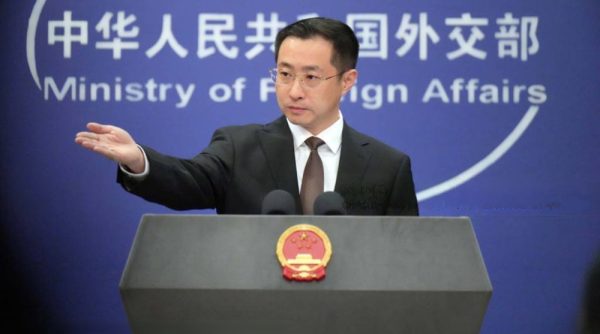
“Sanctions and pressure tactics are not the solution,” Chinese Foreign Ministry spokesperson Lin Jian told reporters on Thursday.
The rebuke came one day after the Trump administration issued an open call to allies and China alike to fall in line with what the president billed as the “most crushing economic operation ever taken against any country”—a boastful threat that came after Washington failed to achieve any of its war objectives military some six months after starting the aggression on Iran in late February.
Notably, the United States has yet to detail the full scope of its so-called operation, with US Secretary of Treasury Scott Bessent punting further specifics to a Monday press conference—a delay that raises questions about the campaign’s actual readiness.
China calls on parties to act responsibly and stick to the political and diplomatic approach, added Jian.
Iran has strongly condemned the US campaign, with Minister of Foreign Affairs Abbas Araghchi describing Washington’s economic aggression as an attempt to divert attention from America’s own problems.
Araghchi pointed to America’s “unprecedented debt & surging interest costs” as Washington seeks to impose further economic pressure on Iran.
Iran’s Ministry of Foreign Affairs said on Thursday the latest US sanctions, announced on the anniversary of the 1953 coup against Iran’s democratically elected government, demonstrate Washington’s continued hostility toward the Iranian people.
“The new US sanctions are not only another indication of the continuation of 73 years of hostility by US policymakers toward the Iranian people, but also demonstrate the anti-human, lawless and hegemonic nature of the US government,” the ministry noted.
The ministry further condemned the sanctions for targeting the fundamental rights of Iranian citizens and violating international norms.
“Without a doubt, the US economic sanctions against Iran, which target the fundamental human rights of every Iranian citizen, constitute ‘economic terrorism’ and ‘crimes against humanity,’” it maintained.
Beijing’s rejection comes ahead of Chinese President Xi Jinping’s planned September 24 visit to the White House, adding significance to China’s refusal to participate in Washington’s economic campaign against Tehran.
Featured Video
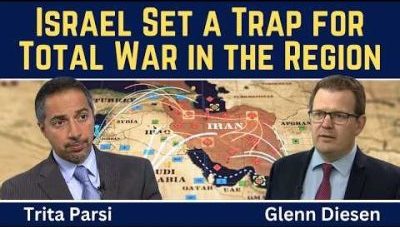
Trita Parsi: Israel Set a Trap for Total War in the Region
or go to
Aletho News Archives – Video-Images
From the Archive
Zionism’s Violent Legacy
By Donald Neff | Washington Report On Middle East Affairs | January 1996
On January 4, 1948, Jewish terrorists drove a truck loaded with explosives into the center of the all Arab city of Jaffa and detonated it, killing 26 and wounding around 100 Palestinian men, women and children.[1] The attack was the work of the Irgun Zvai Leumi – the “National Military Organization,” also known by the Hebrew letters Etzel – the largest Jewish terrorist group in Palestine. The Irgun was headed by Revisionist Zionist Menachem Begin and had been killing and maiming Arabs, Britons and even Jews for the previous ten years in its efforts to establish a Jewish state.
This terror campaign meant that at the core of Revisionist Zionism there existed a philosophical embrace of violence. … continue
Blog Roll
 Aletho News
- Trita Parsi: Israel Set a Trap for Total War in the Region
- Trump’s Iran war is on an Israeli leash
- Saudi oil boss issues global supply warning
- Riyadh Says Its Oil System Is Intact. The Numbers Say Otherwise.
- Trump and Netanyahu Want to “Finish the Job” on Iran
- US ‘one-sided dictation’ not Iran’s beliefs makes rational talks impossible: Baghaei
- Iran’s Next Strike May Not Explode. It Could Shut You Down /Col Doug Macgregor
- Iran: US political targets legitimate if assassinations return
- Iraq shuts key border crossing with Iran under US pressure: Report
- Undersea Internet cables could be targeted in retaliation for attacks on Iran: IRGC deputy chief
- If Americans Knew
- The Israel Lobby’s Changing Fortunes
- AIPAC has become such a political liability that it’s shifting to a more “nimble” approach to buying politicians
- At least 160 Israeli settler attacks in 2 weeks
- Will Gaza’s Ancient Christian Community Disappear Forever?
- Israel’s vision of regional security rests on keeping Arab states weak
- Heidi Levine recounts how Palestinian youths helped save her in settler attack
- DAILY UPDATE: Latest essential news on Palestine, Israel, & region
- Trump’s Intensifying Sabotage of the ICC, for Israel’s Sake
- Israeli military detain US and UK volunteers in West Bank including Democratic NY politician Brad Lander
- Americans at National Conservatism Conference held in Israel this year criticize Israel
- No Tricks Zone
- E-Cars Reduce CO2 Emissions By Only 41% Compared To Internal Combustion Engine Vehicles
- Predictions Made By Renowned Climate Professor Over Past Decades Have Been Proven To Be Poor
- New Study Suggests Large Regions Of The Pacific Ocean Have Been Cooling For The Last 80 Years
- Germany’s Green Energy Debacle: High Energy Costs Force Kahla Porzellan to Close After 182 Years!
- New Study: 50 Years Of The Most Aggressive ‘Net Zero’ Policies Can Only Affect The Global Climate By 0.03°C
- US September “Heat” Was No Record…Many Records Set Decades Ago
- Latest European Green Energy Debacle; Portugal’s Largest Flagship Solar Park Insolvent!
- Green Energy Debacle: German Expert Professor Fritz Vahrenholt Warns Of Severe Economic And Social Consequences
- Two More Paleo Reconstructions Affirm Meters-Higher Sea Levels Across Ireland, Brazil 7000-6000 Years Ago
- New Study: Earth And Venus Surface Warmth Largely Explained By Convection And Lapse Rate, Not CO2 Or Radiation

