Spain’s Left Protested the Crisis It Legitimized: the General Strike as election stunt
By Joaquin Flores | Strategic Culture Foundation | November 16, 2026
At first glance, Spain’s relatively symbolic single-day “General Strike” of November 11th, where some four million took to the streets, with the slogan “Salaries. Housing. Prices.”, fits a typical Western European narrative, much like what you might see in France, Italy, or Greece. Living costs are rising, wages are stagnating, and the major national trade union federations have endorsed a general strike. What’s strangely cynical this time around, besides the futility of striking for a single day, is that it was endorsed (and in effect organized) by the PSOE-led government itself, making it something more of a ‘state holiday’ combined with a pre-election stunt. The story becomes even more paradoxical when we examine the underlying drivers of the public discontent that led ordinary citizens to participate in what effectively functioned as a government-backed protest. What we find is bizarre, even though expected: the left is protesting a crisis it created, or rather legitimized, in service of globalization model capitalism. Events in Spain provide a teachable moment on how the City of London’s “EU” capitalist system works, manages discontent, gaslights mass publics, and controls the narrative. This means we have to dig into questions beyond polling and the questions of the day, and look for a deconstruction which challenges the broad assumptions of the Western globalist model of capitalism.
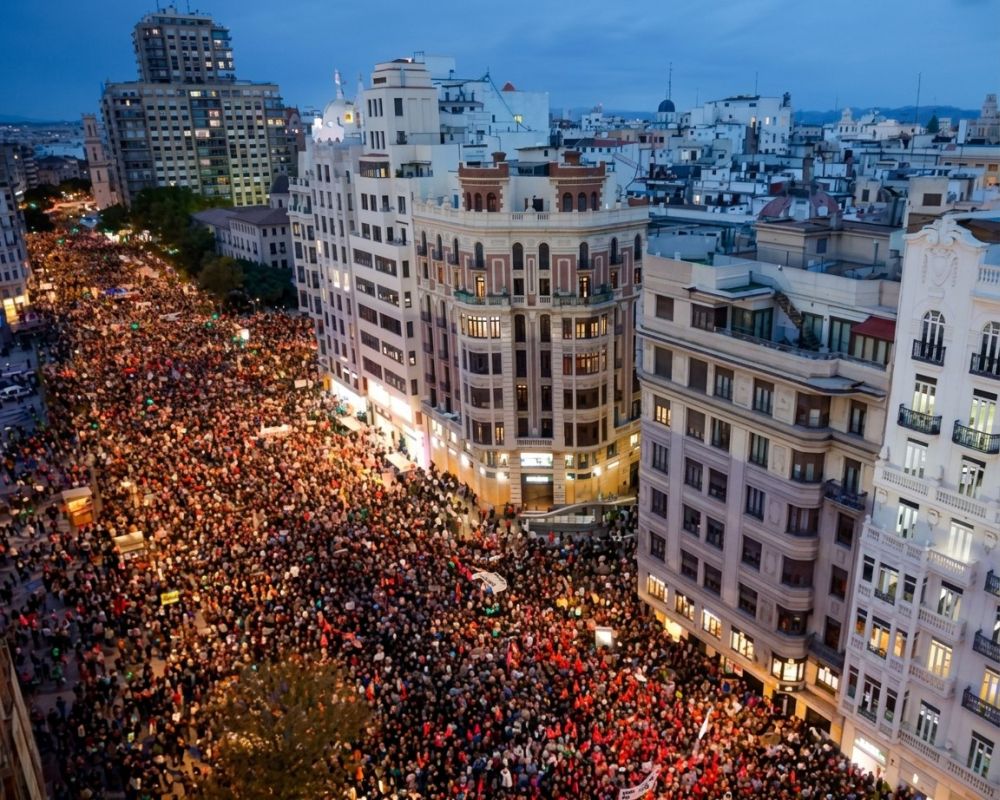
General Strike mobilization in Plaça de l’Ajuntament in Valencia, Spain, November 11, 2026
The General Strike Big Business Loved
What led to the so-called “General Strike”? General strikes, when they occur within EU politics, are normally called in opposition to conservative or center-liberal governments trying to push through austerity measures masked as “budgetary reforms.” Before this weak and non-committal age we live in now, these strikes would carry on for some time until the real, economic, material impact was felt by the ruling class and their governmental representatives. Workers would skip meals and huddle by dumpster fires to stay warm, picket the entrances of workplaces, and face the ferocity of the state’s brutality day after day. Scabs were confronted, and no politician could be trusted farther than they could be thrown or forced to submit. There was a more or less good understanding that the state itself was the organ of power of one class over another. But in this age of symbolic “power” (a symptom of moral decay), such strikes are staged by an elite-aligned labor bureaucracy for their marketing potential, and in this case, as a pre-election stunt. They are not, and have not been for several generations, anything approximating a threat to the power of capital or the ruling class in general, and are considered permissible, even safe.
From the perspective of the owning class, including major IBEX-35 firms and the employers’ confederation (CEOE), this maneuver posed minimal risk and offered huge advantages. The elites recognized Sánchez’s Royal decrees had no path to becoming permanent law as Parliament was sure to vote them down, while the ensuing legislative theater and union-led protests acted as a political pressure valve that channeled public anger over living costs into a predictable electoral cycle rather than unchecked social unrest, which in numerous ways are issues better fit for the populist right. Furthermore, while corporate leaders had benefited from steady macroeconomic growth, EU recovery funds, and an expanded labor supply during Sánchez’s years in office, many in the business community viewed the deliberate legislative collapse as a welcome acceleration toward a new election that polls suggested could bring a more deregulatory, market-friendly government to power and, by exploiting the business/populist division also on the Spanish right, do so without challenging the very “expanded labor supply issue” (mass immigration) which is really at the heart of this.
Problem, reaction, solution.
To be clear almost every single person mobilized out onto the streets did so in response to genuine, authentic grievances provoked by a rapacious oligarchy, soaring costs of living, and there is no-end in sight to the looming austerity should a liberal-right conservative party take power. But while respecting the strikes’ grassroots activists and participants, we simultaneously cannot restrict ourselves to applause when our aim is to critically deconstruct the complex underlying methods which post-modern power structures use to operationalize neo-movements of the post-new-left, and how these fit into a broader model of total real subsumption by globalized City of London capital of that contemporary left itself. What remains unsaid is how a left government in power now for three years has been unable or unwilling to mobilize the collective power of the working class until a train crash, corruption controversies, and failing polls personally hit Prime Minister Pedro Sánchez and threatened the PSOE as a political project.
What is left unsaid by the mainline Spanish left within the PSOE and its affiliates, is how this mobilization actually accomplishes two things: the strike is not enough to solve the crisis or rescue the PSOE come election day, but is enough to push the oligarchy in Spain, England, and Germany towards the path of now supporting a right-wing coalition. In turn, this right-wing party coalition will win because of the promises made by its communitarian populist wing who oppose immigration and speculators (in the second case, like the left), but will govern instead on the principles of a deregulation championed by their liberal business wing, which also includes open borders.
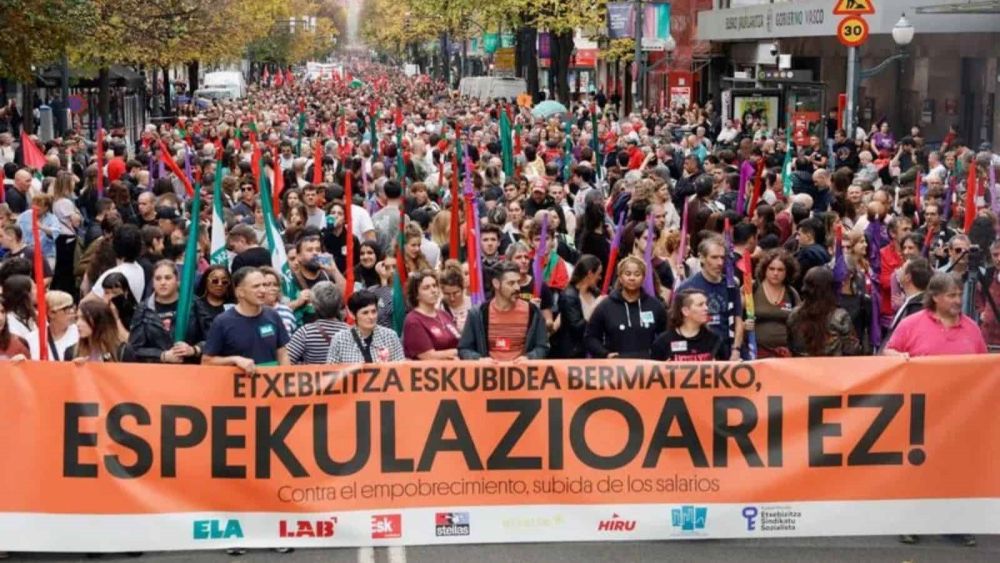
“Speculation No! Guarantee The Right To Housing” Basque language – Bilbao, Spain, Nov 11, 2026. (Photo: REUTERS/Vincent West)
And this deregulation will protect the financial interests of the large banks who own the mortgages of large-scale apartment complexes, whose landlords make interest payments based upon the inflated prices of rents caused by the immigration crisis. Therefore, Sánchez is doing his job, and will find future employment in the style of Tony Blair or Barak Obama, as a consultant for an austerity-mad globalist enterprise, or an advisor for peripheral European politicians.
Consequently, the general strike stunt serves the strategic, cultural, and electoral function of having the left define an affordability crisis which otherwise actually aligns with right-populist critiques, but steering it away from right-populist (communitarian) conclusions by focusing on the downstream effects in terms of the strain on the social budget and housing costs, and simultaneously making reference to “the capitalist system” as the larger overarching cause when speaking to radicalized elements of the working class or university enrolled youth activists (who trend towards communism or anarchism).
A preliminary conclusion
We can call this the macro-to-micro illusion. Yes, big capital is behind this crisis on the macro level, and also indeed, on the micro level, it is experienced as an affordability crisis. But to do this, the left must ignore meso-level analysis which explains the actual mechanics: mass migration as the tool of big business to lower labor costs while simultaneously enriching the landlord class.
This dynamic illustrates how the contemporary Western left has long since subordinated itself to the needs of capital while denying its logic: genuinely worker-centered measures, such as immigration controls, are revisioned as being entirely the politics of the far right, where they can be summarily dismissed by polite society, state and academic institutions, and the Brussels bureaucracy; all of which remain conveniently aligned on the issue. The communitarian right recognizes the logic of capital and opposes its globalized form there: open borders swing the labor market in favor of big business; culturally heterogeneous societies are more difficult to build solidarity in.
Plutocratic oligarchies which favour senatorial privilege, checks on executive power, and utilize instead the politics of divide and conquer, tend to favour culture war divisions which can reinforce but also mask class divisions; the erosion of executive or centralized power behind the mask of various negative freedoms, ignoring positive freedoms almost as a rule. In the evolution of post-modern neo-movements, what today we call the ‘left’ has become by and large a tool in the arsenal of plutocratic oligarchies in the West.
PSOE in Staged Collapse
Now, elections are scheduled for the end of November and these are early elections triggered by Prime Minister Pedro Sánchez’s failure to get through legislation on rent control, which was expected not to succeed in the first place.
Indeed, this sounds ridiculous, but such is the game. The failed legislation sparking the election consisted of two emergency housing measures; the Royal Decree-Laws 26/2026 and 27/2026, informally dubbed the “Maricarmen decrees”, which were predictably voted down by Spain’s Parliament on October 2, 2026. Together, they were designed to suspend evictions of vulnerable tenants until 2030, cap annual rent hikes at 2%, force automatic five-to-seven-year lease renewals with penalties for landlords who refused, restrict short-term tourist rentals, and ban corporate investment funds from buying discounted residential properties.
The defeat of Prime Minister Pedro Sánchez’s emergency housing was known to all before it happened, except for true believers of PSOE propaganda, given that his minority coalition previously relied on the center-right Catalan separatist party Junts to make a government, which represents property-owning interests and had already joined the conservative People’s Party (PP) and Vox earlier in the year to reject a similar eviction moratorium. Sánchez deliberately engineered this legislative showdown despite knowing the parliamentary outcome in advance. But facing investigations over the Koldo kickback scheme, a major Spanish political corruption scandal involving illegal commissions paid on emergency COVID-19 medical supply contracts, several deadly train crashes, growing discontent over rising living costs, and the invasion of almost 100,000 illegal immigrants who poured into Ceuta in the summer, all ahead of a scheduled 2027 vote, the right-wing opposition and Junts allowed the Socialists to trigger an early election on November 29, while framing the campaign around housing affordability and anti-eviction measures.
And all of this was starkly reflected in sliding poll numbers as Spain heads into the November 29 snap election, with major tracking averages showing Sánchez’s PSOE plunging 5 to 6 percentage points from its 2023 result down to roughly 26.7%. As the Socialists fall behind the conservative People’s Party (at 30.1%), polls indicate a combined PP and Vox right-wing bloc surging toward 50% of the vote, which would take them past the 176-seat parliamentary majority.
Sorry, the comment form is closed at this time.
Featured Video

10 Climate Myths Busted (in 60 seconds!)
or go to
Aletho News Archives – Video-Images
Book Review
How the U.S. Navy Sold the Vietnam War
By Gareth Porter | TruthDig | March 27, 2019
Dr. Tom Dooley, whose best-selling book “Deliver Us From Evil” helped create a favorable climate of opinion for U.S. intervention in South Vietnam, has long been linked to legendary CIA officer Edward G. Lansdale and his black operations in Vietnam between 1954 and 1955. But the real story about Dooley’s influential book, which has finally emerged from more recent scholarly research, is that it was engineered by an official of the U.S. Navy’s Pacific Command, Capt. William Lederer.
Lederer is best known as the co-author, with Eugene Burdick, of the 1958 novel “The Ugly American,” which was turned into a 1963 movie starring Marlon Brando. Far more important, however, is the fact that from 1951 through 1957 Capt. Lederer was on the staff of the commander in chief of the U.S. Pacific Fleet (CINCPAC), Adm. Felix Stump. … continue
Blog Roll
 Aletho News
- The 10 Disease Renamings That Rescued the Vaccine
- NATO cancels 2027 leaders’ summit
- IAEA’s politicized use of safeguards undermines its impartiality: Russian envoy
- UK must be ready to strike Russian Arctic – ex-PM
- Fico’s Two Red Lines: Russian Energy and the Next Ukraine Loan
- Thousands rally for banned NATO-skeptic presidential candidate
- Ukraine Settlement and New European Security Architecture Must Go Hand in Hand – Kremlin
- Book review: Boiling Point, How America Brought War to Ukraine
- Israel Revives The ‘Iranian Assassination Threat Against Trump’ Deception In A Desperate Bid To Restart The War
- US rewrites history to dodge blame for illegal war on Iran: Foreign Ministry spokesperson
- If Americans Knew
- An error has occurred; the feed is probably down. Try again later.
- No Tricks Zone
- New Study: Barents Sea Temperatures Were Warmer And Sea Ice Less Extensive In The 1700s Than Today
- German Authorities Start Initiative To Evaluate Public Register For Climate “Disinformation” Spreaders!
- Zonal Asymmetry of Temperature Change in the Antarctic Circumpolar Current
- New Study: The Net Fossil Fuel Contribution To Rising Atmospheric CO2 Has Been Zero For 500 Years
- Germany’s Green Energy Transition Becoming Increasingly Expensive…Another 6 Trillion Euros!
- Sudden Stratospheric Warming, Powerful El Niño Combination May Lead To Extreme Europe Cold, Energy Crisis!
- Two New Studies Find Thwaites Glacier Melt Cannot Be Driven By Human Activity Or A Warming Ocean
- E-Cars Reduce CO2 Emissions By Only 41% Compared To Internal Combustion Engine Vehicles
- Predictions Made By Renowned Climate Professor Over Past Decades Have Been Proven To Be Poor
- New Study Suggests Large Regions Of The Pacific Ocean Have Been Cooling For The Last 80 Years

