Coordinated Media Messaging Is Prepping for Iran War
By Thomas Karat | The Libertarian Institute | February 5, 2026
Between January 27 and January 29, 2026, something carefully orchestrated unfolded across Western capitals. Within this forty-eight hour window, the USS Abraham Lincoln carrier group arrived in the Persian Gulf, President Donald Trump declared “time is running out,” the European Union unanimously designated Iran’s Revolutionary Guard as terrorists, German Chancellor Friedrich Merz announced “Iran’s days are numbered,” and oil surged 5%. This was not a spontaneous crisis but methodical preparation for military action.
Analysis of 235 news headlines from eleven countries1 reveals a coordinated information operation mirroring Iraq and Libya’s preparatory phases. The pattern: synchronized political statements, expanding legal justifications, managed market reactions, and systematic absence of dissenting voices. What emerges is not diplomacy exhausted but deliberately sidelined.
Forty-seven headlines—twenty percent of the dataset spanning back to 2021—appeared within those two days. This clustering is inconsistent with organic news flow. News organizations covering genuine crises do not synchronize attention with such precision across multiple countries unless events themselves were coordinated to generate exactly this response. The headlines did not drive events; events were staged to generate headlines.
Military deployments require weeks of planning. Carrier groups do not sail on presidential whim. The Abraham Lincoln‘s Gulf presence represented logistical preparation that necessarily preceded public rhetoric by considerable time. Yet political messaging was timed to coincide with arrival, creating the impression of responsive crisis management when reality was long-planned positioning. Iranian protests provided convenient moral framing for plans already in motion.
The European Union’s unanimous Revolutionary Guard terror designation demonstrates similar coordination. Achieving consensus among twenty-seven member states typically requires months of negotiation. Yet this designation moved with remarkable speed, arriving at unanimous approval precisely when it would provide maximum legal cover for military action. International legal frameworks precede military operations in the modern interventionist playbook. The terror designation creates legal architecture for strikes against Revolutionary Guard targets anywhere, transforming acts of war into counterterrorism operations under existing agreements.
Chancellor Merz’s “Iran’s days are numbered” represents an unprecedented declaration from a German leader on Middle East military matters. That Merz made this pronouncement within hours of the EU designation and Trump’s escalating rhetoric points to coordinated messaging at the highest levels. When pressed about advocating military action, Merz offered calculated non-denial: “I am describing reality.” The phrasing reveals purpose—presumes outcome while disclaiming responsibility for advocating it.
Meanwhile, according to multiple reports, Israeli military intelligence officials were sharing targeting data with Pentagon planners. This intelligence sharing represents not consultation among allies but active participation in operational planning. Israeli defense analysts have identified approximately three hundred sites linked to the Revolutionary Guard’s command structure and weapons programs. The message conveyed through these leaks is transparent: if American strikes occur, Israel is already integrated into the campaign. The question is not whether Israel will be involved but whether the United States will join an operation in which Israeli interests are clearly paramount.
Yet behind this public coordination lies a revealing contradiction. According to University of Chicago political scientist John Mearsheimer and multiple Israeli sources, Israeli Prime Minister Benjamin Netanyahu privately asked Donald Trump around January 14 not to launch strikes against Iran because Israeli air defenses were insufficiently prepared to handle the inevitable counterattack. After absorbing approximately eight hundred Iranian ballistic missiles throughout 2024 and 2025, along with hundreds more from Hezbollah and Houthi forces, Israel’s Arrow interceptor stockpiles had been severely depleted. The Jerusalem Post confirmed that despite reducing Iran’s pre-war missile arsenal by roughly half, Netanyahu feared the Islamic Republic retained enough firepower to overwhelm Israeli defenses in their current degraded state. The public posture of coordinated operational planning contradicted the private reality of Israeli vulnerability.
This creates an impossible position for the Trump administration. Carrier strike groups cannot maintain forward deployment indefinitely—the logistical burden and operational costs make extended positioning unsustainable without clear objectives. Yet backing down after deploying what Trump himself called a “massive armada” risks appearing weak, undermining American credibility precisely when the administration seeks to project strength. The machinery of escalation, once assembled and publicly announced, develops its own momentum. Political costs of retreat can exceed strategic costs of engagement, even when engagement serves no clear national interest.
The situation grew more complex in late January as Iran responded to American military positioning with its own demonstrations of capability. On January 30 and 31, the Revolutionary Guard conducted live-fire naval exercises in the Strait of Hormuz, prompting sharp warnings from U.S. Central Command about “unsafe and unprofessional behavior” near American forces. Iran’s military spokesman reminded audiences that “numerous U.S. military assets in the Gulf region are within range of our medium-range missiles”—a statement of fact rather than mere bluster given Iranian capabilities demonstrated repeatedly over the previous year.
Regional powers, meanwhile, moved to constrain American options. Saudi Arabia’s Crown Prince Mohammed bin Salman and UAE officials both announced their territories and airspace would not be available for strikes against Iran. Turkey offered to serve as mediator between Washington and Tehran. Egypt engaged in intensive diplomatic consultations with Iranian, Turkish, Omani, and American officials. The architecture of constraint was being constructed even as military assets concentrated. By January 31, both American and Iranian officials were signaling that talks might commence, though with contradictory preconditions: Trump demanding Iran abandon nuclear weapons [no nuclear program, no ballistic missile program, and no support to armed proxy groups] development entirely, Iranian Foreign Minister Abbas Araghchi insisting defense capabilities remain off the table. Trump told reporters Iran was “seriously talking to us,” while Ali Larijani, head of Iran’s Supreme National Security Council, acknowledged that “structural arrangements for negotiations are progressing.”
The question is whether these diplomatic signals represent genuine off-ramps or merely tactical pauses in an escalation that has acquired its own logic. Netanyahu’s private request that Trump delay strikes suggests even the most hawkish regional actor recognizes the costs of actually executing the plans being prepared. Yet the very existence of those plans, the deployment of assets, the public threats, and the coordinated messaging create pressures that constrain diplomatic flexibility. Leaders who threaten military action and then negotiate without delivering on threats risk domestic political consequences. The machinery assembled for coercion can become difficult to dismantle without appearing to capitulate.
The multiplication of justifications over seven days reveals strategic hedging rather than clarifying purpose. Nuclear negotiations, humanitarian intervention for protesters, counterterrorism via the EU designation, and finally explicit regime change language—four distinct rationales in one week. This pattern has precedent. The George W. Bush administration cycled through weapons of mass destruction, democracy promotion, and humanitarian intervention as rationales for Iraq. Paul Wolfowitz later acknowledged that WMDs were selected not because evidence was strongest but because “it was the one reason everyone could agree on”—a marketing decision, not an intelligence assessment.
When governments offer multiple expanding rationales, it indicates the decision to strike preceded the search for justification. A principled case for intervention would stand on a single foundation. The proliferation reveals a predetermined conclusion seeking retrospective legitimization. Each rationale serves a distinct constituency, constructing a coalition no single justification could achieve.
What remains absent from the 235 headlines reveals as much as what appears. Chinese state media produced zero articles captured in Western aggregation despite China’s strategic partnership with Iran and opposition to American intervention. Russian media produced only four headlines—less than 2%—despite Moscow’s regional involvement. Turkish, Saudi, and Arab League perspectives were similarly absent, despite these nations facing direct consequences from regional war. The Iranian perspective itself was reduced to threatening rhetoric with no diplomatic proposals or policy statements beyond deterrence. Western audiences encounter an information environment that presents military action as responding to Iranian aggression rather than initiating it.
This selective amplification follows established patterns. Before Iraq, weapons inspector Scott Ritter’s detailed assessments that Iraq had been disarmed received minimal coverage while administration officials making evidence-free claims dominated news cycles. Millions protesting the war globally in February 2003 generated less coverage than Secretary of State Colin Powell’s fabricated United Nations presentation. The pattern is refined through repetition.
Financial markets, often more honest in their assessments than political rhetoric, sent contradictory signals that warrant attention. Oil prices surged as expected when supply disruption from the Strait of Hormuz closure became possible—20-30% of global oil supply transits this waterway, and Iran possesses the anti-ship missiles and naval mine capability to close it for extended periods. Yet gold, the traditional safe-haven asset that rallies sharply during genuine geopolitical crisis, fell 10% during the same period. Institutional traders with billions of dollars at stake and access to the same intelligence briefings as government officials apparently viewed the escalation as a pressure campaign rather than certain prelude to war. The gold crash suggests sophisticated market participants believe the military posturing serves primarily coercive diplomatic purposes, not inevitable preparation for strikes.
This market divergence creates an interpretive dilemma. Either traders are badly misreading signals—unlikely given the sophistication of institutional risk assessment—or the public escalation deliberately overstates the probability of military action to maximize pressure on Tehran. Yet history demonstrates that pressure campaigns can transform into actual wars when escalation momentum becomes impossible to reverse without political cost. The machinery assembled for coercive purposes can be activated for actual strikes if diplomatic face-saving becomes impossible or if domestic political calculations shift. The invasion of Iraq began as a pressure campaign to force weapons inspections and compliance; it became regime change when backing down appeared politically untenable.
The costs of military action against Iran dwarf previous Middle Eastern interventions yet receive minimal discussion. Iran fields ballistic missiles capable of striking American bases and Israeli cities, anti-ship missiles threatening carrier groups, and proxy forces across Lebanon, Syria, Iraq, and Yemen. Hezbollah alone possesses 150,000 rockets—enough to overwhelm Israeli defenses. This is not Iraq 2003 with degraded capabilities.
The financial burden would exceed the six trillion dollars already spent on Iraq and Afghanistan. Iran’s population is three times Iraq’s, its military more capable, its geographic position more strategic. Regional destabilization would be immediate. Strait of Hormuz closure for two weeks would drive oil above $150 per barrel, triggering global recession. Every Gulf nation would face impossible choices. Humanitarian consequences measured in hundreds of thousands.
The blowback from intervention would generate more terrorism. The CIA’s own assessments confirm military action creates enemies faster than it eliminates them. The Islamic Republic’s proxy network exists precisely to impose costs on adversaries with conventional superiority. Strike Iran, face attacks throughout the region for years. The presumption that Tehran would absorb strikes without major retaliation contradicts both Iranian doctrine and rational assessment of their capabilities.
What is being assembled is not simply military capability but political momentum. The forty-eight hour window represented orchestrated escalation designed to create facts—legal, political, military, psychological—that constrain future options. Each element reinforces others: assets positioned, consensus constructed, frameworks established, markets reacting, attention concentrated. The machinery operates through accumulation of decisions that individually appear reasonable but collectively narrow space for alternatives.
This is how wars begin in the twenty-first century—not through sudden attacks but through gradual construction of inevitability. Diplomatic options are not explored and exhausted; they are marginalized. Intelligence is curated to support predetermined conclusions. Public opinion is manufactured through coordinated messaging and selective information. And when bombs fall, the question asked is not whether war was necessary but only whether it can be prosecuted successfully.
The next seven to fourteen days will reveal whether coordination produces strikes or sustained coercion. Carrier positioning, intelligence preparation timelines, and rhetorical escalation pace suggest decision point approaching. But whether the outcome is strikes or coercion, the pattern revealed in these 235 headlines demonstrates how consent is manufactured—not through lies alone but through timing, framing, omission, and construction of false consensus that makes dissent appear isolated. Understanding these patterns is essential not merely for analyzing this crisis but for recognizing how power operates when information warfare precedes military action.
Beijing cancels Panama deals after court blocks Chinese port operations
The Cradle | February 5, 2026
Chinese authorities have asked state-owned companies to suspend talks on new projects in Panama, in response to the Central American nation’s cancellation of a contract with China’s CK Hutchison Holdings to operate two ports along its strategic canal, Bloomberg reported on 5 February.
According to sources familiar with the matter, Panama’s decision could jeopardize billions of dollars in potential Chinese investments.
Chinese authorities also asked shipping companies to consider rerouting goods through other ports if the extra cost is not prohibitive, and have stepped up inspections of Panamanian imports, such as bananas and coffee.
Chinese Foreign Ministry spokesman Lin Jian issued a statement saying that the Panamanian Supreme Court ruling “ignores the facts, violates credibility,” while harming the interests of Chinese companies.
Hong Kong-based CK Hutchison responded to the Supreme Court decision by initiating international arbitration proceedings against Panama.
CK Hutchison has operated Panama’s Cristobal and Balboa ports for decades. The ports lie at opposite ends of the Panama Canal – the strategic waterway that connects the Pacific and Caribbean Oceans, and through which roughly three percent of global seaborne trade passes.
The move comes amid US President Donald Trump’s campaign to counter Chinese influence over strategic infrastructure in the Americas.
Following his election last year, Trump argued that it was “foolish” of the US to hand over control of the canal to Panama. The US built the canal in 1904 and handed it back to Panamanians nearly a century later, in 1999.
Trump has also complained about the fees Panama charges the US to use the waterway.
Amid pressure from Washington, Panama also withdrew from China’s Belt and Road Initiative (BRI) in February last year.
At the time, Beijing stated it “firmly opposes the United States using pressure and coercion to smear and undermine Belt and Road cooperation. The US side’s attacks … once again expose its hegemonic nature.”
Twenty Latin American nations have participated in the BRI since Beijing initiated it in 2013.
Current Chinese infrastructure projects in Panama include a $1.4-billion bridge over the canal, a cruise terminal constructed by China Harbour Engineering Co., and a segment of a metro line by China Railway Tunnel Group Co.
In Latin America, Trump is seeking to revive the 200-year-old Monroe Doctrine. It states that Washington will not allow European powers to interfere in the Western Hemisphere as they had in colonial times, asserting that the region would be regarded as a sphere of US interest.
Trump used the doctrine as one of his justifications for bombing Venezuela and abducting its president, Nicholas Maduro, on 3 January.
The US president claimed that Maduro was hosting “foreign adversaries in our region” and acquired “menacing offensive weapons that could threaten U.S. interests and lives.”
Idea of strategically defeating Russia an ‘illusion’ – Lavrov
RT | February 5, 2026
European leaders have “changed their tune” toward Russia, moving from calls to inflict a strategic defeat on Moscow to cautious reassessment, Russian Foreign Minister Sergey Lavrov has told RT.
Speaking with RT’s Rick Sanchez ahead of Diplomats’ Day on Wednesday, Lavrov noted how many European politicians had initially “spoken in unison, demanding firmness, insisting on unwavering support for Ukraine, continued arms shipments, sustained financing – all to ensure Russia’s defeat, a strategic defeat on the battlefield.”
Over time, European leaders “realized it was all an illusion,” he said in a wide-ranging interview. Western military strategists, who orchestrated the Ukraine conflict and “prepared Ukrainians to fight and die advancing European interests against Russia,” are finally recognizing that their plans had collapsed, the top diplomat stated.
Lavrov added that Western governments had learned nothing from history, citing Adolf Hitler and Napoleon’s failed attempts to defeat Russia. He said Europe had once again rallied nearly the entire continent under the same ideological banners, “only this time, unlike Napoleon and Hitler, not yet as soldiers on the battlefield, but as donors, sponsors, arms suppliers.” He said this attempt had produced outcomes similar to the failures of Napoleon and Hitler, adding that the West, particularly Germany, “learns history poorly.”
Lavrov noted that German Chancellor Friedrich Merz had “lifted constitutional restrictions on military spending, then declared this was necessary for Germany to once again – I emphasize that word, once again – become Europe’s dominant military power.” The minister said the stance “speaks volumes” about Merz’s mindset, arguing that in practice it amounts to preparation for war.
Lavrov also noted Russia’s status as the largest country in the world, but highlighted its place in Eurasia, saying “every attempt so far to establish security in this space has focused exclusively on the western part of Eurasia – so-called Europe.” He criticized NATO as a US-led structure, asserting that Americans never intended to leave Europeans to act independently while maintaining oversight of their allies.
European countries portray Russia as militarily and economically exhausted, he said, yet immediately assume they must prepare for an attack from the same Russia, calling this approach “pathetic diplomacy.”
According to Lavrov, Europe has “walked into their own trap by adopting this uncompromising stance” toward Russia, and “all they’re doing now is trying to sabotage” peace negotiations on Ukraine that “finally began taking shape between Russia and the United States, and now are joined by Ukrainian representatives.”
Russia doubts ‘bright future’ for US economic ties – Lavrov
RT | February 5, 2026
The actions of US President Donald Trump’s administration contradict its claims that it is willing to restore economic cooperation with Russia, Foreign Minister Sergey Lavrov has said.
Since returning to the White House more than a year ago, Trump has repeatedly said he wants to do business with Moscow. After a phone call with Russian President Vladimir Putin last March, the White House teased “enormous economic deals” between the two countries once the Ukraine conflict is settled.
Moscow doubts the sincerity of those claims by Washington, Lavrov said in an interview with RT’s Rick Sanchez on Thursday, ahead of Diplomatic Workers’ Day on February 10.
Not only the economic restrictions that had been slapped on Moscow under the previous administration of US President Joe Biden “all remain in place,” but “very harsh sanctions have been imposed against our largest oil companies, Lukoil and Rosneft, for the first time,” he said.
Washington’s move “surprised” Putin, the foreign minister recalled, coming just weeks after his face-to-face meeting with Trump in Anchorage, Alaska, in August, during which Moscow “supported the US proposal for a comprehensive settlement of the Ukrainian crisis.”
According to Lavrov, the Americans are now “openly trying to push Russian companies from Venezuela.” This follows a January raid by US commandos on the Venezuelan capital, Caracas, during which President Nicolas Maduro and his wife were abducted.
“India is being banned from buying Russian oil. At least, that is what was announced,” the Russian diplomat added.
Last month, Washington also said that “a state of emergency is being declared due to the threat Cuba poses to US interests in the Caribbean, including due to Russia’s hostile and malicious policies,” the minister noted.
The US is looking to introduce “a worldwide ban” on Russian oil and gas supplies, saying that they should be replaced by American oil and liquefied natural gas, Lavrov stressed.
“Well, the bright future of our economic and investment cooperation doesn’t really square with that,” he noted.
US’s Lack of Response to Russia’s New START Proposals Regrettable – Foreign Ministry
Sputnik – 04.02.2026
MOSCOW – Washington’s approach of ignoring Russia’s ideas on the New Strategic Arms Reduction Treaty (New START) is regrettable, the Russian Foreign Ministry said on Wednesday.
“However, no formal official response from the United States with regard to the Russian initiative has been received through bilateral channels. Public comments from the US side also give no reason to conclude that Washington is ready to follow the course of action in the field of strategic offensive arms proposed by the Russian Federation,” the ministry said in a statement.
“In fact, it means that our ideas have been deliberately left unanswered. This approach seems erroneous and regrettable,” it added Russia proceeds from the position that the parties to the New START Treaty are no longer bound by any obligations and symmetrical declarations amid the expiration of the treaty.
With the suspension of the New START Treaty in February 2023, Russia declared its intention to voluntarily stick to the central quantitative limits on weapons set by the Treaty until it expires in February 2026, the statement said.
“In the current circumstances, we assume that the parties to the New START are no longer bound by any obligations or symmetrical declarations in the context of the Treaty, including its core provisions, and are in principle free to choose their next steps,” the statement read.
Russia “intends to act responsibly and in a balanced manner,” developing its policy based on an analysis of the US military policy and the overall situation in the strategic sphere, the statement added.
Still, Moscow is open to finding ways to stabilize the situation through equal dialogue, the ministry added.
“The Russian Federation remains ready to take decisive military-technical measures to counter potential additional threats to the national security. At the same time, our country remains open to seeking politico-diplomatic ways to comprehensively stabilize the strategic situation on the basis of equal and mutually beneficial dialogue solutions, if the appropriate conditions for such cooperation are shaped,” the ministry said.
Douglas Macgregor: Russia, China & Iran Seek to Contain U.S. Military
Glenn Diesen | February 4, 2026
Douglas Macgregor is a retired Colonel, combat veteran and former senior advisor to the U.S. Secretary of Defense. Col. Macgregor explains how the military adventures of the U.S. are incentivising greater military cooperation between Russia, China and Iran.
Follow Prof. Glenn Diesen:
- Substack: https://glenndiesen.substack.com/
- X/Twitter: https://x.com/Glenn_Diesen
- Patreon: https://www.patreon.com/glenndiesen
Support the research by Prof. Glenn Diesen:
- PayPal: https://www.paypal.com/paypalme/glenndiesen
- Buy me a Coffee: buymeacoffee.com/gdieseng
- Go Fund Me: https://gofund.me/09ea012f
Judge Strikes Down Hawaii Deepfake Law as Unconstitutional
By voiding Hawaii’s law, the court signaled that the fear of deepfakes cannot outweigh the freedom to mock those in power.
By Cindy Harper | Reclaim The Net | February 4, 2026
A federal judge has struck down Hawaii’s election “deepfake” law, calling it a violation of free political expression. In The Babylon Bee v. Lopez, U.S. District Judge Shanlyn Park ruled that Act 191, which criminalized or penalized the use of certain AI-generated media during elections, infringed on both the First and Fourteenth Amendments.
The ruling permanently blocks enforcement of the statute, which had been set to take effect on February 1. The satirical website The Babylon Bee and Hawaii-based content creator Dawn O’Brien brought the case, arguing that the law threatened parody and political commentary protected by the Constitution.
We obtained a copy of the order for you here.
Act 191 would have made it a crime to share or repost “materially deceptive media” without a disclaimer during election periods if that material could be seen as damaging a candidate’s reputation or influencing voters. It covered any AI-altered image, video, or audio that showed a person “engaging in speech or conduct in which the depicted individual did not in fact engage” and that a “reasonable viewer or listener” might believe was authentic.
Although broadcasters and most online intermediaries were exempt unless they helped create or knowingly distributed such content, the law still applied broadly to individual users and content creators.
Judge Park’s opinion dismantled the measure, describing it as a direct restriction on political speech and creative expression. “Political speech, of course, is at the core of what the First Amendment is designed to protect,” she wrote. The court found that compelled disclaimers would distort the meaning and effect of satirical speech.
“As plaintiffs point out, Act 191’s compelled disclaimer would impermissibly alter the content, intended effect, and message of their speech,” Park wrote. “Put simply, a mandatory disclaimer for parody or satire would kill the joke.”
Supporters of Act 191, including Governor Josh Green, had described it as a necessary defense against misinformation in the era of artificial intelligence. Lawmakers said AI-generated videos or fake audio could mislead voters or inflame tensions during elections. The measure passed with near-unanimous legislative approval in 2024, but the court found that the government’s aims did not justify limiting protected expression.
Judge Park said Hawaii failed to show that its goals could not be achieved through less restrictive means. She pointed to digital literacy education, voluntary counter-speech campaigns, and enforcement of existing laws on defamation and fraud as viable alternatives.
“[State defendants] have failed to demonstrate that existing laws are insufficient to deal with the purported risk of political deepfakes and generative AI technologies on the integrity of Hawaii elections,” she wrote.
The opinion also criticized the statute for vague and subjective language that left unclear what conduct was prohibited. The law’s focus on “risk” rather than concrete harm, Park explained, gave enforcement agencies too much discretion and created a danger of selective prosecution based on viewpoint.
“Rather than require actual harm, Act 191 imposes a risk assessment based solely on the value judgments and biases of the enforcement agency, which could conceivably lead to discretionary and targeted enforcement that discriminates based on viewpoint,” she wrote.
“This decision marks yet another victory for the First Amendment and for anyone who values the right to speak freely on political matters without government interference,” said The Babylon Bee CEO Seth Dillon. “We are grateful to Alliance Defending Freedom for representing us as we continue to challenge laws that treat comedy like a crime.”
By striking down Act 191, the court reaffirmed that satire and parody remain protected forms of political participation even when created with new technology. The decision prevents Hawaii from regulating humor, commentary, or artistic expression under the guise of protecting election integrity.
The ruling leaves Hawaii without a dedicated deepfake election statute as the 2026 campaign season approaches and may influence similar efforts in other states that are considering restrictions on AI-generated political media.
SIMILAR: Judge Strikes Down California Deepfake Censorship Law
Sen. Schumer: I Will Continue to Fight to Give Israel All the Aid It Needs
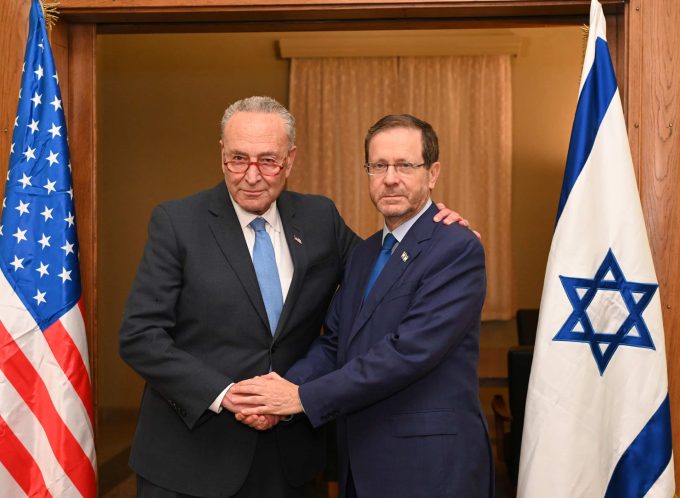
Photo by : Haim Zach / GPO
By Kyle Anzalone | The Libertarian Institute | February 4, 2026
Senator Chuck Schumer said that he would fight to get Israel “all the aid that it needs.”
“I will fight for aid to Israel. All the aid that Israel needs. I will continue to fight for it,” the Senate minority leader said on Saturday. He went on to refer to Israel aid as his “baby.”
The US has provided hundreds of billions in security assistance to Israel and fought several wars in the Middle East for Tel Aviv. Following the October 7, 2023, Hamas attack on Israel, the US sent Israel $14 billion in arms that were used to conduct a genocide in Gaza.
Schumer touted his role in passing that aid package to Israel. “We delivered more security assistance to Israel, our ally, under my leadership than ever, ever before. We will keep doing that,” he told the conference of Jewish-Americans. “As long as I’m in the Senate. This program will continue to grow from strength to strength, and we won’t let anyone attack it or undo it.”
The Democratic leader of the Upper Chamber also said that he hopes the ceasefire in Gaza turns into a lasting peace. However, Israel is undermining the truce with daily strikes on Gaza. Since Saturday, Israel has killed over 60 Palestinians.
While the US holds significant leverage over Israel via military assistance, statements like Schumer’s make it clear to Tel Aviv that Washington is unprepared to threaten Prime Minister Benjamin Netanyahu that if he does not comply with the ceasefire, Washington will end the flow of aid.
Epstein Files- Steve Bannon Admits Trump Administration Would ‘Not Cross Sheldon Adelson’ During First Term
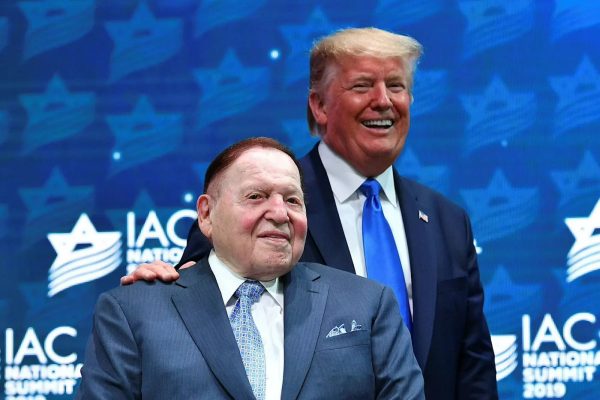
The Dissident | February 4, 2026
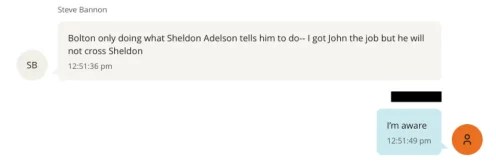
In text messages between Steve Bannon and Jeffrey Epstein in 2018, now released as part of the DOJ’s Epstein releases , Bannon admitted that the Trump administration was captured by the Zionist lobby and the Zionist mega donor Sheldon Adelson.
While discussing U.S. policy towards Qatar with Epstein, Bannon admitted “Bolton [John Bolton, then National Security Advisor to Trump] only doing what Sheldon Adelson tells him to do– I got John the job but he will not cross Sheldon” to which Epstein replied, “I’m aware”.
This is further conformation that much of Trump’s foreign policy agenda during his first term was set by Sheldon Adelson, and since his passing, his wife Miriam Adelson.
During a speech to the Israeli Knesset last year, Trump boasted , “I am proud to be the best friend that Israel has ever had” then went on to list every policy he enacted at the behest of Israel, saying,
But as president, I terminated the disastrous Iran nuclear deal. And ultimately, I terminated Iran’s nuclear program with things called B-2 bombers. It was swift and it was accurate, and it was a military beauty.
I authorized the spending of billions of dollars which went to Israel’s defense, as you know. And after years of broken promises from many other American presidents, you know that they kept promising… I never understood it until I got there. There was a lot of pressure put on these presidents. It was put on me too, but I didn’t yield to the pressure. But every president for decades said, “We’re gonna do it.” The difference is I kept my promise and officially recognized the capital of Israel and moved the American Embassy to Jerusalem.
He then credited the Adelsons with these Zionist policies, pointing to Miriam in the crowd after listing them and saying, “Isn’t that right, Miriam?”
He added, “Miriam and Sheldon would come into the office. They’d call me, he’d call me. I think they had more trips to the White House than anybody else I can think of … And she loves Israel. But she loves it. And they would come in, and her husband was a very aggressive man, but I loved him. He was very aggressive, very supportive of me. And, he’d call up, ‘Can I come over and see you?’ I’d say, ‘Sheldon, I’m the President of the United States, it doesn’t work that way.’ He’d come in… But they were very responsible for so much, including getting me thinking about Golan Heights, which is probably one of the greatest things to ever happen to Israel.”
He even admitted that Miriam Adelson- who Trump admitted was “responsible for so much” cared more about Israel than America, saying, “I actually asked her, I’m gonna get her in trouble with this, but I actually asked her once, I said, ‘So, Miriam, I know you love Israel. What do you love more, the United States or Israel?’ She refused to answer. That means, that might mean, Israel”.
While introducing Miriam Adelson at an event, Trump again boasted “Miriam (Adelson) gave my campaign $250 million” adding, “her husband Sheldon was an amazing guy, he’d come up to the office, and there was nobody more aggressive than Sheldon … he would always say ten minutes it turned out to be an hour and a half and what he did was he fought for Israel, it’s all he really fought for”.
Bannon’s comments in 2018 are just further conformation that Trump’s agenda was shaped by money from Miriam and Sheldon Adelson during his first term, and since Sheldon Adelson’s passing in 2021, Miriam Adelson, during his current term.
Germany eyes military space spending splurge to counter ‘threats’ from Russia, China: Report
By Deng Xiaoci | Global Times | February 4, 2026
The head of German Space Command Michael Traut reportedly claimed that Germany is considering a 35 billion euro ($41 billion) military space push, including spy satellites, space planes and offensive lasers, citing so-called “threats” from Russia and China in orbit. Chinese analysts on Wednesday slammed the move as classic double standards and Cold War mentality, as it cites baseless China “threat” claims, while ignoring the fact that the US is the top driver of space militarization.
Speaking with Reuters on the sideline of a space event ahead of the Singapore Airshow, Traut claimed that the spending plan is “aimed at countering growing threats from Russia and China in orbit,” Reuters reported on Tuesday local time.
It is reported that Traut revealed that Germany will build an encrypted military constellation of more than 100 satellites, known as SATCOM Stage 4, over the next few years. He also claimed network would mirror the model used by the US Space Development Agency, which is described by the Reuters as “a Pentagon unit that deploys low-Earth-orbit satellites for communications and missile tracking.”
Chinese analysts pointed out that while turning a blind eye to the US, the main driver behind the militarization of outer space, Germany choses to hype a groundless space threat theory against China and Russia. This is a typical manifestation of deep-seated double standards and camp confrontation with Cold War mentality, analysts said.
This kind of double standard is blatantly obvious, military affairs expert Zhang Junshe told the Global Times on Wednesday. “The US is currently the country that has deployed the most military offensive assets in space. Yet now, while Germany wants to imitate the US and do the same thing, it turns around and make baseless accusations against China and Russia. This is textbook double standards, Zhang criticized.
Notably, US Defense Secretary Pete Hegseth has just expressively harped on the importance of “American space dominance,” and claimed that the US needs to “dominate the ultimate highground,” at Blue Origin rocket factory in Cape Canaveral, Florida, on US local time Monday, News Nation reported Tuesday.
Germany will channel funding into intelligence gathering satellites, sensors and systems designed to disrupt adversary spacecraft, including lasers and equipment capable of targeting ground-based infrastructure, Traut claimed in his interview with Reuters. He also pointed to so-called inspector satellites – small spacecraft capable of maneuvering close to other satellites – which he claimed Russia and China had already deployed.
Hype about the “China-Russia space threat” has become a form of political correctness among European countries. Regardless of the facts, they feel compelled to point the finger at China and Russia. As an established old-school Western power, Germany is no exception to this cliché, Song Zhongping, a military affairs expert, told the Global Times on Wednesday.
It must be emphasized that should this plan come to fruition, it would markedly heighten the intensity of the space arms race, Song noted.
Germany’s indigenous launch capabilities are woefully inadequate. If it turns to SpaceX’s Falcon 9 for these deployments, it would confirm Germany’s status as an immature and dependent space actor. Should it instead rely on foreign rocket systems, that reliance would primarily fall on the US – leaving Germany unable to shake off its profound strategic dependence on the US, Song warned.
Power outages in Russian region after Ukrainian attack – governor
RT | February 4, 2026
Ukrainian strikes have severely damaged energy infrastructure in Russia’s Belgorod Region, causing widespread power outages and disrupting heating and water supplies, Governor Vyacheslav Gladkov reported on Wednesday morning.
Emergency crews worked through the night to repair the damage following what he described as a massive attack.
According to the governor, the city of Belgorod was struck by 12 munitions and three drones, with energy facilities among the damaged targets. Drone and artillery attacks were reported across nearly a dozen other districts. In the village of Dunayka, a drone attack on a truck wounded a man, requiring hospitalization. Another civilian was injured by an FPV drone in the village of Glotovo. A volunteer fighter was also wounded in Borisovsky District.
Due to the extensive damage to the power grid, Gladkov ordered schools and vocational colleges in ten districts to switch to remote learning, with kindergartens operating in a limited capacity.
He warned residents that emergency power outages would be unavoidable during the restoration work.
On Wednesday, the governor of neighboring Bryansk Region, Aleksandr Bogomaz, reported that Ukrainian forces had also used US-made HIMARS rockets to strike residential buildings, seriously injuring a woman.
The cross-border attacks come ahead of more US-backed talks between Russia and Ukraine in Abu Dhabi. Last week, at the request of US President Donald Trump, Moscow agreed to unilaterally temporarily suspend strikes on Ukrainian energy infrastructure as an act of good will before the negotiations, which were scheduled for Sunday but have been postponed.
Trump stated that Russian President Vladimir Putin had “kept his word” and that the pause had indeed lasted for a week from Sunday to Sunday. Ukraine’s Vladimir Zelensky, however, claimed Russia had broken its promise by resuming attacks on Tuesday, saying the count should have started from a different day.
Featured Video

More Iran War fallout: Maritime insurance industry shifts from London to China
or go to
Aletho News Archives – Video-Images
From the Archives
Allies Don’t Need Lobbies
By Jay Knott | Dissident Voice | September 24, 2013
In a recent article on Counterpunch, Rob Urie defended the traditional Marxist analysis of US policy in the Middle East. He argues that support for Israel is driven primarily by economic interest, not the Jewish lobby.
He starts by paying tribute to the idea that Western societies are uniquely racist. He says that the “Western narrative” claims there is an “Arab character”, and that this is “antique racist blather”. He gives no definition of these terms. Further, he establishes his credentials as part of the dominant current in the American left by claiming that “over a million people in Iraq died so ‘we’ in the West can drive SUVs.”1
When he tries to criticize bourgeois economics, he makes it clear he doesn’t understand the developments it has made since Marx’s day, using the mathematical discipline known as “game theory”. He dismisses the basic abstraction of economic theory, the idea of the rational individual, on the grounds that it is “devoid of history, culture and political context”. But abstractions are always devoid of something.
He defends a more concrete economic theory, mostly Marxist, with some input from another theorist of capitalist crisis, Hyman Minsky. This concrete theory leads him to the view that US activity in the Middle East is primarily driven by rational capitalist motives, the need to secure a supply of oil.
“Taking the totality of circumstance — former oil company executives launching war on an oil rich nation on a pretext they publicly proclaimed they didn’t believe shortly before taking office — and that upon launching their war proved to be non-existent, requires a willingness to overlook the obvious — that the war on Iraq was for oil, that is difficult to support.”1
Perhaps I’ve misunderstood him, but based on what he says in the rest of the article, this convoluted sentence seems to argue that, because president Bush and vice-president Cheney attacked Iraq on false premises, and they also said it was all about oil, and they are former oil executives, and Iraq has a lot of oil, it’s difficult to deny US attacks on Iraq are all about oil.
In fact, it’s not hard at all. As Urie points out, at times Bush and co. said that attacking Iraq was “protecting the world’s supply of oil.”1 But, as he also points out, they are congenital liars. Why should we believe them when they say they are trying to “protect” the oil supply? Protect it against what? When politicians “admit” attacks on Middle Eastern countries are wars for oil, they are parroting the neo-con party line, feeding the public, both left and right, with a plausible-sounding pretext. For right-wingers, “it’s a war for oil” is a reason to support war, and for leftists, it’s a way to feel better by complaining impotently about corporate greed. Both approaches help the war drive. … continue
Blog Roll
 Aletho News
- More Iran War fallout: Maritime insurance industry shifts from London to China
- US-Israeli aggression on Iran triggers review of GCC countries’ investment pledges to Washington
- Russia slams UK plan to seize tankers suspected of carrying its oil
- Pakistan ramps up food exports to Persian Gulf nations as war deepens food insecurity
- Iran submits response to US plan, sets terms for war’s end: Tasnim
- US vs Iran: Kharg Island Talk — Bluff or Escalation? Ex-Military Officer Weighs In
- Zelensky unnecessarily involves Ukraine in the Middle East crisis
- Turkish tanker blacklisted by Ukraine hit in drone attack – media
- Canada, the U.S., and NATO: the inescapable trap
- Villains of Judea: Leonid Radvinsky
- If Americans Knew
- ‘No Innocent Children’: Far-right Israeli Lawmaker Defends Killing of Palestinian Family
- Mossad’s promises helped Netanyahu convince Trump that Iran could be toppled
- US Arms Control Official Refuses To Comment When Asked If Israel Has Nuclear Weapons
- Veterans warn US landing could be ‘more Gallipoli than Vietnam’
- Israel may be committing war crimes in Lebanon – Not a ceasefire Day 167
- In the West Bank, life is a constant battle – 3 articles
- Jacob Reses, one of the most powerful pro-Israel operatives in Trump’s Washington
- Israeli-US assaults kill or injure 87 children a day – Not a ceasefire Day 166
- ‘Forever live by the sword’: Understanding Israelis’ massive support for Iran war
- UN’s special rapporteur on human rights says Israel is systematically torturing Palestinians
- No Tricks Zone
- Devastating Assessment Of Comirnaty Vaccine By Former Senior Pfizer Europe Toxicologist
- New Study: CO2 Is ‘Effectively Negligible’ As An Explanatory Climate Change Factor Since 2000
- Former Pfizer Toxicologist Dr. Helmut Sterz Tells Bundestag Hearing Pfizer Vaccine Should Have Never Been Approved
- Energy Expert: Germany’s Nuclear Phaseout Was A “500 Billion Euro Mistake”
- New Research: South Australia’s Mid-Holocene Sea Surface Temperatures Were 4°C Warmer Than Today
- Storing Green Energy To Last Germany 10 Days Would Require A 60-Million Tonne Battery
- New Studies: UK Sea Levels Were 4 Meters Higher Than Today During The Mid-Holocene
- Destructive Green New Deal: German Energy And Metal Group Warns Of Drastic Crisis
- New Study Documents A 20-Year Pause In Arctic Sea Ice Decline – Driven By Internal Variability
- Wake-up Call: Survey Shows Majority Of Germans Now Favor Postponing Climate Targets!
 Aletho News