Ukraine & Europe Can’t Out Wait Russia /Alexander Mercouris & Lt Col Daniel Davis
Daniel Davis / Deep Dive – February 3, 2026
IRGC drone completes lawful recon mission before contact lost
Al Mayadeen | February 3, 2026
Iran’s Islamic Revolution Guard Corps (IRGC) has reportedly lost contact with one of its drones during a reconnaissance mission over international waters, according to a source cited by Tasnim News Agency on Tuesday.
The Shahed 129 was conducting a routine operation when communication with the aircraft was suddenly interrupted.
Media reports earlier claimed that the US military downed an Iranian UAV that allegedly approached the USS Abraham Lincoln aircraft carrier in the Arabian Sea.
According to the Iranian source, the drone had been engaged in lawful reconnaissance and aerial photography, consistent with standard practices in international airspace. “The Shahed 129 drone was carrying out its routine reconnaissance and photography missions in international waters. This is considered normal and legal practice,” the source said.
The source added that the UAV had successfully transmitted all required imagery to the command center before contact was lost.
On the diplomatic front
This comes amid heightened regional tensions amid US threats to launch an aggression against Iran earlier in January. According to AFP, Saudi Arabia, Qatar, and Oman mounted a coordinated diplomatic effort on January 15 to dissuade US President Donald Trump from authorizing military strikes, warning that such an attack could trigger uncontrollable regional repercussions given the concentration of US military bases and strategic assets across the Gulf.
On the same day, diplomatic sources in Tehran told Al Mayadeen that a friendly regional party had informed Iran that Washington had reversed course on plans for military action following a reassessment of security and military risks, including the potential consequences of a large-scale strike and an evaluation of internal conditions inside Iran. Despite this reported pullback, Iranian authorities said they remained on full alert while keeping diplomatic channels open.
Both Tehran and Washington are expected to engage in mediated talks. Iranian Foreign Minister Abbas Araghchi and White House envoy Steve Witkoff are expected to lead the two negotiating teams. Araghchi held calls on Tuesday with his Omani and Turkish counterparts, as well as with the prime minister of Qatar.
Newly surfaced Epstein email ties him to Israel–UAE strategy targeting Qatar
MEMO | February 3, 2026
Newly uncovered emails dated July 2017 reveal disgraced sex trafficker Jeffrey Epstein, long accused of acting on behalf of Israeli intelligence, lobbying for political and financial pressure to be applied against Qatar at the height of the Gulf diplomatic crisis.
The email exchange, dated 6th July 2017, sees Epstein accusing Qatar of “terrorism financing,” describing its leadership as “dangerous,” and demanding that it be made to “come out against terrorism and not just say it.” He proposes creating a billion-dollar “victim fund” for terrorism survivors to be administered by the US, UK and UN, while calling on Qatar to either contribute financially or recognise Israel—framing both as tests of its sincerity in opposing terrorism.
Epstein outlines a strategy of reputational damage and financial pressure, proposing a Western-administered fund that would publicly test Qatar’s stance on terrorism. His language reflects the broader Israel–UAE effort at the time to isolate Qatar over its support for Palestinian rights and refusal to normalise relations with Israel.
The message was sent just weeks after the blockade on Qatar was launched by the UAE, Saudi Arabia and Bahrain in June 2017. Though publicly framed as a crackdown on terrorism and the Muslim Brotherhood, the blockade was seen as part of a broader effort to force Qatar to abandon its support for Palestine, close Al Jazeera, cut ties with Iran, and expel Turkish forces, demands that aligned directly with Israeli priorities.
As MEMO first reported in 2017, leaked emails from the UAE Ambassador Yousef Al-Otaiba revealed coordination with staunch pro-Israel figures in Washington, including Elliott Abrams and Dennis Ross, on strategies to “punish” Qatar. At one point, Abrams suggested that conquering Qatar would “solve everyone’s problems.” Al-Otaiba responded: “It would be an easy lift”.
Former German Foreign Minister Sigmar Gabriel later confirmed that the UAE had drawn up plans for a military invasion of Qatar. What prevented the assault was not US President Donald Trump, who publicly backed the blockade initially and called Qatar a “terrorism funder,” but then-Secretary of State Rex Tillerson, who intervened after being tipped off by Qatari intelligence, making over 20 calls in a frantic attempt to stop the invasion.
Throughout the crisis, Israeli and Emirati lobbyists jointly pressured US lawmakers to label Qatar a state sponsor of terrorism. The Foundation for Defense of Democracies, a pro-Israel neo-conservative outfit backed by billionaire and Benjamin Netanyahu ally Sheldon Adelson, worked closely with UAE officials to frame the narrative in Washington. Netanyahu himself met with UAE and Bahraini diplomats to coordinate efforts behind the scenes.
The email places Epstein—widely considered to have been a Mossad asset involved in sophisticated blackmail operations—squarely within the broader effort to isolate Qatar during the 2017 blockade. His proposals echo the strategy pursued by Israel and the UAE to punish Doha for its support of Palestinian rights and refusal to normalise relations with Israel
Focus on Panama’s ‘port case’ must not be misplaced
Global Times | February 3, 2026
Since the Supreme Court of Panama ruled that CK Hutchison’s concession contract to operate Panama Canal ports was “unconstitutional,” the most elated individuals over the past few days have undoubtedly been certain US politicians and media outlets. US Secretary of State Marco Rubio quickly posted on social media that the US is “encouraged,” while some American media outlets claimed this marks a “major victory” for Washington in curbing Chinese influence. The Wall Street Journal even issued a blunt threat, stating that other countries “might re-examine their ties to the world’s second-biggest economy.”
The cries of “victory” coming from the US confirm widespread outside suspicions and further expose Washington’s hegemonic arrogance in using geopolitical means to interfere with commercial cooperation and undermine trade rules. Although the US formally handed over control of the Panama Canal in 1999, in Washington’s Cold War mentality, this area remains an “inner lake” that others are not allowed to touch. The US has repeatedly expressed desire to “retake control of the Canal,” and Secretary of State Rubio chose Panama for his first overseas visit, threatening the country that it “must reduce Chinese influence.” Therefore, when the Supreme Court of Panama issued its so-called ruling, it is difficult for the international public opinion not to question its independence.
However, if one follows Washington’s rhythm and views this turmoil through the lens of “US-China competition,” they fall into a cognitive trap set by the US, and the focus on this matter becomes misplaced. These ports have never been, and should never be, bargaining chips in a geopolitical game. In fact, CK Hutchison has operated these ports for nearly 30 years; in such a long span of time, where has there ever been a shadow of a “Chinese threat”?
On the contrary, under the company’s management, these ports have been developed, benefiting the local area and contributing to global free trade. In this process, the US itself has been one of the beneficiaries. Therefore, regarding the attention on Panama’s port operation rights, if one must talk about winners and losers, the core should lie in the contest between free trade and hegemonism, and the confrontation between the spirit of contract and power politics.
Whether it is the ports along the Panama Canal, Australia’s Darwin Port mired in controversy, or the case of Nexperia in the Netherlands, the same “invisible hand” looms in the background. Some countries repeatedly claim to uphold a “rules-based order”; yet in practice, what they defend is an “order based on the interests of a single country.” This is, in essence, a targeted demolition of global investment credibility. If commercial contracts can be nullified at the whim of politicians or under pressure from allies, then no long-term investment within the Western system is truly safe. From Southeast Asia to the Middle East, global investors are watching closely, asking whether today’s rapacious acts will tomorrow descend upon any profitable industry.
International investment law does indeed recognize “security exceptions,” but these are by no means a universal master key for hegemonism. The core of international commercial law is certainty: companies that operate in compliance with the rules deserve the protection of the law. By using diplomatic coercion to push allies into rulings that defy legal principles, the US is eroding from within the very credit foundations on which the capitalist world depends. In the short term, Washington may have secured a few “strategic footholds”; however, in the long term, this has fundamentally undermined the international credibility of the US and the space for transnational commercial interactions. It is foreseeable that when the law ceases to be a fair arbiter and becomes a political tool, global capital will have to seek safe havens independent of the dollar system and the US “long-arm” influence.
What is even more concerning to the international community is that the geopolitical will of the US often surpasses the constitutions of some sovereign nations. This is a mockery of the principle of sovereign equality enshrined in the United Nations Charter. From the case of Alstom years ago to the current controversy over Darwin Port, the methods used by the US to attack competitors and seize interests are strikingly similar. The international business community needs a fair, just, and non-discriminatory business environment, not a “law of the jungle” dominated by hegemonic will. If this trend of politicizing economic and trade issues and weaponizing legal tools continues unchecked, the ultimate victim will be the entire international economic and trade order. Those who attempt to curb their rivals by undermining the rules will also find themselves facing a bankruptcy of credibility.
As an important maritime passage that carries about 5 percent of global shipping trade, the Panama Canal ports have become a crucial cargo hub on a global scale, and they should not waver under the shadow of hegemonism. According to reports, concessions for the Panama Canal ports will now need to be auctioned off.
In this context, it is hoped that the Panamanian side will truly demonstrate its “independence” by providing a predictable environment for fair competition for all bidders, rather than trying by any means to “ensure that China is blocked from the bidding” as some US media outlets have trumpeted. The whole world is watching everything that happens there.
‘No nuclear program, no ballistic missiles, no support for resistance’: Israel sets red lines ahead of Iran–US talks
The Cradle | February 3, 2026
Israel is pushing the US to maintain the “three no’s” in upcoming talks with Iran, Israeli media reported – referring to the demand that Tehran end enrichment and give up its nuclear program, end its ballistic missile program, and halt support for resistance groups in the region.
“Israel is expected to call for the US to uphold ‘three no’s’ during the talks with Iran. These demands are that under any deal with the US, Iran agree to have no nuclear program, no ballistic missile program, and to give no support to armed proxy groups,” the Times of Israel said.
The report says the message will be delivered during a meeting with Israeli Prime Minister Benjamin Netanyahu ahead of US envoy Steve Witkoff’s expected engagement later this week with Iran’s top diplomat.
According to Israel’s Channel 12, the chiefs of Mossad and the Israeli army will be present at the meeting, as well as other security officials.
Iranian President Masoud Pezeshkian has announced that Tehran has agreed to hold a round of nuclear talks with Washington – in an effort to de-escalate tensions – on the condition that threats be halted and that “fair and equitable” negotiations take place.
“I have instructed my Minister of Foreign Affairs, provided that a suitable environment exists – one free from threats and unreasonable expectations – to pursue fair and equitable negotiations, guided by the principles of dignity, prudence, and expediency,” he said.
Iranian Foreign Minister Abbas Aragchi will meet Witkoff in Ankara on Friday.
Despite agreeing to hold talks, Tehran has categorically refused to capitulate to the “three no’s” demand.
“Iran’s defense is non-negotiable,” an Iranian source told Reuters.
Ali Shamkhani, senior advisor to Iran’s supreme leader, said the same thing in an interview with Al Mayadeen. He also said the US must “set aside unreasonable demands.”
He said Iran could potentially reduce enrichment, as was reported last year and hinted at by some officials.
“If the US attacks us, we will automatically regard Israel as a party to it, and we will inevitably respond accordingly. Any aggression against Iran, no matter how limited, will be turned into a very serious crisis, far greater than others imagine.” he added.
The Islamic Republic’s Supreme Leader, Ali Khamenei, has warned of a “regional war” if Iran is attacked. Officials have vowed that Tehran will strike Israel and US military bases across the region if the US decides to bomb.
Resistance groups in West Asia, including Lebanon’s Hezbollah, have warned that an attack on Iran would ignite the region.
Washington’s aircraft carrier, the USS Abraham Lincoln, has arrived in West Asia with several accompanying warships. Washington has also deployed additional fighter jet squadrons to the region.
Last week, Trump said that a “beautiful armada” is headed toward Iran, calling on the Islamic Republic to capitulate to US terms.
“If Iran doesn’t come to the talks on Friday with tangible things, it could find itself very quickly in a very bad situation,” a top official from a mediating country told Axios.
Araghchi recently said, “Let’s not talk about impossible things” when asked about the three main US-Israeli demands.
Showdown
By William Schryver – imetatronink – February 2, 2026
For several years now I have been making the argument that, because American military power is so widely dispersed and diluted across the planet, the only way the United States could concentrate sufficient forces to prosecute a war against one of its three major power adversaries (Russia, China, and Iran) would be to significantly deplete its force posture relative to the other two.
That is precisely what has been happening over the course of the past few weeks in relation to the military buildup in the Persian Gulf region, in apparent preparation to launch an air campaign against Iran.
Now, granted, as I wrote yesterday, the force the US is concentrating in the Middle East via an aggressive heavy airlift operation is not sufficiently potent to sustain more than about two weeks of high-intensity war against Iran. US stockpiles of precision-guided weaponry are simply too limited to allow for a more protracted campaign.
Nor do I believe the US has the logistical and maintenance capacity to keep a large percentage of its fleet of aging aircraft air-worthy for more than about two weeks — especially when there will very likely be Iranian missiles raining down on all the US bases in the region.
And therefore, if Iran proves capable of turning it into even a month-long regional war of attrition, there is no way I can see the US being able to sustain its sortie rate, nor to tolerate the losses of men and equipment it would inevitably incur.
The US would be forced to withdraw.
It would be a catastrophic debacle for Washington, and would radically alter the global balance of powers.
Of course, a great many Americans and others around the world are convinced that the US military is so incomparably awesome that it will be able to overwhelm and subdue the Iranians within no more than 48 hours or so – and therefore the risk of “running out” of strike missiles and air defense interceptors is illusory and irrelevant.
For most people around the globe, the notion that the US could actually LOSE a war to Iran is utterly incomprehensible.
Maybe these people are right. Maybe I and others have completely overestimated Iranian capabilities. Maybe Iran will collapse like a house of cards in the face of one “shock and awe” strike by the US and Israel. Maybe they will be so intimidated by this major concentration of American force that they will, at the eleventh hour, simply accede to American demands to abandon their nuclear program, dismantle their missile force, and permit the US to install a puppet government in Tehran.
But I strongly doubt it.
In any case, the US has delivered a formidable strike force to the region. In addition, a huge proportion of US air defense capability has now been committed to this campaign in anticipation of a formidable Iranian counterstrike to an American/Israeli attack on them.
I have, for the past few years, repeatedly expressed my doubts that the US would ultimately opt to launch a war against Iran. I have been largely persuaded that clear heads in the Pentagon would recognize the very significant risks of such an undertaking, and that their well-established aversion to human and material losses would eventually dissuade them from stumbling into such a potential strategic disaster.
But, by all indications, the powers-that-be in Washington are now fully committed to enforcing their demands on Tehran. And the Iranians appear committed to standing their ground. Neither side can retreat at this juncture. So it’s gonna be a showdown.
US traders struggling to find buyers for Venezuelan oil, as China shifts supply chain to Canada
Inside China Business | February 2, 2026
Following the US takeover of the Venezuelan oil industry, commodities trading firms were given contracts to market the crude to buyers across the world, including to China. But Venezuelan crude oil is now being sold at far higher prices than before, with the profits routed through US companies and energy traders. The higher prices have pushed Chinese refiners out of the market for the heavy crude from Venezuela, and they are shifting their orders to Canada, Russia, and Iran. Canadian tar sands oil is more expensive than Venezuelan heavy sour, but is similar, and offers far shorter transit times and lower shipping costs. Chinese energy traders have been instructed to refuse new offers for Venezuelan crude. Closing scene, Wulingyuan, Hunan Resources and links:
Reuters, Vitol, Trafigura offer Venezuelan oil to Indian, Chinese refiners for March delivery, sources say https://www.reuters.com/business/ener…
China replaces US barrels with crude from Canada https://www.seatrade-maritime.com/tan…
Trump’s Venezuela oil grab is pushing Chinese refiners to Canada (Not paywalled) https://calgaryherald.com/business/tr…
Reuters Exclusive: PetroChina holds off from buying Venezuelan oil marketed under US control, sources say https://www.reuters.com/business/ener…
Bloomberg, Trump’s Venezuela Oil Grab Pushes Chinese Refiners to Canada https://www.bloomberg.com/news/articl…
Trump administration demands Venezuela cut ties with US adversaries to resume oil production https://www.cnn.com/2026/01/07/politi…
New York Bans Israel-Linked Terror Group
A Good Start, But…
By Kevin Barrett | American Free Press | February 2, 2026
On January 13, the State of New York set a small but significant precedent by banning the Jewish-supremacist terror group Betar. In a settlement with the state’s Attorney General, Betar agreed to stop terrorizing New Yorkers who disagree with the group’s pro-Israel, Jewish-supremacist agenda. Simultaneously with the agreement Betar dissolved its New York operations—but vowed to reconstitute itself and continue terrorizing Americans in other jurisdictions.
Though New York did not officially deem Betar a terrorist group, it’s clear that’s exactly what it is. The definition of terrorism is: “Using violence or the threat of violence against civilians to create fear for political purposes.”
Clearly, terrorism was and remains Betar’s central mission. New York’s Attorney General Letitia James wrote: “My office’s investigation uncovered an alarming and illegal pattern of bias-motivated harassment and violence designed to terrorize communities and shut down lawful protest.” Leaked messages show the group conspired to blind peaceful anti-Israel protesters with laser weapons and attack them with chemical weapons. Betar even plotted to car-bomb New York’s mayor. They delivered dozens of bomb threats to students, professors, and other Americans.
Betar’s members conspired to attack anti-Israel protesters with lasers, asking “can we burn their eyes out?” They routinely dispensed bomb threats by delivering Israeli-style (exploding?) pagers to people whose views they disagreed with. And they conspired to commit these and other acts of terrorism with “many people in various goverment (sic) offices including the prime ministers (sic) office, shin bet and other intelligence agencies in the state of Israel” according to their own leaked text messages.
The violence wasn’t just talk. On numerous occasions, pro-Palestine demonstrations have been brutally attacked by suspected Betar thugs, who typically wear face-masks to prevent identification. In just one of many examples, peaceful protesters at UCLA were attacked by Betar-aligned terrorists armed with explosives and chemical weapons last June. Unfortunately, since the pro-Zionist-terrorism Anti-Defamation League (ADL) and other organized crime syndicates have infiltrated and bribed local and national police agencies, Betar’s Jewish supremacist terrorists are rarely brought to justice.
If you’re still wondering whether Betar is really a terrorist group, try the following thought experiment: Imagine what would happen if radical Muslims plotted to blind Jews with lasers, attack them with explosives and chemical weapons, threaten them by delivering realistic-looking bombs, and joyfully envisioned murdering a Jewish mayor of New York by blowing up his car. Clearly such a group would be immediately slapped with a terrorist designation: All its assets would be confiscated, its members would be arrested and sent to Guantanamo, all their assets would be seized, and any remaining members would be hunted down and killed using US military drones.
And what would happen to the foreign nation that supported that wave of terrorism in the US? Our federal government would immediately sanction it, freeze and confiscate its assets, bomb it, and very possibly invade it and execute its leaders.
But when the terrorists are Jewish supremacists backed by the state of Israel, the rules suddenly change. The worst thing that can happen to them is a negotiated settlement with the state of New York in which the terrorists promise to stop terrorizing New Yorkers, while vowing to continuing terrorizing Americans in other states.
Maybe it’s time to start treating Betar and similar groups the same way we treat other terrorists. After all, the whole point of declaring a “war on terrorism” after the attacks on September 11, 2001 was to punish the people who committed that atrocity and remove their ability to commit future atrocities.
But we went after the wrong people. The real 9/11 terrorists were Israeli-backed Jewish supremacists, who orchestrated the false flag demolition of the World Trade Center to hijack America’s military and use it against their regional enemies. (For details, read “9/11 Was an Israeli Job” by Laurent Guyénot; “American Pravda: October 7th and September 11th” by Ron Unz; and “Israel Did 9/11” by Wyatt Peterson.
New York’s polite closure of Betar’s local branch office is a good start. But Americans need to recognize that Betar and its state sponsors are terrorists—and treat them accordingly.
It would be logical, not to mention poetic justice, for the US government to use the extraordinary powers it seized after 9/11 to punish the real perpetrators of the demolition of the World Trade Center and the attack on the Pentagon, and to ensure that they will never again commit such an act. By recognizing that Betar and other Jewish supremacist groups are terrorists, and that the world’s worst terrorism-supporting rogue nation is the so-called state of Israel, Americans could finally do what is necessary to win the war on terror that was declared in the wake of Israel’s controlled demolition of the World Trade Center.
Mike Pompeo admits Washington ‘directly helped’ rioters in Iran
Press TV – February 2, 2026
Former CIA director Mike Pompeo has admitted that Washington played a direct role in recent violent riots in Iran, saying the United States “directly helped” the rioters.
In an interview with Israeli Channel 13 on Monday, the interviewer referred to US President Donald Trump’s promises of support for the rioters and suggested that such help never materialized.
Pompeo rejected that view, responding, “I do not think so. Help did come … a lot of help. We may not see it all … We may not know about it all, But the United States is actively trying to help [them].”
When asked whether Trump had missed the opportunity to “overthrow” the Iranian government, Pompeo again disagreed.
His remarks revealed that despite the Trump administration’s repeated statements about pursuing a peaceful solution with Iran, Washington was in practice working toward “regime change” in Tehran.
Pompeo had previously linked the riots in Iran to American and Israeli intelligence agencies. During the riots on January 2, he wrote on the social media platform X, “Happy New Year to every Iranian on the streets. Also to every Mossad agent walking beside them.”
Peaceful protests began in late December in Iran’s commercial districts following the depreciation of the rial against the US dollar.
By early January, however, the situation escalated into violent riots after terrorists linked to Israel and the US infiltrated the gatherings, using live ammunition against security personnel and civilians.
In response, and to protect ordinary people, Iranian security forces and intelligence units intervened decisively and detained the ringleaders behind the violence.
On January 12, millions took part in nationwide demonstrations in support of the Islamic Republic, after which the riots quickly subsided.
Iranian FM reveals ‘fruitful’ indirect talks with US in push for de-escalation
The Cradle | February 2, 2026
Iranian Foreign Minister Abbas Araghchi said in an interview on 1 February that a nuclear agreement with the US was still possible, while warning that a war would engulf the entire region.
Speaking to CNN, Araghchi said indirect communications through regional intermediaries have been “fruitful,” stressing that negotiations must focus strictly on Iran’s nuclear program rather than missiles or regional allies. “Unfortunately, we have lost our trust (in) the US as a negotiating partner.”
In June last year, Iran was attacked by Israel in the middle of nuclear negotiations. US President Donald Trump pretended to favor diplomacy while secretly plotting war with the Israeli leadership.
When asked about halting support for resistance groups in West Asia and a cap on the ballistic missile program, which Washington is demanding, Araghchi told CNN, “Let’s not talk about impossible things.”
“And not lose the opportunity to achieve a fair and equitable deal to ensure no nuclear weapons. That, as I said, is achievable even in a short period of time,” he added. “Of course, in return, we expect sanction lifting.”
Araghchi went on to say that “war would be a disaster for everybody,” given that US military bases were scattered “all over the region.”
He added that Iran has learned lessons from the 12-day war in June and is ready to defend itself from any attack.
“And I think we are now very well prepared. But again, being prepared doesn’t mean that we want war. We want to prevent a war.”
The foreign minister also condemned the foreign-backed “terrorist” riots in Iran last month, and denied Trump’s claims that the execution of protesters was canceled, prompting the US president to halt his planned attack.
“There was no plan for the execution or hanging. I can affirm that the right to each and every person who is arrested and detained would be observed and guaranteed,” he stressed.
“We consider these three days as the continuation of those 12 days of war that was an operation led by Mossad from outside, and of course, we crushed that operation.”
Washington’s aircraft carrier, the USS Abraham Lincoln, has arrived in West Asia with several accompanying warships. Washington has also deployed additional fighter jet squadrons to the region.
Last week, Trump said that a “beautiful armada” is headed toward Iran, calling on the Islamic Republic to capitulate to US terms and come to the negotiating table.
The Iranian military and several other officials say both Israel and the regional countries hosting US bases will be targeted if Washington attacks.
Araghchi’s comments to CNN came after Iran’s Supreme Leader Ali Khamenei warned that a “regional war” would erupt if the US decides to launch an attack against the Islamic Republic.
“The US should know that if they start a war this time, it would be a regional war. Of course, we are not the initiators of war. We do not seek to oppress anyone. We do not seek to attack any country. However, anyone who seeks to attack or cause harm will face a decisive blow,” the leader said.
Resistance groups in West Asia, including Lebanon’s Hezbollah, have warned that an attack on Iran would ignite the region.
Over the weekend, Ali Larijani, head of Iran’s Supreme National Security Council, said, “Contrary to the atmosphere being created by artificial media warfare, the formation of a structure for negotiations is underway.”
On Friday, Araghchi held de-escalation talks in Ankara with his Turkish counterpart Hakan Fidan, who said that Turkiye opposes military action against Iran.
American Zionists are using Trump’s Republican Party to create a multicultural supremacist elite

By Matt Wolfson | Al Mayadeen | February 2, 2026
On January 13, 2025, seven days before Donald Trump’s second inauguration as president, The Free Press, the online magazine created by the Zionist operator Bari Weiss who has powerful connections to the Trump Administration, ran a profile which may say more about the ultimate causes of America’s current policies, and where those policies will likely lead, than any other public document.
The profile was of Amy Chua, famously the author of Battle Hymn of the Tiger Mother, a mostly well-received cri de Coeur for what Chua sees as rigorous Chinese parenting; and less famously the John M. Duff, Jr. Professor of Law at Yale Law School. The profile, drawing explicitly on Chua’s most publicly recognizable achievement, was titled “The Tiger Mother Roars Back,” and its subtitle reinforced its approach, an ardent rave: “Yale tried to run Amy Chua out. Now her former students, J.D. Vance and Vivek Ramaswamy, are headed to Washington. So is she.”
For people who follow the politics of America and so of America’s empire, the forwardness of this profile raises questions. Construed as a gesture of support for two politicians, Vance and Ramaswamy, who are attempting to woo the public on populist credentials, it seems misthought. There is nothing populist about Chua—and her lacks are tells about the lacks of her mentees. Indeed, it was under Chua’s mentorship that Vance wrote a bestselling book with the encouragement of another Chua mentee, Vance’s future wife Usha, blaming the failures of his lower-income Appalachian upbringing on the “cultural” deficiencies of the community which raised him. This is a view that, since entering politics with the aim of appealing to precisely that community, he has quickly disavowed. Ramaswamy, for his part, has fallen deeply and predictably afoul of populist Americans precisely by making that case in public.
So why would Weiss, who if nothing else is a strategic operator, run a piece on Chua connecting her to Vance and Ramaswamy as well as broadcasting Chua’s views, which are anathema to the people from whom Vance and Ramaswamy want support?
The answer is that, though Weiss is an ideologue focused on advancing “Israel’s” immediate interests, there is a “positive,” longer-term Zionist play in the works among her and her allies. I have reported in miniature on this play last year, in a September investigation of the philanthropic education donations of Bill Ackman, the Zionist financier: to seed a new ruling elite based on technological and management skills. But the project goes deeper. It amounts to the legitimation of a new ruling class in America centered on a narrow cadre of elites of three groups— Zionists, Hindutvas (Hindu supremacists), and, discernably but least specifically definably, East and Southeast Asian supremacists often with connections to countries where Buddhism has exercised significant influence.
These elites use their present success in America’s military corporate complex to make claims to group superiority. They then use those claims to justify special treatment for their groups and nations that allow them to solidify their power, and to solidify the hold of American empire, which they see as the rightful disseminator of “merit.” Their accelerating project will likely realize itself through the Republican Party, via Chua’s mentees, the Vances and Ramaswamy, among others, and it may ally itself with other right-wing influences as seemingly dissimilar but actually imitative as the white supremacy of Nicholas J. Fuentes. It is only now taking recognizable shape, and understanding its origins and spread is crucial to understanding the havoc it is already beginning to wreak in America and abroad.
That understanding begins with examining the arguments which influenced Vance and Ramaswamy; arguments made by Amy Chua and Jed Rubenfeld, her husband, a Yale Law professor and Jewish Zionist who writes for The Free Press. These arguments are noteworthy in that they look for “warps” in cultures to explain problems which other scholars have put down to military corporate power and its brute effects (outsourcing, conglomeration, the Wars on Crime and Drugs, unauthorized and some kinds of authorized immigration) on American life.
Indeed, the most straightforward reason why Vance’s Appalachian Americans as well as Black and Latino Americans have notably struggled is American imperial policy that has started at the top: labor outsourcing and urban mis-development, misthought immigration policies, and military corporate buildup. These policies have accrued for 60 years, and academics and writers have made the case against them for almost 50.
This book of Chua and Rubenfeld’s, where they lay out their view (The Triple Package: How Three Unlikely Traits Explain the Rise and Fall of Cultural Groups in America) does not emphasize these structural, practical explanations. Instead, Chua and Rubenfeld put “winners’” success in America over the last sixty years down to three group traits: specifically, “a superiority complex,” “insecurity,” and “impulse control.” According to The Triple Package, “a superiority complex” means “a deeply internalized belief in your group’s specialness, exceptionality, or superiority” flowing from religion, civilization, or social traits. “Insecurity” means “a sense of being looked down on, a perception of peril, feelings of inadequacy, and a fear of losing what one has.” And “impulse control” means “the ability to resist… the temptation to give up in the face of hardship or quit.”
But the paradox of Chua’s and Rubenfeld’s explanation, which they don’t appear to realize, is that, taken logically on its face, it supports the structural, practical explanations they apparently ignore. Political theory and history show that groups in the grip of triple package holders’ emotional Cartesianism (possessing an a priori thesis, superiority, in the face of insecurity, and so willing to do anything to prove the thesis right) are reliable tools of arbitrary imperial power. Indeed, empires moving aspirant, insecure, determined groups into their own managerial elite is a defining feature of the Roman Empire; the British Empire in the American colonies and India; the German Empire; and the United Arab Emirates. In America’s empire, these co-opted groups have most prominently been the three which Chua and Rubenfeld write about most often and with whom they and their family most identify: Jewish Americans, Indian Americans, and East and Southeast Asian Americans.
All three of these groups experienced marginalization and persecution at the hands of various empires (the Russian and German; the British; the American) before 1950. Their members have attendantly experienced heightened levels of insecurity; and elite cadres of two of the three groups have adopted what most scholars consider to be clearly definable supremacist ideologies: Zionism, which was founded in 1897 and Hindutva ideology, which was founded in 1925. The third type of supremacy, East and Southeast Asian supremacy, is more diffuse but clearly discernable.
Unlike Zionism, which is linked to “Israel”, and Hindutva ideology which is linked to India, there are multiple countries at play and multiple labels under which claims of East and Southeast Asian supremacy are raised. Also, the way these claims are raised often surfaces less as outright supremacy and more as “cultural essentialism”—that there’s something in this group’s cultural “essence” that makes members more “successful.” Finally, research into outright supremacist manifestations from groups associated with them is more recent, usually under the headings of Buddhist or East Asian supremacy. Nonetheless, taking these distinctions into account, East and Southeast Asian success in America’s imperial complex and corresponding claims like Chua’s to superiority are recognizable trends: some of them embraced by supremacists who praise thinkers like Chua for what critics call their cultural supremacy.
I have reported at some length about how the process of these groups claiming power in American empire played out, beginning with Jewish Zionist elites in the 1960s. I examined these Zionist elites’ acceptance into the American military corporate complex by WASPs (White Anglo-Saxon Protestants). I also pointed out that Zionists’ overall success accessing this complex came from their pursuit of narrow applied skills valued by the WASPs: economics, management theory, administrative law, engineering, finance, and technological proficiencies; a model the WASPs took quite consciously from European Empires. Zionists, in their own description, were easy marks for this kind of invitation to power that ultimately deracinates the culture of the people who accept it.
Theodor Herzl, the founder of the movement who embodies the terms of its successes and failures, was a marquee possessor of Chua’s and Rubenfeld’s triple package. He had grown up a secular Jew with little connection to his religion but a strong sense of his own superiority, and only embraced Zionist Judaism with a manic intensity when the Dreyfus Affair made him decide that he could never realize his ambitions without identifying as Jewish.
An instructive echo of Herzl’s mentality comes in the memoir of Martin Peretz, one of the early entrants into America’s corporate complex in the 1960s. Peretz, who taught at Harvard, owned The New Republic, the most influential Zionist magazine in the country, and played a prominent connective role in and near Wall Street, is in many senses a later-day Herzl. He is a high-status secular Jew with an admitted sense of insecurity who is also a fervid Zionist, and he writes in his memoir about himself and his friends who “made it” that
We were… from a strong culture that was an outsider culture, in the first generation when that culture could assert itself in American institutions. We weren’t constrained by old obligations because we were coming into a world that didn’t want us anyway. We had each other’s backs because we knew the kind of resentment arrivistes, and Jewish arrivistes, unleashed… We were the first ethnicity to break through into the ruling class institutions following the wane of Protestant influence, and we saw those institutions as the key to our flourishing.
Peretz’s Harvard mentee, Bill Ackman, the Zionist financier, is a good example of how younger Zionists operating in Herzl’s and Peretz’s tradition have swallowed this model whole. Ackman’s view of Harvard, where he is also a donor, falls along just these lines of imperial functionality:
As one of the oldest and perhaps the most notable of this country’s academic institutions, Harvard represents the gateway to elite status and to ‘making it’ in modern day American society. One need only look at the disproportionate numbers of Presidents, Nobel Laureates, and chairmen of Fortune 500 companies who have graduated from Harvard to understand the power of the Harvard degree. As a result, admission to Harvard has become the target of groups seeking upward mobility.
What goes unacknowledged here is that “elite status,” “upward mobility” and the skills that create them have only been an aspiration for most Americans since 1945, when the Cold War allowed WASPs to expand their institutions and use them to try to mold the country in their image. Before this point, most Americans understood their country as being predicated on towns and cities and states; and on a high degree of associational thickness, communal coherency, and decentralized government which allowed individuals a say in the terms of their lives. But Zionists were never open to an argument like this. Their strategy, like Herzl’s, was to enter empire and use it to rise, and it is not a coincidence that, almost immediately on accessing America’s military corporate complex, they opened America’s doors to Hindu and East and Southeast Asian operators who approached the matter of institutions and power on their terms.
The Zionists’ tool was the 1965 Immigration and Nationality Act, which was sponsored by staunch Jewish Zionist Congressman Emmanuel Celler. The Act opened America’s elite universities to “high-skilled,” often upper-middle class arrivals from undemocratic or less democratic countries like India and China: people not particularly versed in constitutionalism but extremely well-versed in applied technical proficiencies valued by empire.
The most obvious beneficiaries were Hindu Americans. It was the 1965 legislation and its 1990 expansion by George H.W. Bush, the penultimate WASP president, which brought into this country the parents of Usha Vance; Vivek and Apoorva Ramaswamy; the pro-Zionist Republican operative and current Assistant Attorney General for Civil Rights Harmeet Dhillon; and the U.S. Representatives Ro Khanna, Raja Krishnamoorthi, and Suhas Subramanyam. More decisively, as I reported in December, it has brought into the defense-tech mecca of Silicon Valley aggressive Hindu financial operators who have deep political sway. Much as, in the telling of anti-Zionist Jews like Norman Finkelstein, the converging success of Israelis and American Zionists off the largesse of America’s imperial complex hardened these players’ Zionistic belief in their Jewish supremacy, so a similar trend appears to have taken place with American Hindus who adopt some version of Indian Prime Minister Narendra Modi’s Hindutva ideology. Their influence, as outlined by Andrew Cockburn in a groundbreaking article in Harpers, reaches deep and wide, in part through their connections to Zionists.
Somewhat more subtle than the Hindutva assumption of influence in America, but equally noteworthy has been the East and Southeast Asian, especially Chinese, accrual of influence here. WASPs had used their educational and financial influence to foster relationships with China going back to the 1870s. Later, Zionists took up that task: bringing Chinese elites into philanthropy and finance, aided by the 1965 legislation, which led to a sharp increase in high-skilled East and Southeast Asian immigration to America. Arguably the clearest window onto this process is the Committee of 100: a group with connections to Amy Chua founded in the late 1980s by influential Chinese Americans at the urging of Peretz ally and “Israel” defender Henry Kissinger, and with the aid of Peretz’s friend Yo-Yo Ma. As I traced in my report last year on the Committee’s growth, the Committee and some of its members have assiduously inserted themselves at crucial educational and philanthropic junctures. As I reported about their propaganda last April:
The obvious part of their message is that… America is a colorblind nation where, minus prejudice, anyone can succeed. In this schema, anyone questioning the loyalties or actions of those who have succeeded, like [members of the Committee] and their allies, are acting off of lower motives, and are anti-merit.
What is also instructive is that, despite vocal pushback to Chua’s ideas by regular readers, prominent East and Southeast Asian Americans and East Asian American organizations, including but not limited to the Committee of 100, have embraced Chua since she gained fame with her ideas and given her a public platform. Allies of Chua’s echo her arguments in a gentler way, among them the Chinese-American writer Sherryl WuDunn, a connection of Chua’s via other East Asian American organizations, whose husband Nicholas Kristof made a less constrictive, “essentialist” version of Chua’s cultural supremacist arguments in The New York Times. And cultural, ethnic, and even racial supremacists like the neoconservative Charles Murray have embraced Chua’s claims.
Jewish Zionists have been forging alliances with Hindu and East and Southeast Asian American arrivals at an accelerating rate for nearly 40 years. They have used these groups’ shared success to argue that any opposition to those groups with an outsized place in America’s military corporate complex comes from resentment and envy among people who don’t measure up.
In 1988, only 23 years after the Immigration and Nationality Act was signed, two years before the inception of the Committee of 100, and eight years before the Silicon Valley boom began, Bill Ackman, on the advice of his Harvard mentor Peretz, wrote an honors thesis entitled “Scaling the Ivy Wall: The Jewish and Asian Experience in College Admissions.” In the thesis, Ackman “draws parallels between the experience of Jews trying to gain admission to Harvard in the 1920s with the experience of applicants from Asia during the 1980s.” In 2024, gearing up for his crusade against anti-Zionism in universities, Ackman began making the rounds of newspapers, magazines, and online interviews, armed with his undergraduate thesis, arguing that the groups he wrote about in the 1980s (Jews and Asians) are technical achievers being discriminated against by opponents of merit.
That same year, Ackman’s ideological ally Bret Stephens featured in his Zionist magazine Sapir a piece quoting Ackman’s 1988 thesis by an ardent backer of Ackman’s ardent ally Vivek Ramaswamy: Rajiv Malhotra, arguably the most prominent Hindutva operating outside of India. Malhotra began this essay, an argument for “A Hindu Jewish Partnership”, by arguing that, like Asian Americans and Jews, Hindu Americans are “‘model minorities’ who have made much of the American dream” and must come together “to safeguard the world from the regressive movement against merit.” This notion that any resentment against those groups which seem to be steering American Empire flows from jealousy or resentment is shared by Amy Chua, who said, in a recent interview, that
There is tremendous resentment, fear, and insecurity about Asian-Americans because of college admissions… And then you’ve got China, a whole different source of insecurity.… Now on campus, I noticed that this anti-Chinese resentment slash fear is coming from both the Left and the Right, which is very unusual.
Tellingly, none of these arguments about “safeguarding merit” define merit as anything other than technical skills fit for empire, and this is not a bug but a feature of supremacist argument. Jewish, Hindu, and East and Southeast Asian supremacists justify their traditions based on their ability to impart skills that help empires claim power. Examples of this pattern range from Hindutvas who boast that “ancient Indians were proficient in stem cell technology and built aircrafts” in “an imagined Hindu golden age of scientific progress,” to equally remote Zionist narratives claiming that consumer innovations of all kinds originated with “Israel” to Amy Chua’s “conceptually loose” and factually dubious appropriation of her “meretricious” heritage for raising “successful” children. None of these arguments address the arguments of dissenters from within their traditions who think that, by attaching their traditions to a project of empire based on technical skills, supremacists have distorted the moral, intellectual, and cultural essences that made these traditions worth having. The most accurate description of the supremacists may in fact be “ethnopreneurs”: players who use their groups’ access to empire to show a public they assume is aspirant how to be like them, gaining recognition or profit by doing so.
The supremacists also have imitators, sometimes in the most seemingly unlikely of places. It was Nicholas J. Fuentes, nominally on the other side of the new Republican coalition from Ramaswamy and Chua and Rubenfeld and Weiss, who recently told Piers Morgan that “In Israel, they have my politics. If they had their way, it would only be Jewish people.” In fact, in “Israel”, it’s not Jewish people who are welcome; it’s only Jews openly committed to Jewishness as an imperial supremacist project, much as Fuentes is openly committed to an imperial supremacist project around white male Americans whom he says are victimized based on the superiority of their race.
Chua’s mentee J.D. Vance appears to be working to stabilize the Republican coalition in ways that may function, whatever his intent, to unite the supremacists. Even as Vance speaks implicitly in favor of including Nick Fuentes in the Republican Party and Vance’s ally Tucker Carlson gives Fuentes a platform, Vance’s most prominent ally, Erika Kirk, who is publicly committed to his 2028 presidential bid, is appearing in interviews with Zionists like Bari Weiss and Andrew Ross Sorkin. Vance only recently helped ink the deal that put Zionists, including Jared Kushner and the Ellisons, in control of TikTok; and in 2025 both Vance’s wife Usha and his mentor Chua gave rare, exclusive interviews to Weiss’s Free Press, which the Ellisons now own.
This year, Vance is scheduled to appear on CBS’s new Town Hall series, where he will be interviewed by Weiss. This looks like the rudiments of a new coalition of elites with nominally different heritages united by a shared conviction of supremacy. And policy is following suit to privilege these elites—not so much shrinking the “deep state” as Trump promised during his reelection campaign but redirecting it in ways that serve their interests:
“Israel”, with American support, is “modernizing” and “improving” Latin America and the Middle East using its technical prowess, compromising the sovereignty of nations and regions. Hindutva ideologists are coming to Silicon Valley, where Zionists arbitrate power. East and Southeast Asians are entering the Ivy League in record numbers with the aid of lawsuits from Zionist operatives, even as the Trump Administration has made no effort to shrink these universities’ power as the “gateway” to political influence.
The Muslim world, arguably Zionists’ and Hindutvas’ and Buddhist East Asians’ greatest enemy, has become our enemy. American Zionist operatives are using artificial intelligence to track anti-Zionist opinions online in conjunction with imperial outgrowths like Harvard in ways that sound quite similar to the Hindutva ideologue Rajiv Malhotra’s proposal in the Zionist magazine Sapir for an “Intellectual Iron Dome” in imitation of Israel’s defense system the Iron Dome. (This is a project seemingly imitative of Philip K. Dick’s dystopian novella The Minority Report: “to harness the powers of AI… to monitor and examine trends in antisemitism and Hinduphobia online and predict problems before they manifest.”) And, thanks to the Zionist Stephen Miller, the Trump Administration is deporting migrants of color while deracinating their “sh**hole” countries of oil in the name of serving the people for whom Fuentes claims to speak. Namely, a mostly white American population now “freed” from “third world” “leeches, killers, and entitlement junkies” but indentured in the same servitude to the military corporate elite.
In the face of unrelenting infiltration by these colonial supremacists of all sorts in pursuit of their own global Raj flowing from America, anti-imperial resistance at home and abroad, using law and popular politics, is the only sensible path.
Featured Video
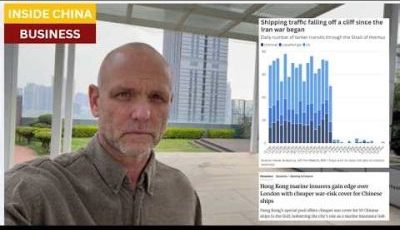
More Iran War fallout: Maritime insurance industry shifts from London to China
or go to
Aletho News Archives – Video-Images
From the Archives
The Biggest Threat to Peace in Middle East
By Dr. Elias Akleh* | Sabbah Report | May 24, 2010
A build up of heightened tension in the Middle East is escalating in the last few weeks. American and Israeli postures towards Lebanon, Syria, and Iran have become more threatening. Listening to speeches of political leaders one hears talks only about war not peace. Iranians and Israelis are continuously training hard for a possible showdown. Both sides are conducting extensive war games every month. This led Syrians to claim that Israel is preparing for a soon-to-come another war. The Jordanians also are warning that current stalemate of the peace process is an indication of a war breaking out this summer. The Russian President and his army chief hinted, a few months ago, that the US and Israel were planning for an attack on Iran.
Indeed Iran is, as it has been for last few years, the target of most of the threats and accusations of supporting terrorism. Escalating incitement against Iran the American Defense Department sent last month (April) to Congress a report on Iran’s military claiming Iran could develop intercontinental ballistic missiles capable of reaching the US by 2015.
Ignoring the fact that N. Korea, India, Pakistan, and Israel are proven to have nuclear weapons while Iran does not, the US Secretary of State Hillary Clinton chose in her speech, to the nuclear Non-Proliferation Treaty review conference at the UN, to focus on Iran’s alleged nuclear ambitions putting the whole world at risk as she put it. According to Clinton Iran’s acquisition of nuclear weapons, rather than Israel’s more than 200 nuclear bombs, is destabilizing the Middle East. She called on the world’s nations to rally around US efforts to hold Iran, not other nuclear countries, to account.
The accusation that Usama Bin Laden is living comfortably in Iran had received a boost after the broadcast of a documentary called “Feathered Cocaine”. This echoed the June 2003 claims of the Italian newspaper Corre de la Sierra that Bin Laden was in Iran according to some intelligence report, and according to Richard Miniter’s book “Shadow War”. … continue
Blog Roll
 Aletho News
- More Iran War fallout: Maritime insurance industry shifts from London to China
- US-Israeli aggression on Iran triggers review of GCC countries’ investment pledges to Washington
- Russia slams UK plan to seize tankers suspected of carrying its oil
- Pakistan ramps up food exports to Persian Gulf nations as war deepens food insecurity
- Iran submits response to US plan, sets terms for war’s end: Tasnim
- US vs Iran: Kharg Island Talk — Bluff or Escalation? Ex-Military Officer Weighs In
- Zelensky unnecessarily involves Ukraine in the Middle East crisis
- Turkish tanker blacklisted by Ukraine hit in drone attack – media
- Canada, the U.S., and NATO: the inescapable trap
- Villains of Judea: Leonid Radvinsky
- If Americans Knew
- ‘No Innocent Children’: Far-right Israeli Lawmaker Defends Killing of Palestinian Family
- Mossad’s promises helped Netanyahu convince Trump that Iran could be toppled
- US Arms Control Official Refuses To Comment When Asked If Israel Has Nuclear Weapons
- Veterans warn US landing could be ‘more Gallipoli than Vietnam’
- Israel may be committing war crimes in Lebanon – Not a ceasefire Day 167
- In the West Bank, life is a constant battle – 3 articles
- Jacob Reses, one of the most powerful pro-Israel operatives in Trump’s Washington
- Israeli-US assaults kill or injure 87 children a day – Not a ceasefire Day 166
- ‘Forever live by the sword’: Understanding Israelis’ massive support for Iran war
- UN’s special rapporteur on human rights says Israel is systematically torturing Palestinians
- No Tricks Zone
- Devastating Assessment Of Comirnaty Vaccine By Former Senior Pfizer Europe Toxicologist
- New Study: CO2 Is ‘Effectively Negligible’ As An Explanatory Climate Change Factor Since 2000
- Former Pfizer Toxicologist Dr. Helmut Sterz Tells Bundestag Hearing Pfizer Vaccine Should Have Never Been Approved
- Energy Expert: Germany’s Nuclear Phaseout Was A “500 Billion Euro Mistake”
- New Research: South Australia’s Mid-Holocene Sea Surface Temperatures Were 4°C Warmer Than Today
- Storing Green Energy To Last Germany 10 Days Would Require A 60-Million Tonne Battery
- New Studies: UK Sea Levels Were 4 Meters Higher Than Today During The Mid-Holocene
- Destructive Green New Deal: German Energy And Metal Group Warns Of Drastic Crisis
- New Study Documents A 20-Year Pause In Arctic Sea Ice Decline – Driven By Internal Variability
- Wake-up Call: Survey Shows Majority Of Germans Now Favor Postponing Climate Targets!
 Aletho News