The US government has quietly sold two oil tankers seized following its military aggression against Venezuela to Dubai-based vessel recycler Global Marketing Systems (GMS), with the vessels set to be dismantled in India.
The two tankers, the Era and Lileo, were purchased by GMS last month for an undisclosed sum, Lloyd’s List reported on Monday.
Both vessels had been seized by US authorities in January 2026 amid Washington’s military campaign against Venezuelan oil shipments.
The Era, formerly known as Marinera and Bella 1, and the Lileo, previously named Galileo and Veronica, are now due to be scrapped at shipbreaking yards in India.
“The US government has sold them to us and there was a court order authorizing the sales, but there are complexities, not least the fact that we weren’t really sure who previously owned them,” GMS CEO Anil Sharma told Lloyd’s List.
The sale comes amid a broader series of US military operations to intercept and seize oil tankers linked to Venezuelan oil shipments, actions that Caracas and other governments have condemned as acts of maritime piracy.
Venezuela formally complained to the UN Security Council following the seizure of a tanker in December 2025, noting that US forces boarded the vessel on the high seas, subduing and detaining its crew, and seizing a shipment of Venezuelan oil.
Iran has also condemned the US actions. Its embassy in Caracas described the seizure of a Venezuelan oil tanker as “piracy in the Caribbean Sea” and said the action violated international law, including the principles governing freedom of the seas and navigation.
US Secretary of War Pete Hegseth, who faces mounting scrutiny from legal experts over potential war crimes during Washington’s military campaign in Latin America, oversaw the seizure of one of the oil tankers.
The Era was seized in January 2026 after US Coast Guard and military personnel intercepted the Russian-flagged tanker in waters south of Iceland, following a weeks-long pursuit across the Atlantic. The vessel had previously evaded a US maritime blockade in the Caribbean aimed at restricting Venezuelan oil exports.
The Lileo was also seized in January, this time in the Caribbean Sea, as part of Washington’s broader campaign to intercept Venezuelan oil shipments following its military intervention in Venezuela.
US authorities seized as many as 10 oil tankers in the aftermath of the operation, according to reports.
The subsequent sale of the Era and Lileo for scrap means the vessels will not return to commercial service and will instead be dismantled at shipbreaking yards in India.
A Financial Times investigation published in July estimated that Washington has collected more than $13 billion from Venezuelan oil exports since taking control of the country’s oil sales in January, following the abduction of President Nicolas Maduro Moros.
The investigation found that only one transfer, worth $300 million, has been publicly recorded on a Venezuelan government website established to monitor oil revenues controlled by the United States.
The first proposed Trump-class battleship now has a price tag: $23 billion.
This cost, as assessed by the Congressional Budget Office, will garner a lot of attention. But the primary concern for policymakers and citizens alike should be the complexity of the ship’s design.
The U.S. Navy has a poor shipbuilding record in the 21st century. The Zumwalt-class destroyer, the Littoral Combat Ship, and the Constellation-class frigate have been complete failures. The final verdict of the Ford-class aircraft carrier is not yet in, but when the ship’s crew can’t even rely on the sewage system to work properly, the case isn’t looking too good.
It becomes clear reading through the CBO’s report that Navy officials in Washington have learned nothing over the past 25 years from their shipbuilding mistakes. In typical Washington fashion, the new ship is being touted as “the fastest, the biggest, and by far 100 times more powerful than any battleship ever built,” as President Donald Trump put it. In practical terms, the ship will be armed with “antiair, land-attack, and antiship missiles, hypersonic missiles, nuclear cruise missiles, large lasers, and a rail gun (a weapon that uses electromagnetic energy to fire nonexplosive projectiles at hypersonic speeds),” according to the CBO.
All of these systems will require a tremendous amount of electrical power to operate. To meet this challenge, the new ship will also be nuclear-powered. The addition of a nuclear reactor will dramatically increase both the cost and complexity of the ship’s construction.
The original sin of all the Navy’s 21st century shipbuilding failures is a lack of design discipline. The architects of each program attempted to incorporate every gadget the technologists could imagine, several of which (including cutting-edge rail guns) remain unproven to this day. Excess complexity drives up costs and delays delivery, often by years.
Officials compounded that essential mistake when they began building ships before the underlying technology had been developed. The practice of beginning construction before the development process ends is known as concurrency. When the overlap between manufacturing and development is too great, as it has been with acquisition programs like the Littoral Combat Ship and the USS Gerald R. Ford, costs rise and schedules slip because it becomes more difficult to incorporate the new technology into work that has already been completed.
A glance at America’s shipbuilding capacity suggests that the construction timeline for the battleship program is also unrealistic. Navy leaders plan to buy 15 of the new ships between 2028 and 2056. But naval construction is already years behind schedule.
The next Ford-class aircraft carrier, for example, is already five years late, yet the Pentagon hopes to assemble the new battleships at the same Newport News shipbuilding dock used to build aircraft carriers. The Navy’s current fleet of 289 ships is already far short of the legally required 355 ships. Attempting to build the largest and most complex surface warship in nearly a century hardly seems like the proper course of action to expand the fleet and alleviate the strain on the Navy’s already harried sailors.
The size of the fleet matters because it directly impacts the quality of life and service of the nation’s sailors. The U.S. Navy has played an integral role in maintaining freedom of navigation around the globe since the end of World War II. Having fewer ships in the fleet means that the existing ships and their crews must work longer and harder to meet the Navy’s operational demand. Since leaders in Washington show few signs of reducing the number of missions the Navy must perform, adopting a shipbuilding plan that will see the fleet continue to shrink for the foreseeable future makes little sense.
The fact that the battleship program is projected out over the next 30 years also deserves scrutiny. Instituting a warship program of this size to span three decades at a time when uncrewed vessels and anti-ship missiles are proliferating means that officials today believe a large surface warfare ship will remain viable throughout that timespan. That is a bold assumption to make. It is doubtful many people in 1996 would have anticipated the Ukrainians effectively denying the Russian fleet the use of the Black Sea with uncrewed vessels and shore-based missiles. A $23 billion American battleship will be an inviting target for submarines, anti-ship missiles, and hypersonic weapons.
The current National Security Strategy released in November 2025 calls for the United States to concentrate on defending the Western Hemisphere. Building the largest surface combatant ship since World War II, armed with conventional, hypersonic, and nuclear-tipped missiles, is hardly necessary to defend the seas close to home. Such a ship is designed specifically to project military power around the globe. The battleship plan provides more evidence that the national security establishment will do precisely what it wants to do, no matter what defense strategy the government adopts.
Dan Grazier is a senior fellow and program director at the Stimson Center. He is a former Marine Corps captain who served tours of duty in Iraq and Afghanistan. His assignments in uniform included tours with 2nd Tank Battalion in Camp Lejeune, North Carolina, and 1st Tank Battalion in Twentynine Palms, California.
When U.S. Treasury Secretary Scott Bessent told an interviewer this weekend that the Strait of Hormuz would “become irrelevant” within two years — with more than half the energy now crossing it rerouted through underground pipelines — he was indulging a pipe dream. Bessent fails to grasp that Iran’s ability to use the Strait of Hormuz as geopolitical leverage is not going to vanish if the Gulf arabs quickly build oil pipelines. It is true that capital hates chokepoints, and Gulf producers are indeed racing to build around one. Saudi Arabia is expanding its East-West Petroline, the UAE has leaned harder on its Fujairah bypass, and Iraq is dusting off long-dormant overland export corridors. Chevron is even studying a revived Haditha–Baniyas line from Iraq to the Syrian Mediterranean.
Although Bessent ‘s oil pipeline proposal sounded like a nifty way to neuter Iran, he fails to grasp the true economic importance of the Persian Gulf and the leverage that Iran will continue to have for years to come. Bessent’s framing treats Hormuz as an oil problem, and a pipeline network — however ambitious — solves an oil problem. But Hormuz is not merely the world’s most important oil chokepoint. It is the sole maritime exit for a cluster of specialized commodities that cannot be pumped through a pipe, cannot be quickly re-sourced elsewhere, and whose disruption is already inflicting measurable economic damage across food, semiconductors, and heavy industry. Building a crude bypass and declaring the strait “irrelevant” mistakes one throughput for all of them.
The evidence for that is not hypothetical. It is the record of the past five months.
The oil bypass math is already the easy part — and it still doesn’t close
Start with the commodity the pipelines are meant to address. Even here the substitution is incomplete. Roughly 20 million barrels per day of crude, condensate, and products normally transit Hormuz — about a fifth of global petroleum consumption. Existing bypass capacity totals somewhere around 4.7 million barrels per day. Closing that gap requires not one flagship pipeline but an entire redundant network, built through active or recently active conflict zones, over a period of years. Bessent’s own two-year horizon is optimistic against that backdrop, and it is the most favorable case, because crude is the one Hormuz cargo that pipelines are actually designed to carry.
Everything else produced in the Gulf are not cargo that can be carried by a pipeline, and these are critically important to the global economy.
LNG: No pipe runs from Ras Laffan to Tokyo
About a fifth of the world’s liquefied natural gas trade moves through Hormuz, overwhelmingly from Qatar, the second-largest LNG exporter on earth. When Iranian strikes damaged Qatar’s Ras Laffan complex — the single largest LNG export facility in the world — and QatarEnergy declared force majeure in early March, roughly 10 billion cubic feet per day of supply, about 20% of globally traded LNG, went offline. Kpler tanker data showed no laden LNG vessel crossing the strait for nearly two months.
The consequences landed fast and far from the Gulf. The World Bank’s natural gas price index jumped 24% in a single month. Europe’s benchmark is now projected to climb roughly 25% across 2026, because LNG frequently sets the marginal price there; Asia, which takes the overwhelming majority of Qatari cargoes, was hit hardest as buyers scrambled to replace contracted deliveries on the spot market.
Here is the part a pipeline cannot fix: LNG has no overland route out of Qatar. Liquefied gas is a seaborne product by definition — you liquefy it precisely because you cannot pipe it across oceans to Japan, South Korea, or India. And the one producer large enough to plug the gap, the United States, cannot. New American liquefaction terminals take years and billions to build; the EIA expected U.S. exports to rise by only a small fraction of the missing Qatari volumes, with meaningful new capacity trickling in through late 2026 at best. A crude bypass does nothing for the LNG buyer in Osaka. There is no bypass to build.
Urea and ammonia: the fertilizer shock that reaches every farm
The Gulf is not just an energy hub. It is one of the planet’s great fertilizer factories, and Hormuz is how those fertilizers reach the fields that depend on them. The Middle East supplies close to a quarter of global urea exports; by some measures roughly a third of world seaborne fertilizer trade was put at risk when the strait closed. Iran halted ammonia production; Qatar suspended urea, ammonia, and sulphur output after the Ras Laffan damage.
The price response was violent. Urea climbed above $850 per metric ton in April — up around 80% from February and the highest level since 2022. World urea prices roughly doubled at the peak. Ammonia jumped nearly 40% in weeks, and about 24% of all global ammonia trade normally passes through Hormuz. Fitch raised its 2026 ammonia and urea forecasts by around a quarter and warned nitrogen fertilizers would be the hardest hit of any product category.
And unlike a price chart, the downstream damage compounds. India — which sources roughly 80% of its ammonia from the Gulf — saw ammonia-based domestic production stall and lost hundreds of thousands of tons of monthly urea output as industrial gas was rationed. American farmers absorbed the shock at the worst possible moment, entering spring planting with fertilizer costs spiking and diesel above $5 a gallon. Because natural gas is around 80% of the cost of nitrogen fertilizer, the LNG disruption and the fertilizer disruption feed each other — a second-order effect no crude pipeline touches. When fertilizer gets scarce and expensive, the eventual bill is measured in crop yields and food prices, in countries that never bought a barrel of Gulf oil.
Sulphur and DAP: the quiet input behind the phosphate chain
Sulphur rarely makes headlines, which is exactly why its disruption is instructive. It is a byproduct of Gulf gas processing and a critical input for phosphate fertilizers and countless industrial processes. With Qatari sulphur output suspended and regional supply choked, prices roughly doubled since the start of the year. That fed straight into diammonium phosphate (DAP): DAP prices rose more than 10% in April on tightening supply and higher sulphur costs, compounded by China moving to restrict its own exports — China relies on the Middle East for roughly half its sulphur imports.
This is the pattern worth noticing. Hormuz disruption does not produce one clean shortage; it produces a cascade through interlinked chemistry — gas into ammonia, ammonia and sulphur into finished fertilizer, export bans stacked on top of physical shortfalls. A pipeline that moves crude oil intersects none of these chains.
Helium: the commodity with no substitute and no alternative exit
Helium is the sharpest illustration of Bessent’s blind spot, because for helium the pipeline argument does not merely fall short — it is categorically inapplicable.
Qatar supplies roughly a third of the world’s helium, extracted as a byproduct co-located with LNG processing at Ras Laffan. The March strikes and the strait’s closure took an estimated 30% of global helium production offline, with damage assessments suggesting some infrastructure could take years — not weeks — to fully restore. US distributors invoked force majeure, began rationing, prioritized healthcare customers, and layered on surcharges; spot prices spiked.
Helium cannot be synthesized. It is a finite, non-renewable gas with no substitute in its critical uses: semiconductor fabrication, advanced chip packaging, MRI machines, and the sealed interior of every high-capacity hard drive at a moment when AI-driven data-center demand is surging. Seagate and Western Digital reported full-year allocations and 20–30% price increases; South Korean chipmakers were reported to be running on roughly six months of inventory.
And every gram of Qatari helium leaves the country the same way: by ship, through Hormuz. There is no pipeline alternative, no overland route, no bypass — helium’s only exit from the world’s second-largest production hub is that one 33-kilometer-wide waterway. A network of crude pipelines could be completed tomorrow and it would not move a single liter of helium to a chip fab in Taiwan.
Why the framing matters
None of this means the bypass pipelines are a bad idea. Reducing the world’s dependence on a single crude chokepoint is prudent, and market-driven redundancy is exactly what one would want. Bessent is right that capital routes around risk, and that Tehran has accelerated its own strategic marginalization by weaponizing the strait.
But the claim that “the Strait of Hormuz will become irrelevant” is grossly misleading. The waterway’s true strategic weight comes from its role as the shared export gate for a bundle of commodities — LNG, urea, ammonia, sulphur, helium — that are seaborne by physics, concentrated in a handful of Gulf facilities, and impossible to re-source at speed. Each has been disrupted in the real world over the past five months, and each disruption has produced price shocks and downstream damage that a crude pipeline is powerless to prevent.
The current market underlines the point. As of early August, Brent was trading in the mid-$80s and climbing on Hormuz headlines, with a war-risk premium that has refused to deflate through months of on-again, off-again negotiation — the US Strategic Petroleum Reserve has been drawn down to its lowest level since the 1980s in the process. That premium reflects traders pricing the whole basket of what the strait carries, not just its barrels of crude. Until there is a plan for the LNG tanker, the ammonia cargo, the sulphur shipment, and the helium flask — none of which fits in a pipeline — Hormuz will remain very far from irrelevant.
A pipeline can carry crude. It cannot carry the rest of what Hormuz moves. And it is the rest that is quietly reshaping the global economy right now.
Investigation into clinical trial documents reveals the FDA used statistical sleight of hand to make a serious safety signal in Moderna’s flu vaccine disappear
When the FDA licensed Moderna’s new mRNA flu vaccine last week, legacy media coverage focused almost exclusively on efficacy.
The pivotal trial reported that the vaccine was “26.6% more effective” than a conventional flu vaccine at preventing protocol-defined influenza-like illness.
What received far less scrutiny was a much more serious problem in the trial data published in The New England Journal of Medicine—much of it relegated to an appendix behind a paywall.
An analysis of that appendix alongside the FDA’s own briefing document exposes clear regulatory malfeasance.
A statistically significant safety signal from the pivotal trial was systematically diluted until it disappeared from the official story.
The safety signal
Moderna’s pivotal Phase 3 trial (P304) enrolled roughly 40,000 adults aged 50 and older, randomised 1:1 to either the company’s mRNA-1010 vaccine or a traditional trivalent flu vaccine.
This study evaluated an “optimised” version of Moderna’s vaccine after earlier versions produced disappointing efficacy results.
Even with this updated formulation, the headline “26.6% relative efficacy” figure was misleading. In absolute terms, the vaccine reduced the risk of illness by just 0.8%.
Most concerning, however, were the serious adverse event (SAE) data.
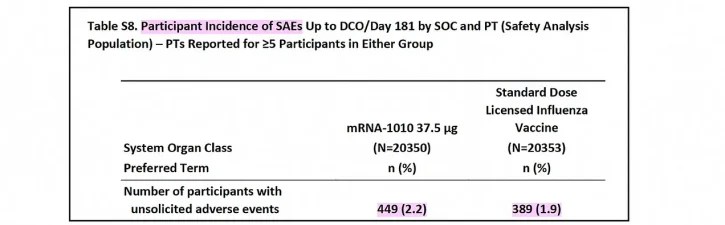
The six-month data show that 449 participants in the mRNA group experienced at least one SAE, compared with 389 in the conventional group—an excess of 60 people.
So, while the pivotal trial showed there were 4 fewer influenza hospitalisations in the mRNA group, 60 additional people experienced an SAE.
SAEs are not mild events—they are usually severe enough to require hospitalisation, threaten life, cause significant disability, or result in death.
The imbalance of SAEs in Moderna’s pivotal trial was statistically significant—meaning it was unlikely to be a random fluke.
Yet in the briefing documents presented to the FDA’s advisory committee, VRBPAC, the agency characterised SAEs as “balanced.”
So how did the FDA make the SAE imbalance disappear?
Making serious adverse events disappear
The short answer is that the FDA used pooled data that obscured the safety signal.
Specifically, the agency relied on Moderna’s own “Integrated Safety Summary,” which combined data from four separate Phase III trials (P301, P302, P303 and P304), involving nearly 72,000 participants.
Once the pivotal trial P304 was combined with the other trials, the SAE rate became 3.1% in the mRNA group versus 2.9% in the comparator group—allowing the FDA to state that the rates were “balanced.”
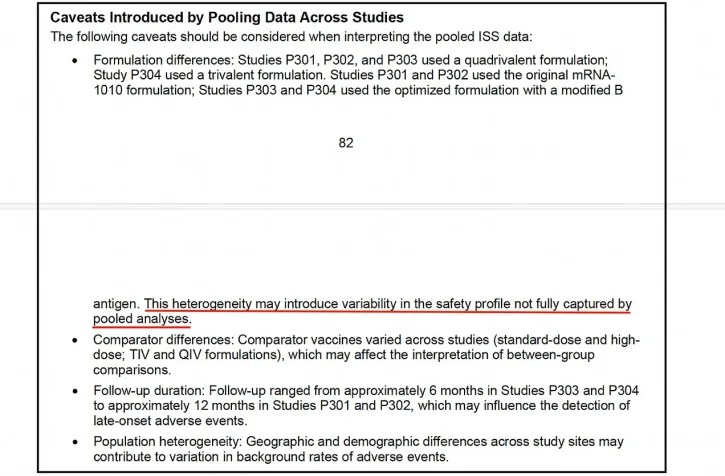
Pooling data across clinical trials is common when regulators are looking for rare events. But the four trials Moderna pooled were very different in many aspects.
They tested different mRNA vaccine formulations against different flu vaccines—standard-dose and high-dose, quadrivalent and trivalent—across different age groups and countries, with follow-up ranging from six months to a year.
When these disparate trials were combined into a single analysis, the safety signal that stood out in the large pivotal trial was diluted.
The FDA accepted the approach—despite being aware of the problem.
In an appendix to its own briefing document, the FDA acknowledged that differences between the trials could produce safety variations “not fully captured by pooled analyses”—but proceeded anyway.
Table 6 of the FDA’s own review makes the switch even clearer (see below).
For the first 28 days after vaccination, when serious adverse events were still balanced between the groups, the agency reported safety results from the pivotal P304 trial alone (purple box).
But as more SAEs accumulated over the following months, a statistically significant imbalance emerged.
Instead of reporting those longer-term results from P304 in the same way, the FDA switched to Moderna’s pooled analysis (red box), where the signal was diluted enough for the agency to continue describing the rates as “balanced.”
The pooled analysis also obscured a concerning pattern in all-cause mortality.
In the pivotal trial P304, there were 40 deaths in the mRNA arm versus 34 in the comparator arm.
In the preceding trial P303, deaths were consistently higher across all three mRNA sub-studies:
Sub-study 1 (mRNA vs Standard Trivalent): 5 deaths in the mRNA-1010 arm vs. 1 death in the comparator arm (5 vs 1).
Sub-study 2 (mRNA vs High-Dose Trivalent): 3 deaths in the mRNA-1010 arm vs. 2 deaths in the comparator arm (3 vs 2).
Sub-study 3 (mRNA vs Standard Quadrivalent): 3 deaths in the mRNA-1010 arm vs. 1 death in the comparator arm (3 vs 1).
Notably, in Sub-study 1, Moderna’s own trial investigators assessed one of the five deaths in the mRNA group as caused by the vaccine—the same product that has now been licensed.
Together, these numbers raise serious concerns about a possible excess in mortality in the mRNA groups—a pattern the FDA failed to highlight.
One rule for efficacy, another for safety
The FDA’s handling of efficacy reveals an even more striking double standard.
For efficacy, the agency relied strictly on study P304—the large pivotal trial testing the exact formulation submitted for licensure.
Earlier trials of Moderna’s vaccine had produced weaker efficacy results—and in at least one case, negative efficacy. Had the FDA pooled those trials for efficacy, the “26.6% efficacy” figure would almost certainly have been substantially lower.
But, as noted above, when the pivotal trial produced an unfavourable safety result, the FDA did the opposite—it pooled the data.
One approach maximised the efficacy. The other diluted the safety concerns.
Who is protecting the public?
On the surface, the FDA says Moderna’s flu mRNA vaccine is “safe and effective.”
Dig deeper, and the pivotal trial shows a statistically significant excess of participants experiencing SAEs.
Dig deeper still, and you discover the statistical trickery Moderna used—and the FDA accepted—to make the SAE signal disappear.
This brings us back to a fundamental question I have raised over years of reporting on regulatory failure.
When the FDA accepts the manufacturer’s trial design, adopts its data analyses, and rubber-stamps statistical methods that dilute a safety signal, who is actually protecting the public from harm?
Iran believes it has fundamentally altered the balance of power with the United States and now has a narrow opportunity to convert its position into lasting strategic and economic gains, Johns Hopkins University Professor Vali Nasr argued in an interview on Switzerland with Tom Switzer.
Speaking alongside University of Chicago political scientist John Mearsheimer, Nasr said Washington has struggled to accept how dramatically its position has changed following the prolonged war on Iran, particularly as Tehran retains leverage over the Strait of Hormuz. The interview was conducted by host Tom Switzer, who introduced Nasr as a leading Iran expert and Mearsheimer as a political scientist.
“There’s a consensus that they have defeated the superpower, at least put it on its heels,” Nasr said of the view inside Iran, arguing that Tehran sees little reason to moderate its position while it holds the advantage.
Iran sees narrow window to press advantage
Nasr rejected arguments circulating in Washington that Tehran is “overplaying its hand,” saying such assessments reflected disbelief at the extent to which the balance had shifted.
“In reality, Iran is not overplaying its hands. It’s just playing its hand,” he said.
According to Nasr, Iranian policymakers believe they have a limited period in which to secure the maximum possible strategic advantage.
“They think they have a narrow window to get the maximum amount of strategic advantage from having turned the table on the US,” he said, adding that Iranian leaders would consider it a major mistake not to press their advantage while Washington remains on the defensive.
That calculation extends to sanctions relief, frozen Iranian assets, compensation, and Iran’s position in the Strait of Hormuz. Nasr described Tehran’s approach as accepting immediate economic hardship in exchange for potentially much greater long-term gains.
Mearsheimer: US has ‘no choice’
Mearsheimer offered an even sharper assessment, arguing that Washington no longer possesses an effective means of forcing Tehran to abandon its position over the Strait.
Asked why US President Donald Trump would accept an arrangement under which Iran exercises substantial control over passage through Hormuz, Mearsheimer replied, “It’s very simple, Tom. He has no choice. He lost the war. This is a devastating defeat for the United States.”
He added that Trump “has no cards here,” arguing that Washington’s principal threat — further military escalation — had become increasingly difficult to carry out.
According to Mearsheimer, the United States faces both depleted munitions stocks and resistance from Gulf allies fearful that another escalation would trigger Iranian attacks on oil infrastructure, desalination facilities, and other critical installations.
Weapons shortages expose limits of US campaign
Nasr similarly argued that Washington’s weapons shortages had sharply reduced its ability to continue the campaign.
“It’s clear that the US doesn’t have the munitions, either offensive munitions or defensive munitions to keep bombing Iran,” he said, arguing that another month of fighting ultimately left Iran stronger and Washington weaker.
Mearsheimer said US military leaders had warned Trump before the war about limited stocks and the dangers of a prolonged confrontation. He argued that a major factor behind the end of the 40-day air campaign was that Washington was “running out of munitions.”
Nasr said the implications reach beyond West Asia, arguing that China and Russia would draw conclusions from the United States’ difficulty rapidly replacing sophisticated weapons during a prolonged war.
He cited Trump’s withdrawal from the 2015 nuclear agreement in 2018, attacks launched while negotiations were underway, and what Tehran viewed as Washington’s failure to uphold subsequent understandings.
Trump has created “such distrust about himself with Iranians” that even accepting Tehran’s terms might no longer be enough without guarantees that Washington would implement an agreement, Nasr said.
That distrust, he argued, explains why Iran wants concessions delivered upfront rather than postponed to future negotiations.
The earlier June 17 memorandum had envisaged reopening the Strait, lifting oil sanctions, and establishing a ceasefire that also covered Lebanon, while wider sanctions, reparations, and frozen assets would be addressed later.
Nasr said Tehran concluded that Washington subsequently undermined that arrangement, including its provisions related to Lebanon, reinforcing the view that Iran should secure tangible benefits before relinquishing leverage.
Mearsheimer described the result as a “humiliating defeat” for Washington before adding, “I believe it’s an even bigger defeat for Israel.”
He argued that Israeli officials were reluctant to acknowledge “the extent to which Iran has defeated not just the United States, but Israel,” predicting that both “Israel” and its supporters in Washington would seek to undo any agreement favorable to Tehran in the future.
Nasr later argued that Israeli Prime Minister Benjamin Netanyahu had “overreached in Lebanon and Iran,” describing them as wars “Israel” could not win and saying “Israel” had been “strategically defeated”.
For Nasr, the larger consequence is a regional order increasingly different from the one Washington sought to impose. Iran, he argued, now sees an opportunity not simply to end the current confrontation, but to use the outcome to reduce the US military threat around its borders, ease its economic isolation and consolidate its position as a major regional power.
For the first time in years, Washington is discussing Turkey’s return to the F-35 program as a serious possibility.
At the NATO summit in Ankara last month, President Donald Trump said he would lift the CAATSA sanctions that the U.S. imposed on Turkey after Ankara purchased Russian S-400 missile defense systems in 2019. Trump added that he was “certainly” considering restoring Turkey’s access to the F-35 program, which was also suspended at the time..
Notably, a separate sale of American engines for Turkey’s domestic KAAN fighter jet has advanced through congressional review. Ankara is also reportedly exploring the transfer of its S-400 batteries to a Gulf state, a step Washington has demanded for years.
But the Russian system is no longer the only source of resistance. Israel argues that Turkish F-35s would, in Prime Minister Benjamin Netanyahu’s words, “destroy the power balance” in the region. The phrase invokes Israel’s “qualitative military edge,” a provision in U.S. law according to which Washington cannot sell weapons to Middle Eastern states if those arms would give them capabilities on par with Israel’s own weaponry.
Yet these rules have never been formally applied to Turkey, which is, after all, a U.S. treaty ally. What is being tested is thus not only an arms sale, but whether Israel’s claim to regional primacy can restrict American policy toward a NATO ally.
How Turkey was pushed out
Turkey’s search for a long-range air defence system predates the crisis by a decade. In 2009, the Obama administration approved a sale of Patriot missile defense munitions to Turkey, but the deal broke down over questions of price, technology transfer and local production. Ankara turned to a Chinese system in 2013, cancelled it in 2015, and signed with Moscow in 2017. A late American offer in 2018 came too late to reverse the Russian deal, and the first S-400 components arrived in July 2019.
But the S-400 decision was never simply the product of a failed arms negotiation. When Turkey downed a Russian jet in November 2015, it became the first NATO member to do so since the 1950s. As pressure from Moscow mounted, Ankara had to face it largely alone. The withdrawal of American and German Patriot batteries that same winter, even though armed groups in Syria still posed a threat, hardened Turkey’s sense of exposure.
The July 2016 coup attempt turned mistrust into a political rupture, particularly given that Fethullah Gülen, who Turkish authorities accused of orchestrating the coup, was living in the United States at the time.
Russia exploited the opening, filling Turkey’s defense gap while widening the rift with its NATO allies. Turkish officials justified the purchase as an urgent requirement.
President Recep Tayyip Erdoğan gave it a second meaning. The real issue, he said, was not to the S-400 but to Turkey acting on its own will. Elsewhere he refused to retreat, saying Turkey was “not a slave.” Repeated at rallies, Erdogan’s rallying cry about the missile defense system turned it into an emblem of strategic autonomy, making the purchase as hard to reverse politically as militarily.
This has now become a political liability for Erdogan. In Turkey today, commentators and the main opposition describe the purchase as an act of stubbornness — one that left the S-400 rusting in a hangar and wasted the $1.5 billion Turkey had already paid for the F-35 program.
Turkey remains the only participant expelled after paying in, and the six aircraft it financed were never delivered. Its air force depends on an aging F-16 fleet, with Eurofighter Typhoons serving as a stopgap. The domestic KAAN fighter is the long-term answer, but its first batch is set to fly using American F110 engines under a $700 million sale that drew organized opposition in Congress before clearing review in July.
How Israel built a case against Turkey’s return
Within 72 hours of the Ankara summit, Netanyahu took his objections to three American networks, arguing that Erdoğan was “not a friend” and could not be trusted.
The centerpiece of Israel’s case against Turkey was a remark by Turkish Foreign Minister Hakan Fidan. Asked on CNN Türk whether Turkey was among Israel’s targets, the foreign minister said Israel had become a problem for the world and that, with these policies and this mindset, “these men have become a burden that humanity can no longer bear.” The reference to “these policies” and “this mindset” pointed to the Netanyahu government, and the same judgment about Israel’s isolation has surfaced in European capitals and at senior levels of the U.S. administration, from Trump to Vice President JD Vance.
But Israeli Foreign Minister Gideon Sa’ar recast the remark as dehumanizing Jews and calling for Israel’s erasure, and this framing became the dominant account in Israeli commentary. Netanyahu carried it further on Fox, telling American viewers that Fidan had said the Jewish state must basically be wiped out.
The framing slotted Turkey into an existing category, the state that denies Israel’s right to exist. But that is the language of Iranian state rhetoric, repeated by senior officials and inscribed on missiles. Turkey has never pursued such a policy; in fact, it supports a two-state solution and has recognized Israel diplomatically since 1949. Yet Israeli leaders, eager to drive a wedge into Ankara’s relationship with Washington, appear determined to cast Turkey as the next Iran.
Balance for whom?
The most revealing element of Netanyahu’s argument was his definition of the regional balance. By telling Washington that Turkish F-35s would “destroy the power balance,” he equated regional stability with continued Israeli superiority. Israel operates 48 F-35s and is contracted for 100, while Ankara’s immediate effort centers on the six aircraft it already paid for. Turkey’s return to the program would not erase Israel’s advantage; rather, it would modestly narrow an asymmetric order built around Israeli air power and freedom of action.
Israel’s concerns about Turkey are difficult to reconcile with Tel Aviv’s own increasingly preventive and attack-oriented doctrine. While Israeli officials like Netanyahu frame Turkish F-35s as evidence of “aggressive aspirations,” Israeli aircraft have struck targets in Lebanon, Syria, Yemen, Iran, Qatar, and Gaza. In Ankara, this is seen as hypocrisy; Netanyahu’s “balance” is, in this reading, less about mutual restraint and more about preserving Israel’s air superiority and freedom to strike.
Nor are the objections unique to Turkey. Since 2008, American law has required arms sales to Middle Eastern states be certified as preserving Israel’s qualitative military edge, a standard Israel has invoked against countries including Qatar, the UAE, Saudi Arabia, and Egypt. Nor is this only the position of Netanyahu. Naftali Bennett, his top rival in the coming election, told CNN that Israel cannot allow its Turkish “enemies” such advanced weaponry.
But applying the qualitative military edge doctrine to Turkey does not make sense for U.S. interests. Ankara is not a Middle Eastern buyer seeking parity with Israel but a NATO member whose air force anchors the alliance’s southeastern defense, and its deterrent capacity is a European security question as much as a Middle Eastern one. Extending an Israeli veto over what Washington sells its own allies would put that doctrine in direct tension with NATO’s requirements.
Israel’s concern extends beyond the military effect of a stronger Turkish air force. Despite his best efforts, Netanyahu is unlikely to easily reverse Trump’s broader opening to Ankara. By appointing his longtime associate Tom Barrack as ambassador there, Trump opened a new phase in Turkish-American relations. As Trump said when asked about Netanyahu’s opposition to giving F-35s to Turkey, “nobody tells me what we should be selling or not.”
Unless Ankara takes a step that directly threatens Israel’s security — an unlikely scenario — Trump has little incentive to abandon a relationship he finds useful. That relationship, more than the aircraft, is what Israel is working to prevent.
Fatih Kocaibis is a Turkey-based journalist and political analyst covering U.S. foreign policy, transatlantic relations, and European security, and their implications for Turkish foreign policy.
The Strait of Hormuz cannot be reopened through diplomacy while Washington continues to use military pressure against Tehran, the Iranian Foreign Ministry has said.
Iran closed Hormuz in response to a US-Israeli military campaign launched in late February. Washington subsequently imposed a naval blockade on Iranian ports, escalating a standoff over a strategic waterway that has historically carried around a quarter of the world’s seaborne oil trade.
Iranian Foreign Ministry spokesman Esmail Baghaei said on Monday that diplomacy is “certainly” part of the “struggle to safeguard our national interests,” but added that “when dealing with a side that insists on the use of force, a maritime blockade is not a diplomatic action that we can lift through diplomacy.”
“Certainly, you have to use authority and military power, along with diplomacy, to prevent the United States’ aggression, and that is what is being done,” Baghaei told a press briefing.
Tehran has set out a series of conditions for reopening the strait, including compensation for war damage, the lifting of sanctions, and the release of frozen Iranian funds, as well as a permanent end to hostilities against Iran and its regional allies.
The IRGC has also said that reopening Hormuz will depend on Washington fully accepting Tehran’s conditions.
US President Donald Trump said that Washington was in no rush to reach an agreement, telling Axios that Washington was “low-keying” negotiations while allowing economic pressure on Tehran to build.
“We are only semi-negotiating with them. We are just watching Iran with its huge inflation and the fact they have no money,” Trump said, adding “It’s like a chess game.”
The talks follow weeks of disagreement over a 14-point memorandum of understanding that established a temporary ceasefire and provided for the gradual lifting of the US blockade of Iranian ports and the restoration of commercial traffic through Hormuz. Fighting resumed last month after the sides failed to agree on how the deal should be implemented.
Iran and Oman, meanwhile, are discussing arrangements for future shipping through the strait, although Tehran has stressed that any agreement with Muscat would not in itself mean the waterway would reopen.
The disruption to traffic through Hormuz has put sustained pressure on global energy markets. Oil prices rose nearly 3% on Monday amid uncertainty over negotiations, with international benchmark Brent reaching $85 a barrel and US WTI hitting $80.
Almost every day, the military tests various emerging technologies across the U.S., including drone and counter-drone systems and GPS jamming.
To a certain extent, this testing is inevitable. But, as experts told RS, the government has in many cases not ensured that the proper safeguards and necessary interagency coordination are in place to make sure such tests can be conducted safely. These testing issues strain civilian airspaces — increasingly disrupting aircraft and even sometimes leading to accidents.
Drone and counter-drone mayhem
In particular, the military’s domestic testing and use of drone- and counter-drone technologies have precipitated several recent high-profile mishaps.
Last March, the Navy and Secret Service tested counter-drone technologies at a military base near Ronald Reagan Washington National Airport (DCA). As a result, several flight crews received faulty alerts warning of possible collisions with nearby aircraft.
In 2020, an MQ-9 reaper drone crashed during testing at the Hancock Field Air National Guard Base, which shares its flight line with Syracuse Hancock International Airport. Military officials did not tell the public about the incident, which caused over $6 million in damages, until more than a year later.
Interagency disagreements and coordination issues over the tech’s use in U.S. airspaces have only caused more problems.
Back in February, the military lent a counter-drone laser to U.S. Customs and Border Protection (CBP). CBP subsequently used it, without coordinating with other agencies, to target what it thought were Mexican cartel drones. Instead, it hit party balloons.
The incident prompted the FAA — which had concerns about the laser’s possible effects on civilian aircraft — to temporarily close the surrounding airspace. The agency did so without notifying other agencies in advance, causing confusion amid fears that the U.S. could intervene militarily in Mexico.
Later in February, the military shot down a CBP drone with a laser-based anti-drone system after mistaking it for a cartel drone — again prompting the FAA to close airspace around El Paso.
The FAA and Pentagon formally agreed in April that the laser system’s safety controls work and “do not pose undue risk to passenger aircraft.”
But broader tensions over the testing and use of these technologies in civilian airspace persist.
The FAA’s departing deputy administrator, Chris Rocheleau, said at a drone leadership conference late last month the agency is being “nudged” to accept “more risk” regarding uncrewed drones. FAA officials toldPolitico last week that the Pentagon’s decisions about aviation often prevail over the FAA’s safety concerns in practice.
Following the repeated airspace closures in Texas, Sen. Tammy Duckworth (D-Ill.) called for an investigation into “potential serious and alarming problems and deficiencies” with interagency coordination and oversight over counter-drone systems.
“As we saw with the DCA Midair Collision, failures in interagency planning create an unacceptably dangerous situation where it’s no longer a matter of if but rather when the next catastrophic accident occurs that will claim American lives,” Duckworth wrote, referencing a collision between a commercial flight and an Army helicopter near the DCA airport in January of last year.
As Dana Goward, founder and president of the Resilient Navigation and Timing Foundation, tells RS, it’s “not clear” the U.S. is prepared for drone and counter-drone operations in its airspace.
He questioned whether officials consistently know where and how such systems are used, and whether they have adequate safeguards to manage them safely and efficiently.
“My sense is that while those things are being worked on, they’re not in place right now,” Goward said. That “should be a concern.”
Aircraft ‘couldn’t navigate safely’ near White Sands
The U.S. military has also been testing GPS jamming across the continental U.S., especially in the American Southwest. While it has worked to notify pilots of its efforts, testing often stands to interfere with civilian aviation in practice.
A notable example is a recent accident back in May in New Mexico, where a small medical plane lost its GPS signal due to military jamming testing in the White Sands region. Attempting to land with older navigation methods, the plane became disoriented and crashed into a mountain.
Under investigation, the crash is the first known case where military jamming testing can be directly linked with a civilian plane crash in the U.S. But many other episodes could have come close.In 2021, engineering magazine IEEE Spectrum revealed internal Federal Aviation Administration (FAA) records showing that 233 GPS interference incidents took place in the southwestern U.S., where military testing is especially frequent, during 2017 and the early months of 2018.
In those cases, testing repeatedly led commercial, civilian and medical aircraft to lose their navigation capabilities, drift off course, and sometimes enter restricted airspace. Pilots declared emergencies in five of the incidents.
“The GPS jamming at White Sands was effecting [sic] the safety of flight of the aircraft to the point to where they couldn’t navigate safely,” an air traffic controller anonymously wrote to NASA’s Aviation Safety Reporting System in 2021. They added that the military often refuses to stop testing when asked to do so by pilots nearby.
The military issues Notices to Airmen (NOTAMs) before it tests electronic warfare technologies like jamming, spoofing, and anti-jamming and – spoofing capabilities, which can all disrupt aircraft navigation systems.
But these NOTAMs often cover regions spanning thousands of square miles and cannot predict exactly where or when interference will occur. Pilots receive large numbers of NOTAMs with little relevance to their flights and can often fly through NOTAM-affected areas without experiencing interference. Such circumstances mean many pilots overlook or otherwise miss important warnings.
In any case, the air traffic controllers assisting the troubled medical plane crew in New Mexico helped three other aircraft without GPS signal on the same evening — despite a NOTAM having warned pilots of possible interference beforehand.
Pilots are required to know how to use older navigation aids in case they lose access to GPS mid-flight. But, as Goward tells RS, GPS has become central to how pilots navigate in practice.
GPS “is something that they’ve grown up with, and trained with, and used for decades,” Goward said. “When that system is no longer available [due to interference], the workload increases, distractions increase, and safety margins decrease.” (In aviation, safety margins refer to the buffers crews maintain to manage unexpected events, including having additional time and fuel, and maintaining greater distances from other aircraft.)
“You end up with a higher likelihood that something bad is going to happen,” Goward said.
As Todd Humphreys, a professor of aerospace engineering at the University of Texas at Austin, tells RS, “there is no question that testing increases aviation risk in the short term.”
“But not doing the testing would increase aviation risk in the long term,” he warned. “We need to test anti-jam and anti-spoof technologies if we hope to put them on planes in the years to come.”
According to a Wall Street Journal report citing US officials, President Trump has been privately weighing the possibility of declaring victory against Iran and ending the war without securing a nuclear deal.
Trump reportedly has floated to senior aides that if the US can keep Iran’s nuclear program in check and traffic resumes through the Strait of Hormuz, he would be willing to extend the ceasefire “indefinitely” and effectively declare the conflict over.
In recent meetings, Trump has expressed confidence that Iran is “likely unable to revive its nuclear work” after Operation Midnight Hammer caused heavy damage to Iran’s nuclear infrastructure in June 2025. He believes US intelligence capabilities would catch any Iranian attempts to rebuild, and that the threat of further American strikes would “serve as an enduring deterrent.”
Trump’s key condition for ending the war is that Iran agrees to fully reopening the Strait of Hormuz to international shipping. In exchange, officials expect Trump would lift the US naval blockade on Iranian ports.
According to the Wall Street Journal, a White House official said that the U.S. has “completed all of its military objectives against Iran,” and the president’s focus is now on “securing the flow of the world’s energy through the Strait of Hormuz.” The reporting suggests Trump is patient and expected to ride out the latest diplomatic snarl, especially so long as gas prices remain where they are.
Let’s assume that this WSJ report is accurate (a big assumption). President Trump is still living in a fantasy world. Despite his recent outbursts about bombing Iran’s nuclear sites, he now seems content to revert to his original declaration from June 2025 that Iran’s nuclear program has been obliterated. Count me skeptical. However, if Trump is willing to make that assumption then it removes one item from the negotiation list… Until recently the US, via Pakistani mediators, was pressing Iran to discuss the Iranian nuclear program before addressing the lifting of the blockade and sanctions, and the unfreezing of assets. Iran, for its part, has insisted on the reverse position: i.e., lift the blockade and sanctions, unfreeze the assets and accept Iran’s sovereignty over the Persian Gulf.
If Trump’s decision to declare victory and end the war hinges on Iran, “fully reopening the Strait of Hormuz to international shipping,” then prospects for a deal are slim. Iran will only agree to allowing ships to transit the Strait of Hormuz in accordance with the Persian Gulf Strait Authority guidelines it issued on April 22nd. In early May, the Supreme National Security Council and other Iranian bodies publicly confirmed the PGSA’s formation and role. It began administering a permit-based system requiring vessels to submit a detailed “Vessel Information Declaration” (covering ownership, insurance, crew, cargo, etc.) before receiving clearance. Fees for “specialized services” were part of the planned mechanism. Iran is not going to back down on this point.
The WSJ article hints at the major focus of concern for Trump: the domestic price of gas. I have repeatedly pointed out on several recent podcasts that there is a global shortage of diesel and aviation fuel and that the price effects of this shortage will become more profound with each passing week. Also, as I discussed in a recent article, the damage to the oil and gas infrastructure in the Persian Gulf and the departure of maintenance/repair personnel from the Persian Gulf Arab nations, along with the destruction of warehouses that held replacement parts needed to repair damage to the oil and gas terminals, the shortage of diesel and aviation fuel will persist for several months, if not longer.
Trump’s attention at present appears to be focused more on the November mid-term elections than on pursuing a new missile and bombing campaign on Iran. Although Iran has fired on at least five ships trying to transit the Omani channel in the Strait of Hormuz without submitting to the PGSA protocol, Donald Trump has not ordered any new strikes on Iranian targets despite his previous vow to attack Iran for each such incident.
I think that there is growing concern within the Trump administration about the potential for a global economic crisis if the Persian Gulf remains shuttered, especially if this continues as is into September. And this is likely the main factor pushing Trump to do a repeat of the end of Operation Rough Rider… i.e., Declare victory and leave.
US Senator Chris Murphy has delivered a scathing assessment of the ongoing war on Iran, declaring that President Donald Trump “has lost this war” and warning that every day the fighting continues, the United States grows weaker while Iran grows stronger.
In an interview on NBC News, the Democratic senator from Connecticut argued that the administration is facing a dire strategic reality, urging an immediate end to the hostilities even if it means accepting highly unfavorable terms.
Murphy highlighted that the cost to reopen the Strait of Hormuz increases daily, noting that a proposed deal currently on the table would effectively pay Iran $100 billion a year to reopen the critical waterway.
“What a victory for Iran,” Murphy remarked. “At the end of this war, they get paid to reopen the Strait, they get paid to rebuild their military, they get paid to rebuild their support for proxies in the region.”
Acknowledging the unfavorable terms, the senator stated he is willing to accept a flawed agreement simply to stop the bleeding.
“I am prepared to support a bad deal to end this war and reopen the Strait, because the only deal that is available at this point in time is a terrible, bad deal,” he said.
The senator stressed the severe domestic economic consequences of the conflict, pointing out that ordinary Americans are bearing the brunt of the administration’s military adventurism.
“People here in the United States get screwed, as prices go up, and up, and up,” Murphy said. He noted that seven in ten Americans want the war to end, adding that “families are being bankrupted, as we speak.”
Highlighting the immediate impact on daily life, Murphy pointed out that as children return to school, “filling up lunchboxes this year is going to cost them $4,000 more than it did last year. That is mostly because of this war.”
A depleted arsenal and global vulnerability
Beyond the economic fallout, Murphy warned of the severe toll the war has taken on US military readiness. The prolonged engagement has drastically depleted America’s defensive capabilities, leaving the country vulnerable to other global adversaries.
“We have used up almost all of our interceptors, the majority of our Tomahawks,” he revealed. He cautioned that this depletion has “put the United States in a dangerous position,” arguing that the military’s overextension has “allowed Russia and China to imagine things that they couldn’t have imagined early on because of our inability to defend ourselves and our allies.”
While Democrats have repeatedly attempted to curb Trump’s war powers, efforts that have been consistently blocked by Republican majorities in Congress, Murphy drew a strict line on future military funding.
“I am not going to support funding to keep this war going,” he declared, adding that he does not expect his Democratic colleagues to fund “a continuation of a war that is destroying American credibility and destroying American families.”
However, the senator offered a conditional path forward for post-war military recovery.
“If the war comes to an end, if the president ends this war, then, yes, of course, I and my colleagues will be ready to provide the funding to replenish the stores of munitions that have been spent,” Murphy concluded. “But the priority is ending this war.”
As context is very important for all videos, this message is to confirm that the purpose of this video is reporting on or documenting the content. Note that we make an effort to research for context and cite our sources as appropriate.
Underlying regional calculations behind the new military alliance between Saudi Arabia, Turkey and Pakistan have been shaped by fear of Israel, not Iran, says an analyst.
Speaking to the Press TV website, Anusar Farooqui, a US-based writer and commentator who is also the founder and CEO of Systematic Portfolios LLC, said the newly signed “Mecca Joint Defense Agreement” is aimed at the Israeli regime.
“The alliance politics of the Sunni Arab powers is driven by fear of Israel, not Iran,” he said.
“The Saudis and especially the Turks are very fearful of Israeli plans,” he added, noting that Israeli discussions about confronting Turkey, including talk of a possible surprise attack intended to cripple the Turkish air force, had contributed to Ankara’s concerns.
The agreement was signed on Friday in Mecca by Turkish President Recep Tayyip Erdogan, Saudi Crown Prince Mohammed bin Salman and Pakistani Prime Minister Shehbaz Sharif.
The three countries said an armed attack against any one of them would be regarded as an attack against all, while describing the pact as a means of strengthening collective deterrence and regional stability.
The agreement did not specify the practical obligations of its members. A Turkish official said it was not directed against any particular actor, remained open to other regional countries and did not replace existing bilateral or multilateral arrangements.
Farooqui said the absence of Egypt from the initial agreement was particularly significant.
“The important thing about the announcement is the conspicuous absence of Egypt,” he told the Press TV website, adding that the possibility of a Turkish-Egyptian military pact was central to understanding the regional balance.
“The Egyptian question is paramount: why has it taken a pass,” the analyst asked.
He added that such a pact would represent a much stronger counterweight to Israel and said the United States understood the implications.
“So it seems to have intervened to prevent the nightmare from happening,” he said.
Egypt’s position, however, has not been presented as permanently outside the arrangement. Turkish Foreign Minister Hakan Fidan said Saturday Egypt could eventually join the pact after several technical issues were resolved.
He described Egypt as Ankara’s “natural partner” and said other countries had also expressed interest in joining, although the founding members were still discussing how expansion should be handled.
The new military alliance comes amid US-Israeli destabilizing actions in the region. Since October 2023, Israel has waged a genocidal war on Gaza, invaded southern Lebanon and occupied territory in Syria, while also launching two wars of aggression with the United States against Iran that triggered massive retaliatory strikes against US and Israeli assets in the region.
Meanwhile, the regime’s bellicose agenda has raised concerns about the so-called “Greater Israel” scheme that regards Israeli-occupied Palestinian territories as well as parts of Egypt, Jordan, Syria, and Lebanon as part of the Zionist entity.
Israeli regime prime minister Benjamin Netanyahu said in October 2025 that he feels a deep connection to “this vision”, describing it as “a historical and spiritual mission.”
On the other hand, some analysts have linked the growing Turkish-Israeli rivalry to a broader contest over regional influence. Turkey and Israel have maintained diplomatic relations since 1949 and their strategic and commercial ties have survived tense rhetoric.
Yet tensions seem to have intensified recently over Gaza, Syria, energy routes, maritime issues and Ankara’s expanding regional role.
Pakistan’s position has added another dimension to the emerging security alignment.
Pakistani Defense Minister Khawaja Asif said on Saturday, following the signing of the agreement, that Israel was “a threat to the entire Muslim world” and called for “a united military front” against it, while noting that the regime poses a direct threat to countries across the region.
The broader security environment has also been affected by changes in the US military posture. Washington has reportedly withdrawn warplanes and other military equipment from countries including Qatar and the United Arab Emirates following Iranian retaliatory strikes.
Asked whether the new alliance could eventually contribute to a region without US military presence and with Israel more contained, Farooqui said the current arrangement is insufficient.
“Not without Egypt,” he told the Press TV website. “The Saudi-Turkish-Pakistan pact is mostly for show. By itself, it is not an effective balancing coalition against Israel.”
A Review of Conspiracy Theories and Other Dangerous Ideas by Cass Sunstein (based on an earlier paper co-authored with Adrian Vermeule); In Defense of Troublemakers: The Power of Dissent in Life and Business by Charlan Nemeth; and Conspiracy Theories and the People Who Believe Them, edited by Joseph E. Uscinski
On January 25 2018 YouTube unleashed the latest salvo in the war on conspiracy theories, saying “we’ll begin reducing recommendations of borderline content and content that could misinform users in harmful ways—such as videos promoting a phony miracle cure for a serious illness, claiming the earth is flat, or making blatantly false claims about historic events like 9/11.”
At first glance that sounds reasonable. Nobody wants YouTube or anyone else to recommend bad information. And almost everyone agrees that phony miracle cures, flat earthism, and blatantly false claims about 9/11 and other historical events are undesirable.
But if we stop and seriously consider those words, we notice a couple of problems. First, the word “recommend” is not just misleading but mendacious. YouTube obviously doesn’t really recommend anything. When it says it does, it is lying. … continue
This site is provided as a research and reference tool. Although we make every reasonable effort to ensure that the information and data provided at this site are useful, accurate, and current, we cannot guarantee that the information and data provided here will be error-free. By using this site, you assume all responsibility for and risk arising from your use of and reliance upon the contents of this site.
This site and the information available through it do not, and are not intended to constitute legal advice. Should you require legal advice, you should consult your own attorney.
Nothing within this site or linked to by this site constitutes investment advice or medical advice.
Materials accessible from or added to this site by third parties, such as comments posted, are strictly the responsibility of the third party who added such materials or made them accessible and we neither endorse nor undertake to control, monitor, edit or assume responsibility for any such third-party material.
The posting of stories, commentaries, reports, documents and links (embedded or otherwise) on this site does not in any way, shape or form, implied or otherwise, necessarily express or suggest endorsement or support of any of such posted material or parts therein.
The word “alleged” is deemed to occur before the word “fraud.” Since the rule of law still applies. To peasants, at least.
Fair Use
This site contains copyrighted material the use of which has not always been specifically authorized by the copyright owner. We are making such material available in our efforts to advance understanding of environmental, political, human rights, economic, democracy, scientific, and social justice issues, etc. We believe this constitutes a ‘fair use’ of any such copyrighted material as provided for in section 107 of the US Copyright Law. In accordance with Title 17 U.S.C. Section 107, the material on this site is distributed without profit to those who have expressed a prior interest in receiving the included information for research and educational purposes. For more info go to: http://www.law.cornell.edu/uscode/17/107.shtml. If you wish to use copyrighted material from this site for purposes of your own that go beyond ‘fair use’, you must obtain permission from the copyright owner.
DMCA Contact
This is information for anyone that wishes to challenge our “fair use” of copyrighted material.
If you are a legal copyright holder or a designated agent for such and you believe that content residing on or accessible through our website infringes a copyright and falls outside the boundaries of “Fair Use”, please send a notice of infringement by contacting atheonews@gmail.com.
We will respond and take necessary action immediately.
If notice is given of an alleged copyright violation we will act expeditiously to remove or disable access to the material(s) in question.
All 3rd party material posted on this website is copyright the respective owners / authors. Aletho News makes no claim of copyright on such material.


 A Review of Conspiracy Theories and Other Dangerous Ideas by Cass Sunstein (based on an earlier paper co-authored with Adrian Vermeule); In Defense of Troublemakers: The Power of Dissent in Life and Business by Charlan Nemeth; and Conspiracy Theories and the People Who Believe Them, edited by Joseph E. Uscinski

