Israel’s allies block Security Council statement condemning Tehran attack

The Cradle | August 1, 2024
The US, UK, and France blocked a Russian-proposed statement at the UN Security Council (UNSC) condemning the assassination of Hamas politburo chief Ismail Haniyeh in Tehran, Iran’s envoy to the UN Amir Saeid Iravani said on 1 August.
“Russia’s proposed statement condemning Israel’s heinous act was blocked by the US, UK, and France,” Iravani told Russian media following an emergency UNSC meeting on Wednesday night.
“It is now absolutely necessary to hold the occupying [Israeli] regime accountable for the atrocities it committed,” the Iranian diplomat added. “This regime cannot be allowed to escape accountability and consequences for the violations it has committed.”
During the session, Iravani stressed that Tehran “reserves its inherent right to self-defense in accordance with international law” and said that “the responsibility of the United States as a strategic ally and main supporter of the Israeli regime in the region cannot be overlooked in this horrific crime. This act could not [have] occurred without the authorization and intelligence support of the US.”
Permanent UNSC members Russia and China strongly condemned Israel’s attacks on the Iranian and Lebanese capitals, blasting Tel Aviv for once more sabotaging Gaza ceasefire talks and pushing the region to the brink of all-out war.
“China is deeply concerned about the potential for this incident to further destabilize the region,” Fu Cong, China’s permanent representative to the UN, emphasized during the meeting. “China strongly opposes and condemns recent irresponsible actions, including Israel’s attacks on southern Beirut,” he added.
Fu also called on Tel Aviv to cease all military actions in Gaza and appealed to “influential countries” to “put more pressure and work more vigorously … to put out the flames of war in Gaza.”
Russia’s first deputy envoy to the UN, Dmitry Polyansky, also condemned Haniyeh’s killing, calling it an “attempt” to drag Iran into war.
“This provocative attack was carried out while the Hamas leader was in Iran on an official invitation to attend the inauguration ceremony of the President-elect of the Islamic Republic of Iran, Masoud Pezeshkian. Those behind this political assassination had to realize how dangerous the consequences could have been for the entire region,” Polyansky said.
“The misguided practice of targeted liquidations of prominent political and military figures is bringing the Middle East to the brink of a region-wide war,” the Russian diplomat added.
Feda Abdelhady Nasser, the deputy permanent observer of the State of Palestine to the UN, told the gathered diplomats that the global community “has a choice to make” between “peace and security” or letting “Israel drag us all to the abyss.”
“Israel has been the oppressor, tormentor, and murderer of Palestinians for decades, and it is the longstanding destabilizer of our region,” Nasser highlighted.
Lebanon’s Acting Permanent Representative to the UN, Hadi Hashem, contested Israel’s claims that the attack on the Beirut suburb of Dahye this week was an act of “self-defense.”
“Israel’s claim that it seeks to protect the population it occupies is a display of hypocrisy,” Hachem said, adding, “The real goal of Israel is to prolong and escalate the hostilities. And it is ironic that the killer of tens of thousands of children in Gaza sheds tears for the children of the occupied Syrian Golan.”
Similarly, Syria’s UN ambassador, Qusai al-Dahhak, stressed that “Israel is responsible for the crime in Majdal Shams” and noted that the territory is Syrian, accusing Israel of “weaponizing” the attack on the Druze community “to continue its aggression on the states of the region.”
Robert Wood, deputy US ambassador to the UN, called on UNSC members with influence over Iran “to increase pressure on it to stop escalating its proxy conflict against Israel and other actors.”
France and the UK took a similar line, reiterating a call for an “immediate ceasefire” in Gaza and condemning what they said was Iranian support for “destabilizing actors in the region.”
Iraq boosts security on Syrian border after US proxies free hundreds of ISIS fighters
The Cradle | August 1, 2024
The Iraqi armed forces have increased security along the country’s border with Syria following the release of hundreds of ISIS fighters from prison camps controlled by the US-backed Syrian Democratic Forces (SDF).
“The porous nature of the Iraq–Syria border, coupled with the ongoing conflict in the region, creates ideal conditions for ISIS to regroup and launch attacks,” Ahmad al-Sharifi, a strategic expert, told Shafaq News Agency on 1 August, adding that Baghdad has increased patrols along the border region and are “closely monitoring the situation in northeastern Syria.”
Sharifi also explained that the prisoner release is a result of the need by the SDF to “free up manpower for the frontlines” to face a potential confrontation with Turkiye.
In mid-July, authorities from the SDF-controlled Autonomous Administration of North and East Syria (AANES) issued a general amnesty that has so far secured the release of over 1,500 Syrian ISIS fighters convicted of terrorism-related offenses, provided they “did not participate directly in combat” against the SDF.
The US-backed SDF holds thousands of ISIS fighters and their family members in around two dozen prison camps in occupied northeast Syria. These include 2,000 foreigners whose home countries have refused to repatriate them.
Kurdish officials said the amnesty was based “on the recommendation” of the tribal forum titled “Dialogue, Safety, Construction for a Unified Decentralized Syria,” held in Hasakah on 25 May.
“We, the Shabak, Christian, Yezidi, Kakayi, and Turkmen communities, are afraid of the resurgence of ISIS like the tragedy that occurred in 2014. Now that the SDF has released these fighters, where will they go? They will return to the border of Nineveh province or go to the Kurdistan Region, so the communities living in Nineveh are afraid,” Majed Shabaki, an activist from Mosul, told Kurdistan 24 last week.
“All those released by SDF have been dispersed along the Iraqi borders, and there is no monitoring. According to gathered information by the Iraqi government, none of these released ISIS fighters hold Iraqi citizenship and are all foreigners,” Mohammed Kakeyi, chairman of the Nineveh Provincial Council’s Security and Defense Committee, revealed to the Kurdish news outlet.
The mass release of ISIS fighters in northeast Syria coincides with an expansion of Turkiye’s military campaign against Kurdish groups on its borders with Iraq and Syria, plus renewed attacks by local resistance factions against US bases in both nations.
The move by the SDF also follows an ongoing resurgence of the extremist armed group in Syria, where they have repeatedly launched bloody attacks against the Syrian Arab Army (SAA).
In 2022, the US military described the SDF-run prison camps as an ISIS “army in waiting.”
America’s Syrian Gulag
By Brad Pearce | The Libertarian Institute | August 1, 2024
At the beginning of last month the U.S. Deputy Assistant Secretary of State for Near Eastern Affairs, Ethan Goldrich, granted an interview to Rudaw, which is something like PBS for Iraqi Kurdistan. He emphasized that the United States has no plan to end its occupation of northeast Syria, where the U.S. continues to maintain some nine hundred troops under the guise of preventing the resurgence of the Islamic State. The U.S. claims it is in Syria under the authorization of United Nations Security Council Resolution 2254 to bring an end to the “Syrian Crisis,” however much of the crisis has ended, and where it has not it is primarily due to foreign occupation. Overall, the interview shows that the U.S. is continuing its dead-end policy, but Goldrich does say something interesting: the United States has concerns about providing “humanitarian” assistance for a network of prisons for IS fighters.
To those who know about the United States’ continued presence in Syria supporting the Kurdish separatists and their military known as the Syrian Democratic Force [SDF], it is commonly said that the American motive is to steal Syrian oil and grain. One would also wonder how much nine hundred soldiers could accomplish, but of course as usual they are actually there as hostages, to ensure that in Syria cannot try to retake this area without killing Americans and thus unleashing the wrath of the U.S. government. This prison network provides another important angle to the occupation. While the prisons in Syrian Kurdistan are not secret, they are also not well known. However, CNN (of all places) recently featured an excellent investigation exposing that more than 50,000 humans are kept in a network of twenty-seven facilities in Syria. CNN’s chief international correspondent Clarissa Ward was given rare access to the prisons and her reporting is illuminating. All of the inmates are denied access to any form of legal process and have no chance of release besides a vague hope that their home countries may repatriate them. Everything the United States has done in Syria, of course, it has been done in the name of human rights; but it seems to be the case that all of these individuals would have had a better chance of receiving some form of trial and definite sentencing under the government of the Syrian Arab Republic. At the very least, they could not be denied a legal process to a greater extent than they currently are.
There are two primary categories of prisoners the U.S.-funded facilities are holding in Syria. The first are accused Islamic State terrorists—most of them probably are fighters captured by the SDF, but in the absence of a legal process it is impossible to know—and families of Islamic State militants. The largest prison is known as “Panorama” and holds 4,000 inmates. According to CNN, legal experts have called it, “A U.S.-funded legal black hole, worse than Guantanamo Bay.” Clarissa Ward was allowed to see two cells and speak to a handful of prisoners. The first thing one notices is that this is a “nice” facility. One would imagine the SDF would hold prisoners in some ancient Ottoman fortress, but this is clearly a modern and newly built prison for which the U.S. taxpayer has paid a fortune. It is overcrowded, but nothing like the images one commonly sees of third world prisons. Of course it was a managed tour, as Ward acknowledged in her report. The problem is that the inmates have been there for years and have no legal rights, though an SDF official claimed that they intend to reintegrate these people into society; it has just not been possible to make progress in that regard as no country will take them.
While the men are mostly kept in conventional prisons, the women and children, who are not accused of any crime, are kept in what must be the world’s largest literal concentration camp, Al Hol. The camp holds 40,000 people. Five years after the fall of the caliphate there is no plan for what to do with the individuals stored at this desert camp. Many of the women remain ideologically committed, though Ward also spoke to one former American citizen who has fully turned against IS and even stopped covering in the camp, but she has had her U.S. citizenship stripped on grounds that there was an error in her naturalization process. At a certain age—supposedly eighteen, but according to inmates as early as fourteen—the boys are removed from the camp and sent to the prisons to stop the teens from marrying and producing a “new generation of Islamic extremists.” While the conditions appear to to be broadly humane, if bleak, it is indeed hard to imagine a better breeding ground for radical Islam than this desert city of IS wives denied human rights by a United States proxy. It is of course the case that IS arose from American managed prisons in Iraq in the first place.
The biggest question is why CNN was given this access, with the SDF volunteering information about a prison system which has been criticized by basically every major human rights organization. Based on the interviews it seems to me that the SDF wants out of this obligation. The United States is functionally making them run a Gulag Archipelago and even if they are paid for it, running the prisons consumes an enormous amount of man hours by personnel who could be put to other uses. Further, there is the constant risk of breakouts (as happened in 2022) and of terrorist groups trying to liberate the camp. However, the United States clearly has no other plan for the ultimate fate of these humans, unless they intend to use them to unleash a new wave of terrorism. This is simply yet another policy where our ruling class has no exit strategy. It seems that the U.S. will occupy northeast Syria forever, if only to imprison some 50,000 people without trial. The irony, of course, is that they will continue to justify their presence by saying they need to bring human rights to Syria, just not for those trapped in this desert Guantanamo.
Disinformation Board Chief Sued Fox News For Alleging She Was Pro-Censorship. A Judge Agreed With Fox News.

By Didi Rankovic | Reclaim The Net | July 31, 2024
America’s attempt to set up what critics called the “Ministry of Truth” failed miserably last year when the Disinformation Governance Board was quickly set up as an advisory to the Department of Homeland Security (DHS) – and then quickly dissolved, under massive public pushback.
The Board’s head was Nina Jankowicz, whose role some of those same critics, among politicians and media among them, summed up as “misinformation czar.”
Let’s say that this is a kind way of saying, “censorship czar.” But, reporting to this effect still personally offended Jankowicz enough to file a defamation lawsuit against Fox News.
And now, a federal judge has dismissed that suit.
We obtained a copy of the order for you here.
Jankowicz stated in the filing that Fox was making false claims about her intent to censor Americans, denying also that she “wanted to give verified Twitter users, including herself, the power to edit others tweets,” or that she was actually fired (rather than resigning).
The reason she had to leave the Board, Jankowicz asserted, was the “harassment” she endured because Fox published reports that contained those claims.
US District Court for the District of Delaware Judge Colm Connolly, however, dismissed these three arguments. Jankowicz cited 37 statements heard on Fox, but the judge said 36 of them were about the Board in general, not her in particular.
And the one instance that could be construed to refer to Jankowicz (her picture was used to illustrate a report about the Board) doesn’t count, either.
The Fox report said the Board was “dedicated to working with the special media giants for the purpose of policing information.”
The judge decided to express himself plainly: “The statement is not defamatory because it is not false.”
And he didn’t stop there: “The Board was formed precisely to police information and to work with non governmental actors,” Connolly wrote.
The fact that the Board was to “coordinate” with private companies to tackle what they identified as “misinformation”, is an objective that Connolly said is “fairly characterized as a form of censorship.”
As for the claim that Fox lied regarding the Twitter controversy, the ruling reads: “The complaint itself quotes Jankowicz confirming in a Zoom session that she endorsed the notion of having ‘verified’ individuals edit the content of others’ tweets.”
Fox commented on this outcome by saying they were satisfied that the court supported the First Amendment, while Jankowicz told her GoFundMe supporters, who are raising funds for her legal fees, that she would appeal.
The case is just one episode in the legal battles raging in the US, that fall into the broader category of “supercontroversy” that is the the Big Government-Big Tech collusion.
Missouri AG Andrew Bailey Advocates for Tech-State Separation Criticizes, Big Tech Censorship Influence
By Didi Rankovic | Reclaim The Net | July 31, 2024
Missouri Attorney General Andrew Bailey wants First Amendment free speech protections to be bolstered and believes that the separation of Tech and State ( creating a “wall of separation” between them) is in order.
This is to make sure government censorship is efficiently prevented going forward, he suggested.
Bailey sat down with journalist Tim Pool, and went through a litany of other issues plaguing political and social democratic processes, most clearly visible in what critics of the current White House consider to be the government colluding with social media companies to suppress lawful speech.
Bailey spoke about the Missouri v. Biden case (which reached the Supreme Court as Murthy v. Missouri) to say that “government coerced censorship” has already been proven, and now that the case has been referred back to a lower court, the discovery process can be used to fully expose what the state AG called, “that vast Censorship Enterprise.”
Regarding the much contested on both sides of the aisle (but for different reasons) Section 230 of the CDA, Bailey agreed with the host that it should not continue in the current form, since platforms are protected for hosting third-party content – and then allowed to freely censor that content.
But the collusion with the government demonstrated in stark terms why Section 230 should be reformed so that it’s “just a shield” for platforms, without also putting the “sword” of censorship in their hands, the interlocutors agreed.
The issue of social media and internet services becoming so widespread they are arguably the most powerful influence on people’s choices – from shopping to politics – means they qualify as the public square.
And on that square, culture can be “fundamentally reshaped,” Bailey said. Platforms banning “misgendering speech” was mentioned as an example.
And back to Section 230, but this time with regards to Wikipedia. Here, the Missouri AG doesn’t believe immunity from the rules should extended to Wikipedia.
This is because whatever is published on Wikipedia is not clearly marked as written by users (such as on social platforms) – this is only visible in the source of a webpage.
“The byline is, ‘from Wikipedia’,” Pool remarked.
“They look like a publisher,” Bailey said, alleging that Section 230 was not designed to protect those.
Scott Ritter: EU’s Anti-Russian Sanctions ‘Have Boomeranged Back on Europe’
By Oleg Burunov – Sputnik – July 31, 2024
EU packages of sanctions on Russia have backfired, becoming “one of the greatest economic disasters in modern European history,” former US Marine Corps intelligence officer and ex-UN weapons inspector Scott Ritter pointed out.
“These sanctions, which are designed to punish Russia, have failed to do so. In fact, they’ve boomeranged back on Europe. And Europe continues to move forward, putting more sanctions into more sanctions, all the while Russia gets stronger economically,” the ex-US Marine Corps intelligence officer noted.
He dubbed the EU “the economic arm of a gaggle of organizations and institutions, which include the North Atlantic Treaty Organization, all of which serve fundamentally at the behest of the United States.”
“So the sanctions that were implemented by the European Union were done so because the United States wanted Russia to be isolated” and “confronted by Ukraine that was functioning as a de facto proxy of NATO,” Ritter argued.
The former UN weapons inspector insisted that America is using the sanctions “to achieve a larger strategic objective, not only weakening Russia but also weakening Europe, so that the United States emerges from this [Ukraine] conflict stronger.”
“It’s been the goal of the United States for decades to break Europe of its addiction to cheap Russian energy. So the sanctions and the blowback are achieving that result. Maybe Europe doesn’t realize this, or they haven’t woken up to the reality that the United States isn’t their friend,” Ritter concluded.
He was echoed by Gunnar Beck, outgoing member of the European Parliament for the Alternative for Germany party, lawyer and academic specializing in EU law, who told Sputnik that it’s safe to say the EU shot itself in the foot by deciding to impose sanctions on Russia.
“There’s no doubt that the economic impact [from the sanctions] is felt to a much greater extent here in the EU itself compared to Russia. I mean, the Russian economy, according to the official data, is doing very well and it appears to have adapted to the sanctions,” Beck pointed out.
The EU’s sanctions on Russian raw materials, including oil and gas “have hurt primarily the European economies,” which “used to be able to rely on predictable, high quality and cheap gas and oil imports from Russia,” according to the expert.
These economies, he went on, “still cannot do without importing oil and gas from Russia, but they’re now doing it via third countries at much higher prices,” with Russia continuing to sell its oil and gas.
“So the EU has basically harmed itself with these sanctions, or rather to be more precise, the bloc has massively harmed European industry and European consumers. But it [the restrictive measures] don’t appear to have had much impact on the Russian economy,” Beck emphasized.
The sanctions “have not had the impact that the EU hoped they would have,” which was predictable, per the expert.
“The EU probably underestimated the degree to which the Russian government had prepared for the eventuality of sanctions, including far-reaching restrictions on energy imports into the EU, as well as financial transactions. On this occasion, I think the sanctions have proved ineffective and they have failed insofar as Russia is concerned,” Beck summed up.
Russia and China challenge US claims to marine seabed – media
RT | July 31, 2024
US claims to a vast section of potentially resource-rich seabed floor have no basis in international law and should be rejected, Russian and Chinese government representatives have said, according to Bloomberg.
The statements were reportedly made during a session this week of the International Seabed Authority, held in Kingston, Jamaica, and were in response to recent claims by the US that it would be adding about one million square kilometers (386,100 square miles) to its continental shelf in the Bering Sea, the Pacific Ocean, the Atlantic Ocean and the Gulf of Mexico.
Both the representatives of Russia and China stressed that Washington’s unilateral claims contradict the United Nations Convention on the Law of the Sea (UNCLOS), which the US has never ratified, Bloomberg wrote on Tuesday.
Adopted in 1982, UNCLOS sets out rules relating to the world’s oceans and seas, covering issues including territorial limits, resources and protection of the marine environment.
Under the law, countries have the right to any resources in the sea or seabed floor within their so-called exclusive economic zones, which can stretch up to 200 nautical miles (370 km) off a country’s coast.
States that have ratified UNCLOS undergo a lengthy process to reach agreement on where the boundaries of underwater continental shelves lie, which will define exclusive economic rights to potentially lucrative seabed resources based there.
The US’ unilateral claims jeopardize a fragile international balance, as well as the integrity of the convention, Russia’s representative reportedly said and added that Moscow rejects Washington’s selective approach to international law.
China’s delegate at the Seabed Authority meeting also argued that the US doesn’t have the right to make such claims unilaterally, and can’t expect to enjoy the benefits of the convention without having ratified it, Bloomberg reported. The unnamed representative described the resources in the international seabed as the common heritage of mankind and said any act that threatens that shouldn’t be accepted. Both Russia and China ratified UNCLOS in the 1990s.
The US representative Gregory O’Brien defended his nation’s position, according to reports, claiming it followed the rules of the convention in making the claims.
The US announced the extensions of its claims on the ocean floor in December 2023, as part of an effort to boost access to so-called critical minerals that are necessary for electric vehicle batteries and renewable energy projects. The claims were “about geography, not resources,” the State Department insisted.
The extension “highlights American strategic interests” in securing hard minerals, such as lithium and tellurium, on its seabed and subsoil, “lying sometimes hundreds of miles offshore,” according to an article by James Kraska, chair and professor of International Maritime Law at the US Naval War College.
The latest US Geological Survey, conducted in 2008, estimated that about 90 billion barrels of undiscovered oil and 1,670 trillion cubic feet of gas lie inside the Arctic Circle, along with critical metals needed for electrification. However, most of that estimate is based on land studies and the offshore potential is largely unexplored, Bloomberg wrote.
Okinawa on Fire: Division Brewing in Japan Over US Militarizing & Nuclearizing
By Ekaterina Blinova – Sputnik – 31.07.2024
The US and Japan have made further steps towards closer military integration and an extension of Washington’s nuclear umbrella over its ally. Their increased military buildup in the Asia-Pacific region means a greater risk for war, particularly nuclear war, warns Okinawan rights activist Rob Kajiwara.
In the wake of their Security Consultative Committee (“2+2”) July 28 meeting in Tokyo, the US and Japan announced the strengthening of military ties and upgrading of the US Forces Japan (USFJ) to a warfighting command.
“The US and Japan are increasing the threat of war in the region,” Robert Kajiwara, an Okinawan rights activist and founder of the Peace For Okinawa Coalition, told Sputnik, stressing that the military buildup has nothing to do with Japan’s security and national interests.
Actually, the US is using Japan as a bulwark against Russia, China and North Korea in a bid to maintain its dominance in the Asia Pacific region, according to the pundit. “The world is seeking to become multipolar, but the US is intent on doing whatever it can to maintain hegemony,” he noted.
The American and Japanese delegations also discussed extending the US nuclear umbrella over Japan. While the US and Japan have coordinated on the issue since 2010 within the framework of the Extended Deterrence Dialogue (EDD), most recently the US has doubled down on its nuclear umbrella in the region.
It is expected that this year the US and Japan will specify under what conditions the US will use its nukes to “protect” Japan, according to Newsweek.
For its part, Chinese media believes Washington is planning to deploy nuclear weapons in their military bases in Japan, again. The “extended deterrence” means nothing but the US intent to use Japan as an outpost to strengthen its nuclear deterrence in Northeast Asia, according to Global Times.
Between 1954 and 1972, the US bases on Okinawa hosted a staggering 19 types of nuclear arms. In 2015, the US government officially admitted the fact that it stored hundreds of nuclear warheads in Japan during the Cold War. At the height of the Vietnam War, around 1,200 nuclear weapons were stationed in Okinawa.
“If there’s any country that should be against nuclear arms, it should be Japan, given the use of nuclear weapons against the cities of Hiroshima and Nagasaki. Japan should be strongly against the storing of nuclear weapons in its territory. Unfortunately, Japan hasn’t learned anything from World War II and appears destined to repeat its past mistakes,” the pundit argued.
Why Okinawa is Important for the US
Okinawa, which is part of the Ryukyu island chain, is of utmost strategic importance for the US as it serves as a stronghold for the Pentagon’s operations in the Western Pacific and deployment of troops directly to the Taiwan Straits and to the Korean Peninsula.
The US military installations in the region – which American troops have occupied since the late 1940s – were crucial for Washington’s invasions of Vietnam and North Korea in the past.
The US air and naval bases on Okinawa are located in close proximity to China’s mainland and even closer to Taiwan Island. Furthermore, the Ryukyu island chain presents a natural “wall”, allowing the US military to “control” China’s passage into the Pacific Ocean.
While Tokyo and Washington name Russia, China and North Korea as potential “threats” to the region’s stability, a considerable chunk of Japanese citizens think otherwise, Kajiwara said, referring to Okinawa Prefecture, a home to numerous US military bases and facilities – over 70% of their total number in Japan.
“The overwhelming majority (somewhere between 70-90%) of Ryukyuans [another name for Okinawans] do not consider Russia, China, or North Korea to be military threats,” the activist stressed.
Okinawans Oppose US Bases and Japan’s Militarization
Ryukyuans have opposed the US militarization of the island for decades, citing security and environmental issues, as well as repeated criminal acts committed by US troops against local residents.
In September 1995, three US soldiers kidnapped and raped a 12-year-old girl in Okinawa, prompting prefecture-wide rallies which brought together 92,000 protesters. This year, two rape cases committed by US soldiers against an Okinawan minor and a woman came to light in June. The first occurred in December 2023 and remained muted by the US military for almost six months.
“The US and [Japan’s central government] covered this up until after Okinawa Prefecture’s recent election,” said Kajiwara. “They wanted to avoid negative publicity before or during the election in order to prevent the [ruling] Liberal Democratic Party from losing votes. Is this democracy? Can the US and Japan rightly call this democratic?”
In another snub of Okinawans’ democratic freedoms, Japan’s central government overruled the Okinawan authorities’ ban on building a new US military base at Henoko-Oura Bay near Nago in 2023. In September last year, Okinawa Gov. Denny Tamaki sought international backing at a UN session, arguing that the concentration of the US military forces in the prefecture threatens peace.
“My petition against the construction of the military base at Henoko received over 212,000 signatures,” Kajiwara said. “The 2019 Referendum in Okinawa resulted in over 70% of Okinawans voting against the Henoko base. In spite of all this, the US and Japan continually ignore the voices of Ryukyuans.”
Who are Okinawans and Why Do They Differ From Japanese
Okinawa was previously an independent Ryukyu kingdom, which was conquered and annexed by Japan at the end of the 19th century, the expert pointed out.
Ryukyuans have our own history, culture, languages, values, and identity. According to Kajiwara, Ryukyu has a tradition of being a “bridge of nations” with the focus on mutually-beneficial trade and diplomacy. “Whereas Japan has a long history of warfare and samurai bushido culture, Ryukyu banned the public carrying of weapons during the 15th century in order to promote peace,” the pundit remarked.
“In 1879, Japan invaded Ryukyu as the first of its colonial conquests… From 1879 until 1945, Ryukyu had to deal with imperial Japanese militarism,” he said. “During World War II, Japan deliberately placed a heavy amount of military presence in Ryukyu with the intent of sacrificing Ryukyuans in order to ‘save Japan’.”
This resulted in the Battle of Okinawa in 1945, which amounted to nothing short of the Ryukyuan genocide, according to the activist.
“At least 123,000 Uchinaanchu (Native Okinawans) were killed during a time frame lasting only around three months, which was around one-third of the population at the time. Japanese soldiers deliberately killed Ryukyuan men, women, children, and elderly, claiming they were ‘Chinese spies,’ using them as human shields, and forcing thousands to commit suicide. It is said that every Okinawan family lost someone during the battle. Many of my own relatives were also killed,” Kajiwara continued.
Those who survived were sent to concentration camps by the US occupation forces. During the period from the end of 1945 to 1947 locals returned to their land to find many of their homes and farms bulldozed flat and turned into US military facilities. According to some estimates, at least 40,000 Okinawan landowners lost their land and were not compensated for the loss. The 1951 San Francisco Peace Treaty signed between Japan and the Allies “legitimized” the US occupation of Okinawa.
“From 1945 until 1972 Ryukyu was under direct US military rule. Since 1972 Ryukyu has been under joint US and Japanese rule. This, of course, has caused great hardship for Ryukyuans, such as economic deprivation, environmental destruction, water poisoning, military accidents, and crime,” he said.
Currently, Ryukyuans fear that the US-Japanese military buildup will invite another devastating war to their land, as per the expert.
“As we speak, Japan is continuing the construction of a new airfield at Henoko, paving over the coral reef in order to build it. The Okinawan dugong, an endangered creature, is being driven into extinction by this. This airfield, along with missiles being stationed around Ryukyu, poses a direct threat to Russia, China, and North Korea. So you see, the US and Japan really have no intention of decreasing Ryukyu’s military burden at all.”
Kajiwara emphasized that he and his team are continuing to raise awareness about the risks of the US-Japanese growing militarization, adding that Okinawans remain hostages to Tokyo’s warmongering. “We discuss all these things in our upcoming documentary film, ‘Occupied Okinawa.’ The film will be entered into international film festivals around the world starting in September,” the pundit concluded.
Pentagon trying to hide latest hypersonic test failure, says results ‘unclear’
By Drago Bosnic | July 31, 2024
The Pentagon just tested a hypersonic weapon, but refuses to disclose whether it was successful or not. It doesn’t even want to specify which system was involved or if there was an actual launch, as the US military often runs ground tests and presents them as “successful weapon launches”. In a previous test, the US Army’s “Dark Eagle”, a ground-based hypersonic weapon, failed miserably, forcing the Pentagon to go back to the drawing board. The initial plan was to have the weapon ready in the next two months, a year later than originally planned. The US Army and Navy are running a joint Long-Range Hypersonic Weapon (LRHW) program which aims to save costs by using the Common-Hypersonic Glide Body (C-HGB). However, the US military simply cannot master the technologies needed to make an operational weapon. Apart from dozens of failures, there are also regular cancelations of tests (just last year, there were three scrubbed test launches).
Last month, the Pentagon announced it supposedly conducted a “successful test” of the C-HGB designed for both the US Army’s “Dark Eagle” and the US Navy’s IRCPS (Intermediate Range Conventional Prompt Strike). However, it released no data about the launch, prompting many to question the validity of its claims. US military sources report that “there has been no known full end-to-end test of the missile involving a production-representative launch system”. The latest test of the unknown hypersonic weapon leaves much to be desired, with a US defense official telling The War Zone that “this test was an essential benchmark in the development of operational hypersonic technology” and that “vital data on the performance of the hardware and software was collected that will inform the continued progress toward fielding hypersonic weapons”. The source refused to provide any specifics, including the exact date, which is speculated to be July 25.
Combined with public warning notices and using online flight tracking software, observers concluded that the weapon was launched from Cape Canaveral precisely on July 25. The presence of several US Navy and NASA aircraft tracking the test on that day also supports this hypothesis. Observers and military experts mostly agree that the weapon in question was indeed the LRHW equipped with the C-HGB. Although this is yet to be explicitly confirmed by the US military, the previous aborted “Dark Eagle” tests were supposed to take place at Cape Canaveral. The concept of the missile is essentially a copy of Russia’s “Avangard” HGV (hypersonic glide vehicle), only on a much smaller scale and range. However, unlike Moscow, the US is incapable of producing an operational weapon. The US Government Accountability Office (GAO) repeatedly criticized the Pentagon for its incompetence and warned about numerous delays and cost overruns.
The US military is regularly getting ahead of itself and failing to induct new weapon systems. Back in 2021, the US Army reactivated missile units that have been dormant since the (First) Cold War and deployed “Dark Eagle” launchers without missiles, expecting the weapon to be ready in months. However, it’s been three years since then and all data indicates that the missile won’t be ready before 2026 (in the best-case scenario). As a result, the US now lags not only behind China, but even North Korea and Iran. Some experts say that this could partially be because various US companies refuse to cooperate and share data. As for the US inferiority to Russian hypersonic weapons, it’s now measured in decades, a fact that not even Western experts deny. Still, the mainstream propaganda machine regularly talks about the US military’s plans to “dominate hypersonic weapons” with missiles such as the “Dark Eagle”, even though the Pentagon is yet to conduct a verifiable successful launch.
The US Army insists that the weapon will reach speeds of at least Mach 17 and a range of around 2,800 km. This falls within the previously banned intermediate-range missiles that the US is now deploying in Germany, sparking another Cold War-style missile crisis in Europe. However, apart from regular systems such as the “Typhon”, the US is unable to field advanced 21st-century hypersonic weapons, in part because it’s using outdated techniques, as reported by some analysts. Both the US Army and Navy are now uncertain about when (or whether) the LRHW or IRCPS could enter operational service. The previous three test failures were blamed on the launcher rather than the missile itself. However, as previously mentioned, this is a common practice, as the US military is now regularly reporting about either “successful booster tests” (which is not a hypersonic weapon), or simply lying about a “successful launch” which is then followed by several consecutive failures.
The mainstream propaganda machine is trying its best to hide the embarrassment with pompous articles about “Putin fearing US weapons”. The latest such text was published just days before the failed launch of July 25. Earlier this year, US media talked about “unprecedented launches”, only for these chest-thumping titles to be replaced by complete silence to avoid having to give humiliating explanations as to what went wrong. In the meantime, Russian hypersonic weapons keep obliterating illegally deployed NATO personnel across Ukraine. The US military has been having issues with fielding advanced weapons for decades, particularly when it comes to missiles. The long-running problems with its Military Industrial Complex have resulted in its inability to design even basic ICBMs. Approximately half a decade ago, I argued that the Pentagon is approximately 15-20 years behind Moscow in hypersonic technologies and that it won’t field a weapon before 2030.
Although many thought such a prognosis was too far-fetched at the time, it seems this scenario is likelier than ever before. In the last two years alone, there have been at least half a dozen failures, including those reported in GAO’s latest reviews. There are claims of a “successful test” in June, but footage shows that none of the planned ground or sea-based launchers were used, once again prompting the informed public to question the validity of such claims. All this is only reinforcing the fact that the US has fallen decades behind its geopolitical adversaries. The miserable failure of its pompously announced “Super Duper” missile shows just how widespread these troubles are in various US hypersonic programs. After the cancelation of the AGM-183A (better known as the ARRW), the US Air Force stated it would be shifting away from it to “focus its efforts on the development of an air-breathing Hypersonic Attack Cruise Missile (HACM)”, which is a joint effort with several Australian companies.
However, this program is also running into numerous challenges and is unlikely to be ready any time soon. To ease the humiliation at least a bit, the US has been trying to justify Russia’s advantage in these systems by using rather pathetic excuses, such as the laughable claim that Moscow “stole” non-existent American hypersonic technologies. However, President Vladimir Putin announced that the Kremlin was developing hypersonic weapons back in 2004, when such statements were met with ridicule in the political West. Despite these ludicrous public displays of false “superiority”, the US secretly kept sending spies to steal Russian hypersonic secrets. For years, American intelligence has also been trying to get Russian scientists to sell their secrets or even recruit them to help the struggling US programs. Such attempts have been futile for the most part, but Washington DC doesn’t have much of a choice. In the meantime, all it can do is lie about “shooting down” Russian hypersonic weapons.
Drago Bosnic is an independent geopolitical and military analyst.
A majority of Americans now officially meet the definition of “anti-vaxxer”
By Aaron Siri | Injecting Freedom | July 29, 2024
The Merriam-Webster dictionary defines an “anti-vaxxer” as “a person who opposes the use of some or all vaccines, regulations mandating vaccination, or usually both”:
So, to be an “anti-vaxxer,” per the dictionary, a person needs to only oppose receiving some vaccines. Meaning, a person that opposes receiving a COVID-19 vaccine or an influenza vaccine is an anti-vaxxer. And guess what? The majority of Americans now oppose receiving both of these vaccines.
In fact, according to the CDC, despite spending billions of dollars wildly promoting these products, less than half of Americans received an influenza vaccine, RSV vaccine, and the updated COVID-19 vaccine. In fact, less than 23% of the adult population in the U.S. has received an updated COVID-19 vaccine despite a relentless multi-billion-dollar national promotion campaign.
Not only do a majority of Americans oppose receiving these vaccines, an even greater percentage of Americans no doubt (including some that receive these vaccines) oppose mandating one or more of these products.
The irony is that deciding against being injected with a product after reviewing its clinical trials, post-licensure safety record, lack of liability, etc., is an informed, thoughtful decision. Yet those that mindlessly get every vaccine are the ones painted as making informed, thoughtful decisions?! Hats off to Big Pharma/CDC for convincing so many that up is down and down is up.
The next time someone calls you an “anti-vaxxer” because you have made an informed decision to not receive a medical intervention, let them know that, yes, you did make an informed, independent medical decision. And wish them luck doing the opposite!
You can also let them know that since “anti-vaxxers” are now the majority, you understand their insecurity and hostility. But they shouldn’t worry: the anti-vax majority is not interested in taking away the rights of the pro-vax minority. They can feel free to get (or not get) as many vaccines as they want. We in the majority just ask that they respect our right to do the same.
Shocking testimony regarding Remdesivir
Health Advisory & Recovery Team | July 30, 2024
Some rather shocking testimony has emerged from the USA.
An American doctor working in Everett, Washington (just north of Seattle) called James Miller, recently published an attestation which can be downloaded from here.
This was written to be filed as evidence with some attorneys who are petitioning state Attorney Generals to investigate hospital administrations and others responsible for what some regard as homicides. More about that can be read here.
The whole statement is worth reading, but in our view the following in particular stands:
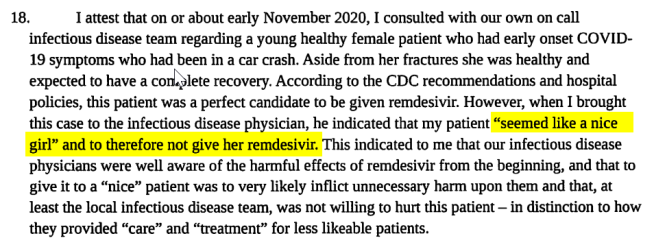
From just that small extract, the following can be surmised:
- treatment was entirely protocol-driven — this person was well enough to be in a car and her “covid-19” was incidental; there were, however, recommendations in place that notwithstanding that, she should receive remdesivir just because a protocol said so
- usually these protocols were followed, regardless of clinical need, but just because a person had a positive test
- the protocols, however, could be flexibly applied and in this case a doctor decided that a valid criterion for making a decision was how “nice” the patient was
- a treatment was actively avoided here “because she was nice” — indicating that the doctors knew that per-protocol they ought to be giving treatments which they themselves knew to be harmful
The core departure from medical norms on display here from which this fortunate patient escaped — the rigid application of “protocols” by compliant unquestioning doctors resulting in harmful treatment being given — is an extremely disturbing phenomenon. It would be naive to think this only happened in the USA, and was seen only in association with the particular treatment — remdesivir — mentioned here.
It’s worth noting that the tenacious Jessica Hockett has written this article in which she suggests a series of further questions she’d like to ask Dr Miller.
Featured Video

Diplomacy is Now a Crime in Britain / Ian Proud
or go to
Aletho News Archives – Video-Images
From the Archives
Genetic baloney in thick slices
MAYBE COULD BE INC.
By Jon Rappoport | No More Fake News | July 8, 2021
Gene research companies tend to come and go. They start out banging and popping like fireworks in the sky, and then they fade out—selling themselves to larger outfits who’ve hired better liars…
Once upon a time, it sounded easy. Start with a disease, find the gene responsible for the disease, and correct the problem.
Then, researchers wondered, was disease the result of one gene or a group of genes acting together?
Either way, the proof would be in devising cures for diseases using gene therapy. “Not yet, but soon…”
And regardless, the major need was: money. Lots and lots of money.
This need required good PR people. “We have to pump up the idea that we’re on the edge of tremendous breakthroughs. We’re always on that edge…”
This hype also needed to obscure the fact that there wasn’t (and isn’t) ANY gene cure for ANY disease. … continue
Blog Roll
 Aletho News
- Diplomacy is Now a Crime in Britain / Ian Proud
- UK Government Body Kept Files on People Criticizing Prevent Program
- US military withdrawal from Iraq and the collapse of US-Israeli hegemonic project in West Asia
- What does Europe want – a war with Russia?
- She Followed the Actual Data on COVID Vaccines and Masks — Her Career Took a Huge Hit
- Florida AG Sues Pfizer, Bourla Over Deceptive Marketing of COVID Vaccines
- Von der Leyen gifts her spin doctor a job for life
- 10K More U.S. Troops Deploy as Trump Weighs New Iran Strikes /Suliaman Ahmed
- Iranian crew declared Dena training vessel ‘unarmed’ to US warship before deadly torpedo strike: Report
- Iran’s NPT debate moves beyond parliament
- If Americans Knew
- Israel is squeezing the life out of Palestinians – Daily Update
- The Israeli Right Portrays Islam as Murderous. It Serves a Political Purpose
- Jordan Has Had Enough: King Abdullah’s Scathing Warning to Israel
- Israeli Colonizers (i.e. Settlers) Kill Palestinian Man Near Salfit
- New Google Maps images reveal massive scale of devastation in Gaza
- Jewish supremacy, anti-Palestinian bigotry on display in Israel – Daily Update
- Israeli Soldiers Abduct At Least 22 Across Occupied West Bank
- Eight Palestinians Killed in Israeli Attacks on Gaza
- Israeli former leaders and security chiefs threaten legal action over ‘Jewish terrorism’
- Israel map in LA Times ad includes all land from the river to the sea
- No Tricks Zone
- Green Energy Debacle: German Expert Professor Fritz Vahrenholt Warns Of Severe Economic And Social Consequences
- Two More Paleo Reconstructions Affirm Meters-Higher Sea Levels Across Ireland, Brazil 7000-6000 Years Ago
- New Study: Earth And Venus Surface Warmth Largely Explained By Convection And Lapse Rate, Not CO2 Or Radiation
- 2025 Nature Paper Claiming Worsening Global Drought Gets RETRACTED …Heavily Flawed
- New Study: ‘Global Drought Shows No Detectable Recent Acceleration Under Climate Warming’
- Economic Masterminds: German Socialists Suggest Taxing Productivity Gains Stemming From Using AI
- The South China Sea Has Not Been Cooperating With The Climate Change Narrative
- Energy Crisis: Germany Enters Heating Season With Historically Low Gas Reserve Fill Levels
- New Study: The Antarctic Ice Sheet Gained Mass From 2020-2024 Due To Staggering Snow And Ice Accumulation
- Study: Ocean Heating Rates From Thousands Of Years Ago ‘Dwarf’ Modern Ocean Heating Rates

