ANALYSIS: HOW THE UK AND US MEDIA DEHUMANISE PALESTINIANS
BY CLAIRE LAUTERBACH AND NAMIR SHABIBI | DECLASSIFIED UK | NOVEMBER 22, 2023
Nazis. Beneath animals.
This is a small sample of what Palestinians have been called by commentators speaking to Western media outlets in the last month of the Palestinian-Israeli conflict – examples of the bestiary of zoological terms natural to a coloniser’s view of the colonised.
Political philosopher Frantz Fanon wrote during France’s colonial war in Algeria of “hordes of vital statistics”, “hysterical masses”, “faces bereft of all humanity”, and “children who seem to belong to nobody”.
These are all terms that could describe how western media covers the suffering of Palestinians — “a tide of humanity… a teeming mass of Gazans”, as the BBC put it (15 October). This is all sharply in focus since Hamas’ October offensive, and Israel’s genocidal razing of the Gaza strip.
We analysed the front page coverage of Israel’s war in Gaza by five major US and UK news media — the Washington Post, the New York Times, the Guardian, the Times, and the BBC (the news landing page at 7am daily) between 7-26 October.
Over these three weeks following Hamas’ offensive, the mechanics of the Western press’ dehumanisation of Palestinians in death and life are revealed as clinical and routine.
Israelis are murdered, Palestinians die
The dehumanisation process begins (or ends) with questioning who counts in death, and how the killer and the victim are portrayed.
In the UK-US mainstream media, Israelis die actively. They are either killed or murdered by Hamas, or “after a surprise Palestinian attack”. “The Palestinians” stands in for “Hamas” for sloppy or ideological editors, for example in the Guardian on 8 October.
Palestinian civilians, by contrast, die passively – and yet it is they who have done most of the dying since 7 October; over ten times the number of Israelis killed.
Gazans aren’t killed by Israeli forces or Israeli government policies. They “dehydrate to death as clean water runs out” (Guardian, 18 October) while Israeli airstrikes “continue to pound the Palestinian territory”.
On 9 October, the BBC ran with “700 people have been killed on the Israeli side with more than 400 also dead in Gaza”, presumably succumbing to shock or an act of God.
On 8 November, the Times of London noted: “Israelis marked a month since Hamas killed 1,400 people and kidnapped 240, starting a war in which 10,300 Palestinians are said to have died”, which is of course qualified.
Palestinian deaths are natural, undifferentiated. This is only possible because the media treat Israel’s blockade of Gaza as wholly logical, proportionate and even restrained.
Violations of international law
Collective punishment, which is essentially what Israel is doing by striking civilian “targets” and totally blockading the “open prison” (in former prime minister David Cameron’s words), is also illegal. This is the view of EU foreign policy chief Josep Borrell, UN human rights chief Volker Türk and Human Rights Watch, among others.
When UN chief António Guterres noted Israel’s decades-long occupation of Palestine and called for an end to the siege, Israel’s UN representative demanded he resign. At least one of Guterres’ colleagues, the head of the New York office of the UN high commissioner for human rights, Craig Mokhiber, resigned of his own accord, protesting Israel’s “genocide unfolding before our eyes” in Palestine.
However, in none of the three weeks’ of front-page headlines and lead paragraphs for the five UK-US media analysed for this article are Israel’s serial violations of international law mentioned.
The exclusion of this important context on Israel’s crimes is important. As journalists we’re trained to account for the fact that most people don’t read beyond the headlines or first paragraphs.
Off the front page, some media published separate analysis pieces, such as the New York Times’ “Israel, Gaza and the laws of war” (12 October). This unsurprisingly goes nowhere near calling Israel’s crimes what they are: crimes.
Despite discussing at length how civilians cannot be targeted or disproportionately harmed for military purposes, the closest the New York Times gets to criticising the action of the Israel Defence Forces (IDF) is quoting the opinion of an expert on siege law.
This was that Israel’s siege is “an unusually clear-cut example of starvation of civilians as a method of warfare, which is considered a violation of international humanitarian law, a crime against humanity and a war crime” (emphasis added).
A swift qualifier follows: “Jurisdiction over some war crimes would depend on whether the conflict is considered inter-state.” So some crimes are not a crime as long as Palestine or Palestinians don’t exist, as Israeli prime minister Golda Meir asserted over 50 years ago, repeated by current Israeli politicians.
By contrast, Hamas’ actions are, to the same cited expert, “not close calls”.
Preventable deaths
Moving on from, or ignoring completely, both the illegality of Israel’s total siege of Gaza, the UK-US media portray the starvation and preventable deaths resulting directly from it in almost entirely passive, naturalistic language.
For example, the Washington Post’s print version front page: “Civilian harm in Gaza looms over Biden’s visit; Rising human toll from attacks could threaten Israel’s global backing” (harm arising of course from Israel’s battering).
On 13 October, from the New York Times : “300,000 homeless in battered Gaza as food runs low” (because Israel is blocking food from entering Gaza). It continues: “Hospitals overwhelmed and fuel scarce” (because Israel is blocking medical supplies and fuel from reaching Gaza) “as Israel strikes back at Hamas.”
That’s fine then – the reader should feel at ease since Israel’s crushing of hospitals is merely an act of “self-defence”.
The Israeli military is not much a fan of Gazan hospitals – it regularly bombs them. It ordered 23 hospitals in northern Gaza to evacuate on 13 October, and seems to have been picking them off, with patients inside, ever since.
When Israel might have gone too far, as it did in almost certainly bombing Al-Ahli Arab Hospital on 17 October, most outlets covered the strike by repeating both Israel’s and Hamas’ “he said-she said” accusations against the other.
Nevertheless, the New York Times gave the IDF’s denial more weight with “Hamas fails to make case that Israel struck hospital” (23 October, emphasis added), which is a catchier headline than “We don’t know, and don’t want to work it out ourselves”.
Meanwhile, the Times ran with “Strike kills up to 500 in Gaza”, swiftly adding that “Israel denies responsibility and blames jihadis”, with no comment from a Palestinian voice.
Mirroring the discrepancy between how Palestinians have died (passively, often with no mention of Israeli actions) and Israelis have died (actively, directly attributed to Hamas or “Palestinian” actions) is how the media describes child victims of both sides.
Discussing a prisoner exchange, a Washington Post columnist described Israel’s “children hostages” while referring to Palestinian children as “young people”. Under Military Order 1591, the Israeli government can hold minors as young as 12 without trial and potentially indefinitely in “administrative detention”, UNICEF reports.
When Gazan civilian deaths from siege and strikes against civilian infrastructure are shown as authorless natural disasters rather than as war crimes, any access Gazans get to essential goods becomes “aid” or “relief”, and every tiny amount allowed to reach them is an act of Israeli mercy.
For example, the New York Times (19 October): “Deal lays groundwork for aid to reach desperate Gazans”. Or the Washington Post (12 October): “Closed borders, falling bombs choke Gaza; thousands injured as supplies wane”, adding “humanitarian crisis in Gaza worsens” (due to Israeli siege, let’s not forget).
Also in the Washington Post is the incredible headline (16 October) “As Palestinian death toll rises, aid stuck in Egypt”, as if it couldn’t physically fit through the door, which ignores the fact that Israel prevented aid from entering Israel via Rafah, demanding proof it would not be diverted to Hamas.
The numbers
Having reduced Palestinians to numbers, the work then becomes to cast doubt on these numbers.
When Israel’s flattening of Gaza began raising international alarm, Biden said he didn’t trust that “Palestinians” (or the Hamas government, since to him the distinction is irrelevant) “are telling the truth about how many people are killed.”
His statement was the latest in a time-honoured tradition of US administrations disputing the number of deaths wreaked by their allies abroad, from Suharto’s Indonesia, to Salvadoran death squads in the 1980s and Saudi Arabia today, as historian Bradely Simpson notes.
No one seriously disputes the Gazan Ministry of Health’s numbers as too high. If anything, they are likely a serious undercount given how many bodies are trapped under rubble.
Nevertheless, the attribution of figures to the “Gaza Ministry of Health” is now almost always prefaced by “Hamas-government” or followed by “controlled by Hamas”. This would seem an odd waste of words, considering that everyone from the UN to the US State Department cites Gazan health ministry casualty data, and Gaza’s government is run by Hamas.
Dead Palestinians are simply irrelevant for some media. The first mention of Palestinian deaths in Times headlines occurred 11 days after Hamas’ assault: “Strike kills up to 500 in Gaza”. It had by then run several front page pieces about specific, named Israeli victims, including an in-depth profile (with portrait) of a kibbutz family horrifically killed by the Hamas-led offensive [or not].
Unsurprisingly, on 12 October, the Telegraph published the number of Israelis killed in factors of “9/11s” in a striking infographic which didn’t even bother to include an estimate of Palestinian deaths.
Double standards
Once a people are truly dehumanised, it becomes logical – necessary, even – to apply a wholly different standard of (in)decency to them.
UK-US media report Palestinian deaths passively, as if through apparent acts of God, often couching the deaths in language suggesting that they were mostly Hamas or Hamas-adjacent, or at least that they inconveniently stood in missiles’ way.
For still-breathing Palestinians, it is not enough to have somehow escaped being killed by the almost 6,000 bombs Israel launched in its first six days punishing the densely populated territory. This is more than the US, not usually known for its restraint, deployed in any single year of its war in Afghanistan.
A living Palestinian must justify his or her continued aliveness by disavowing Hamas. A viral example of this can be seen in BBC Newsnight’s interview of the head of the Palestinian mission to the UK, Husam Zomlot.
Presenter Kirsty Wark barely flinched upon hearing Zomlot describe in detail how members of his family had been killed by Israeli strikes in the previous days before repeatedly demanding Zomlot condemn Hamas’ actions.
To reverse this, in other words, to ask every Israeli who had lost a family member in this conflict to first begin by condemning Israel’s murders and collective punishment of civilian Gazans would be rightly seen as outrageous. Unsurprisingly, we have not seen any examples of such in the Western press.
The UK-US press also tells us that to support Palestinians is to support Hamas, in case anyone doubted the conflation.
The BBC declared London’s peaceful pro-Palestine protesters as providing “backing for Hamas.” It later retracted its “poorly phrased” comments.
Sky News did no better in using images of peaceful protesters bearing Palestinian flags to accompany its discussion of efforts by the London Metropolitan Police to “tackle extremism”.
These “slips” pale in comparison with the virulently offensive terms guests on BBC programmes have called Palestinians, completely unchallenged by their hosts.
For example, BBC Arabic hosted former Israeli intelligence veteran-turned academic, Mordechai Kedar who refused to recognise popular Israeli racism towards Palestinians, claiming that bestial comparisons of Palestinians are “denigrating to animals.”
Tellingly, the BBC Arabic host neither ejected Kedar from the interview, nor did she admonish him and demand an apology. Instead, the host pivoted away from Kedar’s genocidal language with the comment “that’s your opinion”.
Platforming Israeli justifications
UK-US media have also taken to running pieces platforming Israeli justifications for the IDF’s actions when the staggering number of dead Gazan civilians was becoming harder to write around.
“How Israelis justify scale of airstrikes” ran the New York version front page of the New York Times on 26 October. It was later rewritten as “Israel’s strikes on Gaza are some of the most intense this century”.
It is unthinkable that a Western newspaper would carry a piece platforming in the same benign-to-neutral terms Palestinian rage, or worse, justifications for Hamas’ crimes.
Another trend is to normalise Israel’s actions by focusing not on its costs in Gazan lives, but its intentions which, of course, are shown as benign. (Note: intentions don’t matter in the laws of war.)
Three days into Israel’s illegal total blockade of Gaza, the BBC asked: “Could an Israeli ground invasion of Gaza meet its aims?” (14 October). Charitably characterising Netanyahu as “risk-averse” (for Israelis, not Palestinians), the New York Times ran with “All-out war is untried ground”, comforting readers that “limited strikes in past were safe politically”.
Dissenting voices: harder to hear
Journalists at the BBC and Agence France Presse (AFP) who have been critical of their agencies’ bias against Palestinian lives and minimisation of Israeli war crimes told Declassified that there is no space to discuss editorial concerns.
Palestinian commentators have seen their segments edited out of mainstream news programmes. Palestinian Americans report their events are being cancelled while they’re called Hamas supporters.
Meanwhile, a senior editor at US publication Newsweek called for Gaza to be flattened to resemble a parking lot, apparently without censure.
Elsewhere in the media ecosystem, an official of the UK’s communications regulator OFCOM, Fadzai Madzingira, was suspended for a social media post criticising UK support for “ethnic cleansing and genocide of Palestinians” and “this vile colonial alliance”.
None of these points – that Israel may be committing genocide, that it continues to ethnically cleanse Palestinian land or that Israel was founded as a colonial project which still uses settler outposts to consolidate territorial control – is outside of reasonable analysis of historical facts.
It’s looking an awful lot like the beginning (or end, depending on your starting point) of a genocide.
The IDF has instructed all Palestinians to flee south of the Wadi Gaza area “for their safety” from Israeli strikes. Some were struck as they were evacuating, and Palestinians are still being shelled by the IDF in southern refuge areas.
Soldiers plant Israeli flags on Gazan beaches, while Israel’s intelligence agency floats the idea of permanently expelling Gazans to Egyptian Sinai as a preferred solution. Netanyahu invokes a Bible passage where God orders the Israelites “to put to death men and women, children and infants” of a rival kingdom.
Still, the New York Times uncritically presents Netanyahu as “seeking [a] permanent end to threat but not a reoccupation” (13 October).
That last bastion of dissent, gallows humour, is also at grave risk. Michael Eisen, editor of science journal eLife, was sacked for posting on Twitter an article from humour site the Onion, with the headline “Dying Gazans criticized for not using last words to condemn Hamas”.
The Guardian’s cartoonist Steve Bell’s contract was not renewed after his sketch of Netanyahu preparing to operate on his own stomach with an outline of Gaza was deemed too reminiscent of the “pound of flesh” anti-semitic trope.
Meanwhile, the Washington Post published a cartoon of a Hamas official with Gazan children and women strapped to him saying “How dare Israel attack civilians”. It’s since been deleted following racism complaints.
Yet the cartoonist is still drawing for mainstream media. Last week he published another cartoon in the Las Vegas Review showing a (fat, black) woman with a Black Lives Matter t-shirt holding up a sign saying “Terrorist Lives Matter: Blame Israel, Support Hamas”.
How dare Israel attack civilians indeed.
Claire Lauterbach is an independent investigative journalist and producer. She is the former Head of Investigations at Privacy International where she investigated the use and abuse of surveillance and military technologies, and a former Senior Investigator at Global Witness. Claire previously investigated war crimes in Goma, DR Congo for Human Rights Watch.
Namir Shabibi is an independent investigative journalist, visiting lecturer in Geopolitics at the University of Westminster, and PhD candidate researching covert paramilitary action in the ‘War on Terror’. He is a former International Committee of the Red Cross delegate investigating breaches of the Geneva Conventions in Darfur and Guantanamo Bay.
A hard truth about the Russia-Ukraine conflict is finally dawning on the West
By Tarik Cyril Amar | RT | November 24, 2023
On November 16, the Wall Street Journal, one of the most prestigious and influential American media outlets, published an essay under the title “It’s Time to End Magical Thinking About Russia’s Defeat.”
The authors, Eugene Rumer and Andrew S. Weiss, are influential representatives of America’s national security and international relations establishment. After a career in government service, Rumer now directs the Russia and Eurasia program at the Carnegie Endowment for International Peace; Weiss is Carnegie’s vice president for studies. This is an important text, and both its message and the timing of its publication matter.
The message is simple: “Putin” (by which they mean Russia) has “withstood the West’s best efforts” to roll back the military operation against Ukraine; Moscow’s political system has proven resilient and even become stronger; and “America and its allies” must now switch to a strategy of “containment.”
The timing is more complex. Clearly, the current Israeli war on Gaza – referred to as “tumult in the Middle East” – is one of three key factors. The other two are the approaching presidential elections in the US, and, of course, the failure of Ukraine’s summer counteroffensive, by now acknowledged even in gung-ho outlets such as the British Daily Telegraph.
In addition, America’s hold over the non-Western majority of humanity is continuing to decline. China, in particular, is successfully resisting Washington’s pressure. Domestically, President Joe Biden’s government faces tough headwinds from both the official Republican opposition and a growing movement in the American street, where widespread and deep dissatisfaction with politics and the economy is now combining with an unprecedented groundswell of protest against US complicity in Israel’s genocidal war on the Palestinians.
American polls are unambiguous. In September, even before the Middle East crisis, the Pew Research Center found that “Americans’ views of politics and elected officials” are now unusually and “unrelentingly negative, with little hope of improvement on the horizon.” By now, a majority of Americans also contradict the Biden administration – and the rest of almost the whole bipartisan political establishment – by wanting a cease fire in Gaza, while the number of those supporting Israel is decreasing quickly and significantly.
Against this background, this Wall Street Journal article clearly serves as an authoritative call for retrenchment. The object of this signal to retreat is the proxy war in Ukraine, that is, the single most aggressive, most risky, and most defeated US foreign policy strategy in the past two years (if we count from the moment Washington recklessly decided to stonewall Moscow’s clear warning as well as its urgent offer to find a grand bargain-style off-ramp in late 2021).
So far, so telling. But not surprising. For two reasons: the turn away from Ukraine is already fairly old non-news. Even mainstream media spotted the onset of a severe, probably terminal, bout of Ukraine fatigue well before the eruption of the fresh war in the Middle East. Secondly, the skeptical insights now given prominence in the Wall Street Journal as reasons to wrap up its proxy war investment in Ukraine are very old hat indeed. As a matter of fact, the most interesting question the essay – inadvertently – raises is what took you so long?
It would be tedious to address every point raised now in the Wall Street Journal. But since they all have in common that they have been predicted or were utterly predictable, a few highlights will do.
We learn, for instance, that the West’s attempts to isolate Russia have failed. Yet how hard was it to foresee that the Global South has no reason to follow the West except fear, and that fear is abating? And was it impossible to know in advance that China would answer “No, thank you very much,” when the US and the EU did two things at the same time: urge it to abandon Russia, which would have meant giving up Beijing’s single most important partnership, and signal that China would be next to be cut down to size? China, in essence, initially gestured a little in the direction of distancing itself from Russia, but the strategic fundamentals of the situation determined its real behavior and have become explicit by now. This outcome was predicted, not by every expert but by enough of them to matter.
We are also reminded that this is a war of attrition, i.e. one favoring Russia by its very nature. Even on CNN, we heard that much as early as April 2022, and the militantly Atlanticist Economist magazine admitted it in a backhanded way (using the euphemism “war of endurance”) in September.
Every war is a matter of competitive military performance. But in a war of attrition, three fundamental things matter the most: the size, productive and technological capacity, and resilience of the economy; the stability of the political system, including its real-life popularity and the elites’ legitimacy; and, of course, demography. The Wall Street Journal observes that Russia’s economy has “been buffeted but is not in tatters” (really understating its success, but let’s not quibble) and that its political system draws on “solid” popular support and elites that have neither rebelled nor deserted.
In the West at least, this was harder to predict. Not because of Russia being so difficult to decipher, but due to Western bias and groupthink, or, bluntly put, wishful thinking. Even before the post-February 2022 Ukraine war, Western politics, media, think tanks, and even academia have rewarded unrealistically pessimistic assessments of both Russia’s economy and political stability. Consider, as a pars pro toto, Western reactions to the Wagner rebellion in June. Quite a few of them predicted the imminent collapse of Russia into anarchy and civil war or, at least, a great and lasting domestic and international weakening of Russia. Yet none of this has come to pass.
The importance of this comprehensive, almost total failure of analysis and prediction lies in how typical it was, reflecting a dominant culture of politicized sloppiness vitiating Western thinking about Russia. A sloppiness that is all the more astonishing as precisely Moscow’s opponents cannot afford it without serious self-harm.
For self-harm is the main result. It is true that Russia has to bear some of the cost of Western shortsightedness. Obviously, Moscow as well would be better off if it could work with reasonable, if competitive, partners instead of irrationally hostile opponents who constantly underestimate Russia and overestimate themselves. Yet the West is suffering even more from its pattern of repetitive mistakes.
The costs of the proxy war in Ukraine demonstrate this fact, and not only in terms of arms and money, but of political prestige as well. Regarding the quantifiable costs, the US Congress, for instance, has approved $113 billion worth of aid for Ukraine since February 2022. Currently, a request for even more is turning into a major domestic headache for the Biden administration, and most likely, a defeat. The EU has shelled out almost €85 billion.
Of course, not all of these funds have really been appropriated, and much of them have really been fueling corruption in Ukraine or served the donors and especially their arms industries, as US politicians have repeatedly pointed out with proud cynicism. Yet the overall picture remains one of severe fiscal overstretch spent on a losing gamble. Add the self-inflicted losses that the EU’s economies in particular have incurred from their misconceived sanctions policy and the picture is grim. Add, moreover, how much the West will have to spend if it really wishes to finance the rebuilding of Ukraine, and the prospect turns catastrophic. Good luck, EU, with those membership plans.
In addition, intangibles matter as well. Clearly, “losing” Ukraine (which the West should not have tried to “own” in the first place) will reveal the bloc’s weakness more sharply than the failures in, for instance, Iraq, Libya, Syria, or Afghanistan. For two reasons. First, unlike these countries, Russia is a great power; that means it is in a position to exploit the Western setback. Moscow, put differently, is big enough to geopolitically counterattack.
Whether or when exactly it will do so, and what shape such a new “snapping back” of Russian President Vladimir Putin’s metaphorical “rubber band” will take this time, remains to be seen. What is clear is that such payback is a realistic possibility. Secondly, the West is committed as never before, substantially and rhetorically, when trying to use Ukraine to reduce Russia. Hence, failing to do so exposes Western limits as never before. Rumer and Weiss are not naïve. They cannot say it – and maybe they can’t even quite think it – but in their heart of hearts they know that packaging this defeat as a mere change of strategy to “containment” will not fool anyone who does not want to be fooled.
It is good to finally see some hard facts appear prominently in mainstream Western debates. But it is not enough. For one thing, the West has to ask itself painful questions why it has stayed so obsessively one-sided for so long. Otherwise, the same pattern will be repeated in starting and waging the next war, for instance, against China or Iran. Secondly, a shift to “containment” will not repair the damage but merely stretch it out. What the West really needs is a complete rethinking of not merely its methods but its aims.
Tarik Cyril Amar is a historian from Germany working at Koç University, Istanbul, on Russia, Ukraine, and Eastern Europe, the history of World War II, the cultural Cold War, and the politics of memory.
Marching for Israel? American and Israeli war criminals celebrate together

BY PHILIP GIRALDI • UNZ REVIEW • NOVEMBER 24, 2023
For those who missed it or chose to ignore it, there was a large demonstration in Washington on Tuesday the 14th dubbed the “March for Israel” with many posters and signs featuring “Israel We Stand With You.” I have no big problem with Americans “standing with Israel” as long as they go over to Israel to do it and in some cases at least put their own lives at risk in so doing, but that is not the way they operate. What I do have a problem with is the cause they are supporting, namely the ethic cleansing of an entire nation or even, if required to do that, a military style genocide of the inhabitants of an area that was entirely populated by an ethnic group called Palestinians before Israel’s mostly European immigrants entered the scene and used foreign provided force majeur to steal the land and property. While so doing they were also killing thousands of locals and forcing three quarters of a million more to abandon their homes and spend their lives in refugee camps, a process of ethnic cleansing that has continued and been expanded through the creation of illegal settlements since the founding of the Jewish state 75 years ago.
The rally was organized by the Conference of Presidents of Major American Jewish Organizations and the Jewish Federations of North America in solidarity with Israel’s response to the October 7th Hamas attack. Apart from backing the Israeli government in its devastating counterattack on Gaza, the stated goals of the rally were to support Israel in general, to call for the release of the hostages taken by Hamas, and to combat antisemitism. “Rising antisemitism” allegedly followed the October 7th Hamas attack and the Israel reaction that marked the start of the war. The usually cited source the Anti-Defamation League has stated that antisemitism has increased 388% in the US since October 6, 2023. Now one must observe that the ADL is not a reliable source when it comes to antisemitism as its agenda is clearly to send the message that Jews as a group are threatened, which is just not true to anything near the extent that is being implied. The reason why antisemitism and holocaust denial are used so often against critics is to discredit them without having to provide any evidence. For ADL, a Jewish college student walking on campus and passing a pro-Palestinian poster and being upset by it is an antisemitic incident. What I am saying is that this is an entirely faked exercise to convince the audience that Israel and Jews are the victims in spite of the fact that many more Palestinians have been killed and dispossessed since the founding of Israel in 1948. If there is any real increase in actual antisemitism it is in response to the highly visible bestiality that the Jewish state has exhibited against the original occupants of what was once Palestine. Israel wants the Pals gone and these are the first steps in what might be termed a final solution, aided and abetted by American monsters like Joe Biden and Donald Trump, who have made the United States complicit in war crimes.
Many participants in the Israel rally came by charter buses organized by Jewish houses of worship and schools. Most of the crowd appeared to be Jews but there was also a strong Christian Zionist component. Groups came from New York, New Jersey, Los Angeles, Houston, Miami, Boston, Kansas City, New York, Philadelphia and Miami plus other domestic and even international locations. US college students were given $250 in travel and expenses money to attend as an incentive. The crowd was considerable though there is some confusion about how many were actually in attendance. The organizers predicted 60,000 which was the number initially accepted, but other estimates of the crowd were as low as 10,000 or 25,000. The numbers quickly grew in some news stories to uncorroborated estimates of 270,000 to 300,000. There is, of course, certain bragging rights in large numbers and the March was in competition with a Palestinian rally that attracted 300,000 the week before, so let’s just accept that there was a large group present on the Mall.
Joe Biden did not personally attend the rally but he said on the following day “[that] Israel’s military operation in Gaza would stop when Hamas no longer maintains the capacity to murder, abuse, and do horrific things to the Israelis.” He left out the part of continuous abuse of Palestinians, going back 75 years and clearly is not paying attention to senior Israeli government officials who are making comments that indicate that the grand objective is to remove the Palestinians from what will soon be Eretz or Greater Israel.
Speakers at the three-hour long rally included Israel’s self-described protector in Congress Senate Majority Leader Chuck Schumer, House Speaker Mike Johnson, House Minority Leader Hakeem Jeffries, Senator Joni Ernst, Pastor John Hagee, and Israeli President Isaac Herzog (via video from Jerusalem), who praised US President Joe Biden for his “moral clarity and bold actions…” Johnson predictably declared that “The calls for a ceasefire are outrageous!” while the State Department’s Special Envoy to Monitor and Combat Antisemitism Deborah Lipstadt also delivered on demand a plea “Do not cower, allow no one to make you afraid.” Meanwhile Donald Trump’s US Ambassador to Israel David Friedman, who served mostly as an apologist for the Jewish state while in office, roamed the Mall expressing his joy at developments. Other notable speakers included Natan Sharansky and actress Debra Messing. Speeches followed the predictable narrative, with descriptions of how Israel had been attacked by terrorists who sought to destroy the Jewish state, that Israel is America’s best friend and closest ally, and how Israel is only defending itself from attack. Israeli Prime Minister Benjamin Netanyahu, who did not speak, stated in an interview in Israel that if his country does not succeed in crushing Hamas, the next terrorist attacks would be directed against America, an evidence free claim to strengthen US resolve, but as Netanyahu hardly ever tells the truth it should be taken for what it’s worth.
And, of course, everyone’s openly stated or subliminal message was that the United States must stand by and do whatever it takes to help defend its good friend and ally, including rejecting a cease fire or negotiations and letting the slaughter of Gazan women and children continue. The discredited tales of torture and mass rapes of Israeli women and the killing by beheading of Jewish babies, which are still being replayed by President Joe Biden, were also part of the rally agenda and appeared as the messages on signs and posters. What was not mentioned however was the systematic Israeli bombing of hospitals, schools, churches, and infrastructure, all of which are war crimes, as are the attacks on high density civilian targets which have produced more than 11,000 deaths as of this writing, mostly consisting of women and children. Targeting civilians in that fashion in those numbers can and should be construed as genocide. Israel’s war on hospitals can also be regarded as part of a systematic campaign of genocide. The deliberate targeting of civilian populations, children, medical and aid workers has been elevated to an Israeli government policy to drive the Palestinians from what was once Palestine.
Official Washington was on parade and in lockstep to demonstrate its unshakable loyalty to Israel even as opinion polls suggest that the American public is tired of the charade. A couple of brave peaceniks dared to move on the fringes of the crowd with signs calling for a ceasefire to end the carnage, but they were openly derided and threatened so they kept their distance. One truly shocking attendee at the rally was former Congresswoman Tulsi Gabbard, who was present and spouting the straight Israel line about how it was the victim of terrorists. Tulsi said “It is inspiring to see how many people are flooding into Washington – understanding the seriousness of this moment, coming from all over the country. Many Jewish people [and] many people who are not Jewish . . . are coming and saying that we must stand up against antisemitism. We must stand up for our Jewish brothers and sisters, and we must take a strong stand against the Islamist terrorists who seek to not only exterminate the Jewish people but also to exterminate and kill anyone who does not adhere to their radical interpretation of Islam.” She sounded something like the State Department’s despicable number two Victoria Nuland looking for another country to attack. Now that RFK Jr has also obligingly rolled over for the Jewish state there is no genuine peace candidate anywhere on the horizon with the exception of the Green Party’s Jill Stein and the beat of the war drums will continue to sound.

More out of sync perhaps was the presence as an ally of convenience evangelical Pastor John Hagee of the Christians United for Israel (CUFI) group which was well represented both at the rally and as the key largest Christian Zionist component of the Israel Lobby in the US. Hagee has said that Hitler was a “half-breed Jew,” created and sent by God as a “hunter” to drive European Jews on a divine mission to fulfill prophecy by creating the state of Israel to bring about the End Time and the Second Coming of Christ followed by the Rapture of all true believers into heaven. Jews will have to convert to participate. One brings someone as controversial as Hagee out of the woodwork only to send a message that this is not about making sure that Jews are safe. It’s about showing solidarity with Israel, no matter what it does. And what kind of rally against antisemitism includes racist signs calling for more war, more bombings, and the destruction of not just Hamas but also the ethnic cleansing of the Palestinians? Or as one sign held by a masked protester read, “From the river to the sea, Israel is all you will see.”
The so-called holocaust was evoked a number of times by speakers, particularly when it came time to describe Gaza on November 7th as the biggest killing of Jews since the Second World War. Nor did anyone mention the fundamental dysfunction in the US-Israeli relationship, which is that Israel calls nearly all the shots, including the killing of 34 sailors on the USS Liberty in 1967 and the more recent shooting of American citizen journalists covering Palestinian protests by Israeli Army sharpshooters. Israelis who kill Americans are never punished unlike the demands or retribution being made by speakers in Washington at the rally to kill not only all of Hamas but also the Gazan voters who elected Hamas in the first place. Though it is somewhat repetitive to say so, lest there be any confusion, that is referred to as genocide which is regarded as the most serious crime against humanity. And no one spoke up at the rally against the involvement of the US military in the operation against Gaza, which Biden is lying about and which is opposed by a majority of the public. Nor did anyone cite recent comments by US General Richard Clark that American soldiers must be “prepared to die for the Jewish state.”
Perhaps the politicians in Washington should ask US soldiers whether they are “prepared to die for the Jewish state.” Or maybe there should be called a national referendum asking the public whether it wants to continue arming and sending billions of dollars to Israel and to Ukraine as well. Evidence suggests that a clear majority would oppose both policies, which have hardly been debated at all in any serious way. Americans who want to “stand with Israel” should be allowed to go there with a one-way ticket in exchange for which they have to turn in their US passports as another major issue is “Who are they actually loyal to?” I’ll bet I know the answer to that one!
Philip M. Giraldi, Ph.D., is Executive Director of the Council for the National Interest, a 501(c)3 tax deductible educational foundation (Federal ID Number #52-1739023) that seeks a more interests-based U.S. foreign policy in the Middle East. Website is councilforthenationalinterest.org, address is P.O. Box 2157, Purcellville VA 20134 and its email is inform@cnionline.org.
Why China’s ‘repressed’ Muslims suddenly got dragged back into the light
By Timur Fomenko | RT | November 24, 2023
At the beginning of this week, foreign ministers from a group of Muslim-majority countries, including Saudi Arabia, Jordan, Egypt, the Palestinian National Authority, and Indonesia travelled to China in order to seek support for a ceasefire in the ongoing Gaza war.
The unconditional backing of Israel by the United States and its allies has tanked their credibility across the Islamic world, and Beijing has positioned itself as an advocate of peace when others are not willing to take up that role.
It is curious that within the following few days, a report was released by Human Rights Watch, accusing China of expanding its alleged campaign of closing down and repurposing mosques into regions other than Xinjiang – which had so far been the focus of accusations that Beijing is cracking down on the predominantly Muslim Uyghur minority. Even those allegations had been somewhat on the backburner in the establishment media lately, but the HRW report was quickly picked up and amplified.
Although relations between the US and China have somewhat calmed down, it is obvious that Washington does not want to see Beijing increase its influence in the Muslim world, as that would inevitably come at the expense of American clout. The attempt to draw attention back to China’s alleged repression of its Muslim population, while underreporting Israel’s devastating attack on the (also Muslim) population of Gaza, is an exercise in deflection and part of the ongoing narrative war between China and the US. Be it about Muslims or not, the Xinjiang issue has long been a key component of that struggle for influence.
The Uyghur minority has, since 2018, been a tool of “atrocity propaganda” used to wage public relations offensives against China. It is a means to an end, which often disappears and resurfaces in the media, coinciding with the ebb and flow of anti-Beijing rhetoric coming from the US administration or the State Department. This includes using it to turn public opinion against Beijing in selected countries, including allies, or to manufacture consent for policies aimed at supply chain shifts or “decoupling,” through the accusation of forced labor, especially in the fields of key agricultural goods, polysilicon and solar panels, or to attempt to embarrass China diplomatically at the UN, or to push for boycotting events such as the Winter Olympics.
This is an incredibly opportunistic attitude to something Beijing’s detractors claim is a “genocide.” Since late 2021, the Biden administration has largely ignored the issue and it has fallen off the international agenda, precisely because Washington had gotten the sanctions they wanted from it at the time. However, the Israel-Gaza conflict introduces a new dynamic whereby the US and its allies are dramatically losing face and credibility among Muslim nations because they are backing Israel unconditionally in the wholesale slaughter of Palestinians. From a geopolitical point of view, such a policy pathway is actually strategically disastrous because it alienates the entire Global South, serves as a beacon in projecting US hypocrisy and worse still, directly empowers China as a competitor.
So when you are faced with a situation whereby Beijing is gaining diplomatic capital over your own failures, what do you do? You desperately aim to deflect by trying to draw attention to another issue in the attempt to smear Beijing: Xinjiang and the Uyghurs. Now as it happens, Muslim countries mostly ignore US-led propaganda over the Xinjiang issue, because they see it for what it is and also share a common norm of respect for national sovereignty with Beijing, which is politically beneficial for them. The only Muslim nation who has ever made public comment about it is Türkiye, because Uyghurs are a Turkic ethnic group and the issues is viewed through the lens of Ankara’s Pan-Turk ideology. However, Turkish President Recep Tayyip Erdogan is still likely to ignore the issue, or only involve himself in it based on what he can gain.
On the other hand, the Gulf States, the key US allies in the Middle East, such as Saudi Arabia and the United Arab Emirates, support China’s position, and the Gaza issue is putting them under pressure regarding their relations with the US and the decision to normalize relations with Israel. So suddenly we are seeing a resurgence of Xinjiang material because the US, even if it cannot sway their governments, wants to kindle the anger of Muslim populations about another issue instead and diminish China’s credibility. Although this is less likely in Arab States, it could cause public opinion ruptures in key Asian Islamic countries such as Indonesia and Malaysia, where significant resources were placed by organizations such as the BBC in relaying Xinjiang-related content in their respective languages.
But the question is, will this campaign succeed? It might be worth remembering that Xinjiang is an artificially imposed issue pushed “top-down” by governments and the media, whereas Palestine is a grassroots issue pushing from the bottom up, aspects of which media and politicians endeavor to selectively ignore. China’s heavy-handed management of Uyghurs in Xinjiang is not really a genocide, and it will never rank on the same level of severity as the outright bombardment and mass killing of Palestinians, no matter how hard you try.
Democrats Ignore The First Amendment With Censorship Demand Letter To X
By Christina Maas | Reclaim The Net | November 23, 2023
A group of over 25 Democratic members of Congress have raised allegations against X, once again ignoring the First Amendment and calling for online censorship.
They assert that the company is both allowing and profiting from the dissemination of false and violent content, particularly regarding the conflict between Israel and Hamas.
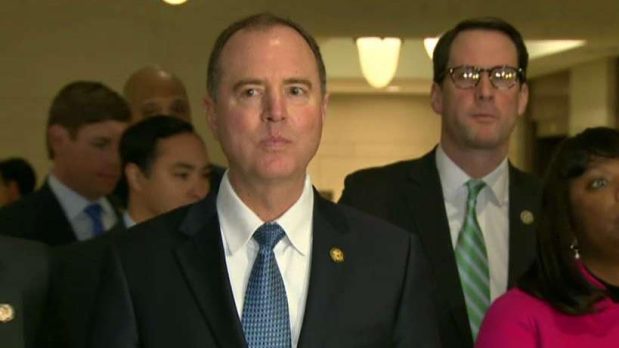
On Tuesday, these lawmakers, including notable figures such as Reps. Dan Goldman, Jamie Raskin, Jerry Nadler, Bennie Thompson, Katie Porter, and Adam Schiff, addressed a letter to Linda Yaccarino, CEO of X, and Elon Musk, its owner.
We obtained a copy of the pressure letter for you here.
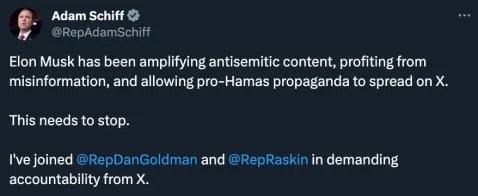
They expressed concern over X’s alleged negligence in enforcing its policies against the spread of misleading information and content promoting violence, hate, and terrorism.
The letter specifically points out the drastic reduction in X’s content moderation staff over the past year, suggesting that the company has deliberately allowed and even benefited from the illegal circulation of terrorist propaganda. This conduct, according to the legislators, is completely inappropriate for a platform as globally influential as X.
Further, the letter highlights reports from the Tech Transparency Project and the Institute for Strategic Dialogue.
“We are demanding that you uphold your public commitments and enforce your policies. Accordingly, no later than December 1, 2023, we request that you provide all forms of written communications, including email, text messages, other messaging services, or X direct messages, relating to content moderation for any posts or accounts associated with, related to, or connected to Hamas,” the letter states.
The lawmakers underscore that X Premium, a subscription service offering features like prioritized ranking in conversations and searches, might be indirectly facilitating the profit from the spread of such content. They note that X gains financially from subscription fees and ad revenue generated from these accounts.
Elon Musk recently declared that all X revenue from ads and subscriptions on content regarding the conflict will be donated to charities in the impacted region.

Additionally, the letter accuses X of profiting from subscribers who spread false and misleading narratives about the Israel-Hamas war.
Further, this month, Representatives Josh Gottheimer, a Democrat from New Jersey, and Don Bacon, a Republican from Nebraska, introduced a bill aimed at countering the uptick of alleged false information disseminated on TikTok and other online platforms amid the recent Israel-Hamas conflict.
Gottheimer clarified during a media briefing, “This legislation will require social media companies to release detailed reports of violations to their terms and services and how they’re addressing these violations, which includes using their platforms for terrorist purposes… It also requires the intelligence community to provide a threat assessment about what’s happening on social media.”
The proposed law, titled the Stopping Terrorists Online Presence and Holding Accountable Tech Entities Act or the Stop Hate Act, incorporates a $5 million daily penalty for any social media enterprise non-compliant with the proposed bill’s conditions. The act is vocally supported by the ADL.
New York Governor Kathy Hochul signed similar legislation in 2022, only to have a judge denounce it as a violation of the First Amendment.
Israel lobby offers US politician $20mn to unseat Rashida Tlaib
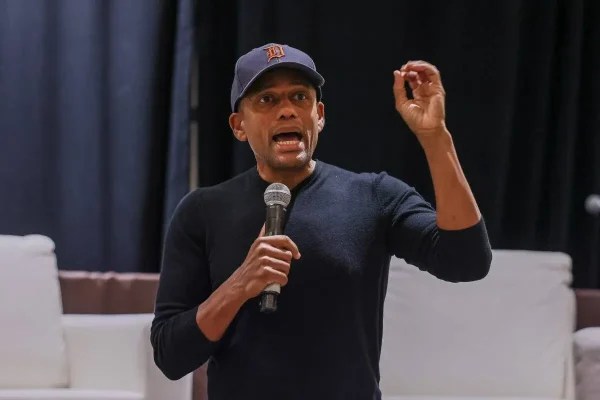
Actor and US Senate candidate Hill Harper – October 20, 2023 [Jemal Countess/Getty Images for NOBCO]
The Cradle | November 23, 2023
A prominent US actor turned politician was offered $20mn by the Israel lobby to run in upcoming elections against Democratic Congresswoman Rashida Tlaib, as she faces fierce criticism for her stance against what she says is Israel’s ongoing genocide against Palestinians in Gaza.
Tlaib, the only Palestinian-American lawmaker in the US Congress, has stood alone in opposing the Biden White House’s staunch support for an Israeli military campaign that has killed over 13,000 Palestinians, the majority women and children, in six weeks.
The $20mn was offered to Hill Harper on 16 October by Michigan businessman Linden Nelson, who is connected to the American Israel Public Affairs Committee (AIPAC), the most powerful Israeli lobby group in Washington.
Frank Eugene “Hill” Harper, 57, a Hollywood actor who most recently portrayed Dr. Marcus Andrews in The Good Doctor on CBS, is running to succeed retiring Democratic Senator Debbie Stabenow in Michigan.
But Nelson offered the money to Harper in exchange for dropping out of the Senate race and running for Congress against Tlaib instead.
Harper confirmed the report on Wednesday, tweeting: “I didn’t intend for a private phone call to turn public. But now that it has, here’s the truth. One of AIPAC’s biggest donors offered $20m if I dropped out of the US Senate race to run against Rashida Tlaib. I said no. I won’t be bossed, bullied, or bought.”
He also tweeted: “Yes, telling the truth here will put a target on my back. But if we ALL come together, we can win.”
“I’m not going to run against the only Palestinian-American in Congress just because some special interests don’t like her,” he added.
Harper revealed that he had been approached to primary Tlaib after Politico reported that Michigan businessman Nelson offered him $10mn in direct contributions to his potential campaign and another $10mn in independent expenditures if he ran against her.
Regarding his transition to politics, Harper explained, “I’ve had a successful acting career, and I’m not someone who grew up thinking I wanted to be a politician,” he said.
“I’m running because I want to break the stranglehold wealthy special interests have on our politics, whether it’s the Israel lobby, the NRA or Big Pharma,” he added.
Nelson’s decision comes despite his history of ties to AIPAC, which has contributed to previous failed campaigns to oust Tlaib from Congress.
In a social media post, Tlaib accused President Joe Biden, the leader of her Democratic Party, of supporting the “genocide of the Palestinian people” by providing unconditional military support to Israel.
Earlier this month, many of her fellow Democratic members of Congress joined Republicans to censure Tlaib for her comments over the war, which critics slammed as antisemitic.
“It is important to separate people and government,” Tlaib said. “The idea that criticizing the government of Israel is antisemitic sets a very dangerous precedent. And it’s been used to silence diverse voices speaking up for human rights across our nation.”
Harvard Law Review bans article on Israeli genocide in Gaza
MEMO | November 23, 2023
The prestigious Harvard Law Review (HLR) has made the extraordinary decision to ban publication of an article examining the legal framework surrounding Israel’s ongoing Nakba against Palestinians, particularly in Gaza.
Authored by Palestinian human rights lawyer Rabea Eghbariah, who is currently completing his doctoral studies at Harvard Law School, the piece had cleared editorial review and was nearing publication when HLR’s president intervened.
In an email quoted by the Intercept’s recent investigation, Editor Tascha Shahriari-Parsa revealed the president blocked publication over concerns that “editors who might oppose or be offended by the piece” may face harassment by pro-Israel groups.
On Saturday, following several days of debate and a nearly six-hour meeting, the HLS’ full editorial body came together to vote on whether to publish the article, reported the Nation. A subsequent vote rejected the article, with 63 per cent of HLR editors voting against its right to be heard. While no reason was given, the facts speak for themselves – honest discourse about Palestinian suffering remains taboo.
In a joint statement, 25 HLR editors expressed alarm that fear of public intimidation now governs editorial decisions at the university that promises to pursue truth and protect academic freedom.
“At a time when the Law Review was facing a public intimidation and harassment campaign, the journal’s leadership intervened to stop publication,” they wrote. “The body of editors—none of whom are Palestinian—voted to sustain that decision. We are unaware of any other solicited piece that has been revoked by the Law Review in this way.”
The Nation has published the article Harvard Law Review refused to run in full. The article argues that the horrific violence and humanitarian crisis unfolding in Gaza should be recognised as genocide. It states that there is credible evidence that Israel intends to destroy the Palestinian people in whole or in part, meeting the UN definition of genocide.
The author cites numerous statements by Israeli officials, as well as the material conditions imposed on Palestinians, to demonstrate genocidal intent and outcome. He asserts that the blockade of Gaza and mass killing of civilians could plausibly constitute genocide under international law.
Additionally, the article condemns the refusal of Western institutions, including prominent legal scholars and journals, to acknowledge the reality of genocide due to selective application of international law. It states that Palestinian lives are devalued and their innocence denied within a colonial structure.
The author argues the Nakba, referring to the ethnic cleansing of Palestinians in 1948 as well as the ongoing system of oppression, serves to erase Palestinians politically and physically. The article concludes that just as concepts like genocide and apartheid were codified in international law post-WWII, the Palestinian experience of genocide equally deserves recognition in order to end the crimes against them.
How the Democratic Party Faked an American Insurrection
By Robert Bridge | Strategic Culture Foundation | November 23, 2023
Last week, more than 40,000 hours of Jan. 6 Capitol Police security footage was released in the public domain that once and for all blew a hole in the pro-Trump ‘violent insurrection’ narrative so dear to the Democrats.
The one question on countless Americans’ minds following the release of the damning videos was: will all those men and women recently locked away as political prisoners for dozens of decades get another day in court? Indeed, January 6 may have been a lot of things to many people, but another Boston Tea Party it most definitely was not.
Social media was alight over the weekend showing one benign scene after another of the ‘insurrectionists’ casually strolling through the Capitol Building premises, exchanging pleasantries with the on-duty police officers, even giving each other fist-bumps.
The revelations of the true nature of the event came to light as newly appointed House Speaker Mike Johnson released the security footage, which came as a political manna from heaven for former president Donald Trump and other members of the Republican Party.
“Truth and transparency are critical,” Johnson said in a prepared statement. “This decision will provide millions of Americans, criminal defendants, public interest organizations, and the media an ability to see for themselves what happened that day, rather than having to rely upon the interpretation of a small group of government officials.”
Democrats, however, who have milked the ‘insurrectionist’ narrative for everything it is worth, predictably chafed at the release, calling it a ‘risk to national security.’
“It is unconscionable that one of Speaker Johnson’s first official acts as steward of the institution is to endanger his colleagues, staff, visitors, and our country by allowing virtually unfettered access to sensitive Capitol security footage,” said New York Democrat Rep. Joseph Morelle, who sits on the Committee on House Administration. “That he is doing so over the strenuous objections of the security professionals within the Capitol Police is outrageous. This is not transparency; this is dangerous and irresponsible.”
For almost two years, Democrats, who managed to cherry-pick the most suggestive scenes of the footage, portrayed January 6th as everything from another September 11 to a second Pear Harbor.
Last year, Alexandria Ocasio-Cortez (AOC), the photogenic member of the Democrat’s radical progressive wing, was shown visibly upset after having to “relive” the events of the Capitol riot.
“I am so angry. Having to relive that footage,” she sobbed, rubbing her forehead. “I know it’s not just me. This is everyone.”
“These attacks killed people, traumatized people and for any of you right-winger Trump loyalists, he sent his own people to jail, and promised his own people that he would pardon them.”
The inconvenient truth, however, is that only one person was killed on the day of the Capitol riot – unarmed Air Force veteran and avid Trump supporter, Ashli Babbitt, who was shot by a police officer.
Now, Republicans are demanding justice be served and that the incarcerated protesters be immediately set free.
“And just like that the J6 Committee’s violent insurrection narrative has crumbled,” said conservative commentator Charlie Kirk over X (formerly Twitter). “The Capitol Police facilitated the protesters passage through the building…the vast majority of J6ers should be immediately released.”
However, with the Democrats still in control of Washington, D.C., together with the FBI, the Justice Department and other administrative offices, the Republicans will have to wait until November 4th – and possibly longer if they lose their White House bid – before any real justice is meted out.
Meanwhile, federal officials have said there is no evidence that law enforcement officials helped coordinate the attacks.
“If you are asking whether the violence at the Capitol on January 6 was part of some operation orchestrated by FBI sources or agents the answer is emphatically no,” FBI Director Christopher Wray told Rep. Clay Higgins (R-La.) during a House Committee hearing. Higgins was questioning Wray about two Greyhound buses he said dropped off FBI agents dressed as Trump supporters at the Capitol on January 6, referring to the vehicles as “ghost buses.”
Whatever the case may be, the fresh revelations were a silver lining in a shitstorm that has been following Donald Trump, who hopes to win back the White House next November despite multiple legal woes.
“Congratulations to Speaker of the House Mike Johnson for having the Courage and Fortitude to release all of the J6 Tapes, which will explicitly reveal what really happened on January 6th!” Trump wrote on Truth Social Friday.
Featured Video

The Search for Truth: Charlie Kirk’s Assassination One Year Later
or go to
Aletho News Archives – Video-Images
From the Archives
US murdering 1 million Iraqis is democracy, Iran giving yogurt to Iraq is “domination”
By Ali Salaam | American Herald Tribune | July 31, 2017
The New York Times, owned by the Zionist Jewish supremacist Ochs-Sulzberger family, has no problem with Iraqi suffering as long as Iran is not the one behind it.
The Iraq War was a genocide of the Iraqi people by Zionist supremacists in the Bush administration. Over 1 million innocent people were killed based on a lie. American soldiers died in an Israeli war and now an average of 22 soldiers commit suicide every day because their consciences cannot cope with the fact they committed crimes in an illegal war that served no purpose other than to benefit Israel, not America.
Benjamin Netanyahu, Prime Minister of the Zionist regime, once said “We are benefiting from one thing, and that is the attack on the Twin Towers and Pentagon, and the American struggle in Iraq.”
Paul Wolfowitz had his sights on Iraq since his time in the first Bush administration. Former Israeli official and Bush administration official Richard Perle had his eyes on Iraq since at least his authorship of the Clean Break white paper. The Zionist regime had their eyes on Iraq since the 1980s when strategist Oded Yinon wrote his white paper in support of dividing the Arab-Muslim world along ethnic and sectarian lines. The global Zionist lobby has had their eyes on Iraq since Theodor Herzl stated that Eretz Israel’s true borders go from the Nile River in Egypt to the Euphrates River in Iraq. … continue
Blog Roll
 Aletho News
- The Search for Truth: Charlie Kirk’s Assassination One Year Later
- ‘Harsh reality’: Iran says France seeks monopoly on power and intimidation, not peace for all
- When Will This White House Madness End?
- Huckabee aide goes to ‘unusual lengths’ to portray ‘Israel’ positively
- Trump Announces Diesel Supply Deal With Putin Following Phone Call
- MEP blasts ‘Euro-Gestapo’ for lecturing Russia on democracy
- Syria May Send Troops to Saudi Arabia Amid War with Ansar Allah
- UK whines about losing billions to ‘Putin tax’
- Baghaei to Rubio: Distorted narratives cannot erase US record of broken commitments
- Houthis Don’t Have to Conquer Saudi Arabia to Make It Pay
- If Americans Knew
- Gaza ceasefire exists in name only, say more than 100 organizations
- Nearly 2 Million in Gaza Need Urgent Shelter Assistance as Winter Looms: IOM Chief Warns
- Suppressing Palestinian resistance: US charity under fire for AI monitoring of Gaza classrooms
- Thousands Are Held in Israeli Torture Camps. This Is What Happens Inside
- Israel puts Gaza’s sick, injured, newborn in peril – Daily Update
- Report claimed Mark Levin used by Israeli government to influence Trump
- Over 2,000 Gazans have died awaiting medical evacuation amid Israel’s continued siege
- How a U.S. Diplomat Suppressed and Altered Reports Critical of Israel
- 5 Palestinians Die from Israeli Strikes in Gaza as Relentless Attacks Continue
- Report: Ceasefire Slows Killing but Leaves Devastation Intact
- No Tricks Zone
- New Study: 50 Years Of The Most Aggressive ‘Net Zero’ Policies Can Only Affect The Global Climate By 0.03°C
- US September “Heat” Was No Record…Many Records Set Decades Ago
- Latest European Green Energy Debacle; Portugal’s Largest Flagship Solar Park Insolvent!
- Green Energy Debacle: German Expert Professor Fritz Vahrenholt Warns Of Severe Economic And Social Consequences
- Two More Paleo Reconstructions Affirm Meters-Higher Sea Levels Across Ireland, Brazil 7000-6000 Years Ago
- New Study: Earth And Venus Surface Warmth Largely Explained By Convection And Lapse Rate, Not CO2 Or Radiation
- 2025 Nature Paper Claiming Worsening Global Drought Gets RETRACTED …Heavily Flawed
- New Study: ‘Global Drought Shows No Detectable Recent Acceleration Under Climate Warming’
- Economic Masterminds: German Socialists Suggest Taxing Productivity Gains Stemming From Using AI
- The South China Sea Has Not Been Cooperating With The Climate Change Narrative


