Putin’s Valdai Speech, What You Need to Know
By Ted Snider | The Libertarian Institute | October 12, 2023
On October 5, Russian President Vladimir Putin addressed the plenary session of the Valdai International Discussion Club near Sochi, Russia. The session was attended by scholars and diplomats from forty-two countries. Putin spoke for half an hour and then answered questions for about three hours. Several interesting things were said.
In western discourse it is always said that Russia started an unprovoked war in Ukraine. There has been much discussion—though not in the mainstream media nor in statements issued by western governments—about whether the war was unprovoked. But there has been little discussion about whether Russia started it.
Putin claimed that Russia’s “special military operation” did not start the war in Ukraine but, rather, was designed to stop it. “I have said many times that it was not us who started the so-called ‘war in Ukraine,’” Putin said. “On the contrary, we are trying to end it.”
The war started, according to Putin, when the United States “orchestrated a coup in Kiev in 2014.” Putin said that the U.S. “provoked the Ukraine crisis by supporting the coup in Ukraine in 2014. They could not fail to understand that this was a red line, we have said this a thousand times. They never listened.”
After the coup, the new government in Kiev “intimidate[d]” the ethnic Russian populations of Crimea and the Donbas, prohibited them from speaking “their native language,” and threatened them “with ethnic cleansing.” It was Kiev, and not Russia, “who tried to force Donbass to obey by shelling and bombing.” The new government in Kiev bombed the region “for nine years, shooting and using tanks. That was a war, a real war unleashed against Donbass.”
The war started, not a year and a half ago, according to Putin’s chronology. Instead, “This war, the one that the regime sitting in Kiev started with the vigorous and direct support from the West, has been going on for more than nine years, and Russia’s special military operation is aimed at stopping it.”
With the end of the Cold War, there was a window of opportunity to learn from the mistakes of the previous destructive era. There was an opportunity to move from “military and ideological” blocs to collective solutions. First Mikhail Gorbachev’s Soviet Union, and then Russia, sought a new international order that transcended blocs. Putin even recalled “a moment when I simply suggested: perhaps we should also join NATO?”
But Putin says that Russia’s “interest in constructive interaction was misunderstood, was seen as obedience, as an agreement that the new world order would be created by those who declared themselves the winners in the Cold War. It was seen as an admission that Russia was ready to follow in others’ wake and not to be guided by our own national interests but by somebody else’s interests.”
American “arrogance” attempted to establish a global “hegemony” over a world “too complicated and diverse to be subjected to one system.” This arrogance led to two things. The first was “endless expansion” by the political West. “NATO expansion has been pursued for decades.”
Putin reminded his audience that Russia was “promised verbally” about NATO “non-expansion to the east.” He then complained, “Yes, we were promised everything verbally, and our American partners do not deny this, and then they ask: where is this documented? There is no document. And that was it, goodbye. Did we promise? It looks like we did, but it was worth nothing.”
Eventually, this broken promise led to NATO expansion creeping up to Ukraine and right up against Russia’s borders. “Among the ways the crisis in Ukraine was provoked,” Putin said, “was the irrepressible desire of Western countries, especially the United States, to expand NATO to the borders of the Russian Federation.”
“After all,” Putin pointed out, NATO “is not only a political bloc, it is a military and political bloc, and the approach of its infrastructure is fraught with a grave threat to us.” He then added, “NATO’s expansion right up to our borders is threatening our security. This is a massive challenge to the Russian Federation’s security.”
To attain its hegemonic goal, it was necessary for the United States to “to replace international law with a “rules-based order.” But unlike the international law of the charter international system that is based on the United Nations, “It is not clear what rules these are and who invented them.” In the service of Americna hegemony, the U.S. “arbitrarily set[s] these rules.”
In a recent essay, professor of international law John Dugard has said that it is neither clear what the rules of the rules-based order are nor “the method for their creation,” and has offered as a possible explanation of the rules based order that it is “international law as interpreted by the United States to accord with its national interests,” meaning whatever the U.S. needs it to mean in any given situation. He suggests that the United States tries “to impose the concept of a rules-based world order on the international community. They use this banner to promote, without any hesitation, a unipolar model of the world order where there are ‘exceptional’ countries and everyone else who must obey the ‘club of the chosen.’”
In this world order, the United States not only tells other nations how they “should behave overall” in a “colonial mentality,” but there exists “an international system where arbitrariness reigns, where all decision-making is up to those who think they are exceptional, sinless and right [and] any country can be attacked simply because it is disliked by a hegemon.”
Putin says that Russia sees a future multipolar world order in which “no one can unilaterally force or compel others to live or behave as a hegemon pleases even when it contradicts the sovereignty, genuine interests, traditions, or customs of peoples and countries.” Russia sees “civilization [as] a multifaceted concept subject to various interpretations.” The world has evolved from the “colonial interpretation whereby there was a ‘civilized world’ serving as a model for the rest, and everyone was supposed to conform to those standards. Those who disagreed were to be coerced into this ‘civilization’ by the truncheon of the ‘enlightened’ master. These times, as I said, are now in the past, and our understanding of civilisation is quite different.”
Putin argued, as he has consistently, for the principle of the indivisibility of security, the idea that security cannot be divided so that the policies that increase the security of one country decrease the security of another. Indivisibility of security assures that the security of one state should not be bought at the expense of the security of another.
The American insistence on the right of states to unrestrained free will in their choice of security alignments and the accompanying NATO open door policy to Ukraine ignores the indivisibility of security. Putin said, “The main thing is to free international relations from the bloc approach and the legacy of the colonial era and the Cold War. We have been saying for decades that security is indivisible, and that it is impossible to ensure the security of some at the expense of the security of others.”
Putin said he thinks that suggestions of “a new security system in Europe, which would include Russia, and the United States, and Canada; but not NATO, but together with everyone else: for Eastern and Central Europe… would solve many of today’s problems.”
It is often said in the West that Putin seeks to reestablish a Russian empire and reacquire vast territories, starting with Ukraine. Putin, though, says in contradiction to those claims, “The Ukraine crisis is not a territorial conflict, and I want to make that clear… [W]e have no interest in conquering additional territory.” He insisted, “This is not a territorial conflict and not an attempt to establish regional geopolitical balance. The issue is much broader and more fundamental and is about the principles underlying the new international order.”
Those principles are a balanced multipolar world, indivisibility of security, an end to blocs and to NATO encroachment and protection of ethnic Russians in the Donbass and Crimea.
During the question and answer period, political scientist Sergei Karaganov suggested that the current Russian nuclear doctrine is no longer taken seriously by the West as a deterrent. He asked whether it was not time to modify the nuclear doctrine and lower the threshold.
Often portrayed in the West as a nuclear weapons sabre rattler, Putin tamped down the question, answering, “I do not see the need to change our conceptual approaches. The potential adversary knows everything and is aware of what we are capable of.”
Putin explained Russia’s existing nuclear doctrine. He said there are two situations that could trigger a “possible use of nuclear weapons by Russia.” The first is that “the use of nuclear weapons against us… would entail a so-called retaliatory strike.” The second situation is “an existential threat to the Russian state—even if conventional weapons are used against Russia, but the very existence of Russia as a state is threatened.”
Putin insisted that Russia does not need to change its stance. In the case of the first scenario, “this response will be absolutely unacceptable for any potential aggressor, because seconds after we detect the launch of missiles… the counter strike in response will involve hundreds—hundreds of our missiles in the air, so that no enemy will have a chance to survive.” As for the second, important as an insight into how Putin evaluates the situation in Ukraine, “There is no situation imaginable today where something would threaten Russian statehood and the existence of the Russian state.”
However, Putin said that nuclear testing is “a whole different matter.” He says that, after signing the Comprehensive Test Ban Treaty, the United States never ratified it. Russia, on the other hand, both signed it and ratified it. He told his audience that the development of new strategic weapons—including the nuclear-powered Burevestnik cruise missile with “basically unlimited range” and the super heavy Sarmat missile—is “nearing completion.” He then said that Russia can “act just as the United States does” and “offer a tit-for-tat response,” suggesting that Russia could repeal the Comprehensive Test Ban Treaty and begin testing new weapons.
In response to the question of whether Russia objected to Ukraine joining the European Union, Putin responded that Russia had “never objected or expressed a negative attitude to Ukraine’s plans to join the European economic community—never.” He said that Russia opposes Ukraine joining NATO because NATO is a “military bloc” and a “tool of U.S. foreign policy.” But “the EU is not a military bloc,” and, as for “economic cooperation, or economic unions, we do not see any military threat.”
US Provides Data of Syrian, Russian Military’s Movement to Jihadists – Russian Intel Head
Sputnik – 12.10.2023
MOSCOW – The United States is providing jihadists with data on the places of dislocation and movement routes of the Syrian and Russian military in Syria, Russian Foreign Intelligence Service (SVR) Director Sergei Naryshkin said on Thursday.
“Work is underway to destabilize the situation, including through the capabilities of ISIS [Islamic State, a terrorist group banned in Russia]. Information about places of dislocation and movement routes of the Syrian army and Russian military is being transmitted to the jihadists,” Naryshkin was quoted as saying by the SVR.
US President Joe Biden’s administration is aimed at disrupting the emerging positive dynamics around and inside Syria, Naryshkin added.
Russia fully supports establishment of Palestinian state: Putin
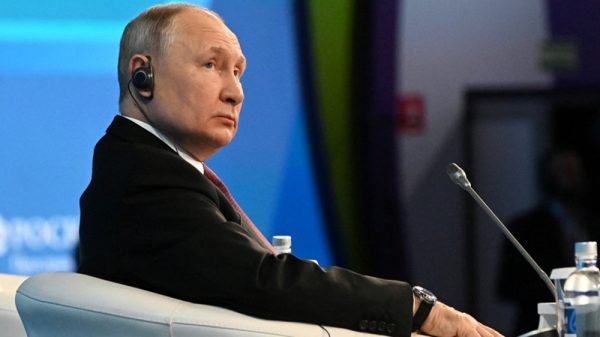
Press TV – October 11, 2023
Russian President Vladimir Putin says Moscow has always fully supported the establishment of a Palestinian state, as the Israeli regime is ceaselessly pounding the besieged Gaza Strip with barrages of missile attacks.
Speaking at the plenary session of the Russian Energy Week on Wednesday, Putin stressed that his country has always supported the implementation of the United Nations Security Council’s decision on the establishment of an independent Palestinian state.
“We have always supported the implementation of the decisions of the UN Security Council, I mean, first of all, the creation of an independent Palestinian state,” the Russian leader emphasized.
Putin’s remarks came as Israel has been launching deadly strikes on the densely-populated Gaza Strip since Saturday after the Palestinian Hamas resistance group waged a surprise attack, dubbed Operation Al-Aqsa Storm, against the usurping entity.
Hamas says that its operation came in response to Israel’s violations at al-Aqsa Mosque in occupied East al-Quds and growing settler violence.
Elsewhere in his remarks, Putin called the eruption of violence between Israel and the Palestinians a vivid example of the failure of US policy in the Middle East.
He stressed that Washington’s policy in the region has taken no account of the needs of the Palestinians as the White House tried to focus on financial assistance, rather than finding solutions to existing fundamental political challenges.
“It is unclear whether it will be possible to somehow calm the situation in the near future, but we must strive for this because the expansion of the conflict zone can lead to dire consequences,” Putin said.
The Russian president also denounced as a mistake the Washington’s move of sending a carrier strike group, which includes the USS Gerald R. Ford, closer to Israel.
“I don’t understand why the US is dragging aircraft carrier groups into the Mediterranean Sea. I don’t really understand the point. Are they going to bomb Lebanon or what? Or have they decided to try to scare someone? There are people there who are no longer afraid of anything. This is not the way to solve the problem. Compromise solutions need to be looked for. Of course, such actions are inflaming the situation,” Putin said.
More than a thousand people have been killed and thousands more have been injured in nearly five days of Israeli airstrikes on Gaza, a besieged territory on the Mediterranean which is home to some 2.3 million people despite its relatively small land area.
Decades before Snowden, this American patriot waged war against illegal surveillance in the US
In the 1970s, US Army Captain Christopher Pyle blew the lid on government agencies’ domestic spying

Former undercover agent Christopher Pyle testifies in the Senate that the Army has spied on politicians and thousands of ordinary Americans, February 24, 1971. © Bettmann Archive/Getty Images
By Robert Bridge | RT | October 11, 2023
In 1970, a US Army captain went rogue after he discovered that the military was conducting surveillance on dissidents across the country, thus sparking the first effort in modern times to tame US intelligence.
In 1968, almost half a century before the world heard the name of Edward Snowden, the former NSA contractor who blew the whistle on a US-run global surveillance system, Christopher Pyle, an Army captain who taught law at the Army’s intelligence school at Fort Holabird, Maryland, was about to do something no less memorable.
After Pyle had concluded one of his popular lectures on civil disorder, which focused on how the military could better quell riots in those highly volatile times, a military officer directly involved in such operations approached him with the request for a meeting. Several days later, Pyle was escorted into a large warehouse facility that once had been used to assemble railroad engines. In his 2006 book, No Place to Hide, Robert O’Harrow described what happened next.
“Pyle walked into the cage, where an officer showed him books containing mug shots. He looked in the first volume and saw a familiar face. It was Ralph David Abernathy, Martin Luther King’s assistant. Officers called the books the ‘black list.’”
“Outside the cage, Pyle saw more than a dozen teletype machines. The head of the CONUS [acronym for Continental United States] intelligence section told him they were spitting out reports from some fifteen hundred Army operatives about demonstrations with twenty people or more. Pyle was starting to understand how naive he’d been. He began formulating a plan. He would be getting out of the Army soon. He could tell the world about what was going on. When he joined the Army he took an oath to defend the country against all enemies, here and abroad. In his mind now, that included the Army’s intelligence operation. They turned in their security badges and left the building.”
And thus was born one of the most consequential whistleblowers of the post-World War II era.
In January 1970, Pyle, now a full-fledged private citizen, penned an article for the Washington Monthly entitled, ‘CONUS Intelligence: The Army Watches Civilian Politics.’ The explosive opening paragraph said it all: “[t]he U.S. Army has been closely watching civilian political activity within the United States. Nearly 1,000 plainclothes investigators … keep track of political protests of all kinds – from Klan rallies in North Carolina to anti-war speeches at Harvard.”
Immediately, some US media swung into action as journalists began hounding the Department of Defense and the US Army to determine the veracity of the claims. Given Pyle’s extreme proximity to the subject matter at hand, however, it soon became clear that Uncle Sam got caught with his hand in the proverbial cookie jar.
Pyle’s revelations were enough to prompt Congress, as well as a slew of litigation lawyers, to sit up and take notice. The chair of the Senate Judiciary Subcommittee on the Constitution, Senator Samuel James Ervin, a self-described “country lawyer” from North Carolina, worked together with Pyle to investigate and expose the clandestine domestic spying program.
Pyle and Ervin eventually spent countless hours delivering testimony before various congressional meetings over a span of several years. The first fruit of their labors came with passage of the Privacy Act of 1974. Signed into law by President Gerald R. Ford on December 31, 1974, the legislation states: “No agency shall disclose any record which is contained in a system of records by any means of communication to any person, or to another agency, except pursuant to a written request by, or with the prior written consent of, the individual to whom the record pertains…” In other words, although the law didn’t actually stop the US Army or intelligence agencies from infiltrating civil action groups and public demonstrations, it did hamper the feds from disclosing the identities of the activists without their foreknowledge.
To this end, Pyle served as a consultant for three Congressional committees: the Subcommittee on Constitutional Rights on the Judiciary Committee (1971-1974), the Committee on Government Operations (1974), and the Select Committee to Study Government Operations with Respect to Intelligence Activities (1975).
According to Pyle, as a result of those successful investigations, “the entire US Army Intelligence Command was abolished and all of its files were burned.” For his actions, Pyle ended up on then-President Richard Nixon’s notorious “Enemies List.”
Given the severity of their overall findings, however, the congressional investigations triggered by the US Army captain did not stop there.
1975, the ‘Year of Intelligence’
On January 27, 1975, by a vote of 82 to 4, the US Senate created the so-called Church Committee, chaired by Democrat Senator Frank Church, to further examine abuses by the Central Intelligence Agency (CIA), National Security Agency (NSA), Federal Bureau of Investigation (FBI), and the Internal Revenue Service (IRS). The House carried out its own set of investigations with the Pike Commission and the Rockefeller Commission, thereby prompting the media to label 1975 as the ‘Year of Intelligence,’ and not in a way that was flattering to the intelligence community.
Pyle lent his expertise to the ambitious Church Committee, headed by Iowa Senator Frank Church, which discovered a number of questionable, unethical and outright illegal activities by the CIA between 1959 and 1973. Detailed in a series of reports dubbed the ‘Family Jewels’, these activities included conducting physical surveillance on journalists, amassing files on nearly 10,000 Americans connected to the antiwar movement, funding behavior modification research on unwitting subjects, and plots to assassinate foreign leaders, including Cuban President Fidel Castro and DR Congolese leader Patrice Lumumba.
The most impactful discovery made by the Church Committee, however, was that of Project SHAMROCK. Started in 1940 during World War II and running into the 1970s, the NSA was given secret authority to access all incoming, outgoing, and transiting telegrams via the Western Union and its associates RCA and ITT. At the peak of Project SHAMROCK, 150,000 messages were captured and analyzed by NSA personnel in a month. The pertinent information contained in these messages was then forwarded to other intelligence agencies, including the CIA, FBI, Secret Service and the Department of Defense. This formed the basis of the so-called ‘Watch List’ of the 1970s that included thousands of American citizens, including high-ranking politicians, celebrities, academics and antiwar activists.
The findings led Senator Frank Church to conclude that Project SHAMROCK was “probably the largest government interception program affecting Americans ever undertaken.”
Based on the recommendations of the Church Committee, Congress passed the Foreign Intelligence Surveillance Act (FISA) of 1978. Under FISA, the government is required to obtain warrants to conduct electronic surveillance against individuals from a special court. Such a warrant requires “probable cause to believe” that the surveillance target is a foreign government or organization, or an agent thereof, “engaging in clandestine intelligence activities or international terrorism,” as per a Department of Justice (DOJ) clarification.
Yet, as we shall see, even this minor legislative hurdle would prove too cumbersome for the Bush administration in its war on terror.
Privacy in the age of terrorism
The tireless work of the Church Commission was put to a test in the aftermath of the September 11, 2001 terrorist attacks as US lawmakers from both sides of the political aisle were prepared to sacrifice citizens’ privacy in the name of national security. Thus, less than one week after three hijacked aircraft toppled the World Trade Center and damaged the Pentagon, killing some 3,000 people in the process, one of the most comprehensive plans for conducting surveillance on American civilians and individuals worldwide – the USA PATRIOT ACT (an acronym for ‘Uniting and Strengthening America by Providing Appropriate Tools Required to Intercept and Obstruct Terrorism Act’) – was already being disseminated to members of Congress.
Arguably the most controversial part of the Patriot Act is contained in Section 215 of the 342-page document, which calls for sweeping government powers against private and public enterprises, individuals, and personal privacy. Most crucially, Section 215 did away with the requirement that the target of the records search be a non-US citizen and “an agent of a foreign power.” American citizens were now legitimate targets as well.
In the Senate, the Patriot Act passed in a 99 – 1 vote. The only senator to vote against it was Wisconsin Democrat Russell Feingold. “There is no doubt,” he declared on the Senate floor before the historic vote, “that if we lived in a police state, it would be easier to catch terrorists…But that would not be a country in which we would want to live.”
Even with this widening of surveillance powers, then-US President George W. Bush, as part of the global ‘War on Terror’ that he declared following the events of 9/11, ordered the NSA to tap the communications of an untold number of people in the US, including citizens, without the warrants demanded by the FISA court – despite the fact that between 1979 and 2005, only four out of over 15,000 warrant requests were rejected by the FISA court.
Christopher Pyle, who was still committed to his cause over 30 years after he chose to become a whistleblower, labeled Bush “a criminal” for violating the FISA law and suggested that he should be impeached.
“The Constitution says he must take care that all laws be faithfully executed, not just the ones he likes,” Pyle said during an interview with Democracy Now in 2005. “The statute says … that the Foreign Intelligence Surveillance Act is the exclusive law governing these international intercepts, and he violated it anyway. And the law also says that any person who violates that law is guilty of a felony, punishable by up to five years in prison. By the plain meaning of the law, the President is a criminal.”
More recently, Christopher Pyle, 83, who now works as Professor Emeritus of Politics at Mount Holyoke College, spoke out on behalf of Edward Snowden, the former NSA contractor turned whistleblower who revealed a massive global intelligence program run by the so-called Five Eyes, a once-secretive intelligence alliance comprising Australia, Canada, New Zealand, the United Kingdom and the United States.
“He’s just an ordinary American,” Pyle explained in 2013. “He’s trying to start a debate in this nation over something that is critically important. He should be respected for that and taken at face value and we should move on to the big issues, including the corruption of our system that is done by massive secrecy and by massive amounts of money and politics.”
Robert Bridge is an American writer and journalist. He is the author of ‘Midnight in the American Empire,’ How Corporations and Their Political Servants are Destroying the American Dream.
Support not ‘indefinite’, White House tells Ukraine
RT | October 12, 2023
The US is running out of money for Ukraine unless Congress approves additional funding, National Security Council spokesman John Kirby told reporters on Wednesday.
“In the near term, we’ve got appropriations and authorities for both Ukraine and for Israel,” Kirby said during the daily press briefing. “But you don’t want to be trying to bake in long-term support when you’re at the end of the rope.”
“And in Ukraine, on the Ukraine funding, we’re coming near to the end of the rope,” he added. “Today we announced $200 million, and we’ll keep that aid going as long as we can, but it’s not going to be indefinite.”
Asked to define “near term,” Kirby said he could not point to a specific date, because that depended on how quickly Ukraine and Israel expended their equipment and ammunition “or what the need is and what our ability to do it is.”
On Tuesday, a Pentagon spokesperson assured reporters that the US had the ability to “continue our support both to Ukraine, Israel, and maintain our own global readiness.”
Kirby, however, admitted that the money previously appropriated for Ukraine by Congress is “not going to last forever” and that the lawmakers needed to approve more and soon.
“The sooner there’s a speaker of the House, obviously, the more comfortable we’ll all be in terms of being able to support Israel and Ukraine,” he said.
The House of Representatives has not had a speaker since last Tuesday, when Kevin McCarthy became the first-ever speaker to be ousted in a House vote, over an alleged secret deal with the White House to approve more Ukraine funding. Several Republicans led the charge against their California colleague, backed by all of the minority Democrats. Steve Scalise of Louisiana, the Republican nominee to succeed McCarthy, has been supportive of funding Ukraine in the past.
Since February 2022, when the conflict with Russia escalated, the US has channeled almost $44 billion worth of military aid to Ukraine, as well as billions more in cash, humanitarian and economic assistance.
Netanyahu wants US involved in war – ex-Pentagon official
RT | October 11, 2023
Israeli Prime Minister Benjamin Netanyahu would like Washington directly involved in the conflict with Hamas because he hopes to expand the war to Lebanon and Iran, former senior security policy analyst at the US Department of Defense, Michael Maloof, told RT on Wednesday.
On Monday, the US ordered the aircraft carrier USS Gerald R. Ford and five guided missile destroyers to the Eastern Mediterranean. According to Maloof, this “meets Netanyahu’s wildest dreams.”
“He wanted the US involved in this conflict,” the former Pentagon official told RT.
Netanyahu “wants to open up the war with Lebanon, by attacking Hezbollah” in pursuit of his ultimate objective, “to bomb Iran’s nuclear facilities,” Maloof added. For that to happen, “he has to have a Gulf of Tonkin moment, if you will.”
Maloof recalled how US President Lyndon Johnson essentially started the Vietnam War by sending ships to the Gulf of Tonkin in 1964. An alleged North Vietnamese attack on two US destroyers was then used as a pretext for direct involvement.
The US has also pledged to help Israel with deliveries of weapons and ammunition, with the Pentagon insisting it has enough to do so and continue supplying Ukraine. Maloof is skeptical of that assertion, however.
He also told RT it was “not surprising” that some of the weapons Washington had sent Kiev ended up in the hands of Hamas.
That accusation was first made by former Russian President Dmitry Medvedev. Ukraine’s military intelligence, the GUR, responded on Monday by accusing Russia of sending captured Western weapons to Hamas militants in a “false flag” operation designed to make Kiev look bad to its backers.
Israel has neither confirmed nor denied the weapons claim, but rejected the Ukrainian insinuations of Russian involvement in the Hamas attack as “complete nonsense.”
How Western media, social media influencers peddle lies to vilify Palestinians
By Shabbir Rizvi | Press TV | October 11, 2023
Since the Hamas-led Palestinian resistance operation “Al Aqsa Storm” on Saturday, mainstream Western media and social media influencers have been aggressively pushing Zionist narratives as part of a murky disinformation campaign against the resistance.
The multi-front information war is designed to control the narrative around anything surrounding the Palestinian issue and the latest military operation that has shaken the foundation of the regime.
Now more than ever, it is becoming clear that Western governments and their ruling class, which have a tight grip on media and information control, are losing the battle of ideas.
Palestinian support in the West is at an all-time high, despite Western leaders coming out in the open in defense of the Zionist regime and its relentless and indiscriminate aggression against Palestinians.
Western leaders came out in unison on Saturday to tow the same false narrative: That the Hamas operation is “unprovoked,” that the Israeli regime is “just” in its decades-long ethnic cleansing of Palestine, and that the Palestinian resistance is “terrorism.”
However, the world saw past these imperialist lies. Millions of people in the West, from New York to London to Paris, poured into the streets to pledge their support to Palestine and the Palestinian resistance, despite their own governments denouncing the Palestinian cause.
In fact, the rallies themselves began to be denounced by Western officials, who despite their aggressive rhetoric against the Palestinian cause saw no end to the outpouring of support for Al Aqsa Storm.
Now, the West and its media apparatuses have turned to their usual assortment of disinformation campaigns to muddy the line between fact and reality.
Perhaps the most egregious claim came from Zionist outlet “i24 News.” Nicole Zedeck, a reporter, falsely claimed that “40 Israeli babies” were killed, and that some were “decapitated.”
Obviously a jarring claim, many netizens pushed back asking for more details or any source that could corroborate this claim, which is part of the disinformation campaign.
Zedeck walked back the claim, saying Zionist soldiers told her this was happening – but the post, which still has not been deleted – or retracted – has been proven categorically false by media outlets.
The multiple high-profile accounts on X (formerly Twitter) shared Zedeck’s baseless claim, disseminating the proven lie to millions of people across the world.
Perhaps most frustrating of all is that while this claim of Israeli babies being killed was spread with no source or proof, very real footage of martyred Palestinian babies being pulled from the Gaza rubble was also being shared – but without the solidarity of any Western influencer accounts.
Another similar example was shared of a woman, Shani Louk, allegedly being held hostage by Hamas.
Zionist influencers claimed she was sexually assaulted and murdered. Later, the woman’s own mother confirmed she was safe and that Hamas had taken her to a hospital in the Gaza Strip – the same hospital targeted multiple times by Israeli warplanes.
This is a very intentional strategy of the Zionist regime, and the West – when their narrative is being challenged by reality itself, they will not be above spreading lies and refusing to apologize or issue a real retraction when they are caught.
The claims are instead echoed by official Zionist accounts as reality without citation, leading media outlets in the West to print the story verbatim.
Even the celebrity apparatus of the West plays a significant role in disseminating false claims – and then quietly walking them back after millions of people were exposed to flagrant lies.
Actress Jamie Lee Curtis published a photo on Instagram of terrified children looking at the sky, with a caption expressing solidarity with the Zionist State. When netizens correctly identified the children in the photo as children of Gaza, fleeing from a Zionist airstrike, she quickly deleted the photo.
The strategy of publishing lies and issuing a whimper of a retraction (if any at all) has been an imperialist strategy for decades.
The US entry into Vietnam was sparked by a false report of an attack on a US warship in the Gulf of Tonkin. The US illegal invasion of Iraq in 2003 was due to a made-up claim of weapons of mass destruction. The invasion of Afghanistan before that was also based on false assumptions.
Iran’s foreign-plotted riots were caused by a categorical lie peddled by accounts known to be on the payroll of the United States intelligence agencies – then were spread using a vast network of online bots and influencer accounts.
Western celebrities and influencers then picked up the story to smear the Islamic Republic, despite multiple witnesses and CCTV footage proving the tragic death of Mahsa Amini was of natural causes.
More recently, after a 16-year-old Iranian girl Armita Geravand fell unconscious at the Tehran subway, social media accounts and news media in the West jumped on the bandwagon, claiming “torture.”
Western media apparatus and celebrity apparatus are intertwined. They are part of a sophisticated system that is forced into place by the US ruling class and further strengthened by the Zionist lobby.
Any deviation – meaning support for Palestine – is met with categorically false claims of anti-semitism, racism, or outlandish smear campaigns.
Western outlets will never publish about the true carnage unleashed upon the people of Gaza – the women and children who were martyred.
They will never publish, for example, the video of Israeli soldiers shutting off the water to Gaza – already contaminated – despite it being a human rights violation and a war crime. The imperialist media will never document reality, because reality would condemn the West for its barbarism.
Furthermore, if the West cannot win a war of information, then it seeks to outright ban inconvenient facts altogether. Take for example the shutdown of Press TV in the United States – or the deplatforming of Russia Today or Sputnik after the February 2022 Russian military operation in Ukraine.
Lebanon’s Al-Maydeen was also briefly banned on Meta platforms for its coverage of Al Aqsa Storm. According to the network, no reason was provided for it, nor was any prior notice given.
The fact of the matter is the imperialist media does not shy away from playing dirty to ensure only its pro-imperialist outlets and narratives dominate public perception.
It understands it is in a losing battle against the truth and is aggressively conducting widespread disinformation and information stifling in a final bid to control its narratives.
An age-old saying is that in war, the first casualty is truth. The imperialist West has been imposing war on the entire globe for over a century. The truth has been “killed” in this sense many times – leading to racism, Islamophobia, and more rot within society – but it can also be salvaged.
As growing contradictions sharpen within our world, the imperialist West will intensify its disinformation campaigns. Based on what we already know about its unethical conduct, the world cannot look to the West for the truth.
The West’s truth is a false reality based on the vision created by the US ruling class and its partners, who are committed to defiling the world for their own greed.
If the West fears the narrative of the Palestinians so much then it must know that the truth is with Palestine – and that Palestine is the truth.
Israel-Hamas “war” – another excuse to shut down free speech

By Kit Knightly | OffGuardian | October 11, 2023
As a brand new war-narrative unfolds, there’s already efforts underway to parlay the conflict into tighter controls on free speech and freedom of expression, both in person and on the internet.
The headlines have been filled with nothing but Israel and Hamas since the “surprise attack” on Saturday, with the predictable back and forth of historical grievances and accusations of racism, punctuated by unsubstantiated claims of atrocities.
“Atrocity Propaganda” is nothing new. It is the opening salvo of every war as state combatants try to win the public to their side.
For example, the totally unsubstantiated claim that Hamas “threw forty Jewish babies out of their cribs and beheaded them”, which was doing the rounds yesterday. As far as atrocity propaganda goes the claim is startling in its unoriginality (Nayirah anyone?)
There’s a lot of that right now, lurid claims of graphic and pointless violence directed against the innocent, most of which survives just long enough to cause some outrage before being “debunked” or walked-back.
Part of that is the general “fog of war”, heightened by the advent of social media. When a lot of people can talk a lot more is said (good and bad).
But there’s another interpretation: That fake war stories are being intentionally seeded onto social media and then “debunked” to discredit platforms and appear to justify digital censorship.
Within the past twenty-four hours Reuters, NBC, YahooNews, The Guardian and the AP have run stories criticising the proliferation of “fake war news” on social media. Al Jazeera joined in too.
Almost all of those accusations have been directed solely at Twitter/X – increasingly the media’s anti-free speech strawman.
Governments have not been quiet on the issue either, with the European Union reportedly “warning” Elon Musk there would be “penalties” for the spread of war-related “misinformation” on his platform.
It’s not just “misinformation” either, but also “hate”. In an unusually subtle headline, NBCNews warns of the “increasingly fraught nature of online speech”. USA Today is more on the nose, claiming “online hate” is “surging”.
Oh, and there are the “unregulated” sites to worry about, where terrorists allegedly upload violent videos, at least so the New York Times says:
“Hamas Seeds Violent Videos on Sites With Little Moderation”
It’s not hard to see where this leads.
And while “misinformation” is used to justify social media censorship, “safety” is used to justify shutting down freedom of assembly.
In the UK and US pro-Palestinian rallies were met with calls for the police to get involved, citing laws that outlaw the public support of “listed terrorist organizations”.
UK Home Secretary Suella Braverman has told the police that waving a Palestinian flag could be considered a crime. Metropolitan police are engaging in “reassurance patrols”.
In France the police are already more directly involved, shutting down a pro-Palestine demonstration.
… and people applauded.
Many of them the same voices who railed against tyranny in defending the Canadian truckers or anti-lockdown protests. It is disheartening to see.
In short, the “war” is four days old and is already being used to suppress dissent on the streets and argue against free-speech on the internet.
However the war narrative evolves over there, over here it’s just more of the same.
Unfounded US accusations against Iran could escalate war in the Middle East

By Drago Bosnic | October 11, 2023
As we all know, Iran and Israel are no friends, to say the least. Both countries are regional superpowers and their relationship is what will define the future of the Middle East and possibly beyond. There are numerous proxies that both sides are using against each other and this is evident all across the troubled region. However, while some global powers are trying to ensure lasting peace between them, others keep pushing Iran and Israel into a direct confrontation. Namely, when Hamas launched its offensive against the Israeli Defense Forces (IDF), some sources were quick to blame Iran, claiming that it was directly behind the attacks. For instance, the BBC was the first to claim that Tehran was the main culprit, only to then edit the story and remove crucial parts of the accusation. Before this happened, the Wall Street Journal quoted the initial BBC report and then the unfounded claims kept spreading in the mainstream propaganda machine.
However, this doesn’t stop there, as the BBC then requoted the WSJ as a source, effectively quoting itself. Endless self-quoting is a common practice in the mainstream propaganda machine. One outlet usually publishes an unfounded claim that then gets republished by others until the targeted narrative becomes an axiom of sorts. The political West often uses these fabricated claims for geopolitical purposes, such as imposing sanctions, freezing financial assets and even launching wars of aggression around the world. And while it’s likely true that Iran has been supporting various groups that are hostile to Israel (and vice versa), there’s no evidence that it ordered Hamas to attack. Even high-ranking Israeli officials and IDF officers stated the same. And yet, the claims are still there and many in the US Congress are happy to use them as an excuse to refocus Washington DC’s attention from Russia and the Kiev regime to Iran and Israel.
Namely, members of the US Congress have been investing in war stocks. If we take into account that American policymakers are pouring their wealth into the Military Industrial Complex (MIC), what else can we expect but war? All this is being done in a very calculated manner. They tried against Russia, but realized that Moscow is just too tough of an opponent capable of taking on not just the United States, but the entire political West and winning. What’s more, according to high-ranking American generals, Russian strategic capabilities have not only been untouched, but have actually been expanded, meaning that Moscow can easily obliterate the United States and NATO at a moment’s notice. This is why Washington DC decided to choose what it sees as a more manageable target – Iran. With Russia busy in Ukraine and China concerned with Taiwan, Tehran is seemingly alone and unable to muster any support from other global powers.
However, Iran is anything but powerless. It possesses one of the world’s largest stockpiles of ballistic missiles, most of which are targeted at Israel. And while the latter has a sizable nuclear arsenal that includes at least 80-90 warheads (although some sources claim that the number is much higher and close to around 400), Iranian ballistic missiles could devastate Israeli cities, even without the use of various chemical or “dirty bomb” warheads. Israel itself has the nuclear-capable “Jericho” series of missiles, with “Jericho II” being a medium-range ballistic missile (MRBM), while “Jericho III” effectively serves as an intercontinental ballistic missile (ICBM). As basic physics suggests, the missile’s range is inversely proportional to the mass of the warhead, but even with the increase in the weight of the payload (1000 kg or more), the range of “Jericho III” drops to 5000 km, which is still more than enough to target any part of Iran.
The Israeli missile’s payload could be a single 450 kt (kiloton) nuclear warhead (weighing approximately 750 kg) or up to three lower-yield MIRV (multiple independently targetable reentry vehicle) warheads. Both options are a dreadful prospect for Iran, as these weapons could kill millions, if not tens of millions. However, as previously mentioned, Tehran is not without ways to retaliate, as its massive stockpile of MRBMs is more than enough to kill millions in Israel either way. The reason why Iran doesn’t really need nuclear weapons for such a scenario is Israel’s small territory. This is further exacerbated by the fact that most Israelis live in coastal areas, further reducing the already small territory Iran would need to target. Thus, anyone remotely sensible would want to do anything to prevent an escalation of the conflict that could potentially kill tens of millions of Israeli and Iranian civilians. However, there’s sensible and then there’s the US.
Unfortunately, we can’t have both. Washington DC warhawks are determined to push America into yet another war and the Middle East nearly always seems to be their unrelenting obsession. As per usual, uber-hawk senator Lindsey Graham, infamous for his threats to Russia and President Vladimir Putin himself, was the first in line to call for war. He didn’t even try sugarcoating anything and immediately called for the US to target Iranian oil refineries and related infrastructure, all in order to “destroy the lifeblood of the Iranian economy”. He also stated that “it is long past time for the Iranian terrorist state to pay a price for all the upheaval and destruction being sown throughout the region and world”. If we didn’t know the context, we’d probably think he’s talking about the US. Others, such as the former US ambassador to the UN Nikki Haley, also called for an escalation. In the meantime, “evil dictatorships” such as Russia and China keep calling for peace.
Drago Bosnic is an independent geopolitical and military analyst.
Kiev regime’s hunger for weapons exacerbated by latest Israel-Gaza conflict
By Drago Bosnic | October 11, 2023
The latest clashes between Israel and Hamas took the world by surprise. Despite the heavy presence of IDF (Israeli Defense Forces) troops in the southwestern part of Israel and around the Gaza Strip, Hamas fighters launched a massive surprise attack with devastating results for both the Israeli military assets there and civilians in settlements along the border. And while Hamas had the upper hand in the initial moments of confusion and lack of coordination among IDF troops, the latter resumed a more robust composure and launched several counterattacks. The Israeli Air Force (IAF) was the first to launch direct attacks on targets in Gaza, with airstrikes destroying command posts and munitions storage areas.
Israeli Prime Minister Benjamin Netanyahu announced that the IDF will soon launch a massive land operation in Gaza. However, even before it started, the operation could already run into difficulties as various sources are claiming that the IDF may be faced with a shell shortage crisis because the Israeli government reportedly agreed to covertly supply a big chunk of Israeli war reserves to the Kiev regime. And while Israeli officials have been careful not to antagonize Russia and keep denying any involvement with the Neo-Nazi junta, various reports by the mainstream media claim that Israel has agreed to transfer at least some American weapons and munitions (particularly 155 mm artillery shells) stored in Israel.
As a result, the Pentagon will now be forced to make a tough strategic decision. Either support the Kiev regime forces or the IDF. The former is much more dependent on the artillery component of its armed forces, while the latter relies primarily on air superiority. However, this is the first time since 2006 that Israel is launching a major land operation and it will need its artillery component more than ever before. Launching airstrikes on every single position held by Hamas is simply not viable, as it dispersed most of its troops all across the Gaza Strip. This is where artillery comes into play. The IDF will surely try to complete the operation as soon as possible, but it’s difficult to determine how long it could last.
If the fighting ends up becoming a stalemate, Israel will need a constant supply of artillery munitions, which isn’t a very good prospect for the Neo-Nazi junta forces. As the much-touted counteroffensive failed, the Kiev regime will soon need to go on the defense. If the Russian military decides to launch a counteroffensive of its own, the need for US-made artillery shells will be exponentially amplified, as the Neo-Nazi junta forces simply have no other way to hold their lines. Artillery duels against the Russian military became the staple of the confrontation when the frontlines stabilized in most areas of Ukraine. Moscow already had a major advantage even with this US/NATO support.
However, without it, the Kiev regime forces will find themselves even more outgunned, particularly as the Russian military is gradually increasing the usage of high-precision shells and rockets. Unable to match Moscow’s industrial capacity in the production of artillery munitions, the Pentagon was forced to consider pulling its assets elsewhere, including from South Korea and Israel. Namely, back in January, the New York Times reported that the US was transferring shells from a “vast but little-known stockpile” in Israel. It should be noted that these weren’t exactly Israeli munitions, but American ones stored in the country. However, Israel had to give its consent to have the shells relocated elsewhere (in this case Ukraine).
According to Business Insider, the Pentagon transferred more than two million 155 mm shells from its own stockpiles, but this was still only a fraction of what the Russian military was able to muster. However, even this was from old stockpiles and the production facilities were unable to match the Neo-Nazi junta’s needs. In September, the US claimed that it would produce 100,000 155 mm shells per month by 2025. For comparison, it produced 14,000 in early 2023, a far cry from what the Kiev regime needs, as it spends up to 6,000 shells per day. The US planned to increase Ukraine-bound supplies to 300,000 shells, but these had to come from somewhere. Israeli officials denied any direct involvement.
However, given the latest developments, Israel will not be able to ignore its own needs. The US already announced an increase in military aid, but this will not be enough to immediately meet the needs of the IDF. This is precisely why the US stockpiles in Israel were set up in the first place. Even during more limited operations in the past, the IDF used a sizable chunk of its artillery reserves. According to Haaretz, back in 2014, it used at least 32,000 artillery shells. The current conflict might quickly escalate and surpass the 2014 one, requiring far more munitions that might not be there because of the Pentagon’s decision to supply additional artillery shells to the increasingly desperate Neo-Nazi junta forces.
Drago Bosnic is an independent geopolitical and military analyst.
Featured Video

The Search for Truth: Charlie Kirk’s Assassination One Year Later
or go to
Aletho News Archives – Video-Images
From the Archives
The 9/11 “Double-Cross” Conspiracy Theory
BY LAURENT GUYÉNOT • UNZ REVIEW • SEPTEMBER 6, 2022
Is it true that “9/11 was an inside job”? Yes, insofar as Israel is “inside” the U.S. But for the 9/11 truthers who have identified Israel as the main perpetrators, “9/11 was an inside job” is at best a half-truth, and at worst an integral part of the Zionist operation, like a secondary flag sewn as a lining under the false flag of Islamism. Victor Thorn (1963-2017) wrote in his book 9/11 made in Israel: The Plot Against America (2011): “In essence, the ‘9-11 truth movement’ was created prior to Sept. 11, 2001 as a means of suppressing news relating to Israeli complicity. . . . The slogan ‘9-11 was an inside job’ was quite possibly the greatest example of Israeli propaganda ever devised.” In milder terms, it is “controlled opposition”.
A genuine truth movement would have pointed to Israel as the prime suspect from the start. From day one, it was obvious who would benefit. … continue
Blog Roll
 Aletho News
- Europe’s mounting social chaos… chickens coming home to roost for proxy war against Russia
- US-Russia Diesel Deal Becomes Massive Defeat for Ukraine
- Hormuz and the Looming Economic Catastrophe
- Dhubab offensive, media blitz and the rapid unraveling of Saudi-backed coalition’s new gambit
- Putin Conveys to Trump Iran’s Vision on Possible Conflict Resolution – Kremlin
- The Search for Truth: Charlie Kirk’s Assassination One Year Later
- ‘Harsh reality’: Iran says France seeks monopoly on power and intimidation, not peace for all
- When Will This White House Madness End?
- Huckabee aide goes to ‘unusual lengths’ to portray ‘Israel’ positively
- Trump Announces Diesel Supply Deal With Putin Following Phone Call
- If Americans Knew
- Israeli forces kill another child in Gaza – Daily Update
- Gaza ceasefire exists in name only, say more than 100 organizations
- Nearly 2 Million in Gaza Need Urgent Shelter Assistance as Winter Looms: IOM Chief Warns
- Suppressing Palestinian resistance: US charity under fire for AI monitoring of Gaza classrooms
- Thousands Are Held in Israeli Torture Camps. This Is What Happens Inside
- Israel puts Gaza’s sick, injured, newborn in peril – Daily Update
- Report claimed Mark Levin used by Israeli government to influence Trump
- Over 2,000 Gazans have died awaiting medical evacuation amid Israel’s continued siege
- How a U.S. Diplomat Suppressed and Altered Reports Critical of Israel
- 5 Palestinians Die from Israeli Strikes in Gaza as Relentless Attacks Continue
- No Tricks Zone
- New Study: 50 Years Of The Most Aggressive ‘Net Zero’ Policies Can Only Affect The Global Climate By 0.03°C
- US September “Heat” Was No Record…Many Records Set Decades Ago
- Latest European Green Energy Debacle; Portugal’s Largest Flagship Solar Park Insolvent!
- Green Energy Debacle: German Expert Professor Fritz Vahrenholt Warns Of Severe Economic And Social Consequences
- Two More Paleo Reconstructions Affirm Meters-Higher Sea Levels Across Ireland, Brazil 7000-6000 Years Ago
- New Study: Earth And Venus Surface Warmth Largely Explained By Convection And Lapse Rate, Not CO2 Or Radiation
- 2025 Nature Paper Claiming Worsening Global Drought Gets RETRACTED …Heavily Flawed
- New Study: ‘Global Drought Shows No Detectable Recent Acceleration Under Climate Warming’
- Economic Masterminds: German Socialists Suggest Taxing Productivity Gains Stemming From Using AI
- The South China Sea Has Not Been Cooperating With The Climate Change Narrative

